






Abstract
“Testing Tele-Savvy” was a three-arm randomized controlled trial that recruited participants from four National Institute on Aging (NIA)–funded Alzheimer’s Disease Centers with Emory University serving as the coordinating center. The enrollment process involved each center providing a list of eligible caregivers to the coordinating center to consent. Initially, the site proposed to recruit primarily African American caregivers generated a significant amount of referrals to the coordinating center, but a gap occurred in translating them into enrolled participants. To increase the enrollment rate, a “Handshake Protocol” was established, which included a warm handoff approach. During preset phone calls each week, the research site coordinator introduced potential participants to a culturally congruent co-investigator from the coordinating center who then completed the consent process. Within the first month of implementation, the team was 97% effective in meeting its goals. This protocol is an example of a successful, innovative approach to enrolling minority participants in multi-site clinical trials.
Introduction
Despite concerted efforts, racial and ethnic minority populations are continuously underrepresented in clinical research (Castillo-Mancilla et al., 2014; Spiker & Weinberg, 2009; Torres et al., 2015). Multiple barriers in the enrollment of underrepresented racial and ethnic individuals have been identified, including mistrust and skepticism of health systems, lack of awareness of clinical trials, poor access, language discordance, and ineffective communication (Disbrow et al., 2020; Erves et al., 2017; Perkins et al., 2019). Inadequate recruitment and enrollment of minority participants contributes fundamentally to the lack of representation of these groups in research which, in turn, limits the generalizability and applicability of clinical research and results validity and further exacerbates disparities (Erves et al., 2017). Participation of racial and ethnic minorities and underserved populations in clinical trials is a critical link between scientific innovation and improvements in health care delivery and health outcomes (Simon et al., 2014).
The willingness to participate in health research studies can be increased through efforts tailored to the recruitment of minority racial and ethnic groups. For instance, a diverse and multicultural team can help to build trust with participants (Fête et al., 2019). Fryer et al. (2016) stress the importance of racial concordance in research recruitment, along with the development of trust and self-reflection related to difference between researcher and participant. Additional successful strategies in the enrollment of underrepresented groups in clinical studies include engaging primary care providers, facilitating access to study sites, and providing clear information about the disease under study and eligibility criteria (Sun et al., 2017). Multi-site clinical trials face additional recruitment challenges such as unclear communication among team members at different sites and misalignment of the goals across sites (Cabral et al., 2018; Finlayson et al., 2019). Therefore, a staggering number of clinical trials fail to meet enrollment goals, which leads to delays, early trial termination, or inability to draw conclusions at trial completion due to loss of statistical power (Mahon et al., 2015).
The responsibilities of caregiving for persons living with dementia (PLwD) make it challenging to participate in research studies (Etkin et al., 2012). African American dementia caregivers provide care at a greater intensity and are more likely to be “sandwich generation” caregivers in comparison with White caregivers (AARP & National Alliance for Caregiving, 2020; Fabius et al., 2020); therefore, their time to participate in research may be limited. In this article, we present the details and results of an innovative approach, the “Handshake Protocol,” used to improve enrollment of African American caregivers in a multi-site clinical trial.
Method
Study Design
The Tele-Savvy study has been previously described (Kovaleva et al., 2018). In brief, the Tele-Savvy study is a multi-site three-arm randomized controlled trial (RCT) of an online version of the Savvy Caregiver program to enhance caregiving skills and knowledge and foster caregiving self-efficacy (mastery; Hepburn et al., 2005). The Tele-Savvy study sought to establish Tele-Savvy’s efficacy in (a) mitigating the affective impact on dementia caregivers compared with caregivers in an attention control or usual care condition, and (b) enhancing caregiver mastery. The study protocol was approved by the Institutional Review Board (#00092812) and registered with ClinicalTrials.gov (NCT03033875). The study is targeted to informal dementia adult caregivers who provided on average at least 4 hr of assistance to a community-dwelling PLwD daily.
The recruitment goal for Tele-Savvy was to enroll 270 participants (65% White, 20% African American, 15% Latino) at a rate of three participants per month throughout the project’s duration. Participants were recruited from four National Institute on Aging (NIA)–funded Alzheimer’s Disease Centers (ADCs) across the United States with Emory University serving as the coordinating center. The collaborating study sites provided access to rural, urban, and ethnically diverse populations of dementia caregivers, and the coordinating center was responsible for consenting the potentially interested participants from each site.
The Handshake Protocol
To establish trust, maintain good rapport, and increase research participation of individuals from minority racial and ethnic groups, the “Handshake Protocol” was developed. This protocol was developed by a research coordinator (J.S.P.) from one of the collaborating study sites and a co-investigator (F.E.) from the coordinating center, who are culturally congruent with each other and the targeted African American recruitment population. The “Handshake Protocol” uses a warm handoff approach that shares the responsibility between the study sites and coordinating center for enrolling research participants.
The phrase “warm handoff” was originated in customer service and is often conducted in person, between two members of a health care team, in front of the patient and/or family (Agency for Healthcare Research and Quality, 2017). This approach has been used in various settings to ensure the customer or patient is connected to someone who can properly address their needs. In health care, a warm handoff approach involves (a) one health care team member introducing another team member to the patient, (b) explaining why the other team member can better address a specific issue with the patient, and (c) emphasizing the other team member’s competence (Schottenfeld et al., 2016).
In alignment with the original warm handoff approach, the “Handshake Protocol” involved pre-scheduled phone calls with the co-investigator, site coordinator, and prospective participants based on co-investigators’ availability; this availability was provided monthly to the site’s research coordinator. Reminder notifications (phone calls or emails) were sent out a week before the scheduled call. On the day of the consent call, the research coordinator called and checked in with the potential participant and then patched the co-investigator into the call who then explained the study and engaged the participants in the informed consent process. Once verbal consent was obtained, the co-investigator addressed any immediate concerns the participant might have had and then exited the call. The coordinator then addressed any additional concerns with the participant and offered his or her availability if any further questions may arise. Figure 1 outlines the steps for the protocol.

“Handshake protocol” process.
Enrollment Outcomes
Part-time study coordinators from the Outreach, Recruitment, and Education cores of each ADC were responsible for enrolling a total of 75 caregivers at each site. The initial enrollment plan included for each study site to advertise the study and refer potentially eligible participants to the coordinating center for consenting. In the first 5 months of the study, three study sites (A, B, C) met and exceeded their target for enrollment (Figure 2). However, Site D, proposed to recruit primarily African American participants, generated a significant amount of referrals to the coordinating center, but a gap occurred in translating them into enrolled participants.

Overall study enrollment (all racial groups).
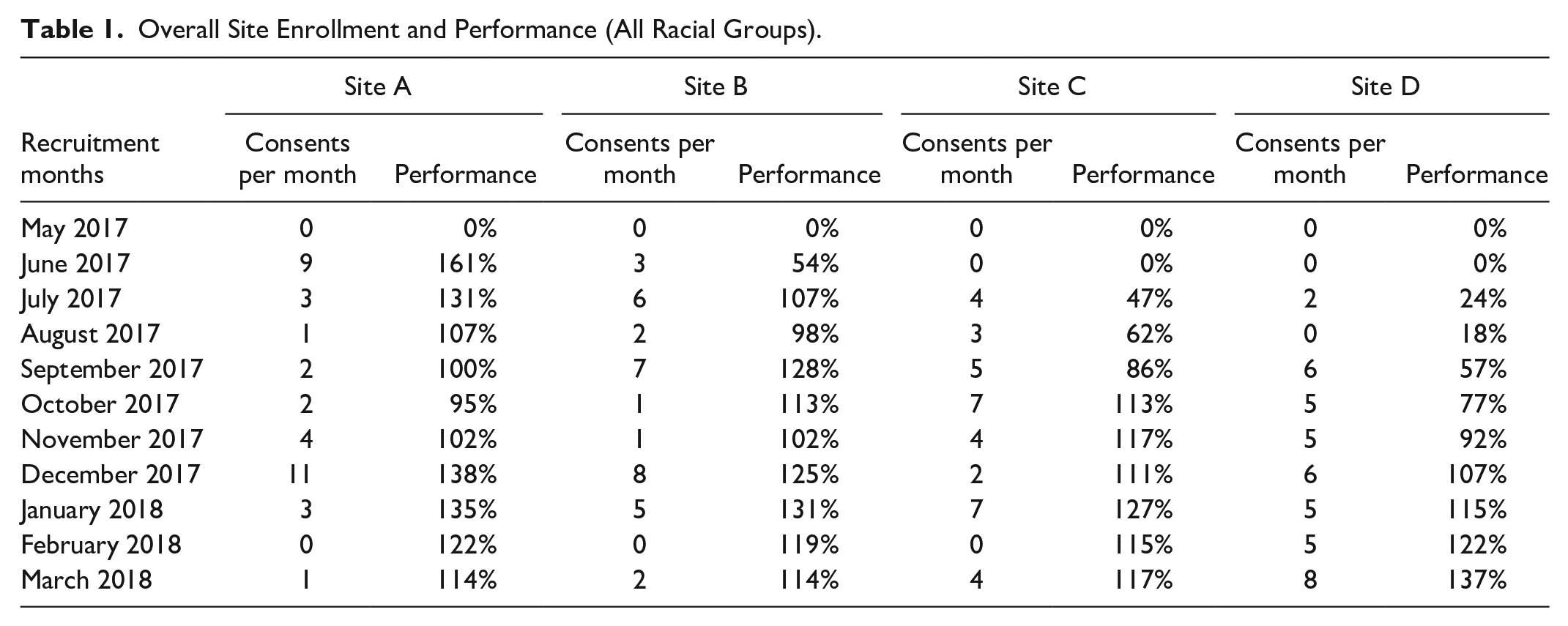
To increase enrollment of African American participants into the study, the “Handshake Protocol” was implemented in October 2017. The first month after the implementation of the “Handshake Protocol,” the team was at 92% of projected enrollment and at 107% by the second month (Table 1). Within 2 months, the team was able to close the enrollment gap among the study sites and exceeded its target enrollment (Figure 2). Enrollment continued to increase after meeting monthly projections. From October 2017 through March 2018, enrollment of referred participants from Site D increased by 525% (n = 42). This growth was significant and comparable with the enrollment from the other sites: Site A (250%, n = 21), Site B (194%, n = 17), and Site C (300%, n = 24).
Overall Site Enrollment and Performance (All Racial Groups).
The “Handshake Protocol” was maintained throughout the study, and Site D consented 86 participants over the course of the study recruitment period (22 months). Overall, study enrollment exceeded targeted goals (N = 311) with 21% (n = 65) African American participants. Latino caregivers comprised 4% (n =13) of the overall study enrollment which was primarily recruited from Sites A, B, and C (n = 10). The collaboration between Site D and the coordinating center using the “Handshake Protocol” resulted in the enrollment of majority of the African American study participants (55%, n = 36).
Discussion
Recruitment and enrollment are two significant barriers in research, particularly for historically underrepresented groups, including racial and ethnic minorities. The lack of representation of these groups in research limits the generalizability and applicability of clinical research and results (Simon et al., 2014). Successful recruitment and enrollment methods for underrepresented populations include the essential components of having effective communication tools, direct benefits for participants, racial concordance, community partnerships, and stakeholders involved in the research process (Fête et al., 2019; Huang et al., 2019; McDougall et al., 2015; Torres et al., 2015). This article reported on the “Handshake Protocol,” a successful and comprehensive enrollment approach used in a multi-site RCT to improve enrollment of African American caregivers. We believe one strength of this handoff was the racial concordance between the research personnel completing the consenting process at both sites and the targeted potential research participants. While we acknowledge that research team racial/ethnic concordance may not always be feasible, we encourage principal investigators to assemble diverse teams. A diverse team is important for building trust and becoming more engaged with racial and ethnic minority communities (Fête et al., 2019).
Our experience demonstrates the importance of creative efforts by the research team to build relationships with and show humility, honesty, and respect to the research participant (Fryer et al., 2016). In the case of the “Handshake Protocol,” the active role of the research site coordinator in building relationships with local caregivers during recruitment cannot be overemphasized. Relationship building and interpersonal skills of the research team are as critical as racial/ethnic concordance in producing good enrollment outcomes (Fryer et al., 2016; Huang et al., 2019). The research team should aim to possess a high degree of social intelligence, understand and appreciate historical context, and demonstrate an ability to utilize other qualities, such as empathy, trustworthiness, and commitment to genuinely support relationship building (Fryer et al., 2016). We were strategic in maintaining the trust established between the research site coordinator and caregiver by engaging the coordinator in the entire consenting process. Ongoing communication (i.e., emails and phone calls) between the research coordinator at Site D and the co-investigator from coordinating center likely also contributed to successful enrollment of participants.
Implementing the “Handshake Protocol” resulted in improved consent rates for the study and contributed to the achievement of planned enrollment of African American caregivers in the study. Specifically, the collaboration between Site D and the coordinating center resulted in greater than 500% increase in enrollment. Site D’s focus on enrolling minority caregivers also appeared to be successful as this was the site from which most African Americans were recruited. These outcomes are encouraging because they affirm the importance of deploying comprehensive enrollment strategies to address the disparity in research participation among minorities. Researchers can benefit from broadening their current recruitment and enrollment strategies by developing or using innovative strategies like the “Handshake Protocol” to enroll participants into research studies.
Challenges and Limitations
While the warm handoff approach adopted for the “Handshake Protocol” was an effective and successful enrollment strategy, it is time-consuming upfront. In this study, not all the participants who consented were assigned to a cohort due to caregivers’ conflicting schedules and changes in the status or living arrangements of the family members under their care. Also, there was only one co-investigator at the coordinating center who participated in the consent process using the “Handshake Protocol” with Site D; therefore, implementation of this strategy was constrained to the investigator’s schedule. In addition, the “Handshake Protocol” was not applied in this study to support the recruitment of Latino caregivers, and further work is necessary to modify the approach for success with this particular ethnic group.
Conclusion
For multi-site clinical trials, enrollment strategies may vary at each site, but the overall goal is to promote successful study participation (Santos et al., 2017). Researching within populations which do not readily participate in research can be challenging, but this challenge can be mitigated by incorporating strategies like the “Handshake Protocol.” When implemented, such strategies may help increase trial participation among underrepresented populations. Strategies shared in this article will assist researchers in identifying and addressing challenges related to enrollment of diverse groups of participants into clinical trials.
Footnotes
Acknowledgements
The authors are grateful to the Tele-Savvy research team and would like to acknowledge the research coordinators at each study site for their assistance in recruitment.
Authors’ Note
The content is solely the responsibility of the authors and does not necessarily represent the official views of the National Institutes of Health (NIH).
Declaration of Conflicting Interests
The author(s) declared no potential conflicts of interest with respect to the research, authorship, and/or publication of this article.
Funding
The author(s) disclosed receipt of the following financial support for the research, authorship, and/or publication of this article: This multi-site clinical trial is funded by the National Institute on Aging (NIA), a division of the National Institutes of Health (NIH), under Award Number R01 AG054079 (K.H.). The NIA also funded the Alzheimer’s Disease Centers that participated in this trial: 2P50 AG025688, Emory University; P30 AG101061, Rush University; P30 AG13854, Northwestern University Feinberg School of Medicine; and P30 AG008017, Oregon Health & Science University. The authors would also like to acknowledge this work resulted from the development plan and activities of the primary author’s career development award through NIA (K23AG065452).
Ethical Approval
Research was approved by the Emory University Institutional Review Board (IRB Approval No. 00092812).
