






Abstract
Senior centers must re-envision their programs to appeal to today’s increasingly older and more diverse older adults. Using a purposeful aging framework, this study aims to inform senior center programming by capturing diverse older adults’ perspectives on future goals, perceptions of aging, attitudes about senior centers, and experience with technology. Participants age 70 and older (N = 64) joined one of eight focus groups organized by race/ethnicity and preferred spoken language. Transcripts were coded using a grounded theory approach to identify perspectives in each domain. Across groups, shared perspectives included aspirations to make a difference, maintain health and independence, continue learning, and embrace positive perceptions of aging. However, both positive and negative attitudes about participating in senior centers and the effects of technology were presented. We discuss how to redesign senior center programming to meet members’ proactive approach to aging and future goals, and facilitate more confidence with new technology.
Keywords
Introduction
The mission of senior centers is to help older adults stay healthy and live independently in the community by offering a variety of fundamental services and programs. While recognized as important community resources to support aging in place and reduce health and social inequality (Turner, 2004), a common criticism is that programs and services have not kept pace with changing consumer demographics, preferences, and sociocultural shifts (Fitzpatrick & McCabe, 2008).
The relative lack of focus on diversity has a historical context. When senior centers gained national prominence in the 1960s, 92% of Americans aged 65 and older were white (US Census Bureau, 1974). Today, just 77% of older Americans are non-Latino white. By 2050, this number is projected to drop to 58% whereas older Latinos will double from 9% to 20% (Vincent & Velkof, 2010). Americans are also living nearly a decade longer today, on average, than in 1965 (World Bank, 2019), driving more attention to how to improve the quality of these additional years.
Demographic changes require that aging services providers make significant efforts to reach underserved groups (Pardasani, 2004). Senior centers may attract diverse older adults through programs that enhance members’ sense of purpose which is been linked to multiple health and well-being outcomes (Lewis et al., 2017; Windsor et al., 2015). But providing purposeful opportunities for minority older adults can be challenging in regions that feature a blend of many different cultures. Los Angeles (LA) County, California, where this study takes place, has been “majority-minority” for longer than 20 years. More than a quarter of older residents (ages 65+) are Hispanic/Latino, 18% are Asian/Pacific Islander, and 9% are black. Half of residents age 50 and older are foreign born (Edward & Roybal Institute on Aging, 2015).
To better serve the region’s aging population, the City and County of LA launched the Purposeful Aging in Los Angeles (PALA) initiative, aiming to improve quality of and access to resources that would enhance residents’ sense of purpose. Capitalizing on the existing infrastructure of LA’s senior centers is an integral part of the PALA initiative. Together, LA City and County surveyed a representative sample of local residents to understand their needs and knowledge about existing services to inform local policy and a plan for creating the most age-friendly community in the world (see Villa et al., 2018).
To complement survey findings, this study uses focus group interviews with older adults from a range of race and ethnic backgrounds to pinpoint priorities for LA and other urban communities as they work to promote purposeful aging. Focus group participants shared their views on (a) future goals and aspirations, (b) growing older, (c) senior centers, and (d) technology use. These topics were chosen because they have been linked to purposeful aging and may inform areas for senior centers to enhance services. We use these findings to suggest solutions for how senior centers may better engage diverse older adults.
Senior Centers as Venues for Enhancing Purposeful Aging
According to the activity theory of aging, staying engaged in, rather than withdrawing from, social roles is critical for health and well-being (Havighurst, 1961). This classic view aligns with more contemporary lifespan development research that demonstrates the importance of pursuing activities that are emotionally meaningful in late life (Carstensen, 2006). We argue that senior centers can facilitate sustained engagement with existing social roles and expansion into new meaningful roles by offering programs and opportunities that promote sense of purpose. Specifically, senior centers can begin with helping older adults pursue their personal goals, embrace the aging process, and stay socially connected using technology. Understanding how diverse cultural backgrounds influence preferences among potential members is a critical first step.
Fulfilling Goals
Life-span development research documents that as people age, they increasingly value goals and activities that they find personally meaningful and enjoyable (Carstensen, 2006), though research focusing on ethnic minorities and immigrants is limited. Pursuing personally relevant goals, rather than goals set by others, is critical. We posit that while senior centers have offered a variety of programs and services to meet members’ essential needs, like nutrition and socialization, the lack of programs that offer the pursuit of meaningful goals may reduce their appeal.
Reframing Aging
Negative age stereotypes and internalized ageism, such as the belief that older adults are frail and senile, have harmful consequences for health (e.g., Levy et al., 2020). These negative attitudes also transfer to perceptions of senior centers. Lund and Engelsrud (2008), for example, found that senior center members were sensitive that their eligibility for membership signaled “being old.” Similarly, Torres and Cao (2019) found that some older adults did not want to socialize in age-segregated spaces. This stigma discourages participation and contributes to age creep at many senior centers (MaloneBeach & Langeland, 2011). Service providers are aware of the role that senior centers can play at disrupting age stereotypes (Colagrossi, 2018). Indeed, research shows there is a link between engaging in physical and social activity programs at senior centers and feeling young, particularly among racial/ethnic minorities (Choi et al., 2020). Little research has explored how attitudes toward senior centers may vary by race/ethnicity and what specific negative attitudes senior centers should focus on reframing.
Acquiring Technological Skills
In today’s society, technological skills and quality of life are intertwined. Older adults’ positive attitudes toward technology, for example, are related to purpose in life (Zambianchi & Carelli, 2018). The rise of social media and smartphones has revolutionized how people connect and share information, however only 62% of 70–79 yr. olds own smartphones (Kakulla, 2020). Lack of access to internet-enabled devices is linked to lower autonomy (Schlomann et al., 2020). Senior centers offer a safe and communal environment to engage in technology learning (Arthanat, 2019), and may help combat digital disparities by providing members with access to technology. Researchers have noted, however, that some minority group members, and particularly immigrants, shy away from free training (Jung et al., 2010). More research is needed to understand the ways in which diverse older adults prefer to engage with technology to identify how senior centers can facilitate a positive learning environment.
Study Purpose
This focus group study aims to understand shared and divergent perspectives on goals and aspirations among older adults from different race and ethnic backgrounds to inform contemporary senior center programming for purposeful aging. We invited participants to discuss activities that they aspire to continue spending time on and new goals that they seek to accomplish as they age. To offer insights into how senior centers might counter ageism, we also explored how diverse older adults view their own aging and their perceptions of senior centers. Finally, we invited participants to discuss daily technology use and their views on digital devices to identify opportunities for senior centers to foster digital literacy and engagement.
Method
Participants and Recruitment
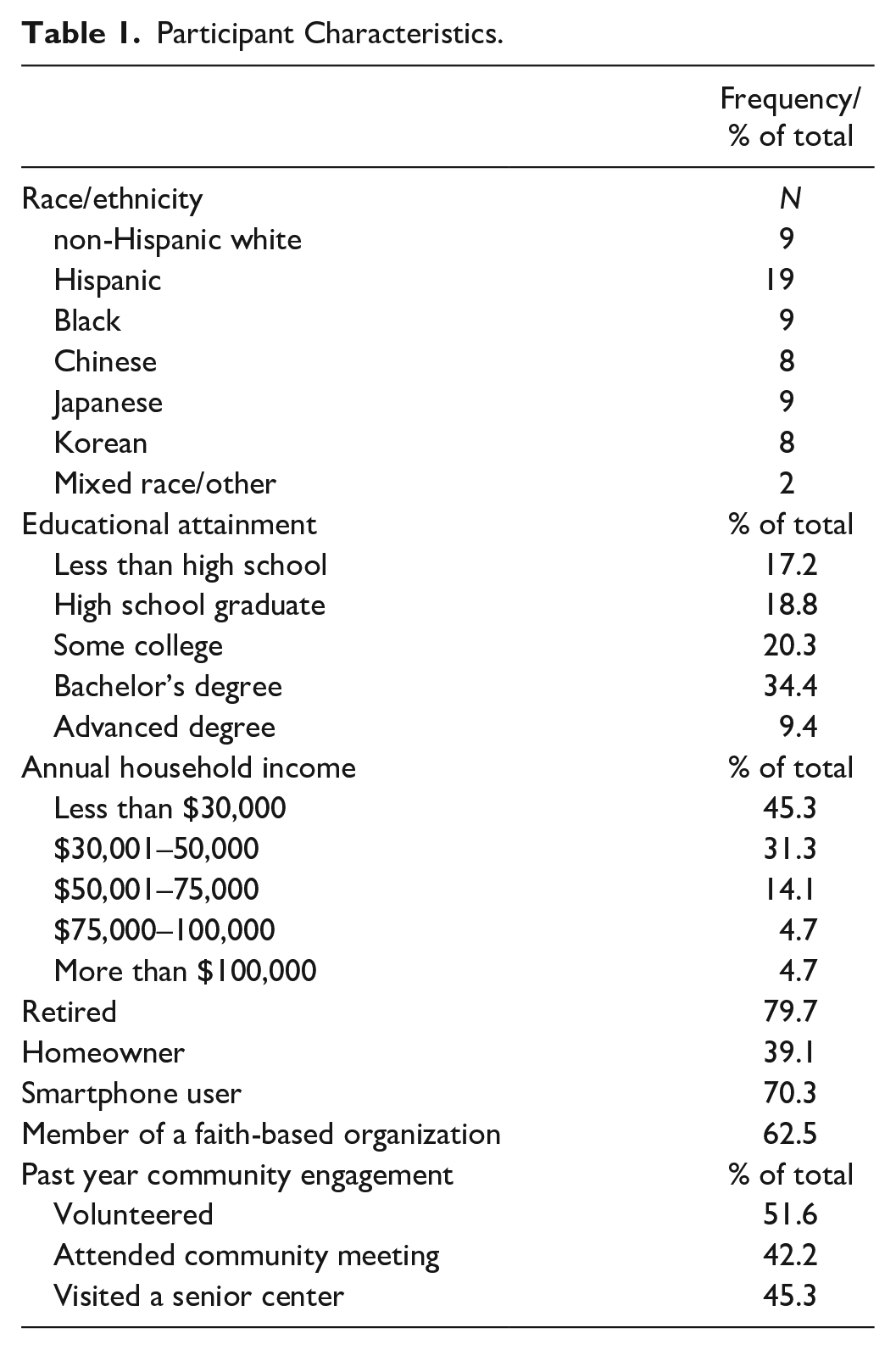
Sixty-four community-dwelling adults aged 70 and older were recruited from the LA area to participate in one of eight focus groups organized by race/ethnicity and preferred spoken language (in parentheses): Japanese (Japanese), Korean (Korean), Chinese (Mandarin), Latino (Spanish), Latino (English), black (English), non-Latino white (English), and combined race/ethnicity (English). Each group included 7 to 12 participants (Mdn = 9). The age criterion was selected because the average senior center member is age 75 (National Center on Aging, 2015). To be eligible, participants had to be born before 1949, pass an articulation test, and declare that they had no impediments that would interfere with their ability to fully participate in a focus group.
Procedure
The English version of the study protocol (#46442) was reviewed and deemed exempt by Stanford University Institutional Review Board. The moderator’s guide and written consent forms were translated to Spanish, Korean, Japanese, and Mandarin. Participants read and signed a consent form prior to participating and received an incentive between $125 and $175 depending on the time of the interview.
Focus groups were held in July 2018 and lasted 90 minutes. Non-Latino white, black, and combined race/ethnicity focus groups were conducted in English and were moderated by a study author and a member of the research staff. All other focus groups were held at a professional focus group facility and were led by experienced foreign language moderators. Interpreters in the observation room simultaneously translated foreign language discussions to English. All discussions were audio-recorded.
Data Analysis
Interviews were transcribed verbatim and reviewed by a study author present at all focus groups. Using a grounded theory approach (Strauss & Corbin, 1994) involving an inductive and iterative process of systematic review and continuous comparison of statements across and within focus groups (Braun & Clarke, 2006; Ragin, 1987), the study authors independently read the transcripts and created a preliminary code list based on the key areas of inquiry. Codes with similar meanings were consolidated into broader thematic categories to create a final coding scheme. Beginning with this new list of codes and clean (unprocessed) transcripts, the authors independently recoded one transcript at a time. They reconciled discrepancies in coding assignment during four consensus meetings and assigned final codes. After four transcripts were independently coded, discussed, and the coding scheme finalized, an acceptable inter-rater agreement was reached (i.e., 80%) on the fourth transcript. The remaining four transcripts were divided and coded independently.
Consistent themes were as follows: activity participation, social engagement, spirituality, time perception, goals and aspirations, barriers and concerns, technology use, views of aging, and perceptions of senior centers. As per study aims, we focused on findings related to goals and aspirations, attitudes toward and use of technology, views of aging, and perceptions of senior centers; and whether these concepts were expressed differently across race/ethnic groups.
Results
Table 1 presents participant characteristics collected during recruitment screening. Most (91%) were low and middle income—$75,000 or less in annual household income—and 39% owned homes. Sixty-four percent attended at least some college. Eighty percent were retired, 65% were members of a faith-based community, 52% volunteered, and 45% visited senior centers at least a few times per year. In Table 2, we present frequency counts of each emergent theme discussed by each group, comparing the relative salience (number of mentions) of subcategories within these themes. In the following section, we provide narrative examples to showcase participants’ perspectives. Given that older adults tend to experience mixed emotions (Ersner-Hershfield et al., 2008), our analysis identified positive and negative emotional sentiments (see also McLean & Breen, 2009), as well as the coexistence of positive and negative attitudes (mixed/ambivalent perceptions). Based on frequency counts, we calculate the relative percentage of positive and negative/ambivalent sentiments regarding technology use, views of aging, and senior centers.
Participant Characteristics.
Frequency of Mentions of Key Attitudes, Values, and Preferences by Focus Group.
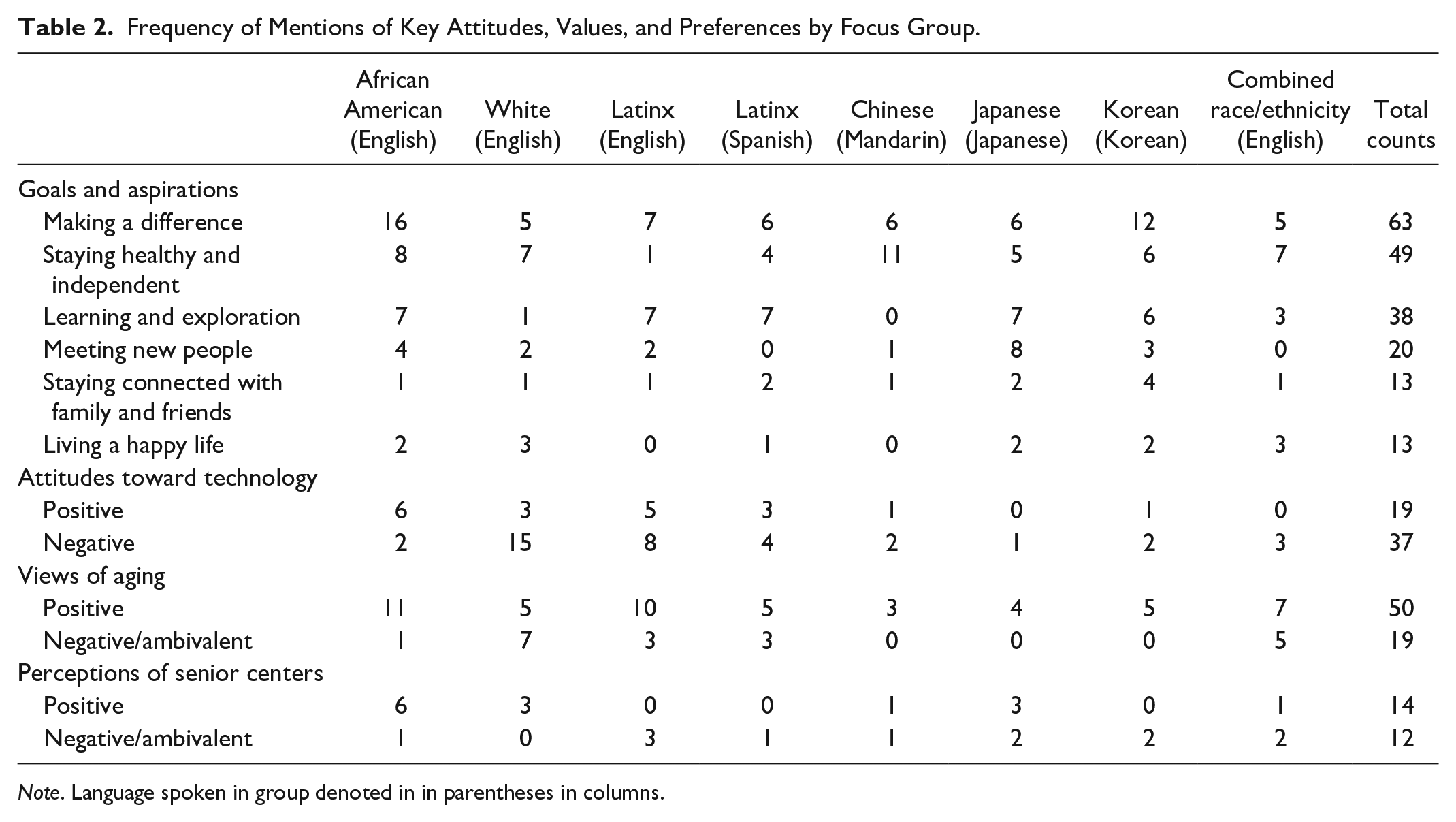
Note. Language spoken in group denoted in in parentheses in columns.
Future Goals and Aspirations
Six shared subcategories of goals and aspirations emerged: making a difference (32.1% of total goals and aspirations mentioned across all groups), staying healthy and independent (25.1%), learning and exploration (19.4%), meeting new people (10.2%), staying connected with family and friends (6.6%), and living a happy life (6.6%). Making a difference refers to actions that improve the lives of others and/or contribute to the greater good. For example, one black participant stated, “This is the main thing to me in life now. It’s important, and maybe even to my detriment, to make a difference in the world,” Another said, Mostly, it seems to come back to helping people. So, you know, I care about the young people . . . the ones that are twenty and younger, that age group from fifteen to twenty-one, I really care about them.
A participant in the Korean group indicated, “I want to help seniors out, senior people who’s having financial difficulties, I want to help them out.” Specific examples included teaching young people leadership skills, providing rides to seniors, volunteering in classrooms, and addressing homelessness. Korean, Japanese, and black participants also described how they want to help people within their communities, such as providing interpretation services for immigrants and mentoring young adults.
While making a difference had the highest number of mentions overall, staying healthy and independent was the most salient goal for most groups. Health was described as fundamental for pursuing other ambitions in life and was typically mentioned in tandem with maintaining independence. A participant in the Chinese group stated, “And the first thing, of course, is to have good health. I think good health is when you can take care of yourself, you can reduce the burden on other people.” When asked what is important to her, another black participant said, “Being able to function every day. To do the things that I like doing, and to be as independent as I can.” Participants across groups were concerned about becoming a burden and elaborated the many activities they do to stay fit: yoga, walking, and eating healthy foods, among others.
Learning and exploration was also highlighted across groups, especially the Latino focus groups. A participant stated, “I want to continue learning; reaching out for more knowledge. I don’t want to die dumb . . . If I am not learning something, I am wasting my time.” Learning goals, such as photography, writing, attending lectures, and visiting museums, varied more by participants’ personal interests than by their race or ethnicity, although one cultural difference did emerge. Chinese participants tended to describe more satisfaction with routine pleasures, such as playing mahjong and tidying the household. This group talked relatively little about learning and exploration. It is important to note that this was the only group comprised entirely of immigrants, and all lived with their adult children.
Technology Use
The majority of participants (70%) had access to smartphones with broadband access but shared mixed feelings about modern technology. Positive opinions were shared; a black participant said, “I love technology, I think the smartphone is the most wonderful thing since sliced bread. I would die without it,” but two thirds of the sentiments (66.1%) were negative. Older adults in the English- and Spanish-speaking groups in particular shared their frustration with learning new applications, concerns about younger generations’ addiction to smartphones and social media, complaints that technology complicates life, and fears about identity theft and financial fraud. Participants nodded in agreement that staying “up-to-date with technology” feels overwhelming.
In more than half of the groups, participants were concerned about technology’s effects on younger generations. Expressions of generational discord surfaced. A white participant stated: “When I see people on a date in a restaurant, young, and they’re sitting there, each of them texting somebody else. I’m saying, ‘What exactly are they doing together?’ I feel like we’re losing personal contact.” Asian participants shared relatively few ambivalent comments on technology.
Although more negative than positive sentiments emerged, participants mentioned the ways they engage with technology a total of 110 times across groups. Uses included online transactions (e.g., shopping, banking, booking trips), text messaging, entertainment (e.g., playing games, listening to music, reading the news), and sharing experiences with others (e.g., sending photos, posting on social media). Despite concerns and sometimes feeling overwhelmed, many participants wished to gain proficiency with applications, such as photo editing and sharing.
Views of Aging
The majority of sentiments voiced about aging were positive (83.3%). Participants largely embraced this period of development and expressed gratitude: “I like being in my 70s. I waited my lifetime to get here. I don’t want to go back to being 50. I enjoyed 50 and I enjoy 70 also” (white male). Some elaborated the benefits of being older, such as having more knowledge and experience. A participant from the English-speaking Latino group said, “I find myself with a degree of wisdom that I’m enjoying, because I’m so glad that I’ve reached this age range.” A black participant reacted to a prompt “70 is the new 50” by commenting, Because, it’s like since I’ve gotten a few years older, and I definitely have more time that I’ve got left in front of me . . . it’s kind of a desire to . . . man, you know, want to be the best me I could be.
Although less frequent, some shared negative perceptions of aging such as losing purpose in life. A white participant stated, . . . we raised our family and now what about us? Where do we go? What are we doing to fill our lives? When we were raising our children we said, “Oh, once they get out of the house, I’m going to do this.” And now we’re like, “Now what?”
Another participant in the Korean group questioned, “ . . . what good is living a long life when you really don’t have a happy life? A meaningful life, right?” These statements underscore finding meaning and purpose for well-being in later life.
Compared to Latinos and black participants, the non-Latino white and combined race participants expressed relatively more mixed sentiments about aging. Observations about the aging process and physical appearance were mentioned. For example, a participant shared that before age 80, she felt young, but about the present moment, she stated, “I’m getting a little old. Who’s that person over there in the mirror? Oh, that’s me. Ew, do I look like that?”
Perceptions of Senior Centers
Both positive (54%) and negative sentiments (46%) about senior centers were shared. Forty-five percent of participants went to senior centers for programs such as meals, fitness, card games, and field trips. These participants noted their appreciation for senior centers as places to gather. One black participant enthusiastically said to another, “When you said you were thinking about joining a senior center, I think that’s the best thing I’ve done since I retired.”
Concerns about the quality of programs were sometimes mentioned. A participant in the Japanese group said, I go to the many centers but the lectures they provide [are] a very low level. It’s almost for the senile people. I don’t really want to go to unsophisticated meeting, I want to go somewhere that I can hear something very challenging.
Overall, complaints about senior centers focused on bland meal options and lack of program offerings. Some nonmembers voiced stereotypes about who belongs at senior centers. A Spanish-speaking Latino participant suggested that senior centers were places for those who have no family support: “I recommend it to people that are alone because they don’t have these bigger families, or maybe they are a widow.” Others, however, shared that senior centers provide an important source of social engagement, for example, “I see a comradery of interaction that they have with each other, things to do, activities. That’s my sense. I don’t look at it negatively” (English-speaking Latino) and, “The community center gives [us] opportunity to be active. It’s very good” (Japanese participant).
Discussion
Starting with the theoretical premise that continued social role participation is key to successful aging (Havighurst, 1961), this study focuses on identifying ways to reimagine senior centers to help diverse older adults age with a sense of purpose. We use a focus group approach to learn what might draw members from different race and ethnic backgrounds to participate beyond meals, fitness, and social activities. In contrast to survey methods, focus groups encourage interaction, reflection, and deeper insights, and also allow ambivalent feelings to surface.
Balancing Programs that Facilitate Goal Fulfillment and Health and Independence
Our findings suggest that making a difference is a core component of older adults’ future goals and aspirations, regardless of cultural background and primary spoken language. This speaks directly to older adults’ striving for meaning and purpose in life. This qualitative finding is consistent with a survey of adults in their 50s that found that the majority planned to increase civic engagement during retirement (MaloneBeach & Langeland, 2011), and with research that indicates high levels of intrinsic altruism among older adults (Mayr & Freund, 2020), and that giving to others enhances feelings of mattering (Piliavin & Siegl, 2007).
Findings suggest that senior centers seeking to attract diverse members can offer service and leadership opportunities. These may include member-directed roles and responsibilities within the center—teaching classes and serving on leadership committees—and/or or matching members to causes in the community that complement their interests and skills. Our participants were motivated to serve underprivileged youth and frail seniors in their communities. To facilitate civic engagement, senior centers may connect older adults with organizations such as Senior Corps which has programs to become a foster grandparent or a senior companion (Tan et al., 2016). Research also suggests that mobility is an important factor in volunteering (Tang, 2006). By providing transportation to volunteer sites, centers can address this common barrier to civic engagement. Further research is needed to identify how to incorporate service and leadership positions into core programming and infrastructure to help community organizations promote volunteer opportunities within senior centers.
Addressing Concerns About Technology
In today’s digital era, use of technology is an integral part of staying socially engaged. Technology can empower older adults and foster greater autonomy (Delello & McWhorter, 2017). Hill et al. (2015) found that older adults who had little experience with digital devices tended to view that technology intensifies the feeling of being left behind and that it is harmful to young adult development. Our study adds nuance to that finding. Despite familiarity with and reliance on technology, many of our participants expressed anxiety about learning new applications and concern about its negative social influences on younger generations. Some research documents the risks and benefits associated with social media use. Among adolescents, risks include cyberbullying, depression, anxiety, and poorer school performance (Keles et al., 2020); however, social media engagement among older adults is related to higher social satisfaction (Bell et al., 2013) and health literacy (Tennant et al., 2015).
We suggest that senior centers take a proactive role by adding technology learning programs that develop skills, enhance confidence, and provide a social space for exchanging ideas and discussing concerns (see also Lee & Coughlin, 2015). Bringing young volunteers into the senior center to participate in and/or lead the training could be a fruitful and affordable approach. Leedahl et al. (2019) found heightened interest in technology among older adults and reduced negative age attitudes among young adults following an intergenerational mentoring program where college students helped older adults learn new technology. This echoes the experience of some of our participants who appreciated receiving help from their grandchildren and suggested that young people be available at senior centers to coach and to troubleshoot.
Recognizing Diverse Needs and Preferences
We found that language is a barrier to volunteering among immigrant older adults. Chinese participants specifically shared their struggles becoming civically engaged in their new communities. To be inclusive, senior centers should hire multilingual staff or appoint “ambassadors” (multilingual members who are connected to the broader community), to act as liaisons between non-English speaking members and the causes they care about. For senior centers with limited resources, collaborating with local agencies that serve immigrant populations may help bridge members to community organizations that need native speakers (see also Fukui & Menjívar, 2015). These partnerships would also help promote the senior center among older adults who are served by the agency.
There were also group differences in the relative salience of future goals and aspirations by race/ethnicity. Notably, participants in the non-Latino white, Chinese, and combined race/ethnicity groups emphasized health and independence as their top priorities. Although this study focuses on potential innovative programs beyond those who meet basic needs, this finding suggests that health-related services remain important. Pardasani and Thompson (2012) describe how “Wellness Centers” are an increasingly popular senior center model. Participants across groups described their ideal community center as a space with full athletic facilities—pool, weight room, basketball court, sauna, and dance/yoga studio. To attract members who prioritize health, senior centers may partner with local recreation centers and gyms to add fitness offerings to their rosters while keeping facility costs low. The success of the Southeast Seattle Senior Physical Activity Network, for example, provides insight into how this approach might work (Cheadle et al., 2010).
Another observed difference was that black and Latino participants were mostly avid smartphone users, consistent with survey research (Perrin & Turner, 2019). They expressed favorable attitudes and were comfortable with smartphones and the internet in general. In contrast, non-Latino white participants mentioned more alternatives to technology for obtaining information, such as libraries and the Eldercare Locator, relative to other groups where 0 to 1 alternatives were mentioned in each group. One explanation for the more positive appraisals among immigrant and non-white participants is their more frequent interaction with younger family members. Children and grandchildren were mentioned as sources of technology support. Social support, or the lack thereof, likely plays a role in the extent to which older adults use technology in daily life.
Addressing Stigma around Senior Centers to Reflect Positive Views of Aging
Our participants predominantly expressed optimistic views about growing older, consistent with prior research (Chopik & Giasson, 2017), but mixed attitudes about senior centers. This aligns with Lund and Engelsrud (2008) finding that some older adults want to distance themselves from negative labels associated with senior centers (see also Pardasani & Berkman, 2020). Descriptions that senior centers have a “stifling, stodgy, old age-vibe” (Hannon, 2015) discourages participation. The contrasting perspectives between positive views of one’s own aging and mixed feelings about senior centers suggest that centers need to catch up with older adults’ progressive views on growing old. Incorporating purposeful aging programming and contemporary design features may help senior centers counteract negative stereotypes. Pardasani and Thompson (2012), for example, reported that embracing innovative models and avoiding the “senior center” label helps disrupt age stereotypes. Adopting a lifelong learning/arts model may appeal to members, but to be accessible to non-English speakers and reflect diverse interests, this and other contemporary models must have staff representation from immigrant communities and include immigrants in programming decisions. More research is needed to identify features of modern designs that help senior centers rebrand as attractive venues for older adults who want to contribute.
Limitations and Future Directions
Our focus on purposeful aging is not intended to minimize the importance of fundamental services that senior centers provide (see Casteel et al., 2013), but rather to inspire designs that attract and serve a variety of older adults. Grounded in the literature of diversity science (e.g., Fukui & Menjívar, 2015; Pardasani, 2004), this study begins with the assumption that older adults from different race and ethnic backgrounds likely differ in their interests, goals, and experiences, and that these differences influence their participation in senior centers.
Focus groups suggest that differences in perspectives were more predominant between individuals than between race/ethnic groups. Given the small sample size of each group, observed trends might be attributed to random selection effects or different facilitators leading the groups. Slight differences in translation and participants’ culture-specific interpretations of the questions could yield different perspectives. Future research may take a mixed-methods approach and include participants living in rural areas.
Conclusion
Senior centers serve countless older adults, yet considerable changes in demographic diversity, technology, and a focus on quality of life require that centers update programming to facilitate purposeful aging in the 21st century. Findings suggest that senior centers may consider helping older adults pursue altruistic goals and adopt new technology. Programming should counter ageist stereotypes to reflect the positive self-perceptions of aging embraced by most older people. Substantive change in senior centers will require funding, advocacy, and sustained engagement from communities, but these are worthwhile investments to promote quality of life among a growing population of diverse older adults.
Footnotes
Declaration of Conflicting Interests
The author(s) declared no potential conflicts of interest with respect to the research, authorship, and/or publication of this article.
Funding
The author(s) disclosed receipt of the following financial support for the research, authorship, and/or publication of this article: This study was supported by a grant from the Annenberg Foundation awarded to the Stanford Center on Longevity.
