







Abstract
This study examined the relationship between the behavioral activation system (BAS) and fall risk awareness among Korean older adults, focusing on the mediating roles of optimistic bias and risk-taking. Data from 280 participants aged 60–84 were collected via an online survey. Using PROCESS Macro 3.5 Model 6, results showed that BAS positively correlated with optimistic bias, risk-taking, and fall risk awareness. However, optimistic bias and risk-taking were not directly correlated with fall risk awareness. A double mediation effect was observed, where optimistic bias and risk-taking sequentially mediated the BAS-fall risk awareness link. While BAS generally increased fall risk awareness, its influence became negative when mediated through optimistic bias and risk-taking. These findings suggest BAS affects fall risk awareness in complex ways, sometimes leading to lower awareness due to overconfidence and risk-taking behaviors.
• This study establishes a significant relationship between the behavioral activation system (BAS) and fall risk awareness in older adults, highlighting the role of personality traits in risk perception. • Optimistic bias and risk-taking were identified as negative mediators that reduce fall risk awareness, even in individuals with high BAS. • The findings extend previous research by demonstrating that addressing cognitive biases and behavioral tendencies can enhance fall prevention strategies in older adults.
• Clinical interventions should focus on reducing optimistic bias and risk-taking tendencies in older adults with high BAS to improve fall risk awareness. • Fall prevention programs can be tailored to incorporate psychological and personality-based approaches, ensuring a more personalized and effective strategy. • Future research should explore additional mediators that positively influence BAS to develop comprehensive interventions that enhance fall prevention efforts among older adults.What this paper adds
Applications of study findings
Background
Frequently occurring in old age, falls are preventable but pose a serious threat to the health and well-being of older adults, potentially leading to other diseases and even death (Hauer et al., 2006; Kakara et al., 2023). One in three older adults and over 50% of those aged over 80 years experience a fall at least once a year (Shumway-Cook et al., 2009). In older adults, even minor falls can lead to hip fractures, which may ultimately result in death (Vaishya & Vaish, 2020). Even after treating hip fractures caused by falls, the probability of death within one year remains high (Wu et al., 2016). Prolonged bed rest or immobility following a fall can lead to secondary complications, such as pressure ulcers, respiratory diseases, and urinary disorders (Vaishya & Vaish, 2020). Thus, falls can significantly threaten the quality of life of older adults.
The causes of falls can be categorized into intrinsic factors, such as specific diseases or sensory impairments, and extrinsic ones related to the environment where falls may occur; controlling these factors is an effective way to mitigate falls (Ashari et al., 2021; de Clercq et al., 2020). Intrinsic factors also include impaired balance, paralysis, visual impairments, reduced visuoperceptual response speed, medication side effects, cognitive impairments, and cardiovascular diseases, whereas extrinsic factors include inadequate lighting, unstable stair railings, low head clearance in passageways, thresholds, slippery floors, slippery footwear, and the lack of assistive devices, such as canes (Nevitt et al., 1989). However, psychological factors also hinder the management or control of these risk factors (Abdal Qader et al., 2013). Therefore, we intended to explore the psychological variables related to fall risk awareness among older adults.
Falls can be life-threatening, but increasing fall risk awareness may help prevent them. When individuals recognize falls as a life-threatening risk factor, behaviors that could lead to falls tend to decrease (Azzarello & Hall, 2016). Being aware of the risk of falling means recognizing its danger, which may be associated with anxiety or fear about falls (Abdal Qader et al., 2013). When older adults experience a fall, they are likely to develop a fear of falling, which may lead them to becoming more aware of the risks of falling (Byun et al., 2020). Notably, excessive fear of disease can lead to health anxiety or illness anxiety disorder (American Psychiatric Association, 2013). Nonetheless, empirical evidence has shown that fall risk awareness significantly increases the likelihood of engaging in fall prevention behaviors (Kim, 2013; Lee et al., 2015).
Our study assumed that the behavioral activation system (BAS) of older adults may be correlated with their fall risk awareness. The BAS was empirically developed by Gray (1981) as an extension of Eysenck’s theory of personality. It contrasts with the behavioral inhibition system (BIS), which relates to sensitivity to rewards and approach motivation.13 Moreover, it may be associated with risk perception in everyday life. Although BAS is primarily linked to approach motivation, research suggests it may be negatively associated with anxiety-related traits, such as social interaction anxiety (Kimbrel et al., 2010), indicating that higher BAS may reduce anxiety-driven avoidance and risk awareness. Hou et al. (2022) suggested that BAS might lead to a reduced perception of risks associated with distracting behaviors, such as using a smartphone while crossing the street, which can potentially result in injury or death. Buelow et al. (2022) found that individuals with higher BAS levels tend to perceive lower risks associated with COVID-19. Its relation to drivers’ risk perceptions associated with speeding has also been studied (Logan et al., 2019). We considered that BAS might influence fall risk awareness among older adults. Although BAS is generally linked to reduced risk perception, it may also enhance risk awareness when safety is perceived as a goal or reward. Such mechanisms may contribute to increased attentiveness to fall-related risks among individuals with higher BAS (Corr, 2013; Scholten et al., 2006).
Humans have a psychological tendency to create a positive attribution bias regarding their own lives or actions. This is known as optimistic bias—the belief that, although there are dangerous elements in the world, those risks will not specifically affect oneself (Weinstein & William, 1996). Optimistic bias, a concept included in the precaution adoption process model proposed to predict disease prevention behaviors, plays a role in discouraging individuals from adopting preventive health actions that could help prevent diseases (Weinstein et al., 2008). Studies have shown that optimistic bias reduces individuals’ awareness of the risks associated with smoking, unhealthy eating habits, bungee jumping injuries, and the risk of becoming a victim of crime (Chapin & Coleman, 2009; Suh et al., 2019; Weinstein & William, 1996).
In this study, we assumed that although older adults possess information about the risk factors for falls, those with a high level of optimistic bias may not be aware that such risks could affect them personally. Furthermore, given that studies have shown a correlation between BAS and optimistic bias, as well as evidence that cognitive bias mediates the effects of BAS (Kimbrel et al., 2012; Moser et al., 2020), we hypothesized that optimistic bias would mediate the effect of BAS on fall risk awareness among older adults.
Although humans tend to avoid risks to protect themselves, they also have a risk-taking tendency (Blais & Weber, 2006). Risk-taking tendency is a different concept from risk perception; however, they may be inherently interconnected (Megías-Robles et al., 2022). For instance, individuals who engage in risk-taking behaviors may ignore or selectively perceive risk-related information, which can lead to a lack of a full awareness of the risks (Lion & Meertens, 2005). Therefore, we assumed that the risk-taking tendency of older adults may influence their fall risk awareness. Research has neurobiologically demonstrated that BAS can increase risk-taking behaviors (Black et al., 2014), and this relation may play a role in promoting health-risk behaviors (Voigt et al., 2009). These previous studies suggest that risk-taking may mediate the relation between BAS and fall risk awareness among older adults. Furthermore, given the evidence suggesting that optimistic bias may increase the likelihood of engaging in risk-taking (Gakhar, 2019; Shukla et al., 2021), it is plausible that optimistic bias and risk-taking could sequentially mediate the relation between BAS and fall risk awareness in older adults. Sequential mediation was proposed because optimistic bias can increase risk-taking behaviors, which in turn may further diminish awareness of fall risks. Thus, we hypothesized that BAS would influence fall risk awareness indirectly through a sequential pathway involving first optimistic bias and subsequently risk-taking.
Our study aimed to investigate how BAS is related to optimistic bias, risk-taking, and fall risk awareness among older adults, and how optimistic bias and risk-taking mediate the relation between BAS and fall risk awareness. The proposed sequence assumes that BAS first influences individuals’ cognitive tendencies (i.e., optimistic bias), which then shape behavioral tendencies (i.e., risk-taking). Empirical studies support this directionality, showing that optimistic bias is associated with increased likelihood of engaging in risk-taking behaviors (Gakhar, 2019; Shukla et al., 2021). Thus, we hypothesized that BAS may indirectly affect fall risk awareness through a sequential pathway involving optimistic bias and subsequent risk-taking. Accordingly, we formulated the following hypotheses: First, in Korean older adults, BAS, optimistic bias, risk-taking, and fall risk awareness are all related. Second, optimistic bias and risk-taking sequentially mediate BAS and fall risk among Korean older adults. Figure 1 illustrates our proposed mediation model. Proposed double sequential mediation model. BAS = Behavioral Activation System.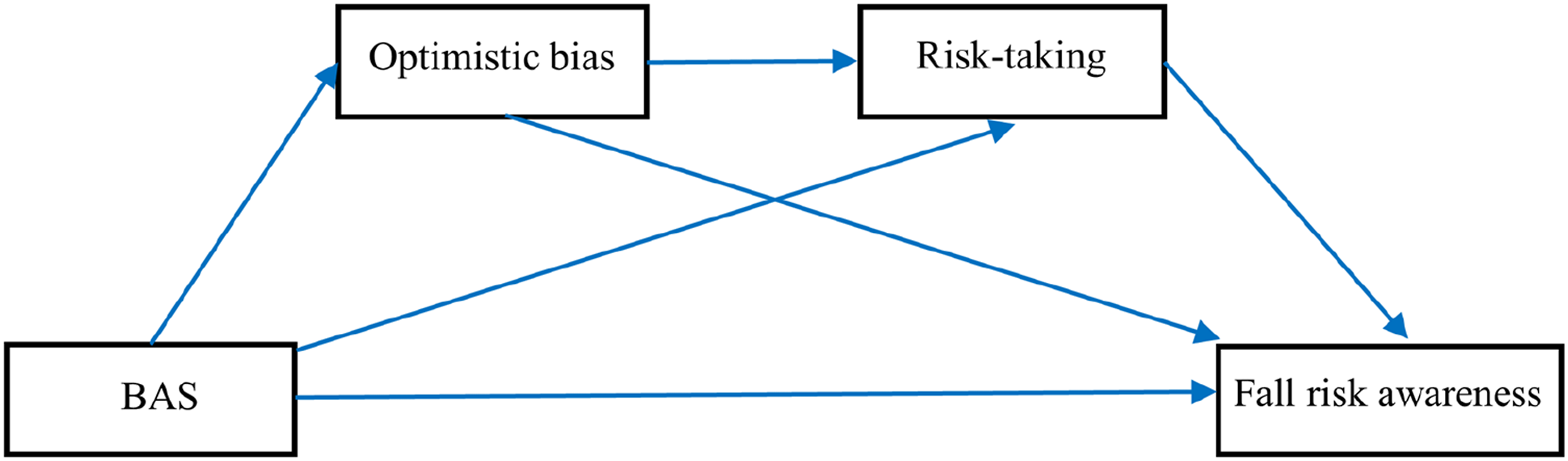
Methods
Participants
A total of 280 Korean adults aged 60 years or older participated in this study. Among them, 140 (50.0%) were male and 140 (50.0%) were female. Their ages ranged from 60 to 84 years, with an average age of 68.69 years (SD = 6.13): 157 (56.1%), 103 (36.8%), and 20 (7.1%) were in their 60s, 70s, and 80s, respectively. Among the participants, 203 (72.5%) had attained a college degree or higher, and an additional 69 (24.6%) had completed high school.
Twenty-six participants reported living alone. Regarding marital status, nine individuals (3.2%) were single, 15 (5.4%) were divorced, 23 (8.2%) were widowed, and 233 (83.2%) reported being currently married. Of the 280 participants, 120 (42.9%) reported having a job, 63 (22.5%) indicated experiencing financial difficulties, and 76 (27.1%) reported living with at least one illness. Within the past year, 133 older adults (47.5%) had experienced a fall, and 95 (33.9%) reported multiple fall incidents. Additionally, 26 participants (9.3%) experienced falls in multiple locations, and 37 (13.2%) reported multiple reasons for their falls.
Instruments
Fall Risk Awareness
We measured the degree to which the older adult participants were aware of their risk of falling using a modified version of a tool originally developed by Hong (2016). The modification was necessary because the original tool assessed whether the individual was at risk of falling owing to their personal conditions or reasons. However, in our study, we intended to measure whether anyone could be aware of the risk of falling in specific states or situations. For example, the original item “My leg strength is weak, so I am at risk of falling” was modified to “Weak leg strength increases the risk of falling.” The modified tool consisted of a total of 24 items that assessed the risk of falling owing to six factors: physical, sensory, cognitive and psychological, medication and activities of daily living, floor-related environmental, and instrumental activities of daily living-related environmental factors. Each item was rated on a four-point Likert scale (0: Not at all true to 3: Very true). Higher scores indicated greater risk awareness, and the total score was used in the analysis. In our study, the internal consistency (Cronbach’s α) of the 24 items was 0.94.
BAS
We measured BAS using the Korean version of the BAS/BIS scale, which was validated by Kim and Kim (2001) based on the original scale developed by Carver and White (1994). It consists of a total of 20 items, measuring BIS through seven items and BAS through 13 items under three subfactors: Reward Responsiveness (5 items), Drive (4 items), and Fun Seeking (4 items). Reward Responsiveness refers to a tendency to respond positively to anticipated rewards; Drive is characterized by a strong desire to pursue desired goals and maintain this pursuit; and Fun Seeking represents a tendency to approach new rewards, show eagerness for them, and seek potentially rewarding experiences. The validity of the BIS/BAS scales for older adults has been supported by previous research (Dierickx et al., 2022). In our study, only the BAS subscale was used, with higher scores indicating stronger BAS tendencies. The total BAS score was included in the analysis for this study. Each item was rated on a four-point Likert scale (1: not at all true to 4: always true). In our study, the Cronbach’s α for the 13 BAS items was 0.89.
Optimistic Bias
Weinstein (1984) initially aimed to measure optimistic bias using two items. Later, Suh et al. (2019) referred to Weinstein’s original items in developing seven items related to dietary behaviors concerning vegetable and fruit intake that could measure optimistic bias in that context. In the present study, we developed six items based on Suh et al.’s items, modified to suit our purpose (2019). The reason for this adaptation was to assess general optimistic bias concerning risks that individuals may encounter in various situations in life. The items included the following: “There is little chance of me getting into an accident even if I don’t follow safety precautions,” “The likelihood of me catching an infectious disease is low even if I don’t engage in preventive behaviors,” and “The chance of me getting robbed is lower compared with others, even if I am not vigilant.” Each item was rated on a seven-point Likert scale (1: strongly disagree to 7: strongly agree). Higher scores indicated stronger optimistic bias, and the total score was included in the analysis. In our study, Cronbach’s α was 0.89 for these six items.
Risk-Taking
We measured the risk-taking tendency of the participants using the Korean version of the Risk-Taking Questionnaire originally developed by Knowles et al. (1973) and validated by Lee (2002). This 15-item scale measures general motivations and tendencies to either avoid or approach risky situations. In Lee’s study (2002), the items converged into a single factor. Our participants rated each item on a five-point Likert scale (1: not at all true to 5: very true), with higher scores indicating a stronger inclination toward risk-taking. Of the 15 items, eight were reverse-coded, and the total score was included in the analysis. In our study, the Cronbach’s α for the 15 items was 0.85.
Data Collection Procedures
Data collection was conducted by Invight Co., an online survey company based in South Korea. Prior to beginning data collection, we obtained approval from the Institutional Review Board to ensure adherence to ethical standards.
Written informed consent was gathered from all participants. After consenting to take part in the online survey, the participants were informed that they could withdraw at any time if they felt any discomfort. Additionally, participants were assured that their data would be used exclusively for research purposes, stored on an encrypted computer for three years, and then destroyed.
Statistical Analysis
Data were analyzed using IBM SPSS Statistics for Windows, version 25.0, along with PROCESS Macro 4.2. Prior to analysis, we calculated for skewness and kurtosis to verify the normality of the variables. We performed correlational analyses using SPSS and then tested the double mediation model using Model 6 of PROCESS Macro 4.2 (Hayes, 2018). We further assessed the significance of the mediating effects through bootstrapping with 5000 resamples and 95% confidence intervals (CIs). Bootstrapping was used to examine the significance of indirect effects because it does not assume normality of the sampling distribution and provides a more accurate estimation of mediating effects.
The mediation model was adjusted with fall experience as a covariate. The fall experience score ranged from 0 to 4, with one point assigned for each: having experienced a fall, experiencing multiple falls, having multiple fall locations, and having multiple reasons for falls (Kim, 2018).
Results
Relation Among Variables Involved in Fall Risk Awareness
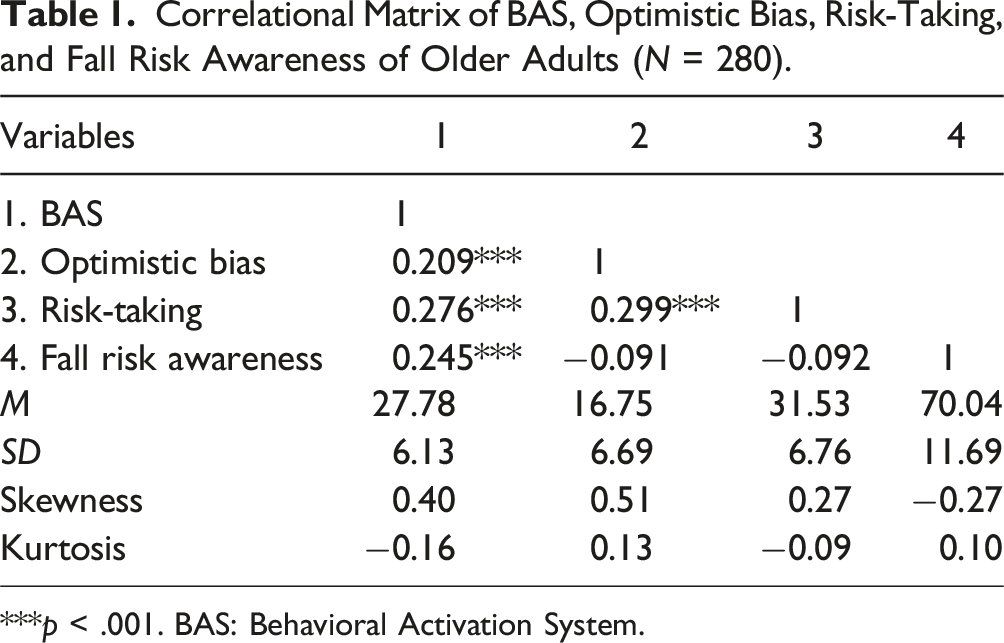
Correlational Matrix of BAS, Optimistic Bias, Risk-Taking, and Fall Risk Awareness of Older Adults (N = 280).
***p < .001. BAS: Behavioral Activation System.
Correlational analysis showed that BAS was positively correlated with optimistic bias (r = 0.209, p < .001), risk-taking tendency (r = 0.276, p < .001), and risk-taking (r = 0.245, p < .001). Optimistic bias was positively correlated with risk-taking (r = 0.299, p < .001) but not significantly correlated with fall risk awareness (r = −0.091, n.s.). Risk-taking tendency was not significantly correlated with fall risk awareness (r = −0.092, n.s.).
Verification of Double Mediation Model for Fall Risk Awareness
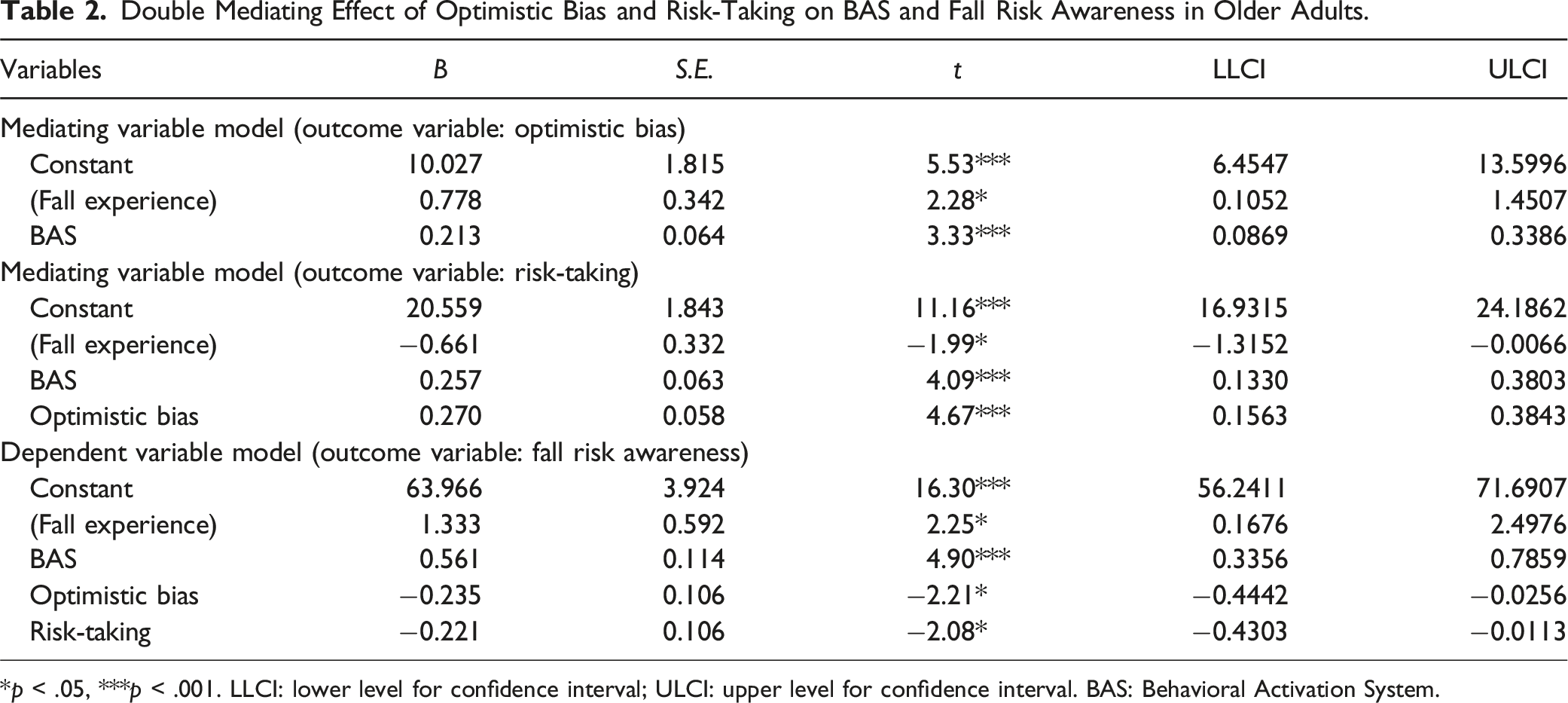
Double Mediating Effect of Optimistic Bias and Risk-Taking on BAS and Fall Risk Awareness in Older Adults.
*p < .05, ***p < .001. LLCI: lower level for confidence interval; ULCI: upper level for confidence interval. BAS: Behavioral Activation System.
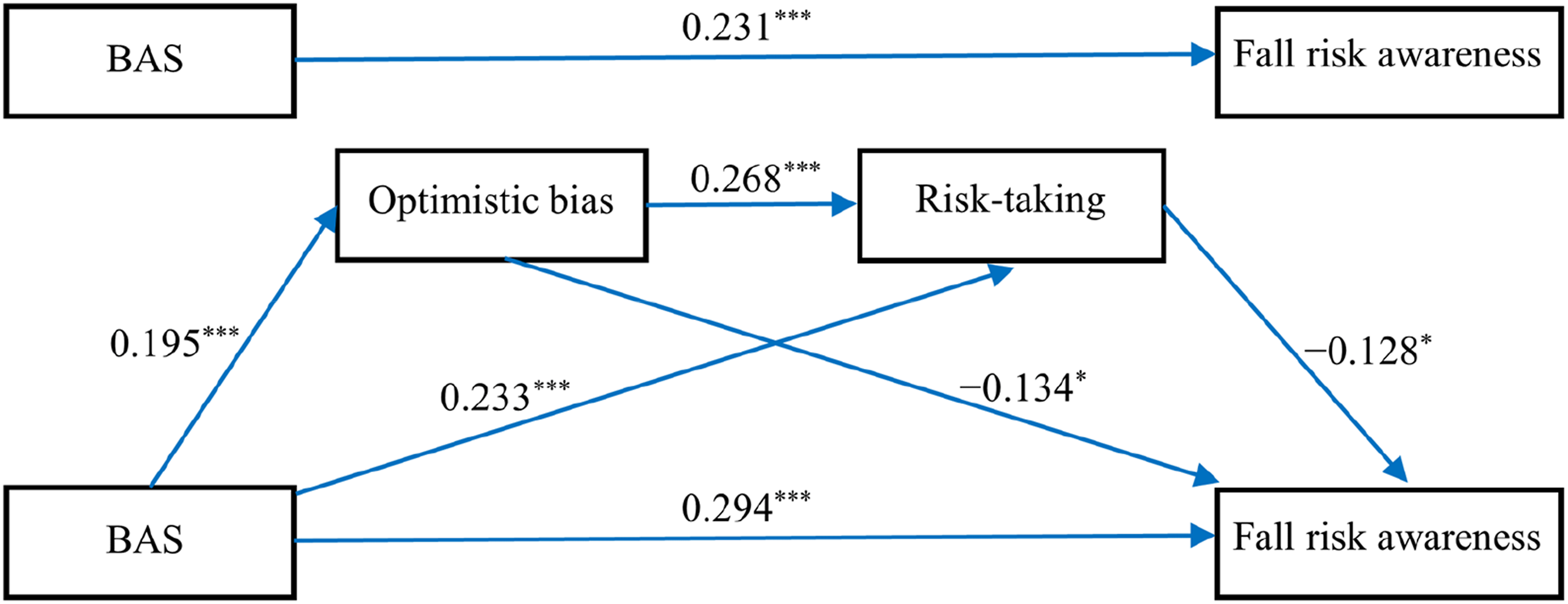
Double mediation model of optimistic bias and risk-taking on the BAS and fall risk awareness in older adults (*p < .05, ***p < .001; standardized coefficients; covariate: fall experience). BAS = Behavioral Activation System.
The results showed that BAS positively influenced optimistic bias (B = 0.213, p < .001), risk-taking (B = 0.257, p < .001), and fall risk awareness (B = 0.561, p < .001) in this model. Moreover, optimistic bias positively influenced risk-taking (B = 0.270, p < .001). However, optimistic bias (B = −0.235, p < .05) and risk-taking (B = −0.221, p < .05) directly negatively influenced the fall risk awareness of older adults.
Figure 2 demonstrates the increased direct influence of BAS on fall risk perception when optimistic bias and risk-taking are added as mediating variables to this model (β = 0.294, p < .001). The indirect effect of BAS through optimistic bias or risk-taking tendencies on fall risk awareness was negative. Therefore, the effect of BAS after including the indirect effects through optimistic bias or risk-taking tendencies was greater than the effect before including them (β = 0.231, p < .001).
Indirect Effects Based on the Mediation Model.
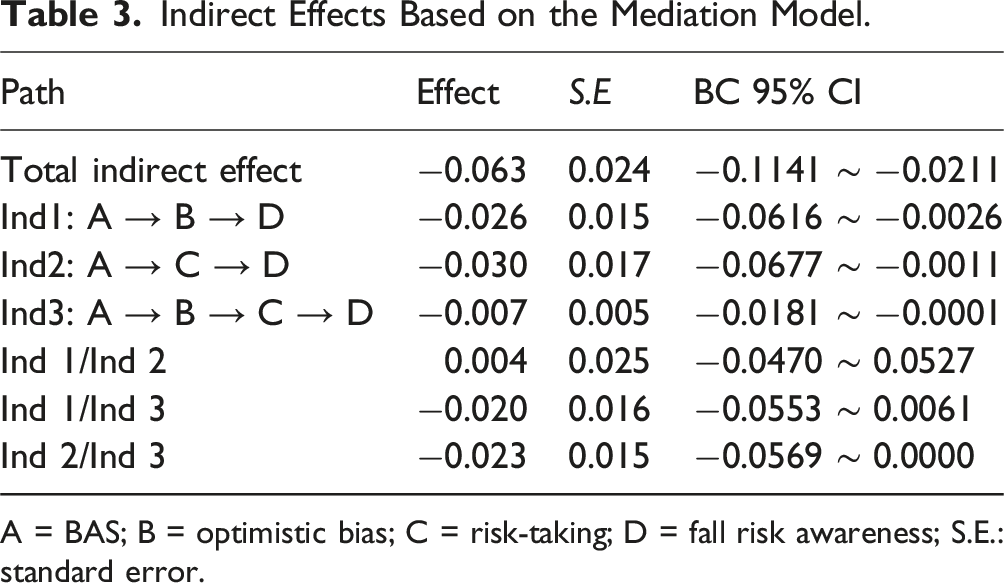
A = BAS; B = optimistic bias; C = risk-taking; D = fall risk awareness; S.E.: standard error.
The simple mediating effect revealed that the path from BAS to fall risk awareness via optimistic bias was significant (−0.0616 to −0.0026). The path from BAS to fall risk awareness via risk-taking was also significant (−0.0677 to −0.0011). Additionally, the sequential double mediating effect of optimistic bias and risk-taking on BAS and fall risk awareness (BAS → optimistic bias → risk-taking → fall risk awareness) was −0.007 (−0.0181 to −0.0001), which was significant.
Furthermore, we checked for any differences in the sizes of the indirect effects investigated in this study (Table 3). The results revealed no significant differences in the effect sizes among the paths analyzed. Specifically, the effect sizes of both simple indirect paths (A → B → D and A → C → D) showed no significant difference. We also found no difference compared with the sequential double indirect path (A → B → C → D).
Discussion
In the correlation analysis, neither optimistic bias nor risk-taking tendency showed a significant direct relation with fall risk awareness among Korean older adults. However, in the mediation model, both variables significantly influenced fall risk awareness in the negative direction. Individuals with higher BAS may underestimate their personal vulnerability due to optimistic bias and engage in more risk-taking, both of which may distort risk perception and reduce awareness of fall risks. These findings suggest that optimistic bias and risk-taking function as psychological mechanisms through which BAS exerts a negative indirect influence on fall risk awareness. In addition, fall experience significantly predicted fall risk awareness when included as a covariate (Choi et al., 2021), supporting the idea that fall-related experience enhances risk awareness. Clinical interventions aimed at reducing these factors—such as cognitive restructuring to challenge unrealistic optimism or behavioral training to improve risk recognition—could be particularly beneficial for older adults with high BAS.
We also found that optimistic bias and risk-taking sequentially mediated the relationship between BAS and fall risk awareness. In this serial pathway, BAS first increased optimistic bias, which in turn heightened risk-taking tendencies, ultimately lowering fall risk awareness. The sequential mediation effect was comparable in magnitude to the simple indirect effects of each mediator, suggesting that optimistic bias not only independently affects risk awareness but also operates as a precursor to risk-taking. These findings emphasize the importance of addressing optimistic bias early in intervention programs, as reducing such bias may prevent subsequent risk-taking behaviors and mitigate their negative impact on fall risk perception (Cutello et al., 2021; Weinstein & Klein, 1996). Cognitive restructuring and hazard awareness training may be particularly beneficial for high-BAS older adults, helping to preserve their motivation while promoting safety vigilance.
Interestingly, in the double mediation model, the direct effect of BAS on fall risk awareness increased when the negative indirect effects via optimistic bias and risk-taking were removed. This pattern suggests that BAS may positively influence fall risk awareness when its maladaptive pathways are controlled. This supports with our interpretation that BAS-related reward responsiveness may enhance cognitive engagement with risk cues. As noted earlier, fun-seeking—a BAS component—was positively associated with prior fall experiences, which significantly predicted fall risk awareness. Future research should further investigate what other psychological variables (e.g., fear of falling and self-efficacy) might mediate the positive influence of BAS on fall risk awareness. Moreover, as cultural differences may shape both risk perception and behavioral tendencies, cross-cultural studies are also warranted.
Although these findings are meaningful, the study has several limitations. First, the sample recruited via online survey may not fully represent the older adult population, particularly those with limited digital access. Given the relatively high educational attainment observed in the sample, it is likely that participants were more digitally proficient than the general older adult population. Therefore, caution is warranted when generalizing the findings to less-educated or digitally inexperienced older adults. Second, data collected through self-report instruments are subject to potential biases. Third, this was a correlational study; thus, causality cannot be confirmed. Although we initially hypothesized that BAS would reduce fall risk awareness, the direct effect was positive. This may be explained by BAS-related sensitivity to reward cues, which may enhance risk attentiveness when the influence of optimistic bias and risk-taking is accounted for. Future research should also consider using actual fall incidents (self-reported or objective) as outcome variables to evaluate how BAS and related traits translate into real-world fall risk. In addition, given the established role of fall experience in shaping fall risk awareness, future studies could examine whether fall experience moderates the relationship between BAS and fall risk awareness, potentially revealing differences between fall-experienced and fall-naïve older adults.
Footnotes
Acknowledgments
We would like to thank all the participants and research assistants. We also appreciate the support provided by Sahmyook University, which created a research-conducive environment for this study.
Author’s Contribution
J. An and K. Suh designed the study; K. Suh collected data; J. An and K. Suh conducted analyses J. An and K. Suh drafted the original manuscript; and J. An and K. Suh reviewed and edited. All authors agreed to the published version of the manuscript.
Declaration of Conflicting Interests
The author(s) declared no potential conflicts of interest with respect to the research, authorship, and/or publication of this article.
Funding
The author(s) received no financial support for the research, authorship, and/or publication of this article.
Ethical Statement

Data Availability Statement
The datasets analyzed in this study are available from the corresponding author upon request.