







Abstract
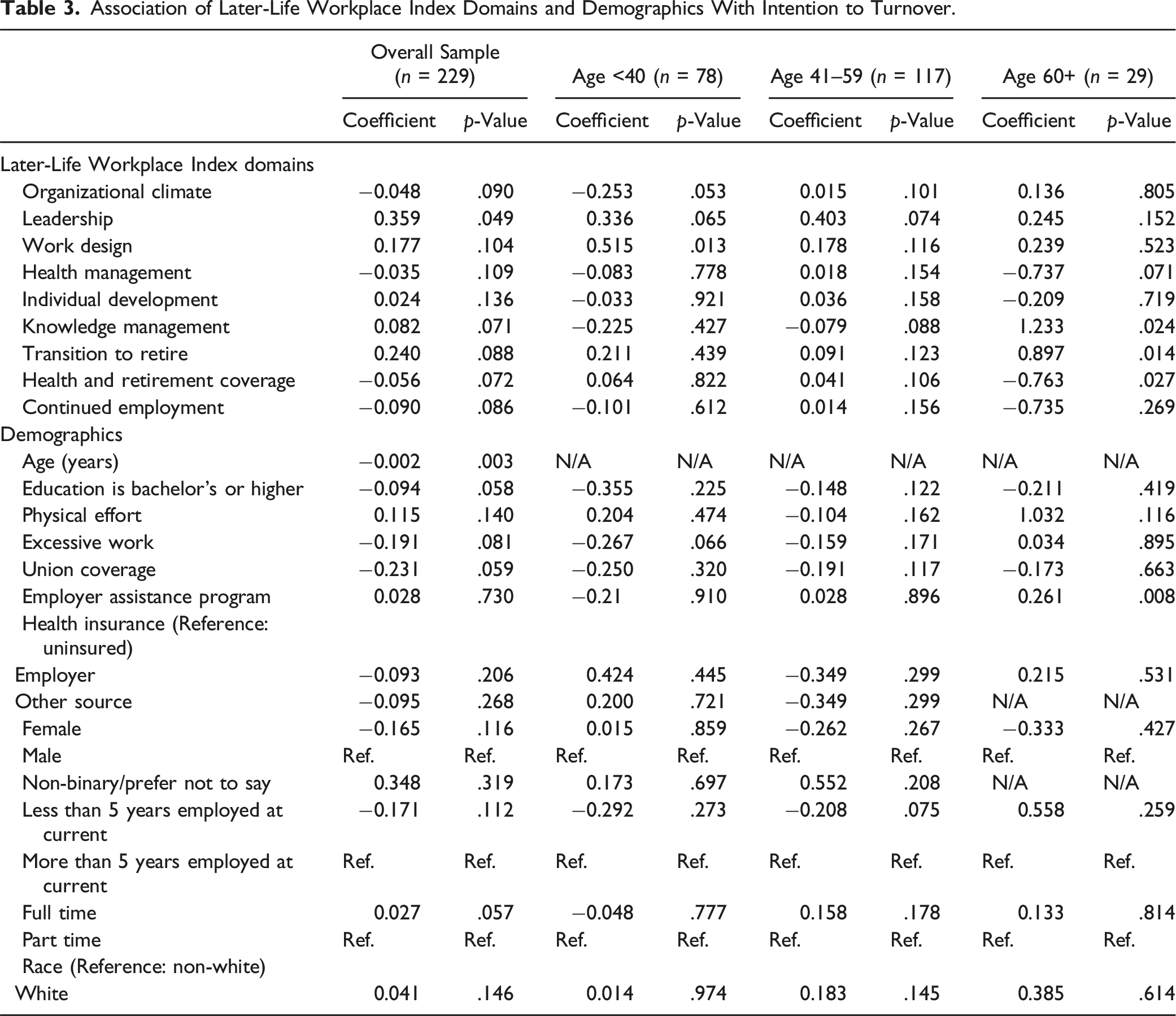
This study used data from 230 respondents of 16 organizations from a regional study of organizations’ employee working conditions in the Midwest. We used linear regression to assess practices related to turnover intention and stratified analysis within age groups. Employees with supportive managers are less likely to consider leaving their positions (coefficient = 0.36, p-value = .049). For respondents younger than 40 years old, employees with flexible work design were less likely to consider leaving their positions (coefficient = 0.52, p-value = .013). For those aged 60 years or older, having better institutional knowledge transfer and intergenerational collaboration (coefficient = 1.23; p-value = .02) and better planning for retirement (coefficient = 0.90; p-value = .01) were less likely to consider leaving their positions. Those with comprehensive retirement and health insurance plans were more likely to consider leaving their positions (coefficient = −0.763; p-value = .02). Small actions by organizations could influence employees’ perceptions of their working conditions.
Phased retirement planning was absent from several organizations. Working conditions that are beneficial for older workers vary in importance related to turnover depending on age range.
Policies should be written broadly to accommodate flexibility for caregiving for all age ranges. Small actions on the part of an organization could influence employees’ perceptions of workplace culture.What this paper adds
Applications of study findings
Introduction
The United States’ population is aging and driving an increase in the labor force participation of older adults (Centers for Disease Control and Prevention, 2024). The proportion of adults aged 65 years or older in the workforce has increased over the last three decades, currently 19% compared to 11% in 1987 (Richard and Braga, 2023). In 2023, there were 1 million adults aged 65 years or older living in Minnesota, a number that is projected to grow to 1.2 million by 2030 (Van Berkel, 2024).
With an increasing population of older adults in the workforce, concerns about whether organizational practices are meeting the needs of this population have risen. Research has shown that organizational practices (e.g., age-inclusive climate, respectful leadership, and flexible work design) are closely related to older employees’ health, motivation, performance, and retirement preferences (Wilckens et al., 2021). Several studies have found that the relevance of different types of organizational practices change over a person’s lifespan (Cadiz et al., 2019; Kooij et al., 2013); organizational practices are not just relevant to the older workforce but also to middle-aged workers as they decide whether or not their current employer will fit their future needs (Armstrong-Stassen & Schlosser, 2011; McCarthy et al., 2014).
This study uses the Later-Life Workplace Index, a survey instrument that includes 80 items to measure nine domains of organizational practices for an aging workforce (Finsel et al., 2021). The nine domains are organizational climate, leadership, work design, health management, individual development, knowledge management, health and retirement coverage, continued employment, and transition to retirement. This instrument has been developed by psychologists in Germany and validated in an English-speaking population (Finsel et al., 2021). The Later-Life Workplace Index instrument has been piloted and validated for employees in organizations that range in size from 30 to 500 employees (Wilckens et al., 2021).
Organizations need to evaluate themselves on their ability to attract and retain an older workforce, as failure to meet the needs of an aging workforce will result in the organizations losing workers at an increasing rate and being unable to fill open positions. This study sought to identify the strengths and weaknesses of organizations in the Midwest regarding organizational practices valued by their workforce. Additionally, we sought to examine the association between the Later-Life Workplace Index domains and employee intentions to turnover.
Methods
Measure Domains
The Later-Life Workplace Index measures nine domains differentiating organizational practices related to aging at work. Within each domain, there are several items used to assess organizational practices totaling 80 items in the index. Most of the domains have subdomains (e.g., organizational climate has three subdomains: equality of opportunity (3 items), positive image of age (3 items), and open and group communication (4 items)), while one domain does not (e.g., leadership (6 items)). Generally, the questions are framed in a positive manner and worded based on the perception of the organization, not necessarily how an individual has been treated. For example, many items start with the phrase “In our organization…” or “Employees/Managers of our organization…” For a comprehensive description of the original survey and its domains, see Finsel et al. (2021).
Measure Adaptation
The Later-Life Workplace Index is an English-validated survey. Our research team reviewed each question and made seven minor adjustments to the survey questionnaire to better reflect U.S. culture and values. For example, we changed the word “physiotherapy” to “occupational therapy.” Respondents were asked to agree or disagree with the statements from 1 (strongly agree) to 5 (strongly disagree), whereas the original version had a rating scale ranging from 1 to 7. This change was made to improve usability, particularly for participants completing the survey on mobile devices.
The research team also added questions to capture additional information such as type of health insurance, job workplace demands (physical and psychological), age, race, gender, length of employment at current employer, length of work experience overall, turnover intentions, union status, independent contractor status, use of employer assistance program, educational attainment, and plans for working after retirement.
Survey Distribution
We distributed the survey through two rounds. First, the research team invited 25 members of the Duluth Workforce Development Board, which serves the city of Duluth, Minnesota, to distribute the survey to the employees of their own organizations. The board members come from a mix of large employers, nonprofit organizations, educational institutions, and government entities. These organizations have locations both in Duluth, MN but also across the Duluth, MN-WI Metropolitan Statistical Area including Douglas County, WI, Carlton County, MN and all of St. Louis County, MN. The invitation included information about the survey itself, and a sample email the board members could have their organization send to their employees. Typically, board members are either human resource professionals or hold a leadership role at their organization and could, therefore, make the decision to participate in the survey. Others on the workforce board were encouraged by the research team to forward the email to the individual or department responsible for making such a decision for their organization. In the second round, we distributed the survey to a broader network of organizations in the northeast region of Minnesota using a similar method with an invitation and sample email.
Survey respondents were offered a $25 gift card incentive with 1 in 10 odds of receipt through a random drawing of completed surveys. Most organizations distributed the survey via email to their employees with an online link we provided that was unique to each organization. One organization preferred a physical copy of the survey. Therefore, we emailed a pdf copy that the organization printed for their employees to complete. A flow chart showing the process and number of invited organizations is in Figure 1. Flowchart of organization participation.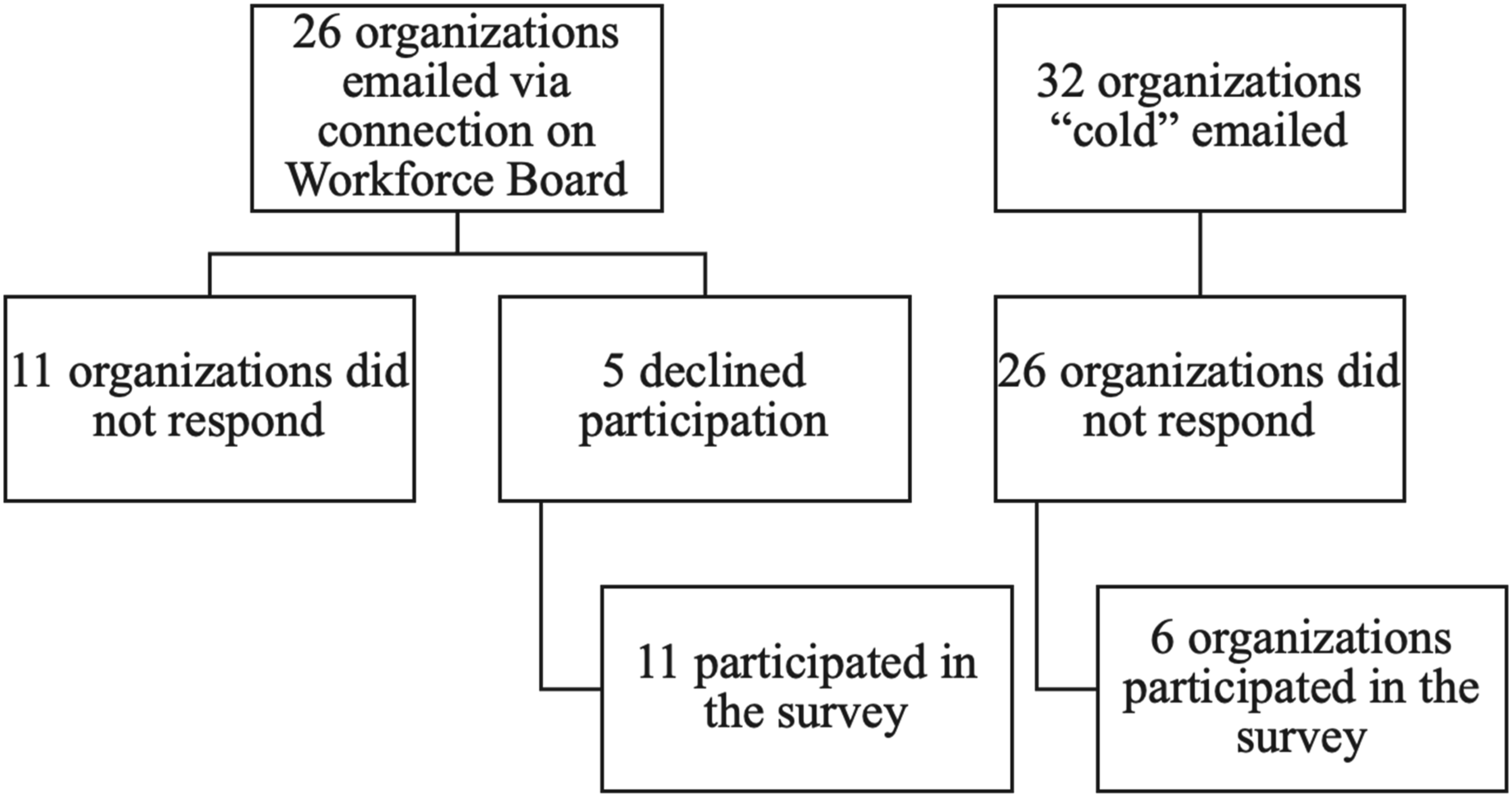
Variables
The dependent variable is turnover intention. It was measured by one question “Within the past six months, how often have you thought about leaving your job?” adapted from Spector et al. (1988). There were five choices from which to respond: never, sometimes, about half the time, most of the time, and always.
Later-Life Workplace Index Domains Averages.
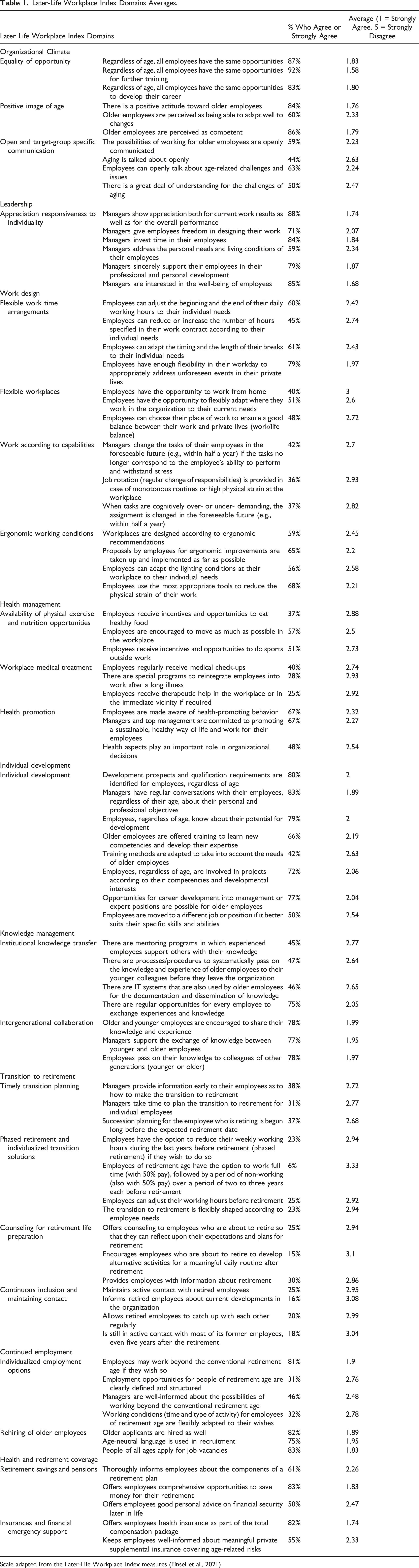
Scale adapted from the Later-Life Workplace Index measures (Finsel et al., 2021)
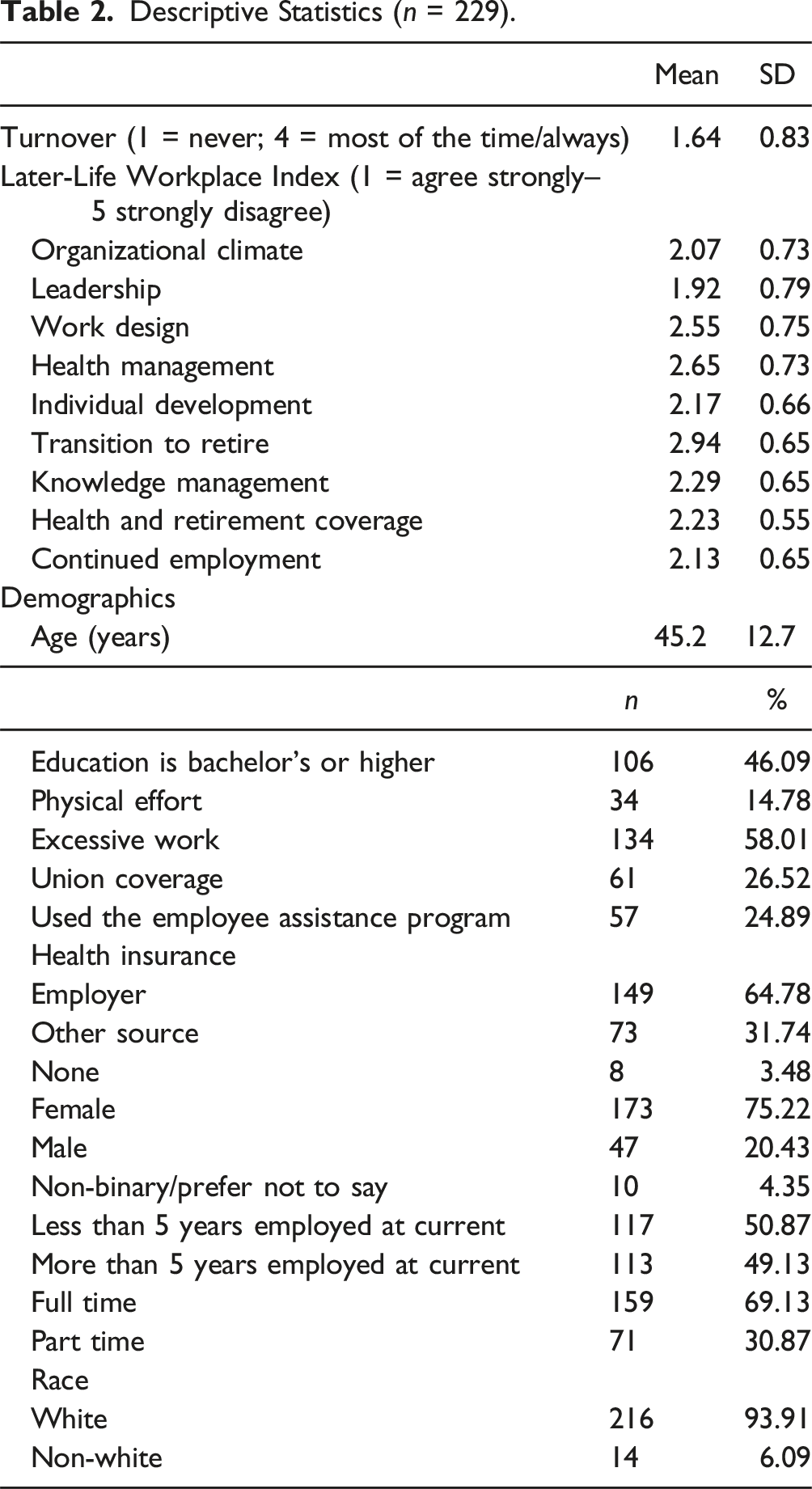
We chose to control for the demographics of age (measured continuously), education (bachelor’s degree or higher), physical effort, excessive work, union status, use of the employer assistance program, health insurance coverage (from employer, other source, or none), gender (male, female, and non-binary/prefer not to say), tenure at current employer (more than five years), full time/part time, and race (white and non-white). Physical effort, as a physical demand question, and excessive work, as a psychological demand question, were used to capture job demand for a particular occupation (Choi et al., 2012). We decided not to use length of work experience overall in the regression analysis because of its high correlation with age (correlation coefficient = .8). We also did not use the independent contractor variable due to its rarity in the sample (2%).
Statistical Analysis
We used linear regression to assess which domains were statistically significant with intent to turnover. This was collapsed into four categories that were the same as the choices above (never, sometimes, about half the time, and the combined most of the time and always). In the secondary analysis, we removed the continuous age variable and divided the sample into three age groups: <40 years old, 40–59 years old, and 60 years or older. We clustered standard errors at the organization level to account for correlations between respondents. Organizations with only one response dropped out of the models (n = 2).
Results
Table 1 shows the domains, subdomains, and individual items of the Later-Life Workplace Index. The item with the highest level of agreement (average: 1.58) was within the organizational climate domain: 92% of respondents strongly agreed or agreed that regardless of age, all employees have the same opportunities for further training. The item with the lowest level of agreement (average: 3.33) was within the transition to retirement domain: 6% of respondents strongly agreed or agreed that employees of retirement age have the option to work full time (with 50% pay) followed by a period of non-working (also with 50% pay) over a period of two to three years each before retirement.
Descriptive Statistics (n = 229).
Association of Later-Life Workplace Index Domains and Demographics With Intention to Turnover.
Discussion
Our results show that certain domains of work are important for all employees, across all ages, such as managers who care about an individual on a personal level. We also found different factors matter in different age groups. For example, knowledge management and transition to retirement domains were significant for the older group of workers.
This study found several factors related to organizational practices in the context of aging at work that can be learned from to decrease turnover in an organization. First, we found that a protective factor for turnover was supportive managers. Organizations that are struggling with turnover should look to invest in their management training to strengthen leadership support. Second, younger respondents valued flexible work design. Several organizations have been re-evaluating their telework policies in the years after the COVID-19 pandemic shifted a lot of work to be done from in-home. In a similar fashion, the federal government required their agencies to rescind telework agreements in January 2025. However, such changes may hamper efforts to recruit younger workers or impede succession planning. Third, for older workers, systems that foster knowledge transfer both informally and formally were related to lower turnover intentions. This finding suggests that departments can take steps to prevent turnover by improving internal policies related to documentation and sharing of institutional knowledge. Depending on the size of the organization, these policies may happen at organizational, departmental or team level. As Argote and Ingram (2000) emphasize, effective knowledge transfer mechanisms are critical for sustaining organizational learning and performance. Finally, there were mixed findings regarding retirement planning. We found that planning for retirement (including timely transition planning, phased retirement, counseling and continuous inclusion) was protective against turnover, but those whose organization offered comprehensive options to save in retirement plans had a higher likelihood of having turnover intentions. This finding may be more reflective of an intention to retire early rather than leaving their position to go to another job. Our survey did not ask about retirement intentions specifically.
After survey collection, the research team sent each organization’s representative their organizations’ results and offered to meet to discuss the results with respect to the Later-Life Workplace Index domains. Five organizations each met with us over Zoom for 45 minutes. One organization had low agreement in workplace flexibility, and we learned that they had focused on flexibility for employees with younger children but not for other types of caregiving. Another organization had very high agreement across all domains, due to the nature of its organization—working with people who need in-home support—respect for people of all ages was ingrained into their culture. Additionally, one organization with lower scores for ergonomics had recently reconfigured its main working area. Finally, one organization had very high scores in the domain of retirement transition, which was likely because retirees were regularly invited to company events.
This study is a small sample of regional organizations and thus may not be generalizable to other regions. However, gaining a larger survey sample is feasible taking into consideration the issues that we learned. Some of those issues are noted here. For instance, some large organizations, such as health care employers, chose not to participate. Several organizations distributed the survey but had a low response rate. We also had distribution both online and on paper, which may have introduced response bias, but we had so few paper responses (n = 3) it is unlikely. Often, employers had other surveys that they had just completed or that were being conducted at the same time as our study, so there were competing demands for time. In addition, our incentive of physical gift cards needed mailing addresses for distribution, which people were hesitant to provide. If we were to expand the survey distribution to a broader audience, a different type of incentive (e.g., electronic gift card) might be more effective for encouraging participation. Finally, our outcome was a one-item question that assessed employee turnover but did not encompass issues related to the context of why an employee may want to leave the company. However, the survey was distributed during a relatively short time frame in spring 2024 and thus external influences would have been consistent over the sample.
Overall, this study was the first to survey organizations in the United States using the Later-Life Workplace Index. Future research could tailor the survey to focus on domains that are important to a specific organization. This type of study could also be used to create workshops focusing on organizational practices that are valued by older workers to incorporate into organizational policies. Small actions by organizations could influence employees’ perceptions of an age-inclusive workplace culture.
Footnotes
Acknowledgments
Thank you to Gina Chiodi Grensing for the invaluable support in editing and revising. We thank our student interns Avery Wendinger and Mahad Ahmed for helping prepare the survey and distribution of the survey. We also want to thank Elena Foshay and the Duluth Workforce Development Board for allowing us to partner in this work. A previous shortened version of this was published as a blog on the BBER: 
Author Contributions
Conceptualization (LL, MH, KD, and LX). Methodology (LL, MH, KD, SN, and LX). Software (LL, MH, SN, and LX). Formal Analysis (LL, MH, SN, and LX). Investigation (LL, MH, KD, SN, and LX). Resources (LL, MH, KD, and LX). Data curation (LL, MH, and SN). Writing (LL and SN). Writing reviewing/editing (MH, KD, and LX). Visualization (LL and SN). Supervision (LL and MH). Project administration (LL and MH). Funding (LL, MH, KD, and LX).
Declaration of Conflicting Interests
The author(s) declared no potential conflicts of interest with respect to the research, authorship, and/or publication of this article.
Funding
The author(s) disclosed receipt of the following financial support for the research, authorship, and/or publication of this article: We thank the University of Minnesota Duluth executive vice chancellor of academic affairs for funding this project.