







Abstract
Although later-life learning is an important contributor to active ageing, research suggests that older adults with lower socio-economic status (SES) may participate less in learning. Simultaneously, we know little about whether the benefits of later-life learning, in terms of quality of life (QoL), vary by older adult SES. Hence, we investigated whether SES shapes older adults’ participation in and benefits from learning. Using two waves of data (2016–17; 2019) from a nationally representative cohort of Singaporeans aged 60 to 95 years (n = 2,502), we find that older adults with higher education and occupational prestige had greater participation in both job- and nonjob-related learning. Moderation analyses showed that the beneficial effects of nonjob-related learning on QoL were only observed for lower-SES older adults. Our findings suggest that although lower-SES older adults benefit more from later-life learning, they are less likely to participate in it.
• We provide longitudinal evidence that nonjob-related later-life learning promotes QoL and that SES, examined using multiple measures, affects the relationship between later-life learning and QoL. • Lower-SES older adults were less likely to be job- and nonjob-related learners. • Nonjob-related learning was associated with QoL only for lower-SES older adults.
• Not all types of learning can be assumed to benefit older adults’ QoL, and not all older adults derive the same benefits from participation in learning. • Policymakers and lifelong learning administrators should seek to understand whether lower-SES older adults face unique barriers to participation in learning and attract this target group through reforms which address participation barriers. • Future studies and policymakers should seek to examine the role of learning environments and other learning program features in explaining why older adults of different SES receive different benefits from their learning.What This Paper Adds
Applications of Study Findings
Introduction
Societies are increasingly faced with the challenge of financing healthcare and social services for the growing proportion of older adults (individuals aged 60 years and older) in their populations (OECD & World Health Organization, 2020). Policymakers have enacted active ageing policies to promote older adult health and participation and reduce the burden on healthcare and pension systems (Zaidi & Howse, 2017). Lifelong learning is a key constituent of the active ageing framework (World Health Organization, 2002). Although learning has traditionally been promoted as a means to develop human capital in service of the economy, governments are beginning to leverage on the wider, non-economic benefits of learning for older adults (Formosa, 2012). That said, key knowledge gaps remain in our understanding of the variation in participation in and benefits reaped from later-life learning.
First, despite efforts to increase participation in learning among older adults, participation is marked by inequalities. While studies have found that participation in later-life learning differs by socio-economic status (SES), researchers have primarily focused on education as the key SES measure (e.g., Jenkins, 2011). There remains a dearth of knowledge on whether and how participation differs by other dimensions of SES, such as occupational type and perceived financial adequacy.
Second, while researchers have found that participating in learning can promote quality of life (QoL) in later life (e.g., Jenkins, 2011), it is unclear whether these benefits differ by type of learning. Since job-related learning tends to prioritize economic returns while nonjob-related learning is more oriented toward intrinsic enjoyment (Jenkins & Mostafa, 2015), we might expect the benefits, in terms of QoL, to differ for job and nonjob-related learning. However, most studies do not consider job and nonjob-related learning separately (e.g., Leung & Liu, 2011), which makes the association between each type of learning and QoL ambiguous.
Finally, while there is consistent evidence about how non-economic benefits from participation in later-life learning differ by characteristics such as gender and health (Narushima et al., 2013; Shi et al., 2022), evidence on whether SES moderates non-economic benefits of learning, such as QoL, remain scarce and mixed. Though later-life learning may alleviate inequalities by allowing disadvantaged individuals to gain new skills, studies have found that adults with higher-SES experience greater career-related benefits from learning (Kilpi-Jakonen et al., 2015).
This study thus examines the following research questions: (1) Does SES, assessed using multiple measures, influence older adults’ participation in learning? (2) Are job and nonjob-related learning differently associated with older adults’ QoL? (3) Does SES moderate the benefit, in terms of QoL, of later-life learning?
Literature Review
Unequal Participation by SES in Later-Life Learning
Lower-SES older adults are less likely to participate in later-life learning compared to higher-SES older adults.
Two of the most important socio-economic determinants of participation in later-life learning are an individual’s educational history and occupational class background (White, 2012). Prior educational attainment is a key socio-economic determinant of participation in later-life learning, as older adults with lower education are less likely to engage in various forms of learning (Jenkins, 2011; Jenkins & Mostafa, 2015). The “learning divide” in later life is exacerbated by diminishing opportunities for free public education globally—for instance, Narushima (2008, p. 675) suggests that only older adults with higher education and income will be able to continue learning in Ontario.
Benefits of Job-Related and Nonjob-Related Learning
Nonjob-related learning has a stronger positive association with older adults’ QoL compared to job-related learning.
Previous studies on the returns of later-life learning show that it is associated with a range of positive outcomes, including economic benefits such as increased employment and higher wages (De Lima Flauzino et al., 2022; Midtsundstad, 2019). Furthermore, an increasing body of literature finds that learning leads to non-economic benefits in later life—encompassing social and civic participation (Sung et al., 2023), life satisfaction, and psychological well-being (Jenkins, 2011; Narushima et al., 2018).
Yet benefits may vary by the type of learning. Some older adults pursue learning primarily for its labor market benefits, while others might be more driven by interest or leisure (Sung et al., 2023). Studies on the link between job-related learning and QoL have yielded mixed findings. For instance, Manninen et al. (2014, p. 34) find that job-related courses are most positively associated with the emergence of “control of own life,” but Jenkins (2011) found no associations between work-related learning and QoL. Conversely, there is consistent evidence for the positive association between nonjob-related or more recreational types of later-life learning and QoL (Jamieson, 2007; Jenkins, 2011; Jenkins & Mostafa, 2015; Leung & Liu, 2011). In particular, Jamieson (2007) identified benefits of later-life learning in the pleasure, self-realization and control domains of QoL. One way to understand these findings is that for learning to be beneficial, it should match the interests, strengths and needs of learners (Hammond, 2004). Job-related learning may improve (or protect) QoL only if learners achieve their goals of increased employment prospects or earnings (Jenkins & Mostafa, 2015). Given evidence that later-life learners may be more motivated by the social and intrinsic enjoyment aspects of learning compared to extrinsic factors (Maulod & Lu, 2020; Sheffler et al., 2022), we hypothesize that nonjob-related learning might better suit their motivations and therefore better promote their QoL.
Unequal Benefits by SES of Later-Life Learning
Higher-SES older adults experience more benefits, in terms of QoL, from participation in learning compared to lower-SES older adults.
Furthermore, SES may also shape the benefits yielded from participation in later-life learning. Currently, studies have not explored if SES moderates the association between later-life learning and QoL, except for Jenkins (2011), who found that those with higher education qualifications tended to have larger increases in QoL relative to those with no qualifications. That said, some research has explored how SES moderates the association between later-life learning and well-being—a concept closely related to QoL (Camfield & Skevington, 2008)—yielding mixed results. For instance, studies found that older adults in the lowest income groups reported greater appreciation for learning programs’ benefits in supporting their health and coping ability (Manninen et al., 2014; Narushima et al., 2013). However, others have argued that the design of formal learning programs may sometimes be less relevant for lower-SES older adults (Formosa, 2012) and can generate exclusionary experiences if lower-SES older adults form the minority in such settings (Lewis, 2020).
Later-Life Learning in Singapore
Singapore is ageing rapidly. By 2030, one in four citizens in Singapore will be aged 65 years and older (Department of Statistics Singapore, 2023). Later-life learning was originally adopted to ensure lifelong employability amidst Singapore’s ageing and shrinking workforce (Sung & Freebody, 2017). The 2015 and 2023 Action Plans for Successful Ageing expanded this approach to include social objectives, encouraging older adults to expand their interests and stay active (Ministry of Health, 2016, 2023). The state has increased their investment in recreational and nonjob-related later-life learning by launching a wide variety of courses via avenues such as the Council for Third Age’s National Silver Academy (Ministry of Health, 2023).
Given the country’s strong investment in later-life learning through government-led initiatives, one might expect little to no barriers in accessing learning as an older adult in Singapore. For instance, potential barriers arising from the lack of financial resources are addressed by partial funding of participation in courses by the state-sponsored SkillsFuture Credit scheme (Organisation for Economic Cooperation and Development, 2020). However, despite these measures, take-up rates of learning programs remain low (Chan et al., 2020). Older adults face barriers to participation such as time, financial constraints (Kim et al., 2021), and poor physical health (Thang et al., 2019). Further, empirical evidence on the impact of economic and recreational learning on older adults’ QoL remains scarce.
Singapore’s historical focus and strong foundation in formal education provides a solid basis for later-life learning (Sung & Freebody, 2017), although sociocultural preferences for academic rather than vocational education in Singapore have contributed to low take-up rates (Tan, 2017). This context, coupled with the country’s comprehensive government-led initiatives for later-life learning, makes Singapore a compelling case for studying the impact of later-life learning policies.
Methods and Measures
Data
This study used data from two waves of Transitions in Health, Employment, Social engagement and Inter-Generational transfers in Singapore Study (THE SIGNS Study), conducted in 2016–17 and 2019, respectively. A nationally representative sample of 4,459 older Singaporean citizens and permanent residents, aged 60 years and older, were interviewed in wave 1 (W1), and 2,887 of them were re-interviewed in wave 2 (W2). Detailed sampling and interview procedures are described in Chan et al. (2020). The analytic sample for this study included only respondents who participated in both waves. We further excluded participants whose current occupation could not be classified according to the Singapore Standard Occupational Classification’s (SSOC) (Department of Statistics Singapore, 2020) Major Groups (n = 16) and those with missing values on QoL (n = 280), later-life learning participation (n = 6), SES indicators (n = 73), and other covariates (n = 10). After exclusions, the final analytic sample comprised 2,502 respondents.
Later-Life Learning
At each wave, respondents were asked if they had attended any course (or training) in the last 12 months (yes/no). Respondents who had attended at least one course were asked to choose the main reason for participating in each course—whether mainly job-related or mainly nonjob-related—for up to three of their most recent courses. A definition for either reason was shared with the respondents. Job-related reason was defined as learning to obtain knowledge and learn new skills for a current or future job, increase earnings, or improve job and career opportunities for advancement and promotion. Nonjob-related reason was defined as learning to develop competencies for personal, community, domestic, social, or recreational purposes. Job-related learning was not restricted to those currently employed, as it also applied to individuals who were unemployed, retired, or transitioning between career stages. Following Sung et al. (2023), we constructed a categorical variable for later-life learning indicating whether participants were non-learners, job-related learners (those who participated in courses solely for job-related reasons), and nonjob-related learners. We combined those who participated in courses solely for nonjob-related reasons with those who participated in courses for both job- and nonjob-related reasons into the nonjob-related learning group; learners with mixed reasons were assigned to the nonjob-related learning group rather than a separate category due to their small numbers (n = 22 at W1 and n = 21 at W2).
SES
We included three measures of SES—education, current occupational type, and perceived financial adequacy, all based on self-report. Education was measured by a dichotomous measure of whether respondents had completed education at the secondary school level and above (i.e., less than secondary/secondary and above). Occupational type was obtained by matching respondents’ current occupation to the SSOC’s Major Groups (i.e., a classification of skill specialization) and collapsing the Major Groups into smaller categories (i.e., not working/looking for work/routine/operational/professional). Examples of professional occupations include teachers, technicians and managers; operational occupations include drivers, security guards, and hairdressers; and routine occupations include warehouse assistants, kitchen assistants, and packers (Department of Statistics Singapore, 2020). While we note that older adults who are not working are not necessarily lower in the hierarchy of occupational prestige than those who are (e.g., non-working older adults could be wealthy and thus retired), we retain these respondents in the analysis to ensure a larger sample size and to draw inferences on the effects of lifelong learning for non-working older adults, given that non-working older adults make up a majority of the sample (n = 1,461; 58%). In sensitivity analyses (not shown; available on request), retaining only older adults who were working yielded results that were consistent with our moderation analyses with occupational type. Perceived financial adequacy was measured by a dichotomous measure of whether respondents thought they had adequate income to meet their monthly expenses (i.e., enough money/some difficulty). All three SES measures were simultaneously included as covariates in all analyses. We did not include housing type or household income as measures of SES, as we primarily focused on personal SES measures, since we expect the barriers and benefits of later-life learning to be strongly contingent on older adults’ personal SES and histories (e.g., Withnall, 2006). Nevertheless, in sensitivity analyses (not shown; available on request), we included both housing and household income as additional measures for SES; findings remained largely consistent with those for the other measures of SES.
Quality of Life
QoL was measured by the 11-item Control, Autonomy, Self-Realization and Pleasure Scale (CASP-11-SG), recently validated for the older population in Singapore (Tan et al., 2023). Respondents chose a response option (Never = 0; Not Often = 1; Sometimes = 2; Often = 3) on statements such as “I look forward to each day” and “I feel that my life has meaning.” The total score was the sum of all items, ranging from 0 to 33. Higher values indicate better QoL (Cronbach’s alpha = 0.80).
Covariates
Sociodemographic covariates used in this analysis included age (in years), gender (male/female), ethnicity (non-Chinese/Chinese), number of living children (0/1–2/3 or more), housing (1–3 room government-built housing/4 room government-built housing/5 room government-built housing and private property), marital status (not married/married), and living arrangement (not living alone/living alone). We further included health-related covariates—presence of limitation in any activities of daily living (ADLs) or instrumental activities of daily living (IADLs) (no/yes), presence of any chronic illness (no/yes), self-rated health (1 = Poor; 5 = Excellent), self-rated vision (1 = Poor; 5 = Excellent), and self-rated hearing (1 = Poor; 5 = Excellent). The W1 values of all covariates were used in the analysis.
Analytic Plan
Our statistical analysis proceeded in three steps. First, we used a multinomial logistic regression model with a lagged dependent variable (LDV) (i.e., later-life learning at W1) to examine how SES at W1 influenced the probability of later-life learning at W2. Second, using the model-based predicted probabilities of being a non-learner, job-related learner, and nonjob-related learner, respectively, at W2, we generated inverse probability weights (IPWs) by taking the reciprocal of the probability that a respondent belonged to the later-life learning category. The IPWs were then multiplied by the inverse probability of attrition (from W1 to W2) weights to further control for sample attrition. Thereafter, to examine how later-life learning at W1 influenced QoL at W2, we included the final weight into an LDV linear regression model with QoL as the outcome variable. Third, interaction terms were added to the LDV linear regression model to examine if SES moderated the effects of later-life learning on QoL. Equation (1) denotes the general regression model used to estimate whether SES moderated the effects of later-life learning on QoL, where β is the vector of coefficients associated with the vector of covariates Z. Separate regression models were fitted for interactions with each measure of SES (although all SES measures were included as covariates in all regression models).

The use of longitudinal data helps us address the issues of reverse causality between later-life learning and QoL, given the possibility that older adults with higher QoL are more likely to engage in learning (Wenzel et al., 2024). Examining the effects of learning at W1 on QoL at W2 helps us make stronger causal inferences about the directionality of the relationship. The use of IPWs also aids causal inference by controlling for the likelihood of respondents self-selecting into participation in learning (Cole & Hernán, 2008), as it is likely that the same variables and characteristics that predispose older adults to learning are also related to QoL (e.g., demographics, health). Adjusting for lagged dependent variables further acts as a proxy control for the effects of omitted time-varying confounders (O’Neill et al., 2016) that explain QoL in both waves.
Results
Weighted Descriptive Statistics by Later-Life Learning Participation (n = 2,502)
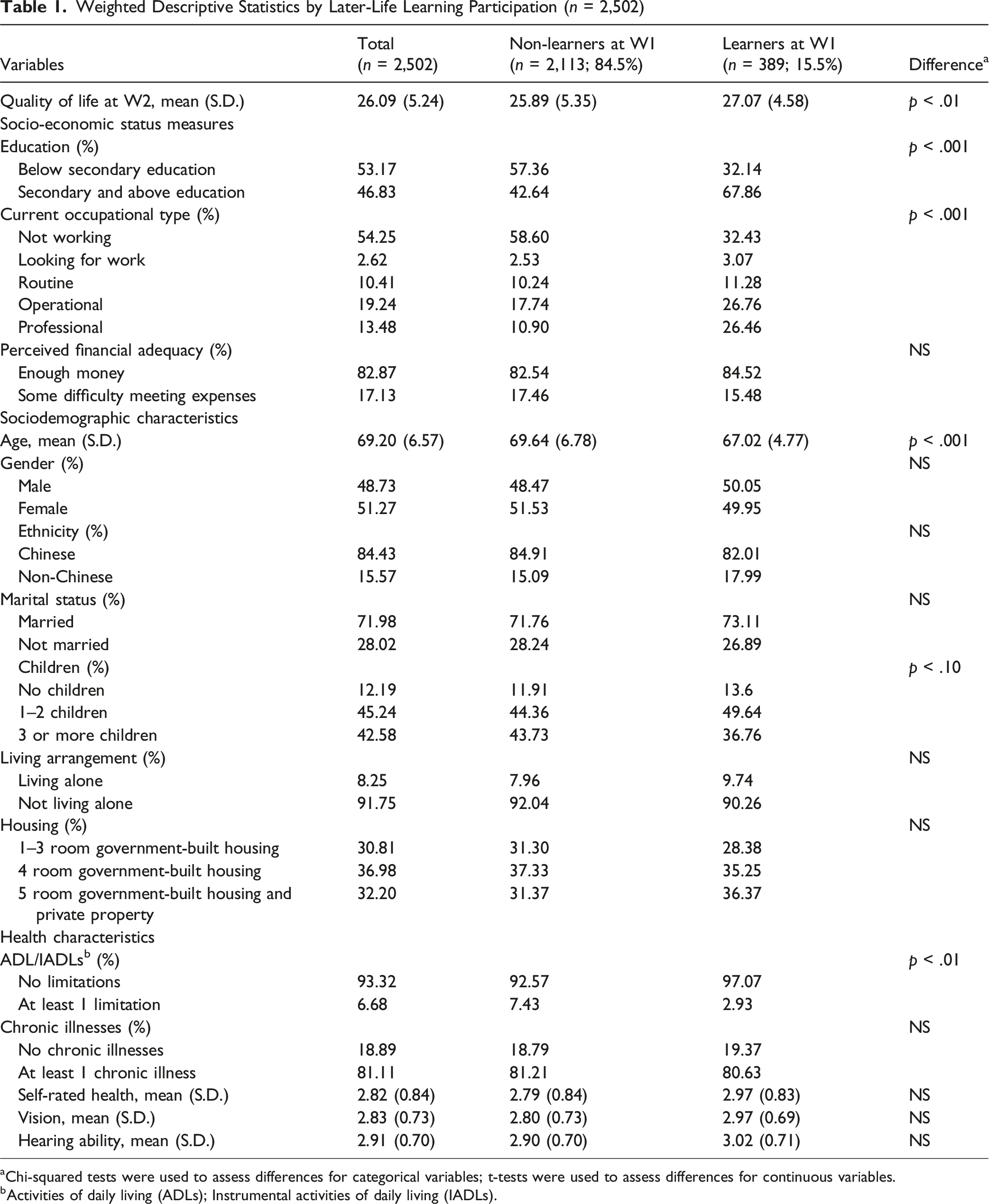
aChi-squared tests were used to assess differences for categorical variables; t-tests were used to assess differences for continuous variables.
bActivities of daily living (ADLs); Instrumental activities of daily living (IADLs).
Supplement Table 1 further shows the weighted descriptive statistics of only job-related learners and nonjob-related learners. Compared to job-related learners, nonjob-related learners had a greater proportion of female and Chinese respondents, and a greater proportion of respondents who were not working. Compared to nonjob-related learners, job-related learners were also younger on average.
SES Measures as Predictors of Later-Life Learning
Figure 1 presents results from the multinomial logistic regression analyses, showing the predicted probabilities of being a non-learner, job-related learner, and nonjob-related learner (at W2) by SES (at W1). Working in an operational occupation was associated with a higher probability of being a job-related learner (Relative Risk Ratio [RRR] RRR: 3.24; p < .01), while working in a professional occupation was associated with a higher probability of being a job-related (RRR: 3.55; p < .01) and nonjob-related learner (RRR: 1.88; p < .05) compared to those who were not working. Having secondary and above education was associated with a higher probability of being a job-related learner (RRR: 1.92; p < .05) and nonjob-related learner (RRR: 1.53; p < .05) compared to those with below secondary education. Financial adequacy was not associated with later-life learning. These results partially supported Hypothesis 1, showing that lower-SES older adults were less likely to participate in both job- and nonjob-related learning. Predicted probabilities of later-life learning participation at wave 2 by socio-economic status at wave 1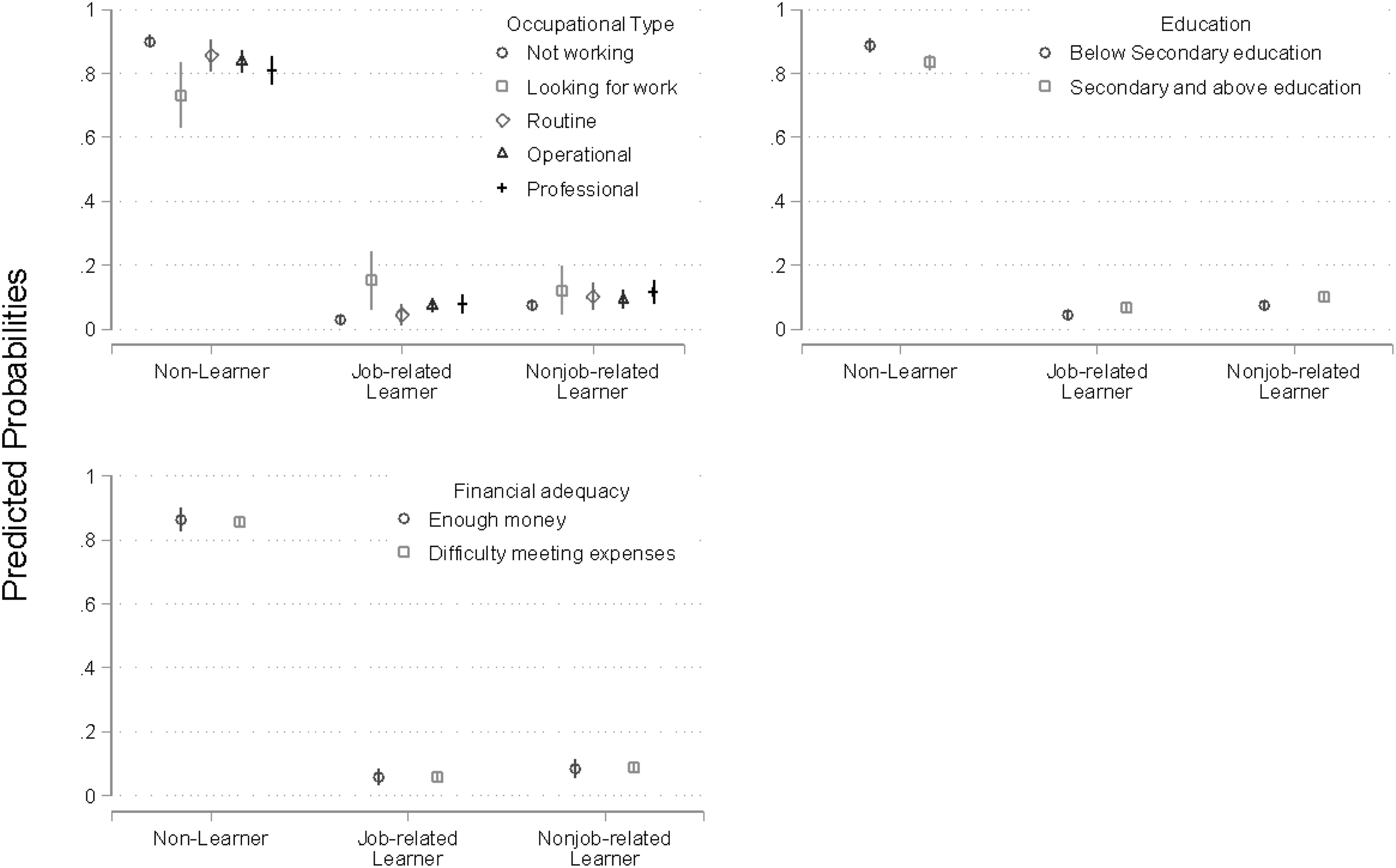
Associations Between Later-Life Learning and QoL
Results From Lagged Dependent Variable Regressions Predicting Quality of Life at Wave 2 (n = 2,502)
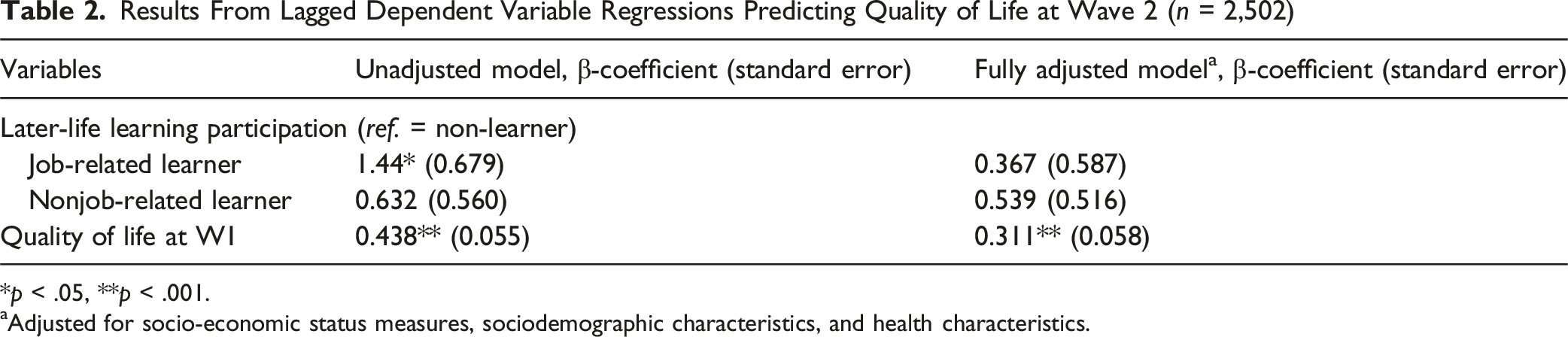
*p < .05, **p < .001.
aAdjusted for socio-economic status measures, sociodemographic characteristics, and health characteristics.
Next, we re-specified the LDV regression model thrice, including interaction terms between later-life learning at W1 and each measure of SES, respectively. Figure 2 presents the average marginal effects (AMEs) from each of the regression models. Results show that the AMEs of job-related learning on QoL were only significant among respondents who were looking for work (AME = 6.68; p < .001). That said, we interpret this finding with caution, because there were only five respondents participating in job-related learning at W1 who were looking for work. Next, we observed that the AMEs of nonjob-related learning on QoL were only significant among respondents working routine jobs (AME = 2.95; p < .01), respondents with below secondary education (AME = 1.82; p < .05), and respondents with at least some difficulty meeting monthly expenses (AME = 3.44; p < .05). Overall, these results run counter to Hypothesis 3, showing that the association between participation in nonjob-related learning and QoL was only observed among lower-SES older adults, but not higher-SES older adults. Average marginal effects of later-life learning participation on quality of life by socio-economic status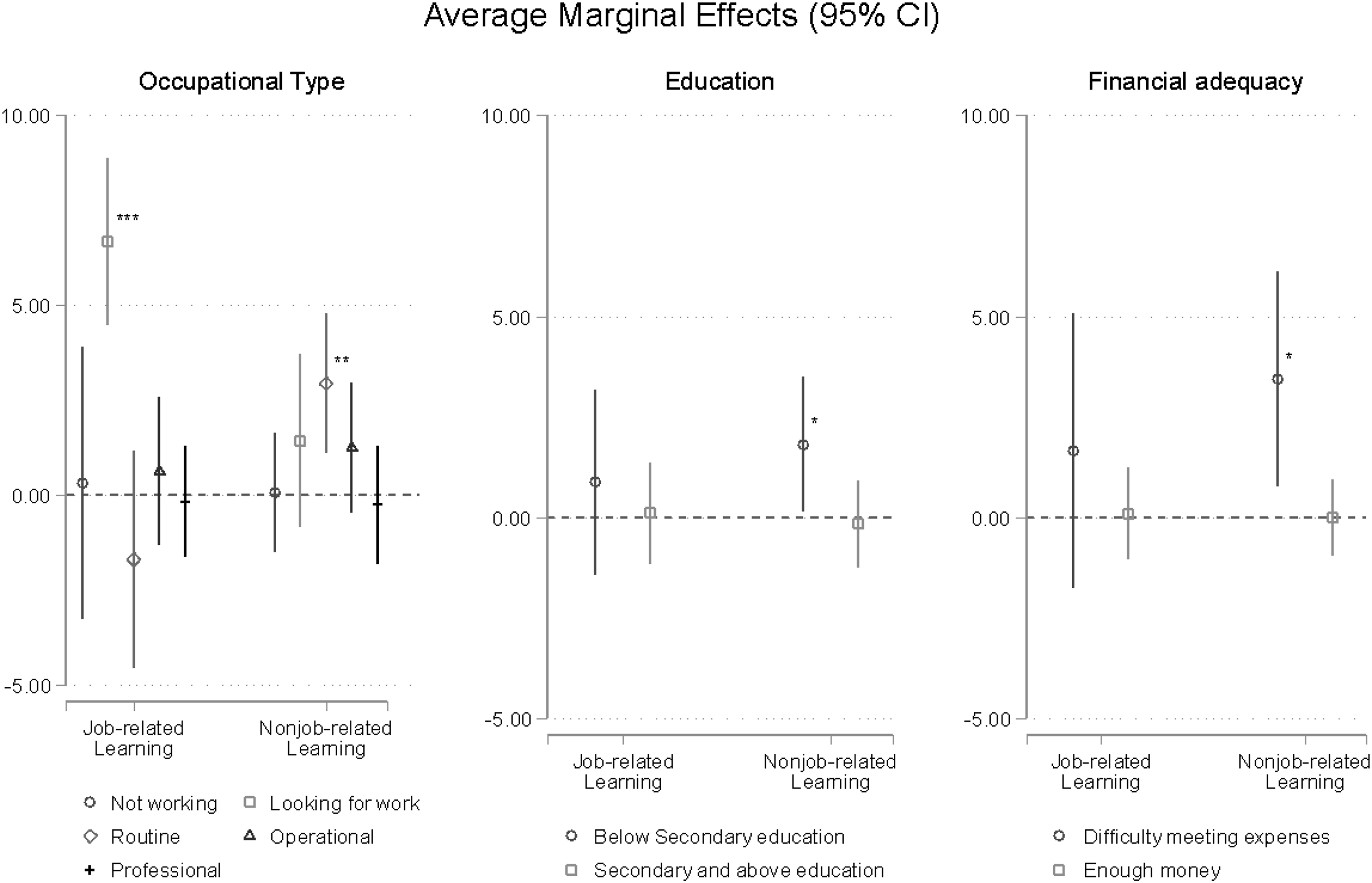
Discussion
Despite a growing number of initiatives to tap on later-life learning to promote active ageing, we know little about whether access and returns to participation in later-life learning differ by SES. This study examined the association of SES with participation in later-life learning, the relationships between older adults’ participation in job- and nonjob-related learning and their QoL, and whether SES moderates these relationships. We found that while lower-SES older adults were less likely to participate in both job- and nonjob-related learning, only lower-SES older adults experienced benefits to QoL from their participation in nonjob-related learning.
First, in line with Hypothesis 1, we found that lower-SES older adults were less likely to participate in both job- and nonjob-related learning. This finding is on par with global literature demonstrating the under-representation of lower-SES older adults in various forms of learning (Jenkins, 2011; Jenkins & Mostafa, 2015). One possible reason for the lower participation rates in job-related learning among lower-SES older adults may be that their workplaces are less inclined to send them for upskilling due to lost work time (Narot & Kiettikunwong, 2021). Further, even if job-related learning leads to work-related benefits in the long run, lower-SES older adults may not have adequate resources at their disposal to manage potential disruptions of current income flows—in other words, “too busy earning to be learning” (Jackson, 2003, p. 375). Future qualitative studies should seek to better understand the specific barriers to learning that lower-SES older adults face and if these barriers differ across job and nonjob-related learning.
Second, contrary to Hypothesis 2, we did not find evidence that job-related learning was positively associated with QoL at W2 for most groups, except for those looking for work, which suggests that participation in job-related learning for those who were already working may not have added benefits to QoL. Also contrary to Hypothesis 2, we did not find evidence that nonjob-related learning was associated with QoL for most groups, except for those with routine jobs, those with below secondary education, and those with at least some difficulty in meeting monthly expenses.
That said, our analysis showed that participation in nonjob-related learning enhanced QoL only for lower-SES older adults. This was contrary to Hypothesis 3 as well as previous literature that has found lower-SES older adults to benefit less from learning due to poor fit between course design and learners’ skill levels (e.g., Jenkins, 2011). This suggests that learning courses in Singapore might be organised in ways that better match the interests and needs of lower-SES older learners. For instance, NSA offers exam-free modules and promotes learning alongside others, which might better cater to the older adults’ intrinsic and social motivations for learning (Maulod & Lu, 2020; Sheffler et al., 2022). Crucially, all three SES indicators significantly moderated the relationship between nonjob-related learning and QoL. Our findings affirm previous research showing the significance of unidimensional SES measures such as education, while also showing that subjective SES measures should also be considered in future studies and policy design. Future research should clarify the mechanisms through which each SES measure influences the QoL benefits of learning.
In addition, job-related learning was only associated with QoL among those who were looking for employment. This is consistent with past research showing that benefits to QoL from job-related learning might be contingent on the older learners attaining their work-related goals (Jenkins & Mostafa, 2015). That said, only five respondents in our sample were looking for work and participating in job-related learning in W1—future studies should investigate the benefits of job-related courses for older workers looking for work with a larger sample.
We did not observe an association between later-life learning and QoL among higher-SES older adults. One possible explanation for this finding might be that higher-SES older adults are already engaged in more forms of social and recreational activities (e.g., leisure, community, volunteer activities, travel) compared to lower-SES older adults (Cheng et al., 2022; Morrow-Howell et al., 2014). For instance, older Singaporeans who perceive greater current financial adequacy are more likely to go on extended travels (Mathews & Straughan, 2014). Later-life learning may hence have less added benefits to QoL for those who were already participating in such activities. Overall, these findings add to the mixed evidence around inequalities in benefits from participation in later-life learning and broadly align with studies showing that participation in later-life learning is an effective compensatory strategy for lower-SES older adults (Hammond, 2004; Narushima et al., 2018). Namely, it may be the case that later-life learning provides lower-SES older adults valuable opportunities to pursue personal interests and hobbies that they may not have had the chance to earlier in the life course.
Limitations
Several limitations are present in this study. First, our measures of learning collapsed attendance in all courses in the past 12 months but did not examine important factors such as whether learning was in formal or non-formal contexts, whether learning was done in offline or online settings, and the demographics of other students in the course. It is possible that lower-SES older adults engaged in learning may have done so in environments that were more conducive for their learning. For example, lower-SES older adults may be more likely to participate in community/neighborhood-based learning activities, which may simultaneously reinforce older adults’ informal place-based networks (Narushima, 2008) and improve their QoL. Future studies should seek to examine the role of learning environments in explaining why older adults of different SES receive different benefits from their learning.
Second, although this study used LDVs as a proxy for all time-varying effects between waves (O’Neill et al., 2016), LDVs cannot control for the effects of other time-invariant effects which may have been omitted from this model. While it is possible to use structural equation models to include such time-invariant unobserved heterogeneity as a latent variable (Andersen & Mayerl, 2023), such methods require at least three waves of data. Another limitation of using only two waves of data is that it is difficult to make strong causal inferences about the moderating role of SES in the relationships between later-life learning and QoL. For instance, it is possible that a bidirectional relationship exists, whereby older adults with higher QoL are more likely to participate in learning activities, and that this relationship may itself be moderated by SES. A failure to account for these bidirectional effects may have led to overestimations about the role of learning in influencing QoL. More waves of data over a longer period will be required to clarify the relationships between SES, learning, and QoL among older adults.
Finally, we only considered older adults’ learning activity in 2016/17 (W1), which is the same year the National Silver Academy was introduced by the Singapore government (Maulod & Lu, 2020). Other recent policy shifts to the later-life learning landscape include initiatives such as the SkillsFuture Mid-Career Enhanced Subsidy to further encourage upskilling for older Singaporean workers. That said, the shift toward online and remote educational delivery methods post-pandemic also introduces new barriers such as digital literacy, comfort, and access, which may be more salient for lower-SES older adults. These shifts may further modify the effects of SES on participation in and benefits from learning. Considering these shifts, it is unclear whether lower-SES older adults are still less likely to participate in job- and nonjob-related learning, and whether they still benefit more from participation in these more accessible modes of learning.
Conclusion
Notwithstanding these limitations, we provide longitudinal evidence that nonjob-related later-life learning promotes QoL and that SES, examined using multiple measures, affects the relationship between later-life learning and QoL. Our study also has the advantage of being based on data from a nationally representative sample in a country with strong state support for later-life learning. We find that although only lower-SES older adults benefit from nonjob-related learning, they are also less likely to participate in learning. Policymakers and lifelong learning administrators should seek to understand whether lower-SES older adults face unique barriers to participation in learning and attract this target group through a combination of reforms which address participation barriers (Organisation for Economic Cooperation and Development, 2020). Further, our findings suggest that not all types of learning can be assumed to benefit older adults’ QoL, and that not all older adults derive the same benefits from participation in learning. Beyond looking at job- and nonjob-related learning, policymakers should investigate how and whether other learning program features might influence the benefits of participation in learning, to maximize the benefits of state investment on older adults’ QoL.
Supplemental Material
Supplemental Material - Socio-Economic Status Inequalities in Older Adults’ Learning Participation and Benefits
Supplemental Material for Socio-Economic Status Inequalities in Older Adults’ Learning Participation and Benefits by Shu Yee Chin, Jolin Chua Yi Xin, Nathan Widjaja, Rahul Malhotra, and Shannon Ang in Journal of Applied Gerontology
Footnotes

Ethical Considerations
Approving Body: National University of Singapore Institutional Review Board (NUS-IRB). Approval Numbers: LB-15-152.
Consent to Participate
Written informed consent was taken either from the older participants or their proxy respondents in both THE SIGNS Study—I and II. Proxy respondents provided consent and responded to the survey questionnaire on behalf of the older adult participants if either if the older adult participant was unable to respond due to a physical or psychological issue such as hearing or speaking difficulty, memory loss or dementia, current sickness, etc. or if the older adult participant had cognitive impairment, that is, answered fewer than five questions correctly on the Abbreviated Mental Test—Singapore in the screener. The proxy respondent had to be aged 21 years and above, be either a family member or someone who had been living with the older adult participant and have been helping the older adult participant in his/her daily living for some time.
Funding
The authors disclosed receipt of the following financial support for the research, authorship, and/or publication of this article: Waves 1 and 2 of Transitions in Health, Employment, Social Engagement and Inter-Generational Transfers in Singapore (THE SIGNS) Study were supported by Singapore’s Ministry of Health (MOH) [grant number MOH-NUS RL2015-053].
Declaration of Conflicting Interests
The authors declared no potential conflicts of interest with respect to the research, authorship, and/or publication of this article.
Data Availability Statement
The de-identified dataset used for the analysis may be made available on request, subject to approval from the study stakeholders and funder. The request for accessing the dataset can be sent to the corresponding author or to
Supplemental Material
Supplemental material for this article is available online.
References
Supplementary Material
Please find the following supplemental material available below.
For Open Access articles published under a Creative Commons License, all supplemental material carries the same license as the article it is associated with.
For non-Open Access articles published, all supplemental material carries a non-exclusive license, and permission requests for re-use of supplemental material or any part of supplemental material shall be sent directly to the copyright owner as specified in the copyright notice associated with the article.
