







Abstract
Drawing on data from the 2023 Chinese Social Survey (CSS), the study investigates the effect of social trust on life satisfaction among middle-aged and older adults in China, with particular attention to the mediating role of volunteering and the moderating role of educational attainment. The findings demonstrate that social trust exerts a significant positive impact on life satisfaction in later life, and that volunteering mediates this association. Moreover, educational attainment positively moderates the relationship between social trust and volunteering. These findings highlight how strengthening social trust and broadening educational opportunities can promote volunteering and enhance middle-aged and older adults’ life satisfaction amid rapid population aging.
• Chinese middle-aged and older adults with a high level of social trust regularly tend to have higher life satisfaction. • Volunteering serves as a mediator in the relationship between social trust and life satisfaction among Chinese middle-aged and older adults. • Educational attainment moderates the relationship between social trust and volunteering among middle-aged and older adults.
• Communities should foster social trust through neighborly interactions and mutual support to enhance their life satisfaction. • Foster social trust through community interaction to strengthen middle-aged and older adults’ connections and life satisfaction. • Promote volunteering by supporting middle-aged and older adults’ sense of purpose and belonging through reflective activities and peer support.What This Paper Adds?
Applications of Study Findings
Introduction
Population aging is accelerating in China and worldwide. In China, adults aged 60 and above accounted for 22% of the population in 2024, up from 18.7% in 2020 (Wang, 2025), and this share is projected to reach 22% globally by 2050 (PRB, 2020). As older populations expand, understanding how to sustain quality of life has become increasingly important. Life satisfaction, a central indicator of subjective well-being, is therefore a key focus in aging research (De et al., 2018). Evidence from the 2023 China Household and Family Track suggests that life satisfaction among adults aged 65 and above remains relatively high, highlighting the need to identify factors that help maintain well-being in later life.
A growing literature links older adults’ life satisfaction to social trust and related social resources (Bittmann, 2022; Oh & Bae, 2023), as well as mental health and religiosity (Pahlevan et al., 2021; Wang et al., 2022). Social trust is generally associated with higher life satisfaction, though findings are not always consistent (He et al., 2024; Lee & Bae, 2023). This inconsistency suggests that the trust–well-being link may depend on intervening pathways and enabling conditions.
One plausible pathway is social participation. Prior studies show that social trust may shape life satisfaction through social networks, loneliness, income, resilience, and participation (Aliyev et al., 2022; He et al., 2024; Sun et al., 2024; Xie & Han, 2024). Volunteering is a salient form of participation in later life and has been linked to greater happiness and life satisfaction (Baeriswyl & Oris, 2023; Chu & Koo, 2023; Liu et al., 2024). Education may further shape this process: lifelong and civic learning can promote active aging and volunteering, and education appears to facilitate participation by expanding social ties and strengthening individual capacities (Drazic et al., 2024; Nakamura et al., 2022; Rüber & Janmaat, 2021; Russell et al., 2023).
Despite these advances, the combined roles of social trust, volunteering, life satisfaction, and education remain underexplored. Few studies examine volunteering as a mediating pathway while simultaneously treating education as a factor that shapes the strength of the trust–volunteering link; many instead model volunteering primarily as a direct predictor (Marchesano & Musella, 2020). To address this gap, we use CSS2021 data to examine how social trust relates to life satisfaction among Chinese middle-aged and older adults, testing volunteering as a mediator and educational attainment as a moderator of the pathway from social trust to volunteering. This study makes three contributions. First, it tests whether volunteering partly explains how social trust relates to life satisfaction, linking trust to civic action. Second, it examines education as a boundary condition, assessing whether trust is more likely to translate into volunteering among those with greater capacity and access to opportunities. Third, by focusing on middle-aged and older adults, it clarifies the role of volunteering in supporting role continuity and well-being in an aging society, with implications for promoting engagement and life satisfaction across educational groups.
Literature Review and Hypotheses
Social Trust and Life Satisfaction
Trust is a psychological state in which individuals assess the likelihood that others will act in ways affecting their well-being (Falcone, 2001). Social trust, or generalized trust, reflects confidence in the benevolence of most people (Hu & Xie, 2025). As a core element of social capital, it is mutually reinforcing with other components and is a key determinant of subjective well-being, classified into generalized and particularized forms including institutional, interpersonal, and familial trust (He et al., 2024).
Life satisfaction refers to an individual’s subjective evaluation of the extent to which their needs and desires are fulfilled, encompassing domains such as housing, economic status, and social relationships (Xia et al., 2024). Empirical research consistently demonstrates a close link between social trust and life satisfaction. For example, Xie & Han (2024) found that higher levels of social trust significantly predict life satisfaction across both urban and rural populations. Trust helps individuals navigate complex social systems, including healthcare and social welfare, thereby enhancing well-being among older adults. International evidence further supports this relationship, showing that strong interpersonal connections and neighborhood cohesion are associated with higher subjective well-being in later life (Bazinyan & Mayilyan, 2024; He et al., 2024). Life satisfaction among older adults is shaped by multiple factors, including gender, age, education, health, and social relationships, with social capital playing a particularly important role. As a key dimension of social capital, social trust exerts a positive influence on older adults’ life satisfaction. Cognitive social capital has been shown to enhance life satisfaction. Despite these findings, research examining the role of social trust in life satisfaction within the Chinese context remains limited, highlighting the need for further investigation.
Social trust has a significant positive effect on life satisfaction among middle-aged and older adults.
The Mediating Role of Volunteering
Volunteering encompasses various forms of mutual aid, formal service, and civic engagement undertaken voluntarily for the benefit of society without primary economic compensation (Serrat-Graboleda et al., 2021). Among older adults, low-to-moderate volunteering is linked to lower psychological well-being than non-participation, while high engagement boosts well-being—though benefits may be reduced by role conflicts or excessive demands (Yang et al., 2022).
As China faces an increasingly aging population, promoting healthy aging has become an urgent priority. Positive social engagement, particularly volunteering, helps older adults maintain social connections, build relationships, and navigate daily challenges (Morawski et al., 2022). Social participation theory suggests that involvement in organized, collective, and voluntary activities enables individuals to achieve self-realization, rebuild social networks, assume new roles, and enhance subjective well-being (Aroogh & Shahboulaghi, 2020; Yang et al., 2022). Consequently, social participation is central to successful aging and constitutes a key dimension of social capital influencing life satisfaction. Supportive social networks provide both instrumental and emotional resources that sustain volunteer engagement (Aroogh & Shahboulaghi, 2020; Lv et al., 2024). Empirical evidence consistently shows a positive relationship between volunteering and life satisfaction among older adults (Baeriswyl & Oris, 2023). Volunteer activities offer retirees avenues for social engagement and a sense of purpose through continued societal contribution (Philippus et al., 2020), while both informal and formal activities, including volunteer services and club participation, promote adaptation to aging and enhance life satisfaction (Wu, 2024).
Prior research has documented a positive association between social trust and volunteering, although the magnitude may vary across contexts (Taniguchi & Marshall, 2014). In China, recent evidence has shown that volunteering and social trust are positively associated with life satisfaction among older adults, although urban–rural differences remain context-dependent rather than uniformly stronger in urban settings (Xie & Han, 2024). Trust-related cognitions, such as perceived trust, can further enhance individuals’ motivation to participate in voluntary and social activities (Wollebæk, 2025). Evidence also suggests a reciprocal dynamic whereby trust promotes volunteering and volunteering, in turn, reinforces trust through socialization processes (Wollebæk, 2025). Generalized trust facilitates responsible helping behaviors and interaction with beneficiaries (Guidi et al., 2021), while in China the “trust radius”—the breadth of one’s interpersonal trust network—may shape volunteering participation, with a wider radius associated with greater engagement (Liu et al., 2021). Thus, volunteering may serve as a key behavioral mechanism linking social trust to life satisfaction. By reducing uncertainty and interaction costs, social trust fosters expectations of reciprocity and cooperation, thereby increasing the likelihood of volunteering. For middle-aged and older adults, volunteering provides social connection, role maintenance, emotional support, meaning, and positive self-evaluations of being needed, all of which enhance life satisfaction. Thus, volunteering represents an action pathway through which social trust translates into subjective well-being.
Volunteering mediates the relationship between social trust and life satisfaction among middle-aged and older adults.
The Moderating Role of Educational Attainment
Education is a learner-centered developmental process that cultivates civic knowledge, attitudes, and skills through both formal and informal channels (López-Meseguer, 2025; Zhang, 2022). Research shows education is a strong, stable predictor of volunteer engagement, with higher-educated individuals participating more across demographic groups (Nakamura et al., 2025).
Education is consistently associated with higher levels of volunteering, partly because it broadens social networks, enhances self-efficacy, and reduces the perceived costs of participation by providing access to information and resources (Rüber & Janmaat, 2021). As a form of human capital, education also strengthens civic competencies and reinforces a sense of social obligation, thereby facilitating volunteer engagement (Son & Wilson, 2017). Importantly, prior evidence suggests that education is closely related to volunteering, while social trust has also been shown to promote voluntary participation. In this sense, education may serve as a human-capital and cognitive-resource condition that facilitates the translation of trust into volunteering behavior (Son & Wilson, 2012, 2017; Taniguchi, 2013), .
Based on these literatures, we argue that the translation of social trust into volunteering varies by education. Higher education enhances information access, organizational skills, and perceived efficacy, enabling individuals to act on their trust. Lower education may impose informational and capacity constraints that weaken this link. Thus, education is a key boundary condition in the trust-to-volunteering pathway.
Educational attainment moderates the relationship between social trust and volunteering among older adults.
Building on H2 and H3, we propose a moderated mediation model in which educational attainment conditions the indirect effect of social trust on life satisfaction via volunteering. Higher education is consistently associated with greater life satisfaction and subjective well-being (Bursová et al., 2024) and may strengthen the extent to which social trust translates into volunteer participation, thereby amplifying the well-being benefits of volunteering. Accordingly, the indirect effect of social trust on life satisfaction through volunteer engagement is expected to be stronger among individuals with higher educational attainment.
Educational attainment moderates the indirect effect of social trust on middle-aged and older adults’ life satisfaction through volunteering.
Methods
Sample and Participants
Data came from the 2023 Chinese Social Survey (CSS), a biennial longitudinal survey with probability-based household sampling across 31 provinces in China (151 districts/counties, 604 villages/neighborhood committees). The survey was approved by the Institute of Sociology, Chinese Academy of Social Sciences. The inclusion criteria were as follows: (1) respondents were middle-aged and older adults aged 45–70 years; (2) data on the core study variables were complete, including social trust, volunteering, life satisfaction, and educational attainment; and (3) no missing values were observed for key covariates (e.g., sex, age, Household registration, marital status, and annual personal income). Respondents were excluded if their age was outside the eligible range or missing, or if any core variables or key covariates contained missing data. Of the 13,035 respondents in the initial sample, 3,435 met the eligibility criteria and were ultimately included in the statistical analyses (Figure 1). Among respondents, 54.4% were female (n = 1,869) and 45.6% were male (n = 1,566). Participants were aged 45–74 years, with 37.1% aged 60–74 (n = 1,275) and 62.9% aged 45–59 (n = 2,160). Regarding household registration, 64.6% were rural residents (n = 2,220) and 35.4% were urban residents (n = 1,215). In terms of marital status, 12.9% were unmarried (n = 442) and 87.1% were married (n = 2,993). The mean personal annual income was RMB 31,809.69. Sample inclusion and exclusion flow diagram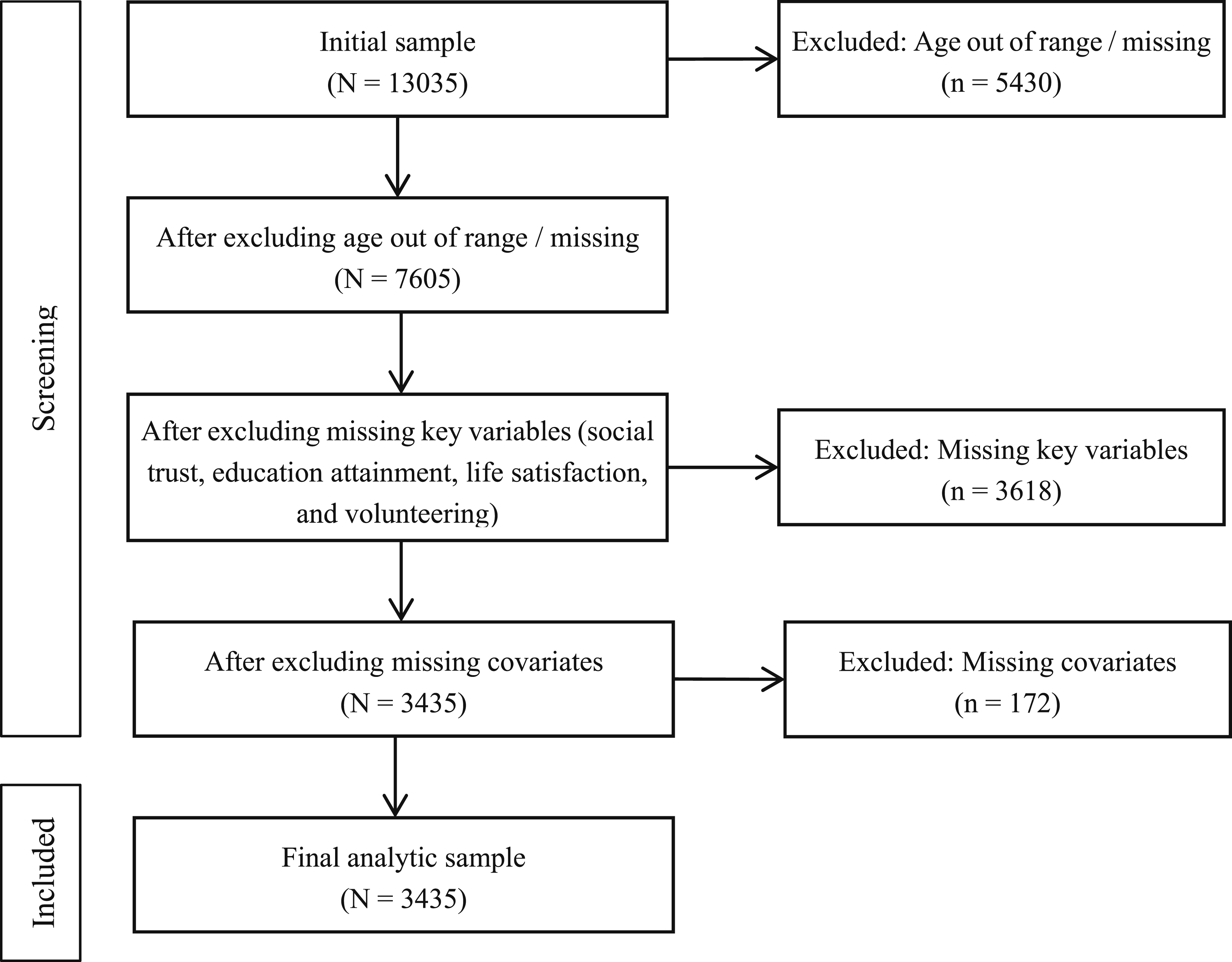
Measures
Independent Variable: Social Trust
Social trust was assessed with the item: “What is the current level of trust among people?” Responses were measured on a 10-point Likert scale, with 1 indicating “complete distrust” and 10 indicating “complete trust.” Higher scores reflect greater levels of social trust.
Dependent Variable: Life Satisfaction
Life satisfaction was measured using the item: “Overall, how satisfied are you with your life?” Responses were rated on a 10-point Likert scale, where 1 represented “very dissatisfied” and 10 represented “very satisfied.” Higher scores indicate higher life satisfaction.
Mediator: Volunteering
Volunteering was measured with the item: “Which of the following volunteer activities have you participated in during the past year?” Thirteen options were provided, including child care, youth tutoring, elderly care, women’s rights, assistance for the disabled, teaching support, poverty alleviation, medical care, legal aid, environmental protection, disaster relief, international aid, and others. Drawing on previous research, we constructed both a count variable and a total participation variable, with higher scores indicating greater frequency of volunteer service involvement.
Moderator: Educational attainment
Education attainment was assessed with the question: “What is the highest level of education you have completed?” Following Zhang & Liu (2022), responses were classified into four categories: (1) Primary or below, including no formal education, literacy programs, and primary school; (2) Secondary school, including middle school; (3) High school, including general high school, vocational high school, secondary technical school, and technical college; and (4) College or above, including associate degrees, bachelor’s degrees, and postgraduate studies.
Control Variables
To reduce potential confounding, we included a set of socio-demographic covariates that are commonly associated with social trust, volunteering, and subjective well-being. Specifically, gender was coded as 1 = male and 0 = female. Age was measured in years and entered as a continuous variable. Household registration was coded as a binary variable, with 1 indicating non-agricultural household registration and 0 indicating agricultural household registration. Marital status was coded as 1 = married and 0 = unmarried. Annual personal income was log-transformed to mitigate skewness and reduce the influence of extreme values, and the natural logarithm of annual income was used in all models.
Data Analysis
Data were analyzed using SPSS 17.0, PROCESS 4.1, and AMOS 21. Descriptive statistics, independent-samples t tests, Pearson correlations, and multivariable regressions were conducted in SPSS. Mediation and moderated mediation were tested using PROCESS Models 4 and 7, with indirect effects estimated via bootstrapping and reported with confidence intervals. Propensity score matching was used as a robustness check. All tests were two-sided, and statistical significance was set at p < 0.05 (p < 0.01 and p < 0.001 denoting stronger evidence).
Results
Descriptive Statistics and Correlations
Descriptive statistics of variables by social trust level
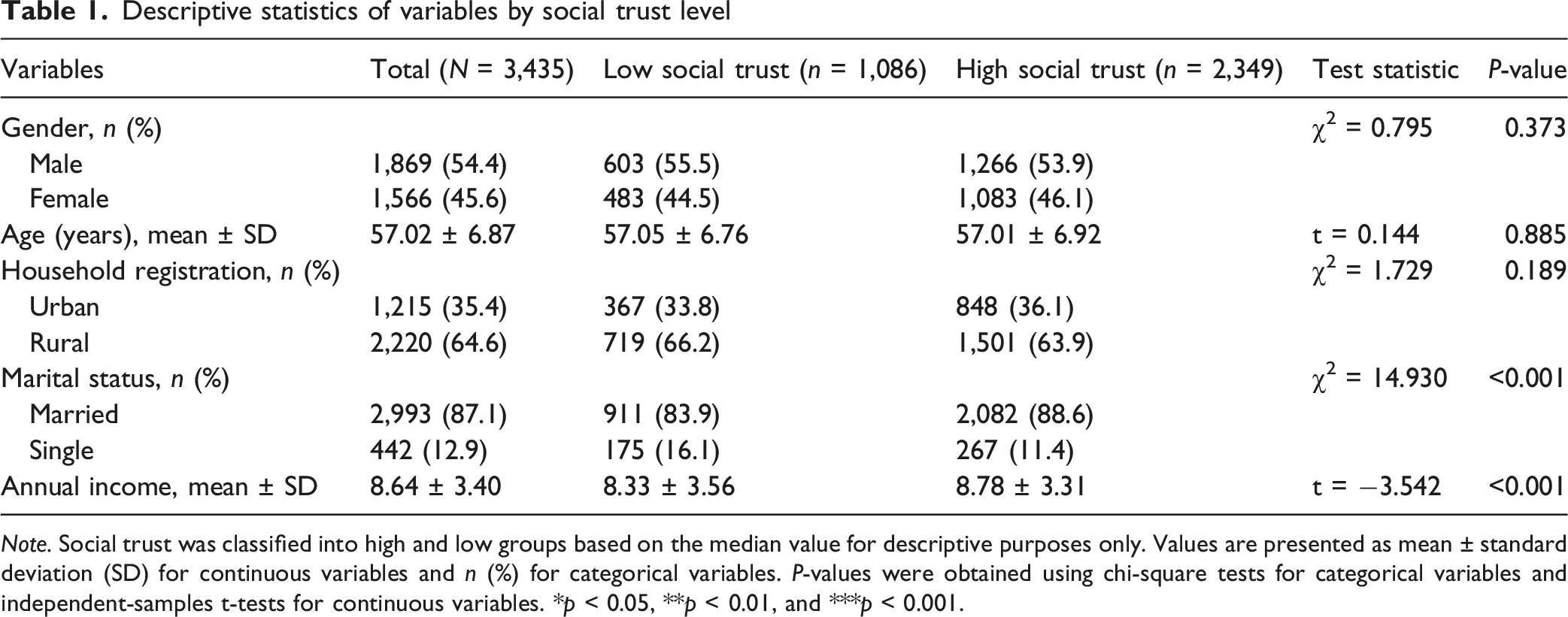
Note. Social trust was classified into high and low groups based on the median value for descriptive purposes only. Values are presented as mean ± standard deviation (SD) for continuous variables and n (%) for categorical variables. P-values were obtained using chi-square tests for categorical variables and independent-samples t-tests for continuous variables. *p < 0.05, **p < 0.01, and ***p < 0.001.
Multivariate Regression Analysis
Crude and adjusted linear regression models for the association between social trust level and life satisfaction
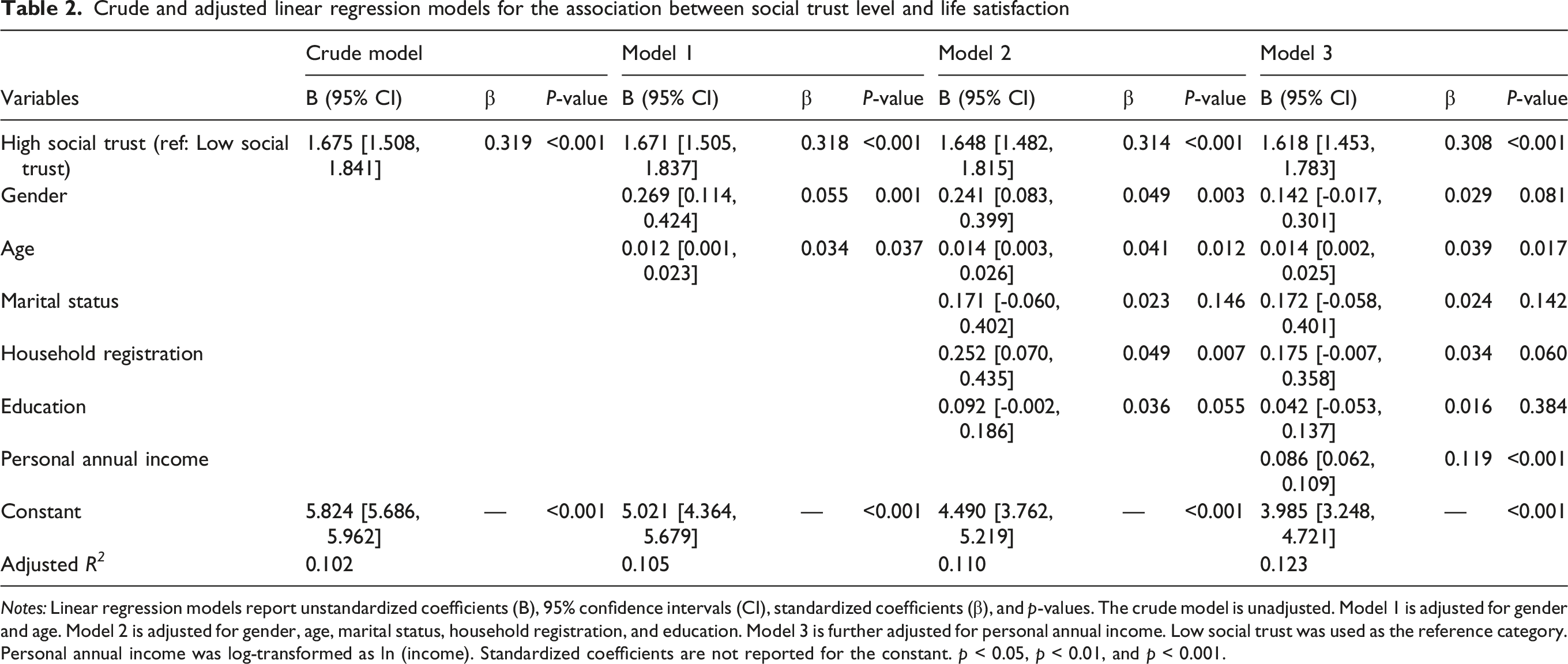
Notes: Linear regression models report unstandardized coefficients (B), 95% confidence intervals (CI), standardized coefficients (β), and p-values. The crude model is unadjusted. Model 1 is adjusted for gender and age. Model 2 is adjusted for gender, age, marital status, household registration, and education. Model 3 is further adjusted for personal annual income. Low social trust was used as the reference category. Personal annual income was log-transformed as ln (income). Standardized coefficients are not reported for the constant. p < 0.05, p < 0.01, and p < 0.001.
After adjusting for covariates, restricted cubic spline analyses showed a positive non-linear association between social trust and life satisfaction, weaker at low trust levels and stronger at moderate to high levels, with wider confidence intervals at the extremes (Figure S1). Subgroup analyses by sex and Household registration further examined potential differences across groups (Figures S2–S5).
Mediation and Moderation Effect Testing
Using SPSS 27.0 and PROCESS 4.1, Table S2 and Figure 2 show that social trust had a significant direct positive effect on life satisfaction (β = 0.410, 95% CI [0.372, 0.436], p < 0.001), supporting Hypothesis 1. Social trust also significantly predicted volunteer participation (β = 0.043, 95% CI [0.024, 0.061], p < 0.001), which in turn predicted life satisfaction (β = 0.133, 95% CI [0.075, 0.191], p < 0.001). With volunteer participation as a mediator, the direct effect remained significant (β = 0.404, 95% CI [0.372, 0.436], p < 0.001), and the indirect effect was also significant (β = 0.006, 95% CI [0.003, 0.010], p < 0.001). The mediated proportion was 2.3%, indicating partial mediation and supporting Hypothesis 2. Moderated mediation model and path estimates (Educational attainment moderates the association between social trust and volunteering)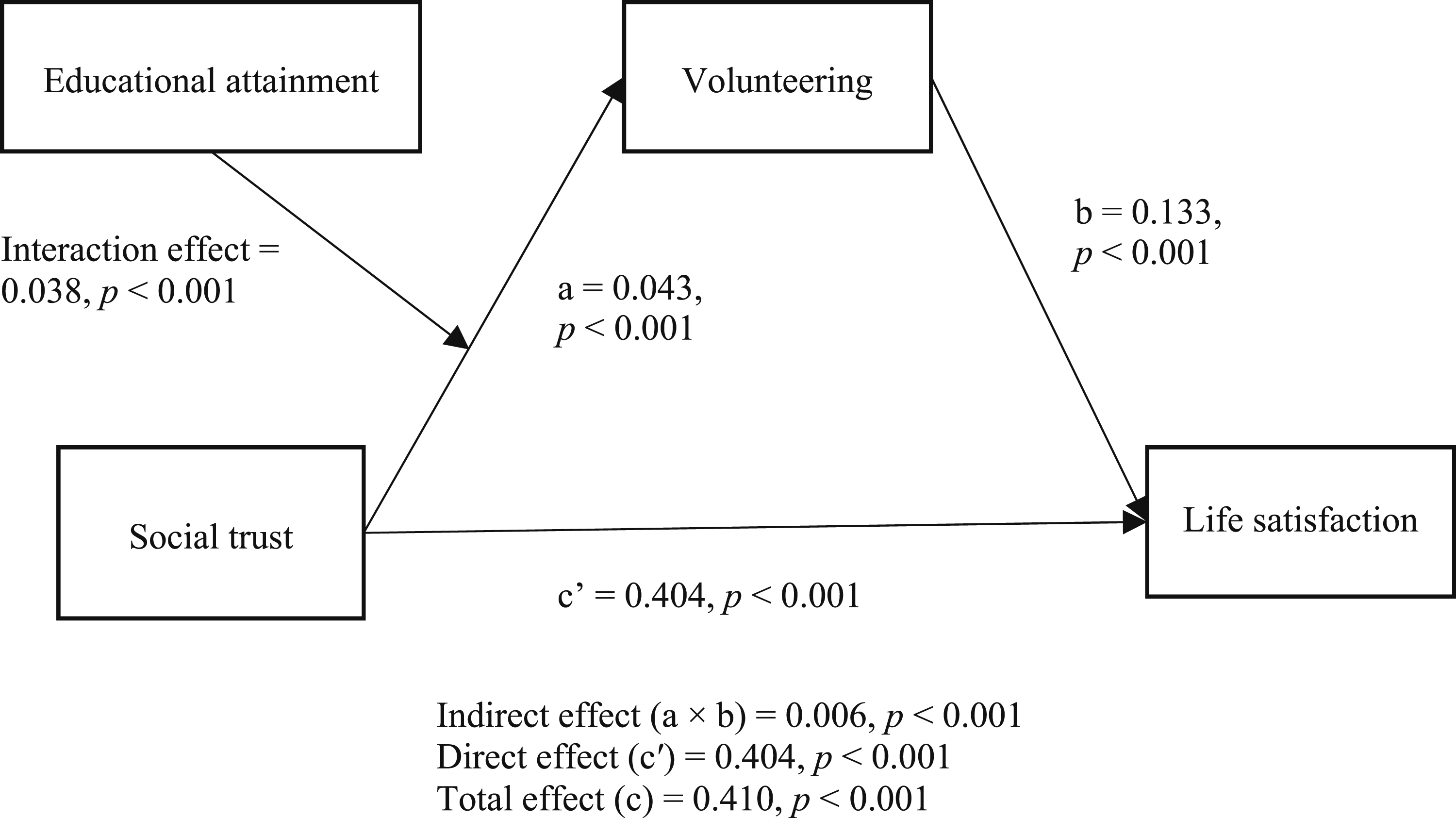
Table S3 shows that education positively predicted volunteering (β = 0.272, 95% CI [0.219, 0.324, p < 0.001), and its interaction with social trust was also significant (β = 0.038, 95% CI [0.016, 0.059], p < 0.001), supporting Hypothesis 3. To provide a clearer depiction of the moderating role of education, an interaction plot was generated (Figure S6). The plot illustrates that the slope for the high education group is steeper than that for the low education group, indicating that the influence of social trust on volunteering is stronger at higher levels of education. In other words, education positively moderates the relationship between social trust and volunteering, further corroborating Hypothesis 3.
Table S4 shows that the index of moderated mediation (index = 0.005, 95% CI: [0.001, 0.009]) does not include zero, indicating a significant moderated mediation effect. The indirect effect was nonsignificant at low educational attainment (Effect = 0.003, 95% CI [−0.001, 0.006]) but became significant at the mean level (Effect = 0.007, 95% CI [0.004, 0.012]) and was strongest at high educational attainment (Effect = 0.012, 95% CI [0.006, 0.020]). The positive indirect effect of social trust on life satisfaction via volunteering strengthens with higher education, indicating that educational attainment amplifies this pathway and supporting Hypothesis 4.
Robustness Check
Balance Test Results

Note. Mean Bias = mean standardized bias; Median Bias = median standardized bias.
Propensity Score Matching Estimation Results

Discussions
Drawing on data from the 2023 China Social Survey (CSS), this study explored how social trust shapes life satisfaction among middle-aged and older adults, and the roles that volunteering and educational attainment play in this relationship. First, our findings confirm that social trust exerts a significant positive effect on life satisfaction. Those adults who report higher levels of social trust also experience greater life satisfaction. This result is consistent with prior research (Lee & Bae, 2023; Wang et al., 2022; Xie & Han, 2024), reinforcing evidence that trust in others is a key determinant of well-being in the context of population aging in China. Notably, by leveraging the most recent national CSS data and focusing specifically on middle-aged and older adults, our study strengthens the contemporary relevance and population-specific applicability of this relationship in an aging society.
Second, we found that volunteering serves as a mediating mechanism linking social trust to life satisfaction. Social trust was positively associated with volunteer participation (Liu et al., 2021), and volunteering itself had a notable positive effect on life satisfaction. This suggests that higher levels of trust encourage middle-aged and older adults to engage in volunteer activities, which in turn enhances their overall well-being. These results align with previous studies (Chu & Koo, 2023; Wang et al., 2022; Xie & Han, 2024) and underscore the importance of volunteer engagement as a pathway through which trust fosters life satisfaction. Beyond corroborating prior evidence, our findings clarify a behavioral “trust-to-action-to-well-being” process, specifying volunteering as a key channel through which social trust is translated into well-being gains among older populations.
Finally, the analysis revealed that educational attainment moderates the relationship between social trust and volunteering. Consistent with earlier findings, highly educated individuals are more likely to uphold social norms and engage in volunteer activities (Nakamura et al., 2022). This indicates that education not only reflects human capital but also serves as a key social and cultural resource that facilitates civic engagement. Importantly, our results suggest that the extent to which social trust translates into volunteering varies by educational level, identifying education as a boundary condition of the trust-to-volunteering pathway.
Practical Implications
The study also offers practical guidance for middle-aged and older adults, volunteer organizations, and practitioners. First, community and grassroots governance should jointly enhance social trust and life satisfaction by creating regular, trust-building interactions. Activities such as neighborhood mutual aid, interest-based groups, community forums, and intergenerational programs can strengthen reciprocity and social connectedness. Greater transparency in public services and accessible information platforms can reduce uncertainty and encourage middle-aged and older adults to maintain social ties and engage in community affairs.
Second, volunteer organizations and social work practice should prioritize participation as a key pathway through which social trust translates into well-being. Efforts should focus on expanding low-threshold, nearby, and flexible volunteering options and improving the quality of engagement. Peer-support groups, life-review activities, and strengths-based approaches can enhance meaning and belonging, helping older adults feel valued and recognized and thereby sustaining participation and improving life satisfaction.
Third, because education shapes the conversion of trust into volunteering, mobilization should be stratified. More specialized and coordination-intensive roles may suit higher-educated adults, whereas clear, easy-to-start tasks can lower barriers for lower-educated adults. Embedding learning–service modules in senior education and continuing education programs may further build capacity and sustain engagement.
Limitations and Future Directions
Several limitations merit consideration. First, the cross-sectional design precludes causal inference among social trust, life satisfaction, volunteering, and education; longitudinal studies are needed to capture temporal dynamics and strengthen causal claims. Second, reliance on self-reported data may introduce reporting and social desirability biases; future work should incorporate objective indicators or multiple data sources. Third, we focused on social trust without distinguishing other trust domains (e.g., institutional or interpersonal trust), nor did we differentiate types of volunteering or educational experiences. Future research should examine these dimensions, including specific volunteer activities and lifelong learning programs (e.g., senior universities or community colleges), to provide a more nuanced understanding of pathways to well-being and social engagement in later life.
Supplemental Material
Supplemental Material - The Impact of Social Trust on Life Satisfaction Among Chinese Middle-Aged and Older Adults: The Role of Volunteering and Educational Attainment
Supplemental Material for The Impact of Social Trust on Life Satisfaction Among Chinese Middle-Aged and Older Adults: The Role of Volunteering and Educational Attainment by Jun Li, Jin-Chang Liu, Jia-Li Jiao, Xin Cao, and Kai-Peng Gan in Journal of Applied Gerontology
Footnotes
Acknowledgements
We thank The Institute of Sociology of Chinese Academy of Social Sciences for providing the Chinese Social Survey (CSS) data used in this study.

Ethical Considerations
This study used publicly available, anonymized, and de-identified secondary data from the 2021 Chinese Social Survey (CSS), which were collected in accordance with national and institutional ethical standards. As the study involved only secondary data without interventions or experimental procedures, no additional ethics committee approval was required in accordance with Chinese law and common academic practice.
Author Contributions
JL and JCL performed the data analyses. JL, JLJ, and XC drafted the manuscript. KPG and JL revised the manuscript. All authors contributed to the final version of manuscript and approved it for publication.
Funding
The authors disclosed receipt of the following financial support for the research, authorship, and/or publication of this article: This work was supported by National Social Science Foundation of China (23CSH060), Yunnan Provincial Social Science Planning Project (B202035), and Yunnan University of Finance and Economics Postdoctoral Later-stage Funding Project (2021D06).
Declaration of Conflicting Interests
The authors declared no potential conflicts of interest with respect to the research, authorship, and/or publication of this article.
Data Availability Statement
Supplemental Material
Supplemental material for this article is available online.
References
Supplementary Material
Please find the following supplemental material available below.
For Open Access articles published under a Creative Commons License, all supplemental material carries the same license as the article it is associated with.
For non-Open Access articles published, all supplemental material carries a non-exclusive license, and permission requests for re-use of supplemental material or any part of supplemental material shall be sent directly to the copyright owner as specified in the copyright notice associated with the article.
