






Abstract
While artificial intelligence (AI) rapidly integrates into everyday life, little research addresses whether vulnerable populations like older adults can reliably distinguish AI-generated images from real ones. Intuitively, older adults may be less reliable in doing so because visual working memory and fusiform face area networks decline with age. In this study, 93 participants (35 children, 28 adolescents, and 30 older adults) completed an image-classification task. A 3 (age group) × 2 (image type: AI vs. real) × 4 (category: Transport, Humans, Plants, Animals) factorial design was used to analyze accuracy rates. Results showed that older adults underperformed both younger groups when identifying AI-generated humans images and real animal images, yet outperformed children in identifying real human images. Other image categories showed no significant age-group differences. These findings reveal older adults’ unique vulnerability to AI-generated images, which suggests that age-inclusive safeguards and targeted interventions may be necessary.
The older adults exhibit a systematic bias toward perceiving human images as real, leading to higher accuracy in recognizing authentic human photos but more errors in identifying AI-generated portraits. Older adults are more likely to misclassify real animal images as AI-generated ones.
In the era of rapid artificial intelligence development, older adults’ cognitive characteristics and behavioral patterns in human image recognition should be fully considered in relevant policy formulation as well as the design of intelligent applications and systems. Older adults tend to readily regard AI-generated portraits as authentic, and this study provides practical implications for preventing and protecting them from emerging AI-related fraud risks.What This Paper Adds
Applications of Study Findings
The rapid integration of artificial intelligence (AI) into daily life presents unprecedented challenges for visual authenticity verification. As diffusion models enable hyper-realistic image synthesis (Rombach et al., 2022), critical gaps persist in understanding how vulnerable populations, particularly children and older adults, discern AI-generated content from reality. This oversight poses the risk of systemic digital inequality, in which age-based exclusion from technology disproportionately impacts a population group (Griffin, 2024). Bronfenbrenner’s ecological systems theory treats AI as a developmental microsystem that differentially shapes perceptual capabilities (Bronfenbrenner, 1979), while visual forensics principles demonstrate how biological constraints impair artifact detection (Farid, 2020). These factors intersect with socio-technical exclusion mechanisms that compound limitations through design biases favoring the capabilities of the young (Griffin, 2024).
Childhood vulnerabilities emerge in AI-saturated environments, where premature executive function limits analytical verification (Dykstra et al., 2023). Ecological systems theory suggests that such exposure occurs without compensatory critical thinking skills, which increases the perceived credibility of synthetic imagery. Older adults face multimodal constraints. Sensory decline reduces contrast sensitivity after age 65, and declining visual and cognitive functions are common conditions among the elderly (Marquié et al., 2019; Zheng et al., 2018). These factors interfere with the detection of diffusion artifacts like spectral anomalies in human features (William et al., 2014). Furthermore, visual working memory deficits hinder cross-image inconsistency recognition (Guo et al., 2021). To make matters worse, socio-cognitive shifts heighten trust and lower deception detection accuracy (Brashier & Schacter, 2020; Ruffman et al., 2012).
Category-specific neural mechanisms further explain the divergence in recognition patterns. Human images rely on fusiform face area (FFA) networks that deteriorate significantly with aging (Park et al., 2002). This neural specialization underpins our experimental focus on human and animal imagery as key test cases for age-related vulnerabilities. Do older adults exhibit systematic misconceptions across different image types? Does greater social exposure and living experience enhance their recognition accuracy, particularly in human image recognition?
Global survey data indicate a negative relationship between age and social media engagement frequency, with users aged 16–24 reporting an average of 4.6 days of social media use per week, compared with 2.81 days among men aged 65 and above; nevertheless, most age groups below 65 continue to use social media on more than 3.5 days per week on average (Kemp, 2026). The regional disparities further exacerbate these challenges. According to a survey conducted by the Beijing Municipal Bureau of Statistics, 88.7% of adults living in Beijing aged at least 60 years actively use smart devices (smartphones, tablets, or computers). However, only very few older adults have received formal digital literacy training, which highlights a significant gap in structured support systems (Beijing Municipal Bureau of Statistics, 2021). The proliferation of AI intersects with Confucian filial piety norms, wherein material support often takes precedence over digital empowerment. This phenomenon makes “digital reverse mentoring,” younger generations imparting digital skills to older adults, necessary.
To resolve contradictory evidence regarding age-related detection patterns, this study tests three null hypotheses:
Older adults (age 60–75) will demonstrate significantly lower accuracy for AI-generated human images than minors, consistent with FFA degradation and diffusion model artifact amplification.
Older adults will demonstrate a relative advantage in recognizing authentic human images compared to minors, reflecting compensatory mechanisms from lifelong social experience accumulation.
Compared with older adults, adolescents (age 12–17) will achieve peak performance across categories, leveraging transitional neurocognitive advantages and extended AI exposure.
Method
Participant
Ninety-three people volunteered to participate in our research. Thirty-five of them were aged from 6–11 (children), 28 of them were aged from 12–17 (adolescents), and thirty of them were aged 60–75 (older adults). The sample included forty-three females (46.24%) and 50 males, with balanced gender representation across all age groups. Given that the AI recognition accuracy in middle-aged adults is influenced by a multitude of complex factors, this demographic was deliberately excluded from the present study. The research ethics review was conducted by the corresponding author’s affiliated institution, with the approval number SUIS2025001.
Materials
Stimulus Distribution Matrix
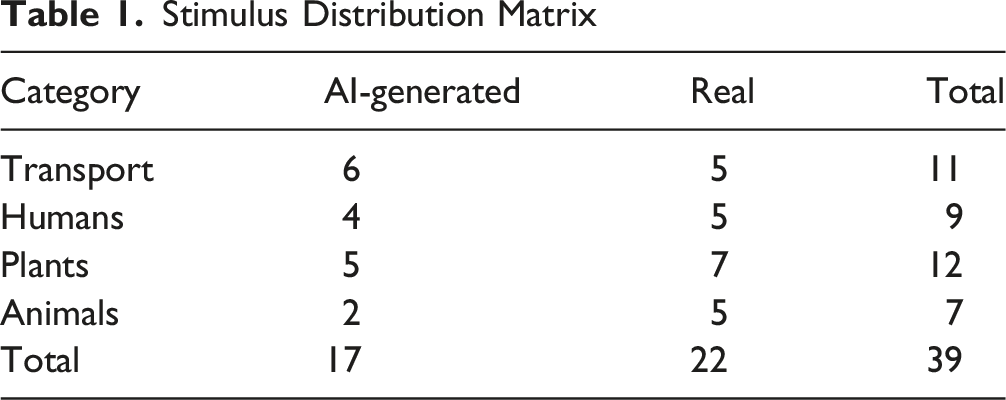
The following procedures define the image sourcing method and validation protocols. (1) AI-Generated Images: Synthesized using DeepAI’s text-to-image API (https://deepai.org/). Generated with prompt engineering to ensure category representativeness (2) Real Images: Sourced from Bing (https://cn.bing.com) and Google (https://www.google.hk). Filtered using “Creative Commons” licenses to ensure ethical compliance. (3) Authenticity Verification: All images underwent AI-detection screening via SightEngine (https://sightengine.com). Validation Thresholds: AI-generated images: ≥99% synthetic probability score. Real images: ≤1% synthetic probability score.
Procedure
A total of thirty-nine stimulus images were randomized and integrated into a digital survey platform using an online survey system (www.wjx.com/), with recruitment employing a multi-stage sampling strategy to ensure demographic diversity through both on-site testing at public spaces across four provinces in China. Participants completed the survey within an estimated 8–9 minutes, with child respondents (aged 6–11) receiving age-appropriate small incentives to maintain engagement, following acquisition of informed consent, including parental consent for minors.
The method for calculating the percentage of accuracy is as follows: (1) get the average number of correct answers of each age group for each category. (Total amount of correct answers for that category divided by the number of participants in that age group); (2) get the average number of correct answers and divide them by the total number of questions in that category. (3) Log-transform the percentage data to approximate a normal distribution; (4) Conducting cross-cohort comparisons by computing mean accuracy rates for AI versus real images within each semantic category (Transport, Humans, Plants, Animals) and performing ANOVA with post-hoc Tukey tests (α = .05) to identify statistically significant inter-group differences.
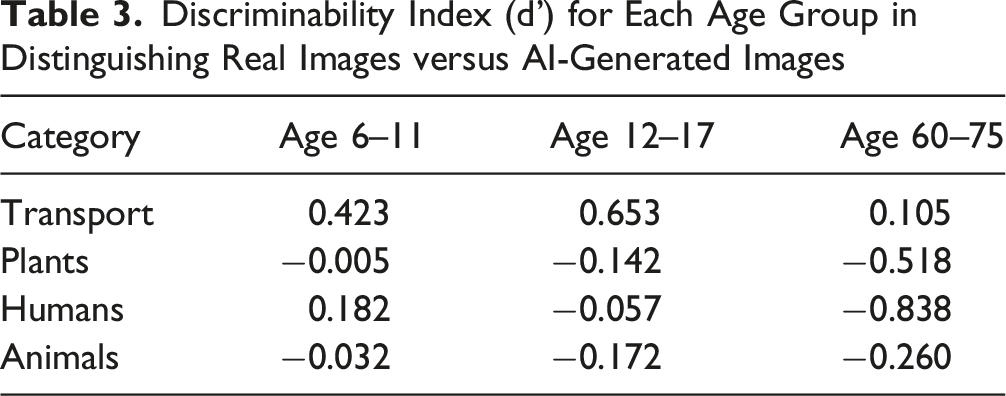
Meanwhile, calculate the discriminability index (d') for each age group across different image types based on the Signal Detection Theory (Green & Swets, 1966). The d' index serves as a core metric for assessing an individual’s perceptual sensitivity, reflecting their ability to distinguish a target signal from background noise. It is computed using the formula: d' = Z(Hit Rate) – Z(False Alarm Rate). A positive d' indicates an ability to differentiate between AI-generated and real images (with higher values denoting stronger ability). A zero suggests an inability to discriminate. A negative d’ signifies a systematic response bias (e.g., a tendency to misclassify real images as AI-generated, or vice versa).
Results
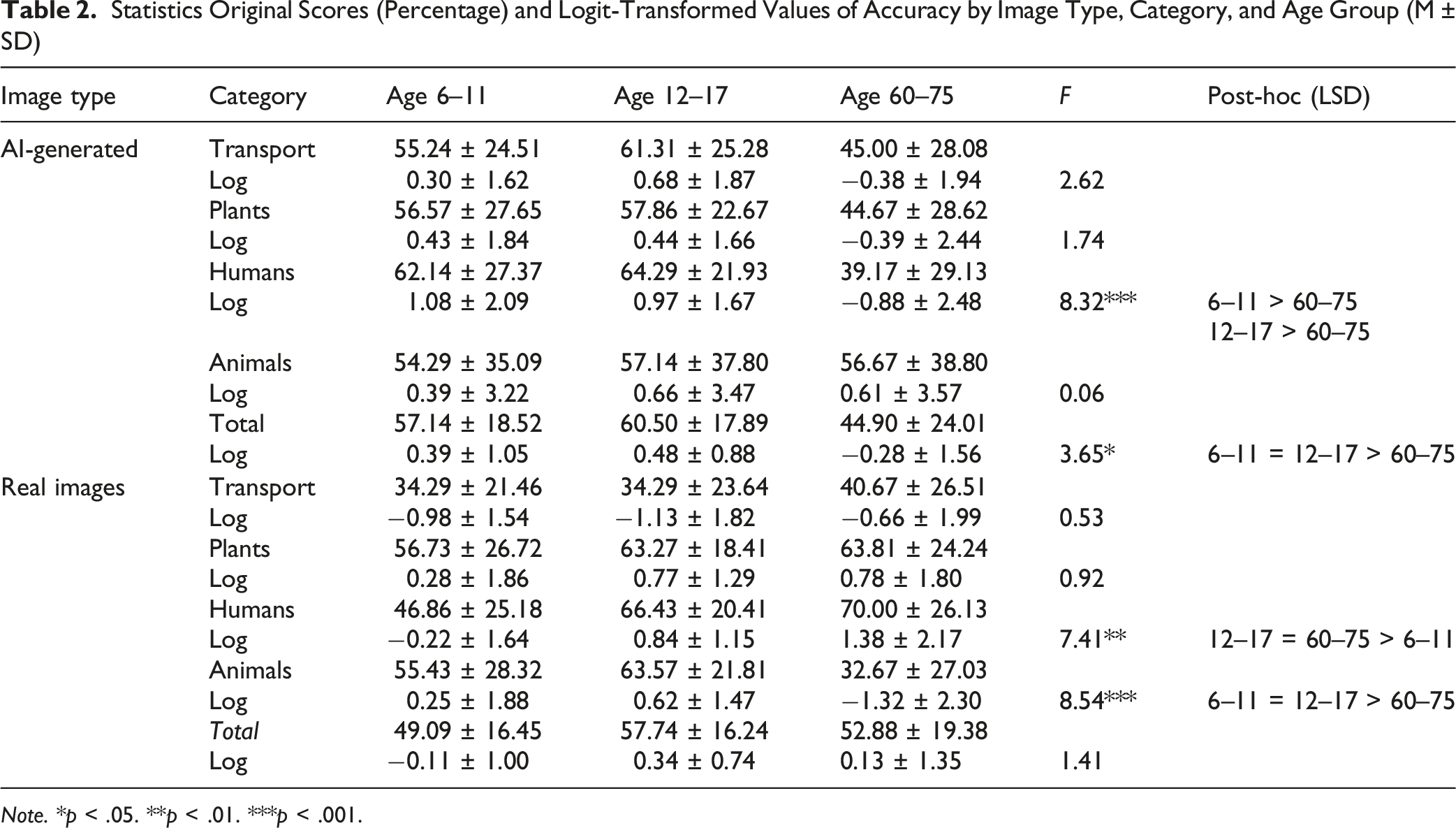
Statistics Original Scores (Percentage) and Logit-Transformed Values of Accuracy by Image Type, Category, and Age Group (M ± SD)
Note. *p < .05. **p < .01. ***p < .001.
AI-Generated Image Recognition
Analysis of variance revealed significant age-related disparities in recognition accuracy across categories. For Transport images, no significant age differences emerged (F(2, 105) = 2.62, p = .08, η2 = .06). Similarly, Plants category recognition showed comparable performance across age cohorts (F(2, 105) = 1.74, p = .18, η2 = .04). However, Humans category recognition demonstrated pronounced age effects: both children (M = 62.14%, SD = 27.37; LogM = 1.08 ± 2.09) and adolescents (M = 64.29%, SD = 21.93; LogM = 0.97 ± 1.67) significantly outperformed older adults (M = 39.17%, SD = 29.13; LogM = −0.88 ± 2.48), F(2, 105) = 8.32, p < .001, η2 = .16. LSD post-hoc tests confirmed these differences (6-11y > 60-75y, t = −1.96, p < .001; 12-17y > 60-75y, t = −1.84, p = .001). Animals category recognition showed no significant age-based variations (F(2, 105) = 0.06, p = .95, η2 = .001). The results indicated that minors collectively outperformed older adults in overall AI recognition (F(2, 105) = 3.65, p = .03, η2 = .08, with pairwise comparisons confirming superior performance of both child and adolescent groups relative to older adults (p < .05).
Real Image Recognition
Distinct patterns emerged across real image categories. Transport images showed no significant age differences (F(2, 105) = 0.53, p = .59, η2 = .01), nor did Plants category recognition (F(2, 105) = 0.92, p = .40, η2 = .02). For Humans images, older adults achieved the highest accuracy (M = 70.00%, SD = 26.13; LogM = 1.38 ± 2.17), followed by adolescents (M = 66.43%, SD = 20.41; LogM = 0.84 ± 1.15; t = 0.54, p = .23) and significantly outperforming children (M = 46.86%, SD = 25.18; LogM = −0.22 ± 1.64), F(2, 105) = 7.41, p = .001, η2 = .14 (6-11y < 12-17y, t = −1.06, p = .02; 6-11y < 60-75y, t = −1.60, p < .001). Animals recognition revealed substantial age effects: both children (M = 55.43%, SD = 28.32; LogM = 0.25 ± 1.88) and adolescents (M = 63.57%, SD = 21.81; LogM = 0.62 ± 1.47) significantly outperformed older adults (M = 32.67%, SD = 27.03; LogM = −1.32 ± 2.30), F(2, 105) = 8.54, p < .001, η2 = .16 (6-11y > 60-75y, t = −1.57, p = .001; 12-17y > 60-75y, t = −1.94, p < .001). Composite analysis indicated no significant age differences in overall real image recognition (F(2, 105) = 1.41, p = .25, η2 = .03).
Discriminability Index (d')
Discriminability Index (d') for Each Age Group in Distinguishing Real Images versus AI-Generated Images
Discussion
The results validated our predictions regarding age-related recognition disparities. Consistent with the first hypothesis, older adults (60–75 years) demonstrated significantly lower accuracy for AI-generated human images than minors (ps < .01). This may potentially be explained by the theorized mechanisms supporting FFA degradation and diffusion artifact amplification (Park et al., 2002; Rombach et al., 2022). Conversely, the second hypothesis was confirmed through their superior authentic human image recognition, outperforming children by 23.14% (p = .002), a finding attributable to compensatory effects of lifelong social experience (Brashier & Schacter, 2020). Older adults displayed a dual cognitive profile. One is risk susceptibility, and they exhibited critical deficits in detecting AI-generated humans (39.17% vs. minors’ 62.14–64.29%), exposing vulnerability to synthetic media deception. The other one, older adults, also have compensatory strength. They performed superior real human recognition (70.00% vs. children’s 46.86%), indicating preserved socio-cognitive expertise. The third hypothesis regarding transitional neurocognitive advantages is supported by the fact that adolescents (12–17 years) achieved peak cross-category performance. Based on these results, older adults exhibit a decline in perceptual discrimination sensitivity for human images. This index effectively separates perceptual sensitivity (d') from response bias (criterion). This phenomenon indicates a decline in older adults’ perceptual discrimination ability for human images, and such reduced perceptual sensitivity may also underlie their overall judgment patterns. This asymmetry may also support the explanation of the interaction between neurobiological decline and experiential compensation, whereby FFA deterioration impairs the processing of synthetic faces, while the activation of schematic knowledge enhances the perception of authentic social cues. Meanwhile, older adults generally have limited familiarity with AI-generated content, lower digital literacy, and less exposure to synthetic media, which may also serve as important factors restricting their authenticity judgment performance.
The pervasive integration of artificial intelligence into 21st-century life necessitates urgent attention to age-related digital disparities. The accuracy of AI recognition and the resulting digital divide also vary considerably across different age groups (Wang et al., 2024). Our findings align with this imperative, revealing that adolescents demonstrate robust perceptual-cognitive capacities across semantic categories. Children exhibit developmental trajectories suggesting experience-dependent plasticity (r = .42, p < .01 between age and accuracy), with their current performance indicating significant growth potential (Δ = +13.28% versus adolescents). These results underscore the critical need for age-inclusive AI design as technological saturation accelerates. These patterns necessitate fundamental reorientation in AI development. As Brashier and Schacter (2020) pointed out in a post-truth landscape, interventions must address older adults’ shifting social motivations and digital literacy gaps. AI systems should integrate gerontological design principles, reducing high-frequency artifacts in synthetic media to promote social and life adaptation among older adults. The research findings provide practical value for governments, AI developers, and anti-fraud units to understand the cognitive features of older adults, guiding the development of AI tools accessible to the elderly and the prevention of harm from fake images. We suggest adding prominent reminder or warning labels on daily products (especially those involving human portraits) frequently used by the elderly, launching popular science and skill training programs to help older adults distinguish AI-generated images from real human photos.
While the findings reveal age-dependent recognition differences, this study acknowledges three methodological constraints. First, participant sampling was geographically restricted to a single metropolitan region (N = 108) with limited socioeconomic diversity and to the exclusion of a critical age cohort (18–59 years). Additionally, the population aged 60 and above exhibited heterogeneity and was not further subdivided in this study. Second, the number of images adopted in this study is unbalanced overall, with fewer AI-generated images than real ones. Stimulus inadequacies emerged in the animal category, which contained only 7 items, significantly fewer than other categories (Humans: 9 items; Plants: 12 items). Such an imbalance may exert a certain influence on classification judgments across different categories. In particular, older adult participants tend to label AI-generated images as real. This issue warrants further in-depth investigation in future research. Third, the study did not control for confounding variables such as daily screen time exposure, working memory, and fluid intelligence. The lack of these covariates prevented us from examining potential interactions between technological experience and cognitive characteristics. Future research should incorporate standardized cognitive assessment batteries (e.g., Matrix Reasoning or working memory). Physiological factors such as age-related declines in working memory and reduced analytical processing ability, together with individual differences in digital media literacy, may all constitute important mechanisms underlying older adults’ errors in image authenticity judgment.
Conclusion
Three critical findings emerge from this investigation: (1) Older adults exhibit a paradoxical profile. They retained expertise in identifying authentic human images but were critically vulnerable to AI-generated human images, which suggests that their neurocognitive skills may compensate for sensory deterioration. (2) Adolescents demonstrate peak cross-modal performance, achieving better accuracy across both synthetic and authentic content due to transitional advantages in perceptual-executive integration. (3) Children display dissociative competencies, showing relative proficiency with synthetic media yet limitations in interpreting authentic social images, consistent with ongoing ventral stream maturation and socio-cognitive development.
Footnotes

Ethical Considerations
Ethical approvals were obtained from Shanghai United International School
Consent to Participate
Informed consent was obtained from all individual participants included in the study.
Author Contributions
Leyao Cai played a crucial role in the data collection, the writing of the original draft, conceptualization, methodology and reviewing and editing. Chenxin Wang played a crucial role in data collection and methodology. Einstein Pillai Sankara played an important role in project administration and supervision, and an equal role in writing review and editing.
Funding
The authors received no financial support for the research, authorship, and/or publication of this article.
Declaration of Conflicting Interests
The authors declared no potential conflicts of interest with respect to the research, authorship, and/or publication of this article.
Data Availability Statement
The dataset analyzed during this study will be available from the corresponding author upon reasonable request.
Declaration of Generative AI and AI-Assisted Technologies in the Writing Process
During the preparation of this work, the author(s) used Deepseek-R1 and GPT-4 for language editing and polishing of specific sections to enhance grammatical accuracy and academic expression. GPT-4 was also used to find resources. After using this tool/service, the author(s) reviewed and edited the content as needed and take(s) full responsibility for the content of the publication