







Abstract
Using a national sample of state and local law enforcement agencies, we collected survey data about local methamphetamine (meth) markets and related problems, in terms of public safety, health, and the local economy, from narcotic officers in these agencies. Our hypotheses related to the importance of the structural and interactional organization of meth markets for assessing their impact on the community; the salience of market instability and its potential for leading to more uncertainty for meth buyers, more market conflict, and related community problems; and the relevance of the types of characteristics of the market (e.g., the presence of import or locally supplied meth markets, general market criminality, and use of technology by the market participants) to community public safety, health, and economic problems. The authors found that markets characterized by both imports and locally produced meth are associated with higher levels of problems compared to local-only markets but import-only markets are associated with fewer problems. Meth markets characterized by more criminal activity and greater use of technology by the market participants are significantly associated with higher levels of community problems but market instability and interactional organization were not significant. Also, the market’s structural organization was related to community problems.
Introduction
Despite decades of research on drug markets through the 1980s (e.g., Goldstein, Brownstein, Ryan, & Bellucci, 1989) and 1990s (e.g., Inciardi, Horowitz, & Pottieger, 1993; Johnson, Golub, & Dunlap, 2000) and more recent work (see Brownstein & Taylor, 2007a, 2007b; Taylor & Brownstein, 2003), there is still more to learn about the social activity and behavior of drug market participants and how the organization of drug markets affects local communities, especially in the area of methamphetamine (meth) markets. Researchers have begun to document how negative public health, safety, and economic outcomes have been observed among people and communities in relation to their involvement with or proximity to drug markets (National Institute of Justice, 2003; National Research Council, 2001). There appears to be variation in terms of outcomes as they relate to different drugs and different drug markets. For example, violence related to disputes between dealers has been observed in studies of crack cocaine markets (Brownstein, Baxi, Goldstein, & Ryan, 1992; Goldstein, Brownstein, & Ryan, 1992; Goldstein et al., 1989; Reuter, 2001), but not necessarily in studies of marijuana markets (Curtis, 1998; Curtis & Wendell, 2002). Also, it has been suggested that variation in the operation of illicit retail drug markets is related to variation in public health, safety, and economic outcomes in those communities, where different markets are located (Berg & Rengifo, 2009; Brownstein & Taylor, 2007a, 2007b; Curtis et al., 1995; Jacques, 2010; Kerr, Small, & Wood, 2005). In this article, we offer an approach for measuring the organization and stability of drug markets using data from detailed surveys with narcotics officers that will permit us to explore the relationship between characteristics of meth markets and potential negative impacts on their surrounding communities.
Measuring the Stability of Markets
To the extent that they are driven by the forces of supply and demand, illicit drug markets 1 are economic markets (cf. Brownstein, 2000; Johnson et al., 1985). However, they are unlike legitimate economic markets in that they operate independent of legal authority and unconstrained by conventional social and cultural norms (see, Johnson, Hamid, & Sanabria, 1992; Reuter, MacCoun, & Murphy, 1990; Skolnick et al., 1990). Therefore, drug markets (at least theoretically) are vulnerable to higher levels of instability, violence, and other social ills than other economic markets. Most illicit drugs in the United States are purchased in drug markets, and most of the violence and many other problems associated with drugs stems from their distribution in markets (Simeone, Rhodes, Hunt, & Truitt, 1997). Not surprisingly, in the late 1980s and early 1990s social scientists devoted much attention to the study of the relationship between instability and violence in drug markets (Brownstein et al., 1992; Dembo et al., 1990; Goldstein et al., 1992; Smith, Sviridoff, Sadd, Curtis, & Grinc, 1992). In fact some researchers linked the observed reductions in criminal violence in U.S. cities during the 1990s to the stabilization of drug markets (Brownstein, 1996; Curtis, 1998; Jacobs, 1999; Lattimore, Trudeau, Riley, Leiter, & Edwards, 1997).
While retail markets for illicit drugs operate outside of the law, they do not operate independent of the social and economic forces that serve as the operational context for all commercial transactions (Brownstein, 2000).As economic markets they typically are characterized by rapid turnover in participants, an overlap of buyers and sellers, and a large variation in price and quality within a narrow geographic area (Reuter, 2001). Historically, they have tended to be clustered geographically in inner city and socially disorganized neighborhoods (Forsyth, Hammersley, Lavelle, & Murray, 1992; Olligschlaeger, 1997). However, variation in the structural and in interpersonal characteristics of illicit drug markets has been observed (Brownstein & Taylor, 2007a; Taylor & Brownstein, 2003), particularly in terms of the drug being exchanged (Johnson et al., 1992). In this study, we focus on meth markets. Meth is particularly interesting in that its markets appear to be organized differently than traditional illicit drug markets (McKetin, McLaren, & Kelly, 2005), and there is evidence that meth markets are found in rural as well as urban areas (Herz, 2000; Weisheit & White, 2009).
To study the relationship between drug market stability and neighborhood outcomes, data to construct reliable and valid indicators of stability are needed. While the stability of drug markets has been conceptualized in terms of enduring and established patterns of operation and relationships, (Brownstein, Crimmins, & Spunt, 2000), little work has been done in operationalizing drug market stability (see, Lattimore et al., 1997; Taylor & Brownstein, 2003). In that illicit drug markets do operate outside of the legal and normative structures of the wider society, it is especially difficult to measure their relative stability. 2 For example, street-level drug dealers are neither likely to maintain nor to make any official records available to researchers regarding the number of sales, quality, and purity of drugs sold. Illicit drug markets therefore can only be measured indirectly or informally. Informally, measures of drug market activity could be constructed from information collected from interviews with individuals very knowledgeable about drug market activity. In an earlier study, we did this by interviewing market participants (see Brownstein & Taylor, 2007a; Taylor & Brownstein, 2003), and in this study, we develop similar measures using data from interviews with narcotics officers.
While official records of arrests, prosecutions, sentences, and incarcerations of drug offenders are available, they are not particularly useful as measures of drug market activity over time since they say little about illicit drug market activity and little if anything about the characteristics or dynamics of these markets. In an earlier study (see Brownstein, Mulcahy, Fernandes-Huessy, Taylor, & Woods, in press), we discussed the value of working with law enforcement in a different way to measure drug markets. Rather than relying on existing law enforcement records of drug markets, we designed a data-collection instrument in which narcotics officers were asked a series of survey questions about their knowledge and understanding of how markets were organized and operated in their locality. While they are an imperfect measure of drug markets, prior research has shown that interview data about deviant activity can be reliable and valid (Fagan & Wexler, 1987; Hindelang, Hirschi, & Weis, 1981). They are better in that they are collected specifically for a research purpose and can more directly be focused on particular research questions, as compared to official justice records.
Social actors interpret and understand their social life in the context of their own experience and interests (Berger & Luckmann, 1966). Participants in illicit retail drug markets have different social roles and locations in the market so have different experience with and different interests in the market. Given their place in relation to the market each has his or her own understanding and perspective of how the market is organized and how it operates and the impact it has on nearby people and their community. In this sense, each perspective tells us something worth knowing about the market and its impact, including the police perspective. For our purpose, the police perspective is particularly useful given the responsibility of the police for addressing problems associated with market activity. We recognize that as is true for any social agent, the knowledge and perspective of local police is a product of their social position and experience (see Ryan, Goldstein, Brownstein, & Bellucci, 1990). But they do represent a common institution in all communities that has a vested interest in knowing where to locate illicit drug markets and knowing something about how they are organized and how they operate as well as the impact they have. While the police perception of local problems related to meth markets is not an independent or disinterested measure of whether or not such problems actually exist, it is important in itself because of the police role in responding to such problems.
The Impact of Illicit Retail Drug Markets on Communities
Illicit retail drug markets are economic markets and participants in these markets do engage in commercial transactions. As economic markets for the exchange of an illicit substance or substances, these markets by their very being may be viewed as a disturbance to the legitimate order of the community. But as social organizations, theoretically they can be operated in an orderly manner such that participants could view their relationship to the community in a less negative or even positive way. That is, participants in an illicit drug market (as a social organization) should adhere to institutionalized (even if not legitimate) patterns of behavior designed to maximize their chances of attaining their goal of transferring a product (illicit drugs) from seller to buyer. Theoretically, then, market participants would primarily be oriented to the goal of successful and profitable drug transactions and not necessarily to any form of community disruption. By definition, illicit drug market participation involves significant risk-taking behavior. However, just as the police have a vested interest in knowing about how illicit drug markets are organized and operate so do the drug dealers—as self-interested profit maximizers. Also, users have an interest in maintaining stable/nonviolent markets, if for no other reason to reduce the likelihood of drawing attention of law enforcement.
If we think about illicit retail drug markets as organizations in this way, then as organizations their impact on the local community might not necessarily be a problem. If the markets are structurally well organized and stable and operate through established and enduring social relationships then their impact on the community should be no better or worse than that of any other economic market in the community. Arguably, the substance that their trade releases into the community may itself be a source of social harm or personal injury, or both. But the substance is not the focus of our discussion. In its own right, a well-organized illicit retail drug market as a social organization that is part of a community might not necessarily be a problem for its surrounding community or for the people who live there. However, what about those that are not well organized in the context of their community? In unorganized markets, it may be that the normal market forces do not operate and the participants no longer maximize their own interests in predictable ways. As noted earlier, research has found negative community outcomes related to the existence of illicit drug markets in their community (National Institute of Justice, 2003; National Research Council, 2001). But, perhaps these negatives outcomes are a product of the organization of the market rather than the presence of the market itself. Does the nature of the organization of an illicit drug market impact the level of problems that a community experiences related to meth markets?
There has not been as much attention in the research literature to the relationship between drug markets and community outcomes as there has been to drug use and users and such outcomes (National Institute of Justice, 2003). There have been a few studies of market economy focusing on markets as a way that local people support themselves (Reuter et al., 1990; Venkatesh & Levitt, 2000) and a number of ethnographic studies describing a community of people whose lives intercept with a local market (Adler, 1993; Bourgois, 1995; Hughes, 1977; Jacobs, 1999; Mieczkowski, 1990, 1992; Murphy, Sales, Duterte, & Jacinto, 2005; Venkatesh, 2008). A growing number of studies have looked more directly at community outcomes, such as the safety issue of violent crime or the health issue of human immunodeficiency virus (HIV; Altschuler & Brounstein, 1991; Bellair & McNulty, 2009; Berg & Rengifo, 2009; Dembo et al., 1990; Fagan, 1989; Ousey & Lee, 2007; Scott & Wright, 2008; Taniguchi, Rengert, & McCord, 2009). Also, some attention has been paid directly to market organization as it relates to community safety or health (Brownstein, 1996; Brownstein et al., 1992; Brownstein & Taylor, 2007; Goldstein et al., 1989, 1992; Jacques, 2010; Payne & Gainey, 2007; Taylor & Brownstein, 2003). The point is that there is a need for additional research specifically on the characteristics of illicit retail drug markets and their impact on surrounding communities.
The Current Study: The National Survey of Meth Markets
We set out in this study to explore whether specific characteristics of meth markets could help explain the potential impact they can have on communities in terms of public safety, health, and the local economy. We examine the importance of market types, the organization of the market, and the stability of the market. Using a nationally representative sample of state and local law enforcement agencies, we collected detailed survey data about local meth markets and related problems from narcotic officers in these agencies. We hypothesized that in areas where the local meth markets are better organized, local police should observe less of a negative impact on the community. In areas where the local drug markets are poorly organized as part of their community, local police should observe there to be a greater negative impact on the community. Our first hypothesis is that markets with less organization are likely to be associated with more dysfunction and disorder and this lack of organization is likely to compromise public safety in these communities, interfere with the provision of public health for meth users, and create more uncertainty and problems for the local economy. On the other hand, repeated consistent organized interactions between the same buyer and seller would allow them to know each other at least well enough to know what to expect from one another and reduce the potential for violent conflicts. Similarly, having established and enduring relationships with dealers that have distinct territories, distinct roles, and follow rules can create the basis for orderly and predictable interactions and fewer community problems.
In areas where the local meth markets are more unstable within the context of their community, we expected that local police should observe there to be a greater negative impact on the community. In areas where the local meth markets are more stable, local police should observe there to be less negative impact on the community. Our second hypothesis is that when the availability, price, and quality of meth changes regularly in a market, it leads to more uncertainty for the buyers and possibly more conflict in the market that leads to more violent encounters in the neighborhood and fewer opportunities to intervene successfully with public health programs for meth users.
Our final set of hypotheses is that the types of characteristics present in the market will affect the level of public safety, health, and economic problems in a community. That is, it might not simply be the organization of the market itself that matters, but the types of characteristics present in the market. For example, if many of the market participants are involved in more general criminal activity that is likely to lead to obvious public safety problems. However, it can also lead to more public health and economic problems due to greater fear in the community associated with this criminal activity. The use of technology by the market participants to facilitate meth sales could also be an important factor. That is, it might suggest that there are fewer social ties and less trust and less personal relationships among market participants who have less face-to-face contact and this can lead to more problems and conflict for the local communities. The source of the meth for the market may also lead to community problems. That is, import markets may be sophisticated enough to have a business model to transport meth great distances but involve the use of more meth market workers that are strangers to a community, which can create local conflicts and more community problems. However, markets dominated by local meth production may be able to blend into the community better by basing the trade among people who know each other.
Method
The frame for our sample of law enforcement agencies was developed from the 2007 National Directory of Law Enforcement Administrators (NDLEA) database of the National Public Safety Information Bureau (NPSIB). The NDLEA is a comprehensive listing of law enforcement agencies in the United States. It includes the name and type of the agency, some descriptive information about the agency (e.g., number of officers), and relevant contact information. For our sample frame, we included data from 15,917 agencies representing four NDLEA segments: municipal police departments and independent city sheriffs; county police and sheriff’s departments; state police/highway patrol headquarters; and state criminal investigation headquarters. We assigned these departments to 27 different strata that were based on the 9 Organized Crime Drug Enforcement Task Force (OCDETF) regions of the National Drug Intelligence Center and three levels of urbanicity using county designations as metropolitan urban, micropolitan urban, or rural. Within each stratum, the allocated sample was selected systematically with probability proportional to agency size (including a disproportionate number of larger agencies), where size is measured as the number of municipal and county police officers/sheriffs per agency.
Of the 15,917 law enforcement agencies, a representative national sample of 4,389 agencies was selected. Our final sample included 1,367 agencies (31.1% response rate or about one third of the 4,389 selected agencies) representing all 50 states of the United States all of which demonstrated knowledge of the extent to which meth was or was not being marketed and was or was not considered problematic in their community. 3 The survey was sent to each agency with a cover letter from both National Opinion Research Center (NORC) at the University of Chicago and the Police Executive Research Forum (a project partner on this study) requesting that it be completed by a narcotics investigator or other designee who is “the most knowledgeable about meth and its impact on the agency and community.” In each case, the selected respondent was a representative of his or her agency (generally a narcotics officer/detective) who from his or her position had knowledge of and experience with meth use, distribution, and/or manufacturing within their jurisdiction and from their position all of them had something to say about the extent to which meth did or did not have an impact on their community.
The respondent in each agency received a seven-page questionnaire asking questions about their jurisdiction in terms of: meth use; the existence, circumstances, and characteristics of local markets; the source of local meth (e.g., local labs, importing); where it is sold; whether or not it is related to local health or safety problems and the local economy; and the organization and operation of local markets relative to patterns of buying, selling, production, and use. Each agency was given the option to respond by mail, fax, or via an online (secure) website at a designated location. To maximize our response rate using multisurvey modes, we implemented the survey using a modified Dillman’s (2009) approach including a respondent-friendly questionnaire; up to five contacts with recipients of the survey; a brief prenotice letter sent a few days prior to the arrival of the questionnaire; a questionnaire mailing that includes a detailed cover letter; a thank you/reminder postcard; a replacement questionnaire; and a final contact by fax or telephone.
Measures
Below we review the content of each of our study measures, including the number of items and their reliability scores.
Community problems
In terms of the impact on the surrounding community, respondents were asked to estimate the extent to which meth was associated with problems related to public health, public safety, and the local economy on a 6-point scale based on the following descriptions: “no impact,” “very small impact,” “small impact,” “moderate impact,” “large impact,” or “very large impact.” These three measures of community outcomes, which form our dependent variable, are specifically related to the views of local law enforcement. As noted earlier, while we do recognize the limitations of a single perspective, we believe that (given the role of the police in the community in relation to illicit drug markets) their perspective is of particular value. 4 Our measures of community outcomes are based on the score assigned by local police respondents in terms of the extent to which meth is considered by them to be a local problem of public health, public safety, and local economy. For our statistical models, we summed these three measures to create a total problems variable with a range of a score of 3–18. A reliability analysis of these three measures yielded a Chronbach’s α score of .960.
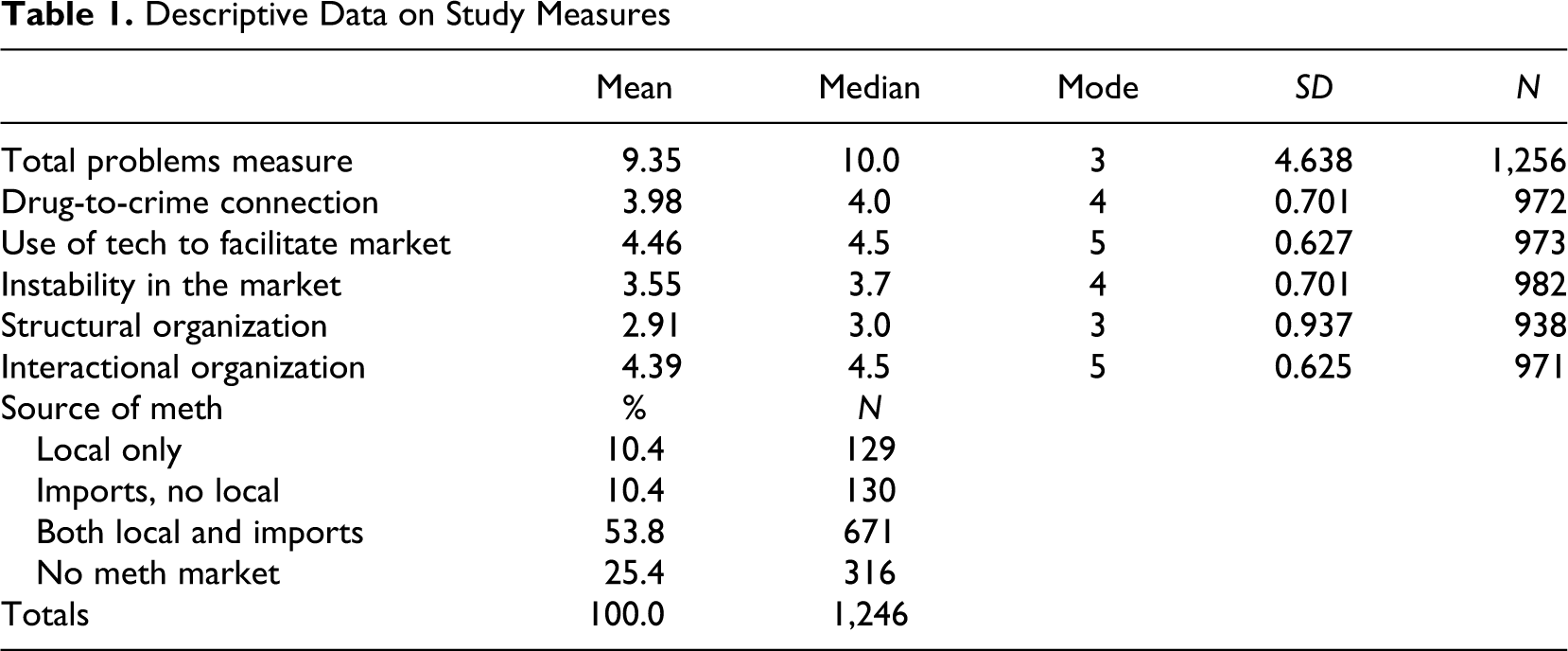
A summed measure of our public health, public safety, and local economy variables yielded a range of 3–18, with a mean score of 9.35 (see Table 1 ). About 20% of our respondents indicated that meth has had no impact on their community in terms of problems with public health, public safety, and the local economy. About 17% indicated that meth had between no impact and a very small impact on their community in terms of problems with public health, public safety, and the local economy. About 12% indicated that meth had between a very small impact and a small impact on their community. About 21% indicated that meth had between a small impact and a moderate impact on their community. About 21% indicated that meth had between a moderate impact and a large impact on their community. About 9% indicated that meth had between a large impact and a very large impact on their community.
Descriptive Data on Study Measures
Types of markets
Building on Reuter and MacCoun’s (1992, p. 237) work on types of drug markets, the first component of our measure of types of markets in an area is based on responses to our survey item on the source of meth including the following options: locally produced/home-cooked, imported from Mexico, imported from another country other than Mexico, and imported from another U.S. State. Based on the distribution of our data, we coded the source items into three categories for the purposes of our later regression models: market characterized by (a) both sources (local/home-cooked and imported from Mexico or somewhere else [either another U.S. State or another country]), (b) local/home-cooked only, and (c) imported only (jurisdictions not reporting a meth market are not included in multivariate models). A descriptive analysis of our source of meth variable (see Table 1) showed that 10.4% of the jurisdictions had local sources of meth only, 10.4% had import sources only, 53.8% had both local and import sources, and 25.4% had no meth market (this group was removed from our outcome model).
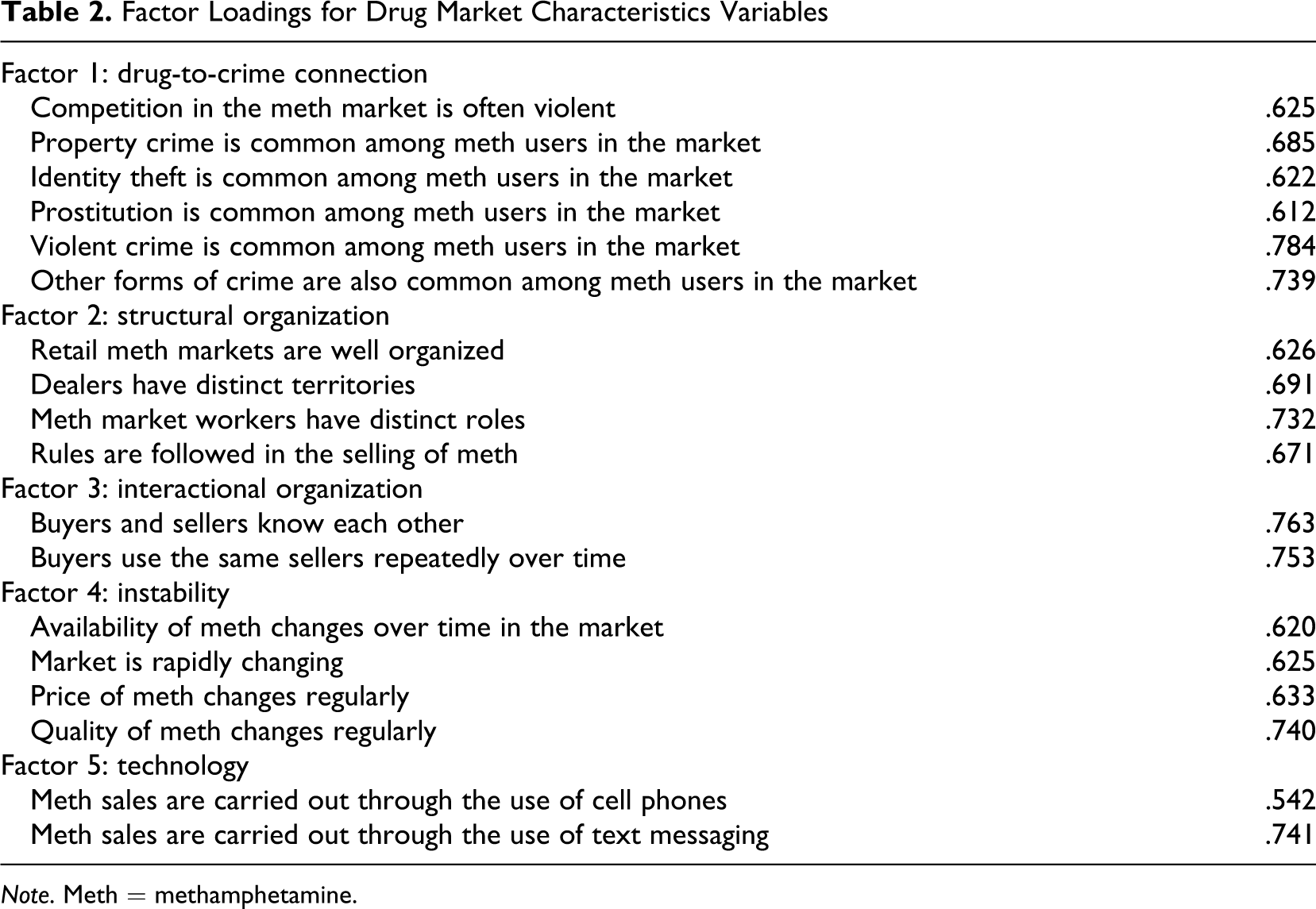
Following the research on differences in types of drug markets based on their relationship to crime (e.g., Berg & Rengifo, 2009; Inciardi et al., 1993; Jacques, 2010), we included as a component of our measure of type of market a drug-to-crime-connection derived from six items: The extent to which the competition in the meth market is violent, the extent to which property crime is common among meth users in the market, the extent to which identity theft is common among meth users in the market, the extent to which prostitution is common among meth users in the market, the extent to which violent crime is common among meth users in the market, and the extent to which other types of crime are common among meth users in the market. A reliability analysis of our six-item drug-to-crime-connection measure yielded a Chronbach’s α score of .802. Our measure of the drug-to-crime-connection related to a market was constructed from the below factor analysis in which six items emerged (see Table 2 ). The scale for this measure was bounded to an average score from 1 to 5 (strongly agree = 5, somewhat agree = 4, neither agree nor disagree = 3, somewhat disagree = 2, and strongly disagree = 1). For jurisdictions with meth markets, the average experience is that narcotics officers “somewhat agree” (a value of 3.98) with the statement that a range of crimes (property crime, identity theft, prostitution, violent crime, and other types of crime) are common among meth market participants as part of being involved in the meth market and that competition in the meth market is often violent (Table 1).
Factor Loadings for Drug Market Characteristics Variables
Note. Meth = methamphetamine.
Based on earlier findings about the role of technology in different types of illicit drug markets (Brownstein & Taylor, 2007), we included two measures of technology used to facilitate the exchange of meth in the drug market including the extent to which meth sales are carried out through the use of cell phones and/or text messaging. A reliability analysis of our two-item technology measure yielded a Chronbach’s α score of .601. Our measure of technology used to facilitate the exchange of meth in the drug market was constructed from a factor analysis in which two items emerged (the extent to which meth sales are carried out through the use of cell phones and/or text messaging). For jurisdictions with meth markets, narcotics officers (on average) agree (between “somewhat agree” and “strongly agree”) that meth markets are often facilitated by the use of technology (a value of 4.46).
Market Instability
Our measure of instability in the market is grounded in earlier work on the fluctuation of market characteristics over time (Taylor & Brownstein, 2003) and was derived from the following four items: the extent to which the availability of meth changes over time in the market, the extent to which the market is rapidly changing, the extent to which the price of meth changes regularly, and the extent to which the quality of meth changes regularly. A reliability analysis of our four-item instability measure yielded a Chronbach’s α score of .712. Our measure of instability in the market was constructed from a factor analysis in which four items emerged (whether the availability of meth changes over time in the market, whether the market is rapidly changing, whether the price of meth changes regularly, and whether the quality of meth changes regularly). For jurisdictions with meth markets, narcotics officers are in the middle (“neither agree nor disagree”) on the extent to which there is instability in the jurisdiction’s meth market (a value of 3.55). The typical meth market in our sample has a mid-level of instability.
Market Organization
We begin with two measures of market organization: structural and interactional organization (Brownstein et al., 2000; Brownstein & Taylor, 2007; Taylor & Brownstein, 2003). Structural organization refers to the structural elements of the market, and interactional organization refers to the patterns of social relationship among market participants (Brownstein et al., 2000). A structurally stable market would have “established routines of operation and relationship, recognized territorial boundaries, order maintenance standards, and hierarchical patterns of authority” (Taylor & Brownstein, 2003, p. 80). Measures of structural stability would then be reflected in responses to questions about things like whether markets are well organized, dealers have distinct territories, market workers have distinct roles, and rules are followed in the selling of meth. A reliability analysis of our four-item structural organizational measure yielded a Chronbach’s α score of .706. Our measure of structural organization was constructed from a factor analysis (see Table 2) in which four items emerged (markets are well organized, dealers have distinct territories, market workers have distinct roles, and rules are followed in the selling of meth). The scale for this measure was bounded to an average score from one to five. For jurisdictions with meth markets, narcotics officers (on average) are in the middle (“neither agree nor disagree”) on the extent to which meth markets are structurally organized (a value of 2.91). That is, the typical meth market in our sample has a mid-level of structural organization.
On the interactional level, stability would involve “ongoing and established relationships among participants who are knowledgeable of each other” (Taylor & Brownstein, 2003, p. 82). This would be reflected in responses to questions about repeated exchanges with the same people (e.g., dealer) who you know and can trust in familiar locations. Therefore, our measure of interactional stability uses variables regarding the extent to which buyers and sellers know each other and whether the buyers use the same sellers repeatedly over time. A reliability analysis of our two-item interactional organizational measure yielded a Chronbach’s α score of .658. Our measure of interactional organization was constructed from a factor analysis (see Table 2) in which two items emerged (extent to which buyers and sellers know each other and whether the buyers use the same sellers repeatedly over time). As above, the scale was bounded between one and five. For jurisdictions with meth markets, officers agree (between “somewhat agree” and “strongly agree”) that meth markets are interactionally well organized (a value of 4.39).
Results
In the following section, we present our factor analysis results, along with our reliability analyses, followed by our presentation of our outcome model.
Factor Analysis
Our team developed a number of measures (n = 26 survey questions) to assess the characteristics of the meth markets in our study. To increase the reliability of these measures and avoid the problem of multicollinearity, we conducted an exploratory factor analysis of our market measures (using Varimax rotation). Five main factors emerged that aligned with our conceptualization of markets, including measures of the (a) drug-to-crime connection in the market, (b) structural organization, (c) interactional organization, (d) instability in the market, and (e) use of technology to facilitate the market. These five factors accounted for 73% of the variance in our factor analytic model. The factor loadings on the top five factors are presented in Table 2. The other six factors that emerged had smaller loadings (below 0.6) and we do not use them in our later outcome model (due to the low reliability of these measures or lack of conceptual clarity). The below factor analytic results were used to create simple summed scales (e.g., for the drug-to-crime connection factor, we summed the six below factors and divided the score by six).
Regression Model
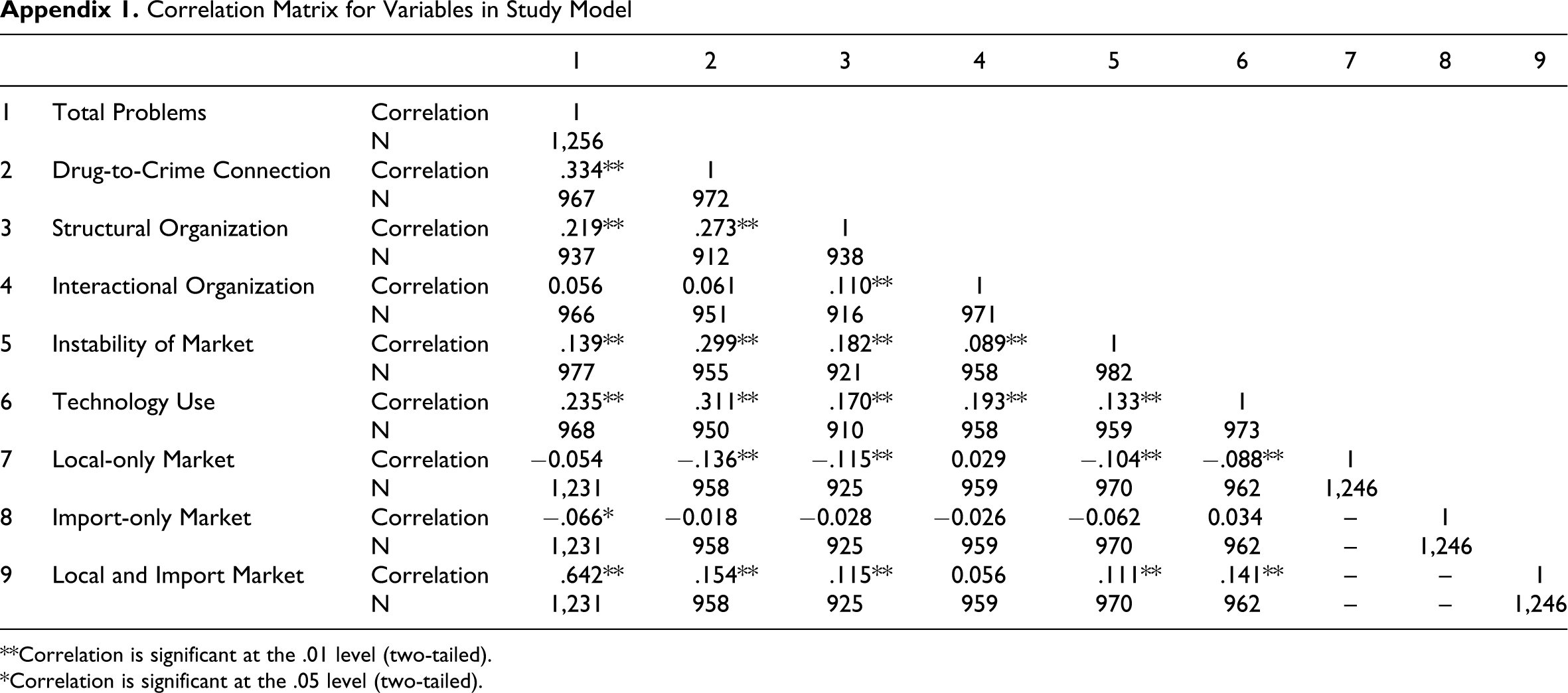
Prior to developing our regression model, we examined the bivariate relationship among our study variables (see Appendix 1), and found that most of the study variables were significantly related to our total community problems measure, with correlations as high as 0.64. To explore these relationships further, we developed a multivariate model.
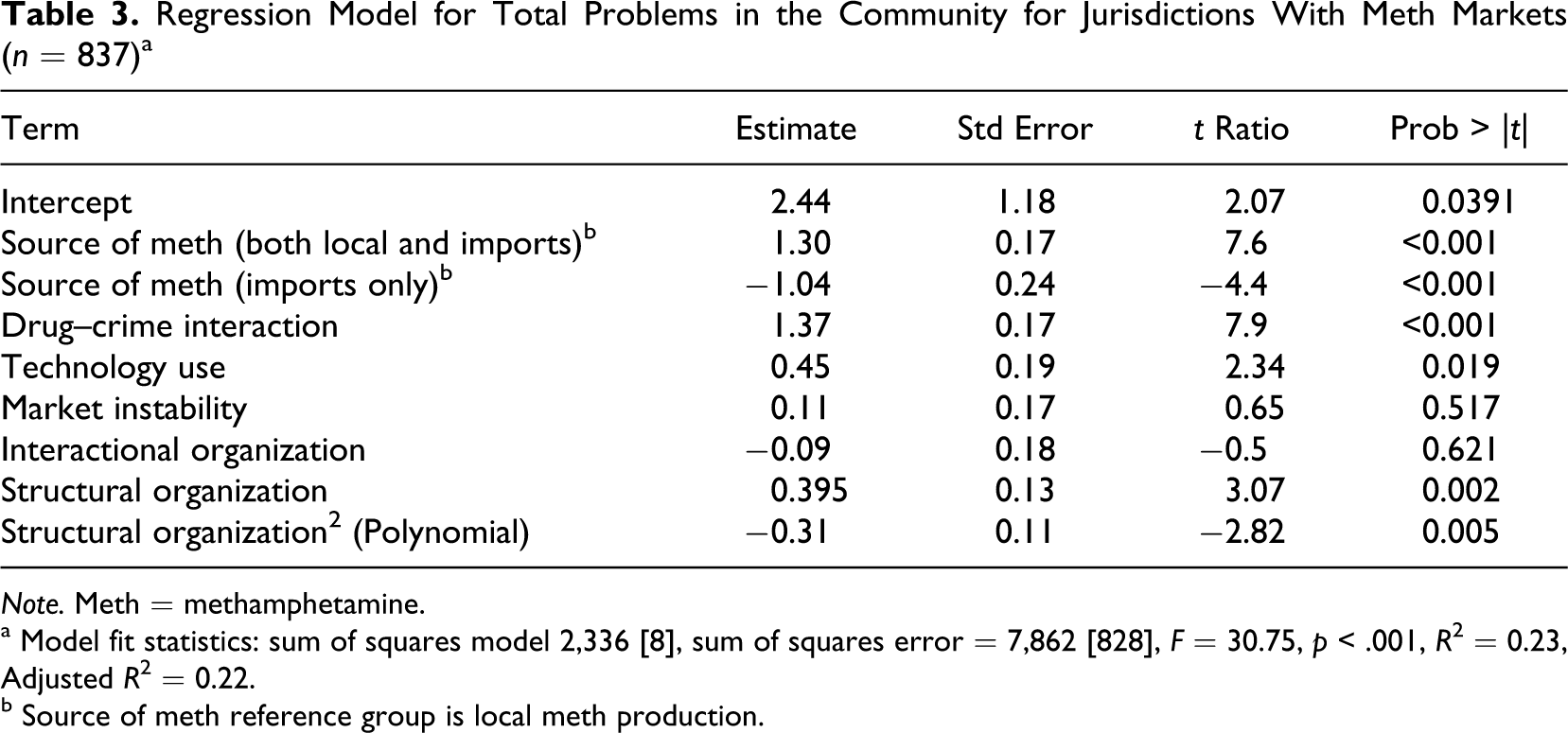
Table 3 presents our results for our composite dependent variable based on a summation of the public health, public safety, and local economic problems questions. We used an ordinary least squares (OLS) regression model because our dependent variable problem measure had a range to a score up to 18 and was interval-like in character with a normal distribution (we also assessed our results with a nominal regression model and a count model and in both cases found substantively similar results as reported in this article). Our factor analysis (see Table 1) identified five main market characteristics: structural organization, interactional organization, instability in the market, drug-to-crime-connection related to the market, and use of technology to facilitate the market. These five factors are included in our regression model plus a categorical variable for the source of meth for the market.
Regression Model for Total Problems in the Community for Jurisdictions With Meth Markets (n = 837) a
Note. Meth = methamphetamine.
a Model fit statistics: sum of squares model 2,336 [8], sum of squares error = 7,862 [828], F = 30.75, p < .001, R 2 = 0.23, Adjusted R 2 = 0.22.
b Source of meth reference group is local meth production.
The overall fit of our regression model is decent, R 2 = .23, adjusted R 2 = .22, F = 30.75 (df = 8, 828), p < .001. 5 Prior to running our regression model, we examined a variety of diagnostic plots and checked our data in terms of outliers, normality, collinearity, and linearity as outlined by Belsley, Kuh, and Welsch (1980) and Rousseeuw and Leroy (1987). Our models were consistent with the underlying assumptions of OLS regression such as linearity, homogeneity of variance, normally distributed residuals, independence of errors, and proper model specification (Belsley et al., 1980).
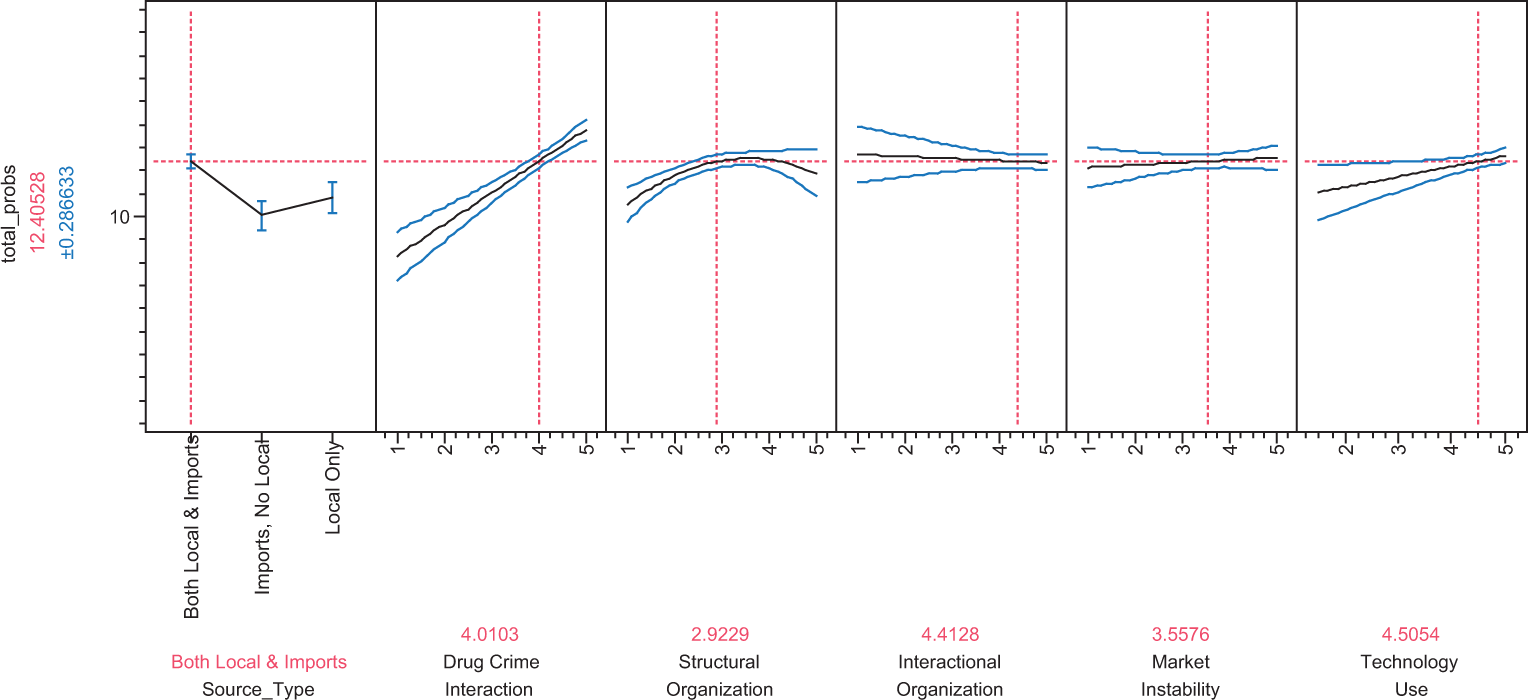
We found a number of statistically significant variables in our model. First, Table 3 indicates that markets characterized by both imports and locally produced meth (β = 1.30, p < .001) are associated with higher levels of problems compared to local-only markets (our reference group). Whereas markets characterized by importing of meth only (β = −1.04, p < .001) are associated with fewer problems compared to local-only markets (our reference group). Table 3 indicates that meth markets characterized by more criminal activity (β = 1.37, p < .001) and greater use of technology by the market participants (β = 0.45, p = .019) are significantly associated with higher levels of problems (in the areas of public health, safety, and local economics). We found that our variables for market instability and interactional organization were not statistically significant. Our final finding relates to structural organization, where we found a curvilinear relationship (see upside down U in Figure 1 ). To model this curvilinear relationship we added a quadratic (X 2) polynomial variable to the model, along with the untransformed version of the structural organization variable. To facilitate a more straightforward interpretation of our structural organization variable, we present a graph of the relationship of this variable to our dependent variable (see Figure 1). As seen in Figure 1, markets containing very low levels of structural organization or very high levels of structural organization are associated with fewer community problems. However, markets with mid-levels of structural organization are associated with more community problems.
Prediction profiler.
Discussion
We set out in this study to explore whether specific characteristics of meth markets could help explain the potential impact they can have on communities in terms of public safety, health, and the local economy. Building on findings of earlier research, we examined the importance of market types (the source of meth for the market, whether market participants are involved in criminal activity, and the use of technology in a meth market), the organization of the market (structural and interactional organization), and the stability of the market. Using a nationally representative sample of state and local law enforcement agencies, we collected detailed survey data about local meth markets and related problems from narcotic officers in these agencies.
Defining illicit retail drug markets as the particular place at which the transfer of drugs from buyers to sellers takes place (National Research Council, 2001, p. 160), we observed that the areas we studied included not a single meth market but rather a number of markets that could vary in a number of ways (Brownstein et al., in press). The first thing we learned from our survey data about particular meth markets in given areas was that were some commonalities among the meth markets in our sample in a number of areas. Across our measures for this analysis, we observed that our sample of agencies (on average) characterized their mix of local meth markets in a “mid-range” across most of our measures. In terms of how local police viewed the extent to which meth was a local problem, we observed the full range of impacts associated with meth: about half of the sample indicated that meth has had no, a very small, or a small impact on their community in terms of problems with public health, public safety, and the local economy and the other half assessed the impact as moderate, large, or very large.
Next, narcotics officers “somewhat agree” (a value of 3.98 out of 5) with the statement that a range of crimes are common among meth market participants as part of being involved in the meth market and that competition in the meth market is often violent, they were in the middle (“neither agree nor disagree”) on the extent to which there is instability in the jurisdiction’s meth market (a value of 3.55/5), they were in the middle (“neither agree nor disagree”) on the extent to which meth markets are structurally organized (a value of 2.91/5), but they gave a higher rating for interactional organization (between “somewhat agree” and “strongly agree” or a value of 4.39/5) and the use of technology to facilitate the exchange of meth (between “somewhat agree” and “strongly agree” or a value of 4.46/5). Also, the source of meth for the markets referenced in our study was split across local sources of meth only (10%), import sources only (10%), both local and import sources (55%), and no meth markets (25%).
We developed a number of hypotheses for our study. Our first hypothesis is that markets with less organization are likely to be associated with more dysfunction and disorder and this lack of organization is likely to compromise public safety in these communities, interfere with the provision of public health for meth users, and create more uncertainty and problems for the local economy. In terms of the importance of the organization of the market (structural and interactional organization), we learned surprisingly that the variable interactional organization was not statistically significant and that structural organization is important but in a more complex way than we hypothesized. For structural organization, we found a curvilinear relationship. We were correct in hypothesizing that markets containing very high levels of structural organization would be associated with fewer community problems. However, we did not expect that markets containing very low levels of structural organization would be associated with fewer community problems. Perhaps when markets are so poorly organized they function so ineffectively that not much meth is exchanged in these markets so they do not contribute too many problems. Our main finding is that markets with mid-levels of structural organization are associated with more community problems. These markets may be organized enough to allow for large quantities of meth to be sold in the market but not organized enough for these transactions to be carried out smoothly. It is in this middle state where the community can experience the worse outcomes and is something the law enforcement has to consider as it intervenes in these markets. That is, unless law enforcement can eradicate highly organized markets to very low levels of organization, they may be making the situation worse for the community by replacing a highly organized market with a moderately organized market.
Our second hypothesis was that when the availability, price, and quality of meth changes regularly in a market (i.e., more market instability), it leads to more uncertainty for the buyers and possibly more conflict in the market that leads to more violent encounters in the neighborhood and fewer opportunities to intervene successfully with public health programs for meth users. We found that our variable for market instability was not statistically significant. Despite our hypothesis suggesting that more instability would be associated with more community problems, it may be that since they operate outside of legitimate realms that instability is a natural element of meth markets and does not help distinguish one from another very well. That is, even in the areas with highly organized markets they too may operate in an unstable environment and simply make constant adjustments to keep their operation running.
Our final set of hypotheses is that the types of characteristics present in the market will affect the level of public safety, health, and economic problems in a community. That is, it might not simply be the organization of the market itself that matters but the types of characteristics present in the market. First, we learned that markets characterized by both imports and locally produced meth are associated by local police with higher levels of problems compared to local-only markets. The mixing of import and local markets appears to be a volatile mix. In these cases, having both markets may create a breakdown in the organization of the market and puts the market into a mixed level of organization that leads to more community problems. Next, we observed that markets characterized by importing of meth only are associated with fewer problems compared to local-only markets. This was a somewhat unexpected finding. It may be that the import markets (especially when not mixed with the local markets) are better organized and more profit driven. Local-only markets may be more likely to be driven by sellers who are also meth users, which are more likely to lead to less organized markets and additional community problems.
Finally, as we hypothesized, meth markets characterized by more criminal activity and greater use of technology by the market participants are significantly associated with higher levels of community problems. Having more market participants involved in more general criminal activity is not surprisingly associated with more community problems. Also, as explained earlier, the greater use of technology by the market participants to facilitate meth sales might suggest that there are fewer social ties and less trust and less personal relationships among market participants who have less face-to-face contact, which could lead to more problems and conflict for the local communities.
Limitations of the Study
We recognize that our data has some limitations. First, there is the issue of our reliance on the knowledge of local law enforcement to characterize the clandestine world of meth markets in their jurisdictions. Just as one can question the reliability and validity of data collected from drug addicts (who may be inebriated during an interview or be motivated to complete the interview to receive a cash incentive and provide unreliable data) and sellers (who may not want to be truthful about revealing elements of the drug markets for fear of reprisal from other dealers or fear that the information may become known by the police), one can question the accuracy of surveys with narcotics enforcement personnel. However, we do believe that surveys of police of drug markets do have value. While the police are not direct participants in the actual exchange of drugs, they do have a role in these markets. The police not only shape these markets through their interdiction activities, but it is their job to understand the dynamics of these markets so they can disrupt them in meaningful ways. The police represent a common institution in all communities that has a vested interest in knowing where to locate illicit drug markets and knowing something about how they are organized and how they operate as well as the impact they have. Given the multiple players involved in drug markets, there are different perspectives that need to be captured. In the field of measurement, knowledge often has different sources. The police provide another, perhaps equally or more relevant, perspective. The police perspective is also likely to be broader than any one drug user or seller’s perspective and not limited to a particular block or neighborhood. Law enforcement’s perspective on drug markets is also more likely to be informed by known facts (e.g., lab reports on the purity of drugs), as opposed to supposition.
Another concern with our data is our modest response rate of about one third of a national sample of 4,389 agencies. We believe that our response rate was somewhat low due to the fact that meth markets are not well represented in all communities across the United States (see Office of Applied Studies, 2006). That is, for many agencies, they do not have a meth problem and they might not have seen much relevancy in the survey. In fact, our response rate was somewhat better in regions that are generally associated with higher rates of meth use (e.g., the Southwest, West central, and Pacific regions of the United States were all around a 40% response rate) and lower in areas not associated with meth use (the New York/New Jersey region and New England region were closer to a 25% response rate). However, other than some regional differences in our response rate (which we addressed through statistical weighting of our sample), we did not observe a pattern to our nonresponse based on data for all 4,389 selected agencies and feel that our data provides a reasonable representation of law enforcement in the United States. We also observed a diversity of responses to our survey questions, suggesting that we also had a diverse sample of agencies in our study. The goal of our sampling approach was to include a rich variety of markets in our study to assure that we captured the diversity of meth markets in the United States, and despite our low response rate (which we address through statistical weighting), we believe we have achieved that goal. Finally, we ended up with over 1,300 completed agency-level surveys, providing a statistically large sample to explore our research questions with a high level of statistical power.
Conclusion
Our overall purpose for this analysis was to assess when and under what circumstances police view illicit retail meth markets as a problem to their local community. Recognizing that it is not the only legitimate perspective, we focused on the law enforcement perspective because of their explicit responsibility to address problems in their community, notably those associated with illicit retail drug markets. Building on findings of earlier research on such markets, we distinguished meth markets by type in terms of the mix of local markets in an area based on the source of the product, the relationship of local markets to crime, the relative level of organization of the markets, and their relative stability. We hypothesized that police in areas where local markets were less organized and more unstable would be more likely to say that the markets were a problem for their area.
Earlier research found there to be a link between the likelihood that local illicit retail drug markets are a problem for their community given the characteristics of the local market (e.g., Goldstein et al., 1989) or the mix of market types in an area (e.g., Reuter & MacCoun, 1992). Our findings support these conclusions, demonstrating that both the mix of market types and certain characteristics of local markets are related to the whether or not local police perceive the markets to be a problem in their area. But it is not simply whether particular local markets are more or less organized, by rather the nature of that organization. We found that the perceived impact of the markets was more a product of the structural organization of the markets and not a product of whether or not the interactions of market participants were organized. Similarly, we found that the mix of market types in an area, particularly the combination of locally produced and imported product is important for understanding how problematic a market may become for the local community.
There are policy implications of our findings for law enforcement. They suggest that to adequately address what they see as problems associated with local illicit retail drug markets, the local police need to view each particular market in their jurisdiction independently and to assess the type and level of organization of each. In addition, they need to be attentive to the mix of markets in their area, and possibly in their neighboring jurisdictions. This would suggest that even in a single jurisdiction a single approach to dealing with problems associated with local drug markets would be insufficient. The jurisdiction would gain important knowledge from an ongoing assessment of the nature and mix of particular spots in their area, where there are drug markets as well as the organizational features of those markets and the mix of markets in the area. Law enforcement responses could then be advanced that would be attentive to these markets features and characteristics and did not unnecessarily disrupt these markets in ways that created more problems than they solved. Future research will need to include qualitative methods from multiple sources (e.g., including meth dealers and users in the study) to further explore these findings and sort out the nature of the relationship between market types, organization, stability, and community outcomes.
Footnotes
Acknowledgments
The authors thank Bethany Deeds of NIDA and Yonette Thomas, formerly of NIDA now at Howard University, for their encouragement and support. The opinions and points of view of the authors are theirs alone and do not reflect or represent the position of NIDA, NORC at the University of Chicago, or the Police Executive Research Forum.
The authors declared no potential conflicts of interest with respect to the research, authorship, and/or publication of this article.
The authors disclosed receipt of the following financial support for the research and/or authorship of this article: This article was supported in part by a grant from the National Institute on Drug Abuse, The Dynamics of Methamphetamine Markets: A Systematic Approach to Process, Grant Number 1R21DA024391-01.
Notes
Appendix 1. Correlation Matrix for Variables in Study Model
| 1 | 2 | 3 | 4 | 5 | 6 | 7 | 8 | 9 | |||
|---|---|---|---|---|---|---|---|---|---|---|---|
| 1 | Total Problems | Correlation | 1 | ||||||||
| N | 1,256 | ||||||||||
| 2 | Drug-to-Crime Connection | Correlation | .334** | 1 | |||||||
| N | 967 | 972 | |||||||||
| 3 | Structural Organization | Correlation | .219** | .273** | 1 | ||||||
| N | 937 | 912 | 938 | ||||||||
| 4 | Interactional Organization | Correlation | 0.056 | 0.061 | .110** | 1 | |||||
| N | 966 | 951 | 916 | 971 | |||||||
| 5 | Instability of Market | Correlation | .139** | .299** | .182** | .089** | 1 | ||||
| N | 977 | 955 | 921 | 958 | 982 | ||||||
| 6 | Technology Use | Correlation | .235** | .311** | .170** | .193** | .133** | 1 | |||
| N | 968 | 950 | 910 | 958 | 959 | 973 | |||||
| 7 | Local-only Market | Correlation | −0.054 | −.136** | −.115** | 0.029 | −.104** | −.088** | 1 | ||
| N | 1,231 | 958 | 925 | 959 | 970 | 962 | 1,246 | ||||
| 8 | Import-only Market | Correlation | −.066* | −0.018 | −0.028 | −0.026 | −0.062 | 0.034 | – | 1 | |
| N | 1,231 | 958 | 925 | 959 | 970 | 962 | – | 1,246 | |||
| 9 | Local and Import Market | Correlation | .642** | .154** | .115** | 0.056 | .111** | .141** | – | – | 1 |
| N | 1,231 | 958 | 925 | 959 | 970 | 962 | – | – | 1,246 |
**Correlation is significant at the .01 level (two-tailed).
*Correlation is significant at the .05 level (two-tailed).