







Abstract
Beckett and Sasson argue that the wars on crime and drugs of the 1980s and 1990s were part of an elite-engineered hegemonic strategy aimed at replacing the welfare state with the security state. As the welfare state came under attack, a new hegemonic strategy emerged that attacked welfare policies and promoted “tough on crime” policies. Yet, Beckett and Sasson note that for the new hegemonic strategy to be successful, it must be rooted in the experiences and cultural beliefs of the general population. We investigate the possibility of an elite-engineered effort to build support for tough on crime policies by conducting a time series analysis using General Social Survey data and statements by presidents in State of the Union addresses from 1972 to 2010. Specifically, we predict aggregate levels of fear of crime and support for welfare spending with presidential mentions of “crime” and “welfare” in State of the Union addresses. Our results indicate that fear increases when presidents discuss crime and welfare in the State of the Union. In addition, fear of crime is inversely related to supporting welfare spending. These relationships hold even after controlling for crime rates. Our findings offer support for Beckett and Sasson’s argument.
Keywords
A 2008 New York Times article criticizes the United States for having the world’s highest incarceration rate, exceeding Mexico’s, which holds the second highest rate, 3 times over (Liptak, 2008). Although the U.S. crime rates and incarceration rates have fallen in recent years, the United States still has the highest incarceration rate globally (Bureau of Justice Statistics, 2012). This was not always the case, however. The rate of imprisonment rose dramatically beginning in roughly 1980. Rising incarceration rates could possibly be explained by a parallel rise in crime rates, but incarceration rates increased despite declining crime rates in the 1990s and stable rates since. Another possible explanation for the rapid increase in U.S. incarceration rates since the 1980s could be dramatic increases in rates of drug use since a substantial number of prisoners are serving sentences for drug offenses (Carson & Golinelli, 2013). However, rates of drug use decreased dramatically in the 1980s (see Hawdon, 1996) and, despite fluctuations since the early 1990s, rates of drug use remain well below those of the early 1980s when incarceration rates began increasing dramatically (see Johnston, O'Malley, Bachman, & Schulenberg, 2010).
If the increasing incarceration rates were not a result of increased drug use or crime, why then have they occurred? Moreover, why has the public discussion of crime and drugs been so punitive in nature (see Beckett, 1994; Caplow & Simon, 1999; Hawdon, 2001) when rates of crime and drug use have declined? One explanation is that the public discussion of drug use and crime may exaggerate reality in support of a punitive policy approach. Marked increases in jail or prison populations, despite a lack of any increased crime problem, make such policies hard to defend (Beckett & Sasson, 2000). However, the adoption of punitive anticrime and antidrug policy may not have anything to do with the reality of crime; instead, they may be part of a legitimating hegemonic strategy used by elites to maintain their dominant position.
This article offers a partial test of Beckett and Sasson’s argument that a new hegemonic strategy of a security state replaced the previous welfare state strategy. 1 We argue that for Beckett and Sasson’s argument to be plausible, we should be able to detect (a) an increased use of “security state rhetoric” and (b) evidence that this rhetoric creates an atmosphere that would lead “regular people” to support security state policies. We also argue that promoting a sense of fear would be one way of generating support for the antiwelfare policies of the security state. Then, using data from presidential State of the Union (STOU) addresses, Uniform Crime Reports, the General Social Survey (GSS), and other governmental sources, we conduct a time series analysis to determine whether the content of STOU speeches influences levels of fear of crime independent of empirical crime rates. We also investigate whether fear of crime and the rhetoric of STOU speeches lead to oppositional attitudes toward welfare spending. Failing to find evidence of the use of security state rhetoric or a relationship between this rhetoric and public opinion supporting security state policies would offer evidence that refutes Beckett and Sasson’s argument.
We begin by reviewing some of Gramsci’s (1971) basic arguments regarding hegemony. We then briefly discuss Beckett and Sasson’s specific argument regarding the replacement of the welfare state hegemonic strategy with that of the security state. After this discussion, we present our empirical analysis and then discuss the implications of our findings.
Literature Review
Using a neo-Marxist theory of hegemony and relying heavily on Gramsci’s (1971) theory of hegemony, Beckett and Sasson (2000) explain the dramatic rise in U.S. incarceration rates since 1980. As Gramsci (1971) argues, in states such as the United States with strong civil society vis-à-vis the state, the ruling classes use cultural and ideological mechanisms, including the media and political institutions, to generate consent and secure their hegemony. The lower classes generally accept the status quo because they adopt the ruling class’ definition of reality, which always promotes a favorable opinion of the capitalist society that supports them. The elite wins support through hegemonic strategies that endorse the capitalist system.
Yet, Gramsci (1971) viewed the ruling class as fractured, with competing groups vying for control of the state. In the competition among elites for control of the state, they will try to mobilize public support around the functions of the state. While these competing visions of the state will always include a defense of the capitalist system, they offer alternative means of reaching capitalistic goals. Because of this ongoing struggle for dominance among the factions of elites, hegemonic strategies are only partially secured and are apt to change (Gramsci, 1971). In addition, nonelite classes maintain a degree of disillusionment about the current system and its legitimacy. Given the insecure nature of hegemonic strategies and a level of skepticism in the lower classes, economic or political crises can lead to serious challenges to the existing order. During such crises, a new hegemonic strategy is needed, and it is established either through force or through the revival of a segment of the ruling class (Gramsci, 1971).
Beckett and Sasson’s Extension of Gramsci: A New Hegemonic Strategy
Beckett and Sasson (2000) argue that such a crisis emerged with the social upheaval during the 1960s and 1970s as the welfare state hegemonic strategy was called into question. Based on Keynesian economics, the welfare state strategy attempts to mitigate the cyclical nature of capitalism through countercyclical governmental spending and social welfare programs (social security, Medicare and Medicaid, worker safety laws, minimum wage requirements, and means-tested programs such as Aid to Families with Dependent Children [AFDC] or Temporary Assistance for Needy Families [TANF]). With respect to criminal justice policies, the welfare state hegemonic strategy emphasized the social causes of crime and the need for the rehabilitation and reintegration of offenders (Beckett & Sasson, 2000). Beckett and Sasson (2000, p. 65) state, “In its heyday, then, the welfare state secured the consent of the governed through its emphasis on inclusion and mutual social responsibility as well as scientific planning and risk management.”
The welfare state strategy, which replaced Fordism 2 after the Great Depression, worked well until the turbulent 1960s and 1970s. As the Civil Rights Movement, antiwar movement, youth movement, women’s movement, environmental movement, youthful counterculture, welfare movement, and other protest movements offered a “counter-hegemonic” challenge to the prevailing system (Beckett & Sasson, 2000; also see Hawdon, 2005; Wacquant, 2009a, 2009b, 2010) and the economy continued its sluggish growth, the ruling classes faced a hegemonic crisis in the 1970s. Conservatives, according to Beckett and Sasson (also see Wacquant, 2009a), rose to this challenge through an alliance between neoliberals (who accepted social changes such as alternative lifestyles and families but opposed the economic policies of the welfare state and reforms demanded by the Civil Rights Movement) and neoconservatives (who opposed the social issues championed by many of the protest movements such as women’s reproductive rights, gay rights, children’s rights, etc.).
Neocons and neoliberals united against the policies of the welfare state and its hegemonic ideology. They critiqued the redistributive polices of the welfare state and attempts to reduce social inequalities. As Beckett and Sasson (2000, p. 66; also see Wacquant, 2010, 2011) note, “to discredit the welfare state, they argued that welfare breeds ‘dependence’ and linked welfare spending with a host of social problems including crime, poverty, and illegitimacy.” According to this argument, welfare programs were responsible for worsening crime and poverty by undermining the work ethic and allowing citizens to become accustomed to “handouts.” Their rhetoric vilified the poor and defined them as dangerous and thus undeserving of aid (Beckett & Sasson, 2000).
These political actors offered an alternative view of the state that included reduced welfare guarantees and expenditures, the deregulation of businesses, and an emphasis on security from foreign and domestic threats. Beckett and Sasson (2000, p. 68) argue this constituted the new hegemonic strategy of the “security state,” and the wars on drugs and crime launched in the 1980s and 1990s were “mechanisms for winning the consent of the majority” (Beckett & Sasson, 2000, p. 68). The rhetoric and policies of the new security state transformed the symbolic meaning of poverty by redefining the poor—from “people in trouble” to “criminals and addicts”; from “deserving” to “underserving.” This ideological shift undermined the welfare state and legitimated the “dramatic expansion of the police, courts, and prisons” (Beckett & Sasson, 2000, p. 68). On a practical level, the United States saw a dramatic decline in federal welfare programs, a substantial increase in criminal justice spending, an unprecedented crackdown on drug users and dealers, new mandatory minimum sentencing, a scaling back of parole eligibility, and the revival of the use of the death penalty (see Beckett & Sasson, 2000; Wacquant, 2009a, 2010). Social inequalities rose during this time as well, and the incarceration rate increased dramatically. Black males disproportionately experienced the increased use of incarceration as a higher percentage of black males are now in prison than ever before (Beckett & Sasson, 2000; Wacquant, 2011).
While there is little doubt that conservatives launched an attack against the welfare state and the policies Beckett and Sasson (2000) discuss, it does necessarily follow that this was part of a successful hegemonic strategy. Although hegemonic strategies typically secure the elite’s position, not all strategies are successful. As Beckett and Sasson (2000, p. 64) state when discussing Gramsci’s position, “popular common sense, rooted in the lived experience and cultural beliefs of regular people, limits the range of viable hegemonic strategies.” The ruling classes must therefore secure their interests while also maintaining popular consent. Thus, when the state wants to initiate unpopular policies, it must first generate public opinion that is favorable to or at least accepting of those policies. If it fails to do so, the “lived experiences” and “common sense” of the masses may reject the policies and contest the legitimacy of the system.
If Beckett and Sasson’s argument—and by extension Gramsci’s argument—is accurate, how would “tough on crime” and “tough on drugs” policies match common sense and the lived experiences of Americans when crime rates and rates of drug use were decreasing? Why would welfare programs and policies designed to combat recidivism be discarded in favor of a punitive strategy at a time when crime rates were decreasing?
Moreover, was the public acceptance of these security state policies a result of an elite-engineered hegemonic strategy or were they simply a reflection of the public’s demands, as Garland (2001) and others argues? Beckett and Sasson (2000) explicitly reject the later position and note that popular opinion on crime is complex (see Frost, 2010 for a discussion of the complex relationship between public sentiment and criminal justice policy; also see Burstein, 2003). For example, while a sizable portion of the American population fear victimization, the majority does not; and while the majority of Americans believe the courts are too lenient on criminals, they also support government spending on crime prevention rather than law enforcement (see Beckett & Sasson, 2000, p. 71; also see Tonry, 1999; Roberts & Stalans, 1997; Cullen et al., 2000). Beckett and Sasson (2000) also clearly reject the argument that public support is due to grassroots concerns. The authors state (Beckett & Sasson, 2000, p. 72), In sum, although members of the public are somewhat worried about crime and inclined toward punitive solutions, politicians have played a crucial role in expressing, channeling, and heightening these inclinations. Thus, it is politicians who are the driving force behind the new criminal justice punitiveness.
While the authors’ position is clear, they do not elaborate on how politicians express, channel, or heighten the public support for punitive criminal justice policies. Other researchers, including Beckett, have demonstrated the influence of politicians on the public’s support for various criminal justice policies and we now turn briefly to this body of work.
Politicians and Public Opinion
Winning public support is critical for presidents because, as noted by several scholars, political communication has become increasingly important in policy-making processes (Kernell, 2007; Kiousis & Strömbäck, 2010; Wattenberg, 2004). A growing body of research indicates that politicians can have an influence on public opinion on a wide variety of issues (e.g., Bonn, 2010; Conover & Sigelman, 1982; Cohen, 1995; Edwards & Wood, 1999; Hawdon, 2001). This influence, especially enjoyed by the president, occurs even independent of the objective facts regarding the issue (see, for example, Beckett, 1994). As Kieve (1994, p. 16) states, “presidents are image makers. As such, they seek the opportunity to define situations and construct the reality they want the public to accept.”
Just as research has indicated that presidents can influence public opinion on issues such as foreign policy or war (e.g., Bonn, 2010), a body of literature reveals presidents can influence public opinion about domestic issues such as criminal justice policies. For example, when crime is a central campaign issue or discussed in presidential STOU addresses, the more the public believes crime is a serious problem (see Baumgartner & Jones, 1993; Elwood,1994; Marion, 1992; Oliver, 1998, 2002, 2003). Similarly, Beckett (1994) demonstrates how state initiatives regarding drugs typically precede public opinion toward drugs and create concern independently of the objective extent or seriousness of the problem. Hawdon (2001) presents evidence that President Regan’s use of communitarian arguments and a choice model of drug use helped generate a moral panic about drugs in the mid-1980s, which then generated popular support for increasingly punitive drug policies. In a similar analysis, Oliver, Hill, and Marion (2011) find that presidential references to drugs in their STOU addresses increase public concern about illicit drugs. Finally, presidential speeches influence the percentage of people considering terrorism and homeland security to be the most important problem facing the nation (Hill, Oliver, & Marion, 2010). 3
Assuming presidents can influence public opinion, the body of evidence that they can persuade the public to support specific criminal justice policies offers support to Beckett and Sasson’s (2000) argument. Yet, their argument is not simply about criminal justice policy; instead, it is about a broader hegemonic strategy that delegitimates the welfare state and legitimates the control state. The ruling elites had to, as Beckett and Sasson (2000, p. 67) note, develop “an alternative model for state-society relations.” Specifically, the state had to refocus its efforts away from reducing poverty toward expanding law enforcement (Beckett & Sasson, 2000). Central to the hegemonic strategy of the security state was to instill fear in the population.
Beckett and Sasson (2000, p. 67) argue that the rhetoric of the security state altered the popular conception of the poor from that of “just like us” to “dangerous.” The authors note, “The conservative emphasis on the dangers of ‘street crime,’ widely associated with poverty, was crucial to this attempt to reconfigure the popular image of the poor” (Beckett & Sasson, 2000, p. 67). This transformation of the poor undermined the moral foundation of the welfare state. Moreover, “the sense that the poor were dangerous and menacing (rather than sympathetic) legitimated the dramatic expression of the police, courts, and prisons” (Beckett & Sasson, 2000, p. 68). And, the use of coded language popular in the wars on drugs and crime (“drug kingpins,” “welfare queens”, etc.) “allowed for the indirect expression of racially charged fears and antagonisms” (Beckett & Sasson, 2000, p. 69; Wacquant, 2011 makes similar points).
In short, if Beckett and Sasson’s (2000) argument is plausible, elites used rhetorical strategies to equate welfare with dangerous criminals and then used the population’s fear of crime to justify cutting support for welfare and expanding the powers of the criminal justice system. If this is the case, we should be able to detect an influence of presidential rhetoric on the public’s fear of crime and opposition to welfare. That is, we assume that if the capitalist class and its political representatives champion an ideology publicly, their rhetoric should make it visible to and popular with the citizenry. We therefore analyze the language used by presidents to determine whether their rhetoric influences fear of crime. Specifically, we investigate whether discussions of “welfare,” “crime,” and “poor” in presidential STOU addresses correlate with heightened fear of crime in the American population, assuming there is a relationship between presidential rhetoric and fear and Beckett and Sasson’s (2000) argument is plausible, we should then find that fear of crime is related to greater opposition to welfare spending.
STOU Addresses
This study uses transcripts of presidential STOU addresses to test Beckett and Sasson’s theory of hegemonic strategies. These addresses are chosen for a number of reasons. Primarily, however, they are a chance for U.S. presidents to address the nation directly and without intermediaries. Rhetoric provided by presidents is often mediated by news outlets, where their speeches or statements are subject to bias. With the STOU addresses, the only bias presented, at least during the speech, is that of the president and his speechwriters. As Fitch (1985) notes, there is little doubt that each message in a STOU address is a conscious choice about what to include and what to exclude. While the impact of presidential rhetoric in STOU addresses may have diminished as cable television provided alternative programming for audiences (see Young & Perkins, 2005), the STOU is still perhaps the best single indicator of what the American political elites’ consider important and what they want the American public to consider important. Moreover, several researchers analyzing the influence of STOU on public opinion have continued to find a significant and substantial effect (see Bonn, 2010; Oliver, 2002; Oliver et al., 2011).
The Media and Public Opinion
Beckett and Sasson are clearly in the “elite manipulation” camp that argues elites manipulated the public into believing crime was a serious problem and that increasingly punitive measures were the appropriate response to the threat crime posed (see Frost, 2010). This model sees the media as playing a crucial role because few citizens have direct experience with the criminal justice system. Instead, most citizens develop their understanding about crime and punishment from secondary, indirect sources, especially the media. The media, in turn, rely on official government sources, thereby permitting government “claims-makers” to influence the extent and the nature of discussions about crime, criminals, and appropriate punishments (see Beckett, 1999). Garland (2001, p 146), however, rejects this notion and argues that mass support for punitive policies cannot be “conjured up from nothing.” Regardless of the direction of the effect, scholars note the agenda-setting role of the media (see Iyengar & Kinder, 2010; McCombs, 2013). Therefore, models analyzing politician’s influence on public opinion need to also consider the influence of media.
Other Factors Influencing Fear
Although we focus on the president’s use of the STOU address as a means of legitimating the security state by stimulating fear of crime, we recognize that there are other variables that may influence the dependent variable. Although numerous scholars have noted the correlates of fear of crime at the individual level, we focus on the correlates of aggregate levels of fear since our analysis is conducted at the aggregate level. First, the overall crime rate may be related to aggregate levels of fear, although existing studies are inconclusive (see De Donder, Verté, & Messelis, 2005; Fox, Nobles, & Piquero, 2009; Hummelsheim, Hirtenlehner, Jackson, & Oberwittler, 2011; Liska & Warner, 1991; Mesch, 2000). We also control for unemployment rates because the economy is often found to be correlated with crime (Lin, 2008) and fear of crime (Hummelsheim et al., 2011). Finally, recent scholars note that fear of crime is related to widespread beliefs about social trust and socioeconomic conditions (e.g., Girling, Loader, & Sparks, 2000; Hummelsheim et al., 2011; Taylor, Evans, & Fraser, 1996); therefore, we add a control that captures levels of social trust.
Method
To test the viability of Beckett and Sasson’s (2000) argument, we conduct two time series analyses. The first uses presidential rhetoric from STOU addresses to predict average levels of fear of crime from 1972 to 2010. We then investigate whether fear of crime and presidential rhetoric influence public attitudes toward welfare spending over the same period. The selected time frame is appropriate for this analysis since the previous legitimating strategy started to be attacked and the security state started to be promoted beginning in the early 1970s, and if it was going to be a successful strategy as Beckett and Sasson assert, it would be firmly established by 2010 (see Beckett & Sasson, 2000). The data for the analyses are derived from a number of sources, including the GSS, The American Presidency Project, and governmental records.
We should note at the onset that we lack individual-level data. Instead, we correlate presidential utterances with aggregate levels of fear and opposition to welfare spending. We cannot know with these data whether the individuals responding to the survey items heard the STOU address that is allegedly influencing their attitudes and concerns. Similarly, we use homicide rates as a measure of “objective risk,” yet we do not know whether the GSS respondents have any idea of what these objective risks are. While this is a limitation of our research and prohibits us from conducting a critical test of Beckett and Sasson’s theory, we believe these aggregated data permit us to address the plausibility of their argument.
Measures
Our first dependent variable is fear of crime. The original data come from the 2010 GSS question that asks respondents whether they were afraid to walk alone at night. This variable was recoded into a dummy variable, with a score of 0 indicating the respondent was not afraid to walk alone at night and 1 indicating the respondent was afraid to walk alone at night. Other responses (e.g., don’t know) were removed from the analysis. Average scores for each available year from 1973 through 2010 were then calculated, and this average represents the proportion of the American population who expressed fear of walking alone in their neighborhood at night. Values for this variable ranged from .316 to .488 across a total of 23 time points.
Next, according to the theorists, the promotion of the security state was meant to be a hegemonic strategy to replace the welfare state and promote neoliberal policies. We therefore investigate the relationship between presidential rhetoric and public attitudes toward welfare spending. The GSS variable asking respondents whether they believe there is too little, about the right amount, or too much spent on welfare is used to measure public attitudes toward welfare spending. Specifically, the percentage of respondents saying “too much” was spent on welfare was calculated for each year and serves as our second-dependent variable.
The central independent variables come from STOU addresses given by U. S. presidents from 1972 through 2010. Transcripts of the addresses were acquired from the University of California Santa Barbara’s The American Presidency Project (www.presidency.ucsb.edu). A content analysis of the transcripts was performed, and the number of times certain words were used during each speech was coded for each year. The terms selected for analysis were crime and criminals as a means to promote the idea of an impending threat that needed to be addressed with enhanced security measures. In addition, we counted the number of times the word welfare was mentioned in each speech to determine whether the welfare state was being attacked. All speeches in which any of the selected key words were present were read to ensure the terms were being used in a manner consistent with Beckett and Sasson’s argument that elites were attacking the welfare state and promoting the security state. Only incidences in which this was indeed the case were included in the analysis.
For example, President Nixon’s statement that, “we will start on a new road toward reform of a welfare system that bleeds the taxpayer, corrodes the community, and demeans those it is intended to assist” (Nixon, 1974) was coded as attacking welfare. Another example of attacking the welfare state was President Reagan (1982) linking welfare programs with waste and fraud by saying, “Virtually every American who shops in a local supermarket is aware of the daily abuses that take place in the food stamp program.” Statements about crime were less ambiguous in that when presidents spoke about crime they were noting either that it was a problem that needed attention or that crime rates were decreasing. Only those statements that asserted crime was a problem were included in the count of presidents mentioning crime or criminals. Statements about decreasing crime rates were not included in the total count because it is unlikely that such statements would lead to heightened fear.
To control for the media’s influence on public opinion, we include the number of stories on U.S. national television networks about welfare, “welfare reform,” crime, and “crime control” that aired in a given year. The data are from the Vanderbilt Television News Archive, and the collection consists of regularly scheduled newscasts from ABC, CBS, NBC, CNN, and Fox News (Vanderbilt Television News Archive, 2013). The “phrase search” function of the archive’s search engine was used, and commercials were excluded from the results. We use television data for two reasons. First, the content of television news and news coverage in other sources are highly correlated (see, for example, Semetko & Valenburg, 2000). Second, increasing numbers of Americans receive their news from the television; therefore, any media effect would most likely be through television viewing. As Iyengar and Kinder (2010, p. 2) say, “television news is news that matters.”
Next, it would be logical to assume that the fear of crime would vary directly with actual crime rates. To control for the objective rate of crime, we include the homicide rate per 100,000 people as reported in the Uniform Crime Reports (www.fbi.gov). This measure includes both murder and nonnegligent manslaughter, and values ranged from 4.8 to 10.2. 4
Other factors that are conceivably related to fear of crime are also included. We include the unemployment rate as reported by the Bureau of Labor Statistics, and we include a measure of social trust derived from the GSS. The measure represents the percentage of respondents who said, “most people can be trusted” when asked, “Generally speaking, would you say that most people can be trusted or that you can’t be too careful in dealing with people.” The variable ranges from 0.33 to 0.48. Finally, the issue of crime control is primarily associated with Republican administrations (see Oliver, 2002), so the political party of the president giving the address was also recorded, with Republican presidents being coded as 1 and Democrats as 0.
Analysis
We begin by conducting a time series analysis predicting levels of fear between 1972 and 2010. We do not lag any of our predictor variables. First, since our dependent variable is derived from GSS data that are collected over the entire year and the STOU address is given in the first month of each year, our two STOU variables are not lagged. Next, since people are likely aware of the general trend in both the homicide and unemployment rates because these are frequently reported by the media, the effect of these variables on fear of crime would likely be relatively immediate. Similarly, the influence of TV news on fear of crime is likely to be immediate. Consequently, these factors are not lagged. 5
Testing whether ordinary least squares (OLS) regression techniques are appropriate for our analysis, we note that the dependent variable’s skewness (−.581) relative to its standard error (.481), the variable’s Kurtosis (−0.140), and the Shapiro-Wilk test of normality (0.932; p = .122) indicate that it is normally distributed. Thus, OLS regression techniques are appropriate for the fear of crime data.
Results
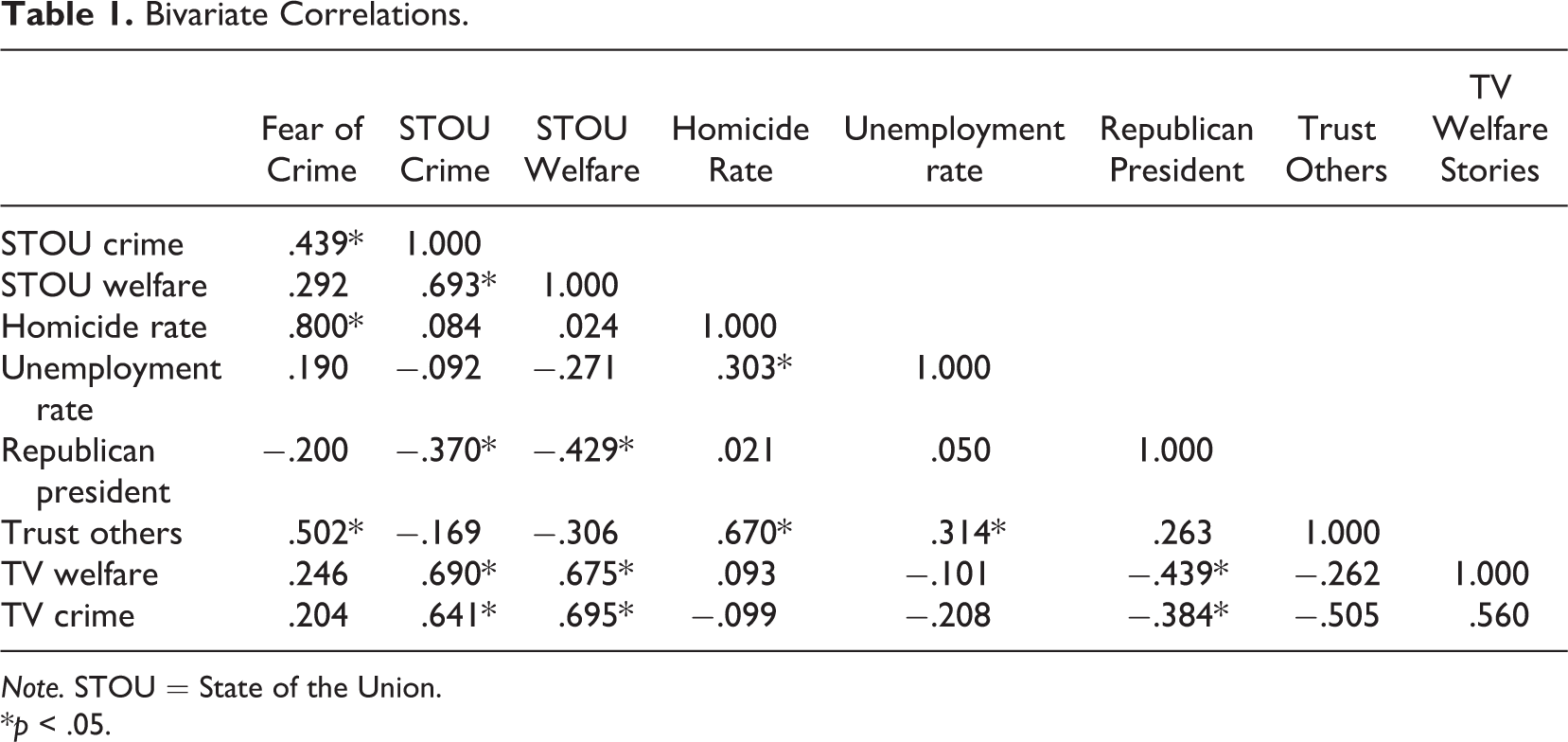
Table 1 presents the bivariate correlations among the variables. At the bivariate level, mentions of crime in the STOU are significantly related to fear of crime (r = .439; p = .036) but mentions of welfare are not (r = .292; p = .176). As expected the homicide rate is strongly and positively correlated with expressed levels of fear. Contrary to predictions, trusting others is positively related to fear (r = .502; p = .015). The two media variables and the political party of the president are not significantly related to fear of crime at the bivariate level.
Bivariate Correlations.
Note. STOU = State of the Union.
*p < .05.
Moving to a multivariate analysis, because we have time-series data and a small sample, we are careful to test the assumptions of OLS. We are particularly sensitive to issues of autocorrelation and multicollinearity. There is no indication that these are problematic in our model, and the model meets the other assumptions of OLS regression. 6
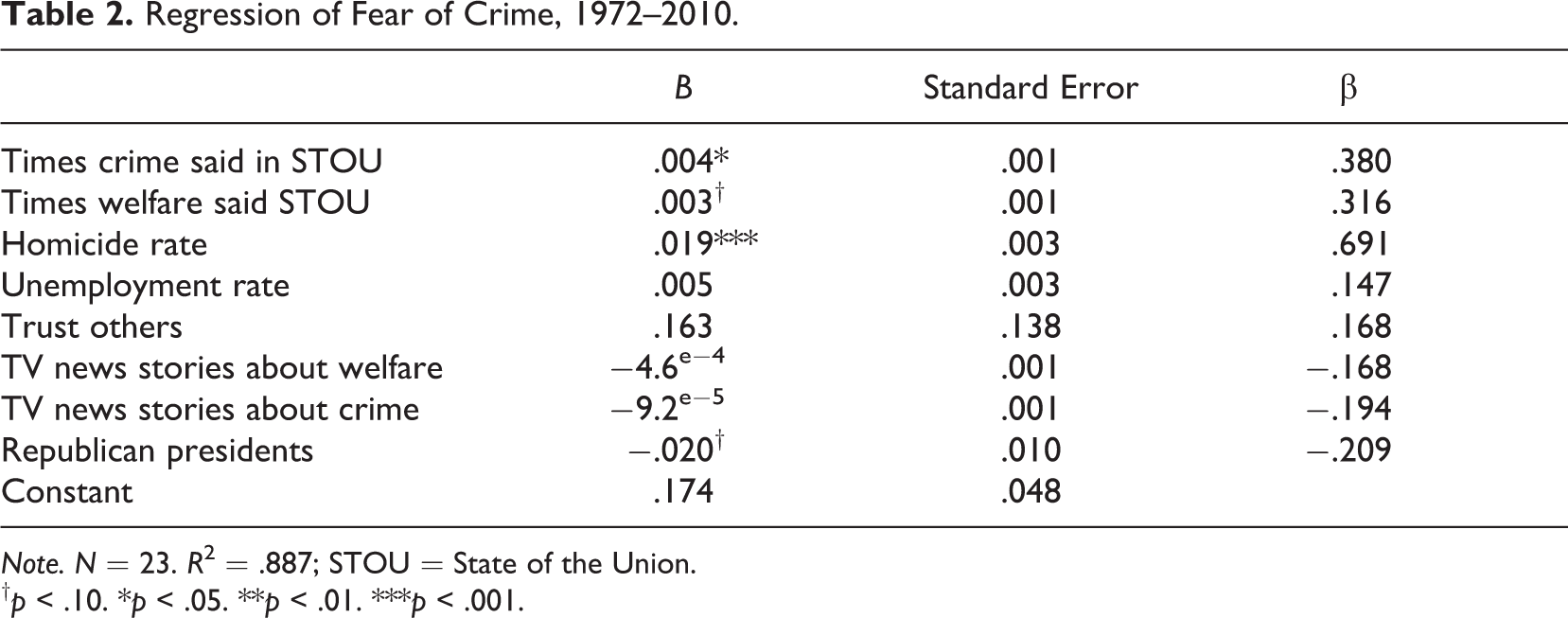
Our model predicting fear of crime is reported in Table 2. The model provides support for Beckett and Sasson’s argument. Statistically significant (F = 13.52: p < .001) and accounting for approximately 89 percent of the variance in expressed levels of fear between 1972 and 2010, the model indicates that when the president mentions crime (b = .004; p = .033) or welfare (b = .003; p = .058) in his STOU address, fear of crime increases. Also, fear of crime is related to an objective measure of criminal threat as fear varies directly with homicide rates (b = .019; p < .001). Fear tends to be lower during republican presidencies (brepublican = −.020; p = .075). News stories about crime (p = .255) and news stories about welfare (p = .257) fail to achieve statistical significance in the model. Similarly, levels of trust and unemployment rates are not significantly related to fear of crime (p = .255 and p = .167, respectively).
Regression of Fear of Crime, 1972–2010.
Note. N = 23. R 2 = .887; STOU = State of the Union.
† p < .10. *p < .05. **p < .01. ***p < .001.
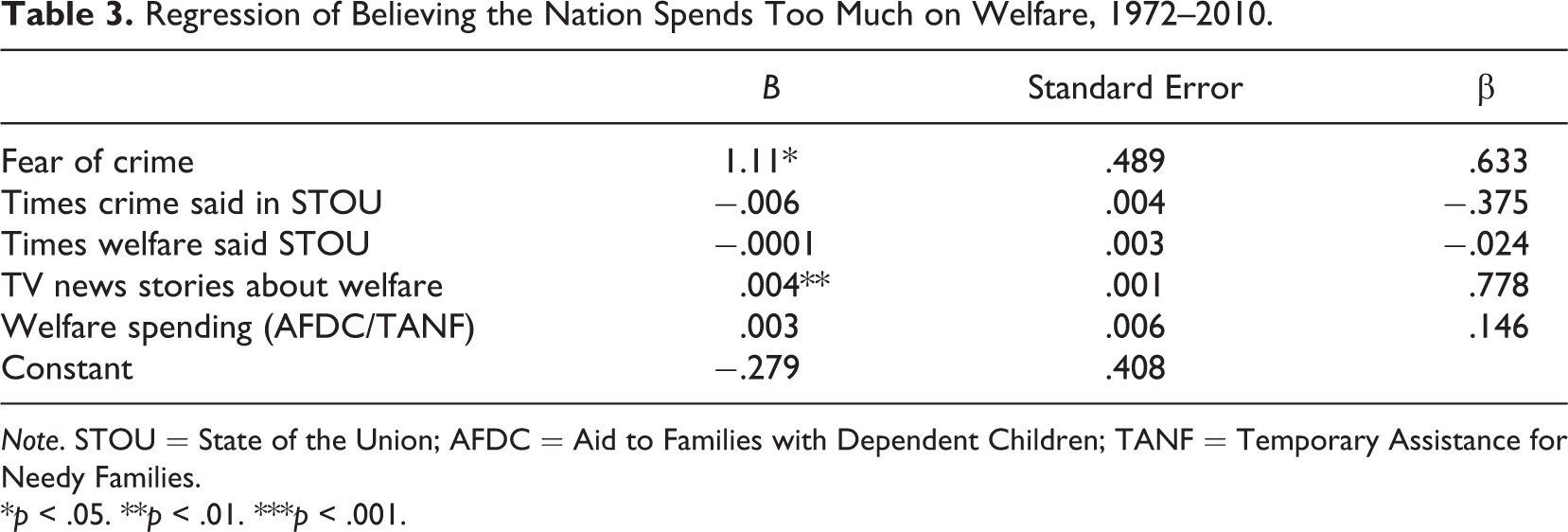
While the above-mentioned analysis appears to support Beckett and Sasson’s (2000) argument, we also need to investigate whether presidential rhetoric influences public attitudes toward welfare spending. To investigate this relationship, we predict the percentage of respondents saying too much is spent on welfare. We add an objective measure of welfare spending to the model. Specifically, we include the total annual expenditure on AFDC/TANF. In addition to AFDC/TANF expenditures, the model includes the two STOU variables, fear of crime and the number of television news stories about welfare reform. Including the number of television stories about crime in the model created multicollinear terms so this variable was dropped from the model. Table 3 reports the results of this analysis.
Regression of Believing the Nation Spends Too Much on Welfare, 1972–2010.
Note. STOU = State of the Union; AFDC = Aid to Families with Dependent Children; TANF = Temporary Assistance for Needy Families.
*p < .05. **p < .01. ***p < .001.
As seen in Table 3, fear increases opposition to welfare spending (b = 1.11; p = .039). The mentioning of welfare or crime in the STOU address is unrelated to attitudes about welfare spending (p = .905 and p = .170, respectively); however, there is an apparent media effect as the number of television news stories about welfare reform is positively and significantly related to opposition to welfare spending (b = .004; p = .002). The actual amount being spent on welfare (specifically AFDC and TANF) is unrelated to attitudes toward welfare spending (p = .578). Therefore, at least based on this analysis, fear and media coverage are more important drivers of public sentiments toward governmental assistance to the poor than is the actual amount of assistance the government is providing to the poor. The model explains 69.5 percent of the variance in attitudes toward welfare spending from 1972 to 2010. 7
Discussion
Beckett and Sasson (2000) build on basic Gramscian arguments and assert that neocons and neoliberals united against the welfare state and undermined its hegemonic ideology. These political elites discredited the welfare state by arguing that welfare spending actually produced crime and worsened poverty. Welfare programs destroyed the work ethic and created a class of people who not only relied on governmental handouts but also expected these handouts. The rhetorical attack on the welfare state vilified the poor and defined them as dangerous and undeserving of aid (Beckett & Sasson, 2000).
Once the old legitimating ideology of the welfare state was successfully attacked, the political elite offered an alternative view of the state that would allow them to reap added benefits. The new hegemonic strategy argued that our basic security was under attack from both foreign and domestic sources. To confront this crisis, we needed to reduce welfare guarantees and expenditures, deregulate businesses, and meet all security threats with heightened urgency. According to Beckett and Sasson (2000), this constituted the new hegemonic strategy of the security state. While this hegemonic strategy would meet the elite’s needs, the elites needed to “sell it” to the public. As Gramsci argues, successful hegemonic strategies must be rooted in the lived experience and cultural beliefs of regular people. The wars on drugs and crime launched in the 1980s and 1990s were aimed at achieving this end by demonizing the poor and legitimating tough-on-crime policies (Beckett & Sasson, 2000).
We argue that for Beckett and Sasson’s argument to be plausible, we should be able to detect (a) an increased use of the security state rhetoric and (b) evidence that this rhetoric creates an atmosphere that would lead regular people to support security state policies. We also argued that promoting a sense of fear would be one way of generating support for the antiwelfare policies of the security state.
Our analysis offers support for Beckett and Sasson’s (2000) general argument. First, even controlling for homicide rates and other factors that are likely to affect levels of fear in the general public, the president’s mentioning of crime or welfare in the STOU address influences the levels of fear in the public. Second, while the rhetoric used in STOU addresses does not appear to influence attitudes toward welfare spending directly, fear of crime does. As fear increases, opposition for spending on programs designed to assist the poor also increases. This relationship holds even when actual amounts of spending are held constant. Therefore, as argued by Beckett and Sasson (2000), it appears a new hegemonic strategy has been developed.
In addition to supporting Beckett and Sasson’s (2000) argument, our findings are further evidence of how important presidents are in determining public opinion. Scholars have long noted that presidents can raise concern about an issue even when empirical evidence contradicts them (see, for example, Beckett, 1994), and a growing body of literature (e.g., Hawdon, 2001) indicates that the president’s rhetorical devices influence public opinion. This research further demonstrates that the ideological power the president wields can be exercised simply by discussing a topic during the STOU. This work therefore extends the body of literature devoted to analyzing and documenting the president’s agenda-setting ability.
The work also supports and extends the broader constructivist perspective of deviance. The constructionist perspective emphasizes the subjective, social, and political processes by which phenomena are framed to give meaning to events. According to this perspective, phenomena can be subjectively defined as social problems beyond the objective conditions related to those phenomena. Thus, despite objectively decreasing risks associated with crime, presidents can generate greater fear of crime; despite objective levels of spending on assistance to the poor, presidents can, at least indirectly, undermine public support for that spending.
The implications of this research are far reaching. As a growing number of scholars note, the United States has pursued a number of policies, both domestically and internationally, that threaten our personal liberties and our international reputation and standing (see, for example, Bonn, 2010; Kramer & Michalowski, 2006; Michalowski & Kramer, 2006; Rothe, 2006). These policies have been justified by using communitarian rhetorical devices that promote fear and call for immediate action against some enemy that (allegedly) threatens the safety of the group (see Hawdon, 2001; also see Bonn, 2010). In addition, this strategy demonizes the poor and calls for a more aggressive and punitive-oriented criminal justice policy (also see Wacquant, 2009a, 2009b, 2011). By undermining support for the welfare state, the new hegemonic strategy paves the way for deregulation and other neoliberal policies. By promoting a sense of fear and championing the notion that the state needs to protect us from all foreign and domestic threats, this strategy paves the way for the prison–industrial complex.
While our analysis supports Beckett and Sasson’s (2000) neo-Marxian explanation, there are limitations we must acknowledge. First, we have a small number of data points. Because we lack nationally representative data concerning aggregate levels of fear prior to GSS’s implementation in the early 1970s, our time series begins at the same historic period that the crisis of the welfare state hegemonic strategy and the emergence of the security state strategy began. Ideally, we would have data that began in the mid-1960s when the welfare state was still strong and more widely supported. Only then could we tell for certain that changes in support for welfare policies and increasingly draconian criminal justice policies covaried as predicted.
Next, we have missing data in our time series data. The GSS was administered annually from 1972 through 1978; however, the survey was not administered in 1979 or 1981. After resuming annual collection until 1991, the survey was not administered in 1992 and then went to a biannual administration beginning in 1994. The lack of data for some of years between 1972 and 2010 obviously interrupts the time series and weakens our analysis considerably.
Finally, we lack individual-level data. We correlate presidential utterances with aggregate levels of fear and opposition to welfare spending; however, we cannot know with these data whether the individuals responding to the survey items heard the STOU address that is allegedly influencing their attitudes and concerns. Similarly, we use homicide rates as a measure of objective risk, yet we do not know whether the GSS respondents have any idea of what these objective risks are. In addition, research indicates that those who fear crime are not those who have experienced it (e.g., Skogan & Maxfield, 1981), and there is a difference between diffuse anxieties about crime and the fear of crime (Farrall, Jackson, & Gray, 2009; Gray, Jackson, & Farrall, 2011). Ideally, we would conduct the analysis with a multilevel model that measured individuals’ exposure to the president’s speech, their personal levels of fear, and their personal support for welfare policies. Unfortunately, these data simply do not exist.
Despite these limitations, we believe the findings are accurate. First, the models meet the assumptions of OLS regression. Second, the findings are clearly predicted by theory. Finally, the findings are consistent with a wide body of literature that similarly predicts the linkage between neoliberalism and the rise of draconian criminal justice policies that result in the increased use of incarceration (especially see Wacquant, 2009a, 2009b, 2011). Nevertheless, while we are confident in our results, they should be interpreted with care. Additional research is needed and the analysis should be extended to other ideological dimensions of the security state. Moreover, future research should investigate the presidents’ promotion of this hegemonic strategy in forums other than the STOU address and the promotion of this strategy by politicians other than the president.
Given our limitations and the need for further research, we must emphasize that while our findings are supportive of Beckett and Sasson (2000), they certainly are not definitive. We recognize the large body of evidence that indicates the opinion of the masses matters. For example, Burstein (2003) concludes after reviewing the literature that public opinion has a substantial effect on public policy even when the influence of elites is consider. Thus, as Burstein (2003) notes, while no study estimates the relative impact of public opinion versus elite activities, it appears that elites both influence public opinion and are constrained by it. Gramsci (1971) and Beckett and Sasson (2000) recognize this fact by noting the necessity of elites to have their hegemonic strategies logically mesh with the lived experiences of the masses. Yet, the question remains as to how much elites can manipulate public opinion.
Conclusion
As Gramsci (1971) noted, the ruling classes use cultural and ideological mechanisms to generate public consent. It is only through this consent that elites can secure their hegemony. The elites, by controlling political institutions and the media, are able to define reality in a manner that is always favorable to the capitalist society that supports them. The elites then win support through hegemonic strategies. In recent years, the American elites have pursued a hegemonic strategy rooted in fear. They have promoted the notion that the poor are undesirable and dangerous, and they have generated concern about escalating crime rates driven by out-of-control rates of drug use. Yet, empirically, crime and drug use have declined. Despite this, were elites—specifically presidents—able to generate sufficient concern to justify their neo-liberal policies? Based on our evidence, they were.
The policies that the American elites have pursued and the hegemonic strategy they have used to justify these policies have been criticized. Critics argue they have led us to a major financial collapse, to rapidly expanding levels of inequality, to civil rights abuses, to the world’s highest rates of incarceration, and into two wars. This may be true, but these policies have also proved exceedingly successful for the elites who promote them. The extreme elites, the power elite as Mills called them, are wealthier than at any time in history. They enjoy the benefits of a system that reap them tremendous profits. Yet, with growing inequality, increasing rates of incarceration, fiscal and civil rights crises, and other problems associated with the current global system, one wonders how long the current hegemonic strategy can last.
Footnotes
Appendix
Declaration of Conflicting Interests
The authors declared no potential conflicts of interest with respect to the research, authorship, and/or publication of this article.
Funding
The authors received no financial support for the research, authorship, and/or publication of this article.