






Abstract
Staff support of agency mission is an accepted axiom in organizational research. This analysis examined staff attitudes toward reentry preparation in a large prison system. Analysis examined whether local conditions at different prisons had an impact upon average views about the importance of reentry efforts. The study also investigated whether local conditions across prisons mediated differences between custody and treatment staff evaluations of reentry importance. Multilevel models demonstrated that average levels of reentry importance did vary across prisons, but the gap between custody and treatment staff evaluations was consistent across prisons.
One of the results of the get tough on crime era in the United States was a rapid increase in the size of the U.S. correctional population. From 198,061 inmates in 1971, the population expanded rapidly to 1,615,487 in 2009. Since that time, the population of U.S. inmates declined somewhat to 1,561,525 (Bureau of Justice Statistics, 2015). Associated with the rise in the population was the subsequent release of much larger numbers of former inmates back into society at the completion of their sentences. For example, 623,000 prisoners were released in 2013 alone (Lindquist, Willison, Rossman, Walters, & Lattimore, 2015). Preparing such large numbers of inmates for successful transition back into their communities became a national priority as reflected in passage of the Second Chance Act (P.L. 110-199). Reentry efforts brought the combined efforts of the criminal justice system as well as social service agencies—including educational, housing, labor, and health—to bear on the problem of guiding former inmates into more productive social roles. Prisons retained their focus upon providing treatment to inmates, but this treatment was only one part of a more comprehensive effort to rehabilitate former inmates.
Providing treatment for the expanding population of inmates as part of reentry efforts was not a new task for U.S. prisons, therefore it carried familiar challenges that have always existed in prisons. Prisons have always had structural conflict built into their operations created by the need to securely confine inmates, while at the same time preparing inmates for entry back into society (Clemmer, 1940). Inmates within prison are encouraged and to a certain extent expected to assume accountability for themselves, first and foremost, for their criminal past, but also for other facets of their lives such as health maintenance. Prisons, however, are built upon rules designed to insure safe operations, including controlling the types of items that inmates possess. Hypodermic needles, for example, are considered contraband in secure prisons, so diabetic inmates cannot possess the equipment needed to administer their own medication (Gaes & Kendig, 2003). Further compromising the reentry component of the correctional mission, studies demonstrate that correctional officers prefer job functions such as maintaining order, which as a by-product includes strengthening their control over the behavior of inmates (Hepburn, 1987; Jacobs, 1977). Moreover, this preference on the part of correctional officers operates in a context freighted with the abuse of power: Evidence of the excesses associated with unchecked power in modern prisons goes back to the Zimbardo study conducted at Stanford (1973).
This tension in the missions of the prison and the need to make inmates accountable while maintaining secure prisons is just one example of the formal tensions between the treatment and custody functions built into the prison culture. The culture of a prison arises from the shared experiences of common working conditions, management practices, and physical technology. While culture or social climate/environment is intangible, it is nonetheless real and the focus of this study. There are other informal tensions in prisons associated with the enactment of formal rules and policies of the prison bureaucracy, what Lipsky (1980) called the issue of street-level bureaucracy. Lipsky reminds us there is always an underlying tension between the intentions and desires of the designers of formal policy and the enactment of this policy by line staff. For example, a correctional officer permanently assigned to a residential faith-based unit in one prison openly referred to the program as the fake-based program.
Lin (2000) provided a qualitative examination of the enactment of prison programs at five federal prisons within this context of tension between custody and treatment functions. She found that the success of program implementation rested largely on two factors. The first factor involved prison-centered needs. Prison-centered needs refer to the fit between the goals of the program and the primary operational need for order in the prison. Order allows for predictable behavior and thus safe prisons for inmates and staff. The second factor is the institutional values of the prison. This dimension refers to the climate governing staff interactions with inmates from the extreme ends of the spectrum characterized by an “us versus them” mentality to an open understanding of the view of the inmate. While Lin was not naively positing that either end of the spectrum existed in isolation, she argued that the more prison administrators could promote programs that supported the goal of prison order, the greater the chances of successful program implementation by facility staff. She notes that the question of whether inmates are amenable to prison programs (where amenable is replaced with responsive in the current risk, need, and responsivity paradigm—RNR) is trivial to the more important task of creating “prison environments that encourage prisoners to rehabilitate themselves, and that encourage staff to help the prisoners along” (Lin, 2000, p. 6).
The current study focuses upon whether there are detectable, systematic differences across prisons in the attitudes of staff toward reentry programs, differences that might enhance or hinder reentry efforts. Particular attention is paid to differences in attitudes about the importance of reentry programs both within individual prisons and across different prisons in attitudes held by different types of staff in particular custody and treatment staff. The following review demonstrates that there is an extant literature documenting the differences between custody and treatment staff in their views toward prison programs and reentry. However, a corresponding literature on differences across prisons that produce different outcomes for treatment programs, such as Lin claimed in her study of five federal prisons, is largely lacking. While the focus here is upon the conditions that support reentry efforts, research has shown that officers who work in treatment-oriented prisons and have more favorable attitudes toward reentry have more favorable job outcomes (role stress, work–family conflict, and related factors) than officers with more of a custody orientation (Lambert, Altheimer, Hogan, & Barton-Bellessa, 2011). Such factors support staff retention and job performance in addition to providing emotional support for programs (Camp, 1994; Lambert, Kim, Hogan, Kelley, & Garland, 2014). Further, staff members with higher levels of support for rehabilitation were more likely to be good organizational citizens (Lambert, Barton-Bellessa, & Hogan, 2014), meaning that they were more likely to expend greater efforts in meeting the goals of the agency. This suggests that the match between correctional officer attitudes with treatment goals may impact all stakeholders including prison administrators, all prison staff, and inmates.
Review of Literature
A sizable literature documents the conflict between the custody role of prisons and treatment (Hepburn & Albonetti, 1980; Jacobs, 1977; Jurik, 1985; Lambert & Hogan, 2009; Larivière, 2001; Maxim, 1976; McLaren, 1973; Pogrebin, 1978; Scott Ronald, 1977; Steadman, McCarty, & Morrissey, 1986). Gradually, the concern with role conflict among correctional officers became more generic and attention switched to the consequences of role conflict rather than the antecedents generating role conflict (Lambert, Hogan, Cheeseman, & Barton-Bellessa, 2013; Lambert, Paoline Iii, Hogan, & Baker, 2007). The conflict has been addressed through various initiatives with the belief that the attitudes of correctional staff are important for the rehabilitation of inmates (Kerce, Magnusson, & Rudolph, 1994; Young, Antonio, & Wingeard, 2009). Despite what we have learned from this body of research, the tensions of role conflict have never been eradicated. Research has demonstrated that inmates recognize support from correctional staff as providing more positive circumstances (Molleman & Leeuw, 2012).
The tension created by the sometimes competing functions of custody and treatment creates differences across prison jobs, for example, between treatment professionals and correctional officers (Adams & Ferrandino, 2008; Dvoskin & Spiers, 2004). The competing functions also create conflict within positions. Jacobs, for example, documented the confusion created at Stateville for correctional officers during administration changes that led to greater emphasis upon prison programs. Instead of officers holding inmates accountable consistently for rule infractions, officers were encouraged to vary their responses depending upon an individual inmate needs. This created frustration among correctional officers—while their primary job responsibility was to prevent riots, escapes, and other misconduct, they were also expected to communicate effectively with inmates about their treatment needs (Jacobs, 1977, pp. 178–180). In the end, correctional officers defaulted to their institution maintenance and security functions, as these aspects were the primary focus for their performance evaluations. In another study, Farkas (1999) found that correctional officers did not want the counseling role as part of their jobs.
Few correctional researchers or practitioners believe there is no tension between custody and treatment goals. Instead, the question is the degree to which the role and structural conflict between treatment and custody functions hampers the two goals of protecting public safety and providing treatment. For example, not all correctional officers have the training to identify and properly address behaviors which may be associated with mental illness. Correctional officers without training often believe that all inmate misconduct is intentional (Fellner, 2006, p. 396). Therefore, correctional officers are more likely to respond to the behavior with the tool they are most comfortable with: issuing a written infraction for willful misconduct. Even when behavior is suspected to be related to mental health issues, there is still organizational inertia to initially treat the behavior as manipulative and/or volitional to prevent inmates from gaming correctional workers into stays in health units or other “perks” (Jeglic, Knight, Jonhnston, & Trickey, 2005). In other words, it can be difficult for officers to overcome the correctional mind-set that inmates are trying to manipulate the system. In fact, correctional officers have described experiences working in settings that supported other ideals, such as therapeutic communities (TC). Crawley (2004, pp. 200–209) described how negative peer pressure from other correctional forced two correctional officers to transfer out of the TC unit even though they supported the ideals of TC. In terms of conflicting demands faced by treatment staff, in particular mental health staff, Bonner and Vandecreek (2006) noted that treatment staff sometimes face ethical quandaries in balancing treatment needs with the public safety demands of a correctional facility—enforcing institutional rules sometimes compromises their legitimacy as helping professional. Hepburn and Albonetti (1980) found that treatment staff faced more role conflict in doing their jobs than correctional officers.
The tension between the structural expectations for correctional staff and treatment staff is perhaps exacerbated by the attitudes the respective staff bring with them into their jobs. Correctional officers with college degrees tend to come out of criminal justice or criminology program which are often more supportive of “law and order” positions such as the death penalty (Farnworth & Leiber, 1989; Mackey & Dourtright, 2000). Care, though, is necessary to keep from overstating this position. Many correctional officers hold complex attitudes toward inmates and many support rehabilitation (Cullen, Lutze, Link, & Wolfe, 1989). While treatment staff tend to come from social science majors other than criminal justice and may have a more social service point of view, like correctional officers, treatment staff are not a monolithic group and should not be categorized in broad brush strokes. Beyond such broad generalizations, little is known about the extent to which correctional and treatment workers come to their jobs with different worldviews about corrections and how these differences are or are not reinforced by the structural differences created by the respective job duties.
Studies on the Pennsylvania Department of Corrections (DOC) have found that correctional staff and treatment staff do come to the job with different expectations about reentry efforts (Antonio, Young, & Wingeard, 2009a, 2009b; Young et al., 2009). The Pennsylvania DOC designed a training program for all new employees that emphasized the importance of all staff reinforcing treatment goals. Following training, survey data revealed that treatment staff believed more strongly that how inmates are treated by staff has an impact on inmate rehabilitation. Treatment staff also more strongly agreed that staff support of treatment programs had an impact on inmate outcomes.
Correctional officers have a role to play in treatment, if only for the fact that correctional officers have more contact with inmates and can provide valuable intelligence about what inmates need (Applebaum, Hickey, & Packer, 2001). The existing literature suggests that the tension between the custody and treatment functions of prisons flows from multiple sources including how correctional/treatment work is structured in prisons, the enactment of policy, or in this case treatment by the various parties, the predispositions of staff, and the general culture of individual prisons. Additionally, correctional officers and treatment staff may import different worldviews into the workplace.
The United States is currently faced with an unprecedented number of people in prison even though population levels have recently declined somewhat. Lin (2000) in a qualitative study of federal prisons noted that prisons programs worked most effectively at prisons with the highest levels of staff support, suggesting that the culture or social climate of prisons makes a difference in effective programming. The agency studied here introduced a measure of capturing whether workers supported reentry efforts, and the intention of this study was to examine whether those perceptions varied in a systematic fashion across different prisons. Culture, being intangible, is seldom measured directly but is instead captured in different practices and symbols, including respondents feelings about reentry importance in corrections.
In an effort to unravel the differences in attitudes toward prison programming and to determine whether different prisons indicate different levels of cultural support for prison reentry efforts, the present study examined survey results collected in 2011 from a large correctional agency. The first step was to determine whether aggregate attitudes about reentry were different at the 100 prisons examined here. This sets the context for examining the other research questions which presumed variation across prisons in attitudes toward reentry. The other research questions examined whether the gap in attitudes held by custody and treatment staff toward prisoner reentry, first acknowledged in Clemmer’s pioneering work in the 1940s, persisted in a modern correctional agency oriented to preparing inmates for lawful return to society. It was a strong presumption that the gap persisted, but the less studied question was whether the size of the gap varied based on the unique social context at different prisons.
The data were also examined to make the determination of whether differences in reentry attitudes between correctional and treatment staff are fixed across prisons or whether management practices alter these differences. The research questions addressed in this study are stated as formal hypotheses.
Strategy of Analysis
The prison agency that provided the survey data for this study collects data annually from staff and on a periodic basis from inmates. The current study used staff data only. The survey has been administered to staff since 1988. Initially a paper form, the survey is now presented electronically. The confidentiality of the respondents is protected, and the data contain information about long-standing issues (organizational commitment, workplace diversity, etc.) and topical workplace issues (staff perceptions of new programs). Surveys were collected from 9,004 staff in 2011 from the 17,150 asked to participate for a response rate of 52.5%. The number of staff who answered questions about reentry was 7,730. Response rates across individual prisons varied between 34% and 76%, necessitating weighting of the data to retain proportionality of each institution as part of the prison system overall. The weights also adjusted for disproportionate responses from some of the cells used in the sampling design as discussed next.
The main survey design is a stratified random sample. Some groups were oversampled to enable analysis of small groups, including racial minorities, women, supervisors, and employees of prison industries. A census was conducted at prisons with fewer than 130 staff to retain the ability to compare across institutions in the agency’s analyses. Survey weights were used in the analyses for respondents at institutions where there was oversampling to insure proper representation among the oversampled cells as well as adjust for the fluctuation in response rates across prisons. A discussion with the staff who administered the survey did not suggest any systematic issues between the sampling cells and nonresponse in the survey. For the most part, nonresponse was consistent across demographic and job categories, but where there was underrepresentation of groups, the calculated weights did not create large weights for any specific group or prison combination. Over 50 different weights were calculated using these guidelines, and the values ranged continuously between 1 (self-weighting) and 3. The weights were applied to all statistics generated for this study.
The descriptive statistics for the variables used in the analysis are presented in Table 1. As can be seen there, most of the variables used in the analysis were dummy variables, although the dependent variable and select other variables were quasi-continuous. The responses on the reentry scale (discussed below) ranged between 0 (no support for reentry) and 24 (highest level of support for reentry). 2 The mean response was 17 on the 24-point scale. About 30% of the respondents to the survey were supervisors and about 30% were women. Redundant statistics, such as the proportion of respondents who were men or nonsupervisors, was not reported in the table but easily calculated. The average age of the respondents was around 42, and 11% of the respondents worked in treatment roles and another 55% worked in roles other than custody or treatment. This means that about 34% of the respondents were frontline custody staff. Around 9% of the respondents self-reported as Hispanic, and another 21% as minority members, meaning that around 70% of the respondents were White. Thirty-four percent of respondents reported having some college education with another 46% of the staff having at least a bachelor’s degree. Only about 20% of the respondents reported only a high school education. Average staff tenure was around 14 years.
Descriptive Statistics of Variables Used in the Analysis.

Table 1 also provides information about the 100 prisons surveyed. Thirty-two percent were low-security prisons, 45% medium-security, and 7% were minimum-security prisons. That means that 15% of the facilities were high security. Respondents were classified according to the highest security level of the prison. So, respondents who worked at minimum-security camps attached to a more secure prison were counted as working at the higher level prison. The regions were not reported by name, but it is easy to see that the regions held about the same number of facilities. Finally, the average age of the staff at the different facilities was also around 42. Since the average age at the 100 different prisons was the unit of analysis, the standard deviation was much smaller. The same pattern held for staff tenure where the average of the averages (14 years of tenure) was similar to the individual-level mean, but the standard deviation was smaller.
A new scale about reentry was proposed in 2011. Six questions were developed and examined that were believed to represent the perceived importance of reentry efforts. Camp, Langan, and Pruss (2013) found that two of the proposed questions did not fit with the others in assessing the measurement properties of the scale using factor analysis. These two questions were dropped from the final scale of reentry importance. The final 4 items selected for the reentry scale are listed in Table 2. The items address the underlying belief of staff regarding the importance of reentry programs in reducing recidivism, in particular, the effects of prison industry, drug treatment, education, and vocational training programs.
Questions Used to Create Reentry Scale.

The measurement properties for the 4 items comprising the reentry scale are presented in Table 3. The confirmatory factor results were produced with Stata. As seen in the standardized coefficients, all of the coefficients were above .7, with a very small probability of falsely rejecting the null hypothesis of no effect. The fit statistics also indicated good model properties. The root mean square error of approximation (RMSEA) value was below .05, and the probability that the RMSEA was less than .05 was very high. This was the defining indication of favorable fit used here. Other fit measures favor more complex models over simpler models. The RMSEA measure penalizes model complexity, so that simpler models can perform better than the same model with additional parameters (Browne & Cudeck, 1993). Two other commonly used fit measures showed excellent fit properties. The comparative fix index (CFI) and Tucker–Lewis index (TLI) were all above .90 as is desirable for these measures. In fact, both the CFI and TLI were near the theoretical maximum value of 1.
Measurement Properties of Reentry Scale.

Note. RMSEA = root mean square error of approximation; CFI = comparative fix index; TLI = Tucker–Lewis index.
The analysis proceeded as follows to address whether responses to the scale of reentry differed for correctional officers and treatment staff and whether these responses depended upon the social context of the different prisons. To conserve space, only one table was presented in the findings section to represent these stages of analysis. All analysis results are available upon request.
First, a “null” model was examined that included only the individual-level covariates and the random intercept. The random intercept allowed for prisons to differ in the level of importance placed on reentry independent of the characteristics of the raters, the prison staff. This model provided a test of whether significant variance existed across prisons in evaluation of reentry, in other words, a test of Hypothesis 1. Second, a test was conducted to determine whether the coefficient representing the difference in custody and treatment staff evaluations was fixed across prisons or whether social conditions at different prisons had an impact of the size of the difference. In these models, the institution-level variables were included in the models. This provided a test of Hypothesis 2 that prison conditions influence differences in custody and treatment staff evaluation of reentry. Finally, the difference between custody staff and treatment staff evaluations were examined in the full models with a dummy variable. This provides a test of Hypothesis 3, whether a difference persists in evaluations of reentry importance between custody and treatment staff. Since it turned out that the effect for the custody/treatment staff difference was fixed across all prisons, only the results from a fixed-slopes model are presented. The intercept (differences in overall level of reentry importance) remained random. All multilevel models in this analysis were estimated with the
Findings
The results for the model of the importance of reentry are given in Table 4. The first thing to note is that the intercept was specified as a random coefficient as suggested by Hypothesis 1. Even with the full model specified, there is still variance across prisons in reentry importance that is not explained by the model. The estimate of prison-level residual variance was many times larger than the standard error. The evaluations of reentry are nested within prisons, meaning that otherwise similar staff provides evaluations of reentry that are influenced by working at a specific prison. These differences in “average” evaluations of reentry importance were not completely explained by the characteristics of the prisons, such as security level, or the individual characteristics of the staff. It is reasonable to conclude that some part of the evaluation of reentry importance was influenced by the cultures at the individual prisons. Hypothesis 1 was supported.
Multilevel Model of Reentry.

aCorrectional officers excluded comparison group. bWhite excluded comparison group. cHigh school excluded comparison group. dHigh security excluded comparison group. eRegion 6 excluded comparison group.
Table 4 does not contain results for the treatment/custody comparison being specified as random instead or fixed (Hypothesis 2). The two specifications of the variable as fixed or random were tested with a deviance test. The deviance test is calculated as the difference in −2 times the log likelihood of the original model and −2 times the log likelihood of the model with extra parameters, in this case the variance of the slope associated with the random specification of the treatment/custody difference. The value computed was .446. For all practical purposes, the log likelihood values of the fixed and random slope models were identical. The deviance value is distributed as a χ2 distribution with the degrees of freedom set by the difference in the number of parameters. There was one parameter difference in this analysis, and with a test statistic of .446, the null hypothesis was not rejected. There was no reason to believe that the random specification of the treatment/custody comparison was superior to the fixed-effect treatment. Given no difference in the models, the simpler fixed-effect specification was accepted.
In practical terms, none of the 100 prisons demonstrated any variation in the magnitude of the difference between evaluations of reentry provided by custody and treatment staff. While the evaluations of reentry changed from one prison to another, the difference between custody and treatment staff was the same across all 100 prisons. So while differences in social climate do create differences in overall level of evaluation of reentry importance, supporting Hypothesis 1, the same climate does not have an impact upon the difference in the evaluation provided by custody and treatment staff. This did not lend support for Hypothesis 2.
The results in Table 4 show that treatment providers continue to rate reentry efforts more favorably than correctional officers, supporting Hypothesis 3. As noted previously, reentry was measured on a 24-point scale created by adding the responses to four questions with Likert-type responses ranging from 0 (strongly disagree) to 6 (strongly agree). Treatment staff provided a rating of reentry that was 4 points higher than correctional officers on that 24-point scale, a notable difference. The difference is by far the largest absolute difference noted in the table. The next closest effect was a prison-level effect for security level. On average, staff at minimum-security prisons rated reentry importance around 2 points higher than staff at high-security prisons.
The effects of the other variables in Table 4 are worth mentioning. The coefficient for being a supervisor suggests that supervisors, on average and independent of other factors in the analysis, evaluated reentry almost 1.5 points higher than did nonsupervisors. Females provided higher evaluations of reentry than males. Female evaluations were 1.2 points higher than otherwise similar males. Staff members who were neither correctional officers nor treatment staff provided evaluations that were .88 points higher than correctional officers, almost a full point. 3 Of the three staff groupings, correctional officers provided the lowest evaluation of the importance of reentry efforts. Minority members evaluated reentry efforts as more important, although the difference (.2) was small. All of the above effects for the individual-level covariates were statistically significant.
Age was positively associated with evaluations of reentry. Older workers, controlling for other factors, provided evaluations that were .065 points higher than for every year of age. For example, workers who were otherwise alike in all factors, including tenure, but who were 10 years apart in age would have reentry evaluations that differed by over half a point (.065 × 10). The effect was statistically significant. Staff with differing levels of education provided different assessments of reentry, with more highly educated staff providing more favorable assessments of reentry. Staff with at least a bachelor’s degree provided reentry assessments that were .9 points higher than staff with a high school level of education. The difference between staff with some college and high school education was relatively small in comparison, and the difference was not statistically significant (p > .05). Although not reported in the table, a linear comparison of the coefficients for staff with a bachelor’s degree or higher and staff with only some college education was also statistically significant. Staff with at least a BS provided evaluations that were .80 points higher than staff with some college completed.
The last individual-level variable presented in Table 4 is tenure in the prison system. The coefficient was negative, meaning that staff with high levels of tenure provided lower evaluations of reentry than staff with lower amounts of tenure. While the finding suggests that more experienced workers hold more jaded views toward reentry preparation, the effect was not large. For example, a staff member with 13 years of tenure, all other things being equal, only differed in reentry evaluation from a staff member with 3 years of tenure by −.5 points. The senior staff member was a half point lower than the more junior staff member. The age range of correctional workers and thus range of tenure in this agency is bounded by mandatory retirement. All prison workers are considered to be law enforcement and face mandatory retirement at age 57, although many retire sooner when they reach the qualifier for full retirement, 20 years of service and 50 years of age.
There were a few factors examined at the prison level for the effect on the prison contribution to reentry evaluations, the random effect on the intercept. As those familiar with corrections would expect, working at prisons of different security levels had an effect on staff evaluations of reentry. As noted earlier, staff members at minimum-security prisons provided assessments of reentry that were 2 points higher than staff at high-security prisons, all other things being equal. The differences were less extreme between assessments of reentry provided by staff at high-security prisons and low- and medium-security prisons. The differences were 1.3 points between high and low and slightly over 1 point between staff at medium and high. This is the pattern one would expect.
There were regional effects as well. Again, this variable was entered to capture geographical and management differences between regions in the prison system. At the request of the agency analyzed, the regions were not identified in the analysis. The other two prison-level measures examined (average age and tenure at the respective prisons) were not significantly related to the reentry assessments.
Discussion
The findings supported Hypotheses 1 and 3 presented above. The finding that treatment staff differed from correctional officers in how they evaluate the importance of reentry was expected from prior research. The difference between evaluations provided by correctional officers and treatment staff was the largest effect noted in the statistical model. More importantly, working at a specific prison environment exerted influence on evaluations of reentry importance; prisons did differ in the importance that staff assigned to reentry, just as Lin (2000) suggested in her pioneering work in the federal prison system. Although the effect of working at different prisons was not huge, it is substantively interesting. Figure 1 provides a graphical representation of the empirical Bayes (EB) residual with a 95% confidence interval for each of the 100 prisons that were part of this study. While the EB residual has a technical explanation, its interpretation is quite simple. The EB residual is simply the amount that evaluations of reentry differed at the prisons. 4 Otherwise identical staff working at Prison 1 in the graph provided evaluations that were over 1 point lower on the 24-point scale than would have been expected if there was no prison effect. At the other end of the graph, inmates at Prison 100 provided evaluations that were slightly more than 1 point higher. The prison effects plotted in Figure 1 were derived controlling for the individual-level and prison differences that impact the evaluation of reentry importance. Individual prisons were not identified at the request of the prison agency.
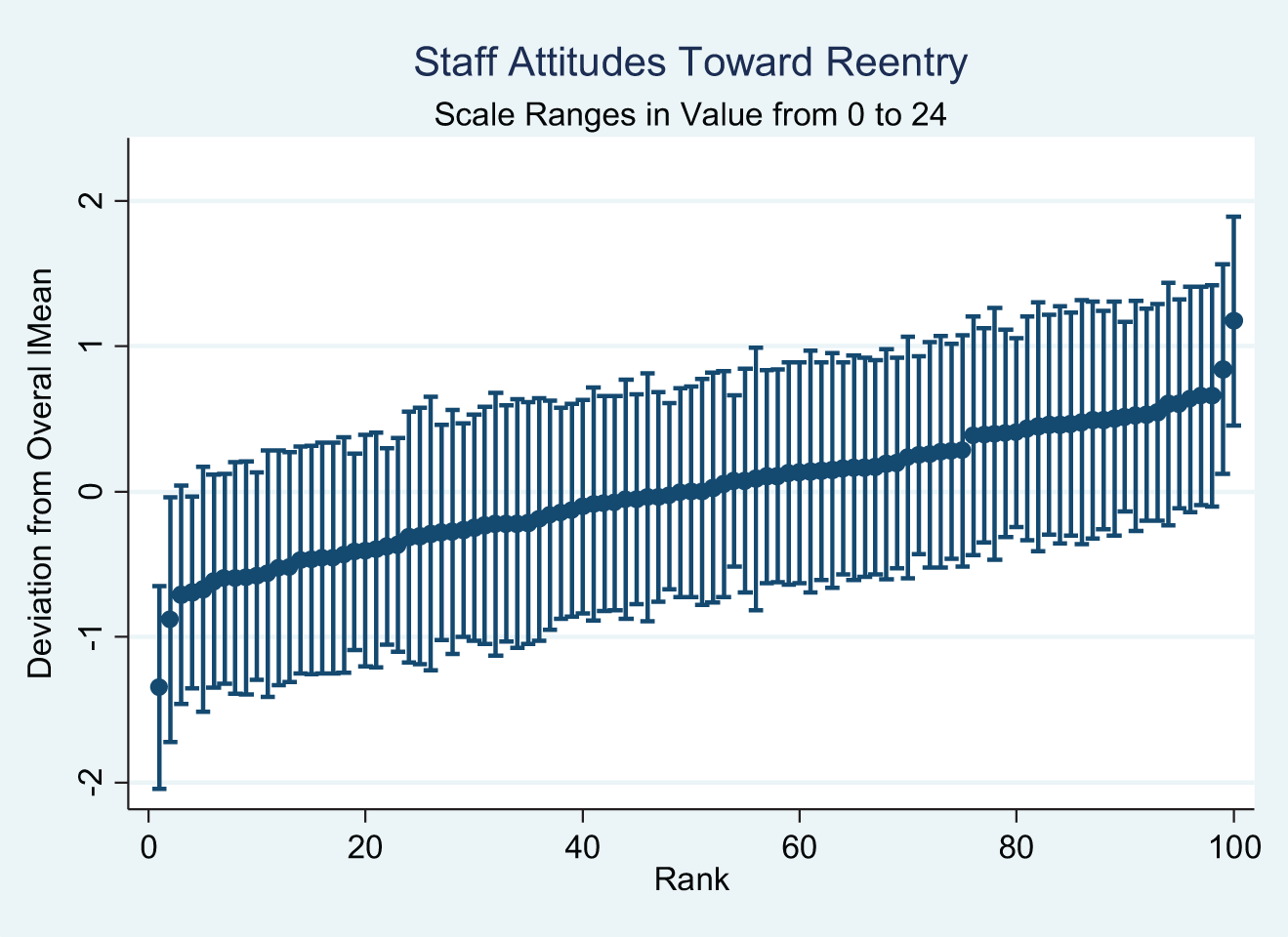
Average differences associated with prisons.
No support for Hypothesis 2 was evident in this analysis. There was simply no evidence that prison environment or cultural differences at specific prisons influenced the magnitude of the difference between custody and treatment staff in their respective evaluations of reentry importance. While prison differences moved the average evaluation of reentry importance up and down, the movement up and down was consistent for both custody and treatment staff. The difference of 3.75 points was fixed across all of the permutations represented by the 100 prisons included in this study.
Conclusions
Preparing inmates for reentry is a continuing and mission critical factor for correctional systems. While the term reentry is now preferred, correctional systems have always been concerned with the role played by prisons in the reentry process, the rehabilitation of inmates. Reentry implies the recognition that prison programs alone do not fully constitute reentry. Successful reentry calls for an integrated approach of different agencies working together to transition former inmates into society. Regardless of the terminology, criminologists have long speculated that the attitudes of staff toward reentry/rehabilitation efforts are crucial to such efforts. Lin provided a detailed qualitative account of how differences in the culture at different federal prisons were important to successful program implementation. The study here provided partial support for the idea that attitudes about reentry are malleable to different conditions at prisons and can be systematically measured. Attitudes can move up and down due to specific factors at different prisons even if the differences between evaluations provided by custody and treatment staff remain fixed.
As a first step in the continuing investigations into the importance of staff attitudes and prison culture or environment, this study focused on a large prison system in which inmate reentry is explicitly recognized as a mission function. Important differences in assessments of reentry were observed among different categories of prison staff. As hypothesized, correctional officers continued to provide lower evaluations of reentry than treatment staff. And even though the level of reentry support differed across prisons systematically, the differences between custody and treatment staff evaluations were fixed across prisons. This is not to claim that the differences between custody and treatment staff evaluations are permanently forged. Lerman and Page (2012) argued that differences in the punitive orientation of officers across different states resulted from the fact that the respective officers were embedded in systems with different orientations and goals. The results reported here for the constant gap between correctional and custody staff may imply that institutional practices are not sufficiently different across prisons to systematically alter the roles and attitudes of the respective staff toward reentry preparation.
The most important practical question that begs for an answer is whether prisons with greater support shown for reentry have more successful programs. This is a trickier question to answer than may first be obvious. Different prisons have different combinations of program functions, and it could be that prisons with more programs and/or more successful prison programs generate greater appreciation of the importance of reentry. The question of whether support for reentry comes first or whether programs bring about positive attitudes is interesting, but there are practical implications to these findings that are not contingent upon knowing whether the chicken or egg came first. For prison administrators, it is useful to know that prisons do differ in the support for prison programs when deciding where to locate new programs or expand existing ones.
There are two related issues implied by this research regarding the fixed difference between custody and treatment staff in how they evaluate reentry importance. First, can differences between correctional officer and treatment staff evaluations of reentry be changed by training, job redesign, or organizational incentives? If criminologists are correct in believing that staff attitudes, morale, and related factors are important for accomplishing agency goals, then attitudes of correctional officers toward reentry may be important. The idea that the attitudes of staff are important for accomplishing agency goals is a standard tenet of organizational theory. It is to the benefit of the agency to address the gap between correctional officers and treatment staff in their respective evaluations of reentry importance to determine whether agency goals are negatively impacted by the persisting difference. And this is the second major issue: Do the attitudes of correctional officers toward reentry and prison programs impinge upon the operations and success of prison programs? If prison programs function equally well without the active cooperation from correctional officers, then the attitudes held by correctional officers are moot. Clearly, correctional officer attitudes would matter if they were hostile in this scenario, as these attitudes might lead to passive or active attempts to subvert program goals.
In sum, the first question that follows from this research is the question of whether prisons with greater support for prisoner reentry efforts produce better prison outcomes. The current study only addressed the modest goals of determining whether the custody/treatment differences in attitudes continue to exist—they do, whether local conditions at different prisons influenced evaluations of reentry importance—they did, and whether the gap between custody and treatment staff varied across prisons—it did not. If staff support of reentry goals is important in running successful prison programs, then the next logical step is to identify the sources of differences in evaluations of reentry importance. If staff support is important, altering the difference in evaluations of reentry importance provided by treatment and custody staff seems to be a fruitless endeavor. Instead, it is more practical to raise everyone together in appreciating the importance of reentry as a legitimate function of corrections.
Footnotes
Declaration of Conflicting Interests
The authors declared no potential conflicts of interest with respect to the research, authorship, and/or publication of this article.
Funding
The authors received no financial support for the research, authorship, and/or publication of this article.