






Abstract
Little is known about the social correlates of serial rape or about trends in offending across time and space in the United States. Furthermore, the limited serial rape scholarship that exists was largely generalized from small, captive samples. The current study aims to amplify our understanding of serial rape by pursuing three fundamental objectives. First, guided by theory and research we propose a new, more precise, and comprehensive conceptualization of serial rape. Next, we draw from media representations of serial rape published in five major American newspapers from 1940 to 2010 to develop an offender social profile and to identify patterns in attack style. Our analysis of a broad and diverse sample of serial offenders described in media accounts (N = 1,037) produced the following profile estimates—age: 27 years; race/ethnicity: African American, 46%; Caucasian, 29%; Latino, 19%; Asian, 5%. Most offenders were employed in unskilled or semiskilled occupations and the most common attack strategy was the surprise approach (47%). Finally, our data allow us to estimate and interpret historical trends as depicted in media accounts. Our analysis revealed low levels of serial rape in newspaper accounts during the 1940s to 1950s, followed by a steady increase (with periodic decreases) leading to a peak in 1991. This peak is followed by a steady and dramatic decline from 1992 to 2010.
Compared to other types of predatory crime, serial rape is relatively less studied and significantly less understood. The scarcity of knowledge on serial rape represents a significant gap in the literature since prior research suggests that a small subset of offenders commits the majority of violent sexual acts. Studies have shown that sexual offenders will have offended against, on average, between 7 and 11 victims (Hazelwood & Warren, 1990; Lisak, 2011; Lisak & Miller, 2002; Warren et al., 1999). Lisak and Miller (2002) state that while repeat rapists make up a small amount of the offender population, they account for about 28% of the violence. In Lisak and Miller’s sample, a total of 76 rapists committed 488 acts of rape, attempted rape, or sexual assault. Furthermore, the 41 serial rapists interviewed by Hazelwood and Warren (1990) were responsible for raping a total of 837 victims. Similarly, the 108 serial rape cases studied by Warren et al. (1999) involved a total of 565 rapes. Finally, the Canadian research team of Beauregard, Proulx, Rossmo, Leclerc, and Allaire (2007) identified 72 rapists responsible for 361 sexual assaults.
These findings suggest that while serial rape may or may not be a common crime, there is a significant victim count associated with it—suggesting that serial rapists need to be researched and understood in a more extensive manner. Furthermore, scholars suggest that serial rape cases may be relatively more difficult to solve than single-rape cases since serial offenders largely attack strangers, use more sophisticated strategies, and appear to have more forensic awareness (Corovic, Christianson, & Bergman, 2012). Thus, magnifying our understanding of the social correlates of serial rape and of patterns in attack styles is an important enterprise.
While research on serial rape is limited, cues may be taken from the vast literature on serial murder. Serial murder scholars have studied historical trends, developed offender profiles, and brought an understanding to the social correlates of offending and victimization. Furthermore—as is the case with the current study—these scholars often use media accounts in order to produce their samples and to conduct, rich qualitative analyses (Holmes & Holmes, 2010; Jenkins, 1989, 1992, 1994). Lessons may be learned from the large body of research on serial killers. In particular, the current study is informed by the way that serial murder scholars conceptualize serial offenses and the tradition—most clearly exemplified by Philip Jenkins’ work (1989, 1992)—of drawing from media accounts to estimate the forms and trends of serial crime over time.
In this context, the current study analyzes newspaper accounts to develop estimates of the social profile of offenders, to summarize the attack styles of serial rapists, and to estimate historical trends in serial rape by drawing upon media representations. Next, we briefly review the extant literature constructed by serial rape scholars and suggest ways in which our current study improves upon past work and expands the general understanding of serial rape.
Serial Rape: The Empirical Literature
Rape and sexual assault are often underreported crimes, making it difficult to truly know the numbers associated with these crimes. Sable, Danis, Mauzy, and Gallagher (2006) found that factors such as shame and guilt, concerns about confidentiality, and victim perceptions that they will not be believed are potential reasons why someone might not report a sexual assault. While sexual victimization often goes unreported to law enforcement, researchers have produced reliable estimates of the extent of rape and sexual assault from national surveys (Tjaden & Thoennes, 2006). Still, low rates of reporting to law enforcement make it challenging for researchers to study multiple offenders because low rates of official reporting makes case linkage and prosecution difficult (Lisak, 2011). Moreover, published serial rape studies have often been conducted on incarcerated rapists (e.g., Beauregard, Proulx, Rossmo, Leclerc, & Allaire, 2007; Hazelwood, Reboussin, & Warren, 1989; Hazelwood & Warren, 1990; McCormack, Rokous, Hazelwood, & Burgess, 1992). While these data are valuable, generalizability is limited. Prison samples are often affected by selection bias. For example, incarcerated serial offenders may be—on average—more violent, less cautious, or less competent than those offenders who were not apprehended and incarcerated. Despite this critique, the existing body of work on serial rapists offers important clues about the social structural characteristics and practices of serial rapists.
Examples of the scattered studies of serial rapists are summarized in Table 1. Sample sizes and offender characteristics are reported to illustrate what previous researchers have discovered. As depicted in the table, the extant literature offers insights, though limited, on the social profile of the serial rapist.
Study Characteristics and Offender Social Profile for Serial Sexual Offender Samples.

aMean reported when available, otherwise range is reported. b“Over 26 years” = 57%; “Under 26 years” = 43%. cOne study subject was referred to as “colored.”
Sex of Offender
The first commonality across samples is that all of the studies displayed here draw their conclusions from relatively small samples ranging from 16 to 108 offenders. Data on these offenders were drawn from police reports, court records, or prison interviews. Furthermore, all of the serial rape studies tabled here draw from exclusively male samples. Based on the existing literature then, it appears that serial rape is largely limited to male offenders.
Race/Ethnicity of Offender
As displayed in Table 1, two studies focused on samples that were race homogenous (Beauregard et al.’s, 2007, mostly White sample and Woodham and Labuschagne’s, 2012, Black, South African sample). Of the remaining six studies where offender characteristics were described, the samples are more diverse. The small incarcerated sample studied by Hazelwood and Warren (1990) and McCormack, Rokous, Hazelwood, and Burgess (1992) was composed of Whites (86%), Blacks (12%), and Hispanics (2%). Park, Schlesinger, Pinizzotto, and Davis’ (2008) sample of 22 serial rape offenders was 41% White, 32% Black, 18% Hispanic, and 9% Asian. Canter and Larkin (1993) and Warren et al. (1999) analyzed data from samples that were fairly evenly split between Black and White offenders (i.e., 53% Black, 47% White and 51% Black, 49% White, respectively). Finally, Kocsis and Irwin’s (1998) sample was reported to be 75% White and 25% of “Ethnic Origins.” Since these studies all analyze samples drawn from offenders formally processed by the criminal justice system in specific geographic locales (e.g., Beauregard et al.’s, 2007, Canadian sample and Woodhams and Labuschagne’s, 2012, Black, South African sample), it is not possible to arrive at any sort of summary statement about the race/ethnic membership of serial rapists. The racial/ethnic makeup of a given sample surely owes less to actual rates of offending among different groups and more to the geographic context of the study and to the relationship of race to the probability of being identified, apprehended, and incarcerated by the criminal justice system.
Age of Offender
It is difficult to summarize the age profile of offenders since investigators measure age at different stages of apprehension and adjudication. Some studies do not qualify their measurement of age of offender (e.g., Santtila, Junkkila, & Sandnabba, 2005). Other researchers appear to be entering age of offender as age at the time of the research interview (e.g., Hazelwood & Warren, 1990). A common operationalization of age is age at time of arrest (or incident) or conviction for a sex crime in the series (e.g., Kocsis & Irwin, 1997; Park, Schlesinger, Pinizzotto, & Davis, 2008). Beauregard et al. (2007) and Woodhams and Labuschagne (2012) measure offender age at the beginning of the crime series or at first known offense. Given the varieties of measurement strategies, it may not be meaningful to summarize age profiles. As displayed in Table 1, however, past researchers that provide a mean offender age mark the typical age of serial rapists at somewhere between 29 and 35 years of age.
Offender Occupation
Little is known about the occupational class status of serial rapists. Park et al. (2008) are one of the few research teams to include measures of employment status in their analysis. In their sample of offenders where occupational class was available (N = 22), 26% of the offenders were unemployed, 42% were blue-collar workers, 5% were white-collar workers, and 10.5% were students.
Attack Style
Hazelwood and Warren (1990) developed the first systematic typology of serial rapist styles. According to their typology, typical serial rapist attacks include the con, the blitz, and the surprise approach. The con approach involves using deception and persuasion to gain the victim’s trust. The con often feigns a need for assistance (e.g., asking for help from a motorist), offers assistance (e.g., offering a ride to a woman at a bus stop, knocking at the victim’s residence in the guise of a maintenance man), or poses as a trusted authority figure (e.g., police officer). The blitz approach involves the use of a sudden, direct attack that quickly subdues the victim and is more opportunistic, as it does not appear to involve careful planning. According to Hazelwood and Warren’s (1990) analysis, the blitz approach was used the least frequently of all three types and the surprise approach was the most common method used by serial rapists. The surprise approach is more premeditated than the blitz strategy and appears to involve a preselection of victims and a strategic plan to attack the victim when vulnerability is heightened (e.g., breaking into a residence when the occupant is sleeping). In a related study, Park et al. (2008) found that 79.5% of their sample employed the surprise attack, while 18.6% of their sample offenders used the blitz method and 11.6% favored the con approach.
Theorizing Serial Rape
Environmental criminologists locate offending within the normal routines and patterns that govern social life. Brantingham and Brantingham (1984) suggest that, in general, most offending and victimization occurs while social actors engage in their daily routines, such as going to and from work or school or engaging in leisure activities. This approach guides the work of Warren et al. (1998) whose findings suggest that rapists tend to only travel on average about 3.14 miles to commit their crimes. Similarly, Pizarro, Corsaro, and Yu (2007) found that incidents of homicide often took place in or around places associated with the daily routines of offenders and victims.
As a variant of environmental criminology, the routine activities approach takes a similar route to understanding criminal behavior. According to routine activities scholars (Cohen & Felson, 1979; Felson & Cohen, 1980; Felson & Eckert, 2016), the ideal location for crime is characterized by the convergence of three elements in time and space: (1) a motivated offender, (2) a lack of capable guardianship, and (3) a suitable target. Capable guardianship has been conceptualized in a variety of ways by scholars. In a recent review of the guardianship concept in the literature, Hollis-Peel, Reynald, van Bavel, Elffers, and Welsh (2011) argue that Cohen and Felson’s (1979) pioneering statement intended for the concept of capable guardianship to represent the idea that someone is watching and that this watching deters a likely offender from committing a criminal act. Thus, the most capable guardians are human guardians or human-operated surveillance technology (e.g., closed-circuit television [CCTV]). Crime, then, is more likely to occur in locations where it is less likely that someone is looking out for the welfare of potential victims.
The routine activities approach can illuminate the factors that influence how and why offenders choose their victims and how daily routines increase victim vulnerability by placing victims in close proximity to offenders (Fisher, Daigle, & Cullen, 2010). For example, Schwartz and Pitts’ (1995) feminist approach to explaining sexual assault demonstrated that women were at increased risk for victimization if they more frequently entered the drinking scene and if they were friends with motivated offenders (i.e., men who strategically preyed on intoxicated women).
Finally, the routine activities perspective can help explain changing trends in serial rape across time by considering social trends, demographic shifts, and changes in the supply and positioning of capable guardians. Cohen and Felson (1979), for example, demonstrated that historical changes in American family life in the 1960s and 1970s and increases in the amount of time that people spent apart from traditional families were related to increases in some violent crimes over time. Furthermore, Cohen and Felson’s (1979) routine activities model predicts that violent crime is likely to decrease over time when social changes in patterns of human interaction result in a decrease of the convergence of motivated offenders, suitable targets, and the lack of capable guardianship in time and space.
In this context, we seek to estimate offender social profiles, examine patterns in offender style, and conclude with a brief sociohistorical analysis of American serial rape from 1940 to 2010. In the next section, we describe our research methodology, our measurement of key variables, and offer a description and justification for our conceptualization of serial rape.
Data, Methods, and Sample
To locate and track media representations of serial rape over time, we drew from newspaper accounts. Newspapers are one of the most commonly used resources when attempting to trace crime over time. The time parameters for the current study span from 1940 until 2010. Jenkins (1992) used secondary sources and media reports to research serial murder, arguing that sensationalized crimes often receives heavy coverage in media outlets. Duwe (2000) echoes this claim by arguing that news outlets profit from reporting on topics that might attract a wide variety of readers. While rape is an underreported crime, cases of serial rape may be likely to be reported more by both newspapers and victims because it raises fear in communities and its extreme nature appeals to the general public as newsworthy.
There are several benefits to using newspaper articles to research serial rape. Huff-Corzine et al. (2013) argue that newspapers are the only sources available for many of the earlier decades prior to the development of systematic crime reporting efforts. Furthermore, newspapers may provide more details on cases than might be drawn from official data. On the other hand, Huff-Corzine et al. (2013) alert that one possible limitation of drawing data from newspapers is that there could potentially be conflicting information from different sources. It is also logical to assume that as technology expanded, such as cable television and access to the Internet, so too would coverage of crimes like serial rape. Thus, an increase in serial rape coverage in newspapers may appear to reflect an actual increase in the crime but some of that increase may owe to increasing expansion of information and news sharing among agencies.
Our newspaper sample includes: The Boston Globe, The Chicago Tribune, The Los Angeles Times, The New York Times, and The Washington Post. Our historical search parameters were 1940–2010. Jenkins (1992) set similar parameters to better understand waves of serial crime across several decades. The selection of these newspapers was based upon their broad geographical coverage of areas in the United States and because they were consistently in print during the period being researched. Furthermore, we selected these newspapers because—while they each have a regional focus—they also each have a long-running interest in and reputation for reporting national news. While we did not draw from a newspaper headquartered in the American South, we observed that our nationally focused newspapers gave coverage to events occurring in the South. Our investigation identified reports of serial rape occurring in 38 states, including many in the American South (e.g., Alabama, Arkansas, Georgia, Mississippi, and Tennessee). The data were collected using Proquest. Described by the company as having access to over three centuries worth of newspaper articles, Proquest has been used as a resource for several other empirical studies (Huang, Kvasny, Joshi, Trauth, & Mahar, 2009; Jones, 2005; Savelsberg, King, & Cleeland, 2002; Woloshin & Schwartz, 2006).
Using Proquest, we searched the terms “rape” and “rapist” across the 1940–2010 time periods for all five newspapers. This broad search produced a total of 255,238 articles. After narrowing our sample to legitimate cases of serial rape (see Conceptualizing Serial Rape section for our definitional parameters), the research team coded 2,987 articles for content.
Five researchers coded the articles. Before entering the data, the two principal investigators conducted training sessions with three research assistants. The principal investigators presented and explained the logic of the codebook and then conducted a data gathering and coding seminar for the rest of the team. Training lasted several sessions, which lead to a pilot coding exercise to develop a measure of intercoder agreement and to test the conceptualization of our codebook. Intercoder agreement measures the extent to which researchers’ coding decisions agree and, thus, gives researchers confidence in their operational definitions, conceptual categories, and in the quality of coder training (Kolbe & Burnett, 1991).
To develop an estimate of intercoder agreement, all five researchers coded the same 35 articles (5 articles per each of the seven decades under examination). Each coder entered data as it was depicted in the news articles. Values for the following variables were entered: “offender name,” “offender pseudonym,” “newspaper source,” “newspaper source date,” “offense date range,” “city/town and state of offense,” “victim count,” “case disposition (e.g., offender at-large; offender convicted),” “victim age,” “victim sex,” “victim race/ethnicity,” “use of weapon,” “specific location of attack (e.g., parking lot; apartment lobby),” “age of offender,” “sex of offender,” “race/ethnicity of offender,” “individual attack or team effort,” “has offender had previous convictions?” “perpetrator occupation and employment fraction,” “was robbery involved in attack?” and “style of attack.”
Like Corovic, Christianson, and Bergman (2012), who used raw agreement percentages to assess intercoder agreement in their study of serial and single-rape offenders, we computed a raw percentage value. We calculated the percentage of our coding decisions that agreed (i.e., the total number of entries that matched as a percent of the total number of items entered). After the pilot coding exercise, we calculated our overall intercoder agreement value to be 87% (item agreement ranged from of 63% to 100%). According to Popping (1988), percent agreement is one of the most commonly used methods of identifying intercoder agreement. Percent agreement may overestimate reliability—especially when nominal variables with few entry options are entered (e.g., sex). On the other hand, Stemler (2004) argues that the percent agreement method effectively deals with most nominal data and allows coders to diagnose rater discrepancies. Indeed, our assessment of intercoder agreement allowed the research team to examine the extent to which coders varied on their agreement of some entries relative to others. After examining our pilot coding data, we discovered that we had more agreement on certain variables (e.g., agreement of “newspaper source” was 100%) and less agreement on others (e.g., agreement for “victim count” was 63%). This finding alerted the research team to potential inconsistencies in the ways in which we recognized and recorded victim counts as they were depicted in the news articles. As a result, the team revisited the 35 articles included in our pilot analysis and coded “victim count” together, talking through our methodological decisions. This coding exercise and the subsequent discussion it generated created better consensus on the measurement and recording of victims counts and of other variables and guided our coding thereafter. In the next section, we offer our justification for the manner in which we conceptualized serial rape to create our sample.
Conceptualizing Serial Rape
According to Vronsky (2004), the “serial killer” concept was coined in the mid-1970s by Federal Bureau of Investigation (FBI) agent and behavioral profiler Robert Ressler. In its original form, the serial murder concept lacked specific definitional parameters. To Ressler, serial killers murdered a series of victims in a cyclical, patterned style. At this point, the serial killer was not defined in terms of the specific qualities of serial crime. Thus, the temporal, spatial, and stylistic characteristics of serial violence were not yet part of the definition. By the 1980s, the FBI defined serial killers as male offenders that were driven by sexual motives and who killed three or more victims (Ressler, Burgess, & Douglas, 1988). Scholarly interest in the serial killer also grew significantly in the 1980s. Researchers used a variety of definitions for serial murder. Most definitions, however, had several key components in common. Specifically, serial killers were generally conceptualized as those who killed three or more victims, driven by an intrinsic drive or urge as opposed to a profit motive, with an “emotional cooling off period” in between offenses.
Scholarly conceptualizations of serial rape vary considerably. The existing body of the literature employs a variety of definitions on what constitutes “serial rape.” And most conceptualizations of serial rape are simplistic and vague and fail to capture the unique properties of serial rape that sets it apart from other predatory offenses. Just as important as knowing what serial rape is, is knowing what it is not.
Table 2 displays a list of serial rape conceptualizations used by scholars in the field. As depicted in the table, most definitions of serial rape are rather simplistic. That is, scholars often simply define a serial rapist as one who has committed some act of sexual coercion against multiple victims. Merely defining a serial offender as one that has committed multiple acts of criminality is problematic because it fails to consider important variables related to offender motives and intent, the temporality of the crime series, offender–victim relationship, and the accomplishment of the crime itself. Serial rape is a social process that involves a complex interaction between offenders and victims across time and space. Accordingly, it would be a mistake to label one a serial offender simply because he or she has offended against multiple victims. Several of the definitions in Table 2 limit their identification of serial rapists in this manner. Lebeau (1985, 1987), Hazelwood, Reboussin, and Warren (1989), Graney and Arrigo (2001), and Santtilla, Junkkila, and Sandnabba (2005), in fact, conceptualize a serial rapist as one who has committed multiple acts of rape. These definitions fail to capture the temporal qualities of serial offenses. Serial rape researchers should follow the lead modeled by scholars of multiple homicides, who see a meaningful categorical difference between mass killers and serial murderers. Mass killers differ in kind from serial offenders because their acts of violence tend to be explosive outbursts occurring in a relatively short time frame and often—but not always—limited to one physical space. On the other hand, serial killers commit their offenses in a more measured series of attacks stretching across broader spans of time and space. Theoretically, then, scholars must give attention to time when defining serial rape. A multiple rapist, for example, is not a serial rapist if he or she commits their crimes during the course of 1 day.
Serial Rape/Rapist Definitions.
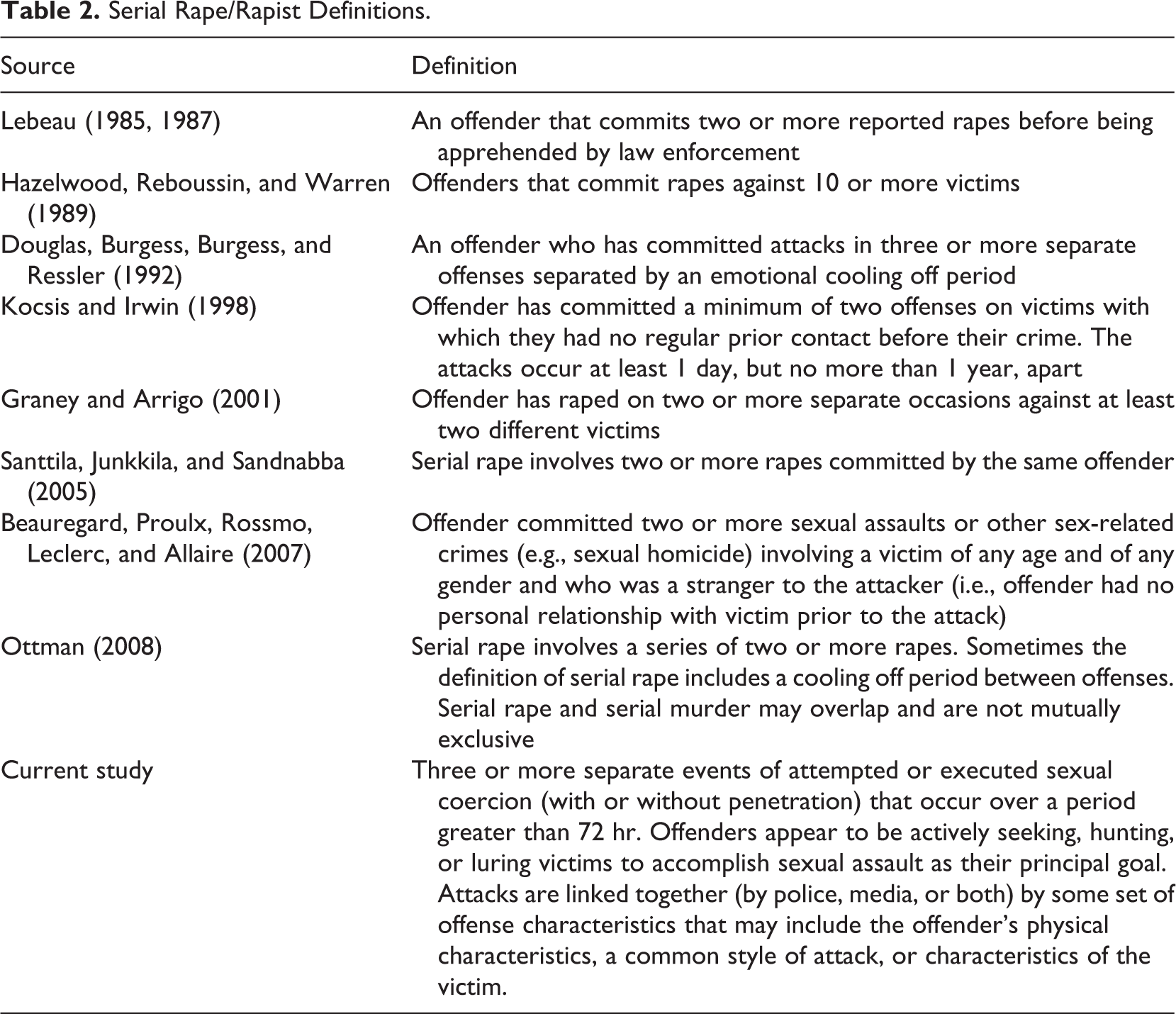
The definitions listed in Table 2 also say little about the offender–victim relationship. The exceptions are represented by Kocsis and Irwin (1997) and Beauregard et al. (2007). Both of these research teams assert that serial rapists are those that offend against “strangers.” This is an important observation, since it highlights the importance of target selection. Serial predators, presumably, select victims due to their vulnerability, based on opportunity, and in a strategic way to maximize the probability that they will complete the act without being identified or apprehended. After all, the serial predator hopes to continue his or her crime series. While researchers have demonstrated that most sexual predators are previously known to the victim, serial rapists appear to prey more on strangers (Beauregard et al., 2007; Hazelwood & Warren, 1990) which makes it harder for them to be identified and makes a case more difficult to prosecute (Lebeau, 1987).
A useful conceptualization of serial rape should also recognize that the serial rapist’s main objective is a sexual assault. Like Hazelwood and Warren (1990) and Beauregard et al. (2007), we see the serial rapist as hunting, luring, and otherwise seeking vulnerable victims in order to carry out the principal goal of sexual assault. Thus, versatile criminals who rob victims directly or burglarize homes and then attack victims as a peripheral or opportunistic act are not counted as serial rapists. There are, however, offenders who commit sexually motivated burglaries that are principally interested in sexual assault and commit property crimes as an incidental or opportunistic act (see Pedneault, Beauregard, Harris, & Knight, 2015). Sexually motivated burglars of this kind do count as serial rapists.
With respect to the actual physical offense, we believe that the act of serial rape may include a variety of attempted or completed acts of sexual coercion. Our conceptualization is consistent with recent revisions to the FBI classification of rape as “penetration, no matter how slight, of the vagina or anus with any body part or object, or oral penetration by a sex organ of another person, without consent of the victim” (2013, p. 1). This definition is far more inclusive than any previous definitions, as it now includes a broader range of penetration and male victims as well as females.
Finally, we set our victim count parameters in line with the FBI definition of serial murder. According to the FBI: “The term ‘serial killings’ means a series of three or more killings, not less than one of which was committed within the United States, having common characteristics such as to suggest the reasonable possibility that the crimes were committed by the same actor or actors” (Behavioral Analysis Unit, National Center for the Analysis of Violent Crime, 2008, p. 8). One of the key strengths of the FBI’s definition is that it introduces case linkage as an important definitional dimension. When defining a collection of multiple attacks as a series, one must draw from all the available evidence to demonstrate that the series was committed by one actor or specific actors working together.
Taking all of these factors into consideration, our conceptualization of serial rape is as follows: Three or more separate events of attempted or executed sexual coercion (with or without penetration) that occur over a period greater than 72 hr. Offenders appear to be actively seeking, hunting, or luring victims to accomplish sexual assault as their principal goal. Attacks are linked together (by police, media, or both) by some set of offense characteristics that may include the offender’s physical characteristics, a common style of attack, or characteristics of the victim.
Rapists that kill their victims are not included in our conceptualization (to distinguish them from sexual serial killers). There are some similarities between serial killers and serial rapists. Hazelwood and Warren’s (1990) con–blitz–surprise typology is consistent with models created by serial murder scholars who designate serial killers as somewhere on the continuum between organized and disorganized offenders. On the other hand, investigators have discovered important differences between sex offenders who kill their victims and those that do not. Chan and Beauregard (2015) found that homicidal sex offenders appear to be more likely to select a victim of choice, report deviant sexual fantasies, mutilate their victim, and to admit to their offense upon apprehension. Nonhomicidal sex offenders, by comparison, appear to select victims with distinctive characteristics.
Furthermore, sexual offenders who befriend, recruit, mentor, or counsel children over an extended period of time in order to sexually victimize them are not included as we believe that they represent a significantly different category of offender in terms of style, profile, and motives. Scholars of sexual offending against children make clear distinctions between those who develop an enduring relationship with the victim before the molestation and those who hunt, target, and sexually coerce children in the same way that a rapist might attack an adult victim. For instance, Groth, Hobson, and Gary (1982) differentiated between “child molesters” and “child rapists” in their research based largely on their observation that child molesters generally use a grooming process on their victims, whereas child rapists do not as their assaults occur suddenly. Moreover, Canter, Hughes, and Kirby (1998) argue that those who use “aggressive coercion” against child victims are a distinct type. Canter et al. make a distinction between the interpersonal/intimate type (the groomer) and aggressive or opportunistic offenders who stalk and hunt children. In the case of child rapists that are criminal opportunists (and not groomers), the victimization of the child is often a one-time occurrence—the interaction between the adult offender and the child victim is not repeated because the sex act constitutes the extent and duration of their relationship. In the case of an intimate offender (the groomer), the relationship is long term and the molestation is likely to occur more than once.
Thus, our sample does include child rapists that attack victims in a manner consistent with Hazelwood and Warren’s (1990) typology. We excluded, however, rapists that were constructed in news accounts as groomers. According to Knoll (2010), grooming is “the process by which sex offenders carefully initiate and maintain sexually abusive relationships with children. Grooming is a conscious, deliberate, and carefully orchestrated approach used by the offender. The goal of grooming is to permit a sexual encounter and keep it a secret” (p. 374). The grooming process, then, is distinctly different from the blitz–con–surprise model in that it involves the cultivation and maintenance of a relationship with a child that permits a sexual encounter. This is not to say that victims of child molestation consent to their attack. As Lanning and Dietz (2014) argue, “The term compliant child victim is used to describe those children who in any way, partially or fully, cooperate in their sexual victimization without the threat or use of force or violence” (p. 2823). To “cooperate” with molestation means that the victim may believe—as a result of extended offender manipulation—that he or she is voluntarily taking part in a sexual relationship. A molester may prey on a child’s need for adult attention or ply them with gifts to facilitate closeness that he or she escalates into sexual intimacy. This is not to say that a molested child is not a victim. The grooming process, however, is different in kind from the hunting and luring and physically coercive acts perpetrated by the offenders that fall under our conceptualization of serial rape.
Having established these conceptual parameters, we narrowed our sample to those cases that fit our conceptualization of serial rape. To distinguish cases from spree or mass rapists, as in a murder series, we used victim count and time parameters. That is, guided by our definitional parameters, we identified and entered a rape series as the executed or attempted sexual coercion of three or more victims over a period greater than 72 hr. Using our conceptualization of serial rape, we identified 1,037 offenders from 1940 to 2010.
We focused on media representations of active serial rapists, the time period during which they were active, and a variety of variables related to offender characteristics and attack styles. For the purposes of the current study, four variables were used to form a basic social profile. Those measures include age, race, sex, and occupational class.
Age
This variable is defined as the age at which the offender committed their first known act of rape in a series. For example, one offender in our sample was accused of 11 different rapes in the 1950s and was subsequently arrested and convicted in 1957 when he was 18. News accounts stated that he began his series of rapes in 1955, making him 16 years old when the crimes first occurred (Chicago Tribune, 1957). In some cases, where the assailant was still at-large, we estimated age based on victim estimates of age range. When a range of ages was given (e.g., 25–30), the median age was used. Median age estimates were used in 8.5% of the cases. Age of offender was present in about 91% of the cases (n = 947).
Race/Ethnicity
The race/ethnicity of the offender was determined based on identifying language in each news account. Of the total number of cases of serial rape, only 29% had an identified race or ethnicity (n = 297). Often times, race was assigned based on victim descriptions when a perpetrator was considered at large and had not been caught. In the case of the “Horn-Rimmed Glasses” rapist from 1969 in Edison and Orioles Park, Illinois, the Chicago Tribune stated, “at least four recent victims have described the assailant to police as a white male, age 25 to 30…” (p. B24). In rare cases, race or ethnicity was not stated in the article but a police sketch was present. In these few cases, the data coders used their observations of the features depicted on the artist’s rendering to estimate race or ethnicity. If the coding team all agreed on a particular racial or ethnic category, then that category was entered. If the team could not agree, then a missing value was entered for race.
Sex of Offender
The sex of offenders was either clearly stated in news accounts or was deduced by examining the use of pronouns by either police or victims. Sex was identified in 100% of the cases. All but two of the cases (n = 1,035) were men; two of the active rapists in our sample were identified as women. In one case, the female assailant was part of a collaboration (1 of the 25 rape series collaborations in our sample). And while the rape victims in our sample were overwhelming female (96%), 4% of the cases involved males. For example, The Baytown Rapist was arrested and convicted for a series of crimes in 2006 in Baytown, Texas. According to news accounts all five of his victims were male (Los Angeles Times, 2006). Based on media accounts, however, the rape series in our data are overwhelmingly male offender–female victim attacks.
Occupational Class
Our measurement of occupational class draws on Colvin and Pauly’s (1983) class fraction typology and Vander Ven and Cullen’s (2004) occupational class coding scheme to estimate occupational class for each of our offenders. Colvin and Pauly (1983) divided the working class (i.e., those who sell their labor in the marketplace) into three discrete class fractions. Fraction I employees are those unskilled, nonunion workers found in the secondary labor market: agricultural labor, small manufacturing firms, retail and food services, household domestic work, and low-level clerical jobs (e.g., stock clerk). Fraction II laborers include skilled blue-collar workers (e.g., welders, plumbers, steelworkers, and auto assemblers), skilled clerical workers (e.g., secretaries), craftsworkers, and lower level supervisors in the trades or service industry. Fraction III status was assigned to professionals, self-employed entrepreneurs, highly trained medical personnel, technicians, managers, and advanced government workers. Offenders were assigned a class fraction status based on the description or title of their job in the news article. Occupational status was referred to in 35% of the cases (n = 362).
Some of the offenders were described as students, while others were reported as being chronically unemployed or homeless. Other offenders were described as spending much of their lives incarcerated with no known work history. Therefore, we created categories for the chronically unemployed/homeless, the chronically incarcerated, and for students. Offenders were coded as “chronically unemployed/homeless” or “chronically incarcerated,” if they were described as such in associated news accounts. Furthermore, offenders described as high school or college students were coded as “student” for the occupational class variable. This coding scheme produced six occupational class categories: chronically unemployed/homeless, Fraction I: secondary labor market, Fraction II: semiskilled laborer, Fraction III: professional, chronically incarcerated, and full-time student.
Offense Date Range
This variable is defined as the years during which media accounts reported that a serial rapist was active. The offense date range was determined by the specific years reported by police or victim accounts. If a newspaper report stated that an offender began his series in a certain year and was caught and processed in a subsequent year, we estimated that the assailant was active during all years in between. For example, one offender in our sample was convicted in 1976 for a series of rapes in Porterville, California. The Los Angeles Times stated that the offender “…pleaded guilty to raping nine women between July, 1974 and July, 1976” (1976, p. B2). This would suggest that the offender was also active during 1975. Occasionally, a rapist would be deemed a serial rapist, get caught and convicted and upon release, would commit a series of rapes again. In this instance, the offender could not have been active while incarcerated, as his attacks were temporarily suspended. For example, a serial predator was arrested and convicted in 1966 for a series of rapes in Hermosa Beach, CA, and was released in the 1970s. While he was out of prison, the offender committed another series of rapes in 1972 and 1973, making his known offense date range: 1966, 1972, and 1973 (Los Angeles Times).
Attack Style
Hazelwood and Warren (1990) identified three basic types of offender approach: the con, the blitz, and the surprise. The con approach involves the use of a theatrical ruse to temporarily gain the trust of a potential victim. One offender, for example, was convicted in 1980 for attacks on 14 women. According to news accounts, he would gain access to the victims’ homes by saying he was a plumber sent over to check on their house or pretend he needed help with his car and once inside, would attack (Leeds, 1980).
The surprise approach involves premeditation and often a preselection of victims, however, unlike the con approach, this method does not rely on personal interaction with the victim beforehand. For example, an offender convicted in Los Angeles, California, in 1978, was dubbed by police “The Pillowcase Rapist” because he would sneak in through windows and place a pillowcase over the victim so they could not identify him (Decker, 1978). The blitz approach is opportunistic and typically involves an unexpected attack on the victim. The “Halls Hill Rapist” in Arlington, Virginia, would grab women from behind after they exited buses and drag them at knifepoint behind buildings (Dougherty, 1981).
In addition to these three methods of attack, our analysis identified a previously neglected method of assault—drugging. Drugging was considered a discrete method because it employs different tactics that do not fit into the previous three categories. Drugging involves the use of medicine, sedative, or a street drug to subdue the victim (e.g., laughing gas). In the 1980s, for example, a physician admitted to raping five of his patients while they were sedated. The offender informed patients that he needed to put them under sedation to perform small surgeries: “[The offender] admitted that he had anesthetized five women patients between 1982 and 1984 and…then sexually assaulted them” (Myers, 1987, p. A2).
The drugging style differs from the other attack categories in important ways. First, in most cases (73% of drugging series), the drugger’s victims entered the attack site (e.g., a doctor’s or dentist’s office) voluntarily to seek medical treatments and without being lured or persuaded through face-to-face interaction. While the con-rapist uses rhetorical strategies to move the victim to the attack site, the medical professional, who drugs and rapes, draws in victims by simply operating a medical services office. This type of drugging rapist uses his professional establishment and access to incapacitating drugs as resources in his attacks. The other 37% of the drugging rapists used drugs or alcohol to incapacitate a victim while on a date or during a professional interaction (e.g., a photographer who dosed victims during a shoot). Thus, unlike blitzers or surprise rapists who hunt in public spaces and use brute force to overcome victims, or con-rapists that create a dramaturgical ruse to isolate victims, the drugging rapist interrupts an otherwise legitimate and noncoercive interaction with the surreptitious administration of drugs in order to render a victim unconscious and vulnerable to attack.
Findings
Offender Social Profile and Style
The social profile generated by the current study reflects media representations of over 1,000 active serial rapists and 70 years of offense tracking. Our sample is unique in that it draws from newspaper accounts of serial offenders in every stage of identification and criminal justice processing (e.g., at-large offenders, arrested, convicted, and incarcerated). Our social profile includes estimates of sex, age, race, and occupational class. With respect to sex, all but 2 of our 1,037 offenders were male. Regarding offender–victim relationships in serial rape cases, news accounts rarely provided explicit information on the known relationship prior to the attack. While it appears that the overwhelming majority of the attacks occurred between strangers—especially in the case of blitz, surprise, and con attacks—there were doctor–patient drugging cases where the offender and victim appeared to have at least some previous history of interaction through the administration of medical services.
Age
The mean offender age for the current study is 27.15 years of age with a range of 10–71 years of age. Compared to studies of single victim rapists, our sample mean age is younger, and our range of ages is broader. Our average offender age, however, is similar to the estimates offered by other multiple rape scholars (e.g., Corovic et al., 2012; Park et al., 2008; Woodhams & Labuschagne, 2012).
Race/ethnicity
Twenty-nine percent of our cases had an identifiable indicator of race or ethnicity (n = 297). Thus, the overwhelming majority of our cases lacked media representations of race. Based on this subsample, we generated the following estimates of offender race as reported by media sources: African American: 46%, Caucasian: 29%, Hispanic/Latino: 19%, Asian: 5%, and Other: 1%.
Occupational Class
Using our occupational class coding scheme, we identified six discrete categories for offenders for whom class information was provided (n = 363 or 35% of the sample). According to our estimates, the most common occupational class position for offenders in our sample was semiskilled laborers and service workers (47%). Secondary labor market employees accounted for 22% of the sample, while professionals made up 17%. Full-time student (high school or college) status was estimated at 7%, while the chronically unemployed/homeless and the chronically incarcerated categories each represent 4% of the offenders.
Offender Style of Attack
Attack style patterns are displayed in Figure 1. Seventy-four percent of the cases had an identified method of attack (n = 768). In some cases, offenders used more than one attack style, in which case all styles were entered and counted. Five percent of the rapists described in news accounts used more than one attack style in their series (n = 52). The most common combination of attack styles was the use of blitz and surprise during the series. Thirty-five percent of offenders that used more than one style combined the blitz and surprise methods.

Serial rapist style of attack.
As illustrated in Figure 1, 47.4% (n = 389) of our cases involved offenders that employed the surprise approach, 27.9% (n = 229) used the con approach, 22.2% (n = 182) employed the blitz style, and 2.6% (n = 21) used the drugging strategy.
Historical Trends in Serial Rape, 1940–2010
Serial Rape, 1940–1963
Figure 2 depicts historical trends in media representations of serial rape over the 1940–2010 time period. The 1940–1963 period is generally characterized by consistently low levels of media-reported serial rape. According to newspaper coverage of this period, the number of active serial rapists range from a low of 0 in 1940 to a high count of 13 in 1953. The number of serial rape accounts during this period is in single digits for 20 of the 24 years included in the span of analysis. The yearly average for number of media-reported serial rapists during this era is 7.04.

Historical trends in media representation of American serial rape, 1940–2010.
It might be argued that these consistently low numbers are an artifact and an expression of the limitations of using newspaper data. That is, it may be that the large newspapers included in our sample were less likely to capture rape series’ taking place in more remote or rural areas or in regions that fall outside of the radar of large city newspapers. News sharing and the broad dissemination of crime stories are likely to have been relatively lower during this period as compared to more contemporary news spreading practices. As Jenkins (1992) points out, large newspapers like The New York Times significantly expanded their regional news coverage in the 1950s. Serial murder scholars, however, suggest that large newspapers did, in fact, uncover stories that reached far beyond their local area. According to Jenkins (1992, p. 4), apparent increases in serial murder cannot be explained by changing news reporting practices alone: Throughout the century, major serial murder cases have usually been viewed as stories of great journalistic interest, and between about 1900 and 1940 the New York Times reported extensively and enthusiastically on serial murder cases as far afield as Colorado, Iowa, Alaska, and South Dakota…Even so, the danger of overlooking cases prior to the 1960s is reduced by using Newton’s Hunting Humans, which draws on regional and local newspapers from no fewer than 25 states: papers such as the Eagle-Beacon of Wichita, Kansas; the Daily News of Anchorage, Alaska; and the Clarion Ledger of Jackson, Mississippi. Even a search as wide as this apparently failed to find a large number of midcentury cases that escaped the attention of the major metropolitan press.
Serial Rape, 1964–1979
Figure 2 illustrates a steady increase in the number of newspaper accounts of serial rapists during the 1964–1979 time period. According to newspapers accounts, the number of offenders ranges from a low of 13 in 1968 to a high of 59 in 1979. The yearly average for the number of serial rapists reported by news outlets during this 16-year period is 26.9.
The routine activities approach (Felson & Eckert, 2016) may offer a useful theoretical explanation for the rising trend in serial rape between the mid-1960s and 1970s. That is, cultural changes, policy shifts, and the increasing spatial mobility of victims and offenders may have tipped the social climate to the advantage of motivated offenders who were increasingly likely to find suitable targets in a context lacking capable guardianship.
Serial rapists, by and large, appear to exploit or manufacture pockets and moments of low guardianship in order to increase target vulnerability. The blitz rapist, for example, relies in part on the existence of solitary victims traveling in unguarded spaces. Blitzers generally mount sudden, explosive attacks on targets in open spaces. Any social trend that increases unaccompanied travel, then, will result in increasing levels of predatory crime. Similarly, surprise rapists exploit moments of low guardianship when they, for example, stealthily break into the homes of single-living women or lie in wait in unguarded public rooms (e.g., apartment laundry rooms). The social and cultural conditions that emerged in the 1960s and 1970s may have helped the serial rapist to accomplish his or her goals more efficiently and more frequently.
As Jenkins (1992) argues, the expanding cultural freedoms of young people during the 1960s and 1970s may have had the unintended effect of putting more people in harm’s way. With reference to increasing vulnerability to serial predators, Jenkins (1992) posits that “the vital changes in the 1960s might have been the greater independence of the younger generation and changes in their sexual behavior and attitudes. This greatly enhanced the opportunities for a potential offender to find himself or herself in intimate circumstances with a victim, and the increased physical mobility of these years made it less likely that a young person’s disappearance would be immediately noticed” (pp. 14–15).
Furthermore, one might argue that the 1960s and 1970s represent a period of emergent norms that encouraged people to be more accepting and trusting of strangers and those with alternative lifestyles and to reject the assistance of formal agents of social control. According to Jenkins (1992, p. 15), Changes in mores increased a willingness to experiment with alternative belief systems and life styles and made many people less prepared to reject or suspect individuals who might appear strange or deviant. The sum total of these changes was to facilitate encounters between strangers that might have been far more difficult only a few years previously. At the same time, the political fragmentation of the late 1960s discouraged young people from invoking police assistance in what might have been seen as suspicious circumstances.
Serial Rape, 1980–1991
As depicted in Figure 2, the period from 1980 to 1991 is characterized by a brief decline in newspaper accounts of serial rapists from 1980 to 1984 followed by a steady climb from 1985 to the highest recorded level in 1991. The number of media reported cases for 1991 is 84 or twice the number of estimated in 1983. The brief decline in offenders identified by news outlets during the 1980–1984 years matches the general decline in American predatory crime identified by a host of researchers. Steffensmeier and Harer (1987, 1999), for example, observed drops in both rape and homicide during this period. According to the authors, this brief decrease in predatory crime is at least partially explained by changes in the age structure in American society. Since predatory crime peaks during the late teens and early twenties, fluctuations in the age composition of a population can impact the crime rates of that population (Steffensmeier, Streifel, & Harer, 1987). The most crime-prone age group shrank as a proportion of the population in the 1980s, which helps to explain early 1980s declines. According to Steffensmeier, Streifel, and Harer (1987), “In the United States…both the dramatic increases in the overall crime rate in the 1960s and early 1970s and the decreases in the rate in the 1980s are linked to the post–World War II ‘baby boom’ and the post-1960 ‘baby bust’” (p. 702). Steffensmeier and Harer (1987) use age-adjustment models to demonstrate that as much as 40% of the 1980–1984 decline can be explained by changes in the age structure of the population.
Figure 2 shows a steady increase in media accounts of active serial rape from 1985 to 1991. This trend follows the steady general increase in serial rape accounts from the mid-1960s onward. As previously noted, according to our estimates, the number of active serial rapists reported by the media reached a zenith in 1991. The early 1990s spike in serial rape is consistent with many other studies that show a dramatic increase in predatory crime at this time. Crime researchers have observed a dramatic spike in a variety of offenses in the early 1990s including increases in homicide and rape (see Levitt, 2004; Steffensmeier & Harer, 1999). Our data suggest that serial rape—as depicted by media sources—followed similar historical trend lines.
Serial Rape, 1992–2010
According to media accounts, the number of serial rapists declined steadily from 1992 to 2010, with a brief increase in 2003–2004. The dive in cases of serial rape identified by media sources picks up again in 2005 and plummets to single digits in 2009 and 2010 for the first time since 1963. This gradual, substantial drop in serial rape accounts reflects the broader decrease in American violent crime over this time period. According to Levitt (2004), “crime fell sharply in the United States in the1990 s, in all categories of crime and all parts of the nation. Homicide rates plunged 43% from the peak in 1991 to 2001, reaching the lowest levels in 35 years. The FBI’s violent and property crime indexes fell 34 and 29%, respectively, over that same period” (p. 163).
The dramatic drop in predatory crime (in general) and in serial rape (in particular) may be attributed to a variety of factors. Drawing from the routine activities approach, it may be argued that social trends, criminal justice practices, and the increasing use of surveillance technology may have effectively reduced the extent to which motivated offenders, suitable targets, and the lack of capable guardianship converged in time and space (see Baumer & Wolff, 2014; Felson, 1995).
The pool of motivated offenders was undoubtedly reduced by legislation and judicial practices that grew the American prison population to unprecedented levels during this period. According to Conklin (2003), “…13 to 54 percent of the decline in crime rates in the 1990s was due to growth of the prison population” (p. 95). Similarly, Levitt (2004) argues that “The 1990s was a period of enormous growth in the number of people behind bars…. By 2000, more than two million individuals were incarcerated at any point in time, roughly four times the number locked up in 1972. Of that prison population growth, more than half took place in the 1990s” (p. 177). To the extent that many would-be serial predators were among the masses incarcerated during this period, it is no wonder that serial rape experienced a downward trend.
The decline in serial rape since 1992 may also be explained by increasing and more sophisticated guardianship. The growth in police forces is one way to measure increased guardianship. Levitt (2004) reports that the number of American police officers grew by 14% in the 1990s. More importantly, advancements in law enforcement technology and investigation techniques have made it increasingly difficult for serial predators to maintain a crime series. According to Jenkins (1992), modern law enforcement officers are more skilled and experienced at discovering and tracking serial offenders: “The agency’s modern counterparts would be more familiar with patterns of serial homicide and would thus tend to speculate with greater freedom. Modern agencies also have superior recordkeeping techniques and more experience of interagency cooperation, enhancing the likelihood that a suspect could be linked to a large number of earlier offenses” (pp. 4–5). Furthermore, the forensic sciences advanced rapidly during the apparent decline in serial offending. In the late 1980s, DNA evidence entered into the court system. The Committee on Identifying the Needs of the Forensic Sciences Community (2009) suggests that over the past 20 years, science and DNA evidence have allowed for more prosecutions and convictions, as well as solving previously unsolved cases. The FBI (2008) has drawn increasingly from forensic evidence based upon a person’s DNA and a nationally maintained database which has allowed for prosecution in previously unsolved cases, and allowed for linkage between cases that were not known before. These advancements have allowed for an increasing potential for identifying offenders and, thus, have made serial offending more difficult to accomplish. Since serial rapists tend to have more forensic awareness than single-victim offenders (Corovic et al., 2012), advancing technology may have served to discourage would-be offenders from acting upon criminal desires.
Finally, the broad use of everyday surveillance and security technology in American life has undoubtedly resulted in fewer serial offenses. Guardianship, in the form of surveillance cameras on city streets and in public establishments, for example, has increased dramatically in recent decades. According to Welsh and Farrington (2009), CCTV cameras are currently being installed at an unprecedented rate in the United States and have been associated with crime decreases in some settings. Since serial rapists—especially those that hunt at night in sparsely inhabited spaces—rely on moments of reduced guardianship, the growth in surveillance technology may have had the effect of reducing their offense opportunities.
Conclusion: Summary, Limitations, and Future Directions
The current analysis of media representations of serial rape in America was driven by three main objectives. First, we offered a critique on the limitations of past definitions of serial rape in the extant literature and constructed our own more comprehensive conceptualization of serial rape. Our conceptualization, guided by the work of serial murder scholars, sees serial rape in terms of temporality, offender motives and behavior, and case linkage. We believe this conceptualization is an improvement on past scholarship in terms of specificity and comprehensiveness and may inform future serial rape scholarship.
Second, we drew from 70 years of newspaper accounts to estimate the social profile of the serial rapist and to summarize offender attack styles. Our estimates represent news data on offenders or suspects in various stages of detection, identification, and criminal justice processing. Thus, our analysis improves upon estimates produced by past scholars who generally focus on captive or formally processed samples. According to newspaper accounts, the typical offender is male and has an average age of 27 years at the time of his first recorded or suspected offense. Furthermore, 47% of the offenders identified in newspaper accounts are African American, 29% are Caucasian, 19% are Hispanic/Latino, 5% are Asian, and 1% of our sample represent some other racial/ethnic group. It is possible that the large number of African Americans in our data is partially the result of race-biased crime news reporting. It may be that crime reporters are more likely to identify the race of offenders when the offender in question is African American. Currently, there is little empirical evidence to support this hypothesis (see Collins, 2014; Kumar, 1999), but the existence of race-reporting bias in news accounts should be investigated in future research. It is important to note that, as stated previously, the profile created is a summary based on seven decades of offense coverage, and the racial makeup of the offender pool may vary significantly depending on the time period under examination. Finally, our study represents the most systematic effort to estimate the occupational class of serial rapists. Media accounts suggest that serial rapists are typically members of the unskilled or semiskilled working class. Approximately 69% of sample offenders (where occupation was indicated) were employed in semiskilled labor or unskilled work in the secondary labor market, while 17% of sample offenders were employed as professionals.
According to our analysis of news treatments—and consistent with past research (Hazelwood & Warren, 1990; Park et al., 2008)—the most common attack style is the surprise strategy at 47%, followed by the con approach at 28%, the blitz style at 22%, and the drugging strategy at approximately 3%. Our analysis is the first to extend Hazelwood and Warren’s (1990) original style typology to include drugging as a discrete attack category. The routine activities approach helps to offer explanations for attack style patterns. The surprise approach may be the most common style because it potentially presents the least risk to the offender. The advantage of the surprise attack is that is designed to create moments of vulnerability where a suitable target is isolated under conditions of low guardianship. Surprise offenders appear to be relatively systematic in their attempts to exploit the vulnerability of victims. For example, surprise offenders often collect environmental data by following and watching the routine travels of a suitable target to assess optimum times for attack. The surprise offender may stealthily break into homes when he knows victims are alone and sleeping or lies in wait in unguarded stairwells or laundry rooms. The blitz approach, being the most purely opportunistic approach, may be the riskiest and least appealing style for offenders. Blitzers appears to exploit moments of low guardianship (e.g., attacking lone pedestrians late at night) rather than manufacturing vulnerability through intelligence-gathering as the surprise rapist might or through a dramatic ruse as employed by the con rapist. Surprise rapists also appear to be more systematic in their attempts to handicap their victims’ ability to identify them. Based on our news accounts, out of the 48 sample offenders that wore some sort of mask during the commission of their crime, 38 of them were surprise rapists. The dominance of the surprise attack appears to be related to the added confidence it provides the offender that he can execute the act in the presence of low guardianship.
Our final objective was to draw from media representations to estimate and interpret trends in serial rape from 1940 to 2010. The trend line depicted in Figure 2 closely matches the shape and direction of general crime change in America as documented by a host of investigators. The fact that our graphed data resemble the typical trends produced by other systematic designs is a strong testimonial for the strength of our research design and the validity of our findings. Our analysis of newspaper data suggests that serial rape was fairly uncommon from 1940 to 1963, rose steadily in the 1960s and 1970s until it hit a dramatic peak in 1979, took a brief and minor dive in the 1980s, sped upward to an all-time high between 1985 and 1991, and has since steadily and radically declined to levels not observed since the 1940s. We suggest that the recent decline and relatively low offense rate of serial rape can best be explained by observing the social forces that influence the convergence in time and space of motivated offenders, suitable targets, and lack of capable guardianship. For example, the advancement of guardianship in the form of police technologies, crime intelligence-sharing, and everyday surveillance (e.g., CCTV) is likely to have some impact on serial offending.
The current study is limited in a variety of ways. First, while we feel confident that drawing from newspaper accounts provided a solid empirical foundation for our study, we are certain that cases of serial rape escaped the coverage of newspapers over time. Some of the observed differences in offending over time, that is, could be explained by changing reporting and news-sharing practices. Moreover, our newspaper sample did not include periodicals from all regions of the United States. The American South, for example, is least represented in our newspaper sample. And although we employ an historical interpretation of our data, the current study makes no attempt to explain how offender profiles, attack styles, victim counts, or victim characteristics changed over time. Furthermore, the current study focused primarily on offender characteristics and attack styles while neglecting to investigate victim characteristics. In future research, we plan to examine these media accounts to better understand the construction of victim characteristics and to interpret historical changes in key variables.
One of the more intriguing findings in our analysis relates to offender race and ethnicity. While it should be noted that news accounts identified offender race in just 29% of the cases, our data suggest that 47% of the offenders depicted were African American. While there is little empirical evidence that crime reporters are more likely to report race when offenders are African American, it is possible that race shapes the frequency and form of serial rape news reporting. Future researchers might evaluate the structure and form of crime reporting as it pertains to race as well as examine race-reporting patterns over time. Finally, our data allow us to examine serial rape over time and space. The current analysis looked only to capture temporal changes in serial rape. In the future, we hope to extend our analysis by tracing serial rape over time and over the geographical areas covered by our data. Focusing our analysis on the changing demographics and infrastructure of a particular city (e.g., Washington, DC, Los Angeles, and Chicago) and how those changes relate to trends in serial offending would be instructive to those interested in crime control and prevention models.
Finally, our study may serve as one model for those interested in drawing from media constructions to estimate historical crime trends. Our sociohistorical approach suggests that there is merit in understanding crime in social context. Popular culture treatments of serial criminals often construct them as crazed predators who must be understood in terms of psychological pathologies and traumatic life histories. Our study suggests that understanding serial offense rates is enhanced by examining the offense in social-historical context and that the commission of serial rape is shaped by historically specific social conditions. We have drawn upon the routine activities approach to interpret the changes in serial rape offending over time (as reported by news accounts). In simple terms, we suggest that decreases in serial rape might be explained by social changes that promote patterned reductions in the convergence of suitable targets, motivated offenders, and the lack of capable guardianship. As Jenkins (1992) argues, in order to reduce serial crime “these underlying factors must be understood, and this can be achieved only if the [offender] is seen not merely as a disturbed individual but as an actor within a changing social context” (p. 17). Understanding these underlying factors that promote reductions in crime may lead policymakers to identify strategies for preventing and reducing serial rape.
Footnotes
Declaration of Conflicting Interests
The authors declared no potential conflicts of interest with respect to the research, authorship, and/or publication of this article.
Funding
The authors received no financial support for the research, authorship, and/or publication of this article.