







Abstract
Issues of innocence have become more salient to the public in recent years, including the problem of police misconduct. However, citizens also tend to be supportive of the police, perceiving them as ethical, honest, and trustworthy. Using a survey experiment with a nationally representative sample, we explore the degree to which public opinion toward police misconduct is influenced by priming respondents on the issue of innocence. We find that reminding citizens of these issues increases their willingness to admit police misconduct that contributes to this problem by roughly 7 percentage points overall. Moreover, this effect is driven by conservatives and, to a lesser extent, moderates, presumably because liberals do not need priming. In contrast, the efficacy of the prime was not affected (i.e., moderated) by the race of the respondent. We place these results in the context of the current debate regarding police use of force as well as the ideological divide in rhetoric surrounding the recent string of high-profile police shootings.
How much do U.S. citizens perceive police misconduct to be a contributing factor in wrongful convictions? On one hand, surveys show that the public has a great deal of confidence in the police, placing them below only the military and small businesses among a list of several institutions (Gallup, 2015). The police tend to be afforded the greatest confidence among specific actors in the criminal justice system as well (Sherman, 2002; Tyler, 2005). And while a majority of adults believe that wrongful convictions occur at least some of the time (Unnever & Cullen, 2005; Zalman, Larson, & Smith, 2011), they also believe that actors in the criminal justice system—including police—are generally reliable when it comes to the presentation of evidence in trials (Zalman et al., 2011).
On the other hand, high-profile instances of police misconduct appear in the national news with some regularity (Jones, 2015). Studies have shown that these incidents, such as the beating of Rodney King, lower support for the police (e.g., Lasley, 1994; Tuch & Weitzer, 1997; Weitzer, 2002, although see Chermak, McGarrell, & Gruenewald, 2006). Recently, confidence in police has declined nationally in the wake of a string of highly publicized instances of misconduct and the use of force against unarmed citizens (Pew, 2014a). There is also some evidence that general exposure to media reports of police misconduct, not just to a specific incident, erodes support (Weitzer & Tuch, 2005, although see Miller, Davis, Henderson, Markovic, & Ortiz, 2005).
Moreover, such coverage coincides with increased public attention to wrongful convictions. This is in part spurred by organizations such as The National Registry of Exonerations (NRE) and The Innocence Project that consider informing the public to be a principal goal (Zalman et al., 2011). Empirically, analyses show that news media coverage has given increasing attention to the issue of wrongful convictions, at least with respect to the death penalty (Baumgartner, DeBoef, & Boydstun, 2008; Fan, Keltner, & Wyatt, 2002). In turn, this focus on exonerations appears to have shaped public opinion, specifically by lowering support for capital punishment over time (Baumgartner et al., 2008; Fan et al., 2002).
We suspect that this effect applies in other domains of the criminal justice system as well: Heightened attention to the issue of innocence affects citizens’ perceptions regarding police misconduct, specifically by increasing the perceived frequency with which such misconduct contributes to wrongful convictions. Before describing the survey experiment that enables us to test this suspicion, we first outline previous studies of public opinion regarding police misconduct and false convictions. This brief discussion provides context for two additional hypotheses: the impact of highlighting innocence on attitudes regarding police misconduct is moderated by racial and political considerations. After presenting the results, we discuss the implications of our findings as well as related questions for future research.
Who Perceives Police Misconduct to Be a Problem?
Although global attitudes toward the police are distinct from attitudes regarding police misconduct (Miller & Davis, 2008), far less scholarly attention has been paid to the latter. One exception to this comes from Weitzer and Tuch (2004), who sought to understand why racial minorities are more likely to perceive police behaviors as misconduct than Whites. They demonstrate that the racial gap is, in large part, a function of racial differences in personal encounters with the police and perceptions of neighborhood crime (see also Weitzer, 1999).
This same analysis suggests that the racial gap is also partially explained by reported differences in exposure to media coverage of police misconduct. This finding is echoed by Dowler and Zawilski (2007), whose survey shows that viewers of network TV news perceive misconduct as occurring more frequently than nonviewers of network news. Indeed, perceptions of police misconduct may be more sensitive to media coverage than attitudes toward the police in general (Miller & Davis, 2008).
Even less is known about perceptions of wrongful convictions or how police behavior may contribute to this problem. One survey found that roughly 10% believe wrongful convictions occur less than 1% of the time, while more than two thirds believe they occur in 4% or more of cases (Zalman et al., 2011). Unnever and Cullen (2005), who focused specifically on the death penalty, reported that three fourths of respondents believed an innocent person had been executed in the United States in the last 5 years. We are aware of only one study that uses a nonstudent sample to examine public opinion with a specific focus on police misconduct: The previously mentioned survey of Michiganders found that an overwhelming majority of citizens believed the police are reliable in the presentation of evidence during trials (Zalman et al., 2011).
Although it is unclear to what extent Americans perceive police misconduct to be a problem for the administration of justice, we do anticipate ideological and racial differences in response to framing the issue in terms of innocence or not. With respect to the former, political polarization has affected public opinion across a variety of issues, and the criminal justice system is no exception. The Washington Post reports that perceptions of racial bias in the criminal justice system have polarized along ideological lines, from a 13-point gap between self-identified liberals and conservatives in 1988 to a 36-point gap in 2007. Moreover, “partisanship and ideology play a stronger role in white Americans’ views on [issues of race and justice] than almost all other demographic and regional factors, according to a statistical analysis looking at the impact of many factors at once” (Balz & Clement, 2014, para. 18). Indeed, a recent Gallup poll indicates that democrats—but not republicans or independents—have expressed waning confidence in the police (Jones, 2015).
In a more politically polarized era, it is likely that liberals and conservatives will not only have different perceptions when it comes to police misconduct but also react differently to the presentation of information about the issue of innocence. The manner in which political ideology affects perceptions regarding innocence and police misconduct is ambiguous, however. One can envision that political conservatives, owing to their affection for the police, would be resistant to information about wrongful convictions and unmoved—or even polarize—in their perceptions. Yet it is equally plausible that liberals, due to their already negative orientations toward the police and/or previous incorporation of this information into their attitudes (i.e., they are already more aware of police misconduct and wrongful convictions), are unmoved by the prime. In either case, we would be surprised to see liberals and conservatives responding in parallel to the framing of police misconduct.
Similarly, we expect race to moderate the degree to which highlighting the issue of innocence affects attitudes regarding police misconduct. Racial divides are common in public opinion regarding crime and justice issues, but there is also evidence that Blacks and Whites respond differently to information about these issues. For instance, Weitzer and Tuch (2005) found that exposure to media reports of misconduct decreased satisfaction with the police, but only among Black respondents. Similarly, an analysis of how media coverage of the Rodney King incident impacted perceptions of police fairness showed that while it eroded support across the board, this was particularly true among Black citizens (Lasley, 1994). Thus, as with political attitudes, it is likely that race moderates the impact of information about innocence.
In sum, we hypothesize the following:
Data and Method
The analysis below utilizes data from an online, omnibus survey funded by RTI International and fielded by GfK (Knowledge Networks at the time), March 6–18, 2013. GfK administers surveys via the web but recruits respondents for their KnowledgePanel using random digit dialing of landlines and address-based sampling methods. Respondents without web access are given a free computer with Internet service for as long as they remain an active part of the panel. All respondents are given modest incentives to encourage participation. Our respondents (N = 2,119) were a random sample of all GfK panel members; the completion rate for this survey was 58%. 1 Because it was an omnibus survey, these data come from questions asked after two unrelated modules. 2
As part of a series of questions on perceptions of police misconduct and the use of force, respondents were randomly assigned to receive one of the two versions of the survey item we use as our dependent variable. Specifically, half the respondents were given information, what we call our prime, on the issue of innocence: You may have heard of The Innocence Project, a national litigation and public policy organization dedicated to exonerating wrongfully convicted individuals through DNA testing. To date, their efforts have led to over 300 innocent people being exonerated (that is, individuals who were originally found guilty and sentenced to prison but later, through DNA testing, were found to be innocent).
Respondents were subsequently asked how much time they spend watching local TV news (“In a typical week, how much time per weekday do you spend watching local television news?”) and crime dramas (In a typical week, how much time do you spend watching fictional crime dramas, such as CSI? This can include shows that are no longer airing new episodes, such as NYPD Blue or the original Law & Order.) in minutes, as indicated by an open-ended box. 4 Responses to TV news watching were recoded such that 0 = doesn’t watch, .333 = watches 1–29 min, .667 = watches 30–59 min, and 1 = watches 60 min or more. Responses to viewership time of crime dramas were recoded such that 0 = doesn’t watch, .5 = watches 1–60 min, and 1 = watches 61 min or more. The survey concluded by asking respondents for standard sociodemographic information, including gender, race/ethnicity, ideology (Would you say your views in most political matters are liberal, moderate, or conservative?), previous experience with the police (Have you ever been involved in an encounter with the police other than a traffic stop? In other words, a situation where the police approached or stopped you as a suspect?), and residency information, which allowed us to determine whether the respondent lived in an urban or rural area and in what census region. These variables were dummied so that 1 indicates a respondent who is male, Black, Hispanic, moderate, conservative (with liberal as the reference category), had a previous encounter with the police, lives in an urban area or the south, 0 otherwise. Age, education, and income were also recoded to range from 0 to 1, with 1 indicating the oldest respondent, the highest level of education, and the highest level of income.
It should be noted that several studies have raised questions about the validity of ideological self-identification as an indicator of one’s political worldview. Indeed, because of the multidimensionality of politics (i.e., economic vs. social issues) and issues pertaining to the wording of the question, self-identification does not necessarily reflect one’s underlying political philosophy, particularly among the less sophisticated (Ellis & Stimson, 2012; Feldman & Johnston, 2014; Treier & Hillygus, 2009). Despite these problems, self-identification remains a strong and consistent predictor of party affiliation, issue positions, and vote choice (e.g., Abramowitz & Saunders, 2008; Jost, 2006) and the most common method of measuring citizens’ political ideology in surveys.
Results
The weighted 5 sample was representative of the population with respect to gender (48% male) and race (13% Black) but slightly underrepresented with respect to ethnicity (12% Hispanic). The mean age of respondents was 40. Two fifths (42%) of respondents reported receiving a high school degree, 29% receiving some college, and 29% receiving a bachelor’s degree or higher; one quarter (25%) reported incomes of less than US$30,000, and 39% reported incomes of US$75,000 or more. Finally, 29% of respondents self-identified as conservative, 20% as liberal, and 51% as moderate.
Table 1 displays the weighted distribution of beliefs about police misconduct leading to false convictions separated by experimental condition. Overall, nearly two thirds (63%) believed that misconduct rarely or never leads to false confessions. However, respondents who were primed on innocence were significantly more inclined to believe police misconduct leads to false convictions than those who did not receive a prime (χ2 = 27.45, p < .001; all reported tests are two tailed). While the small percentage who believed this happens “most of the time” did not increase across the two conditions, respondents in the more popular categories were affected: One-third of primed respondents (33%) believed this to happen “sometimes,” compared to a quarter of respondents (26%) who did not receive the prime. This movement appears to have come largely from those saying police misconduct “never” leads to false convictions, but it is equally, indeed more, plausible that priming respondents on innocence shifted everyone in the bottom two categories of the scale up 7 percentage points.
Beliefs About Police Misconduct Leading to False Convictions, by Innocence Prime.
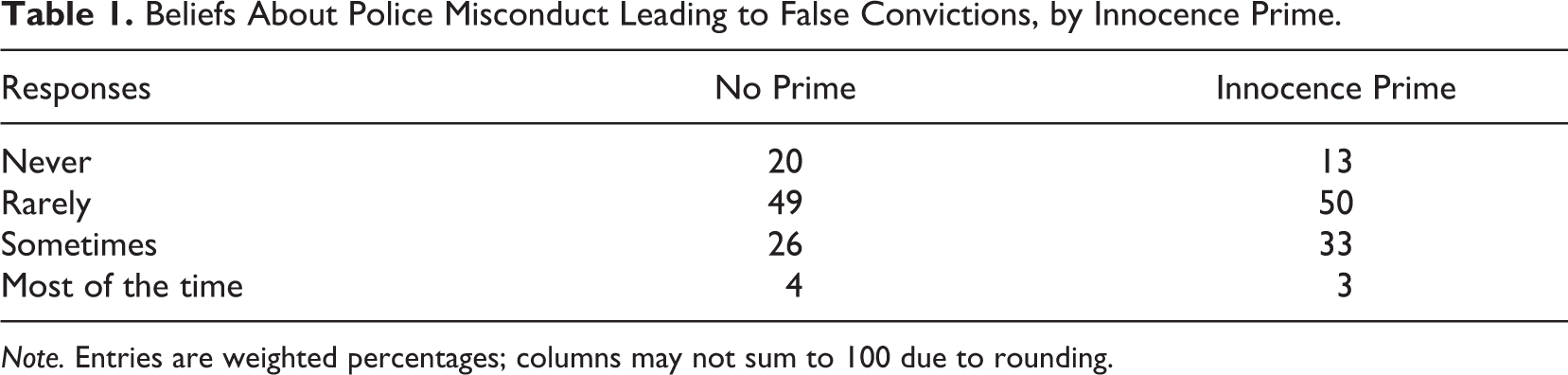
Note. Entries are weighted percentages; columns may not sum to 100 due to rounding.
Given the small number of respondents believing that this kind of misconduct happens “most of the time,” their responses were combined with those who said “sometimes” to create a trichotomous variable for analysis. This variable was recoded such that 1 indicates a response of sometimes or most of the time, 2 a response of rarely, and 3 a response of never. Due to the ordinal and discrete nature of our dependent variable, we first ran an ordered logistic regression, but the assumption of parallel lines was not met (χ2 = 29.97, p < .01). We thus conducted a multinomial logistic regression, with sometimes/most of the time as the base outcome; the estimated coefficients are presented in columns 1 and 2 of Table 2.
Priming Innocence Affects Beliefs About Police Misconduct, Mostly Among Conservatives.
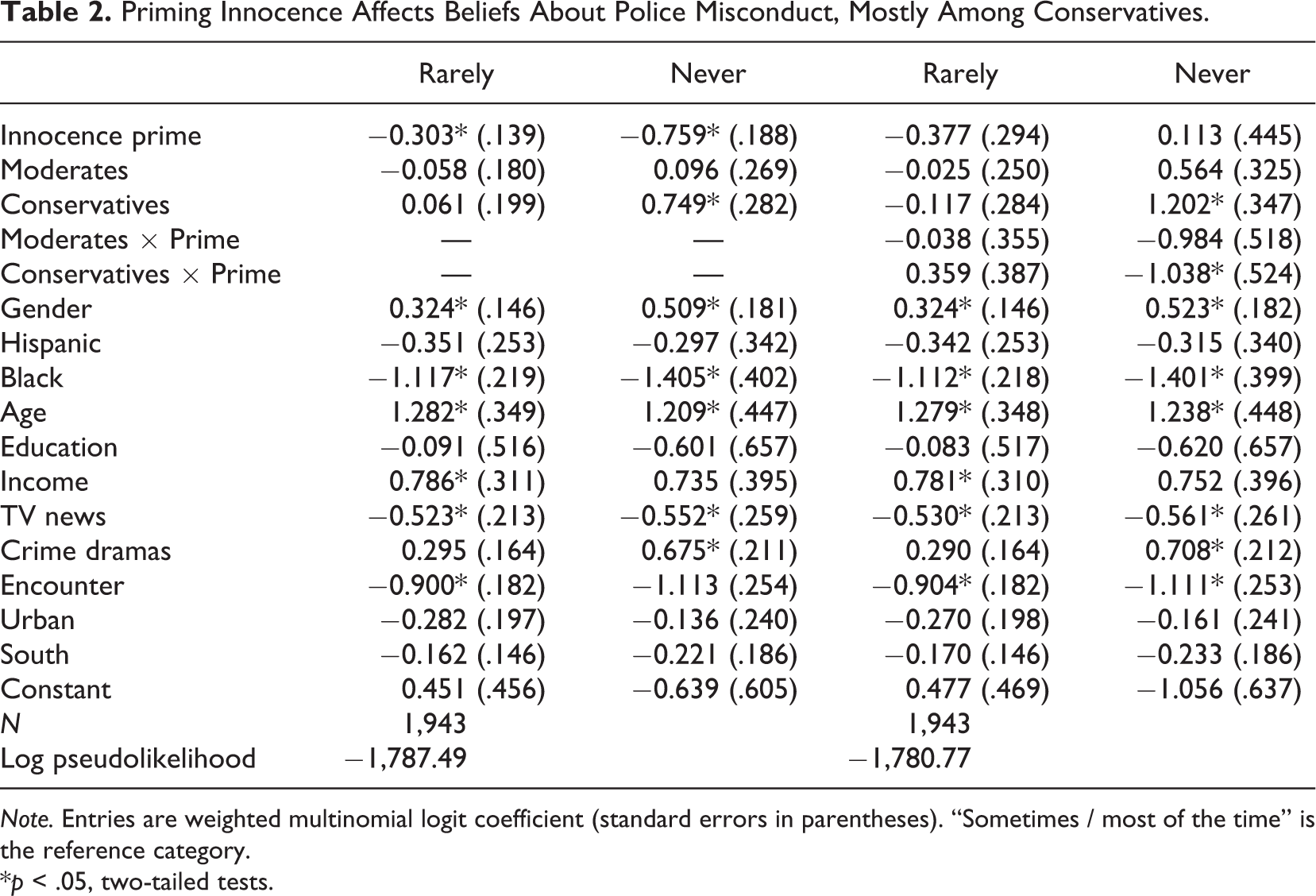
Note. Entries are weighted multinomial logit coefficient (standard errors in parentheses). “Sometimes / most of the time” is the reference category.
*p < .05, two-tailed tests.
These results replicate the intuition from Table 1, in which the innocence prime was shown to significantly affect respondents’ beliefs about police misconduct leading to false convictions, all else constant. Because these coefficients are difficult to interpret directly, we generated the predicted probabilities of giving the three responses assuming a White, non-Hispanic, female of average age, education, income, and media consumption who lives in a non-southern, urban area and reporting no previous police-initiated encounters. This exercise reveals that, relative to no prime, the innocence prime increases the probability of saying sometimes/most of the time by 7 percentage points (from .18 to .25; p < .05), did not significantly affect the probability of saying rarely (p > .10), and significantly decreased the probability of saying never by 8 percentage points (from .26 to .14; p < .05), with respect to the role of police misconduct in wrongful convictions.
We next investigate the possibility that the impact of the innocence prime on respondents’ attitudes is moderated by race and ideology. It is clear from columns 1 and 2 that these variables matter for such attitudes: across the board, non-Blacks are significantly less likely to have positive views of the polices than Blacks, while self-identified conservatives are more likely than liberals to say the police “never” engage in misconduct. Surprisingly, an interaction term that modeled these possible moderating effects revealed no significant difference in the efficacy of the innocence prime among Black versus non-Black respondents (p > .10; model not shown); interaction terms between moderates, conservatives, and the prime, however, revealed a significant and substantial difference in how these groups responded to the survey experiment. The estimated coefficients are reported in columns 3 and 4 of Table 2.
The innocence prime coefficients indicate the predicted difference between liberals who received the innocence prime and liberals who did not. These coefficients are not statistically significant, indicating that self-identified liberals answered the question similarly regardless of the innocence prime. That is, holding the other variables constant as before, the probability of a liberal responding never was .15 without the innocence prime and .21 with the innocence prime (a nonsignificant difference of 6 percentage points; p > .10). In contrast, conservatives were highly reactive to the prime: The coefficient indicates that conservatives who did not receive the innocence prime were significantly more likely to say never relative to liberals. The negative coefficient for the interaction between conservatives and the prime suggests that highlighting innocence leads conservatives to respond like liberals. More specifically, the probability of a conservative saying never was .39 without the innocence prime and .21 with the innocence prime. This is a significant difference of 19 percentage points (p < .05), and the same predicted probability as a self-identified liberal who received the prime. Moderates were somewhere in between, with a predicted probability of responding sometimes/most of the time that is 9 percentage points greater when given the prime than not and an equal sized decrease in the predicted probability of responding never (both the constituent coefficient for moderate and the interaction term are marginally significant in column 4 of Table 2; p < .10)
Table 2 additionally reveals that several of the control variables exhibit significant relationships to attitudes in expected ways. For instance, males were significantly more likely to have faith in the police, as were older and wealthier individuals. In line with media research, more frequent viewers of local TV news tended to have less confidence in the police, while the opposite relationship appeared for fictional media. And lastly, respondents who reported having a previous encounter with the police were consistently less likely to believe police misconduct rarely or never leads to false convictions.
Discussion
As of October 31, 2016, The NRE lists over 1,900 wrongful convictions in the United States and counting. Of course, these numbers reflect situations in which evidence was available, and it is quite likely that some innocent convictions will never be overturned due to a lack of physical evidence (Medwed, 2012). Indeed, most criminal justice officials believe that wrongful convictions occur in their own jurisdictions between 0.5% and 1% of the time (Ramsey & Frank, 2007; Zalman, Smith, & Kiger, 2008), suggesting that the absolute number of wrongful convictions is much higher than what the NRE database indicates.
Although there are many reasons wrongful convictions occur, one common factor is false confessions related to police misconduct (Scheck, Neufeld, & Dwyer, 2000), including the use or threat of force, as well as the presentation of fabricated evidence to elicit an admission of guilt (Drizin & Leo, 2004). Indeed, roughly 12% of exonerations listed in the NRE to date involved a false confession; over 50% involved official misconduct of some sort. Given the disjuncture between globally positive attitudes toward police and the consequential role misconduct on their behalf plays in wrongful convictions, we explored the extent to which reminding citizens about recent exonerations affected their perceptions of police misconduct. We found that, net controls, citizens were 7 percentage points more likely to believe that police misconduct is a problem for the fair administration of justice and 8 percentage points less likely to say this never happens when reminded of the issue of wrongful convictions.
This finding must be given an important qualification, however: The shift in response to an innocence prime strongly hinges upon one’s political predispositions. Net controls, conservatives were 19 and moderates 9 percentage points more likely to perceive police misconduct as occurring when the question highlighted innocence; liberals were unaffected by the prime. The lack of responsiveness among liberals is likely due to the fact that they already perceived police misconduct as a problem: The innocence prime eliminated ideological differences in responses, leading conservatives to perceive police misconduct as a contributing factor to false convictions as much as liberals do.
Although we expected ideology to moderate the effect of the innocence prime, we were unsure in what direction. While citizens often respond rationally to new information and update their attitudes appropriately, there are also numerous and clear instances of motivated reasoning, biased processing, and ultimately attitudinal polarization. As noted at the outset, criminal justice issues have not been immune to the larger forces of political polarization: Recent surveys show that liberals have less confidence (Newport, 2016), are less trusting (Dugan, 2015), and hold generally less favorable attitudes (Ekins, 2016) toward the police than conservatives. This is also true in specific instances: Pew reports that twice as many republicans (43%) than democrats (21%) supported the police response to events that unfolded in Ferguson, Missouri after the Michael Brown shooting (Pew, 2014b).
This study demonstrates that, despite the ideological gap in perspectives, conservatives’ attitudes are less crystallized and more susceptible to influence than are liberals, at least when it comes to the issue of police misconduct and false convictions. The nature and degree of the shift in opinions due to the prime suggests that public opinion would be similarly, and perhaps more, affected if the media were to employ innocence frames in their reporting on police misconduct (see also Baumgartner et al., 2008). In the same vein, those who seek to enact police reforms should be more successful in generating public support by framing them in the context of false convictions. Of course, whether the media and reformers can and would use these frames depends entirely on the reality of police misconduct. If the police are, in fact, rarely or never engaging in misconduct that contributes to false convictions, then these frames will be absent from the political discourse and trust should remain high. But it is equally clear from previous research and the present study that attitudes toward the police are not fixed, and even a minor informational campaign would likely generate greater support for police reforms, particularly among their most ardent political supporters.
Interestingly, although Blacks were significantly and substantially more likely to believe that police misconduct plays a role in false convictions than Whites, the impact of the innocence prime was not moderated by respondent race in our study. In other words, highlighting innocence was a persuasive argument for conservatives, but not for Whites. We find this noteworthy because previous research has found a polarization effect when explicitly racial arguments are made: Whites have been found to be more supportive of the death penalty after a reminder of its racially discriminatory nature (Peffley & Hurwitz, 2007). Thus, although the prime did not move Whites’ perceptions of police misconduct, it did not polarize them either, suggesting that innocence is a much more effective frame than racial bias for liberalizing opinion on criminal justice issues.
An important question these findings raise is what about this frame shifted conservative opinion so dramatically? Is it simply mentioning the raw number of false convictions? Albeit ad hoc, we propose that one possible mechanism at work behind the effectiveness of the prime was the shifting of attributions of responsibility. The tendency to place blame for problems on the individual versus situational circumstances is clearly aligned with ideological tendencies, with conservatives emphasizing the former (e.g., Skitka & Tetlock, 1993; Zucker & Weiner, 1993). Given conservatives’ higher level of trust in the police to begin with, it is possible that they were not only skeptical of the idea that the police are engaging in misconduct but also of the notion of false confessions: Why would anyone who is innocent confess to a crime they did not commit? We suggest that emphasizing the legitimacy of these exonerations (e.g., referencing The Innocence Project, DNA testing), and thus shifting attributions of responsibility for wrongful convictions away from citizens and toward the police, was a critical component for the effectiveness of the prime.
Some supporting evidence for this hypothesis comes from rhetoric by conservatives, who have emphasized individuals’ responsibility in high-profile instances of claims of police misconduct. For example, Rush Limbaugh emphasized the criminality that led to Brown’s death, implying that his role was not a completely innocent one in this event (Limbaugh, 2014). Similar notions were raised in conversations surrounding other high-profile incidences of dubious killings of suspects by police, with questions as to why citizens fail to obey police commands (e.g., Walter Scott) or the illegal behavior that instigated a police–citizen encounter in the first place (e.g., Eric Garner and Freddie Gray). Placing our results in this context suggests that conservatives are less likely to believe police misconduct leads to innocent convictions not only because they trust the police but also because they believe individuals share some (and perhaps a lot of) blame for their circumstances. When innocence is clear—as it was in our survey experiment—political conservatives may incorporate this into their perceptions of the police, becoming more critical. When the innocence of a citizen is ambiguous, however—as it is in many real-world situations—conservatives are likely to remain highly supportive of the police unless shown otherwise. We see this hypothesis as a fruitful avenue for future investigation, particularly in the context of other research linking attributions of responsibility and race in the formation of public opinion on crime and justice issues (e.g., Iyengar, 1994).
In closing, we note that while interest in wrongful convictions has been percolating among legal and justice scholars for decades, the issue has recently gained significant attention among mainstream society as well. After the data for this research note were collected, two cases of possible wrongful convictions captivated Americans, one documented by the podcast Serial (Ricciardi & Demos, 2015), and one by the Netflix series, Making a Murderer (Koenig & Snyder, 2014). The Steven Avery case, which is the focus of Making a Murderer, is particularly riddled with questionable police activity, to say the least. Serial immediately generated a cult-like following during its first season and achieved five million downloads faster than any other podcast at the time (Dredge, 2014). Netflix does not release viewership figures, but ratings companies estimate that the docuseries averaged 19 million viewers per episode within the first 35 days of release (Lynch, 2016). Beyond merely attuning viewers to the issue, Making a Murderer motivated many viewers to take action: The series served as a catalyst for a petition signed by 275,000 people requesting President Obama to pardon Mr. Avery (Helmore, 2016).
In spite of growing public awareness about wrongful convictions and skepticism of police, as well as the increasing implementation of safeguards aimed at thwarting police misconduct (e.g., legislation requiring interrogations to be videotaped; police body cameras), recent allegations of a “black site” operated by the Chicago Police Department at Homan Square remind us that police misconduct continues to skew the scales of justice and, in some cases, induce confessions from innocent people (Ackerman, 2015). The fallout from reports of misconduct is equally problematic for police departments, who rely on community support to perform many of their duties (Eck & Spellman, 1987; Moskos, 2008). Not surprisingly, policy makers seek answers to the public’s questions about the accuracy of the criminal justice system. Our findings suggest that when reminded of concrete and clear instances of wrongful convictions, those most supportive of the police are also the most swayed by a reminder of false convictions. Emphasizing issues of innocence can serve as a catalyst for public support of policy changes designed to minimize the role of police misconduct in wrongful convictions.
Footnotes
Declaration of Conflicting Interests
The authors declared no potential conflicts of interest with respect to the research, authorship, and/or publication of this article.
Funding
The authors received no financial support for the research, authorship, and/or publication of this article.