







Abstract
Objectives:
To examine short-term associations between offending and victimization using daily data on criminal offenses. We also examine the within-individual association between several types of offenses and victimization and see whether incidents closer together in time are more likely reflect revenge motives.
Method:
We use total data on all victims (n = 88,106) and offenders (n = 60,584) in police-reported assaults in Finland during 2007–2009 to examine temporal clustering of the two outcomes. Monthly panel data (n = 4,886) on offending and victimization are analyzed with fixed-effects regression models, while revenge motives are derived from detailed case descriptions (n = 299).
Results:
The risk of violent victimization is higher in months following criminal offending. Although the offending rates directly before and after victimization are low on absolute terms, we find that these rates are higher around the time of victimization. Violent offenses closer to victimization incidents are more likely to include the same parties in opposite roles.
Conclusions:
Criminal offending increases the risk of victimization in a state-dependent matter. Closer analysis of situational and motivational dynamics of victimization and offending requires temporally detailed data, as a substantial share of the victim–offender overlap is explained by incidents that take place on the same day, complicating the analysis of the temporal sequence of those events.
One of the most consistent empirical regularities in the study of violent victimization is that individuals with criminal backgrounds have an elevated risk of being victims themselves (Averdijk & Bernasco, 2015; Jennings, Piquero, & Reingle, 2012). To an important extent, this overlap is likely to be a result of shared risk factors that have an effect on both outcomes (Broidy, Daday, Crandall, Sklar, & Jost, 2006). In empirical studies, risky routine activities (Cops & Pleysier, 2014) and low self-control (Flexon, Meldrum, & Piquero, 2014; Schreck, Wright, & Miller, 2002) have been some of the most central candidates for such risk factors. At the same time, it seems likely that some part of the overlap is related to state-dependent processes, where criminal offending causally increases the risk of future victimization above and beyond unobserved heterogeneity.
Several studies have sought to disentangle the state-dependent effect (Lauritsen & Laub, 2007) of offending on victimization (Chen, 2009a, 2009b) and victimization on offending (Ousey, Wilcox, & Fisher, 2011; Sullivan, Ousey, & Wilcox, 2015; Zhang, Welte, & Wieczorek, 2001). Some have used longitudinal data to examine how within-individual change in offending is related to change in victimization while controlling for stable unobserved heterogeneity (Chen, 2009b; Ousey et al., 2011), whereas others have compared group-based trajectories of both offending and victimization, finding similarities in the life-course development of the two outcomes (Jennings, Higgins, Tewksbury, Gover, & Piquero, 2010; Smith & Ecob, 2007). Although many of these studies suggest that offending has a state-dependent positive effect on later victimization (Sullivan et al., 2015), there are also results suggesting that violent offending decreases the risk of later victimization (Berg & Loeber, 2015; Ousey et al., 2011; Smith & Ecob, 2007).
One issue in the study of state-dependent effects between offending and victimization is the temporal distance between the two events. It is plausible that some of these effects are “developmental” by nature, for instance, when maltreatment in childhood leads to violent offending in adulthood. At the same time, some effects could emerge within a very short temporal frame, perhaps within a span of days or weeks. Methodological issues, however, complicate the analysis of short-term state-dependent associations. Data sets with yearly or longer measurement intervals are not optimal in such inquiries, as they cannot reliably distinguish the temporal order of offending and victimization on weekly or monthly levels. This means that some important short-term effects may have been missed (Sariaslan, Lichtenstein, Larsson, & Fazel, 2016). Only a handful of studies have used temporally detailed data (Averdijk & Bernasco, 2015; Sariaslan et al., 2016) to study these questions, which means that existing research does not provide much insight into short-term dynamics between offending and victimization.
One specific mechanism that could cause an immediate increase in violent offending after victimization is revenge. Revenge motives are generally very prevalent in adolescent violent offending (Kivivuori, Savolainen, & Aaltonen, 2016) and cycles of revenge are a well-known phenomenon in gang violence (Bjørgo, 2005; Papachristos, 2009). As it stands, the literature on state-dependent associations between offending and victimization has not looked at retaliatory acts and whether they might be one explanatory mechanism behind these dynamic associations.
The aim of the current article is to examine short-term associations between offending and victimization and analyze the potential role that revenge motives play in creating state-dependent effects between offending and victimization. We contribute to this mostly survey-based literature by using complete data on police-reported assaults in Finland during 2005–2011, where both offenders and victims involved in the incidents can be identified. These data include exact dates of these incidents and thus allow a temporally detailed investigation of these dynamics.
We present three sets of related analyses that increase in level of detail in examining the possibility that some state-dependent associations between victimization and offending are based on short-term situational and motivational revenge mechanisms. First, we use a fixed-effects regression model with monthly panel data to examine whether the risk of victimization is higher during periods of criminal offending. If state-dependent effects exist, the hypothesis is that the risk of violent victimization should be higher after crimes are committed. In the second part, we increase temporal precision and the size of the data and examine whether the probability of violent offending changes in the days, weeks, or months preceding and following violent victimization and vice versa. If short-term, state-dependent effects exist, we should see an increased level of violent offending in the periods preceding victimization. The final part of the analysis approaches the question of revenge motives. If the hypothesis of violent victimization causing revenge-motivated violent offending is true, one empirical indication would be that victimization–offending sequences temporally close to one another should be more likely to include the same individuals. To examine this possibility, the final part of the analysis draws on open-ended case descriptions in the police files, and analysis which thus contains information on the actual motives of the offending party. We compare the share of incidents including the same individuals (in opposite roles) in cases that happened close to the victimization incidents to cases that were further apart and provide a more nuanced analysis on whether the police reports of those incidents indicate that revenge motives played a role in violence.
Theoretical Framework
In the context of life-course criminology, a common way to group theoretical explanations for the victim–offender overlap is to contrast the processes of population heterogeneity and state dependence (Lauritsen & Laub, 2007). The position of population heterogeneity is that persistent differences in stable propensity for offending and victimization are the main causes for the victim–offender overlap. What is essentially a selection perspective, pure population heterogeneity explanation would mean that there is no dynamic association from offending at t = 1 to victimization at t = 2, but that the level of both variables at a given point in time are mainly influenced by persistent individual differences. However, as pointed out by Sullivan, Ousey, and Wilcox (2015), a population heterogeneity perspective does not rule out life-course changes in level of offending and victimization but argues that the development of these trajectories is largely governed by these “preprogrammed” (Sullivan et al., 2015) early differences.
A state-dependent process is one where changes in life circumstances (or in basically any time-varying factor) bring about changes in both offending and victimization. Thus, a state-dependent association does not necessarily mean that offending at t = 1 is a causal force driving victimization at t = 2, but such change could also reflect changes in other time-varying factors. If factors such as substance abuse or unstructured socializing increase, it might increase the risks of both offending and victimization, creating a time-varying association between offending and victimization—in such case, however, the true causal factor would be the change in substance use patterns and routine activities. A state dependent and causal effect of offending on victimization would be one where the higher risk of victimization is directly attributable to prior offending or increased criminal activity.
One inherently state-dependent process that links victimization and offending is revenge. Within criminology, research has mainly focused on the role and functions of revenge in criminal subcultures and street-level crime. This type of research has often underscored that persons involved in criminal subcultures are reluctant to resort to official conflict resolution mechanisms such as police reports or the criminal justice system in general (Berg & Loeber, 2015). Instead, they engage in self-help by inflicting punishments by committing revenge-motivated crimes that are intended to serve deterrent purposes (Jacobs & Wright, 2006; Topalli & Wright, 2013). The study of self-help among serious offenders appears to be consistent with evolutionary accounts which see revenge motives as evolved adaptations to the social interaction challenge of deterring predatory behaviors in nonstate conditions (Eisner, 2011; McCullough, Pedersen, Schroder, Tabak, & Carver, 2012; Westermarck, 1898).
However, the rationality of deterrence is consistent also with more proximate explanations of rational adaptation to immediate circumstances. From the point of view of communication, real revenge behaviors are costly signals making the deterrence credible (Gambetta, 2009). In street-level violence, sensitivity to threats may thus be rational. It is also possible that high propensity for violent behavior protects against victimization in the criminal underworld, if this propensity deters potential offenders from using violence against a person who is known to be violent himself or herself (Berg & Loeber, 2015). Prior research suggests that high perceived risk of retaliation is associated with decreased offending in the future (Averdijk, van Gelder, Eisner, & Ribeaud, 2016).
A classical revenge-motivated offense results when a victim aggresses on a person who previously offended against the avenger. This could be labeled as direct revenge. However, the reality of revenge is more complex than this. These forms of revenge are relevant here because they influence the extent to which based on victim–offender relationships and violent acts including the same individuals can be used as proxies in revenge studies. First of all, in altruistic revenges, someone else avenges for the victim; the offense is motivated by revenge, but this is not detectable in prior violence history of the parties. Altruistic revenges are probably an important subcategory of revenge behavior. In a recent analysis, about one in four violent revenges were committed for someone else (typically for a friend or a relative; see Kivivuori, Savolainen, & Aaltonen, 2016). Second, an indirect revenge is committed by the original victim but is targeted against a relative or a friend of the original offender; again, this motivation is not captured by history of violence between the initial parties. Third, the original victim may engage in displaced revenge by targeting a person who has no substantial link whatsoever to the original incident. In the Finnish context, fights that take place after bars and nightclubs close are common and may be a triggered by something that happened earlier during the same evening. Thus, revenge may be both specific in targeting the initial offender and general in targeting some other suitable target for displaced aggression. Analyses based on victim–offender combinations are likely to underestimate the role of revenge motivations in perpetuating cycles of violence and provide a lower bound for analyzing the share of acts motivated by revenge.
Prior Research
The evidence on state-dependent association between offending and victimization is somewhat mixed in the literature. This research has mainly relied on repeated measures data on adolescents, but statistical approaches have differed. Prior studies also differ in how they measure criminal offending: Some include composite measures of “deviant lifestyles” (Zhang et al., 2001), whereas others only measure violent offending (Sullivan et al., 2015).
Studying the time-varying association of victimization and measures of delinquency, deviant peers, and routine activities in a 4-year follow-up in late adolescence, Chen (2009a) found that changes in all three measures were associated with changes in victimization risk in that more crime, more delinquent peers, and more unsupervised activities increased the risk of victimization. In another study using the first two waves of data from Add Health, Chen (2009b) used fixed-effects models to show that delinquent behavior increases the risk of victimization after accounting for stable individual-level heterogeneity. After inclusion of fixed effects, the delinquency–victimization association remained particularly robust for serious victimization outcome. Thus, these studies suggest that increases in offending are associated with increases in victimization.
Other studies have examined the reciprocal association between offending and victimization, looking at effects going both ways. Using two waves of data and analyzing both contemporaneous and cross-lagged associations, Zhang, Welte, and Wieczorek (2001) found that offending was associated with increased victimization risk 18 months later, but victimization was not associated with an increase in offending after a similar time. Ousey, Wilcox, and Fisher (2011) analyzed the same question using a structural equation model with both reciprocal (from offending to victimization and vice versa) and fixed effects (stable unobserved heterogeneity), and found that victimization was actually associated with less offending in the future, but also that a lagged measure of offending was associated with less victimization in the future. The authors speculate that the prior findings of relatively strong dynamic effects may have been brought about by insufficiently controlled unobserved heterogeneity.
Because most existing studies are based on adolescent years, it is unclear whether the state-dependent association between offending and victimization depends on age and varies across the life course. In a recent study, Schreck, Berg, Ousey, Stewart, and Miller (2015) analyzed the development of the victim–offender overlap with age using data from the pathways to desistance study and found that the impact of victimization on offending decreased with age. The weakening of this association could not be explained with standard measures related to demographic or socioeconomic factors, and neither by peer measures nor by measures of community involvement. Unlike in the study by Ousey et al. (2011), victimization was still linked to higher levels of offending even in a within-individual model, although the strength of the association diminished with age.
Most studies cited before have used data with yearly or longer measurement intervals, with a couple of exceptions. Averdijk and Bernasco (2015) used space–time budget data (hourly accounts of time use) to study the situational association between routine activities, delinquency, and victimization in a Dutch sample of adolescents. While alcohol use, lack of guardianship, and late hours were associated with the risk of victimization on a situational level, delinquent behavior was by far the strongest correlate of victimization. Roughly, half of the sample members had committed offenses during the same hour when victimization took place (Averdijk & Bernasco, 2015). In a study using Swedish register-linkage data, Sariaslan, Lichtenstein, Larsson, and Fazel (2016) found that the risk of committing a violent crime was roughly 8-fold during the week after violent victimization when compared to other weeks in a within-individual model.
With the exception of the aforementioned study by Sariaslan et al. (2016), administrative data have not been used to study state-dependent associations between offending and victimization. Prior studies with Finnish register data show that the relationship between criminal background, socioeconomic attainment, and the risk of violent victimization depends on both the seriousness of violence and the criminal background of the aggressor. The more serious the violence, the more likely it is that the victims are disadvantaged (Aaltonen, Kivivuori, Martikainen, & Sirén, 2012), and the more extensive the criminal background of the offender, the more likely it is that the victim is also criminally active (Aaltonen, 2016). Thus, the violent acts committed by individuals with extensive criminal backgrounds tend to have other criminal offenders as victims. While this finding does not prove that cycles of revenge in the criminal underworld would be the mechanism that causes this pattern, the homogeneity of criminal backgrounds of victim–offender dyads is consistent with such an explanation (see also Green, Horel, & Papachristos, 2017).
There is fairly little quantitative evidence on the prevalence of revenge-motivated crimes. Estimates from Finnish self-reported delinquency survey show that fairly large share of delinquent acts committed by 15- to 16-year-old adolescents are self-reported to have been motivated by revenge (Kivivuori et al., 2016). This share is highest in violence, where 44–54% of most recent incidents were motivated by revenge. School bullying (27%) and running away from home (21%) manifested were also fairly often motivated by revenge. Nonviolent crimes can also offer ways of retaliation (Jacques, 2010). In the said Finnish study, property-related offenses such as robbery (21%) and vandalism outside school (13%) were sometimes motivated by revenge. Felson and Eckert estimate that one third of property offenses emerge from interpersonal disputes and thus have aspects of retaliation embedded in them (Felson & Eckert, 2016). Findings such as these suggest that it is relevant to consider property offenses as well, as in the current study. Other studies have indicated that revenge urges and ideation are much more common than actually acting out in revenge (Crombag, Rassin, & Horselenberg, 2003).
Overall, existing research suggests that the association between offending and victimization is dynamic and is not simply a function of population heterogeneity. Most data sets that include information about both offending and victimization are either cross-sectional or longitudinal with long measurement intervals, which has posed limitations on the study of short-term associations between the two.
Current Study
The purpose of the current study is to examine short-term temporal dynamics between offending and victimization. The study comprises three parts. First, given that this type of data has not been previously used to analyze state-dependent associations between offending and victimization, we use a random sample of 150,010 Finnish residents to analyze to what extent violent offending and victimization covary in time. Like several other studies (Chen, 2009a; Zhang et al., 2001), we also examine whether other common types of offenses are associated with increases in the risk of victimization in a within-individual model using monthly data from years 2005 to 2011. These results provide a point of comparison to some of the prior studies that have looked the effects of offending on victimization with panel data (Ousey et al., 2011) but use a more fine-grained temporal scale. In this part, we focus on the impact of offending on a lagged measure of victimization.
In the second part of the analysis, we increase temporal precision further and examine short-term change in offending rates directly before and after victimization, and vice versa. To obtain statistical precision, we use complete data on all police-recorded assaults between years 2005 and 2011 and identify all individuals who were either victims or offenders in assaults during a 3-year period in the middle of the follow-up (2007–2009). Using these incidents as reference events, we examine the violent offending trajectories 2 years before and after violent victimization. If state-dependent associations between violent offending and victimization exists, we should see some temporal clustering for these two outcomes, so that the risk of offending is higher closer to the victimization incidents. The analysis is conducted on daily, weekly, and monthly levels, with a maximum of 2 years of pre-/posttime. For robustness, the analysis is also conducted the other way around, using violent offending as the reference incidents and violent victimization as the outcome.
The third part of the analysis approaches the question of revenge motives and examines the case descriptions of violent victimization incidents among those victims in the sample who also committed a violent crime. We conduct two tests: First, we examine whether victimization–offending sequences closer to another in time are more likely to include the same victims and offenders. If this is the case, it indicates that there might have been a connection between the two cases. Second, we use the case descriptions written by the police to see whether they indicate that the violent offense was motivated by revenge and whether this varies by temporal distance between the two events. The comparison is between violent incidents that took place within 1 month of the victimization incident and those that took place within 1 month to 2 years.
Data and Method
Risk Factors of Crime in Finland (RFCF)
The RFCF data set are based on a general population random sample of 150,010 Finnish residents at the end of year 2004. The follow-up time starts on January 1, 2005, and continues until the end of year 2011. The register-based data include information about sociodemographic background, residential mobility, mortality, crime (both police-reported and convictions), and imprisonment for all individuals. All variables are based on administrative data. The current analysis focuses on individuals aged 18–64 at the start of the follow-up. Given that we use fixed-effects models, we only include those individuals with variation in the outcome, leaving us with 4,886 individuals with at least one victimization incident during the 7-year follow-up.
The victimization and offending outcomes for years 2005–2011 were combined to the RFCF sample from a larger database including all police-recorded assaults maintained by the Institute of Criminology and Legal Policy (ICLP). The included penal codes are “petty assault,” “assault,” “aggravated assault,” and “attempted homicide.” Victimization and offending variables are measured as being involved in either role in these incidents. As the ICLP data set on police-reported crimes does not include all crime types, the independent variables measuring other types of crime are based on convictions and fines. The crime types are property crime and drug-related crime. These are classified on the basis of the month of the crime in the panel data.
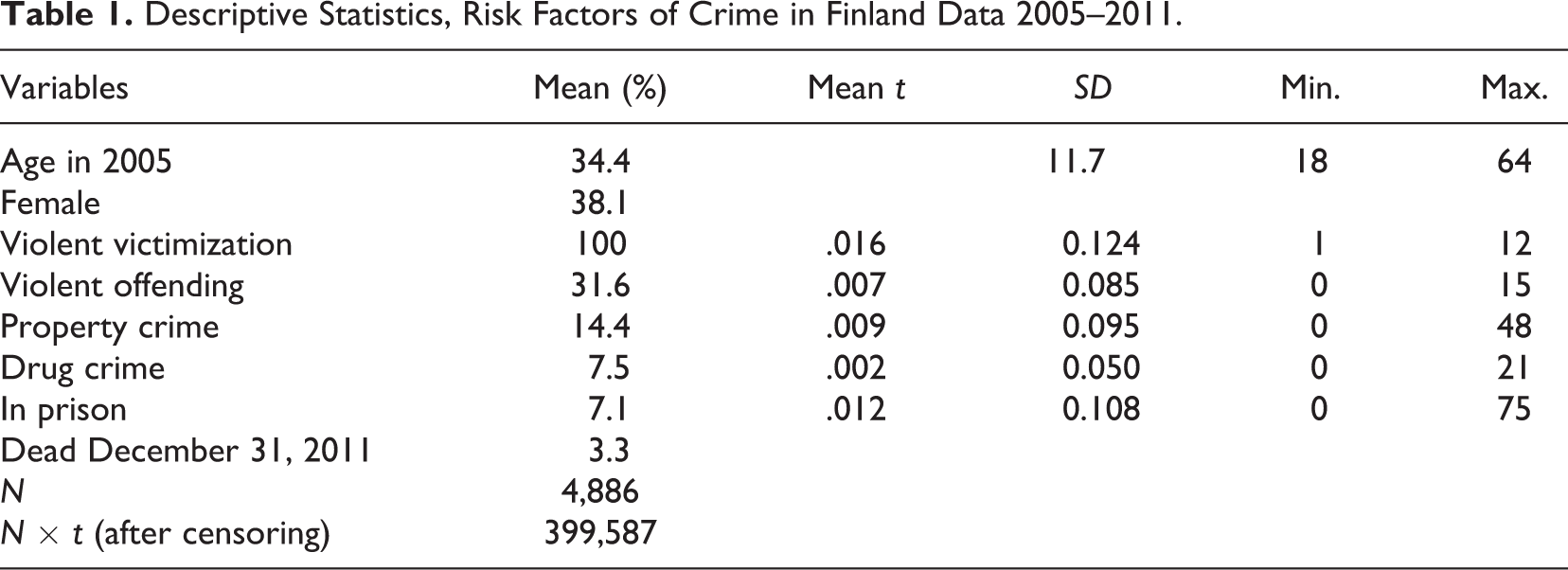
The descriptive statistics for this sample are provided in Table 1. Given that we only include those individuals with at least one victimization event, the proportion of victimized individuals is 100%. Number of victimization months ranges from 1 to 12. Thirty-two percent of these individuals committed at least one violent offense (range 0–15), the proportions committing property crime (14%) and drug crimes (8%) being somewhat lower. Roughly, 7% went to prison at least once, whereas the proportion of incarcerated individuals (at least 1 day in prison during the given month) per month is around 1%. Incapacitation is thus not very common in the data, so censoring based on imprisonment and mortality (based on data of death) does not matter very much.
Descriptive Statistics, Risk Factors of Crime in Finland Data 2005–2011.
The within-individual models were estimated using fixed-effects logistic regression models using binary monthly indicator of violent victimization as the outcome. The crime measures were lagged by 1 month to make sure that the crime took place before victimization. In addition this model, we fitted a model including a measure for violent crime during the reference month, to guard against the possibility that our estimates for the within-individual association between crime at t = −1 and victimization at t = 0 would mainly mirror the association between crime at t = −1 and crime at t = 0.
Complete Data on Police-Reported Assaults in 2005–2011
The second part of the analysis uses 3 years of complete data on offenders (60,584 individuals) and victims (88,106 individuals) in police-reported assaults in Finland (see Table 2). To ensure that all individuals in the analysis have equally long pre- and postperiods with respect to the reference event, we chose the victimization and offending months from years 2007 to 2009 as the possible reference points, while the database includes all crimes between 2005 and 2011. This allows a minimum of 24 months of pre- and posttime for each individual. In the first analysis, victimization is the “centered” event at t = 0, and offending rates are the outcome, whereas in the second part violent offending is centered at t = 0, and victimization rates are the outcome.
Descriptive Statistics, Police-Reported Assaults 2007–2009.
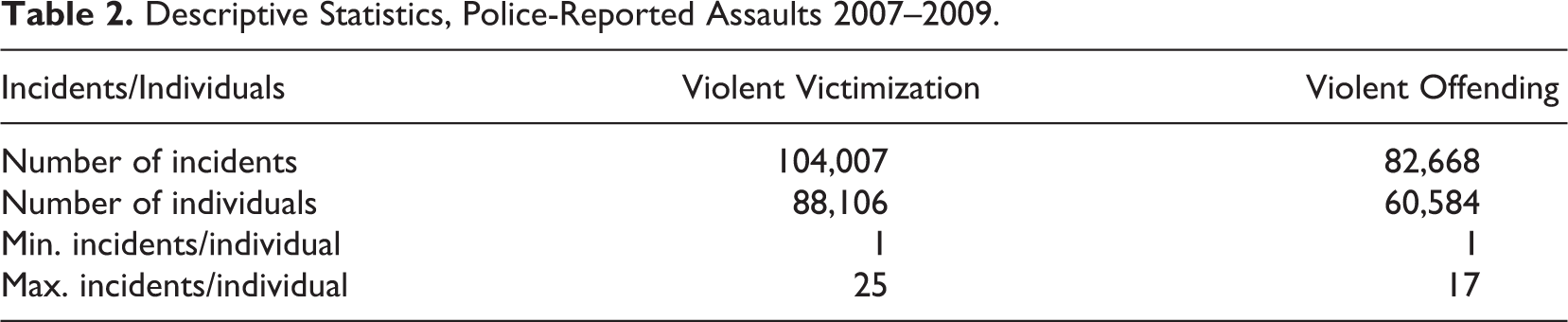
The individual-level number of victimization incidents in 2007–2009 ranges from 1 to 25, whereas the number of violent offenses ranges from 1 to 17. If multiple victimization incidents took place within the same day, we included only one of those incidents, and then calculated the temporal distance (in days, weeks, or months) to each violent offense that took place 2 years before or after. To ensure that all individuals contribute similarly to the analysis while including all violent incidents, the individual observations are weighted down by their multiplicative inverse (e.g., a weight of one third for a person with three different victimization incidents). A similar procedure was conducted the other way around. 1 The results are presented as proportions by the temporal unit (day, week, or month) and smoothed Lowess curves using 50% bandwidths. These graphs produce essentially similar results as within-individual models including time to victimization event as the covariate and binary indicator of offending as the outcome.
Revenge Motives in Case Descriptions
The cases for analyzing mentions of revenge motives in police reports of violence were drawn from the same data set (RFCF) as the first part of the analysis. We drew two samples, the first including violent offending within 1 month (±30 days) from a victimization incident, and the other including violence offending more than 1 month (>30 days) but less than 2 years (<731 days) apart from a victimization incident. All reports were read and coded, and two variables were derived from these incidents: (1) whether the incident included all or any of the same parties as in the victimization incident and (2) whether or not a revenge motive was mentioned in the case description, and whether this revenge motive related to an incident having taken place on the same day or before that. This latter coding was ultimately based on the perception of the police officer who wrote the report, and it is possible that all revenge motives are not reported. However, the difference between offenses closer and further apart in time should not be affected.
Results
Within-Individual Models of Violent Victimization
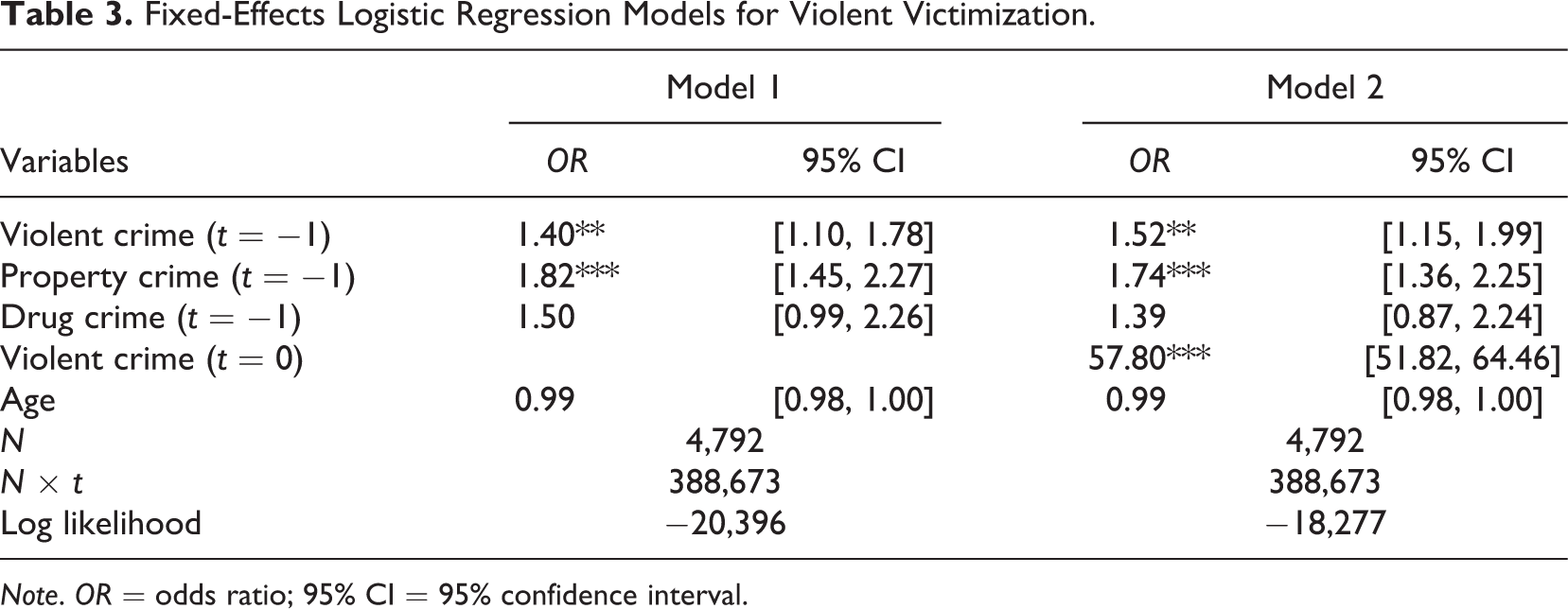
The fixed-effects logistic regression models using monthly data from RFCF data set with a 7-year follow-up and censoring for mortality and incarceration are presented in Table 3. Results from Model 1 indicate that several types of criminal offending increase the risk of victimization. If the individual committed a violent crime (odds ratio [OR] = 1.39), property crime (OR = 1.79), or drove while intoxicated (1.64) during the previous month, his or her likelihood of violent victimization is elevated during the next month. Model 2 includes the contemporaneous coefficient for violent offending, which is expectedly very large in showing that the odds of violent victimization are 58 times higher during periods of violent offending, suggesting a huge state-dependent effect of offending on victimization. Controlling for this contemporaneous measure does not, however, change the results for the lagged variables to a meaningful degree. Next, we analyze this short-term association in more detail.
Fixed-Effects Logistic Regression Models for Violent Victimization.
Note. OR = odds ratio; 95% CI = 95% confidence interval.
Temporal Clustering in Police-Reported Violent Crime
The left-side panel of Figure 1 shows the smoothed daily, weekly, and monthly violent offending trajectories in the 24 months before and after violent victimization for all police-reported violent crimes that took place during 2007–2009. The panel on the right shows corresponding victimization rates in relation to violent offending. The graphs do not show the incidents that took place during the same day, but it is evident that much of the observed victim–offender overlap is caused by incidents where the individual is registered as both victim and offender. Of the victims, 18.3% (n = 88,106) were registered as offenders during the same day, whereas 26.6% of offenders (n = 60,584) were registered as victims. During the entire 4-year follow-up, 29.4% of victims appear as offenders and 43.7% of offenders appear as victims. This means that 62.2% of victims with at least one violent offense were suspected of a violent offense on the same day as the victimization incident. 60.9% of victimized offenders were victimized on the same day as their reference case.
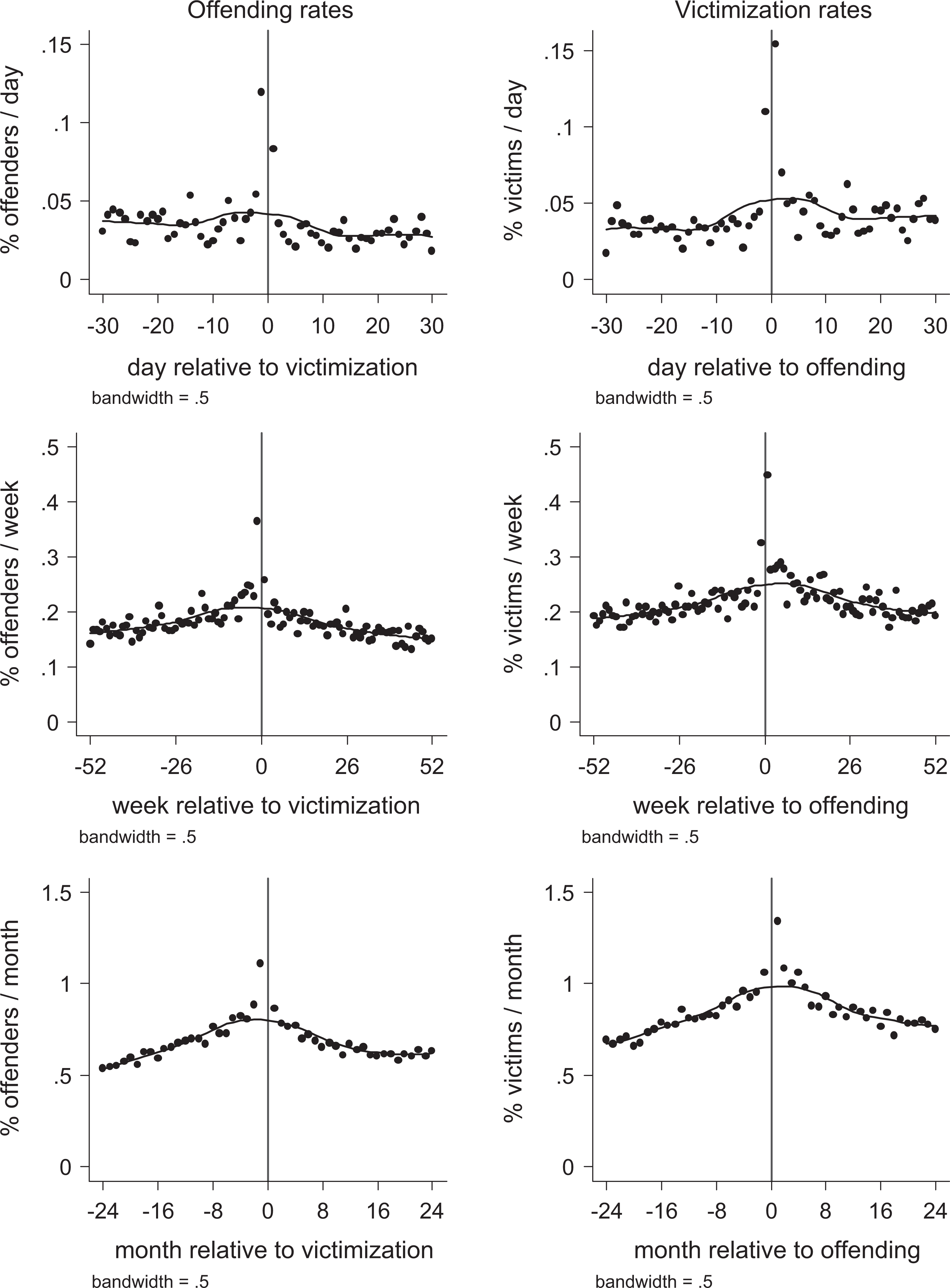
The daily, weekly, and monthly rates of (a) offending relative to victimization event (left panel) and (b) victimization rates relative to violent offending event (right panel). Observed means and Lowess smoothers with .5 bandwidth.
The first observation that emerges from the results is that offending rates prior to victimization, and vice versa, are generally rather low. The days or weeks preceding victimization are not characterized by unusually high levels of violent offending. Roughly, 1% of victims were registered as violent offenders in the month prior to victimization, and the corresponding rate of victimization prior to offending is also around 1%. It thus appears that only few victims committed violent crimes directly before victimization. The same applies the other way as well, as only few offenders were victims of violence directly before their own violent crime.
Despite these low levels, the results suggest that there is some temporal clustering in violent offending and victimization. Starting with rates of violent offending relative to the victimization incident, we do not see clear trends in offending rates when assessed on a daily level during the 1 month before and after the incident. However, when the level of aggregation is increased to the weekly level and the observation period to 1 year, some clustering starts to emerge, and it seems that the weeks before victimization exhibit somewhat higher offending rates. On the monthly level, there is a linear increase in the probability of offending prior to victimization. Both the weekly and monthly figures also indicate that offending rates start decreasing soon after victimization, returning close to the levels at the start of the follow-up. The results look highly similar the other way around as well. On the monthly level, victimization rates increase slowly but steadily in the 24 months preceding violent offending and start decreasing afterward.
Case Descriptions
Finally, we examine the case descriptions of violent incidents where the RFCF sample members who were victims of violence at least once appeared as offenders. The first set of incidents are such that took place within 1 month (±30 days) of the victimization incident but were still separate incidents. These are compared to incidents that took place within 31–730 days of the victimization incident.
When cases that took place within 1 month are examined (Table 4), it appears that these incidents are slightly more likely to involve the same individuals as the victimization event chosen as the reference (χ2, p = .009). Eight percent of cases where the victim of the reference case now appeared as the offender included the exact same parties as the victimization event, albeit in opposite roles. An additional 4% of cases included some of the same parties. In cases that took place further apart, only 3% of cases included some of the same individuals. This suggests that direct retaliations are somewhat rare, although a bit more common in cases taking place within a short frame. In addition, the case files were coded according to whether some type of revenge motive was mentioned in the police report. Some type of revenge motive for something that took place on the same day or earlier was mentioned in roughly half of the reports, but the difference between cases closer to the victimization event and further apart was not significant.
The Share of Violent Incidents With Revenge Motives and Same Parties as the Victimization Incident by Temporal Distance to Victimization.
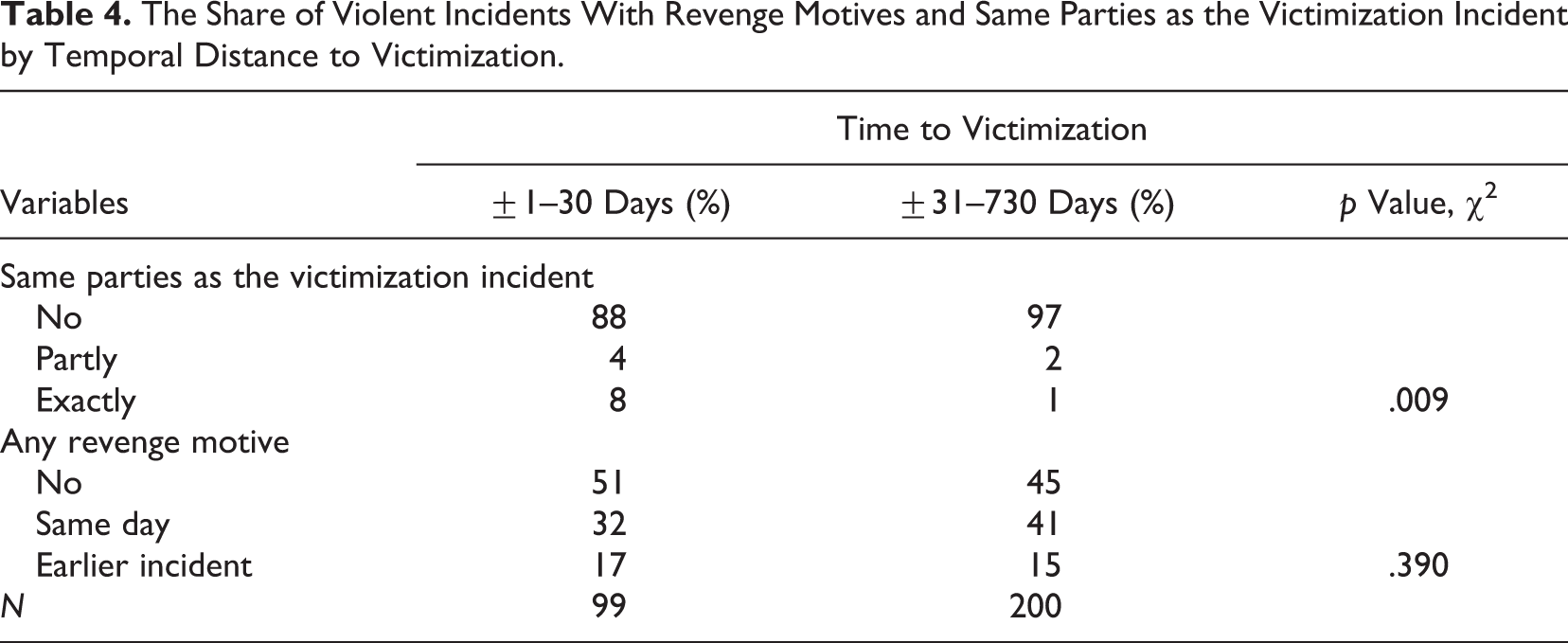
The findings suggest that overall, revenge plays a substantial role in violent crime. While 12% of the incidents were revenges in relation to the parties of the index offense within the 30-day interval, the overall prevalence of revenge motive in the same sample of violent crimes was 49%. The latter figure is surprisingly close to the recent survey-based finding that 54% of assaults committed by young people are revenge motivated according to their own admission (Kivivuori et al., 2016).
Discussion
Existing studies on state-dependent effects between offending and victimization had mostly relied on samples with relatively long measurement intervals, and only a few (Averdijk & Bernasco, 2015; Sariaslan et al., 2016) had examined these dynamics within shorter temporal frames. The main aim of the current study was to contribute to this literature by assessing whether the probability of criminal offending varies around the time of violent victimization and generally to see whether these outcomes are clustered together in time.
The first part of the analysis examined the within-individual association between lagged measures of offending and victimization in a fixed-effects model. Replicating findings from several prior studies, the fixed-effects models indicate that the relative risk of victimization is substantially higher in the month following a criminal offense. In addition to violent crime, the results reach conventional levels of statistical significance for property crimes as well. At the same time, the model shows that the coefficient for the contemporaneous measure of violent offending is very high, indicating that much of the overlap between violent offending and victimization is caused by the incident taking place within a short temporal frame.
The second analysis examining the timing of offending relative to victimization showed that much of the observed overlap between offending and victimization in police-recorded crime, in fact, stems from incidents taking place during the same day. Most of them are single violent incidents where the individual was registered as both the offender and the victim. The assumption was that if violent offending increases the risk of violent victimization in a state-dependent way, we should see an increase in levels of offending prior to victimization. The results indicate that there is a gradual increase in levels of offending in the 2 years preceding the reference incident, but this increase is only modest in absolute terms. Although slightly elevated, the days or weeks preceding the victimization incident are not characterized by particularly high levels of violent offending.
The final part of the analysis focused on revenge-motivated acts and found that roughly half of violent incidents recorded by the police include elements of retaliation. A substantial proportion of revenge-motivated acts were responses to something that happened during the same day. Despite this, relatively few cases included the exact same parties as the reference victimization incident. However, incidents taking place closer to one another in time were more likely to include the same individuals.
Taken together, the analyses suggest that offending has a state-dependent effect on violent victimization that cannot be fully explained by stable unobserved heterogeneity and that revenge-motivated violence is likely to explain some part of this association. However, these conclusions come with important qualifications. Given that the absolute levels of violent offending are very low in the days and weeks before victimization, for most victims of crime a short-term increase in their own police-recorded violent offending in days prior to the reference incident can hardly be a very prevalent cause for their victimization.
Regarding revenge, the data do suggest that revenge motives are often present in violence, but the question of its specificity remains. We detected a seemingly anomalous finding when using textual analysis to explore the prevalence of revenge within 30 days of the index incident. Twelve percent of the incidents in this time frame involved some or all the parties of the index offense, while as many as 49% of the offenses were more generally revenge related. There appears to be a discrepancy between “specific revenge” and “general revenge” measures. Some part of this divergence could be explained by the nondirect types of revenge we discussed earlier. The victim of the original incident can take revenge on a relative or friend of the original perpetrator; someone else can altruistically revenge for another; or the victim of the original incident can displace his or her revenge on an entirely unrelated person, in an act of so-called displaced aggression. Displaced aggression can take place without provocation or as triggered displaced aggression targeted against a secondary trigger provocation (Vasquez, Lickel, & Hennigan, 2010). As applied to revenge, in both cases revenge motivation remains, yet the incidents are disconnected from the original index offense. Whatever the case, the analysis shows that temporal precision of days may yet be too crude to capture the dynamics of revenge-motivated violence (see also Averdijk & Bernasco, 2015).
Most of the existing research on the victim–offender overlap, and of revenge behaviors, is based on U.S. samples of criminal subcultures or community samples of normal adolescents (Jacobs & Wright, 2006; Kivivuori et al., 2016). In addition to the data source, the population of the current study may differ from both of these standard approaches, if Finnish “criminal subcultures” tend to be more strongly associated with serious alcohol abuse and drinking group behavior rather than with drug trade, gangs, or organized crime. Comparative homicide research suggests that Finnish scenes of serious violence are more alcohol abuse dependent than in other Western European countries (Liem et al., 2013). Violent interactions taking place under advanced alcohol stupor may obfuscate the dimensions of motivation and interaction of parties. Thus, for instance, the revenge motive may become disconnected from the person of the victim, if displaced revenge is exacted on a third party. Also other nondirect types of revenge can be prevalent in acts of violence taking place in drinking groups or acts of revenge emanating from drinking group dynamics. To sum up, Finland may be a hard test case for the role of direct revenge cycles constituting the victim–offender overlap because gang violence is not likely to be as prevalent an explanation as in the United States (Green et al., 2017).
Limitations
Given that this study relied solely on administrative data on criminality, hidden crime remains a concern. It is certain that the true rates of violent offending and victimization are much higher than the ones reported here. The validity of the temporal analyses on state-dependent associations, however, depend on whether the likelihood of police notification of a person’s own violent offending is associated with temporal distance to victimization. It is difficult to tell whether this is the case on the basis of prior research on determinants of police notification. “Surveillance bias” might increase the likelihood of notification immediately after violence takes place, particularly if the police anticipates retaliatory acts. If this is the case, our analyses might be biased upward in terms of overestimating levels of offending after victimization. There might also be reliability issues with some of the dates in the data, particularly when the notification of the violent incident happened quite some time after violence took place. This also applies to intimate partner violence, which might have be recurring rather than an isolated incident.
Regarding time-varying confounding factors, it would be good to have a larger variety of measures on shorter temporal units to examine their influence on the time-varying association between offending and victimization. It seems probable that measures of criminal offending tap into unobserved changes in routine activities, unstructured socializing, and substance use (Osgood, Wilson, O’Malley, Bachman, & Johnstron, 1996; Schreck et al., 2015), but quantifying the magnitude of their impact is impossible with the current data.
For the study of state-dependent effects between offending and victimization, it is problematic if single violent incidents contribute to both victimization and offending outcomes at one measurement point (Pyrooz, Moule, & Decker, 2014), and we cannot tell if this is the case. At least in this data set, a large proportion of the entire victim–offender overlap comes from incidents that are best characterized as fights. Although making distinctions between offenders and victims based on police case files (which are often retrospective reports based on hazy recollections of drunken brawls in the late hours) is an error-prone endeavor. Treating these sample members as both offenders and victims in these cases, like we have done, seems like the most justifiable solution when register-based data are used. However, future studies of the victim–offender overlap should pay more attention to how such cases are analyzed and also consider how the decision to aggregate data within some temporal interval might mask some of the important dynamics. Finally, natural-language processing techniques could be used to automatically extract information about revenge motives for a larger sample.
Conclusions
In our view, the life-course tradition of studying the victim–offender overlap in the long term could be enhanced by greater attention to detailed situational and motivational mechanisms. At face value, the results of the current analysis on the timing of victimization and offending could be interpreted as reflecting a selection perspective: Certain kinds of individuals have a higher risk of both offending and victimization, but these two outcomes might not have much of an effect on one another. However, we believe that much of the state dependence might yet have been missed in prior studies but also in this study, as we have not been able to “zoom in” closely enough. It could be that the relevant time scale is one of minutes or hours. At least two conclusions in regard to future research present themselves.
First, the relationship between individual traits, revenge propensity, and time to next offense/victimization should be probed further. It is possible that victimization enacts violent responses in particular kinds of individuals. If offenders tend to manifest low self-control, they may find it difficult to postpone the gratification of their revenge desires (see also Kivivuori et al., 2016). While the old saying suggests that “revenge is a dish best served cold,” the typical criminal may not be able to live up to this maxim. Even being a victim twice in a single day can result from a victim’s revenge attempts if they are unsuccessful. Also, from the point of view of deterrence functions, delayed revenge may not be better than fast revenge, which provides “celerity of punishment” by a nonstate actor. Another interesting question relates to type of offending and risk of later victimization—it could be that offenses against some persons or groups are more risky than others and also that specific types of offenses are more likely to be avenged.
Second, in-depth situational or very short-term studies on the victim–offender overlap are warranted. Space–time budget data or qualitative textual analyses of case descriptions appear to be needed here because both standard survey and register methods may lack resolution in capturing complex interaction sequences, for instance by treating a rapid offense-revenge sequence as a single “case.” The recent studies using closed-circuit television footage to analyze violent incidents provide another interesting approach to studying such situational dynamics (Lindegaard & Bernasco, 2016). Furthermore, research could benefit from data types which include explicit information on the motivational foreground of the offense. Our small-scale coding of police open-ended descriptions constituted such a data component through proxy reports (i.e., the motivational foreground was described by the investigating police). Register data could be supplemented by any types of design where it is possible to ask the offenders and/or victims about the motives. This way, the possibly relevant role of nondirect revenge including third parties could be studied in greater detail. Additionally, using reports by victims and offenders could help to disentangle the problem of time lapse between the trigger event and revenge-motivated reaction. In revenge studies, the notion of rumination implies that the time distance can be, in some instances, longish.
Finally, there is reason to further develop theoretical hypotheses on what kinds of situational and motivational interaction chains constitute victim–offender overlap in a state-dependent manner. The most general framework is routine activity theory: If you hang out in a group of high-risk offenders, you may alternately enter police statistics as a victim or an offender. Another conceptual resource which could be useful is the notion of crime multipliers (Felson & Eckert, 2016). Revenge is a subcategory of such multipliers. Another is the monetary incentive to target offenders who are likely to be in the possession of cash, drugs, or alcohol. Crime multiplication effects also transgress the limits of specific crime types, if disputes are resolved by resorting to theft or vandalism. Regarding theoretical development in life-course context, one gain from such analyses would be to separate the short-term influences driven by revenge motives and other situational determinants of behavior from those that operate over the longer term. Analyses of short-term dynamics could be conducted in a life-course context, as well. Further studies on short-term dynamics should also investigate whether these situational associations vary by age and whether the contribution of revenge-motivated acts to victim–offender overlap is different across the life course.
Footnotes
Declaration of Conflicting Interests
The authors declared no potential conflicts of interest with respect to the research, authorship, and/or publication of this article.
Funding
The authors received no financial support for the research, authorship, and/or publication of this article.