







Abstract
The aim of this article is to identify the socioeconomic context that can influence young peoples’ decision to engage in crime. The sample is composed of youngsters (aged between 18 and 23 years old) convicted or detained in an interim regime accused of property crimes, serving a sentence in Brazilian prison units. A survey with 302 respondents was conducted in Paraná and Rio Grande do Sul states. Logistic regression models reveal that a young people’s family composition, use a firearm, be motivated by the idea of easy gain, have a favorable attitude toward drug legalization, and consume alcohol—all factors contribute to an increased probability of the young person engage in crime. This article finalizes with a discussion of the results and policy implications.
The aim of this article is to identify the socioeconomic context that potentially influences young peoples’ decision to engage in crime. The sample is composed of young people (aged between 18 and 23 years old) convicted or detained in an interim regime accused of property crimes, serving a sentence in Brazilian prison units. This aim is achieved by using the logit model, whose data were obtained by conducting a survey with inmates of the prison units in Paraná and Rio Grande do Sul states—two states in the southern Brazil. The prison units were the following: Foz do Iguaçu State Penitentiary I (PEF) and the Women’s Social Reintegration Center of Foz do Iguaçu, both in Paraná; and the Central Prison of Porto Alegre, Madre Pelletier Women’s Penitentiary, Arroio dos Ratos State Penitentiary, and Women’s State Penitentiary of Guaíba, all in Rio Grande do Sul.
Note that these two states share borders with Paraguay, Argentina, and Uruguay. This is an important aspect from a situational perspective because it facilitates crime since criminals can cross the border and easily disappear. Thereby, this study contributes to the primary research involving criminals who reveal in their criminal practice behaviors that can help us to reflect on the dynamics of crime. In this sense, the findings point to broader and more complex circumstances that have led young people to engage in crime.
This article is structured in four main parts, the first of which is this introduction. The second one summarizes the theoretical background. The third part details the methodological procedures, from the statistical definition of the sample and data collection procedures to the elaboration of the econometric model and data analysis. The fourth part presents the results, the fifth one discusses them, and the last part summarizes the final considerations.
Theoretical Background
Criminal behavior has been the subject of analysis in prisons in Brazil, mainly addressing the perceptions of inmates about their motivations for crimes of economic nature (Borilli, 2005; Santos et al., 2015; Shikida, 2016). Conceptually, an economic crime is a type of offense that aims at obtaining financial benefits. According to the United Nations Office on Drugs and Crime (UNODC, 2015), such crimes can be classified as acts against property only (theft); acts against property involving violence or threat against a person (robbery); acts involving controlled drugs or other psychoactive substances (drug trafficking); acts involving fraud, deception, or corruption (embezzlement); and acts against public order, authority, and provisions of the state (reception of stolen goods and smuggling). In line with Fragoso (1982), crimes with a pecuniary purpose are all those that manifest themselves in the exercise of the economic process of production, circulation, and consumption of wealth. It is worth mentioning that crime, whatever it may be, is an act of noncompliance with a law in force in Society (Brenner, 2009; UNODC, 2015).
Brazilian Theoretical Background
Several studies in Brazil investigated relationship between crime engagement, victimization, and socioeconomic conditions of offenders. For example, Andrade and Lisboa (2000) analyzed homicides in Minas Gerais, Rio de Janeiro, and São Paulo states between 1981 and 1997, testing a possible relationship between the homicide rate, specific for each age between 15 and 40 years old, and the economic variables, actual wage, unemployment, and Gini coefficient. The methodology used was a logit model in a mix of cross-sectional data and time series. The actual wage was a robust variable in reducing the homicide rate among young people. The results also showed that the probability of death related to criminal violence was increasing until the age of 25, after that age, it decreased.
Sant’anna et al. (2016) studied the effects of income and age on the risk of victimization in Brazil. The source of data was the Continuous National Household Sample Survey - Pesquisa Nacional por Amostra de Domicílios Contínua (PNAD) survey of 2009, using the crimes of theft, attempted theft, and physical aggression. The relationship between income and victimization follows a “U” format, in which the risk of victimization increases as income increases. However, this effect occurs up to a certain level of income, from which the risk of victimization stabilizes and starts a process of decline due to the individual’s ability to invest in private security at that time, increasing the criminal’s costs.
Shikida (2016) surveyed inmates between 18 and 23 years of age at the Piraquara Penal Complex, Cascavel Public Prison, and Toledo Public Prison, in the State of Paraná. The aim was to find out the position of the inmates on the issue of reducing the age of criminal responsibility in Brazil, from 18 to 16 years of age. The author interviewed 165 inmates, in which results showed the following position: In the total sample, 55.8% were against the reduction of the age of criminal majority, while 43.6% were favorable and 0.6% did not express an opinion.
International Theoretical Background
International research indicates how socioeconomic factors affect youth crime engagement. For example, Munyo (2015) proposed a dynamic model of behavior to assess youth crime in Uruguay, considering the contrasts in the level of punishment for youth and adults. The model explained 91% of the recent increase in crime in that country. The author concluded that the decrease in returns on legal activities is directly related to the increase in crime rates, that the harshest punishments for young people tend to increase the likelihood that they will again become involved in crime, and that the level of education was the only variable that was able to deter and reduce crime.
Loughran et al. (2016), based on criticisms by criminologists about the limitation and narrow application of the rational choice theory, tested it as a general theory for crimes. The premise of the rational choice theory is that individual criminal behavior is not simply an irrational, emotional, and antisocial attitude, but a rational choice (Becker, 1968). This rational choice occurs when the individual compares the gains from the possible illegal activity with the gains that are possible in the legal market, associating as a cost to the criminal practice, the risk of being arrested and convicted. The empirical research involved 1,354 young people and adolescents who committed the most diverse crimes, from crimes against property to the most violent ones. Youngers and adolescents were selected for their characteristics of significant socioeconomic vulnerability, who would generally have less likely to have rational decision-making behavior. The results showed great sensitivity of the individuals to a response of rational choice, through a thorough assessment of risk, costs, and benefits. It can also be seen that there was not a considerable difference in behavior between crimes against property and against the person. The authors concluded that the theory of rational choice can indeed be considered a theory of general application within criminology.
Taking all together, the aim of this article is to identify the socioeconomic context that can influence the decision of young people to choose between the legal and the illegal sector of the economy, namely, to engage in crime. This study hypothesizes that socioeconomic environment and family breakdown affect young people’s decision in engaging in criminal activities. Other variables that might influence criminal engagement are minimum legal criminal age, salaries, and the use of a firearm as suggested by Andrade and Lisboa (2000), Munyo (2015), Loughran et al. (2016), Sant’anna et al. (2016), and Shikida (2016).
Data and Methods
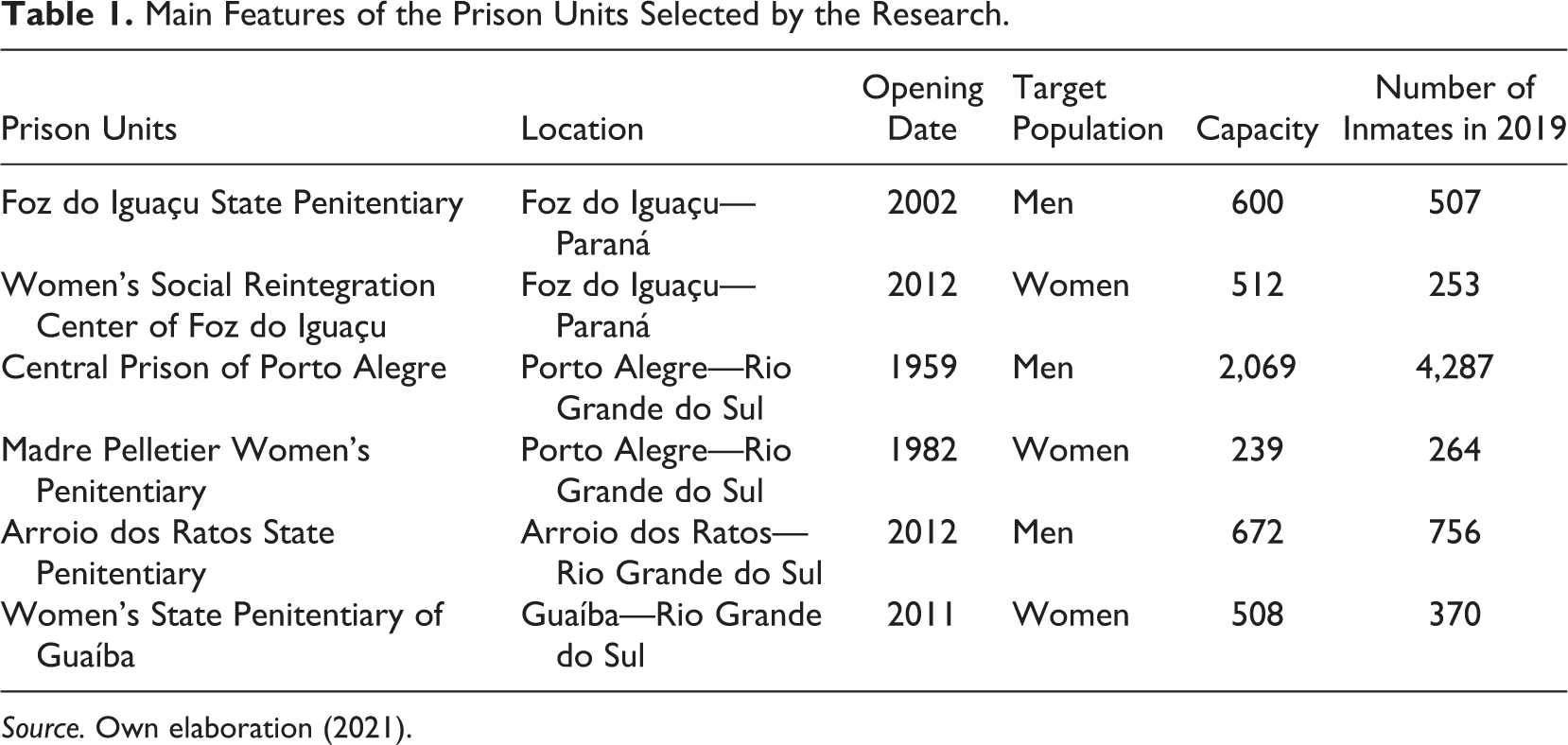
To carry out this research, a survey was conducted to the inmates of the prison units and data were treated by logistic regression. Prison units selected were: PEF and the Women’s Social Reintegration Center of Foz do Iguaçu in the Paraná state and the Central Prison of Porto Alegre, Madre Pelletier Women’s Penitentiary, Arroio dos Ratos State Penitentiary, and Women’s State Penitentiary of Guaíba in the Rio Grande do Sul state. Table 1 shows the main features of these prison units.
Main Features of the Prison Units Selected by the Research.
Source. Own elaboration (2021).
Paraná and Rio Grande do Sul, both Brazilian states located in the southern region, represent together 11.2% of Brazilian prison capacity. In 2019, the number of inmates in Paraná was 23,802 in 2019, and in Rio Grande do Sul, it was 40,687, representing 3.2% and 5.4%, respectively, in relation to the total prison population in Brazil (Brazilian Institute of Geography and Statistics [IBGE], 2021; National Penitentiary Information Survey—Infopen, 2019).
In 2019, there were 752,277 inmates in Brazil, corresponding to a prison population rate of 367.91 inmates per 100,000 inhabitants. It is lower than the rate in the United States that was 655 inmates per 100,000 inhabitants, but higher than the rate in Europe that was 142 inmates per 100,000 inhabitants (IBGE, 2021; Montanari et al., 2021; Walmsley, 2020).
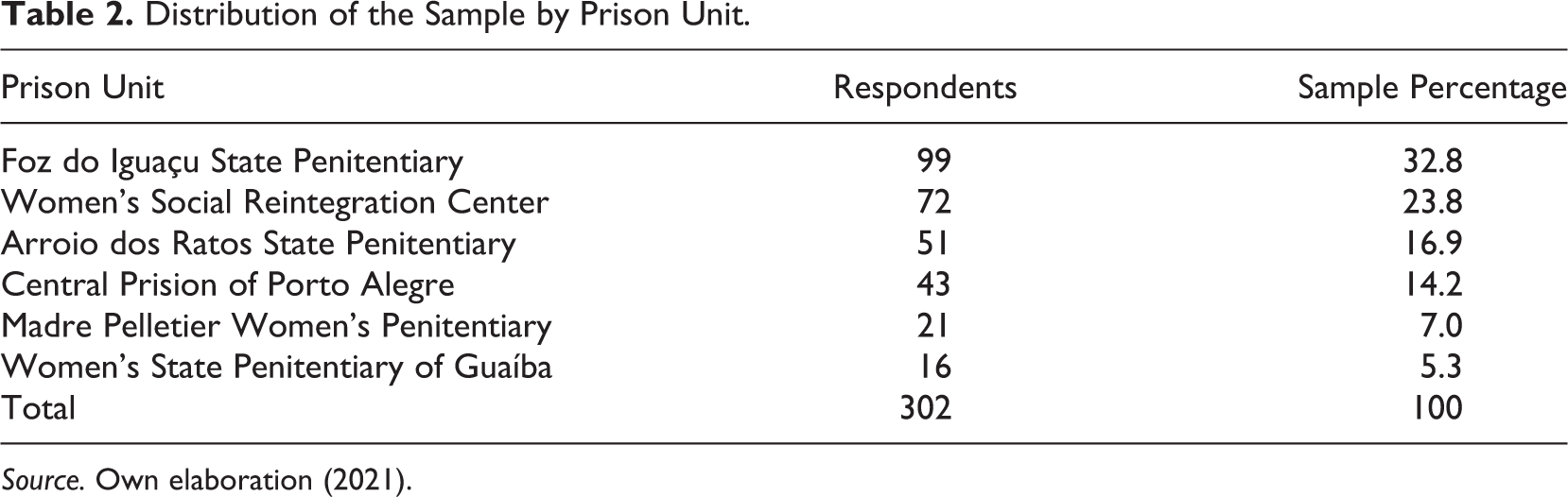
A survey was conducted on a sample of 302 inmates: 171 in Paraná and 131 in Rio Grande do Sul. The survey conducted in six prisons with a questionnaire (Online Appendix 1) including four groups of questions. In the first group, called “General data,” there were questions related to the interviewees’ personal, demographic and social behavior characteristics. In the second group, called “typology and economic aspects of crime,” the type of crime, the reasons that led the individual to commit it, professional occupation, reasons for failure, and other aspects related to the crime are questioned. The third group, “age of criminal responsibility,” concentrates on questions about the inmate’s point of view on this issue. Finally, the fourth group, “other issues,” involves questions about rebellions, aspects about the legalization of drugs, and a criminal’s life expectancy. As for the number of the sample, 302 interviews were carried out, being 192 men (63.6% of the sample) and 110 women (36.4% of the sample). Table 2 shows the number of interviews conducted in each prison unit surveyed.
Distribution of the Sample by Prison Unit.
Source. Own elaboration (2021).
The sample of Rio Grande do Sul was made with a 95% confidence level and a margin of error of 8.57%. On the other hand, the sample of Paraná was made with a 95% confidence level and a margin of error of 7.5%. For these values, it was considered the total number of inmates in both states in 2019.
Prison units surveyed were those that were available by the National Prison Department (Depen), once authorization was required to conduct interviews in prison establishments. In addition, each prison unit director had to authorize the research’s conduct.
Once the researchers’ team was allowed to enter these establishments, the conviction for nonproperty crimes was adopted as an exclusion criterion. In conducting the survey, among all possible respondents, it was the own respondent who decided to participate or not voluntarily. All of them were informed about what the research was before they accepted to participate in it. It is noteworthy that only those who voluntarily accepted participated in the research. In addition, due to security planning issues, the time schedule, periods, shifts, and location of the interviews were extremely variable, whether from prison unit to prison unit or by adjusting activities within each unit. Note that this research was evaluated by a Brazilian ethics committee and was approved.
Method
This article focuses on utilizing logistic regression results to determine which factors affect young people’s decision to engage in crime. From the options of logistic functions presented by the literature, the logit model was chosen based on the Wooldridge’s (2012) justifications, that is, logit is a model of simple operation and efficient response in its proposal.
Furthermore, this method has already been successfully tested in other research in the area of crime economics, with emphasis on Shavit and Rattner (1988), Glaeser et al. (1996), Cole and Gramajo (2009), and Thompson and Bobo (2011). As mentioned, this research considered the analysis of the commission of economic crimes. The dependent variable was the fact that the inmate has committed the crime for which he is detained before reaching 24 years of age (Y = 1 for yes and Y = 0 for no). The explanatory variables used were those obtained through the survey, summarized in Chart 1 (Online Appendix). To define them, the stepwise method was chosen. According to Hair et al. (2010) in the stepwise method, all possible explanatory variables enter an initial model. When processed, it returns only the significant variables with the greatest influence over the dependent variable. In this way, we have an optimized model. Thus, all variables from the survey, which could have some relation with the dependent variable, were included in the initial model, as shown in Chart 1 in Online Appendix.
The stepwise method is used to select the explanatory variables that most influence the dependent variable in order to compose the regression equation. The method has an interactive principle through the addition of explanatory variables (forward step) or exclusion of variables (backward step). In both cases, the method obeys a criterion of statistical coefficient. As for it, we can highlight: F test, multiple linear correlation, total quadratic error, criterion of Akaike information, and likelihood ratio (Hair et al., 2010).
Model Estimation
The estimated regression model had as dependent variable the condition of the inmate having or not committed a crime before reached 24 years old. Whether there was a crime in this condition, the model assumes the value 1, otherwise, the value will be 0. As soon as defining the dependent variable, the initial model was completed with the addition of all 57 explanatory variables in Chart 1 (Online Appendix). The equation for the initial model was:

In which
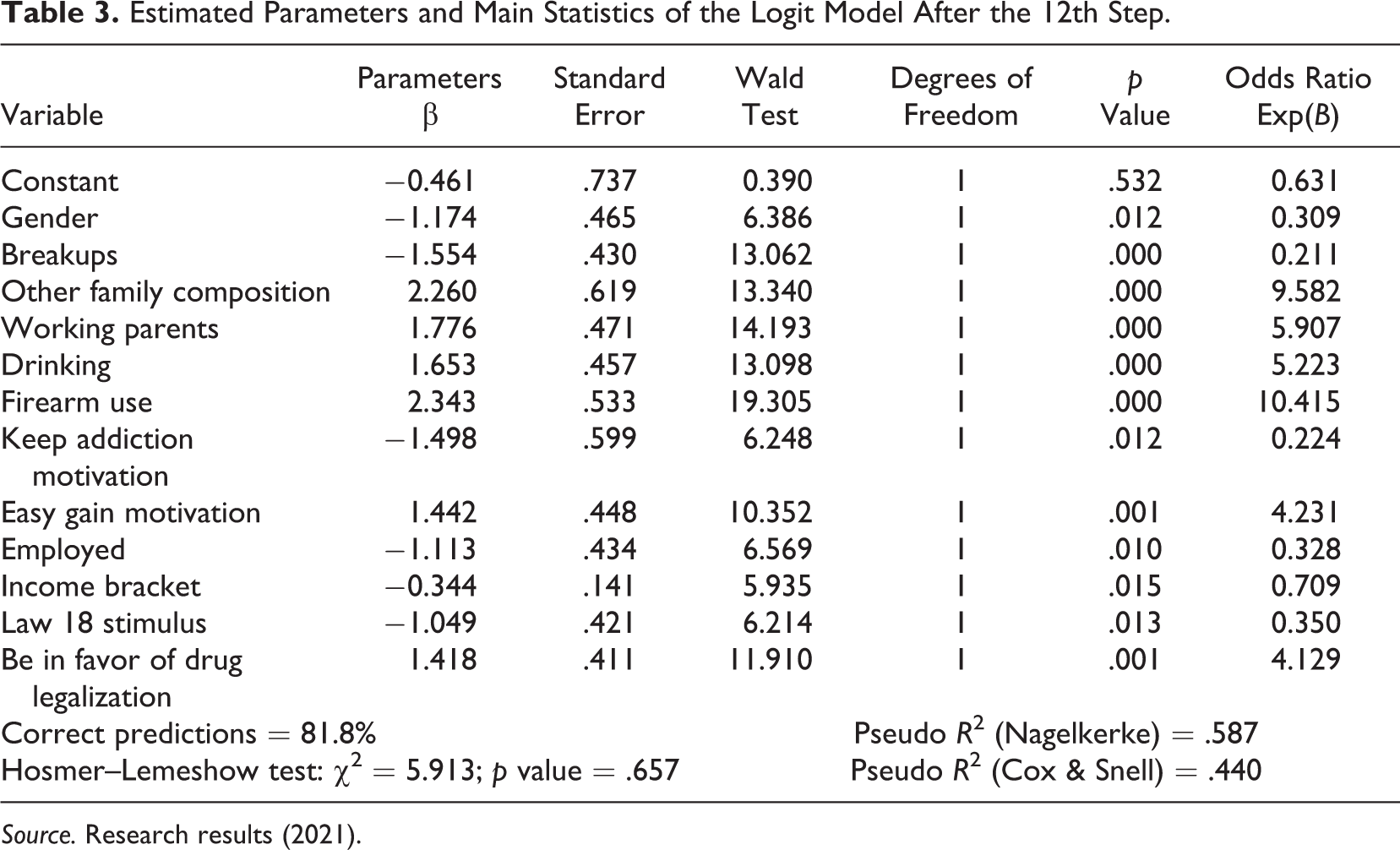
The next stage was to submit the other variables to the stepwise forward method, for automatic determination of the set of variables with greater explanatory power for the dependent variable. In addition to this procedure, the presence of outlier observations was verified in each run of the method. All outliers in each step were excluded for a new run. It was done until the sample was completely free of outlier observations. As a result, five observations were excluded, so that the model could be suitable for analysis. It resulted in 50.2% of cases in which the dependent variable is classified as 1 (they committed the crime before reaching 24 years old, considered “young crime”) and 49.8% of cases where the dependent variable is classified as 0 (they did not commit the crime before reaching 24 years old). Therefore, the initial model is represented by expression (2; Online Appendix). The final model was estimated in a total of 12 steps, in which the 12th step determined 12 significant explanatory variables (Table 3).
Estimated Parameters and Main Statistics of the Logit Model After the 12th Step.
Source. Research results (2021).
Results
Table 3 shows the main statistics on the logit model. The last lines present some of the main tests that confirm the efficiency of the model.
The Hosmer and Lemeshow test assesses whether there are significant differences between the model’s prediction and actual observations. In this case, the value was not significant (.657), that is, there are no significant differences between prediction and observation. Therefore, the model can be used. Cox and Snell’s and Nagelkerke’s pseudo-R 2 indicate that the model is capable of predicting variations in the odds ratio logarithm in the respective order of 44.0% and 58.7%. The Wald test verifies the level of influence of each variable on the model, requiring its value to be different from zero for it to be significant. It is noteworthy that, except for the constant, all variables were significant at 1% or 5%, as shown by the p value of each one of them. As for statistics in Table 3, through the coefficients (β), it is possible to measure the probability of an individual committing a crime before the age of 24, considering a certain profile.
Highlighting each variable by its odds ratio, it is observed that the fact that the person is male reduces the probability of committing the crime before the age of 24 (e −1,174 = 0.309). Nevertheless, it is necessary to emphasize that the chance of this variable occurring is smaller than the unit, which implies that men are less likely to commit a crime while young than women.
Women who were previously seen as an accomplice in crimes committed by their partners and/or children become the main perpetrator of the crime (Borilli, 2005). Another situation that may lead women to crime earlier than men is the need to support their children. While the literature points that the main male motivations are the idea of easy gain, greed, ambition, and status, female motivations are related to helping the family budget.
The coefficient of breakups (e −1,554 = 0.211) shows that a criminal who has had more than one breakup is less likely to commit a crime before the age of 24 compared to those who had only one breakup. Once again, the chance of this variable occurring is less than unity. It shows that the number of afterward breakups is not decisive for entering criminal life but rather the family breakdown caused by the first breakup. The effect of breakups affects one of the moral barriers that contribute to hinder migration to criminality, which is the properly structured family. The lack of family structure can cause traumas that make the individual look for ways to overcome them, one of the options being involvement in economic crimes.
Corroborating this assertion, the model shows two expressive coefficients, which denote characteristics related to family in terms of odds ratio. The variable other family composition (e 2,260 = 9.582) shows that whether the person has a family structure different from the traditional one (spouse and children and/or parents and siblings), there is 9.582 times more likely to commit a crime before the age of 24 than those people who have a traditional family structure. The variable working parents (e 1,776 = 5.907) demonstrates that whether the person has a father and/or mother working, they are 5.907 times more likely to commit a crime before the age of 24 than those who do not have at least one parent working. One explanation for it may be the fact that if the parents do not work, supervision over the young person is greater than the supervision of those working parents, that is, there are more opportunities for delinquency when there is no supervision. Indeed, Wilson and Herrnstein (1985) affirm that the family can minimize or maximize any child’s natural tendency, shaping their values and beliefs. According to Borilli (2005, pp. 112–113), “the family, as one of the foundations of the good progress of society, is not being an ally in the fight against crime and/or passing on good customs to its members.” In line to Brenner (2009, p. 63), “individual behavior is, in a way, a result of the conditions created by the families themselves, by the individual and by the society in which they live.” See also Cardoso (2017) who corroborated this finding in her study. The coefficient related to variable drinking (e 1,653 = 5.223) shows that criminals who use alcoholic beverages are more likely to practice an offense under the age of 24 than those who do not consume alcohol. Perhaps because the individual consumes alcohol, which is a legal drug, the reason to maintain the addiction reduces the probability of committing a crime before the age of 24 (e −1,498 = 0.224). Brenner (2009) pointed out in his study that an important proportion of crimes are carried out under the influence of alcohol and other drugs.
Related to the coefficient of the variable be in favor of drug legalization (e 1,418 = 4.129), it indicates that inmates who have a favorable position for drug legalization are more likely to commit a crime before reaching 24 years of age. Cooter and Ulen (2016) also pointed out as one of the motivational factors for crime the fact that people who are drug addicts need to commit crimes to support their drug use. It can have resulted in the fact that they are in favor of legalizing drugs.
Another motivation related to the chance of committing a crime before the age of 24 is the easy gain, represented by the coefficient easy gain motivation (e 1,442 = 4.231). This variable is 4.231 times more likely to occur, denoting a particularity that Schaefer (2000) also exposed with empirical research. That is, individual causes considered psychic in nature are increasingly attracting people to illicit activities. In this way, the principle of maximum gain with minimum effort is verified. The idea of easy gain presents itself to youngers as an opportunity for quick, short-term, and effortless economic conquest, enabling them to demonstrate status through consumption, which is highly valued, especially in the poorest communities.
Regarding the use of a firearm in criminal action, the coefficient of firearm use (e 2,343 = 10.415) shows that a criminal, by using a firearm, is 10.415 times more likely to commit an offense before the age of 24 than those who do not use a firearm. Results found out that there is no way to dissociate whether the use of a firearm enhances youth to delinquency. It would also be important to raise the origin of these guns used illicitly (this question was not in this survey).
Last but not least, the three remaining coefficients, all with negative values and, consequently, odds ratios smaller than the unit [employed (e −1.113 = 0.328), income bracket (e −0.344 = 0.709), and law 18 stimulus (e −1.049 = 0.350)], show an inverse relationship with the probability of committing the crime before the age of 24. In other words, working or having a progression in the income bracket reduces the chance of this illicit occurrence for young people who commit crimes. Regarding the Brazilian legislation on the minimum legal criminal age in force, the negative sign shows that inmates who answered that the age of 18 as criminal majority encourages youth crime were those who committed crimes after the age of 24 (see also Shikida, 2016).
Discussion of the Results
The aim of this article was to identify the socioeconomic context that influences young peoples’ decision to engage in crime. The results show that gender (male), family composition, having working parents, use of alcoholic beverages, using firearm, having motivation to keep the addiction, having motivation idea of easy gain, have used drugs and alcohol, have worked, and being the age of 18—all these variables are associated with crime engagement. An individual who has all these characteristics has 97.5% more likely of engaging in crime before the age of 24.
It is important to highlight that this research was conducted in prison units in the states of Paraná and Rio Grande do Sul, both located in southern Brazil. In terms of family structure, the main characteristics of the surveyed inmates are 51% of respondents had divorced or separated parents, 29% suffered some type of family violence in their childhood, and the parents’ education level was 52.5% elementary school and 12.5% had no education, that is, they were illiterate.
As for youngers who commit crimes, the vast majority interrupted their studies due to involvement with drugs and crime, with 62% of respondents having completed elementary school. Regarding their income, the majority (43.5%) had an average income between one and two minimum wages, mostly from informal jobs. In behavioral terms, these inmates were mostly consumers of alcoholic beverages, cigarettes, and illicit drugs. These results can be useful for the Brazilian Government to improve its public policies related to all issues about youngers such as drug trafficking, firearms possess, studies support, and so on. Other than that, we can highlight some family programs in order to improve their income and the labor market.
In addition, Brazilian Government should have agreements with frontiers countries so as to improve their programs for the youngers in terms of involving them in cultural, artistical, educational activities. Thus, there will be less likely of youngers enter in the criminal life. Furthermore, Brazilian Government should be agreements with other countries in order to facilitate internship between the youngers from other countries. Thus, Brazilian youngers will be the opportunity to know another reality. It can be useful in the fight against young criminality. Finally, resocialization policies, which aim to put people in contact with society, must be in line with other social policies, offering professional training courses within the prison units for as many inmates as possible.
Conclusion
The econometric analysis revealed six main variables that increase the probability of a person to engage in crime before reaching 24 years old. These characteristics are belonging to a nontraditional family composition, having parents working, use a firearm, be motivated by the idea of easy gain, having a favorable opinion on the legalization of drugs, and being a user of alcoholic beverages. The greatest odds ratios were family composition which corroborate the so-called moral constraints. Unstructured families often are not able to maximize the foundation of a greater face-to-face upbringing. Obviously, this does not mean that parents should not work. The use of alcoholic beverages becomes frequent. The use of a gun is a clear demonstration of the use of strength in the offense committed. As a young man, the idea of easy earning and the favorable position for legalizing drugs also stood out.
Public policies derived from these findings, whose aim is to reduce crime in Brazil, should pay attention to the quality of the interaction among family members and school. Furthermore, it is necessary to expand the costs of illegal activities, increasing the probability of being arrested and punished, and decreasing the benefits resulted from crime engagement.
It was also found that the search for supplementing family income was one of the factors in migration to crime, especially women, for the subsistence of their children. Thus, we suggest a range of technical/professional training programs which can help them to find a job. As a matter of urgency, until the training and professional insertion programs begin to take effect, income transfer policies are important, especially for the most economically vulnerable populations.
Although this research has set young people as target of study, it is important to notice that they are also the main victims. In 2018, 52.2% of homicides in Brazil were of people aged between 20 and 24 years. In this same year, 4,519 women were murdered in Brazil, representing a rate of 4.3 per 100,000 women. From the total, 68% were Black women, confirming a growth trend of 12.4% in the period from 2008 to 2018 for this category of women, while in the same period, homicides of non-Black women fell by 11.7%.
Lastly, it is also essential to mention the limitations of this research, which essentially were the fact that the sample was not extended to more prison units and Brazilian states. Furthermore, the number of observations do not depend directly on the researchers but on permission from the Public Security Department and the inmates themselves. As for the method, one of the methodological limitations of the logit model is the mandatory condition of the binary response of the dependent variable, restricting some possibilities for exploring the database. We proposed for future research the comparison between prison units in the different states of the Brazilian regions.
Supplemental Material
Supplemental Material, sj-docx-1-cjr-10.1177_07340168211038326 - Juvenile Criminality: Evidence From Prisoners in Two Brazilian States
Supplemental Material, sj-docx-1-cjr-10.1177_07340168211038326 for Juvenile Criminality: Evidence From Prisoners in Two Brazilian States by Bárbara Françoise Cardoso Bauermann, Pery Francisco Assis Shikida and Alexandre Luiz Schlemper in Criminal Justice Review
Footnotes
Declaration of Conflicting Interests
The authors declared no potential conflicts of interest with respect to the research, authorship, and/or publication of this article.
Funding
The authors received no financial support for the research, authorship, and/or publication of this article.
Supplemental Material
Supplemental material for this article is available online.
References
Supplementary Material
Please find the following supplemental material available below.
For Open Access articles published under a Creative Commons License, all supplemental material carries the same license as the article it is associated with.
For non-Open Access articles published, all supplemental material carries a non-exclusive license, and permission requests for re-use of supplemental material or any part of supplemental material shall be sent directly to the copyright owner as specified in the copyright notice associated with the article.
