







Abstract
Polydrug use presents a priority public health issue because of the range of physical and mental health issues that may follow from the use of multiple types of drugs. Exposure to violence has been identified as a risk factor for polydrug use, but there remains limited work that has identified mechanisms linking these constructs. Major depressive disorder and differential development of dual systems (impulse control; sensation-seeking) may provide two psychological mechanisms, and mediating effects were tested here. The Adolescent Brain Cognitive Development data were analyzed. Generalized structural equation modeling was used to assess direct and indirect relationships of interest. Lifetime exposure to violence prior to Wave 2 was associated with increased drug-use variety at follow-up. Dual systems imbalance significantly mediated this relationship, whereas major depressive disorder did not. Mediation accounted for about 25% of the direct effect of exposure to violence. These findings suggest that programing to foster healthier cognitive development for youth survivors of violence may help to prevent polydrug use.
Introduction
Exposure to violence, defined as directly experiencing some form of violent victimization and/or witnessing this happen to someone else, is a risk factor for a range of substance use outcomes, including the use of multiple substances known as polydrug use (Blackman et al., 2022; Fagan et al., 2015; Hautala & Sittner, 2021; Lee et al., 2021; Wojciechowski, 2019). Polydrug use presents a concerning behavioral outcome because it entails the potential health risks involved with both the immediate risks of concurrent use of multiple substances and also the longer-term risks involved with each individual substance (Earleywine & Newcomb, 1997; Sano & Moukaddam, 2025). The robust effect of exposure to violence on substance use outcomes highlights a need to identify mechanisms linking these two constructs. This would facilitate more effective design and implementation of treatment programing for survivors of violence exposure to help to mitigate polydrug use risk among this population.
Another particular concern pertaining to the relationship between exposure to violence and polydrug use is the timing of exposure. Exposure to traumatic stress in childhood presents a particular concern here because of the impact that such exposures may have on the developing brain and associated cognitive and affective outcomes, as well as substance use patterns (Bustamante et al., 2022; Hoffmann & Hoffmann, 2025; Ramírez et al., 2025; Wong et al., 2023). This indicates that these cognitive and affective domains may present a set of mechanisms that may help to explain the relationship between exposure to violence and early polydrug use risk. Research on cognitive and affective mechanisms in this context, however, currently remains limited. The present study sought to address these gaps in the extant literature in several ways. First, by examining exposure to violence in childhood as a predictor of polydrug use risk in late childhood and early adolescence. Second, by testing for the mediating effects of affective and cognitive constructs in the aforementioned relationship between exposure to violence and polydrug use.
Research on Exposure to Violence and Polydrug Use Risk
There is a great deal of research that has indicated the relevance of exposure to violence as a predictor of polydrug use (Alvarez-Alonso et al., 2016; Armour et al., 2014; Lee et al., 2021). For example, Wojciechowski (2019) identified six drug use variety trajectory groups and observed that victimization prior to baseline predicted increased risk of assignment to trajectories characterized by either deceleration in drug use variety or high chronic patterns of elevated drug use variety. Previous research has also indicated that specific forms of exposure to violence may be pertinent for understanding polydrug use risk. For example, Alvarez-Alonso et al. (2016) observed that while adolescent polydrug users reported greater prevalence of having histories of all forms of child maltreatment, sexual abuse was the form of exposure to violence most apparent for distinguishing polydrug users from nonpolydrug users. Beyond the relationship between exposure to violence and polydrug use, research has also highlighted the potential for polydrug-using youth to present additional serious behavioral issues of concern. For example, Weerakoon et al. (2025) observed that while polydrug users reported significantly greater prevalence of experiencing bullying victimization, they also reported significantly greater prevalence of weapon-carrying behaviors as well. This indicates the potential for survivors of violence to not only be at increased risk for drug use behaviors, but also that they may take measures to prevent further victimization, even if such measures place them at greater risk for justice-system involvement.
It should be noted that drug use among such a young population is particularly problematic given that any level of drug use among such a young population is exceedingly rare (Aly et al., 2020; National Institute of Drug Abuse, 2014). Given that polydrug use entails the use of more than one type of drug during a given timeframe, this likely makes any polydrug use reported in the sample as being highly unusual. While early-life exposure to violence may trigger elevated substance use risk (Blackman et al., 2022; Fagan et al., 2015; Hautala & Sittner, 2021; Lee et al., 2021; Wojciechowski, 2019), access to substances must also be considered in this regard. If young children are reporting the use of multiple types of drugs, then this likely indicates the existence of a broader context conducive to drug use. Beyond the fact that exposure to violence may increase risk for substance use, young children reporting multiple forms of drug use also entails much greater accessibility to these drugs than their peers. This may be driven by exposure to illicit drug markets and potentially violence within these drug markets in a manner that drives a spurious relationship between exposure to violence and polydrug use. If youth are turning to substance use due to exposure to violence, they may simply be at greater risk for polydrug use over the course of a given year because they are just taking what is available at any given time (e.g., sometimes it is alcohol and sometimes it is opioids). As such, it is important to note that while exposure to violence is expected to lead to a greater variety of drug use through varying psychological mechanisms, contextual factors influencing access to these drugs also play a very large part in risk for polydrug use.
This research highlights the need to better understand the relationship between exposure to violence and polydrug use. Doing so may help to prevent not only escalation of drug use behaviors and potential health effects among youth, but also may help to prevent further downstream antisocial behaviors. This indicates the importance of identifying key mechanisms linking exposure to violence to polydrug use. However, there is currently limited research which has examined this specific chain of relationships.
Dual Systems Imbalance and Major Depressive Disorder as Mediators of the Relationship Between Exposure to Violence and Polydrug Use
While the extant literature is limited in examinations of tests identifying significant mediators of the relationships between exposure to violence and polydrug use risk, several psychological domains present intriguing possibilities: cognition and affect. The dual systems model presents a framework that may be particularly relevant in the cognitive domain in this regard. The dual systems model posits that the imbalance in the development of impulse control and sensation-seeking during adolescence helps to understand the elevated propensity for engagement in risky behaviors during this period of the life-course (Steinberg et al., 2008; Steinberg, 2010). Brain regions governing sensation-seeking generally develop rapidly following puberty, whereas brain regions governing impulse control develop much more slowly and steadily during adolescence and into emerging adulthood (Spencer-Smith & Anderson, 2009). As such, adolescents tend to develop strong drives toward novel and thrilling activities (sensation-seeking) long before they develop their full capacity to stop and consider potential consequences and risks involved with the activity (impulse control).
For example, Wojciechowski (2021) examined the relationship between post-traumatic stress disorder and polydrug use risk with key dual systems model constructs of sensation-seeking and impulse control as mediators. While the total mediation effect was significant, neither of the mediating pathways individually demonstrated significant mediation in the full model. This was posited to be due to the collinearity of impulse control and sensation-seeking, so each mediator was examined separately and only impulse control was found to significantly mediate the hypothesized relationship. This collinearity issue highlights another potential concern about the use of both cognitive measures in a single model. Other research has addressed this issue through computation of a “dual systems imbalance” measure that is consistent with the postulations of the framework itself (McCabe et al., 2021; Meisel et al., 2019; Wojciechowski, 2025). Such measures standardize both sensation-seeking and impulse control measures and compute a difference between the standardized scores. This provides indication of the degree to which individuals’ sensation-seeking and impulse control are imbalanced at a given point in time in a manner consistent with how the dual systems model conceptualizes differential development of these constructs. This same research has demonstrated the relevance of such imbalance scores for understanding outcomes of interest in a manner consistent with the dual systems model (Vazsonyi & Ksinan, 2017; Wojciechowski, 2025). This imbalance provides one potential mechanism for linking exposure to violence in childhood with polydrug use risk, exposure to violence has been identified as a risk factor for elevated sensation-seeking and low impulse control and both of these cognitive constructs are also risk factors for substance use (Hoffmann, 2021; Rinehart & Spencer, 2021; Wojciechowski, 2022). It should also be noted that this study examined these processes among justice-involved youth specifically. Because of the indicated nature of this sample, there were also concerns that these findings lacked generalizability. This highlights another important reason to examine these processes among general population youth, as this may help to determine the robustness of the findings of this previous work.
Another psychological mechanism that may potentially link exposure to violence and polydrug use is MDD. MDD is a diagnosable depressive disorder characterized by persistent sadness, fatigue, loss of interest in activities, and changes in sleep patterns (American Psychiatric Association, 2013). MDD is particularly relevant here because it has been identified as both a robust risk factor for substance use and an outcome predicted by exposure to violence (American Psychiatric Association, 2013; Kavish et al., 2019; Kim et al., 2021). The manner in which likely MDD diagnosis may link exposure to violence to polydrug use and substance use more generally is via coping. A number of theories have linked MDD and other mental illnesses to substance use risk through this mechanism, as individuals may cope with unaddressed depressive symptoms by numbing them through drug use (Agnew, 1992; Khantzian, 1997). General strain theory specifically links depression like this to both exposure to violence and drug use and other coping responses through this specific mediation relationship where strain leads to negative affect and negative affect is mitigated through a coping response like drug use (Agnew, 1992). While the use of a true diagnostic measure of MDD was beyond the scope of this study, advanced survey methodologies do now allow for the assessment of “likely” diagnosis of a range of mental disorders (MDD included) that correspond strongly diagnostic prevalence (Chromik & Friedman, 2025). The use of survey algorithms to identify a “likely” diagnosis of MDD was used in the present study as a proxy of a true diagnostic interview.
While general strain theory presents perhaps the most salient framework for understanding the interrelationships between exposure to violence, MDD, and polydrug use; there is limited research that has explored these specific constructs via a chain of relationships. A great deal of research on general strain theory has examined more generic depressive symptomatology as a mediator of the relationship between exposure to violence and substance use risk (Carson et al., 2008; Song et al., 2021; Zweig et al., 2015). In reviewing the extant literature, there were no studies identified that examined diagnosis of MDD as a mediator of the relationship between strain and crime/drug use though. This omission leaves a significant hole in our understanding of these processes. MDD diagnosis represents a recognition of clinically pathological depression. This diagnosis then represents a point in which depressive symptoms have reached a point of impairment in an individual's functioning. Unlike raw symptom counts, there are also clinical implications for the treatment of this disorder through psychotherapy and/or medication in a manner that can provide potential relief from symptoms and impairment. If MDD does significantly mediate the relationship between exposure to violence and polydrug use risk, then this would provide a mechanism for clinicians to address through established treatment protocols. Beyond the general treatment implications, examination of MDD onset during the childhood and early adolescent years may be particularly relevant. Prior research has indicated that early onset of MDD is a risk factor for recurrent MDD episodes and a more chronic course of the disorder (Herzog et al., 2021; Zisook et al., 2007). This indicates that examining how these processes are relevant during this period of the life-course may have longer-term implications for behavioral development throughout the life-course. Considering that MDD is a risk factor for polydrug use and exposure to violence in childhood is a risk factor for MDD (Jongenelis et al., 2019; Kavish et al., 2019; Kim et al., 2021), the lack of examination of these constructs in a single chain of relationships remains a major concern and necessitates further examination of a potential mediating effect here.
Current Study
Exposure to violence is a robust risk factor for polydrug use (Alvarez-Alonso et al., 2016; Armour et al., 2014; Lee et al., 2021). However, there remains a dearth of research examining psychological mechanisms linking these constructs in a single chain of relationships. MDD and dual systems imbalance present two potential mechanisms that may mediate this relationship, as both of these constructs are related to exposure to violence and polydrug use in a manner consistent with the posited chain of relationships. Beyond these relationships more generally, examination of these processes during early life may be particularly important. Early substance use is a risk factor for more chronic substance use issues (Behrendt et al., 2009; Merrin et al., 2022). Similarly, early onset of MDD may result in a more chronic and recurrent course of the disorder (Herzog et al., 2021; Zisook et al., 2007), resulting in the potential for continued substance use risk throughout life. While the dual systems model has typically focused on adolescence (Steinberg et al., 2008; Steinberg, 2010), there have also been calls for extending examinations of these processes to earlier stages of the life-course due to earlier variation in sensation-seeking and impulse control (Jonas & Kochanska, 2018). If this earlier variation is relevant for substance use, this may similarly result in early onset of substance use behaviors that may present this same elevated chronic risk. If exposure to violence early in life is triggering these psychological changes associated with dual systems imbalance and MDD, this may provide indication of priority populations for treatment. Figure 1 provides a visual depiction of this set of posited relationships. Identification of such populations and the specific psychological dysfunction that may follow exposure to violence may help in the design, implementation, and delivery of more effective programing to reduce polydrug use risk. That said, research in these areas remains limited. The present study sought to address these gaps in the literature by testing the following hypotheses:
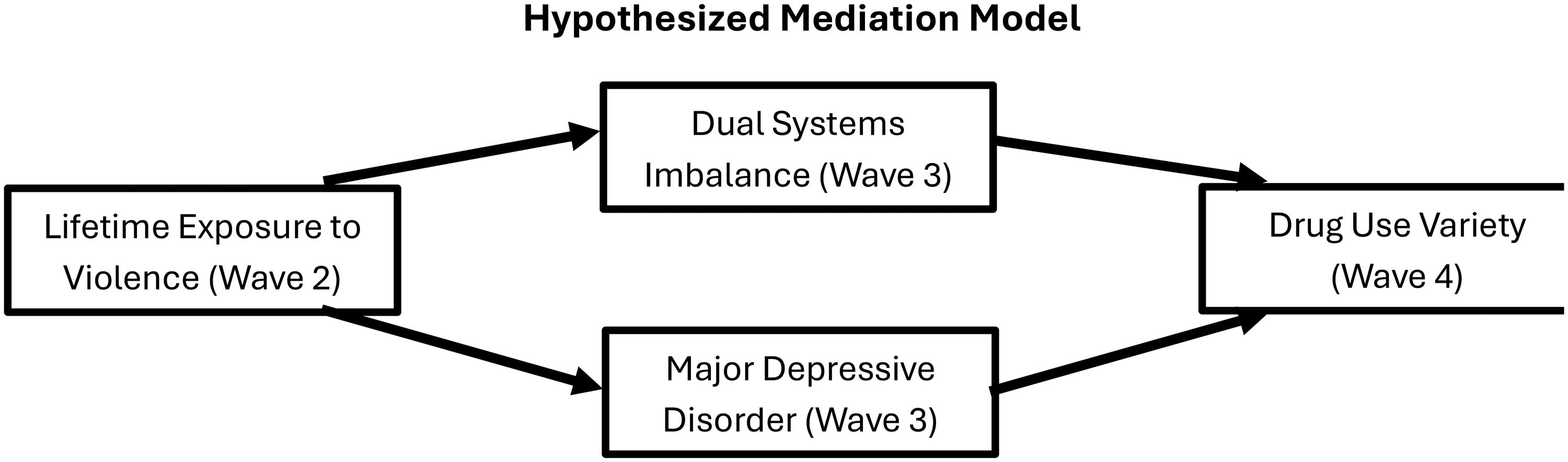
Hypothesized mediation model.
Hypothesis 1: Experiencing exposure to violence in childhood will be associated with greater polydrug use risk.
Hypothesis 2: MDD and dual systems imbalance will both positively and significantly mediate the relationship between exposure to violence and polydrug use risk.
Methods
Data
The present study utilized data from the first four waves of the Adolescent Brain Cognitive Development (ABCD) study. The ABCD study is an ongoing panel study comprising the data of 11,880 youth aged 9–10 years old at baseline measurements, with the intent to follow these youth through emerging adulthood to better understand the causes of mental illness and substance use behaviors within developmental context. The first four waves of this study were used because of the need to establish temporal ordering between key independent, mediating, and dependent variables in a manner that is consistent with the measurement intervals of these key variables. 1 Using the first four wave also allowed for examination of these relationships during the specific life-course stage of interest and issues of missingness were much less severe in these first four waves than in the subsequent waves (seven waves released as of this writing). Participants were recruited from catchment areas surrounding the 26 study sites located in the continental United States. A multistage cluster sampling methodology was used to build a diverse sample that resembles that of the United States, though it may not be truly representative considering that these catchment areas may differ from other areas of the country in terms of demographic characteristics of residents. Researchers gathered survey data and brain scan data (restricted access) from participants on an annual basis, though only the survey data were used in the present analyses. Participants’ parents/guardians provided informed consent for minor participants to take part in the study with concurrent minor participant asset for participation. The data collection for the ABCD study received institutional review board approval, whereas the present study was deemed to be exempt from full ethical review because it entailed secondary analysis of deidentified survey data only.
Measures
Polydrug Use
The main dependent variable examined in this study was polydrug use at Wave 4 as operationalized as drug use variety. Using a series of binary variables, participants were asked whether they had used the following drugs during the Wave 4 observation period: alcohol, tobacco/nicotine, marijuana, cocaine, opioids, Dextromethorphan, hallucinogens, and ecstasy/molly. 2 Using these binary variables, a count variable was computed, with higher scores indicating greater variety of drug use in a manner consistent with polydrug use as conceptualized in the present study. This dependent variable had a mean score of 0.033, standard deviation of 0.242, and minimum and maximum scores of 0 and 6, respectively. Only 0.61% of the sample reported the use of more than one type of drug at Wave 4 (N = 82), indicating the low prevalence of polydrug use in these very early stages of the life-course. It should also be noted that drug-use variety provides only a proxy measure of polydrug use. However, this is a measure that is widely used in this regard in the extant literature (Gordon et al., 2013; Kuettel, 2021; Wojciechowski, 2019).
Exposure to Violence
The main independent variable examined in this present study was lifetime exposure to violence prior to Wave 2 measurements. The Adverse Life Events Scale was used to measure this construct at Wave 2 (Tiet et al., 1998). This instrument utilized a series of 4 binary items that asked participants whether they had experienced a variety of forms of exposure to violence in their lifetime prior to the Wave 2 measurements (e.g., was a victim of crime/violence/assault). A single binary variable was then computed from these items that delineated participants that reported experiencing any of these forms of exposure to violence in their lifetimes compared to those who had not (0 = No; 1 = Yes). This approach of using a single binary item computed from a series of binary indicators is consistent with prior research in this area (Wojciechowski, 2024), as this provides a general measure of traumatic stress exposure for understanding outcomes of interest. 3
Dual Systems Imbalance
The first of the key mediating variables examined in this study was dual systems imbalance at Wave 3. This construct was measured using the UPPS Impulsive Behavior Scale (Whiteside et al., 2005). This instrument is comprised of a series of ordinal items that assess various dimensions of impulsivity and are sorted by subscale. The subscale assessing sensation-seeking was used to measure sensation-seeking at Wave 3 (e.g., I quite enjoy taking risks). Higher scores on these items corresponded to greater sensation-seeking. The subscale assessing lack of premeditation was used to assess impulse control, as these constructs share the definition of one's capacity to stop and consider potential consequences of an action prior to engagement (e.g., I like to stop and think things over before I do them). The impulse control items were reverse coded so that higher scores corresponded to lower impulse control. Index scores were computed from the individual ordinal items for each of the subscales. These index scores were then standardized by subtracting the sample mean and dividing by the sample standard deviation from each individual score. Because of the reverse coding of the impulse control items, participants’ standardized sensation-seeking and impulse control scores were added together to create an overall dual systems imbalance score. Higher scores on this imbalance measure corresponded to greater imbalance characterized by elevated sensation-seeking and diminished impulse control. Lower (negative) scores on this scale corresponding to greater imbalance characterized by greater impulse control and lower sensation-seeking. Scores of “0” corresponded to perfectly balanced impulse control and sensation-seeking on this measure.
Major Depressive Disorder
The other key mediating variable examined in the present study was MDD diagnosis at Wave 3. This construct was measured using the Kiddie Schedule for Affective Disorders and Schizophrenia (Puig-Antich & Ryan, 1986). This instrument utilized a series of items that probed for the presence of symptoms of a variety of mental illnesses, including MDD (e.g., anhedonia). Participants reported whether or not they had experienced each symptom and based on this reporting an algorithm developed by the creators of the instrument and applied by the ABCD research team was able to provide a determination of whether the participant likely met criteria for a diagnosis of MDD. A binary variable was then used in analyses that delineated participants who reported a likely diagnosis of MDD at present from those who did not (0 = No; 1 = Yes). While this is not a true diagnostic measure, prior research has indicated that the use of algorithms of surveys like this provide “likely” proxy measures of mental illness diagnosis that correspond strongly with actual diagnostic prevalence (Chromik & Friedman, 2025). These survey questions ask youth about the experience of MDD symptoms that clinicians would be looking for in a diagnostic interview, but lack the assessment of a trained clinician to determine their presence or absence. Further, missing from these survey measures, though, are parent and other third-party reporting and behavioral patterns observed directly by a clinician. As such, this “likely” measure of MDD diagnosis should be interpreted only as a proxy measure with the potential for measurement error.
Control Variables
Several control variables were also included in analyses in order to mitigate bias in the estimation of relationships of interest. The first of these variables was gender, as prior research has indicated that boys present a greater risk for polydrug use than girls (Wojciechowski, 2023). Gender was measured as a binary variable at baseline and delineated boys and girls into distinct categories (0 = Boys; 1 = Girls). 4
Another set of variables controlled for in these analyses pertained to race/ethnicity, as past research has indicated that polydrug use risk may vary along racial/ethnic lines (Wojciechowski, 2019). Race was measured at baseline using a binary variable that delineated White and Racially Minoritized participants (0 = White; 1 = Racially Minoritized). Latinx ethnicity was also controlled for in analyses using a binary variable that delineated Latinx participants from Non-Latinx participants (0 = Non-Latinx; 1 = Latinx).
It was also necessary to control for family income in analyses, as prior research has indicated that polydrug use risk may be stratified by social class (Carter et al., 2013). Participants’ parents’ annual income was measured by parent-report at baseline using an ordinal variable, with higher scores corresponding to a greater annual income.
Age at Wave 4 was also controlled for in analyses because research has indicated that risk for polydrug use risk may be age-graded (Wojciechowski, 2019). Age was measured at Wave 4 in single-year intervals.
Deviant peer association was controlled for at Wave 3, as past research has indicated that this is a risk factor for polydrug use (Wojciechowski, 2023). Deviant peer association was measured using the Peer Behavior Inventory (Bingham et al., 1995). This instrument used three prompts asking participants about how many of their friends engaged in distinct deviant behaviors using an ordinal scale: shoplifting, skipping school, suspended from school. Higher scores on these ordinal scales corresponded to having more friends who engaged in these behaviors or had experienced school suspension. A mean score was then computed from these individual ordinal scores so that every participant had a single deviant peer association score at Wave 3.
It was also important to control for parental monitoring at Wave 3 in these analyses because prior research has indicated that appropriate parental monitoring of youth behaviors is a protective factor against polydrug use (Chan et al., 2017). The Parental Monitoring Survey was used to assess parental monitoring at Wave 3 (Chilcoat & Anthony, 1996). Ordinal items assessed the degree to which participants reported that their parents monitored their behaviors and were knowledgeable about their activities (e.g., How often do your parents/guardians know where you are?). A mean score was computed from these individual ordinal scores so that every participant had a single parental monitoring score at Wave 3.
The final control variable used in these analyses was a baseline measure of drug use variety. This construct was controlled for to ensure that prior levels of drug use variety did not confound the later relationship between the independent and dependent variables of interest. Drug use variety was measured analogously to the main dependent variable examined in these analyses as a count of the number of different types of substances that participants reported ever trying prior to baseline measurement.
Analytic Strategy
The present study utilized generalized structural equation modeling (GSEM) to examine direct and indirect relationships of interest. GSEM was chosen because of its capacity to analyze multiple dependent variables in the same model, thus, allowing for examination of the full mediating pathways running from exposure to violence to polydrug use risk through the likely MDD diagnosis and dual systems imbalance mediators. Results from the analyses using this method also have the advantage of being able to be extended to determine whether either or both of these pathways constituted statistically significant mediation of the direct effect of exposure to violence on polydrug use risk. Poisson regression was used within the GSEM framework to examine the effects of independent variables on the polydrug use dependent variable because of the count and skewed nature of this variable. The nbvargr function in Stata was used to test for the potential of overdispersion in the data and the potential that a negative binomial model may be better suited for modeling the data than a poisson model. This test indicated that a poisson model provided better fit to the data based on probability of model fit between the two models. Mean and variance of this dependent variable also indicated little concern about overdispersion (Mean = 0.033; Variance = 0.059). There were concerns about zero-inflation and the implications for modeling the data, but a zero-inflated poisson model was not available in the GSEM context, so this remains a limitation of the study. Two models were estimated. Model 1 examined the direct effect of lifetime exposure to violence at Wave 2 on drug use variety count at Wave 4 net of all control covariates. Model 2 then included the hypothesized mediating pathways running through likely MDD diagnosis and dual systems imbalance to determine the impact that the addition of these constructs in the model had on the direct effect of exposure to violence, again, net of all control covariates.
Listwise deletion was used to manage missing data in these analyses. While more advanced forms of missing data management would have been ideal, GSEM was not compatible with these methods in Stata. This resulted in a final analytic sample of 10,706 participants (∼10% missing data overall). The major contributors to missingness within this context were dual systems imbalance, MDD, deviant peer association, and parental monitoring; with each of these variables missing between 7% and 9% of data. 5 A Little's test also indicated that data were not missing completely at random (Chi2 = 1427.877, p < .001), indicating concern over bias in estimation of relationships of interest. To address concerns over the potential for biased estimates of relationships of interest due to data being not missing completely at random, sensitivity analyses were estimated. These sensitivity analyses utilized a traditional linear structural equation model approach with the skewed drug use variety dependent variable. While this model violated assumptions of the linear model, this approach allowed for the use of full-information maximum likelihood estimation to manage missing data more effectively. These sensitivity analyses served as only a partial robustness check on the main analyses and are reported in the “Results” section. This is only partial, again, because this approach involves both model specification and missingness assumptions and the direct and mediation findings should be interpreted with caution given the acknowledged distributional violations.
The second phase of analyses entailed the extension of the GSEM method to formally test whether either or both of the hypothesized pathways running from exposure to violence to polydrug use were significantly mediated by likely MDD diagnosis and/or dual systems imbalance. To test for mediation, it is necessary to compute standard errors for the full vectors running from independent variable, to mediator, to dependent variable. While the delta method can be used to compute these standard errors, this can result in biased estimates. To address this issue, the Preacher & Hayes (2008) method of bootstrap resampling of standard errors was carried out. This method addresses this concern through resampling of these standard errors to compute a standard normal distribution of errors and then pooling these errors in a manner that should result in non-biased estimates of statistical significance. A total of 500 bootstrap repetitions were estimated to compute these unbiased standard errors for each hypothesized mediating pathway. Stata/MP 16.1 was used to conduct all analyses. The traditional threshold of p < .050 for statistical significance was used for interpretation of all analyses.
Results
Table 1 provides descriptive statistics for all of the variables examined in the present analyses. Participants reported very low drug use variety at Wave 4 on average (Mean = 0.033; Standard deviation = 0.242). However, this was up from even lower drug use variety scores observed at Wave 1 (Mean = 0.009; Standard deviation = 0.097). The correlation between drug use variety scores at Wave 1 and Wave 4 was weak, positive and significant at the p < .050 level (r = .102). Prevalence of any drug use at Wave 4 was only 2.37%, up from 0.90% at Wave 1. This raised additional concerns about the lack of a zero-inflated poisson option within the GSEM framework. Prevalence of lifetime exposure to violence at Wave 2 was 29.73% (N = 3,334). Average dual systems imbalance scores indicated scores averaging near the balance point of 0 (Mean ≤ 0.001; Standard deviation = 1.511). Prevalence of likely MDD diagnosis in the sample was very low at 0.54% (N = 59). The gender split of the data was close to even (Boys = 52.16%, N = 6,190; Girls = 47.84%, N = 5,678). White participants were the majority racial group in the sample (White = 65.78%, N = 7,805; Racially Minoritized = 34.22%, N = 4,061). Non-Latinx participants were in the majority compared to Latinx participants in the sample also (Non-Latinx = 79.32%, N = 9,379; Latinx = 20.68%, N = 2,445).
Descriptive Statistics.
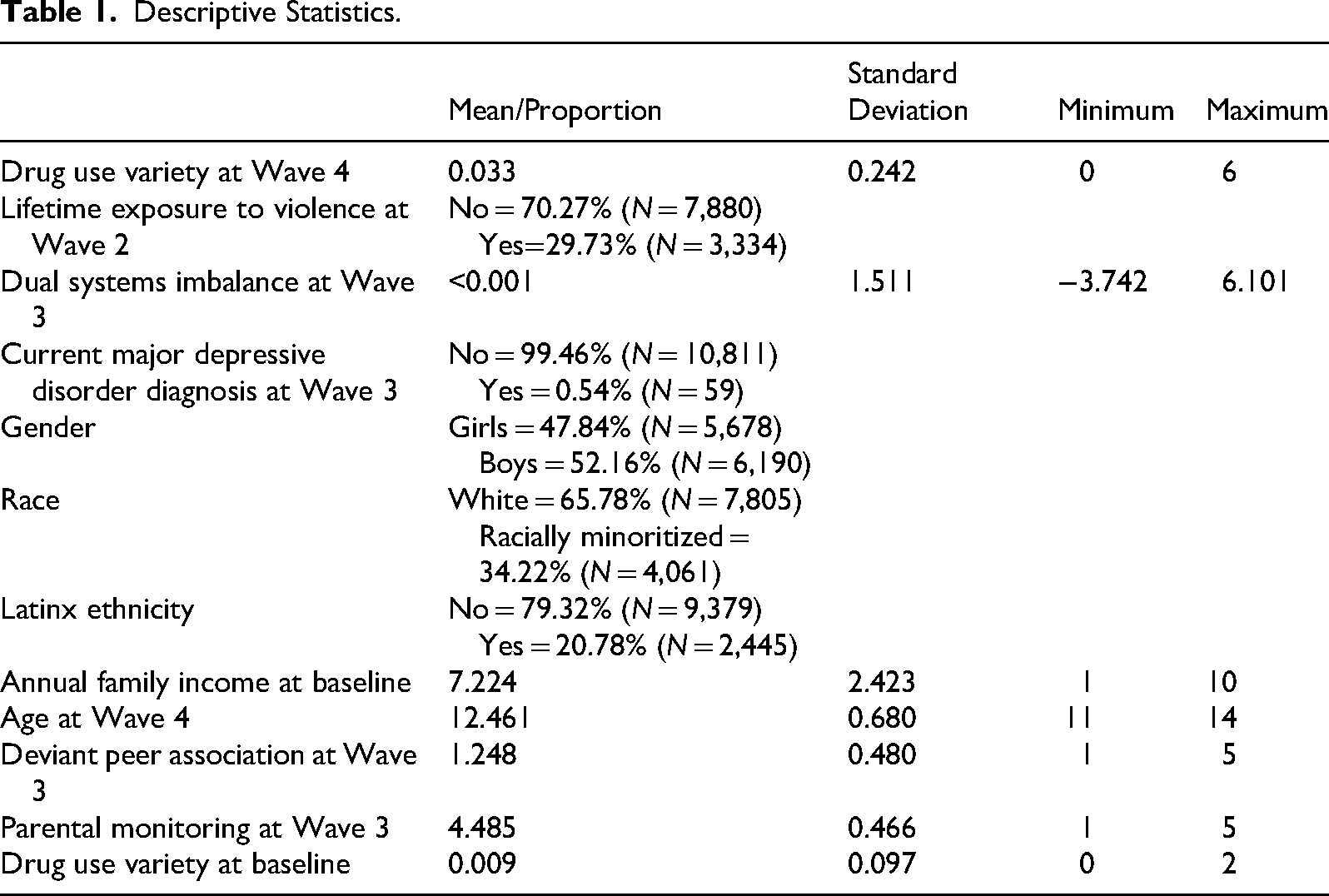
Table 2 provides findings from Model 1 and Model 2 GSEM analyses. Model 1 results indicated that lifetime exposure to violence was associated with greater drug use variety at follow-up (Coefficient = 0.356, p = .020). Being older, greater deviant peer association, weaker parental monitoring, and greater drug use variety at baseline were also all associated with increased drug use variety at Wave 4 in this model. Girls also reported greater drug use variety than boys in this model. Model 2 results indicated that inclusion of the hypothesized mediating pathways attenuated the direct effect of exposure to violence on drug use variety to the point of non-significance (Coefficient = 0.270, p = .079). Greater dual systems imbalance characterized by elevated sensation-seeking and diminished impulse control was also a significant predictor of increased drug use variety in this model (Coefficient=0.299, p < .001). Likely MDD diagnosis was not a significant predictor of drug use variety in this model. Being younger, weaker parental monitoring, lower annual income, greater deviant peer association, and greater drug use variety at baseline also predicted increased drug use variety at Wave 4 in this model. Girls continued to report increased drug use variety compared to boys in this model. Additionally, exposure to violence predicted greater dual systems imbalance characterized by increased sensation-seeking and lower impulse control in this model (Coefficient = 0.286, p < .001). Lifetime exposure to violence was not a significant predictor of likely MDD diagnosis in this model.
Generalized Structural Equation Poisson Regression Modeling of Lifetime Exposure to Violence Prior to Wave 2 on Drug Use Variety at Wave 4 and Proposed Mediating Pathway (N = 10,706).
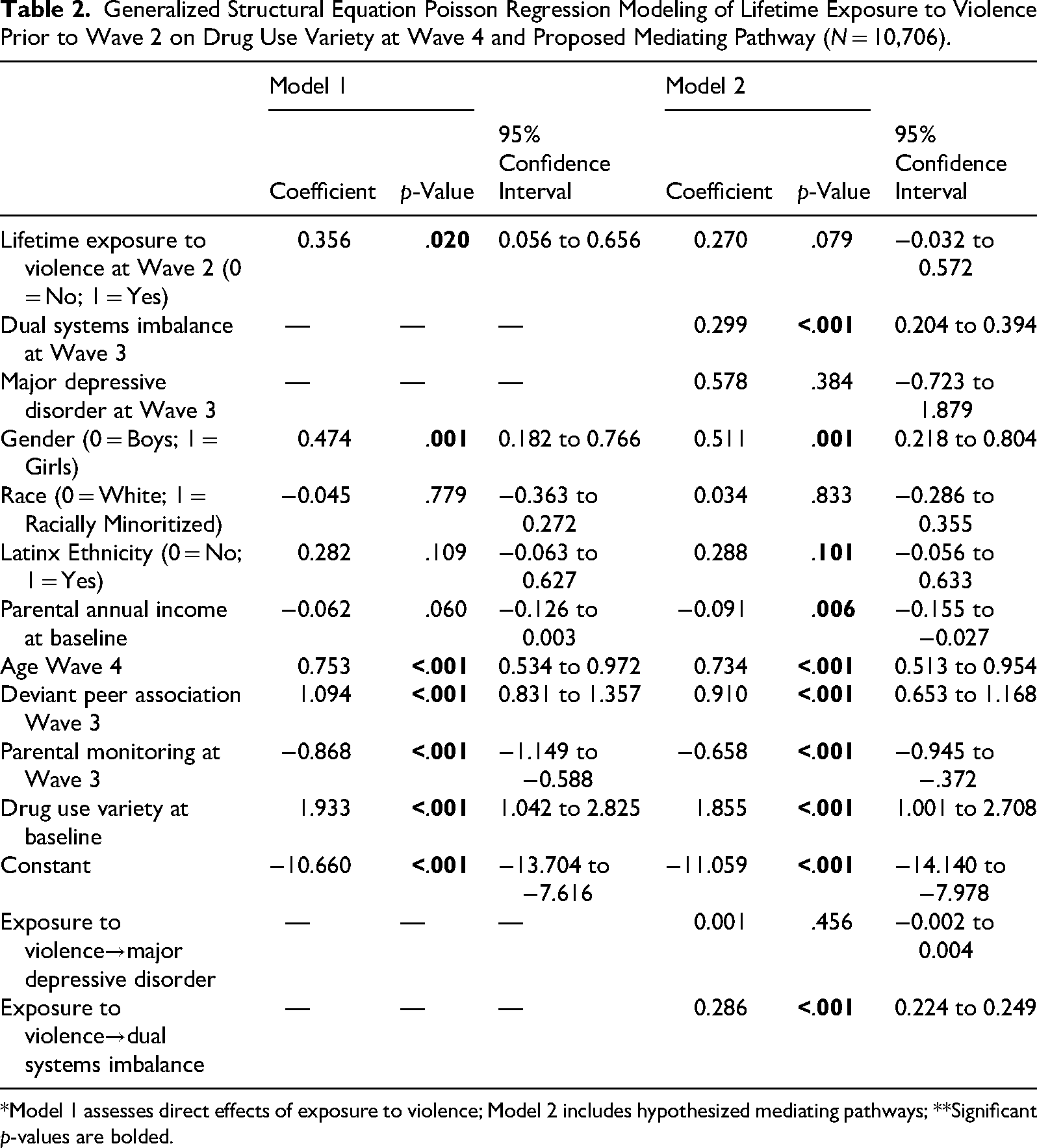
*Model 1 assesses direct effects of exposure to violence; Model 2 includes hypothesized mediating pathways; **Significant p-values are bolded.
The second phase of analyses entailed extension of the results from the GSEM analyses to determine whether either or both of the hypothesized pathways running from exposure to violence to drug use variety constituted significant mediation effects. Results from the Preacher & Hayes (2008) bootstrap resampling process indicated that dual systems imbalance significantly mediated the relationship between exposure to violence and drug use variety (Coefficient = 0.086, Standard error = 0.017, p < .001, 95% confidence interval = 0.053–0.118). Likely, MDD diagnosis did not significantly mediate this relationship. In sum, these mediating pathways accounted for about 25% of the relationship between exposure to violence and drug use variety, with dual systems imbalance accounting for essentially all of this mediation effect.
Sensitivity analyses were estimated to determine the robustness of results from the main analyses. Linear structural equation modeling was used with full-information maximum likelihood estimation to test for this robustness. There were some notable differences in the findings of the main analyses from those of the sensitivity analyses. First, the impact of exposure to violence on drug use variety was non-significant in the sensitivity analyses (Coefficient = 0.008, p = .131). Likely MDD diagnosis was a significant predictor of greater drug use variety in these analyses (Coefficient = 0.104, p = .001), as was dual systems imbalance (Coefficient = 0.012, p < .001). Exposure to violence also predicted significantly greater dual systems imbalance scores and had nonsignificant effects on likely MDD diagnosis in a manner analogous to the main analyses. While these differences may have been due to the highly skewed nature of the dependent variable, it very well could have been due to the more valid approach to missing data management used in the sensitivity analyses. Despite the lack of a significant direct effect of exposure to violence, additional analyses indicated that dual systems imbalance still significantly mediated this relationship and likely MDD diagnosis did not. While the lack of a significant direct effect of exposure to violence should necessarily temper interpretation of these results from the sensitivity analyses, there does still remain important rationale to test for mediation even in the absence of significant direct effects (O’Rourke & MacKinnon, 2018).
Discussion
The present study provided unique insight into mechanisms linking exposure to violence in childhood and polydrug use risk. Exposure to violence was associated with increased drug-use variety at follow-up. Greater dual systems imbalance characterized by greater sensation-seeking and diminished impulse control, significantly mediated the relationship between exposure to violence and drug use variety, accounting for about 25% of this direct effect. Contrary to expectations, likely MDD diagnosis did not significantly mediate this relationship. It should be noted that these findings did differ in the sensitivity analyses, indicating some concern about the robustness of results. There are a number of important implications of these findings for prevention programing focused on mitigating early risk for polydrug use.
The finding that exposure to violence was associated with increased risk for polydrug use was consistent with prior research on this relationship (Alvarez-Alonso et al., 2016; Armour et al., 2014; Lee et al., 2021). These results indicate the need to prioritize youth survivors of violence exposure for treatment, as this may help to mitigate risk for early involvement in substance use behaviors and this may help to prevent the more chronic substance use issues that may arise following this early onset. Because of the need for early intervention among this population of youth, this indicates the need for age-appropriate programing that best matches the developmental stage of participants receiving said programing. Further, such programing necessitates an approach oriented around the understanding that survivors of violence have specific needs due to these experiences. Trauma-informed care (TIC) presents one potential orienting philosophy that may aid in this regard. TIC is oriented around the notion that treatment should not inflict additional trauma to those who have already experienced trauma and that those individuals have distinct treatment needs. TIC centers on three main pillars for affecting behavioral and psychological change in participants: safety, connections, and managing emotions (Bath, 2008). These pillars understand that individuals who have experienced trauma need a safe treatment environment to recover, that they may need help to build strong relationships characterized by trust, and that prosocial management of emotions will help to mitigate risk for unhealthy reactions and coping responses. Providing programing oriented by TIC for youth survivors of violence exposure could help to address some of the trauma-related issues that underpinned the remaining direct effect of exposure to violence on polydrug use risk. That said, there remains a need for additional research on the effectiveness of TIC in general (Fernández et al., 2023). Further, no studies have examined TIC as a prevention strategy for reducing polydrug use specifically, thus, necessitating additional research examining this as an outcome of interest. As such, these suggestions for treatment remain speculative for the time being.
The other major significant finding of this study pertained to the significant mediation effect of dual systems imbalance for understanding the relationship between exposure to violence and polydrug use. This finding indicates that programing for youth survivors of violence exposure should focus on fostering healthier cognitive development. Doing so may provide an effective means of reducing risk for polydrug use among this population. Message framing may offer one potential means of doing so, as prior research has indicated that this is an effective modality for reducing propensity for engagement in substance use behaviors (Goh et al., 2021; Wu et al., 2024; Zimmerman et al., 2014). Message framing generally entails medical authority figures educating participants on the potential risks and consequences of various health behaviors as a means of raising awareness about these risks. This may be particularly pertinent here because it has the potential to address both components of dual systems imbalance. By educating youth about the risks of substance use and polydrug use, it may foster a greater capacity to actually stop and consider these potential risks before engagement in a manner consistent with the exertion of impulse control. Further, this education may dull drives to seek out the novelty of substance use if youth are aware of the problems that the behaviors may cause. That said, this remains speculative since this programing is not explicitly focused on cognitive change. There does exist the potential for pairing this message framing with evidence-based programing meant to specifically foster healthier cognitive development also. This would allow not only for youth to be educated on these potential risks, but also to engage in skill-building activities that more directly help to foster the development of impulse control. Such programing could also be nested within a TIC-oriented foundation for the programing overall that would be well-suited for the population of interest. Future research should seek to examine the potential utility of combining aspects of these programs to provide a more holistic approach to treatment for these youth that could help to prevent an early onset of polydrug use.
It should also be noted that likely MDD diagnosis did not significantly mediate the relationship between exposure to violence and polydrug use. This finding was inconsistent with the surfeit of research on general strain theory linking strain, depression, and substance use in a single chain of relationships (Carson et al., 2008; Peck et al., 2018; Zweig et al., 2015). That said, this study provided the first examination of likely MDD diagnosis as a mediator of this relationship instead of more generic depressive symptom measures. These continuous measures of depression may better capture the variation in depressive symptomatology than the coarser binary diagnostic measures used here. These continuous measures capture depressive symptomatology that are both sub-threshold for diagnosis and also of increased severity beyond diagnosis itself. This highlights a significant limitation of diagnostic measures that previous tests of general strain theory have yet to contend with. This also highlights the fact that there appear to be many individuals who may report substance use issues that may not be linked to diagnosable depressive disorders. It may also simply be that polydrug use specifically as an outcome is not predicted by likely MDD diagnosis in this way, but other substance use outcomes may be related to likely MDD diagnosis and exposure to violence in the manner hypothesized. This indicates a need for future research to further examine these nuances to better understand whether this is an issue with the binary measurement of depression in general or if it is outcome-specific.
Finally, the significant gender differences in drug use variety should be acknowledged. These findings suggest that young girls in the sample reported significantly greater drug use variety scores than young boys. This is particularly interesting because prior research has indicated that boys/men engage in polydrug use at higher rates than girls/women (Chan et al., 2016; Goodwin et al., 2022; Whitehorne-Smith et al., 2012), though more inconsistent findings are observed among adolescents by gender (Goodwin et al., 2022). This indicates an additional area for further research since polydrug use has been understudied among such young populations. This would provide a better understanding of how early substance use patterns may vary by gender and then potentially change and diverge.
There are a number of important limitations of this study. First, this study examines polydrug use as an outcome during late childhood and early adolescence only. Because substance use risk tends to accelerate during adolescence and emerging adulthood (Merikangas& McClair, 2012), it may be that many of the youth in the sample had not yet initiated substance use. While these analyses provide an important examination of early onset of multiple substance use behaviors, these findings may not be generalizable to other periods of the life-course. This indicates a need for additional research to examine these processes at other points in the life-course to determine the robustness of these findings.
Another limitation of this research relates to the limited nature of the exposure to violence variable used in these analyses. This binary measure delineated participants who reported experiencing any form of violence exposure in their lifetimes at the time of measurement. While simple measures like this provide a great deal of utility for understanding relationships of interest, they offer little in the way of understanding these processes with more nuance. It may be that different forms of exposure to violence exert different effects on polydrug use risk and dual systems development. For example, the effects of physical victimization may differ from those of sexual victimization and both of these may differ in effect from that of witnessed violence. Indeed, prior research has indicated that various forms of exposure to violence do indeed differ in this way for predicting outcomes of interest (Shields et al., 2009; Wojciechowski, 2024). While the current data would have allowed for this, examining distinct subtypes of violence exposure would have led to a much less parsimonious approach to analyses and so the choice was made to take the more general approach taken here. This indicates the need for additional research to examine these processes using more nuanced measures of exposure to violence, as this would allow for a better understanding of how these relationships may vary in this regard and more specific design and implementation of prevention programing.
The role that differential access to drugs among a very young population must also be acknowledged as a limitation in the context of significant findings. With substance use being so rare among children and increasing in prevalence only after youth reach adolescence (Aly et al., 2020; National Institute of Drug Abuse, 2014), the use of multiple types of drugs at early life-course stages is likely a function in-part of having access to these drugs. While data limitations precluded the capacity to control for differential access, this highlights a need to interpret these findings cautiously, as broader contextual factors that influence both risk for exposure to violence in childhood and access to drugs may drive a spurious relationship here. Exposure to violence within the context of illicit drug markets may be a major factor driving this spuriousness if children are exposed to these illicit sales by their parents/guardians. If more types of drugs are available in the home because of parents’ substance use, then young children may simply use whatever is currently available at any given time, thus, increasing the risk that they will engage in polydrug use over a given span of time. This highlights another means by which these relationships may be intertwined in such a manner that leads to potentially spurious relationships here. This indicates a need for continued study of these relationships to test their robustness.
It should also be noted that the MDD measure used in analyses was not a true diagnostic measure, but rather, only a “likely” measure of the presence of MDD diagnosis. While survey measures like this have been observed to be valid measures of diagnosis corresponding strongly with true diagnostic prevalence (Chromik & Friedman, 2025), this still raises concerns about measurement error and indicates the need for additional research on the topic. This is especially concerning since no significant mediation effect was observed in the study, leading to concerns about whether measurement error was a contributing factor here.
The drug use variety measure used as the dependent variable should also be discussed in the context of limitations of this study. This is not a true measure of polydrug use, as this is not a measure that delineates between non-polydrug users and polydrug users. That said, this is a widely used proxy of polydrug use in the literature (Gordon et al., 2013; Kuettel, 2021; Wojciechowski, 2019). Further, this measure does allow for examination of the risk of substance use greater than a single type of drug using the regression method employed here. This limitation does indicate the need for using a more specific measure of polydrug use in future research though.
Another limitation of this study pertains to the lack of inclusion of previous measures of mediating variables in analyses. It would have been beneficial to include Wave 2 measures of MDD and dual systems imbalance to ensure that relationships of interest were not confounded by pre-existing levels of these constructs at earlier waves. However, these constructs were not assessed at Wave 2, thus, precluding their inclusion at this time. While Wave 1 measures of these constructs did exist in the data, this would potentially confound relationships worse because these levels of these mediators may still be assessed post-exposure to violence if the lifetime exposure occurred prior to Wave 1. This indicates a need for continued research on these relationships with data that do not suffer from these limitations.
The lack of robustness of findings in sensitivity analyses should also be viewed as a limitation of this study. Exposure to violence did not exert a significant direct effect on drug use variety in the sensitivity analyses. Determination of whether this was due to the different means of missing data management or the use of linear modeling to assess the relationship between this construct and a skewed dependent variable was unclear. This is particularly concerning given the significant Little's test for missing completely at random observed in preliminary analyses. That said, the mediation effect of dual systems imbalance remained significant, though this should be interpreted with caution due to the nonsignificant direct effect of exposure to violence on drug use variety. This is a particularly salient concern given that other statistical analysis platforms (e.g., MPlus) could potentially model the data in this manner. However, such software was not accessible during the course of the project, thus, precluding their use in the present study. Further, because this approach violated model assumptions pertaining to the skewed dependent variable, it should only be viewed as a partially robust check on relationships of interest. Because this approach involves both model specification and missingness assumptions, the direct and mediation findings from these analyses should be interpreted with caution given the distributional violations acknowledged already. For these reasons, whether the differences in analyses were due to missing data management or different model assumptions/violations remains undetermined. These issues highlight the need for additional research on these relationships using methods/platforms that are capable of implementing missing data management techniques beyond listwise deletion in conjunction with the appropriate modeling strategy for the dependent variable, and these concerns extend to the entirety of the mediation structure examined in these analyses.
Conclusion
Findings from this study indicated that lifetime exposure to violence was associated within increased drug use variety at follow-up. This relationship was significantly mediated by dual systems imbalance, but not by likely MDD diagnosis. These findings suggest that programing focused on fostering healthy cognitive development for survivors of violence could help to mitigate risk for progression to polydrug use. However, the inconsistent findings in the sensitivity analyses raise concerns about the validity of the findings of the main analyses and so they should be interpreted with caution. This indicates a continued need to examine these relationships of interest to better understand how early-life exposure to violence influences early polydrug use risk.
Footnotes

Funding
The author received no financial support for the research, authorship, and/or publication of this article.
Declaration of Conflicting Interests
The author declared no potential conflicts of interest with respect to the research, authorship, and/or publication of this article.
Data Availability Statement
The ABCD data are available upon request from the National Institute of Health.