






Abstract
Supermax housing—long-term segregation of individuals in prison deemed too dangerous to be safely managed any other way—arose as a common practice in the United States and became a point of substantial debate in recent decades based on different views of whether the housing is needed or humane and its potential benefits or harms. This term is not consistently used, however, and now is typically characterized as a form of restrictive housing. The change in terminology and the variety of other types of restrictive housing units (e.g., disciplinary segregation, protective custody) obscure the nature and use of this extreme form of confinement. This study advances knowledge about contemporary state-level policies for supermax housing (i.e., lengthy periods of segregation for individuals who prison systems may view as unmanageable) and stated adherence to standards endorsed by correctional accreditors, by describing, for each state as of 2025, the terminology used and the policies in place for this type of confinement. It finds that most states now use the term “extended restrictive housing” to describe supermax incarceration, detailed policy descriptions are minimal, and many states’ policies do not adhere to the standards recommended by the American Correctional Association, the leading accreditor of prison systems. Implications of the findings for research and policy are discussed.
Supermax confinement represents the most restrictive type of prison housing used in the United States and worldwide (Anderson, 2024; Mears, 2016; Ross, 2013). This practice involves the separation of incarcerated persons from the general prison population and placement in a closed cell with limited access to accommodations, services, and other people. Typically, individuals are held in supermax cells alone for prolonged durations (e.g., months to years). Such placements are often justified on the grounds that doing so is necessary for the purposes of institutional safety and security (Butler et al., 2013). This type of housing came into prominence during the 1980s in response to fears of rising prison violence (King, 1999). Since its inception, views about the use and impacts of supermax prisons have been controversial and fiercely contested (Cochran et al., 2025; Frost & Monteiro, 2016; Ross, 2013). While proponents argue the availability of this type of housing is essential for ensuring systemwide order, critics charge that the practice is inhumane, ineffective, and negatively affects the mental health of incarcerated persons (see e.g., Haney, 2018; Glancy & Murray, 2006; Kurki & Morris, 2001; Morgan et al., 2016). Scholarship has identified additional concerns, such as the potential for the housing, and long-term solitary confinement, to increase institutional misconduct and post-release recidivism (Butler et al., 2017; Labrecque & Smith, 2018; Zgoba et al., 2020) as well as to adversely influence the mental and physical health of prison personnel (Aranda-Hughes et al., 2021).
Over the past decade, there has been a decisive shift in the terminology used to describe segregation practices used in prison systems (Frost & Monteiro, 2016; Labrecque, 2016; Mears et al., 2019). Correctional authorities have largely stopped using the terms “supermax” and “solitary confinement” and have begun using the term “restrictive housing,” which encapsulates not only long-term or more restrictive housing but also short-term and less restrictive types of confinement. More recently, the American Correctional Association (ACA)—the leading accrediting agency for prisons systems—and scholars have begun using the term “extended restrictive housing” (ERH) to distinguish between long- and short-term restrictive housing placements (ACA, 2021; Mears et al., 2026). These changes have created challenges in developing even a basic descriptive understanding about the use of what has traditionally been referred to as supermax incarceration, with its focus on lengthy periods of solitary confinement for individuals viewed as too dangerous and unmanageable for any other type of housing. In turn, the field lacks a foundation for understanding policies governing the use of ERH and assessing how well they adhere to national accreditation guidelines.
The goal of this study is to take stock of the state prison system's ERH policies and assess their alignment with ACA standards. This effort is a critical first step for better understanding if and how states currently employ practices that have traditionally been referred to as supermax confinement, and it serves as a foundation for empirically assessing the disjuncture between stated policy and actual practice. To achieve this objective, the current study addresses the following three research questions: Research Question 1: How many state prison systems have current segregation policies that align with the ACA's definition of ERH? Research Question 2: What are the unit names and cell occupancy guidelines specified in the identified ERH policies? Research Question 3: To what extent do the ERH policies adhere to ACA's restrictive housing standards?
To address these questions, this study proceeds as follows. First, it articulates the evolution of supermax confinement discourse over three eras spanning a several-decade period with a focus on the terminology and definitions used to describe this practice. Second, it discusses the prior reviews of restrictive housing policies. Third, it describes the analytical approach used to collect and code state ERH policies. Fourth, it summarizes the results by examining the documentation of ERH among states and comparing their policies with the ACA's (2021) standards for ERH confinement. Finally, it discusses the findings and sets an agenda for future research, including a call for studies that can systematically assess the alignment and disjuncture between stated policy and actual practice, and for those that can identify strategies for improving policies and practices.
Background
The Rise of and Concerns About Supermax Incarceration
In the late 1970s, get-tough approaches to crime became an increasingly prominent feature of the criminal justice landscape, especially in the United States (Garland, 2001; Ross, 2013; Tonry, 2024). Sanctioning increased and became more punitive, giving rise to mass incarceration (Mears & Cochran, 2015) and, within prison systems, more severe responses to misconduct and reliance on new forms of incarceration to control incarcerated persons (King, 1999). This included the use of super-maximum, or “supermax,” housing, which, in general, consisted of solitary confinement for all but an hour or two per day for many months or even years, with few privileges, and targeted individuals deemed to be the “worst of the worst” who could not, it was held, be safely managed any other way (King, 1999; National Institute of Corrections [NIC], 1997; Riveland, 1999). Historically, solitary confinement has its roots in the early years of American penology (Rubin & Reiter, 2018; Shalev, 2009). The difference in the modern era of corrections lies in the widespread adoption of the housing, with the federal government and states building entire new facilities for supermax housing or converting existing units, wings, or institutions for this purpose (Reiter, 2016; Richards, 2015; Ward & Werlich, 2003).
Correctional system administrators, along with policymakers, often justified the housing on the grounds that it constituted a last resort, but was also an effective strategy for maintaining safety and order in prison systems (see, e.g., Bruton, 2004; Hershberger, 1998). Scholars, however, identified concerns about a lack of evidence for these impacts, as well as concerns about potential adverse impacts on the mental health of incarcerated persons, prison order, personnel safety and health, and recidivism (Frost & Monteiro, 2016; Kapoor & Trestman, 2016; Toch, 2003). Credible empirical evidence about the full range of beneficial or harmful impacts, their magnitude, or the precise conditions under which they occur remains contested. Some accounts suggest that the evidence of harm is conclusive (Haney, 2018; Kupers, 2021). Others indicate that the literature has found that the housing may contribute to small to modest increases in misconduct and recidivism, and possibly to mental health symptomatology or to mental illness, and that the state of evidence on these and other outcomes is methodologically weak (Gendreau & Labrecque, 2018; Glancy & Murray, 2006; Luigi et al., 2020; Mears & Labrecque, 2025; Morgan et al., 2016; Wright et al., 2023).
One of the central challenges to understanding both the use and impacts of supermax housing is the terminology (Mears et al., 2019; Rubin & Reiter, 2018). As Riveland (1999) long ago highlighted, correctional systems employ diverse terms to characterize what functionally amounts to similar housing that comports with definitions of what constitutes “supermax” confinement. With the passage of time, there are roughly three different, if not overlapping, eras that can be identified. These eras are not fully distinct, and one might argue for the use of different transition points, but they serve to identify that supermax policy—and, as we will discuss, terminology—has evolved over time. The shifts underscore the importance of more precisely capturing contemporary state-level supermax policies both for guiding research and for providing a foundation for assessing impact and appropriate implementation.
Supermax Era (1979–2009)
The first is the Supermax Era, roughly spanning the period from 1979 to 2009. As Ward and Werlich (2003) have documented, states saw how the federal prison system used extended solitary confinement through a facility-wide lockdown in 1983 after violence at a Marion, Illinois, federal penitentiary. The Marion lockdown was an escalation of a new strategy, introduced in 1979, of relying on single-cell long-term confinement for so-called “rotten apples” who had “records of serious violence” (p. 57). Evidence of the rapid adoption of this type of housing can be seen in the NIC's (1997) pursuit of a national survey to take stock of the status of “supermax housing.” The NIC (1997) survey defined the housing as “a free-standing facility or a distinct unit within a facility that provides for the management and secure control of inmates who have been officially designated as exhibiting violent or serious and disruptive behavior while incarcerated” (p. 1). Furthermore, these individuals “have been determined to be a threat to safety and security in traditional high-security facilities, and their behavior can be controlled only by separation, restricted movement, and limited direct access to staff and other inmates” (NIC, 1997, p. 1). Although the ACA (1981) did not use the term “supermax” at the beginning of this era, by 1998, the organization defined it in a similar, though not identical, manner, noting that this housing entails: the highest level of custody and security. Inmates assigned to these facilities have demonstrated an inability to adjust satisfactorily to general population units at other secure facilities. Inmates are housed in single secure units. They typically spend twenty-three hours per day in their cells with one hour for recreation. All programming involving staff is through cell doors (ACA, 1998, p. 113).
This terminological issue was more widespread. For example, many state systems did not use the “supermax” term but rather others, such as “administrative segregation,” and the precise nature of the housing could differ in a variety of ways, such as the precise criteria for admission, duration of hours allowed out of cell, and privileges therein. Accordingly, although a similar type of housing could be identified based on its goals, design, and the types of individuals for whom it was to be used, there were challenges in creating a consistent operationalization of “supermax” housing. This created problems for the NIC (1997) in generating an accurate survey of the housing practice. King (1999), however, estimated that roughly 2% of all incarcerated persons were held in supermax confinement, but also noted the definitional, terminological, and attendant measurement challenges (see also Mears, 2006; Naday et al., 2008; Riveland, 1999).
Restrictive Housing Era (2010–2020)
Beginning around 2010, the Restrictive Housing Era emerged. The term “restrictive housing” started to come into use and was employed in ways that seemed to suggest that the focus was on supermax-like housing. Indeed, the Bureau of Justice Statistics undertook a national study that culminated in a report that was titled, “Use of Restrictive Housing in U.S. Prisons and Jails, 2011–12” (Beck, 2015), and that employed a definition like the one used for supermax housing (Mears, 2016). A national meeting convened by the federal government included an edited book that expressly focused on “restrictive housing” but was centered on confinement that comported more with what traditionally was termed “supermax” incarceration, such as lengthy stays of solitary confinement (Garcia, 2016).
At the same time, however, the term was being used to capture a wider range of specialized housing, such as units or cells used for punishment for rule violations or protective custody, that went beyond supermax incarceration but generally entailed more restrictions than traditional general population confinement. Here, then, a new type of inconsistency emerged, one anticipated by the Association of State Correctional Administrators (2013) and others (e.g., Baumgartel et al., 2015). In addition to the potential for supermax housing to vary in a number of ways (Naday et al., 2008) and for different terms, such as “administrative segregation,” to be employed to capture distinct types of confinement, including “supermax” confinement (Labrecque et al., 2021), there now was the problem that supermax or supermax-like incarceration was subsumed under a more general heading, resulting in it being conflated with housing that had different goals (e.g., punishment of disciplinary infractions or protection of at-risk incarcerated persons), design features, and target populations (Mears et al., 2019). Meanwhile, some research publications continued to use “supermax” terminology (Richards, 2015; Ross, 2013).
Extended Restrictive Housing Era (2021–Present)
The third era is the ERH Era. In the 2020s, the term ERH began to surface and was most notably featured by the ACA (2021) in the fifth edition of its standards and practices manual, which distinguished ERH from restrictive housing. Whereas the latter entailed “a placement that requires an inmate to be confined to a cell at least 22 hours per day for the safe and secure operation of the facility” (p. 307), the former entailed “housing that separates the offender from contact with general population while restricting an offender/inmate to his/her cell for at least 22 hours per day and for more than 30 days for the safe and secure operation of the facility” (p. 293). The main distinction between the two was that ERH entails confinement for more than 30 days. Thus, ERH appeared to more directly comport with what in the past would have been termed “supermax” incarceration and still is used in some research publications (Anderson, 2024; Kupers, 2021). In this era, as with its two predecessors, there remains little consistent empirical information about key aspects of supermax-like housing, including not only when and how it is used and what impacts it may have, but also the policies that guide when and how it is to be used, how these vary across states, and their alignment with correctional accreditation standards.
Prior Reviews of Correctional Policies on Supermax or Supermax-Like Housing
In a review of supermax practices, Butler and colleagues (2013) examined the placement criteria for supermax housing specified in 42 state prison policies collected in 2010. To define a facility as supermax, they focused “only on policies that pertained to long-term administrative segregation” (p. 684). The findings of this content analysis revealed that admission standards for supermax placements varied from state to state but typically required at least one of the following: repeat violent behavior, escape risk, riotous behavior, threat to institutional safety, or security threat group membership. In addition, this study highlighted that states used a variety of names to refer to these units, including administrative segregation, intensive management, and special housing unit. A subsequent report by Metcalf et al. (2013) expanded upon this review by adding in the federal prison system and summarizing details from the administrative segregation policies obtained through 2012 about placement procedures, review standards, conditions of confinement, and removal processes. This study highlighted that these correctional policies varied greatly in terms of the details provided across these dimensions.
Butler and colleagues (2014) later reviewed the same 42 state supermax policies for information about the treatment standards for persons with mental illness and attempts to mitigate the potential psychological harms associated with placements within these units. Study findings indicated that eight of the state policies allowed authorities to place individuals with preexisting mental illness into supermax housing. More than half of the policies required a preliminary or immediate evaluation of mental health prior to placement in a supermax while nearly three-quarters of them required routine mental health evaluations and reactionary strategies (e.g., more frequent observations, treatment plans, mental health services) during placement.
Building on this prior work, Labrecque et al. (2021) conducted an updated and expanded review of administrative segregation policies, collected in 2016, from 48 states and the federal prison system. This content analysis summarized key elements from the policy documents that included placement criteria, procedures for housing status reviews, provisions for mental health services, and conditions of confinement. Across these four categories, the authors found elements of consistency but also evidence of variation across some critical areas. For example, although the policies all included placement criteria for the purposes of safety and security, about a third of the policies also allowed placements for preventing damage to property and protecting the public. In addition, while all but one policy required status review hearings, the number of days between reviews ranged considerably from once every 7 days to once every 180 days. The review also highlighted that the policies often lacked information about mental health provisions (e.g., initial mental health screenings, mental health review schedules, access to mental health services) and minimum standards for out-of-cell time (e.g., recreation, personal hygiene).
Labrecque et al. (2021) demonstrated that the uniformity observed across state policies was a result of policymakers adopting the exact language included in the ACA (2003) Standards for Adult Correctional Institutions (4th edition) manual, illustrating the influence that the ACA has in informing correctional policies. Given that the ACA updated its policy manual in 2021 (5th edition)—and that the manual now explicitly defines ERH and includes revised standards for restrictive housing settings—there is a need for an updated policy review.
Such a review does not substitute for detailed analysis of all aspects of supermax housing, such as may be possible with in-depth qualitative accounts of supermax and other types of restrictive housing (see, e.g., Rudes et al., 2022). It nonetheless serves several important purposes, including documenting the purported use of supermax-like housing and alignment of state policies with accrediting agency performance-based standards. It also provides an opportunity for identifying whether states report use of housing that aligns with what traditionally has been viewed as “supermax,” even if the “supermax” terminology is not used. Not least, it provides a potentially more accurate appraisal of the landscape of supermax policy nationally. In the past, for example, the ERH terminology was not prevalent or promoted by the ACA. In turn, researchers used searches that may not always have included housing that aligned with conditions of supermax housing or the goal of institutional safety and security. To illustrate, Butler et al. (2013) and Labrecque et al. (2021) focused on “administrative segregation,” which was meant to serve as a proxy for “supermax housing,” but might sometimes have included housing that served other purposes besides institutional safety and security. One reason is likely political. As Butler and colleagues (2013) noted, “Special care was taken to avoid the word ‘supermax’ when requesting the policies, considering the moniker is a loaded phrase many administrators associate with the mismanagement and mistreatment of inmates” (p. 684). Another is, again, terminological inconsistency. In some states, “administrative segregation” might not refer to supermax-like housing but rather shorter-term restrictive housing for other temporary purposes (Labrecque, 2016).
Current Study
This study appraises correctional policies that have traditionally been referred to as supermax confinement and further assesses their alignment with national standards of prison practices. To do so, it draws on identified changes in supermax housing terminology across the three eras and builds upon the prior reviews of administrative segregation practices (Butler et al., 2013; Butler et al., 2014; Labrecque et al., 2021; Metcalf et al., 2013). More specifically, we collect and analyze state prison policies that appear to align with ACA's (2021) definition of ERH, namely, “housing that separates the offender from contact with general population while restricting an offender/inmate to his/her cell for at least 22 hours per day and for more than 30 days for the safe and secure operation of the facility” (p. 293). Additionally, this study documents the specific terms used across jurisdictions to describe these housing units and assesses several critical dimensions of their policies, including cell occupancy guidelines and adherence to select ACA (2021) restrictive housing standards (e.g., living conditions, exercise, personal hygiene, access to programs).
Data and Methods
State Policies
Restrictive housing policies were collected from February through April 2025 through a search of state department of corrections websites and other online sources. The policies reflect, to the best of our knowledge, the most current ones in place at the time of the search and focused on any policy related to housing that most closely aligned with the ACA (2021) definition of ERH (see Appendix). We sought, in short, to identify if any housing fit with the ACA (2021) definition. Although some jurisdictions had multiple types of restrictive housing policies available—such as separate documents for administrative detention and disciplinary segregation—this review focused on those that were best aligned with what has traditionally been described as supermax confinement or that, more recently, has been referred to as ERH. Our research team was able to locate relevant policy documents from all 50 states.
Coding of Policies
The identified policies were coded on several dimensions. First, the documents were reviewed to record the housing unit name and determine if it met each of the three conditions in the ACA's (2021) definition of ERH. These included: (1) being assigned to the unit for the purpose of safety and security (i.e., “yes” = policy specified that individuals are assigned to the unit for safety and security, “no” = policy specified that individuals are not assigned to unit for safety and security, and “not specified” = policy did not specify whether the unit is used for safety and security); (2) being restricted to their cell in the unit for 22 or more hours per day (i.e., “yes” = policy specified that individuals are confined to a cell for 22 + hours per day, “no” = policy specified that individuals are confined in a cell for less than 22 h per day, and “not specified” = policy did not specify the number of hours individuals are confined to their cell); and (3) being held in the unit for 31 or more continuous days (i.e., “yes” = policy specified placements of 31 or more days are possible, “no” = specified placements are for 30 or fewer days, and “not specified” = the number of days is not specified in policy). The policies that met all three criteria were marked as a “yes” for meets ERH definition, while those that did not meet one or more criteria were marked as “no.”
Second, cell occupancy information was recorded among the unit policies that met the ERH definition (i.e., “single cell” = policy specified that confinement was limited to a single-occupied cell, “single or double cell” = policy specified that confinement could include either a single or double occupied cell, and “not specified” = policy did not specify the number of occupants per cell). Finally, the ERH policies were evaluated on seven other dimensions drawn from the ACA (2021) manual: living conditions (5-ACI-4B-04), exercise out of cell (5-ACI-4B-24), classification review (5-ACI-4B-08), mental health appraisal (5-ACI-4B-10), personal hygiene (5-ACI-4B-16), access to programs (5-ACI-4B-26), and step-down programs (5-ACI-4B-31). Each of these domains was abstracted using a coding scheme where “yes” = meets or exceeds standard, “no” = does not meet standard, and “not specified” = information not specified in policy. In the instances where these dimensions were coded as “no,” qualitative text was taken from the document to demonstrate how it failed to meet the ACA standard.
An electronic coding form was developed to systematically capture the pertinent information from the policy documents. Five state policies were initially selected at random and double-coded to assess inter-rater reliability. After comparing the results and ensuring similar ratings across the items, we determined that no changes were necessary to the coding form, and the remaining policies were all individually coded. The research team met regularly to discuss the project, and whenever a question was raised about the scoring of an item, we collaborated to agree upon the best decision.
Analytic Strategy
This study employs descriptive techniques to summarize and compare characteristics of state prison restrictive housing policies. First, it examines if the unit policy meets the three criteria in ACA's (2021) definition of ERH (i.e., safety/security, 22 + hours, 30 + days). Second, it summarizes the housing unit names and cell occupancy guidelines specified in the identified ERH policies. Finally, it assesses ERH policy adherence to seven select ACA (2021) restrictive housing standards: living conditions, exercise out of cell, classification review, mental health appraisal, personal hygiene, access to programs, and step-down programs. This analytical approach helps contextualize current practices throughout the United States related to the use of prison housing that has traditionally been referred to as supermax confinement. It also highlights the similarities and differences in the use of ERH across states.
Results
Extended Restrictive Housing
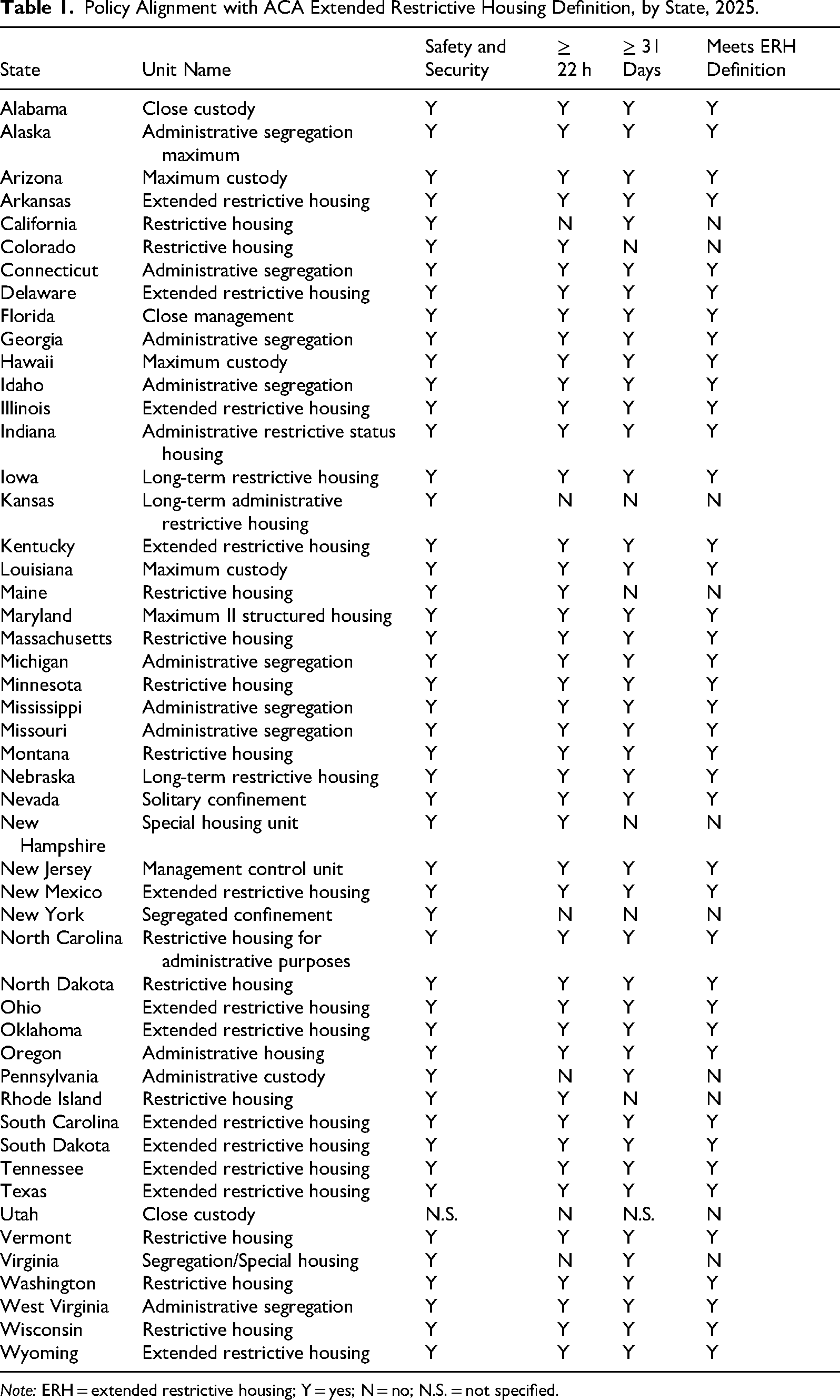
Table 1 details the extent to which the 50 states’ prison housing policies align with the three criteria included in the ACA's (2021) definition of ERH. Forty-nine of the policies (or 98%) stated that individuals could be assigned to such a unit for the purpose of ensuring institutional safety and security. One policy did not specify a unit goal or criteria for placement. Forty-four of the policies (or 88%) indicated that individuals assigned to the unit could be restricted to a single cell for 22 or more hours per day. The other six policies (or 12%) specified that individuals in the unit were confined in their cell for less than 22 h per day. Forty-three of the policies (or 86%) indicated that individuals could be held in the unit for 30 or more continuous days. Six policies (or 12%) specified that individuals could only be held in the unit for 29 or fewer days, while one policy (or 2%) did not provide any information regarding the length of confinement.
Policy Alignment with ACA Extended Restrictive Housing Definition, by State, 2025.
Note: ERH = extended restrictive housing; Y = yes; N = no; N.S. = not specified.
In total, 40 of the 50 (or 80%) policies obtained were determined to meet the ACA's (2021) definition of ERH. Among the 10 policies that did not fully align with this definition, four were excluded for confining individuals to a single cell for less than 22 h per day, four were excluded for holding individuals in the unit for 29 or fewer continuous days at a time, and two were excluded for failing to meet both criteria. There were 14 different terms used to describe the housing units in the 40 policies that met the definition of ERH, reflecting the diversity of terms that has long existed in states’ description of their supermax housing (Riveland, 1999). The most common unit name was ERH (n = 12), followed by Administrative Segregation (n = 7), Restrictive Housing (n = 7), Maximum Custody (n = 3), Long-Term Restrictive Housing (n = 2), Administrative Housing (n = 1), Administrative Restrictive Status Housing (n = 1), Administrative Segregation Maximum (n = 1), Close Custody (n = 1), Close Management (n = 1), Management Control Unit (n = 1), Maximum II Structured Housing (n = 1), Restrictive Housing for Administrative Purposes (n = 1), and Solitary Confinement (n = 1). Across these 40 ERH policies, six (or 15%) specified that confinement was limited to a single-occupied cell, five (or 12.5%) specified that confinement could include either a single or double occupied cell, and 29 (or 72.5%) did not include cell occupancy information.
American Correctional Association Housing Standards
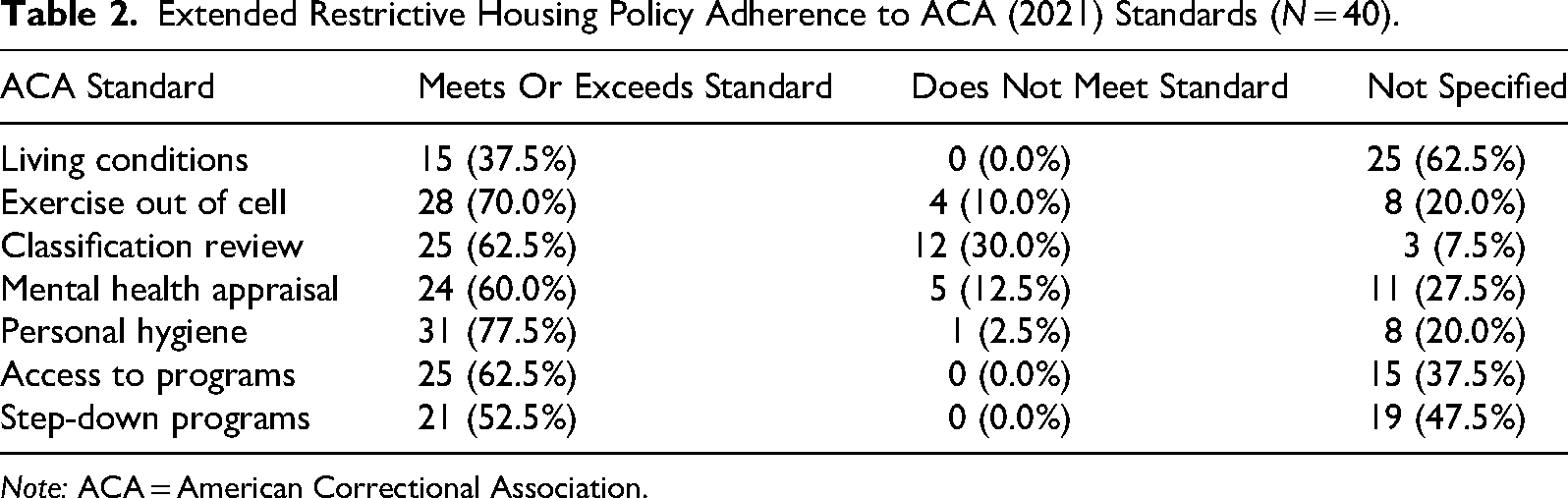
Table 2 summarizes adherence of the identified ERH policies to seven of the ACA's (2021) restrictive housing standards. In so doing, we follow the ACA in focusing on critical areas of performance that are salient for accountability or meeting minimum standards of care for populations in ERH (see, generally, Logan, 1993).
Extended Restrictive Housing Policy Adherence to ACA (2021) Standards (N = 40).
Note: ACA = American Correctional Association.
Living Conditions Standard
Fifteen of the 40 state policies (or 37.5%) met or exceeded the living conditions standard, which requires that restrictive housing units provide living conditions that approximate those of the general inmate population (i.e., restrictive housing cells permit conversations and observations by staff members, space is available for treatment staff to consult with individuals held in restrictive housing; see ACA, 2021, p. 122). Most of the identified policies, however, did not provide sufficient information to determine if the unit met the living conditions standard (n = 25 or 62.5%).
Exercise Standard
Twenty-eight (or 70%) of the state policies met or exceeded the exercise standard, which requires that inmates in restrictive housing receive a minimum of 1 hour of exercise per day outside of their cell at least 5 days per week (see ACA, 2021, p. 129). Four states (or 10%) did not meet the standard because opportunities for out-of-cell exercise were listed as being fewer than 5 days per week. For example, Missouri and Texas policies both indicated that individuals are offered out-of-cell recreation opportunities “a minimum of 1 hour a day, 3 days per week.” In addition, eight states (or 20%) did not provide enough information to determine if the policy met the exercise standard. Although the Tennessee policy stated that “segregated inmates shall be afforded an exercise period five days per week (Monday through Friday),” it did not indicate whether these opportunities were for at least an hour. In other instances, such as in Arizona, the policy states only that individuals in restrictive housing are “provided appropriate exercise opportunities” but no further information regarding the number of days per week or hours per opportunity are provided.
Classification Review Standard
Twenty-five (or 62.5%) of the state policies met or exceeded the classification review standard, which requires that an incarcerated person's status in restrictive housing is reviewed by a classification committee or other authorized staff every 7 days for the first 60 days and at least every 30 days thereafter (see ACA, 2021, p. 124). Twelve states (or 30%) did not meet the standard because the review cadence was less frequent than required, such as every 30 days throughout the duration of one's placement (e.g., Arizona, Idaho) or once every 6 months (e.g., Alabama, Connecticut). Three of the policies (or 7.5%) did not provide enough information to determine if the policy met the classification review standard.
Mental Health Appraisal Standard
Twenty-four (or 60%) of the ERH policies met or exceeded the mental health appraisal standard, which requires a health practitioner/provider to complete a mental health appraisal within 7 days of initial placement, and if confinement continues beyond 30 days, a behavioral health assessment should be conducted every 30 days for those with a diagnosed behavioral health disorder or every 90 days for those without (see ACA, 2021, p. 124). Five states (or 12.5%) did not meet the standard either because an initial appraisal was not required or that appraisals only occur after an extended period of continuous placement, such as after 30 consecutive days (e.g., Idaho, Louisiana, West Virginia), every 180 days after the initial 30-day period (i.e., Florida), or just once every 12 months (i.e., Missouri). Eleven states (or 27.5%) did not provide enough information to determine if the policy met the mental health appraisal standard.
Personal Hygiene Standard
Thirty-one (or 77.5%) of the state policies met or exceeded the personal hygiene standard, which requires that inmates in restrictive housing are given the opportunity to shave and shower at least three times per week (see ACA, 2021, p. 126). One state did not meet the standard because it only offered opportunities to shower once per week (i.e., Wisconsin). Eight policies (or 20%) did not provide sufficient information to determine if it met the personal hygiene standard.
Access to Programs Standard
Twenty-five (or 62.5%) of the state policies met or exceeded the access to programs standard, which requires that those in restrictive housing have access to programs and services that include, but are not limited to, the following: educational services, commissary services, library services, social services, counseling services, religious guidance, and recreational programs (see ACA, 2021, p. 130). The other 15 policies (or 37.5%) either included no programming information or did not provide enough information to determine if it met the programming standard. For example, the Arkansas policy simply states that individuals are provided with “institutional activities as approved by the Warden” and the Nevada policy says, “to the extent possible, consistent with security, offenders in solitary confinement will be allowed to participate in institutional programs.”
Step-Down Program Standard
Finally, 21 (or 52.5%) of the state policies met or exceeded the step-down program standard, which requires that programs are offered to ERH inmates to facilitate their reintegration into the general population or the community (see ACA, 2021, p. 133). 1 The remaining 19 policies (or 47.5%) did not specify whether step-down programming was available.
Discussion
This study documents what can be viewed as three eras of supermax confinement discourse in the United States. Although the initial Supermax Era (1979–2009) had the advantage of using a clear definition for this type of housing, with a narrow and specific goal in mind (i.e., increase institutional safety and order), it also disregarded other types of restrictive confinement that were being used by prison systems for other intended purposes (e.g., punishment, protection). The Restrictive Housing Era (2010–2020) helped bring to light the myriads of other types of non-traditional and more restrictive forms of confinement. Despite efforts to understand and categorize these units into meaningful groupings (e.g., disciplinary segregation, protective custody), the field is no closer today than it was 25 years ago (see, King, 1999; Riveland, 1999) in understanding even basic information about the nation's use of restrictive confinement practices. These difficulties have arisen, in part, because of imprecise definitions of concepts, inconsistent names used for units within and across systems, lack of understanding about how these units operate or what purpose they seek to serve, and the inability of current data systems to easily provide metrics about use either at the individual, prison system, or national prison system levels (Mears et al., 2019).
During the transition between these two eras, the focus of scholarship, litigation, and reform efforts shifted from supermax specifically to restrictive housing more generally. There were certainly political advantages for both proponents and opponents in using different terminology. From the prison system perspective, the term restrictive housing may sound more humane than supermax or solitary confinement. Whether and how much this name change reflects a difference in practice, however, warrants careful attention. From a critic's perspective, it may be advantageous to more broadly focus on restrictive housing practices because grouping multiple types of units together helps to draw attention to a wider array of non-traditional, and potentially more punitive housing, than is captured by a sole focus on supermax confinement.
More recently, the ERH Era (2021–present) has sought to more clearly distinguish between the long-term and more restrictive type of housing—what traditionally has been referred to as supermax confinement—from short-term and less restrictive types of housing. The reason for the transition is not fully clear and has not been carefully examined, but may have arisen in response to the logical problem of conflating types of housing that may differ both in their goals and operational features (see, generally, Mears et al., 2019). Extended placements in restrictive housing typically are associated with a distinct goal, such as prison security and safety, and operational features, such as solitary confinement for months or even years as a form of incapacitation. By contrast, other types of restrictive housing have different goals, such as discipline, and entail shorter stays of confinement, with potentially more privileges. Despite the ascension of the ERH term, the extent to which prison systems employ the terminology and housing that aligns with what the ACA (2021) has termed “ERH” remains largely unknown. As a step toward better understanding such usage, the current study drew on the identified changes in supermax terminology across these three eras and built upon the prior reviews of prison policies (Butler et al., 2013; Butler et al., 2014; Labrecque et al., 2021; Metcalf et al., 2013) to develop the current review of restrictive housing policies from the 50 state prison systems.
Study results indicated that most (80%) of state policies met the ACA's (2021) definition of ERH. This finding suggests that while the term “supermax” may have fallen out of favor, the use of longer term and more restrictive housing nevertheless persists and appears to be widespread. We also discovered that states refer to these units by a variety of different names. Indeed, in addition to the “ERH” term, there were 13 additional names used to describe housing that aligned with what the ACA (2021) characterizes as ERH. Based on this review of policies, cell occupancy in these units is not well understood. Nearly three-quarters of the policies did not include any information about the number of occupants allowed per cell. Six states mandated single-occupied cells and five allowed for both single and double cell confinement.
Stronger adherence to the ACA (2021) policy guidelines was found among the personal hygiene (77.5%) and out of cell exercise (70%) standards, followed by the classification review (62.5%), access to programs (62.5%), and mental health appraisal (60%) standards. Less adherence was found among the living conditions (37.5%) and step-down program (52.5%) standards. Among the state prison system policies that did not meet the minimum standards set by the ACA (2021), most did not include sufficient information to determine compliance with their own guidelines. This finding highlights the need for more detail and transparency about the unit operations included in these policies and what counts as compliance with them.
These results should be interpreted with an understanding of two key study limitations. First, this investigation was limited to the policies that were obtained via an online search. It is possible that some documents may have since been updated from the versions that were found or that the policies for some ERH units may not have been discovered; for example, they may have only been available as internal agency documents. Future research should seek to implement strategies that can better ensure the accuracy and completeness of policies, such as by working directly with state officials to acquire pertinent documents. Second, some aspects of the ACA (2021) standards, such as the types of programs available or the characteristics of the step-down programs, may not be documented in states’ restrictive housing policies themselves, but rather in other state policies or records. Future research should consider other strategies for documenting ERH policies and practices, such as agency interviews, reviews of internal documents, and on-site observations. Despite these limitations, the findings of this study have several important implications both for future research and policy.
Research Implications
Although the transition to the ERH era represents an important attempt to distinguish between prison housing units that are long-term and more restrictive (i.e., supermax confinement) from those that are shorter-term and less restrictive (e.g., disciplinary segregation, protective custody), much more can and should be done in clarifying the goals and operations of all different types (and sub-types) of restrictive housing confinement. The research in this area remains difficult to interpret due to varying housing unit names, purposes, and conditions (Mears & Labrecque, 2025). For example, a study may provide a rigorous assessment of one type of housing that is used for a specific purpose (e.g., short-term disciplinary segregation as a response to a rule infraction). But these findings would not likely generalize to another type of housing that is used for a different purpose (e.g., long-term administrative segregation due to perceived threat to institutional safety and order). When the two types of housing are conflated, misunderstanding and mis-generalization are likely to occur.
Despite the existence of supermax confinement in the United States over the last four decades, there is still limited understanding about its use and impact. To address this problem, a renewed focus on descriptive research is critical. Prior attempts to capture the prevalence of supermax use suggested that there were 34 jurisdictions that operated at least one supermax facility, and these units held approximately 20,000 individuals (King, 1999; NIC, 1997). These data, however, were not only limited but were also collected in the 1990s. Subsequent efforts are now over two decades old and, as with the earlier work (e.g., Mears, 2006; Naday et al., 2008), also suffered from methodological limitations in gauging the prevalence of supermax incarceration. We are left, then, with open empirical questions as to how many supermax facilities or cells exist today, how many individuals are currently confined in these settings, and the nature of the services provided or the disjuncture between policy and operational practices. Broader knowledge about all types of restrictive housing will undoubtedly lead to more accurate information about supermax confinement. It will also serve as a catalyst for investigating critical research questions, such as how other types of restrictive housing have affected the use of supermax confinement, the types of factors that contribute to the use of supermax housing, and how this housing can be modified to better serve its goals.
A major challenge that remains is that there still exist no agreed-upon definitions or terms regarding restrictive housing practices, a problem anticipated by Riveland (1999) in his criticism of work on supermax prisons and by other efforts to examine supermaxes (e.g., Naday et al., 2008). One potential solution has been suggested by Mears and colleagues (2019). They presented a conceptual framework for examining restrictive housing which included four dimensions: goal of the housing, duration of the placement, quality or characteristics of the housing, and intentionality. Future research should build upon this framework or create an alternative one and incorporate knowledge gained from further reviews of unit policies and observations of units. The adoption of such a framework will provide researchers with a better guide about what elements or aspects of a housing unit to include in a study on its use or impact (e.g., goal, duration, cell occupancy, out-of-cell time). It also may be helpful in determining what outcomes should be evaluated and in reducing the mis-generalization of research findings. At the same time, it should be recognized that there are a variety of ways that one might go about defining and operationalizing supermax confinement or characterizing what constitutes solitary confinement (see, e.g., Rubin & Reiter, 2018).
One intriguing research avenue that has not been investigated is what has driven changes in terminology within and across states. In short, why have states changed the terminology that they use to describe supermax-like housing? One possibility is that jurisdictions may find certain terms to be useful. For example, in some places or periods of time, the “supermax” language might be politically advantageous, and signal that a prison system is taking a hardline, seemingly effective stance on violence. At other times, such language might lead to adverse attention or publicity and, in turn, lawsuits. Another possibility is that states follow the trends set by accrediting agencies such as the ACA (2021). Whereas the ACA (2021) has provided guidance, for example, in providing standards for ERH, such guidance does not appear to have been provided by the ACA in the past concerning supermax housing. As Riveland (1999) has averred, “In actuality, formal standards (such as those promulgated by the ACA and American Bar Association for correctional facilities) do not exist for supermax facilities specifically” (p. 6). Of course, accrediting agencies might draw from state prison systems and correctional stakeholders in the terminology they employ or the practices they endorse. We can only speculate, and there may be additional possibilities, such as ways in which terms may be used to convey legitimacy, beyond those identified here (see, e.g., Rubin & Reiter, 2018). Regardless, answers to what has led to these changes would help advance knowledge about penal policies and practices as well as efforts to hold prison systems accountable and to improve their effectiveness.
Finally, although this study focused on state adherence to the ACA (2021) standards, there would be a benefit for future scholarship to assess policy compliance with other organizational guidelines, including the United States Department of Justice's (2016) recommendations for the use of restrictive housing and the United Nation's (2015) minimal rules for treatment of prisoners (i.e., Mandela rules). Moreover, there is a need for systematic and detailed state-level policy analyses, such as the qualitative accounts that have been undertaken in California (Reiter, 2016), Pennsylvania (Rudes, 2022), and Florida (Mears et al., 2026). Ideally, these would exist for all states and would employ similar definitions of ERH and similar research methodologies. Such an approach would provide a foundation for discerning commonalities and differences among states in their use of ERH and inform assessments of any disjuncture between stated and actual practices, or what sometimes is colloquially discussed as “law in books versus law in action.”
Policy Implications
The findings of this study highlight that several aspects of the ERH practices were not specified in the identified policies. A recommendation that aligns with policymaker calls for accountability and effectiveness is for state officials to review their local policies and take steps to ensure that key details about their use of ERH—such as the cell occupancy, living conditions, and available programming information—are clearly documented. This step accords with longstanding emphasis and guidance on developing consistent measurement of prison system performance (e.g., Logan, 1993). Given criticisms about specific aspects of restrictive housing practices, such as isolation and limited services, states would want to clarify in policy the precise conditions of confinement associated with ERH or any other type of restrictive housing, the duration of confinement and when precisely it can be extended or ended, requirements for various privileges or the withholding of them, and so on.
It is notable how much of an influence the ACA has on the state prison system policies, and this influence suggests one avenue for further policy change. For example, across the state policies that we examined, many used language or excerpts taken directly from the ACA's (2021) manual. One way to increase details in state policies, then, is for the ACA to provide more details about different types of restrictive housing policies, including expanding its standards to include not only ERH but also other goal-specific types of such housing (e.g., disciplinary segregation, protective custody).
Another important avenue, both for research and policy, is to document empirically the extent to which state ERH policies are followed in practice. Qualitative scholarship conducted in individual state prison systems suggests that some restrictive housing units may operate outside the guidelines of formal written policies (Mears et al., 2026; Reiter, 2016; Rudes, 2022). For example, some individuals who do not meet the criteria for placement in ERH may nonetheless be placed in it, the out of cell times that they should receive may not be provided, and the services that they should have access to may not be available. A more systematic collection of information on adherence to standards and policy would provide a foundation for improving accountability and for providing an objective foundation for assessing the appropriate, or inappropriate, use of ERH or other types of restrictive housing.
Conclusion
Government accountability and evidence-based policy require empirical research on implementation and impacts (Welsh et al., 2024)—the traditional focus in discussions about “what works”—but they also require explicit definitions and performance standards as well (Hatry, 2007). Remarkably, despite more than four decades in which supermax and other forms of restrictive housing have become ubiquitous, differences in scholarly accounts about the benefits or harms of the housing, and a large body of research on certain aspects of it, there remains no consistent documentation of the supermax or other restrictive housing policies that states use. As this study identified, basic information about which housing—whatever term a given state uses for it—aligns with general categories of confinement (e.g., ERH) is, as of 2025, lacking across states despite prior calls for improved documentation (Butler et al., 2013; Cochran et al., 2025; Labrecque et al., 2021; Naday et al., 2008). The information gaps go much further and include details about the precise operational features of the housing, conditions that permit placement or release from it, frequency of classification reviews and mental health assessments, and documentation of the extent to which states follow the standards that they, and accrediting agencies set, for use of the most extreme forms of incarceration. Until research and policy address this situation, a missed opportunity to improve accountability and prison system effectiveness will persist.
Footnotes

Funding
The authors received no financial support for the research, authorship, and/or publication of this article.
Declaration of Conflicting Interests
The authors declared no potential conflicts of interest with respect to the research, authorship, and/or publication of this article.
Notes
Author Biographies
Appendix: State Policies Used to Code Extended Restrictive Housing Practices
Alabama Department of Corrections. Male Inmate Handbook.
Alabama Department of Corrections. Mental Health Services in Restrictive Housing Units (Administrative Regulation No. 625).
Alaska Department of Corrections. Policies and Procedures: Special Management Prisoners – Administrative Segregation (Policy No. 804.1).
Arizona Department of Corrections Rehabilitation and Reentry. Inmate Maximum Custody Management and Incentive System (Department Order No. 812).
Arizona Department of Corrections Rehabilitation and Reentry. Inmate Classification (Department Order No. 801).
Arkansas Division of Correction. Restrictive Housing (Administrative Directive No. 17-02).
Arkansas Division of Correction. Inmate Handbook.
California Code of Regulations. Restricted Housing Unit Placement, 15 CA ADC § 3335.
California Department of Corrections and Rehabilitation. (2025). Restricted Housing.
Colorado Department of Corrections. Offender Group Living: Restrictive Housing (Policy No. 650-03).
Connecticut Department of Correction. Restrictive Housing and Special Management Status Matrix (Administrative Directive No. 9.4).
Connecticut Department of Correction. Special Management (Administrative Directive No. 9.4).
Delaware Department of Correction Bureau of Prisons. Restrictive Housing (Policy No. 4.3).
Florida Department of Corrections. Maximum Management (Policy No. 33-601.820).
Florida Department of Corrections. Close Management (Policy No. 33-601.800).
Georgia Department of Corrections. Standard Operating Procedures: Administrative Segregation (Policy No. 209.06).
Georgia Department of Corrections. Standard Operating Procedures: Administrative Segregation – Tier II (Policy No. 209.08).
Hawaii Department of Corrections and Rehabilitation. Corrections Administration Policy and Procedures: Administrative Segregation and Disciplinary Segregation (COR No. 11.01).
Hawaii Department of Corrections and Rehabilitation. Corrections Administration Policy and Procedures: Special Problem Inmate Management (COR No. 11.04).
Hawaii Department of Corrections and Rehabilitation. Corrections Administration Policy and Procedures: Recreation and Leisure Time (COR No. 14.14).
Hawaii Department of Corrections and Rehabilitation. Corrections Administration Policy and Procedures: Personal Hygiene (COR No. 17.04).
Hawaii Department of Corrections and Rehabilitation. Corrections Administration Policy and Procedures: Inmate Classification System (COR No.18.01).
Idaho Department of Correction. Standard Operating Procedure: Restrictive Housing (Control No. 319.02.01.001).
Idaho Department of Correction. Standard Operating Procedure: Short Term Restrictive Housing (Control No. 319.02.01.001).
Illinois Department of Corrections. Restrictive Housing. (Administrative Directive No. 05.15.100).
Indiana Department of Correction. Policy and Administrative Procedures: Disciplinary Restrictive Status Housing (Policy No. 02-04-102).
Indiana Department of Correction. Policy and Administrative Procedure: Administrative Restrictive Status Housing (Policy No. 02-01-111).
Iowa Department of Corrections. Policy and Procedures: Long-Term Restrictive Housing (LTRH) (Policy No. IO-HO-08).
Kansas Department of Corrections. Internal Management Policy & Procedure: Segregation/ Restrictive Housing – Purpose of Administrative Restrictive Housing and Appropriate Placements (IMPP No. 20-104A).
Kansas Department of Corrections. Internal Management Policy & Procedure: Segregation/ Restrictive Housing – Basic Operations of Administrative Restrictive Housing (IMPP No. 20-105J).
Kentucky Department of Corrections. Policies and Procedures: Special Management Housing and Restrictive Housing (Policy No. 10.2).
Louisiana Department of Public Safety and Corrections. Disciplinary Rules and Procedures for Adult Offenders.
Maine Department of Corrections. Administrative Status (Policy No. 15.1).
Maryland Department of Public Safety and Correctional Services. Maximum Security II – Structured Housing (MAX II SH) (Facility Directive No. DOC.100.0004).
Maryland Governor's Office of Crime Prevention, Youth, and Victim Services. (2023). Restrictive Housing 2022 Report.
Massachusetts Code of Regulations. Restricted Housing, 103 CMR § 42300.
Michigan Department of Corrections. Segregation Standards (Policy Directive No. 04.05.120).
Minnesota Department of Corrections. Restrictive Housing Management (Policy No. 301.083).
Minnesota Department of Corrections. Administrative Segregation (Policy No. 301.085).
Minnesota Department of Corrections. Restrictive Housing Step-Down Management Program (Policy No. 301.088).
Mississippi Department of Corrections. Standard Operating Procedures: Offender Segregation (SOP No. 19-01-01).
Missouri Department of Corrections. Institutional Services Procedure Manual: Administrative Segregation (No. IS21-1.2).
Montana Department of Corrections. Restrictive Housing (Policy Directive No. DOC3.5.1).
Montana Code Annotated. Restrictive Housing, 53 MCA § 5-30-702.
Nebraska Department of Correctional Services. Restrictive Housing (Policy No. 210.01).
Nevada Department of Corrections. Solitary Confinement (Administrative Regulation No. 513).
Nevada Department of Corrections. Restrictive Housing (Administrative Regulation No. 507).
New Hampshire Department of Corrections. Guidelines for Inmate Segregation (Policy and Procedure Directive Statement No. 7.49).
New Hampshire Code of Regulations. Organizational Rules, 100 COR § 313.
New Jersey Administrative Code. Definitions, 10A N.J.A.C. § 10A:5-1.2.
New Jersey Department of Corrections. Administrative Close Supervision Administrative Segregation Inmate Handbook.
New Mexico Corrections Department. Restrictive Housing (No. CD-141500).
New York Department of Corrections and Community Supervision. Special Housing Units (Directive No. 4933).
North Carolina Department of Adult Correction. Restrictive Housing for Administrative Purposes (Policy No. O.0100).
North Carolina Department of Adult Correction. Conditions of Confinement (Policy No. O.0300).
North Dakota Department of Corrections and Rehabilitation. Correctional Facility Standards: Special Management Inmates (Standard No. 97).
Ohio Department of Rehabilitation & Correction. Restrictive Housing Procedures (Policy No. 55-SPC-02).
Oklahoma Department of Corrections. Restrictive/Extended Restrictive Housing (Operations Memorandum No. OP-040203).
Oregon Department of Corrections. Administrative Housing Placement (DOC Policy No. 40.3.3).
Oregon Secretary of State (2021). Permanent Administrative Order: Adult in Custody Assignment Management (Order No. DOC7-2021).
Pennsylvania Department of Corrections. Administrative Custody Procedures (Policy Statement No. DC-ADM 802).
Rhode Island Department of Corrections. Classification Process (Policy No. 15.01-8 DOC).
Rhode Island Department of Corrections. Conditions of Confinement (Policy No. 12.27-1 DOC).
South Carolina Department of Corrections. Restrictive Housing Unit (Policy No. OP-22.38).
South Dakota Department of Corrections. Restrictive Housing (Policy No. 300-19).
South Dakota Department of Corrections. Offender Classification (Policy No. 400-11).
Tennessee Department of Correction. Administrative Segregation, Placement, Review, and Release (Index No. 404.10).
Tennessee Department of Correction. Living Conditions for Segregated Inmates (Index No. 506.16).
Tennessee Department of Correction. Mandatory Segregation (Index No. 404.11).
Texas Department of Criminal Justice. Health Evaluation and Documentation Inmates in Segregation/Restrictive Housing (Policy No. E-39.1).
Texas Department of Criminal Justice. Personal Hygiene (Policy No. F-49.1).
Texas Department of Criminal Justice. Exercise Program (Policy No. F-48.1).
Utah Department of Corrections. Restrictive Housing (Policy No. FC07).
Utah Department of Corrections. Structured Housing (Policy No. FD31).
Vermont Agency of Human Services Department of Corrections. Restrictive Housing Status, Conditions of Confinement (Policy No. 410.06).
Virginia Department of Corrections. Special Housing (Operating Procedure No. 861.3).
Virginia Department of Corrections. Restorative Housing Units (Operating Procedure No. 841.4).
Virginia Department of Corrections. The Reduction of Restrictive Housing in the Virginia Department of Corrections: FY2019 Report.
Virginia Department of Corrections. Restorative Housing in the Virginia Department of Corrections: FY2023 Report.
Washington Department of Corrections. Restrictive Housing (Policy No. DOC 320.255).
West Virginia Division of Corrections & Rehabilitation. Segregation Units (Administrative and Punitive) (Policy Directive No. 326.00).
Wisconsin Department of Corrections. Green Bay Correctional Institution (GBCI) Restrictive Housing Unit Handbook.
Wyoming Department of Corrections. Special Management Housing (Policy No. 3.302).