






Abstract
In India the exotic epigeic species, Eisenia fetida is mostly used for vermicomposting. The introduction of exotic species into local bio system may affect the indigenous earthworm species population. A comparative study between exotic species (Eisenia fetida) and indigenous species Perionyx sansibaricus and Perionyx excavates was performed to determine the potential of indigenous species of the area vis-à-vis the exotic species for composting of domestic organic waste blended with cattle manure. The results of the study show a significant reduction in initial C/N ratio from 55 to 13 for P. excavates and 15 for P. sansibaricus of the ready product which was within the agronomic acceptable limit ( < 20). The total organic matter reduced by 50% and pH also reduced to be nearer to neutral, but there was an increase in total nitrogen to 102% and total phosphorus increased from the initial concentration of 7.62 g kg−1 up to 13.2 g kg−1. Overall, by employing above indigenous species, domestic organic waste can be directly converted into high-quality hygienic stable fertilizer (vermicompost) which is rich in nitrogen, phosphorus and potassium and free from pathogens.
Introduction
Vermitechnology application has been proposed globally as an appropriate alternative for the safe, hygienic and cost-effective disposal of the organic fraction of municipal solid waste (MSW) (Gajalakshmi et al., 2001; Gupta and Garg, 2008; Suthar, 2008a; Suthar and Singh, 2008 a, b). Vermitechnology utilizes earthworms in an eco-biotechnological process that transforms energy rich organic substances into stabilized humus-like product (Benitez et al., 2000). The large quantity of MSW produced in modern society, has become a serious environmental, social and economic problem. Domestic solid waste such as fruit and vegetable residues (FVW) constitute a source of nuisance in municipal landfills because of their high biodegradability. In India, FVW constitute about 5.6 million tons annually and currently these waste materials are disposed of by dumping on the outskirts of cities (Arvanitoyannis et al., 2008). The problem is magnified due to lack of adequate infrastructure for segregation, collection, transportation and disposal of MSW. There are various shortcomings in the existing practice followed for the management of solid waste (domestic waste); these pertain mainly to inadequate manpower, financial resources and machinery required to perform various activity. However, vermitechnology can be used as a potential resource for transformation from expensive disposal to stabilized product for agricultural and soil conditioning.
Vermitechnology is a process of bio-oxidation and stabilization of organic material involving the joint action of earthworms and micro-organisms. Although microbes are involved in the biodegradation of organic matter, earthworms are the important drivers of the process, conditioning the substrate and altering biological activity (Adi and Noor, 2009; Sharma et al., 2005). During the process of vermicomposting the earthworms act as the carriers of micro-organism, they feed on the organic matter and convert them into stable castings (ejected matter), which are rich in plant nutrients such as nitrogen, phosphorous and potassium.
In India the exotic epigeic species, Eisenia fetida (Savigny) and Eisenia euginae (Kinberg) have been identified as potential candidates to decompose organic waste materials (Khwairakpam and Bhargava, 2009b). The introduction of foreign species into local biosystem has been justified by a few scientists (Lavelle et al., 1989; Murphy, 1993), but the introduction has been considered unnecessary and undesirable and leads to confrontation between the indigenous and foreign species (Ismail, 1995; Kaviraj et al., 2003).The composting potential of a few indigenous species such as Perionyx excavatus, Lampito mauritti, Dichogaster bolaui, Amynthas morrisi, Drawida willsi and Perionyx sansibaricus is well established (Gajalakshmi et al., 2002; Suthar and Singh, 2008 a, b; Tripathi and Bhardwaj, 2004). With this in view the present study was undertaken to investigate the potential of indigenous species in the vermicomposting of domestic waste in order to help to solve waste management problems by minimizing the waste handling by the local authorities.
Materials and methods
Collection and culturing of earthworms
In the present study exotic earthworms E. fetida were randomly picked up from the laboratory of Indian Institute of Technology Roorkee (IITR) for experimentation, where it has been cultured for the last 6 years. However, indigenous earthworm species P. excavatus was collected from a drain in IITR and P. sansibaricus was collected from a village and both were identified before use. All three earthworm species were cultured in the environmental engineering laboratory of IITR.
Substrate for experiment
Domestic waste was procured from campus residences and the student canteen of IITR. The non-biodegradable items such as plastic, rubber, polythene bags, wood, cardboard and glass were separated through hand sorting from the collected domestic waste. The domestic waste blended with cattle dung, having the initial characteristics of pH 8.62 ± 0.2; EC 0.25 ± 0.015 (S m−1); total organic carbon (TOC) 54.13 ± 4.3 (%); TN 0.99 ± 0.5 (%); C/N 54.67 ± 2.3; NH4-N 0.15 ± 3.1 (%), TP 7.62 ± 0.45 (g kg−1), C/P 71.32 ± 1.1, K 1.8 ± 1.9 (%), Na 0.45 ± 2.9 (%) was used as the substrate.
Experimental set-up
The reactors were kept in a dark room in which the temperature was maintained at 25 ± 3°C, which is the optimum temperature range for all the three species (Tripathi and Bhardwaj, 2003). The experiments were conducted for 45days in rectangular plastic containers of 5 L capacity. The containers were punched with pin holes at the bottom for aeration and leaching of extra water. The experiments were conducted in quadrate, the first three sets having P. excavates (T1), P. sansibaricus (T2), and E. fetida (T3) and the last set acting as the control (without any earthworms) (T4). Ten centimetres of bedding was provided in all the containers using matured vermicompost to provide the initial favourable condition for the earthworms. Forty grams ( ∼ 130–150 in number) of the experimental species of worms having clitellated were inoculated in the bedding of all containers except the control. One kilogram of domestic waste was amended with cattle manure in a 4 : 1 ratio to provide a favourable condition for earthworms and was kept for 2 weeks prior to the experimentation for thermal stabilization and then added to each of the reactors. The quantity of waste to be added to each container was decided, based on the literature reports that the earthworms can consume the food equal to half of their body weight per day under favourable conditions (Haimi and Huhta, 1986; Khwairakpam and Bhargava, 2009a,b). The moisture level was maintained at about 60–70% throughout the study by periodic sprinkling of an adequate quantity of tap (potable) water. To prevent moisture loss, the reactors were covered with bags prepared by jute fibers at the top.
Compost analysis
The homogenized wet samples of the feedstock were collected on 0, 15th, 30th and 45th day from each experimental reactor and analyzed. The zero day sample refers to the substrate taken out before earthworm inoculation. (1 : 10 w/v waste: water extract) total coliforms (TC), faecal streptococci (FS) and faecal coliforms (FC) were measured by inoculation of culture in tubes having Lauryl tryptose broth, Azide dextrose broth and Escherichia coli medium, respectively, using the most probable number (MPN) method (APHA, 1995), and the rest sub-samples were oven dried at 110°C, ground in a stainless steel blender, passed through a 0.2 mm sieve and stored until further analysis. Each sub-sample was analysed for the following parameters: pH using a pH meter and electrical conductivity (EC) using a conductivity meter (1 : 10 w/v waste : water extract), total organic carbon (TOC) determined by Shimadzu (TOC-Vcsn) solid sample module (SSM-5000 A), total nitrogen (TN) using the Kjeldahl method, ammoniacal nitrogen (NH4+-N) and nitrate nitrogen (NO3−-N) using KCl extraction (Tiquia and Tam, 2000). Total potassium (TK), chemical oxygen demand (COD) and biochemical oxygen demand (BOD) were analyzed by spectrophotometry. In addition the temperature of the composting bed was monitored on a daily basis.
Statistical analysis
All the reported data are the mean of four replicates. One way analysis of variance (ANOVA) was used to determine any significant difference among the parameters analysed. Where asignificant difference was observed, individual means were tested using the Fisher’s Least Significance Difference test (P < 0.05).
Results and discussion
pH
The pH reduced in all of the reactors, the maximum reduction was observed for T3 where the pH reduced from 8.62 to 7.03 and the minimum reduction was observed in the control where the pH reduced nominally to 8.2 (Table 1). A higher reduction in pH in T3 was observed because of the higher rate of breakdown of organic matter in this reactor. In the case of T1 and T2 the pH had reduced to 7.28 and 7.42, respectively. The decreasing trend of pH was prominent for T1, T2 and T3 during the first 30 days of vermicomposting. In the last 15 days the reduction was nominal. However, for the control reaction the reduction was uniform throughout the period of vermicomposting. The result was in accordance with the finding reported previously by others (Atiyeh et al., 2000; Gunadi et al., 2003; Mitchell, 1997; Ndegwa and Thompson, 2000). The lowering of pH in the final product was due to the generation of CO2 and organic acids produced during microbial metabolism (Elvira et al., 1998; Haimi and Hutha, 1986; Hartenstein and Hartenstein, 1981). There was a significant variation in pH on the 45th day of sampling (P < 0.05) for all the reactors.
Effect of P. excavatus, P. sansibaricus and E. fetida inoculation on pH, e. conductivity (EC) and TOC

Data with the same letter within the same column do not differ significantly at the 5% level according to the Fisher’s Least Significant Difference test.
Electrical conductivity
A gradual increase in EC was observed in all reactors during the process of vermicomposting. The maximum increase was observed in EC values of reactor T3 (0.28 S/m) as compared to control (0.26 S/m), T1 (0.27 S/m) and T2 (0.27 S/m) (Table 1). These observations are supported by the findings of other authors who have reported an increase in EC during the course of vermicomposting (Garg et al., 2006). The increase of EC is attributed to the loss of organic matter and release of different mineral salts in available forms (such as phosphate, ammonium, potassium, etc) which means the mineralization/decomposition of the organic matter is responsible for the increase in EC. This is supported by the findings of the other researchers (Huang et al., 2004). No significant variation was observed in EC on the 45th day in all the reactors (P < 0.05).
Total organic carbon
The TOC reduced during the process of vermicomposting (Figure 1). A large fraction of TOC was lost due to the oxidation of biodegradable organic carbon to CO2 and consumption of available carbon as an energy source by earthworms and micro-organisms. The maximum reduction was observed for T1 from 541.28 to 270.36 g kg−1 (50%) and the minimum reduction was observed in the case of controls, which had shown a reduction of 22% during the period of composting (Table 1). The observed results are supported by the findings of other authors who have reported 20 to 45% loss of carbon as CO2 during vermicomposting of municipal or industrial waste (Elvira et al., 1998; Kaviraj and Sharma, 2003). TOC varied significantly (P < 0.05) on the 15th and 30th day but showed insignificant variation on the 45th day of sampling (P < 0.05).

TOC profile during vermicomposting.
Total nitrogen, nitrogen (NH4+) and nitrate (NO3−)
The maximum increase of 113% in TN was observed for reactor T3 as shown in Table 2. The minimum increase of 17% was observed for control. For T2 and T1 the increase was in the order of 102 and 108%, respectively, which is comparable to the performance of reactor T3 (Figure 2). The reduction in organic carbon due to substrate utilization by microbes and earthworms, and water loss by evaporation and mineralization of organic matter might have led to a relative increase in nitrogen (Viel et al., 1987). However, in general the final content of nitrogen in vermicomposting is dependent on initial nitrogen present in the waste and the extent of decomposition. Earthworm activity enriches the nitrogen profile of the vermicompost through microbial-mediated nitrogen transformation, addition of mucus and nitrogenous waste secreted by earthworms (Khwairakpam and Bhargava, 2009; Suthar, 2009 a, b). A decrease in NH4+-N was observed with a corresponding increase in NO3−-N at the end of the vermicomposting process (Suthar, 2008, 2009 b; Suthar and Singh, 2008 a, b). However, there was no relation observed between both forms of nitrogen. The difference between various forms of nitrogen would be due to immobilization and de-nitrification. TN showed a significant variation (P < 0.05) on the 30th and 45th day for all the reactors.
Effect of P. excavatus, P. sansibaricus and E. fetida inoculation on nitrogen
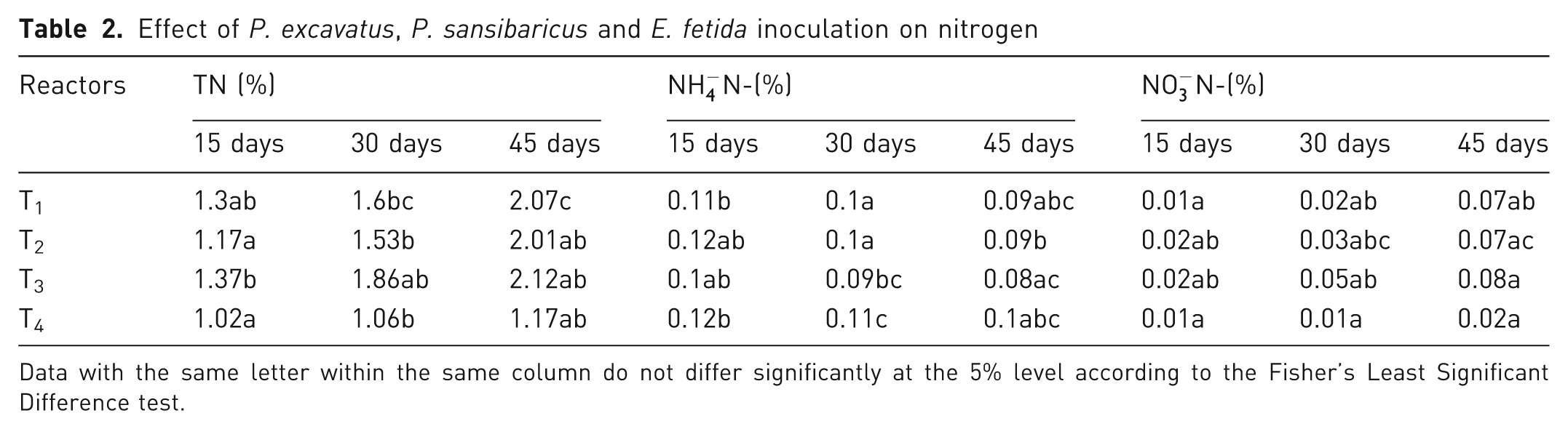
Data with the same letter within the same column do not differ significantly at the 5% level according to the Fisher’s Least Significant Difference test.

TN profile during vermicomposting.
Total phosphorous
Total phosphorous increased during the vermicomposting process because of the mineralization of the organic matter (Figure 3). The initial value was 7.62 g kg−1 and this subsequently increased during vermicomposting to 13.2 g kg−1 for T1, and to 11.3, 13.5 and 8.52 g kg−1 for T2 and T3 and T4, respectively (Table 3). The maximum increase of about 1.77 times the initial value was observed in T3. The increase in TP during vermicomposting was due to mineralization and mobilization of phosphorus by the bacterial and faecal phosphates activity of earthworms (Edwards et al., 1972). An increase of 25% in TP of paper waste sludge after worm activity was found by some authors (Satchell et al., 1984). The difference in TP content was significant in all the reactors on all the sampling days (P < 0.05).
Effect of P. excavatus, P. sansibaricus and E. fetida inoculation on TP and potassium

Data with the same letter within the same column do not differ significantly at the 5% level according to the Fisher’s Least Significant Difference test.

TP profile during vermicomposting.
C/N and C/P ratios
The role of organic carbon and inorganic nitrogen for cell synthesis, growth, and metabolism is important in all living organisms. The C/N and C/P ratios are important because plants cannot assimilate mineral N and P unless these ratios are of the order of 20 : 1 and 15 : 1, respectively or less (Khwairakpam and Bhargava, 2008; Tripathi and Bhardwaj, 2003). The decrease in C/N ratio over time is due to increase in the earthworm population (Ndegwa and Thompson, 2000), which led to rapid decrease in the organic carbon due to enhanced oxidation of the organic matter. The release of part of the carbon as carbon dioxide (CO2) in the process of respiration, production of mucus and N excrements, increases levels of N and lowers the C/N ratios (Khwairakpam and Bhargava, 2009). To provide proper nutrition for earthworms during vermicomposting, carbon and nitrogen must be present in the substrates at the correct ratio (45–60). The usual practice is to arbitrarily add either a rich nitrogenous material, or a rich carbonaceous material to the feed substrate, depending on the situation, to correct C-to-N imbalance. The initial C/N and C/P value of the substrate were 55 and 71 respectively. C/N subsequently reduced during vermicomposting to 13 for T1, 15 for T2, 13 for T3 and 36 for T4 as shown in Figure 4. Similar to C/N, a gradual reduction in C/P was observed in all the reactors during the process. The decrease observed was 20 for T1, 26 for T2, 21 for T3 and 49 for T4 (control) (Figure 5). In both the cases the minimum reduction was observed in the case of the control (Table 4). The performance of both indigenous earthworm species was comparable with that of other exotic earthworm species. The differences in both C/N and C/P content in the final product obtained from the different reactors were significant (P < 0.05) for all of the reactors on all the sampling days.

C/N profile during vermicomposting.

C/P profile during vermicomposting.
Effect of P. excavatus, P. sansibaricus and E. fetida inoculation on C/N and C/P ratio

All data represent average of four replicates.
Macro-nutrients (potassium, sodium, calcium)
The initial concentration of potassium in the substrate was 13.6 g kg−1 and this subsequently increased for all reactors during the process of vermicomposting. The maximum increase was observed in reactor T3, in which the concentration after vermicomposting was 19.72 g kg−1 (45% increase) and the minimum increase was observed in the case of the control, in which the potassium increase was 16.6 g kg−1 (22% increase) as shown in Table 3. The performance of T1 and T3 was comparable, as T1 has shown an increase of 18.5 g kg−1 (36% increase). In the case of vermicomposting the enhanced number of micro flora present in the gut of earthworms plays an important role in this process resulting in increased potassium over the control (Kaviraj et al., 2003). There was significant variation (P < 0.05) for all the reactors on all the sampling days.
The initial concentration of Na in the substrate was 6.6 g kg−1 and this increased during vermicomposting in all reactors except for the control (Table 5). The maximum increase was observed in T3 and was 8.7 g kg−1 (32% increase) and the minimum increase was observed in T2 and was 7.4 g kg−1 (12% increase). The increase for T1 was 8.2 g kg−1 (24% increase). There was significant variation (P < 0.05) in all the reactors on all of the sampling days.
Effect of P. excavatus, P. sansibaricus and E. fetida inoculation on sodium and calcium

Data with the same letter within the same column do not differ significantly at the 5% level according to the Fisher’s Least Significant Difference test.
The initial concentration of Ca was 5.6 g kg−1, which subsequently increased to 6.8, 6.7, 7.2 and 6.3 g kg−1 for T1, T2, T3 and T4, respectively (Table 5). There was no significant variation for Ca on all the sampling days.
Coliforms and fecal streptococci
This parameter is important from the view point of application of compost in the field. The number of coliforms reduced in all of the reactors during vermicomposting as shown in Table 6. The initial value for total coliforms (TC) was 2.4 × 10⁹: In T1, T2 and T3 7 log reductions were observed for TC in vermicompost; however, for control only a 2 log reduction was observed. The initial fecal coliforms (FC) count was 4.3 × 10⁶, which subsequently reduced to 24 for T1, 36 for T2, 43 for T3 at the 45th day, however for the control only 2 log reduction was observed. The source of fecal coliforms in the substrate was the cattle manure, as no fecal coliforms were found in the domestic waste. The initial value for fecal streptococci (FS) was 9.3 × 10⁷, which reduced by 5 log during vermicomposting in reactor T1, T2 and T3. For T4, only a 2 log reduction was observed. The presence of coliform bacteria is often used as an indicator of overall sanitary quality of the compost. For compost hygiene, the recommended FC and FS densities are 5 × 10² and 5 × 10³ MPN g−1, respectively (Vuorinen and Saharinen, 1997). These results show that the pathogen stabilization potential of the indigenous species of earthworm (P. excavates and P. sansibaricus) is comparable with that of the exotic species (E. fetida) within 45 days. The coliform count varied significantly for all the reactors (P < 0.05).
Effect of P. excavatus, P. sansibaricus and E. fetida inoculation on coliforms and streptococci

All data represent average of four replicates.
Earthworms biomass
The change in worm biomass in all the reactors during the vermicomposting period is depicted in Table 7. No mortality was observed in any reactor during the vermicomposting period. The vermicompost was dark brown (towards blackish) in colour and homogeneous after 45 days of earthworm activity. At the end of the 45 days, the earthworm biomass increased slowly in all the reactors. The increase in weight of earthworm biomass during the composting period varied between 27.5 and 47.5%. The maximum increase was observed in T3 and the value was 47.5%. However in T1 the increase observed was 14.3% and in T2 the increase observed was only 9.98%. The biomass increase in E. fetida was found to be a maximum, but in comparison the amount of juveniles were more in the indigenous species. This may be because the activity of the native worms is delayed in the beginning or the adaptation process is slow (Garg, 2010; Khwairakpam, 2009; Tripathi and Bhardwaj, 2004). The adaptability of E. fetida is a well known fact.
Growth and reproduction of P. excavatus, P. sansibaricus and E. fetida.

All data represent average of four replicates.
Conclusions
Waste management in vegetable production is a tough problem, and its optimum solution must look for local factors that need to be taken into account. Vermicomposting could be answer to this difficulty. Unfortunately, the vermicomposting process is limited in use because the users have to purchase the earthworms in the beginning and if they are lost for some reason then they have to be purchased again and thus more expenditure is needed. This constraint can be removed by use of indigenous earthworms.
In addition, E. fetida is well known to be a more tolerant species, hence after continuous application of the vermicompost produced using E. fetida the local earthworm species will vanish from that area.
This study was performed to investigate the efficacy of indigenous species in comparison with E. fetida for the composting of domestic waste. From the study it is concluded that the performance of the indigenous species of earthworms (P. sansibaricus and P. excavates) is comparable with that of the exotic species (E. fetida). This study also revealed that the exotic species degraded the organic matter faster in comparison with the indigenous species but P. sansibaricus and P. excavates produced a quality of compost which was comparable with that produced from E. fetida; that is, the C/N ratio was below 20 with a minor difference in N P K values. The process of stabilization takes about 30 days for completion and maturation takes place in another 10–15 days later. Hence these species can be successfully used for on-site treatment of domestic organic waste.
Footnotes
The authors would like to express thanks to Uttarakhand Council of Science and Technology (UCOST) for their Financial assistance.