







Abstract
Governments of municipalities in Vietnam experiencing dynamic economic growth and dramatic population increases have been struggling to manage increased amounts of municipal solid waste (MSW). This study aimed to clarify the advantages and disadvantages of the current MSW collection service for citizens of the four central districts of Hanoi city, Vietnam, by conducting interviews with 200 households and 200 business entities regarding their satisfaction with the service. The survey results showed that Hanoi city provides an economical collection service with sufficient frequency and at appropriate times for citizens. However, a number of citizens complained about unsanitary conditions in the area surrounding their residence. Business entities had sufficient motivation to sell recyclable waste (RW) to the informal sector, not only to derive revenue from selling RW, but also to reduce the amount of MSW generated, thus reducing the MSW collection fee. Households were not motivated to reduce MSW by selling RW to the informal sector because they paid a fixed collection fee. As a result, an improvement in living standards in the near future is expected to contribute to increasing the amount of MSW generated from households.
Keywords
Introduction
Governments of municipalities in Vietnam experiencing dynamic economic growth and dramatic population increases have been struggling to manage increased amounts of municipal solid waste (MSW). In Ba Dinh, Hoan Kiem, Dong Da and Hai Ba Trung districts (Figure 1) of Hanoi city, the capital of Vietnam, the Hanoi Urban Environment Company (URENCO) is in charge of managing MSW (Kawai and Osako, 2011). The ‘Regulation on general solid waste management in Hanoi city, 2010’ specifies that MSW is to be collected daily, discharged at designated times and places, and not left on the pavement in front of offices or houses. Following the regulation, Hanoi URENCO collects MSW every evening. MSW collection containers in which citizens living nearby can place their trash have been placed along the main streets at approximately equal intervals of 50–100 m. In addition, collection workers from Hanoi URENCO collect MSW in built-up areas by passing along alleys with handcarts while ringing a bell loudly. MSW collected in the containers and handcarts is transferred to trucks that transport the MSW, mainly to Nam Son landfill site, which is approximately 50 km from the centre of Hanoi city, and also to the Cau Dien composting site (Figure 1).
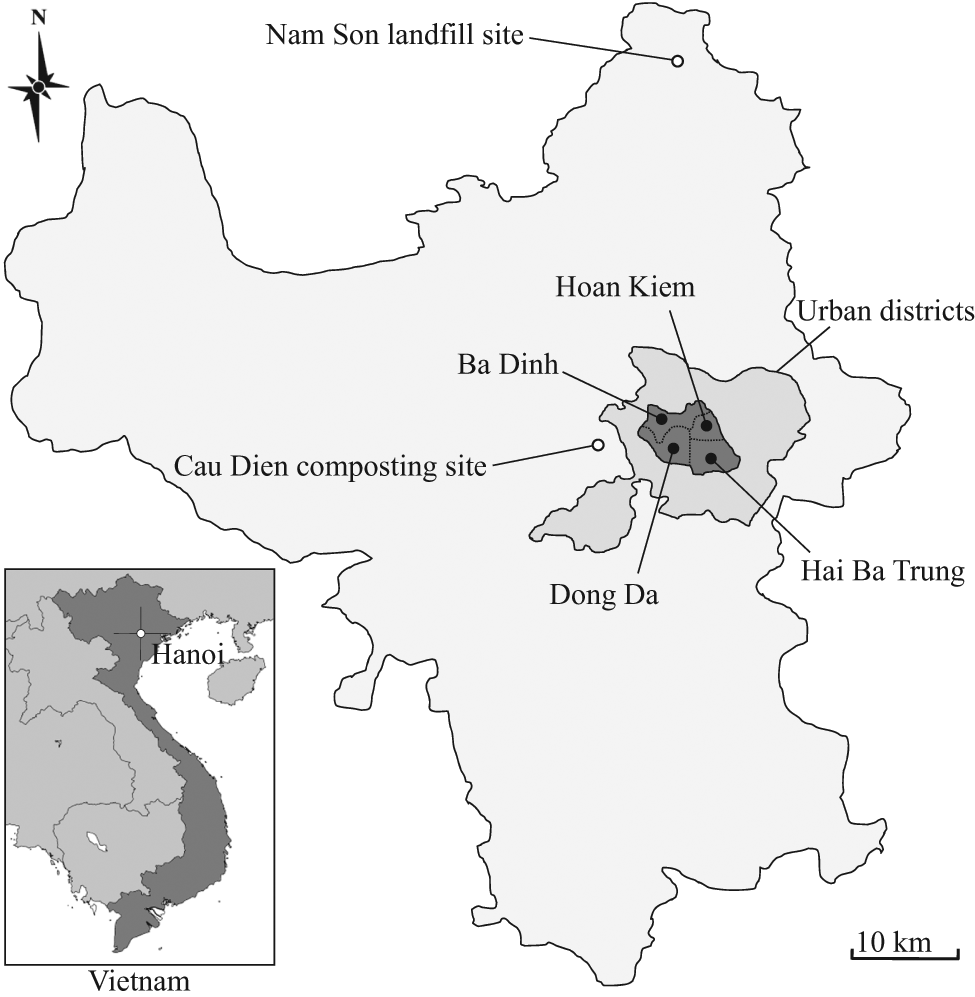
Map of Hanoi city.
Recyclable waste (RW), such as cardboard, newspapers, plastic bottles, glass bottles and aluminium cans are separated by citizens and then collected by junk buyers, who circulate through different areas of the city as itinerant collectors of RW. Then, RW is sold and recycled in the iinformal sector, which supplies secondary resources to businesses (DiGregorio, 1994; Li, 2002; Medina, 2000; Mitchell, 2008; Ojeda et al., 2002; Wilson et al., 2009, 2012). The informal sector, defined as private sector buyers and recyclers who are not sponsored, paid or recognized by the formal sector (Rodic et al., 2010; Scheinberg et al., 2011), contributes greatly to reducing the amount of MSW disposed of in landfill sites (Narayana, 2009; Wilson et al., 2006).
Trading of RW in Vietnam is greatly influenced by international markets for resources (Mitchell, 2009) and, as a result, the prices received for RW in Vietnam are relatively high in relation to the ordinary living standard. This situation has enhanced the recovery of RW by the informal sector. However, as living standards improve with economic growth, citizens may be less motivated to sell RW, and the informal sector may be less motivated to buy or collect RW. In that case, the formal sector will collect and dispose of RW that was formerly collected by the informal sector.
The objective of this study was to clarify the advantages and disadvantages of the current MSW collection service for citizens in the four central districts of Hanoi city, Vietnam, by conducting interviews with 200 households and 200 business entities regarding their satisfaction with the MSW collection service.
Materials and methods
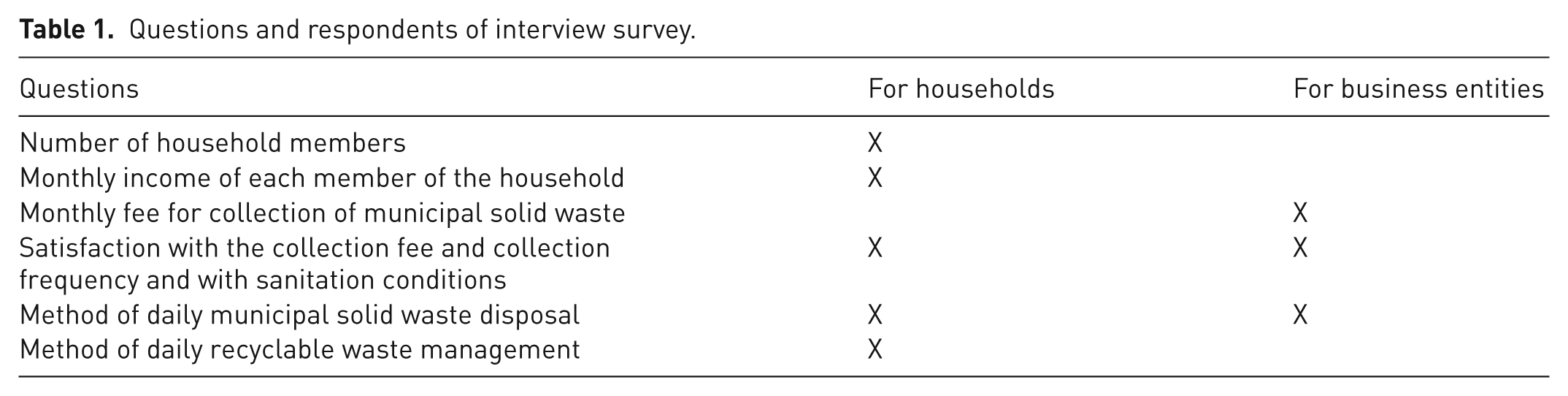
First, information on MSW collection fees in Hanoi city, Hochiminh city and Haiphong city was collected. Then, 200 households and 200 business entities in the four central districts (Ba Dinh, Hoan Kiem, Dong Da and Hai Ba Trung) were surveyed by a local Vietnamese team of consultants, who conducted interviews in January 2011. In each of the four districts, interviews were conducted with members of 50 households, 20 shops, 10 restaurants, 10 hotels and 10 offices. In consultation with residential leaders, 15 low-income, 15 middle-income, 15 high-income households and 5 households with small-scale businesses in each district were selected for interviews. Based on the list, we selected 200 business entities, which had to contract with Hanoi URENCO for removal of MSW if they disposed of more than 1 m3 of MSW per month, judged by the collection workers visually. Table 1 shows the categories of questions asked of household and business interviewees. The interviewees were asked to choose one answer from several possible answers, and they were asked to give reasons for their answers to some questions. The results of the interview survey were analyzed statistically by using IBM SPSS Statistics 20 software.
Questions and respondents of interview survey.
Results and discussion
Collection fee
The sources of revenues for MSW management among different cities depend on the financial and social situation of each city (Wilson, 2012). In Hanoi city, 66% of revenue for managing MSW is from the Hanoi city People’s Committee, 10% is from household collection fees and 6% is from fees collected from business entities (Japan International Cooperation Agency, 2006). Like many cities around the world (Piclin, 2008), Hanoi city charges households and some institutional organizations a fixed collection fee. Table 2 shows the MSW collection fees in Hanoi city (note that these fees include a street-sweeping service). The MSW collection fees of Hanoi URENCO are assessed per person. Although the collection fee systems of other major cities of Vietnam are slightly different from the system used in Hanoi city, in all cases the fees for households are fixed and the rates are similar. In Hochiminh city, the collection fee is assessed not per person but per household; households along main streets pay 20,000 Vietnamese Dong (VND) each month; those along alleys pay 15,000 VND per month (Hochiminh city, 2008). Haiphong city charges 16,000 VND per household per month for households along alleys or on upper floors (Haiphong city, 2009).
Municipal solid waste collection fee in Hanoi city.
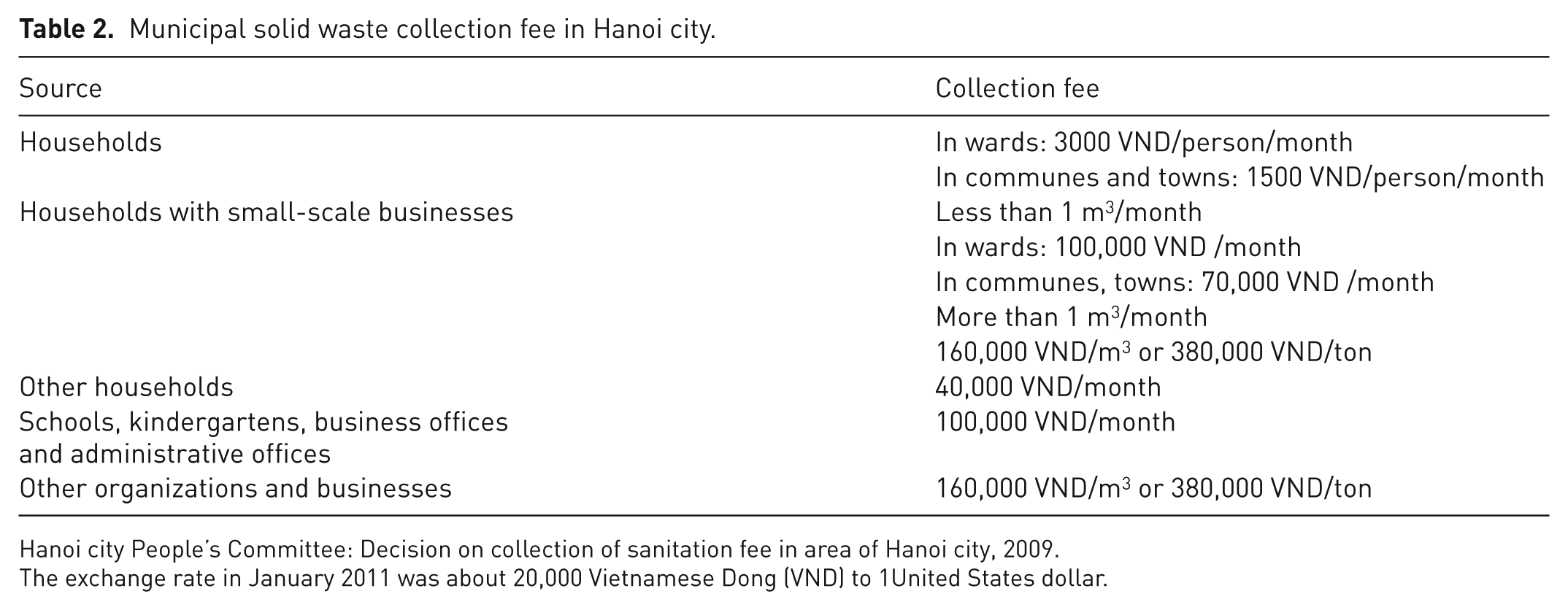
Hanoi city People’s Committee: Decision on collection of sanitation fee in area of Hanoi city, 2009.
The exchange rate in January 2011 was about 20,000 Vietnamese Dong (VND) to 1United States dollar.
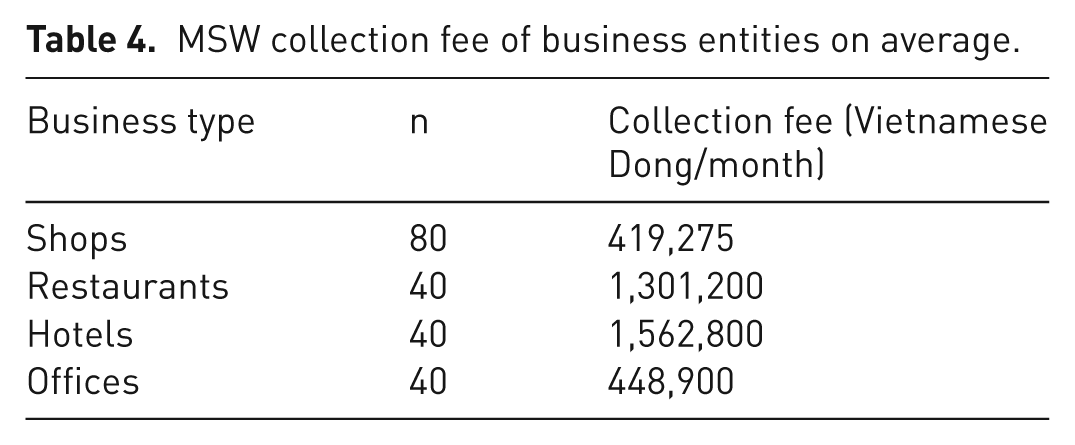
The interview survey results showed that the monthly collection fee accounted, on average, for 0.11% of monthly household income (Table 3). Although the collection fees charged for restaurants and hotels were, on average, approximately three times those charged shops and offices (Table 4), most restaurants and hotels, as well as shops and offices, were satisfied with the the cost. This result shows that the collection service provided in Hanoi city is economical (Figure 2). It follows that the services in other major cities of Vietnam, such as Hochiminh and Haiphong cities, are also probably economical.
Relationship between monthly income and collection fee of households on average (n = 121).
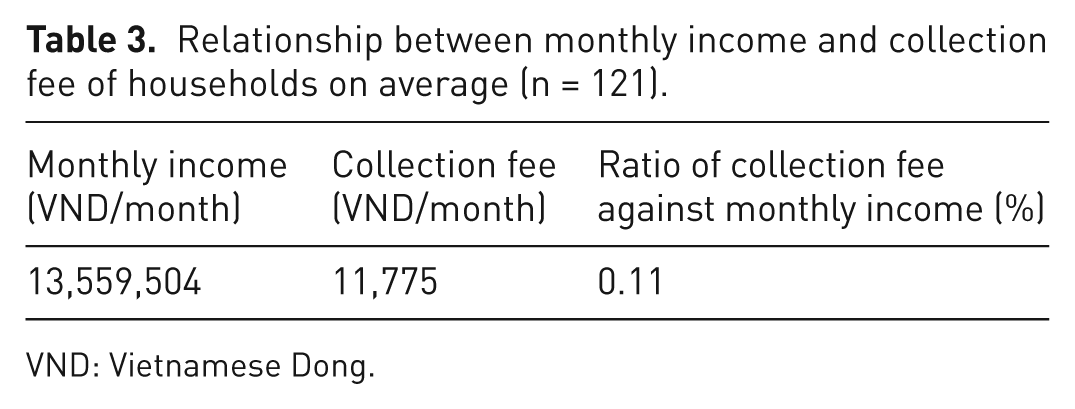
VND: Vietnamese Dong.
MSW collection fee of business entities on average.
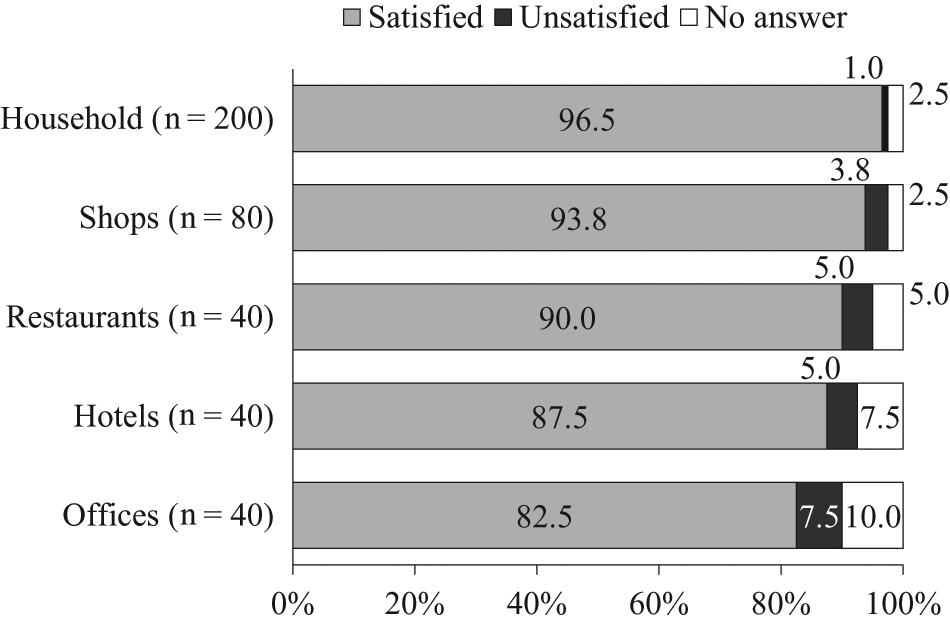
Citizen satisfaction with the collection fee.
Collection frequency and time
The survey results also showed that Hanoi city provides its collection service with sufficient frequency (Figure 3). In Vietnam, as in other countries of Southeast Asia, it is important for MSW to be collected frequently and removed promptly from densely populated urban areas to maintain sanitary conditions, because MSW, which consists mainly of organic waste, decomposes rapidly in the hot, humid climate of this region. Citizens were satisfied that they were able to discard MSW daily before decomposition began. Business entities under contract with Hanoi URENCO also had their MSW collected daily, and complaints about the collection frequency were rare.
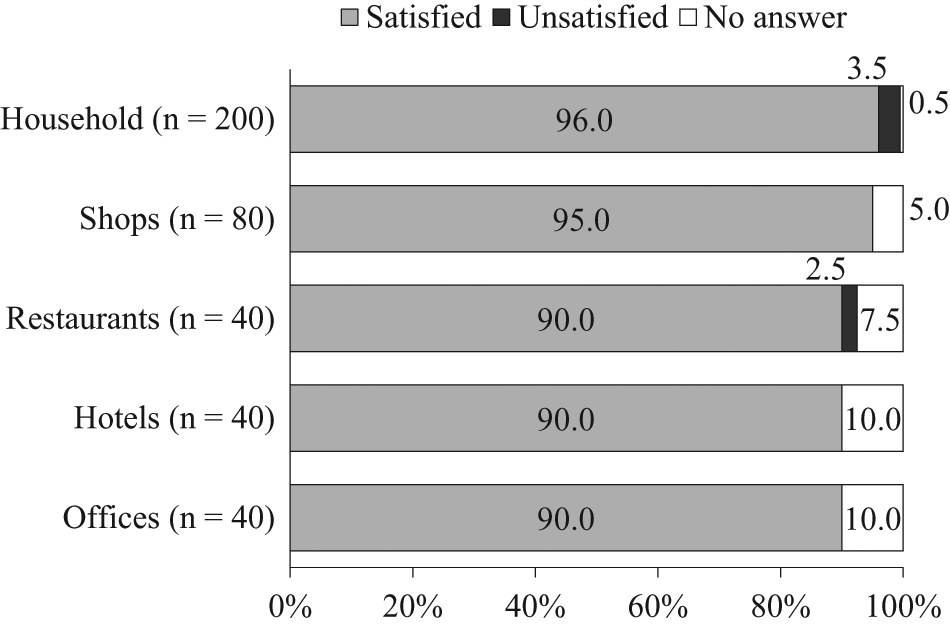
Citizen satisfaction with the collection frequency.
In addition, most survey respondents reported that they were satisfied with the MSW collection times in Hanoi city (Figure 4). In general, citizens of Hanoi city have breakfast out, but dinner at home. Some households suggested that it was convenient to be able to discard their MSW soon after they had cooked their dinner. Business entities, from whom MSW is collected at designated times according to their contract with Hanoi URENCO, rarely had complaints about the collection time.
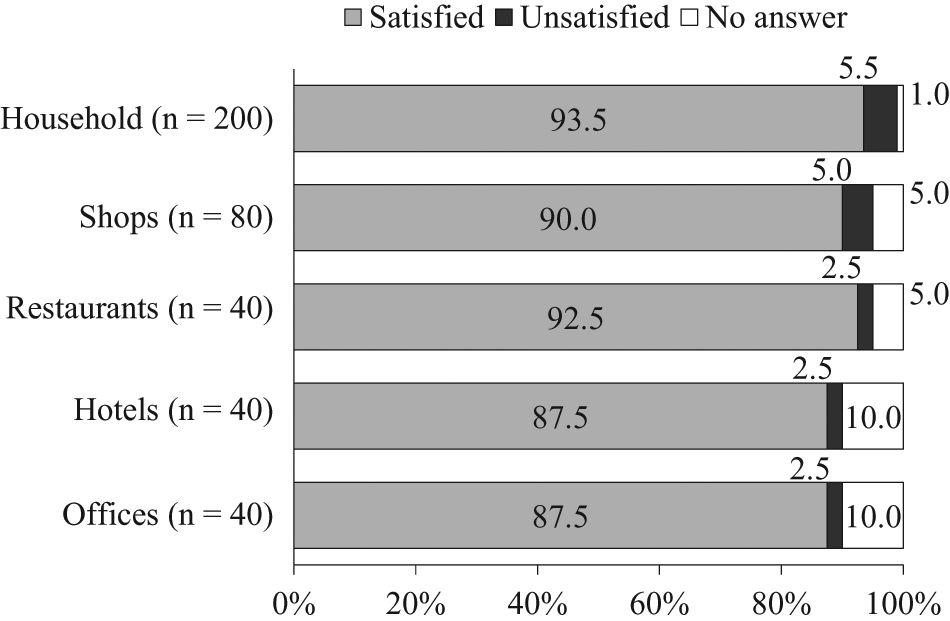
Citizen satisfaction with the collection time.
Sanitary conditions
Not a few citizens complained about unsanitary conditions in the area surrounding their residence (Figure 5). Although citizens were satisfied with the street sweeping performed by Hanoi URENCO collection workers, they were not satisfied with sanitary conditions, especially odor, along streets littered with MSW. Some citizens do not wait for the collection time but, in violation of regulations, throw away their MSW onto the streets, and, as a result of this inappropriate littering behavior, streets are often filthy and smelly. Although 65.5% of households reported that they followed the regulation by appropriately disposing of MSW in handcarts or designated containers, 34.5% of them left MSW on the pavement or at temporary dump sites (Figure 6). The citizens who did not follow the regulation added explanations such as ‘I cannot discard my MSW at the designated time because I am away from home so I leave it on the pavement before the collection time’, ‘it is more convenient to discard MSW at any time’ and ‘I am used to discarding my MSW on the pavement (or at a temporary dump site)’. In contrast, all business entities except one disposed of their MSW appropriately into handcarts or designated containers. Business entities do not dispose of their MSW inappropriately because Hanoi URENCO collection workers collect business MSW daily at the time designated by the contract. In other words, it is MSW disposed of inappropriately by households that results in the streets being unsanitary. Even though the regulation prohibits leaving MSW on the pavement, Hanoi URENCO maintains sanitation by street sweeping. It is possible that MSW continues to be left on the pavement or at temporary dump sites mainly because these practices do not result in punishment, but are given tacit approval. Following Singapore and Japan, which have tackled the tasks of keeping cities clean and preventing littering through various approaches, including punishment (Ong and Sovacool, 2012), Hanoi city should take action to keep the city clean. Specifically, Hanoi city should enforce regulations that prohibit citizens from littering or leaving MSW on the pavement. Otherwise, the unsanitary conditions and aesthetic problems must negatively affect not only the city’s residents, but also tourism.

Citizen satisfaction with sanitary conditions.
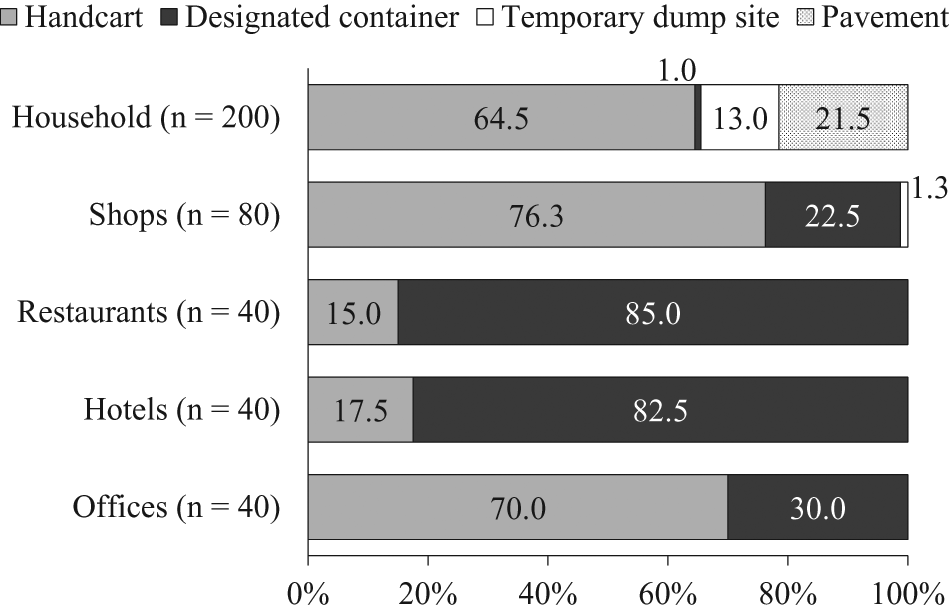
Method used for daily disposal of municipal solid waste.
Management of RW
In the interview survey results, reasons given for selling or giving RW away included to obtain income, to reduce the amount of MSW and to help the livelihood of junk buyers. The reasons given for simply throwing RW away included too little income from RW, and a lack of time and space for separating and storing RW.
The method used to manage RW was related to household income (Figure 7). High-income households were significantly more likely to throw out RW (P <0.01; two-sided t-test). Thus, high-income households in Hanoi city have a weaker motivation to sell RW. In general, households generated smaller amounts of RW than business entities, and thus needed to store it longer before selling it. Thus, households that were not willing to store RW for lack of space also tended to throw it out.
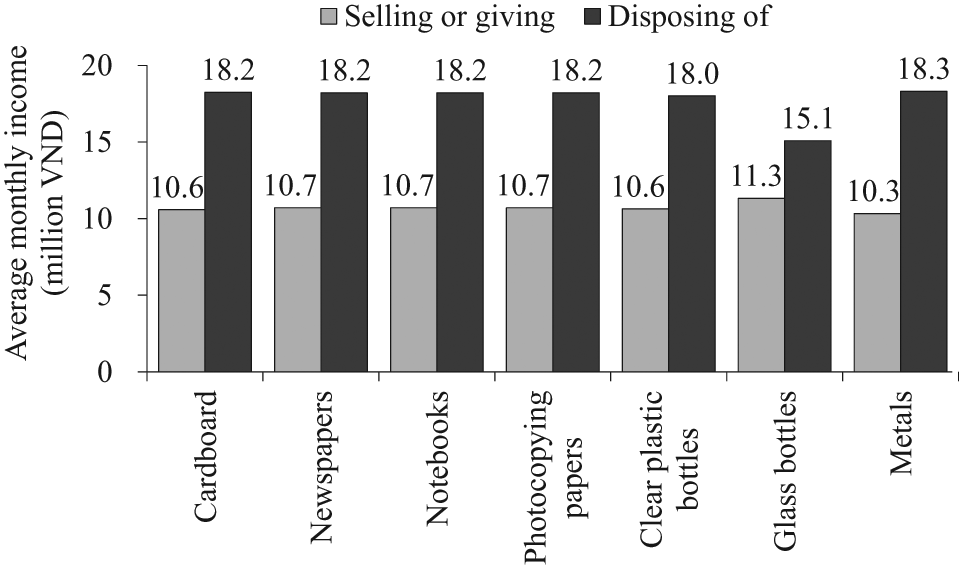
Average monthly incomes of households selling or giving recyclable waste (RW) and of those disposing of RW. VND: Vietnamese Dong.
Business entities were more likely to sell RW than households (Figure 8). Moreover, restaurants and hotels were more likely to sell RW than shops and offices because they generated more RW, especially containers and packaging materials made of paper or plastic. In addition, all restaurants and hotels sold food waste, which was collected regularly by farmers in the suburbs for feeding swine.
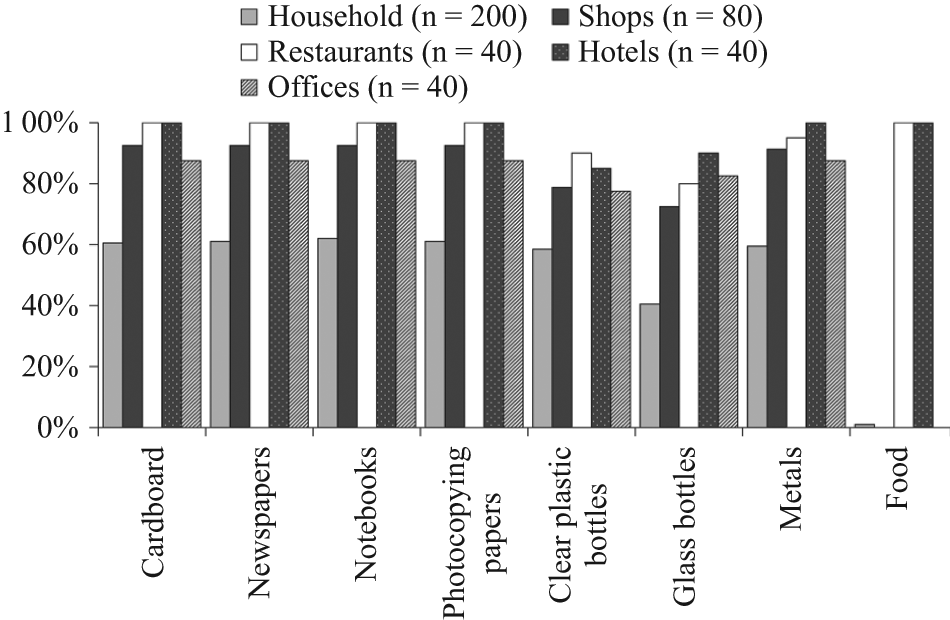
Proportions of citizens of households and businesses selling or giving recyclable waste.
Motivation to sell RW to reduce MSW
Business entities sell RW not only to obtain income, but also to reduce the amount of MSW they produce, which eventually reduces the collection fee that they pay. In Hanoi city, the collection fee for households is fixed according to the number of household members, but the fee for business entities can fluctuate depending on the MSW amount. Thus, households had little motivation to reduce MSW, whereas business entities had sufficient and concrete motivation to sell RW to the informal sector. Improvement in living standards in the near future is expected to contribute to increasing the amount of MSW to be generated from households.
Suggestions for reducing MSW from households
The necessity of implementing a pay-as-you-throw (PAYT) system of collection fees for households in order to reduce MSW from households and encourage RW recovery is a worldwide subject of discussion (Sujauddin, 2008). PAYT is a possible future solution to increased generation of MSW from households because it would motivate citizens to recycle and to reduce MSW from households. For example, citizens can be charged in proportion to the amount of waste that they generate through the use of prepaid bags for MSW (Sakai et al., 2008).
Few local governments in Southeast Asia have implemented a PAYT solution for MSW from households, and the feasibility of PAYT for Hanoi city still needs to be verified, taking the local situation into account. The use of prepaid bags, as mentioned earlier, is one effective type of PAYT system. However, affordable and feasible prices for prepaid bags need to be determined based on the current household income level and the current MSW collection fee, which, according to the results of this study, most of the citizens of Hanoi city found satisfactory. Otherwise, illegal dumping of MSW generated from households might increase. Implementation of PAYT might encourage citizens to separate and store RW at the source because RW collection at the source by junk buyers is already established in Hanoi city, and junk buyers actively seek out and pay for the RW that they collect (Kawai et al., 2012). Hanoi city could exploit that system to get RW flowing into recycling streams operated by the informal sector and to prevent an increase in MSW from accompanying implementation of PAYT. Simultaneous implementation of PAYT and strict enforcement of regulations against illegal dumping of MSW would likely be effective at both reducing MSW and improving sanitary conditions. Hanoi city should consider developing an appropriate and acceptable collection fee system after careful discussion with citizens if its goal is to achieve a reduction in the MSW disposal amount and to promote recycling.
Conclusion
Survey responses showed that citizen satisfaction with the MSW collection service fees in Hanoi city is high, and that MSW is collected with sufficient frequency and at appropriate times. However, a number of citizens complained about unsanitary conditions in the area surrounding their residence caused by the improper disposal of MSW by others. Business entities had sufficient and concrete motivation to sell RW. In contrast, households had little motivation to reduce MSW and thus were only weakly motivated to sell RW to the informal sector, indicating that improvement in living standards in the near future will likely contribute to increasing the amount of MSW to be generated from households.
One possible future solution to increased MSW is PAYT, which would motivate citizens to recycle and to reduce MSW. Simultaneous implementation of PAYT and strict enforcement of regulations against illegal dumping of MSW would likely be effective at both reducing MSW and improving sanitary conditions. Hanoi city should consider developing an appropriate and acceptable collection fee system after careful discussion with citizens if its goal is to achieve a reduction in the MSW disposal amount and to promote recycling.
Footnotes
Acknowledgements
Sincere thanks go to Mr Tran Ngoc Hoang, the leader of the local consultant team.
Funding
We express our sincere and profound gratitude to the Environment Research and Technology Development Fund by the Ministry of the Environment, Government of Japan (K2118, K22059, K2338).