






Abstract
Elevated Cr and Mo concentrations are often found in leachates of thermally treated solid waste, but there is no general explanation for this so far. Therefore, we studied the leaching behaviour after thermal treatment as a function of heating temperature and residence time for two types of solid waste: contaminated sludge and bottom ash from municipal solid waste incineration. The leaching behaviour of both waste streams was compared with experiments on synthetic samples, allowing deduction of a general mechanism for Cr and Mo leaching. Cr and Mo showed a similar leaching behaviour: after an initial increase, the leaching decreased again at higher temperatures. Oxidation of these elements from their lower oxidation states to chromate and molybdate at temperatures up to 600 °C was responsible for the increased leaching. At higher temperatures, both Mo and Cr leaching decreased again owing to the formation of an amorphous phase, incorporating the newly formed chromate and molybdate salts, which prevents them from leaching.
Keywords
Introduction
Leaching of heavy metals like Ni, Cu, Zn and Pb from bottom ash from municipal solid waste (MSW) incineration was already studied intensively in literature (Arickx et al., 2007; Hyks et al., 2011; Van Gerven et al., 2007). The release of these heavy metals during leaching with water can be related to the presence of organic material in the bottom ash. Fulvic and humic acids are known to form mobile organo-metallic complexes with cations of Cu, Pb, Ni and Zn (Pandey et al., 2000), so that removal or destruction of organic substances allows decreasing of the leaching of toxic cations. Additional thermal treatment is applied to oxidise the organic matter and, in some cases, also to obtain a sintered material that can be used in or as building material (Bethanis et al., 2004; Hyks et al., 2011; Selinger et al., 1997; Van Gerven et al., 2006). This treatment was reported to be an effective way to reduce heavy metal leaching, but some authors also observed increased Cr and/or Mo leaching after such thermal treatment (Hyks et al., 2011; Selinger et al., 1997; Van Gerven et al., 2006).
Not only bottom ash from MSW incineration, but also contaminated sludges can be treated thermally. Again, the reason for treatment is twofold: obtaining a useful ceramic material in view of using it in or as construction material (Alonso-Santurde et al., 2008; Chang et al., 2007; Gonzalez-Corrochano et al., 2012; Xu et al., 2008), and reducing heavy metal leaching by destruction of the humic substances. Various cases are described in literature where these two criteria are met, but analogously to bottom ash, some authors also report increased Cr leaching after thermal treatment (Chang et al., 2007; Xu et al., 2008). The leaching of Mo after thermal treatment of sludges was less reported in literature. Alonso-Santurde et al. (2008) studied the leaching behaviour of sintered contaminated marine sediments and observed for two types of clay an increase in Mo leaching in a leaching test with a liquid to solid (L/S) ratio of 2. Gonzalez-Corrochano et al. (2012) sintered mixtures of inorganic sludge and fly ash, and also observed increased leaching of Mo (and As, Sb) after sintering.
Operating conditions during thermal treatment, such as temperature and residence time, are of major importance to explain the leaching behaviour of heavy metals and/or oxyanions, but most articles only report leached concentrations at fixed temperatures. In a previous publication, Verbinnen et al. (2013) investigated the leaching behaviour of Cr after thermal treatment of synthetic samples containing Cr2O3 and alkali and alkaline earth salts. Upon heating, Cr(VI) formation and subsequent leaching in the presence of K, Na and Ca (hydr)oxides was observed. The aim of this article is to study the leaching behaviour for two types of industrial waste: contaminated sludge and bottom ash from MSW incineration, and to link it with the behaviour observed for synthetic samples to deduce a general mechanism. Moreover, as the behaviour of Cr and Mo, two elements of the same group in the periodic table of elements, was not yet compared previously, the leaching behaviour of Mo will also be studied.
Materials and methods
All reagents used were of analytical grade and all experiments were performed at least in duplicate. Thermodynamic calculations were performed using the Factsage thermochemical software.
Six industrial sludges (<63 µm) were obtained from a soil remediation company. The sludges originate from the cleaning (mainly washing and sieving) of soils with different origin; all are mainly inorganic and contaminated with several heavy metal cations and oxyanion forming elements. The six sludges were dried at 105 °C, ground, and then mixed in equal quantities to obtain a representative, homogeneous sample. About 30 w/w% of ultrapure water (Millipore MilliQ) was added to the mixture and it was pelletised to obtain spheres with a diameter of about 1.5 cm and an average weight of 5 g. The spheres were introduced in a preheated muffle furnace (Heraeus Thermicon P) and heated at temperatures ranging from 200 °C to 1100 °C for residence times between 0.5 and 6 h. After heating, the spheres were ground (<4 mm) and ultrapure water was added to the material to obtain an L/S ratio of 10. A 24 h leaching test (DIN 38414-S4) was performed on a shaking device (Gerhardt Laboshake) rotating at 160 r/min. The supernatant was filtered over a 0.45 µm membrane filter (Chromafil) and element concentrations were measured with ICP-MS (Thermo Xi series). Cr(VI) concentrations were also measured spectrophotometrically in some selected samples using the diphenylcarbazide method. The soil organic matter (SOM) content was determined by the loss on ignition after heating the samples (already dried at 105 °C) at 550 °C for 4 h, according to the EN 15935:2012 method. The organic matter content is then calculated as the difference between the initial and final sample weight divided by the initial weight times 100%.
The sand fraction of bottom ash (i.e. the fraction 65 µm–2 mm obtained after size separation and ferrous and non-ferrous separation, representing 13% of the total amount of bottom ash) from a grate furnace incinerating MSW was dried at 105 °C and was subjected to the same heat treatment as the sludge. To facilitate reading, the sand fraction of the bottom ash is always referred to as ‘bottom ash’. Organic matter content and leached concentrations were determined in the same way as for the sludge. To determine the total metal concentrations for both waste types, digestion of the dried and ground solid matrix was performed by the successive addition of 5 ml HNO3, HClO4 and HF to 0.1 g of the sample and boiling the mixture. This was done in triplicate and the standard deviations indicated that the samples were homogeneous. After digestion, the excess acid was evaporated, the solutions were transferred to 100 ml volumetric flasks and the metal concentrations were determined with ICP-MS.
Pure K2CrO4 was heated at 1100 °C for 30 min with and without SiO2, and pure Na2MoO4.2H2O was mixed with SiO2 and heated at 950 °C for 30 min. After cooling, the samples were leached for 24 h with ultrapure water and an L/S ratio of 1000 (K2CrO4) or 20 (Na2MoO4.2H2O). The supernatant was filtered over a 0.45 µm membrane filter and Cr or Mo concentrations were measured with ICP-MS.
Results and discussion
Total and leached concentrations of sludge and bottom ash
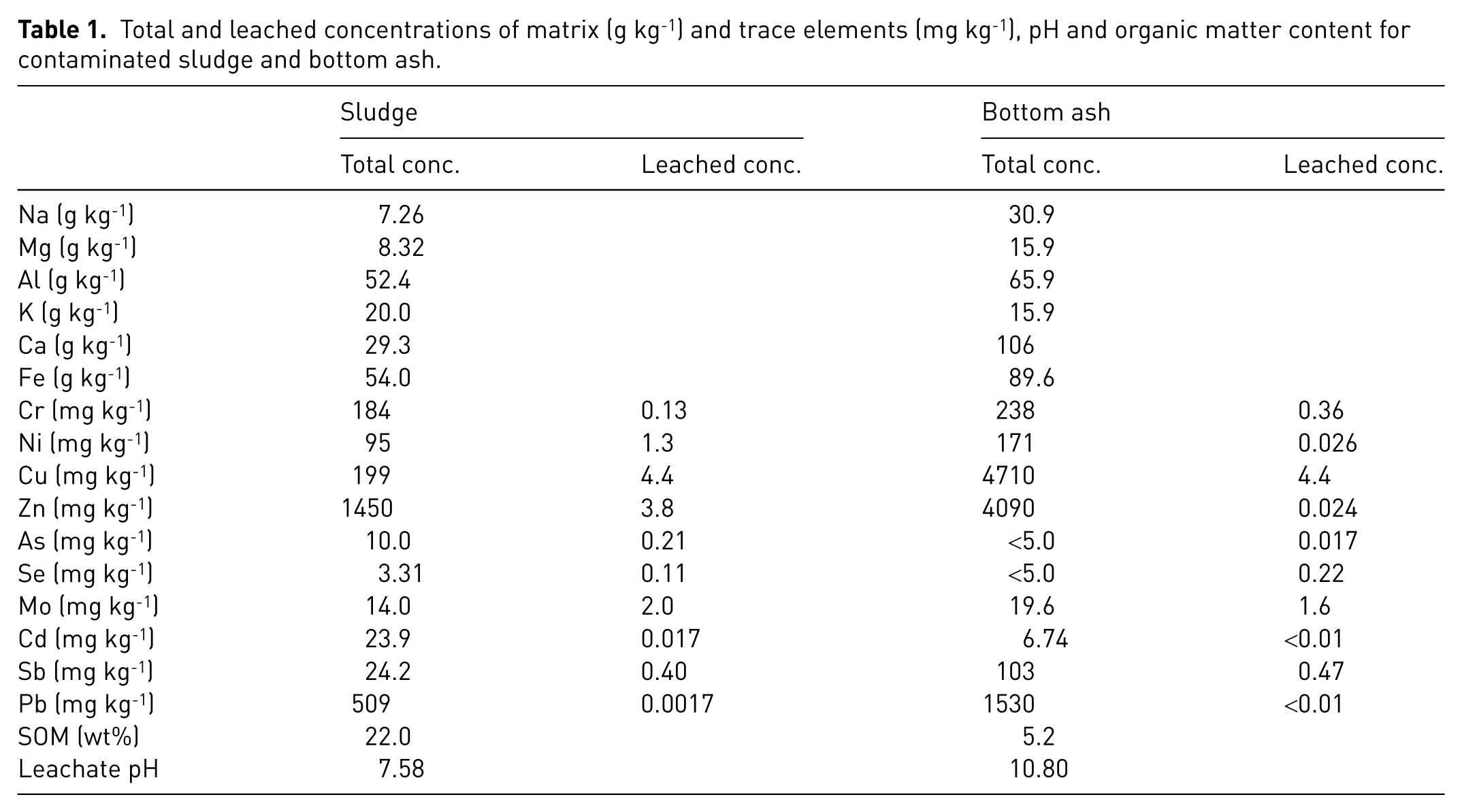
In Table 1, total and leached concentrations of matrix and trace elements in the sludge and bottom ash are shown. Bottom ash contains a higher total amount of cation-forming heavy metals Ni, Cu, Zn and Pb than sludge, although the leached concentrations are comparable with or lower than those of sludge. This can partly be explained by the difference in pH (Table 1), but the higher organic content of the sludge might be the most important factor, as humic substances form highly soluble organo-metallic complexes with cations (Pandey et al., 2000). Elemental carbon formed during incineration is also included in the organic matter content of bottom ash (5.2%). For bottom ash, only Cu leaching exceeds the regulatory limit for use in or as building material (0.5 mg kg-1, Flemish Government Order, 2008). The stability of the Cu–humic acid complex is higher than that of any of the other metal–humic acid complexes (Pandey et al., 2000; Van Gerven et al., 2007), thus explaining the elevated leaching of only Cu from the bottom ash. Bottom ash contains more Na and less K than the sludge, which may be of importance when Cr leaching as a function of heating temperature is considered in a later section. These alkali metals can have an influence on the Cr leaching behaviour upon heating (Verbinnen et al., 2013).
Total and leached concentrations of matrix (g kg-1) and trace elements (mg kg-1), pH and organic matter content for contaminated sludge and bottom ash.
Leaching of heavy metals after heat treatment
In Figure 1(A), leaching of cation-forming heavy metals Ni, Cu and Zn is shown after heating of contaminated sludge for 30 min at temperatures between 200 °C and 1100 °C. In the untreated material (shown in the Figure at 105 °C, the temperature at which the samples were dried), the limit values for use in or as building material for Ni (0.75 mg kg-1), Cu (0.5 mg kg-1) and Zn (2.8 mg kg-1, Flemish Government Order, 2008) are exceeded, but upon heating, leaching of these three elements decreases. Simultaneously, decrease of the SOM content is observed (Figure 1(B)), from 22% initially to 6.3% at 400 °C. Although there is still a significant amount of organic material left at that temperature, no more leaching of heavy metals is observed. Complexation of cations by humic substances is mainly attributed to the presence of carboxylate and phenolate functional groups (Martyniuk et al., 2001). The decarboxylation of humic substances already starts at 200 °C or even at lower temperatures (Kolokassidou et al., 2007; Martyniuk et al., 2001; Smidt and Lechner, 2005). This explains why, in these experiments, a significant decrease in heavy metal leaching is observed at 200 °C, where the SOM content is only reduced from 22% to 15%.

Leaching of Ni, Cu and Zn (A) and SOM (B) for contaminated sludge heated at 200 °C–1100 °C for 30 min.
There was no significant change in pH – another crucial parameter when looking at heavy metal leaching – observed at temperatures up to 400 °C, so a pH change did not influence Ni, Cu or Zn leaching after treatment at these temperatures. Also, heavy metals like Zn can be volatilised as, for example ZnCl2 upon heating, but this mainly occurs at temperatures above those for which the highest reduction in leaching was observed (<400 °C) in Figure 1(A) (Abanades et al., 2002). Other elements (e.g. Cu) are less likely volatilised in the relevant temperature range. The reduced leaching can thus be attributed to reduced formation of highly soluble organo-metallic complexes. A similar observation was made for the leaching of Cu from bottom ash (not shown): both the organic matter content and Cu leaching were reduced upon heating.
The leaching of the heavy metals Ni, Cu and Zn could thus be reduced significantly by heating the samples (Figure 1(A) and (B)). However, earlier research (Verbinnen et al., 2013) showed that heating of Cr contaminated waste can lead to elevated Cr concentrations in the leachate. Cr and Mo are chemically similar elements, appearing in the same group (Group 6) of the periodic table. Therefore, the leaching of both Cr and Mo from contaminated waste upon heating is studied here together.
Leaching of Cr after heat treatment
In Figure 2, the leaching of Cr from contaminated sludge for temperatures between 400 °C and 900 °C and residence times between 0.5 and 6 h is shown. At 400 °C, there is a small increase in Cr leaching after a residence time of 4 h, but at 600 °C and 700 °C, Cr leaching increases immediately with increasing residence times. The leached concentration reaches around 25 mg kg-1 after 6 h at 600 °C, 50 times the regulatory limit for use in or as building material (0.5 mg kg-1, Flemish Government Order, 2008). At higher temperatures (800 °C–900 °C), Cr leaching is higher than for untreated samples, but the values observed at 600 °C and 700 °C are not reached anymore. Cr(VI) measurements in some selected samples showed that all Cr detected in ICP-MS measurements was actually Cr(VI), as can be expected owing to the high mobility of Cr(VI) compounds.

Leaching of Cr from contaminated sludge heated at 400 °C–900 °C for 0.5–6 h.
Figure 3 shows Cr leaching of bottom ash for temperatures between 400 °C and 700 °C and residence times between 0.5 and 6 h. An increase in Cr leaching is observed at 400 °C up to values of around 5 mg kg-1 and at 500 °C, a concentration of 22 mg kg-1 is reached. At 600 °C, Cr leaching increases to 18 mg kg-1 after 1 h, but decreases after longer residence times. At 700 °C, this decrease already starts after 30 min.

Leaching of Cr from bottom ash heated at 400 °C–700 °C for 0.5–6 h.
The increased Cr leaching for both contaminated sludge and bottom ash can be explained by the oxidation of Cr(III) to Cr(VI). This oxidation does not occur by reaction with only oxygen, but in the presence of alkali and alkaline earth salts soluble chromates are formed (Verbinnen et al., 2013). The Na/K ratio for bottom ash is 1.94, whereas for contaminated sludge this ratio is 0.63. Therefore, it is likely that more Na2CrO4 is formed in the bottom ash than in the sludge, where more K2CrO4 is formed. For contaminated sludge (Figure 2) maximum leaching is observed after heating at 600 °C–700 °C; for bottom ash (Figure 3), the maximum is observed at 500 °C. These maxima are consistent with observations made in a previous study by Verbinnen et al. (2013): for synthetic samples, the maximum in Cr(VI) leaching in the presence of K salts was observed at higher temperatures than in the presence of Na salts.
A decrease in Cr leaching is observed at temperatures above 800 °C for sludge and above 600 °C for bottom ash. To ensure that this decrease is not due to volatilisation of Cr, the total concentration was determined for sludge heated at 1100 °C for 30 min. The average Cr concentration was 311 mg kg-1, higher than in the untreated material, which can be explained by the decomposition of organic matter and certain minerals (e.g. carbonates), and shows that Cr is not volatilised.
Some authors describe a similar decrease in Cr leaching at elevated temperatures and several explanations were reported for this. Some suggest that Cr(VI) can be reduced to Cr(III) by more reducing conditions at higher temperatures (Sorensen et al., 2000; Wei et al., 2005). However, their heating conditions differed much from the conditions in this article as they heated their samples in covered crucibles, which promotes reduction owing to lack of oxygen. Furthermore, for bottom ash heated at 600 °C and 700 °C in this study, Cr(VI) is formed initially, indicating oxidising conditions, and after longer residence times, the Cr leaching is decreased again. Other authors claim that Cr(VI) can be reduced by reducing compounds in the samples, for example metallic aluminium (Astrup et al., 2005; Bodenan et al., 2010). This can occur in untreated bottom ash during leaching, but after heating at the oxidising conditions described in this study, metallic aluminium present in the samples is rather oxidised and passivated before Cr(VI) is reduced. The thermodynamic calculations confirm this: for example at 800 °C the Gibbs free energy of reaction for the oxidation of metallic aluminium is −1328 kJ mol-1, whereas the Gibbs free energy of Cr(III) oxidation in the presence of KOH or NaOH is −456 and −346 kJ mol-1, respectively. So thermodynamically, in our experiments, metallic aluminium will rather be oxidised than Cr. Furthermore, tests with synthetic samples reported by Verbinnen et al. (2013) showed that Cr(VI) leaching also decreased at elevated temperatures, even when no metallic aluminium was present.
Solid solution formation of Cr(VI) with ettringite is also a possible mechanism to explain the decreased leaching in alkaline solid waste (Cornelis et al., 2008), but again, a decrease in Cr(VI) leaching was also observed in synthetic samples where no ettringite was present (Verbinnen et al., 2013). Furthermore, the decomposition of ettringite takes place at temperatures around 114 °C–125 °C (Zhou and Glasser, 2001), so other mechanisms might predominate in this case.
The available literature seems insufficient to describe the reduced Cr leaching observed in this study adequately. It is hypothesised here that at higher temperatures the newly formed Na and K chromates can form a binary system with SiO2, resulting in the formation of an amorphous phase after cooling and thus preventing Cr from leaching. This was confirmed by heating synthetic mixtures of K2CrO4: when this compound was heated to 1100 °C (well above its melting point), all Cr was leached afterwards. However, when K2CrO4 was mixed with SiO2 and also heated at 1100 °C, the leaching was reduced to below 2% of the total.
Leaching of Mo after heat treatment
In Figure 4, the leaching of Mo from contaminated sludge for temperatures 400 °C–900 °C and residence times between 0.5 and 6 h is shown. At all temperatures, Mo leaching reaches a plateau after 1 h. Between 400 °C and 700 °C, the amount of Mo leached is 5–6 mg kg-1. At 800 °C, around 8 mg kg-1 Mo is leached and at 900 °C almost the entire amount of Mo (around 14 mg kg-1, Table 1) is leached.

Leaching of Mo from contaminated sludge heated at 400 °C–900 °C for 0.5–6 h.
The leaching of Mo can be related to the presence of mineral oils in the contaminated sludge. MoS2 and WS2 nano and micro particles are commonly used as dry lubricants in mineral oils (Vadiraj and Kamaraj, 2010). MoS2 can be oxidised to MoO3 according to reaction (1) (Abdel-Rehim, 1999); MoS2 is only slightly soluble, whereas the solubility of MoO3 exceeds 1 g l-1 at 20 °C (Zelikman et al., 1966).
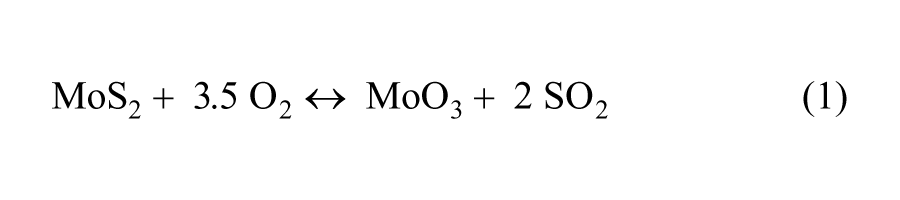
The standard free energy of reaction (1) was calculated with Factsage and is negative throughout the entire temperature range (0 °C–1100 °C) relevant to this study. Abdel-Rehim (1999) studied the roasting of Egyptian molybdenite (MoS2) as a function of temperature; the observed Mo leaching behaviour after heating was comparable with that of Figure 4. The lower conversion at lower temperatures was attributed to the formation of a compact thick layer of molybdenum trioxide (MoO3) around the molybdenite particles that inhibits the diffusion of O2 and SO2, so that the reaction velocity is low. At higher temperatures the oxide layer becomes friable and porous, and oxidation of MoS2 can also take place inside the particles (Abdel-Rehim 1999; Marin et al., 2009; Zelikman et al., 1966).
In Figure 5, the leaching of Mo for bottom ash treated at temperatures between 400 °C and 700 °C and residence times between 0.5 and 6 h is shown. The leaching behaviour differs from that observed for contaminated sludge: only a small increase in Mo leaching is observed at 500 °C and 600 °C. In the bottom ash, most of the Mo is probably already in its hexavalent state, so that only little oxidation of Mo(IV) occurs during the heat treatment. At 400 °C, Mo leaching as a function of residence time is stable at around 1.5–2 mg kg-1. At 500 °C, leaching increases to around 2.5 mg kg-1 after 0.5 h heating, probably because the part of Mo that was originally in a lower oxidation state, is oxidised. At 600 °C, Mo leaching initially increases to around 2.5 mg kg-1 after a residence time of 1 h, but starts to decrease after longer residence times and reaches a value of around 0.4 mg kg-1 after 6 h. At 700 °C, Mo leaching decreases immediately and also reaches a value of 0.4 mg kg-1 after 6 h.

Leaching of Mo from bottom ash heated at 400 °C–700 °C for 0.5–6 h.
The reduced leaching for bottom ash after a residence time of 1 h at 600 °C and the immediate decrease at 700 °C can be explained by the interaction of molybdates with SiO2 and formation of an amorphous phase preventing Mo from leaching when cooled. Thermodynamic calculations indicated that the formation of molybdates is thermodynamically favourable (e.g. ΔGr = −258 kJ mol-1 for the formation of Na2MoO4 at 800 °C). Mainly Na2MoO4, with a melting point of 627 °C (Zelikman et al., 1966) will be formed in the bottom ash owing to the high Na content, and can form an amorphous phase together with SiO2 from which no Mo can leach.
The hypothesis of the formation of a binary molybdate–SiO2 system was tested by heating a synthetic mixture of Na2MoO4.2H2O and SiO2. Similarly to Cr, only 11% of the total Mo content was leached after heating the mixture at 950 °C for 30 min. A similar observation of a molybdate–SiO2 binary system was, to our knowledge, only reported by Chrenkova et al. (2001), who studied the binary system K2MoO4–SiO2 and observed a decrease in melting temperature when both components were mixed. The eutectic point was not observed, as they only investigated SiO2 contents up to 20%. Determination of the exact eutectic point is beyond the scope of our study, but the decreased melting temperature proves the interaction between molybdates and SiO2.
The sludge contains more K, so it is likely that mainly K2MoO4, with a higher melting point (928 °C, Chrenkova et al., 2001) will be formed. However, the SiO2–K2MoO4 phase might not be molten yet, as no significant decrease in Mo leaching was observed for the sludge at 900 °C and the lowest reported melting temperature for the binary system K2MoO4–SiO2 is 913 °C (Chrenkova et al., 2001). Moreover, it might not be very likely that any molybdates are formed in the sludge. Mo is initially mainly present as MoS2 particles in the organic fraction and will be oxidised to MoO3, but the formed MoO3 might not be able to react with alkali metal ions owing to diffusion restrictions.
Influence of organic matter
The organic material present in the waste plays an important, yet double role. On the one hand, too much organic material (i.e. humic substances) increases leaching of heavy metals like Cu, Ni, Zn and Pb by the formation of organo-metallic complexes. On the other hand, after destruction of organic matter, Cr(III) can be oxidised to mobile and toxic chromates in the presence of oxygen and alkali or alkaline earth salts. MoS2 can be oxidised to mobile MoO3 or molybdates. For instance, at 400 °C, the SOM content of the sludge is reduced from 22% to less than 7% after 30 min, and Mo is oxidised and leached. After 3 h, the SOM content is below 2%, and then Cr leaching also starts to increase. At 700 °C, the organic matter content is already below 2% after 30 min, and both Cr and Mo leaching increase after this residence time. To control leaching of both cation-forming heavy metals and Cr and Mo after heating, an optimal heating temperature and residence time should be defined for every type of waste. For instance, for the sludge optimal conditions are heating at 400 °C for 0.5–3 h, for which leached concentrations for both Cr and Ni, and Cu and Zn are below the regulatory limits. Another option to control leaching of all regulated elements is heating at higher temperatures, where Cr leaching decreases again.
Conclusion
The leaching behaviour of Cr and Mo after thermal treatment of two solid waste types was characterised. The explanation for increased Cr leaching after thermal treatment deduced from experiments with synthetic samples is also relevant for real waste. Cr(III) is oxidised to toxic and mobile Cr(VI) in the presence of K and Na salts in both waste types, and the leached concentrations reach up to 25 mg kg-1, 50 times the Flemish regulatory limit for use in or as building material. Moreover, the increased leaching of Mo could also be explained by experiments with synthetic samples. Mo, mainly present as MoS2 in the untreated material, is oxidised to mobile MoO3 in the contaminated sludge during heat treatment.
At temperatures above 600 °C, the leaching of Cr from bottom ash and sludge, and of Mo from bottom ash, decreased again with increasing temperatures. At these temperatures, melting of the formed chromates and molybdates in the presence of SiO2, a binary system that forms an amorphous phase when cooled, prevents Cr and Mo from leaching. Cr and Mo seem to behave similarly during thermal treatment of bottom ash and contaminated sludge. When contaminated waste is thermally treated, the possible elevated leaching of oxyanion forming elements should be taken into consideration.
Footnotes
Declaration of conflicting interests
The authors declare that there is no conflict of interest.
Funding
This research received no specific grant from any funding agency in the public, commercial, or not-for-profit sectors.