






Abstract
Faced to the economic and energetic context of our society, it is widely recognised that an alternative to fossil fuels and oil-based products will be needed in the nearest future. In this way, development of urban biorefinery could bring many solutions to this problem. Study of the implementation of urban biorefinery highlights two sustainable configurations that provide solutions to the Walloon context by promoting niche markets, developing circular economy and reducing transport of supply feedstock. First, autonomous urban biorefineries are proposed, which use biological waste for the production of added value molecules and/or finished products and are energetically self-sufficient. Second, integrated urban biorefineries, which benefit from an energy supply from a nearby industrial activity. In the Walloon economic context, these types of urban biorefineries could provide solutions by promoting niche markets, developing a circular economy model, optimise the transport of supply feedstock and contribute to the sustainable development.
Introduction
The biorefinery concept can be defined as the sustainable conversion of biomass into a range of marketable bio-based products (platform chemicals, additive molecules for the chemical industry, biomaterials, etc.) and/or bioenergy (biofuels, electricity, heat, etc.) (Laurent et al., 2011). Appearing in the earlier 1980s after the first oil crisis, the development of the biofuels products industry has grown significantly in recent years. The limited availability and gradual increase in the price of oil and petrochemicals, added to the appearance of new environmental concerns (global warming, REACH legislation, etc.), has prompted research institutes and industry to design alternatives to petroleum products (Kamm, 2007).
By proposing biomass as an alternative, biorefineries reduce the current dependence of our society over these fossil resources and allow an efficient use of biomass while minimising waste and global fossil-fuel carbon emissions (Demirbas, 2012; Wiloso et al., 2012).
The current growth of the biorefinery concept also contributes to replacing the concept of ‘waste’ with ‘valuable coproduct(s)’. In recent years, waste management has remained one of the most expensive challenges. To reduce the costs associated to waste management, manufacturers continue to invest to reduce the tonnage. For industry, the idea of a complete recovery of their raw materials (the ‘zero waste’ paradigm) is linked to a maximum profitability (Jacquet et al., 2015).
In many cases, the ‘zero waste’ remains inaccessible. However, it could become a reality with the development of specifically designed biorefineries. In this sense, biorefineries in the ‘autonomous mode’ use residues (solid or liquid waste and coproducts) of their production to generate their own energy. At the opposite end, integrated biorefineries tend to represent the ‘ideal’ model of the future industry plant. In the framework of industrial ecology, the principle of integrated biorefineries is based on the combination of several companies (production units), where the co-products and the outgoing energy flow of a first unit provides raw material(s) and/or energy to the next. Independently, each of these units is autonomous and market products in a standard way (Kokossis and Yang, 2010). However, the complementarities of all the companies allow achieving the full recovery of raw materials in the most energy-efficient and cost-effective way (circular economy concept).
One factor that ensures the viability of these integrated biorefineries is the proximity of the various production units. Proximity limits the cost associated to the transport of logistics flows between companies, and implicates, ideally, that integrated production units must be located on the same geographical site (Kokossis, 2014). This notion of proximity allows for the differentiation of biorefinery into two classes, respectively ‘rural biorefineries’ and ‘urban biorefineries’.
Rural biorefinery is a structure that processes valuable edible crops (first generation biorefinery) or their related ‘coproducts’ (second generation biorefinery) into refined fractions, located at the centre of a farming community. The biorefinery system starts with the harvesting contract of whole crops (grains and straws and coproducts), which are then stored (including drying if required) and fractionated into valuable products and by-products for sale (Audsley and Annetts, 2003).
In a same way, an urban biorefinery, which is usually a second-generation concept, is located in an urban or sub-urban area and uses fundamental waste streams, such as food waste, unrecyclable papers and lignocellulosic feedstock (second generation) for the production of energy (mostly biofuels) and/or bioproducts (Chintala et al., 2013, 2014; Gavrilescu, 2014).
This article evaluates the viability of these (integrated or autonomous) urban biorefineries near the Walloon urban centres where significant volumes of negative-cost feedstocks are concentrated and collected by specific and powerful waste-sorting.
Regional feedstock availability and composition
In parallel to economic considerations, it is also important to ensure that negative feedstock material supply will be sufficient to ensure the durability of the process.
Considering a regional case, the identification of flows of negative feedstock mobilised in the Walloon Region is subject to various debates. Most estimations are established on the calculation of a theoretical amount of raw material, based on arable Walloon lands. These approximated estimations obtain an annual availability of cellulose (1.14*106 t), hemicelluloses (1.12*106 t) and lignin (0.33*106 t) from the crop yields in cereals, indigenous crops (residues of the culture of potatoes, sugar beet, chicory inulin) and forage crops.
Estimations for ‘wood’ and industrial residues are more easily accessible, however, the amounts are clearly overestimated because they do not take into account the existing use of this biomass (mulching, energy sector, etc.) and do not provide a realistic picture of the negative feedstock sustainably and reasonably mobilised. Besides the agricultural, forestry residues and dedicated crops, waste and by-products of our consumption or industrial processing activities could theoretically be exploited in second-generation biorefinery schemes. In Wallonia, it appears that organic household waste alone represents hundreds of thousands tonnes per year, as well as green and gardening waste, cardboard and waste papers (Table 1).
Household waste amount theoretically recoverable in the Walloon Region for biorefining applications.
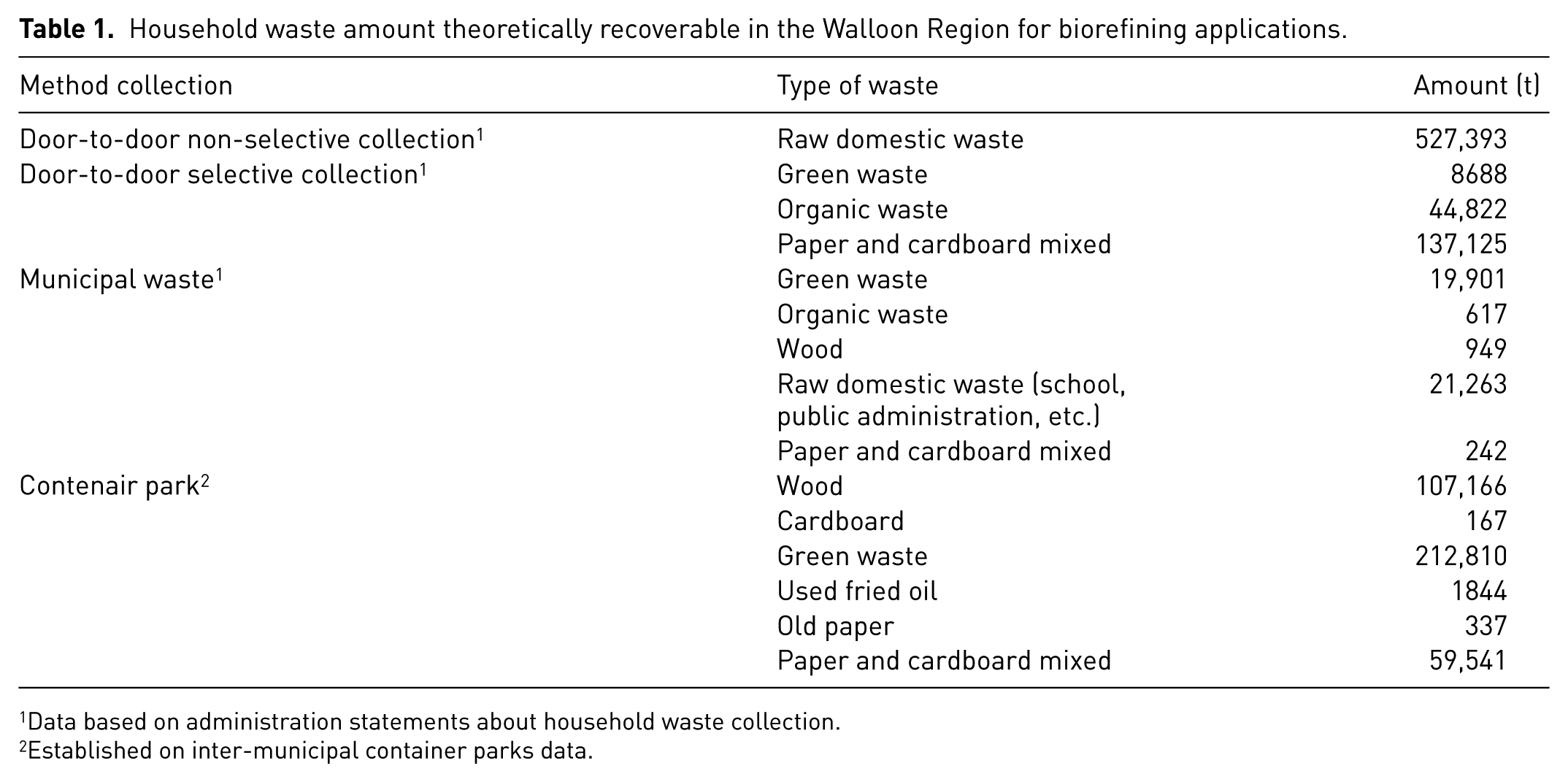
Data based on administration statements about household waste collection.
Established on inter-municipal container parks data.
Raw domestic waste still contains various unsorted reusable materials, including a majority (41%) of organic compostable waste (16% of uneaten food, 21% of waste food and 4% of garden waste) and about 12% of paper and cardboard (packaging, etc.).
These materials, actually buried in sanitary landfilling, partially integrated into recycling channels or incinerated for energy production, contain valuable biological molecules and could be used as raw materials in the development of circular economy patterns.
From a chemical point of view, ‘compostable’ waste (fruit waste, vegetable and meal wastes, mowing waste, etc.), with a moisture higher than 60%, contain between 6% and 12% cellulose, 2% and 5% of hemicelluloses and 3% to 17% lignin (relative to the wet weight); while wood and the cardboard/paper mixed contains between 6% and 20% of residual humidity from 28% to 90% of cellulose, 7% to 15% of hemicelluloses and 2% to 23% of lignin (Stuart and El-Halwagi, 2012).
Economics of negative-cost feedstock
Economic considerations for negative-cost feedstock have been clearly detailed by Sheldon-Coulson (2007). Authors showed that the use of raw materials with a negative cost impacted the standard business model of the industry. In standard configuration, the goal of the company is to maximise the volume of marketable product, while minimising the process cost and the volume of feedstock. When a negative feedstock is used, the raw material is considered as a source of revenue and the new economic model is considered to maximise the marketable product and feedstock volume, and minimise the production cost.
To analyse more specifically the impact of the negative-cost feedstock, we can consider the profit equation, which aims to maximise the profitability of a company:

where π is the profit, a is the feedstock volume, f (a) is the industry output (which depends on feedstock volume), PA is the feedstock price, PB is the output price, v (a) is the variable cost link to feedstock volume and c is the fix cost not linked to feedstock volume.
To simplify this economic equation, the hypothesis that the production function is linear with f(a) = y.a (where y is the yield or the proportion of feedstock converted in final product) is admitted. In this case, the profit can be calculated by using:

In this equation, the hypothesis is also made that non-converted feedstock becomes waste that is deposited without generating any cost. Based on this equation, it is possible to determine the impact of a negative-cost feedstock on the profit, by taking the partial derivate of the function depending on the variables of interest.
In a first place, the partial derivate for y, gives a yield of:

The form of equation (3) shows that the profit increase (resulting of a yield increase) is independent of the feedstock price PA. So, yield betterment will always lead to an increase in profit, whether the feedstock cost is negative or positive. This observation, which could seem trivial, puts a damper on the idea that we should not worry about the performance of a process when feedstock has a negative cost. Special attention should always be given to the efficiency of the process to maximise profit. However, the form of equation (3) also shows that the variation of profit based on yield variation depends on a, the feedstock volume. The higher the a value, the higher the gain variation will be owing to an increase of the yield.
To specifically study the impact of the volume feedstock on the profit, the partial derivation of equation (1) with respect to a is proposed in:

Equation analysis shows that, as PB.y is always >0, the expression is always positive only if PA + v’(a) is negative. If the raw material is a negative-cost feedstock and PA exceeds in absolute value v’(a), feedstock revenues are enough to cover the full conversion and an increase of the scale of the plant will always be profitable. In this case, any yield and any product price are sufficient to ensure the rentability of an increase in scale.
Conversely, if the feedstock price is not so negative to offset the conversion cost, an increase of scale will be profitable only if equation (5) is verified:

In this case, the output price plays an important role in the determination of the minimum yield required to warrant the profitability of the process (Sheldon-Coulson, 2007).
We can conclude, with respect to these equations system, that economic consideration is more complicated than the standard account, which considers that negative-cost feedstock is a source of revenue. If the price of negative feedstock is quite negative to pay fully of the process plant (including amortising cost), there is no limit to the scale of the plant’s profitable operation. Otherwise, price of output product(s) will be determinant to identify the minimum required yield and warrant the profitability of the process.
Conversion processes: Feasibility
First generation technology is the only way that allows biofuel production in a controlled distribution and approval policy. Three types of biofuels are currently recognised and authorised in Belgium: bioethanol integrated in gasolines; fatty acid methyl esters (FAME) to form biodiesel and finally pure vegetable oil.
Beside the production of first generation biofuels, some companies have turned to the production and marketing of derivative compounds from the first generation bioethanol or glucose, both biodiesel co-products. In Belgium, various branches of first generation bio-based production are identified. For example, polylactic acid (PLA), obtained from corn starch, is a biodegradable polymer intended to replace plastics derived from petrochemicals; succinic acid initially derived from petroleum products can now be synthesized from sugars by fermentation; the use of ethanol as a platform molecule for producing bio-based polymers such as polyvinyl chloride (PVC), polyethylene terephthalate (PET) and polyethylene (PE). Ethylene synthesis by dehydration of ethanol is particularly interesting, because it is the basis for the synthesis of all derivatives in C2, such as ethylene oxide and ethylene glycol.
The raw materials used in first generation processes are rich in starch and free sugars (including grains) or triglycerides (rape), and are converted into simple process units with reasonable production costs. However, competition for these raw materials (part of the food production for non-food application) is imposed to diversify sources of possible supply (Jacquet et al., 2015).
In the additional sources of supply, lignocellulosic plant materials offer good prospects. However, the intrinsic chemical complexity of these materials (mainly composed of cellulose, hemicellulose and lignin) requires additional unit operations (pre-treatment processes) with relatively high costs. In addition, transport of lignocellulosic materials (which contain a lot of water), combined with the low conservation time, timing of cultural practices and non-standardisation of the chemical composition, involve constraints to design cost-effective second-generation production units.
Concerning the second-generation biorefinery, Wallonia seems to suffer from an imbalance between lignocellulosic supply actually mobilised and the increasing demand for bio-based products. To reverse this trend, three options are being considered.
To promote niche markets by targeting small tonnage production of molecules with high added value for local consumption or export.
To modify the linear economic model (extraction–production–consumption–waste disposal) towards a circular economy model, where all materials used in the design of a (bio-based) product are recovered, recycled and upgraded in energy or materials, and where the end-of-life of the product is considered to promote a maximum reuse of all its components as raw materials.
To develop production units near the raw materials collection points to minimise transport, and secure the supply chain by regulating the input of materials throughout the year.
Considering these three observations, the second generation biorefinery in the Walloon Region could be defined as the conversion of lignocellulosic materials, available in limited geographical areas, into value-added molecules by a circular approach where all intermediate products and co-products are recovered and re-used as raw material for sequential production units.
In this way, two types of urban ‘biorefineries’, located in an urban or sub-urban area, could be implanted near waste treatment facilities (incinerators, sorting centres) and lignocellulosic residues production (by-product of the activities of the UPA, for example).
Urban biorefineries with autonomous energy production, which use waste for the production of value-added molecules and/or finished products.
Urban biorefineries integrated with existing industrial structures, benefiting from the energy of some adjacent processing activities.
These urban biorefineries could be seen as a processing unit for converting a single commodity flow (single input) into various intermediate finished or semi-finished products. In the first case, the management of liquid or gaseous effluents, vinasses and solid residue to a heat generation unit and power to allow a biorefinery function in a quasi-autonomous manner (Figure 1). In the second case, the biorefinery has an external supply of energy that will power the various stages of the process (Figure 2).
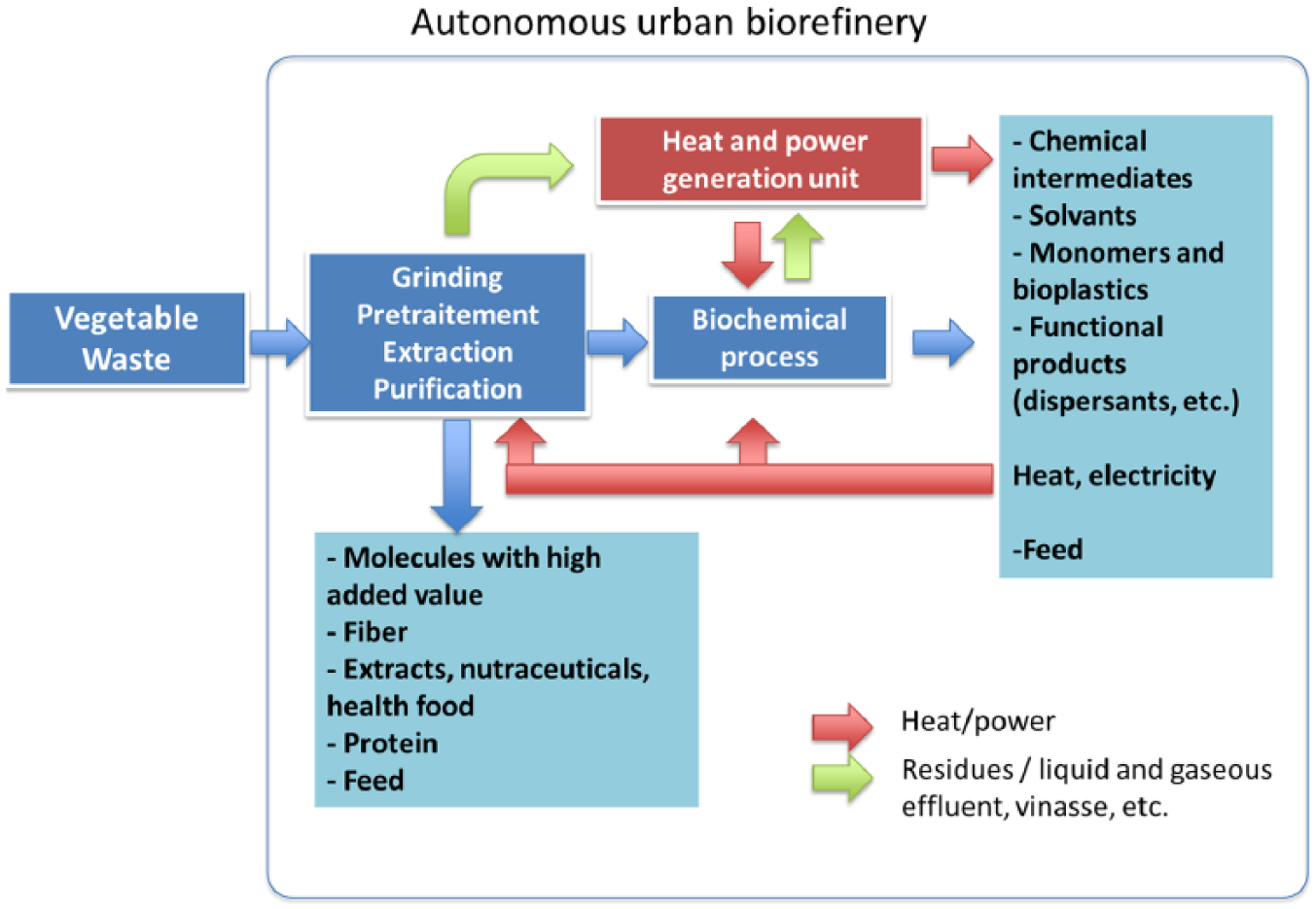
Autonomous urban biorefinery supplied by vegetable waste.
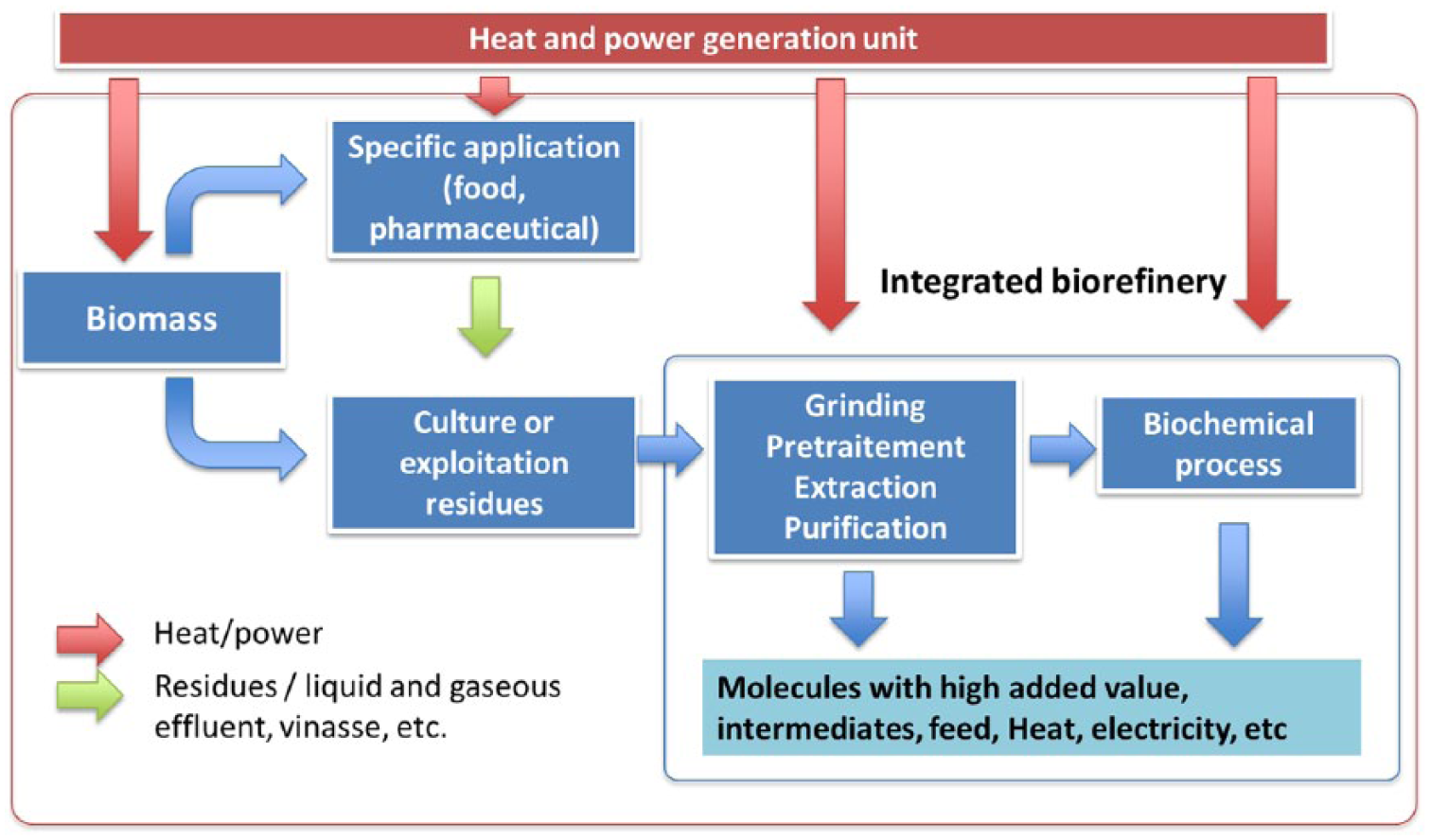
Integrated urban biorefinery benefiting of an energy external supply.
The conversion of the raw material is ensured by various operation units, including pre-treatment (separation of the main chemical components constituting the vegetable matrix) followed by one or more conversion steps (physical, chemical and/or enzymatic ones). The processes used for the conversion of lignocellulosic inflows are preferentially performed at low working temperatures, typically below 300 °C, allowing access to a wide range of semi-finished or finished products (referred as the ‘biochemical pathway’).
Affordable bioproducts and biofuels
The products range is wide and depends on the nature of the raw material, but also on the nature and conditions of pretreatment and subsequent conversion. Concerning the biofuels production (mainly bioethanol production), further studies are nowadays conducted to make the second-generation bioethanol cost-competitive compared with the first generation. In this context, research is focused on pretreatment techniques, methods of hydrolysis, fermentation and recovery of vinasse with high lignin concentration, in order to improve the process profitability (Balat, 2011; Carvalheiro et al., 2008; Kumar et al., 2009, Talebnia et al., 2010). However, the second-generation biofuels production processes have not yet reached profitability and remain down compared with the first generation (Eggert and Greaker, 2014; Eisentraut, 2010).
In the case of a valuation of lignocellulosic materials by fermentation, interest comes from the C6 sugars (glucose, galactose and mannose) derived from hydrolysis and readily fermentable (including bioethanol). However, the other sugars of the lignocellulosic material (C5: xylose, arabinose, rhamnose) are less assimilated by traditional strains and have low conversion efficiencies. Research has therefore turned to recombinant strains (bacteria and yeasts) able to co-ferment hexoses and pentoses to ethanol and other bio-based products with high yields (Laurent et al., 2011).
Besides the use of a lignocellulosic biomass to produce ethanol, exploration pathways exist for the production of bio-based compounds (molecules or platforms molecules with high values) from the second generation. Many of these ways are still being explored, but some of them have already been completed. In this sense, the report of the US Department of Energy has identified some platform molecules that can be produced from polysaccharides of this biomass. The following list includes these molecules: succinic acid, fumaric acid, maleic acid, 2,5-furandicarboxylic, 3-hydroxypropionic acid, aspartic acid, glutamic acid, glucaric acid, itaconic and levulinic acids, 3-hydroxybutyrolactone, sorbitol, xylitol and arabinitol (Bozell and Petersen, 2010).
Without going so far in the deconstruction of the constituent of lignocellulosic biomass, opportunities are also emerging for several years. In the case of cellulose fibres, a series of chemical, enzymatic and mechanical treatments leads to the creation of nanofibres and nanocrystals with special properties (Dufresne, 2012). These properties, as well as the renewable and biodegradable nature of nanocellulose, enable it to potentially affect a huge variety of business, ranging from cosmetics, paints and textiles to electronics (Shatkin et al., 2014).
Beyond the traditional components of the biomass composed of sugars (cellulose and hemicellulose), lignin has a completely different structure. Lignin is an aromatic polymer compound of monolignols: p-coumaryl, coniferyl and sinapyl alcohol. The valuation of this bioresource is relatively interesting because lignin is the second component represented in the biomass after cellulose. Unfortunately, it has long been used as a fuel owing to its high calorific value (Voitkevich et al., 2012). Future research will help develop leads for the valuation of lignin. Lignin can be used in particular for the production of phenolic resins (Effendi et al., 2008), methanol, acetic acid, formic acid, acetaldehyde, methyl acetate, propanal, 1- hydroxybutanone, 2-butenal, furan, phenol derivatives, aromatic compounds (De Wild et al., 2009; Wang et al., 2007) and various hydrocarbons by synthesis gas production and Fischer-Tropsch synthesis.
Conclusion
In recent years, many efforts have been made in Belgium to carry the biorefinery of lignocellulose materials to the industrial level. However, efforts are still required. In the coming years, the depletion of oil reserves and global population growth will result in an increase in demand for biofuels and bio-based products. The second-generation biorefinery will therefore become a necessity.
In this context, this article shows that urban biorefineries, located in an urban or sub-urban areas implanted near waste treatment facilities and lignocellulosic residues production, could meet this demand. Two configurations are possible for theses biorefinery. Autonomous urban biorefineries that operate with residues, and gaseous and liquid effluent to produce their own energy. Integrated urban biorefineries that benefit from an energy supply from a nearby industrial activity.
These types of urban biorefineries also provide solutions to the Walloon context by promoting niche markets, especially those related to bio-based products and molecules with high added value, developing a circular economy model by the use of negative economic feedstock, avoiding the transport of supply feedstock and contributing significantly to the sustainable development.
Footnotes
Declaration of conflicting interests
The author(s) declared no potential conflicts of interest with respect to the research, authorship, and/or publication of this article.
Funding
The author(s) received no financial support for the research, authorship, and/or publication of this article.