






Abstract
The aim of this study is to analyse the effect of temperature on the biodegradation and settlement properties of municipal solid waste by using bioreactors. Three kinds of controlled temperature were performed during the biodegradation test; the variation of weight, leachate and biogas production were carefully monitored. The degradation test indicated that more leachate leaked out owing to the external compression and polymer hydrolysis reaction in the aerobic phase, which could lead to the decrease of biodegradation rate in the anaerobic phase. A proper temperature range in favour of enhancing biodegradation of refuse was obtained, which ranged from 22 °C to 45 °C. Finally, an empirical equation of biodegradation ratio was proposed, which incorporated the temperature effect. In the end, the validation of this proposed model is verified, and is proved to be reasonable for predicting degradation velocity in landfills.
Introduction
With the population growth in cities over the past few decades, more industrial and municipal solid waste (MSW) has been produced. As an economical way to dispose of MSW, 52%, 54.3%, and 83% of all urban waste was sent to regulated landfill centres in Korea, America, and China, respectively (Luca et al., 2002; Renoua et al., 2008; Zhan et al., 2008, Zhao et al., 2014). In China, the growth rate of MSW production in recent years ranged from 8% to 20%, and the continuing increase of MSW could pose a great threat of environmental pollution in the city and even cause landslide disasters within landfills. Past experience has shown that prediction the landfill settlement is difficult, since the MSW is a composed of complex and heterogeneous materials, their density, moisture content, and volume varies as the biodegradation process in the refuse (Hettiarachchi et al., 2007); meanwhile, owing to different compositions, there is a scarcity of available historical data to assist with the calibration, validation, and development of settlement models being proposed (Garcia de Cortázar et al., 2002; Merry et al., 2005). Explaining changes in settlement as a function of waste’s decomposition is very important when the waste decomposition in landfills is accelerated. In such cases, changes in the composition and orientation of the waste particles may affect the settlement of landfills (Garb, 2007).
Many researchers have pointed out that as more lechate and biogas leaks out during the biodegradation process, the weight of waste mass will decrease owing to the loss the degradable matrix, which will eventually cause the change of voids of the MSW. Generally, the settlement of refuse occurs as a result of stress acting on it, however, the change in composition and settlement owing to the degradation in the landfills has sometimes been overlooked while designing the landfills (Elagroudy et al., 2008). To better understand the settlement properties, which incorporated the mechanical and biodegradation-induced settlement, the mechanism of biodegradation properties should be further studied during the filled stage or closed landfills.
Numerous experiments on the biodegradation properties have been conducted to identify the relationship of degradation, leachate, and mechanical behaviour by using the bioreactor test (Elagroudy et al., 2008; Fadel and Khoury, 2000; Gabr et al., 2000; Hettiarachchi et al., 2007, 2009; Hossain and Gabr, 2005; Machado, 2002, 2008; Marques and Vilar, 2003; Niu et al., 2013; Reddy et al., 2011; Sivakumar Babu, 2009; Sowers, 1973; Swati and Joseph, 2008). Yeşiller et al. (2005) reported that the heat, biogas, and leachate production are the primary by-products during the biodegradation process in MSW landfills. However, it is still difficult for elevating how the temperature affects the ongoing biochemical process, mechanical hydraulic properties, and behaviour of the settlement. A landfill is a system of multiphase media (heat, biogas, liquid, and solid matrix) with each phase exhibiting spatial and temporal variations. In general, temperature is considered to affect MSW decomposition in two ways: (1) short-term effects on biochemical reaction rates; (2) longer-term effects on microbial population balance (Hartz et al., 1982). However, as an important factor in designing a bioreactor landfill system, the effect of temperature is often overlooked in the previous literatures. Thus, the effect of temperature on the biodegradation and biogas production needs to be identified, especially for evaluating the biodegradation velocity of organic matrix in waste mass (Machado et al., 2002).
In this study, a comprehensive laboratory test was performed and the biodegradation properties of MSW were studied. During the test, one objective of the biodegradation test was to study the settlement properties and biodegradation velocity rate of degradable particles in the waste under different temperature fields; the settlement caused by external load (mainly considering the landfill coverage) acting on it and the mass loss owing to the decomposition of organic content were studied; the movement of leachate was assume to occur in the vertical direction and biogas was expected to reach the top surface using a gas collection system. Finally, a degradation ratio model was proposed based on the decomposition tests, which incorporated the temperature effect. Unless stated otherwise, all of the experiment tests were performed in dry, no-leachate recirculation conditions indoors and were carried out in accordance with the standard ASTM D2974 soil procedures.
Material and methods
Materials collection
MSW specimens were collected from the Chongqing landfill, which is one of the largest modern landfills, located in a warm, rainy region of southwest China (at present, almost 70% of the MSW is deposited in the landfill at a rate of 1.8×10⁶ kg day−1). Landfilling started in the year 1999 and is expected to be completed by 2020. Borehole 1# was drilled using a special bucket auger that was 600 mm in diameter and 1000 mm long. Samples obtained from borehole 1# at a depth of 1 to 3 m were approximately 5 days old (the date of filled age was obtained from the daily filling record). To prevent the inter-structure of the sample being disturbed, the sampling process was performed carefully and the whole sampling process lasted for about 30 min; collected samples were sealed using paraffin in the field and then conveyed to the laboratory on the right day for determining the density and moisture content. More than 24 fresh, partial-degraded specimens were obtained from the drilled borehole 1#, the diameter of samples was about 500 mm in diameter and 90 mm height; the average value of waste composition, and typical moisture content are presented in Table 1.
Typical components and water content of MSW at research areas*.
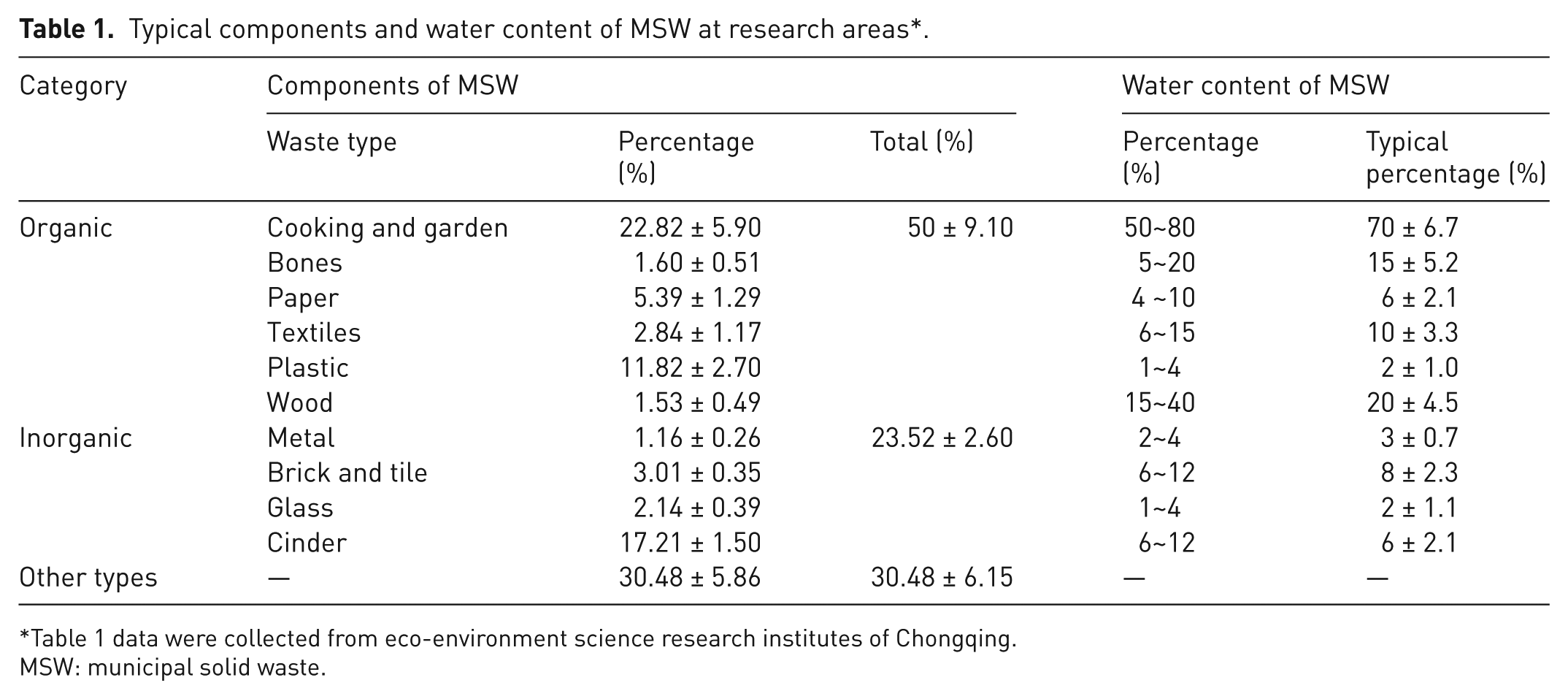
Table 1 data were collected from eco-environment science research institutes of Chongqing.
MSW: municipal solid waste.
During the degradation tests, two kinds of sample were prepared for the tests. (1) According to the typical constituent and moisture content in Table 1, the drilled sample was reconstructed with different organic, such as 10%, 20%, 35%, 50%, and 65%, respectively. The degradation velocity of waste with different organic content was studied; the size of the drilled sample was keep consistent with the degradation apparatus, and the average value of initial quality of reconstructed samples were 28.77, 22.13, 19.90, 17.71, 16.82, and 11.24 kg, respectively. (2) To investigating the effect of different temperature levels on the biodegradation properties, the drilled samples with representative organic content of 50% were prepared.
The gradation of the drilled sample was determined by using a set of three large sieves. The samples retained 46%, 23%, and 16% (by wet weight) of MSW on the 100 mm, 50 mm, and 20 mm sieves, respectively. Most of the traditional laboratory geotechnical testing equipment cannot accommodate MSW samples from the field with large particle sizes. Therefore, in order to facilitate standard laboratory testing, but with a representative field composition (Reddy et al., 2009), the MSW samples were shredded using a slow-speed, high-torque shredder (Shred Pax Corp., AZ-7H, Wood Dale, IL) and their gradation was determined with sieves (sizes: 100 mm, 50 mm, 20 mm, 10 mm, and 5 mm), the size of shredded waste particles was no more than 300 mm. All laboratory tests were conducted in accordance with Standard ASTM soil procedures (the typical gradation of MSW was shown in Appendix A, available online).
Methods
Biodegradation apparatus operation procedure
A special biodegradation apparatus (an improved version of Reddy’s apparatus) with dimensions of 500 mm × 500 mm was prepared to ensure a reasonable simulation (Figure 1). The size of this apparatus is larger than the one used by Reddy et al. (2011) (127 mm × 508 mm). To better understand the effect of temperature on the biodegradation of MSW, the operation procedure for the biodegradation test was shown as follows.
Before the biodegradation, the air tightness of the apparatus was examined, which ensured no biogas could leak out during tests.
Before the biodegradation test, the initial weight of the prepared sample was carefully measured by the weight-graph; the variation of MSW weight, biogas production, and leachate production were recorded each day during test, and the biodegradation rate could be conducted from it.
The daily gas production was measured with wet gas meters (Shinagawa Corporation, Japan); the composition of biogas was analysed by using an HP 6850 gas chromatograph equipped with a thermal conductivity detector. The volume of biogas was evaluated by a water displacement method using a gas collection tube prior to the gas measurement device.
A closed landfill condition was simulated in this study. In order to simulate the weight of closed landfill coverage, a weight equal to the press of 3 kPa was applied at a time after the space of the biodegradation apparatus was filled. The external press was transmitted to the surface of the specimens with the aid of a loading transmitted plate; a highly permeable natural drainage medium (15 cm of coarse gravel) was placed at the bottom of the apparatus as the filter layer.
The variation of settlement could be recorded by using a dial gauge fixed in the biodegradation apparatus. As the volume of waste changed during the biodegradation process, the vertical displacement was transmitted to the load support plate, which eventually caused the change of dial gauge.
The changing external temperature was simulated by adjusting the water tank in the apparatus, which connected the hot water circulating pump. Meanwhile, the temperature of the tank water was also monitored so as to keep consistent with true temperature conditions as far as possible.
The leachate was carefully collected using a measuring flask, and the weight of it was calculated by weight-graph. In this study, the biodegradation rate λm can be calculated using equation (1) (proposed by Andersland et al., 1981; Erses et al., 2008; Liu et al., 2011), which is defined as:
where λm was the degradation rate; Vλ(t) was the degradation ratio when the time (t) changed from i-1 to i; λi was the degradation rate when time was i, and λi-1 was the degradation rate when time was i-1.

Biodegradation apparatus.
Temperature operations
Previous researchers have suggested that heat can be generated by either the decomposition of degradable matters or by the hydrolysis reaction of MSW’s carbohydrate matters. As a result of continuing bio-chemical reaction in the waste, temperatures in landfills may range from 15 °C to 60 °C throughout a wide depth in landfills (Coccia et al., 2013; Hanson et al., 2005, 2009; Townsend et al., 1996; Yeşiller et al., 2005). To systematically study the effect of temperature on MSW biodegradation, three kinds of controlled temperature condition were performed during the biodegradation test. (1) By adjusting the temperature of the water tank in apparatus, the effect of varied environmental temperatures on the biodegradation was considered (temperature dates were obtained from an atmosphere observation station and the monitored temperature risen, to 45 °C in October 2012 from 5 °C in September 2011, located in Chongqing, China). (2) Different constant temperature fields were considered by keeping water temperatures at different constant values (20 °C, 25 °C, 30 °C, 35 °C, 40 °C, 45 °C, and 50 °C). (3) To neutralise the effect of external temperatures, the temperature of the tank water was maintained at a constant 20 °C (Yeşiller et al., 2005), and the correlation between settlement with leachate was studied. During the degradation test, three kinds of controlled temperature were conducted and the correlation of temperature with biodegradation was clarified. All laboratory tests were conducted in accordance to Standard ASTM soil procedures.
Degradation test
Many researchers have suggested that organic content in waste mass depends mainly on local life and consumption habits, which can vary significantly from landfill to landfill; both spatially and temporally varied from 22.3% to 68% in China (Zhan et al., 2008). To adequately replicate the full complexity of field conditions is difficult; only the temperature effect was considered in this study. Meanwhile, a bioreactor apparatus was used to simulate the physicochemical properties and decomposition reaction under anaerobic conditions (see Figure 1) and significant care was taken to exercise operational control. To ensure the date validation, the experiment was performed with three parallels; 15 samples (each test had three parallel specimens) were prepared for the biodegradation test. In addition, except for some large particles of refuse, such as fibre, textile fabric, etc., most of the MSW composition was not shredded. As the drilled sample was transported to the laboratory (on the right day), it was directly loaded onto the gravel layer at the bottom of the biodegradation apparatus, which manually compacted in thin lifts to simulated the daily weight coverage of landfill. Three kinds of temperature-controlled biodegradation tests were performed. During the variety of temperature-controlled tests, the drilled sample with typically 50% organic content was chosen for the tests, and the initial average dry density was 620 kg m−3. During the constant temperature-controlled tests, five different reconstructed MSW specimens with a wide range of organic content (10%, 20%, 35%, 50%, and 65%) were prepared for the laboratory tests. To study the correlation of settlement with leachate production, the effect of the temperature was neutralised; the temperature of the water tank was kept at 20 °C. During three kinds of biodegradation tests, the closed landfills condition was simulated and no leachate recirculation was performed during the test. Leachate and biogas samples were collected during the biodegradation process, and the gas composition (O2, CH4, CO2, N2) was analysed using an HP 6850 gas chromatograph equipped with a thermal conductivity detector. Finally, leachate samples were analysed for pH using an HP 402 gas chromatograph.
Results and discussion
Effect of temperature on biodegradation
The effect of variation temperature on the biodegradation properties of MSW was studied. Figure 2(a) shows that as external temperature increased from 5.5 to 17.5 °C in the first phase (0 to 90 days), the leachate production reached a peak value of 210 ml and then decreased to 87.81 ml after 17 days (Figure 2(b)). The change in leachate production may be attributed to the initial external compression and inner biochemical reactions, as well as fibre and cellulose carbohydrate hydrolysis. Meanwhile, the percentage of carbon dioxide in the biogas reached a peak value of 38% owing to the hydrolysis reaction (0 to 90 days). Under aerobic conditions, fibre, cellulose, and other substrates were gradually oxidised to the carbon dioxide. However, with more carbon dioxide dissolved in the leachate, rapid polymer hydrolysis happened and the value of accumulated carboxylic acids increased, which lead to the decrease of pH value (ranged from 9.18 to 5.9, see Figure 2(d)). According to the value of monitoring biogas, the temperature’s effect on the degradation of waste mass was minimal at this stage, and the change of settlement could be mainly dependant on the voids ratio, material physical size, stiffness, etc. (Figure 2(c)).
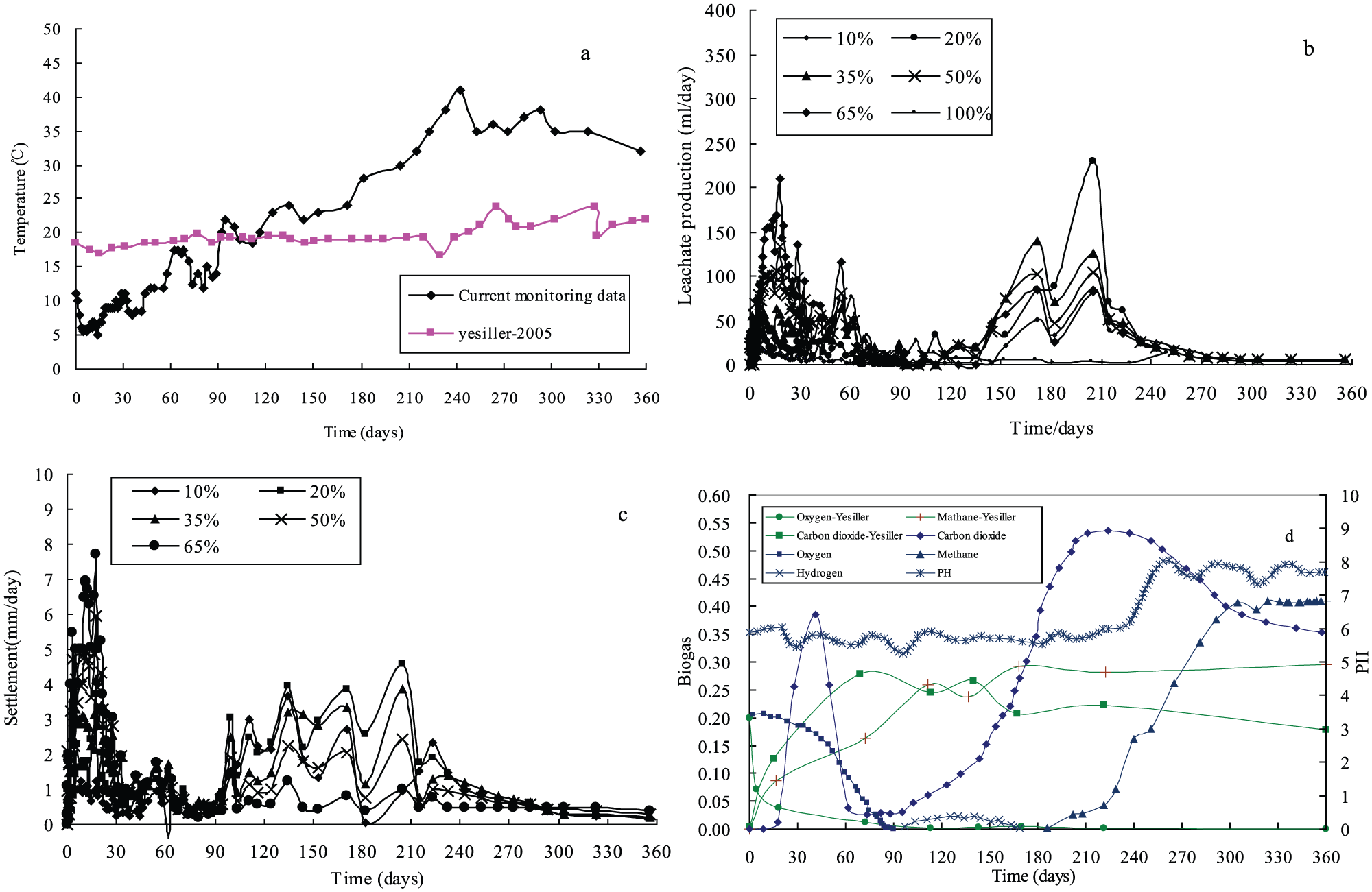
Variation of temperature-leachate production–settlement–biogas–pH vs. time.
In the second phase (90 to 180 days), the residual oxygen was exhausted in the bioreactors after the 90-day mark, and a large amount of methane, carbon oxygen, and a little hydrogen gas were produced. As the level of bicarbonate ions increased, the pH value gradually decreased and held at a low level (5.25 to 5.9) owing to the dissolved carbon dioxide in the leachate, and the biodegradation condition in the bioreactors gradually transformed to the transition-acids phase (Figure 2(d)). With continuing the oxidation reaction of the refuse, more carbon dioxide, methane, and organic acids (such as propionic acid, butyric acid, acetic acid, etc.) were produced during this stage. Presuming that the organic acid was produced under good chemical equilibrium conditions in the waste, and was not accumulated, part of it would transform into hydrogen gas under the thermo-hydrogenium, which was why little hydrogen gas was produced between 90 and 165 days. However, the test date has proved that the range of temperature (12 °C to 22 °C) made little effect on the degradation of the waste mass at this stage (the detected methane was minimal, see Figure 2(d)).
Between 180 to 360 days, the field temperature increased to a suitable range (22 °C to 45 °C). Along with the process of biodegradation, a large amount of hydrogen and carbon dioxide converted to methane under the effect of the methanogens. Meanwhile, as more fat, alcohol, and organic acids were produced as the matter further decomposed, the value of the pH level gradually increased from 5.25 to 8.2. The biogas production indicated that the temperature range between 22 °C to 45 °C was favourable for methanogen bacteria production, which exercised a great influence on the biodegradation of the refuse in the anaerobic phase, and the corresponding leachate production reached a peak value of 39.05 ml day−1 owing to the fact that the biodegradation accelerated (leachate production represented the ‘M’ type).
To identify the temperature effect on the biodegradation of MSW, a comparison of this study with a previous study was performed. It should be noted that the range of temperature in this study was collected from an atmosphere station, which is higher than the temperature reported by Yeşiller et al. (2005) (temperature data were collected from the shallow covered layer of landfill). Figure 3(d) shows that the trend for the exhausting of residual oxygen in this study was similar to Yeşiller et al.’s results during the processing of biodegradation. Reddy (2011) reported that the residual oxygen in the waste could prevent the growth of methane bacteria, and methane production was inhibited in the aerobic phase. In this study, the methane was not monitored in the aerobic phase and the biogas reached a peak value of 38% of total biogas and then decreased to 2.5% during the aerobic phase. Compared with Yeşiller et al.’s results, where the production of methane and carbon dioxide was gradually stable after 120 days, which was ahead of the 180 days in the current tests. The value of leachate, settlement, and biogas production (Figure 2) illustrated that the temperature range between 22 °C and 45 °C proved to be a thermophilic range, which could influence the bio–chemical reaction and enhance the biogas production under anaerobic conditions (Coccia et al., 2013).
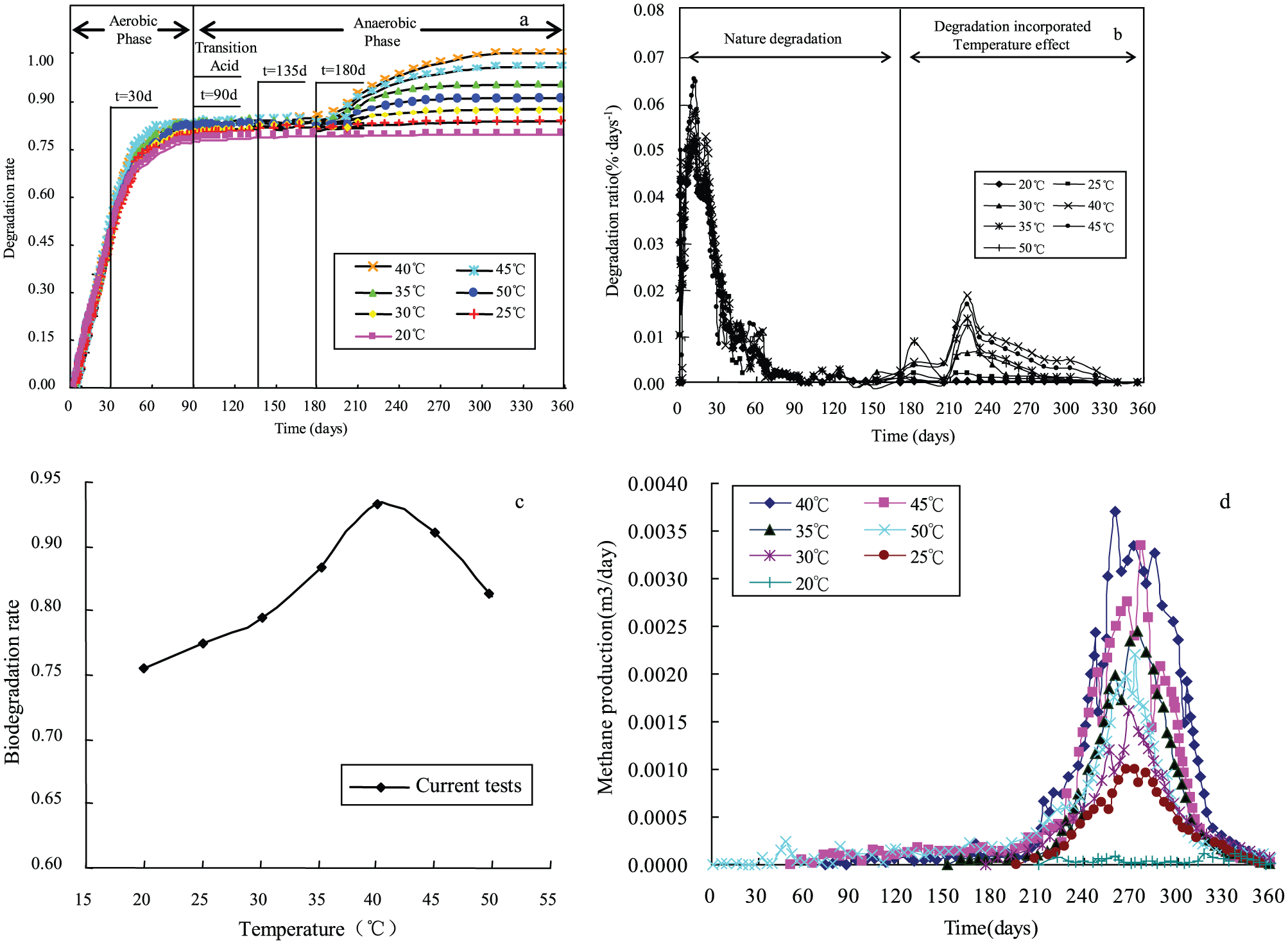
The curves of degradation ratio and degradation rate vs. time.
Degradation ratio model of MSW
Biodegradation tests were conducted in the laboratory and the correlation of temperature on the decomposition was studied. Un-shredded MSW samples (the representative organic content was 50%) were chosen in order to study the biodegradation properties of the MSW under the respective temperature field (20 °C, 25 °C, 30 °C, 35 °C, 40 °C, 45 °C, and 50 °C) during the aerobic and anaerobic phases (0 to 360 days). The organic fraction of waste mass was diligently recorded to calculate the degradation rate. According to the equation of degradation rate (λm), the degradation ratio (Vλ(t)) can be defined by:
where λm was the degradation rate; Vλ(t) was the degradation ratio when the time (t) changed from i-1 to i; λi was the degradation rate when time was i, and λi-1 was the degradation rate when time was i-1.
According to the monitored data of methane gas production and weight variation, the biodegradation rate can be determined using equation (1). Figure 3(a) and (b) shows the biodegradation process of waste mass tending towards to stability after 90 days. In this stage (0–90 days), the curve of calculated biodegradation rate and biodegradation ratio was conformed to the natural decomposition process as the corresponding temperature was 20 °C; meanwhile, the monitored methane gas was limited before 90 days. These dates indicated that the change of external temperature has little effect on the biodegradation and the biodegradation process was time depended in this phase. The change in biodegradation properties may be attributed to the quick decomposition of easy degradable matters in the waste owing to the hydrolysis and biochemical reaction in the aerobic and partial anaerobic phase.
As biochemical reaction continues in the waste mass, the curves both for biodegradation rate and methane gas production represent a second increase, as corresponding temperature ranged from 25 °C to 50 °C (see Figure 3(a) and (d)); compared with a temperature range of 20 °C to 35 °C, the time of methane gas production is advanced as corresponding temperature ranged from 40 °C to 50 °C. Meanwhile, the biodegradation rate and methane gas reached the maximum of 0.94 and 0.0037 m3 as the corresponding temperature was 40 °C. Figure 3(c) shows the biodegradation rate increased from 0.75 to 0.94, and then decreased to 0.83 as the corresponding temperature increased from 20 °C to 50 °C, and the biodegradation rate reach the maximum of 0.94 as the corresponding temperature was 40 °C. Figure 3(d) shows the methane gas production reached a peak interval as the temperature ranged from 25 °C to 50 °C during 180 to 360 days. Despite negligible other affecting factors, the influence of temperature on the biodegradation was pointed out.
These data illustrate that the reasonable temperature range of 25 °C to 50 °C was in favour of methane bacterial production, with more methanogenesis produced in the anaerobic phases, more methane gas and carbon dioxide produced owing to the quickly decomposed of fat, alcohol, and organic acids in the waste mass; meanwhile, as more methane gas was generated in the early stage (0 to 180 days), the later output reduced as time ranged from 180 to 360 days (Figure 3(d)). Test results indicated that by using the vertical and horizontal heat generation system in the modern landfills with proposed temperature zones, the process of biodegradation of waste in the anaerobic phase could be in advanced.
On the basis of the foregoing theories and monitored data of biodegradation test under the different constant temperature fields, the calculated degradation rate and degradation ratio were agreed with the natural decomposition process with a temperature field of 20 °C (shown in Figure 4(a) and (b)) and the law for degradation rate can be expressed as (Liu et al. 2011):
where λm was the degradation rate; t was the degradation times; and a, b were empirical constants relating to the degradation condition.
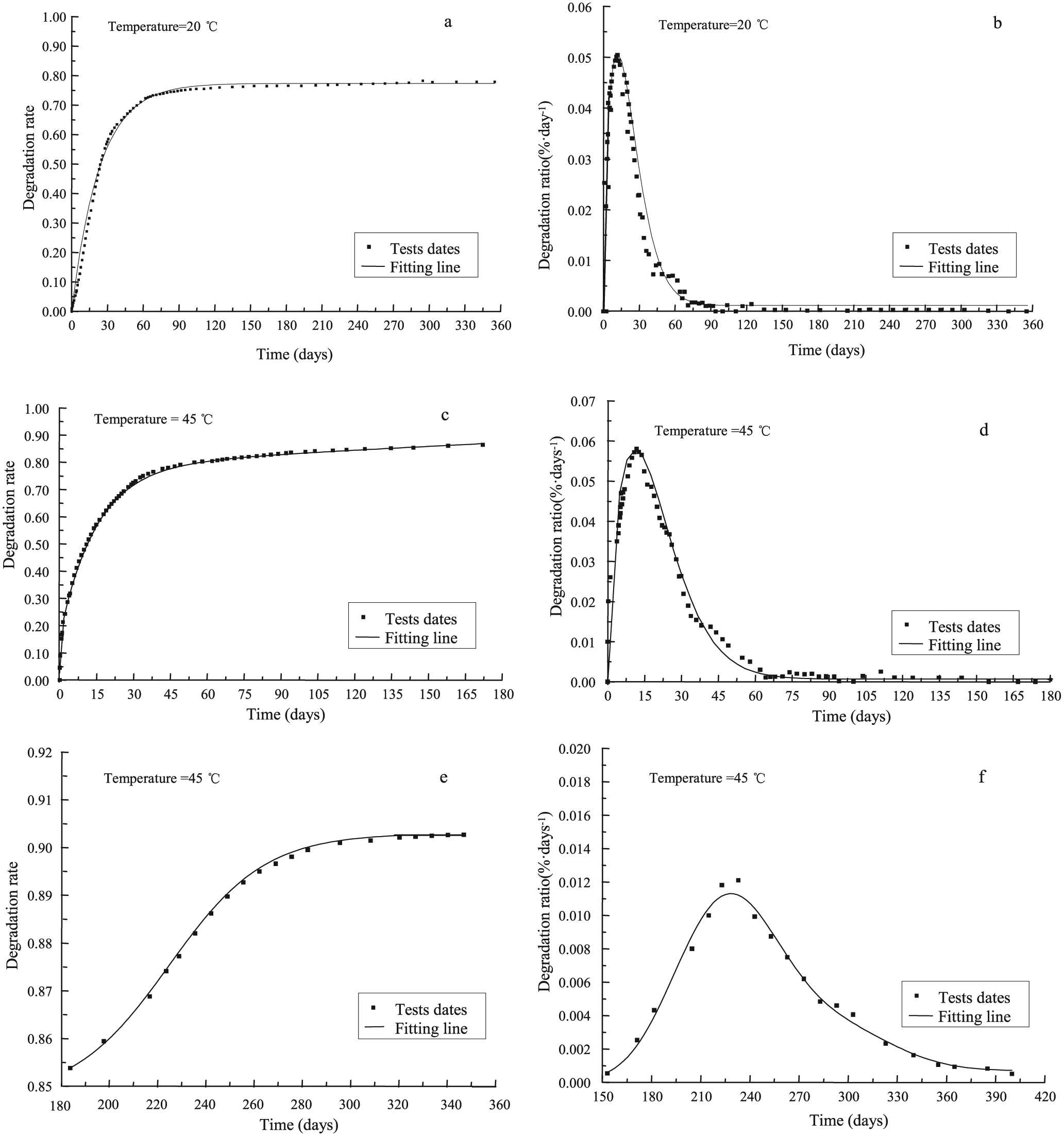
The curves of degradation rate and ratio vs. time under the natural degradation.
The degradation ratio was obtained from the derivation of equation (3):
The properties of the biodegradation that incorporated the temperature effect were analysed and the test curve both for calculated biodegradation ratio and rate under the external temperature of 45 °C were presented (Figure 4(f) and (c)). An empirical formula that could better demonstrate the degradation properties incorporating the temperature effect between 180 and 360 days was proposed:
where λm was the degradation rate; λ0 was the degradation rate at 180 days; t0 was 180 days in this study, t⩾t0; T was the temperature; a1 was the degradation constants; b1, b2 were empirical constants that relate to the degradation condition; and the value of λ0 and t0 was the degradation rate and time before the temperature increased to an optimal range for thermophilic methane bacteria development in the anaerobic degradation.
The fitting values for a, b, a1, b1, a2, b2 were obtained from the degradation tests of different temperature fields. During the natural degradation process, when compared with the temperature value, the value of a was between 0.0155 and 0.0174; and b remained constant at 10. Considering the effect of temperature on the degradation process between 180 and 360 days, the value of a1 was between 0.015 and 0.128; b1 was between 54 and 80; a2 was between 0.66 and 0.90; b2 was between 0.09 and 0.16 (Table 2).
Best fitting value for parameters of the degradation model.
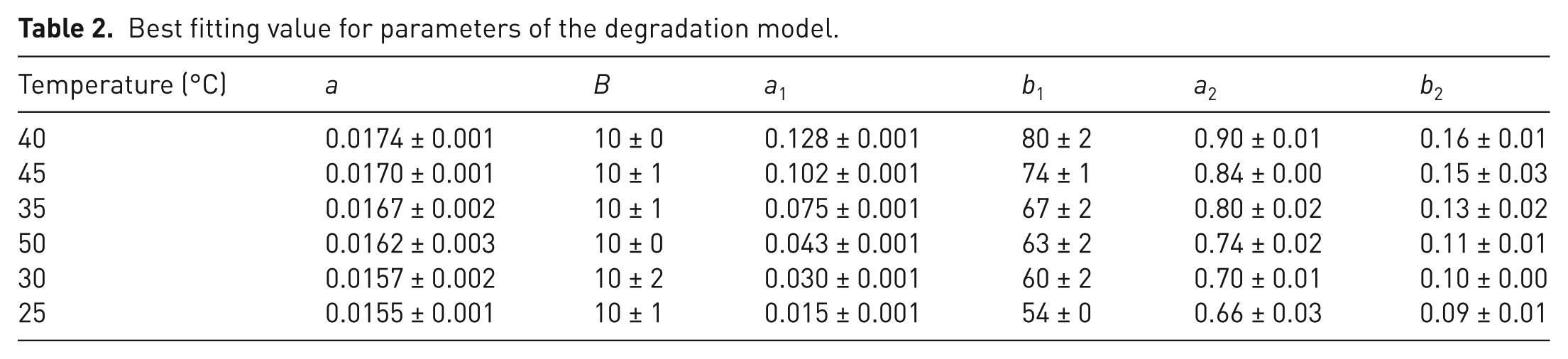
The parameters listed in Table 2 correspond to the MSW with 50% organic content, and as a result, they were used to calculate the biodegradation rate under the different temperature fields. As Figures 3 and 4 show, the effect of the temperature on the degradation of the MSW was limited when it was below 20 °C, the decomposition process could be considered as natural degradation, and equation (3) was proposed; since the temperature had a significant impact on the biodegradation, equation (5) was proposed.
Correlation of leachate with settlement
To simulate the closed landfills condition, the biodegradation apparatus was completely sealed and the external temperature was kept at 20 °C (the effect of temperature could be eliminated as it was 20 °C, as reported by Yeşiller et al., 2005). The loading equal to the coverage press was applied after the space of biodegradation apparatus was filled. The leachate production, owing to the bio–chemical reaction, is an important factor in estimating the settlement of the MSW (Barlza et al., 1987; Elagroudy et al., 2008); the correlation of leachate production with settlement was identified in this study. The specimens of MSW with different organic content (10%, 20%, 35%, 50%, 60%, and 100%) were prepared for the biodegradation test.
Figure 5(a) shows that, in the first phase (0 to 90 days), the value of leachate production continually increased as the of organic content in the waste increased; the leachate reached a peak value of 62.5 ml at 65% and then decreased to 38.2 ml. In the second phase (90 to 360 days), the production of leachate declined from 39.05 ml to 18.27 ml once the organic content exceeded 20%. In addition to the leachate production caused by the biochemical and hydrolysis reactions, the external physical compression could cause part of the leachate overflow, especially because of the high organic content of the MSW. Figure 5(b) shows that the average value of settlement varied from 0.69 to 2.71 mm in the aerobic phase (0 to 90 days) in accordance with the organic content growth (10% to 65%). However, the average value of the settlement increased from 1.30 mm to 1.87 mm and then decreased to 0.58 mm in the anaerobic phase (90 to 360 days).

Variation of organic content vs. average leachate production and settlement.
The value of leachate production and settlement indicated that the initial roller compaction could cause an overflow of pore water and nutrient liquid of refuse, and accelerate the settlement of the MSW in the aerobic phase, especially for the waste with a high organic content. However, as the decomposition of refuse continued in the aerobic phase (90 to 360 days), a declined trend for both leachate and settlement was observed. These data demonstrated that the decreased biodegradation rate and settlement may be attributed to the decreased anaerobic biochemical reaction, as a result of lacking substrates and nutrients in the anaerobic phase.
Conclusions
On the basis of the laboratory-scale tests, the effect of temperature on biodegradation properties was studied during the course of the 360-day survey, as well as settlement. The following conclusions can be drawn from this study.
Two kinds of temperature-operated biodegradation tests indicated that 22 °C to 45 °C was a more proper temperature range, which was in favour of enhancing the degradation velocity of waste in the anaerobic phase.
Enhancing the mechanical deformation in the aerobic phase by using the external pressure could cause overflowing leachate of waste mass, which eventually caused a decrease in biochemical reaction during the anaerobic phase.
A biodegradation ratio model was proposed, and it was proved to be suitable for predicting the biodegradation level of waste when considering the temperature effect.
Footnotes
Declaration of conflicting interests
The authors declared no potential conflicts of interest with respect to the research, authorship, and/or publication of this article.
Funding
The authors disclosed receipt of the following financial support for the research, authorship, and/or publication of this article: The authors would like to acknowledge the financial support from research grants provided by the China Post-doctoral Science Found [No.2015M570296].
References
Supplementary Material
Please find the following supplemental material available below.
For Open Access articles published under a Creative Commons License, all supplemental material carries the same license as the article it is associated with.
For non-Open Access articles published, all supplemental material carries a non-exclusive license, and permission requests for re-use of supplemental material or any part of supplemental material shall be sent directly to the copyright owner as specified in the copyright notice associated with the article.
