







Abstract
The most viable option for biostabilisation of old sanitary landfills, filled with raw municipal solid waste, is the so-called bioreactor landfill. Even today, bioreactor landfills are viable options in many economically developing countries. However, in order to reduce the biodegradable component of landfilled waste, mechanical and biological treatment has become a widely accepted waste treatment technology, especially in more prosperous countries. Given that mechanical and biological treatment alters the geotechnical properties of raw waste material, the design of sanitary landfills which accepts mechanically and biologically treated waste, should be carried out with a distinct set of geotechnical parameters. However, under the assumption that ‘waste is waste’, some design engineers might be tempted to use geotechnical parameters of untreated raw municipal solid waste and mechanical and biological pre-treated municipal solid waste interchangeably. Therefore, to provide guidelines for use and to provide an aggregated source of this information, this mini-review provides comparisons of geotechnical parameters of mechanical and biological pre-treated waste and raw untreated waste at various decomposition stages. This comparison reveals reasonable correlations between the hydraulic conductivity values of untreated and mechanical and biological pre-treated municipal solid waste. It is recognised that particle size might have a significant influence on the hydraulic conductivity of both municipal solid waste types. However, the compression ratios and shear strengths of untreated and pre-treated municipal solid waste do not show such strong correlations. Furthermore, another emerging topic that requires appropriate attention is the recovery of resources that are embedded in old landfills. Therefore, the presented results provide a valuable tool for engineers designing landfills for mechanical and biological pre-treated waste or bioreactor landfills for untreated raw waste as well as planning landfill mining projects.
Keywords
Introduction
With increasing awareness of environmental protection, various municipal solid waste (MSW) pre- and post-treatment techniques have been developed. Their mutual goal is to reduce the impact and amount of disposed waste to the environment.
Of the widely accepted post-treatment techniques for older sanitary landfills filled with raw untreated MSW, the most viable option is the so-called bioreactor landfill. A bioreactor landfill operates in a manner to minimise environmental impact and optimise waste decomposition through intensive leachate recirculation (Reinhart and Townsend, 1998). Moreover, another emerging post-treatment technique of old sanitary landfills is landfill mining (Greedy, 2016). The proper design of both bioreactor landfills and landfill mines requires proper knowledge about the geotechnical parameters of raw untreated waste material at various decomposition stages. While bioreactor landfills are currently the most viable option only in economically developing countries, the recovery of resources that are embedded in old landfills – landfill mining – has received increased attention in the most developed countries.
One of the widely accepted pre-treatment methods is the mechanical and biological treatment (MBT) process. During mechanical treatment, coarser waste particles are screened out or shredded into smaller pieces. Further size reduction and a change of the waste structure are mainly achieved with subsequent biological treatment. As a consequence, the mechanical and biological (MB)-pre-treated waste usually has a finer and more homogenous particle distribution compared with raw untreated waste material.
Regardless of whether landfilled MSW has been pre-treated or is going to be post-treated, the main objective of proper landfill design is the assurance of pertinent functioning of all landfill components, not just within the operational period, but also in the post-closure period. Improper landfill design could lead to the loss of the integrity of lining systems and subsequently to the loss of overall landfill stability, which would present a significant environmental hazard.
From the perspective of civil engineering, sanitary MBT/bioreactor/mine landfills can be viewed as artificial embankments and slopes where the main building block is MSW. As both types of waste materials – pre- and post-treated – are strongly heterogeneous in nature, establishing the appropriate design parameters of distinct waste material can be a demanding task. Consequently, by assuming that ‘waste is waste’, one might be tempted to treat the mechanical parameters of pre- and post-treated MSW interchangeably. By following the mentioned assumption, the risk of disregarding fuzziness in the mechanical properties of the pre- and post-treated MSW is significant.
Therefore, the examination and critical estimation of the geotechnical properties of waste material, by taking into consideration the type of structure that has to be built (MBT/bioreactor/mine), are of substantial importance to a qualified design process.
The geotechnical parameters of MB pre-treated MSW were examined by Ziehmann (1999), Bidlingmaier et al. (1999), Duellmann (2002), Kuehle-Weidemeier and Doedens (2003), Carrubba and Cossu (2003), Boni et al. (2006), Bauer et al. (2006, 2007), Entenmann and Wendt (2007), Olivier and Gourc (2007), and more recently by Bhandari and Powrie (2012), Siddiqui et al. (2012, 2013a, 2013b), Pimolthai and Wagner (2014) and Sivakumar Babu et al. (2015).
According to Reddy et al. (2011), very few studies focused on geotechnical parameters of raw untreated MSW at various degrees of decomposition (DOD): e.g. Kavazanjian (2001), Kavazanjian et al. (2001), Hossain (2002), Hossain et al. (2009), Hossain and Haque (2009), Dixon and Langer (2006), Gabr et al. (2007), Bray et al. (2009), Reddy et al. (2009a, 2009b, 2011) and more recently by Reddy et al. (2015) and Lakshmikanthan et al. (2015).
Operating principles of MBT processes
Various mechanical treatment processes have been designed in order to separate different waste streams prior to biological treatment. Some steps included in mechanical treatment are hand sorting, screening, shredding, ballistic separation and magnetic separation. The first treatment step is commonly based on a mechanical separation of biodegradable organic components and recyclable materials, such as plastic, metals, glass, paper and cardboard. In this step, a stream of mainly biodegradable organic matter, along with small inert material that cannot be separated, is obtained. After mechanical treatment, aerobic or anaerobic biological treatment takes place.
With respect to aerobic treatment, there are two distinctive treatment processes: composting and biodrying. Biodrying usually occurs immediately after the biodegradable organic components have been mechanically separated in order to preserve its calorific value. After drying, subsequent mechanical treatment processes permit the production of high-calorie fuel. As opposed to biodrying, composting usually takes place only after mechanical treatment is completed. The composting process leads to the complete decomposition of easily degradable organic matter. Ultimately, regardless of the specific MBT process used, a remaining non-recyclable waste stream has to be landfilled.
Operating principles of bioreactor landfills
Bioreactor landfill technology involves injecting leachate into the waste mass to accelerate or enhance the anaerobic biodegradation of raw untreated MSW. There are two main operating conditions that must be maintained:
the moisture content must be held at field capacity, and
the pH must remain nearly neutral.
As opposed to dry-tomb landfills, bioreactor landfills offer a sustainable way to achieve higher rates of MSW decomposition and faster reduction of leachate and landfill gas pollution potential. In parallel, the decomposition of organic waste matter changes the composition of the solids matrix of MSW. With the drastic changes in solids composition and increased moisture content, the mechanical behaviour of bioreactor MSW is going to change as decomposition continues.
The generally accepted decomposition stages that leachate undergoes in a bioreactor landfill were defined by Pohland and Harper (1986). These stages are as follows.
Stage 1: Initial adjustment or aerobic phase. Moisture is added and the waste supports an active microbial community. This phase continues for a very short period of time, and mainly nitrogen and carbon dioxide are produced during this phase. Methane production is not observed in this stage.
Stage 2: Transition phase. All the oxygen is consumed by the bacteria, and production of carbon dioxide takes place. Both chemical oxygen demand (COD) and total volatile acids (TVA) appear in the leachate.
Stage 3: Acid formation phase. Acid-forming bacteria convert these molecules into short chain carboxylic acids, alcohols, carbon dioxide and hydrogen. This results in a lower pH. Both COD and TVA in the leachate are maximised.
Stage 4: Methane fermentation phase. Acids are consumed and converted into methane and carbon dioxide. Heavy metals are removed from the leachate by complexation and precipitated onto the remaining solids.
Stage 5: Final or maturation phase. Biological activity diminishes along with diminished gas production. Leachate strength is at much lower concentrations than in all previous stages. However, the concentrations of CH4 and CO2 in Stages 4 and 5 remain approximately the same.
Scope of article
In this work, a mini-review of the geotechnical parameters (i.e. hydraulic conductivity, consolidation coefficient, oedometric modulus, compression indices, cohesion, shear friction angle and tension angle) of MB pre-treated MSW and raw untreated MSW at known decomposition stages are presented and compared. Furthermore, the influence of biodegradation on particle size is also discussed.
Categorical evaluation
Influence of biodegradation on particle size distribution
Kuehle-Weidemeier (2007) argues that the granulometry of MB pre-treated waste material is mainly affected by the mechanical treatment process because large/coarse waste components were removed by sieving or reduced to smaller pieces by shredding. He also recognises that the influence of biological treatment on the particle size distribution, in contrary to the mechanical treatment, is negligible. The exception is for fractions less than 20 mm where clear refinement of particles owing to biological treatment can be noticed. Furthermore, he also found that, with respect to the mass content, the fraction of particles in the range of 0–20 mm prevails, followed by the fraction of particle in the range of 20–40 mm, and the fraction of particles larger than 40 mm represents only a small share of the mass content of the MBT-output.
A similar distribution of mass content in MB pre-treated waste was also confirmed by the author’s research (Petrovic et al., 2014). The particle size distribution curves for MB pre-treated MSW presented in Figure 1 were established from two (denoted as A and B) air dried samples with residual moisture contents of 7% in accordance with the Croatian standard testing procedure HRN.U.B1.018 (1980). As can be seen from Figure 1, the mass content of particles larger than 20 mm in samples A and B are 3% and 7%, respectively.
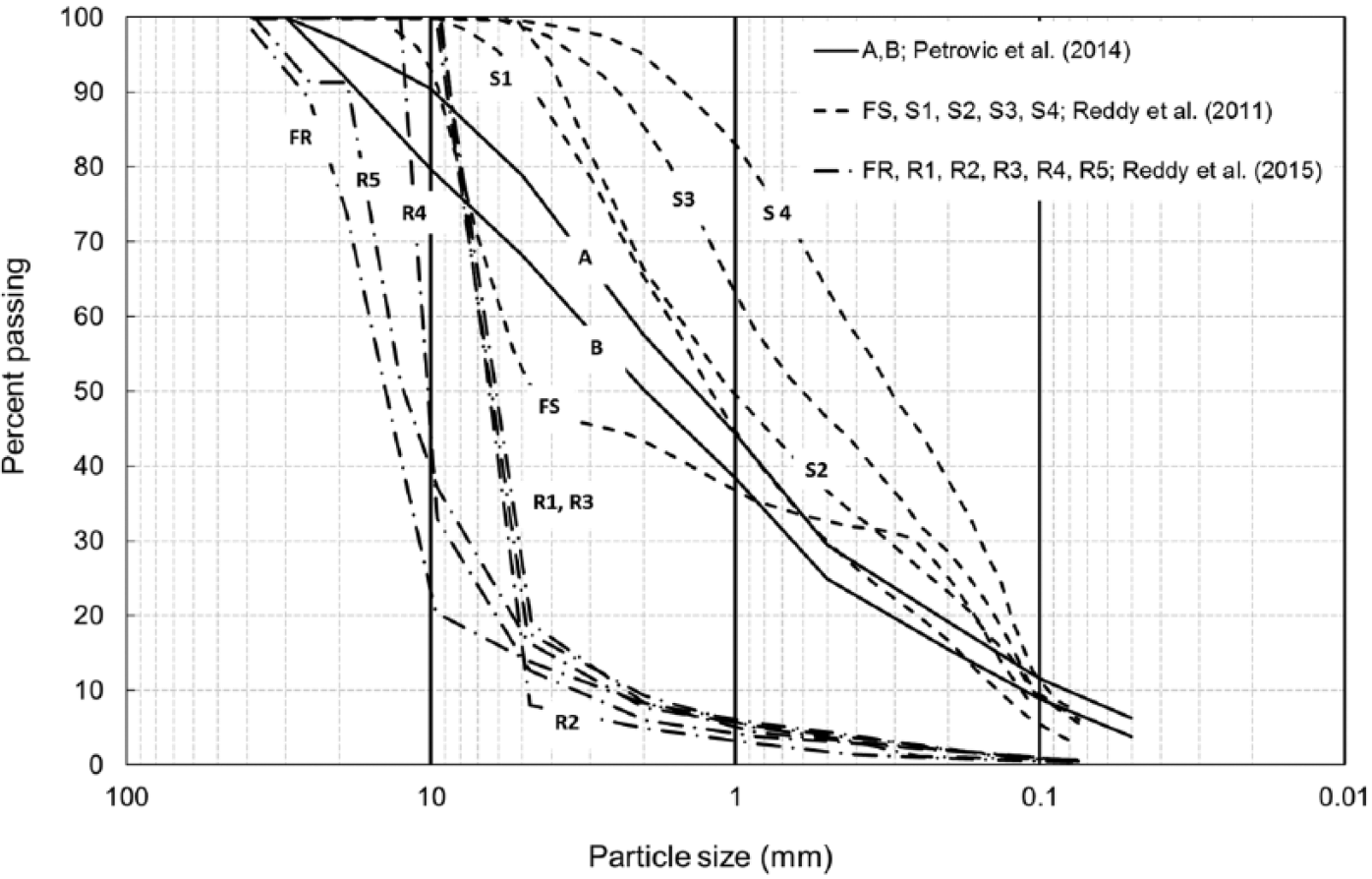
Particle size distribution curves for MB treated MSW and raw MSW.
Research on synthetic and real raw untreated waste conducted by Reddy et al. (2011, 2015) revealed that particle refinement of raw untreated waste material caused by the decomposition process also takes place (Figure 1). The decomposition phases of synthetic waste are identified as fresh (FS), anaerobic acid (S1; DOD = 50%), accelerated methane (S2; DOD = 53%), decelerated methane (S3; DOD = 70%) and methane stabilisation (S4; DOD = 86%). The decomposition phases of real waste (collected from the working phase of Orchard Hills Landfill) are identified as the initial stage (FR), stage R1 (DOD = 43%), stage R2 (DOD = 45%), stage R3 (DOD = 53%), stage R4 (DOD = 56%) and stage R5 (DOD = 73%). Figure 1 reveals that the particle size of synthetic raw untreated MSW continuously decreases as decomposition occurs. The particle size of real raw untreated MSW also decreased as decomposition continued, during which the percentage of particles smaller than 10 mm in the highly decomposed sample (R5) doubled with respect to the initial stage.
Although the particle size distribution curves indicate that fresh synthetic raw MSW (FS), was a gap-graded material, those gaps clearly diminished during the decomposition process. Furthermore, with respect to the considered MB pre-treated MSW and synthetic raw untreated MSW, Figure 1 also reveals that the examined real raw untreated MSW is coarser and more uniformly graded. However, the transition from poorly graded to well-graded, as in the case of synthetic raw untreated MSW, was not observed. By taking into consideration the mentioned features, it can be anticipated that the real raw untreated MSW tested by Reddy et al. (2015), being coarser and more uniformly graded, is going to be more permeable and compressible than MB pre-treated and/or synthetic raw untreated MSW.
Hydraulic conductivity
In general, the hydraulic conductivity of any porous media is primarily a function of the interconnected void space. Reddy et al. (2009a) examined raw untreated MSW for the dependency of hydraulic conductivity on particle size distribution. They have found that at comparable dry unit weight, the hydraulic conductivity obtained for decomposed waste was slightly lower than that of fresh waste material, which can be attributed to the difference in their particle-size distribution caused by biodegradation. Furthermore, they argued that larger effective size (i.e. diameter for 10% passing) provides an indication of higher conductivity values for raw untreated MSW with fewer small particles. In addition, the authors demonstrated that tests conducted by Penmethsa (2007) also confirm the dependency of hydraulic conductivity on the particle size distribution of MSW. These results were reconfirmed by Reddy et al. (2011, 2015) for synthetic and real raw untreated MSW samples at various decomposition stages. The obtained results for both types of material show a clear dependency between hydraulic conductivity and DOD, and correspondingly on the increased number of smaller particles caused by decomposition.
In contrast, Powrie and Beaven (1999) established that the hydraulic conductivity resulting from particle size reduction and waste decomposition are essentially second order, but appear to be more significant at higher vertical effective stresses. What they found to be more important is a single correlation between vertical hydraulic conductivity and vertical effective stress in initial loading. This correlation has been confirmed by various studies: for raw bioreactor MSW at various DOD by Reddy et al. (2011, 2015), for MB pre-treated waste by Petrovic et al. (2011) and for raw untreated MSW by Gavelitė et al. (2015).
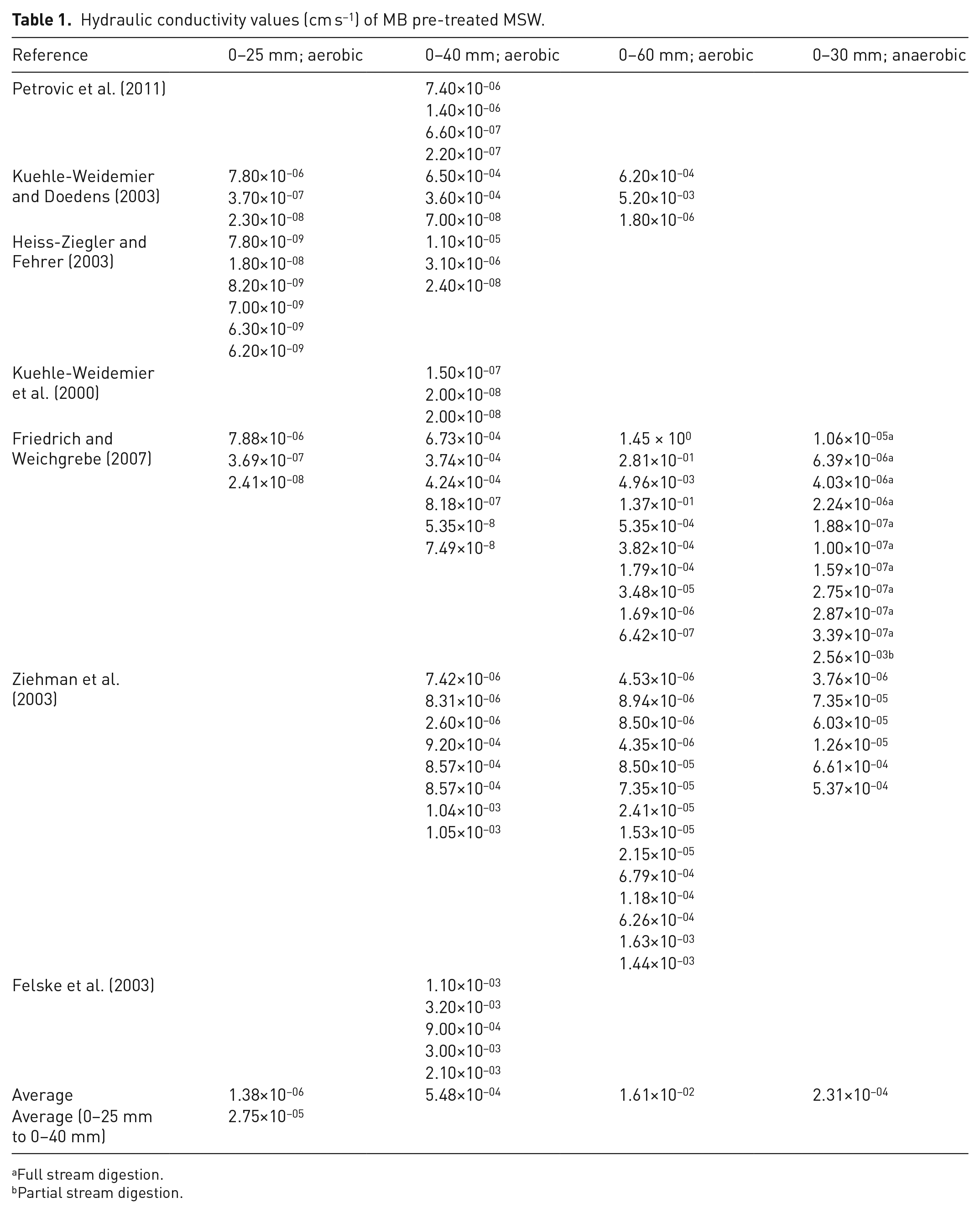
Considering that hydraulic conductivity is dependent on the particle size of MSW, Table 1 presents the average hydraulic conductivity values obtained for various fractions of MB pre-treated MSW. Furthermore, Figure 2 shows the average hydraulic conductivity values of MB pre-treated MSW and synthetic raw untreated MSW at various decomposition stages in relation to grain diameter at 60% passing (D60). The grain diameter at 60% passing (D60) for synthetic raw untreated waste was obtained from Figure 1 (Reddy et al., 2011); in contrast, the appropriate D60 values for different fractions of MB pre-treated MSW were obtained from Kuehle-Weidemeier (2007).
Hydraulic conductivity values (cm s−1) of MB pre-treated MSW.
Full stream digestion.
Partial stream digestion.
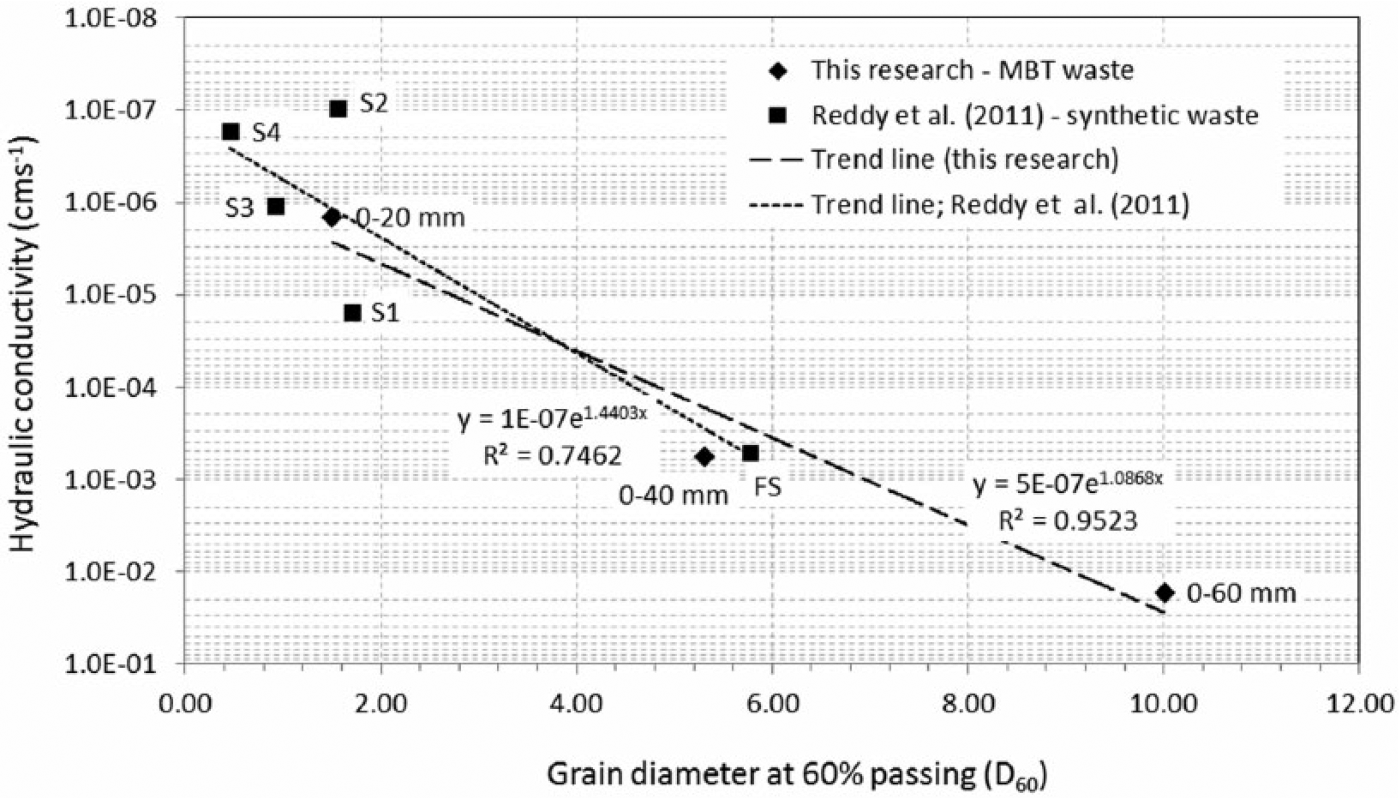
Correlation between average hydraulic conductivity values obtained for various fractions of MB pre-treated MSW and hydraulic conductivity values of synthetic raw untreated MSW at various DOD with grain diameter at 60% passing (D60).
Figure 2 and Table 1 reveal that the hydraulic conductivity of MB pre-treated MSW and raw untreated waste at various DOD directly correlates to their fraction size. As can be seen in Figure 2, the average hydraulic conductivity value of MB pre-treated MSW (0–40 mm fraction) is similar to those of slightly decomposed synthetic or raw untreated MSW, whereas the average hydraulic conductivity value of MB pre-treated MSW (0–25 mm fraction) is similar to that of well-decomposed synthetic raw untreated MSW. Figure 2 also reveals that the average hydraulic conductivity value of MB pre-treated MSW (0–60 mm fraction) is at least one order of magnitude higher than those of fresh synthetic MSW, suggesting no relevant comparison. Moreover, the average hydraulic conductivity value of anaerobically pre-treated MSW (0–30 mm fraction) is similar to that of slightly decomposed synthetic raw untreated MSW. However, a correlation between the D60 value and hydraulic conductivity values for real raw untreated MSW at various DOD (Reddy et al., 2015) could not be established.
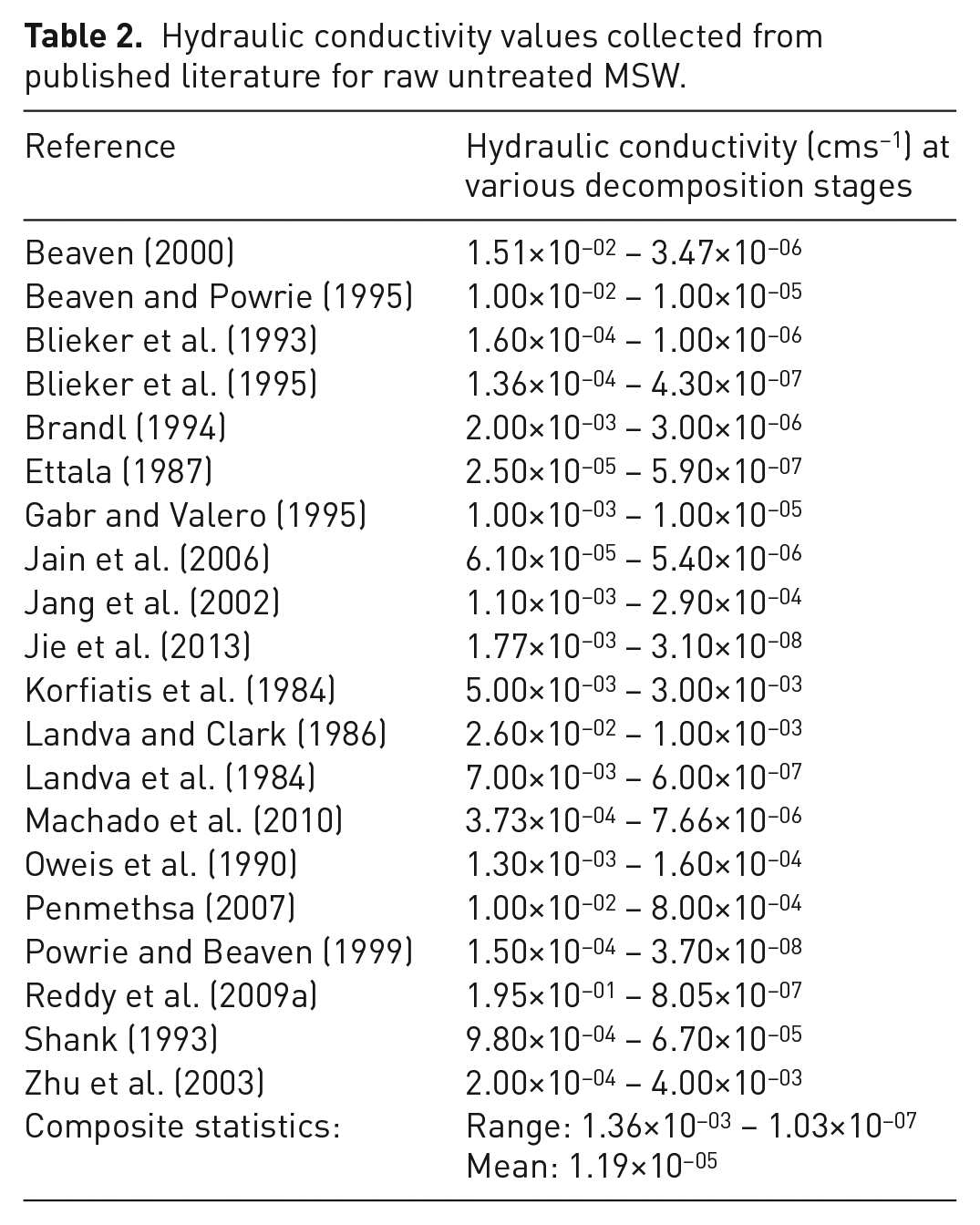
Table 2 summarises hydraulic conductivity values from various literature and the average hydraulic conductivity values of raw untreated MSW over various DOD. Figure 2 indicates that these values coincide reasonably well with the mean hydraulic conductivity value obtained from the 0–25 mm to 0–40 mm MB pre-treated MSW fraction range.
Hydraulic conductivity values collected from published literature for raw untreated MSW.
Compressibility
Analogous to soils, waste settlement is usually divided into three distinguished stages. The first stage corresponds to the immediate waste settlement as a consequence of compression or expulsion of gas and/or particles. The second stage is known as the consolidation stage, which is driven by the time-dependent process of dissipation of excess pore pressures. The third stage is secondary settlement, which in the case of waste materials is the aggregate of mechanical creep and additional settlement caused by biodegradation.
Siddiqui et al. (2013a) conducted a comprehensive analysis of MB pre-treated waste settlement and critically investigated all three stages. They tested MB pre-treated waste samples taken from two different MBT facilities. One sample, with the largest particle size of approximately 60 mm, was taken from an MBT facility in Germany (GER), whereas the second one, with the largest particle size of approximately 20 mm, was taken from an MBT treatment facility in England (E).
With respect to immediate compression, they have found that immediate compression of finer MB pre-treated waste material (E) was in the range from 18% to 20%; whereas for the coarser MB pre-treated waste material (GER), the immediate settlement was between 21% and 23%. In contrast, Hossain et al. (2009) found that initial compression settlement of bioreactor waste material at various DOD is more pronounced for finer material (7%–15%) than for coarser material. The observed trend remained consistent, even at different cell sizes and various decomposition stages.
It is anticipated that the majority of immediate waste settlement occurs during the emplacement period, and therefore does not significantly alter the total amount of settlement throughout time; therefore, it will not be discussed any further.
Regarding the primary compression (consolidation) stage, Siddiqui et al. (2013a) suggested that one-dimensional consolidation theory could provide a suitable framework for analysing the settlement of saturated MB pre-treated waste. In this context they established consolidation coefficients cv of tested MBT waste samples at vertical stress of 50 kPa. For the coarser MB pre-treated waste material (GER) they obtained a consolidation coefficient cv of 6.45 × 10⁻⁷ m2 s−1 (at k = 3.46 × 10⁻⁵ ms−1); whereas for the finer MB pre-treated waste material (E), they obtained a consolidation coefficient cv of 7.89 × 10⁻⁷ m2 s−1 (at k = 3.85 × 10⁻⁵ ms−1). For the same vertical stress level, Petrovic et al. (2011) obtained a consolidation coefficient cv for MB pre-treated waste taken from an Austrian MBT plant (0–40 mm fraction) of approximately 2.33 × 10⁻⁶ m2 s−1 (at k = 4 × 10⁻⁸ ms−1).
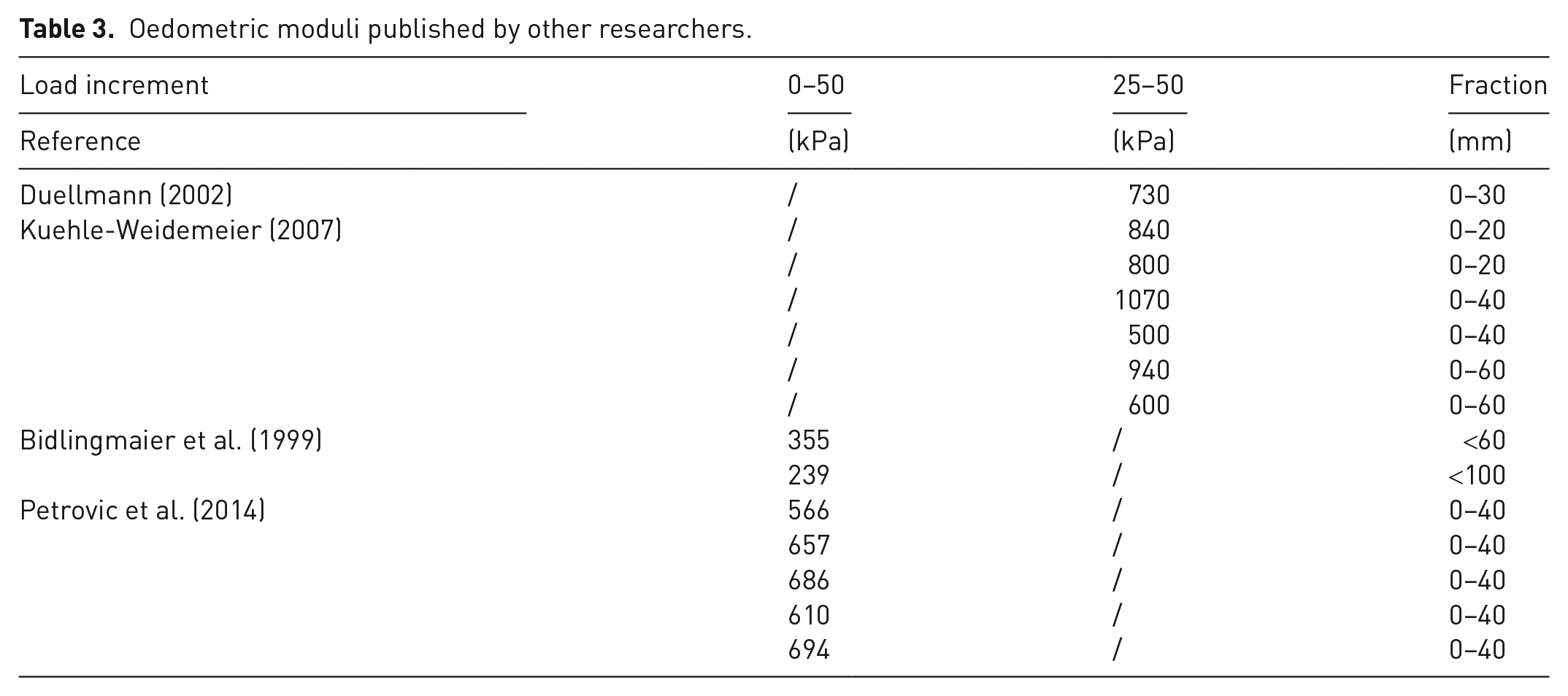
From the data by Siddiqui et al. (2013a), it was possible to recalculate the oedometric modulus of tested MB pre-treated waste materials at a vertical stress of 50 kPa. The obtained oedometric modulus was approximately 0.2 kPa for both samples. Interestingly, the obtained values significantly differ from the stiffness modulus of MB pre-treated waste material (at the same stress level) published by various researchers, as is summarised in Table 3. The reasons for such a large discrepancy remain unclear.
Oedometric moduli published by other researchers.
With respect to secondary compression, Siddiqui et al. (2012) have shown that the total settlement strain of MB pre-treated waste caused by biodegradation is 3.2% for finer MB pre-treated waste material (E) and 1.7% for coarser MB pre-treated waste material (GER). These observations are in good agreement with Kuehle-Weidemeier (2007) who published that a maximum volume reduction of 4.5% owing to biodegradation can be anticipated, whereas approximately 2% volume reduction occurs in the post-closure period.
It should also be noted that secondary compression caused by biodegradation might be dependent on the type of applied bio treatment process, namely, composting, biodrying or anaerobic digestion. However, to the best knowledge of the author, this kind of data is not yet available.
As for the compressibility of bioreactor raw waste material, a comprehensive analysis of primary and secondary compression on synthetic and real untreated MSW samples was conducted by Reddy et al. (2011, 2015). The final results are somewhat ambiguous as the results obtained for synthetic samples show that both the primary and secondary compression ratios decrease with decomposition, whereas results obtained for real samples show that both the primary and secondary compression ratios increase with decomposition degree. As for the distinction between mechanical creep and secondary settlement caused by the decomposition process, the authors found, at least for the real waste samples, that there was no significant decomposition process effect over the period of testing considered. A longer duration may be needed to assess the contribution of biodegradation-induced compression.
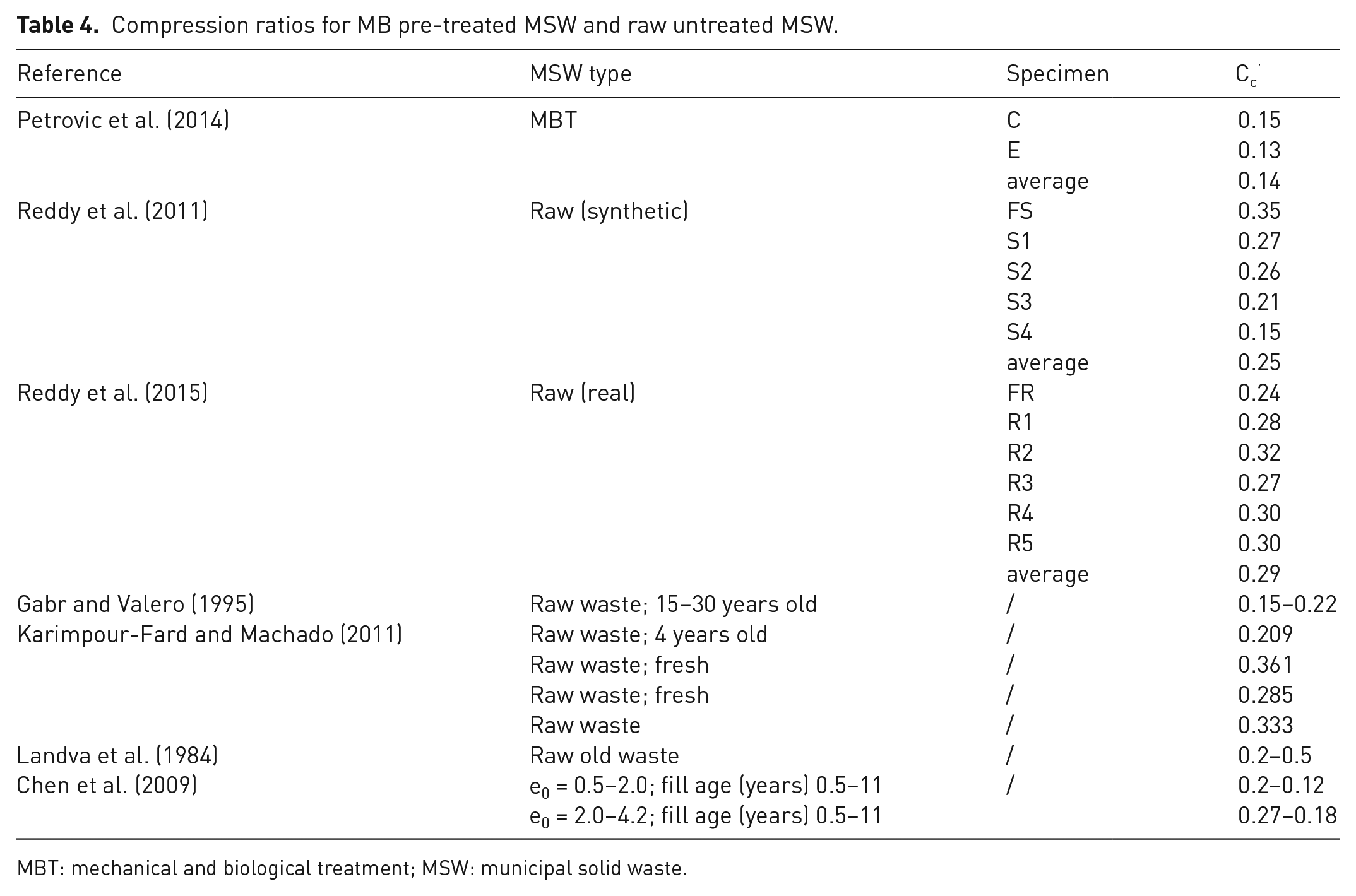
In addition, the literature review (Table 4) shows that some researchers (e.g. Chen et al., 2009; Karimpour-Fard and Machado, 2011) reported that less decomposed material is more compressible; whereas other researchers (e.g. Hossain, 2002) reported that the compressibility of raw untreated waste increases as decomposition occurs. Therefore, it remains unclear whether the compression ratio of raw untreated MSW rises or falls with decomposition.
Compression ratios for MB pre-treated MSW and raw untreated MSW.
MBT: mechanical and biological treatment; MSW: municipal solid waste.
Furthermore, Table 4 also shows a comparison of the compressibility ratios (
Shear strength
The shear strength of granular materials is usually described with two parameters: shear friction angle φ’ and cohesion c’. In addition, Kölsch (1993) introduced a third shear strength parameter for raw fibrous waste – the tensile angle ζ. According to Kölsch (1993, 1995), the total shearing resistance is composed of the friction in the shear plane and the tensile force in the fibres. Therefore, the total shearing resistance of waste, at an arbitrarily chosen normal stress, is higher than the frictional resistance alone.
Ziehmann (1999) investigated the influence of waste treatment (untreated, biologically treated, mechanically–biologically treated and mechanically–biologically treated <60 mm fraction) on the shear and tensile strength of MB pre-treated waste material. He found that cohesion is not affected by waste treatment, whereas the biological treatment increased the shear angle by approximately 17%. Furthermore, it was shown that the tensile angle in the sieved fraction with particles smaller than 60 mm cannot be detected. Therefore, according to Ziehmann (1999), the shear strength of MB pre-treated waste can only be described by its shear parameters. These observations were also confirmed by Heiss-Ziegler and Fehrer (2003), who found that the tensile strength in MB pre-treated material becomes more noticeable at fraction sizes of above 80 mm. However, Bhandari and Powrie (2012) found that MB pre-treated waste samples with a maximum particle size of less than 10 mm, also exhibit a reinforcing effect at confining pressures larger than 100 kPa and axial strains in excess of approximately 1%.
More recently, Fucale et al. (2015) analysed the friction properties of basic MB pre-treated matrix and tensile properties of two reinforced MB pre-treated matrices (10% and 20% fibre components). They found that the tensile strength depends on the fibre content, as the compound matrix with fewer fibre components continuously demonstrated a higher strength than the compound matrix with more fibre components. The measured tensile angle for matrices with fewer fibrous particles was ζ = 19°, whereas for the matrix with more fibrous particles, the measured tensile angle was ζ = 13°.
With respect to the shear strength parameters of MB pre-treated MSW, Kuehle-Weidemeier (2007) reported that the friction angles usually ranged between 32° and 38°, whereas the cohesion lay between 10 kPa and 62 kPa. Bauer et al. (2009) examined MB pre-treated MSW from three different treatment facilities and different treatment processes with maximum particle sizes of 40 mm to 60 mm. In addition, they accounted for different water contents and portions of fibrous components. They found that the shear friction angle ranged between 28.1° and 39.8°, whereas cohesion ranged from 5 kPa to approximately 47 kPa. Sivakumar Babu et al. (2015) conducted direct shear (DS) tests and small and large scale consolidated drained (CD) and consolidated undrained (CU) triaxial tests on reconstituted compost reject (MB pre-treated MSW) samples. They found that the friction angles at 20% strain levels were 40°, 55° and 33° from the DS, CU and CD tests, respectively. There was a minor variation in cohesion values (0–10 kPa).
Thorough examination of the shear strength properties of bioreactor waste at various DOD were conducted by Reddy et al. (2011, 2015) and Gabr et al. (2007). However, the mentioned authors did not address the tensile angle of bioreactor waste material. The DS tests conducted on synthetic raw untreated waste samples by Reddy et al. (2011) showed a general decreasing trend for the shear friction angle with decomposition and an increasing trend for cohesion. The DS tests conducted on real raw untreated waste samples by Reddy et al. (2015) also showed a general decreasing trend for the shear friction angle with decomposition, whereas cohesion, although not constant, showed no consistent trend. These findings are in good agreement with previous finding from Hossain (2002), who also showed that the shear friction angle decreases with age. However, these results contradict the ageing effect reported by Zhan et al. (2008) and van Impe (1998), who claims that the shear strength of raw untreated waste material increases with age.
Figure 3 presents comparisons of the shear strengths of MB pre-treated and bioreactor waste materials. In addition, Figure 3 also presents a boundary curve with a 90% probability of containing the shear strengths of raw untreated MSW (Petrovic et al., 2015). As can be seen from Figure 3, the shear strengths of synthetic and real raw untreated MSW (Reddy et al., 2011, 2015) are dispersed across a wider area, whereas the shear strengths of MB pre-treated MSW show a much narrower region of appropriate shear friction angle values. Therefore, even though the shear strengths of MB pre-treated MSW is deeply rooted within the boundary curve of raw untreated MSW, a specific relationship between the shear strength of MB pre-treated MSW and raw untreated MSW at various DOD cannot be established. The general trend line of the variation of cohesion and friction angle of MB pre-treated MSW, with respect to the miscellaneous testing devices and multiple test conditions published by Sivakumar Babu et al. (2015), is also presented in Figure 3. Sivakumar Babu et al. (2015) obtained a wide range of possible shear friction values, whereas cohesion lies in a very narrow range. These results contradict findings published by Kuehle-Weidemeier (2007) and Bauer et al. (2009).
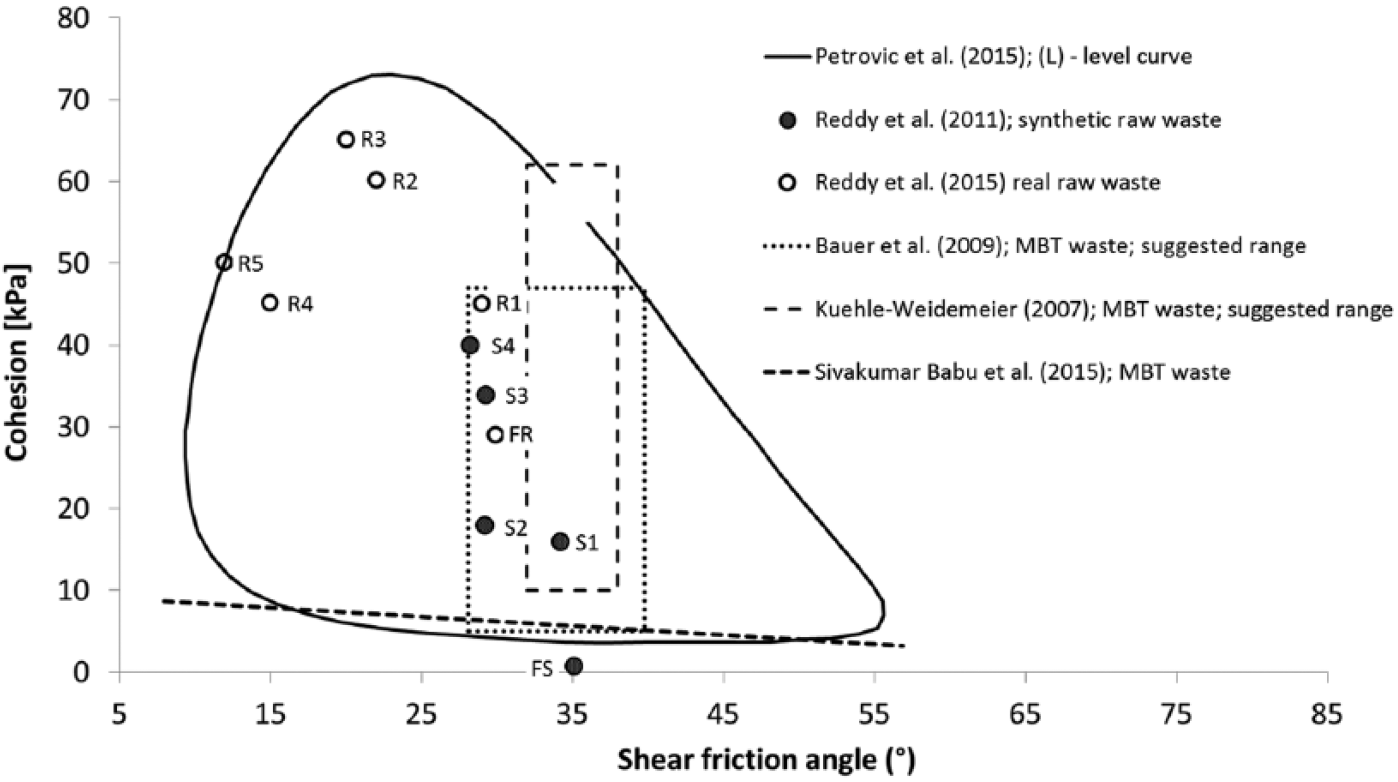
DS strength of MB pre-treated MSW and raw untreated MSW.
Conclusion
Owing to the strong heterogeneity of waste material that has to be mined or landfilled, landfill design/design of a landfill mining project is a demanding task. The inhomogeneous nature of MSW requires that laboratory testing of such materials be conducted on non-standard laboratory equipment that is capable of dealing with large waste specimens. In comparison with standard geotechnical equipment, such devices are usually not easily available. Thus, it is not uncommon that, for the purpose of designing sanitary landfills, the mechanical parameters of waste material are estimated based on data published in literature rather than from measurements. With respect to the mentioned obstacles, the presented aggregation of results is a valuable tool for designing landfills/landfill mining projects involving MB pre-treated or raw untreated MSW in scenarios when laboratory testing is not a viable option.
The obtained results suggest that MB pre-treated MSW is a substantially stiffer material than raw untreated MSW. Additionally, it seems that one-dimensional consolidation theory can provide a suitable framework for analysing the consolidation process of a saturated MB pre-treated waste. However, for MB pre-treated waste, only two researchers have published data about the consolidation coefficient cv. Therefore, in order to provide a better understanding of the consolidation process of MB pre-treated waste, additional research is necessary. Moreover, in practice it is assumed that the hydraulic conductivity and oedometric modulus are constants, which also makes the consolidation coefficient constant. However, this assumption is valid only if the stress changes are small enough such that the hydraulic conductivity and oedometric modulus do not change significantly. As the hydraulic conductivity and oedometric modulus of MB pre-treated waste material changes by few orders of magnitudes during compression, the assumption that hydraulic conductivity and oedometric modulus are constants is probably invalid; therefore, the variation of these parameters should be taken into account.
Furthermore, an absence of correlation was also noticed with respect to the shear strength of the considered waste materials. Therefore, the shear strengths of these two MSW types should not be used interchangeably. In general, the MBT process gives a much narrower range of appropriate shear friction angles, yet cohesion is not significantly altered with the MBT process. The influence of fibrous components on the shear strength of MB pre-treated waste material needs to be thoroughly investigated. In addition, the influence of aging on both the stiffness and shear strength of bioreactor waste, is also necessary.
In contrast to the compression ratio and shear strength, the mean hydraulic conductivity values for MB pre-treated MSW and raw untreated MSW, which were obtained for various DOD in the fraction range of 0–25 mm to 0–40 mm, coincide reasonably well. Moreover, the gradation type of MSW, in conjunction with the largest particle size, might also have a significant influence on the hydraulic conductivity of both MB pre-treated and raw untreated MSW.
Footnotes
Declaration of conflicting interests
The author declared no potential conflicts of interest with respect to the research, authorship, and/or publication of this article.
Funding
The authors disclosed receipt of the following financial support for the research, authorship, and/or publication of this article: This work was supported by the University of Zagreb [grant number TP106].