







Abstract
This paper analyses waste management on small islands (on a global scale these are micro-islands). In the context of the paper, small islands are islands that have an area less than 50 km2. The study presents an overview of the problems connected with waste transport from islands to the mainland. Waste generation on islands is very much related to tourists. If tourists do not handle waste properly, it will cause problems. Four small Estonian islands in the range of 3–19 km2 are studied in detail. For these and other small islands, the main problem is the waste produced by tourists, or related to tourists and waste transport to the mainland. Currently, the local municipality has to arrange and finance waste transport. In fact, and based on the polluter-pays principle, the tourists should bear the cost of waste management. There are different tax options available in order to collect the money from tourists – waste tax, harbour tax, tourist tax, donations, environmental tax and others. The study results revealed that the best possible solution for Estonian islands may be a non-deposit system – including an additional charge on ferry ticket prices. The extra money should cover the costs of waste management and waste shipping. The tourists arriving in their own boats should pay a harbour tax, which includes a waste tax to compensate for the cost of waste management.
Introduction
There is a lack of studies on how waste management is arranged on islands that have an area less than 50 km2. In several studies, a small island is defined as an area of more than 200 km2 with the population of 7000 people and more (Mateu-Sbert et al., 2013; Mohee et al., 2015; Sealey and Smith, 2014). In Estonia, according to the Permanently Inhabited Small Islands Act (Püsiasustusega väikesaarte seadus, 2003), there are 11 small islands and three large islands – Saaremaa (2671 km2), Hiiumaa (989 km2) and Muhu (198 km2).
On small islands, tourism is very popular and people essentially want to go there for the nature (beaches, nature reserves, landscape parks, etc.). During tourist visits, waste generation increases; landfilling is not an option and all the waste that is generated has to be transported to the mainland. Tourism can offer high levels of employment and income for local people. However, tourists and the tourism sector are also a source of environmental impact (high levels of noise, air and water pollution, changing views and landscapes, waste generation). Aguiló et al. (2005) have also pointed out that electricity consumption increases and groundwater levels drop besides the double increase in waste generation.
All tourists generate municipal solid waste (MSW). This has a negative impact on both the environment and budgets of local governments who have to arrange waste management on their territory. Still, tourism can also have positive environmental impacts, e.g. the creation of national parks and wildlife parks, conservation of beaches and forest. Residents have to pay via taxes for all the public services offered by the regional government, yet it makes no difference whether the service is meant for residents or tourists.
Many articles describe the phenomenon of MSW growth as a result of the seasonal increase of the tourist population in different areas and regions (Espinosa Lloréns et al., 2008; Shamshiry et al., 2011; Willmott and Graci, 2012). Therefore, in these areas waste management is important and MSW has to be collected, transported and processed in an environmentally sound and cost-effective way (Chen et al., 2005).
On small islands, the separate collection of recyclables is particularly necessary because islands are environmentally more vulnerable to growing amounts of solid waste (Tutangata, 1999). Most residents of small islands collect waste separately, provided they have the possibility to do so, because they care about their home island. The same cannot be said about tourists. Even if tourists collect their MSW and do not dispose of it in nature, Mateu-Sbert et al. (2013) found that one resident separately collects an average of 47.3% more than one tourist.
Sealey and Smith (2014) have described how islands can be ‘zero waste’ environments where waste is not a problem but a resource. ‘Zero waste’ means that waste is not disposed of in a landfill or incinerated. All waste materials are composted, reused or recycled. A ‘zero waste’ island can promote itself as a sustainable tourism destination and for some groups of tourists this adds value.
The main problems caused by tourists on Estonian islands are camping and campfires in places not intended for this. Burning waste in campfires leads to environmental pollution. Financially, the biggest problem is the removal of waste from the islands to the mainland.
The aim of this paper is to analyse the problems of financing MSW management and waste transport on four small Estonian islands and to provide weighted solutions for decision makers.
Materials and methods
To obtain an overview of the research question, a detail observation has been conducted based on gradation of the research methods. On-site interviews with open questions (the island’s residents, tourists, waste management companies, waste station operator, local authority representatives, etc.) were carried out. Additionally information has been gathered from existing sources, statistical and scientific articles. The surveys were carried out in 2013–2014.
In the present research, legislation is analysed in detail in the light of the Estonian Acts, which is based on EU legislation. Considering the journal readership, this topic is not discussed in depth.
The main legislation regulating waste handling is the Waste Act (Jäätmeseadus, 2004). The Act states that a local government within the administrative territory in which live more than 1500 inhabitants has the obligation to arrange organized waste collection and transport. In rural areas, the arrangement of organized waste transport is not an obligation according to the Waste Act because it is not economically feasible. At local level, waste handling is regulated, in addition to the Waste Act, according to the local government waste management plan and waste management rules. The local government primarily organizes waste management in its territory in line with the Waste Act. The principle of producer responsibility is implemented for packaging and products that are defined in the Waste Act as a ‘product of concern’. The Waste Act does not set any producer responsibility obligation on local government. However, it is not possible to organize municipal waste management and promote separate collection without handling waste that is under the principle of producer responsibility. Local government income for waste handling comes from pollution charges that are paid by the companies that operate on the local government’s territory.
Small islands
Estonia has over 2200 islands (318 of them larger than 1 ha), of which just three – Saaremaa, Hiiumaa and Muhu – are deemed big islands. According to the Permanently Inhabited Small Islands Act (Püsiasustusega väikesaarte seadus, 2003), there are 11 small islands where people reside or where they have their main habitat. These are the islands of Abruka, Kihnu, Kessulaid, Kõinastu, Manija, Osmussaare, Piirissaar, Prangli, Ruhnu, Vilsandi and Vormsi. However, some of them only have a few residents. Not all of the islands are accessible, but there are many uninhabited islands where tourists or visitors go during the summer. The most well known of these are Naissaar, Aegna, Suur-Pakri and Väike-Pakri.
Tourists mainly visit islands because of the nature (landscape reserve, nature reserve), beaches and coastal water. For this reason, the uninhabited islands are the places where most waste is generated by the tourists. That is why it is very important to promote environmentally responsible tourism (Sullivan-Sealey and Cushion, 2009). Four islands (Prangli, Aegna, Naissaar and Ruhnu) were chosen for investigation, as they are the most visited and easily accessible for tourists. These islands also have problems with waste collection and transportation (Tamme and Rivis, 2011).
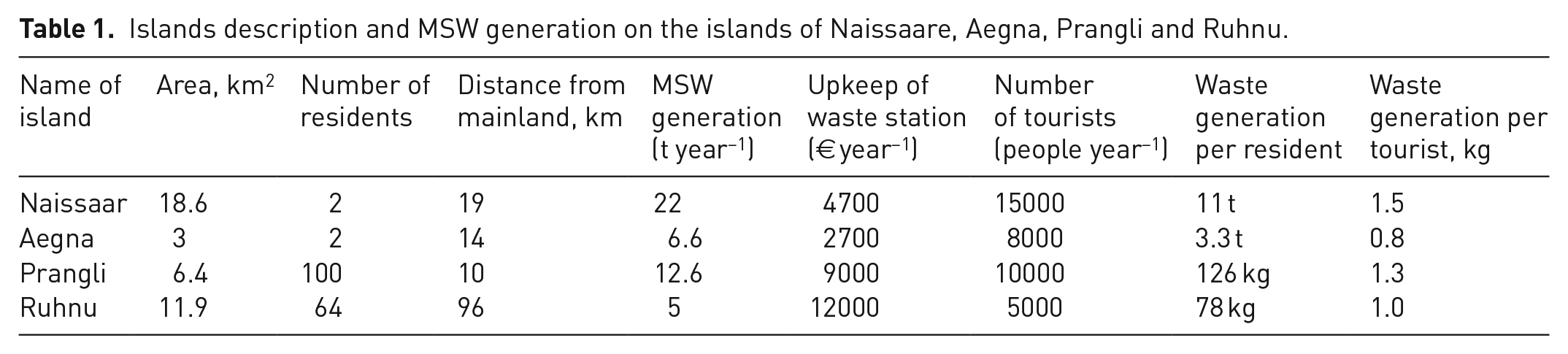
This paper presents the arrangement and options for waste management on four Estonian small islands, where visitors and tourists generate waste, which is a major problem on all the above-mentioned islands. Short descriptions of the islands are given in Table 1.
Islands description and MSW generation on the islands of Naissaare, Aegna, Prangli and Ruhnu.
Approximately 5600 tourists visit Aegna every year by ferry; the corresponding number for the island of Prangli is 5200. Monthly visits by ferries to the inhabited Prangli and uninhabited Aegna are presented in Figure 1. As many tourists visit the islands on their own or take travel agencies’ boats, the estimated annual number of tourists on the island of Aegna is 8000 and that on Prangli is 10 000. The ferries to Aegna navigate from May to October. If the ice conditions during the winter season are good, it is possible to use ice roads to visit some of the small islands. In 2011, when the ice became thick enough, more than 400 tourists visited Aegna within a period of 2 months, February and March.
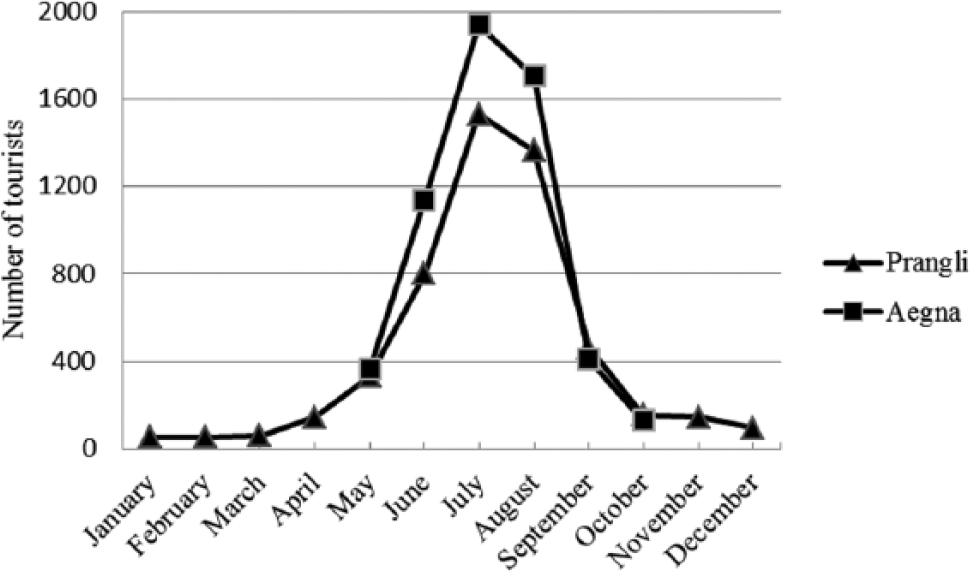
Number of tourists visiting by liner the inhabited Prangli island and the uninhabited Aegna island.
Waste is generated through different types of human activities. Waste transport by ship from the islands to the mainland is generally problematic and costly. The Estonian Waste Act does not place an obligation on the arrangement of waste transport in low-density areas, which include the small islands. The budgets of local governments, which have to arrange waste management (included that on uninhabited and inhabited islands), are tight; therefore, it is complicated to cover all the costs involved in waste collection and ferrying this waste to the mainland. In addition, it is in contrast to the polluter-pays principle. Although the tourists visiting the island generate waste, they do not contribute financially to the budget of the municipality. The situation is better on the islands that have a year-round ferry service to the mainland (Vormsi and Kihnu). In this case, waste can be transported with refuse vehicles. However, when the weather conditions become bad, waste transport is disrupted.
Waste management
All four islands have a waste station, which is located in the port area. Waste stations are mostly funded by the state through grants. A waste station is a roofed, wood-framed building with an area of 19–58 m2 and a concrete floor. The area is surrounded by a fence. In most cases, there is a bale press for waste to reduce the total volume of waste during shipping. A waste station is open on certain days at certain times of the day. For example, on the island of Aegna the waste station operates from 1 June to 30 September, and is open twice a week, on Saturdays and Sundays. However, tourists also come to the island on weekdays and they do not have the opportunity to use it. Most stations collect the following types of waste: packaging, metal scrap, paper and cardboard, hazardous waste, electrical and electronic equipment, glass, tyres, construction and demolition waste, and household waste. On some islands, e.g. Aegna, certain types of waste are taxed: household waste – €10 per 1 m3; 100-l and 150-l garbage bags – €1.5 each; broken household appliances – €10 per item.
In the opening hours of the waste stations, there is an operator whose responsibilities include the collection and sorting of waste, cardboard, paper and plastic waste compaction and preparation for shipment to the mainland.
When the waste station is full, the operator organizes waste shipment to the mainland. In general, there will be more journeys made in the navigation period than outside the navigation period. On some islands, e.g. Aegna and Naissaar, there is no waste shipping to the mainland outside of the navigation period. If possible, a regular ship is used to transport waste in the navigation period; otherwise, a special ship is used.
The amounts of waste generated on the islands differ. On Ruhnu, the amount of MSW generation per capita per year is relatively low: 55–70 kg. On Prangli, the total amount of MSW to be shipped to the mainland is 12 600 kg annually. In addition, around 500 kg of waste paper is collected. On the islands of Naisaar and Aegna, the annual amounts are accordingly 22 000 and 6600 kg of MSW. Most tourists stay on the islands for only 1 day (Tamme and Rivis, 2011); therefore, on Naissaar, where there is a playhouse during the summer, waste generation per tourist is 1.5 kg and on Aegna it is 0.8 kg per day. In comparison, Gidarakos et al. (2006) assumed on the basis of the average quantity of MSW generated by resident that the mean produced quantity of MSW per tourist in Crete is 1.2 kg per day in the 2001–2002 period. This quantity is quite similar to the results for Menorca of 1.31 kg per day (Mateu-Sbert et al., 2013). UNEP (2003) has estimated that tourists travelling in Europe generate about 1 kg−1 day−1 solid waste.
There are no waste composition statistics available for Estonian islands. The results of separately collected waste on Prangli island show that most waste comprises generated packaging waste (350 kg year−1) and paper and cardboard waste (300 kg year−1). Figure 2 shows the possible paths of waste movement. A local resident has two waste transport options – carrying waste to a waste station or shipping it by private boat to the mainland. In addition to these two options, residents can choose to dump the waste illegally. Conversely, tourists have many more options. Unfortunately, observation on the islands showed that there are problems with littering. Tourists dispose of their waste in nature, burn it in open fires or dump it in the sea.
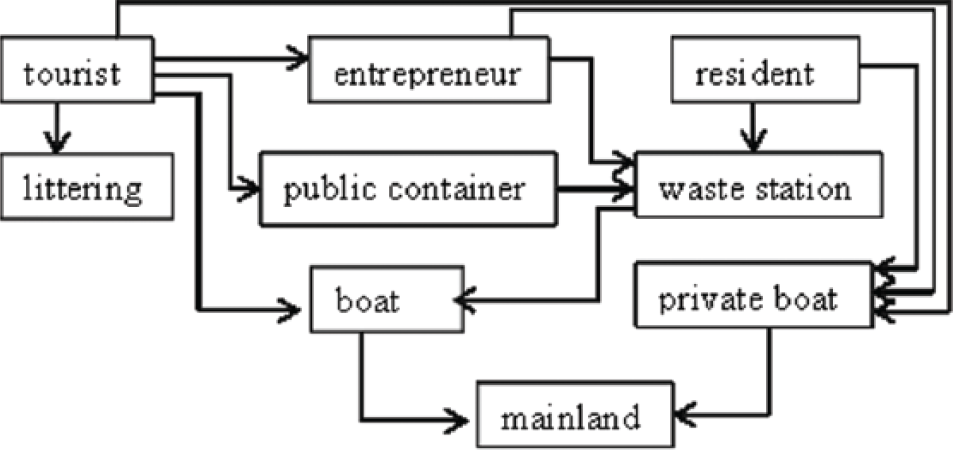
Waste routes to the mainland.
Waste transport and financing
All the residents of the islands have the obligation to collect waste separately. Finnveden et al. (2007) showed that the participation of people in source separation depends on how accessible the waste station is (opening hours, introduction by operator, user convenience, etc.).
Separately collected waste, which cannot be re-used on site, and mixed MSW must be delivered to the waste station by the waste holder. Paper and cardboard is mostly burned in ovens or open fires. Separately collected food and garden waste is composted. Problems are caused by the food waste generated by tourists. This waste will be transported to the mainland together with household waste. As the waste transport usually takes place once a month, biodegradable waste mixed with household waste causes problems such as foul odours, rodents, etc. The situation is especially bad during the summer when the outside temperature is high and the organic material begins to decompose very quickly.
Waste collection and transportation from islands is an activity that companies do not want to deal with. For example, in the period of 2007 to March 2014 waste collection and shipment from Prangli island was carried out by a waste handling company that has a subcontractor on the island. The subcontractor was responsible for collecting household waste once a month from the property of the island’s residents as well as for arranging the shipment of waste to the mainland, where it was adopted by the waste handling company. In 2014, the waste handling company no longer wanted to continue and the price proposed to the municipality was too high.
The waste-related costs are mainly covered by the municipalities. On permanently inhabited small islands, where waste disposal is organized, the residents also have to pay for the waste management, such as emptying the containers. The price calculation is the following: the company makes a quotation in which all the expenses incurred on the territory of the municipality, island and the mainland have been taken into account. It means that the people who live on the mainland have to pay more for emptying their waste containers to cover the waste management costs on the island. Despite this, the municipality has to pay extra to collect and ship the waste to the mainland. On Prangli island for example (Table 1), with a population of about 100 inhabitants, the municipality expenses made on waste station maintenance and shipping were €9000; on Ruhnu island, the cost exceeds €12 000 per year (the entire budget of Ruhnu island for 2014 was €218 000). The main expense items are salary for the waste station operator, cost of boat rental and cost for transporting containers to the mainland.
On the islands with no residents, waste management and financing during the navigation period is arranged by the local municipality. On Aegna island for example, the costs per navigation period were €2700 and on Naissaare island €4700.
On these islands, all the waste transported to the mainland is generated by tourists. Therefore, it would be fair if the tourists themselves paid for the waste removal.
Results and discussion
Currently, there are no taxes for tourists on the islands of Estonia, and all the expenses related to waste management have to be covered by the municipality. In Estonia, the municipalities as well as their budgets are small, as the number of residents is small, but they have many duties and responsibilities other than waste management. For example, there are only 64 residents on Ruhnu island but the costs of waste management are over €12 000 a year.
To make up for the local government costs, and based on the polluter-pays principle, tourists should pay the costs associated with the collection of waste they generate. The best way to do this would be collecting a tax. There are different ways to collect taxes from tourists, e.g. donation, entrance ticket, environmental tax, waste tax, harbour tax, tourist tax, accommodation tax, etc. If the tax is collected, it must cover the waste transport expenses. Also, the name of the tax is essential, and the activities and objectives on which the collected tax money will be spent must be clear.
A great number of tourists, labelled ‘typical sun and beach tourists’, do not care much about nature, and according to studies they are not willing to pay extra for the purpose of environmental protection. The situation is quite different from tourists who can be labelled ‘environmental steward tourists’, ‘nature orientated tourists’ or ‘frugal tourists’ (Valle et al., 2012).
On the Mediterranean coastline, which is a mass tourism destination, tourism taxes and fees are very popular (Ekins, 1999). The application of tourism taxes offers the possibility to apply the polluter-pays principle.
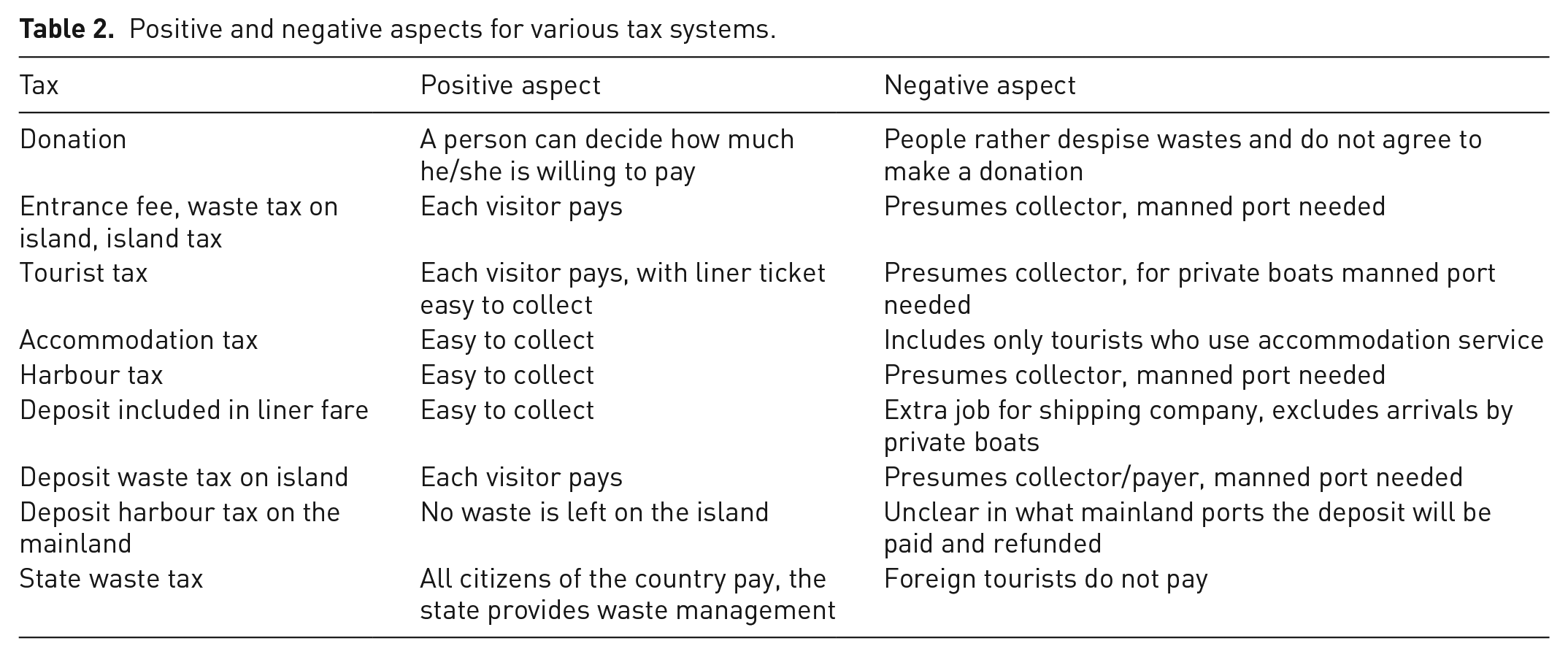
An accommodation tax is very common throughout the whole world, and it is relatively easy to collect (Gooroochurn and Thea Sinclair, 2005), but as people take day-trips to small islands it is impossible to collect an accommodation tax, as people do not use this service (Table 2).
Positive and negative aspects for various tax systems.
A deposit–refund system forces a consumer to pay a certain deposit, which is refunded upon the return of the product. It is a very common system for packages, containers and tyres. This system may also be applied on the islands in such a way that tourists would pay a deposit when they purchase a ferry ticket. Tourists are given a waste bag along with their ticket; when they take back the filled waste bag to the mainland, they receive a refund.
One possible way is to use donations. Only 19% of tourists responded favourably to the accommodation tax, which is earmarked for environmental protection (Valle et al., 2012). Another study, from the Croatian island of Hvar (Taylor et al., 2005), points out the opposite opinion and finds that the majority of tourists are willing to pay extra for environmental improvements. In Estonia, donations probably would not work because waste is an unpleasant issue for the majority of people, and they would not voluntarily agree to give money for waste management purposes.
The population of small islands and the quantity of waste increases significantly during the summer when people who permanently live on the mainland come to their summer cottages on the islands. They use the waste station but do not cover the costs associated with waste management. For example in Finland, Kemiönsaari municipality is an archipelago of over 5000 islands, 40 of which are inhabited year-round (Visitkimiton, 2015). Every property has to pay the waste tax. The waste tax of permanent residents depends on the number of inhabitants and the composting rate. The tax for summer cottages is affected by the rate of composting: e.g. a summer home with no composting has to pay €119, but with composting the waste tax is €85.5 per (home×year)−1 (Lounais-Suomen Jätehuolto, 2015). On the Estonian islands where people own summer homes, e.g. Prangli and Ruhnu islands, the municipalities may introduce a waste tax on the terms described above.
The main problems on small islands with no residents are caused by tourists. Therefore, tourists should pay a tax that is added to the ferry ticket price. Tourists arriving by private boats should pay a harbour tax that would cover the waste removal costs from the island to the mainland. Provided 15 000 tourists visit Naissaare and another 8000 visit Aegna annually, the minimum sum added to the ferry ticket price or to harbour tax should be €0.31 and €0.34 per tourist (Table 3), respectively. If this minimum tax is added to the local municipality budget, it will cover the waste collecting and shipping costs. However, as the minimum amount of money is small, the numbers of tourists are not the same each year and waste generation can vary, the amount of added money should definitely be higher. If this tax were €1, it would not affect the number of tourists or enthusiasts who would like to visit the islands. If 15 000 tourists paid €1 each, a considerable amount of money may be gathered to improve waste management on the islands. It may happen when tourists have paid for waste management, they feel like they can just leave their garbage on the island. At the same time, with greater financial opportunities the municipality can offer a better waste collecting service.
Existing liner ticket fares and fees to be added to compensate waste management expenses.
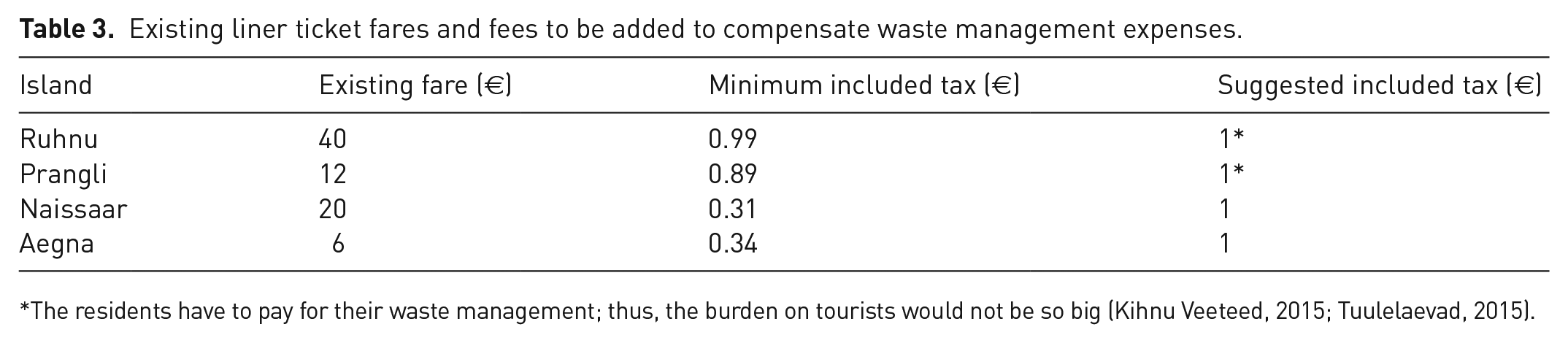
The residents have to pay for their waste management; thus, the burden on tourists would not be so big (Kihnu Veeteed, 2015; Tuulelaevad, 2015).
The same system may also be applied to permanently inhabited small islands. Adding €1 to the harbour tax or ferry ticket should differentiate between tourists and residents. If residents often go to the mainland, they will have to pay too much. In this case, tourists and residents should certainly be differentiated from each other and payments for the target groups should be different.
One possible option would be to establish a deposit–refund system and collect a deposit for waste transport costs from each tourist. When a tourist buys a ferry ticket, a deposit (e.g. €1) for the transportation of waste will be collected, and the tourist is given a garbage bag (e.g. 10-litre sized) along with their ticket. When the visitor to the island takes back the filled garbage bag to the mainland, he/she will be refunded the pre-paid €1 deposit. If applying this method, it is also worth considering imposing higher fees, as a €1 deposit might not be sufficiently motivating. When a tourist does not return any garbage bag to the mainland, the paid deposit will go to the local government budget and can be used to cover the waste management expenses.
As tourists arriving by private boats do not use ferry services, their harbour tax should include additional money to cover their waste management costs. If the port administration collects a harbour rate from ships, it also has to cover the treatment and disposal of waste (Georgakellos, 2007). One possible way is that the waste fee is separated from the harbour rate and all ships will pay for the amount of waste they hand over. Such a system can be easily applied on the mainland, but on islands it would require special equipment to weigh different types of waste. This system may also bring about a risk that the people who want to save money will not use the harbour waste containers and might throw their waste into the sea. It is also possible to establish a fixed waste fee in harbours, whether a seafarer uses the option to deliver the waste to the port waste containers or not. If visitors have to pay anyway, they will probably not throw waste into the water. If the waste fee in the ports of small islands is higher than on the mainland, it could happen that visitors on ships would choose to dispose of their waste on the mainland. Still, some islands do not have manned harbours and in this case waste tax or harbour tax collection is not possible. It may be helpful if the waste tax was obligatory for all vessels on the mainland – if seafarers have to pay, they will deliver the waste.
By analysing various tax systems, it becomes evident that the most appropriate system for small islands would be the one that collects money from tourists for waste management and shipping together with the ferry tickets or harbour taxes.
Conclusion
Small islands have a small population or are uninhabited. However, due to the small islands’ attractive landscape and nature, many tourists want to visit them. A year-round ferry connection is available on the permanently inhabited islands, but on some uninhabited islands the connection with the mainland is only organized during the summer season. The navigation period also provides people with the opportunity to use private boats, thereby increasing the number of tourists. Tourists on small islands cause problems that are related to waste management and waste shipping to the mainland. The islands have to provide tourists with the opportunity to dispose of their waste; otherwise, they will burn waste in open fires, dispose of it in the sea or in nature. The transport of waste from the island to the mainland is expensive for local governments that administer the islands.
In addition, the situation whereby the local government pays for the collection and shipping of waste, while tourists do not contribute at all, is not in line with the polluter-pays principle. Currently, tourists carry waste to the island but do not bring it back to the mainland. The municipality organizes waste collection and transportation, financing all of these actions from its budget. In fact, the tourists should bear the costs that are associated with the waste. For this purpose, it is necessary to introduce a variety of tax systems. A voluntary donation for waste management will not work because most tourists are not willing to make a donation that would cover the costs of waste disposal.
The best possible solution to cover the costs of waste management would be:
A harbour tax for private boats to cover the costs of waste management;
A waste tax that is added to ferry tickets price
It would be possible to implement a deposit system in which each ferry ticket buyer pays a deposit and receives a garbage bag. If tourists return the filled bag, they will be refunded the deposit. This system, however, requires a collector and surveyor. In addition, it would be very difficult to determine or assess whether the tourists brought back all the waste that was generated. For private boats, a system of collecting a waste tax together with a harbour tax can be implemented. If the seafarers do not use the waste management facilities of the island’s port, they will be refunded the waste tax. The drawback of this system is that people want to save money and they will not use the opportunities offered by the harbour. Because of that, a lot of waste may eventually end up in the sea. According to the analysis, a non-deposit system described above would be better than a deposit system.
Footnotes
Declaration of conflicting interests
The authors declared no potential conflicts of interest with respect to the research, authorship, and/or publication of this article.
Funding
The authors received no financial support for the research, authorship, and/or publication of this article.