






Abstract
This paper aims to ascertain the efficacy and acceptability of five incentive schemes for the take-back of waste electrical and electronic equipment in Portugal, focusing in consumers’ perspectives. It assesses users’ perception of these items, evaluating the motivations and interests they have concerning the market of waste electrical and electronic equipment. Results indicate, on one hand, a lack of awareness by consumers about the process of take-back of their equipment. On the other hand, results show that information conditions and socio-demographic factors affect consumers’ motivations for returning the electrical and electronic equipment at the end of life. In this context, it can be concluded that, in Portugal, the market for the recovery of waste electrical and electronic equipment is still in its infancy.
Introduction
Excessive production of waste electrical and electronic equipment (WEEE) entails various economic and environmental problems. This type of waste has in its constitution dangerous substances and materials. Moreover, given the value of its components, an illegal export market has developed, having economies with scarce resources the main buyers (Gui et al., 2013; Lundgren, 2012). It is therefore crucial to optimize take-back policies in order to lessen the improper end of life treatment of WEEE. Legally, the WEEE in Portugal is grouped into 10 categories, according to their functionality and composition (DL no. 67/2014):
Category 1 – Large home appliances; Category 2 – Small home appliances; Category 3 – IT and telecommunications equipment (IT); Category 4 – Consumer equipment; Category 5 – Lighting equipment; Category 6 – Electrical and electronic tools; Category 7 – Toys and sports and leisure equipment; Category 8 – Medical devices; Category 9 – Monitoring and control instruments; Category 10 – Automatic vending machines.
Since the reform of the legal framework in accordance to Directive No. 2012/19/EU, it is expected that from August 2018, WEEE will be regrouped into six new legal categories, with new, more ambitious and demanding targets for collecting, given the technological developments of recent years (European Commission, 2012).
The WEEE take-back and treatment market builds on the extended producer responsibility (EPR) principle, as an environmental policy approach where producer responsibility extends to the post-consumer stage of equipment life cycle (Atasu and Subramanian, 2012; Toyasaki et al., 2011). This concept aims not only to reduce the negative environmental impacts of waste, but also to promote the creation of incentives for eco-design. Theoretically, the EPR is an individual obligation of every producer, but in practice the producers engage in this obligation collectively (Atasu and Subramanian, 2012; Toyasaki et al., 2011). Consequently, this requirement leads to the creation of two types of waste recovery market: either a monopoly or a competitive one. The monopolistic structure consists of a single and dominant firm (either public or private) that is responsible for collecting, recycling and financing all WEEE. In contrast, in a competitive market, there is a large number of service providers guided by a national central body responsible for controlling the obligations of each producer (Atasu and Subramanian, 2012).
According to Toyasaki et al. (2011), a competitive take-back structure becomes more favourable for stakeholders, as recyclers have a greater incentive to practice lower recycling rates. This allows manufacturers to earn higher profits, thereby having margin to reduce the final price of the products and boost their competitiveness. However, the widespread benefits for all stakeholders in the market depend on the degree of substitutability, market size and unit production costs. In scenarios where these variables are significant in the market, recyclers prefer to operate under the umbrella of a non-profit organization, opting for a monopolistic regime (Toyasaki et al., 2011).
According to the EPR concept, the take-back of WEEE in end of life involves a set of stakeholders who interact in order to stimulate the market, irrespective of the implemented return system (Gui et al., 2013). Electrical and electronic equipment (EEE) producers are the main actors in the WEEE market, as they are responsible for internalizing the costs of end of life of their products (Gui et al., 2013). Nevertheless, this approach leads to structural and market financing problems, such as parasitism and ‘orphan’ equipment. In turn, retailers are considered the market liaison officers, as they are the link between producers and consumers, informing the latter about the need to deliver the end of life EEE through campaigns and proximity collection points (Gui et al., 2013). In the same line of approach are the producer responsibility organizations (PRO), as intermediaries who organize the activities of collection and recycling of equipment in end of life, playing an important role in financial operations, collection and communication between the various stakeholders (Gui et al., 2013). Consumers are key players in the WEEE take-back market, as they are responsible for the final routing of the EEE end of life (Favot and Marini, 2013). In fact, they are considered a key element in the structure of the market because they are largely responsible for providing raw materials to the collection and recycling market, and are being called upon to co-finance the post-consumer stage of EEE through increases in the final price of the equipment (Favot and Marini, 2013). With respect to financing strategies, Best (2012) and Mayers et al. (2012) advocate a market financing structure based on different rates, according to the environmental design of the equipment.
In the EU, the WEEE market structure varies according to the economic and social characteristics of each member state, and there are different methods of collection and financing within Europe (UNEP, 2012). Several member states, such as Belgium, have opted for monopolistic systems, in which there is only one PRO responsible for the entire collection, reporting and referral of WEEE (UNEP, 2012). On the other hand, countries such as Portugal and Germany, promote a competitive market by licensing various PRO (UNEP, 2012). In Portugal, there are two management entities licensed (AMB3E and ERP PT) to whom producers transfer the responsibility for the collection and processing of their EEE in end of life through financial provisions (Niza et al., 2014). In order to oversee the entire market, producers are required to provide a production record to the NAWEEE (National Association of WEEE), on the basis of which each producer collection rates is defined. Collection rates are defined to ensure the fulfilment of the EPR principle (Niza et al., 2014).
Compared with other EU member states, Portugal presents a relatively low collection rate, revealing a market that is still under expansion, with various barriers at the level of waste operators and PRO operating logistics. Although the domestic market is identified as a competitive one, there are no significant differences in the practices of PRO or in retailers’ incentive policies to consumers in order to gather more of WEEE (Niza et al., 2014).
Consumer habits regarding the treatment given to their EEE in end of life, depend on the specific country’s characteristics, namely on the influence of firms’ characteristics on how individuals engage in the processes of collection and recycling WEEE. In this regard, several studies have been developed in order to ascertain the factors that determine the behaviour of consumers to return WEEE. Yin et al. (2013) concluded that the main factors affecting the perception of consumers on the return of mobile phones in end of life are the geographical location, the level of education and their monthly income. In contrast, according to the study of Colesca et al. (2014) for Romania, the determinants for the decision on WEEE are societies’ heuristics and environmental attitudes. Gender and monthly income do not seem to have any influence. According to Guraushiene (2008), the success of WEEE take-back is the existence of further information and the environmental awareness among consumers of this type of equipment waste.
Wang et al. (2011) studied the behaviour of the inhabitants of Beijing concerning their willingness to participate in the process of take-back and recycling of WEEE. Their results indicate that individuals show little willingness to proceed with the return of the EEE in end of life. Recycling habits, economic benefits and proximity to old equipment return locations are the driving factors for environmentally friendly behaviour. Their study also concludes that factors such as education level and monthly income do not determine the behaviour of users in managing WEEE.
Thus, the present paper aims to contribute to the ongoing reflections and debates over the management of WEEE by identifying and analysing the campaigns to encourage the take-back of WEEE in Portugal, and comparing their relative effectiveness from the perspective of individual consumers.
Methodology
Given the objectives of this study, the methodology chosen aimed at collecting consumers’ perceptions and acceptability concerning several WEEE take-back alternative schemes. Therefore, we followed a quantitative research approach entailing the development and application of a survey to EEE users. This survey consists of closed, semi-open and opinion questions, for a total of 12 questions, four of which are designed for sample characterization.
The analysis aims to identify the degree of effectiveness of recovery campaigns promoted by management entities and EEE distributors, as well as to assess the interests/desires of consumers concerning the EEE in end of life market implemented in Portugal.
The distribution of the survey to users of EEE was held electronically, sent and completed online between January 2015 and July 2015. The sample consists of 145 individuals. Given the use of an electronic survey platform, it is expected a targeted sample with a higher educational level, higher income, lower age variability and a greater use/familiarity with electronic equipment than that corresponding to the Portuguese population as a whole.
According to the proposed objectives, the research problem involves:
Identifying the socio-demographic factors that significantly influence consumer behaviour in the take-back of the EEE in end of life; and
Identifying the motivations and behaviours that influence the WEEE take-back market.
In addition to descriptive statistics, the data collected is used to estimate six multivariate statistical models. In the estimated models, we first analyse respondents’ actual return of WEEE at collection points, i.e. the dependent variable takes the unit value if the respondent delivers WEEE and the zero value otherwise. The dependent variable in each of the remaining five models is the binary response of individuals concerning whether they would deliver WEEE under five different take-back schemes. The independent variables in each model are education level, monthly income, age, WEEE recovery habits and knowledge of WEEE take-back campaigns. Given the binary nature of the dependent variable, each model is estimated by maximum likelihood methods using a standard PROBIT specification. The marginal effects of each independent variable on the probability that the dependent variable in the relevant model takes the unit value are used to test the following research hypotheses (Table 1):
H1 – The socio-demographic variables play an important role in the return of the EEE in end of life;
H2 – Knowledge of take-back campaigns affects consumer’s behaviour in the return of WEEE;
H3 – Recovery habits of equipment explain the return decision of WEEE;
H4 – The proposed incentive schemes have the same efficacy in the return of WEEE;
H5 – The characteristics of individuals differently affect the type of desired incentives for the return of WEEE.
Description of hypotheses H1–H5, defining concepts and purpose of analysis.
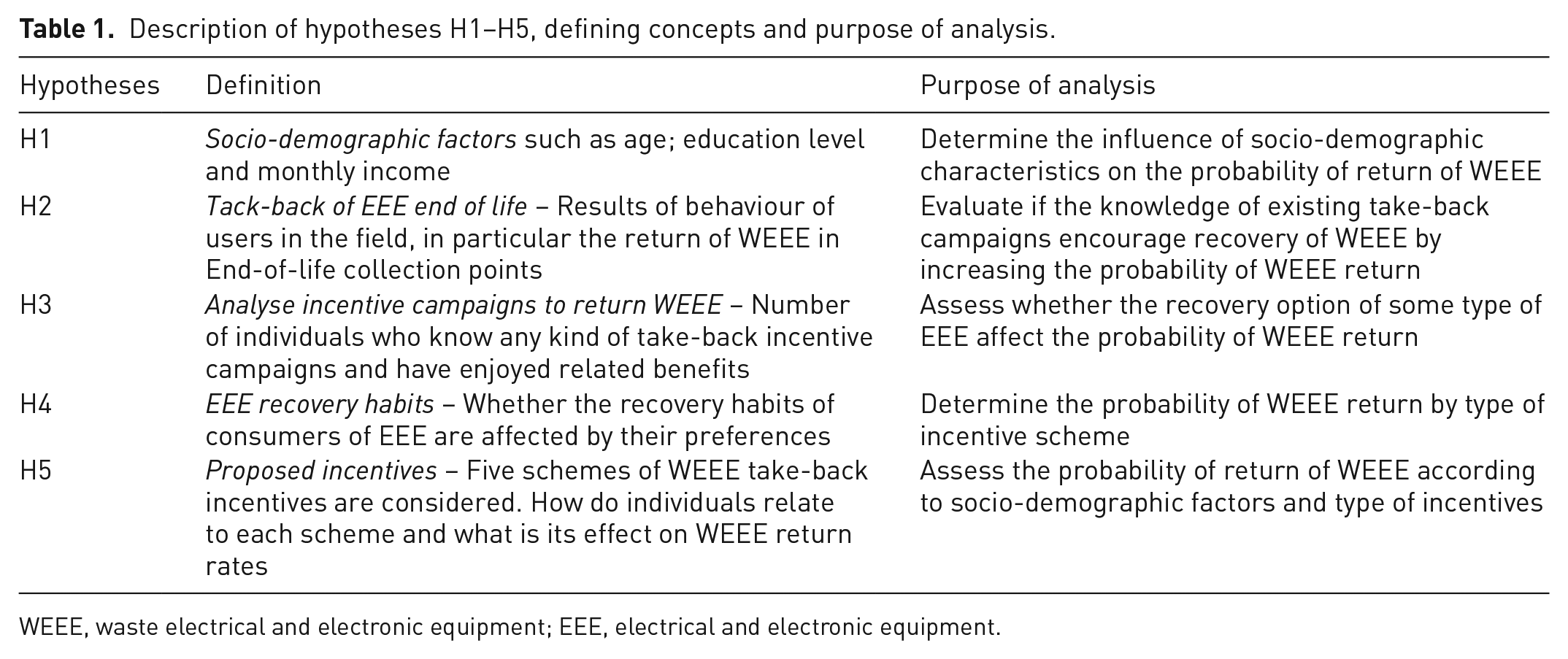
WEEE, waste electrical and electronic equipment; EEE, electrical and electronic equipment.
Results and discussion
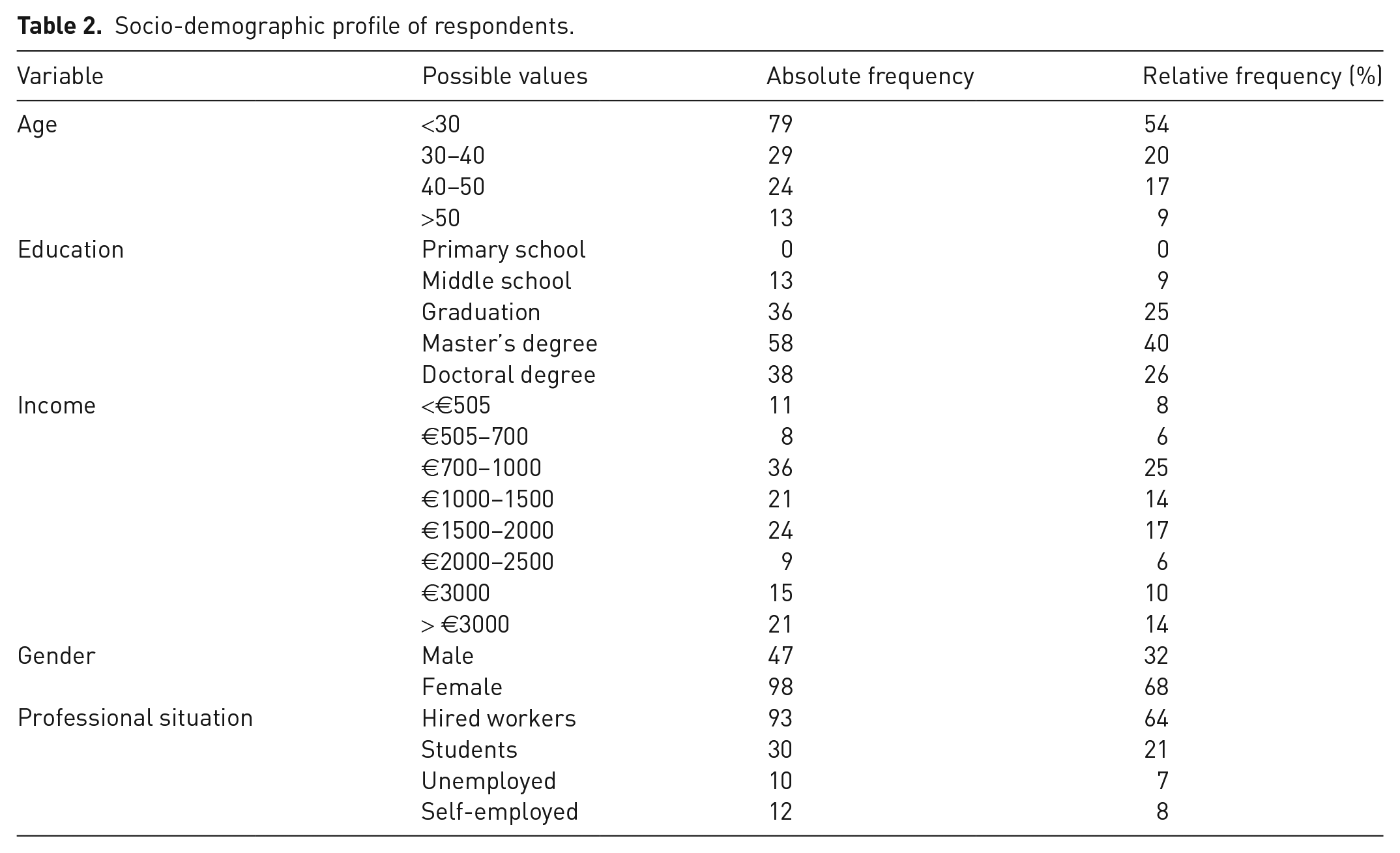
Of the total sample (N=145), more than half of the respondents are female (68%) and about 40% of them hold a master’s degree. Concerning their current occupation, 64% are hired-workers, 21% are students and the rest are divided among the unemployed (7%) and the self-employed (8%). The average monthly gross household income earned by the respondents is €1659 (standard deviation €932) (Table 2).
Socio-demographic profile of respondents.
The descriptive results also indicate that the devices used by more than 50% of the respondents for more than 10 years are: fridge, washing machine, microwave and TV/LCD. By contrast, equipment from category 3, such as mobile phones and computers, has, for 50% of respondents, a usage average time of 3–5 years.
These results match those obtained previously in the literature, i.e. consumers replace computers or telecommunications equipment for single use quicker in comparison with larger equipment (Premalatha et al., 2015).
Concerning the behaviour of individuals when a malfunction is detected in an EEE, the results show that 97% of respondents choose to repair it if possible. However, this option is not designed to all kinds of EEE. Mostly, this behaviour is common for refrigerators (112 individuals), washing machines (118 individuals) and computers (116 individuals). Thus, it can be said that there is a greater tendency for the recovery of large and more durable equipment. In all cases, it is important that the recovery costs are lower than the cost of acquiring a new one. When EEE are designed with this criterion (applying a circular economy’s logic), the volume of EEE can be significantly reduced as the lifetime of the equipment is extended.
With respect to the practices in the post-consumer stage of the EEE, more than half of the respondents go to a collection point (66%) and, of these, 89% forward their WEEE to a collection point close to their homes. These results can be explained by the strategic placement of these collection points. Most are located very close to commercial spaces of large distributors of EEE. According to the results of Cerqueira (2014), consumers search a commercial area with an electron point or depositrão for large EEE return. For small EEE there is no correct routing, mainly due to lack of motivation, awareness and knowledge of the negative impacts of the incorrect placement of this equipment.
There is a range of reasons why consumers do not use the WEEE collection points and the main reason is the lack of collection points (60% of respondents), followed by the distance between home and the collection point (32% of respondents).
The results suggest some ineffectiveness of the campaigns implemented in Portugal to encourage recovery. In particular, they do not seem to create sufficient incentives for users to carry their EEE in end of life up to a return location, for example to a retailer. According to the results, 64% of respondents do not know any upturn incentive campaign and only 36% of the total sample knows about any type of campaign. Moreover, despite knowing about the campaigns, only a small percentage of individuals (15%) has already benefited from these incentives.
In order to uncover the type of incentives desired by consumers of EEE, we analysed the acceptability of five different incentive schemes: exchange of used equipment for money, home collection, exchange for new equipment, tax benefits and discount coupons. According to the results, the five proposed incentives are, in general, well accepted by individuals. However, the favourite incentive schemes are ‘exchange for money’ (57%) and ‘exchange for new EEE’ (52%). In contrast, the use of ‘discount coupons on services’ is the least valued incentive by respondents (23%). We also observe that ‘collection of EEE at home’ is not considered very relevant for individuals who favour the recovery for economic value or new equipment.
Regarding individuals sensitivity to the end-of-life of EEE, 89% of respondents strongly agree with the need for adequate treatment for WEEE. As to whether the treatment of EEE end of life responsibility being allocated to producers, there is a considerable dispersion of respondents’ opinion revealing some ignorance of EPR concept, as for 31% of individuals it is indifferent to who it is assigned the responsibility. Concerning take-back incentive campaigns, 74% of the total sample fully agrees with on the importance of such initiatives. However, 68% of respondents claim that there is not adequate disclosure of campaigns and incentives for the recovery of WEEE. Similarly, 82% of respondents stated lack of information at the time of purchase of new equipment, regarding the routing of the EEE end of life. According to the data obtained, for 54% of the sample the main reasons that lead to the WEEE storage at home was the lack of information and lack of collection points available in the surrounding area of the residence.
Table 3 reports the results (marginal effects) from the estimation of a PROBIT model in order to test whether the socio-demographic variables, knowledge of campaigns and recovery habits of EEE, are statistically significant determinants of the probability of delivering the EEE in end of life. Results show that only the variable ‘age’ is statistically significant (for a 1% significance level). That is, according to the results, the probability of users carrying out the return of their WEEE increases 1.81 percentage points for each additional year of age of the individual.
Marginal effects of PROBIT model in relation to H1, H2 and H3.
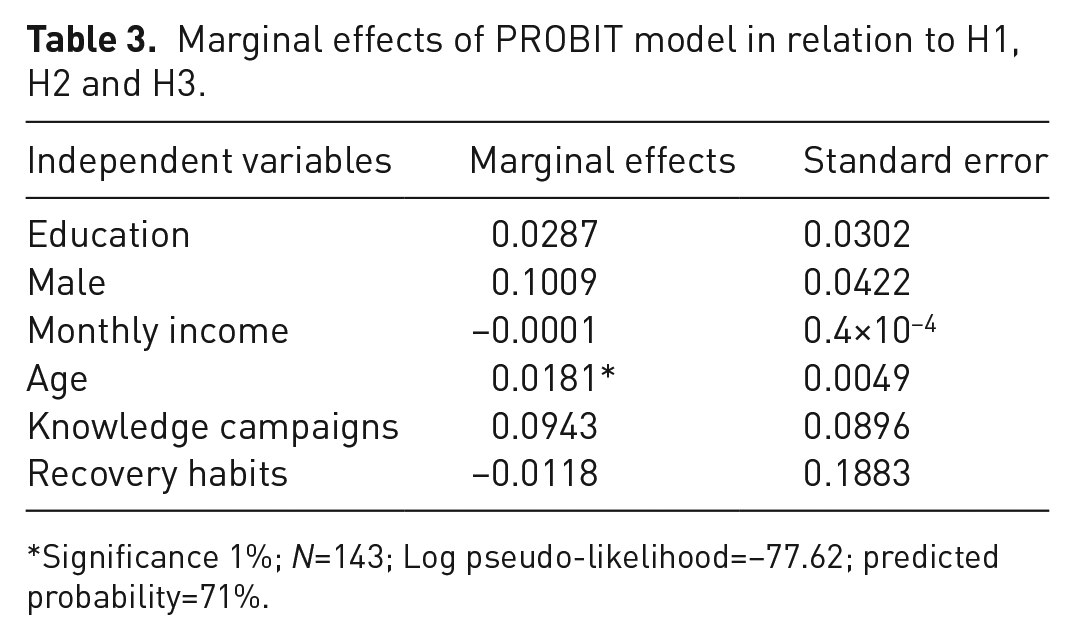
Significance 1%; N=143; Log pseudo-likelihood=−77.62; predicted probability=71%.
Concerning the remaining independent variables, there is not enough statistical evidence to conclude for its influence on the probability of returning WEEE at conventional significance levels.
Thus, concerning H1, our results are generally in line with those found by Wang et al. (2011), and we do not find evidence supporting H2 and H3.
Most important in the present study is to assess the factors that influence the desirability and resulting effectiveness of the five incentive schemes previously identified. Thus, Table 4 shows the estimation results of five PROBIT models aiming at analysing the determinants of the likelihood of consumers’ sensitivity to specific campaigns as a function of their socio-demographic characteristics, campaigns’ knowledge and EEE recovery habits.
Marginal effects of PROBIT model in relation to H4 and H5.
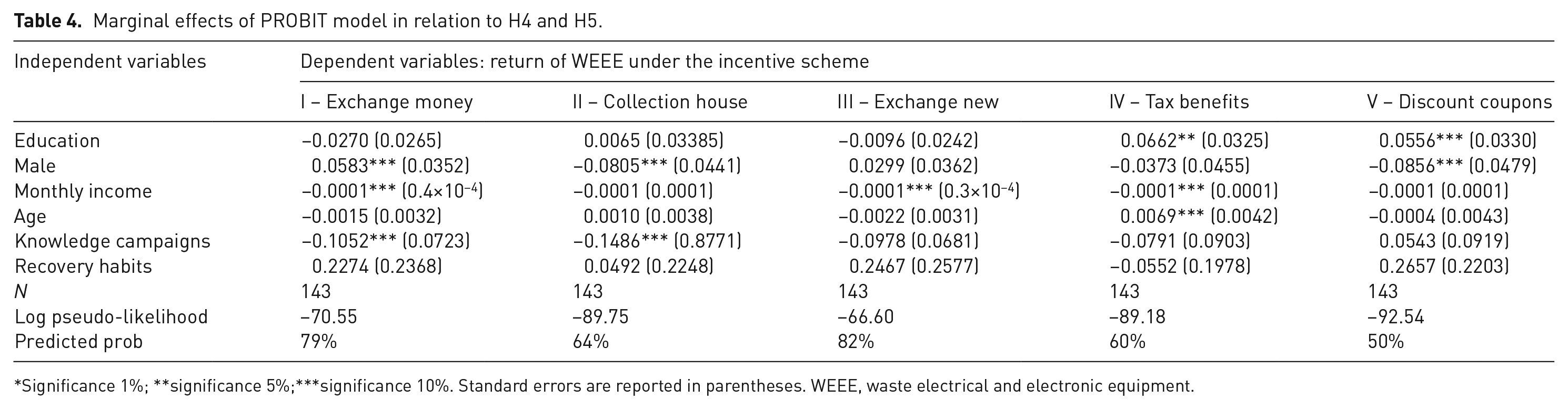
Significance 1%; **significance 5%;***significance 10%. Standard errors are reported in parentheses. WEEE, waste electrical and electronic equipment.
The following (ceteris paribus) effects stand out from the results in Table 4:
The education level positively influences the likelihood of individuals surrender their EEE for recovery if included in a scheme of ‘tax benefits’ or ‘discount coupons on service’, but has no effect on return of WEEE if the remaining three incentive schemes are in place.
Male respondents are more likely to return WEEE than their female counterparts as long as the incentive scheme in place is ‘exchange for money’, but are less likely to do so if the incentive scheme in place is ‘collection of EEE at home’ or ‘discount coupons on service’. No gender differences in behaviour are found if the incentive schemes are ‘exchange for new EEE’ or ‘tax benefits’.
Increases in monthly income exert a negative influence on the likelihood of WEEE return under the ‘exchange for money’, ‘exchange for new EEE’ and ‘tax benefits’ incentive schemes.
Older respondents are more likely to return WEEE as long as the incentive scheme in place is ‘tax benefits’. Age has no effect on behaviour if the remaining incentive schemes are in place.
All else the same, knowing campaigns encouraging the return of EEE in end of life decreases the likelihood of WEEE return under the ‘exchange for money’ and the ‘collection of EEE at home’ incentive schemes, and has no effect on this likelihood under the remaining schemes.
The recovery habits of EEE in end of life do not influence the likelihood of WEEE return under any of the five incentives schemes.
Overall, the highest (82%) predicted probability of WEEE return occurs under the ‘exchange for new EEE’ incentive scheme. In contrast, the lowest (50%) predicted probability of WEEE return occurs under the ‘exchange for discount coupons’. This result may be due to the lack of knowledge concerning the products benefiting from such discounts as well as the money amounts involved in those discounts.
In summary, our results indicate that information conditions and socio-demographic variables play a significant role in the effectiveness of different incentive schemes towards the return of EEE in end of life, providing evidence supporting H4 and H5.
According to Dwivedy and Mittal (2013), Ho et al. (2013), and Ritu and Shalini (2013), individuals’ familiarity with the type of equipment affects their attitudes towards end of life of EEE. According to these studies, the age and level of education affect consumer behaviour when it comes to choosing the routing to give their WEEE. Specifically, Dwivedy and Mittal (2013) state that in the absence of motivating economic benefits, the WEEE tack-back process depend on their knowledge and on the social norm.
Conclusions and further research
In light of fast technological improvements and consumption habits, the proper management of WEEE has become a key concern of current environmental policies at the European level. The research carried out in this study allows the following conclusions concerning the treatment of WEEE in Portugal:
There are gaps in the creation and dissemination of campaigns to encourage the return of EEE in end of life. It appears that knowledge of current trade-in campaigns do not increase the willingness of individuals to return their EEE at end-of-life.
Socio-demographic characteristics explain the kind of incentives for the recovery of WEEE desired by consumers. All else the same, older individuals and those with higher levels of education are more motivated by tax incentives, whereas females prefer schemes such as ‘collection at home’ or ‘discount coupons’. In contrast, male individuals and citizens in a precarious economic situation tend to favour ‘exchange for money’ incentives.
Individuals who already have EEE recovery habits are not further motivated by any of the incentive schemes under consideration.
From the summary results reported herein, it can be concluded that the Portuguese market for WEEE is at best in its infancy. Efforts should be undertaken to make the market truly competitive and attractive WEEE take-back schemes should be designed for the creation of new businesses.
The individual consumers, who are simultaneously the producers of the raw material, are just now being made aware of the need/option to deliver their WEEE, thereby making the market unstable and harder for operators to take advantage of the benefits of economies of scale. Further research should therefore focus on a comprehensive understanding of the target audience for take-back campaigns, in order to target incentives to their needs and motivations effectively. Moreover, although target sampling is not convenience sampling and samples obtained from target sampling may be closer to census data in terms of many demographic characteristics, any findings from a target audience need to be further examined in expanded samples. In particular, our relatively small sample comprises mostly young adults with high educational levels (master’s and doctoral degrees), who are most likely better informed about take-back campaigns and the environmental impacts of incorrect deposition of WEEE than the general population, thereby eventually depicting a more favourable attitude towards take-back outcomes and less sensitive to financial incentives than one would eventually observe in the general population.
Finally, in order to compare the efficacy of the existing Portuguese market structure with that in other member states, a thorough study of the current level of competition between the two management bodies should be undertaken, which would also allow the promotion of more advantageous financing structures along with driving product eco-design.
Footnotes
Declaration of conflicting interests
The authors declared no potential conflicts of interest with respect to the research, authorship and/or publication of this article.
Funding
The authors received no financial support for the research, authorship and/or publication of this article.