







Abstract
In this paper, we discuss recent efforts from the last 20 years to describe transport in municipal solid waste (MSW). We first discuss emerging themes in the field to draw the reader’s attention to a series of significant challenges. We then examine contributions regarding the modelling of leachate flow to study transport via mechanistic and stochastic approaches, at a variety of scales. Since MSW is a multiphase, biogeochemically active porous medium, and with the aim of providing a picture of transport phenomena in a wider context, we then discuss a selection of studies on leachate flow incorporating some of the complex landfill processes (e.g. biodegradation and settlement). It is clear from the literature survey that our understanding of transport phenomena exhibited by landfilled waste is far from complete. Attempts to model transport have largely consisted of applying representative elementary-scale models (the smallest volume which can be considered representative of the entire waste mass). Due to our limited understanding of fluid flow through landfilled waste, and the influence of simultaneously occurring biogeomechanical processes within the waste mass, elementary-scale models have been unable to fully describe the flow behaviour of MSW. Pore-scale modelling and experimental studies have proven to be a promising approach to study fluid flow through complex porous media. Here, we suggest that pore-scale modelling and experimental work may provide valuable insights into transport phenomena exhibited by MSW, which could then be used to revise elementary-scale models for improved representation of field-scale problems.
Keywords
Introduction
Global municipal solid waste (MSW) generation is expected to increase at least threefold by the end of the century (Hoornweg and Bhada-tata, 2012; Hoornweg et al., 2013). Due to high production rates and landfilling being the most common method of waste disposal worldwide, a significant proportion of this waste is expected to go to landfill. Likewise, in parts of the world where disposal has moved away from landfilling, closed facilities will remain. As such, landfilling, at least for the foreseeable future will be of relevance to the waste sector. The leachate produced due to infiltration of net precipitation, typically contains dissolved heavy metals, recalcitrant organics and inorganics that could contaminate groundwater and surface water if allowed to escape from the landfill (Kjeldsen et al., 2002). As such, the fate of this waste water within the landfill mass and in the geoenvironment is of interest to environmental engineers and scientists (Remmas et al., 2017). In bioreactor landfills, the leachate may be recirculated through the waste mass to enhance degradation and methane recovery with the prospect of early stabilization of the landfill (Barlaz and Reinhart, 2004; Reinhart et al., 2002). Moreover, flushing technologies using water and/or other biotechnological agents have also been studied to accelerate landfill stabilization and decrease its potential to contaminate the surrounding geoenvironment (Bolyard, 2016; Bolyard and Reinhart, 2016; Hettiaratchi et al., 2014, 2015;; Jayasinghe et al., 2014; Rashid et al., 2017). The aforementioned approaches may pave the way towards sustainable landfilling (Jayasinghe, 2013; Jayasinghe et al., 2011, 2013, 2014; Rashid et al., 2017). However, for field-scale application and prediction, an understanding of the transport phenomena at play within the waste matrix, which will ultimately determine the effectiveness of flushing or recirculation techniques with the possibility of relatively early stabilization of the landfill, is required.
Municipal solid waste is a complex, biogeochemically active, heterogeneous porous medium (Barlaz et al., 1990; Staley, 2009; Staley & Barlaz, 2009; Staley et al., 2011; Staley et al., 2012; Staley et al., 2006). Due to its spatially and temporally varying nature (both within individual landfills and across the worldwide inventory), it is challenging to develop transport models with a realistic prospect of widespread applicability to MSW. However, it is important to note that models, no matter how complex, will always be a simplification of reality, and that the need for and accuracy of models is often operationally defined. Early studies on flow were focused primarily on predicting the overall volume of leachate produced from an MSW sample under laboratory conditions (Ahmed et al., 1992; Demetracopoulos et al., 1986a, 1986b; El-Fadel et al., 1997; Khanbilvardi et al., 1995; Korfiatis et al., 1984; Noble and Arnold, 1991; Zeiss and Major W, 1992-1993). The most common approach to model the flow of leachate has consisted of applying the Richards’ equation to calculate the evolution of the leachate velocity in space-time while also incorporating the convection–dispersion equation to provide solute concentrations (Bendz and Singh, 1999; Demetracopoulos et al., 1986a, 1986b; El-Fadel et al., 1997; Han et al., 2011; Haydar and Khire, 2005, 2007; Khire and Kaushik, 2012; Khire and Mukherjee, 2007; Khire and Saravanathiiban, 2010; Korfiatis et al., 1984; Noble and Arnold, 1991). Extensive use of these mechanistic representative elementary volume (REV) (often defined as the smallest volume which can be considered representative of the entire waste mass) based models has been carried out to understand the flow behaviour of MSW (Rosqvist and Destouni, 2000; Rosqvist et al., 2005) with some studies focusing on conceptual models of the pore structure of MSW at the elementary scale (Han et al., 2011; Woodman et al., 2013, 2014, 2015). However, to date, our understanding of the flow of leachate, biogas and the impact of other simultaneously occurring biogeochemical processes on flow and transport is incomplete, especially at the pore-scale. This is particularly important to note since it is these pore-scale processes, with the possibility of field-scale processes dominating particular facets at particular times, that ultimately govern the overall behaviour in reactive porous media (Blunt, 2001; Blunt et al., 2013; Menke et al., 2017; Xiong, 2015; Xiong et al., 2016). It is likely that processes average over a wide range of different scales, which would explain the success of the widely used empirical landfill gas models. The real challenge lies in the integration of modelling processes at all the scales and understanding how averaging works. It is clear that one of the most difficult aspects to model is the inherent heterogeneity of the waste mass, and the impact of different waste components (e.g. their shapes, sizes and varying biodegradation rates) and numerous coupled processes on the flow regime. In this paper, heterogeneity is referred to as the variability in the properties of MSW, while preferential flow is defined as the phenomenon where the leachate takes the path of least resistance through the waste mass and channels through the larger pores (Beaven et al., 2011; Dixon and Langer, 2006; Dixon et al., 2008a, 2008b; Kjeldsen and Beaven, 2011; Powrie and Beaven, 1999; Woodman, 2007).
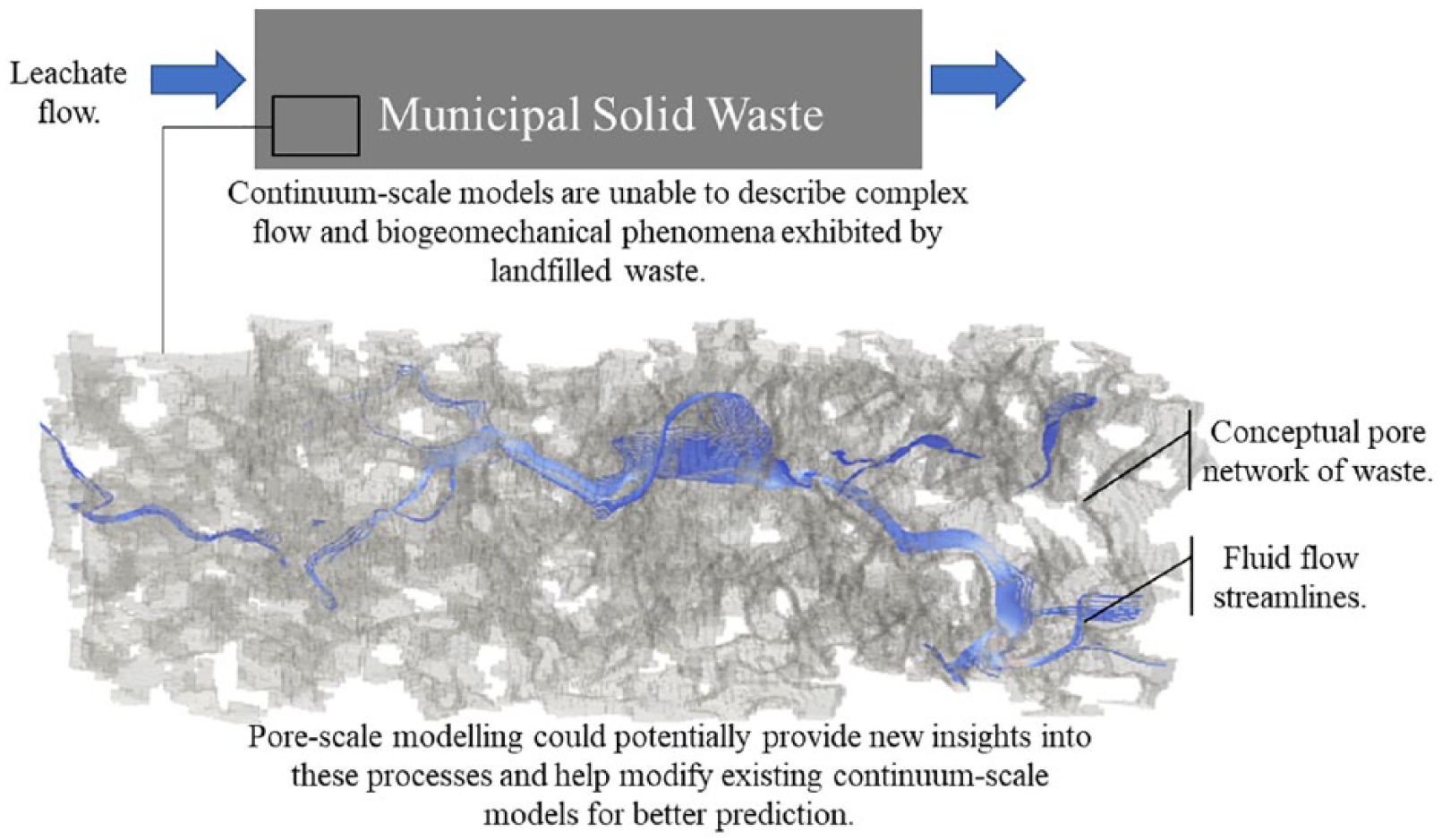
The objective of this paper is to provide a case for examining fluid flow in MSW at the pore-scale. Following from El-Fadel et al. (1997), we pay particular attention to the development of the field within the last 20 years. Whilst attempting to make a case for moving past the REV this paper is not intended to provide an exhaustive overview of the field. Instead, we reflect on a focused collection of recent key contributions with the aim of painting an accurate picture of the state of the art, highlighting the limitations of and gaps in our knowledge to identify emerging themes in the field and provide suggestions for future work. We first discuss emerging themes in the field to draw the reader’s attention to a series of significant challenges. We then examine contributions regarding the modelling of leachate flow and chemical transport via mechanistic and stochastic approaches, at a variety of scales. This is followed by consideration of contributions regarding leachate flow and chemical transport incorporating some of the complex landfill processes (e.g. biodegradation). We conclude with future needs and recommendations to improve our understanding of transport phenomena within MSW. Our recommendations are focused around obtaining pore-scale insights (Figure 1) into these processes with the ultimate aim of better field-scale prediction. We provide the literature search methodology as part of supporting information for this article.
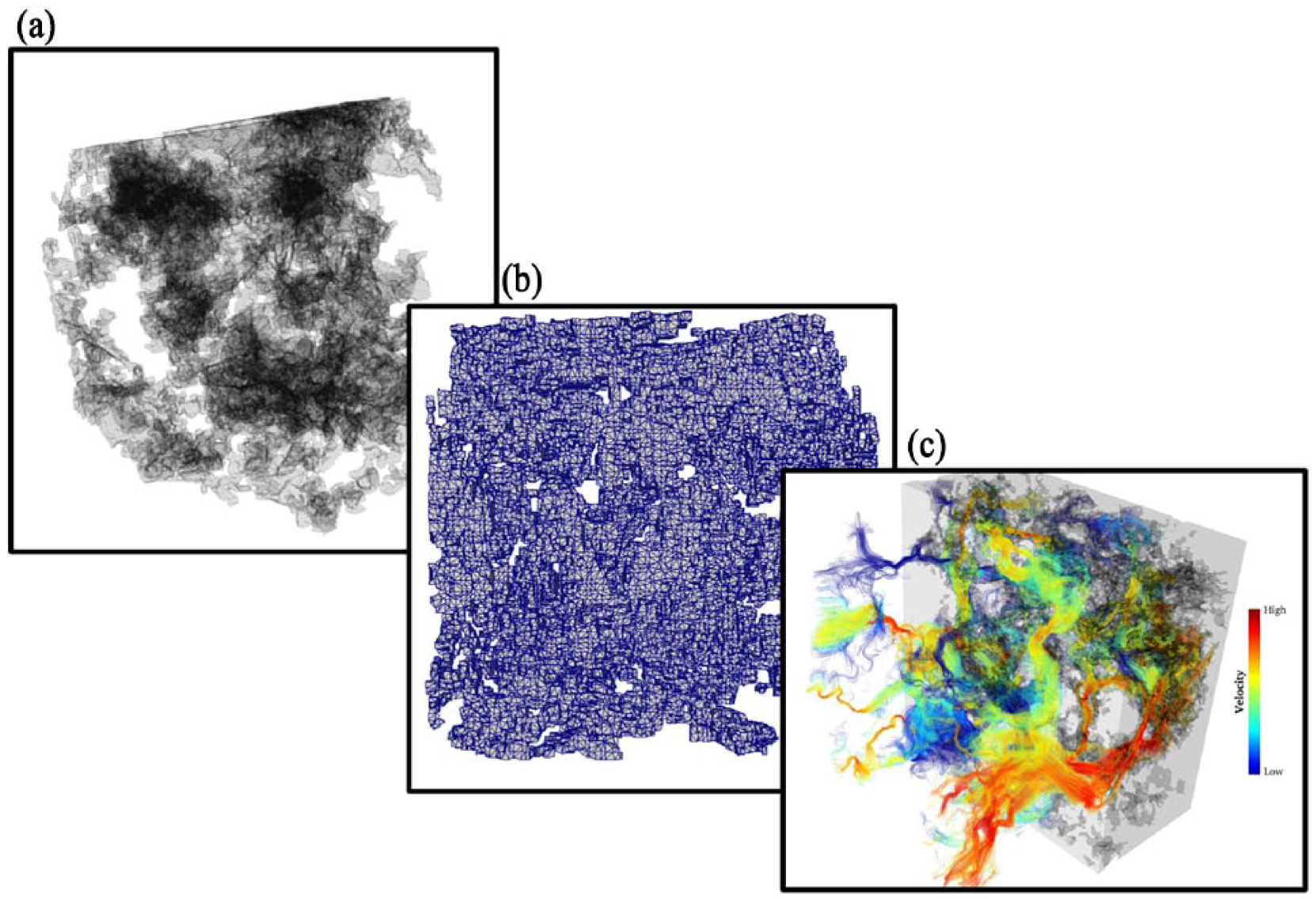
Schematic of a pore-scale simulation: (a) scanning; (b) pre-processing; and (c) computational fluid dynamics simulation.
Emerging themes in the field and motivation
As shown in Table 1, in the last 20 years, work in the field has developed from consideration of homogeneous one-dimensional (1D) models primarily focused on the liquid phase to representation of complex three-dimensional (3D) transport processes (e.g. solute transport, biodegradation and settlement), and the interaction of these phenomena with the waste structure. However, from the literature discussed hereafter, it is evident that our understanding of the transport phenomena at play in MSW is far from complete.
An overview of recent transport models.
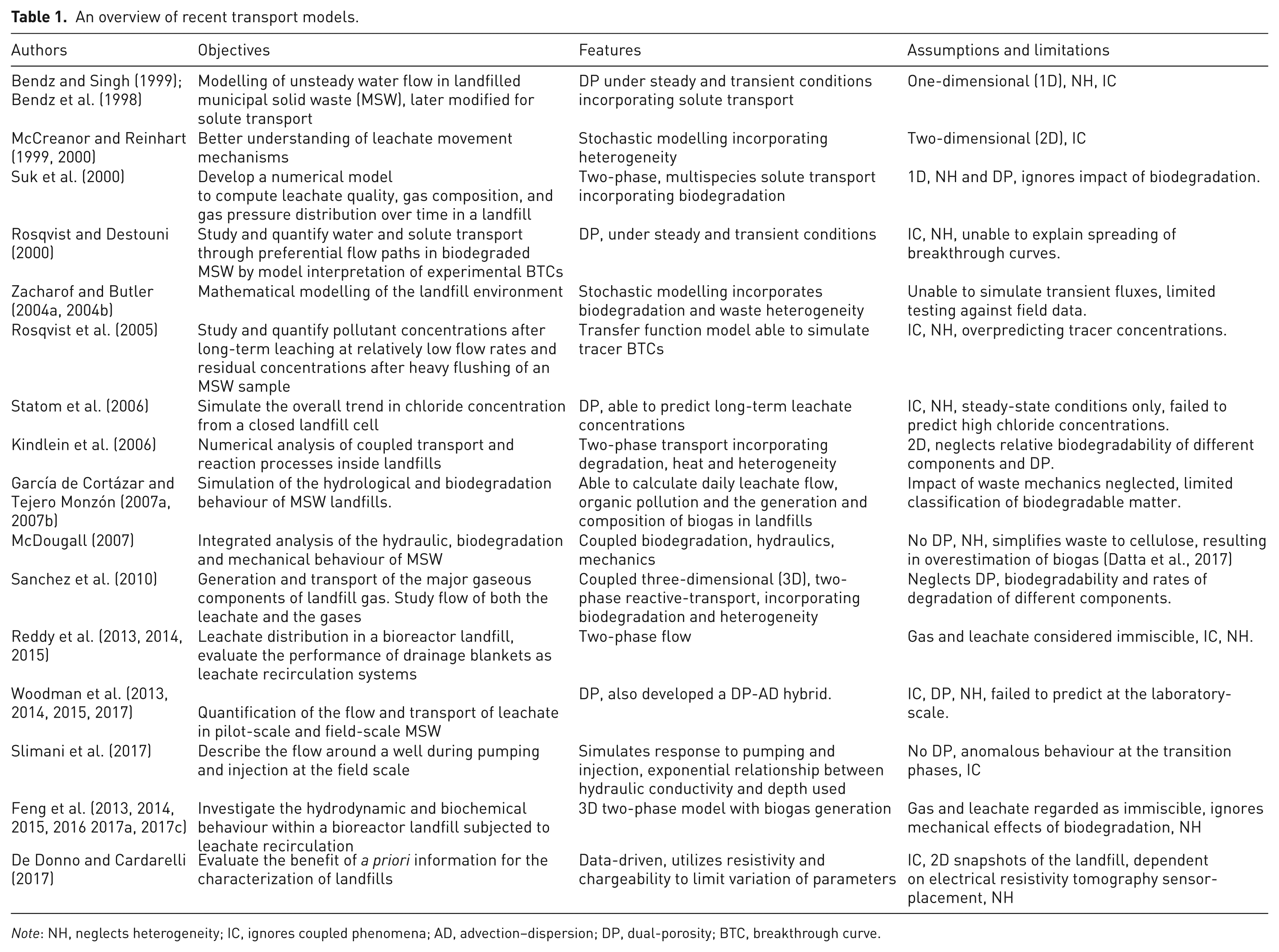
Note: NH, neglects heterogeneity; IC, ignores coupled phenomena; AD, advection–dispersion; DP, dual-porosity; BTC, breakthrough curve.
As discussed in the following sections, elementary-scale models (e.g. the Richards’ equation) have been applied extensively in the last 20 years to study flow in MSW. While researchers have tried to consider the physical and biogeochemical processes taking place in the waste mass, current modelling approaches simplify these processes in comparison to the high level of complexity found in a typical MSW landfill system, likely adding to the discrepancies between experimental data and models; all the while there is growing evidence that these complex processes play a significant role in transport through MSW. Of course, models are always a simplification of reality, and even coupling of relatively simple processes produces models that can be difficult to validate against typical, easily available datasets. However, validation exercises are vital to identify the range of validity of a particular model and its weaknesses. For instance, a relatively recent model comparison exercise, which is explored in detail later, found inconsistencies between available models and their ability to predict experimental data from a well-constrained laboratory-scale MSW landfill (Beaven, 2008; Beaven et al., 2008), suggesting that perhaps our understanding of underlying coupled processes within the waste matrix needs improvement before reliable short-term and long-term predictions can be made. It is also important to note that models are made for a specific objective and in many cases the models are performing at an acceptable level to achieve that objective. An example of this is the use of landfill gas models in practice (for example GasSim (Golder Associates, 2012) is a widely used model in the UK) (Clewes et al., 2008). Such models are extreme simplifications of reality (e.g. based on zero or first-order decay functions) but match the measured trends well and are used to make operational decisions, even though our understanding of the underlying processes in the waste body is still quite poor. The same applies to the stoichiometric equations used in recent geochemical speciation modelling work for landfills (van der Sloot et al., 2007, 2017). While this may be the case for models with a certain objective, when it comes to flow/transport models incorporating biogeomechanical phenomena to describe the landfill system and predict its behaviour, they are difficult to validate due to lack of complete data sets, and/or they become highly parameterized requiring empirical data to infer model parameters, and even then, the high number of degrees of freedom make it difficult to parameterize the models. Within this body of work, we have also found that there is a significant lack of full validation of a number of flow and transport models which attempt to incorporate biogeomechanical processes, against real experimental or field data. Where model comparison exercises have occurred, discrepancies between modelled and experimental data are suggestive of our lack of understanding of the MSW system. As such, it is difficult to say at this moment in time whether these complex models are applicable to real-life scenarios for the operational needs of the waste industry.
Recent studies (Woodman, 2007; Woodman et al., 2013, 2014, 2015, 2017), contrary to previous work (Bendz et al., 1998; Bengtsson et al., 1994; Oman and Rosqvist, 1999; Rosqvist and Bendz, 1999; Rosqvist and Destouni, 2000; Rosqvist et al., 2005), have discovered that some tracers (e.g. lithium and deuterium) exhibit anomalous transport in MSW, with tracers previously thought to be geochemically inert (Oman and Rosqvist, 1999; Reinhart, 1989; Rosqvist and Destouni, 2000) in their passage through the pores of MSW being found to exhibit non-conservative transport (Woodman et al., 2014, 2015). Current mechanistic REV-based approaches have not been able to predict this behaviour; thus, we do not fully know what happens to these tracers as they travel through the pore space. Upon studying the impact of mechanical compression of the waste matrix on diffusion of different tracers with varying diffusivities, researchers have also found that while compression decreases the hydraulic conductivity block diffusion times do not vary significantly, contrary to predictions by continuum-scale models (e.g. Richards’ equation), suggesting that our understanding of diffusive transport through MSW may not be entirely representative of real-life behaviour (Woodman et al., 2014). From anomalous tracer transport, to conceptual models of the structure of MSW, it is clear that our understanding of the role of MSW structure and its fluid–structure interaction with leachate as it travels through the pore space is incomplete and requires further development.
It is also clear that the structure of the waste plays a significant role in the transport of leachate. Generally, attempts to describe the structure as a homogeneous matrix have been unsuccessful, with leachate exhibiting preferential channelling. Typically, in attempts to describe preferential channelling, the waste structure has been split into two domains representing slow- and fast-moving water. It is possible that these dual-porosity/permeability models are an oversimplification of the complex flow behaviour exhibited by MSW, where the flow regimes are instead more likely to be a continuous spectrum rather than just two categories of flow. However, it is important to acknowledge that the simplifications within these models are a direct consequence of the intended purpose of modelling. If the purpose is understanding, then simplification allows a focus on the interaction of the main governing principles, but if the purpose is prediction then the focus is interpolation and extrapolation. However, it is important to note here that it is likely that this preferential channelling, at least in part, is a direct consequence of the structure of MSW and the fluid–structure interaction exhibited by the system as the leachate flows through the pore network.
To further understanding of these phenomena, conceptual models of the waste structure have been proposed, where the waste mass is assumed to contain low and high permeability objects in layers. Here, preferential pathways occur through the large gaps between these objects, and advection dominates, whereas within these layers, diffusion dominates and occurs mainly in the horizontal direction within the more permeable layers (Bendz et al., 1998; Woodman et al., 2014). However, such proposed conceptual models of the structure of MSW are likely to be, at best, difficult to validate via continuum modelling approaches that are prevalent in the literature. As such, when considering transport of leachate in landfills, it may be necessary to adopt more complex models offered by REV approaches to add an extra layer of detail and consider the composition and hydraulic properties of MSW components and the resulting pore network. As discussed below, it is likely that different waste components exhibit different permeability characteristics and may cause local variation of flow properties within the waste matrix (Muaaz-Us-Salam et al., 2017), and it might be important to take these into account, especially due to the ever-evolving pore-structure of MSW due to biodegradation, mechanical creep, etc. (Fei, 2016; Fei and Zekkos, 2012, 2013, 2016; Fei et al., 2013, 2014a, 2014b, 2015, 2016).
Modelling of leachate flow and solute transport
In this section we consider the development of mechanistic and stochastic modelling approaches to represent leachate flow in MSW and seek to critically assess how well these models have been able to capture experimentally observed behaviour. Whilst a considerable number of studies have been reported (e.g. Abbaspour, 2005; Abbaspour et al., 2004; Al-Thani et al., 2004; Brun and Engesgaard, 2002; El-Fadel, 1999; Haydar and Khire, 2005; Islam et al., 2001; Olaosun, 2001; Oman and Rosqvist, 1999; Powrie and Beaven, 1999; Rosqvist and Bendz, 1999; Yildiz et al., 2004), we discuss a selected few representative contributions in detail to highlight the significant issues.
Mechanistic techniques
Earlier studies on flow were focused on simple REV-based approaches, predominantly involving models treating MSW as a homogeneous porous medium based on Darcy’s law incorporating advection–dispersion phenomena to represent solute transport (Ahmed et al., 1992; Bleiker et al., 1995; Chen and Chynoweth, 1995; Deeley et al., 1985; Demetracopoulos et al., 1986b; El-Fadel et al., 1997; Khanbilvardi et al., 1995; Pohland, 1980; Reinhart, 1996; Reinhart and Al-Yousfi, 1996; Sykes et al., 1982). For instance, the theory of unsaturated flow through homogeneous and isotropic porous media has been applied to study flow through MSW by Korfiatis et al. (1984). Their model used a vertical 1D equation for downward flow through an unsaturated porous medium, considering the variation of moisture content with time, hydraulic conductivity with depth and a source/sink term. Overall, the agreement between the modelled and experimental data was poor. To our knowledge, this was one of the first recorded studies to demonstrate the existence of preferential flow and spatial variance of hydraulic properties of MSW. Much of this earlier work highlighted the unsuitability of assuming MSW to be a homogeneous, porous medium and the importance of including the heterogeneous nature of waste in the modelling framework.
Recently, researchers have also used commercial codes and simulation software (e.g. HYDRUS, MODFLOW-SURFACT, COMSOL Multiphysics, etc.) to model transport in MSW (Audebert et al., 2016a, 2016b; Beaven et al., 2011; Fellner and Brunner, 2010; Haydar and Khire, 2005, 2007; Khire and Kaushik, 2012; Khire and Mukherjee, 2007; Khire and Saravanathiiban, 2010; Kjeldsen and Beaven, 2011; Olivier et al., 2009; Saquing et al., 2012; Slimani et al., 2017; Tinet et al., 2011a, 2011b). Amongst commercial codes, HYDRUS has been a recurrent choice for modelling flow through MSW (Fellner and Brunner, 2010; Haydar and Khire, 2005, 2007; Khire and Kaushik, 2012; Khire and Mukherjee, 2007; Reddy et al., 2013). HYDRUS is based on a modified form of the Richards’ equation solved for saturated–unsaturated flow, and the advection–dispersion equation for solute and heat transport. The Richards’ equation may also be modified to include dual-porosity/permeability effects (Šimůnek and van Genuchten, 2008; Šimůnek et al., 2011). For instance, transport of phenol as a model contaminant in a laboratory-scale reactor containing simulated MSW has been studied and its transport modelled via HYRUS-1D (Saquing et al., 2012; Šimůnek and van Genuchten, 2008; Šimůnek et al., 2003). Solute transport in the liquid phase was described by the advection–dispersion equation. When the combined effects of sorption and biodegradation on phenol transport were studied, the model was in very poor agreement with the data, yielding an inversely derived biodegradation rate that was two orders of magnitude higher than the independently measured rate, suggesting that transport through the MSW medium is complex and the fluid–structure interaction exhibited through the medium is of relevance for hydrological prediction.
In recent years, as demonstrated below, the scale of interest for modelling leachate transport has shifted from bench scale towards pilot- and field-scales, partly due to developments in computational capacity but also because engineers, waste managers and regulatory authorities are ultimately interested in the field-scale. For instance, researchers have adopted a kinetic wave model, first proposed by Beven and Germann (1981) for describing water flows in soils with macropores, to determine the channel flow in landfills (Bendz et al., 1998). A source/sink term was used to account for flow from and into the channel from the matrix (Beven and Germann, 1981). Upon moisture intrusion into the landfill due to precipitation or leachate recirculation, water would filtrate from the channel into the matrix domain, whereas during dry periods it would be released to the channel domain. They tested their approach against a pilot-scale MSW sample and found that the model could describe the arrival of the wetting front and the drainage front during unsteady flow, whereas it was not able to describe the observed dispersion through the MSW sample. Their work highlighted the unsuitability of assuming the flux laws through MSW to be strictly convective in nature, and the importance of considering the spatial variability of this porous medium for hydrological modelling.
A very popular mechanistic approach to modelling of flow has been to apply different formulations of the Richards’ equation, dividing the domain into two homogeneous and isotropic overlapping continua (e.g. mobile and immobile regions of liquid) in an attempt to capture the complex pore space of MSW (Beaven et al., 2011; Di Bella et al., 2012; Di Trapani et al., 2015; Fellner and Brunner, 2010; Han et al., 2011; Kjeldsen and Beaven, 2011; McDougall, 2011; Slimani et al., 2017; Statom et al., 2006; Tinet et al., 2011b). For instance, vertical flow in MSW samples at the pilot-scale has been investigated by Woodman et al. (2015) – interestingly, in their study lithium did not behave conservatively as a tracer. The positively skewed tracer breakthrough curves exhibited tailing, as observed in previous studies (Bendz et al., 1998; Oman and Rosqvist, 1999; Rosqvist and Bendz, 1999; Rosqvist and Destouni, 2000; Rosqvist et al., 2005). They compared advection–dispersion, dual-porosity and hybrid advection–dispersion/dual-porosity models. In the advection–dispersion approach, different processes responsible for non-uniform flow are essentially lumped together into the dispersivity parameter. The dual-porosity model consistently offered a better fit. The hybrid advection–dispersion/dual-porosity model only performed well when either advection–dispersion or dual-porosity behaviour dominated. This research shed light on the previously mentioned anomalous transport within MSW, in terms of REV domain-based modelling approaches, indicating that multi-porosity mechanisms may be significant, and considering the variety of components present in MSW (wood, paper, card, food waste, etc.), this is entirely plausible (Athanasopoulos, 2008; Beaven et al., 2011; Dixon et al., 2008b; Gotze et al., 2016; Grellier et al., 2007; Hossain, 2002; Koganti, 2015; Matasovic et al., 2008; Reddy et al., 2009, 2011; Zekkos, 2005; Zekkos et al., 2008, 2010). For instance, researchers have studied the hydraulic properties of different MSW components (e.g. paper and wood (Ghane et al., 2014, 2016; Han et al., 2011; Subroy et al., 2014)) where both these components’ hydraulic properties could be described by dual-permeability Richards’ equations, but their intrinsic permeability varied by 1–2 orders of magnitude, suggesting that if they were both present in a waste matrix, due to their varying hydraulic characteristics, it may not be possible to model the dual-porosity characteristics of the entire waste body by assigning them a single set of properties.
It is important to note that any model be it analytical or numerical is an approximation of real behaviour. Whilst analytical models cannot really handle heterogeneity, and therefore have lumped parameters, numerical models do allow us to include heterogeneity; however, the number of parameters required make it very difficult to parameterize the models. All assumptions, the manner in which the models are implemented (reaction pathways/solution algorithms/numerical schemes) and how the boundary conditions are integrated into the model also have a significant impact on the model outcome. This could help explain why models based on the same governing equations, initial and boundary conditions can yield varying predictions (Beaven, 2008; Beaven et al., 2008).
The increasingly popular dual-porosity approach was recently tested against field-scale data by Woodman et al. (2017). Solute transport and horizontal fluid flow between well pairs in a saturated MSW landfill via the use of lithium and bromide tracers along with a fluorescent dye were investigated. Poor fits were obtained with the advection–dispersion model, while the dual-porosity model considered offered a better fit to the breakthrough curves. However, simply because dual-porosity models tend to fit the data better than others (likely due to the extra degrees of freedom in the equations) is not sufficient to conclude that this is absolutely and the only manner in which fluid flows through MSW, it is more of an indication that REV-based dual-porosity approaches are relatively better at describing the behaviour than other simpler REV-based approaches. This research also added to the growing body of evidence regarding the anomalous behaviour of lithium as a tracer in MSW (Woodman et al., 2013, 2014, 2015). More importantly, this anomalous behaviour highlights the significance of the fluid–structure interaction of the MSW with the mobile liquid, tracers and transport phenomena in general. Fitting parameters in a model to match data is an approach that is adequate if interpolation and limited extrapolation is the objective of the model. Nevertheless, models developed to increase our mechanistic understanding should be based on independently determined material parameters. However, this is only practical for relatively small simple waste samples and upscaling to full-scale landfills will require some form of fitting (determination of parameters of a probability distribution), thereby moving the model away from its mechanistic basis.
Similar to the above, the Richards’ equation has also been applied to model leachate pumping and injection data at the field-scale by Slimani et al. (2017). They tested the Richards’ equation under homogeneous conditions, as well as stratified conditions by decreasing the permeability with depth in order to represent ‘real-life’ conditions, drawing support from the conceptual model of the layered structure of MSW first presented by Bendz and Singh (1999). They found the homogeneous assumption to be inappropriate to describe the flow behaviour, and that consideration of stratification yielded better fits to the data. It should be noted that REV-based modelling approaches, where the domain is essentially homogenized, albeit segmented in some approaches, as discussed above, may not be entirely suitable to carry out a deeper investigation into the role of the structure of MSW, or that of its different components and their dual-/multi-porosity characteristics. This is because the transport processes at play take place inside the pores of this porous medium and it is likely that it is their multi-scale behaviour that governs transport at the field-scale. In another study, researchers developed a dual-porosity flow model to study the flow of leachate to vertical wells (Ke et al., 2018). As is typical for this type of model, the waste mass was divided into matrix and fracture domains, whereby flow could occur horizontally and vertically towards the vertical well with the possibility of mass exchange between the two continua. Sensitivity analysis indicated that the hydraulic properties of the fracture domain influence leachate drawdown more so than those of the matrix domain. Interestingly, the degree of anisotropy (horizontal hydraulic conductivity ÷ vertical hydraulic conductivity) was found to have a negative impact on leachate drawdown as it gets sequentially harder for leachate to flow vertically. Furthermore, the authors also tested their model against field-scale drawdown test data, whereby upon fitting the data to the proposed model to obtain parameters such as hydraulic conductivities of the fracture and matrix continua, the authors were able to obtain a reasonably good fit. Their study shed light on the need for field-scale data which are required to inform current elementary-scale models, without which the predictive capabilities of current elementary-scale models are very limited.
Researchers have also applied electrical resistivity tomography subsurface modelling to understand the flow in two landfill cells and subsequently model the flow of leachate within them (Audebert et al., 2016a, 2016b). Despite the inherent heterogeneity of landfilled waste, similarities between the leachate injection experiments were reported. They proposed a hydrodynamic model (based on the dual permeability model in HYDRUS-2D) with one parameter set to predict leachate flow for the waste deposit cells. Similar to recent studies, they found that the dual-continuum approach better described the flow of leachate in comparison with the single-continuum assumption (Han et al., 2011; Woodman, 2007; Woodman et al., 2013, 2014, 2015, 2017).
Stochastic and probabilistic modelling
Instead of mechanistic approaches, some researchers albeit comparatively few in number, have adopted stochastic and/or probabilistic modelling approaches (McCreanor and Reinhart, 1999, 2000; Reinhart et al., 2002; Rosqvist and Destouni, 2000; Rosqvist et al., 2005; Zacharof and Butler, 2004a, 2004b). For instance, the US Geological Survey’s saturated–unsaturated transport model (SUTRA) has been applied to model flow in MSW in homogeneous anisotropic and heterogeneous waste masses (McCreanor and Reinhart, 1999, 2000) using a stochastic approach to model the heterogeneous nature of MSW. They used normal, exponentially increasing and exponentially decreasing probability density functions to model the frequency–hydraulic conductivity relationships for anisotropy and heterogeneity. The flow in the model itself was described by a general form of Darcy’s law (Voss, 1984). They compared results for the homogeneous, isotropic case, due to low computation times, against field data for cumulative leachate volumes generated and found errors ranging from 27% to 160%, indicating the unsuitability of modelling the waste mass isotropically. They discussed that the discrepancies were likely due to preferential flow. Overall, their study was one of the first to highlight the possibility of applying stochastic approaches to tackle the problem of waste heterogeneity. Similarly, a probabilistic Lagrangian modelling approach was adopted to interpret tracer breakthrough curves by Rosqvist and Destouni (2000) and Rosqvist et al. (2005). To account for preferential flow, they divided the domain into mobile and immobile water (Hopmans et al., 2002; Kohne et al., 2009; Šimůnek and van Genuchten, 2008; Šimůnek et al., 2003; Vereecken et al., 2016). Likewise, another approach divided the waste into regions of fast and slow flow paths, where the solute advection variability between these fast and slow flow paths was described by a bimodal probability density function (BIM). The tracer breakthrough curves had a long tail, and the early peaks were indicative of rapid solute transport in preferential flow paths, while the prolonged tails were possibly due to transport in the slow regions. Overall, the experimental work indicated the existence of nonuniform transport. Interestingly, the authors claimed that the Mobile-IMmobile (MIM - mass transfer permitted between mobile and immobile water zones only; unlike BIM, which considered mobile water and solute advection in both regions) model was able to fit to the data adequately; however, the dispersivity values were unreasonably high suggesting that the spreading of the breakthrough curves could not be explained by local dispersion alone. The BIM model achieved good agreement with the tracer tests. Interestingly, the model interpreted that 90% of total water flow occurred through 47% of the water content of the waste sample, suggesting that preferential flow dominated the flow regime. This study showed that the landfill system cannot be described by models based on homogeneous isotropic media and indicated that two-domain models are better at describing transport through MSW. Interestingly, recent work (Caicedo, 2013; Caicedo-Concha et al., 2011, 2016; de Vries et al., 2017; Kohne et al., 2009; Šimůnek and van Genuchten, 2008; Šimůnek et al., 2003; Vereecken et al., 2016) has suggested that different MSW fractions affect flow in different ways and as such, the validity of assigning the same immobile region characteristics to the entire waste matrix is debatable. Of course, the suitability of adopting such an assumption depends significantly on the objectives of the model, as accuracy is operationally defined and not an absolute term.
Modelling of leachate and gas transport incorporating degradation and deformation
Here, we consider the development of modelling approaches to represent leachate flow in MSW coupled with biogeomechanical processes occurring within the waste mass. Within this body of work, we demonstrate that there is a significant lack of validation against real experimental or field data. Where validation has occurred, the differences between modelled and experimental data suggest a lack in our understanding of the MSW system as a whole. For instance, as noted earlier a recent model comparison exercise was conducted where modellers were provided with set-up and operational data for two experimental laboratory-scale landfills and invited to submit predictions for variables such as waste settlement, gas generation, changes in leachate chemistry, etc. (Beaven, 2008; Beaven et al., 2008; Clewes et al., 2008; Ivanova et al., 2008; Lobo et al., 2008; McDougall, 2008; Reichel and Haarstrick, 2008; White, 2008; White and Beaven, 2013). The majority of the models underpredicted the cumulative biogas production, with one of the models overpredicting the yield (for one of the experiments, by almost twofold). Most of the models predicted the trends in data such as settlement and volatile fatty acid concentrations with varying degrees of accuracy. Detailed descriptions of some of these models and their underlying frameworks are discussed later.
To describe two-phase flow (gas and liquid) in landfills, REV-based models obeying Darcy’s law overall, and in some instances explicitly modelled via variants of the Richards’ equation, with van Genuchten functions to describe relative permeabilities of leachate and gas, have been applied widely (Feng and Zhang, 2013; Feng and Zheng, 2014; Feng et al., 2015, 2016, 2017; Kindlein et al., 2006; Sanchez et al., 2006, 2007, 2010 White and Beaven, 2013; White et al., 2011, 2014). As a typical example, Reddy et al. (2014) applied the finite-difference based Fast Lagrangian Analysis of Continua (FLAC) model to simulate two-phase flow in bioreactor landfills. They assumed leachate and biogas to be immiscible fluids whose flow was governed by leachate saturation and capillary pressure (pressure difference between pore water and pore gas). The flow of these two fluids was described via Darcy’s law, and the relative permeabilities were related to the saturation of the waste via van Genuchten functions ( van Genuchten, 1980). Upon validation against data obtained from the literature (laboratory-scale and field-scale) and similar single-phase modelling work, the authors claimed that FLAC was on par with currently available/used models.
Implicit and explicit modelling of biogeomechanics
Likewise, variants of the two-phase approach have been coupled with models of other biogeomechanical processes in landfills in attempts to describe the whole system. For instance, a two-dimensional (2D) multiphase flow and transport model incorporating degradation was presented by Kindlein et al. (2006). They modelled the landfill system as a homogeneous domain arguing that the landfill heterogeneity at the field-scale can be neglected, which, as previously discussed, may not be a suitable assumption. The hydraulic model for multiphase flow was based on the work of Bear and Helmig by applying Darcy’s law for fluid flow incorporating diffusion and dispersion (Bear, 1972; Helmig, 1997). The relative permeability of waste and gas was based on the Brooks and Corey functions (Brooks and Corey, 1964). Monod kinetics was employed to model biodegradation and the evolution of organic compounds with time. Biodegradation was coupled with multiphase flow implicitly by including sinks and sources in the multiphase equations for leachate and biogas. Although they did not validate their model against field-scale or laboratory-scale data, their model suggested that leachate tends to move preferentially around regions of waste exhibiting gas production. Overall, their study showed the possibility of modelling flow of leachate and gas exclusively, while considering biodegradation as sources and sinks instead of explicitly modelling individual degradation stages. However, their study lacked the inclusion of the inherent heterogeneity of the waste, which might have impacted their results.
In many instances, many of the two-phase flow models in the literature have not been fully tested against experimental data or field data, and where reported, the agreement between these types of models and measured data has been poor. For instance, a hydro-bio-mechanical model to represent the behaviour of landfilled waste has been developed (Datta et al., 2017; Kazimoglu et al., 2006; McDougall, 2007, 2011). The hydraulic model was based on the 2D formulation of Richards’ equation, and the van Genuchten parameters were used to express the relationship between suction and moisture content in order to solve unsaturated flow scenarios. The biodegradation model was based on modelling individual anaerobic degradation reactions explicitly (hydrolysis, acetogenesis and methanogenesis). However, the biodegradation model assumed a perfectly-mixed two-stage anaerobic digester, while all the degradable waste was classified as cellulose in the modelling of these reactions. Recently, Datta et al. applied this model to a laboratory-scale experiment studying coupled processes in MSW (Datta et al., 2017). The overall predicted methane generation volume was more than double the experimental value, suggesting that approximating all the degradable content of MSW as cellulose for modelling purposes is likely an unsuitable assumption, particularly due to the presence of hemicellulose and the more recalcitrant, lignin components of the biodegradable matter within MSW. Similarly, researchers have developed a 3D two-phase flow model for leachate and gas flow in landfills (Feng et al., 2017, 2018). As with Kindlein et al. (2006) they modelled the leachate and gas flow via Darcy’s law, with source/sink terms for gas and leachate resulting from biodegradation from the landfill, ignoring intermediate degradation products (Feng and Zhang, 2013; Feng and Zheng, 2014; Feng et al., 2016, 2017; Kindlein et al., 2006). The relative permeabilities were modelled by adopting the van Genuchten and Mualem model and assuming that gas and leachate are immiscible, the porosity of the waste remains constant and isothermal conditions prevail (Mualem, 1976; van Genuchten, 1980). Comparison against field data for spatial variation of pore water pressure showed poor fits, and the authors discussed the possibility of heterogeneity of the waste hydraulic properties causing disagreements between measured and predicted data. This study highlighted the importance of considering the flow of leachate and gas as coupled phenomena, and the unpredictability that arises in modelling these phenomena when the waste structure and its heterogeneity are not considered, as is typical of REV-based modelling strategies.
In addition to modelling two-phase flow with biogeomechanical processes, some researchers have opted for a compromise between modelling biodegradation explicitly, reaction-by-reaction (Kindlein et al., 2007; McDougall, 2007) and simply including it as a source/sink term by modelling bulk biogas generation as a first-order process. For instance, a 2D coupled hydro-bio-mechanical model was recently developed (Reddy et al., 2017, 2018). The two-phase hydraulic model was based on Richards’ equation, where the biogas and leachate were considered immiscible and the relative permeabilities of the leachate and gas were modelled via the van Genuchten model. A Mohr–Coulomb based plane-strain plasticity model was adopted to model the settlement of the waste. The United States Environment Protection Agency’s LandGEM model was used to model first-order biodegradation of the waste mass (United States Environment Protection Agency, 2005). It should be pointed out that whilst this model has not been verified against field data as of yet, the authors have performed parametric case studies to identify the importance of certain parameters to inform bioreactor landfill design. Their modelling framework does not consider heterogeneity of the hydraulic, biochemical and geotechnical properties of the waste mass, which would likely impact their model’s predictions at the field-scale. Their framework also assumes a first order bulk gas generation and degradation behaviour from the waste mass. Recent evidence has shown that different MSW components which are biodegradable exhibit variable degradation behaviour and that lignin-rich components of MSW generally do not undergo biodegradation in the landfill environment (Jayasinghe et al., 2014; Krause et al., 2016, 2018; Muaaz-Us-Salam et al., 2017; Wang, 2015; Wang and Barlaz, 2016; Wang et al., 2011, 2013, 2015; Warwick et al., 2018; Ximenes et al., 2008, 2015). Overall, their studies have provided valuable insights into the importance of coupled processes in designing bioreactor landfills for leachate recirculation and early stabilization of the waste mass.
Consideration of heterogeneity
In addition to coupling biogeochemical processes with the aforementioned two-phase REV-based approaches, some researchers have also attempted to capture the heterogeneity of the waste mass (McCreanor and Reinhart, 1999, 2000; Sanchez et al., 2006, 2007, 2010; Zacharof and Butler, 2004a, 2004b). For example, flow has been modelled stochastically through MSW incorporating waste heterogeneity and biogas production (McCreanor and Reinhart, 1999, 2000; Zacharof and Butler, 2004a, 2004b). In the latter model, biochemical pathways (hydrolysis, acetogenesis and methanogenesis) were modelled individually for the various components of the organic fraction represented by carbohydrates, fats and proteins. Model molecules for each of these components were chosen and growth/decay functions were used to model the rates of change in the molar mass of these components during hydrolysis, acetogenesis and methanogenesis. Flow was modelled stochastically to include the effects of waste heterogeneity by taking the overall flow through the landfill to be time invariant. It was also assumed that the flows through the waste were log-normally distributed against the average vertical water velocities. The statistical velocity model was then used to calculate the travel times of the leachate particles by using the random function given by the ratio of the distance travelled to the average velocity experienced. Since time was the key variable in the hydrological and biochemical modules, it was used as the basis to produce the integrated model with the overall aim of predicting leachate and biogas compositions. However, similar to other field-scale models discussed in this section, testing against actual field data was not reported. It should also be noted that whilst stochastic modelling may be suitable to fit experimental data and gain some insight into the flow regime of the porous medium, unlike mechanistic approaches, it is not an ideal way to gain in-depth understanding of the physics and biogeochemistry of these phenomena. In another attempt to consider the impact of the inherent heterogeneity of MSW on flow and biogeochemical phenomena, a 3D model for biodegradation, and flow of landfill gas and leachate has been developed (Sanchez et al., 2006, 2007, 2010). They modelled individual aerobic and anaerobic degradation reactions by employing Suk et al.’s and Lee et al.’s models for the dissolved carbon, its conversion to organic acids and the rate of growth of microorganisms (Lee et al., 2001; Suk et al., 2000). They then employed El-Fadel et al.’s strategy to model the bulk biodegradation of the waste by including relative biodegradability of certain fractions (El-Fadel, 1999; El-Fadel et al., 1996a, 1996b). The biodegradation module linked with the standard convection–diffusion–reaction equation to model the concentration of landfill gas. Their hydraulic model was based on Richards’ equations, while the relative permeabilities of gas and leachate were modelled via van Genuchten functions. They considered heterogeneity of the waste mass by introducing spatial variation of permeabilities and porosities in 3D by employing the sequential Gaussian simulation technique. Although they did not test their model against actual field data, they simulated a variety of scenarios for homogeneous and heterogeneous landfills. In summary, their study demonstrated the impact of waste heterogeneity on flow of leachate and gas, and the significance of including two-phase flow to realistic modelling of landfill processes, since the inter-phase interactions impact the gauge pressure within the waste mass and influence the stability of landfills.
Future needs and recommendations
In light of the state of the art reviewed above, we identify the following challenges and on the basis of this, provide recommendations for future research needs and potential multidisciplinary approaches to address them:
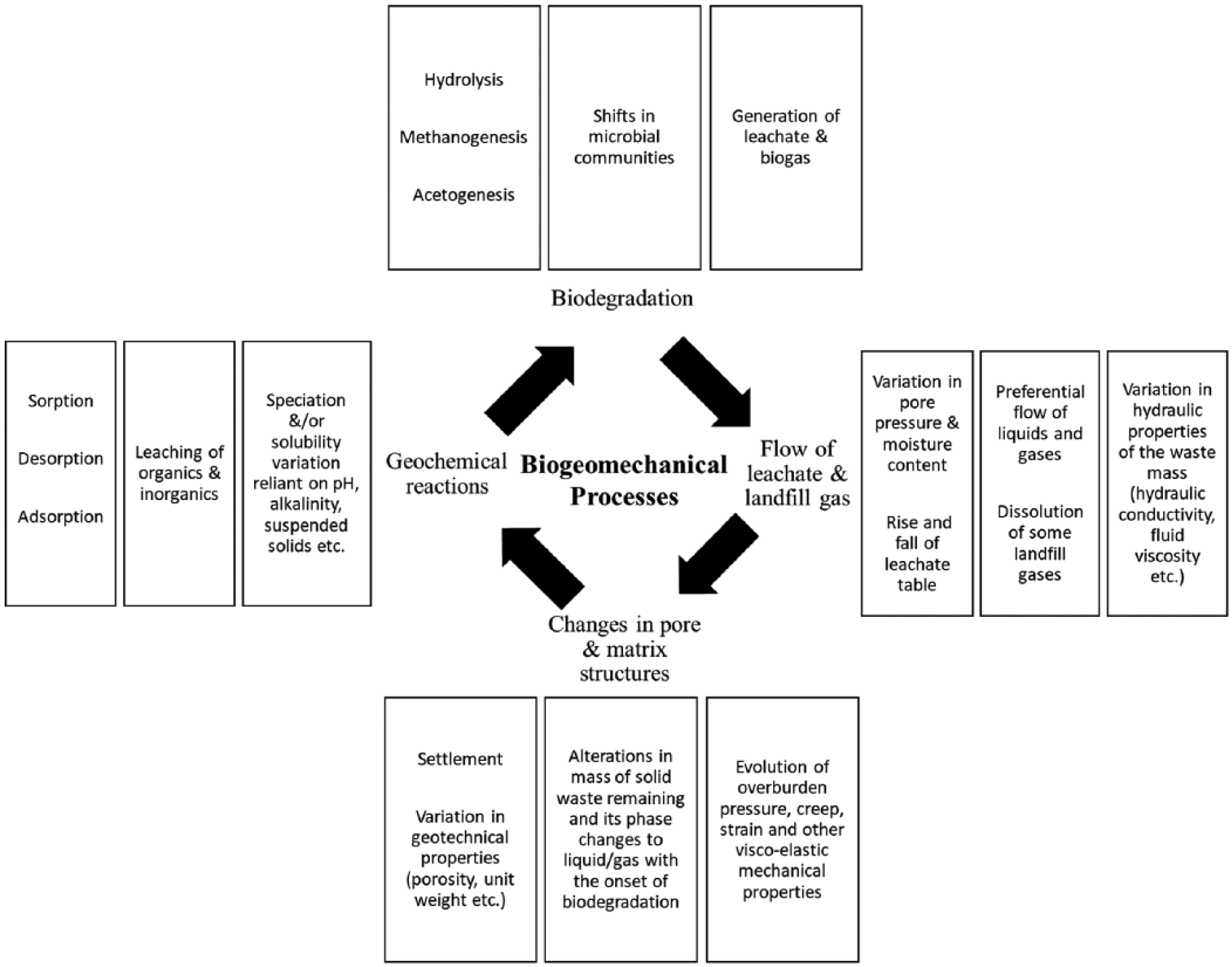
Different processes that take place in the municipal solid waste system: conceptual model informed by the works of Datta et al. (2018), Fei et al. (2014a), and McDougall (2007).
While pore-scale investigation of fluid flow and biogeochemical processes might lead to new insights, as is the case with any experimental/modelling technique, sources of error and challenges will arise. One of the key points addressed in this paper has been the heterogeneity of the waste. This inherent heterogeneity makes representative sampling of a waste body very difficult and casts doubt on extrapolating the conclusions from one particular study to another. Pore-scale studies with micro-model experiments/models will likely encounter these doubts and difficulties. However, the purpose of this line of work would be to further understanding of the fundamental processes of the MSW system and the interaction between the different processes from Figure 2. What does this mean for currently existing models? Hopefully, experimental and numerical pore-scale studies as described above, when put against currently existing data at the laboratory and field scales will help in establishing a relationship between scaling of flow/transport and biogeochemical/physical processes. This relationship between the scales should then help in understanding how averaging will work to upscale from the pore-scale, to the centimetre scale, up to the metre scale, leading all the way up to the field scale.
In conclusion, modelling transport phenomena in MSW is challenging due to its inherent multi-scale heterogeneity and ever-evolving pore space due to various biogeochemical/physical processes. Continuum-scale models have not been able to sufficiently describe transport due to the impact of the aforementioned processes. We suggest studying transport at the pore-scale to further our understanding of transport within the pores of the waste, since it is these pore-scale processes that ultimately govern transport at the field-scale. The insights obtained could then be used to modify existing continuum-scale models for better prediction.
Supplemental Material
WMR828120_SUPPLEMENTAL_MATERIAL – Supplemental material for The case for examining fluid flow in municipal solid waste at the pore-scale – A review
Supplemental material, WMR828120_SUPPLEMENTAL_MATERIAL for The case for examining fluid flow in municipal solid waste at the pore-scale – A review by Syed Muaaz-Us-Salam, Peter John Cleall and Michael John Harbottle in Waste Management & Research
Footnotes
Acknowledgements
We thank Jose Javier Munoz Criollo and Steven Warwick for fruitful discussions on modelling coupled phenomena in landfilled waste, the reviewers for their constructive comments and the funding bodies for their financial support. For the graphical abstract, we used the X-ray micro-computed tomography images from the following repository to generate our three-dimensional pore structure and subsequent mesh for the pore-scale simulations, which is gratefully acknowledged (https://www.digitalrocksportal.org/projects/11) (Muljadi et al., 2016).
Abbreviations
AD, advection–dispersion; CFD, computational fluid dynamics; DP, dual-porosity; ERT, electrical resistivity tomography; FLAC, Fast Lagrangian Analysis of Continua; IC, ignores coupled phenomena; MSW, municipal solid waste; NH, neglects heterogeneity; REV, representative elementary volume;
Declaration of conflicting interests
The authors declared no potential conflicts of interest with respect to the research, authorship, and/or publication of this article.
Funding
The authors disclosed receipt of the following financial support for the research, authorship, and/or publication of this article: Financial support was provided to the first author by Cardiff University and the Environmental Research and Education Foundation.

Supplemental material
Supplemental material for this article is available online.
References
Supplementary Material
Please find the following supplemental material available below.
For Open Access articles published under a Creative Commons License, all supplemental material carries the same license as the article it is associated with.
For non-Open Access articles published, all supplemental material carries a non-exclusive license, and permission requests for re-use of supplemental material or any part of supplemental material shall be sent directly to the copyright owner as specified in the copyright notice associated with the article.
