







Abstract
Over the past 35 years, the Chinese government has established various policies to tackle problems related to the municipal handling of solid waste. It is necessary to study policy-making trends in the area of municipal solid waste for further sustainable development in China. This article fills this gap by designing a new analytical framework made up of policymaker indicators, policy practitioner indicators, policy beneficiaries’ indicators, policy tool indicators, and policy support indicators in order to analyse the policy-making trend based on China’s major municipal solid waste policies from 1 January 1980 to 1 March 2015. Results have shown that policy-making related to municipal solid waste has changed significantly in the past 35 years and that more municipal solid waste policies were issued by one or a few ministerial departments than by the State Council and National People’s Congress. Moreover, the study has shown that the government and companies have dedicated more attention to taking action about municipal solid waste than individuals. With regard to the policy tools, policy-making has stressed the use of market-type tools, regulation-type tools, and public participation-type tools together to tackle the municipal solid waste problem since 2000. Finance and information support were used more as policy support by municipal solid waste policies than technology. This article provides some novel insights on the policy-making trend of municipal solid waste in China.
Introduction
The increase in population levels, boom in economy, rapid urbanisation, and rise in community living standards have greatly accelerated municipal solid waste (MSW) generation in China, which has increased by 8%–10% per year since 2000. The total amount of MSW is expected to increase to 480 billion kg in 2030 (Zheng et al., 2014). The social, financial, and environmental impacts of this growing MSW generation problem are gaining attention from the national government (Zhang et al., 2010).
To minimise the MSW’s negative impact on the environment and human health, the national government of China and the ministerial departments have issued a variety of municipal solid waste policies (MSWPs) to tackle the problem of MSW since 1980 (He et al., 2018). For example, the Law of the People’ Republic of China on Prevention of Environmental Pollution Caused by Solid Waste (National People’s Congress, 2004) stipulates the principles of waste management, responsibilities for waste supervision and administration, pollution control measures, and associated legal responsibilities. All administrative and ministerial regulations on municipal solid waste management (MSWM) must comply with this law (Chen et al., 2010). Here, MSWP is an inclusive term that comprises laws, regulations, standards, measures, department rules, guidelines, norms, and specifications introduced by the national government or ministerial departments.
There has been some literature that study the effectiveness of MSWPs in improving MSWM in China (Chen et al., 2010; Ni et al., 2013; Wan et al., 2014). Some articles focus on MSWP implementation (Chen et al., 2016; Zheng et al., 2014), and others put forward models to analyse MSWPs (Cui et al., 2011; Su et al., 2007). However, the policy-making trends relating to MSW have received less attention. This article fills the gap and addresses this topic, which is of concern to policymakers, practitioners, and researchers. It is beneficial to understand the changes in MSW policy-making that have occurred in the past, in order to potentially enhance effectiveness of the current policy-making decisions. The key objective of this article is to determine what trends exist (or do not exist), and to explain how these trends are formed.
The format of this article is as follows: The method of content analysis is introduced. The results and discussion are then presented, followed by conclusions.
Methods
The aforementioned articles offered a static analysis for MSWPs. For example, Su (2007) developed a policy impact potential analysis method to predict the possible impacts of a MSWP on alternatives. However, when evaluating the MSWPs over time, they all share the same shortcoming in ignoring the dynamic nature of MSWPs. This article uses content analysis to analyse the dynamics of MSWPs over time. Content analysis is a research method used to quantify and analyse the words, concepts, and relationships within text (McAlister and Erffmeyer, 2003). It is used to examine textual data for patterns and structures, single out the key features requiring the attention of researchers, develop categories, and aggregate them into perceptible constructs in order to seize the meaning of a text (Gray and Densten, 1998, Shoemaker and Reese, 1996). Content analysis has been used extensively in public policy research (York and Zhang, 2010) and is a valuable method to analyse the policy-making trends for MSW.
Analytical framework design
Policy-making is the process by which problems are conceptualised through political contests and brought to government for final solutions (Li et al., 2015). In order to solve problems, the national government must survey the range of problems and classify them to make appropriate policies that are within the power of different ministerial departments. Policies provide frames of reference that ‘define and bound what forms of knowledge count, and whose versions, claims and interests are legitimated’ (Brock et al., 2001). Based on these considerations, MSWPs are some political actions taken by the government to solve certain social problems and arrange stakeholder relationships in MSWM. It has been established that an effective MSWP should support the development of sustainable MSWM systems that are not only environmentally effective and economically affordable, but also socially acceptable (Mcdougall, 2001). Therefore, policymakers need to formulate policies based on a close consideration of environment, economy, and society. They also need to consider what tools should be used to achieve the stated MSWPs’ goals.
To describe the policy-making trend of the MSW in China, we propose an analytical framework consisting of five indicators that are included in the process of policy-making in order to make MSWPs more effective. The analytical framework is shown in Figure 1.
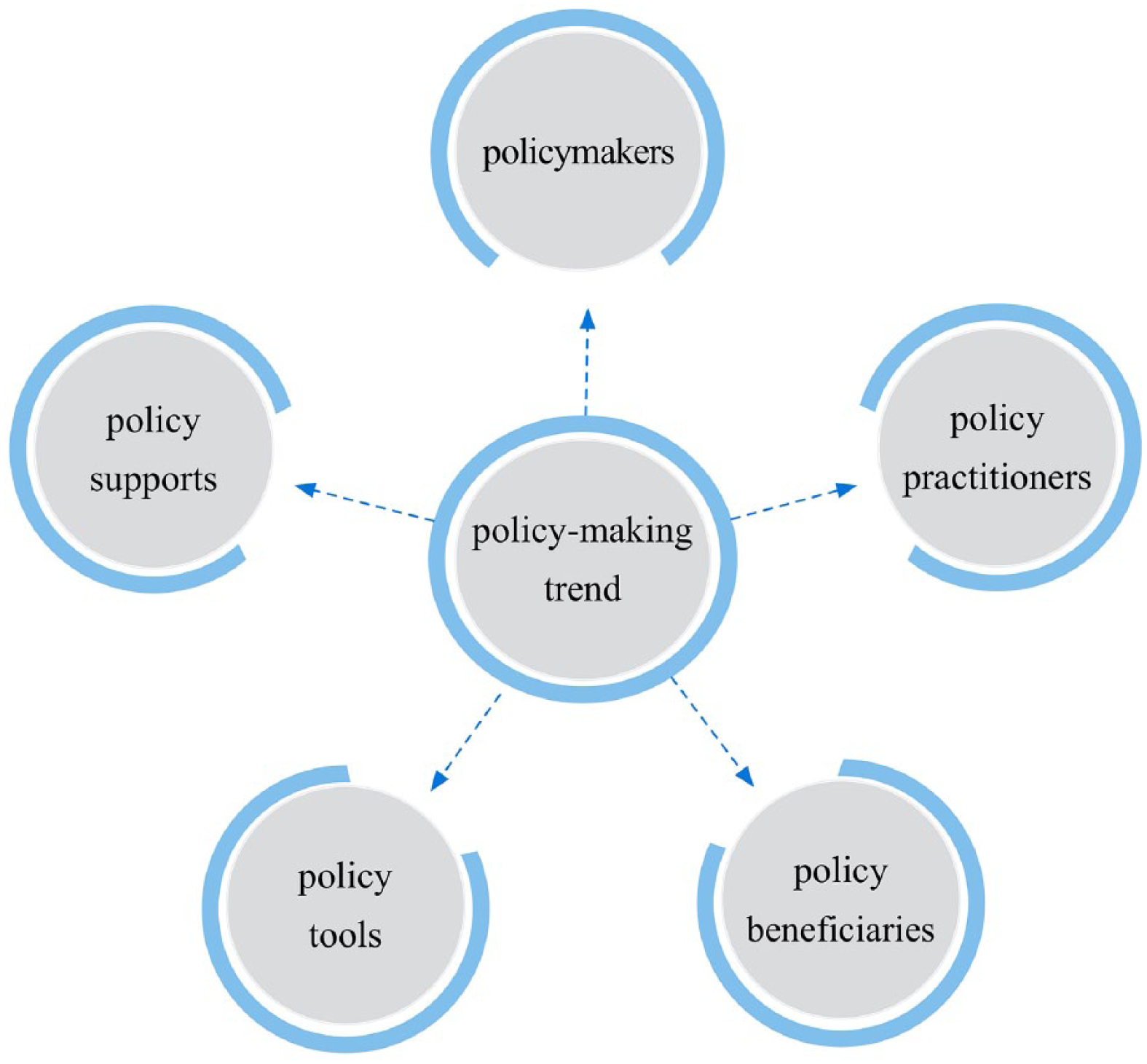
Five indicators of analytical framework.
In China, the State Council and the National People’s Congress have the primary responsibility in policy-making. Additionally, the State Council and the National People’s Congress exercise control over the ministerial departments. Policy-making goals are often formulated at the State Council and the National People’s Congress in order to direct overall objectives of national development about MSW. Therefore, the State Council and National People’s Congress focus on strategic level MSWPs. The ministerial departments focus on fundamental MSWPs, which guide MSW’s development direction, target, and deployment, because the ministerial departments often provide more attention to project management. Therefore, the policymakers’ indicator refers to the State Council, National People’s Congress, and ministerial departments at the national level.
Policy practitioners are tasked with implementing MSWPs. They translate MSWPs into practices according to MSWP requirements at the national and local levels in order to achieve the desired effect. The efficacy of policy practitioners can be limited by funding constraints and political power structures. The term ‘policy practitioner’ is used throughout the article to refer to both formal and informal actors, including local governments, waste companies, and individuals.
MSWPs are formulated and developed to ensure sustainable environmental, social, and economic development in China, as stated in the ‘Analytical framework design’ section. Natural environment, society, and economy are considered as the primary beneficiaries.
Policy tools refer to various means or ways that policymakers use to achieve their MSWPs’ goals. Van de Doelen proposed a previous classification in a western context, dividing policy tools into three categories: legal, economic, and communication (Zhang et al., 2012). This classification provides useful practices for analysing policy tools. Therefore, we categorise the policy tools as regulation-type, market-type, and public participation-type. Regulation-type tools refer to the national executive standards that policymakers enact as regulations or orders to make policy practitioners perform according to the MSWPs’ requirements. Market-type tools mainly refer to subsidies and taxation (fees) that policymakers use as economic means to realise MSWPs’ goals. Public participation-type tools mainly focus on science education that is provided to the public by ministerial departments through the methods of taking responsibility or volunteering in order to help public gain and understand MSW’s necessary basic knowledge, treating process, and solutions, with the aim of giving the public the ability to participate in the preparation and implementation of the MSWPs.
In order to achieve policy goals, policymakers must have sufficient ability to explicitly stipulate support mechanisms and infrastructure for MSWM. In this research, policy supports mean that the State Council, the National People’s Congress, and the ministerial departments provide policy practitioners with all kinds of substantial assistance in order to tackle the MSW problem. This substantial assistance can help policy practitioners solve actual difficulties and break through the restrictions of the main bottlenecks in the MSWM. By 1981, the National People’s Congress, and the ministerial departments had developed a number of different policy supports. In order to facilitate the analysis of policy supports, we classify the policy supports into three categories: finance (e.g. tax free, interest-free loan), information (e.g. information guide, information support), and technology (technology support).
Data collection
The data for this study were collected by a research team composed of teachers, students, and researchers from the Economics and Management School at Harbin Engineering University in China. Core members of this group have focused on eco-management related to solid waste for 10 years. They have extensive knowledge and experience contributing to their understanding of MSWPs. A systematic review of policy handbooks and national departments’ websites on MSWPs was conducted. These sources were selected for two major reasons. First, handbooks and websites are considered major sources of information in China, which makes it possible to trace policy-making developments since 1981. Second, the national government websites are considered the most reliable sources because they release the official MSWPs, which impact decisions made about MSW on the regional level. The MSWPs were collected from 1 January 1980 to 1 March 2015 by the research team. On 1 April 2015, the research team began to analyse the MSWPs in order to write this article. The research team carefully read every MSWP that they collected, paying particular attention to highlighted sections in order to obtain available MSWPs text. Of the MSWPs enacted from 1982, 421 were identified as suitable for analysis (the research team did not find any MSWP issued in 1980 or 1981).
Content analysis coding
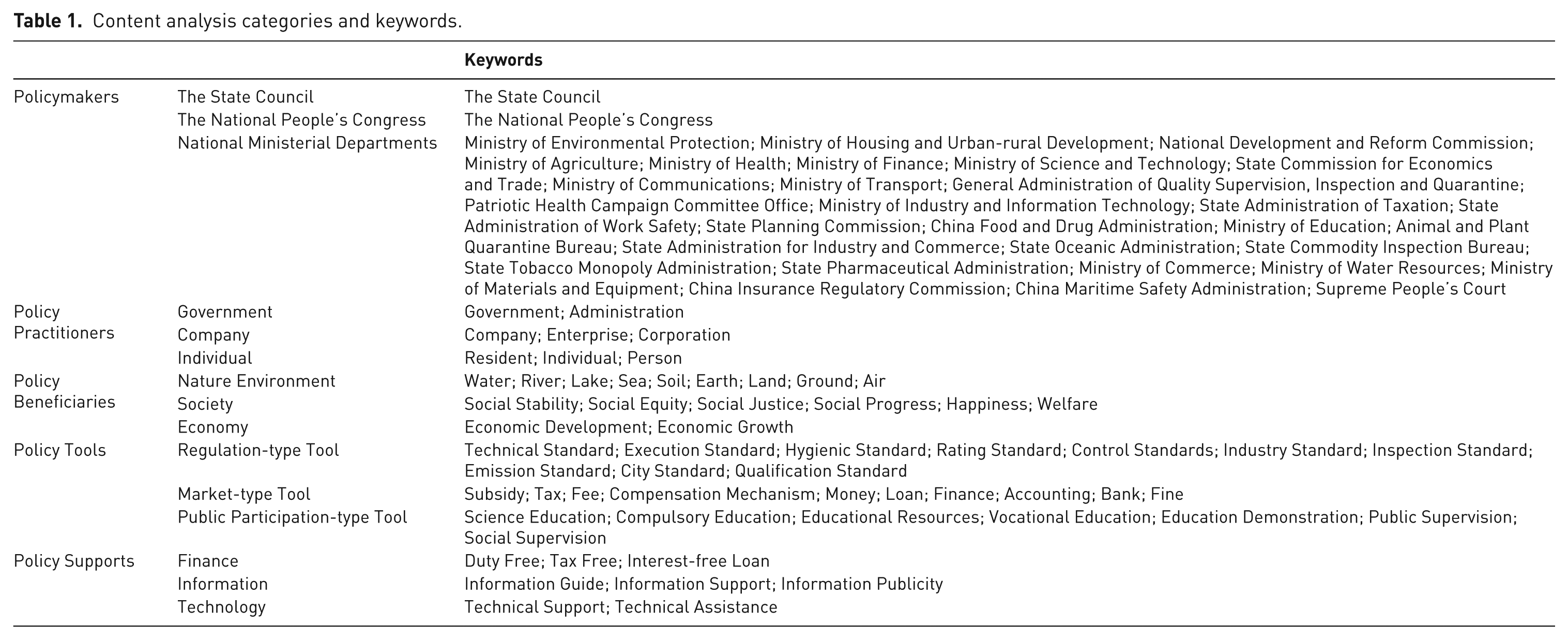
As an important step in content analysis, coding was used to systematically classify the key features in a large amount of textual information (Kaid and Wadsworth, 1989; Krippendorf, 2004; Liu et al., 2015; Nuendorf, 2002). Keywords, listed in Table 1, were selected from policymakers, policy practitioners, policy beneficiaries, policy tools, and policy supports. During this step, the research team derived the definition of the coding scheme from the analytical framework. The coding scheme includes five main categories and 16 sub-categories. The first author used the categories of coding scheme to code the MSWPs. We checked the entire text to capture coding errors owing to multiple possible meanings of words (Ceci and Iubatti, 2012). Coding disagreements were resolved through discussion among the three authors and the cleaned data were analysed.
Content analysis categories and keywords.
To ensure coder reliability in this study, five experts whose careers focus on MSW were chosen to conduct the formal inter-coder reliability test using the total data sets in order to determine the consistency of the coding assessments. The results of the inter-coder reliability tests show that the overall average agreement rate is 0.8, satisfying the reliability criteria set by Neuendorf (2002). Perreault and Leigh’s (1989) formula was used to calculate the inter-reliability. All inter-coder reliabilities for each variable are sufficiently high and fell within the acceptable range of 0.6–1.00. This indicates that the coding procedure is reliable.
Results
Policymakers
For policymakers, the policy-making trend shows that the national authorities became interested in MSW in the later 1990s. The number of MSWPs issued by the State Council, the National People’s Congress, and the ministerial departments has increased since 2000. However, in general, ministerial departments have issued more MSWPs than the State Council and National People’s Congress. The ministerial departments always take a more dominant position in making MSWPs than the State Council and National People’s Congress. Although the first MSWP (Measures of the People’s of China on the Supervision in Frontier Port Health) was enacted by a ministerial department in 1982, the State Council and National People’s Congress did not issue MSWPs until 1983. From 1984 to 1995, no MSWPs were enacted by the State Council and National People’s Congress, and the ministerial departments made very few MSWPs. The number of MSWPs that were issued by one or a few ministerial departments surged in 1999, and reached a peak in 2003. The State Council and National People’s Congress made the largest number of MSWPs in 2007 and 2013. After 2000, the ministerial departments were main policymakers in issuing MSWPs in order to tackle the increasing problems of MSW (Figure 2). For example, as the first environment law, the Environmental Protection Law of the People’s Republic of China (which was test-implemented in 1979, first reviewed in 1989, and second reviewed in 2015) was promulgated by National People’s Congress. It put forward that local governments must take measures to organise MSW classification, recycling, and treatment. This law aimed to protect and enhance the environment, prevent and control pollution, and safeguard public health.
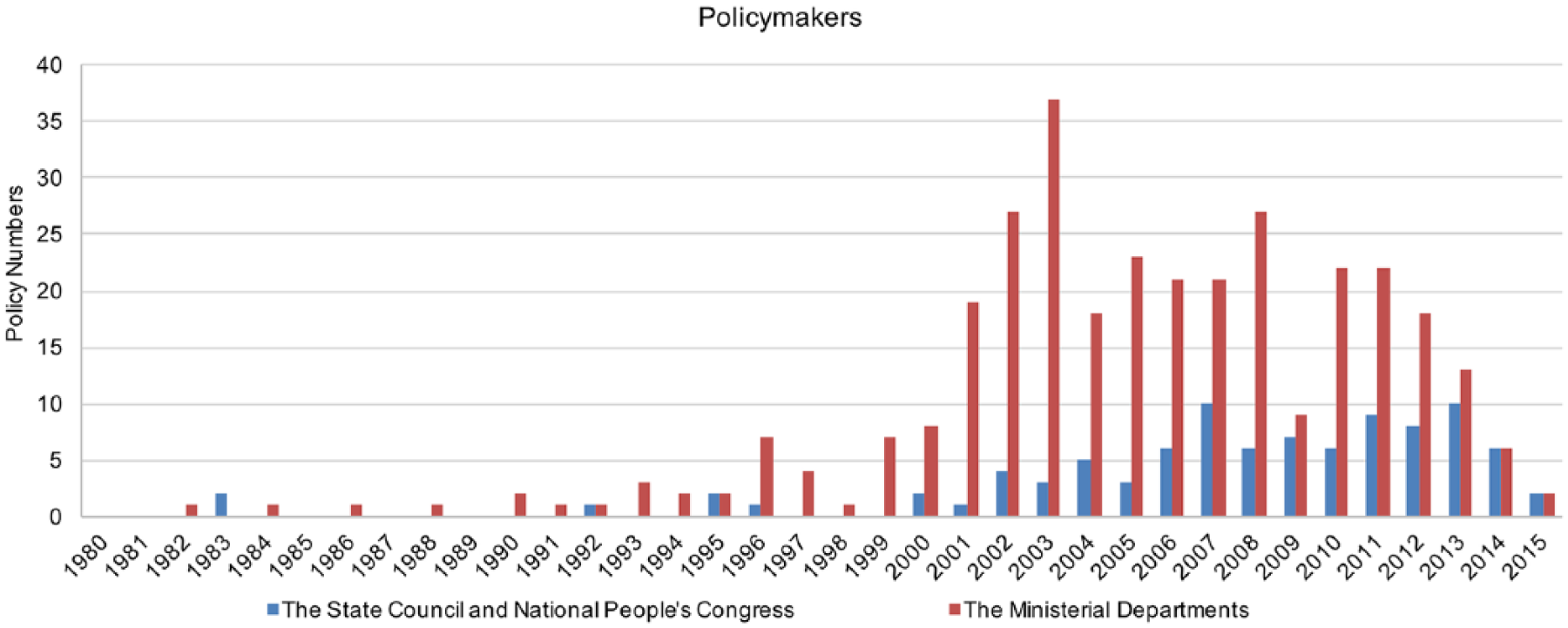
The number of policies and the associated types of policymakers, 1980–2015.
Policy practitioners
The policy-making trend relating to policy practitioners shows that more MSWPs focus on local governments and waste companies’ action than an individuals’ action in the MSWM. Individuals were rarely taken into account as policy practitioners in the MSWPs before 2000. Figure 3 shows that the local government was the first policy practitioner as determined by the first MSWP in 1982. In 1983, waste companies were added as other policy practitioners. MSWPs did not regard individuals as policy practitioners until 2001. There were two surges in MSWPs, which regarded both local governments and waste companies as policy practitioners in 2003 and 2011. An example of one such policy is the Solid Waste Pollution Control Law (National People’s Congress, 2005), which mandates that solid wastes should be reduced, properly recycled and disposed of in an environmentally sound manner, and that institutions and individuals who generate solid wastes should take proper measures to prevent and reduce pollution caused by those wastes (Yu et al., 2010).
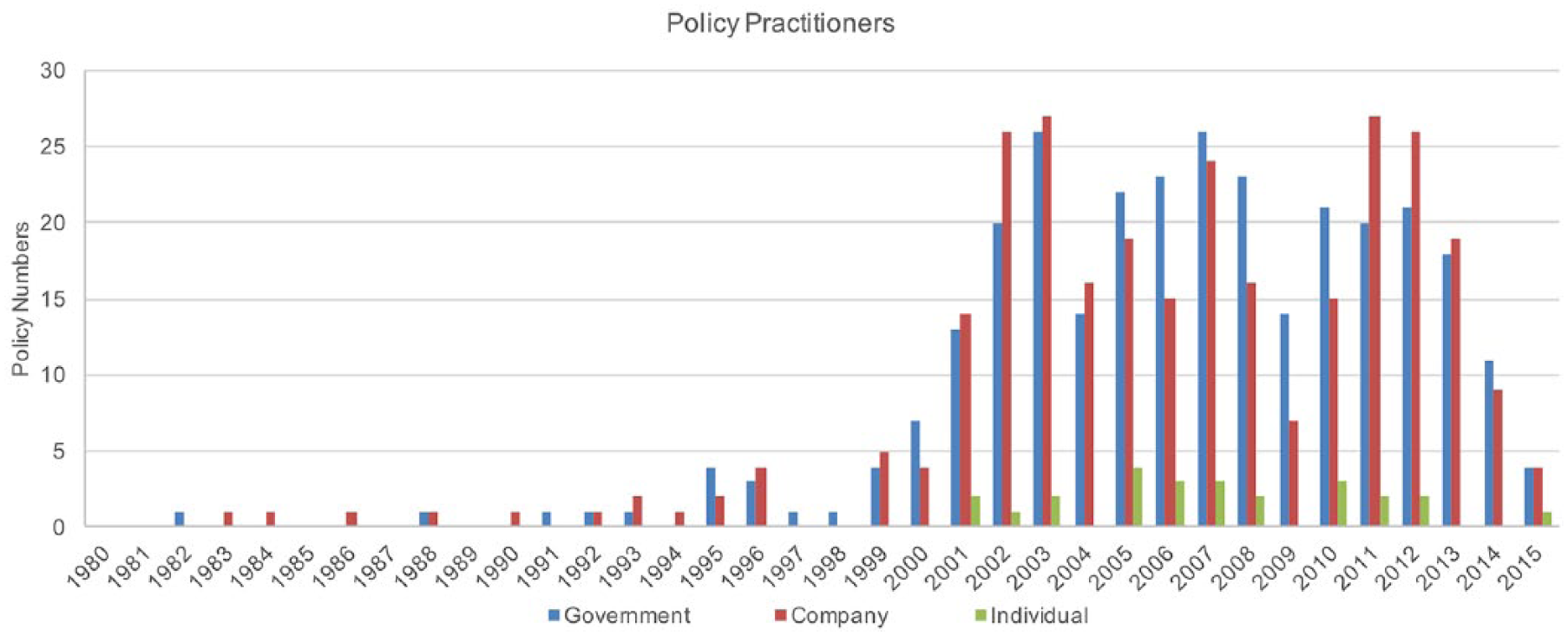
The number of policies and the associated types of policy practitioners, 1980–2015.
Policy beneficiaries
The results show that the policy beneficiaries were divided into two parts during the process of policy-making. A major change in policy motivation was represented in 1989. Before 1989, policy-making considered exclusively the natural environment, society, or the economy as the policy beneficiary. Policies began to consider these concurrently in 1989. More and more MSWPs were enacted based on the natural environment, society, and economy’s mutual profit after 1992. As shown in Figure 4, protecting the natural environment was first mentioned in MSWP in 1982. Promoting economic growth was not far behind, as it was brought into MSWPs in 1983. No MSWPs focusing on societal benefits were issued until 1986. For example, the Circular on Strengthening the Environmental Management of Waste Electrical and Electronic Equipment (Ministry of Environmental Protection, 2003) aims to prohibit the environmentally harmful processing of waste electrical and electronic equipment. It states that provincial-level environmental protection apartments issue waste processing licenses to enterprises in accordance with the Solid Waste Pollution Control Law and encourage electronic product manufactures to promote cleaner production and eco-design.
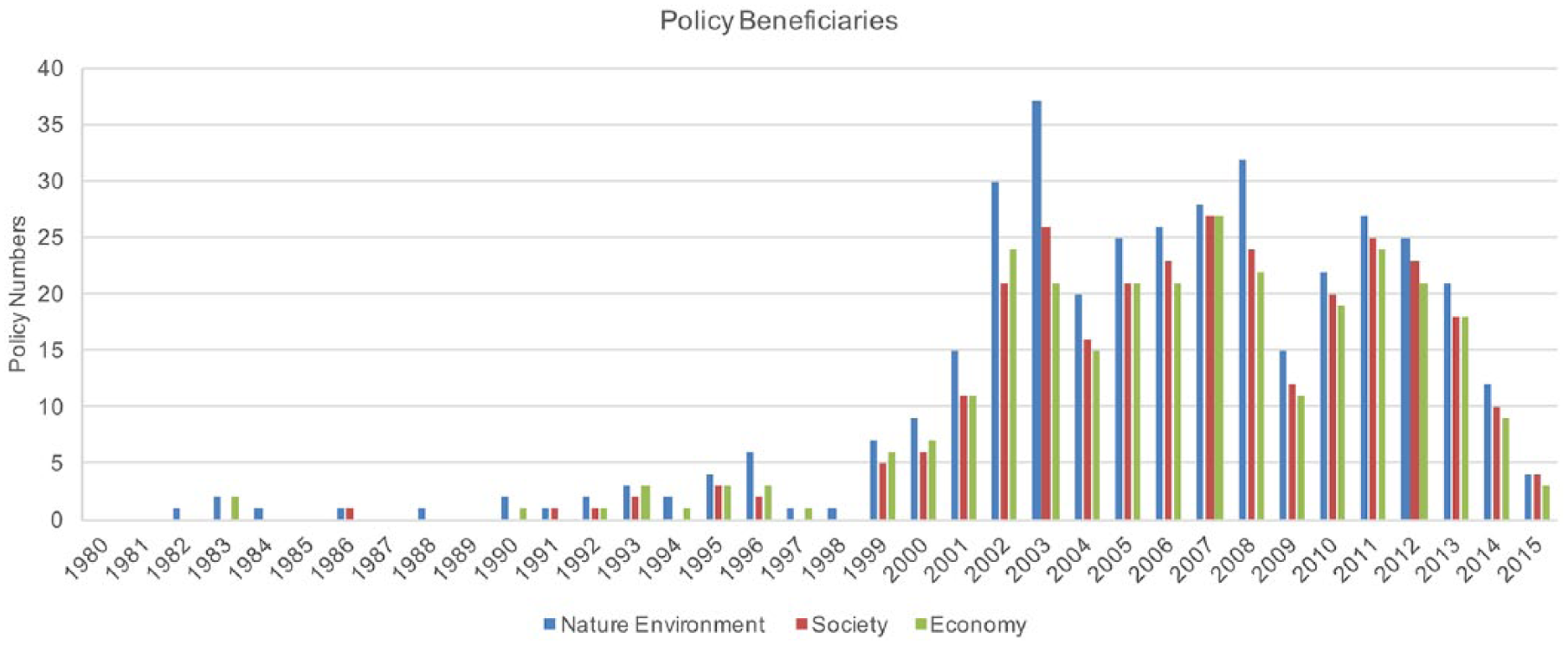
The number of policies and the associated types of policy beneficiaries, 1980–2015.
Policy tools
For policy tools, the policy-making trend shows that the number of MSWPs that used market-type tools, regulation-type tools, and public participation-type tools together to tackle the MSW problem has increased since 2000. Figure 5 shows that MSWPs implemented the first market-type tool (fine) in 1983, the first regulation-type tool (hygienic standard) in 1991, and the first public participation-type tool (public supervision) in 1996. MSWPs focused on only one type of tools to manage MSW before 1999. For example, one regulation-type tool (control standards) was used in 1994, while three market-type tools (pollution discharge fee, operation cost, and fine) were used in 1995. The regulation-type tools (e.g. qualification standards, inspection standard), market-type tools (fine and tax), and public participation-type tools (public supervision and social supervision) were used by the Environmental Protection Law of the People’s Republic of China (2015). The Circular on Adjusting the Value-Added Tax Policy of Production and Labor Resource of Comprehensive Utilization of Resource (Ministry of Finance, State Administration of Taxation, 2011) lists that the waste disposal is exempt from value-added tax in order to encourage MSW recycling. The waste disposal refers to the business of reducing, recycling, and harmless disposal of waste by means of landfill, incineration, comprehensive treatment, and recycling.
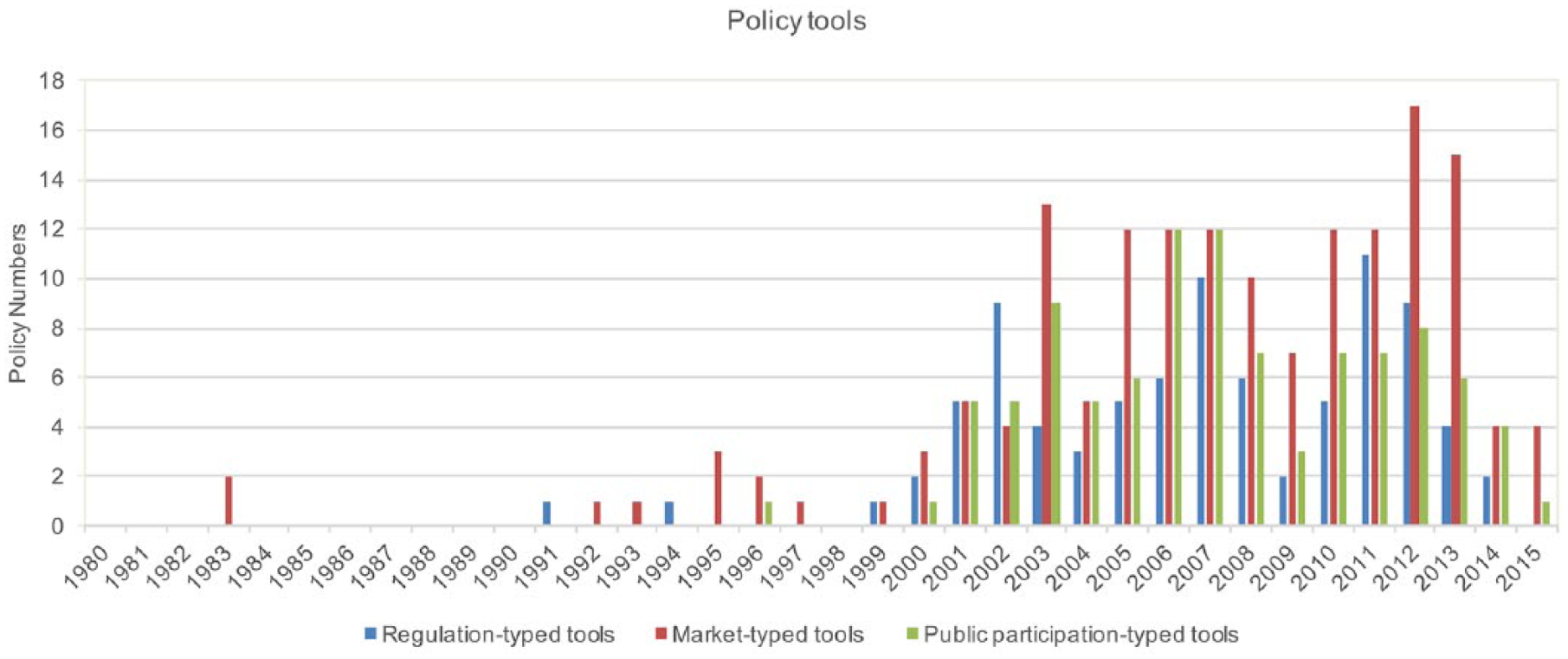
The number of policies and the associated types of policy tools, 1980–2015.
Policy supports
Data on policy-making trends for policy supports show there are slightly increased about finance and information supports after 2001. However, the overall number of finance and information supports were less common than technology support. Figure 6 displays that technology-based support was first offered by policymakers in 1982, with finance support offered second, and information support offered last. Policymakers mainly provided technology-based support in order to exert influence in MSWM before 2000. For example, the Trial Measures for Price Administration and Costs Sharing of Electricity Generated from Renewable Energy (National Development and Reform Commission, 2006) was issued by the National Development and Reform Commission (NDRC). It regulates that the benchmark power price of MSW incineration consists of the price of desulphurising coal-fired power in 2005, plus an additional US$0.043 per kWh of electricity subsidised by the government (Zheng et al., 2014). Local governments offer a financial support US$0.043 to help waste treatment companies solve the problem of capital shortage in the MSW incineration.
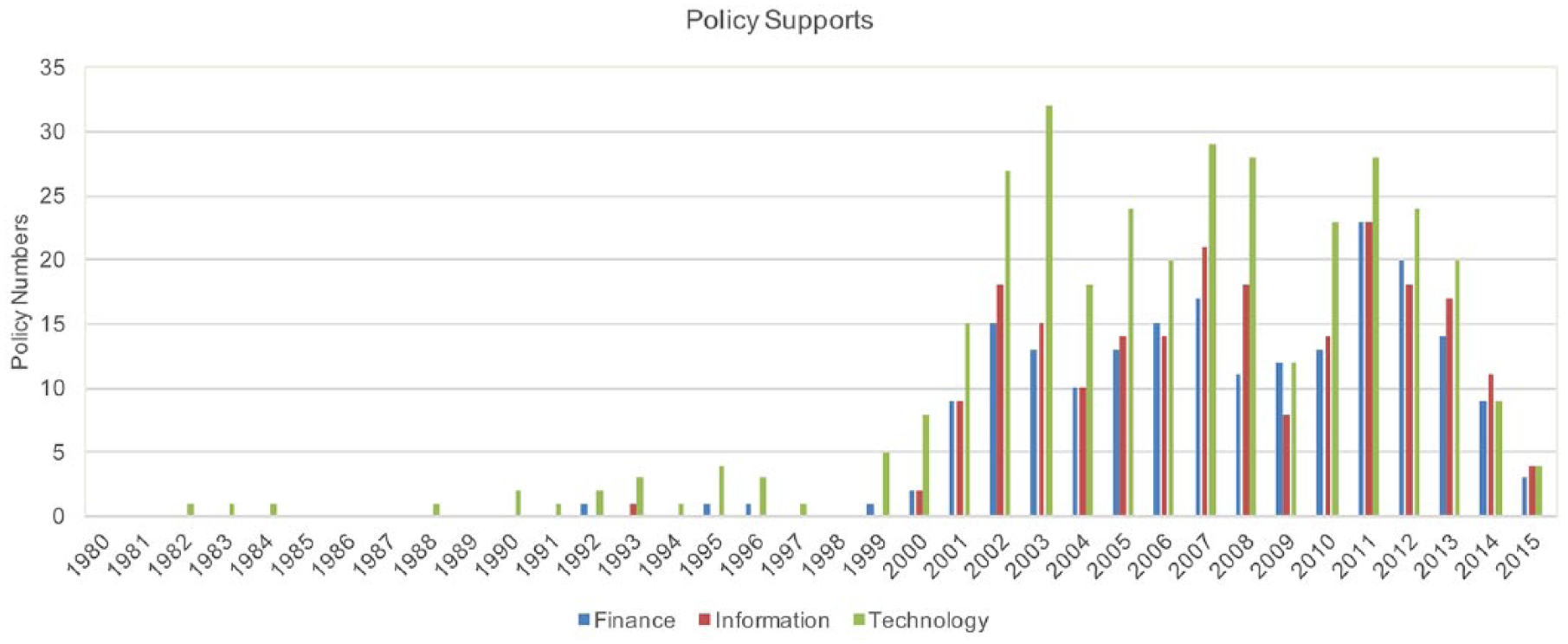
The number of policies and the associated types of policy supports, 1980–2015.
Discussion
Policymakers
No MSWPs were issued in 1980 or in 1981. There were very few MSWPs enacted between 1982 and 1998. This was owing to the fact that the development strategy of China was focused on developing its domestic economy (Cheng and Hu, 2010) and improving the quality of people’s lives. The State Council, National People’s Congress, and ministerial departments at the national level set themselves priorities according to China’s development strategy. The environmental issues were seldom thought of by the State Council, National People’s Congress, or the ministerial departments. On the other hand, individuals and institutions did not generate enough MSW to significantly damage the environment. For example, the total amount of MSW were only 31.3 billion kg in 1980 (Zheng et al., 2014), and the daily generation of MSW per capita was 0.96 kg in 1981 (Li, 2002). The main compositions of MSW were food waste, stones, ground, demolition, and glass, which had minimal environment degradation. At the same time, residents had better habit of recycling MSW materials than now. They usually do their best to use the goods ‘Clothes can go for three-year new, three-year old, and another three-year in patches (新三年,旧三年,缝缝补补再三年) (This proverb means that a just purchased goods can been used as new ones for some years. When it becomes old, it can still be used for some years. After that it could still be used for some years after some repairs. This proverb reflects residents’ traditional way of looking at materials and products.)’. Serious environmental problems were rarely caused by MSW. Few MSWPs were needed to tackle the MSW problem.
Things changed from 1999, because more and more MSW were produced with the rapid urbanisation and industrialisation of the country. For example, the total amount of MSW was 203.62 billion kg in 2016 (Zheng et al., 2014), and the daily generation of MSW per capita was 1.21 kg in 2015. The main compositions of MSW were plastics and electronic waste. MSW contaminates the land and infiltrate the ground water, and consequently creates adverse effects on the environment and people’s health (Kustini et al., 2017). The social, economic, and environmental impacts of MSW compel policymakers to concentrate MSW and MSWM to became a major responsibility for the State Council, National People’s Congress, and ministerial departments. Therefore, the State Council, the National People’s Congress, and ministerial departments stepped up enacting MSWPs.
Policy practitioners
The local governments have a vital role in moving towards policy-making targets on MSW, which are determined by the top-down approach MSWM system. Local governments are empowered to utilise economic, environmental, and societal resources it possesses to ensure MSW sustainable development. Therefore, local governments are traditionally regarded as the only policy practitioner, and implemented MSWPs through its centralised policy-making structure before 1983. Since Chinese market reforms began in 1979, the role of local governments has slowly changed. Local governments have focused more and more on the role of service and supervision. Other actors who are outside the local governments began to have a vital role in activities about MSW later on. Waste Companies have been embedded in the network of policy-making since 1983 as the main policy practitioners. Especially, waste companies’ participation got more and more emphasis by policymakers after 1995. For example, The Clean Production Promotion Law (National People’s Congress, 2003) stipulates that companies’ manufacturing of products and packaging materials included in the mandatory recycling catalogue have the responsibility of recycling their products and packaging materials at their end of life (Yu et al., 2010).
Although local governments and waste companies act at the macro level to practice their behaviour of MSWM, what occurs at the micro level is crucial since it is individuals who purchase goods, use them and finally make decisions regarding their disposal (Barr and Gilg, 2005). Being the main source of MSW generation, the importance of individuals to this problem has been realised in China. Therefore, policymakers added the individuals to the list of policy practitioners in 2001 in order to guide individuals on how to minimise waste, reuse materials and ensure that used material can have some salvage or recovery value. For example, in 2005, the Solid Waste Pollution Control Law (National People’s Congress, 2005) regulated that solid waste should be reduced, properly recycled where applicable, and disposed of in an environmentally sound manner when not recyclable.
Policy beneficiaries
The authorities and the individuals in China did not pay much attention to environmental issues before 1990. At that time, the country focused on developing the economy, and the individuals focused on improving material aspects of their lives. Policymakers formulated MSWPs only in order to meet constitutional requirements because China’s constitution included MSW-related environmental protections. With the improvement of living standards, more and more people began to pursue a healthy natural environment. The natural environment gained attention as an important policy beneficiary from 1999. The State Council, National People’s Congress, and ministerial departments enacted various MSWPs in order to control and address the adverse environmental consequences of inadequate MSWM practices. For example, The Circular Economy Promotion Law was enacted by the National People’s Congress (2008). It aims to promote the development of circular economy, improve the efficiency of resource utilisation, protect and improve the environment, and achieve sustainable development.
China has a low quantity of resources per capita. After 1990, policymakers recognised that MSW is a resource that is often discarded. Policy-making began to emphasise the economic benefits of turning MSW into a valuable resource. The objectives of MSWPs have become the integrated management of MSW, reutilisation and recycling, and the stimulation of the development of businesses aimed at improving production processes and the recycling of MSW, including energy recovery. For example, the Circular Economy Development Strategy and the Plan of Action (State Council, 2013) supports the construction of facilities for resource utilisation of kitchen waste, and encourages the production of biogas, biodiesel, industrial oils, and organic fertilisers from kitchen waste. It states that it is necessary to accelerate the technology development for resource utilisation of kitchen waste.
According to the ‘public value’ paradigm (Alford and Hughes, 2008; Moore,1995), policies should aim not only at economic objectives, but also at a wide range of objectives associated with promoting collective values and preferences, by fulfilling ‘the needs and wants of collective citizenry’ (Ferro et al., 2013). Therefore, policymakers have considered societal benefits, including social welfare, social acceptability, social equity, cultural or heritage issues, and social cost, since 1986. In particular, confronted with MSW posing health hazards to residents, policymakers have recognised that societal benefits must be interweaved with environmental protection and economic growth since 1996.
Policy tools
Before 2000, policy-making mainly used regulation-type tools and market-type tools to oblige the executive agencies of the national government and local governments, waste companies, and individuals to implement the MSWPs. This is mainly because policy-making with regard to the MSWM is a top-down approach, which is determined by the interaction of China’s long-term planned economy system and centralised management mode. This prioritises the regulation-type tools and market-type tools. And more importantly, owing to the characteristics of authority, mandatory, and quick implementation, regulation-type tools and market-type tools are always considered as first choice at that time. For example, The Standard for Pollution Control on the Municipal Solid Waste Incineration (Ministry of Environmental Protection, 2001) imposes a limit on dioxin emission from incineration to ensure cleaner air for local communities surrounding MSW incinerators in order to protect human health and environment. China instituted a ‘polluter pays’ principle, which demands that waste companies and households pay for the environmental costs of MSW disposal.
As time has progressed, policymakers found that many conflicts could be reduced or avoided by involving the public in the process of policy-making. Public participation should not be neglected as an important type tool. Policymakers began to encourage the use of public participation-type tools to overcome some MSW political standoffs since 2000, but their role is not more important than those of regulation-type and market-type tools because there are many misunderstandings between the public and policymakers. The public feels that MSWM is only the duty and responsibility of government and institutional departments, and that they themselves are not expected to contribute (Guerrero et al., 2013). More importantly, transparency is lacking as is democratic accountability to the public, which leads a lack of public understanding on MSWM. All of these factors limit the use of public participation-type tools in MSWPs. The result is that the public participation is required by some MSWPs, but there are still no clear and detailed provisions on the specific conditions, methods and procedures of public participation.
Policy supports
For 35 years, all kinds of policy supports have been set up in order to safeguard the effective execution of MSWPs. The policymakers mainly relied on technological solutions before 1991 owing to its obvious effectiveness that it tackles the MSW problem. For example, in order to reduce or eradicate the production of contaminants, The Law of the People’s Republic of China on the Prevention and Control of Environmental Pollution by Solid Waste (National People’s Congress, 2013) has critical technological and informational requirements for MSW. As time went on, policymakers realised that the ability of technology alone to support MSWM is limited, and that MSW is a complex issue that requires multiple perspectives to solve.
After 1991, policymakers augmented policy supports for MSW. Policymakers explicitly allocated financial support in 1992. Policymakers found that all levels of governments and ministerial departments do not have sufficient funds for MSWM. This forced policymakers to launch different actions after 2002 to increase the financial support in order to tackle the MSW problem. One example of this occurred when the government issued the polluter-pays principle. As a representative of policy supports in the waste management chain, the polluter-pays principle aims at identifying the polluter and his/her enforcement to pay the cost of waste collection and treatment according to the amount of the pollution that he/she produces (OECD, 1992).
Along with the coming of the information age, modern life in China is ruled by a wide range of information. Information on MSW drew the attention of policymakers at the national level in 1993, in particular after 2000. Policy-making increasingly provided various kinds of information aimed at influencing local governments, the public, and waste companies by the transfer of knowledge and persuasive arguments. For example, television, radio, newspaper, and relevant Internet sources have been used effectively to spread information regarding current recycling efforts for MSW. At the same time, various media have been used to provide clear instructions to the public on how to handle their waste, according to the MSWPs guidance. At present, China focuses on gathering periodic documentation nationwide from local authorities by paper documents, internal computer information network, or public opinion monitoring. One of the purposes is to help policymakers collect all related, fundamental, and key information based on specific needs to enact viable and practical MSWPs. This could potentially avoids inaccurate and outdated databases that lead to ineffective MSWPs.
Conclusions
This article provides a new analytical framework made up of policymaker indicators, policy practitioners indicators, policy beneficiaries’ indicators, policy tools indicators, and policy support indicators in order to analyse the policy-making trend based on China’s major MSWM management policies from 1 January 1980 to 1 March 2015. During this period, the Chinese State Council, National People’s Congress, and different ministerial departments at a national level have implemented 421 MSWPs. Our results show that ministerial departments issued more MSWPs than the State Council and National People’s Congress. For policy practitioners, policy-making focused more local governments and waste companies than on the individuals. With regard to the policy tools, policy-making stressed the use of market-type tools, regulation-type tools, and public participation-type tools together to tackle the MSW problem after 2000. As time passed, finance and information support were used more than technology as policy supports.
Limitations of the study need to be addressed in future research. For example, the five indicators are analysed without analysing the relationship between them. Future research needs to analyse the coordination of the five indicators. Additionally, the content analysis model could be improved using optimisation techniques for handling various data. More precise data can contribute to a better understanding of the trend of MSWPs and its dynamic changes in China.
Footnotes
Declaration of conflicting interests
The authors declared no potential conflicts of interest with respect to the research, authorship, and/or publication of this article.
Funding
The authors disclosed receipt of the following financial support for the research, authorship, and/or publication of this article: This article stems from research projects supported by the Major Project of Philosophy and Social Sciences Research, Ministry of Education [grant number 17JZD026]; the National Nature Science Foundation of China (NSFC) Project [grant number 71473056]; the National Social Science Foundation of China [17BGL181]; the Fundamental Research Funds for the Central Universities [grant number HEUCFP201823 and HEUCFP2018348]; and the PhD Student Research and Innovation Fund of the Fundamental Research Funds for the Central Universities [grant number HEUGIP201719].