






Abstract
Accurate estimation of municipal solid waste (MSW) generation has become a crucial task in decision-making processes for the MSW planning and management systems. In this study, the Gaussian process regression (GPR) model tuned by Bayesian optimization was used to forecast the MSW generation of Turkey. The Bayesian optimization method, which can efficiently optimize the hyperparameters of kernel functions in the machine learning algorithms, was applied to reduce the computation redundancy and enhance the estimation performance of the models. Four socio-economic indicators such as population, gross domestic product per capita, inflation rate, and the unemployment rate were used as input variables. The performance of the Bayesian GPR (BGPR) model was compared with the multiple linear regression (MLR) and Bayesian support vector regression (BSVR) models. Different performance measures such as mean absolute deviation (MAD), root mean square error (RMSE), and coefficient of determination (R2) values were used to evaluate the performance of the models. The exponential-GPR model tuned by Bayesian optimization showed superior performance with minimum MAD (0.0182), RMSE (0.0203), and high R2 (0.9914) values in the training phase and minimum MAD (0.0342), RMSE (0.0463), and high R2 (0.9841) values in the testing phase. The results of this study can help decision-makers to be aware of social-economic factors associated with waste management and ensure optimal usage of their resources in future planning.
Keywords
Introduction
Municipal solid waste (MSW) can be described as all wastes generated from human activities that are in solid form and discarded as useless or unused. The development of modern civilization, the rapid increase in the population, and the change of consumption habits have contributed significantly to the increase in the quantity and variety of waste generated (Turan et al., 2009). Good planning and waste management strategy are critical for the communities, particularly in urbanized, densely populated areas. The elements of integrated solid waste management that cover all levels from waste generation to final disposal and their interrelationships must be well defined as solid waste generation has a significant impact on environmental sustainability.
As in many developing countries, MSW management has been accepted as a priority for Turkey and new policies are being developed to solve existing problems. The Solid Waste Control regulation published in 1991 is the first important step toward successful waste management. Moreover, MSW management has been a pressure point for Turkey while being a candidate country for European Union (EU) accession. After the start of EU integration studies in 2004, according to the Metropolitan Municipality Law in 2004 and the Municipality Law in 2005, the initiatives related to solid waste management in Turkey are carried out by the authorities depending on the legislation and policies.
Based on the Turkey Statistical Institute data obtained for 2016, 31.6 million tons of MSW were generated in 2016 while the amount of waste per person was about 1.17 kg /person/day. On the other hand, 61.2% (19,338 thousand tons) of the waste collected in municipalities was sent to sanitary landfills, 28.8% (9095 thousand tons) was dumped into municipal dumps, and 9.8% (3151 thousand tons) was recycled, composted, or disposed of by other methods. In 2017, the annual rate of MSW generation per capita was approximately 487 kg for the EU-28 countries whereas it was 425 kg for Turkey.
The quantity of MSW highly depends on the general socio-economic structure of the countries. Even in the same country, the characteristics and waste composition vary depending on the lifestyles, consumption habits, socio-economic status, and traditions of people living in different cities (de Morais Vieira and Matheus, 2018; Karpušenkaitė et al., 2018). Many researchers have conducted studies on the relationship between MSW generation and socio-economic factors such as population growth, gross domestic product (GDP), income level, unemployment rate, and education status (Namlis and Komilis, 2019). GDP and income level have always been accepted as important factors affecting the MSW generation positively, which directly affects household consumption habits and thus the amount and content of waste generated (Giannakitsidou et al. 2016; Ogwueleka, 2013). Viswanathan and Trankler (2003) reported that in a family with low socio-economic status, daily waste generation rates are generally lower than in high socio-economic families. Furthermore, high-income communities tend to consume more industrialized products; however, the garbage content produced contains more recyclable materials (Bandara et al., 2007). Keser et al. (2012) showed that the unemployment rate negatively affects MSW generation in Turkey. Kayode and Omole (2011) mentioned that the management of MSW by a household with a high level of education is more effective compared to households with low education. This is due to the awareness of the side effect of unmanaged solid wastes and the importance of recycling. As a result, it can be said that the MSW generation has a strong correlation with socio-economic parameters.
One of the main obstacles faced by city planners and decision-makers is the lack of an accurate but simple predictive model for the MSW management system. Access to a reliable predictive model using widely available socio-economic parameters, which can be used to plan resources and allocate budgets, is vital. Thus, in this study, various Gaussian process regression (GPR) models as effective machine learning tools were developed to predict the annual MSW generation of Turkey using population, GDP per capita, inflation rate, and the unemployment rate as input variables. To the best of the author’s knowledge, this is the first study in which the GPR model has been attempted for MSW prediction. The developed models provide new insights on the role of the socio-economic parameters on MSW generation, which can contribute to waste management planning at the national level.
Literature
Decision-makers are constantly looking for new, innovative, and prospective solutions to predict the MSW generation which has critical importance for a sustainable and effective MSW management system. Table 1 summarizes the details of several studies available in the literature that were performed to develop or improve existing systems using various modeling techniques. These models range from traditional to advanced ones such as artificial neural network, grey model, multiple linear regression, principal component analysis, support vector regression and etc. (Abbasi et al., 2019; Abbasi and El Hanandeh, 2016; Antanasijević et al., 2013; Azadi and Karimi-Jashni, 2016; Chhay et al., 2018; Singh and Satija, 2018; Sun and Chungpaibulpatana, 2017; Younes et al., 2015). However, these models have several weaknesses such as over-fitting problems, need for big data, slow convergence speed, and poor generalization performance. GPR is a non-parametric method that can model arbitrary complex systems and has emerged as an alternative powerful tool, especially for prediction purposes to overcome the mentioned problems in recent years. The main advantage of GPR is the way the model is defined. GPR determines the structure of the covariance matrix of independent variables as the backbone of the model, while other regression techniques use algebraic relationships of independent and dependent variables (Akhlaghi et al. 2019). GPR has gained popularity due to its flexibility, non-linearity, and inherent non-parametric structure (Arthur et al., 2019; Cai et al., 2020; Williams and Rasmussen, 2006) and has been successfully applied in various fields (Baraldi et al., 2015). Also, the GPR model can predict at high accuracy even with less data. This is a very important feature, especially in the case of insufficient and small data sets (Kamath and Fan, 2018). Most developing countries do not have a comprehensive and adequate waste generation record due to inadequate funding and mismanagement. Since the GPR model is an effective method even in small data sizes, it is a suitable candidate for MSW generation estimation.
Methodology and the performance of the studies for prediction of MSW generation.

Additionally, models generally contain some structural parameters that play an important role in algorithm performance. These parameters need to be set in order to achieve a global optimum. However, in previous studies, conventional modeling techniques were performed to estimate MSW generation by manual adjustment of parameters without considering the effects of parameters on the performance of the models. In this study, parameter optimization was carried out by Bayesian optimization, which prevents drawbacks from manual adjustment. Bayesian optimization integrated with GPR helps the model to achieve better performance with improved parameters. Thus, considering the aforementioned conveniences and benefits provided by the GPR, the study aims to investigate the feasibility of the improved GPR method based on Bayesian optimization for prediction of annual MSW quantity for Turkey.
Material and method
Dataset
A database was formed by collecting the data associated with population, GDP per capita, inflation rate and unemployment rate (input variables), and the generated municipal solid waste (output variable) for previous years. The database was constructed for the years between 1994 and 2017 using various data sources: data for population and the unemployment rate for persons aged 15–64 were obtained from Turkish Statistical Institute (Turkstat), while the data associated to GDP per capita (based on current US dollars) were extracted from the World Bank Database (Worldbank), the annual inflation rate (based upon the consumer price index (CPI)) was mined out from World Wide Inflation Database (WWID). Finally, the past values of the generated municipal waste data were received from the Organization for Economic Co-operation and Development (OECD) database.
As a pre-processing step, the data set was normalized prior to model construction. This process is required in order to provide constant variability and decrease the effect of variables with a high variance to minimize effects on the prediction outcomes (Ceylan et al., 2018; Ceylan and Bulkan, 2018). Equation (1) was used to normalize the data into the range [0.05, 0.95].
where
Support vector regression
Support vector machine (SVM) was first introduced by Cortes and Vapnik in 1995 (Cortes and Vapnik, 1995). SVM maps input space through the feature domain and then an optimization method was applied to resolve it. SVM consists of theoretical concepts and appropriate generalization, accuracy, and precision which runs with nonlinear situations (Alade et al., 2019; Cristianini and Shawe-Taylor, 2000). It is a supervised non-parametric technique used for classification and regression purposes. When used for classification and prediction problems, SVM is called support vector classification (SVC) and support vector regression (SVR), respectively. SVR is able to model complex nonlinear decision boundaries (margin maximization) and performs good resistance on overfitting (Karimipour et al., 2019). Linear SVR is considered as the following equation:
where y is the model output,
where
Then, the SVR model is formulated as a convex optimization problem:
The regularization constant C in equation (5) is used to determine the complexity (flatness of the function) of the SVM model. It is also known as box constraint or cost function in the literature. Hyperparameter C provides a tradeoff between the empirical risk minimization and the confidence degree. The epsilon (
where
where c is the constant term, d is the polynomial degree,
Gaussian process regression
GPR is an effective kernel-based machine learning method based on statistical learning and Bayesian theory (Williams and Rasmussen, 2006). It is suitable for dealing with complex regression problems such as small sample sizes, high dimensions, and non-linearity. It has also power learning and generalization ability (Su et al., 2019; Younis et al., 2019).
GPR aims to define the relationship between input variables and target variables depending on available data. The goal is to create a function that satisfies
where:
where E[.] denotes expectation. The above statement can be rewritten as follows:
Assuming that
The principle of joint Gaussian distributions enables the prediction results for the target to be inferred from the mean function
The parameters of the mean function and covariance (kernel) functions are named as the Gaussian process hyperparameters (Arthur et al., 2019). The mean function
where α is the shape parameter for the rational quadratic covariance
Bayesian optimization of model hyperparameters
Machine learning algorithms include various hyperparameters that need to be optimized to achieve good results. Hyperparameter optimization is critical for the success of these algorithms since it greatly affects the behavior of the learned model. These parameters can be set manually or automatically. The manual way can be a time-consuming task and it is highly likely that the optimal parameters cannot be found.
There are some common hyperparameter optimization algorithms such as grid search or random search. Grid search exhaustively searches the hyperparameters in simple models. However, this approach becomes complex when the dimensional space of the parameter space is high (Alade et al., 2019; Cornejo-Bueno et al., 2018). On the other hand, the random search does not have this problem. Random search simply samples the search space randomly. The disadvantage of random search is that it does not use information from previous experiments to select the next setting. This is undesirable, especially when the cost of running experiments is high and you want to make an educated decision on what experiment to run next. Many optimization algorithm settings such as the above assume that the objective function f(x) has a known mathematical form. However, the above characteristics cannot be applied to the problem of search for hyperparameters where the model of the function is unknown.
Recently, Bayesian optimization (BO) has emerged as an alternative effective method to solve computationally expensive functions among other traditional hyperparameter optimization techniques (Cornejo-Bueno et al., 2018; Kopsiaftis et al., 2019; Law and Shawe-Taylor, 2017). The BO method searches to find the global minimum of an unknown function
where A denotes the search space of x and
Evaluation of model performance
The success of all predictive models on the prediction of MSW was evaluated using different performance criteria, i.e. root mean square error (RMSE), mean absolute deviation (MAD), and correlation of determination (R2). They are mathematically expressed in equations (25) to (27). The high value of R2 and low values of MAD and RMSE mean that the developed regressor performs better.
where
Results and discussion
Prediction of MSW generation using BGPR model
In order to implement the GPR model for predicting MSW generation, MATLAB 2018b was used. As mentioned before, the performance of the GPR models mainly depends on the kernel function type and the kernel function hyperparameters, length scale parameter

MSW prediction based on Bayesian optimization.

Observed municipal solid waste (MSW) versus predicted MSW generation by (a) exponential-Bayesian Gaussian process regression (BGPR), (b) Matérn 3/2-BGPR, (c) Matérn 5/2-BGPR, (d) squared exponential-BGPR, and (e) rational quadratic-BGPR.

Prediction accuracy comparison of Bayesian Gaussian process regression (BGPR) models using different kernel functions.
Prediction of MSW generation using MLR model
MLR model was constructed to quantify the relationship between MSW generation and socio-economic parameters using Minitab v16 software. In our case the input variables are:
The R² term is equal to 0.622, indicating that 62.2% of the variability in the “MSW” variable is explained by the input variables. Then, testing datasets were used to verify and test the developed MLR equation. The detailed results of the analysis of variance (ANOVA) for MLR analysis were also conducted. Regression analysis was found to be statistically significant since the p-value was less than 0.05.
Prediction of MSW generation using BSVR model
The developed BGPR and MLR models were compared with the Bayesian support vector regression (BSVR) model. The linear, radial basis function (RBF), polynomial (quadratic), and polynomial (cubic) kernel functions were used to develop the BSVR model. The development of the BSVR model for MSW prediction is described in Figure 1. For the BSVR analysis, the maximum number of objective function evaluations was determined as 30 for termination criteria. Figure 4 shows the bar chart for the R2 values and normalized RMSE and MAD values of the BSVR models using four different kernel functions.

Comparison of accuracy performances of Bayesian support vector regression (BSVR) model using different kernel functions.
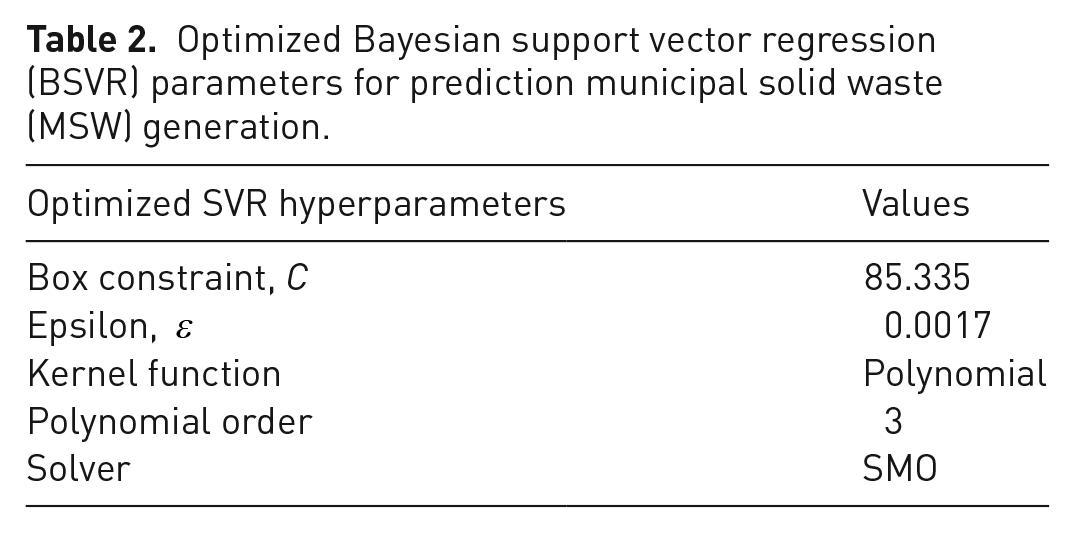
Based on the highest R2 value and lowest MAD and RMSE values from Figure 4, the cubic polynomial kernel was selected as the optimum covariance for the BSVR model. Table 2 shows the optimum hyperparameters of the polynomial (cubic)-BSVR model. The optimum values of the model hyperparameters were applied to the test dataset to evaluate the prediction ability of the developed models. Table 3 summarizes the results of the performance indices for all predictive models. Based on the comparison of the predictions given by the models, it has been shown that the Exponential-BGPR model is more accurate as compared to the MLR and BSVR models.
Optimized Bayesian support vector regression (BSVR) parameters for prediction municipal solid waste (MSW) generation.
Model comparison.
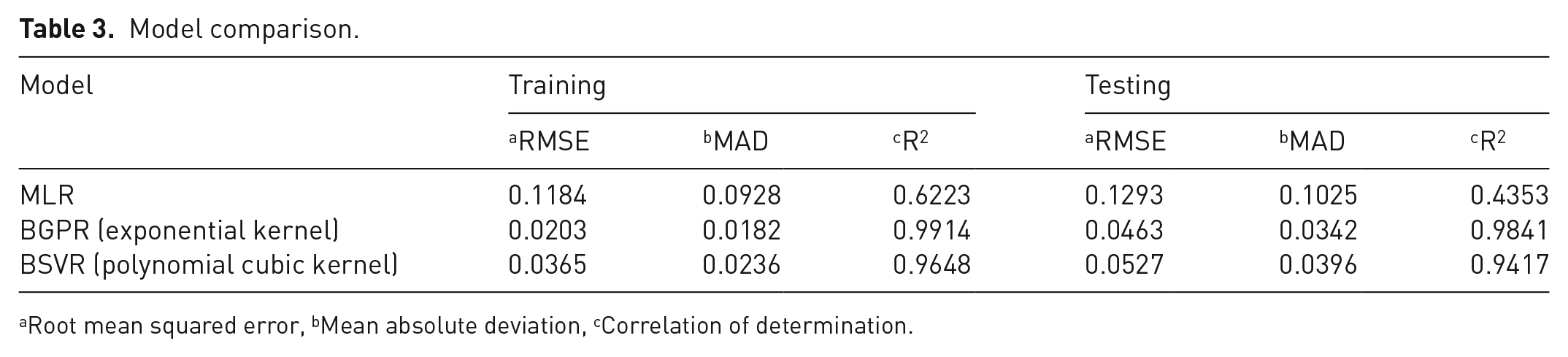
Root mean squared error, bMean absolute deviation, cCorrelation of determination.
Evaluation of results
The rapid generation of MSW has recently become an important issue of environmental concern. There are various socio-economic parameters that affect this generation. The success of the models developed to predict MSW generation is directly related to the suitability of these selected parameters. Since the increase in the number of people significantly increases the amount of MSW generated, the population is applied as the most important factor for the estimation of MSW generation. In addition, GDP has a high impact on the MSW generation as it is directly related to consumption.
In developing countries, improvements in economic conditions have changed the living standard and increased the rate of consumption of materials, which causes the generation of large amounts of MSW. However, the increase in the inflation rate or unemployment adversely affects the purchasing power of people (Chu et al., 2016; Keser et al., 2012; Khajevand and Tehrani, 2019), which reduces the amount of MSW generated. Especially, during economic downturns, economic factors can dominate the effects of population change on waste generation (Khajevand and Tehrani, 2019). As a result, in this study, mentioned socio-economic parameters were applied as inputs. Depending on the statistical analysis, it can be said that these inputs have a great contribution in obtaining high accuracy estimation success from the developed models. However, due to the nonlinear structure of data used in order to predict MSW generation, the problem becomes more complex, which makes it difficult to achieve high accuracy with traditional multivariate regression methods such as MLR. In such cases, powerful machine learning methods such as GPR and SVR are often used in explaining relationships. The results of this study clearly showed that BGPR and BSVR methods performed better than the MLR method because they are kernel-based regression algorithms. The superiority of BGPR model over others can possibly be attributed to its ability and flexibility to model nonlinear relationships using a limited amount of data. Also, GPR is a probabilistic kernel-based machine method that makes BGPR superior to the BSVR model.
This successful model has the potential to reference academics and stakeholders to plan solid waste collection and treatment systems, increase sustainability, and measure comprehensive impacts on MSW. In this regard, the results obtained by the model can help researchers in dealing with different problems such as the selection of MSW treatment methodologies and technologies, determination of the disposal sites, capacity planning of material recovery facilities, and optimization of personnel and resource utilization.
As a result, it can be said that it is essential to estimate waste generation to ensure that existing waste management strategies and treatment technologies continue to operate effectively and to be compatible with future changes in waste generation rates. A suitable waste management system is affected by various factors that highly depend on waste quantity such as appropriate infrastructure, government incentives, applicable laws and regulations, and public awareness and willingness. Thus, with the results presented in this study, waste management strategies can be better planned in advance and can be adapted to unforeseen conditions. In addition, the forecasting results presented in this study can be used as a decision-support tool for municipal waste planners to analyze the status of the current waste management system and produce scenarios for future projections.
Conclusion
MSW management includes the activities and actions of the entire lifecycle of waste from generation to collection, transportation, and treatment and disposal. The estimation of MSW generation and determination of influencing factors are the basis of the management of the MSW operation and planning process. Therefore, it is important that MSW planners and decision-makers select the appropriate tools and methods to accurately predict the generation of MSW and to determine the factors that affect it.
In this study, the BO algorithm has successfully been applied to the GPR model to estimate the MSW generation of Turkey using socio-economic indicators. The results of the study showed that the proposed Exponential-BGPR model has shown high application potential in MSW prediction due to its estimation capability and can help decision-makers to plan and identify appropriate strategies for sustainable waste management for Turkey. Turkey is composed of different geographical and climatic regions. Therefore, the different needs and habits of people living in different regions lead to the generation of MSW in different compositions and amounts. In addition, there are clearly four seasons in Turkey. Seasonal consumption also affects MSW characteristics and quantity. However, to date, the investigation of regional or seasonal MSW generation has not been carried out due to limited data. By obtaining appropriate and adequate data, the investigation of the effects of such parameters on MSW generation quantity and composition in Turkey will be an interesting research topic for future studies.
Footnotes
Declaration of conflicting interests
The author declared no potential conflicts of interest with respect to the research, authorship, and/or publication of this article.
Funding
The author received no financial support for the research, authorship, and/or publication of this article.
