







Abstract
China is experiencing an enormous increase in municipal household solid waste (MHSW) generation and is facing multiple problems associated with the treatment of MHSW. This paper analyses factors affecting residents’ satisfaction with MHSW treatment performance. Six factors were identified by the Delphi method: (a) pick-up frequency by waste collection vehicles, (b) fund supply situation, (c) charging standard for waste treatment, (d) waste bin arrangement, (e) laws and regulations, (f) publicity and education. We examine the significance of these six influencing factors, estimating binary logistic regression models. Data for this study are derived from the survey responses of 469 households in Harbin, one of the largest cities in northeast China. The results indicate that ‘pick-up frequency by waste collection vehicles’ is ranked the first and most important determinant of Harbin residents’ satisfaction with MHSW treatment; this is closely followed by ‘publicity and education’. The third and fourth significant influencing factors, respectively, are ‘fund supply situation’ and ‘charging standard for waste treatment’. The last two factors are ‘laws and regulations’ and ‘waste bin arrangement’. By understanding the influence of various factors on residents’ satisfaction, this study aims to help in designing an effective waste management system to reduce the cost of MHSW management, and to raise the residents’ satisfaction with municipal solid waste treatment. Based on the research findings, we advocate that establishing a reasonable waste transport (pick-up) system as well as strengthening publicity and education of waste management are key to improving residents’ satisfaction with the MHSW treatment performance.
Keywords
Introduction
Modernization provides opportunities and benefits for economies, but it also brings social and environmental harms (Morales-Cayax et al., 2013; Su et al., 2018). Municipal household solid waste (MHSW) is a pervasive urban problem globally (Aliu et al., 2014; Chen et al., 2015; Chu et al., 2017). According to the United Nation Environmental Program (Desai, 2015), solid waste generation has become a pressing environmental and public health problem everywhere in the world, particularly in developing countries, such as China. Urbanization, population growth, and industrialization are three key reasons behind China’s enormous increase in total waste generation (Haddis et al., 2014; Liu et al., 2017a; Patil and Singh, 2015; Singh et al., 2014; Tian, 2013; Zhang et al., 2010). It is estimated that cities in China produce nearly 200 million tons of waste per year, and that amount is increasing yearly by 10%. Nearly two-thirds of Chinese cities are facing an acute waste crisis (Hou and Ma, 2005). Environmental conditions in the cities are appalling as a result of inadequate provision of sanitation and waste treatment services. There is an urgent need to improve the efficiency of solid waste treatment in China (Wang, 2009). Several studies have also stressed the importance of conducting research on the performance of municipal solid waste treatment (Arafat et al., 2013; Liu et al., 2017b; Traven et al., 2018; Zhou et al., 2018).
Researchers studying the factors affecting MHSW treatment performance have identified several factors causing poor treatment performance, including the lack of financial management and logistics, deficient municipal infrastructures and planning, and uncooperative civil perceptions and sociocultural practices (Ogwueleka, 2009). Tao and Ju (2018) weighed the main factors affecting MHSW management and concluded that the social-economic aspect plays an important role, in which the laws and regulations, population, and individual factors exert significant impacts. Although scholars from all over the world have studied the influencing factors of the treatment performance of MHSW, they do not seem to have paid enough attention to the attitude of residents to the treatment performance of MHSW. Su et al. (2018) evaluated the performance level of MHSW treatment in all provinces (districts, cities) and China as a whole during the period from 2006 to 2015. They and other researchers contend that to improve MHSW treatment, it is essential to emphasize and address the role of community residents, their attitudes, their waste-handling practices, and their interactions with other actors in the waste system, because they are the main end-users of waste management facilities (Samuel, 2014). In fact, satisfaction of the residents is a prerequisite for subsequent implementation and improvement of a household solid waste treatment plan (Rahardyan et al., 2004; Lobo, 1973). Thus, improving residents’ satisfaction is a primary concern of waste management (Houghton, 1976; Kim, 1997; Raje et al., 2001). Hariyono (2017) also argued that the security factor is the main aspect of human need and resident satisfaction. Harir et al. (2017) suggested that socioeconomic attributes (such as income and education) have the most significant influence on residents’ satisfaction. All in all, solid waste treatment is an essential public health service and it needs to meet with residents’ satisfaction (Addoyobo, 2003; Chu and Chiu, 2003; Puche-Regaliza et al., 2018). However, no clear consensus has emerged from these studies regarding which factors affect residents’ satisfaction with the MHSW treatment performance, and how important (the relative strength of influence) the factors affecting residents’ satisfaction with MHSW treatment are.
This study joins the literature on the issue of MHSW treatment satisfaction, and fills the gap of research in this area by assessing the relative importance of influencing factors of residents’ satisfaction with municipal solid waste treatment performance. We first apply the Delphi method to identify six critical factors for resident satisfaction with MHSW treatment performance. We then conduct a case study of Harbin residents’ satisfaction with MHSW treatment. Based on the estimation results of binary logistic regression models we obtain the relative degree of influence of the six factors, and discuss the relation and synergetic implications between these determinants of residents’ satisfaction. Our study has theoretical and practical significance. Theoretically, the research results of this article are conducive to the study of MHSW management by scholars. In practice, the findings and insights can contribute to helping the Harbin government to better improve the satisfaction of residents with the treatment performance of MHSW. The rest of the paper is organized as follows: the next section describes the method and models. Following this, the Harbin case study is presented, and the estimation results are display and discussed, followed by conclusions.
Methods and models
Delphi expert opinion method
Definition and description of the Delphi method
The Delphi questioning technique is an interactive method for idea identification and prognosis, through systematic and iterative survey of insights and opinions of selected experts (Luo and Yang, 2013). This method collects experts’ opinions and is designed in a way to draw consensus from panel members without direct interactions among them in a traditional meeting setting, to avoid bias from dominant members and the bandwagon or steamroller effect (Fischer, 1978; Fulbrook and Last, 2003). If the Delphi method is executed appropriately, consensus will emerge out of several rounds of Delphi questioning and anonymous coordination and solicitation of panel members’ opinions and predictions (Luo and Yang, 2013; Staggers et al., 2002).
The specific process of executing the Delphi method is as follows (Lin et al., 2020): after obtaining expert opinions on the issues related to the research subject, the results are summarized and counted. Then the results (opinions) are relayed anonymously back to each expert for more feedback. Again, their opinions are collected, summarized, tabulated, and sent back for further feedback. This process will repeat for several rounds until consensus emerges (passing the consensus test in statistical sense and standard). This process can be simply expressed as: anonymous consultation with experts–induction–statistics–anonymous feedback–induction–statistics. . .; after a few rounds, consensus is reached and iteration stops (Forrest et al., 2002).
Criteria for selection of experts
Contrary to a traditional survey, which would use a random sample to extract the views held by separate individuals in a target population, the Delphi method uses anonymous interactions among specifically selected panel members with relevant expertise to arrive at a consensus (Rodríguez-Mañas et al., 2013). The validity of a Delphi study depends not as much on the number of participants polled, but rather more importantly on the expertise and qualifications of the panel experts who are selected to participate (Kidholm et al., 2016).
The selection of experts in for this study follows the following four criteria that are widely adopted by researchers using the Delphi method:
(1) Possess the knowledge and experience of MHSW, which can be theoretical knowledge or practical experience from related work;
(2) Have the ability and willingness to participate in the expert panel to select relevant influencing factors of residents’ satisfaction with the performance of MHSW treatment;
(3) Can commit sufficient amount of time needed to participate in multiple rounds of the back-and-forth opinion extraction and solicitation process until consensus is reached on the selection of influencing factors;
(4) Must have effective communication skills to be able to express and articulate their opinions accurately and clearly in the anonymous consensus-building process (Adler and Ziglio, 1996).
Selection of experts
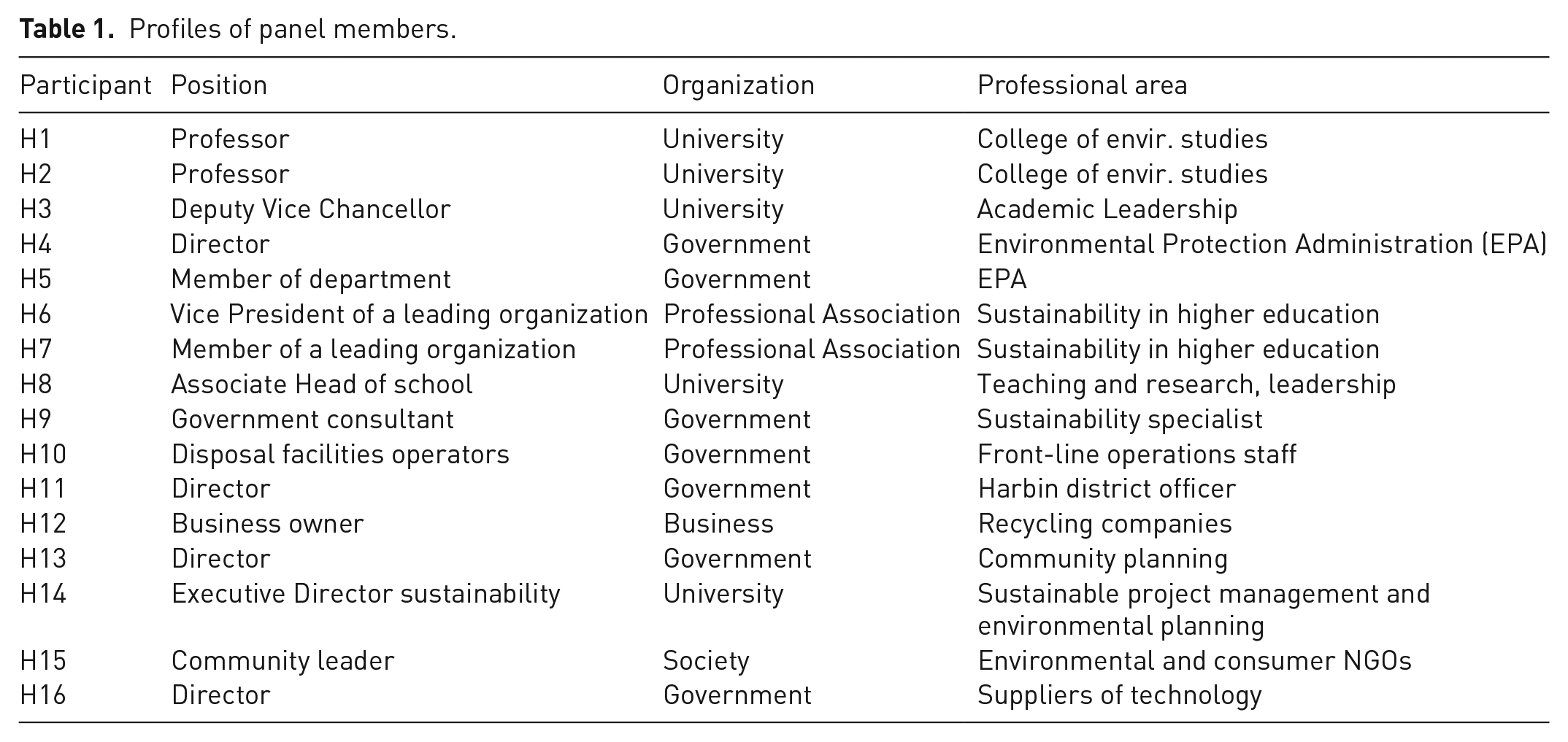
Based on the above four selection criteria and combined with their academic qualifications, professional expertise and knowledge as well as work experience, 29 potential experts were targeted and invited to participate in the Delphi study. Sixteen of them agreed to participate – a participation rate of 55.2%. These participants are representative of various relevant sectors of waste management in China: public authorities and government officials, waste treatment facilities operators, community planners, recycling companies, suppliers of waste treatment technology, environmental and consumer non-governmental organizations (NGOs), representatives of related business groups, academic professionals and scientists specializing in MHSW. Their selection ensures a solid foundation for the validity and reliability of the Delphi data. In addition, five panel members have international backgrounds: three from the UK and two from New Zealand. They can share commonwealth countries’ experiences. Seven of the panel members are Harbin residents, so they have a vested interest to express their opinions on behalf of the residents of Harbin. Table 1 lists the profiles of these panel experts.
Profiles of panel members.
Delphi process and data collection
Delphi surveys were conducted during the period from March to June 2019. In the first round, we conducted open-ended inquiries interviewing 16 experts about the influencing factors of Harbin residents’ satisfaction with municipal solid waste treatment. In this round, we only posed our questions without any restrictions on the experts’ predictions, and summarized and analysed the opinions of the experts. In this round, the opinions of the 16 experts were scattered and could not be readily unified. After sending back the first round of statistical results anonymously to the interviewed experts, we started the second round of investigation. In the second round, all the participants were asked to rate and rank the influencing factors obtained from the first round of statistical results on a Likert-type scale (Hsu and Sandford, 2007), and could refer to the opinions of other experts (unidentified) to provide new ideas for the selection of influencing factors. The rating scales range from 1 to 7, with 1 being ‘totally disagree’ or ‘insignificant’ and 7 being ‘totally agree’ or ‘significant’. After sending the statistical results of the second round to the interviewed experts, we started the third round of survey. In Round 3, the participants were asked to revise their ratings or specify the reason why they want to keep the same rating. In this round, consensus opinion began to converge, and the scope of the selection of influencing factors had gradually narrowed. Finally, the fourth round of compound review was conducted, which repeated the same process of the previous rounds. This process ended when the 16 experts reached a complete consensus on the selection of the influencing factors of Harbin residents’ satisfaction with municipal solid waste treatment.
Data analysis and results
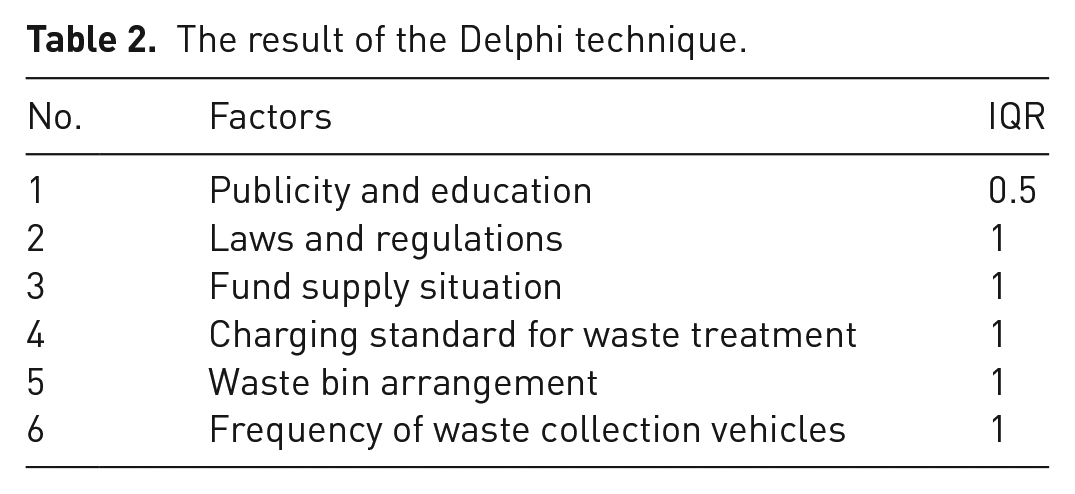
In this study, mean and median values are chosen to represent the average factor ratings by the panel members. Standard deviation and interquartile range (IQR) are also computed as they are closely linked with mean and median to demonstrate the trend towards group consensus. As standard deviation measures the spread of a dataset, the greater the standard deviation, the more spread or dispersion the data exhibit. The IQR is made robust through comparing the difference between the upper and the lower quartiles. Specifically, upper quartile minus lower quartile equals the IQR, with smaller values indicating higher degrees of consensus. According to Linstone and Turoff (2002), an IQR of 1.00 or less can be considered as reaching a good degree of consensus on a seven-point Likert scale. An IQR ⩽1 means that more than 50% of all opinions fall within one point on the scale. To achieve a statistically robust consensus, we also assessed the degree of consensus in the ratings, using Kendall’s coefficient of concordance (W). A strong consensus exists for W ⩾ 0.7; moderate consensus for W = 0.5; and weak consensus for W < 0.3 (Schmidt, 1997). The four rounds of iterations yielded the following results: consensus was obtained (IQR ⩽1) on six items, resulting in an agreement rate of more than 50%. Table 2 lists the final results of Delphi study after four rounds, showing all items with IQR ⩽1. Therefore, six factors (listed in Table 2) are proposed to gauge and poll residents’ satisfaction on municipal household solid waste treatment.
The result of the Delphi technique.
The selection of the six influencing factors in this study is not only based on the scientific approach of the Delphi method, but is also supported by many previous studies. For example, Evison and Read (2001), Deng et al. (2013) and Haight (2007) all recognized the important influence of publicity and education on residents’ satisfaction, and advocated extensive environmental publicity and education campaigns to enhance residents’ cooperation and satisfaction regarding waste treatment. According to the US EPA (2008), strengthening the stipulation and enforcement of laws and regulations related to waste management can help increase customer satisfaction. Lee et al. (2014) also showed that improving waste laws, regulations and policies is highly correlated with residents’ satisfaction. Koo et al. (2009) showed that arrangement and deployment of waste bins and other waste treatment facilities also affect residents’ satisfaction with the treatment performance of MHSW. Wilson et al. (2012) compared the performance of household waste treatment in 20 cities, and concluded that the extent to which the fees or charges are associated with financing the expenses incurred in household waste treatment (fund supply situation) affects the satisfaction of residents. Along the line of funding and charging mechanism, Khan and Farooqi (2012), Athimulam and Odayar (2003) and Doberl et al. (2002) also contended that the extent of the government’s investment in waste treatment significantly affects residents’ satisfaction with the performance of household waste treatment. Khanom et al. (2015) and Puche-Regaliza et al. (2018) investigated the relation between residents’ satisfaction and collection frequency of sanitation vehicles and services of MHSW, and concluded that these are important determinants of residents’ satisfaction.
Logistic regression model
We estimate a logistic regression model, in which the treatment performance of MHSW is taken as the dependent variable Y. Y is a binary variable divided into two types, ‘good treatment performance’ and ‘poor treatment performance’. P represents the probability of good treatment performance rated by Harbin residents, and the probability of bad treatment performance is 1–p. As the dummy variable Y cannot be directly used as the dependent variable in the logistic regression model, it is replaced by the probability E(Y) of its occurrence (Eye and Mun, 2013; Steinberg and Cardell, 1992), and P represents the conditional probability of good and bad treatment performance of MHSW.
Test for multi-collinearity
Multi-collinearity refers to the problem when independent variables in a multiple regression model are highly correlated with one another (Obite et al., 2020; Wonsuk et al., 2014; Zhang et al., 2020). The presence of multi-collinearity can lead to wider confidence intervals and less reliable probability values (P values) for the parameter estimates of independent variables, drastically reducing statistical significance and predictive power of the regression model (Paul, 2006; Zhou and Huang, 2018). In the case of perfect collinearity, estimation will break down and no meaningful parameter estimates can be obtained. Therefore, it is important to conduct a diagnostic test to detect the existence of serious multi-collinearity (Yazid and Mowafaq, 2009).
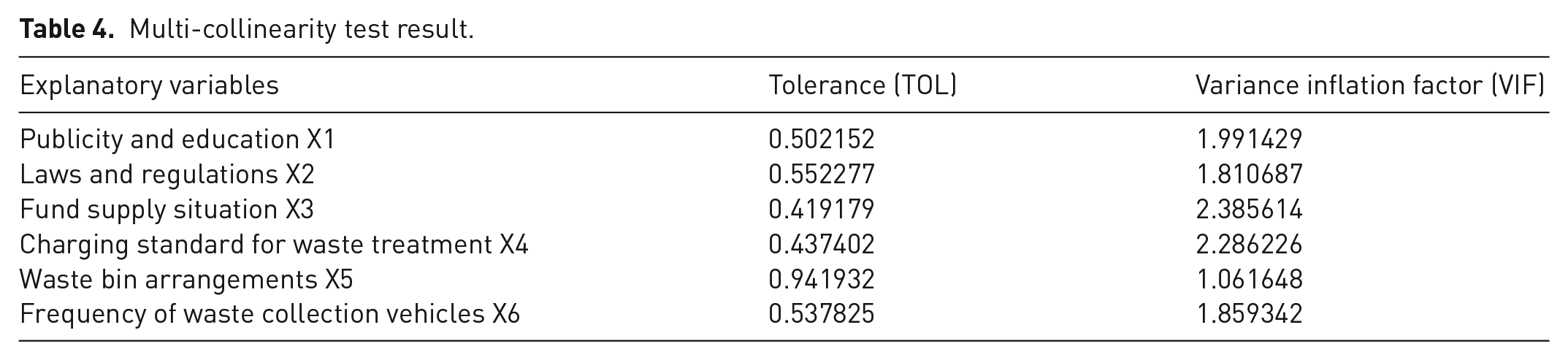
Variance inflation factor (VIF) is commonly used to identify the severity of multi-collinearity issues so that the model can be adjusted (Bary, 2017; Wang et al., 2015). VIF refers to the ratio of variance when there is multi-collinearity among explanatory variables to variance when there is no multi-collinearity (Zhao et al., 2020). It is the reciprocal of TOL (Tolerance) (Kim, 2019).
In the definition,
Case study
Harbin, shown in Figure 1, is the capital city of Heilongjiang Province and a central hub of northeast China. It has 4.728 million residents in the city centre and is divided into eight urban districts. The daily generation of MHSW is 3500 tons in the city (Cheng, 2014). Among them, 58% of MHSW have not been processed. Harbin’s MHSW recycling level and prevalence is lower than other comparable cities and urgently needs to be improved.
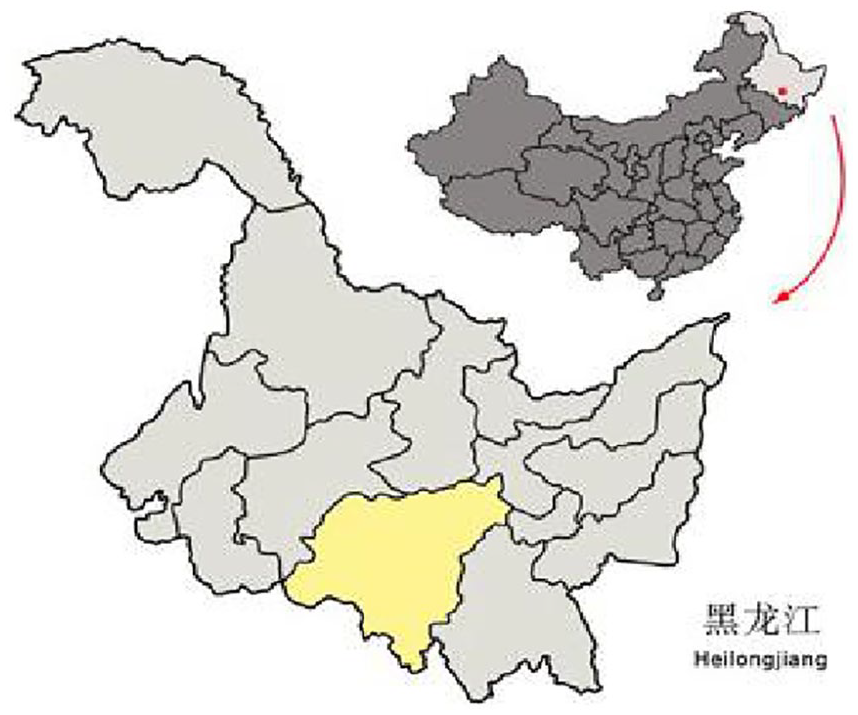
Study area.
Data collection
Researchers in survey studies such as Ergu and Kou (2012) have advised that content and theme of the questionnaire used in survey should be clear and concise, so that the participants can quickly understand the purpose of the survey and respond to the questions. As the survey is aimed at members of the communities with diverse characteristics in age, education level and other social demographics, it is crucial to design pertinent survey questions that can reach targeted respondents for them to answer the questions without confusion and frustration. With this understanding, and given that the purpose of survey for this research is to gauge the residents’ satisfaction about the MHSW treatment programme and to obtain information about the extent of their satisfaction in relation to various influencing factors, we have designed the questions that can be easily answered with yes or no, corresponding to satisfaction or dissatisfaction. The questionnaire can achieve the desired outcome of collecting clear (no misunderstanding) and correct (unmistaken) response and also mutually save time.
The stratified sampling approach is applied to collect and obtain reliable and valid data for this study. We chose sampling districts first and collected 3–6 sampling communities in each place (sampling district). Finally, 16 households were randomly selected from each sampling community to participate in the survey. Harbin has six district areas including Nan-gang district, Dao-wai district, Dao-li district, Ping-fang district, Xiang-fang district and Song-bei district. To ensure the accuracy and wide coverage of the data, all six districts were sampled for this study. Among them, Nan-gang district, Dao-wai district, Dao-li district and Ping-fang district are the most densely populated areas in Harbin. To ensure the comprehensiveness of the survey, this article selects the upscale, mid-range and low-end communities in each district. Based on the population density of each district, six communities in each of the first four districts were selected for questionnaire distribution, and each district includes two upscale communities, two mid-range communities, and two low-end communities. Three communities in each of the remaining two districts were selected for survey, and each district includes one upscale community, one mid-range community, and one low-end community. In this way, Harbin residents sampled in the questionnaire cover all ranges of income levels, consumption levels, educational backgrounds, etc.
Finally, to ensure the validity and reliability of the data, sample size (the total number of observations) should not be too small. According to Zhu (2010), the rule of thumb is that the ratio of the total number of samples to the number of variables is at least five times. Sixteen households in each selected community were surveyed. After selecting the survey community, we contacted the community leader or officer and asked them to help distribute the questionnaire to each family randomly. The household member selected as an appropriate respondent is the person familiar with his or her household recycling situation and behaviour. Two authors of this article live in Harbin, so the investigation process was more convenient and efficient. Data collection work was conducted during the period from June to August 2019. In total, we successfully surveyed 469 of 480 targeted households, yielding a 97.7% response rate. The socio-demographic characteristics of the respondents (one individual per household) are summarized in Figure 2.
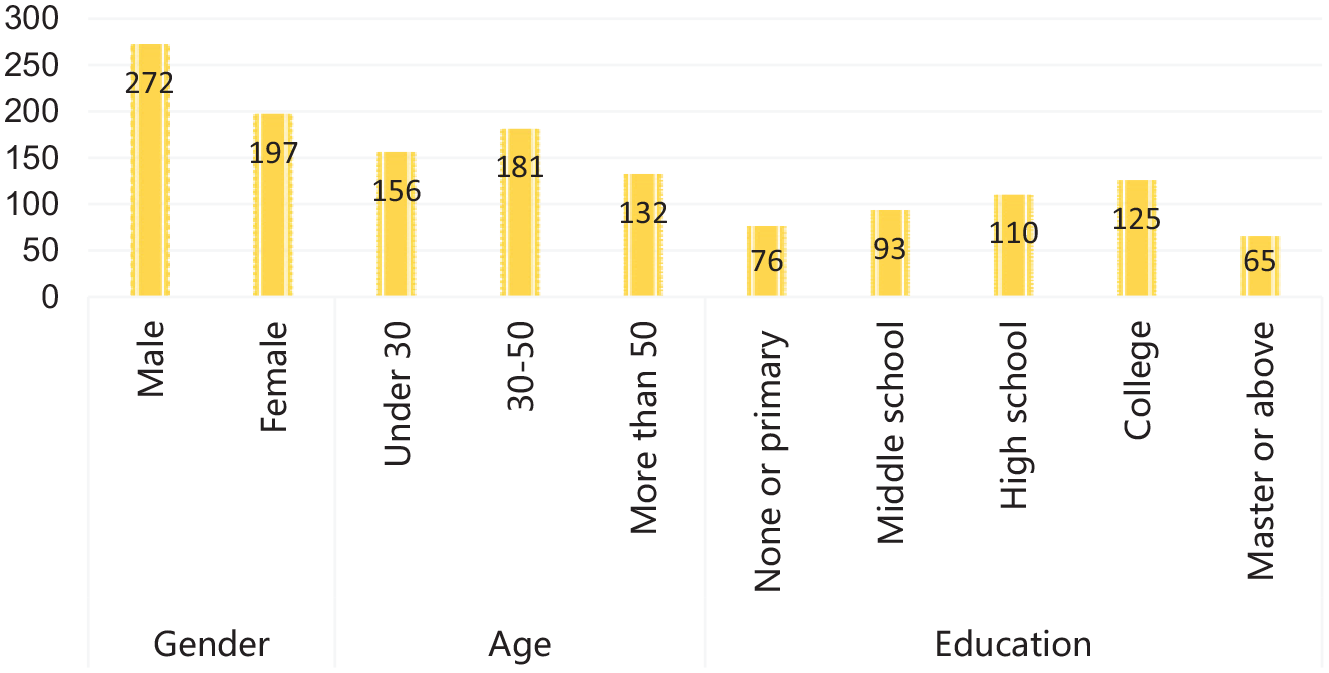
The socio-demographic characteristics of the respondents (one individual per household).
Specification of variables and estimation software used
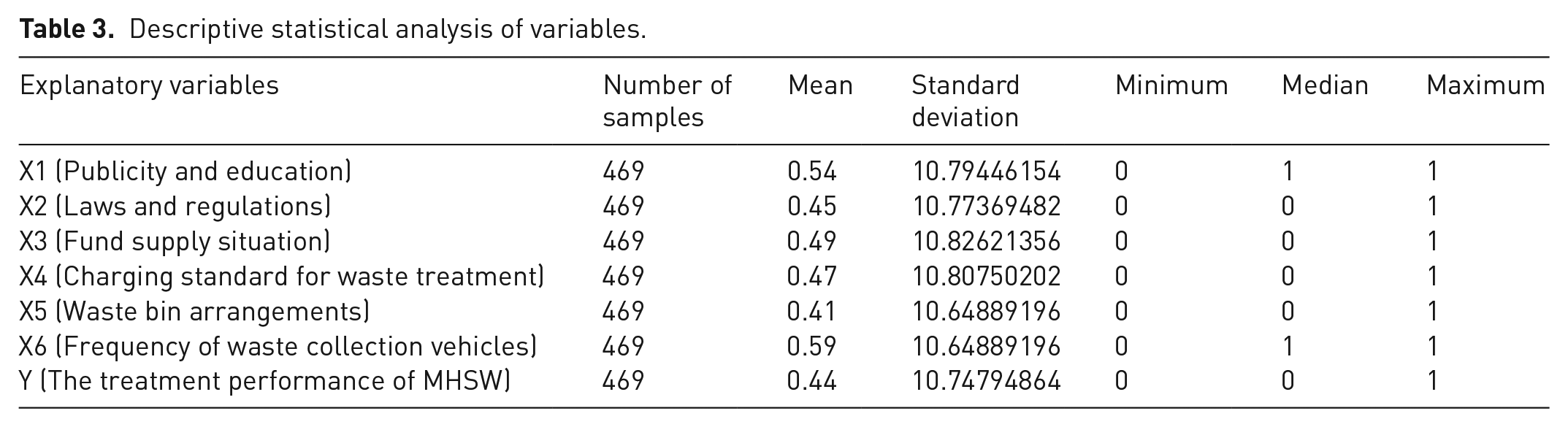
Based on the consensus of panel experts from the Delphi study, we specify the satisfaction-influencing variables X1, X2, X3, X4, X5 and X6 as, respectively: Publicity and education, Laws and regulation, Fund supply situation, Charging standard for waste treatment, Waste bin arrangement, and Frequency of waste collection vehicles. The value for each variable is coded as either 1 (satisfaction) or 0 (dissatisfaction). After the above processing, we present Table 3, the statistical technical table of the total sample variables in this article. Essentially, Table 3 gives the preliminary descriptive statistical results of the data collected from the field survey. It can be seen from Table 3 that the Mean of X1 (Publicity and education) and X6 (Frequency of waste collection vehicles) is greater than 0.5, indicating that these two factors have a greater influence on Harbin residents’ satisfaction with MHSW treatment performance. The average value of X5 (Waste bin arrangements) is the smallest and only 0.4, suggesting that this factor might have the lowest influence on satisfaction.
Descriptive statistical analysis of variables.
The software SPSS24.0 was used to conduct multi-collinearity test and to estimate logistic regression models.
Results and discussion
As shown in Table 4, the multi-collinearity test statistic VIF values for the six explanatory variables are all less than 10. Thus, the empirical specification and regression equations in this study pose no multi-collinearity problem.
Multi-collinearity test result.
The chi-square value of 325.402 is much larger than 14.067, the critical threshold value for testing the overall significance of the model. Thus, the Log Likelihood Ratio test result proves convincingly that the model has very significant overall goodness-of-fit of the data.
Table 5 presents the estimation results of the logistic regression model. It can be seen that X1, X2, X3, X4, X5 and X6 are all statistically highly significant. If we take the coefficients as an approximate indication of the relative importance and significance of the respective factor in affecting residents’ satisfaction, we can rank these factors in the following order: X6, X1, X3, X4, X2, and X5.
Logistic regression results.
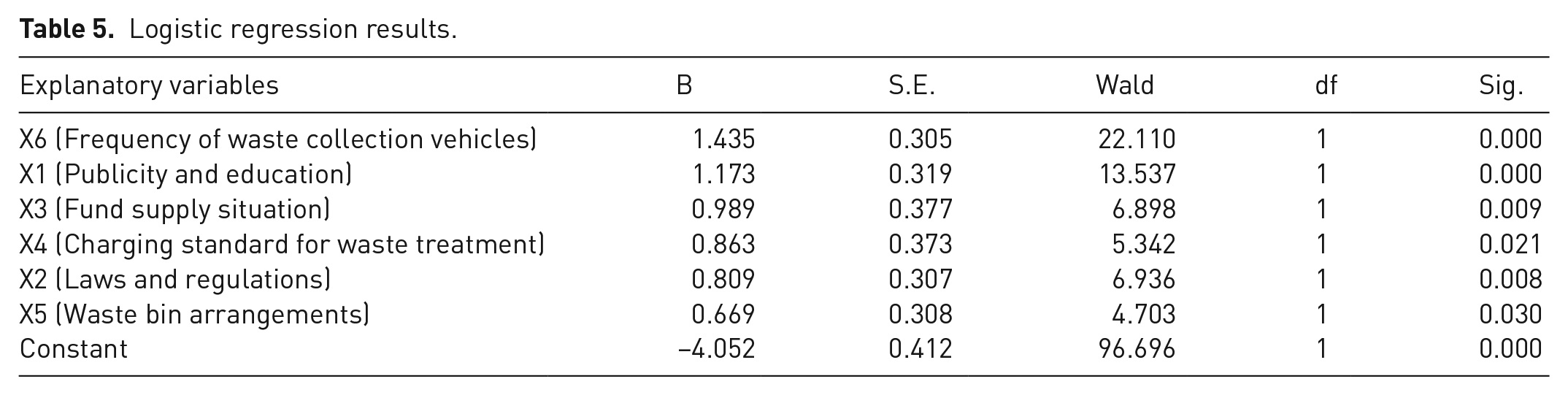
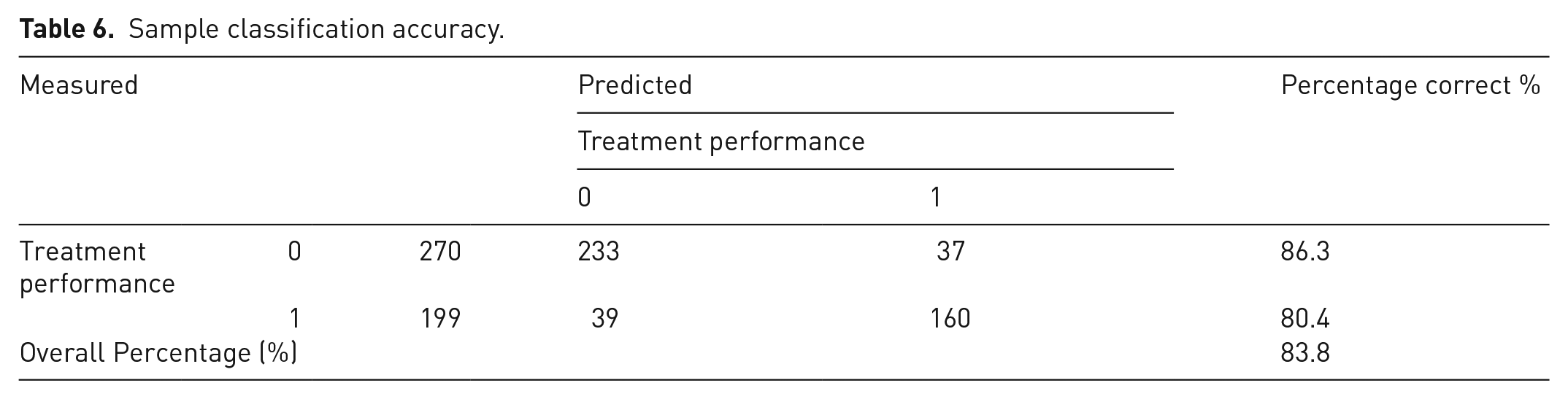
Table 6 shows that out of the total 469 households surveyed, 199 people think that the treatment performance of MHSW in Harbin is good, while the remaining 270 people (57.6%) think not. This is based on internal coding in which 1 means the treatment performance is good, and 0 means the treatment performance is not good. As a standard procedure to verify sample classification accuracy, Table 6 presents comparison of actual performance rating by Harbin residents with the predicted performance rating based on the estimation results of logistic regression model. It can be seen from Table 6 that the logistic regression model exhibits quite accurate predictive power regarding residents’ satisfaction about the treatment performance of MHSW in Harbin. That is, out of 199 people who consider that the treatment performance is good, logistic regression results predict 160 of them (80.4%) would rate the performance to be good, and out of 270 who actually rate the treatment performance to be not good, logistic regression results predict 233 of them (86.3%) would rate the same. The overall predictive accuracy of the model is 83.8%.
Sample classification accuracy.
Based on the above parameter estimation results, we discuss in the following the six treatment satisfaction factors in the order of importance ranked by Harbin residents, and relevant policy implications.
Pick-up frequency of waste collection vehicles
The results show that the frequency of waste collection is the most important determinant of Harbin residents’ satisfaction towards waste management. Solid waste management is a primary concern for every municipality. Among all the steps involved in waste management, efficient collection and processing is the biggest challenge. Waste collection entails a large amount of expenditure in capital, labour, and variable operational costs (Hannan et al., 2018). As mentioned earlier, Harbin is a provincial capital with large population, and generates up to 3,500 tons of waste every day (Cheng, 2014). On the one hand, low collection frequency will lead to the problem of waste accumulation and adversely impact the health and normal life of residents. On the other hand, higher collection frequency will increase waste collection costs and unduly hike the environmental management fees that residents have to pay. As the residents are the direct and primary stakeholders of waste management and waste collection frequency appears to have the greatest impact on residents’ satisfaction towards waste treatment, it is essential to incorporate residents’ opinion in optimizing waste collection frequency.
Publicity and education
Publicity and education is ranked by Harbin residents as the second most important factor for treatment satisfaction. On the one hand, Harbin is one of the country’s first 46 pilot cities for waste separation (Du and Huang, 2019). A sense of honour and pride might have induced Harbin’s residents to be more eager to cooperate and engage in exemplary waste separation practice. Hence, they have higher expectations (and would be satisfied) for the municipal government to increase promotion and education on exemplary waste separation management in their city. On the other hand, Harbin is one of China’s top 10 ice and snow tourism cities (Lewis and McCarthy, 2015; Sun and Zhang, 2013). The large number of tourists have added a greater environmental burden onto Harbin. Hence the residents also demand (and would be satisfied) that the government increase publicity and education of waste separation management (to local residents and tourists alike) to ensure the city’s quality appearance and environment.
Fund supply situation
Waste management is costly. Material and capital inputs such as separation waste bins, collection vehicles and other waste equipment, as well as labour inputs such as sanitation workers, all require substantial funding support from the government (Wilson et al., 2012). Sufficient budgetary appropriations to waste management can provide adequate treatment of household waste, and also give clear gesture to the residents that the Harbin government attaches great importance to municipal waste treatment, thereby raising the residents’ satisfaction of waste treatment performance.
Charging standard for waste treatment
In accordance with ‘The regulation of Harbin municipal solid waste treatment fee’, Harbin community collects a waste treatment fee from residents every year to promote the harmless treatment and resource utilization of municipal solid waste (Mao, 2017). Whether the charging standard is reasonable and satisfactory to the residents depends on the actual performance of household waste treatment, and also on their perception of the fair price to pay (and if they are getting their money’s worth). Thus, while the charging standard is only ranked as the fourth factor influencing residents’ satisfaction, it is important to design a fair charging mechanism and to engage in effective treatment management and publicity and education, i.e. to synergize this factor with the first two influencing factors.
Laws and regulations
While the Harbin municipal government is committed to making the relevant laws and regulations of waste treatment easier to understand and enforce so as to promote comprehensive utilization of waste resources, the survey nevertheless reveals that many residents felt that they do not have (or are frustrated about not having) a clear understanding of the relevant laws and regulations of waste treatment, and this hampers their compliance with laws and regulations. This is an area that policymakers can improve to stipulate straightforward laws, and through publicity and education (again, working with the second influencing factor) to facilitate easier compliance and enforcement, thereby enhancing residents’ satisfaction towards waste management.
Waste bin placement
Currently, waste bins in Harbin are evenly distributed across communities. However, some residents complained that this is not the best arrangement. The waste bin at the intersection tends to fill fast and is prone to overflow. As a result, the residents will have to take the waste to the next available waste bin, which is inconvenient, adding time and hauling cost to them, thereby negatively affecting their satisfaction towards waste treatment. Therefore, a more sensible spatial placement of waste bins needs to be designed to raise residents’ satisfaction with waste management.
Discussion of possible limitations
A few limitations of this work should be noted. One major limitation is the scope of survey and the resulting number of observations used in the study. It would have been desirable to conduct a big-data study by surveying all citizens of Harbin. However, like many researchers (Azizi et al., 2015; Huang et al., 2011; Singh et al., 2015), we were constrained by a limited budget which did not allow us to conduct a large-scale survey study. Facing the same funding shortage issue, an earlier similar study by Liu et al. (2011) did a good job in the sampling process. They used a stratified sampling approach to collect 6–8 samples in each place (sampling district), and obtained reasonably sensible results. Our study is in line with Liu et al. (2011) in the process of sample selection and stratified sampling, and contains a larger sample than theirs to make the results more reliable.
Another limitation of the study, as commented by a couple of reviewers, concerns the validity of the selection of the influencing factors in this study. We are grateful for their insightful comments and criticisms on this issue of variable selection. We would defend our case that the selection is not arbitrary because it is based on the scientific approach of the Delphi method, and is also supported by many previous studies. Still, there is room for improving the selection of influencing factors, such as using the SERVQUAL model, which might be a promising approach in future research.
Conclusion
In this paper, we have examined the factors influencing Harbin residents’ satisfaction about their city’s MHSW treatment performance, using the Delphi method and a logistic regression model for the analysis. To ensure correct operation of the model, the multi-collinearity test was conducted on the data. Our study reveals that the six factors that affect residents’ satisfaction of waste treatment, by their respective order of importance, are: the collection methods and frequency of sanitation vehicles, publicity and education, fund supply situation, charging standard for waste treatment, familiarity with laws and regulations, and arrangement of waste separation facility.
The significance and practical implication of this study are three-fold. First, the research method used in this paper could be applied to examine a variety of MHSW management problems having the same nodes’ structures and urban characteristics. Second, the study provides the knowledge, some insights and suggestions on the improvement of MHSW treatment in generalized contexts. Third, this study could be expanded in future research towards developing comprehensive and optimal strategies for effective MHSW management.
Footnotes
Declaration of conflicting interests
The authors declared no potential conflicts of interest with respect to the research, authorship, and/or publication of this article.
Funding
The authors disclosed receipt of the following financial support for the research, authorship, and/or publication of this article: This research was supported by the Major Project of Philosophy and Social Sciences Research, Ministry of Education (Grant No. 17JZD0260); National key research and development plan key special project (Grant No. 2018YFC1903605); Fundamental Research Funds for the Central Universities (Grant No. GK2090260158); Training Program in Response to Major National Strategic Needs—Think Tanks (Grant No. HEUCFP201823 and HEUCFP201834); The Leading Research Project of Shanghai Jiao Tong University—Think Tanks (Grant No. ZXYJ-2020017); the PhD Student Research and Innovation Fund of the Fundamental Research Funds for the Central Universities (Grant No. HEUGIP201719).
