






Abstract
Waste sorting is an important aspect of environmental protection, which is now being enforced on a large scale in China. More broadly, it is beneficial to improve the implementation strategies for waste sorting policy and programmes. This study analyses the psychology of consumers that influences the mechanisms of consumer waste sorting and the governmental policies influencing consumers’ attitudes and behaviours. About 295 validated participants were collected from four regions of China. Regression analysis was used to examine the relationship among consumers’ internal motivation, government’s external publicity and consumer behaviour, and the Hayes’ PROCESS macro was used to test mediating effect and moderating effect. The results show that consumers’ internal motivation and government’s external publicity have a positive effect on consumer behaviour. Consumer attitude played a complete mediating role between consumers’ internal motivation and consumer behaviour. Between the government’s external publicity and consumer behaviour, consumer attitude played a complementary mediating role. Consumers with self-transcendence values, positive motivation of waste sorting and the government’s external publicity had a greater positive impact on their attitudes than consumers with self-enhancement values. The greater the material benefits and psychic income consumers received from waste sorting, the more it promoted a positive attitude to consumer behaviour. The article puts forward some management suggestions to improve the government’s implementation of its waste sorting policy.
Keywords
Introduction
Municipal solid waste (MSW) management has become an environmental issue of global concern. According to the World Bank’s ‘What A Waste 2.0’ report, the growth rate of waste production will rapidly exceed the rate of population growth. By 2050, the world will produce more than twice as much waste as it does today (Kaza et al., 2018). With the development of urban economies and populations, the amount of waste produced has increased sharply without alterations to the waste management system, resulting in a build-up of waste around cities (Fei et al., 2016; Kaza et al., 2018; Meng et al., 2019). Proper municipal solid waste disposal has become an urgent problem, which needs to be solved in order to sustainably develop cities while protecting the environment (Themelis and Mussche, 2013).
Many countries have realised the importance of municipal waste management and have implemented a variety of solutions, including UK (Abbott et al., 2011), USA (Sidique et al., 2010) and Japan (Hotta and Aoki-Suzuki, 2014). In China, new policies and regulations have been implemented since 2019, starting in Shanghai. Municipal waste sorting in the home is now mandatory in 46 cities across the country. In the USA, all municipal solid waste is collected centrally, and more than half of it is disposed of in landfills. In Australia, municipal waste is sorted and recycled. Recyclable waste includes plastic, steel, aluminium, cardboard box packaging and paper. Recyclable waste is transported to material recycling centres where it is sorted, compacted, baled and finally recycled locally or exported to overseas markets (Banerjee and Sarkhel, 2020). In Vietnam, the government have carried out some measures to recovery of household solid waste, including recycled, reused, recovered energy and produced organic fertilizer (Tran et al., 2019). Although the methods of MSW management vary in different countries, it is clear that an effective method of management is to separate municipal solid waste based on its source, such as households or enterprises (Tian et al., 2019). As the fastest growing country in the world, China began to enforce a garbage sorting policy for households and companies in 2019, hoping to save resources, reduce pollution and improve environment (Xi’an City Government, 2019).
Successful waste sorting depends on many factors, including implementation of public policy and consumers’ participating. Some scholars have studied the implementation efficiency of waste sorting in China; the conclusion is that the mixed MSW quantities projected are sensitive to projections in urban populations and food waste quantities are sensitive to sorting efficiency (Shapiro-Bengtsen et al., 2020). Yet more scholars have analysed the mechanism that affects consumers’ willingness to implement garbage sorting from the perspective of public education, finding that public education affects consumers’ willingness to implement garbage sorting by affecting the consumers’ psychology (Liu et al., 2019). Some scholars proposed a two-phase decision-making model of environment conscious behaviour and explained the determinants of waste reduction behaviours (Hirose, 2015). Meanwhile, internal motivation of consumer’s behaviour on waste sorting and waste reduction behaviour are concerned. For example, environmental concern and the injunctive norm are determinants of the intentional process to promote recycling behaviour (Ohtomo and Hirose, 2007); psychological intervention will reduce plastic bag usage at supermarkets (Ohtomo and Ohnuma, 2014). Moreover, an interdisciplinary approach should be needed for researching the between pro-environmental consumer behaviour and waste management (Concari et al., 2020). From existing research, although the psychological factors and mechanism of consumers’ waste sorting have been analysed, few studies combine the internal factors of consumers with the external factors of the government. In the process of implementing a waste sorting policy, both internal and external factors play a role at the same time, so it is necessary to make an in-depth analysis of the influencing mechanisms.
Consumer engagement is important to the success of effective waste sorting, management and sustainable development. This article uses psychological analysis to explore consumers’ internal motivation for waste sorting and the effect of the government’s external publicity on consumers’ attitudes and behaviour. The first part of the article analyses the impact of consumers’ internal motivation for waste sorting and the government’s external publicity on consumers’ attitudes and behaviour. The second part of the article analyses the moderating effect of personal values on the influence of internal motivation and the government’s external publicity on consumers’ attitude towards waste sorting. The third part of the paper analyses the mediating effect of consumer attitudes in the influence of consumers’ internal motivation for waste sorting and the government’s external publicity on consumer waste sorting behaviour. The fourth part analyses the moderating effect of consumers’ personal income in the relationship between the consumers’ attitude and behaviour toward waste sorting. Finally, some targeted management suggestions are put forward according to the conclusions of the model. Figure 1 shows the analytical structure of this study. It is expected that this research could help waste management departments to improve the implementation of waste sorting, to encourage more citizens to implement waste sorting and to positively contribute to the environment.

Study analytical structure.
Materials and methods
Data sources
Data was collected in four cities where waste sorting was carried out in China, namely, East China, Northeast China, Northwest China and Southwest China. Seventy-five samples were collected in each region, giving a total of 300 samples. Among the four areas, Shanghai is the representative city of East China, and it was the earliest city to implement waste classification, which was enforced in July 2019. Xi’an is the representative city of Northwest China, and it was enforced in September 2019. Shenyang is the representative city of Northeast China, and it was enforced in December 2019. Mianyang is the representative city of Southwest China, and it has not been enforced at present but will be a provincial demonstration city for waste classification. These four areas represent various situations of waste classification in China, and the samples from these four cities are very representative. To obtain accurate data, the survey used manual data collection. A total of 12 people participated in the process; three are in each area. Each participant answered the questionnaire and received a gift. Power analysis was tested for measuring the minimum sample size following by MacCallum and Hong (1997). The power analysis (alpha = 0.05; desired power = 0.9; null root means square error of approximation (RMSEA) = 0.05; and alternative RMSEA = 0.08; degrees of freedom = 52) showed the minimum sample size of 266. Through the examination of the default data, it is found that there were 295 valid questionnaires, and the effective recovery rate of the questionnaire was 98.3%. Among the valid respondents, 160 were female, accounting for 54.2%, and 135 were male, accounting for 45.8%.
Variable selection
Dependent variable
The consumer’s behaviour is the dependent variable in this study. It was measured by four items, which were revised from the field of sustainable consumption and responsible environmental behaviour (Tommasetti et al., 2018; Wang et al., 2018a). The dependent variable was constructed, and all items use the Likert 7-point scale, ranging from 1 to 7, of which 1 indicates ‘strongly disagree’ and 7 indicates ‘strongly agree’.
Independent variable
Consumers’ internal motivation: In the process of implementing the waste sorting policy in China, it became clear that the behaviour of citizens varies widely. Some citizens are careful to classify household waste correctly, whereas others are inattentive. Attribution theory can explain these behavioural differences. In this study, we found that when consumers implement waste sorting, they view the policy differently. Some consumers think the implementation of waste sorting useful to protect the environment and earnestly support the policy. Other consumers are not concerned with environmental protection and only sort their garbage because it is required by the government. Consumers’ different attribution views on the policy of waste sorting lead to differences in consumers’ behaviour. Therefore, according to attribution theory, this study puts forward a research hypothesis to explain the relationship between consumers’ internal motivation and their behaviour of waste sorting.
Government publicity: In the early days of waste sorting in China, the government made great efforts to advertise it in many public places, such as communities, schools and streets. The goal was to educate consumers in the policies and importance of waste sorting. In recent research, some scholars have studied the effect of information publicity on consumers’ attitudes and behaviour in the public domain (Wang et al., 2018b). Some scholars have found that publicity is an important part of the government’s public relations strategy, which affects the government’s policy towards enterprises (He and Tian, 2008). From these studies, it is clear that a government can influence consumers and enterprises through public information campaigns and advertisements. When a policy is first implemented, there is a greater need for government publicity to influence consumers’ behaviour.
Mediating variable
Consumer attitude: Consumers’ attitudes are influenced by the consumer’s internal motivation and the government’s external publicity, which are then transformed into consumer behaviour. The influence of consumers’ attitudes on behaviour has been studied in many behaviour studies (Smith et al., 2008; Vermeir and Verbeke, 2006). The model of theory of reasoned action (TRA) assumes that an individual’s attitude plays an important role in predicting his/her behaviour (Burton et al., 1998). Scholars have analysed the impact of consumer attitudes on sustainable purchasing behaviour and found that a positive attitude towards sustainability will positively affect a consumer’s purchasing behaviour for organic products (Stöckigt et al., 2019). In this study, we mainly analyse the mediating effect of consumers’ attitudes towards waste sorting based on consumers’ internal motivation and the government’s external publicity, respectively.
Moderating variable
Personal values: Personal values is a concept in social psychology, which is widely used in the social sciences (Rokeach and Ball-Rokeach, 1989). Schwartz (2007, 2012) summarises 10 values according to general requirements, which are self-direction, stimulation, hedonism, achievement, power, security, conformity, tradition, benevolence and universalism. According to the degree of concern for the welfare and interests of others, these 10 values can be divided into two types: self-enhancement and self-transcendence. Consumers with self-enhancement values are closely related to personal interests (Schwartz, 2007). Consumers with self-transcendence values pay more attention to the interests of others (Schwartz, 2007). Scholars have combined personal values with attribution theory to study whether consumers’ personal values are related to prosocial behaviour and moral consumption (Heilman and Kusev, 2020; Manchiraju and Sadachar, 2014). In many studies on corporate social responsibility, personal values are considered as important variables; they appear as independent variables and moderator variables in these studies (Barbarossa et al., 2017; De Dominicis et al., 2017; Diddi et al., 2017). In this study, the main purpose is to investigate the moderating effect of different types of personal values on the internal motivation and external publicity influencing consumers’ attitudes towards waste sorting.
Personal benefits: Usually, a positive attitude leads to positive behaviour, but there can be a gap between attitude and behaviour (Claudy et al., 2013; Gupta and Ogden, 2006). For example, there is a big gap between consumers’ pro-environmental attitudes and the purchasing of green products (Tanner and Kast, 2003). Scholars are studying what factors play a role in the gap between attitude and behaviour. According to the previous studies on the moderator variables of the attitude and behaviour gap (Claudy et al., 2013; Gupta and Ogden, 2006), combined with the actual situation of waste sorting implementation, some communities will give money or rewards to consumers who correctly classify and dispose of recyclable waste. Therefore, in this study, personal benefit refers to the material reward or spiritual encouragement that consumers will receive when they actively carry out waste sorting, and it is divided into two categories, namely material benefits and spiritual benefits, used as a moderating variable to determine its influence on attitudes towards waste sorting behaviour.
Methodology
This study focuses on the factors that affect consumers’ attitudes and behaviour towards waste sorting at the initial stage of a mandatory waste sorting policy in China. This article analyses the moderating effect of personal values and personal benefits on consumers’ attitudes and behaviour and uses questionnaire data to test the conceptual model using the Hayes’ PROCESS macro. Three variables were constructed, namely, government publicity, consumer attitude and consumer behaviour.
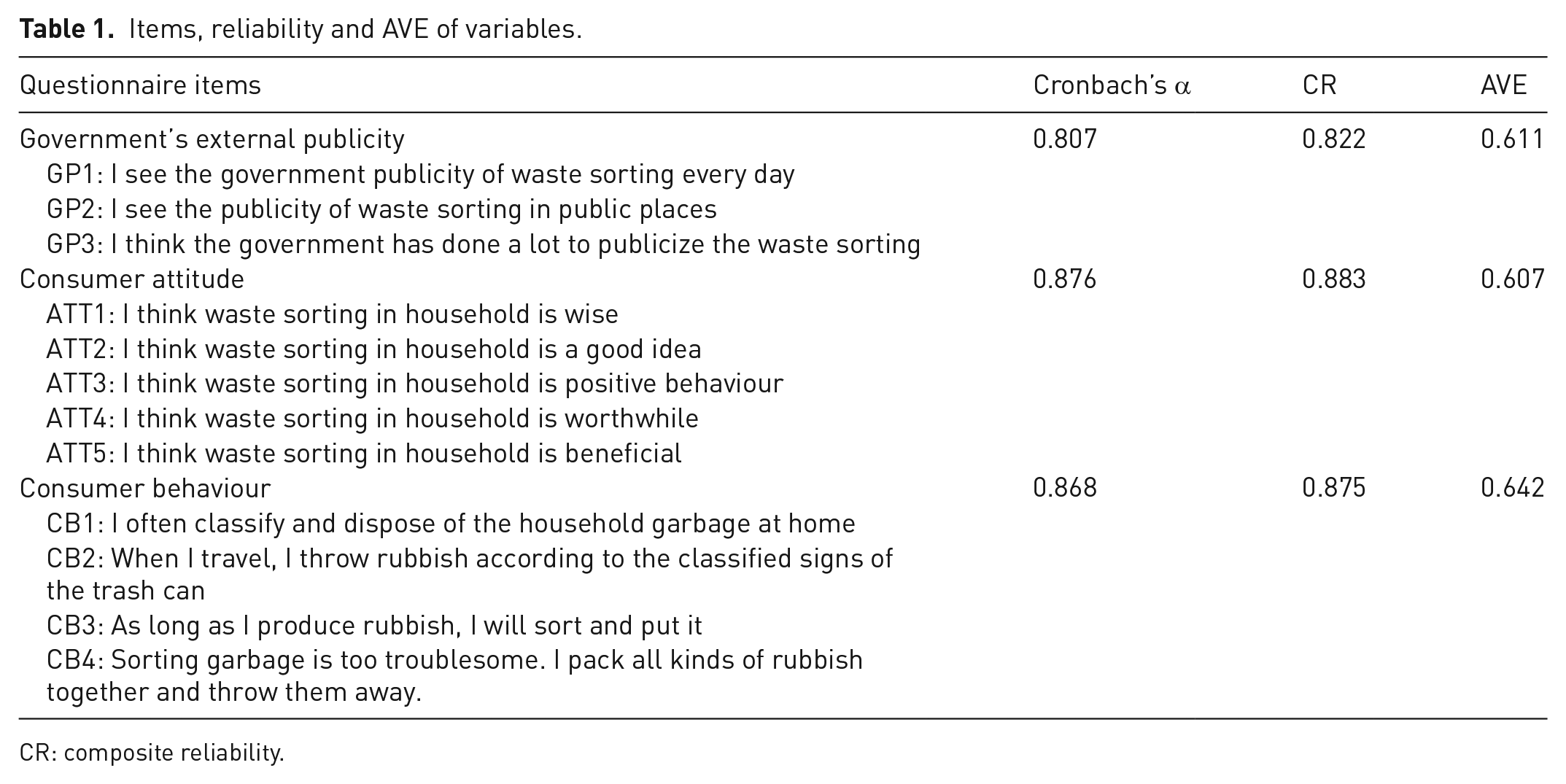
The government external publicity variable included three questions, which were revised from previous research (Gao et al., 2017; Tian et al., 2019). Consumers’ attitude towards waste sorting was measured by five items, which was revised from previous studies (Tian et al., 2019; Yang et al., 2018). The test results of the reliability and validity of the items for the three constructs are shown in Table 1.
Items, reliability and AVE of variables.
CR: composite reliability.
According to the Cronbach’s ɑ coefficient, the government’s external publicity is 0.807, consumer attitude is 0.876, and consumer behaviour is 0.868. The Cronbach’s ɑ coefficient of these variables are all greater than 0.8. According to the literature, the threshold of Cronbach’s ɑ is 0.7 (Mackenzie et al., 2011), meaning the constructs of these three variables have high internal consistency.
The composite reliability (CR) values for each variable in the questionnaire are as follows: government’s external publicity, 0.822; consumer attitude, 0.883 and consumer behaviour, 0.875. The CR value of the three variables is greater than the threshold value of 0.7 (Mackenzie et al., 2011), indicating that the questionnaire is highly reliable. Another way to judge the validity of the questionnaire is from the Ave value. The Ave value of the three variables are 0.611, 0.607 and 0.642 for government’s external publicity, consumer attitude and consumer behaviour, respectively. The three variables all exceed the threshold value of 0.5 (Fornell and Larcker, 1981), which shows that the questionnaire has high validity and is suitable to be used in the study.
The other three variables in the conceptual model are the consumers’ internal motivation for waste sorting, personal value and personal benefit. For the measurement of the variable of consumers’ internal motivation, three possible motivation choices for waste sorting are listed in the questionnaire: firstly, waste sorting is meaningless and therefore needs to be enforced; secondly, waste sorting is meaningful, but it is too troublesome and therefore needs to be enforced and thirdly, waste sorting is very important and can be carried out voluntarily. Looking at the above three levels of internal motivation of consumers regarding waste sorting, the increasing motivation comes from the driving role of the consumers themselves. The measurement of consumer personal value is based on the Schwartz Theory of Basic Values (Schwartz, 2007, 2012), which requires the subjects to choose seven of the 10 values, which are most important to them and then judge whether the consumer’s personal values represent self-enhancement or self-transcendence. In this study, the measurement of personal benefit variables is set as two categories, namely material benefits and spiritual benefits of waste sorting.
Results and discussion
Main effect of consumers’ internal motivation and government’s external publicity on consumer behaviour
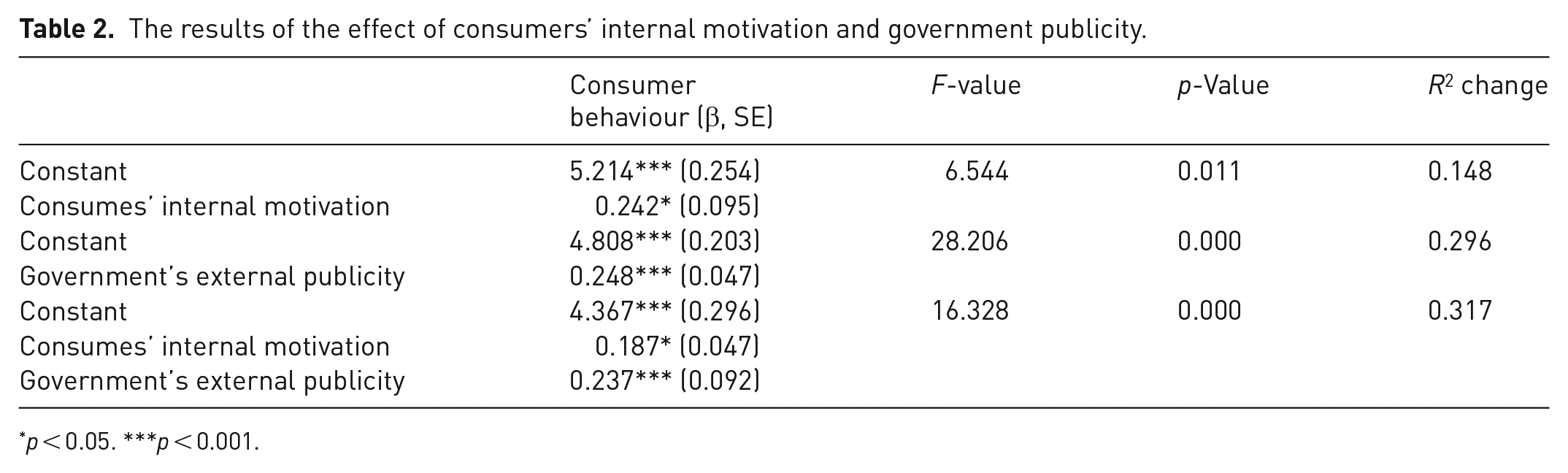
This article used regression analysis by SPSS version 22.0 (IBM Corporation, New York, USA) to test the impact of the consumers’ internal motivation for waste sorting and the government’s external publicity on consumer behaviour. The test results are shown in Table 2.
The results of the effect of consumers’ internal motivation and government publicity.
p < 0.05. ***p < 0.001.
The test results of variables show, first of all, the effect of consumers’ internal motivation for waste sorting on consumer behaviour, analysed separately, giving a significant effect (β = 0.242, p = 0.011<0.05). A separate analysis of the impact of the government’s external publicity on consumer behaviour revealed a positive and significant effect (β = 0.248, p = 0.000<0.001). When consumer internal motivation and government external publicity were included in the regression equation, the results were still significant. The effect of consumers’ internal motivation for waste sorting on consumer behaviour was significant at a 5% level (β = 0.187, p = 0.043<0.05), whereas the effect of the government’s external publicity on consumer behaviour was significant at 1% level (β = 0.237, p = 0.000<0.001).
Mediating effect of consumer attitude
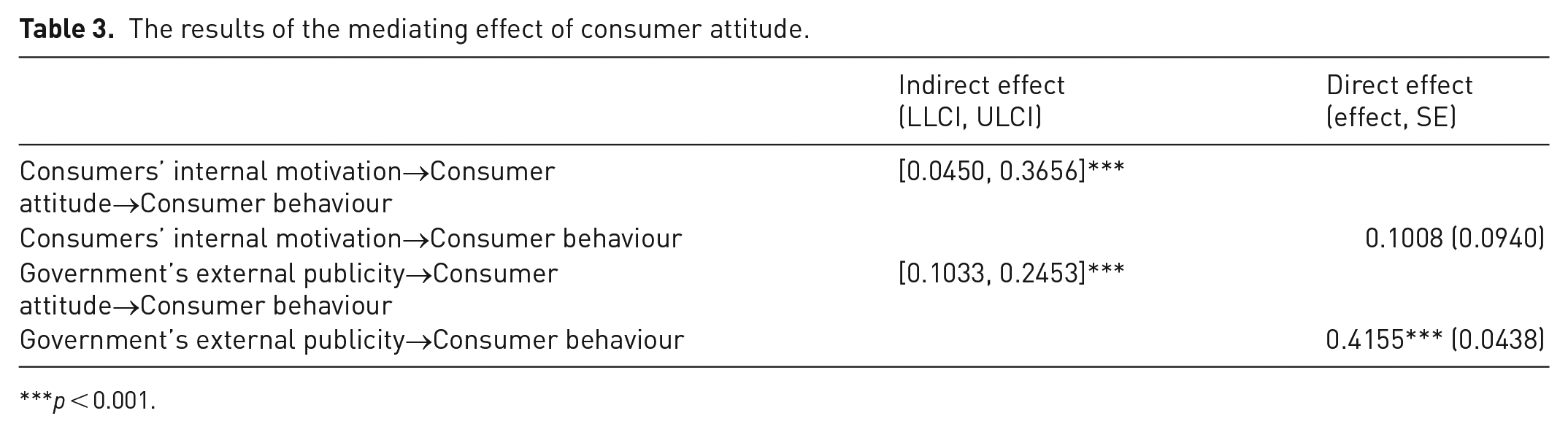
This paper used model 4 with Hayes’ PROCESS macro in SPSS 22.0 to test the mediating role of consumer attitudes. The test results are shown in Table 3.
The results of the mediating effect of consumer attitude.
p < 0.001.
According to the discriminant principle of Hayes on the mediating effect (Hayes, 2017), this article first analysed the mediating effect of consumer attitudes between consumers’ internal motivation for waste sorting and the consumer’s behaviour. The interval between LLCI and ULCI of indirect effect was [0.0450, 0.3656], respectively, excluding 0, indicating that the mediating effect of consumer attitude was significant. However, the direct effect was not significant. This shows that consumer attitudes play a complete mediating role between consumers’ internal motivation for waste sorting and consumer behaviour. The test results support hypothesis H3a. Next, the mediating effect of consumer attitudes between the government’s external publicity and consumer behaviour was analysed. The interval of indirect effect was [0.1033, 0.2453], excluding 0, indicating that the mediating effect of consumer attitude was significant. The value of direct effect was 0.4155 with a t-value of 9.4901, indicating that the direct effect was also significant. This shows that consumer attitudes play a complementary mediating role between the government’s external publicity and consumer behaviour.
Moderating effect of personal values
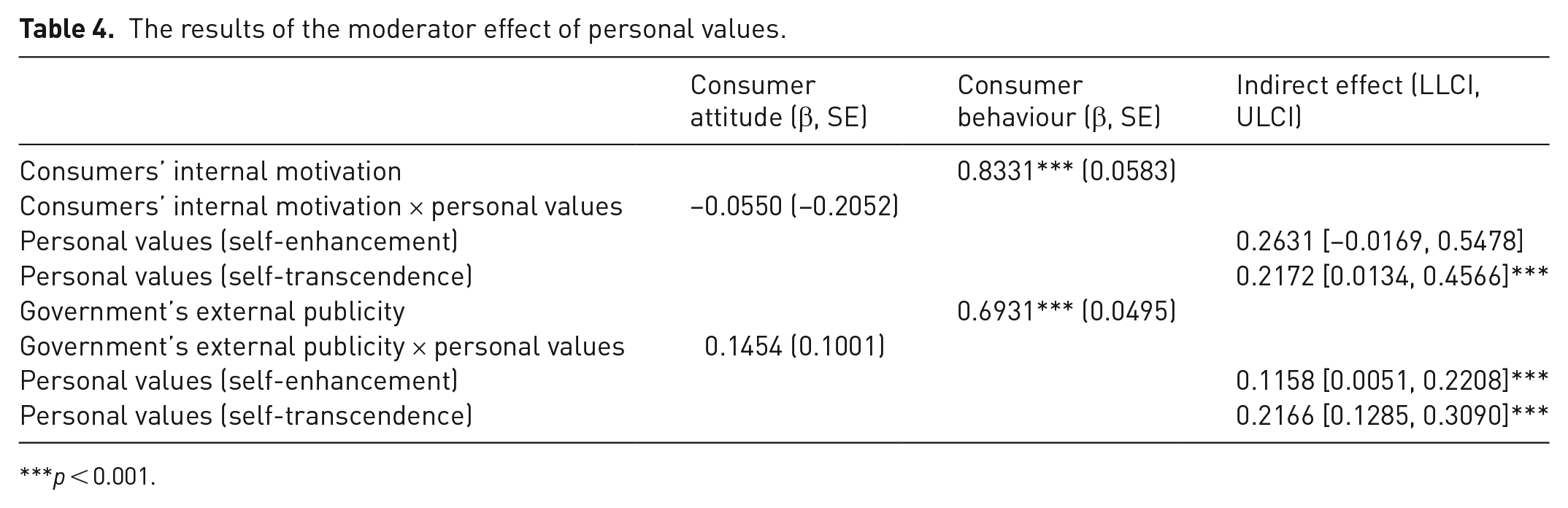
With regard to the test of the moderating effect, this study used model 7 with Hayes’ PROCESS macro in SPSS 22.0 to test the moderating effect of personal values between independent variables and mediating variables. The test results are shown in Table 4.
The results of the moderator effect of personal values.
p < 0.001.
According to the discriminant rules of Hayes, Wen and Chen on the moderated mediation effect (Chen et al., 2013; Hayes, 2017; Wen and Ye, 2014), this study analysed the test results of the personal values and personal benefits.
First, the moderating effect of personal values on the first half of the model was tested. The results show that although the interaction between consumers’ internal motivation and personal values is not significant (β = −0.0550, SE = −0.2052, p = 0.7888>0.05), the direct effect of consumers’ internal motivation on consumer behaviour was significant (β = 0.8331, SE = 0.0583, p = 0.000<0.001). The LLCI and ULCI interval of self-transcendental personal values was [0.0134, 0.4566], excluding 0, indicating that the moderator effect is significant. Similarly, the results show that although the interaction between the government’s external publicity and personal values was not significant (β = 0.1454, SE = 0.1001, p = 0.1281>0.05), the direct effect of the government’s external publicity on consumer behaviour is significant (β = 0.6931, SE = 0.0495, p = 0.000<0.001). The LLCI and ULCI interval of self-transcendental was [0.1285, 0.3090] and self-enhancement was [0.0051, 0.2208], not including 0, indicating that the moderator effect is significant.
Moderating effect of personal benefits
With regard to the test of the moderating effect, this study used model 14 with Hayes’ PROCESS macro in SPSS 22.0 to test the moderating effect of personal benefits between mediating variables and dependent variables. The moderating effect of personal benefits on consumers’ attitudes and consumers’ behaviour has been tested. The test results are shown in Table 5.
The results of the moderator effect of personal benefits.
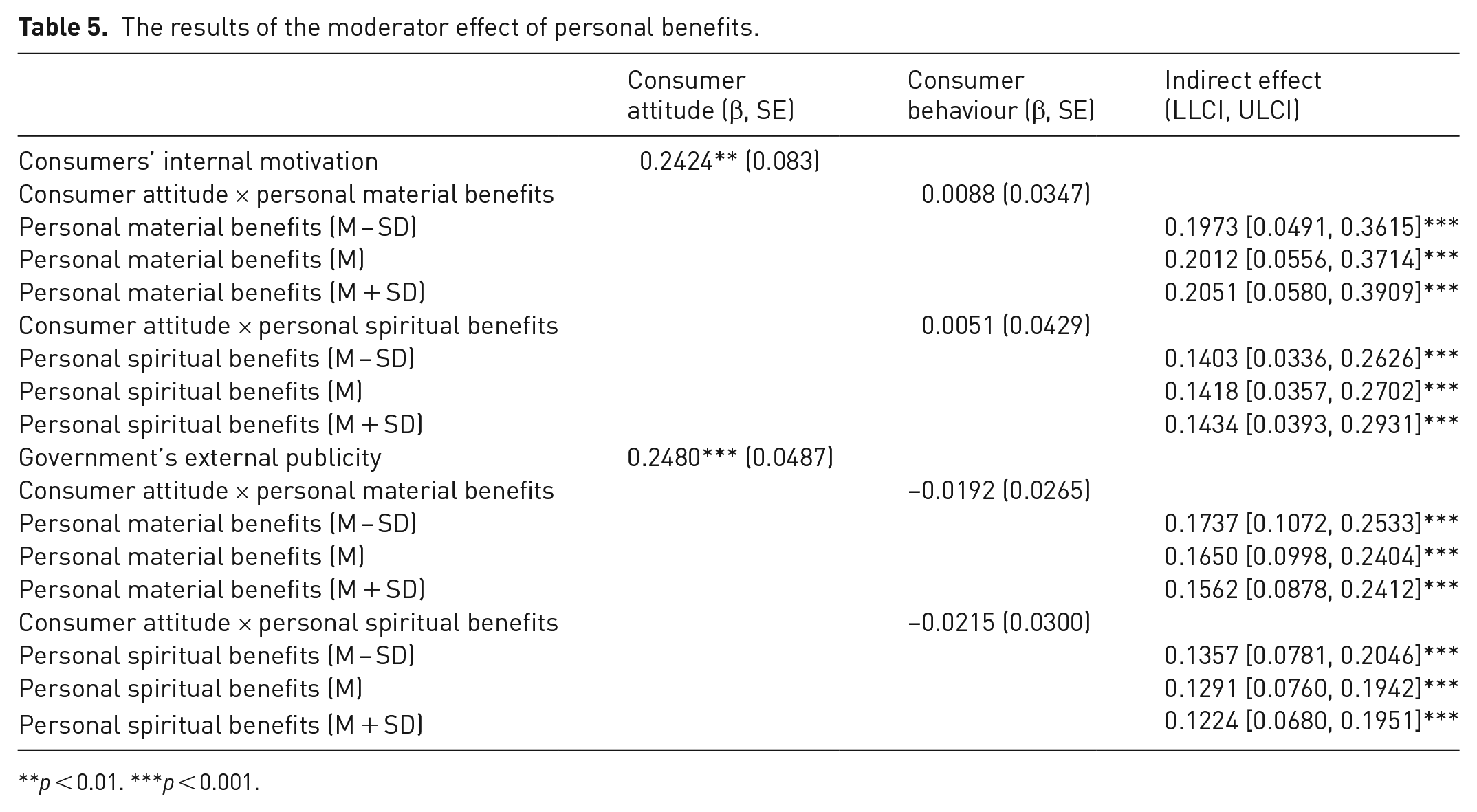
p < 0.01. ***p < 0.001.
We examined the moderating effect of personal benefits on the second half of the model. Here, personal benefits were divided into personal material benefits and personal spiritual benefits. The LLCI and ULCI ranges of all personal material benefit levels do not include 0. The ranges of LLCI and ULCI of personal material benefits at low, medium and high levels were [0.0491, 0.3615], [0.0556, 0.3714] and [0.0393, 0.2931], respectively, indicating that the moderator effect was significant. The moderator effect was 0.1973, 0.2012 and 0.2051, respectively, which gradually became larger. This shows that the higher the personal material benefit, the greater the predictive effect of consumer attitudes on consumer behaviour. The LLCI and ULCI ranges of all personal spiritual benefit levels do not include 0. The ranges of LLCI and ULCI of personal spiritual benefits at low, medium, and high levels were [0.0336, 0.2626], [0.0357, 0.2702] and [0.0393, 0.2931], respectively, indicating that the moderator effect of personal spiritual benefit was significant.
Similar results also appeared in the test of the moderator effect of personal benefits on the mediation effect of consumer attitude between the government’s external publicity and consumer behaviour. The difference is that with the increase in personal material benefit and personal spiritual benefit, the prediction effect of the government’s external publicity on consumer behaviour through consumer attitude decreased.
Conclusions
The difference between this study and other studies is that this paper studies consumers’ attitudes and behaviour towards waste sorting policy by considering two factors, consumers’ internal motivation and the government’s external publicity. Existing studies pay more attention to the technical and consumer aspects of garbage sorting (Botti et al., 2020; Shapiro-Bengtsen et al., 2020; Tian et al., 2019; Wang et al., 2020). From the perspective of consumer psychology, this study analysed the effect of consumers’ internal motivation and the government’s external publicity on waste sorting management; the theoretical conclusions are as follows.
Firstly, consumers’ internal motivation significantly affected their behaviour of waste sorting. When consumers think that the motivation for implementing waste sorting is to protect the environment, they have a more positive behaviour. Although attribution theory has stimulated extensive research on consumer behaviour in previous marketing research and psychological research (Kelley, 1967, 1987; Muschetto and Siegel, 2019; Weiner, 1985), there is still a lack of research on consumer attribution in the field of circular economy and garbage management; this is one of the theoretical contributions of this article. This study also analyses the impact of external publicity of the government on consumers. The wide scope and intensity of the government’s external publicity on waste sorting results in a positive consumer’s behaviour.
Secondly, the mediating effect of consumer attitudes was verified. Consumer attitude played a complete mediating role between consumers’ internal motivation and consumer behaviour. Between the government’s external publicity and consumer behaviour, consumer attitude played a complementary mediating role. In other words, the internal factor of motivation of consumer regarding waste sorting and the external factor of government publicity both affect consumers’ waste sorting behaviour through the consumer’s attitude. The positive effect of consumer attitude on behaviour intention is similar to that of other studies (Wang et al., 2020).
Finally, the moderating effect of consumers’ personal values and personal benefits on the mediating role was tested. For consumers with self-transcendence values, positive motivation of waste sorting and the government’s external publicity had a greater positive impact on their attitudes. Considering the influence of consumers’ attitudes towards their behaviour regarding waste sorting, personal material benefits played a positive role in moderating the positive impact of consumer attitudes on their behaviour regarding waste sorting; that is to say, the greater the material benefits consumers received from waste sorting, the more it promoted a positive attitude to consumer behaviour. Consumers’ spiritual benefits also moderated the positive impact of consumer attitudes on their behaviour regarding waste sorting. The difference is that the higher the spiritual reward for consumers’ waste sorting, the weaker the predictive effect of consumers’ attitudes towards waste sorting on waste sorting behaviour.
Management implications
According to the results, this study puts forward the following suggestions. Firstly, consumers should be guided to correctly understand the waste sorting policy to ensure they understand the environmental benefits of waste sorting. When consumers accept and understand the policy of waste sorting, they will be able to implement waste sorting actively. Secondly, extensive publicity by the government will help to promote positive consumer behaviour. Especially in the initial stage of the implementation of the waste sorting policy, external publicity from the government plays an important role in the effective implementation of the policy. Thirdly, consumer attitudes are the key to the effective implementation of waste sorting; therefore, the government, enterprises, schools and other institutions should adopt various methods to instil positive consumer attitudes towards waste sorting. Finally, more concepts of self-transcendence values, such as benevolence and universalism, can be added to the waste sorting publicity to stimulate consumers’ self-transcendence values. Throughout the process, some incentive policies can also be added to give certain material rewards to motivate consumers to classify their waste.
There were some limitations. Four areas with different degrees of waste classification in China were considered. Although these data collection methods and quantities meet the statistical requirements of large sample data, the samples of this study were from four regions in China, which is relatively limited. The number and area of samples can be expanded in future studies to improve the accuracy of the results.
Footnotes
Acknowledgements
The authors would like to thank Dr. Michael Song from the School of Economics and Management, Xi’an Technological University, Xi’an, China, for his suggestion.
Declaration of conflicting interests
The authors declared no potential conflicts of interest with respect to the research, authorship, and/or publication of this article.
Funding
The authors disclosed receipt of the following financial support for the research, authorship, and/or publication of this article: This research was funded by the National Natural Science Foundation of China (No. 71502133, 71702142 and 71804119), the Shaanxi Provincial Social Science Foundation of China (No. 2019S007), and the Soft Science Project of Science and Technology Bureau of Weiyang District, Xi’an City, Shaanxi Province (No. 201945).
