







Abstract
In urban informal economies, waste-pickers increasingly face threat to their livelihoods due to the rapid emergence of formal systems of waste collection and lack of adequate public policies for their welfare. In this context, the study explores livelihood conditions of domestic waste-pickers and their occupational and educational mobility in Chandigarh, which is often referred as one of most well-planned cities of India. Using a semi-structured schedule, a field-based survey of the waste-pickers brings out that waste-pickers are the migrant workers from adjoining states and work as waste-pickers mainly due to non-availability of alternative employment opportunities. Employment in waste-picking is characterized by informal service charge fixation purely through interaction between house-owners and waste-pickers, where their low bargaining power leads to a surprisingly low level of income with significant variations due to gender. Child labour, even though disguised, also tends to exist. The study reveals unsafe working conditions, awful health conditions and unpleasant living conditions of the waste-pickers along with trivial upward educational mobility and no upward occupational mobility. The analysis presents a classic case of failure of both market and state in delivering optimum economic welfare to waste-pickers even in case of well-planned and highly urbanized city such as Chandigarh of India and demands immediate public policy intervention.
Keywords
Introduction
Globally, municipal solid waste (MSW) has been rising due to fast-growing economies and urbanization (Kaushal et al., 2012). The increasing volume of waste generated world over is one of the world’s most visible environmental issues. There is around 1.3 billion tons of municipal waste each year which is expected to increase to 2.2 billion by 2025 and 13.1 billion by 2050 (Baker et al., 2004; Hoornweg and Bhada-Tata, 2012). In this context, waste-pickers have an integral role to play in the circular economy and in the solid waste management in developing economies (Velis et al., 2009). Waste-pickers remove waste from urban areas that are not served by municipal waste collection and, thus, play a vital role in managing MSW system in urban areas as approximately 70–80% of the recyclable materials are collected and classified by waste-pickers (Chen et al., 2018; Sasaki and Araki, 2014). According to the World Bank, 1–2% of the world population subsists on waste-picking (Chaturvedi, 2010). Despite the significant role of waste-pickers in municipal waste management, the contribution of waste-pickers is unrecognized, they face discrimination and they are not entitled to any government schemes (Reddy, 2018; Sambyal, 2018).
In most of the developing countries including India, a larger part of the economic activities in the urban areas are largely driven by the informal sector, which is considered important for employment generation and egalitarian distribution of income (ILO, 2018). More than 2 billion workers, constituting about 60% of the workers worldwide, are informally employed. Out of this, developing countries employ about 90%, while developed countries account for only 18% (ILO, 2020). Although the wages in the formal sector are set higher than market-clearing prices, but forced by unemployment and for sustaining their livelihoods, the workers enter into an informal sector, which is considered as a disadvantaged sector (Fields, 1990; Stiglitz, 1976). Additionally, informal employments lack legal regulations leading to unskilled workforce and unpleasant working conditions, and without any social security benefits, and thus adversely affect health of the workers and their intergenerational educational/occupational mobility (Singh et al., 2020).
In the cities of the developing countries, informal waste management ecosystem continues to drive the recovery of post-consumer wastes (Hande, 2019). Despite the importance of the work done by the informal waste industry, it is usually overlooked in most developing nations, with governments seldom supporting and sometimes even discouraging it (Sembiring and Nitivattananon, 2010). Due to rapid urbanization and industrialization causing increased solid waste generation in the Global South, it is imperative to provide a waste management system which is efficient and effective (Velis, 2017).
Informal waste management and role of waste-pickers in the Indian context
India which is the second-most populated country, has witnessed tremendous urbanization and industrialization over the past few decades. It has aimed to become an industrialized nation by the year 2020. India with a population of over 1.2 billion constitutes 17.5% of the world’s population with its 31.16% of population residing in urban areas. The continuous population growth and migration of the people from rural to urban areas have led to massive increase in waste generation (Srivastava et al., 2015). As far as informality is concerned, India is not an exception as its informal sector employs around 90.7% (84.4% unorganized and 5.2% organized) of the workforce and contributes about 52.4% in gross value added in 2017–2018 (Government of India, 2019). Within the informal sector, there exist huge variations in employment activities as some activities are less rewarding and provide less scope of occupational mobility vis-à-vis other employment activities (Singh and Singh, 2011).
India produces about 2.6 million tons of waste each year, making waste one of its fastest growing physical parts (Harriss-White, 2020). India, like other developing countries, has both formal and informal waste management systems, even though, the informal waste collection and its recycling networks are considered as backward, unhygienic and incompatible with the emergence of formal systems of waste collection and management (Masood and Barlow, 2013). Informal waste collection has a great contribution in waste management system, as well as in the urban circular economy of India. Within its informal waste management, waste-picking is one such employment in which a significant proportion of urban poor are employed and drive their livelihoods through waste collection and its recycling (Hayami et al., 2006; Moreno-Sánchez and Maldonado, 2006).
India spends more than 90% of its budget on waste collection, but waste collection efficiency is poor at 70–72% (Srivastava et al., 2015). Municipalities draw direct economic benefit as a large chuck of urban waste is removed from formal system by informal sector (Medina, 2000). In this way, informal solid waste management is also an active and effective way to recover and valorize the resources vis-à-vis the formal one (Scheinberg et al., 2010). In countries such as India, expenditure on urban waste management would be enormous in the absence of informal waste collection system driven by waste-pickers. These waste-pickers represent 1% of the urban workforce in India (Raveendran and Vanek, 2020). The projected number of waste-pickers employed in India’s waste management system ranges from 1.5 to 4 million (Dandapani, 2017). Presently, waste-pickers, being key players, have a crucial role in urban solid waste management, and their existence exemplifies the difficulty of integrating the waste-picking activity in the formal waste management systems, which is primarily due to issues relating to the scale of production and logistical problems (Dias, 2012, 2016; Gonçalves-Dias, 2009). Therefore, problems faced by waste-pickers must be analysed for working out specific solutions to ensure their livelihood sustainability (Singh et al., 2018).
Objective of the study
Despite growing recognition of waste-pickers’ contributions to local economies, public health and safety and environmental sustainability, they frequently face low social status, deplorable living and working conditions and little support from local governments (WIEGO, 2019). In urban areas, waste-picking is one of the several informal employment generation activities that aggravate various health and occupational risks among the workers (Gutberlet et al., 2013; Ferronato and Torretta, 2019; Pathan, 2019; Singh et al., 2018). Therefore, such vulnerabilities of informality in the urban economy, especially in the case of waste-picking occupation, requires attention to deal with in real time, and the present study has attempted to explore these vulnerabilities by the taking the case of a well-planned Chandigarh city of India. Appropriate policy directions are also provided in the study with regard to mitigating the living, working and health vulnerabilities associated with this informal occupation.
Chandigarh, known as the city beautiful, was designed as India’s first modern and planned city by French Architect Le Corbusier (Datta, 2006). It is also termed as one of the cleanest cities and torchbearers of the smart city initiative of the Government of India. The pattern of urban development in Chandigarh is considered as one of the ideal solutions to India’s messy urbanization (Biswas, 2019). In 2012, JnNURM (The Jawaharlal Nehru National Urban Renewal Mission) 1 also ranked Chandigarh as the first city to be ‘good in sanitation’ due to its effective solid waste management developed over time (Gupta and Gupta, 2015). However, the role of informal workers such as waste-pickers in planned urban development of a well-planned city such as Chandigarh is often ignored in policy circles in the absence of enough evidences in existing literature. Rather, modernization of urban waste management is attempted to dispossess the workers from their livelihoods due to the rapid emergence of formal systems of waste collections through the entry of private companies and contractors. In this context, the focus of the study on a planned city such as Chandigarh is, therefore, to explore socioeconomic and employment status, occupational-educational immobility and the working, living and health conditions of waste-pickers. The study is significant in drawing the role of public policy in ensuring sustainable livelihoods to waste-pickers, particularly in well-planned and developed cities of India such as Chandigarh. Additionally, the study also brings out a reality check of the National Smart City Initiative (NSSI 2 ) of the Government of India, which was launched on 25 June 2015 with objectives of providing a decent quality of life to its citizens, a clean and sustainable environment and application of ‘Smart’ Solutions.
Material and methods
The present study is based on a socioeconomic field survey of the domestic waste-pickers in Chandigarh, India. MSW includes domestic solid and urban sanitation waste. However, the present study covers workers, who collect domestic solid waste materials from the urban families of Chandigarh and, subsequently, sort, recycle, sell and transport them to Primary Collection Centres, which are also referred to as Sahaj Safai Kendras of Chandigarh Municipal Corporation. Urban sanitation waste consists of materials thrown out of the cities/towns by their sewerage system and it does not involve home collection by the workers, even though many workers are involved in construction and maintenance of these system. Since workers involved in urban sanitation waste management are employed on a regular or contract basis by municipalities, they are excluded from this study because of their different nature of employment than domestic waste-pickers, who are self-employed workers and do not come under organized employment provided by any government or private establishment.
The study is carried out with a field survey of 100 domestic waste-pickers from various locations of Chandigarh city. A sample of 100 domestic waste-pickers is justified given the fact that they are the minority group in the city population, even though they are the majority of workers involved in urban waste management in Chandigarh. Out of the surveyed workers, 70% are men and 30% are women. The men–women ratio is also verified from the office-bearers of the waste-picker Labour Union in Chandigarh. Since the majority of the waste-pickers live in slum areas of Sector-25, Sector-56 and Maloya village of Chandigarh, these areas are selected for the survey. Chandigarh Administration has taken several steps to remove these slum areas from the city by providing free housing to the people living there. As result, slum areas reduced in size but could not be removed absolutely. Thus, existence of slum area at present questions the effectiveness of the public policy in Chandigarh, which requires separate detailed analysis for deeper understanding of slum problem and for drawing its real-time solution. In this study, issues relating to workers of domestic waste-picking occupation are taken, who are just a small portion of slum living population.
A pre-tested semi-structured schedule is used for interviewing the workers. The schedule broadly consists of nine broad sections that include 36 broad questions which has yielded quantitative information for analysis. Besides, qualitative information is collected using open-ended questions which complemented quantitative information. The nine broad sections of the schedule are: demographics, income level, wage fixation mechanism, reasons for opting the occupation, housing conditions, level of awareness, health status, intergenerational educational mobility and intergenerational occupational mobility. To collect the required data about above indicators personal face-to-face interviews of the domestic waste-pickers are conducted in March 2019. Quantitative information gathered from the survey has been processed, organized and analysed using simple statistical tools such as averages and percentages in Microsoft Office Excel, 2007 software. Furthermore, the information related to economic variable is collected in Indian Rupees and subsequently also converted into US dollar on the basis of prevailing exchange rate (1$ = Rs. 69.3798) on 31 March 2019.
Results and discussion
Demographic profile
Depicting the demographic features of surveyed waste-pickers, Table 1 exhibits that 60% of workers (64% men and 50% women) belong to a relatively younger age group of 18–39 years. All the workers are Hindus, except two Christians, and belong to the scheduled caste, particularly from the Valmiki community, which is considered at the lowest strata among other castes in Indian society. Almost half of the workers are illiterate (49%), while the rest of them possess either primary (24%) or secondary (27%) level of education. Being a typical feature of third-world economies, gender inequality in educational status exists at a large scale as 65% of the women workers are found to be illiterate as compared to 45% of the men workers. Primary level educational attainment has also shown a similar trend. Notably, none out of the workers possess a higher educational status. The majority of those who are educated at any level are found to have their schooling from government schools. Since all the workers are devoid of any skills and higher education, it creates obstacles in their vertical occupational mobility. Furthermore, almost all the workers are migrated from neighbouring states such as Haryana, Uttar Pradesh, Punjab, etc. There is only one local worker. Moreover, 95% of the workers are from a rural background, while only 5% represent urban areas. In a nutshell, the findings establish that the workers, who are involved in the occupation of domestic waste-picking, are largely illiterate and unemployed and have migrated from rural areas of neighbouring states for seeking employment. These findings are also consistent with Singh and Singh (2011), who argued that social malice of the rural setup, where workers belonging to lower castes have no chance of escapism. Lack of employment opportunities and/or availability of seasonal work in rural areas forces them to migrate to urban areas and adopt low-paid occupations such as waste-picking, car washing, gardening, domestic works, etc. Thus, it is established that waste picking as a source of employment has been adopted by the workers in Chandigarh city as a last resort, a phenomenon which is well explained by traditional dual labour market theories.
Demographic features of surveyed domestic waste-pickers (in %).
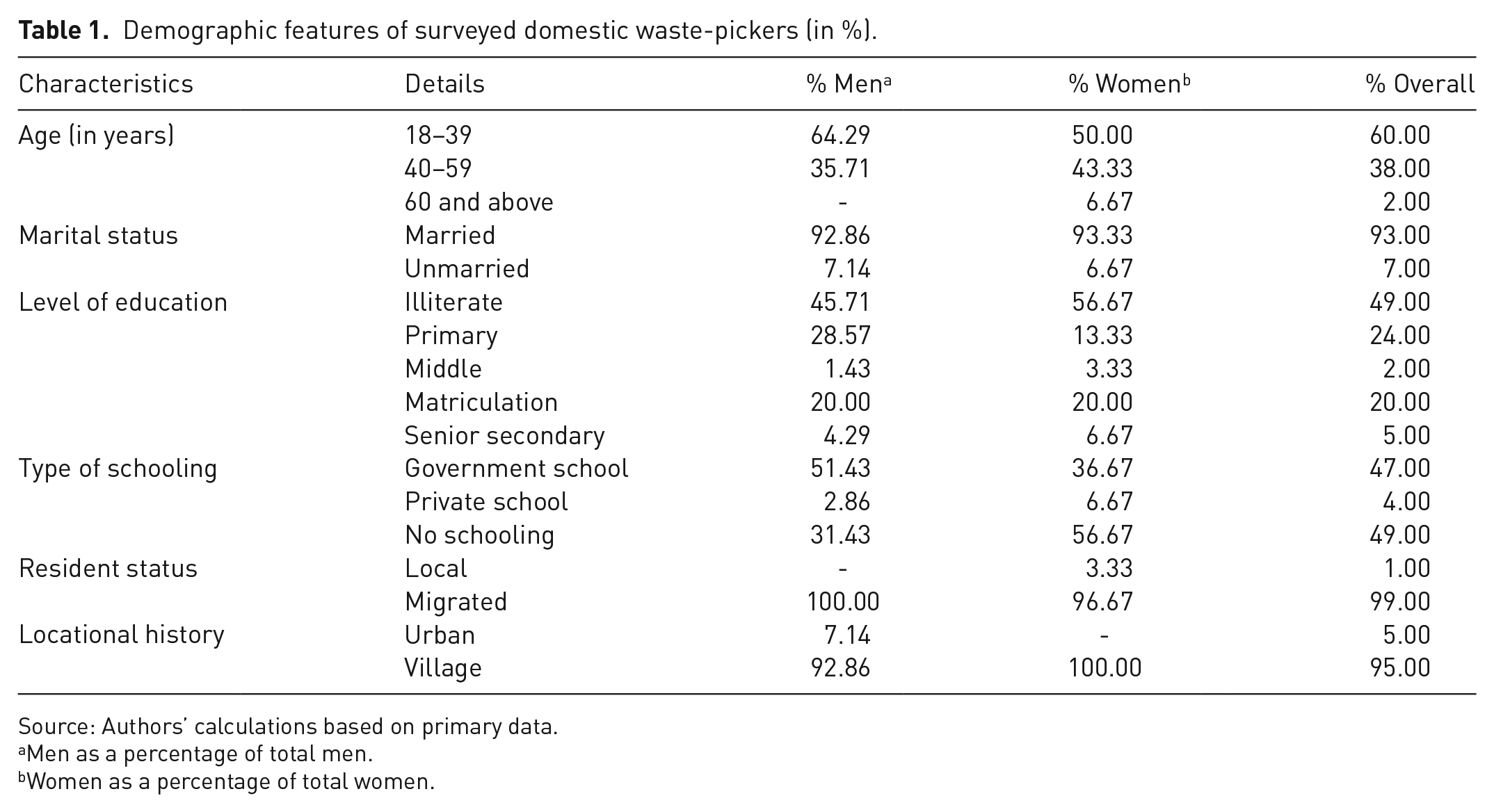
Source: Authors’ calculations based on primary data.
Men as a percentage of total men.
Women as a percentage of total women.
Income level and occupational dynamics
The data presented in Table 2 reveals that the average income level of surveyed waste-pickers is very low at INR 10,516 (US$ 151.58) per month. The average income from the allied activities is also found to be meager (INR 924/US$13.32 per month). Such low-income level has implications for their housing conditions, intergenerational educational as well as occupational mobility and health status. Recent studies by Gupta and Gupta (2015), Dandapani (2017), Bhaduri (2018) and Ocean Conservancy (2019) also corroborate these findings of the study. There also exist differences in the earning levels of the waste-pickers. There are 94% of the workers with income less than INR 20,000/US$ 288.27 per month and 58% with less than INR 10,000/US$ 144.13 per month, while 21% earn income between Rs. 2000 and 5000 (US$ 28.83–72.07) per month only.
Income level and service charges of surveyed domestic waste-pickers.
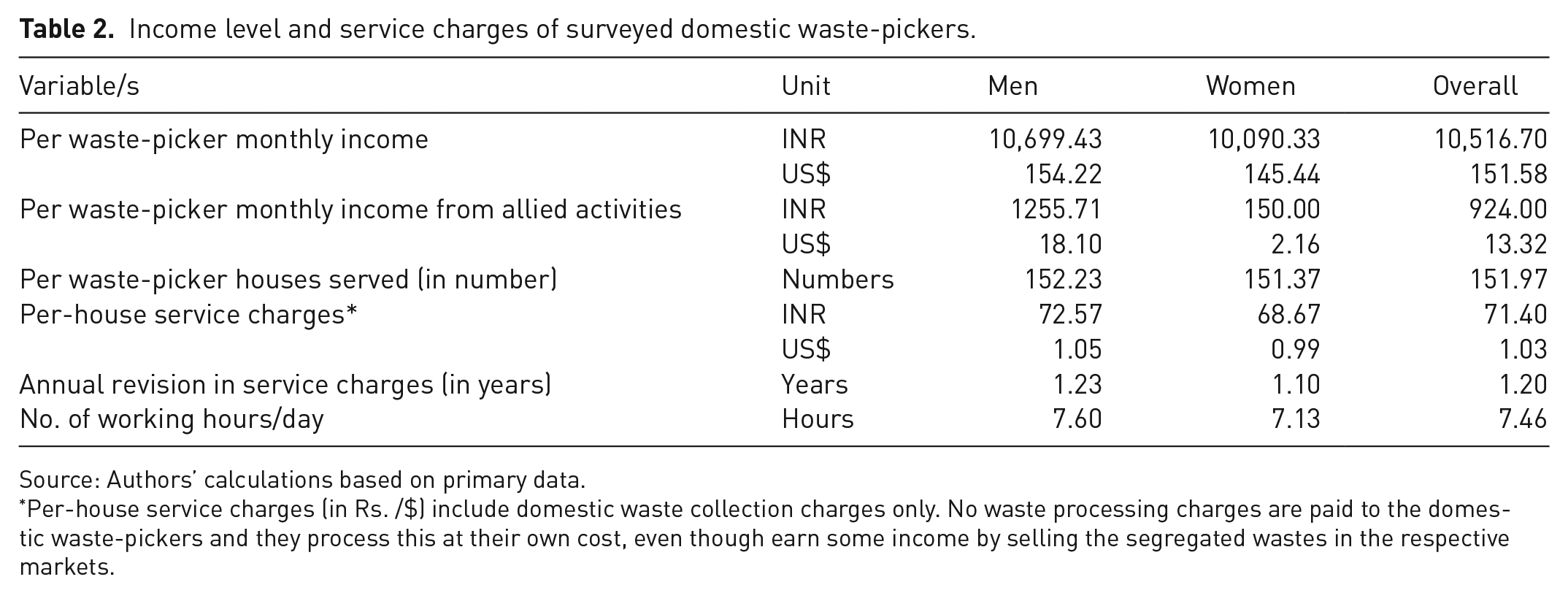
Source: Authors’ calculations based on primary data.
Per-house service charges (in Rs. /$) include domestic waste collection charges only. No waste processing charges are paid to the domestic waste-pickers and they process this at their own cost, even though earn some income by selling the segregated wastes in the respective markets.
Furthermore, only 6% of the workers are able to earn more than INR 20,000/US$ 288.27 per month. The findings of the study also manifest the existence of gender bias in monthly income, number of working hours per day and monthly service charges. The average monthly income of men workers is Rs. 10,700 (US$ 154.22), which is considerably higher than that of women workers (INR 10,090/US$ 145.43 per month) even though both, on average, serve an almost equal number of households. Such differences in the income levels of men and women waste-pickers have also been reported by Kristanto et al. (2022) in the case of Indonesia. Furthermore, the average number of working hours and per-house service charges are also higher among men workers (7.60 hours and INR 72.57/US$ 1.05 respectively) as compared to that of women workers (7.13 hours and INR 68.67/US$ 0.99, respectively). It is also worth mentioning that the annual revision in service charges is only INR 10.00/US$ 0.14 in case of most of the waste-pickers and sometimes, the revision takes place after 2 years. Many a times, the workers have to face demeaning language and abuses from their customers when they demand an annual increase in service charges. Due to low bargaining power and prevailing unemployment scenario, they are compelled to bear low service charge revisions along with demeaning language and caste-related abuses.
Since waste-picking is an informal activity, the service charges fixation mechanism of the waste-picking occupation continues to be informal. It is largely determined by the interaction and negotiation between the house-owner and waste-picker. Only 49% of the waste-pickers can self-determine the service charges, while 29% opine that the service charges are fixed by the house-owners. The union of waste-pickers has intervened for 18% of the workers only. In this informal arrangement, waste-pickers remain at a disadvantage due to a lack of information about minimum wage admissible by law, competition among waste-pickers and greater bargaining power of the house-owners. Henceforth, results show a complete absence of a proper mechanism of determining service charges, which can protect the interests of waste-pickers. Almost 50% of men and 66.67% of women workers reported that they cannot do this work alone and have to take the help of at least one family member. Although only 18% of the waste-pickers reported that they have to take the assistance of their children (Table 3). Hence, the survey shows the prevalence of ‘disguised child labour’ in the occupation of waste-picking. However, the children of the workers do not confirm it during the survey and report that they provide help to their family members only in case of emergency.
Distribution of the waste-pickers by fixation of service charges and assistance received from the family.
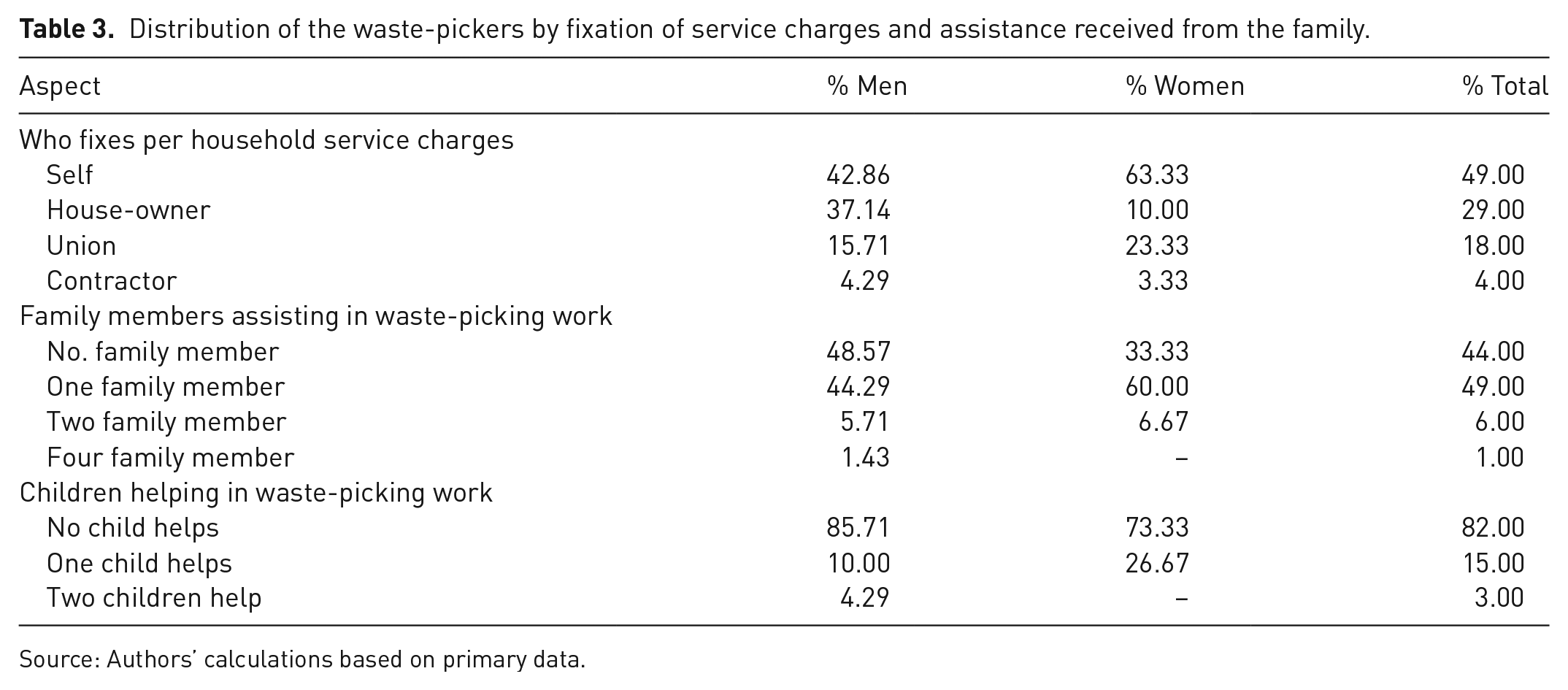
Source: Authors’ calculations based on primary data.
Table 4 shows that 88% of the waste-pickers have chosen this occupation due to being unemployed, 8% joined willingly and 4% have to choose waste-picking under family pressure. Notably, all the respondents do not express their satisfaction with this occupation, but they confess that they have no other option due to a lack of skills for getting other jobs. Surveyed workers have joined this occupation through their family members (39%), relatives (30%) and friends (22%). Only one worker has entered into waste-picking through the contractor. Thus, data also establish the hereditary nature of the profession and strong kinship ties as the main source for entering in the profession of waste-picking. Out of the total workers surveyed, 53% have never tried any other job. However, 47% have tried other works but then shifted to this work afterward due to the seasonal nature of their previous work and low wages being available in rural areas (Table 4). In addition, some workers reported availability of jobs under the Mahatma Gandhi National Rural Employment Guarantee Act 2005, or MGNREGA, which used to be known as the National Rural Employment Guarantee Act or NREGA. The ‘right to work’ is provided by this law and social security measure in the rural areas of India. Under this program, at least 100 days of wage employment are provided to at least one member of each rural household whose members do unskilled manual labour on a voluntary basis each year. Some surveyed workers revealed the MGNREGA provides them only 100 days of employment in rural areas, which is not sufficient to manage their livelihood expenses comfortably. Consequently, they do not want to shift to this low-income employment and are still working as domestic waste-pickers in the urban localities of Chandigarh.
Distribution of the workers by reasons for and sources of entering into the occupation of domestic waste-picking (%).
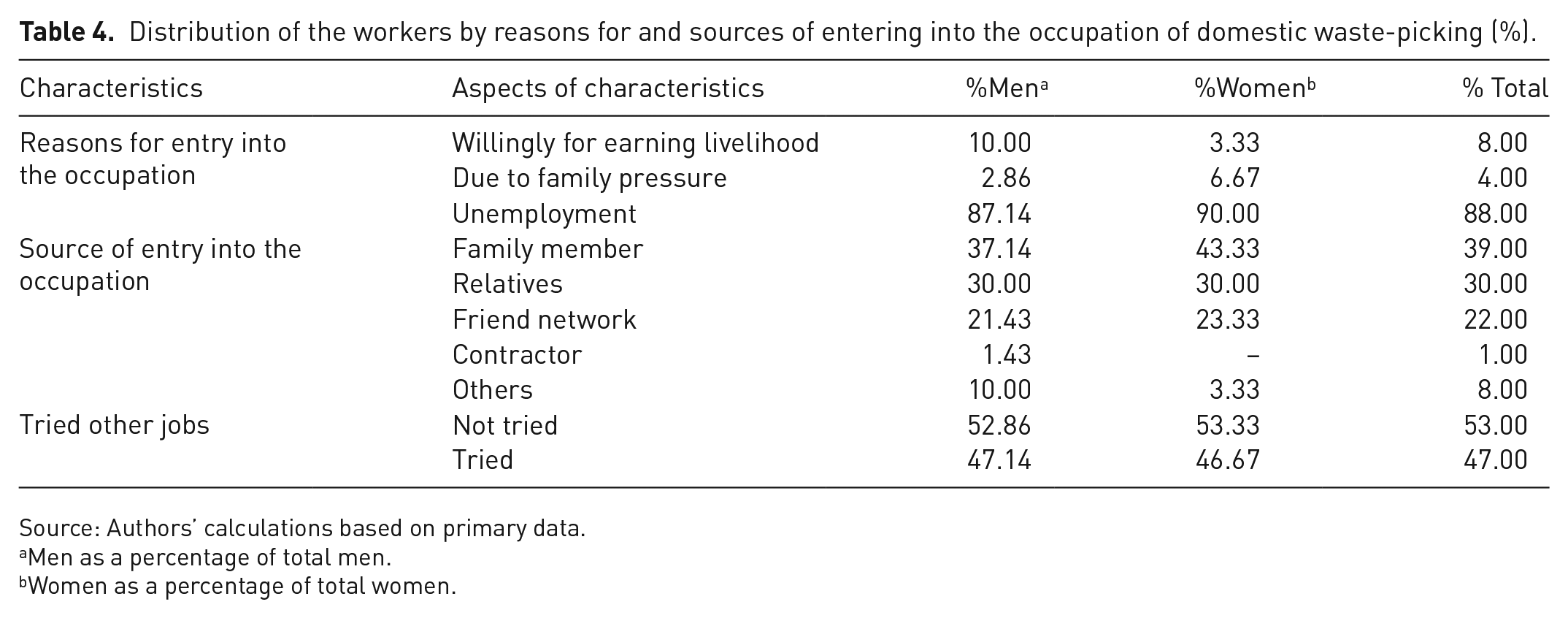
Source: Authors’ calculations based on primary data.
Men as a percentage of total men.
Women as a percentage of total women.
Housing conditions
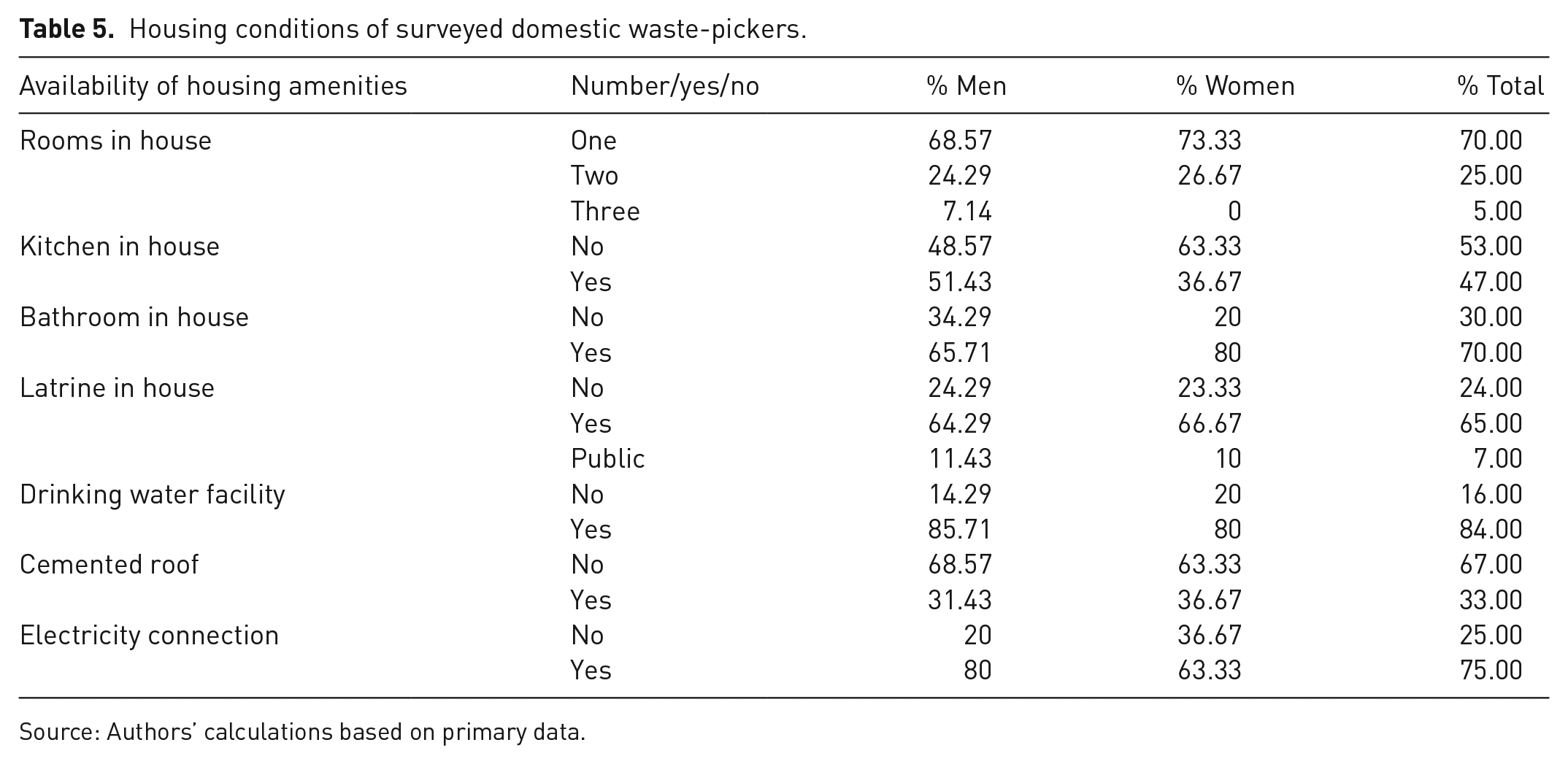
According to the Ministry of Housing and Urban Poverty Alleviation (2012–2017), there existed an urban housing shortage of 18.78 million ‘decent’ houses in Indian cities for 2012–2017. This number indicates that a large number of families in cities are residing in non-livable, temporary, overcrowded and dilapidated homes. This also includes a large number of homeless families (Kundu, 2012). The people working in informal occupations such as waste-picking are found to be most vulnerable so far as the shortage of housing facilities in Indian cities is concerned (D’Souza, 2019; UN Habitat, 2003). In this context, Table 5 brings out the lack of minimum housing amenities among surveyed waste-pickers.
Housing conditions of surveyed domestic waste-pickers.
Source: Authors’ calculations based on primary data.
It is observed that around 70% of the workers reside in a house with a single room, and only 25% stay in a house with two rooms. Furthermore, 47% of the workers do not have a separate kitchen, and 30% lack proper bathroom facilities in their house. Similarly, waste-pickers are also deprived of other basic amenities such as drinking water (16%) and electricity (25%). It is worth pointing out that even those who have access to basic amenities (drinking water, toilets, bathrooms, etc. are shared with community members) face issues in terms of the quality of these facilities. As observed from Table 5, there are 24% of the waste-pickers, who do not have toilets in their houses. Some workers, who use public toilets, have revealed the dirty state of maintenance of those toilets by the municipal corporation. Some respondents of Sector 56 of the city have also reported their helplessness to defecate in open areas when public toilets are choked. The Government of India introduced the Swachh Bharat Mission 3 (SBM) in 2014 to end open defecation and enhance solid waste management in all Indian villages, Districts, States and Union Territories (UTs). Under this mission, all the government bodies/establishments from village to state/UT must proclaim themselves ‘open-defecation free’ (ODF) by 2 Oct 2019 in order to comply with the objective of this mission. However, it is very surprising that when ‘SBM’ is a much-hyped program even in remote areas of the nation, the residents of Chandigarh are compelled to tell their woes on the condition of anonymity. It appears that, besides absolute deprivation, relative deprivation is also very much prevalent. It was also observed during the survey that surveyed workers live in unhygienic conditions as their surrounding environment stinks badly, which can pose some serious health ailments. Findings also confirm that except for drinking water and electricity connection, women workers have lesser deprivation of housing amenities in comparison to men workers. It may be due to the motherly nature of women workers that they want more amenities vis-à-vis than their counterpart men workers and attempt more keenly for the same. In line with the findings of the other studies, the surveyed domestic waste-pickers of Chandigarh, even though, are living in their own houses, but lack decent housing facilities which has serious implications for their health status.
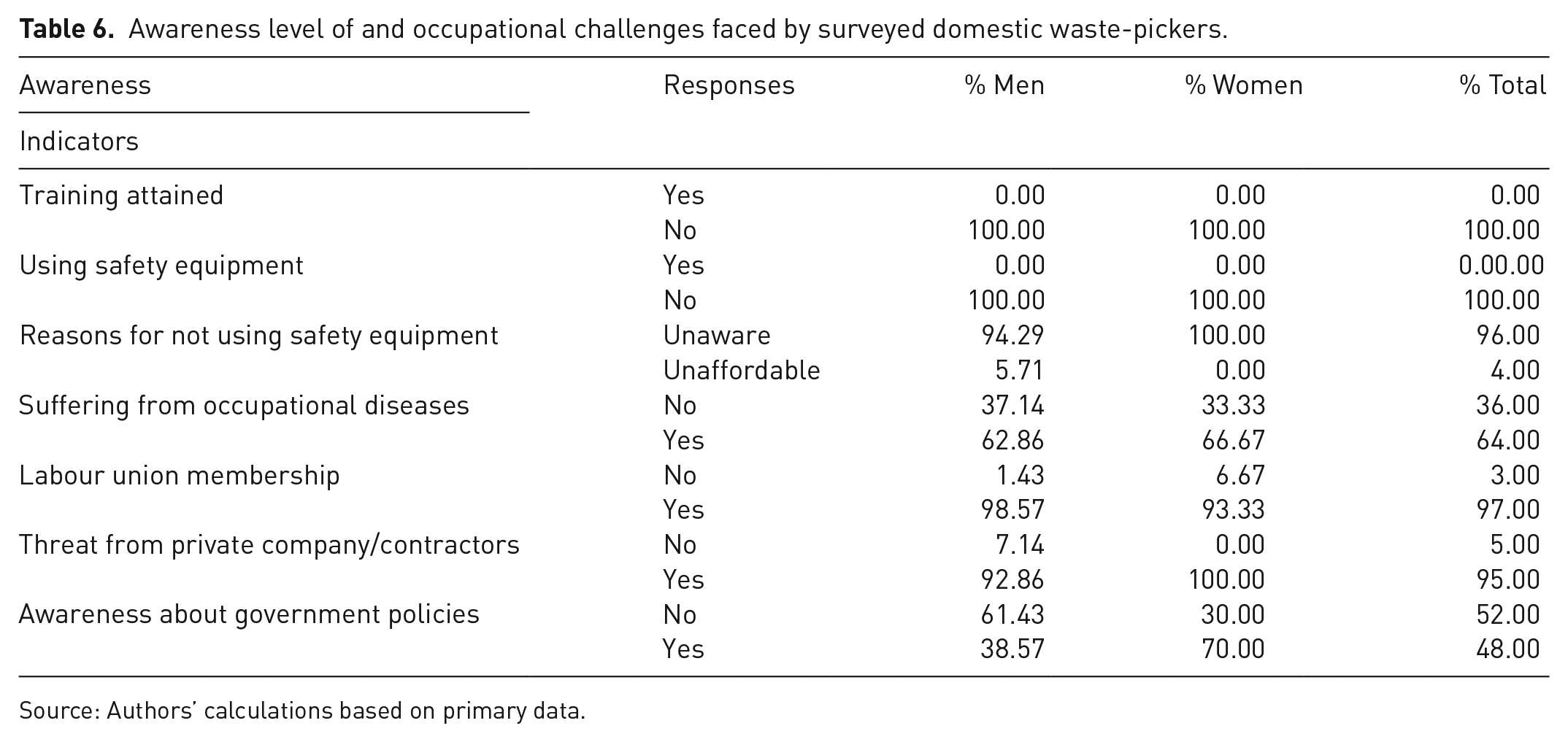
Table 6 presents a discouraging scenario of the awareness level of surveyed waste-pickers. None of the workers, either men or women, receives any formal training before entering into this occupation and no one is found to use safety equipment such as gloves and masks while performing their duty. Being unaware and non-affordability are the reasons for not using safety equipments. One men worker pointed out that several years ago, the municipality distributed hand gloves for waste-picking, but that could not last for more than 2 hours. In the absence of training required to perform the hard job of waste-picking and not using safety equipment, 64% of the workers suffer from different types of occupational diseases. The extent of prevalence of some kind of disease is higher among women as compared to men. For instance, around 67% of women have suffered from some kind of health ailments as against 63% in the case of men workers. These workers are mainly affected by the occupational hazards of waste handling, which result in health ailments relating to their eyes, respiratory system, gastro and skin. Specifically, the workers, who collect discarded items for reselling, suffer from a variety of respiratory diseases which are incidental due to inhaling particles. Furthermore, the infection resulting from direct contact with contaminated materials causes very common diseases such as headache, diarrhea, fever, cough and cold among surveyed waste-pickers. The majority of them also suffer from back pains and abdominal infections. Although this occupation is low-wage informal employment, workers have formed labour unions and around 97% of the workers are union members. Surprisingly, the union is not capable of protecting their interests holistically. It is due the fact that these workers are smaller in number and could not influence administration to introduce welfare mechanisms and policies for them. The private firms and big contractors have entered this business of picking waste and pose challenges of losing employment to these workers. Out of the workers surveyed, 95% have categorically stated that the entry of private firms has threatened their survival. They feel pressured to keep their service charges minimal to restrain the entry of big firms. This challenge was also identified by the waste-picker representatives from 22 countries at the First Global Strategic Workshop of waste-pickers held in Pune (Shankar and Sahni, 2018; WIEGO, 2012). The adverse scenario of the social-economic status of waste-pickers requires appropriate state intervention, particularly at the end of local bodies. Contrary to this, almost all the workers stated that the Chandigarh Administration has not designed any policy to deal with their occupation-related problems. Moreover, they submitted that instead of drafting appropriate policy for protecting their interests, the local government body (municipality) has encouraged the entry of private companies into this business. On the other hand, 52% of the workers are not aware of present government policies. Hence, the negative attitude of the local bodies and unawareness about government policies as well as legal mechanisms are challenging domestic waste-pickers’ socioeconomic life in general and their health status in particular.
Awareness level of and occupational challenges faced by surveyed domestic waste-pickers.
Source: Authors’ calculations based on primary data.
Health status
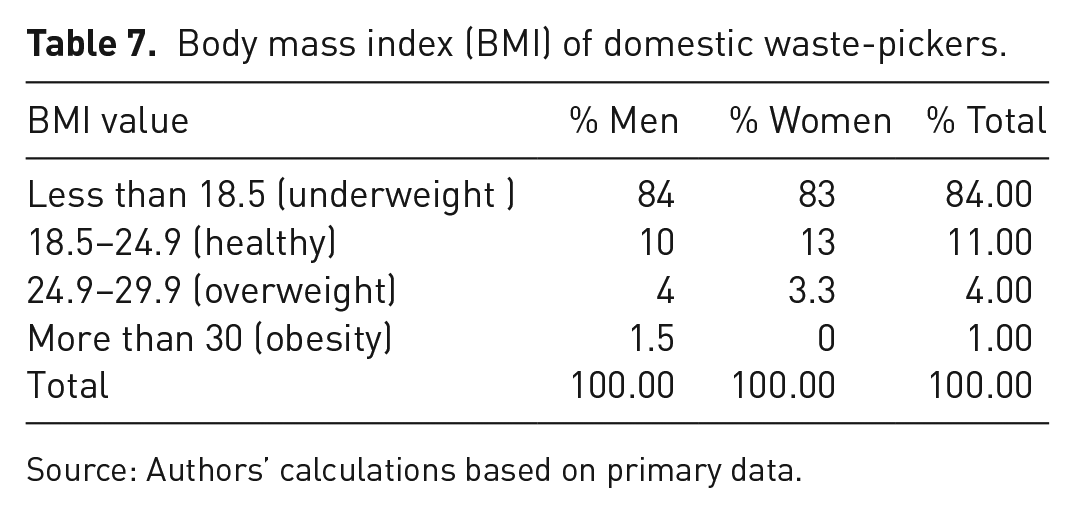
Being characterized by unhygienic and hazardous working conditions, waste-picking occupation causes several health ailments for the workers involved. Table 7 portrays the apologetic state of affairs regarding the health status of the surveyed waste-pickers. The outcomes of health conditions collected through FGD (focused group discussion) are based on the waste-pickers’ experiences or perceptions of past few years and thus provide useful insights about general health status of waste-pickers. Obtaining specific and accurate information about health status of waste-pickers requires involvement of medical experts in the study and coverage of medical considerations while conducting interviews or FDGs. In this study, social scientist’s viewpoint of health status is provided for holistic coverage of problems faced by waste-pickers.
Body mass index (BMI) of domestic waste-pickers.
Source: Authors’ calculations based on primary data.
Data describe that about 84% of the workers have a BMI of less than 18.5 and thus, are underweight and come under chronically energy deficient group. It is alarming health status and demands immediate attention for state intervention. There are only 11% of healthy domestic waste-pickers. During field visits and focused group discussions, respondents reported that only young workers are healthy and with the increase in age they are more likely to suffer from different health-related problems. Furthermore, there are 4% of the waste-pickers having their BMI ranging between 25 and 29.9 and thus, are overweight. One men worker with a BMI of more than 30 suffers from obesity. In a nutshell, it is held that all domestic waste-pickers, irrespective of their gender, suffer from serious occupational health ailments. It is quite surprising that the majority of the workers being aware of their health ailments are not capable of getting them treated due to low income. Such workers manage their health by taking the services of unprofessional doctors or chemists. Only a few of them get treatment for their health ailments from public hospitals. The primary reasons for the sorry health status of waste-pickers are their low level of income, adverse working conditions and their unawareness about the training and safety requirements of the occupation.
Intergeneration occupational mobility
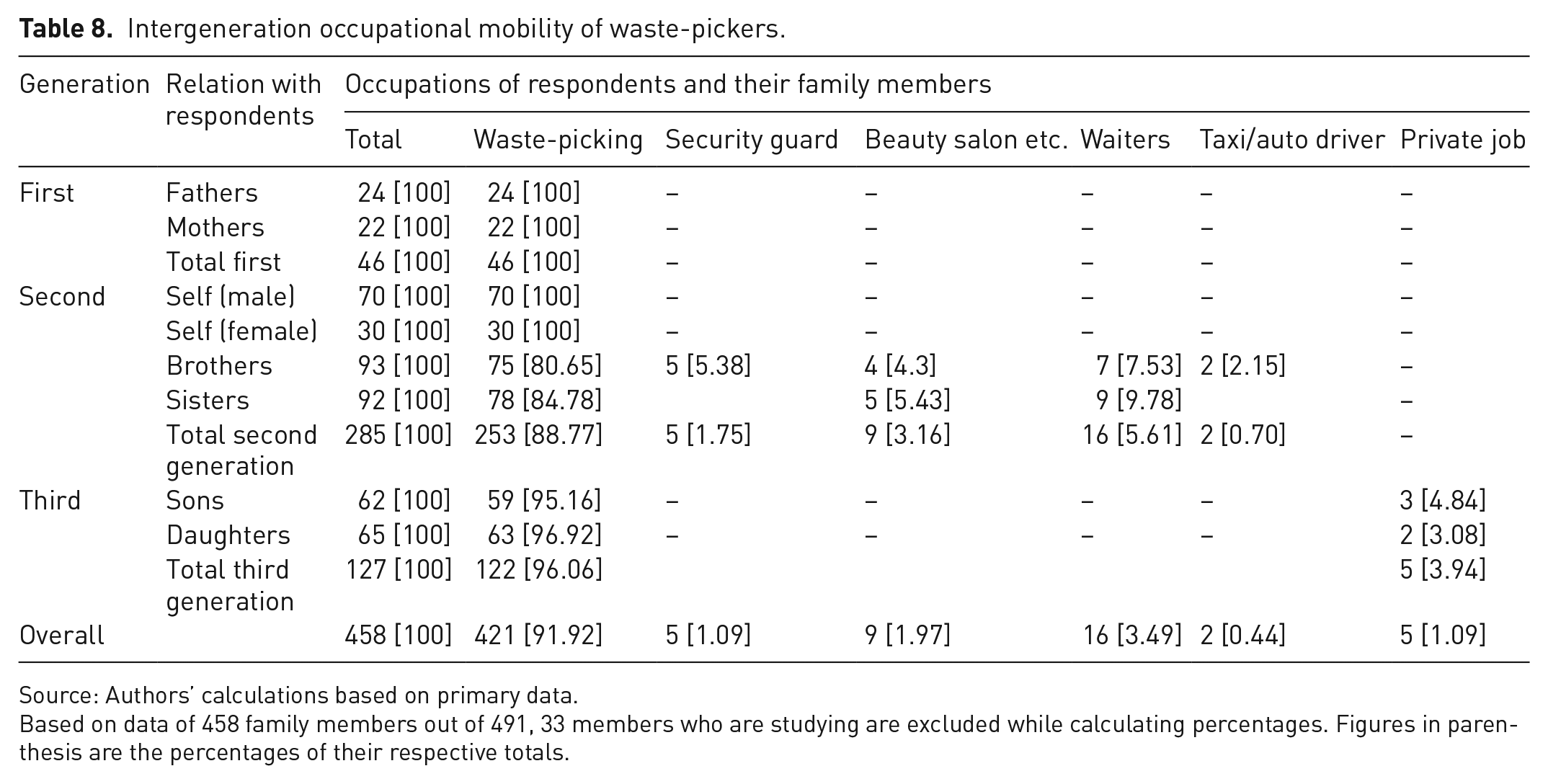
It is considered important per se that individuals and any collective have access to occupational mobility, as societies that impose fixed or set occupations and positions at birth and are transmitted to the next generation through rigid schemes have few possibilities for innovation and fulfilment (Bourdieu et al., 2006). Indian experience in this regard is not very graceful (Azam, 2013; Iversen et al., 2017; Reddy, 2015). In India, among the scheduled castes, 23% have downward mobility and 70% have no mobility, whereas only about 7% have upward mobility (Kumar, 2013). All the workers in domestic waste picking belong to marginalized social groups, therefore it becomes important to explore intergenerational occupational mobility among them to get a fair idea about their undesirable socioeconomic status in the long run. Table 8 portrays the intergenerational occupational mobility of the surveyed workers throughout their three generations. Fathers and mothers are considered under first generation, workers themselves with their brothers and sisters are taken under second generation, whereas their children (both sons and daughters) are taken under third generation. There are 458 working members of the waste-pickers with about 92% of them working in the occupation of domestic waste picking. Only 8% have shifted their occupations to low-paid jobs in the informal sector such as waiters, beauty salon workers, security guards and taxi/auto drivers.
Intergeneration occupational mobility of waste-pickers.
Source: Authors’ calculations based on primary data.
Based on data of 458 family members out of 491, 33 members who are studying are excluded while calculating percentages. Figures in parenthesis are the percentages of their respective totals.
First-generation domestic waste-pickers have spent their whole life in this occupation and are not able to shift despite having a strong willingness to leave the same. There are only about 12% second-generation working members out of a total of 285, who have shifted their occupation and get employed in the aforesaid low-paid jobs of the informal sector. Out of 127 third-generation working members, only 5 members (about 4%) are successful in mobilizing from waste picking and the rest assist their parents in the same occupation. Henceforth, results confirm insignificant intergenerational occupational mobility among the surveyed domestic waste-pickers. Moreover, whatever mobility is recorded, it is in low-paid unorganized employment of the informal sector.
Intergeneration educational mobility
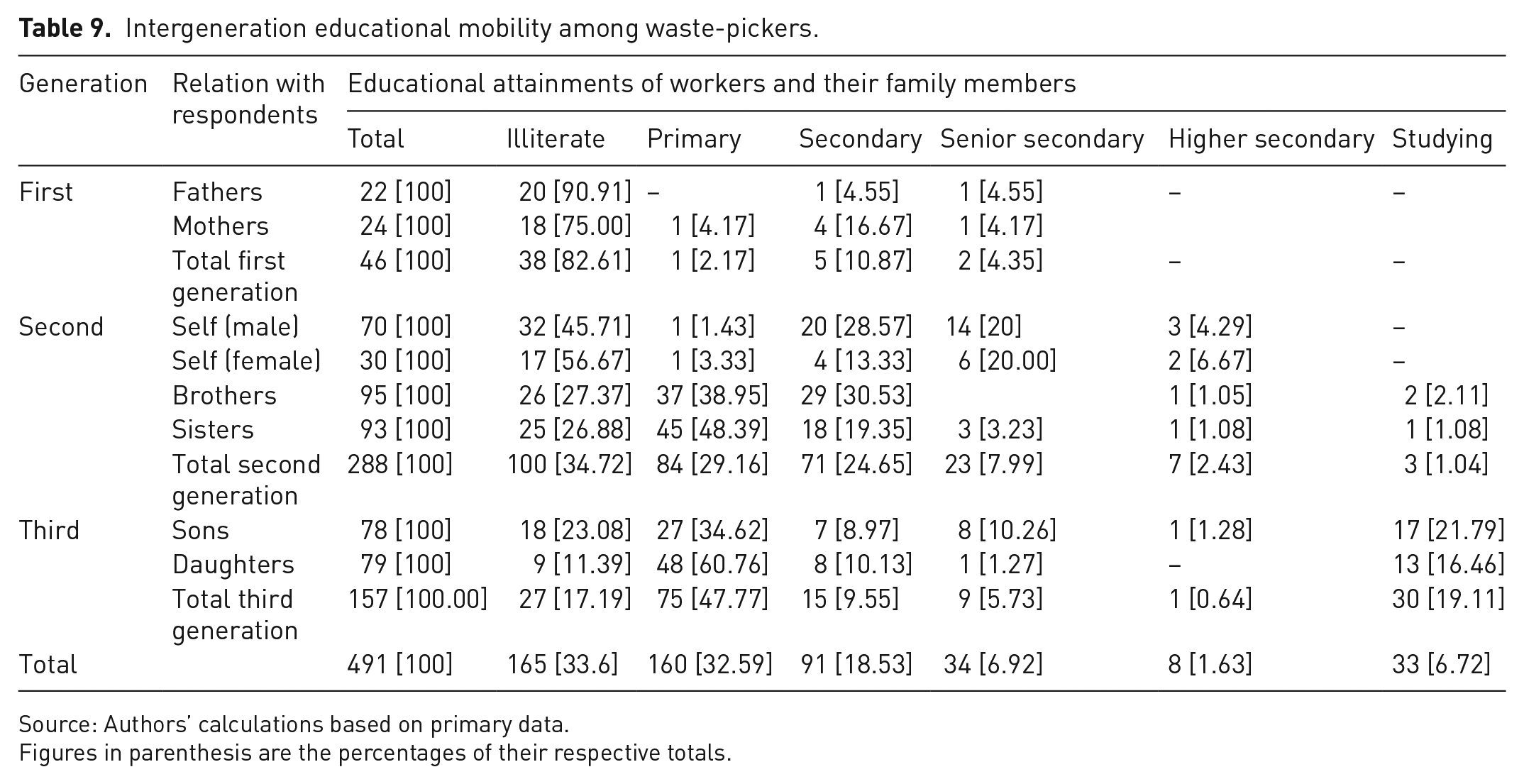
Sustainable Development Goals (SDGs) demand consistent improvement in educational attainment and its mobility over the generation in all the sections of society. However, this is missing in the Indian context given gender and caste-based inequalities in education. This is also prevalent among domestic waste-pickers of the City Beautiful. Table 9 shows that out of 491 family members of the workers, 165 (33.6%) are illiterate and 160 (32.6%) possess primary education. There are only 91 members (18.53%) with secondary education, 34 (6.92%) with senior secondary, 8 (1.63%) with higher secondary and 33 members (6.72%) are still studying. Thus, the data present a dismal picture of intergeneration educational mobility as no member has been able to attain higher education. Moreover, a large portion of the surveyed workers are not literate, presenting a disappointing face of literacy in a city such as Chandigarh that boasts about its high living as well as education standards. The only positive aspect is a decline in the number of illiterates over the generation as first, second and third generations have 82.61, 35.09 and 21.26% illiterate family members in waste picking households respectively. Intergeneration educational mobility is higher towards primary education as compared to secondary or senior secondary education. It is due to the high dropout rate of the students belonging to schedule and backward castes. Having a few members with senior secondary and higher education increasing over the generations is a very dim silver line in the case of the intergeneration educational mobility of the waste-pickers. Such a status of intergenerational educational mobility sufficiently justifies the prevalence of intergeneration occupational immobility among domestic waste-picker’s working family members. In other words, moving from illiteracy to primary, secondary, higher secondary education does not enable waste-pickers’ daughters/sons or brothers/sisters to obtain high-paid blue or white-collar jobs in the organized formal sector. Due to this, the majority of the working members despite having a strong willingness to change their occupation cannot materialize it. It indicates that surveyed workers are not maximizing their utility as neither wage nor non-wage features of their employment informality are favourable and thus makes a case contrary to Maloney (2004). Furthermore, this status of intergeneration occupational and educational immobility may result in exclusive growth and may dampen India’s aim of achieving SDGs.
Intergeneration educational mobility among waste-pickers.
Source: Authors’ calculations based on primary data.
Figures in parenthesis are the percentages of their respective totals.
Conclusion
In the urban informal economy, the waste-pickers continue to rank lowest in the hierarchy of employment and are vulnerable to indecent employment dynamics and unpleasant living conditions even in the highly urbanized and well-planned city of Chandigarh in India. The majority of the waste-pickers are illiterate and unskilled migrants belonging to the lowest castes and poorest of the poor families of rural areas of Chandigarh’s neighbouring states. Most of the workers are second-generation workers willing to obtain other employment but have to adopt this occupation as a last resort from their parents or through their networks such as friends and relatives. Findings reveal a complete absence of proper service charge fixation/revision mechanism as it is mostly determined by the house-owners due to their low bargaining power and lack of awareness about labour laws. As a result, they continue to earn a meager income. Significant differences in income levels of men and women workers are also evident among the surveyed workers. The malice of child labour, even though disguised, is also prevalent as workers have to take the assistance of their children due to the excess burden of the work or during illness. Living in unhygienic housing conditions without civic amenities and working without required training as well as safety equipment, the waste-pickers live a despondent life being residents of the Chandigarh city. Waste-pickers also suffer from deadly occupational diseases given no social security measures/support by the government even though they undertake the most important work of the urban cities such as Chandigarh. Furthermore, they also face the challenge of losing their employment due to the entry of private companies or contractors in their occupation. Local government bodies (municipalities) are ignorant about their living, health and working conditions and behave insensitively. A trivial upward educational mobility and a lack of upward occupational mobility among the waste-pickers indicate that trickledown development has not resulted in their socioeconomic advancement. In this way, this study presents a classic case of failure of both market and state particularly in the case of domestic waste-pickers in Chandigarh in India. The analysis also reveals that Chandigarh city could not offer decent working, living and health conditions to its waste-pickers despite its smart city reputation.
Policy directions for addressing major issues faced by waste-pickers
Due to the lack of vision in protecting workers’ livelihoods, there are no clear or comprehensive policies or legislations to protect the rights of the waste-pickers in India (Madhav, 2010). The Government of Karnataka has recently drafted Waste Picker Welfare Rules (2018) to provide a legal framework for the waste-pickers (Reddy and Kumar, 2020), which can be used as a guide to frame welfare policy in Chandigarh. The rights of waste-pickers to access, collect and sell waste in every future arrangement of solid waste management should be effectively recognized to ensure their sustainable livelihoods (Shankar and Sahni, 2018). Optimum service charges (such as water and sanitation charges, etc.) should be fixed by the Chandigarh municipality to ensure decent monthly income to the workers rather than leaving them at the mercy of house-owners. Formalization of waste workers is the need of hour not only for empowering them, but also to make environmental protection, climate change mitigation efforts and making MSW management cost-effective (Chadha, 2020). Instead of handing over the informal work of the waste-pickers to private contractors, community-based semi-official picker organizational framework, backed by appropriate laws/regulations, and preferential policies as suggested in Chen et al. (2018) can be developed for improving the resource recovery rate and waste-pickers’ living and working conditions and in order to achieve more effective and hazard-free MSW resource utilization. Given the hazardous nature of this occupation and the impediment to waste-pickers being included in integrated solid waste management, investing in their education and professional training can save them from several health-related problems (Ibelli-Bianco, 2022). Free health facilities along with coverage under health insurance schemes can improve the health standard of workers at further level. Hazardous occupation cess/tax may also be levied by the municipality to finance health expenditure of waste-pickers. The sorry state of living conditions of these workers in a city such as Chandigarh requires to be immediately improved by providing free/subsidized houses. Their educational immobility can be checked by lowering school dropout rates among children, while occupational mobility can be improved through financial inclusion of waste-pickers and covering them under various pension schemes, low-premium based term and medical insurance schemes along with soft loans under interest subvention schemes.
Recently, the outburst of Covid-19 pandemic has posed another set of challenges to informal employments in India. Consequently, waste-pickers have lost employment as households stopped using this service so as to break the contact with persons other than family members. Some surveyed waste-pickers got infected by Covid-19 and faced threat to their life and a few died also. Moreover, working without safety measures while suffering from some health ailments and thus putting their lives on stake, waste-pickers have provided this very essential service to the urban families very effectively. However, no specific relief measure has been introduced by the municipalities even though some instructions for using safety measures were provided instead of required equipment and training. Given the threat of re-occurrence of Covid-19-like pandemics in the near future, safety measures and special training to deal with such situations must be provided to waste-pickers by the local administration as they are not capable enough to arrange safety equipments and to attain required training at their own end. In a nutshell, a comprehensive policy framework is needed to be developed and implemented effectively for addressing all the employment, living conditions and health status-related issues of waster-pickers in Chandigarh. Specific measures are also required to be developed and implemented for making this informal system of urban waste management future-ready to face Covid-19-like challenges.
Footnotes
Declaration of conflicting interests
The authors declared no potential conflicts of interest with respect to the research, authorship, and/or publication of this article.
Funding
The authors received no financial support for the research, authorship, and/or publication of this article.
