






Abstract
In the context of circular economy and heavy metal (HM) recovery from municipal solid waste incineration (MSWI) fly ash (FA), detailed knowledge of HM binding forms is required for achieving higher extraction rates. The FA mineralogy is still poorly understood due to its low grain size and low metal concentration. To investigate the HM binding forms, a sophisticated thermodynamic reactive transport model was developed to simulate ash-forming processes. The stability of different binding forms was investigated at different flue gas conditions (varying ratios of HCl, SO2, O2) by simulating the gas cooling path in closed system and dynamic open system, where the gas composition is changing upon cooling due to precipitation of solids. The simulations predict that at flue gas conditions of molar ratio S/Cl < 1, Cu and Zn precipitate as oxides (and Zn silicates) at approximately 650°C. At temperatures <300°C, Zn, Cu, Pb and Cd are predicted to precipitate as easily soluble chlorides. In flue gas with molar ratio S/Cl > 1, the HM precipitate as less soluble sulphates. The results indicate that the less soluble HM fraction in the electrostatic precipitator ash represent oxides and silicates that formed in the boiler section but were transported to the electrostatic precipitator. The model provides insight into the physical–chemical processes controlling the metal accumulation in the flue gas and FA during the cooling of the flue gas. The obtained data serve as valuable basis for improving metal recovery from MSWI FA.
Keywords
Introduction
Thermal waste treatment leads to volume reduction and decomposition of potentially toxic organic matter as well as accumulation of volatile heavy metals (HM) in the municipal solid waste incineration (MSWI) fly ash (FA). The recovery of metals from the incineration residues prior to their deposition in landfills contributes valuably to the sustainable closure of material cycles in the sense of a circular economy (European Environment Agency, 2014; Stylianou et al., 2023). The MSWI FA thereby represents a secondary mining source (Tang et al., 2022), with the potential to substitute metals from primary raw material mining. For optimizing the extraction efficiency, a better understanding of the physical–chemical processes controlling the partitioning of the HM into the different ash fractions is needed, as well as a better knowledge on their binding form.
A schematic description of MSWI plant is given in Figure 1(a). During incineration at 800°C–1000°C, volatile waste compounds with high vapour pressures and low boiling points are transformed into the gas phase that forms the flue gas together with entrained dust particles. High combustion temperatures and elevated chlorine and sulphur concentrations favour the transfer of HM to the gas phase (Abanades et al., 2002; Verhulst et al., 1996), leading to an enrichment of volatile HM compounds in the flue gas and thus in the FA through precipitation. The hot flue gas leaves the combustion chamber to flow along the second pass and third pass (also called empty pass) towards the boiler, which is equipped with heat exchanger tubes. As it passes through the boiler, the metal enriched flue gas is cooled from around 650°C to 250°C. The boiler primarily acts as a heat recovery section, but also serves as a dust separator for coarse particles in which the so-called boiler ash (BOA) is collected in different fractions. At 250°C, the flue gas enters the electrostatic precipitator, where dust or aerosol particles suspended in the gas are electrically charged and then collected at precipitation electrodes which are periodically rapped to release the accumulated dust (electrostatic precipitator ash (ESPA)) to the dust collection funnels. The BOA and ESPA are usually collected together and referred to as FA. Gaseous compounds (e.g. HCl, SO2) are removed from the flue gas in a subsequent dry, semi-dry or wet flue gas cleaning step, before the clean gas containing N2, CO2 and H2O is emitted through the chimney.

(a) Scheme of the flue gas cooling path in the incinerator plant and the arising ash fractions. (b) Schematic conceptualization of the box–flux model, represented by 10 reactor chambers (boxes) with different T, P and in different partial equilibrium states, interconnected through the fluxes of physically distinct phases (e.g. gas, solids). The dedusting mechanism of the plant is simulated by the removal of solids into ‘sinks’. To account for competitive precipitation and transport mechanisms, precipitated salts are allowed to travel with the flue gas stream until the electrostatic precipitator. The predicted solid phases in the sinks 1–5 represent the BOA fractions (BOA 1–5) and the sum of the predicted solids in sink 6–8 represent the ESPA.
In accordance with the commitment to the sustainable development goals and the green economy (Bundesamt für Umwelt, 2020; United Nations Department of Economic and Social Affairs, 2022), the recovery of HM from MSWI FA will be enforced by law in Switzerland by 2026 (Swiss Federal Council, 2015), an important step to promote the circular economy. The FLUWA process (acid fly ash acid-leaching (German: Flugaschenwäsche)) (Bühler and Schlumberger, 2010) thereby represents the state-of-the-art technology for acid leaching in Switzerland, whereby the HM are dissolved from the FA at acidic, oxidizing conditions and later precipitated into hydroxide sludge in order to be recovered by the FLUREC process (method for recovery of heavy metals from fly ash (German: Flugasche-Recycling)) (Schlumberger et al., 2007). On average, the FLUWA process results in extraction rates of 75% Zn, 75% Pb, 60% Cu and 90% Cd (AWEL, 2013). After leaching, roughly 70–75% of the FA input (due to mass loss) remains as solid residue, the so-called filter cake (Bühler and Schlumberger, 2010; Weibel et al., 2021). Due to the remaining amounts of metals, (for example Pb, Zn and Cu) and its low pH-buffering capacity, the filter cake is deposited on landfill type D together with the bottom ash to prevent HM emissions (Güner, 2013). The metal extraction prior to landfilling is not only favourable in the sense of a circular economy, but also for reducing landfill emissions and related toxic effects (Mehr et al., 2021). Since the solubility of HM is strongly dependent on their binding form (Bernasconi et al., 2022), detailed knowledge of the HM binding form in the FA is required to optimize HM recovery through wet chemical processes and to estimate the hazard potential of the filter cake on the landfill.
Several studies have already been conducted to characterize the mineralogy of MSWI FA (e.g. Bayuseno and Schmahl, 2011; Tian et al., 2023; Weibel et al., 2017; Wolffers et al., 2021), focusing on the bulk mineralogy. It was shown that MSWI FA is a material difficult to characterize due to its complex mineralogy and the presence of only about 50% crystalline phases, associated with the short residence time in the combustion chamber. When investigating HM binding forms, conventional methods such as powder X-ray diffraction (XRD) or scanning electron microscopy (SEM) reach their limits due to low HM concentrations present at ppm range and low grain size (<200 μm to submicron scale) (Wolffers et al., 2021). Furthermore, wet chemical methods for characterization of HM binding forms in FA may be error prone due to matrix interferences (Funatsuki et al., 2012). For these reasons, thermodynamic modelling is a promising method to gain complementary information about stable HM binding forms. So far, most of the thermodynamic models of MSWI incinerator plants have focused on the combustion process itself, in particular on the transfer of HM into the gas phase (e.g. Mkilaha et al., 2002, Paoletti et al., 2001, Verhulst et al., 1996) and the partitioning between the different residues (e.g. Zhang et al., 2008, Poole et al., 2008). While these studies provide important information on HM transport in the gas phase, only a few studies considered the cooling of the gas phase and the ash-forming processes. The available models use a simplified flue gas system and consider a limited number of solid phases (e.g. Jiao et al., 2011), due to the lack of comprehensive databases containing the thermodynamic data of the phases formed during cooling of the gas phase (Lindberg et al., 2013).
Goal and scope
This study thus aims at developing a thermodynamic reactive transport model to simulate the dynamic cooling of the flue gas in MSWI plants as realistically as possible. The developed model should help to (i) gain insight into the changes in chemical composition of flue gas and solid residues along the flue gas cooling path and (ii) to investigate the possible HM binding forms in the different ash fractions. The IVTANTERMO thermodynamic database (Gurvich et al., 1982), specifically designed for high temperature gas combustion processes, was extended with thermodynamic data for relevant solid phases. The proposed model includes both batch simulations, where the cooling of a fixed flue gas composition is calculated in a closed system, and dynamic simulations (box–flux model) using a reservoir dynamics approach (Chudnenko et al., 1999, Churakov et al., 2000; Kulik et al., 1993), where the total composition of the system is changing due to inbound and outbound fluxes along with subsequent cooling and phase precipitation. For both approaches, different input flue gas compositions (variations in HCl, SO2, O2 concentration) are considered to study the effect of flue gas composition on phase assemblages in FA. Of special interest are the effects of changing temperature and gas composition on the formation of HM bearing phases. The results of the simulations are used as complementary approach to interpret previously performed ash characterization, to gain a better understanding of the ash-forming processes and possible binding partners of HM.
Materials and methods
The success of the model predictions for such systems is largely related to the availability of thermodynamic data for all relevant species and phases that are controlling the system chemistry over the considered ranges of conditions. These are gas species, melts, crystalline and amorphous solids. At conditions present in MSWI incinerators (atmospheric pressure and high temperatures (up to 1200°C)), the gas phase can be modelled reasonably accurate as an ideal gas mixture. For the condensed phases (solids, melts), the standard state of a pure substance at any temperature is used, assuming the constant molar volume (obtained from density at ambient conditions). Due to the low density of gas phase and low concentration of metals, the use of pure mineral phases instead of solid solutions is also well justified.
Thermodynamic database
The IVTANTERMO thermodynamic database (Gurvich et al., 1982) (with data for >3400 substances) was imported into GEM-Selektor (GEMS) format and complemented with molar volumes for the solid phases (Supplemental Table SM5), obtained from several sources (Barthelmy, 1997; Bergerhoff and Brown, 1987; Hudson Institute of Mineralogy (n.d.; www.mindat.org); Jain et al., 2013). Other available databases proved to be less complete with missing data especially for the condensed phases at elevated temperatures and low pressures. Thermodynamic data for additional solids (Supplemental Table SM6) were collected from literature (Reed, 1989; Stulova et al., 1974; van Miltenburg et al., 1994) and were added as separate complementary dataset. Estimation methods such as volume-based thermodynamics (Glasser and Jenkins, 2016) and the additivity method were used for missing thermodynamic properties (
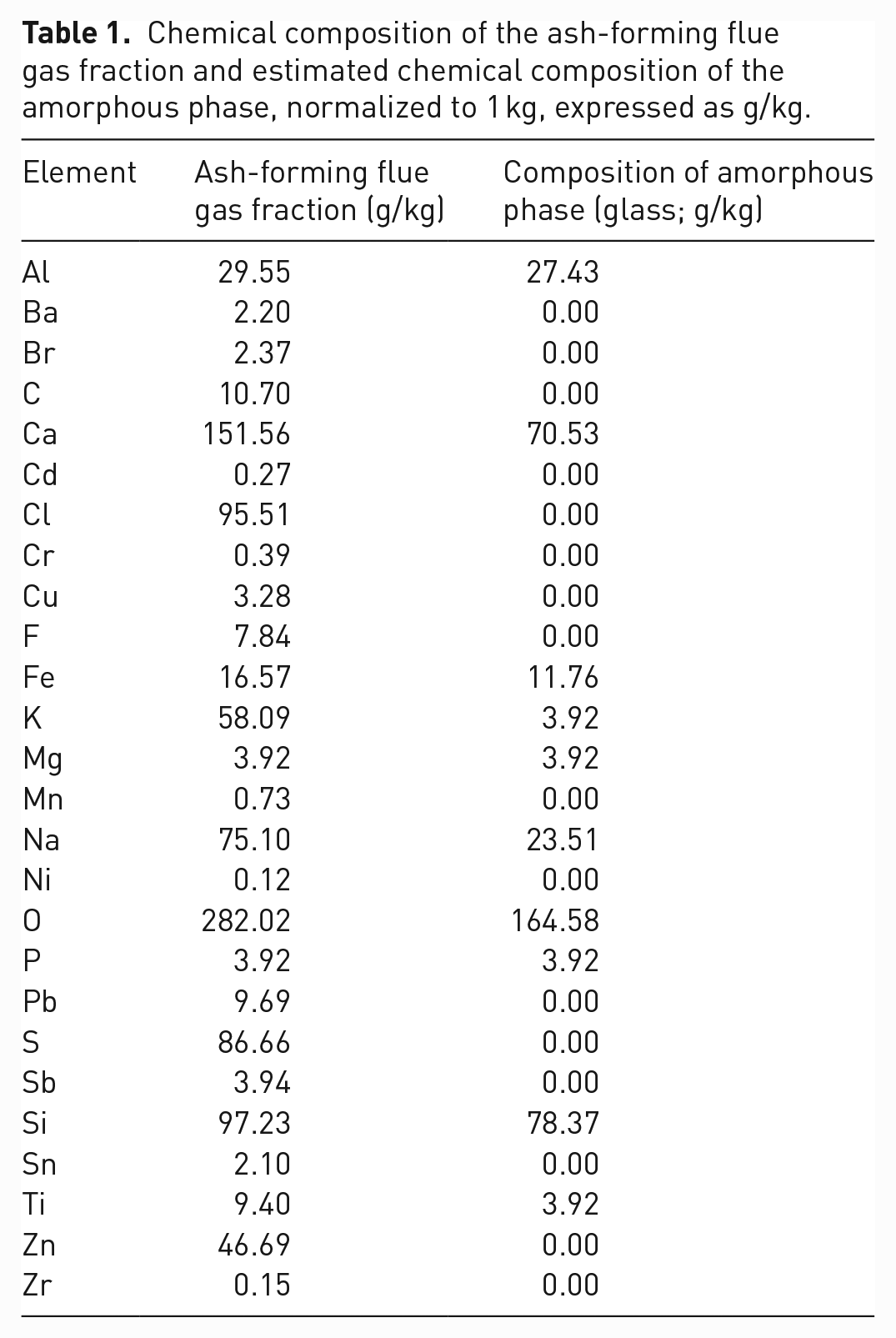
Chemical composition of the ash-forming flue gas fraction and estimated chemical composition of the amorphous phase, normalized to 1 kg, expressed as g/kg.
Flue gas composition
The system parameters were defined based on the operational data from MSWI plant Bern Forsthaus (e.g. operating parameters, chemical data of mass streams, temperature profiles, mass flow, dimensions). The flue gas composition could be estimated based on annual mass balances and chemical analyses of the material flows arising from the flue gas (FA, scrub water, gas emission downstream of the electrostatic precipitator). To be able to calculate different flue gas scenarios, the input was subdivided into flue gas matrix (main composition of the raw gas, Table 2) and ash-forming flue gas fraction (Table 1). The ash-forming flue gas fraction corresponds to the total composition of average FA.
Initial flue gas matrix composition of the different scenarios.

Calculation of equilibria
Thermodynamic calculations were performed by the method of GEM, using the GEMS code package (Kulik et al., 2013; Wagner et al., 2012), in Version 3.8 (http://gems.web.psi.ch). Upon equilibrium calculation in GEMS, the input bulk elemental composition of the system is distributed into phases and their components so that the total Gibbs energy of the system at the given temperature and pressure is at its minimum.
Batch process simulations
In the first step, equilibrium batch calculations were performed to reveal the phase stabilities as function of temperature and flue gas composition. In the batch calculations, the equilibrium composition of the cooling flue gas was simulated in the temperature range from 850°C to 100°C in 25°C steps for four different initial flue gas compositions (scenarios, Table 2). A flue gas quantity of 20 kg was defined as input (19.8 kg flue gas matrix + 0.2 kg ash forming in the flue gas), which represents approximately 65 m3 of hot flue gas at 850°C.
Box–flux model of megasystem dynamics
The dynamic cooling of the flue gas was simulated using a box–flux model (in GEMS implementation) based on a megasystem dynamics approach. A megasystem is defined as a thermodynamic system consisting of several open and chemically interacting multisystems that may exist at different T, P and in different partial equilibrium states (Chudnenko et al., 1999). A multisystem is a chemical system containing more possible thermodynamic phases than the number of chemical elements in its bulk composition (exceeds the phase rule). In this study, each multisystem is represented by a reactor chamber. Ten reactor chambers were defined (called ‘boxes’ Figure 1(b)), each having a defined size (mass, volume), temperature and pressure, and assumed to have their content mixed and partially equilibrated. The reactor chambers are connected with fluxes of physically distinct phases (e.g. gas, solids – herein referred to mobile groups of phases (MGPs)) with the next neighbouring chamber. To account for realistic mass fluxes in the incineration plant, the solid MGPs were split into two subsystems: dust (refractory minerals and amorphous melt) and salt (newly precipitated salts) to allow precipitated salt particles to travel with the flue gas stream towards the electrostatic precipitator.
For the context of this study, it is important that each box maintains its own temperature (and ambient pressure), exchanges matter with neighbouring boxes via inbound and outbound flux of MGPs, and has a ‘sink’ flux for removing certain part of solid MGP (dust, salt) (simulating the removal of solids by ‘filters’ in a plant). The mass transport in the box–flux model is calculated by solving a system of ordinary differential equations for the mass of each element in each box (as described in Kulik et al., 1993), thereby accounting for defined fluxes and MGP compositions. The system of mass balance equations relating the fluxes between adjacent boxes is solved at each iteration, then the equilibria are calculated for each box by the GEM algorithm, which changed the elemental composition of outgoing MGPs. At every following time step, this transport-equilibration loop is repeated. A more detailed description of the principles of the megasystem dynamics approach, flux rates and MGP is provided in Supplemental Material SM 1.2.–SM 1.5. To prevent unrealistically high oxidation rates of SO2(g), it was necessary to set a kinetic constraint on the oxidation of SO2(g) (details in Supplemental Material SM 1.6.). Further minor adjustments in the chemical thermodynamic system are listed in Supplemental Table SM4.
Model limitations
The geochemical processes are of high complexity and the calculations are based on the assumption of local/partial equilibria. Aspects such as kinetics, sorption, heat transport and local inhomogeneities were not considered (except kinetic constraint on SO2 oxidation, see Supplemental Material SM 1.6.) in the present calculations. The particle size distribution (reactive surface area) and crystallization of melt phase are further aspects which were not considered. In addition, the calculations were further complicated by the lack of accurate data and error brackets for fluxes and lack of experimental thermodynamic data of mixed phases and amorphous phases, which only allowed some trial sensitivity calculations. However, a rigorous statistical analysis of model uncertainties and their propagation is yet to be done in future studies.
Results and discussion
Thermodynamically stable phases in batch process simulations
Figure 2 shows the stability of major solid phases for the different flue gas compositions. A detailed table of all thermodynamically stable phases as function of temperature are provided in Supplemental Tables SM 7–10. The predicted mineralogy of the reference scenario A is dominated by CaSO4 and the amorphous phase for the entire temperature range. In the higher temperature range >750°C, CaSiO3 (wollastonite), CaTiO3, CaTiSiO5 (sphene), ZnO, Ca3P2O8 are predicted to be the dominant thermodynamically stable phases. At 750°C, the formation of NaCl and KCl initiates, followed by K2SO4, Zn2SiO4 at 675°C and cristobalite (SiO2) at 625°C. From 600°C on, quartz becomes the dominant SiO2 phase. The matrix phase assemblages of scenarios B and D are comparable to that of scenario A. The similarity of scenarios A and D is related to the fact that even scenario D with low O2 concentration of 3.5 vol.% (which is comparably low for typical flue gas conditions) is at O2 excess.

Overview of thermodynamically stable major phases as function of temperature for the different flue gas compositions.
While scenarios A, B and D show alkali chlorides as dominant alkali phases, scenario C is dominated by sulphates (K2SO4 and Na2SO4). Scenario C shows a S/Cl ratio >1, whereby the sulphates become the dominant solid phases and alkali chloride formation is suppressed. Regardless of the S/Cl ratio, CaSO4 appears to be the dominant Ca phase along with the Ca-containing glass phase, and CaCl2 does not form even at high Cl contents. The strong competition between sulphate- and chloride phases capturing the alkali metals Na and K is in agreement with other studies (Christensen et al., 1998; Jiao et al., 2011; Jiménez and Ballester, 2007).
The predicted stabilities of the HM bearing phases as function of temperature are presented in Figure 3. At around 250°C, a substantial change in solid speciation of most HM is observed. In the reference scenario, Zn is predicted to be present as ZnO at high temperatures until 700°C in the reference scenario. Then, Zn2SiO4 becomes the most stable Zn phase, with minor amounts of Fe2ZnO4 forming. At 275°C, Zn is predicted to be present as ZnCl2. The predominant form of Cu is monoxide (CuO) in the higher temperature ranges and changes to CuCl2 at temperatures <250°C. The predicted conversion of CuO to CuCl2 with decreasing temperatures is consistent with calculations by Verhulst et al., (1996). Lead and cadmium are only found as chlorides and start precipitating at 425°C. Other HM phases are Cr2O3, Fe2O3, MnO2, SnO2, Fe2NiO4 and NiSO4 to a minor extent. Barium is mainly bound as BaSO4 and titanium as TiO2, NiTiO3, CaTiSiO5. The HM binding forms of scenario D are identical to scenario A. In scenario B, it can be observed that the HM bearing silicates and oxides (e.g. Zn2SiO4, CuO) are forming at lower temperatures compared to the reference scenario, while for ZnCl2, a shift towards earlier precipitation is observed. Scenario C with the high sulphur load builds Zn, Pb, Cu, Cd predominantly as sulphates and at higher temperatures (600°C–750°C). The shift from chloride to sulphate binding forms with increased S content has previously been described on the example of Cd (Zhang et al., 2008). Jiao et al. (2011) observed that the presence of SO2 and H2O facilitated the conversion of gaseous metal chlorides to form sulphates, leading to the precipitation of PbSO4 (e.g.) at higher temperatures due to the reduction in the dew point.

Stability of Zn-, Pb-, Cu-, Cd-bearing solids as function of temperature for the different scenarios.
System evolution in dynamic box–flux model
Evolution of gas phase composition and partitioning
The evolution of the gas concentration along the cooling path is shown in Figure 4(a). The gas phase of the reference scenario (scenario A) is dominated by N2 > H2O > CO2 > O2, which all together account for >99% of the flue gas composition. HCl and SO2 are the dominant Cl and S species. Chlorine is also present as NaCl(g) and KCl(g), as well as other HM salts (e.g. ZnCl2, and PbCl2, CuCl2, CdCl2 in minor concentrations). As the gas cools, the concentration of KCl, NaCl and ZnCl2, CuCl2, CdCl2 decreases due to precipitation of metal chlorides. HF is also an important trace species. The compositions of the gas phase for scenarios B and D are similar, except that in scenario B, the ZnCl2 concentration in the gas phase decreases more slowly due to precipitation at lower temperature at higher Cl concentration. For scenario C, it can be observed that the concentration of ZnCl2 drops already after equilibration. Interesting is thereby also the elevated HCl vapour pressure related to the sulphate-dominated system in the solids.

(a) Evolution of gas phase composition during cooling of the flue gas for the different scenarios. The gas concentrations for scenario D are identical to scenario A and are therefore not shown. (b) Partition coefficients of selected elements with respect to the solid phase for the different scenarios. Full partitioning to solid = 1, full partitioning to gas phase = 0.
The partitioning between the solid and the gas phase of Cl, S and Zn, Pb, Cu, Cd with respect to the solid phase is shown in Figure 4(b) by means of partition coefficients. For Cu and Zn, the partition coefficient to the solid phase is already at 0.9 and 0.8, respectively, at 590°C (Box 1) and the partition coefficient to the solid phase increases steadily until full partitioning to the solid phase is achieved at Boxes 5 and 6, respectively. Pb and Cd show comparable partitioning behaviour, as both HM show a sharp transition between full partitioning to the gas phase and a rapid change to full partitioning to the solid phase from Box 4 onwards. While scenario D is identical to scenario A, it can be observed in scenario B (high HCl) that the retention of Cu and Zn in the gas phase is increased and their partitioning to the solid phase is lower compared to scenario A for Boxes 1–5. In contrast, scenario C shows an increased partitioning of HM to the solid state. The elevated HCl concentration in scenario B shows the effect of an increased retention of metals in the gas phase, a phenomenon also observed by Auer et al. (1999), which could be associated with the dew point reduction (Mkilaha et al., 2002).
Thermodynamics of ash mineralogy
Figure 5(a) shows the predicted mineralogy of the different ash fractions for scenarios A and C. The mineralogy of the reference scenario is dominated by the amorphous melt and anhydrite, followed by high shares of silicates (e.g. quartz, Zn2SiO4) and alkali chlorides (KCl, NaCl). The dust load consisting of refractory minerals (e.g. quartz) is settling faster through gravitational forces along the boiler compared to the finely grained newly formed phases (e.g. chlorides), which are assumed to travel with the flue gas further downstream compared to their temperature region of formation. The box–flux model allowed a major share of the alkali chlorides (which start forming at 750°C) to travel with the flue gas until the electrostatic precipitator, leading to an accumulation in the electrostatic precipitator.

(a) Predicted mineralogy for the different ash fractions (a) for flue gas scenarios A and C versus mineralogy of previously characterized ash fractions (b), data from Wolffers et al. (2021). ESPA* represents an assumption on the possible mineralogical composition of the unidentified fraction based on calculated differences in chemical and mineralogical composition. The predicted mineralogy for scenarios B and D is almost identical to scenario A and shown in Supplemental Figure SM1. (b) Predicted HM binding forms in the different ash fractions for different scenarios. The terms major, minor and trace are defined with respect to the wt.% share of the total amount of solid Zn, Pb, Cu, Cd phases, respectively.
For the scenario C with elevated SO2 concentration, the predicted mineralogy is considerably different from the reference scenario. It is predicted that the amorphous phase only represents a thermodynamically stable phase in the first two BOA fractions. Anhydrite and alkali sulphates represent the dominant solid phases, together with minor amounts of silicates, oxides and other (HM bearing) sulphates (e.g. ZnSO4, PbSO4, CuSO4, BaSO4, summarized as category ‘other’). It is, however, important to note that local conditions can vary greatly from the average composition and often probably only partial equilibrium is reached due to short residence times. Thus, differences between thermodynamically calculated stable phases and the phases observed in the ash will prevail, as kinetics often do not allow the phase to decompose once it is no longer thermodynamically stable.
The total predicted amount of ash generated at steady state, as well as the relative distribution of masses among the sink fluxes (Supplemental Table SM 11), is similar for all the calculated scenarios and in good agreement with operational data.
Comparison of predicted ash mineralogy with field observations
Figure 5(a, left) and (b) shows the predicted mineralogy of the different ash fractions for the reference scenario and the mineralogy from previously performed ash characterization summarized in Wolffers et al. (2021), respectively. The predicted mineralogy of precipitates in the box–flux model is in reasonable agreement with the observations. However, few phases observed in the BOA are not stable according to the thermodynamic calculations at given conditions. These phases are mostly refractory minerals (i.e. CaO, CaCO3, (Ca-)feldspars, gehlenite) and thus may have either travelled along the flue gas path as thermodynamically metastable compounds and accumulated in the ash without being equilibrated or their formation is initiated because of locally different chemical conditions, which is assumed for gehlenite formation (Traber et al., 2002). The mentioned phases all include Ca and it is noticeable that CaSO4 was predicted to form in higher quantities than observed in the ash. Another difference is the amount of predicted alkali sulphates. In previous investigations (Wolffers et al., 2021), it was observed that the alkali sulphates forming while passing the boiler are often captured or preferentially accumulate in the heat exchanger deposits and are therefore only periodically released to the hoppers where the BOA is collected. Their produced amounts can therefore be difficult to estimate, and the measured concentration represents only a share of what is released to the BOA.
For the ESPA, there is a difference observed between the predicted and the observed mineralogy. The predicted mineralogy shows higher shares of newly formed phases compared to the observed ash, dominated by anhydrite, alkali chlorides and alkali sulphates. In contrast, the characterized ESPA shows quite high share of amorphous or unidentified phases. When calculating the difference between the elements present in the structures determined by XRD and the bulk X-ray fluorescence chemical composition, the difference in elemental composition suggests that a dominant part of the amorphous or unidentified part is associated with Ca-K-Na chlorides and sulphates. The observed mineralogy was thus adjusted to the assumed contributions from CaSO4, NaCl, Na2SO4, KCl and K2SO4 (ESPA*, Figure 5(b), with the assumption of even distribution of alkali metals between chlorides and sulphates), showing similarity to the thermodynamically predicted mineralogy of the ESPA. The remaining part of amorphous or unidentified is associated with amorphous melt and finely grained dust particles carried along the flue gas path. The SEM investigations of heat exchanger deposits revealed that the (Ca)-alkali sulphates rarely prevail as mono salts but rather as complex mixtures of Ca, K, Na, S, Cl and HM such as Zn, Pb – probably incorporating the constituents in the ratios as they are available in the flue gas. Presumably, such random sulphate/chloride assemblages also form in the ESPA, probably even as very fine-grained particles, which could explain why they could not be detected with XRD and where SEM energy dispersive X-ray spot measurements represent multiple phases.
Predicted HM binding forms
Figure 5(c) shows the distribution of predicted HM binding forms for the different scenarios. In the scenarios where molar S/Cl ratio <1, the HM are predominantly stable as oxides, silicates and chlorides in the BOA. In the ESPA, the HM are predicted to be stable as chlorides, as well as bound to sulphates to a minor extent (ZnSO4, PbSO4, CuSO4, CdSO4). In scenario C, the HM are predicted to be predominantly stable as sulphates, in accordance to predictions from the batch simulations. In MSWI FA, Zn is reported to be predominantly present as K2ZnCl4 in the ESPA (Bayuseno and Schmahl, 2011; Weibel et al., 2017; Wolffers et al., 2021), but the thermodynamic calculations predict ZnCl2 to be the stable zinc binding form. It was observed that the limiting parameter to form K2ZnCl2 is the availability of potassium. If all available K is bound to KCl or K2SO4 at higher temperatures, no K2ZnCl2 is forming but ZnCl2 instead. The formation of ZnO and Fe2ZnO4 is not predicted in the box–flux simulations, probably due to lower reaction temperatures in the box–flux model compared to the batch process simulations. However, both phases, as well as the predicted Zn2SiO4, have been observed in BOA (Wolffers et al., 2021). Zn2SiO4 was thereby observed to form reaction rims around quartz particles, an observation that also confirms the assumption of Frandsen et al. (2004) that Zn tends to be present as oxide at temperatures in the boiler area, and is probably even in close contact with silicates.
Implications for HM recovery through acid leaching
The prediction for the reference scenario, that the HM phases formed in the electrostatic precipitator are mostly present as soluble chlorides, is consistent with high extraction rates achieved with acid leaching at pH 3 (e.g. 75% for Zn; AWEL, 2013). The remaining, less soluble fraction is assumed to mostly represent HM bound to oxides and silicates that formed in the boiler section but were transported to the electrostatic precipitator. This is supported by the simulations which show that a large proportion of the refractory minerals and the phases that are formed in the boiler are transported with the flue gas until the electrostatic precipitator. An adapted leaching process (e.g. further extraction stage, adapted leaching conditions) could therefore be useful to mobilize the residual HM fraction.
The observation that the HM are predominantly bound as sulphates at higher S concentration in the flue gas is important for the future waste handling strategy, as the HM tend to be less soluble as sulphates than as chlorides. It was observed in a field experiment (Fromm et al., 2019) that increased SO2 concentration in the flue gas has led to the preferential binding of Pb as PbSO4, which was hardly extractable from the FA with the FLUWA process. This insight is particularly important with regard to increasing recycling rates of plastic, which will possibly result in lower Cl concentrations in the flue gas and the formation of less extractable sulphate phases.
The prolonged retention of HM in the gas phase at increased HCl concentration is thereby also an important finding for the quality optimization of combustion residues. The fractionation of the HM into selected ash fraction is desirable, firstly to extract highly HM concentrated ash fractions (HM preferably bound as soluble salts), and secondly, to increase the reuse potential of the HM-poor fraction.
Conclusion
For optimizing the extraction efficiency of HM recovery from MSWI FA, a better understanding of the physical–chemical processes controlling the partitioning of the HM into the different ash fractions is needed, as well as a better knowledge on their binding form. To gain a better understanding, this study presents a novel reactive transport model that simulates the cooling of the flue gas in a waste incinerator plant. The model has been developed using the GEM software (https://gems.web.psi.ch) with specially compiled thermodynamic database. The obtained results fit well with previously obtained field data of ash characterization. The performed thermodynamic calculations thereby give a better understanding of the interplay between variations in the input flue gas composition and temperature and its effect on ash mineralogy. The results of the thermodynamic modelling confirm that variations in the S/Cl ratio of the flue gas have a greater impact on the equilibrium phase assemblages than the variation in the O2 content, as a result of the strong competition between Cl and S on the alkali- and HM cations. The S/Cl ratio in the flue gas is thereby decisive whether the HM are predominantly bound as more soluble chlorides or less soluble sulphates. The calculations predict that at standard flue gas conditions (molar ratio S/Cl < 1), Cu and Zn precipitate as oxides (the latter also as silicates) at temperature conditions in the entry of the boiler (650°C), while Cd and Pb remain in the gas phase at these temperatures. At temperature conditions prevailing at the outlet of the boiler and the electrostatic precipitator, Zn, Cu, Pb and Cd precipitate as soluble chlorides. In flue gas conditions where molar ratio S/Cl > 1, the HM form less soluble sulphates. The sublimation temperatures depend on the chlorine content in the flue gas and the HM remain longer (until cooler temperatures) in the gas with increased Cl content. The prolonged retention of HM in the gas phase at increased HCl concentration is an important finding for the quality optimization of combustion residues as the fractionation of the HM into selected ash fraction is desirable, for example, to extract highly HM concentrated ash fractions (HM preferably bound as soluble salts) or to increase the recoverability of the HM-poor fraction.
The thermodynamic modelling has helped to further estimate the mineralogical composition of the very fine-grained ESPA. Mass balance calculations have shown that a large proportion of the solid phases present in the boiler are transported with the flue gas towards the electrostatic precipitator. The results indicate that the less soluble HM fraction in the ESPA represent oxides and silicates that formed in the boiler section but were transported to the electrostatic precipitator. To confirm this assumption, further data are to be obtained on the HM binding forms in the ash and corresponding filter cakes (residues after acid leaching of the ash), for example, by means of synchrotron-based X-ray absorption spectroscopy XAS analysis.
As a future outlook, the developed thermodynamic model represents a promising tool to evaluate the effect of flue gas composition on the fractionation of HM over the different ash fractions and to assess the stability of possible HM phases which could not be detected by XRD or SEM in field studies either due to the fine-grained particle size, low concentration or low crystallinity. The model thus shows a great potential to be further developed to address specific questions from industry, for example, regarding the stability of corrosion-promoting phases or for optimizing the composition of the combustion residues with respect to HM extraction.
Supplemental Material
sj-docx-1-wmr-10.1177_0734242X231178213 – Supplemental material for Thermodynamic model of MSWI flue gas cooling path: Effect of flue gas composition on heavy metal binding forms
Supplemental material, sj-docx-1-wmr-10.1177_0734242X231178213 for Thermodynamic model of MSWI flue gas cooling path: Effect of flue gas composition on heavy metal binding forms by Mirjam Wolffers, Dmitrii A Kulik, George-Dan Miron, Urs Eggenberger and Sergey V Churakov in Waste Management & Research
Footnotes
Acknowledgements
The authors thank Ralf Koralewska (Martin GmbH) and Stefan Schlumberger (ZAR) for valuable discussion of the results. Many thanks to Thomas Andres from MSWI plant Bern Forsthaus for providing operational data. The help from Georg Kosakowski (PSI) and Nicolas Krattiger (University of Bern) on data handling is highly acknowledged.
Declaration of conflicting interests
The authors declared no potential conflicts of interest with respect to the research, authorship, and/or publication of this article.
Funding
The authors received no financial support for the research, authorship, and/or publication of this article.

Supplemental material
Supplemental material for this article is available online.
References
Supplementary Material
Please find the following supplemental material available below.
For Open Access articles published under a Creative Commons License, all supplemental material carries the same license as the article it is associated with.
For non-Open Access articles published, all supplemental material carries a non-exclusive license, and permission requests for re-use of supplemental material or any part of supplemental material shall be sent directly to the copyright owner as specified in the copyright notice associated with the article.
