







Abstract
The European Union (EU) circular economy action plan aims to double its use of recycled material by 2030. We argue that waste-centric approach to resources may have adverse consequences to this ambition. The aim of the work was to find out the factors limiting or promoting the use of waste from primary food sector in countries with the same cultural background and similar climate in Estonia, Latvia, Lithuania and Norway. Biomass from the primary food production sector is of good quality and excellent to use, but its use may be limited if given waste status. From numerous management decision trigger clusters, which may affect valorisation of the biomass, we focus on technology and policy. Our semi-structured interviews addressed the analysis and management of waste or by-products and explored the end-of-waste and alternative mechanisms that allowed the biomass to be valorised. However, the interviews revealed that none of the companies regard anything becoming waste, but as raw material or production left-over. Any obstacles hypothesised turned out not to be acknowledged by companies at all. This appears to be a very good example of the use of resources, but the approach is haphazard and may conflict with official understanding and waste reporting requirements. Definition of waste is the same in the EU, and arbitrary treatment can be misleading. There is a need for better management of the material flow to ensure effective biomass circulation avoiding its becoming waste. We recommend that this be addressed by introducing environmental, social, governance and a self-control system.
Keywords
Introduction
The primary food production stage encompasses agricultural activities, aquaculture and similar processes resulting in raw food materials. It includes all activities related to the harvest, handling and storage of food products before they move to either processing or distribution. Some sort of discarded biomass (Directive, 2009/28/EC) is characteristic in this stage, for example, due to meteorological conditions, production volume requirements or market variability. To promote the valorisation of waste, companies from different sectors engage in industrial symbiosis. This helps to improve resource efficiency, reduce environmental impact (Raimbault, 2020; Trokanas et al., 2014) and create competitive advantage (Chertow, 2000).
However, to avoid more losses, profound transformation and management decisions require proven technologies (Herrero et al., 2020) and technological advancements (O’Callaghan, 2016). Consequently, intention and procedure by the producer become the defining aspects for determining the legal category of residues. Defining the legal state of biomass is subject to interpretation. Biomass that has not been the primary aim of the production process or for some other reason might fail to be valorised at its intended purpose (residue) might become input material for other production processes, a by-product or even waste.
The potential in circular economy
Sustainable approach to residue use is vital in meeting the goals of the Green Deal (EC, 2019) the European Union (EU) Circular Economy Action Plan (COM/2020/98, n.d.) and the EU bio-economy strategy (EC, 2018). It can have a significant impact on the EU’s overall ambition to double its use of recycled material by 2030 (Christis, 2023), in terms of its share in the total amount of material used (EEA, 2023). But diverging views exist on the scale at which loops of nutrients should be closed and the role of technological solutions therein (Ploegmakers et al., 2020).
The concept of a circular economy (EMF, 2013, 2015a) means material use should be restorative and regenerative (Kirchherr, 2017), indicating that all biomass should end up as ‘healthy waste’ (Braungart, 2007) that can be processed to compost and returned to the soil (EMF, 2013; Kalmykova, 2018). The circulation back into soil should be either a biological metabolism process or cascading use (Bezama, 2016; Mair and Stern, 2017) of non-toxic materials (Bezama, 2016; EMF, 2015b; McDonough, 2010) by using residues and recycled materials for material use to extend total biomass availability within a given system (Vis et al., 2016).
This can help address:
he triple planetary crisis (UNFCCC, 2023)
the planet’s limited capacity to produce biomass (Erb et al., 2016; Smil, 2012) and a foreseeable resource scarcity of it (Borgström, 2018)
a need to feed a growing population with planetary boundaries (Muscat et al., 2021b)
supply energy needs within biophysical boundaries (Haberl, 2000, 2013)
Transformative potential in food production
This raises a question, how great is the required change in food production practices to rise up to the challenges aforementioned. Many theories of change assume that transformations start with emerging initiatives that experiment with alternative ways of thinking, doing and organising (Bennett et al., 2016; Gorissen et al., 2018; Loorbach et al., 2020; Smith and Raven, 2012; Termeer and Metze, 2019).
Hoogstra et al. (2024) studied the transformative potential of circular initiatives in agriculture and suggests that the changes needed to address the sustainability challenges should be fundamental.
The problem with legal nature of materials
The level of change becomes relevant when defining residues and how they are treated. Their classification as waste can result in obstacles to circulation (Pongrácz and Pohjola, 2004), make its trade problematic and reduce the number of potential outlets (Johansson and Forsgren, 2020). This is because the EU legislation around waste follows the precautionary principle and has been developed for protecting nature and humans from contaminated and discarded materials. The European Court of Justice has indicated a need for a non-substantive concept of waste (Wilkinson, 1999), which has led to a discussion that waste that can be recovered as material should be treated as secondary raw material (Hoernig, 2022).
Some material flows are already excluded from the scope of the Waste Framework Directive (WFD) (2008/98/EC, n.d.). For example, certain types of energy use of biomass or by-products. We would further propose that materials that can be recovered in primary food production, should not be assumed to become waste in the first place.
The end-of-waste criteria
In the EU, once discarded, to prove that recovery of waste for use as a resource is lawful it needs to undergo a recycling or other recovery operation to comply with certain conditions (end-of-waste (EoW) criteria). The European Commission’s (EC) intention was to be translated into detailed criteria for different waste types, valid across the whole union. But its implementation has failed in most countries. Most member states have delegated the task to local authorities that lack capacity to determine when waste shall cease to be waste (Zorpas, 2016).
In addition, only a few waste types can meet the general EoW criteria as stated in the directive (Johansson and Forsgren, 2020). The use of residues consequently become dependent on legislative restrictions, technologies applied and management decisions (Donner, 2021). There are no overall EoW criteria for biowaste in the EU, and no known system in place for legal classification of biomass as by-product. Some national EoW regulations exist, but none for residues from primary production.
The importance of sustainability governance
Standards and corporate policies could reduce uncertainty and unpredictability that transactions with residue materials could provoke. Corporate policies that follow the division of environmental and social values in their environmental, social, governance (ESG) policy (EU, 2022/2464) could also apply them for decision-making regarding use of residues. The European Sustainability Reporting Standards (ESRS) (EU, 2023/2772) could become another guiding framework for all companies.
The implementation of ESG principles has been assessed crucial for the financial success and competitive advantage of food production companies (Gołębiewski, 2023). Governance (G) factor has been found to play the most significant role in sustainability transformation (Sancak, 2023) and second most important (after production side) to address competition for biomass (Muscat, 2020). On the other hand, the reality of ‘hesitant company culture’ has been identified as one of the most pressing barriers of circular economy (Kirchherr et al., 2018). Farming experiences define managers’ decisions much more than specific intentions (Hidano et al., 2019).
As a result, major changes in farming practices usually occur in response to ‘trigger events’. Only after which, managers react with a new course of action (Sutherland et al., 2012). This means that primary food production is defined by constant reactive management culture.
Aim of this work
The aim of our work was to determine the factors that limit or promote the use of waste from the primary food sector in countries with the same cultural background and similar climate, in Baltic (Estonia, Latvia, Lithuania) and Nordic (Norway) countries.
We hypothesise that:
(i) waste status affects material circulation
(ii) a framework, procedure and/or incentives are needed to support waste prevention and use of bioresources at their highest possible value
(iii) if top managers are aware of business benefits of circular economy principles, then the decision-making processes are set in line with circular economy principles and all of the bioresources are kept in the circulation
Methodology
This study is part of the CIRCLE project. In line with an internally developed methodological guidelines, we described 30 intra- and cross-sectoral cases. Cases were defined twofold (i) a circular business initiative (CBI) engaging with bioresources in agriculture, forestry or aquaculture in Estonia, Latvia, Lithuania or Norway and (ii) a closed loop of the bioresources the CBI is a part of. A total number of 120 active cases were identified where a particular bioresource was valorised through some regenerative process, and through this a company either received money or could avoid the alternative cost that would occur if it did not valourise its residues.
In 2022, these examples were gathered through various sources of information ranging from prior knowledge of team members to searches by relevant keywords in mass media and online resources. From the 120 cases, 10% (3 case studies per country) were selected on the grounds that they should be integral enough to allow analysis of the circular business models and examine conditions and collaborative and governance arrangements that allow the use of residues.
For each case study desk research and a set of interviews were conducted. Some case studies benefited from other case-specific methods. The survey (Supplemental Appendix 1) addressed the management of specific material streams that could be characterised as waste or by-products and explored the EoW and alternative mechanisms that allowed these residues to be valorised.
The aspect of transformative potential
We followed suit of Hoogstra et al. (2024) in determining the transformative potential of circular agriculture initiatives and clustered the case studies according to Muscat et al. (2021b) to the extent they have integrated circular agriculture principles that (i) safeguard the health of agro-ecosystems; (ii) avoid the production of non-essential products and the waste of essential ones; (iii) prioritise materials and biomass for basic human needs; (iv) recycle by-products and residual streams that are not suitable for humans at their highest utility; or (v) entropy, that addresses the importance of minimising energy use combined with using renewable energy. Their order is modified as per authors’ assessment to highlight the priority of valorisation where (i) is food, (ii) production for human needs, (iii) feed, (iv) safeguarding biodiversity and (v) renewable energy.
The aspect of order of change
We distinguished the case studies by three orders of change (Silvius et al., 2023) and highlighted the potential conflict between transformation required for circularity and compliance with WFD. Two status analyses are made, considering the implications of waste and by-product status. Depth of change is a characteristic that according to the WFD may have a direct impact in regulatory restrictions or technological interventions for residue use.
(i) First-order change – optimisation, where the goals and the guiding assumptions for their achieving remain unchanged (Pahl-Wostl, 2009).
(ii) Second-order change – reform that results in novel practices and techniques, including new relationships (Pahl-Wostl, 2009).
(iii) Third-order change – redesign, that addresses the root causes of problems, or ‘prevents problems before they occur, rather than trying to control them after they happened’ (Gliessman, 2016).
Selected case studies
Out of 12 companies interviewed and subsequently analysed case studies, we identified 6 case studies in the primary food sector that presented a concrete residue that could be identified as waste or by-product to explore the practice of their valorisation and incentives for doing so (Table 1). Four sector examples were covered by the research: animal husbandry (A), cereal production (C), fish processing (F) and berry/fruit processing (B). The reason for narrowing down was the dual meaning of a case CIRCLE research team used. Circular agriculture inherently makes use of all bioresources in a holistic manner and without a management system, no by-product/waste stream stood out to analyse on its own. Thus only a few case studies complied with our expectation to investigate how an enterprise governs a particular residue.
Profile of selected case studies.
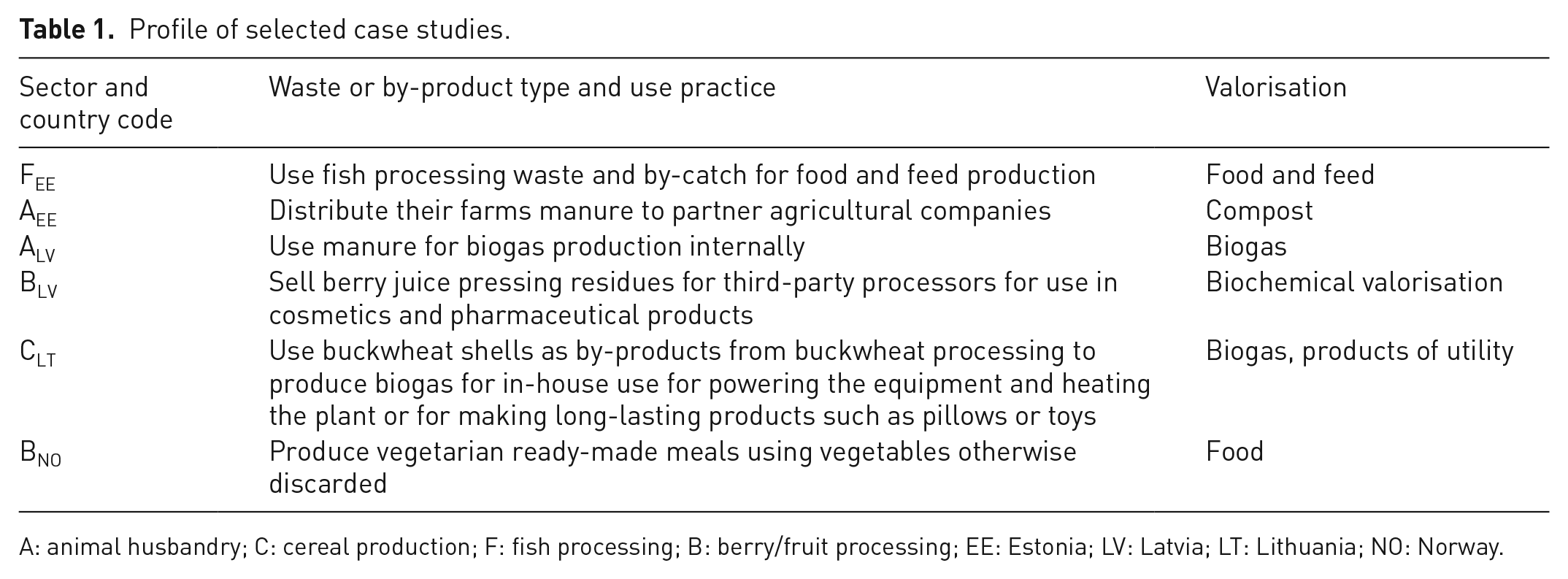
A: animal husbandry; C: cereal production; F: fish processing; B: berry/fruit processing; EE: Estonia; LV: Latvia; LT: Lithuania; NO: Norway.
Results and discussion
Our research proved that waste status matters but not for the reason we thought it did. In practice, managers rarely present strategic intent towards circular use of residues. More often, they are instead reactive and dependent on outside factors. This brought us to the conclusion that a basic framework to govern residues in the company would have an immediate effect.
Transparent governance can serve as a tool to inform managers of business benefits of circular economy principles. It can also inform policymakers of the economic potential held by the industry. The EU’s biggest import article (Eurostat, 2024a) of recyclable raw materials is animal and vegetal wastes (Eurostat, 2024b). Indicating that the EU’s primary food production could generate added value that we are today allowing to exit the EU economy.
However, more than awareness is needed to really change decision-making in a company. Identifying preset ‘trigger event’ scenarios can guide strategic decision-making to trade materials rather than dispose of waste.
Waste status matters
Utilisation of residues becomes dependent on legislative restrictions, technologies applied and management decisions. Our first hypothesis ‘that waste status matters’ derived from assumed administrative burden. In theory, companies would need to launch into EoW proceedings, take the risk of limited marketing outlets of waste material and cause a debatable depth of change. If residue is discarded, the company becomes subject to meeting EoW criteria for future proceedings with the material. Handling and trading waste requires a licence. That should not be expected from primary food producers or related trade partners.
We assume that a company would never be interested in handling waste and always pursue an EoW status or treat its residue as a by-product. We were curious to find causality between waste status, priority and integration of circular agricultural principles, and the depth of change required for achieving it. The biomass valorisation effort is described using the extent circular agriculture principles are integrated in the case study and the depth of change the valorisation represents (Table 2).
Valorisation of biomass and depth of change.
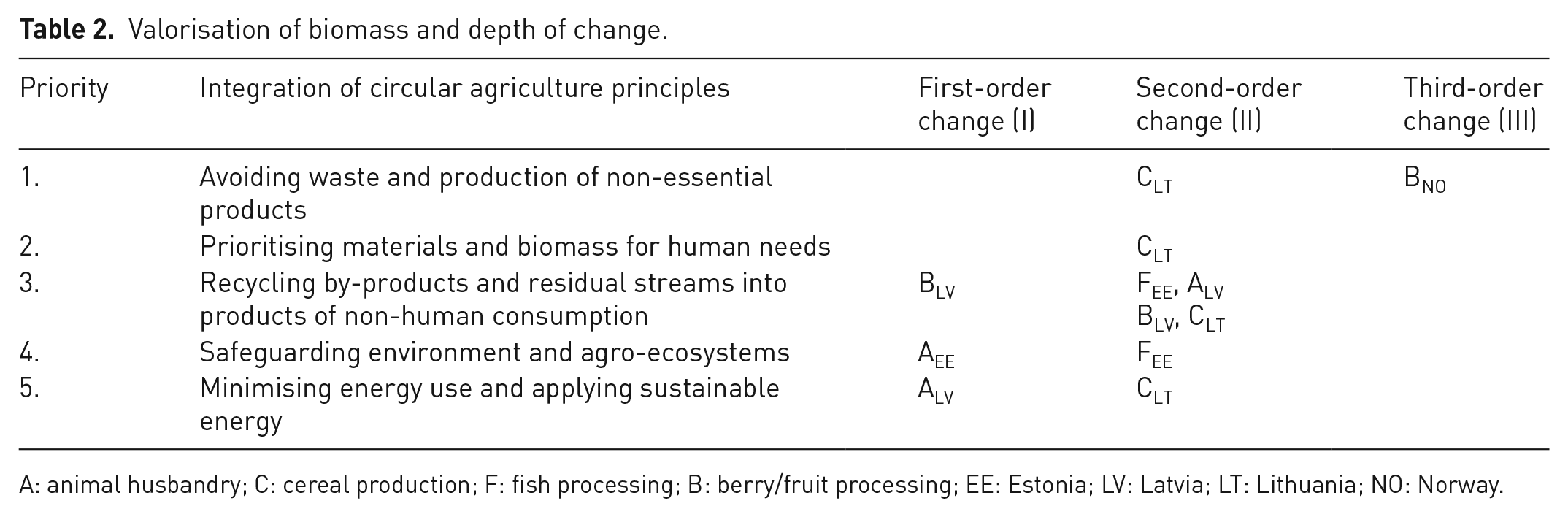
A: animal husbandry; C: cereal production; F: fish processing; B: berry/fruit processing; EE: Estonia; LV: Latvia; LT: Lithuania; NO: Norway.
This clustering gave us the perspective of case studies that show a higher transformative potential (or more ‘radical change’). On the one hand, it presents a higher likelihood to integrate circular agriculture principles in these companies (Hoogstra et al., 2024). On the other, it conflicts with meeting by-product or EoW criteria (further illustrated in Table 4) and increases the risk of facing regulatory restrictions.
In practice, we found that no company perceived their residues as waste. Most companies refrained from any classification of it or at best treated them as by-product (e.g. manure that is determined so in WFD by-default). Such business practices have worked for the case study subjects so far and have become a path-dependency. But they are also oblivious to the risks regulatory intervention may rise which in turn might harm business model sustainability. Public authority may come to a conclusion that residues should be classified as waste where they are not strictly categorised as by-products according to the law (Case C-238/21; Case C-241/12; Case C-242/12; Zanetti and Panepinto, 2023) and in fact they are not required to provide a decision at all (C-60/18).
However, acknowledging waste status does not seem appropriate either. Korhonen et al. (2018) have also underlined that it is difficult to define the exact moment when the material with economic value becomes waste with no or negative value. As a result, we claim that while greater depth of change may increase circularity in primary production, it may have the opposite effect to residue valorisation. A claim we further tested in our proceeding analysis. And while industrially the most often opted valorisation of residues is thermal treatment that many authors say is required in circular economy (Boloy et al., 2021; Lu, 2018; Van Caneghem et al., 2019), it is important to assess if primary food production is a suitable source. And furthermore, is there any need to create such a ‘final sink’ (Brunner and Morf, 2024) for materials that are unlikely to be hazardous?
A framework, procedure and/or incentives are needed to support waste prevention and use of bioresources at their highest possible value
Our second hypothesis was also refuted since none of the case studies had in place official nor internal procedures to govern the use of residues. The only exception was AEE, where manure that is legally a by-product is distributed to third parties under long-term contractual agreements. Most of the enterprises engaged in circularity quite pragmatically – ‘what benefits could circular resource use bring to the enterprise?’. During the interviews, the enterprises mainly presented the circular practice as a pragmatic/economic choice. In public discourse, resource circulation is framed as an environmentally responsible thing to do.
The question of how can one document EoW criteria such as ‘a substance or object is commonly used for a specific purpose?’ has been asked before (Villanueva et al., 2010). A company’s self-control system may in this case help avoid residues from ever becoming waste because of the idea of discarding being the central idea in waste definition. That makes the potential of valorising residue from primary food production a matter of management decision that could be guided by corporate policies and help address hesitant corporate culture – one of the main barriers to circular economy. The evolving ESRS adopted by the EC could give uniform grounds to standards and corporate policies.
Local policies should embrace ambiguity (Muscat et al., 2021a) and be guided by normal industry practices to ensure environmental and health safety but avoid interfering with material valorisation. Research on science–policy interaction has shown extensively that it can be a challenge to inform policy and practice, as evidence does not provide straightforward courses of action (Cairney, 2016). The risk of inhibiting bioresource valorisation in the highest possible value is high due to depth of change. Even lean but experimental transformations may pose risks (Bennett et al., 2016; Gorissen et al., 2018; Loorbach et al., 2020; Smith and Raven, 2012; Termeer and Metze, 2019). Fundamental changes that Hoogstra et al. (2024) has proposed to address the sustainability challenges would doubtlessly create barriers to circularity.
This raises the question if waste regulation is at all suitable to be applied in primary food production. The matter has been discussed by various authors. A suggested alternative approach to the waste category is needed to remove obstacles to circular economy (Hoernig, 2022; Li, 2015; Lees, 2018; Ragossnig and Schneider, 2019; Wilkinson, 1999) accompanied with further development of the EoW criteria (EEB, 2021).
The circumstantial and un-governed approach to residues gave us an opportunity to identify the immediate actions that could be taken by the company to set in place a self-control system to manage risks the legal definition rises (Table 4). Our analysis resulted in a basic framework (Table 3) that could pave the way to govern residues in the company and design trigger event scenarios.
Legal definition and distinction between end-of-waste and by-products (Art 3(1) of the WFD).
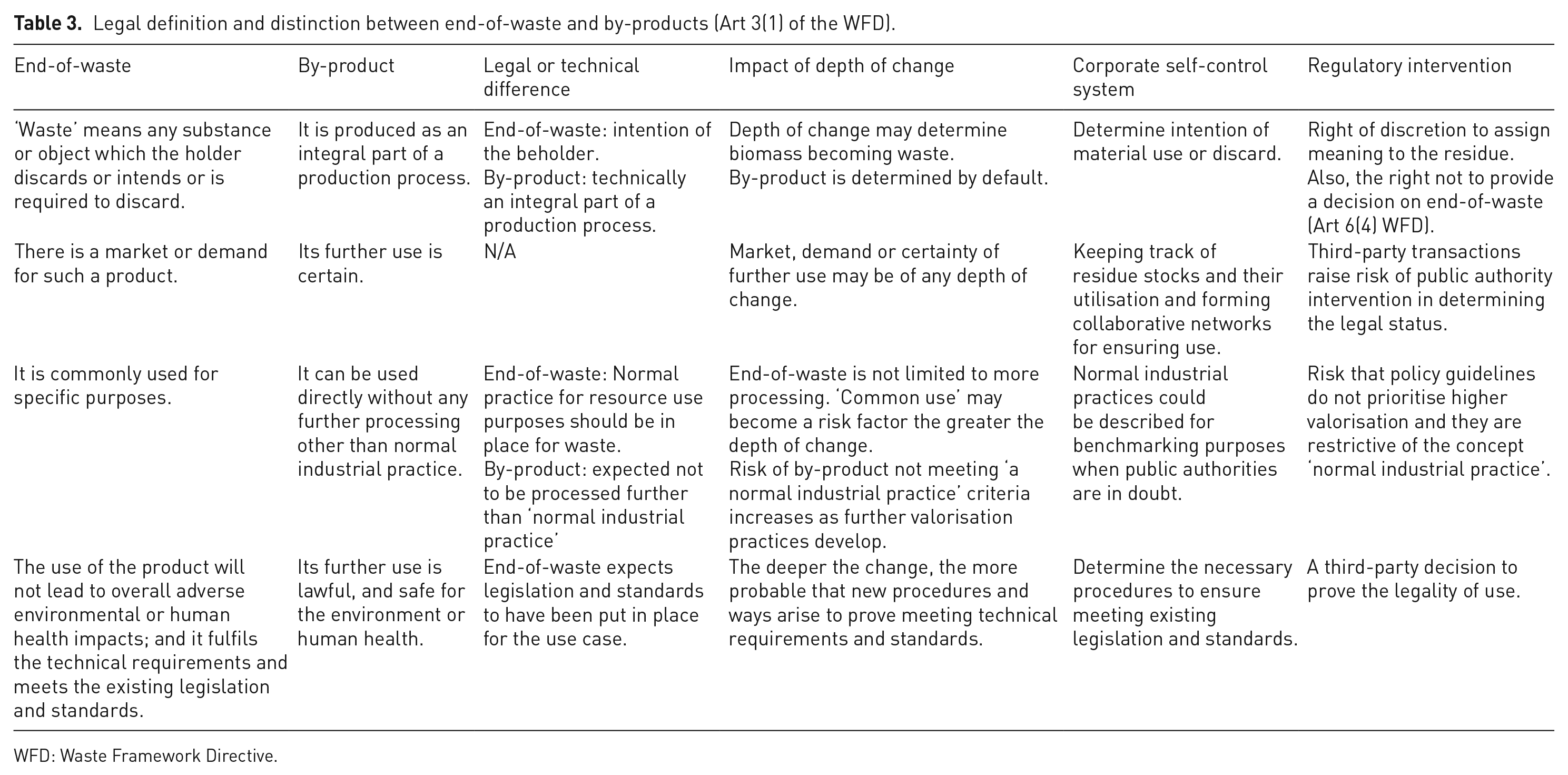
WFD: Waste Framework Directive.
The risk of depth of change on meeting by-product or end-of-waste criteria.
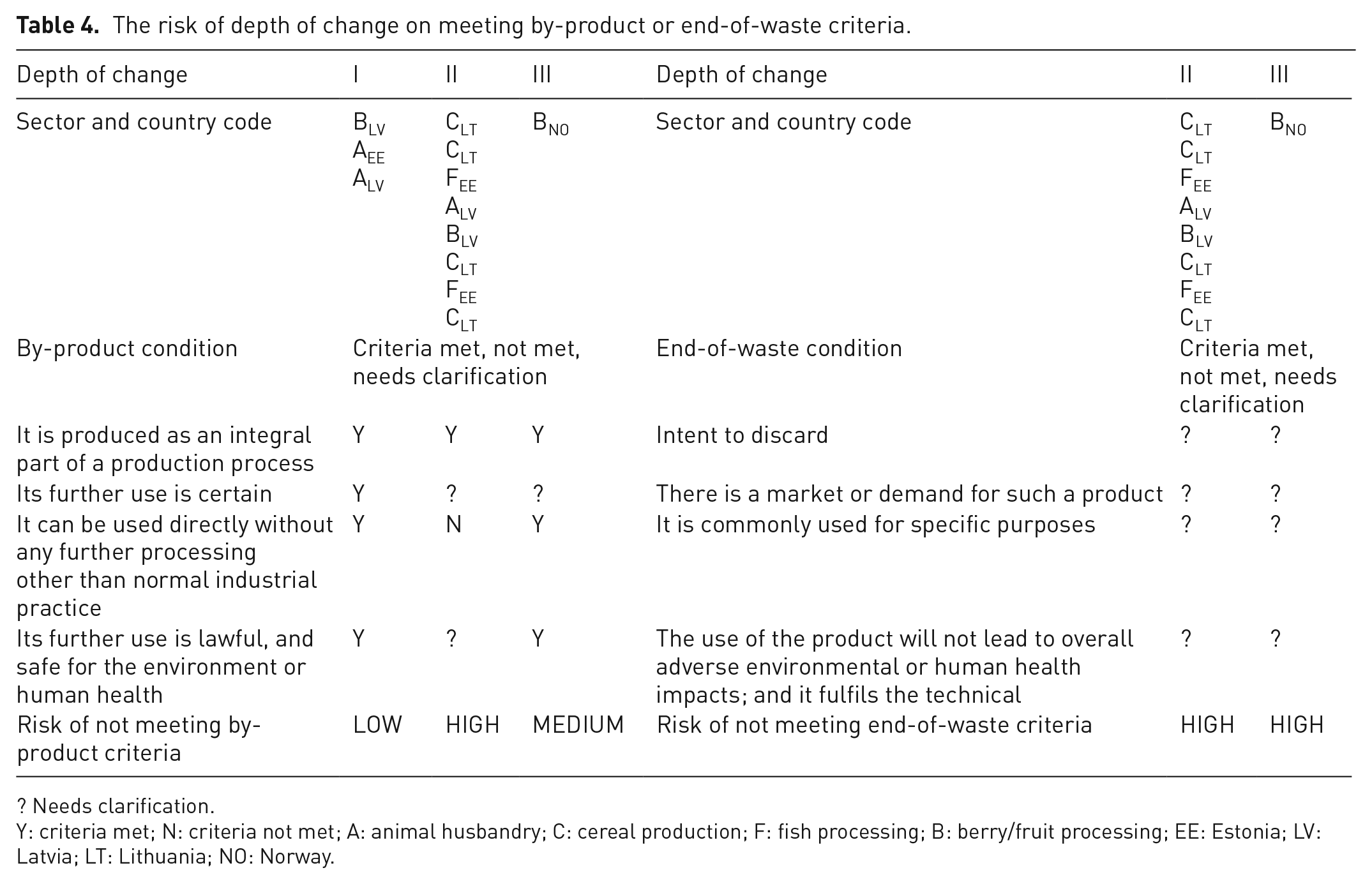
? Needs clarification.
Y: criteria met; N: criteria not met; A: animal husbandry; C: cereal production; F: fish processing; B: berry/fruit processing; EE: Estonia; LV: Latvia; LT: Lithuania; NO: Norway.
We investigated the conflict a lack of self-control system may potentially cause. For this we conducted a comparative analysis of the definition of by-product and EoW criteria relying on the case studies. We know that none of them classified their residues as waste. If these companies treated all their residues as by-products for easier valorisation, we are seeing risks arising.
The risk is calculated by checking off criteria of by-product listed in the WFD. When the second-order change occurs, at least one condition is not met, and it becomes difficult to determine some criteria without further investigation. As a comparison, if we treat the high-risk resources as waste, it becomes even more complicated to determine the suitability of applying the EoW criteria as per WFD (Table 3).
Lowest risk in by-product use occurs when the lowest value is added to it. This inherently limits transition to more circular food systems. The bigger the depth of change, the better for circularity, but the higher the risk of the need for procedural or even technical intervention to make its use legal. The more stakeholders become involved in the process, the higher the risk of public authority involvement. That may complicate or even impede the use of bioresources, such as the risk where the public authority may treat industrial symbiosis cases as waste transportation and treatment.
This suggests that the precautionary principle to mitigate environmental and health risks might be over-restricting in the primary production phase. Case study BNO illustrates an alternative to the EU approach. As long as there is no health hazard, there are no regulations that refrain the vegetables from being used as food production even if they have been discarded by the client (the supermarket chains) and novel practices are put in place to valorise them for human consumption. Under WFD, these aspects alone would impose a high risk of the vegetables becoming waste.
Impact of awareness of business benefits of circular economy principles on decision-making
When asked about limiting factors of higher valorisation, companies perceive different risks and obstacles related to technology and policies. Even if environmental sustainability was mentioned as a priority in the business model, the choices were primarily derived from cost efficiency consideration. From 12 case studies, only 2 clearly expressed environmental concerns as a key motivator to engage with the circular practices.
While the depth of chance analysis expressed transformative potential in most of the case studies, the interviews confirmed previously studied realities. Managers in primary food production fail to act upon strategic intent but are reactive when it comes to residue management.
We identified four key considerations that motivated enterprises to look for ways to close bioresource loops: (i) creating new products; (ii) reducing costs; (iii) optimising the use of resources and (iv) implementing solutions due to regulatory demand. Companies using bioresources have realised the circular economy principles as an opportunity to increase revenue, but not all have set goals to manage environmental impact. They are swayed by economic benefits to use bioresources in a circular manner.
A consequence of this finding is that an external trigger – an EU wide protocol – would be impactful to guide managers in following EoW guidelines in primary food production. We suggest that there is a need for clear guidelines for managers on how preset targets (‘trigger event’ scenarios) could create transparency in residue management and to inform trade partners and public authority of the essence of the residue.
The preset target could be readiness to react to the opening EU funding opportunities related to the EU Farm to Fork strategy (EC, 2020). By identifying most impactful intervention points and approaching them step-by-step, a company can become economically more resilient and help residues be valorised in the process.
Residue management requires not only change management and custom planning internally, but also an intent by different stakeholders. The 120 initially analysed cases illustrated that successful attempts to benefit from waste or by-products often is a collective effort of several companies. A preset target for one company could simultaneously benefit many stakeholders at once. This can mean that companies more open to collaborative efforts may be able to adopt sustainability governance without much effort thanks to the work done by their peers.
Conclusions
It turned out that none of the companies treat residues from the primary production as waste in its legal meaning, but as raw material or left-overs that were transformed into end-consumer products, sold to third parties as input material or used in production to avoid alternative cost. This appears to be a very good example of the use of resources, but the approach is haphazard and may conflict with official understanding and waste reporting requirements. Definition of waste is the same in the EU, and arbitrary treatment can be misleading. There is a need for better management of the material flow, and we recommend that systematic approach in management decisions be addressed by introducing ESG and a self-control system.
We found that there is a need for promoting factors through specific framework, procedure and incentives. These singularly or in combination would support or even enable policymaking and industry practices for valorisation of bioresources. Examples of such could be:
Industrial symbiosis, that is, creating integrated cycles of residues between networks of industrial actors in order to maximise economic value and assuring cascading use.
An EU wide protocol for bioresources, under which waste ceases being waste and becomes raw material again.
Standards between participating actors to manage risks associated with waste and by-product use;
Harmonised data collection system to account residues and their use in primary food production.
A problematic issue is the waste hierarchy and existing presentations of material loops that assume waste generation at the level of end-consumer while the EoW regulation is applied equally to any kind of waste regardless of the product life cycle stage it occurs in. Causes for residues in primary food production are unique to the sector and thus prioritisation for their use should be considered accordingly. This would enable a clearer classification of residue types and to re-evaluate if protecting nature and humans from contaminated and discarded materials the way EoW regulation intends, is at all relevant. For example, if an alternative ‘waste hierarchy’ in the primary production phases would address the three planetary crises, if and how could there be a ranking between avoiding pollution, mitigating climate change and securing biodiversity?
Finally, the absence of governance systems for residual bioresource management makes it impossible to evaluate if awareness of business benefits of circular economy principles would result in their adoption. We suggest ‘triggering change’ cycle is substantial to use in further research to identify if this approach is suitable to develop preset ‘trigger event’ scenarios for primary food producers in the process of designing residue management policies.
Further research across the EU and non-EU jurisdictions can benefit the sector at large since waste and by-products increasingly also travel across borders.
This study has some limitations in the selection process of the case studies. It only covers a small number of agents. Furthermore, this analysis addresses policy relevant research for EoW only in the studied countries and must be adapted to process in other countries or between companies from different geographical scales.
Supplemental Material
sj-docx-1-wmr-10.1177_0734242X241276088 – Supplemental material for No such thing as waste in primary food sector
Supplemental material, sj-docx-1-wmr-10.1177_0734242X241276088 for No such thing as waste in primary food sector by Kadi Kenk, Kristiina Kerge, Mait Kriipsalu, Mikelis Grivins, Jostein Brobakk and Rando Värnik in Waste Management & Research
Footnotes
Declaration of conflicting interests
The authors declared no potential conflicts of interest with respect to the research, authorship, and/or publication of this article.
Funding
The authors disclosed receipt of the following financial support for the research, authorship, and/or publication of this article: Baltic Research Programme No. EEZ/BPP/VIAA/2021/9: Promoting collaboration for sustainable and circular use of bioresources across agriculture, forestry and aquaculture (CIRCLE) is acknowledged for funding the research. Companies which were interviewed in Estonia, Latvia. Lithuania and Norway are acknowledged for their effort and contribution in describing the sustainable development strategy of their companies.

Supplemental material
Supplemental material for this article is available online.
References
Supplementary Material
Please find the following supplemental material available below.
For Open Access articles published under a Creative Commons License, all supplemental material carries the same license as the article it is associated with.
For non-Open Access articles published, all supplemental material carries a non-exclusive license, and permission requests for re-use of supplemental material or any part of supplemental material shall be sent directly to the copyright owner as specified in the copyright notice associated with the article.
