







Abstract
This research examines the impact of environmental (dis)amenities on residential rental values in the urban areas of Rawalpindi and Islamabad, Pakistan. Using a unique dataset of 849 households and geospatial data on 35 irregular dumpsites, we quantify how proximity to environmental disamenities depresses rental prices. Specifically, results confirm that irregular dumpsites significantly depress rental values, especially for properties situated near the closest distance rings. The analysis employs a hedonic pricing model, complemented by instrumental variable (IV) mediation analysis and machine learning (ML) classification models, such as Naïve Bayes, k-nearest neighbours (k-NN) and classification trees, to explore both causal relationships and predictive patterns. The IV mediation approach confirms that the presence of odorous sewers significantly mediates the negative effect of dumpsites on rent. ML models, particularly k-NN, demonstrate high predictive accuracy (>90%) in identifying high-rent properties based solely on environmental variables. These findings emphasise the economic cost of environmental degradation in urban housing markets and highlight the necessity of stricter waste management policies and improved sanitation infrastructure to drive sustainable urban development.
Keywords
Introduction
Housing serves a dual role in society, functioning not only as a place of residence but also as an investment, a notion supported by the dynamics of house rental prices (Umeh and Oladejo, 2015). The value of a house is influenced by a multitude of factors, including its location, quality, neighbourhood characteristics, amenities and environmental factors (Babalola et al., 2013; Zoppi et al., 2015). In this multifaceted framework, a house encompasses various dimensions, including size, local facilities and community cleanliness (Kiel, 2006).
Conversely, rental rates are contingent on structural, locational and environmental factors (Irfan, 2007; Ooi et al., 2014). Households predominantly weigh elements such as construction quality, location and community features when making decisions related to rentals (Ardeshiri et al., 2016; Ooi et al., 2014; Schläpfer et al., 2015). Additionally, the rental value of a house is intricately linked to its environmental surroundings. An abundance of public amenities tends to boost house values, whereas a shortage of such amenities tends to erode them (Zoppi et al., 2015). Areas characterized by superior neighbourhoods and enhanced environmental amenities tend to attract higher-income households (Islam et al., 2020). For instance, an upgraded sewerage system can substantially elevate house rents, whereas the housing prices typically decline in areas plagued by environmental drawbacks (Irfan, 2007; Islam et al., 2020).
Notably, environmental attributes such as green spaces, parks and watersheds also exert a considerable influence on housing prices (Jim and Chen, 2006). Smith (2010) reported that the presence of green space within a 1-km radius can elevate home prices by 0.08%. Moreover, house rent often increases by 1.9–2.9% when located within 600 m of a regional or metropolitan park. In contrast, proximity to waste landfilling facilities tends to diminish property values (Smith, 2010). The housing market constitutes a complex interaction of factors, with residential properties serving the dual role of shelter and investment. Extensive knowledge of the complicated web of explicit and implicit attributes influencing housing prices and rental values holds paramount importance not only from an economic analysis perspective but also for the formulation of sound policy.
This research seeks to rigorously evaluate the impact of environmental (dis)amenities on rental values within the twin cities of Pakistan. To achieve this, we employ a hedonic pricing model (HPM), a well-established analytical framework in economics. The HPM, rooted in the principles of revealed preference theory (Rosen, 1974), quantifies the price of a good by accounting for the diverse attributes of interest associated with that good. Through the examination of the interplay between environmental attributes and rental values, this study endeavours to provide a comprehensive analysis of the interactions within the urban housing market of Islamabad and Rawalpindi. It is within this context that this research aims to contribute to the body of knowledge concerning the complex relationship between environmental (dis)amenities and housing prices, thereby offering key insights for urban planning and housing policy formulation in the twin cities of Pakistan.
The development landscape in the twin cities of Islamabad and Rawalpindi exhibits distinctive characteristics. In Islamabad, residential areas are meticulously planned and overseen by the Capital Development Authority (CDA), ensuring a structured and regulated urban development process. In contrast, Rawalpindi follows a more generic, less planned approach to urban development. Consequently, the willingness of households to pay for environmental (dis)amenities within the urban housing sector is anticipated to be intricately influenced by the varying dynamics of urban development in these two cities.
This research makes a distinctive contribution both empirically and methodologically. Firstly, it utilises a unique dataset encompassing housing properties in Pakistan, capturing their characteristics and environmental attributes. Secondly, it addresses a gap present in much of the existing literature by providing evidence on the impact of environmental attributes, specifically irregular dumpsites, on housing prices. Thirdly, and significantly, it employs an innovative empirical approach, leveraging machine learning (ML) techniques that encompass both classification and regression models to analyse the complex relationship between housing properties and environmental attributes.
The primary objective of this study is to conduct a rigorous examination of the externalities stemming from irregular dumpsites on residential property values in the Rawalpindi–Islamabad region. Although prior research has commendably explored various socio-economic aspects, a noticeable gap exists, especially with regard to the adverse influence of the proximity of irregular dumpsites on the rental values of nearby properties. Consequently, this study aims to fill this void in the current body of research by thoroughly exploring the consequences of the externality introduced by irregular dumpsites on neighbouring property values. The overarching goal is to unravel the complex mechanisms governing property valuation and to identify key property determinants that have the ability to affect property values near small-scale irregular dumpsters in Pakistan.
In essence, this research endeavour stands as a robust contribution to the understanding of the complex interplay between irregular dumpsites and property values. By adopting a systematic and rigorous empirical approach, this research seeks to offer significant understanding for urban planning and policy formulation, clarifying the dynamics that govern property valuation in the vicinity of small-scale irregular dumpsters within the context of Pakistan.
This work contributes not only empirically but also theoretically by extending the application of the HPM to incorporate both causal mediation mechanisms and predictive analytics. Specifically, it integrates instrumental variable (IV) mediation analysis to disentangle the direct and indirect effects of environmental disamenities, thereby addressing endogeneity concerns that are often under-theorized in hedonic studies. Additionally, the adoption of ML techniques introduces a novel methodological layer that captures non-linearities and interaction effects in housing valuation. This dual-framework approach advances theoretical understanding of how environmental externalities are capitalized into rental prices, offering a more comprehensive lens through which to view the valuation of urban disamenities. By merging traditional economic theory with modern computational methods, the study enriches the literature on urban environmental valuation. It lays the groundwork for future research in similarly complex, data-rich urban environments.
The rest of the article proceeds as follows. Sections ‘Literature Review’ and ‘Theoretical model’ of this study elucidate the literature review and the theoretical framework underpinning the research. Section ‘Methodological framework’ describes the empirical framework. Within section ‘Data collection and survey design’, the sampling methods and item measurements employed in the study are expounded upon, providing the necessary foundation for the subsequent empirical analysis. Section ‘Description of the dataset’ describes the dataset in detail, reporting the relevant descriptive statistics. In section ‘Empirical results’, the findings arising from the empirical analysis are presented and discussed. This section serves as the interpretative nexus of the research, where the implications and nuances of the analytical outcomes are dissected in detail. Finally, Section ‘Conclusion and policy implications’ serves as the close of the study, encapsulating the conclusions drawn from the research and elucidating the policy implications that emanate from the empirical insights.
Literature review
The escalating urban population growth in developing countries has led to an exponential increase in the demand for urban housing. This demographic shift has, in turn, placed substantial pressure on urban housing markets. Curiously, there is a lack of empirical evidence regarding the determinants of environmental (dis)amenities that affect housing prices. Only a limited number of studies, exemplified by Irfan (2007), have effectively identified a noteworthy relationship between (dis)amenities and the rental value of residential properties. However, a recent body of research has begun to shed light on the major role played by environmental attributes in shaping the urban housing landscape. These studies have revealed significant relationships between various environmental factors, including noise pollution, proximity to landscapes, urban wetlands, the distance from landfill sites and housing prices (e.g., Du and Huang, 2018; Xiao et al., 2019; Zambrano-Monserrate and Ruano, 2019).
Nelson et al. (1992) and Reichert et al. (1992) highlighted a negative correlation between distance from landfills and property values. Lim and Missios (2007) found that larger landfills have a more substantial impact on housing prices. Gamper-Rabindran and Timmins (2013) emphasised the significant effect of removing hazardous waste sites on house rents. In contrast, Hite et al. (2001) presented an intriguing case, demonstrating an 18–20% increase in house rent within a 3.25-mile radius of landfills in specific U.S. areas. These findings suggest that environmental amenities associated with urban containment boundaries can shift the demand curve outward, whereas the supply constraints imposed by such boundaries bring about an inward shift in the supply curve (see Dawkins and Nelson, 2002). Understanding this interplay has broad implications for urban policies, including zoning regulations, temporal dynamics in housing demand and supply and housing market segmentation (Jun and Kim, 2017). The significance extends beyond economics to encompass broader aspects of environmental and urban governance.
The adverse effects of improper waste management on property values have been extensively explored, with scholars utilising waste as a lens to investigate various aspects of environmental politics, social behaviour, urban history, social regulation and governance (e.g. Bulkeley and Askins, 2009). The economic impact of waste disposal sites on neighbouring residential properties is of vital importance, as price differences among comparable homes solely due to proximity to waste disposal sites offer an understanding of the welfare consequences for households residing nearby.
In the context of global environmental issues, solid waste management has garnered substantial attention, particularly in urban settings (Ashraf et al., 2016; Magazzino and Falcone, 2022). Integrated solid waste management systems (WMSs) and advanced recycling techniques have been adopted in developed nations to address environmental externalities, whereas developing countries grapple with challenges related to waste segregation, enforcement of regulations and unregulated open dumping (e.g., Magazzino et al., 2020; Oteng-Ababio, 2014; Soma et al., 2020).
Sustainable household waste management is imperative due to factors such as rapid population growth and urbanisation, with challenges persisting in developing countries like Pakistan. These challenges include insufficient infrastructure and environmental information, financial and administrative limitations, inadequacies in legislative frameworks and low household participation in waste segregation and recycling activities (Ashraf et al., 2016; Batool et al., 2008). Similar issues related to environmental information have also been noted in other contexts (see Bartiaux, 2008).
The literature extensively examines the ramifications of regulatory frameworks on recycling practices and waste reduction decisions. Three distinct domains of attributes, situational factors, background variables and cognitive elements, are important in understanding the multifaceted landscape of waste management behaviours (Barr, 2007; Schahn and Holzer, 1990; Zhang et al., 2019). Environmental concerns and knowledge, local sustainability policies, behavioural strategies and psychological motivations are key determinants of recycling behaviour, with intrinsic motivation and a sense of ‘environmental citizenship’ playing major roles (see, for example, Chan, 1998; De Young, 1986; Hopper and Nielsen, 1991; Selman, 1996).
The nexus between individual perceptions of environmental challenges and the impact of their behaviour on the overall well-being is highlighted, emphasising the significance of self-efficacy and environmental citizenship in shaping individual environmental behaviour (Ofstad et al., 2017; Séguin et al., 1998; Steel, 1996; Xu et al., 2018). The application of psychological constructs to decipher household responses and perceptions to waste segregation behaviours is measured via life cycle assessments, recognising the cognitive dimensions that influence household judgements concerning the potential adverse repercussions of waste and climate change on human health (Cardwell and Elliott, 2013; Choon et al., 2016; Yadav and Samadder, 2018). This cognitive understanding holds promise for formulating effective waste management strategies and cultivating sustainable behaviours within households and communities.
Theoretical model
Empirical investigations employing the well-established HPM have consistently illuminated the influence of various intrinsic housing characteristics on property values. Nonetheless, the effect of exogenous factors, which is contingent upon both house location and neighbourhood attributes, has yielded a body of literature characterized by mixed findings. HPM serves as a cornerstone in the realm of housing economics, providing a robust analytical framework for evaluating rental values associated with residential properties. In the scholarly literature, it has garnered significant attention owing to its capacity to discern and quantify the subtle factors contributing to housing costs, specifically focusing on environmental and physical attributes that shape the implicit costs of housing (see Schläpfer et al., 2015). Within this paradigm, the HPM facilitates the computation of rental value fluctuations consequent to infinitesimal variations in environmental attributes while diligently controlling for a comprehensive set of other determinants, frequently encapsulated under the umbrella term ‘structural and neighbourhood attributes’ (e.g., Hite et al., 2001).
A foundational premise underpinning the HPM is rooted in the concept that utility-maximizing consumers exhibit a willingness to allocate differential monetary resources for the diverse attributes of housing commodities, thereby manifesting their valuation of these attributes (Wen et al., 2015). This implies that households, in their pursuit of optimising utility, actively consider and weigh the importance of individual housing characteristics when deciding on a residence, taking into account their respective budget constraints.
Past scholarly endeavours, exemplified by Freeman et al. (2014), have offered significant insights by establishing a clear and empirically supported connection between environmental amenities and, by contrast, (dis)amenities in tandem with the structural and neighbourhood features of residential properties and their direct impact on rental values. These investigations have shed light on the complex decision-making processes undertaken by households when optimising their utility functions in the context of housing. In this deliberative process, households meticulously evaluate the myriad attributes that a housing unit offers, all while maintaining a keen awareness of their financial constraints.
HPM plays a major role in the realm of real estate economics, offering a thorough system for evaluating the value associated with various attributes of residential properties. It operates on the fundamental premise that a house is not a homogeneous commodity but rather a complex bundle of heterogeneous characteristics. These characteristics encompass a wide array of factors, including structural attributes, environmental conditions and neighbourhood features, all of which collectively influence a property’s market price. HPM serves as a quantitative tool to discern and quantify the preferences of potential buyers for these distinct attributes.
Crucially, the choice to take the natural logarithm of the rental price is guided by empirical considerations and statistical methodologies. By employing the natural logarithm, the data distribution of the dependent variable is rendered more amenable to analysis. Furthermore, this transformation facilitates the interpretation of coefficients in terms of elasticities (Wooldridge, 2015). 1
In essence, HPM equips researchers and policymakers with an important tool to dissect the complicated web of factors that contribute to property valuations. It allows us to discern not only the individual impact of structural, environmental and neighbourhood attributes but also the interplay between them. This comprehensive understanding is indispensable for making informed decisions in real estate markets, urban planning and environmental management.
Specifically, environmental disamenities such as proximity to dumpsites can significantly influence housing demand, and thus rental values, through several interrelated economic, health and behavioural channels. Firstly, dumpsites generate negative externalities – unpriced costs borne by nearby residents in the form of foul odours, vermin, visual blight and increased health risks due to the spread of pathogens or groundwater contamination. These factors reduce the perceived liveability and safety of an area, thereby lowering tenants’ willingness to pay for housing in proximity to such sites. Secondly, information asymmetry can moderate or delay the market’s response to environmental disamenities. In informal rental markets or areas with weak institutional capacity, tenants may lack a full understanding of long-term health and environmental risks. As a result, rental prices may not immediately reflect the true disutility associated with living near a dumpsite, though over time, word-of-mouth and observed deterioration in conditions can reinforce price depreciation. Thirdly, socio-economic sorting plays a role. Lower-income households with limited housing options may be forced to accept cheaper accommodation in less desirable areas, including those near dumpsites. This dynamic can lead to a clustering of disadvantaged populations in environmentally degraded areas, perpetuating spatial inequality and reinforcing lower market values.
Despite the dominant expectation of a negative effect, it is theoretically possible to observe no significant effect or even a modest positive association, under specific conditions:
If a dumpsite is inactive or well-managed, its externalities may be minimal or mitigated.
If the surrounding area has offsetting amenities, such as proximity to a central business district, transportation hub or employment centres, tenants may accept the trade-off, keeping rents stable.
In dense urban areas with high housing demand and low vacancy, even environmentally compromised units may command relatively high rents due to scarcity, masking the disamenity effect in aggregate data.
Ultimately, the observed effect of dumpsite proximity on rent depends on local context, tenants’ income and preferences and the severity and visibility of environmental degradation. In this study, we test not only whether proximity to irregular dumpsites reduces rent but also whether intermediate factors, such as odour from open sewers, mediate this relationship, using an IV mediation framework to isolate the causal chain.
Methodological framework
This study employs a structured empirical approach to analyse how environmental amenities (or disamenities) affect rental prices in the urban housing markets of Rawalpindi and Islamabad. To ensure both analytical rigour and robustness, we employ a three-step methodology combining traditional econometric models and modern ML techniques, each selected for their specific strengths and relevance to our research objectives.
Step 1: Hedonic pricing via pooled regression
We begin with HPM estimated through pooled ordinary least squares (OLS) regression. This method captures how structural, neighbourhood and environmental attributes individually influence rental prices. Although fixed effects are typically used to control for unobserved regional characteristics, our cross-sectional design and multicollinearity constraints necessitate the use of pooled OLS instead. Despite its limitations, this approach provides an interpretable and well-established baseline for assessing housing market dynamics.
Step 2: IV mediation analysis for causal insight
To account for endogeneity and explore causal pathways, we apply IV mediation analysis using the ivmediate command in STATA. This method disentangles the total effect of environmental disamenities (such as irregular dumpsites) into direct and indirect components, the latter mediated through odorous sewers. The use of ‘open sewer’ as a valid instrument addresses confounding biases in both the treatment and mediator variables. This step introduces an additional dimension of causal interpretation that traditional regression cannot provide.
Step 3: ML for robustness and prediction
Lastly, we incorporate ML classification models (Naïve Bayes, k-nearest neighbours (k-NN) and classification trees) to corroborate our findings and explore non-linear patterns. These models predict whether a property’s rental price falls above specific percentiles based solely on environmental attributes, offering a practical lens on the predictive power of these factors. We also employ regularized regression techniques (Ridge and Lasso) as robustness checks to test the stability and relevance of predictors under penalization.
This integrated approach enables us to navigate the complexities of housing market dynamics, providing a detailed analysis of the interdependencies among variables and their collective impact on rental prices.
Pooled regression analysis
The first empirical step concerns the use of a pooled regression model. This analytical approach blends different temporal observations across the two cities, effectively capturing both cross-sectional and time-series variations inherent in the data.
A key aspect of the model is its absence of fixed effects, which are typically associated with panel data analysis. Instead, we treat the dataset as pooled cross-sectional data, which may lead to some important limitations. One prominent limitation is that we cannot include fixed effects due to the issue of multicollinearity. These fixed effects account for unobservable yet consistent regional idiosyncrasies that could exert a lasting influence on rental prices but remain unchanged over time. These idiosyncrasies, such as region-specific policies, cultural nuances or geographic characteristics, may greatly influence rental prices, but the presence of multicollinearity might distort the results.
Moreover, in the pooled regression model, we handle an extensive set of dummy variables, which represent different structural, environmental and neighbourhood attributes and regional identifiers. The high dimensionality of the dataset with numerous dummy variables can lead to multicollinearity and a substantial increase in model complexity, potentially causing issues related to overfitting. Consequently, we ought to exercise caution when interpreting the results, as the estimated coefficients for these variables may be unstable or exhibit counterintuitive behaviour. Despite these limitations, a pooled regression model remains a valuable tool for identifying the relationships between various attributes and rental prices.
Structural equation modelling analysis via ivmediate
In the realm of housing research, unravelling the complex relationships among environmental attributes, housing prices and their mediated effects is crucial. Researchers often explore how a treatment variable (T), representing an environmental attribute, influences an outcome of interest (Y), such as housing prices, through an intermediate factor (M). This analysis, akin to mediation analysis, seeks to disentangle the total effect of the environmental attribute on housing prices into two components: the ‘Indirect’ effect operating through an intermediate variable (M) and the ‘Direct’ effect that does not involve M.
However, a methodological challenge arises when both the environmental attribute and the intermediate factor are potentially endogenous, indicating the presence of unobserved factors influencing both. In the context of housing research, this challenge is particularly relevant given the potential endogeneity of environmental attributes and housing prices. Utilising IVs is a common strategy to address endogeneity concerns. Yet, as illustrated in Figure 1, there are instances where only a single IV, denoted as Z, is available to address endogeneity.
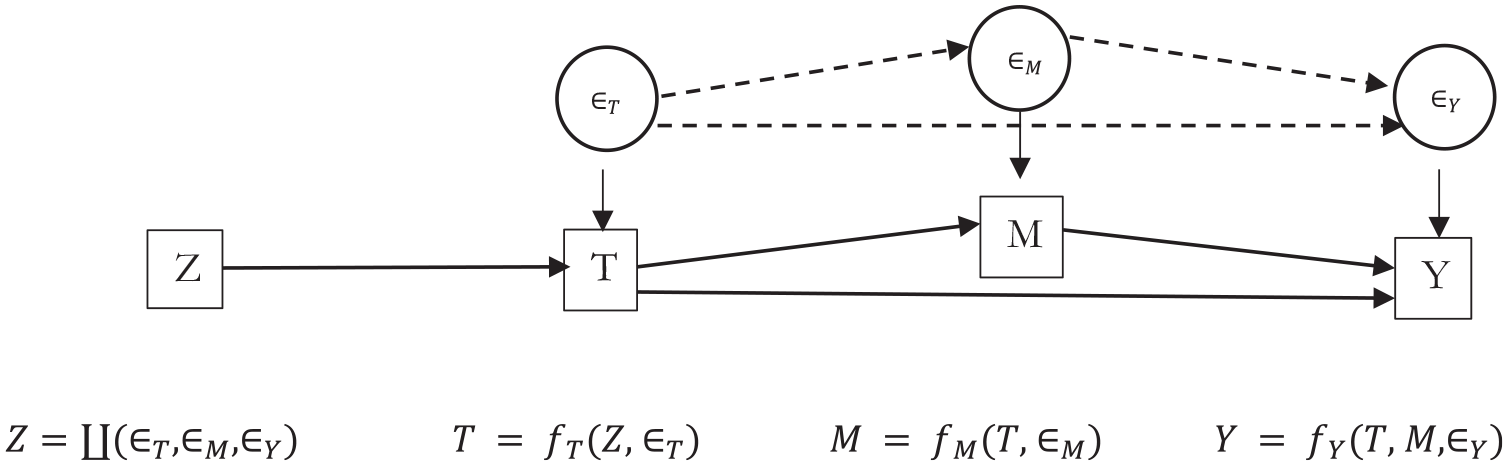
IVs in mediation models.
To address this specific challenge in the housing research context, the ivmediate STATA command (see Dippel et al., 2020) becomes essential. According to Dippel et al. (2020), this regression command offers a novel approach enabling scholars to employ a single IV to estimate the causal impact of the intermediate variable (the environmental attribute’s effects) on the final outcome (housing prices). This approach becomes a valuable tool, providing a solution to the methodological gap in estimating causal mediation effects when dealing with endogeneity in both environmental attributes and housing prices. The ivmediate command is particularly relevant when separate instruments for T and M are challenging to obtain.
Dippel et al. (2019, 2020) proposed an approach to address under-identification issues in causal inference models, suggesting that endogeneity may arise from shared confounders influencing both the treatment and intermediary variables. They advocate for a two-stage least squares regression under specific conditions, eliminating the need for additional instruments. Here, this methodology is applied to examine the mediated indirect effect of environmental (dis)amenities on house renting prices, specifically connecting ‘Open Sewer’ as an instrument for the mediator ‘Odour Sewer’ in the relationship between ‘Irregular Dumpsite’ and ‘House Rent’. This analytical framework clarifies the dynamics of negative externalities caused by environmental (dis)amenities.
ML analysis
In ML analysis, the dataset is divided into training and testing sets to evaluate the model’s performance and assess its generalisation to previously unobserved data (e.g., Fernández-Delgado et al., 2014; Hastie et al., 2009). 2 The evaluation process centres around the confusion matrix, a foundational element that categorizes model predictions into true positives, true negatives, false positives and false negatives (Powers, 2011). This categorization enables a comprehensive view of predictive accuracy and precise measurement of metrics such as precision, recall and overall performance.
Naïve Bayes, a probabilistic classification technique, relies on Bayes’ theorem and assumes conditional independence of features. Despite its ‘naive’ assumption, Naïve Bayes performs well in various applications (e.g., Kowsari et al., 2019). 3 It calculates class probabilities efficiently, being suitable for high-dimensional data. Although k-NN, a non-parametric instance-based learning method, predicts based on the majority class among the k-nearest data points. 4 It is intuitive, flexible and applicable in different fields (Syriopoulos et al., 2025). k-NN is particularly valuable when dealing with complex and non-linear decision boundaries, with parameters like k and the distance metric requiring careful tuning for optimal performance.
Furthermore, in our empirical analysis, classification trees serve as a decision-making structure to predict housing prices based on environmental attributes. These trees recursively partition the feature space into subsets, offering transparency, adaptability and robust handling of missing data. As a complement, we utilise diagnostic metrics like Gini’s Impurity, Entropy and Information Gain to evaluate the quality of the decision-making process (Breiman et al., 1984; Mullainathan and Spiess, 2017; Quinlan, 1986).
However, as additional robustness checks, regularized linear regression techniques (i.e. Ridge and Lasso regressions) are also implemented. Ridge regression addresses multicollinearity by constraining coefficient magnitudes through a penalty term (L2 regularization). It does not lead to feature selection, maintaining predictive capacity (Hoerl and Kennard, 1970). On the other hand, Lasso regression includes a feature selection property, driving some coefficients to zero as the penalty parameter increases (Tibshirani, 1996). Both techniques enhance the resilience and reliability of the predictive models, confirming the relevance of environmental factors in predicting housing prices.
Data collection and survey design
The study focuses on Islamabad and Rawalpindi, managed by the CDA and Rawalpindi Waste Management Company, respectively. Islamabad exhibits meticulous urban planning and a well-orchestrated sanitation system, whereas Rawalpindi represents an unplanned urban milieu with sanitation infrastructure shortcomings. The study area is chosen due to prevalent tenancy arrangements, with 41% of households in Islamabad and 23% in Rawalpindi residing in rented accommodations. Islamabad’s WMS is efficient, but open dumping is widespread due to the absence of dedicated landfill facilities. Rawalpindi faces disposal issues contributing to water source contamination and air quality deterioration. These environmental and waste management challenges justify the study’s focus on this geographic area.
Data acquisition for the research utilised a structured questionnaire, designed to cover critical factors influencing waste management and their implications on the environment, public health and the housing market. The study adhered to the Pakistan Bureau of Statistics’ household definition and engaged with stakeholders to enhance data quality. Secondary data sources, including Pakistan Social and Living Standards Measurement and Household Integrated Economic Survey datasets, provided contextual information on socio-economic, demographic and urban planning dimensions. While valuable, these datasets did not address behavioural dimensions, prompting the design of a questionnaire capturing sophisticated aspects of waste management practices and household behaviours.
Figure 2 lists and describes the dependent and independent variables in the interview schedule. The monthly house rent (in Pakistani rupees, PKR) is the dependent variable. House rent is associated with house structure, neighbourhood and embedded environmental amenities.
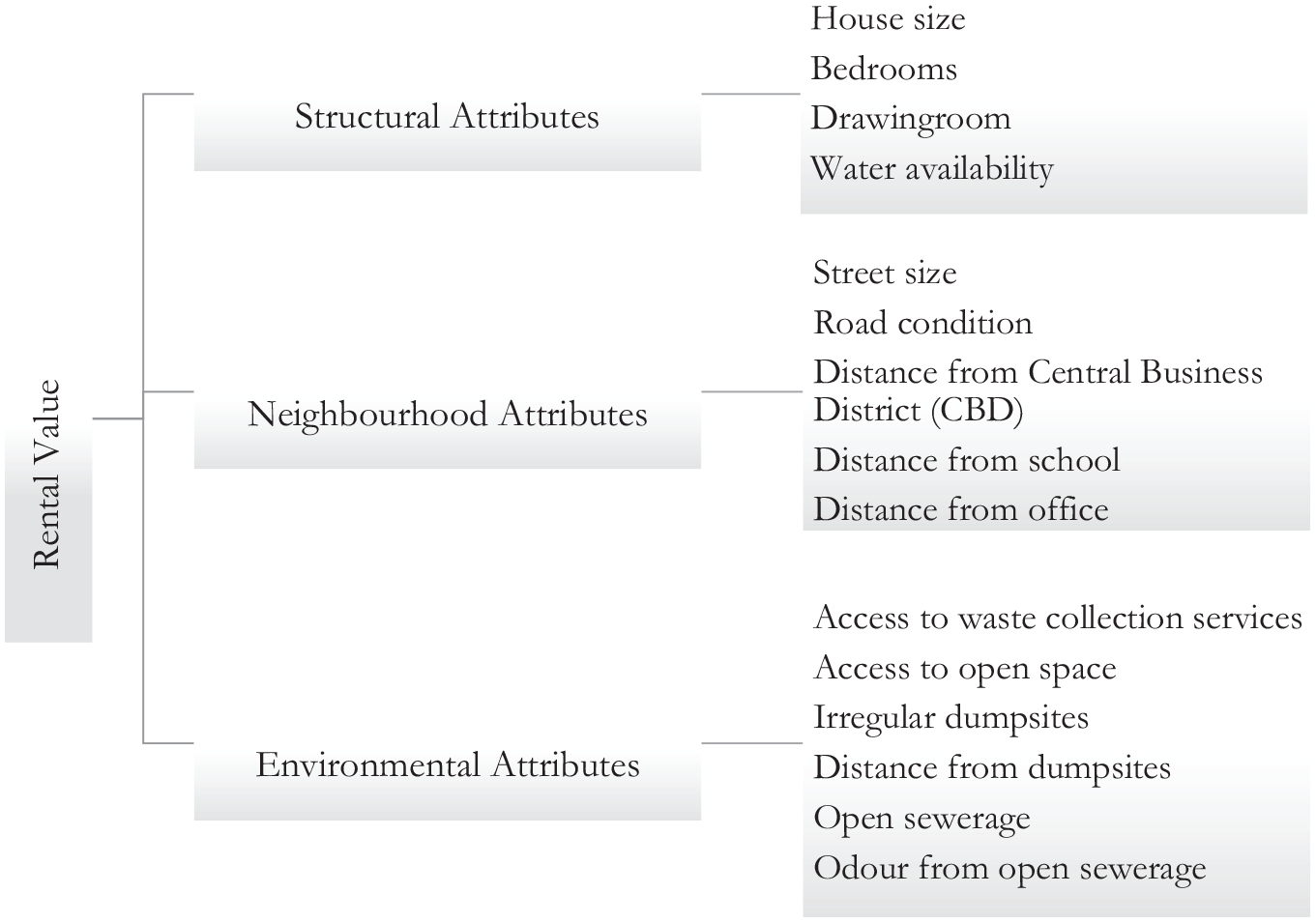
Variables in the interview schedule.
The study area and research sample selection involved a multi-stage systematic sampling approach, ensuring the representation of both underdeveloped and developed zones. The sampling process included the stratification of locations based on their proximity to dumpsites, laying the foundation for subsequent data collection phases. A comprehensive cross-sectional survey, conducted in 2019, included 849 households, focusing on residential location preferences, health and housing costs in relation to proximity to a dumpsite. Face-to-face interviews were conducted to ensure data accuracy, involving 419 households from Islamabad and 430 from Rawalpindi. Enumerators, recruited and trained for the task, possessed a background in Economics and were residents of the surveyed areas. The survey considered specific criteria, targeting respondents engaged in waste management practices and individuals who were tenants or members of tenant households. Appendix Table A.1 outlines the variables in the interview schedule, with the monthly house rent as the primary dependent variable of interest, intricately linked to structural attributes, neighbourhood characteristics and environmental amenities.
Description of the dataset
The study draws on a demographically diverse sample, which provides a strong foundation for analysing housing behaviours in urban Pakistan. The sample includes a majority of female respondents, a feature that enables the exploration of gender-related dimensions in rental preferences, access to services and socio-economic outcomes. In terms of age, a large portion of the sample comprises young adults, typically in their 20s, a group that significantly influences urban housing dynamics. As individuals in this age range often undergo major life transitions such as entering the workforce, pursuing higher education or forming new households, their representation in the dataset is particularly relevant for understanding shifts in housing demand and mobility patterns.
Educational attainment across the sample spans a broad spectrum. Participants include individuals with no formal education as well as those who have completed various levels of schooling, from primary and secondary education to college and university degrees. Socio-economic diversity is another defining characteristic of the sample. Respondents represent a wide range of income groups, from low- to high-income households. This heterogeneity allows the study to assess how economic status influences rental choices, sensitivity to environmental disamenities and broader patterns of housing inequality. The inclusion of different income segments also enriches the empirical basis for discussions related to social protection, economic vulnerability and targeted urban planning.
Regarding housing arrangements, most participants are tenants, while a smaller share are homeowners. This distinction provides an important angle for understanding how tenure type interacts with environmental exposure and economic trade-offs in urban property markets. Tenants may exhibit different levels of willingness to accept housing near undesirable environmental features compared to owners. One of the key highlights of these data is the influence of environmental disamenities, specifically proximity to informal dumpsites, on rental values. Households located close to these sites tend to accept lower rents for otherwise comparable housing, suggesting a clear discount associated with environmental degradation. In contrast, households situated farther away demonstrate a greater willingness to pay more for similar accommodations, reflecting a premium placed on environmental quality and sanitary living conditions.
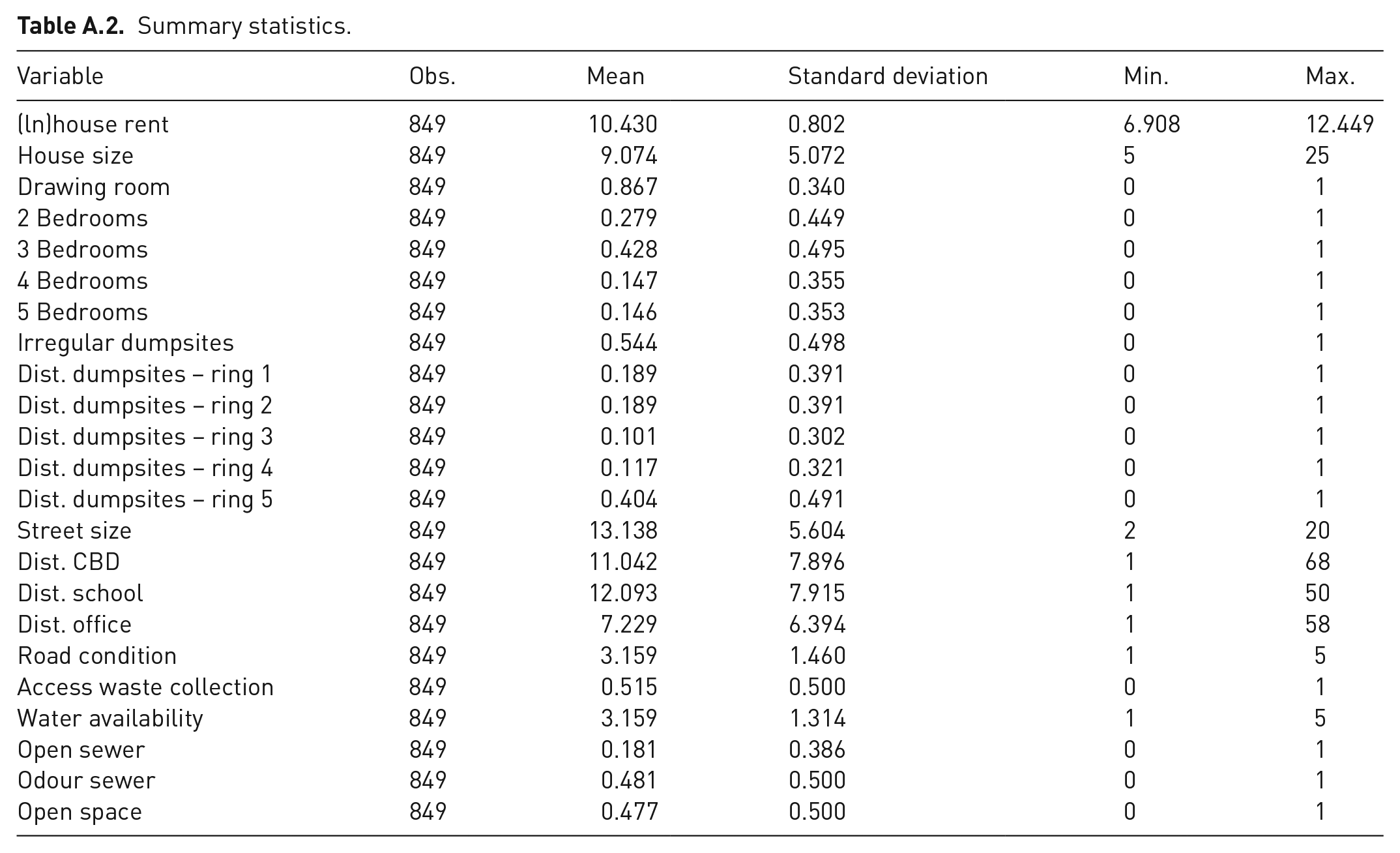
As detailed in Appendix Table A.2, the dataset, comprising 849 observations, offers essential insights into the housing market dynamics of the region. The average of the log-transformed house prices, a central measure of rental values, is reported at 10.430, with a standard deviation of 0.802, indicating relatively low variability. The observed minimum and maximum house rent (6.908–12.449) showcase a broad range of rental values. The analysis extends to the attributes of these residential properties, reporting a mean house size of 9.074 with a standard deviation of 5.072, signifying substantial variations. Categorical variables, including the presence of a drawing room, number of bedrooms and other house characteristics, exhibit diverse patterns within the dataset. Furthermore, the study comprehensively assesses environmental attributes, including the presence of irregular dumpsites, proximity to dumpsites within specific distance rings, street size and the distance from the central business district, schools and offices.
Figure 3 illustrates the smoothed density distributions of housing rents in both cities, highlighting marked differences in rental patterns and price dispersion. Additionally, the correlation matrix of key variables is presented in Appendix Figure A.1.
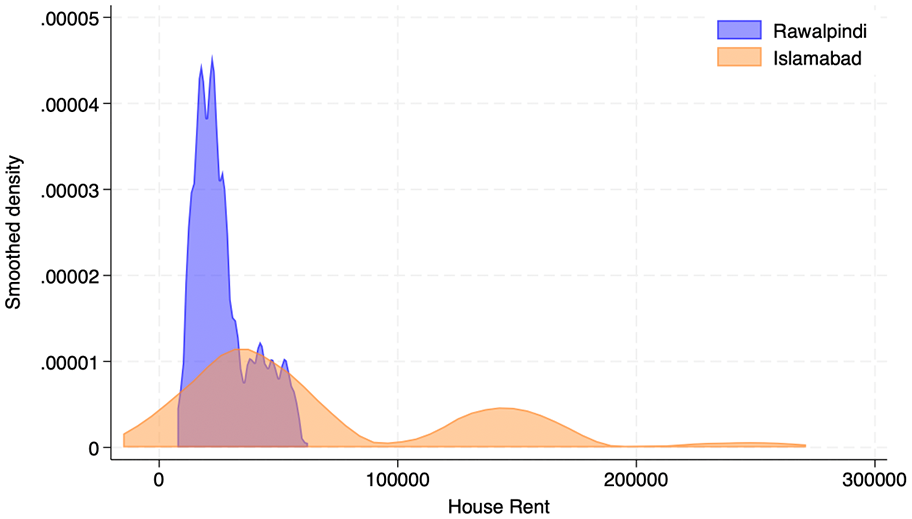
Density distributions of house rent across cities.
Empirical results
Pooled regression results
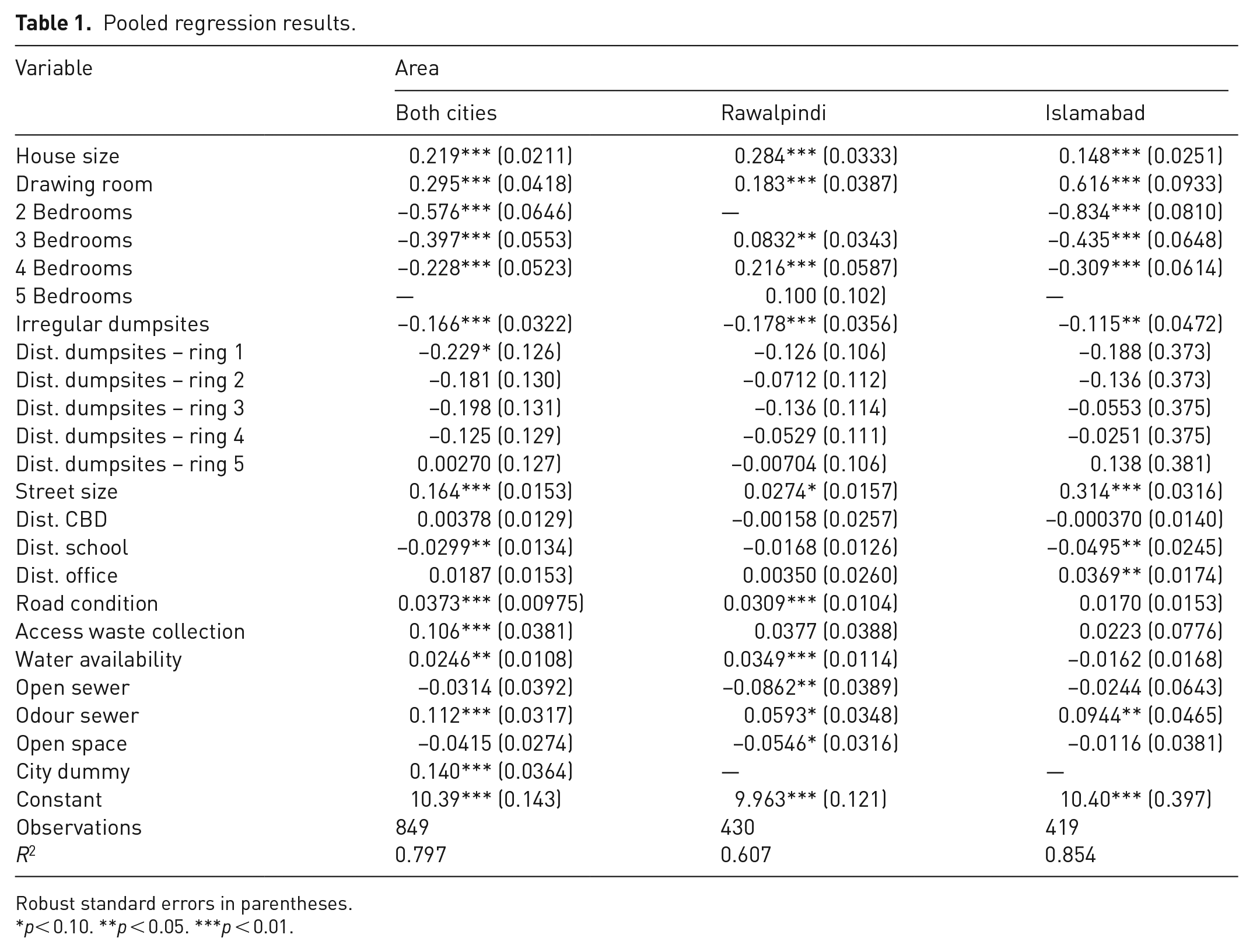
The results in Table 1 highlight the key factors influencing house rent in Rawalpindi and Islamabad, emphasising the impact of various environmental variables.
Pooled regression results.
Robust standard errors in parentheses.
p< 0.10. **p < 0.05. ***p < 0.01.
Notably, standardised house size significantly determines rent, with larger properties commanding higher prices in both cities. In Rawalpindi, a 1-unit increase corresponds to a rise in rent higher than in Islamabad. The presence of a drawing room has a substantial positive impact on rent, particularly in Islamabad. Bedroom numbers also play a non-negligible role, affecting rent differently in each city. Environmental variables, especially irregular dumpsites, exhibit significant effects on rent. Proximity to dumpsites within different distance rings yields varied results, emphasising the subtle impact of location. Larger street sizes are associated with higher rent, especially pronounced in Islamabad. Proximity to schools and offices exerts mixed effects on rent, varying between cities. Notably, road conditions and access to waste collection positively impact rent across all regions, underscoring the significance of infrastructure. Interestingly, ‘Odour Sewer’ shows an unexpected positive coefficient, indicating higher rental prices. This contradicts common intuition, necessitating a closer examination of these variables.
IV mediation results
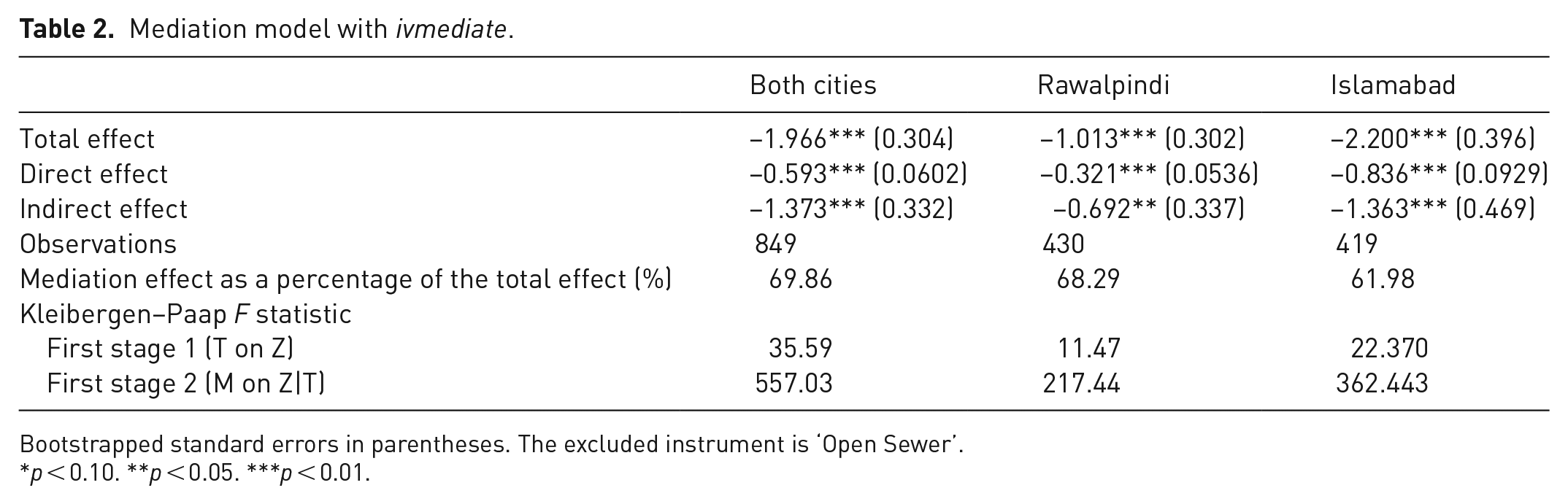
The results in Table 2 provide a more in-depth understanding of the factors influencing house rent in Rawalpindi and Islamabad. To address the underlined pooled regression analysis drawbacks, we employ the ivmediate approach described in the empirical strategy above, revealing detailed insights into the complex dynamics of variables like ‘Open Sewer’, ‘Odour Sewer’ and ‘Irregular Dumpsites’.
Mediation model with ivmediate.
Bootstrapped standard errors in parentheses. The excluded instrument is ‘Open Sewer’.
p < 0.10. **p < 0.05. ***p < 0.01.
Notably, the IV mediation analysis for the treatment of ‘Irregular Dumpsite’ on ‘House Rent’ indicates both direct and indirect effects. The total effect demonstrates a substantial negative influence on rental prices for properties near irregular dumpsites. Dissecting this effect, a direct impact is observed, emphasising the immediate effect of irregular dumpsites on reducing rental prices. The indirect effect, primarily mediated through ‘Odour Sewer’, suggests that an odorous sewer environment significantly contributes to lower rental prices near irregular dumpsites. This highlights the connection between odorous sewer conditions and rental price reductions, underscoring the role of environmental factors in influencing property values. The analysis employs IVs to address endogeneity concerns effectively.
Thus, IV mediation analysis offers a holistic understanding of the relationship between irregular dumpsites, odorous sewer environments and rental prices. However, the peculiar findings in the pooled regression results call for further scrutiny and data refinement to ensure a consistent and reliable interpretation of rental price determinants in these cities.
ML results
In our investigation, we leveraged the potential of Naïve Bayes classification for predicting rental prices, a crucial task in the real estate sector. Our study aimed to evaluate the model’s performance under various scenarios, each representing a distinct percentile range. Specifically, we scrutinised its predictive accuracy for three scenarios: identifying rental prices above the 50th percentile (median value), the 70th percentile and the 90th percentile.
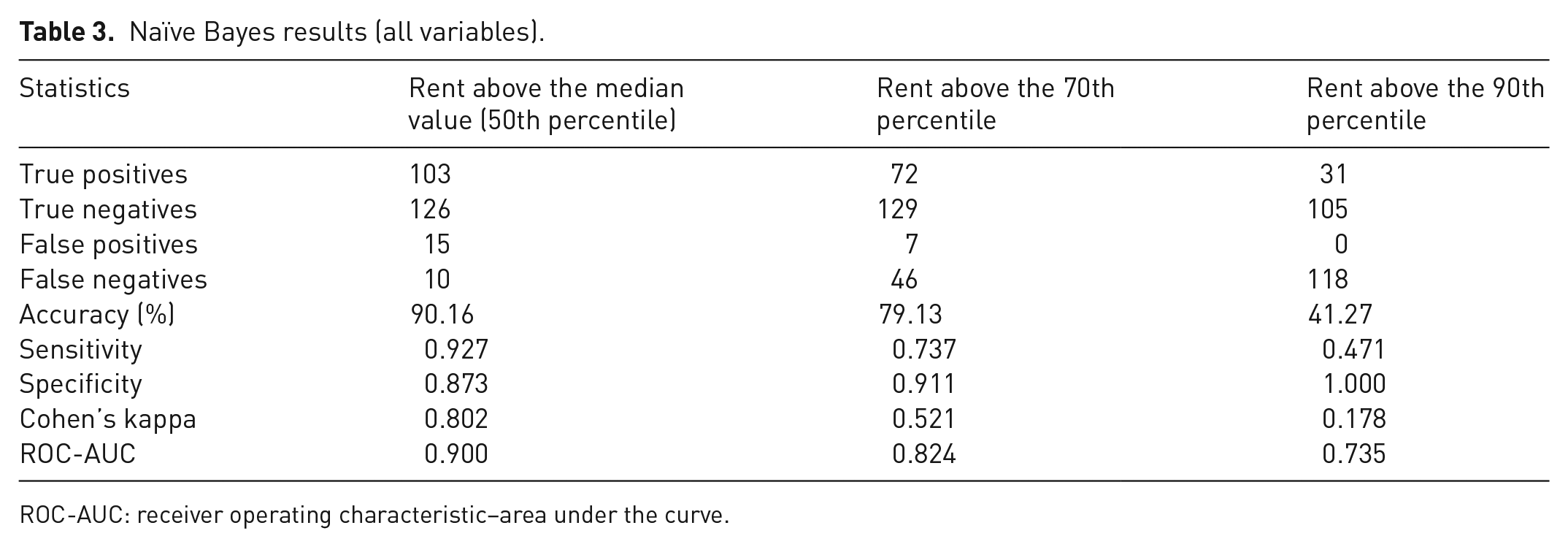
Our initial assessment, which included all variables encompassing environmental attributes, revealed, as shown in Table 3, the model’s commendable accuracy in predicting rental prices above the median value, achieving a success rate of 90.16%.
Naïve Bayes results (all variables).
ROC-AUC: receiver operating characteristic–area under the curve.
This scenario, characterized by a relatively balanced distribution of rental prices, provided an optimal setting for the model. However, as the focus should be put on the higher percentile ranges, particularly the 70th and 90th percentiles, the model’s performance exhibited a noticeable decline. The accuracy value dropped to 79.13% for the 70th percentile and further to 41.27% for the 90th percentile. In these instances, we observed an increase in False Negatives, signifying the model’s challenge in accurately predicting rental prices in the uppermost percentile categories. This observation is consistent with the recognised difficulty in modelling extreme values.
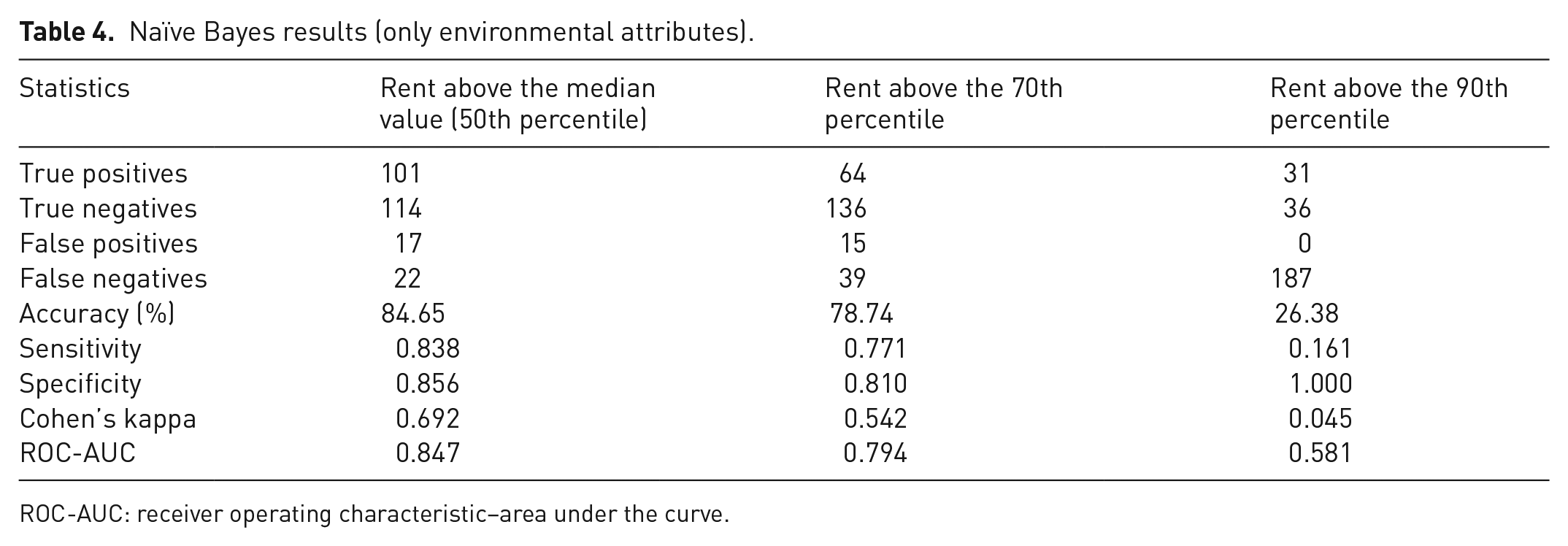
To further test the model’s predictive capacity, we consider in Table 4 a model with only the environmental variables. This change led to improvements in accuracy, notably in the 50th and 70th percentile scenarios. Using only environmental attributes elevated the accuracy for predicting rental prices above the median to 84.65% and for the 70th percentile to 78.74%.
Naïve Bayes results (only environmental attributes).
ROC-AUC: receiver operating characteristic–area under the curve.
Despite these advancements, when compared with the 90th percentile scenario, the model still grappled with extreme values, resulting in an accuracy of 26.38%. This outcome emphasised the model’s limitations when attempting to capture the complexity of exceedingly high values. Naïve Bayes classification exhibited promising predictive performance in scenarios associated with median values. Nevertheless, it showed limitations when dealing with extremely high percentiles.
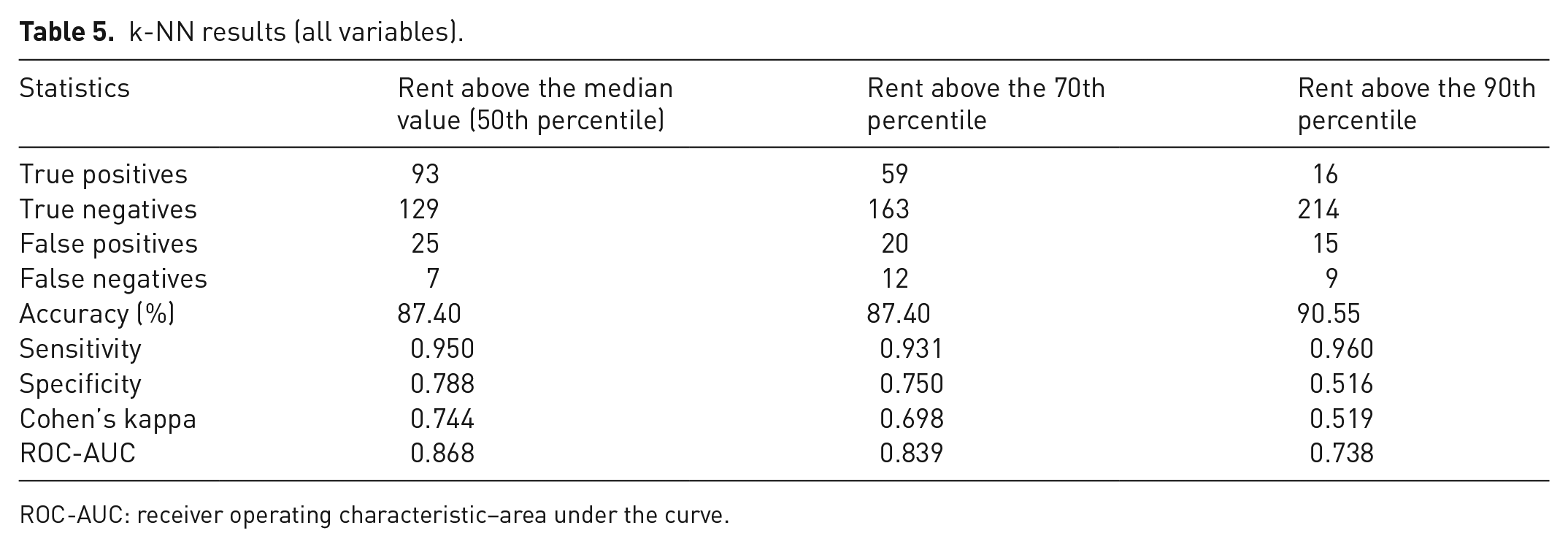
The k-NN model has proven to be a robust and reliable tool for classifying properties based on their rental values, especially in the context of Rawalpindi and Islamabad’s dynamic housing markets. In Table 5, where all variables are considered, the model consistently demonstrates good performance with an accuracy >80% for all thresholds.
k-NN results (all variables).
ROC-AUC: receiver operating characteristic–area under the curve.
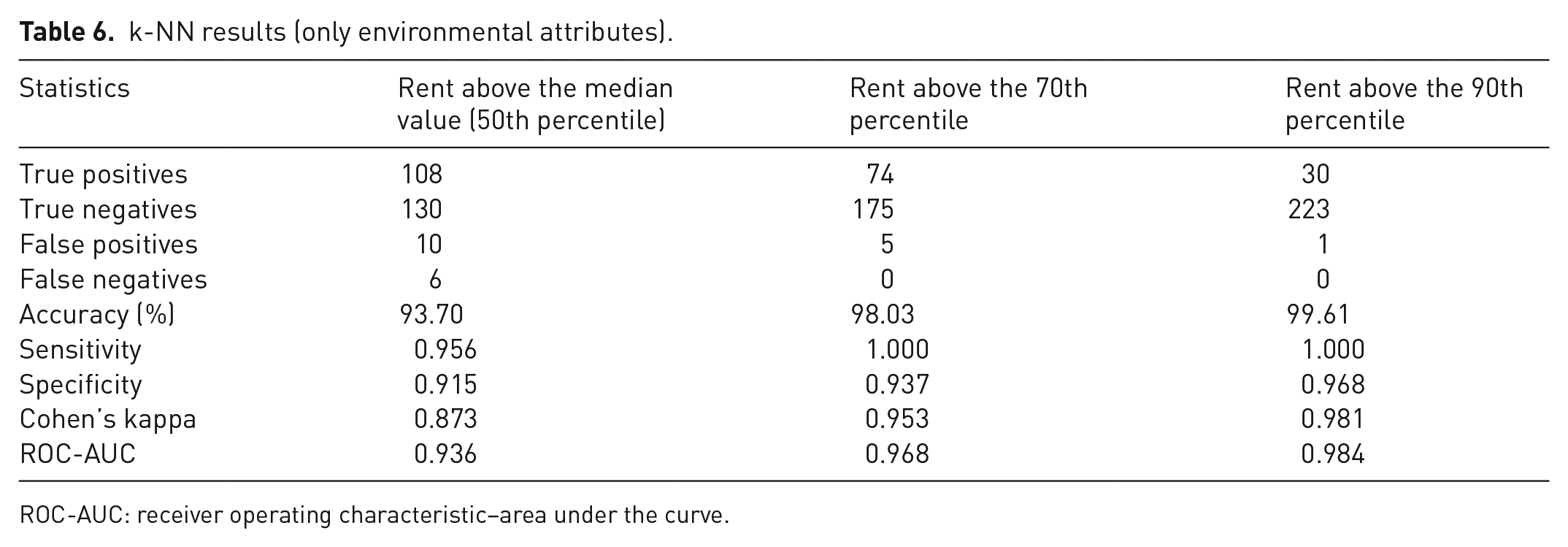
The presence of few false positives and false negatives underlines the model’s ability to correctly categorize properties above different percentile thresholds. This exceptional accuracy showcases the k-NN model’s prowess in identifying complex patterns and relationships within the dataset when all variables are considered. Table 6 shows that even when restricting the analysis to only environmental attributes, the k-NN model continues to deliver an accuracy rate above 90%.
k-NN results (only environmental attributes).
ROC-AUC: receiver operating characteristic–area under the curve.
This result is noteworthy as it indicates that the model excels in classifying properties, primarily relying on features related to the environment, while disregarding other variables. It is not uncommon to anticipate a potential reduction in accuracy with fewer variables, but the k-NN model’s consistency in Table 6 proves its resilience and adaptability in the housing market context.
In addition, when evaluating k-NN’s performance, a remarkable finding emerged. This unwavering accuracy is observed across all three scenarios: rental prices above the median, the 70th percentile and the 90th percentile. Notably, this demonstrates that the k-NN algorithm remains robust when confronted with a variety of percentile-based scenarios, indicating that it is adept at handling extreme values. The k-NN model’s exceptional performance in these scenarios emphasises its ability to accurately categorize properties based on complex patterns and relationships within the dataset.
Robustness checks via ML
To check the robustness of our results, a classification tree model is employed to deepen our understanding of rental price determinants, particularly concerning properties with rent above the 50th percentile. The pruned classification tree, 5 reported in Figure 4, offers significant findings, highlighting the significance of environmental attributes such as access to waste collection in predicting rental values in the housing market. These insights are visually presented in the pruned tree graph, which shows that environmental attributes play a major role in classifying properties.
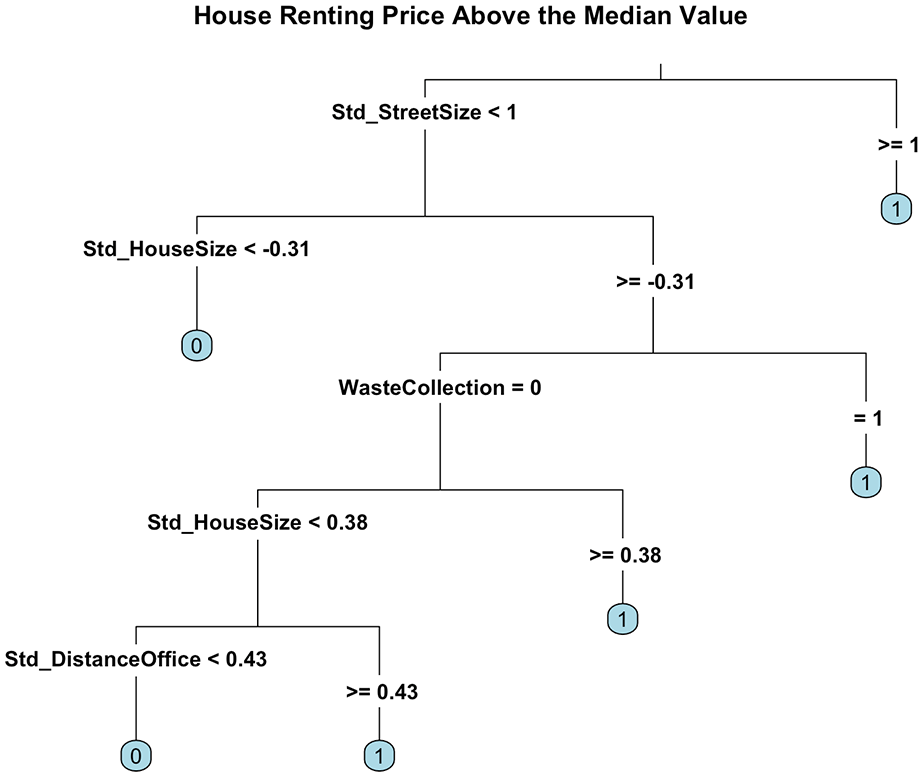
Classification tree results.
To further improve the robustness of the analysis, diagnostic results for these trees are displayed in Appendix Figures A.2–A.4. This comprehensive diagnostic assessment, inclusive of key metrics and validation, reinforces confidence in the reliability of the tree-based methods. Moreover, to ensure that findings are not overly dependent on a specific threshold, a parallel classification tree was constructed for properties above the 70th percentile of the rental distribution. Its graphical output, shown in Appendix Figure A.5, confirms the consistency of results across different segments of the housing market. Notably, environmental attributes such as access to waste collection emerge as key predictors in the tree models.
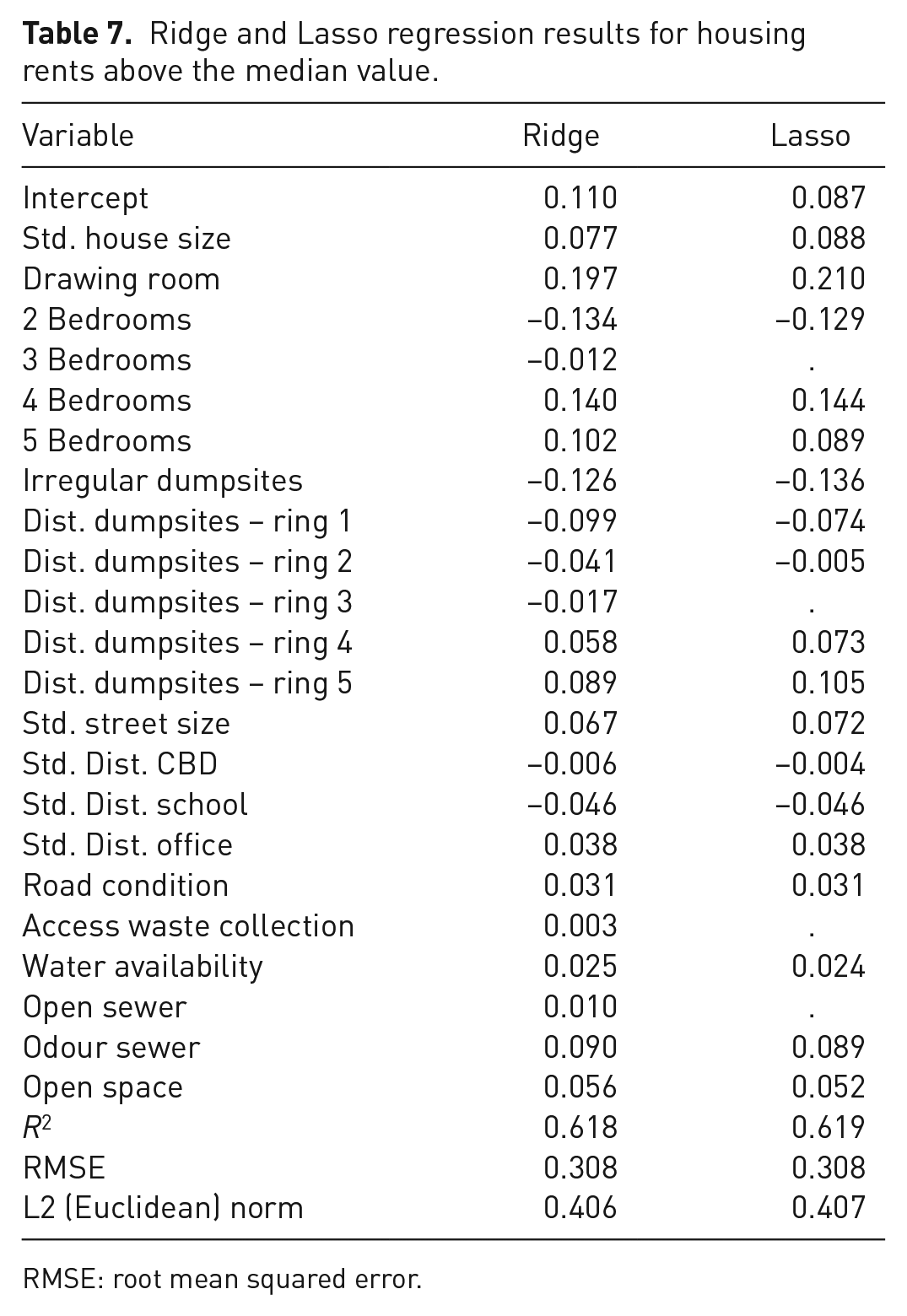
As an additional robustness check, Ridge and Lasso regressions were employed to evaluate the stability of these findings under linear modelling assumptions. Although these models are widely used to address multicollinearity and perform variable selection, they are limited in their capacity to capture non-linear relationships and interaction effects, which are prevalent in complex urban settings. Ridge regression retains all variables through coefficient shrinkage and, as shown in Table 7, confirms the expected negative associations between rental prices and environmental disamenities such as irregular dumpsites and proximity to dumpsites (e.g. ring 1 and ring 2).
Ridge and Lasso regression results for housing rents above the median value.
RMSE: root mean squared error.
Lasso regression, through its feature selection process, assigns a coefficient of zero to several variables, including ‘3 Bedrooms’, ‘Distance From Dumpsites – Ring 3’, ‘Access to Waste Collection’ and ‘Open Sewer’. However, this exclusion appears inconsistent with the classification tree results, where access to waste collection is one of the most important predictors. This divergence draws attention to the limitations of Lasso in capturing variables whose effects may depend on interaction structures or threshold dynamics. Still, Lasso retains negative coefficients for key environmental predictors: irregular dumpsites and the closest rings to them remain negatively associated with rental values. This partial convergence with the pooled and Ridge regression results lends further support to the negative impact of environmental degradation on housing markets.
In both Lasso and Ridge models, however, the variable ‘Odour Sewer’ displays a positive coefficient, an unexpected and counterintuitive result that contradicts the presumed disamenity effect of unpleasant sanitation conditions. This inconsistency, also observed in the pooled OLS model, reinforces the need for further structural investigation. It is precisely for this reason that the study incorporates IV mediation and ML approaches in its main analysis, which are better equipped to uncover indirect effects, address potential endogeneity and account for non-linear dynamics that may be distorting estimates in regularized linear regressions.
The analysis concludes with the diagnostic results of Ridge and Lasso models, which include standard metrics, validation parameters and optimised lambda (λ) values. These outputs, presented in Appendix Figures A.6 and A.7, provide transparency regarding model tuning and internal performance but ultimately reaffirm the necessity of complementing linear models with more flexible and robust analytical approaches in the study of environmental effects on rental housing markets.
Discussion
We have explored a range of house renting price determinants, including both house characteristics and environmental (dis)amenities. This thorough examination has provided crucial insights into the dynamics of the rental market in this region, offering a full picture of the forces at play.
In tandem with established expectations, the findings stress the impact of house characteristics on rental prices. House size, the number of rooms and the presence of a drawing room have all emerged as significant determinants positively correlated with house rent. This aligns with prior research, emphasising the enduring importance of structural attributes in influencing rental values (e.g., Ball, 1973; Richardson et al., 1974). The observed rental premiums associated with varying room counts highlight tenant preferences and the willingness to pay higher rents for more spacious and feature-rich accommodations. Expanding our focus to the neighbourhood level, our analysis has identified several factors that exert discernible influences on house rent. Distance from educational institutions, road conditions and street size have all been recognised as salient determinants contributing to the complex tapestry of rental prices in the twin cities. Notably, these variables exhibit subtle effects, with some exerting stronger influences than others. These findings emphasise the multidimensional nature of housing markets, where various neighbourhood attributes converge to shape rental prices.
These findings align with and extend the established body of research on the economic effects of environmental (dis)amenities on property values. Previous studies have consistently shown that environmental degradation, including proximity to landfills, open sewers and poor sanitation infrastructure, exerts a negative externality on nearby housing values (Gamper-Rabindran and Timmins, 2013; Lim and Missios, 2007; Reichert et al., 1992). This study confirms these effects in the context of Rawalpindi and Islamabad, while also demonstrating that such externalities are not uniformly priced across different urban governance regimes.
By employing an HPM alongside IV mediation and ML methods, our analysis contributes to ongoing debates in environmental economics and urban planning regarding the valuation of non-market externalities (see Freeman et al., 2014; Wen et al., 2015). Our results are consistent with prior work from both developing and developed contexts (e.g. Islam et al., 2020; Smith, 2010), but this study is among the first to apply causal mediation analysis using IVs to unpack the indirect environmental effects – notably, the mediating role of odorous sewers in translating waste site proximity into rent penalties.
Moreover, our study enriches the literature on urban inequality and environmental justice. As highlighted by Carriazo et al. (2013) and Poor et al. (2007), disparities in environmental quality are reflected in housing prices, indirectly pointing to broader patterns of socio-economic stratification. Our data reveal that households with lower incomes or education levels are disproportionately located closer to dumpsites, reinforcing the concept of environmental sorting within housing markets. This supports broader findings in urban economics that residential location choices reflect constrained trade-offs between affordability and environmental quality (Ardeshiri et al., 2016; Dawkins and Nelson, 2002).
Finally, by incorporating ML techniques, this study speaks to the emerging literature on the use of predictive analytics in real estate and environmental economics. Although traditional regression models provide interpretability, ML approaches offer robustness and highlight non-linearities that are particularly valuable when analysing heterogeneous urban datasets in developing countries.
In sum, this research advances three key contributions to the literature:
It empirically estimates the economic cost of environmental disamenities in an under-researched South Asian urban context using a novel multi-method approach.
It provides a causal interpretation of environmental externalities through IV mediation, clarifying complex relationships often obscured by endogeneity.
It demonstrates the predictive power of environmental variables for housing market outcomes using modern ML techniques, reinforcing the salience of environmental quality in rental price formation.
These contributions position the study at the intersection of environmental economics, urban planning and applied econometrics, offering actionable insights for both academics and policymakers.
A distinctive aspect of the study lies in the application of distance rings to assess the significance of environmental (dis)amenities within the twin cities. These distance rings provide a detailed perspective on how proximity to dumpsites influences property values. The consistent pattern observed indicates that houses situated in closer proximity to dumpsites command lower rents. This points out the pervasive negative externalities associated with living near dumpsites, reflecting a decline in property values. This aligns seamlessly with established economic theories, asserting that amenities amplify demand, thereby increasing rental prices, whereas (dis)amenities exert an opposing force, leading to diminished property values.
Specifically, our analysis reveals that the proximity to irregular dumpsites has a pronounced adverse impact on rental values, signalling an urgent need for enhanced WMSs in residential areas. Furthermore, the presence of open sewers and associated odours contributes significantly to a decrease in house rent, highlighting the critical role of environmental amenities and their intersection with housing affordability and desirability. Similarly, access to waste collection services emerges as a notable amenity within the evolving urban landscape of Islamabad and Rawalpindi, positively affecting house rent. This signals the evolving dynamics of housing markets, where access to essential services increasingly shapes rental values.
Importantly, our study unravels intriguing disparities in the impact of environmental amenities between Rawalpindi and Islamabad, highlighting the unique characteristics and dynamics within each city’s housing market. These differences highlight the need to take into account localized factors and contexts when formulating housing policies and urban development strategies. This insight emphasises the need for tailor-made approaches that address the specific needs and preferences of each city’s residents. Moreover, these findings make evident the imperative of addressing environmental concerns and devising housing strategies attuned to the distinct dynamics of each city. Our study thus lays the groundwork for informed decision-making, contributing to the creation of more sustainable and desirable living environments in the twin cities of Pakistan.
Although linear regression models yield a counterintuitive sign for ‘Odour Sewer’, we believe this is a result of spatial clustering, omitted confounders and multicollinearity. The IV mediation model, which provides a more robust identification strategy, confirms the expected negative effect of sewer odour on rental values. Additionally, ML classification models corroborate the results of pooled regression and IV mediation analyses, affirming the significance of environmental attributes in shaping rental prices. This convergence reinforces the robustness and reliability of our findings across different analytical approaches.
While the present study focuses on the twin cities of Rawalpindi and Islamabad, the findings carry broader implications for urban housing markets in developing countries, particularly those experiencing rapid population growth, informal settlements and inadequate environmental regulation. The observed negative impacts of environmental disamenities, especially proximity to irregular dumpsites and open sewers, on rental values are not unique to Pakistan. Similar patterns have been documented in urban areas across South Asia, sub-Saharan Africa and Latin America, where weak waste governance, fragmented service delivery and land-use informality are prevalent.
Our results stress the significance of environmental quality as a determinant of urban housing demand, with potential relevance to municipalities facing comparable challenges. The significant rent discounts associated with proximity to dumpsites suggest that tenants internalize the risks of environmental degradation, even in contexts where formal information about health hazards is limited. This supports the growing evidence that environmental justice concerns, where poorer populations disproportionately bear the burden of urban disamenities, are mirrored in property market outcomes.
Furthermore, the heterogeneity between Islamabad and Rawalpindi illustrates the critical role of urban governance structures in shaping environmental externalities. Islamabad’s more centralized and regulated planning regime contrasts with Rawalpindi’s ad hoc development, resulting in different patterns of waste management, service provision and community responsiveness. These differences inform how environmental risks are perceived and priced by households and suggest that institutional capacity and planning enforcement are central to mitigating environmental impacts in urban housing markets.
The implications also extend to socio-economic disparities. The data show that low- to middle-income households are more likely to reside near dumpsites and open sewers, reflecting a market segmentation that reinforces environmental inequality. These households often face constrained choices, forced to trade environmental quality for affordability and proximity to employment. This dynamic echoes broader themes in urban economics and public policy, where housing affordability and environmental quality are in tension, particularly in the absence of inclusive planning frameworks and enforceable sanitation regulations.
Conclusions and policy implications
This in-depth investigation is dedicated to thoroughly examining the detrimental repercussions of waste disposal sites on residential areas in the twin cities of Rawalpindi and Islamabad, Pakistan. A central focus is placed on understanding the impact of environmental (dis)amenities on the rental prices of houses in these regions. Rising from the theory of HPM, a widely recognised and robust analytical framework, the research systematically explores various factors, including environmental attributes like open spaces and waste collection services. IV mediation analysis is employed to investigate the causal pathways connecting these environmental factors to rental prices, revealing the mediating effects of proximity to irregular dumpsites and the presence of open sewers and associated odours.
A notable contribution of this research lies in the integration of ML techniques, specifically Naïve Bayes and k-NN, providing a novel dimension to the study. These algorithms facilitate the classification of rental prices above different percentiles, uncovering detailed patterns within the dataset. Simultaneously, traditional statistical approaches, including pooled regression and IV mediation analysis, are applied for an exhaustive evaluation. The research outcomes highlight the distinctive characteristics of Rawalpindi and Islamabad’s housing markets, underscoring the unique impact of environmental amenities on rental prices. The study substantiates existing theoretical constructs and provides empirical evidence of the detrimental impact of dumpsites on house rents. Additionally, the study reveals the subtle dynamics of environmental (dis)amenities, with unpleasant odours and open sewers also significantly influencing house rents. Regional disparities in these impacts are observed, with Rawalpindi residents being more affected by odours and open sewers than by the mere proximity of dumpsites. Intriguingly, Islamabad residents exhibit heightened sensitivity to environmental (dis)amenities, influencing their housing decisions more than housing amenities.
Taken together, our findings emphasise the need for: (a) integrated waste and housing policies that prioritize environmental remediation in lower-income neighbourhoods; (b) decentralized urban governance models capable of addressing localized environmental concerns efficiently and (c) community-level interventions that incorporate participatory waste management and affordable housing design.
By linking micro-level housing decisions to macro-level governance and environmental management structures, this research offers an in-depth account of how urban environmental inequalities are reproduced through market mechanisms. The approach and results can inform policymaking in other rapidly urbanising cities, particularly where informal settlements, infrastructure deficits and weak environmental oversight intersect.
Practically, the findings have implications for policymakers, urban planners and property developers, emphasising the necessity of engaging with the challenges posed by improper waste disposal. The study emphasises the need to factor in the external costs associated with waste disposal sites in urban development decisions. The research advocates for sustainable waste collection and disposal systems, coupled with substantial investments in sewer infrastructure, to support long-term and sustainable urban development. It highlights the necessity of informed decision-making, considering diverse environmental attributes and housing investments, to achieve balanced urban growth and development.
While aligning with prior studies emphasising the influence of environmental indicators on property prices (e.g. Lu, 2018), the research acknowledges the inherent limitations of case studies, encouraging future research to explore other ML methods such as support vector machines for regression models.
Footnotes
Appendix
Summary statistics.
| Variable | Obs. | Mean | Standard deviation | Min. | Max. |
|---|---|---|---|---|---|
| (ln)house rent | 849 | 10.430 | 0.802 | 6.908 | 12.449 |
| House size | 849 | 9.074 | 5.072 | 5 | 25 |
| Drawing room | 849 | 0.867 | 0.340 | 0 | 1 |
| 2 Bedrooms | 849 | 0.279 | 0.449 | 0 | 1 |
| 3 Bedrooms | 849 | 0.428 | 0.495 | 0 | 1 |
| 4 Bedrooms | 849 | 0.147 | 0.355 | 0 | 1 |
| 5 Bedrooms | 849 | 0.146 | 0.353 | 0 | 1 |
| Irregular dumpsites | 849 | 0.544 | 0.498 | 0 | 1 |
| Dist. dumpsites – ring 1 | 849 | 0.189 | 0.391 | 0 | 1 |
| Dist. dumpsites – ring 2 | 849 | 0.189 | 0.391 | 0 | 1 |
| Dist. dumpsites – ring 3 | 849 | 0.101 | 0.302 | 0 | 1 |
| Dist. dumpsites – ring 4 | 849 | 0.117 | 0.321 | 0 | 1 |
| Dist. dumpsites – ring 5 | 849 | 0.404 | 0.491 | 0 | 1 |
| Street size | 849 | 13.138 | 5.604 | 2 | 20 |
| Dist. CBD | 849 | 11.042 | 7.896 | 1 | 68 |
| Dist. school | 849 | 12.093 | 7.915 | 1 | 50 |
| Dist. office | 849 | 7.229 | 6.394 | 1 | 58 |
| Road condition | 849 | 3.159 | 1.460 | 1 | 5 |
| Access waste collection | 849 | 0.515 | 0.500 | 0 | 1 |
| Water availability | 849 | 3.159 | 1.314 | 1 | 5 |
| Open sewer | 849 | 0.181 | 0.386 | 0 | 1 |
| Odour sewer | 849 | 0.481 | 0.500 | 0 | 1 |
| Open space | 849 | 0.477 | 0.500 | 0 | 1 |
Authors’ note
All errors and opinions are ours. Standards disclaimers apply.
Data availability
Data is available from the corresponding author upon reasonable request.
Declaration of conflicting interests
The authors declared no potential conflicts of interest with respect to the research, authorship, and/or publication of this article.
Funding
The authors received no financial support for the research, authorship, and/or publication of this article.
Ethics and data statement
The data collection was conducted prior to and independently of the current research. The dataset was provided and curated by Author T. Akmal. To the authors’ knowledge, the data were collected in accordance with established ethical research principles. No personally identifiable information was shared or used in this analysis.
