







Abstract
The increasing deployment of lithium-ion batteries in electric vehicles, stationary energy systems, and consumer electronics has intensified the need for efficient recycling technologies to mitigate their environmental and economic impacts. Although recycling efforts have conventionally focused on cathode recovery, the growing adoption of silicon-enhanced anodes and the large mass fraction of graphite in modern cells underscore the importance of sustainable anode regeneration. This systematic review synthesizes findings from 132 high-quality studies published between 2015 and 2025 that investigate the mechanisms, challenges, and technological progress in recycling graphite, silicon, and Si/C composite anodes. The analysis indicates that mechanical, thermal, chemical, and electrochemical approaches each offer distinct advantages, whereas hybrid processes provide the most effective restoration of structural integrity and electrochemical performance. Silicon regeneration remains particularly challenging because of severe volume expansion and irreversible structural degradation, necessitating advanced strategies such as selective silicon oxide removal, carbon re-coating, and nanostructural reconstruction. Environmental and economic assessments consistently demonstrate that anode recycling can reduce energy consumption and CO2 emissions by 50–80% compared with the production of virgin materials. Despite this progress, key challenges persist, including solid–electrolyte interphase removal, copper contamination, heterogeneous black mass composition, and limitations in selective separation. Future research opportunities lie in intelligent process optimization, green solvent systems, scalable hybrid recycling workflows, and improved recovery strategies for Si-rich anodes.
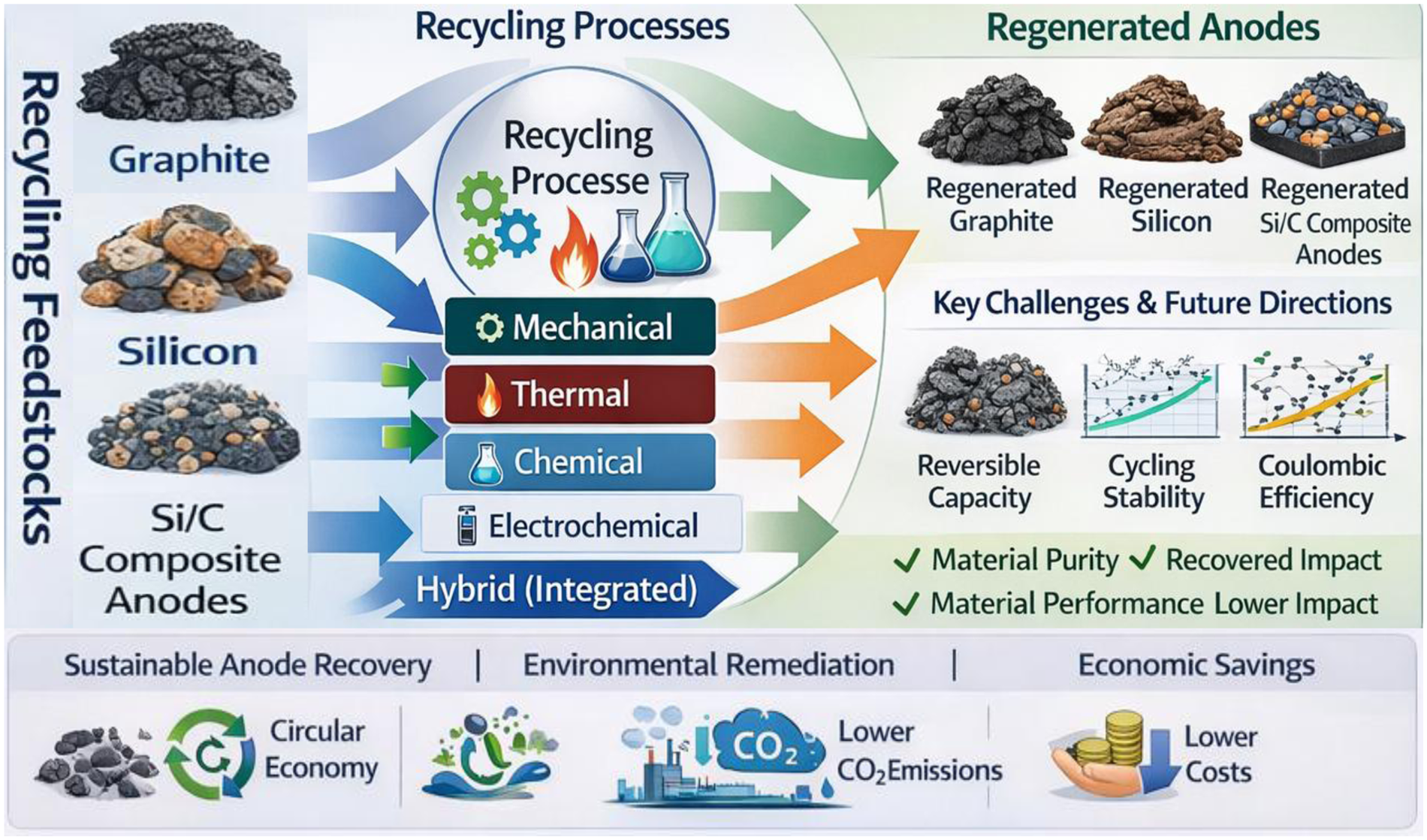
Keywords
Highlights
• Systematic review of graphite, silicon, and Si/C anode recycling (2015–2025).
• Mechanical, thermal, chemical, and electrochemical routes are critically compared.
• Hybrid regeneration achieves superior purity and electrochemical recovery.
• SEI complexity, Cu contamination, and Si fracture limit recycling efficiency.
• Anode recycling cuts energy use and CO2 emissions by up to 80%.
Introduction
Lithium-ion batteries (LIBs) have experienced unprecedented global expansion over the past three decades, becoming the dominant energy storage technology for electric vehicles (EVs), consumer electronics, grid-scale renewable energy integration, and emerging smart energy infrastructures (Hamdan et al., 2024). Global demand for LIBs continues to rise in parallel with decarbonization strategies, electrified transportation policies, and large-scale deployment of renewable energy systems. Projections indicate that annual end-of-life (EoL) battery waste will exceed 8–10 million tonnes by 2040, raising urgent concerns regarding critical material depletion, hazardous waste accumulation, and long-term environmental sustainability. In response, policy-driven roadmaps from the European Union, China, and the United States increasingly emphasize the strategic importance of closed-loop battery material recovery to ensure supply security and mitigate emissions (Munonye et al., 2026; Rehman et al., 2025).
Despite these policy initiatives, existing recycling strategies and regulatory frameworks remain insufficient to address the rapidly increasing volume and compositional complexity of spent batteries, thereby motivating intensive research into closed-loop recovery systems. Historically, battery recycling research has been predominantly cathode-centric, driven by the high economic value of lithium, cobalt, nickel, and manganese (Winjobi et al., 2022; Zhang et al., 2018). However, researchers now believe that strategic recovery of anode materials is essential to achieve true battery circularity, cost neutrality, and long-term sustainability. Graphite alone accounts for approximately 10–15% of the total mass of a lithium-ion cell, making it the largest single solid material fraction within battery electrodes. However, it has long been treated as a secondary or even disposable component in many industrial recycling flowsheets (Fadyl, 2023; Robin, 2024). This practice is increasingly unsustainable in light of rising raw material costs, tightening environmental regulations, and geopolitical vulnerabilities associated with graphite supply chains, particularly due to regional mining concentration and export controls (Fang, 2024; Zhang, 2026).
Graphite remains indispensable in commercial LIB technology because of its high structural stability, low lithiation potential, excellent Coulombic efficiency, and compatibility with established manufacturing processes. However, its production is environmentally intensive. Synthetic graphite requires ultra-high-temperature graphitization exceeding 2800°C, resulting in extremely high energy consumption and substantial carbon emissions (Yi et al., 2024; Zhao et al., 2024). In contrast, natural graphite extraction leads to significant environmental degradation, including land-use disruption and water contamination, while also posing geopolitical supply risks due to the concentration of mining in a limited number of countries (Chukwuma Sr, 2024; de Haes and Lucas, 2024; Groves et al., 2025). Consequently, recycled graphite represents a strategically important secondary resource that can significantly reduce life-cycle energy demand, greenhouse gas emissions, and dependence on virgin raw materials. Life-cycle assessments (LCA) have further demonstrated that regenerated graphite can achieve electrochemical and material performance comparable to that of pristine graphite, but at a fraction of the associated environmental cost (Bhattacharyya et al., 2026; Robinson et al., 2026; Surovtseva et al., 2022).
Beyond graphite, the accelerating transition toward high-energy-density silicon-based anodes further heightens the urgency of developing effective recycling and regeneration technologies. Silicon offers an exceptionally high theoretical gravimetric capacity of 3579 mAh g−1, nearly an order of magnitude greater than that of graphite. However, silicon anodes undergo extreme volume expansion exceeding 300% during lithiation, leading to particle pulverization, pore collapse, loss of electrical connectivity, and continuous rupture of the solid–electrolyte interphase (SEI). These processes ultimately result in rapid capacity fading and severe structural degradation (Jin et al., 2025a; Saidi et al., 2025; Zhong et al., 2024). Such degradation mechanisms not only limit long-term cycling stability but also complicate EoL recovery and regeneration, particularly due to irreversible mechanical fracture and unstable SEI reformation (Li et al., 2025; Wang et al., 2024a).
To address these intrinsic limitations, most commercial manufacturers, including Tesla (Austin, TX, USA), Panasonic (Osaka, Japan), LG Energy Solution (Seoul, South Korea), and CATL (Ningde, China), have adopted Si/C composite anodes, in which a small fraction of nanostructured silicon (typically 5–12 wt%) is embedded within a graphite matrix. These composites achieve enhanced capacity while partially buffering the mechanical stress associated with silicon expansion (Daaliet al., 2024). Recent industrial studies indicate that Si/C anodes are expected to dominate next-generation EV platforms because of their superior gravimetric and volumetric energy densities (Jin et al., 2025a; Xiao et al., 2025). However, their multiphase material architecture introduces significant recycling challenges, as graphite, silicon, binders, conductive carbons, and current-collector residues must be selectively separated, purified, and structurally regenerated. As the silicon content in future LIB anodes is projected to continue increasing, the absence of scalable and efficient recycling solutions for Si/C composites represents a growing bottleneck for sustainable battery manufacturing (Ahmed et al., 2025; Jin et al., 2025a; Toki et al., 2024).
Over the past decade, research on anode recycling has accelerated markedly in response to technological, regulatory, and sustainability-driven pressures. Figure 1 illustrates this rapid expansion and thematic transition. As shown in Figure 1(a), the annual number of peer-reviewed publications on anode recycling increased sharply between 2015 and 2025, reflecting expanding industrial demand, heightened regulatory pressure, and increasing scientific recognition of the strategic importance of regenerated anodes. Furthermore, Figure 1(b) demonstrates a clear shift in research focus from graphite-dominated regeneration toward silicon and hybrid Si/C anode systems, mirroring the evolving chemistry of next-generation LIBs. This growth underscores both the maturation of the field and its increasing diversification across material systems and process technologies (Jin et al., 2025a).
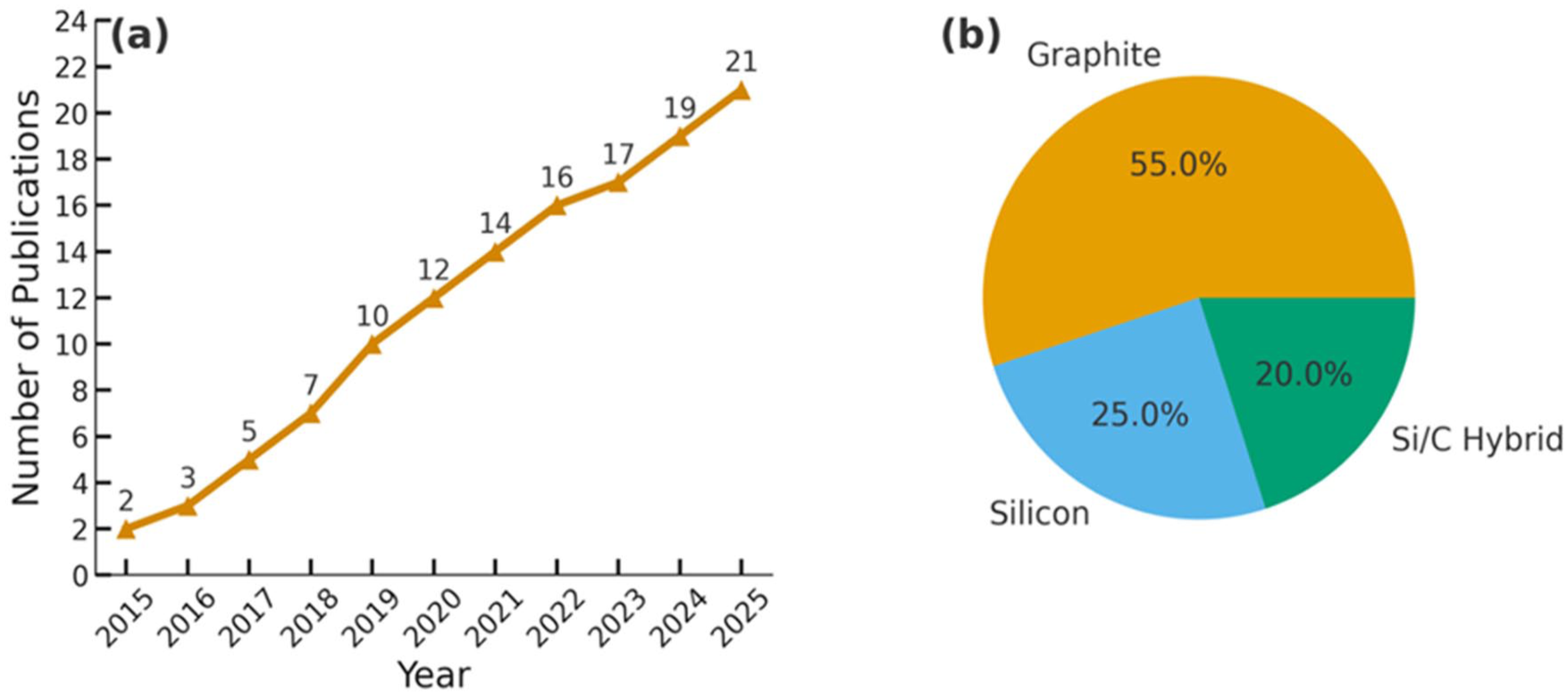
Overview of research activity in anode material recycling (2015–2025): (a) annual number of publications and (b) proportional distribution of studies focusing on graphite, silicon, and Si/C composite anodes, highlighting the shift toward silicon-based systems.
Despite this rapid expansion, the existing literature remains highly fragmented, with studies distributed across various fields, including mechanical processing, thermal treatment, chemical purification, electrochemical regeneration, LCA, and techno-economic analysis. Comparative evaluations of these approaches—particularly for silicon and Si/C composite anodes—remain limited, and no comprehensive synthesis currently integrates feedstock sources, regeneration technologies, electrochemical performance, environmental impact, and scalability within a unified analytical framework (Guzmán et al., 2025; Navarrete-Segado et al., 2026).
To address this critical gap, the present work provides a systematic and comprehensive review of recycling technologies for graphite, silicon, and Si/C composite anodes, based on a rigorous screening of the literature published between 2015 and 2025. A PRISMA-guided screening methodology was employed to ensure objective selection, reproducibility, and comprehensive coverage of relevant experimental and analytical studies. This review examines advances in recycling pathways, regeneration mechanisms, electrochemical performance recovery, and environmental and economic implications, with a particular emphasis on the emerging dominance of silicon-based and hybrid anodes in EV batteries. The following section describes the systematic screening procedure used to identify and refine the literature base for this study.
Methodology
Systematic literature screening
A structured systematic review was conducted to ensure that the analysis presented in this study is comprehensive, transparent, and reproducible. Literature research was performed across major scientific databases, including Web of Science, Scopus, IEEE Xplore, ScienceDirect, ACS Publications, and SpringerLink. The search strategy employed combinations of relevant keywords and Boolean operators to capture the full spectrum of research related to anode recycling. The search terms included “graphite recycling,” “silicon anode regeneration,” “Si/C composite recovery,” “black mass processing,” “electrochemical relithiation,” and “SEI removal,” which are widely used descriptors in the anode recycling literature.
The initial search identified 412 articles published between 2015 and 2025. After duplicate removal, 263 unique publications were retained for preliminary screening. During the screening phase, abstracts were evaluated to exclude studies lacking experimental validation, purely theoretical or simulation-based investigations without material recovery, and research focused exclusively on cathode recycling. This exclusion criterion was applied to ensure that the review remains focused on experimentally validated regeneration processes, enabling meaningful comparison of recovery performance and practical applicability under realistic conditions. This process reduced the dataset to 132 articles eligible for full-text assessment. The eligibility phase involved a detailed examination of each article to confirm relevance to anode recycling. Specifically, studies were required to (i) investigate graphite, silicon, or Si/C composite anodes; (ii) provide clear methodological descriptions of recovery or regeneration processes; and (iii) report electrochemical performance metrics, such as reversible capacity, Coulombic efficiency, and capacity retention.
Articles lacking structural characterization techniques—including scanning electron microscopy (SEM), transmission electron microscopy (TEM), X-ray diffraction (XRD), or Raman spectroscopy—were excluded, as microstructural restoration is essential for evaluating regeneration quality, as demonstrated in multiple prior studies. The final inclusion phase yielded a curated dataset of 132 high-quality publications, which form the basis of this review. These studies encompass a broad range of recycling strategies, including mechanical, thermal, chemical, electrochemical, and hybrid approaches. The PRISMA workflow summarizing the identification, screening, eligibility, and inclusion steps is presented in Figure 2. With this systematic methodology established, the origins and characteristics of anode materials entering the recycling stream are examined in the following section.
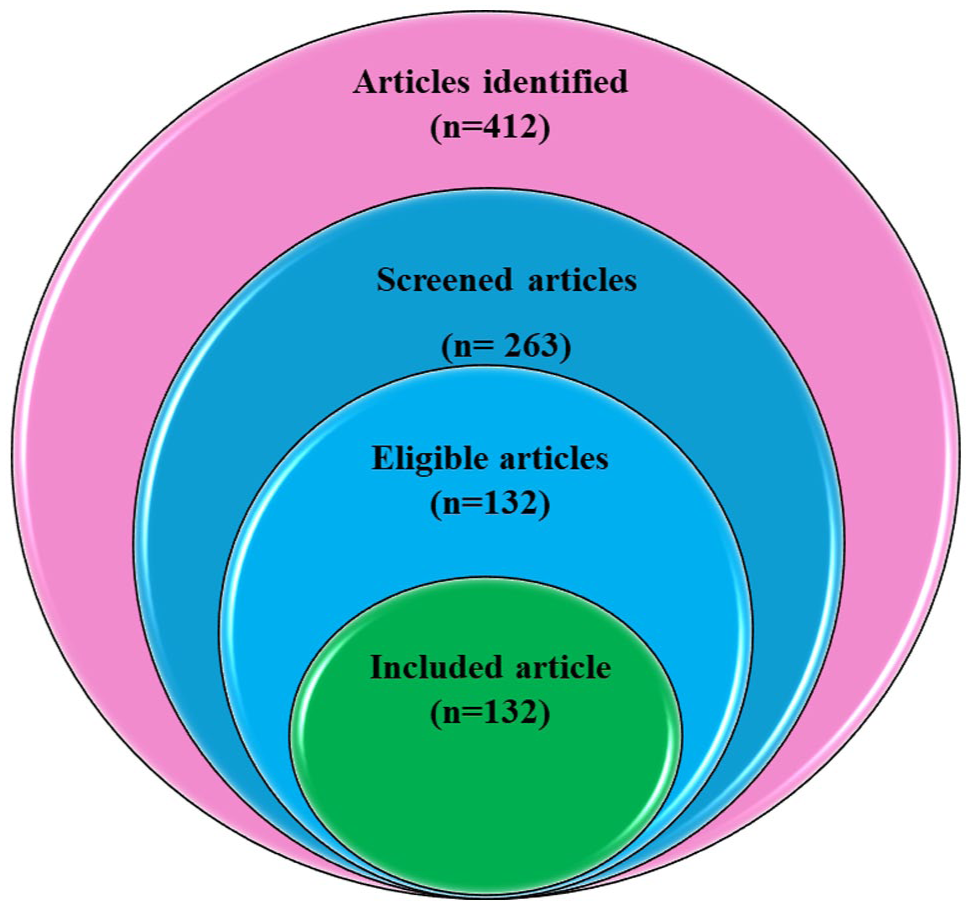
PRISMA flow diagram summarizing the identification, screening, eligibility, and inclusion steps.
Sources of recoverable anode materials
The primary sources of recoverable anode materials and their associated characteristics are summarized in Table 1. As shown in the table, production scrap generated during electrode fabrication represents the highest-purity feedstock. This material consists of nearly pristine graphite or Si/C composites, with contamination largely limited to poly(vinylidene fluoride) (PVDF) binders and conductive additives. Consequently, production scrap requires only mild purification and exhibits the lowest regeneration difficulty and processing costs (Kim et al., 2020; Yang et al., 2021). Similar conclusions regarding the high recyclability and minimal degradation of production scrap have been reported in recent industrial surveys and flotation-based separation studies (Traore and Kelebek, 2023).
Major sources of recoverable anode materials and their characteristics relevant to recycling performance and process complexity.
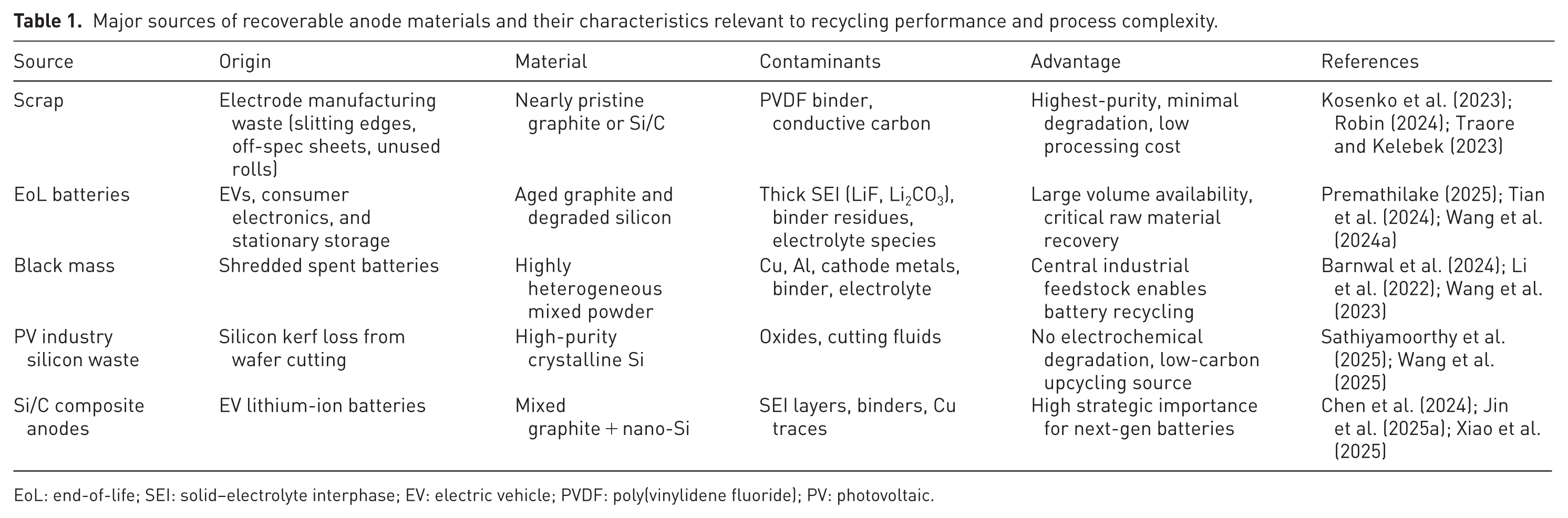
EoL: end-of-life; SEI: solid–electrolyte interphase; EV: electric vehicle; PVDF: poly(vinylidene fluoride); PV: photovoltaic.
In contrast, anode materials recovered from EoL batteries exhibit extensive electrochemical degradation. Recovered graphite typically shows lattice disorder, particle fracture, and thickened SEI layers enriched in LiF and Li2CO3, whereas silicon experiences severe pulverization and electrical disconnection due to repeated volume expansion during cycling (Kosenko et al., 2023; Premathilake, 2025; Tian et al., 2024). These degradation features substantially increase the complexity and energy demand of regeneration processes compared with the production scrap. Additional studies have demonstrated that SEI thickness, microcrack density, and residual electrolyte species play critical roles in determining the reusability of aged anode powders (Kosenko et al., 2023; Wang et al., 2023).
Black mass, generated through the industrial shredding of spent batteries, is identified in Table 1 as the most technically challenging anode feedstock. It consists of a highly heterogeneous mixture of graphite, silicon fragments, conductive carbon, binders, electrolyte residues, copper contamination, and transition metal species originating from cathode materials. This compositional complexity severely complicates physical separation and chemical purification, making black mass one of the most process-intensive substrates for anode recycling (Gupta et al., 2024; Lu et al., 2022). Recent microstructural and impurity analyses further indicate that heavy metal residues and electrolyte decomposition products can significantly suppress the electrochemical performance of regenerated anodes if not thoroughly removed (Li et al., 2022; Zhuang et al., 2026). Beyond battery-derived sources, silicon waste from the photovoltaic (PV) industry, particularly kerf loss generated during wafer cutting, represents a valuable and comparatively underutilized feedstock. As summarized in Table 1, this material retains high crystalline purity and lacks cycling-induced damage, making it a promising low-carbon resource for silicon reuse in next-generation battery anodes. Several recent studies have demonstrated that kerf-derived silicon can be chemically stabilized and electrochemically activated for high-performance lithium storage applications (Li et al., 2021; Sathiyamoorthy et al., 2025).
Finally, Si/C composite anodes, which are now widely deployed in commercial EVs, constitute a strategically important but highly complex recycling target (Jin et al., 2025a; Xiao et al., 2025). Their mixed-phase architecture, combining graphite with nanostructured silicon, introduces compounded challenges related to SEI removal, binder decomposition, copper contamination, and selective phase purification. Consequently, Si/C composites exhibit the highest overall regeneration difficulty, necessitating advanced hybrid recycling workflows for effective material recovery (Haluska, 2023; Jin et al., 2025a). Recent studies further indicate that carbon-shell engineering, porous reconstruction, and electrochemical reactivation are crucial for restoring the cycling stability of regenerated Si/C systems (Chen et al., 2018; Wang et al., 2024a). Given the distinct material characteristics and regeneration challenges associated with each major anode feedstock source (Table 1), the following section examines the global research landscape and thematic distribution of anode recycling studies.
Results and discussions
Global status and research areas of existing literature
Over the past decade, research on the recycling of graphite, silicon (Si), and Si/C composite anodes has expanded rapidly across all major scientific regions, reflecting the global urgency to recover sustainable materials from LIBs. As illustrated in Figure 3(a), Asia dominates the field with 58 publications, followed by Europe (42), North America (22), and other regions (10). This strong concentration of research activity in Asia is primarily driven by China, South Korea, and Japan, where large-scale LIB manufacturing, aggressive EV deployment, and early industrialization of battery recycling infrastructures have generated both regulatory pressure and industrial demand for anode material recovery (Falahati et al., 2024; Hung, 2024; Yang and Huang, 2025). In particular, China’s leadership is reinforced by its vertically integrated battery supply chain, extensive black mass processing capacity, and government-mandated recycling quotas, which collectively incentivize closed-loop material recovery Li et al., 2023; Yousefi and Soleymani, 2025; Zhao et al., 2022).
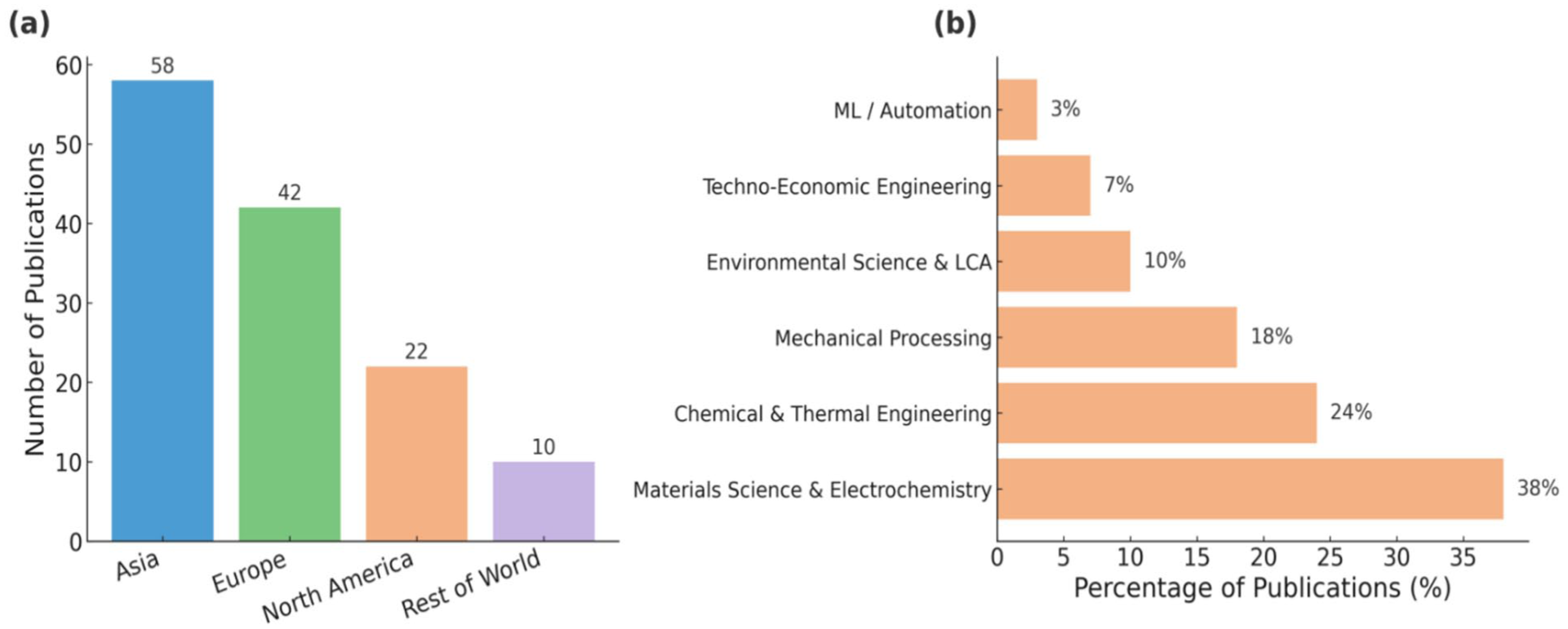
Global distribution and research focus of anode recycling literature (2015–2025): (a) regional distribution of publications, highlighting the dominance of Asia and Europe in research output, and (b) thematic distribution of research areas, illustrating the interdisciplinary nature of the field with emphasis on materials science, chemical engineering, and emerging data-driven approaches.
Europe’s substantial contribution reflects the influence of stringent circular economy policies, the European Battery Regulation, expanding gigafactory ecosystems, and strategic initiatives aimed at reducing dependence on critical raw materials, particularly graphite and silicon (Bobba et al., 2025; Kannisto, 2023; Štěpánek, 2024). Several European research programs emphasize LCA, eco-design, and regulatory-driven sustainability benchmarking, thereby accelerating academic–industrial collaboration in anode recycling research (Calleja et al., 2004). North American contributions, although smaller in volume, exhibit a strong focus on fundamental degradation mechanisms, advanced structural characterization, and industry-oriented regeneration strategies, led primarily by research institutions and start-ups in the United States and Canada (Ji et al., 2025; Li et al., 2022). In these regions, particular emphasis is placed on mechanistic understanding of SEI evolution, copper contamination pathways, and electrochemical reactivation strategies for degraded graphite and silicon. Contributions from other regions, including Australia, India, and Middle Eastern countries, indicate an emerging research interest driven by resource security concerns, PV waste reutilization, and the increasing deployment of battery-based energy technologies (Menkin et al., 2021; Rahman and Alharbi, 2024; Srivastava et al., 2025). Collectively, the geographical distribution shown in Figure 3(a) confirms that anode recycling has evolved into a global research endeavor, with Asia and Europe leading both academic output and near-term industrial implementation.
Beyond geographical trends, the thematic distribution of research activities highlights the strongly interdisciplinary nature of anode recycling science. As summarized in Figure 3(b), materials science and electrochemistry constitute the largest research domain (38%), encompassing fundamental studies on graphite structural regeneration, silicon reconstruction, SEI removal and re-engineering, and the evaluation of electrochemical performance of regenerated anodes (Yi et al., 2025). These studies rely extensively on advanced characterization techniques, including SEM, TEM, XRD, Raman spectroscopy, and electrochemical impedance spectroscopy, to correlate microstructural recovery with electrochemical performance restoration (Fanijo et al., 2022; Yuan et al., 2023). The second largest thematic category corresponds to chemical and thermal engineering (24%), focusing on binder removal, acid and alkaline leaching, solvent-assisted PVDF dissolution, thermal delamination, and high-temperature graphitization or restructuring processes (Sen et al., 2025).
Mechanical processing accounts for 18% of the literature and emphasizes the optimization of crushing, milling, sieving, flotation, and electrostatic separation techniques for scalable black mass pre-treatment and effective metal–carbon phase separation (Martinez, 2024; Premathilake et al., 2023). These studies consistently demonstrate that physical separation efficiency critically influences downstream chemical purification and electrochemical regeneration yields. The growing contribution from environmental science and LCA (10%) reflects increasing attention to energy consumption, carbon footprint reduction, water use, and sustainability benchmarking of anode recycling routes relative to virgin material production (Artz et al., 2018; Mutch, 2022). Techno-economic engineering studies (7%) address process cost modeling, capital expenditure analysis, energy and material flow optimization, and system-level integration of hybrid recycling flowsheets (Safarzadeh and Di Maria, 2025; Zanoletti et al., 2024). Finally, although currently representing a smaller share, machine learning and automation (3%) constitute a rapidly expanding research frontier focused on AI-assisted sorting, digital process optimization, predictive fault diagnosis, and real-time control of hybrid regeneration systems (Antony Jose et al., 2024; Elahi et al., 2023; Rashid and Kausik, 2024).
The distributions presented in Figure 3(a) and (b) demonstrate that anode recycling has transitioned from a niche, laboratory-scale research topic into a mature, globally distributed, and highly interdisciplinary field. The dominance of materials science, chemical and thermal engineering, and mechanical processing underscores that effective anode regeneration is inherently multiscale, requiring coordinated advances in microstructural design, surface chemistry control, and large-scale physical separation. However, the rapid growth of LCA-, techno-economic-, and AI-driven studies signals a decisive shift toward industrial deployment, sustainability optimization, and intelligent recycling infrastructures. This evolving global and thematic landscape provides a critical foundation for the recycling and regeneration technologies discussed in the following sections.
Recycling and regeneration technologies
Recycling technologies for graphite, silicon, and Si/C composite anodes have evolved rapidly over the past decade in response to increasing battery chemistry complexity and growing demand for sustainable material recovery. These technologies are commonly classified as mechanical, thermal, chemical, electrochemical, and hybrid approaches. In practice, however, they are frequently combined in sequential or integrated workflows to maximize purification efficiency and restore electrochemical functionality (Huang et al., 2023; Wang et al., 2021). Recent studies emphasize that no single technique can independently address SEI contamination, binder residues, metallic impurities, and microstructural degradation simultaneously, thereby necessitating multistage processing strategies (Márquez, 2025; Yenigun et al., 2025).
Mechanical recycling typically constitutes the initial pre-processing step, particularly under industrial conditions. This stage includes shredding, sieving, milling, delamination, and density-based separation, which physically liberate anode materials from the copper current collector and remove large foreign components. Effective mechanical delamination produces a concentrated anode fraction suitable for downstream purification (Ivanovskis, 2019; Zhan et al., 2025). Advanced techniques, such as ultrasonic delamination and controlled shear pulverization, have been shown to enhance material liberation efficiency while minimizing microstructural damage to graphite flakes, thereby preserving electrochemical integrity. Additionally, triboelectric and electrostatic separation methods further enhance carbon–metal separation efficiency at the powder scale. Despite its scalability and low operational cost, mechanical processing alone provides limited purification because it cannot remove SEI layers, binders, or surface oxides (Bresser et al., 2018; Chen et al., 2018).
Thermal recycling plays a crucial complementary role by decomposing polymeric binders, particularly PVDF, and removing organic electrolyte residues. Binder decomposition is typically achieved at temperatures between 400°C and 600°C, whereas structural restoration and carbon reordering occur at temperatures up to approximately 900°C (Wang et al., 2023). Under these conditions, graphite can recover a significant degree of crystallinity, whereas silicon undergoes partial structural restructuring. However, excessive temperatures above approximately 1000°C promote graphite oxidation and accelerate silicon cracking, particularly in Si/C composites, making precise thermal control essential (Bresser et al., 2018; Liu, 2018). Ultra-high-temperature graphitization (1200°C–2800°C) enables near-complete recovery of disordered carbon but entails extremely high energy consumption, which limits its sustainability at scale (Yi et al., 2026). Consequently, thermal treatments are most effective when applied as intermediate steps within hybrid regeneration workflows rather than as standalone solutions.
Chemical recycling enables targeted removal of SEI components, metallic impurities, silicon oxides, and binder residues using acids, alkalis, solvents, or redox-active solutions. Acid leaching with HCl, H2SO4, or HNO3 (1–4 M) at moderate temperatures (40°C–90°C) effectively removes Cu, Fe, and Al contaminants, yielding high-purity carbonaceous fractions; however, it generates secondary acidic wastewater and poses a risk of silicon over-etching (Ghaheri Badr, 2025; Su et al., 2025). Alkaline treatments using NaOH or KOH (0.5–3 M) are highly effective for SiOₓ removal and SEI cleaning, but excessive exposure can lead to undesirable graphite etching and basal-plane corrosion (Arshad et al., 2020; Sen et al., 2025). Solvent-based binder dissolution using N-methyl-2-pyrrolidone (NMP), dimethylformamide (DMF), or dimethyl sulfoxide (DMSO) enables efficient PVDF removal while preserving graphite morphology; however, these methods are limited by toxicity, slow kinetics, and challenges in solvent recovery. Oxidative chemical cleaning, such as treatment with H2O2, KMnO4, or O3, provides effective surface purification by removing organic SEI species, although it carries the risk of carbon oxidation if not carefully controlled (Jin et al., 2025a, 2025b). Studies further demonstrate that mild oxidative treatment followed by low-temperature annealing can restore graphite surface functionality without damaging its layered structure (Chen et al., 2024).
Electrochemical regeneration is a particularly effective approach for restoring graphite anodes because it directly reverses cycling-induced lithium depletion. Controlled electrochemical relithiation, typically conducted at 0.05°C–0.5°C and 0.01–1.0 V, rebuilds lithium intercalation pathways, heals structural defects, and promotes formation of a fresh and stable SEI layer (Wang et al., 2019). Multiple studies report that relithiated graphite can recover up to 90–95% of its original capacity, depending on degradation severity, electrolyte composition, and cycling protocol. Although electrochemical regeneration of silicon remains limited owing to irreversible fracture and pulverization, controlled electrochemical cycling can still contribute to partial SEI stabilization and surface passivation. When combined with prior structural reconstruction, this approach can improve cycling stability (Han et al., 2021; Ren et al., 2020).
Because each pathway addresses only a subset of degradation mechanisms, hybrid recycling strategies integrating mechanical, thermal, chemical, and electrochemical treatments have emerged as the most effective solutions for regenerating Si/C composite anodes. A typical workflow begins with mechanical delamination, followed by thermal binder decomposition (500°C–800°C), chemical oxide and SEI removal, and a final electrochemical conditioning stage. These integrated approaches enable simultaneous restoration of surface chemistry, microstructural integrity, and electrochemical performance. Numerous studies consistently demonstrate that hybrid strategies outperform single-step treatments, particularly for heavily degraded composite materials that require both chemical purification and structural re-engineering (Li et al., 2025; Wu et al., 2024). The operating conditions, targeted components, advantages, limitations, and representative references for each regeneration pathway are summarized in Table 2, highlighting the interconnected nature of mechanical, thermal, chemical, electrochemical, and hybrid technologies for regenerating graphite, silicon, and Si/C composite anodes.
Operating parameters, advantages, and limitations of regeneration technologies for graphite, silicon, and Si/C composite anodes.
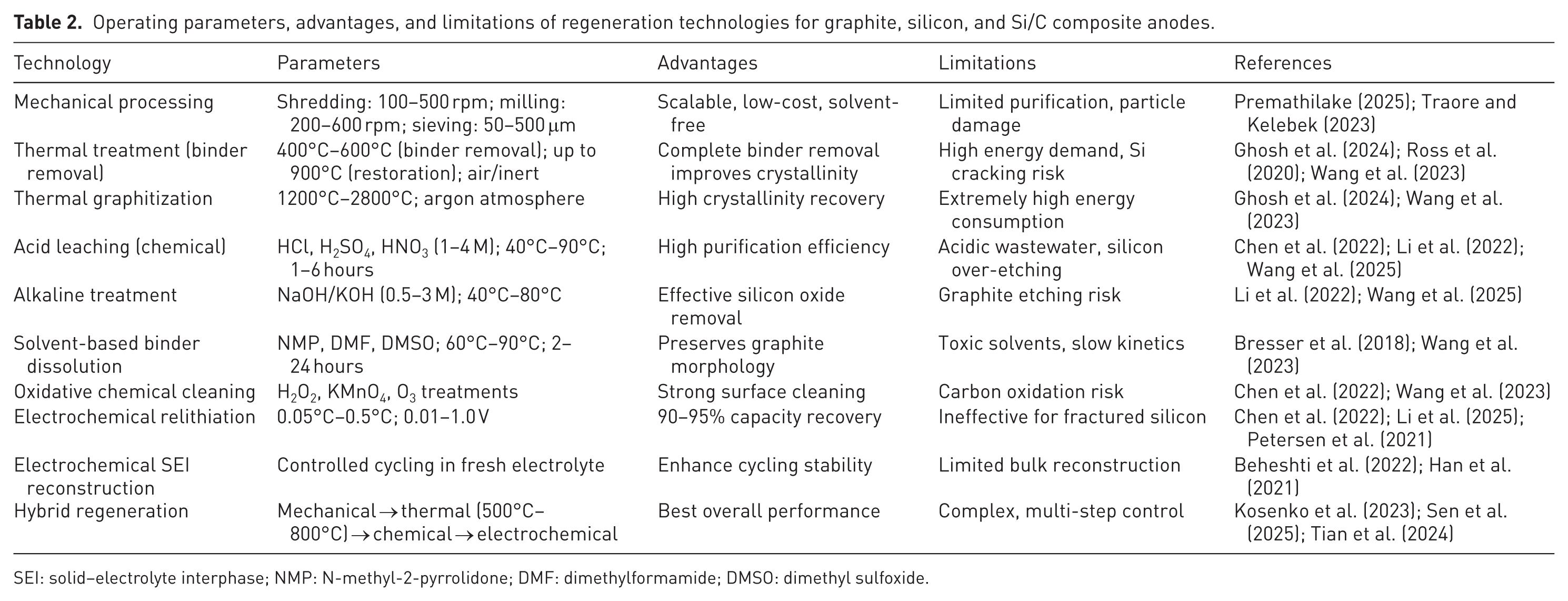
SEI: solid–electrolyte interphase; NMP: N-methyl-2-pyrrolidone; DMF: dimethylformamide; DMSO: dimethyl sulfoxide.
Despite their high efficiency under controlled laboratory conditions, many of these recycling technologies face significant challenges when translated into industrial-scale operations. In practice, pilot and commercial processes must handle heterogeneous black mass, variable impurity levels, and continuous processing requirements, which can reduce separation efficiency and increase operational complexity. Consequently, industrial recycling currently relies heavily on integrated mechanical and thermal pre-treatment steps, followed by simplified hydrometallurgical routes, rather than the highly optimized multistep protocols commonly reported in laboratory studies.
Performance evaluation of regenerated materials
The electrochemical performance of regenerated anode materials is primarily evaluated in terms of reversible capacity, rate capability, cycling stability, Coulombic efficiency, and long-term structural integrity. Among the investigated materials, regenerated graphite consistently exhibits the highest recovery efficiency due to its inherently stable layered structure and relatively low volumetric strain during cycling. Numerous studies report that, following multistage purification, controlled thermal healing, and electrochemical relithiation, recycled graphite recovers capacities of 350–360 mAh g−1, corresponding to approximately 90–95% of the pristine value (Goktas et al., 2018; Ogata et al., 2018; Singh et al., 2024; Zhao et al., 2016).
Raman spectroscopy, X-ray diffraction (XRD), and high-resolution transmission electron microscopy (HRTEM) analyses consistently confirm the reordering of graphitic domains after regeneration, evidenced by significant reductions in defect-related D-band intensity and restoration of interlayer spacing (Chen et al., 2023; Goktas et al., 2018). Electrochemical impedance spectroscopy further reveals reduced charge-transfer resistance and stable SEI formation following relithiation and artificial SEI reconstruction (Goktas et al., 2018). Direct electrochemical rejuvenation through anodic and cathodic relithiation also enables near-complete restoration of lithium intercalation hosts, even in heavily aged graphite. Collectively, these findings demonstrate that graphite exhibits near-complete electrochemical reversibility under optimized hybrid regeneration conditions (Ross et al., 2020).
In contrast, silicon regeneration remains fundamentally constrained by extreme lithiation-induced volume expansion exceeding 300%, which leads to particle pulverization, pore collapse, electrical disconnection, and repeated rupture of the SEI layer (Ghosh et al., 2024; Li et al., 2019). Consequently, silicon recovered from EoL batteries typically shows poor intrinsic capacity retention unless advanced reconstruction strategies are implemented. Reported effective approaches include selective removal of SiOₓ surface layers, hydrothermal restructuring, nanoporous reconstruction, spray-drying reassembly, and carbon-shell encapsulation (Cao et al., 2017; Goktas et al., 2018; Ogata et al., 2018; Xiong et al., 2024). Even with these advanced treatments, regenerated silicon generally recovers only 50–70% of its theoretical capacity, depending on the extent of structural damage and reconstruction quality (Fu et al., 2023; Jiang et al., 2019).
SEI reconstruction remains a persistent challenge for regenerated silicon, as unstable interfacial chemistry continues to drive irreversible lithium loss and accelerated impedance growth. Advanced SEI engineering strategies, including electrolyte additives, artificial passivation layers, and surface chemical modification, have shown promise in mitigating these effects; however, they have not yet achieved electrochemical reversibility comparable to that of pristine silicon (Lyubina, 2021; Zhang et al., 2025). This fundamental disparity between graphite and silicon regeneration highlights a key limitation in current recycling strategies. Graphite maintains a stable layered structure that can be effectively restored through purification, thermal healing, and relithiation, enabling near-complete electrochemical recovery. In contrast, silicon undergoes severe volumetric expansion during lithiation, leading to irreversible structural degradation, electrical disconnection, and unstable SEI evolution. These effects cannot be fully reversed through conventional regeneration processes, even under advanced hybrid treatments. Consequently, silicon recovery requires complex structural re-engineering approaches, such as nanostructuring, carbon encapsulation, or composite reconstruction, rather than simple regeneration pathways. This inherent material instability explains why silicon consistently exhibits lower recovery efficiency and long-term performance compared to graphite (Navarrete-Segado et al., 2026; Roy et al., 2024).
Si/C composite anodes demonstrate the most balanced and practically relevant recovery behavior, particularly when hybrid regeneration routes are employed. Because the graphite fraction is highly recoverable and silicon reconstruction can be partially engineered, composite electrodes achieve simultaneous improvements in capacity restoration, rate performance, and cycling stability. Regenerated Si/C composites exhibit significantly enhanced initial Coulombic efficiency (ICE), suppressed impedance growth, stabilized SEI formation, and improved rate capability (Barnwal et al., 2024; Chen et al., 2022; Goktas et al., 2018).
Hybrid recycling strategies that integrate mechanical delamination, thermal binder removal, chemical oxide cleaning, and electrochemical conditioning deliver the most consistent performance recovery across both graphite and silicon phases. Additional structural reconsolidation through spray-drying, porous reconstruction, and carbon-shell engineering further stabilizes repeated silicon lithiation while preserving rapid lithium diffusion through the regenerated graphite network (da Silva et al., 2018; Jiang et al., 2019; Zhang et al., 2025).
The comparative electrochemical behaviors of pristine and regenerated anode materials are summarized in Figure 4. As shown in Figure 4(a), the regenerated graphite exhibits reversible capacities approaching those of the pristine silicon, confirming its robust structural and electrochemical reversibility following purification and relithiation (Ogata et al., 2018). Regenerated silicon displays substantially lower absolute capacity than pristine silicon owing to irreversible fracture and SEI instability, whereas regenerated Si/C composites exhibit intermediate but technologically optimal performance, in which partial silicon recovery is synergistically supported by highly stable regenerated graphite. The multi-criteria radar analysis in Figure 4(b) further demonstrates that hybrid regeneration induces simultaneous improvements in specific capacity, ICE, rate capability, cycling stability, SEI robustness, and microstructural integrity. These results confirm that hybrid workflows enable multidimensional performance restoration rather than isolated metric enhancement (Basu et al., 2019; Kim et al., 2014; Ogata et al., 2018). Overall, graphite exhibits the highest intrinsic electrochemical recoverability, while silicon remains the most structurally and interfacially challenging material to regenerate. Si/C composites represent the most realistic and industrially valuable targets for hybrid recycling technologies, offering an optimal balance between recoverable capacity, long-term stability, and process scalability.
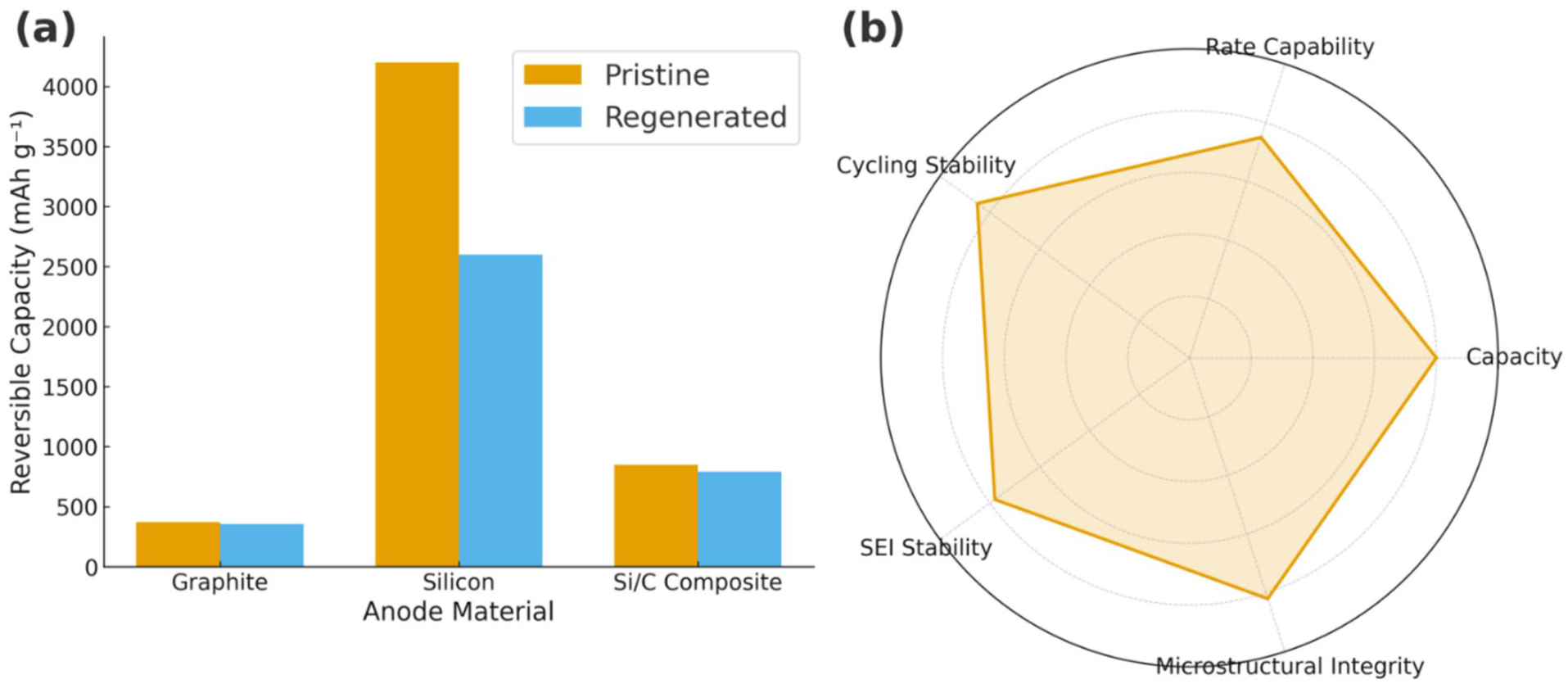
(a) Comparison of reversible capacities of pristine and regenerated anodes, demonstrating high graphite recoverability and limited silicon recovery. (b) Multi-criteria radar chart showing improvements in capacity, SEI stability, and cycling performance following hybrid regeneration.
It is important to note that these performance metrics are primarily obtained under optimized laboratory conditions using well-controlled materials and testing protocols. In contrast, industrial-scale regeneration must contend with feedstock variability, incomplete impurity removal, and process limitations, which can lead to lower and less consistent electrochemical performance. As a result, the reported recovery efficiencies and capacity retention values should be interpreted as best-case scenarios rather than directly representative of large-scale industrial outcomes.
Environmental and economic assessment
The environmental and economic implications of anode recycling have become increasingly critical as global LIB production continues to expand. Multiple LCA studies consistently demonstrate that the recovery of graphite, silicon, and Si/C composite anodes provides substantial sustainability advantages compared with the extraction, purification, and processing of virgin raw materials (Li et al., 2019; Lyubina, 2021). Among these materials, the production of synthetic graphite is particularly energy-intensive, requiring ultra-high-temperature graphitization above 2800°C. In contrast, recycled graphite retains much of its structural integrity after cycling, enabling regeneration through moderate thermal, chemical, and electrochemical treatments (Cao et al., 2017; Zhang et al., 2018). Consequently, regenerated graphite can reduce total energy consumption by up to 50–80% relative to virgin synthetic graphite production, depending on the specific recycling pathway employed (Ross et al., 2020). However, these values are sensitive to underlying assumptions, particularly the energy mix (e.g., fossil-based versus renewable electricity), process scale, and system boundaries considered in LCA. Variations in these factors can significantly influence the magnitude of reported benefits. In addition, the impacts associated with natural graphite mining, including land degradation, water contamination, fine particulate emissions, and geopolitical resource concentration, can be significantly mitigated through closed-loop recycling strategies (Ali et al., 2025; Mohamed et al., 2025; Rey et al., 2021).
For silicon-based anodes, the environmental footprint of primary production is also substantial due to the high-purity refinement, carbothermal reduction, and repeated oxidation–reduction cycles required to produce battery-grade silicon. Although silicon recycling remains more technically challenging than graphite regeneration, emerging approaches such as selective SiOₓ removal, carbon-shell encapsulation, hydrothermal restructuring, and electrochemical activation demonstrate that recycled silicon can achieve meaningful electrochemical recovery at a fraction of the environmental cost associated with virgin silicon synthesis (Mahmood et al., 2025; Ngoy et al., 2025; Yu et al., 2026). From a system-level perspective, Si/C composite recycling pathways further enhance sustainability by enabling the simultaneous recovery of both carbon and silicon fractions, thereby reducing overall material demand, process redundancy, and cumulative environmental impact (Birawidha et al., 2025; Protopapa et al., 2025; Zhou et al., 2024).
From an economic standpoint, anode recycling offers clear advantages by reducing raw material procurement costs, energy consumption, and waste management expenditures. Mechanical and low-temperature thermal recycling routes are generally the most economically accessible and scalable options, although they provide limited purification and electrochemical restoration when applied as standalone processes. In contrast, chemical and electrochemical regeneration methods achieve superior material performance but incur higher operational costs due to reagent consumption, wastewater treatment requirements, electricity usage, and increased process complexity. Hybrid recycling configurations aim to balance these trade-offs by integrating mechanical separation, moderate thermal treatment, selective chemical purification, and electrochemical conditioning. Recent techno-economic analyses indicate that when anode recovery efficiencies exceed approximately 70%, hybrid recycling becomes not only environmentally justified but also economically competitive or profitable at the industrial-scale, particularly under increasing regulatory pressure and carbon-pricing frameworks (Blömeke et al., 2022; Das et al., 2026; Rehman et al., 2025; Yao et al., 2026).
The comparative environmental and economic performances of major anode recycling routes are illustrated in Figure 5. As shown in Figure 5(a), all recycling pathways achieve substantial energy savings relative to virgin material production, with hybrid regeneration providing the highest relative energy reduction, followed by chemical and thermal processes. The superior energy efficiency of hybrid routes arises from their ability to combine selective purification with moderate-temperature thermal steps, rather than relying exclusively on energy-intensive high-temperature graphitization or metallurgical processing. By contrast, although purely mechanical recycling is energetically efficient, its limited purification and electrochemical restoration capabilities reduce its overall sustainability impact when deployed in isolation (Islam and Iyer-Raniga, 2022; Navarrete-Segado et al., 2026; Ogata et al., 2018).
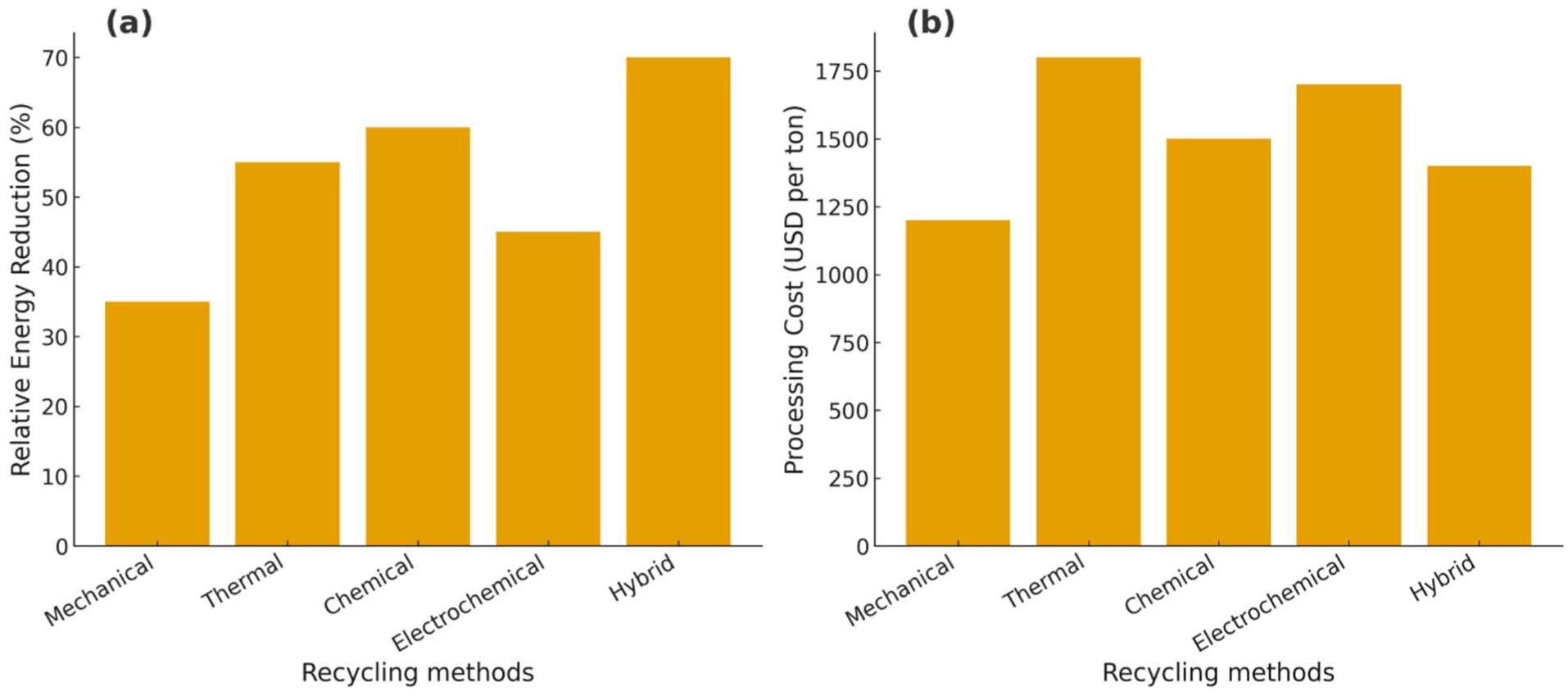
Environmental and economic impacts of anode recycling: (a) relative energy reduction compared with virgin material production and (b) cost comparison of major recycling methods, highlighting the cost–performance advantage of hybrid processes.
The economic dimensions of the recycling processes are summarized in Figure 5(b). Thermal and electrochemical routes incur the highest processing costs due to elevated temperature requirements, extended treatment durations, and significant electricity demand. Mechanical recycling remains the lowest-cost option; however, its limited ability to restore electrochemical performance restricts its viability as a standalone industrial solution. Hybrid recycling routes demonstrate the most favorable cost–performance balance, offering substantially lower processing costs than fully thermal or electrochemical methods while delivering superior material recovery, structural reconstruction, and electrochemical restoration (Biswal et al., 2024; Das et al., 2026; Ross et al., 2020; Woeste et al., 2024). Collectively, combined LCA and techno-economic evidence confirms that hybrid anode recycling strategies represent the most viable pathway for large-scale industrial deployment, particularly for next-generation Si/C composite anodes. However, these environmental and economic benefits are strongly dependent on process configuration, scale, and material recovery efficiency, and may vary under industrial operating conditions (Fan et al., 2025; Furlanetto et al., 2025; Kadivar et al., 2025).
Challenges and future directions
Despite significant advances in the recycling and regeneration of graphite, silicon, and Si/C composite anodes, several fundamental technical and process-level challenges continue to limit industrial scalability and circularity. The dominant challenges and pathway-specific limitations are summarized in Table 3. One of the most critical scientific bottlenecks is the chemical and structural complexity of SEI. The SEI comprises chemically heterogeneous inorganic species, such as LiF and Li2CO3, together with polymeric organic decomposition products that are strongly bonded to anode surfaces (Beheshti et al., 2022; Han et al., 2021; Kosenko et al., 2023). Its nonuniform distribution within black mass makes selective removal extremely difficult without inducing structural damage to the underlying graphite or silicon frameworks, particularly during aggressive chemical or thermal treatments (Tian et al., 2024; Wang et al., 2023). For silicon-containing anodes, this challenge is further intensified by lithiation-induced fracture, loss of electrical connectivity, and unstable SEI reformation, which reduce the effectiveness of conventional regeneration strategies (Basu et al., 2019; Fan et al., 2025).
Key challenges and process limitations in the regeneration of graphite, silicon, and Si/C composite anodes.
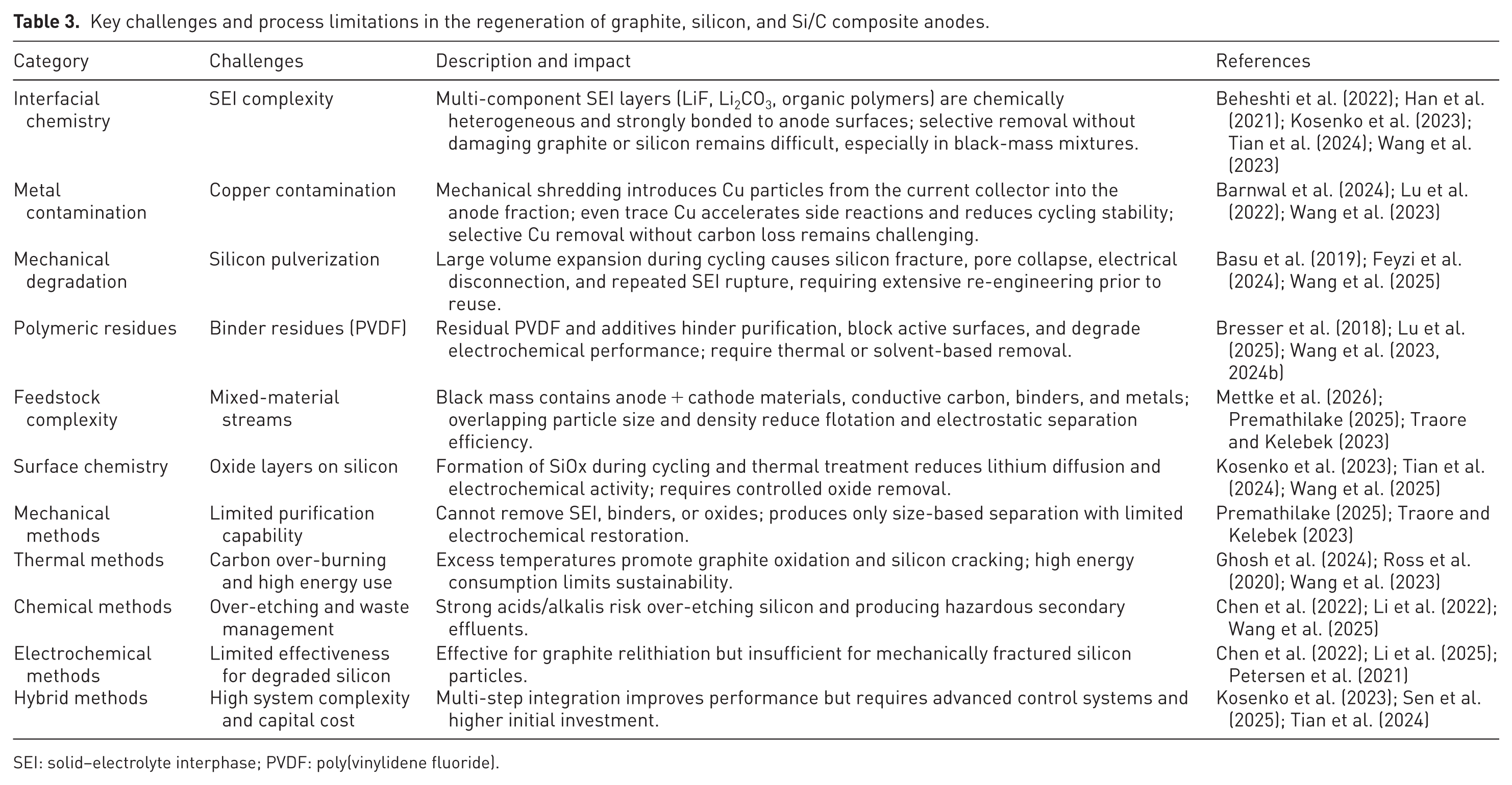
SEI: solid–electrolyte interphase; PVDF: poly(vinylidene fluoride).
Copper contamination originating from current collector foils represents a persistent challenge in anode recycling. Copper particles introduced during mechanical shredding can remain in black mass or regenerated anode fractions, where they may accelerate parasitic reactions and deteriorate electrochemical stability. However, selective copper removal without concurrent carbon loss or silicon degradation remains technically challenging during chemical and electrochemical purification (Barnwal et al., 2024; Lu et al., 2022; Wang et al., 2023). This difficulty is further amplified for silicon-containing anodes, where lithiation-induced volume expansion leads to particle pulverization, pore collapse, electrical disconnection, and repeated SEI rupture. These irreversible mechanical degradation processes generate fragmented silicon phases that require extensive structural re-engineering before meaningful electrochemical reuse becomes feasible (Basu et al., 2019; Feyzi et al., 2024; Wang et al., 2025).
Additional barriers arise from polymeric binder residues, primarily PVDF, which block electrochemically active surfaces and hinder impurity removal. These residues typically require high-temperature decomposition or solvent-based dissolution, introducing energy penalties, solvent recovery challenges, and additional environmental burdens (Bresser et al., 2018; Lu et al., 2025; Wang et al., 2023, 2024b). Furthermore, the heterogeneous composition of industrial black mass—where anode and cathode materials coexist with conductive carbon, binder fragments, electrolyte decomposition products, and metallic debris—reduces the selectivity of conventional flotation and electrostatic separation owing to overlapping particle size, surface chemistry, and density distributions (Mettke et al., 2026; Premathilake, 2025; Traore and Kelebek, 2023).
From a process-technology perspective, each recycling pathway exhibits intrinsic limitations (Table 3). Mechanical pre-treatment is essential for large-scale operations but provides mainly physical separation and cannot eliminate SEI layers, binders, or surface oxides. Thermal treatment is effective for binder removal but poses risks of graphite overoxidation, silicon cracking, and high energy consumption at elevated temperatures (Ghosh et al., 2024; Ross et al., 2020; Wang et al., 2023). Chemical purification achieves high impurity removal efficiency but introduces challenges related to silicon over-etching, secondary wastewater generation, and reagent recovery (Chen et al., 2022; Li et al., 2022; Wang et al., 2025). Electrochemical regeneration enables efficient graphite relithiation but remains insufficient for restoring severely fractured silicon structures (Chen et al., 2022; Li et al., 2025; Petersen et al., 2021). Although hybrid recycling pathways currently deliver the most comprehensive performance recovery, their multistep integration substantially increases process complexity, operating costs, and capital expenditure, thereby constraining large-scale deployment (Kosenko et al., 2023; Sen et al., 2025; Tian et al., 2024).
Although these challenges remain substantial, they also define clear research and technological priorities for next-generation anode recycling systems. Advanced selective separation technologies—including density-gradient centrifugation, triboelectric charging, and high-resolution electrostatic sorting—have demonstrated strong potential to overcome the limitations of flotation-based separation by enabling higher-purity isolation of graphite and silicon phases from complex black mass feedstocks. At the material level, continued innovation in SEI engineering, particularly through artificial SEI deposition, electrolyte-additive-assisted SEI reconstruction, and chemically stabilized interphase design, is critical for stabilizing regenerated graphite and silicon surfaces during reactivation.
The integration of artificial intelligence and machine learning frameworks into recycling systems represents a transformative opportunity. Data-driven control of purification conditions, real-time optimization of hybrid regeneration flowsheets, intelligent fault diagnosis, and automated material sorting offer clear pathways toward scalable, adaptive, and economically optimized recycling operations. As the global battery industry transitions toward high-silicon and Si/C composite anodes, the urgency to develop efficient silicon recovery and structural re-engineering technologies will continue to increase. Advanced strategies—including porous silicon regeneration, spatially controlled carbon-shell coating, oxide-free silicon synthesis, and interface-stabilized composite represent key research directions for enabling durable silicon reuse. However, the long-term success of these approaches ultimately depends on the development of low-cost, high-throughput, and environmentally benign processing routes compatible with closed-loop manufacturing systems. Together, these future directions define the technological roadmap required to transition anode recycling from laboratory-scale demonstrations to fully industrialized circular economy platforms. This section, therefore, consolidates the core conclusions of this review and outlines the most promising pathways for future academic research and industrial implementation.
Conclusion
The recycling and regeneration of graphite, silicon, and Si/C composite anodes have become indispensable components of sustainable LIB ecosystems. As global battery manufacturing continues to accelerate alongside the rapid expansion of EVs, portable electronics, and grid-scale energy storage, the volume of EoL batteries is increasing at an unprecedented rate. In this context, effective anode recycling is no longer optional; it is essential for reducing environmental burdens, mitigating dependence on critical raw materials, and strengthening long-term supply chain resilience. This systematic review, based on 132 rigorously selected studies published between 2015 and 2025, demonstrates that a diverse portfolio of technologies is available for the recovery and regeneration of anode materials. Mechanical, thermal, chemical, and electrochemical treatments each exhibit distinct strengths, whereas hybrid, multistage recycling workflows consistently deliver superior outcomes, particularly in terms of material purity, structural restoration, and electrochemical performance. Among the anode systems reviewed, graphite exhibits the highest degree of recoverability owing to its inherently stable layered structure. Thermal purification and chemical cleaning effectively restore crystallinity, whereas electrochemical relithiation rebuilds lithium intercalation pathways lost during cycling.
In contrast, silicon remains the most technically challenging anode material to regenerate because of severe volume expansion, particle pulverization, and continuous SEI rupture during operation. Consequently, advanced regeneration strategies—such as selective oxide removal, nanoporous reconstruction, and carbon-shell encapsulation—are crucial for achieving meaningful performance recovery. Si/C composite anodes, which now dominate next-generation EV batteries, further highlight the need for integrated hybrid recycling schemes capable of simultaneously restoring graphite and silicon components in a controlled and scalable manner. From environmental and economic perspectives, the analyses compiled in this review confirm that anode recycling offers significant advantages over virgin material production, with reported reductions in energy consumption and greenhouse gas emissions of 50–80%. Nevertheless, persistent barriers—including SEI complexity, copper contamination, binder residues, and the heterogeneous nature of black-mass feedstocks—continue to constrain large-scale deployment. Addressing these challenges will require future innovations in selective separation technologies, sustainable chemical processing, intelligent process optimization through machine learning, and advanced structural engineering of regenerated silicon. As the battery industry transitions toward higher silicon content in anodes, the development of efficient, cost-effective, and environmentally benign recycling technologies will be critical to achieving true circularity in next-generation LIBs. The insights synthesized in this review provide a comprehensive foundation for guiding future academic research, informing industrial process design, and supporting policy frameworks that aim to accelerate the industrial-scale implementation of closed-loop anode recycling systems.
Footnotes

Author contributions
Funding
The authors disclosed receipt of the following financial support for the research, authorship, and/or publication of this article: This work was supported by the Technology development Program RS-2025-02317161 funded by the Ministry of SMEs and Startups (MSS, Korea).
Declaration of conflicting interests
The authors declared no potential conflicts of interest with respect to the research, authorship, and/or publication of this article.