






Abstract
Urban sustainability challenges in many Global South cities occur within fragmented institutional environments where no single authority holds full legitimacy or capacity to govern. This study examines how pluralistic governance—characterized by overlapping mandates among public agencies, non-governmental organizations, landlords, and regulators—can still generate coordinated environmental performance. Drawing on stakeholder and dynamic-capabilities theories, it introduces relational capability as a sustainability-oriented governance mechanism that enables adaptive coordination and substitutes for weak formal structures. Findings from Nairobi’s solid waste management system show that coordination arises not from technical capacity or centralized control but from distributed relational processes that align diverse actors around shared environmental goals. Relational capability thus functions as a meta-governance competence that transforms institutional incoherence into adaptive efficiency. The study highlights the importance of relational infrastructure—trust-building, joint planning, and shared accountability—in strengthening environmental governance across fragmented urban systems.
Keywords
Introduction
In many African cities, the governance of solid waste has become a vivid illustration of the tensions and possibilities of pluralistic governance. Nairobi’s streets—where formal municipal trucks operate alongside informal recyclers and private contractors—reveal an urban system governed not by a single centralized authority but by a mosaic of actors: public agencies, private enterprises, non-governmental organizations (NGOs), landlords, and community groups. As the city’s population expands, solid waste management (SWM) has become not merely a technical problem but a governance challenge in which multiple institutional logics, power relations, and legitimacy claims intersect (Ansell and Gash, 2008; Ostrom, 2010; Swyngedouw, 2005). The coexistence of diverse actors performing overlapping roles raises a central puzzle: when does pluralism foster coordination and innovation, and when does it generate fragmentation and inefficiency? This puzzle exposes a deeper theoretical tension—how collective action emerges when no single authority possesses the legitimacy or capacity to govern effectively.
Nairobi epitomizes this paradox. Although the Nairobi City County (NCC) is legally mandated to manage waste, it collects less than half of the 2500 tons produced daily (Kaza et al., 2018; UN-Habitat, 2010). The rest is handled by private firms, community-based organizations, and informal recyclers (Njeru, 2006). Despite limited state capacity, the system persists—unevenly but functionally. Informal actors create livelihoods and recycle materials neglected by formal authorities (Gutberlet, 2012). Yet, pluralism also generates competition, duplication, and disputes over fees, territory, and authority among NCC, the National Environment Management Authority (NEMA), NGOs, and landlords (Johnstone and Lincoln, 2022). These contradictions make Nairobi a microcosm of the governance dilemmas facing many African cities—where state authority, market incentives, and community norms coexist but rarely align. Nairobi thus provides a theoretically revealing site to examine how coordination and legitimacy are constructed amid institutional incoherence, making it a natural laboratory for understanding pluralistic governance under constraint.
Research on collaborative and environmental governance shows that “wicked problems” like urban waste require distributed, deliberative, and adaptive approaches rather than hierarchical control (Emerson, 2003; Reed et al., 2018; Rittel and Webber, 1973). Pluralism expands the range of resources and knowledge available for public problem-solving, fostering experimentation and responsiveness (Ansell and Gash, 2008; Luyet et al., 2012). However, these benefits depend on the presence of coordination mechanisms—shared norms, accountability frameworks, and trust—that are often weak in low-capacity contexts (Marshall and Farahbakhsh, 2013). Existing theories of collaboration tend to assume cooperative intent and institutional stability, yet in many African cities pluralism operates through asymmetry, contestation, and fluid authority. When such mechanisms are absent, pluralism may degenerate into competition, capture, or symbolic participation (Cornwall, 2008). This raises a key theoretical gap: although pluralism has been normatively celebrated for its inclusivity, we know little about the micro-processes of negotiation and legitimacy work that determine whether pluralistic governance yields coordination or conflict.
In practice, governance pluralization has outpaced institutional integration in many developing economies, creating ambiguity over who decides, who pays, and who benefits (Bevir, 2011; Biermann et al., 2009). In Nairobi, landlords outsource waste services to private contractors, NGOs promote environmental justice, and informal recyclers operate through necessity rather than legality (Ezeah et al., 2013). Governance thus becomes an ongoing negotiation between state, market, and community (Batley and Mcloughlin, 2010; Schleifer, 2019). This fragmented arrangement offers a rare opportunity to theorize how pluralistic governance functions when authority, legitimacy, and resources are distributed across actors with divergent institutional logics and unequal power.
Yet empirical understanding of how pluralistic engagement affects performance remains limited. Much of the stakeholder participation literature assumes cooperation, underplaying the power asymmetries and institutional frictions that define pluralism (Agrawal, 2001; Bennett and Satterfield, 2018; Bryson et al., 2015). This study addresses this gap by examining how pluralistic governance influences SWM in NCC. We conceptualize pluralistic governance as the coexistence of interdependent actors—governmental, private, and civic—whose authority, resources, and legitimacy overlap in producing public value (Freeman, 1984; Swyngedouw, 2005). Building on stakeholder theory (Freeman, 1984; Mitchell et al., 1997) and pluralism scholarship (Ansell and Gash, 2008; Dawkins, 2015), we propose that the effectiveness of pluralistic governance depends not on participation per se but on the relational quality of engagement—how actors negotiate legitimacy, align interests, and sustain accountability across institutional divides.
Nairobi’s hybrid waste system—where regulation, contracting, and informal practices intersect—offers a setting to examine how pluralism works under institutional complexity (Parnell and Pieterse, 2010; Watson, 2014). Each actor brings a distinct form of legitimacy—bureaucratic, economic, moral, or pragmatic (Suchman, 1995)—and system performance depends on how these logics are reconciled through everyday negotiation. Rather than viewing pluralism as a static structural condition, we treat it as a dynamic process of relational coordination through which authority and accountability are continuously constructed and contested.
This study contributes to theory and practice in three ways. First, it reconceptualizes stakeholder engagement as governance negotiation, emphasizing the political and relational work through which actors bridge divergent institutional logics and resource asymmetries (Lawrence and Suddaby, 2006). Second, it extends pluralism theory by explaining how hybrid governance arrangements in low-capacity settings generate both innovation and conflict, highlighting the contingent mechanisms that convert pluralism into coordination (Dodman et al., 2019; Marshall and Farahbakhsh, 2013). Third, it introduces the concept of relational legitimacy work to illuminate how authority and accountability are enacted in everyday interactions, offering a process-based explanation for performance variation in pluralistic systems.
Understanding this matters because pluralistic governance now characterizes many Global South cities where formal authority is limited but societal interdependence is high. By analyzing how legitimacy, authority, and accountability are negotiated in Nairobi, this study advances broader debates on sustainability governance, stakeholder coordination, and public value creation (Bryson et al., 2015; Moore, 2005). It shows that effective governance in complex societies depends less on centralized control and more on the relational capacity to align divergent interests toward collective environmental goals. This study introduces relational capability as a sustainability-oriented governance mechanism that substitutes for weak institutional structures, enabling adaptive coordination and environmental performance in fragmented urban systems.
Literature review
Stakeholder theory and the governance of public goods
Stakeholder theory provides a foundational lens for understanding how organizations navigate the interdependencies between diverse actors whose support is essential for achieving collective outcomes (Freeman, 1984). Originally developed to explain firm–stakeholder relationships in private enterprise, the framework has evolved to encompass public governance and sustainability contexts (Kujala et al., 2022; Reed, 2008). Within public systems such as SWM, the “stakeholder” extends beyond customers or shareholders to include communities, regulators, NGOs, and informal workers (Wilson et al., 2006). This broadened scope underscores that value creation and environmental performance depend on relational coordination and mutual adjustment across institutional boundaries (Sachs and Rühli, 2011).
In governance settings characterized by scarce resources and competing mandates, stakeholder theory offers both a normative and instrumental rationale for collaboration. Normatively, it advances inclusion and procedural fairness in public decision-making (Dmytriyev et al., 2017). Instrumentally, it posits that engaging diverse stakeholders improves legitimacy, resource acquisition, and long-term sustainability (Panda and Sangle, 2020). Yet, as stakeholder networks grow more complex, the assumption of goal alignment weakens. Engagement becomes not only a matter of inclusion but also of managing conflict, asymmetry, and competing value frames. Although stakeholder theory explains why engagement matters, it has been critiqued for limited attention to how engagement unfolds under conditions of institutional plurality and power imbalance (Dawkins, 2015). In African urban contexts such as Nairobi—where landlords, NGOs, regulators, and informal waste actors operate through overlapping yet weakly integrated systems—stakeholder relations are better understood as processes of negotiation and boundary work rather than cooperation. These dynamics call for extending stakeholder theory toward a pluralistic governance perspective that centers on the relational and political dimensions of coordination.
Pluralistic governance: From cooperation to negotiation
The notion of pluralistic governance emerges from critiques of hierarchical and market-centric models that fail to capture the distributed and contested nature of authority in complex public systems (Ansell and Gash, 2008; Swyngedouw, 2005). Pluralism assumes that power and legitimacy are dispersed among multiple actors who hold divergent values, institutional logics, and overlapping jurisdictions (Johnstone and Lincoln, 2022). Unlike consensus-oriented collaboration, pluralistic governance acknowledges friction, ambiguity, and continuous renegotiation as inherent to collective action (Dawkins, 2015). It thus shifts the analytical focus from coordination structures to the practices of negotiation, translation, and compromise that sustain them.
In SWM, pluralistic governance manifests in hybrid institutional assemblages where governments, NGOs, and private actors jointly manage waste flows. Studies across Latin America, Asia, and Africa show that such systems can stimulate innovation, local accountability, and citizen participation (Alamgir et al., 2012; Lederer et al., 2015). However, they can also intensify conflict when mandates are unclear or when actors pursue incompatible logics of value (Guerrero et al., 2013). For instance, NGOs may privilege equity and environmental justice, whereas municipal authorities prioritize efficiency and compliance (Singh and Dey, 2015). Pluralistic governance therefore embodies a productive paradox: diversity enhances adaptability and creativity, yet simultaneously multiplies coordination costs and legitimacy disputes.
Recent scholarship situates pluralism within sustainability transitions, emphasizing “negotiated coordination” among actors with distinct moral and cognitive frames (Johnstone and Lincoln, 2022; Schleifer, 2019). This perspective challenges the harmony assumption of collaborative governance theory, portraying governance instead as ongoing political and discursive work through which actors continually renegotiate authority, roles, and accountability (Swyngedouw, 2005). Such a perspective is especially salient for urban Africa, where informality, institutional layering, and hybrid legitimacy make pluralism not an anomaly but the normal condition of governance.
Collaborative and polycentric governance in urban waste systems
Parallel to pluralism, collaborative and polycentric governance theories explore how multiple decision centers coordinate in managing shared resources (Ostrom, 2010). Collaborative governance highlights deliberation, trust-building, and shared decision-making among interdependent actors (Ansell and Gash, 2008). Polycentric governance extends this logic by recognizing multiple autonomous yet interdependent centers of authority that self-organize through mutual monitoring and learning (Ostrom, 2010). Both approaches illuminate how diversity can yield resilience, but they often assume minimal conflict and overlook the contested politics of coordination in low-capacity settings.
In SWM, collaborative governance has been associated with improved outcomes through information sharing, co-learning, and mutual accountability (Reed et al., 2018). De Feo and Ferrara (2024) showed how communication networks between municipalities and private contractors enhance efficiency in Italy. Similarly, Lederer et al. (2015) found that participatory action research in Uganda built trust between municipal and community actors. Yet, collaboration falters where authority asymmetries persist or where formal and informal actors operate under competing regulatory logics (Marshall and Farahbakhsh, 2013). Pluralistic governance thus complements and extends collaborative perspectives by acknowledging that cooperation in such contexts emerges through pragmatic negotiation, not consensus, and that coordination capacity depends on relational legitimacy rather than institutional design alone.
Stakeholder engagement strategies in pluralistic contexts
Stakeholder engagement strategies describe how organizations interact with diverse actors to influence, negotiate, and co-produce outcomes (Kujala et al., 2022). Engagement may occur along a continuum—from one-way communication to co-decision and empowerment (Reed, 2008). In SWM, strategies include consultation, co-learning, capacity building, and partnership formation (Ezeah et al., 2013). Empirical studies reveal that information sharing and joint planning enhance legitimacy and compliance (Amaeshi and Crane, 2006), whereas empowerment and co-learning foster innovation and behavioral change (Johnson et al., 2018). However, in pluralistic environments, the success of engagement strategies depends less on procedural inclusion and more on how organizations navigate conflicting logics, power asymmetries, and moral expectations.
In Nairobi’s hybrid waste system, landlords pursue cost minimization, NGOs emphasize equity, employees seek dignity, and government agencies focus on compliance (Ferronato and Torretta, 2019). Effective engagement thus entails “relational alignment”—an iterative process of translating interests, mediating trade-offs, and constructing mutual accountability. Poorly aligned strategies can entrench conflict and erode trust (Soltani et al., 2015), whereas adaptive engagement—characterized by reflexivity, experimentation, and shared problem framing—can transform competition into constructive pluralism, generating co-benefits across social, environmental, and economic domains (Johnstone and Lincoln, 2022; Panda and Sangle, 2020). Such adaptive capability transforms engagement from a procedural task into a dynamic governance competence.
Gaps in research on pluralistic governance in developing cities
Despite growing attention to collaborative and participatory approaches, three enduring gaps limit theoretical and empirical progress. First, most studies treat pluralism as context rather than construct (Dawkins, 2015). We lack fine-grained analyses of how pluralistic interactions—characterized by institutional multiplicity, asymmetrical power, and competing legitimacy claims—affect environmental performance and policy coherence. Second, research on African cities remains fragmented. Although community-based and private-sector initiatives are well-documented, the relational interfaces among local governments, civil-society, and informal economies remain understudied (Guerrero et al., 2013; Njeru, 2006). This limits understanding of how hybrid authority structures shape governance outcomes in resource-constrained settings. Third, the mechanisms linking engagement quality to sustainability outcomes remain under-theorized. Participation is often presumed to improve performance, yet evidence from Nairobi and comparable cities shows that engagement may also reproduce inefficiencies, duplication, or symbolic inclusion if pluralism is poorly managed (Lederer et al., 2015; Panda and Sangle, 2020). What remains missing is a theory of how relational legitimacy, negotiated accountability, and adaptive learning translate pluralism into performance.
This study addresses these gaps by theorizing stakeholder engagement as a pluralistic governance capability—the collective ability of local governments to balance divergent stakeholder logics, realign interdependencies, and institutionalize cooperative behavior under competing authority structures. By analyzing NCC’s engagement with landlords, NGOs, national agencies, and employees, we seek to uncover the mechanisms through which pluralistic engagement enhances the effectiveness, legitimacy, and sustainability of urban waste systems.
Conceptual clarification and microfoundations of relational capability
To clarify the conceptual architecture underpinning this study, we distinguish among pluralistic governance, collaborative governance, and relational capability and specify the microfoundations that connect these constructs to governance performance. This distinction responds to calls for greater conceptual precision in theorizing how coordination emerges under institutional plurality (Dawkins, 2015; Greenwood et al., 2011).
Pluralistic governance refers to a structural condition in which authority, legitimacy, and resources are dispersed among heterogeneous actors operating under divergent institutional logics (Johnstone and Lincoln, 2022; Swyngedouw, 2005). Collaborative governance, in contrast, denotes a mode of coordination oriented toward deliberation and joint decision-making among interdependent actors who voluntarily seek consensus (Ansell and Gash, 2008). In many developing-city contexts, however, collaboration is partial, fragile, or contested. Coordination under such conditions depends on a higher-order integrative competence—what we term relational capability.
Relational capability is distinct from social capital, relational coordination, or stakeholder engagement quality. While those constructs capture the existence of trust, network ties, or participation, relational capability emphasizes the micro-processes through which coordination and legitimacy are continuously (re)produced across institutional divides (Lawrence and Suddaby, 2006; Ospina and Foldy, 2010). These microfoundations include negotiation routines that translate competing logics into shared practices, trust-repair episodes that restore cooperation after conflict (Dirks et al., 2009; Gillespie and Dietz, 2009), and joint sensemaking processes that align divergent interpretations of accountability and performance (Maitlis and Christianson, 2014; Weick, 1995). Through these recurrent interactions, actors adapt, learn, and reconfigure relationships, transforming pluralism from fragmentation into adaptive coherence.
Finally, employee capability is positioned as an internal operational competence that interacts with relational capability. Although relational capability represents the external connective tissue linking multiple governance actors, employee capability provides the technical capacity required to implement negotiated solutions. This distinction clarifies the causal chain: pluralism creates coordination challenges; relational capability mediates adaptive alignment; and employee capability operationalizes negotiated outcomes, producing system-level performance improvements (Ostrom, 1990; Teece, 2007). By articulating these boundaries and underlying processes, this framework establishes a coherent theoretical bridge between pluralism, relational capability, and governance effectiveness.
Hypotheses development
Pluralistic governance as a relational capability
Pluralistic governance reflects the idea that complex sustainability challenges require coordination among actors operating under multiple, partially overlapping institutional logics (Ansell and Gash, 2008; Dawkins, 2015). From a stakeholder theory perspective, effective collaboration in such settings depends not only on inclusion but also on relational capability—the collective ability to build trust, share information, align expectations, and negotiate legitimacy across institutional divides (Dmytriyev et al., 2017; Freeman, 1984; Kujala et al., 2022). In SWM, where multiple stakeholders—local authorities, NGOs, landlords, and informal recyclers—operate under resource and authority constraints, the presence or absence of relational capability determines whether pluralism evolves into cooperation or degenerates into conflict.
Institutional theorists emphasize that relational processes constitute the social infrastructure of governance—the trust, reciprocity, and shared understanding that underpin procedural legitimacy (Greenwood et al., 2011; Suchman, 1995). When actors engage through deliberation and mutual respect, they generate relational legitimacy, which fosters commitment and reduces opportunistic behavior (Johnstone and Lincoln, 2022; Reed et al., 2018). These dynamics create social capital and lower coordination costs, allowing fragmented authority to crystallize into self-organizing networks (Ostrom, 2010). Conversely, in the absence of relational capability, pluralistic systems become prone to blame-shifting, duplication, and strategic non-compliance (Guerrero et al., 2013; Marshall and Farahbakhsh, 2013).
Therefore, pluralistic governance should be viewed not as a static structure but as a dynamic relational capability that enables diverse stakeholders to co-create public value through iterative engagement and adaptive problem-solving. Such capability converts pluralism from a condition of fragmentation into a mechanism of coordination.
Stakeholder alignment and institutional complementarity
Institutional theory posits that pluralistic systems are shaped by the interaction of multiple governance logics—bureaucratic, market, and community-based (Greenwood et al., 2011; Mahoney and Thelen, 2009). These logics often coexist in tension, creating institutional complexity that challenges coordination (Thornton et al., 2015). Effective governance arises when actors achieve institutional complementarity—a pattern of vertical and horizontal alignment in which distinct logics reinforce rather than contradict one another (Ansell and Gash, 2008). Complementarity thus transforms pluralism from a site of contestation into a platform for coordinated adaptation.
Institutional alignment enhances governance coherence by clarifying mandates, stabilizing expectations, and signaling consistent incentives across governance levels (Marshall and Farahbakhsh, 2013; Ostrom, 2010). When municipal and national agencies coordinate objectives, share data, and synchronize regulatory routines, they reduce bureaucratic friction and transaction costs, enhancing service delivery (Guerrero et al., 2013). In contrast, misaligned mandates and overlapping jurisdictions diffuse authority, weaken accountability, and foster institutional drift—undermining both performance and public trust (Mahoney and Thelen, 2009; Swyngedouw, 2005).
From a dynamic-capabilities perspective, institutional alignment functions as a sensing and integrating mechanism that allows governance systems to reconfigure relationships in response to changing conditions (Teece, 2007). In Nairobi, where the county government and the NEMA co-regulate waste, alignment determines whether pluralistic governance produces synergy or stagnation.
NGO mediation and the legitimacy mechanism
In pluralistic governance systems, NGOs play a boundary-spanning and legitimizing role, translating formal policy into practices that resonate with community values (Dawkins, 2015; Lawrence and Suddaby, 2006). From stakeholder and institutional-work perspectives, NGOs operate as interpretive intermediaries that reframe technical objectives in socially meaningful ways, thereby linking state authority to citizen trust (Reed et al., 2018; Singh and Dey, 2015). Their engagement strengthens both moral legitimacy—perceived fairness and ethical justification—and cognitive legitimacy—shared understanding of norms and goals (Schleifer, 2019; Suchman, 1995).
Empirical studies show that NGO involvement increases transparency, accountability, and citizen responsiveness in public-service systems (Ferronato and Torretta, 2019; Lederer et al., 2015). In SWM, NGOs organize waste cooperatives, facilitate awareness campaigns, and act as watchdogs against corruption (Amaeshi and Crane, 2006). These functions are particularly critical where governmental capacity is weak and historical mistrust undermines compliance (Marshall and Farahbakhsh, 2013). Through such interactions, NGOs mediate between formal regulation and everyday practice, converting institutional pluralism into socially anchored legitimacy.
From a capability-based view, NGO engagement functions as a legitimacy mechanism that transforms pluralistic diversity into coordinated collective action by aligning formal objectives with informal norms. When NGOs are absent, legitimacy gaps emerge—citizens disengage, compliance declines, and governance loses traction (Johnstone and Lincoln, 2022; Panda and Sangle, 2020). Hence, NGOs are not peripheral participants but central enablers of pluralistic coordination.
Landlord engagement and the micro-institutional translation of governance
Micro-institutional theory emphasizes that macro-level governance reforms depend on how local actors translate collective rules into everyday practice (Barley and Tolbert, 1997; Smets et al., 2012). In Nairobi’s rental-dominated urban housing landscape, landlords act as micro-level institutional brokers—they connect municipal regulations with household behavior and shape tenants’ compliance decisions. From a stakeholder perspective, landlords operate at the interface of policy and practice, deciding whether tenants subscribe to licensed waste collection or resort to informal dumping (Njeru, 2006; Wilson et al., 2006).
The theory of institutional translation suggests that systemic change occurs when actors internalize collective goals and adapt them to local routines. Landlords who perceive governance as legitimate and reciprocal are more likely to cooperate with authorities and enforce tenant participation. Conversely, coercive enforcement or lack of consultation breeds resistance, evasion, and non-compliance (Greenwood et al., 2011; Thornton et al., 2012).
In pluralistic systems, landlord engagement represents a micro-foundation of governance performance—the everyday translation of negotiated pluralism into operational reality (Ostrom, 1990). When landlords coordinate with city authorities and NGOs, they transform regulatory pluralism into behavioral alignment, ensuring waste segregation, timely collection, and fee remittance (Marshall and Farahbakhsh, 2013). Without their engagement, pluralism remains procedural—documented in plans but absent in practice.
Integrative capability and systemic performance
Dynamic-capabilities theory offers a unifying lens for understanding pluralistic governance as a higher-order integrative capability (Teece, 2007). Governance systems facing institutional plurality must continuously sense opportunities for collaboration, seize synergies among actors, and reconfigure relationships across regulatory, civic, and market domains (Marshall and Farahbakhsh, 2013). When pluralistic actors—municipal agencies, NGOs, and landlords—synchronize their efforts, they convert fragmentation into adaptive efficiency, leveraging diversity as a source of innovation (Ostrom, 2010; Reed et al., 2018).
Integration across stakeholder domains facilitates cross-level learning and dynamic coordination, allowing knowledge and resources to circulate through the system (Ansell and Gash, 2008; Johnstone and Lincoln, 2022). The synergistic interaction of institutional alignment (vertical coordination), NGO mediation (legitimacy creation), and landlord engagement (micro-translation) produces recursive feedback loops that enhance responsiveness and sustain performance. When any of these components is weak, the governance system’s integrative capacity declines, leading to renewed fragmentation and institutional drift (Guerrero et al., 2013; Swyngedouw, 2005).
Hence, pluralistic governance effectiveness emerges not from isolated engagement mechanisms but from their dynamic integration—a meta-capability that unites vertical, horizontal, and community levels of governance into a coherent, self-adjusting system.
Methodology
Research design and analytical framework
This study adopted a cross-sectional, explanatory research design to examine how individual level relational capabilities among diverse stakeholders influence perceived effectiveness of SWM in NCC. Pluralistic governance theory posits that performance in complex urban systems arises from the quality of coordination across heterogeneous actors rather than from hierarchical control. Accordingly, the study captured perspectives of individual stakeholders—municipal employees, landlords, NGO representatives, and national regulators (NEMA)—to explore how collaboration, alignment, and coordination manifest in everyday governance practice.
To mitigate common-method bias and strengthen inferential validity, data on independent variables (stakeholder engagement and relational capability) were collected primarily from county employees and other governance actors directly involved in SWM operations. Data on dependent variables (SWM performance) were obtained mainly from external evaluators, including NGO representatives and national regulators (NEMA), whose oversight roles offered a more objective performance perspective.
A total of 2400 structured questionnaires were distributed across 6 purposively selected administrative clusters—Embakasi South, Embakasi North, Kamukunji, Kibra, Mathare, and Ruaraka. These clusters represent high-density zones characterized by institutional diversity and acute waste management challenges. Of these, 1200 questionnaires were administered to county employees and 1200 to other stakeholder groups (landlords, NGOs, and NEMA officials). Each questionnaire contained distinct sections tailored to the respondent’s role, ensuring that predictor and outcome data were collected from separate but interrelated sources. This multi-source design minimized same-respondent bias and enhanced construct validity.
The combination of random sampling for county employees and purposive inclusion of other stakeholder groups was theoretically justified, reflecting the asymmetric configuration of Nairobi’s waste governance system. Public-sector actors form the dominant operational base, whereas NGOs, landlords, and regulators perform specialized coordination and oversight functions.
Unit of analysis and level of measurement
The unit of analysis was the individual respondent. Each participant—whether a county employee, landlord, NGO representative, or regulator—provided personal perceptions of engagement, coordination, and performance within Nairobi’s pluralistic waste system. All constructs were measured and analyzed at the individual level, consistent with perception-based approaches to governance research (Bryson et al., 2015). Although the design does not allow causal inference, it captures individual level variation in how stakeholders experience relational capabilities, providing a strong basis for structural modeling.
Sampling and population
The study population included all actors within NCC’s jurisdiction involved in solid waste governance. The six clusters were purposively selected to reflect demographic diversity and governance complexity. A single analytical “response” was defined as a matched pair consisting of one county employee questionnaire and one other stakeholder questionnaire from the same cluster. When a respondent could not be reached or declined to participate, additional respondents from the same stakeholder category and cluster were approached until equal numbers of complete, matchable questionnaires were obtained from both groups. After data screening and validation, 947 complete matched pairs were retained, representing a 79% effective response rate (947 ÷ 1200 target pairs). Although matched pairs were used to construct analytical observations, the data were modeled at the individual level, ensuring adequate statistical power for structural equation modeling (SEM; Hair et al., 2019). A non-response bias test comparing early and late respondents found no significant demographic or mean differences (p > 0.10), suggesting no evidence of systematic non-response bias
Data collection procedures
Data were collected through in-person administration by six trained research assistants using a structured questionnaire rated on a 5-point Likert scale (1 = strongly disagree to 5 = strongly agree). In-person collection was chosen to enhance comprehension across diverse educational backgrounds. Participants were identified from official county lists, registered waste contractors, and NGO directories. All participation was voluntary, and no financial incentives were provided to reduce institutional response bias.
A pilot test with 50 participants representing different stakeholder groups was conducted to assess item clarity, translation accuracy, and contextual appropriateness. Feedback informed refinements to ensure conceptual clarity and local relevance. Data from the various actor categories were collected independently within a 3-week window to minimize response contamination. Questionnaires with more than 10% missing data were excluded through listwise deletion, whereas minor gaps were handled through mean substitution at the scale level.
Measurement and operationalization of constructs
All constructs were operationalized using multi-item Likert scales (1 = strongly disagree to 5 = strongly agree), adapted from validated instruments and refined for contextual relevance through expert review. The measures captured both the relational and performance dimensions of pluralistic governance within Nairobi’s SWM system. Table 1 summarizes standardized factor loadings, internal consistency coefficients, and representative items for each construct.
Measurement model: Standardized factor loadings.
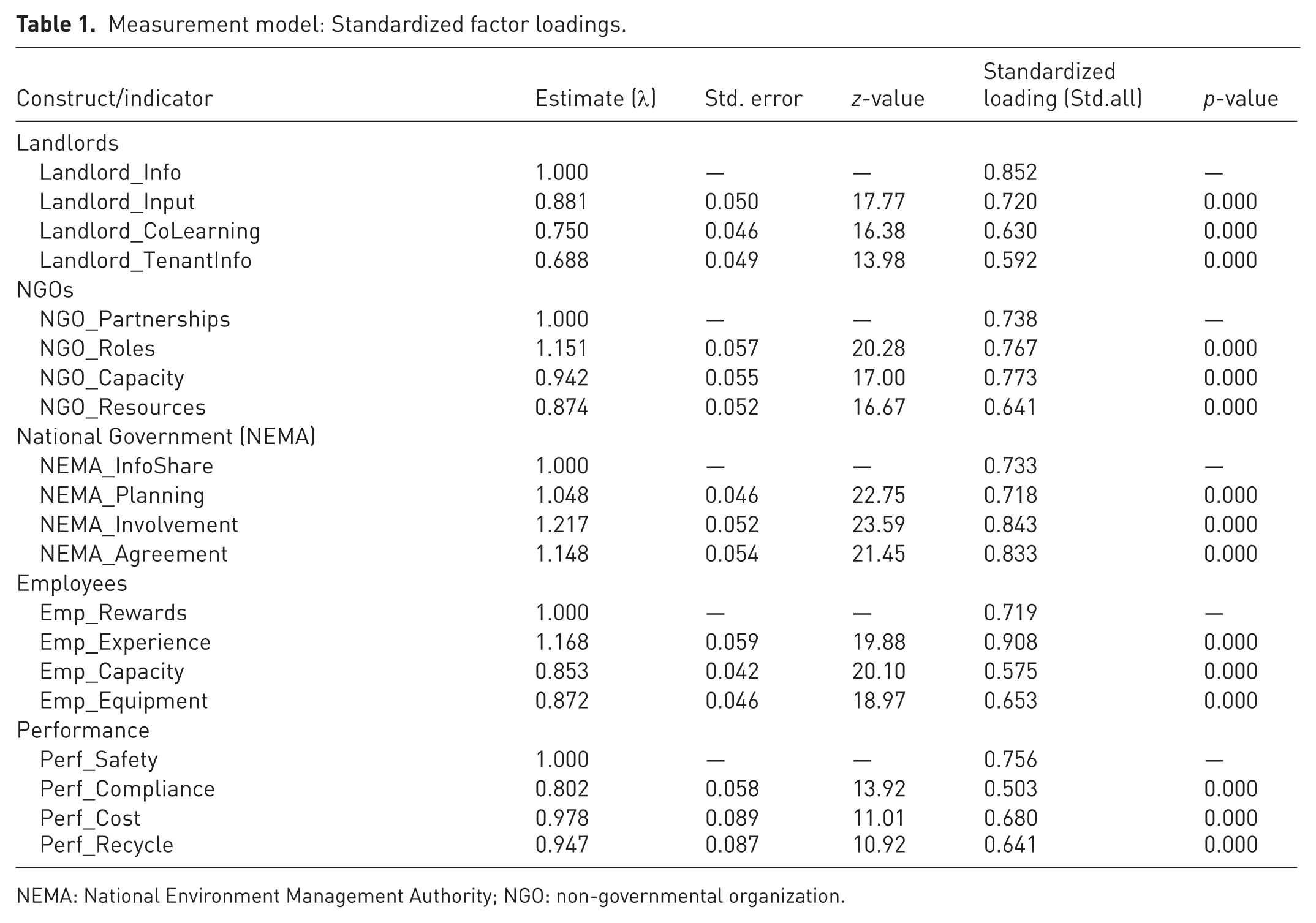
NEMA: National Environment Management Authority; NGO: non-governmental organization.
County government engagement with landlords measured information exchange, participatory input, and co-learning between the county administration and property owners. Items captured the extent to which officials shared knowledge, sought joint input, and coordinated tenant practices. The scale drew from inter-organizational collaboration, stakeholder engagement, and co-production frameworks (Kujala et al., 2022; Ostrom, 2010; Staniškienė and Stankevičiūtė, 2018). The four-item construct demonstrated strong reliability (α = 0.79) and standardized loadings ranging from 0.592 to 0.852, indicating consistent perceptions of participatory landlord involvement.
County government engagement with NGOs captured collaborative partnerships with civil-society actors in waste management, emphasizing shared learning, community mobilization, and advocacy. Drawing on cross-sector-partnership and relational governance research (Bryson et al., 2015; Cornforth, 2004), this construct operationalized the social capital dimension of relational capability. The five-item scale (α = 0.85; loadings = 0.641–0.773) exhibited high internal consistency and meaningful variation across respondents.
County government engagement with the National Government (NEMA) assessed vertical coordination and policy alignment between NCC and the NEMA. Items reflected joint planning, regulatory coherence, and data-sharing practices, drawing from sustainability governance and policy-integration literature (Ansell and Gash, 2008; Eaton et al., 2021). The four-item construct (α = 0.86; loadings = 0.718–0.843) confirmed that national–local integration is a core component of effective pluralistic governance.
County government employee capability reflected the internal capacity of municipal departments to support, train, and equip frontline workers responsible for waste collection and regulation. Consistent with the resource-based and dynamic-capability perspectives (Barney, 1991; Teece, 2007) and the absorptive-capacity framework (Cohen and Levinthal, 1990), items assessed skill adequacy, experiential learning, and resource availability. The four-item measure exhibited satisfactory reliability (α = 0.80) with standardized loadings from 0.575 to 0.908.
SWM performance represented the dependent construct, conceptualized as the perceived efficiency, safety, and sustainability of county waste management operations. Items derived from urban environmental performance and sustainability-reporting frameworks (UN-Habitat, 2010, 2021) captured reliability of waste disposal, compliance, cost efficiency, and recycling outcomes. The four-item scale achieved acceptable internal consistency (α = 0.73) and standardized loadings between 0.503 and 0.756.
Finally, a higher-order latent construct—relational capability—was modeled to represent the county’s overarching ability to coordinate, share information, and sustain collaboration across heterogeneous stakeholders. In this specification, engagement indicators represent the observable manifestations of relational processes, whereas relational capability captures the latent integrative mechanism that enables and sustains these engagements across actor domains. Confirmatory factor analyses supported this second-order specification as a parsimonious and theoretically coherent representation of inter-actor coordination. The construct integrates insights from relational capability theory (Dyer and Singh, 1998), dynamic-capability theory (Teece, 2007), and pluralistic governance scholarship (Ansell and Gash, 2008), linking collaborative engagement to system-level performance.
Validity and reliability
Construct validity and reliability were assessed using internal consistency and convergent validity criteria. As shown in Table 2, all constructs demonstrated satisfactory reliability and validity. Cronbach’s alpha (α) and composite reliability values for every construct exceeded 0.80, confirming strong internal consistency across indicators. Average variance extracted (AVE) values ranged from 0.60 to 0.68, meeting the recommended threshold of 0.50 and indicating adequate convergent validity (Fornell and Larcker, 1981).
Reliability and validity of constructs.
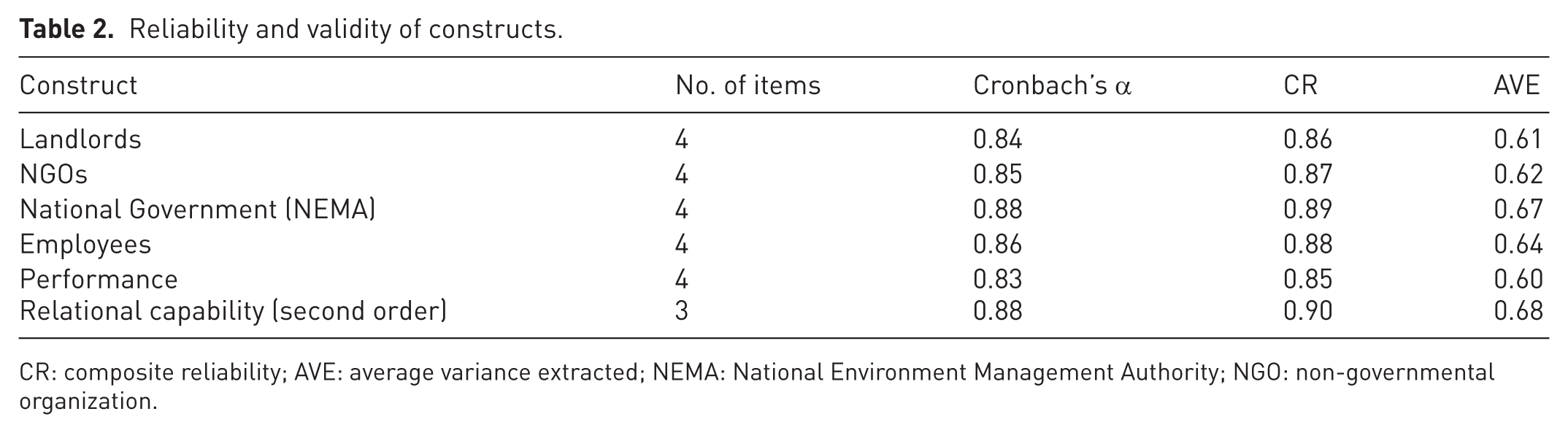
CR: composite reliability; AVE: average variance extracted; NEMA: National Environment Management Authority; NGO: non-governmental organization.
The square roots of each construct’s AVE were greater than the corresponding inter-construct correlations, and Heterotrait–Monotrait ratios ranged between 0.62 and 0.84, providing further evidence of discriminant validity. These results confirm that the observed indicators reliably capture the intended latent constructs and conceptual distinctions among them are empirically supported.
Analytical strategy
Data analysis proceeded in three sequential stages: preliminary diagnostics, measurement model evaluation, and structural model estimation. Descriptive statistics and multicollinearity (VIF <2.5) were first examined to confirm data adequacy. The measurement model was then tested to verify factor structure, reliability, and discriminant validity. Finally, the hypothesized relationships were estimated using SEM with maximum-likelihood estimation.
SEM was chosen because it allows the simultaneous estimation of multiple, interdependent relationships among latent constructs while accounting for measurement error—an essential feature for testing higher-order relational capabilities. Path coefficients and significance levels were computed for each hypothesized path.
Evaluation of potential bias
Prior to estimating the structural model, diagnostic tests were conducted to ensure data robustness and absence of systematic bias. Table 4 shows that the variance inflation factor (VIF) values ranged from 1.582 to 2.750, well below the threshold of 5.0, indicating that multicollinearity was not a concern. To assess potential common-method bias, Harman’s single-factor test was performed. The first unrotated factor accounted for 28.812% of the total variance—substantially below the 50% benchmark—suggesting that common-method bias was not problematic.
Additionally, Cronbach’s alpha values for all constructs exceeded 0.734, confirming internal consistency reliability across the scales (see Table 1). Given that the data met these diagnostic criteria, hierarchical regression and SEM analyses were deemed appropriate for testing the hypothesized relationships among relational capability, stakeholder engagement, employee capability, and performance.
Descriptive statistics and correlations
Descriptive statistics and bivariate correlations among the latent constructs are presented in Table 3. The means of all constructs ranged between 4.04 and 4.31, indicating generally high levels of perceived engagement and performance across stakeholder categories. Standard deviations between 0.64 and 0.72 suggest moderate variability, implying that while respondents broadly agreed on the effectiveness of cross-actor coordination, some heterogeneity in perceptions remains.
Descriptive statistics and correlation matrix of latent constructs.
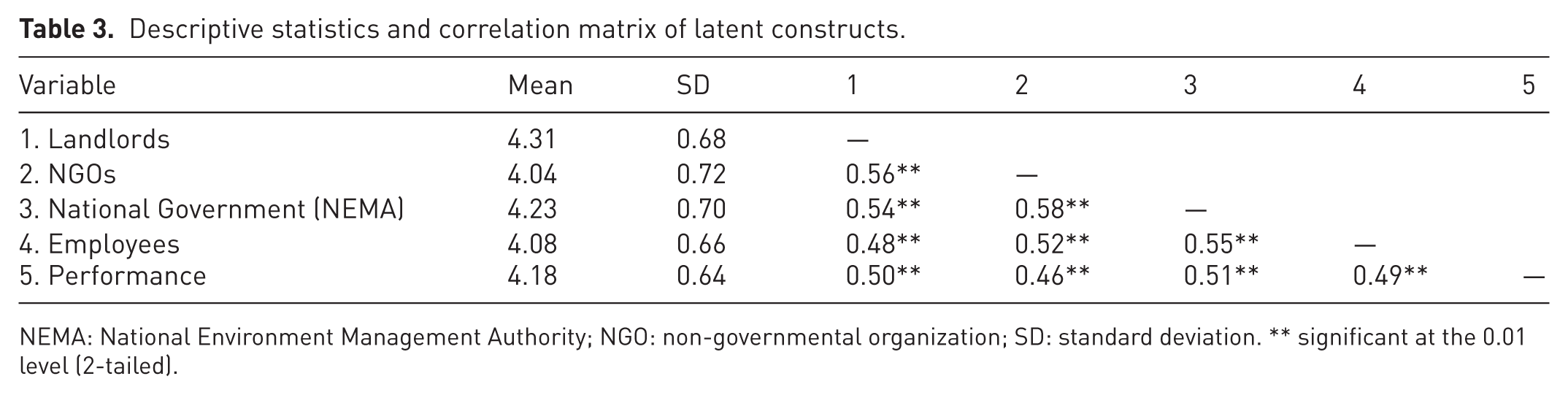
NEMA: National Environment Management Authority; NGO: non-governmental organization; SD: standard deviation. ** significant at the 0.01 level (2-tailed).
Inter-construct correlations were positive and significant at the p < 0.01 level, consistent with the theoretical expectation that higher stakeholder engagement and stronger relational capability are associated with improved SWM performance. The strongest correlations appeared between landlord engagement and performance (r = 0.50) and between NEMA alignment and NGO collaboration (r = 0.58), suggesting complementary roles among institutional and community actors. These descriptive trends provide preliminary empirical support for the hypothesized relationships tested in the structural model.
Measurement model evaluation
Following preliminary diagnostics, confirmatory factor analysis (CFA) was used to assess the adequacy of the measurement model before testing the structural paths. The CFA evaluated how well the observed variables represented their corresponding latent constructs, including the higher-order factor for relational capability. All factor loadings were significant (p < 0.001) and exceeded 0.60, confirming indicator reliability.
Model-fit indices for the measurement and structural models are summarized in Table 4. comparative fit index (CFI) and Tucker–Lewis index (TLI) values ranged from 0.77 to 0.82, and the root mean square error of approximation (RMSEA) ranged from 0.089 to 0.104, which is acceptable for heterogeneous, multi-actor data in governance research (Hair et al., 2019). The standardized root mean square residual (SRMR) values were all below 0.08, supporting adequate global fit (Table 4).
Model-fit indices for measurement and structural models.
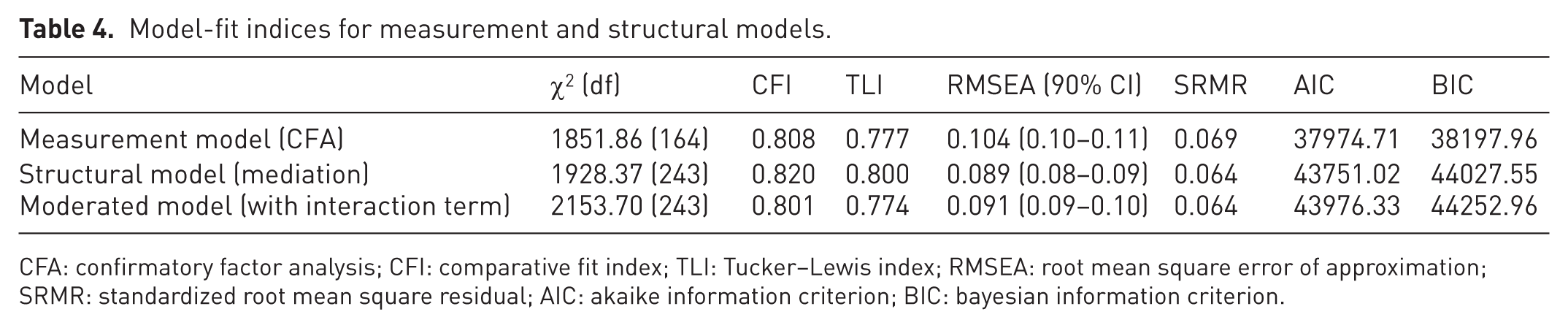
CFA: confirmatory factor analysis; CFI: comparative fit index; TLI: Tucker–Lewis index; RMSEA: root mean square error of approximation; SRMR: standardized root mean square residual; AIC: akaike information criterion; BIC: bayesian information criterion.
Although the fit indices fall slightly below conventional thresholds for homogenous corporate samples, they are appropriate for pluralistic governance models that integrate multiple stakeholder perspectives, where measurement error and perceptual variance are inherently higher. Together, these results confirm that the measurement structure is stable and theoretically coherent, providing a sound basis for testing the hypothesized relationships.
Ethical and reflexive considerations
Ethical clearance was obtained from the National Commission for Science, Technology and Innovation (NACOSTI) and the host university’s ethics review board. Written informed consent was obtained from all participants, who were assured of anonymity and the right to withdraw at any stage. To address potential power asymmetries between government and community respondents, enumerators emphasized voluntary participation and confidentiality. Data were securely stored in password-protected systems. The research team maintained independence from NCC and affiliated institutions to avoid interpretive bias and ensure balanced representation of all stakeholder voices.
Hypothesis testing and structural model results
The structural model examined the hypothesized relationships among relational capability, stakeholder engagement, employee capability, and solid waste management performance within Nairobi’s pluralistic governance system. SEM using maximum-likelihood estimation was applied to test both the direct and indirect effects among the constructs, as well as moderation dynamics. SEM was selected because it allows the simultaneous estimation of multiple interrelated paths among latent variables while accounting for measurement error and testing model fit across groups (Kline, 2016). The results of the structural equation modeling analysis, including direct, mediation, and moderation effects, are presented in Table 5. The analysis followed a two-step logic: first, a component-level model tested the effects of individual stakeholder engagements on performance; second, a higher-order relational capability model assessed how these distinct engagements converge into a system-level coordination capability.
Results of structural equation modeling (direct, mediation, and moderation effects).
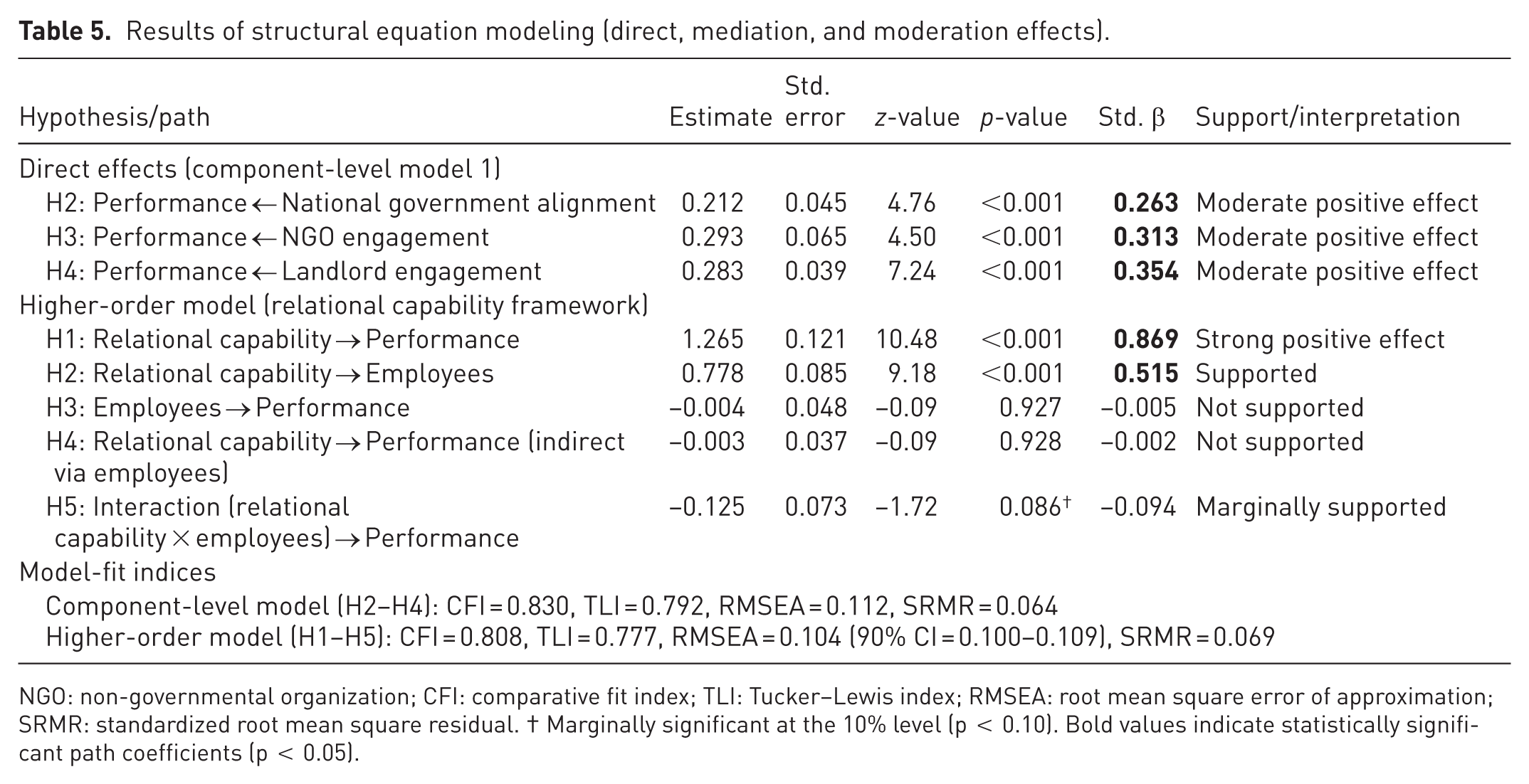
NGO: non-governmental organization; CFI: comparative fit index; TLI: Tucker–Lewis index; RMSEA: root mean square error of approximation; SRMR: standardized root mean square residual. † Marginally significant at the 10% level (p < 0.10). Bold values indicate statistically significant path coefficients (p < 0.05).
Component-level model (H2–H4)
The component-level model evaluated the direct contributions of three key engagement types—alignment with the NEMA, collaboration with NGOs, and interaction with landlords—to SWM performance. This level captures the logic that each actor group performs a discrete but complementary role within the broader pluralistic governance architecture. The results demonstrate that all three forms of stakeholder engagement have significant and positive associations with performance, affirming the hypothesis that collaboration among heterogeneous actors enhances urban service outcomes.
Engagement with NEMA (H2) exhibited a moderate but statistically significant positive effect on performance (β = 0.263, p < 0.001). This indicates that vertical coordination between national and county-level institutions contributes meaningfully to effective SWM. The finding reinforces the theoretical argument that vertical alignment across governance tiers promotes legitimacy, compliance, and regulatory coherence (Ansell and Gash, 2008). By aligning county operations with national environmental standards, NEMA engagement ensures rule enforcement and harmonization of policy objectives. This alignment also helps reduce duplicative efforts, thus improving accountability and clarity of operational mandates.
NGO engagement (H3) showed a robust positive effect on performance (β = 0.313, p < 0.001). This relationship underscores the catalytic role of civil-society organizations as boundary-spanning intermediaries that bridge formal governance and community-level practices. NGOs bring agility, social capital, and trust to spaces where government reach is constrained, helping to mobilize participation and behavioral change around waste sorting, recycling, and community awareness. The result aligns with cross-sector partnership literature (Bryson et al., 2015), which emphasizes the importance of collaborative intermediaries in translating institutional goals into collective outcomes. In the context of Nairobi, NGOs expand the adaptive capacity of the system by enabling real-time responsiveness and localized problem-solving, which are key to dynamic governance in volatile environments.
Landlord engagement (H4) recorded the strongest effect (β = 0.354, p < 0.001), confirming that private property owners play a crucial role in reinforcing waste management behaviors at the household and neighborhood level. Through co-production processes (Ostrom, 2010), landlords help coordinate waste sorting, collection timing, and tenant compliance with municipal regulations. This finding reflects the hybrid governance nature of Nairobi’s SWM ecosystem, where private actors assume quasi-public responsibilities. Landlords’ embedded position within the social fabric of urban neighborhoods allows them to mediate between municipal enforcement and citizen behavior, thus strengthening collective compliance mechanisms.
The overall model-fit for the component-level specification was acceptable given the system’s complexity (CFI = 0.83, TLI = 0.79, RMSEA = 0.112, SRMR = 0.064). Although some indices fall slightly below ideal thresholds, these values remain within permissible limits for multi-actor models characterized by structural heterogeneity and data drawn from diverse respondent groups (Hair et al., 2019). The moderate fit suggests that actor-specific coordination mechanisms collectively explain significant variance in performance, supporting the pluralistic governance view that partial alignment across institutional boundaries produces measurable, if imperfect, system-level gains.
Higher-order relational capability model (H1–H5)
The second analytical stage tested a higher-order model in which relational capability represents the collective capacity of the system to integrate diverse actor relationships into a coherent, adaptive coordination mechanism. The aim was to determine whether this integrative construct exerts greater explanatory power over performance than the sum of individual actor engagements. The results strongly affirm this proposition.
The path from relational capability → performance (H1) was positive, strong, and statistically significant (β = 0.869, p < 0.001), indicating that system-level coordination drives performance improvements beyond what discrete stakeholder engagements achieve independently. This finding corroborates Teece’s (2007) argument that performance in dynamic environments depends on orchestrating complementary assets rather than controlling resources hierarchically. In Nairobi’s SWM system, relational capability enables joint problem-solving, mutual accountability, and flexible coordination—attributes that collectively enhance reliability, efficiency, and adaptability in service delivery.
The path from relational capability → employee capability (H2) was also positive and significant (β = 0.515, p < 0.001), suggesting that relational capability fosters internal capacity development. Cross-sectoral collaboration provides opportunities for shared learning, exposure to best practices, and collective knowledge transfer, thereby strengthening operational competencies. This aligns with relational learning theory (Cohen and Levinthal, 1990; Eisenhardt and Martin, 2000), which emphasizes that knowledge acquisition and capability renewal occur through interaction and feedback rather than isolation.
However, the direct path employee capability → performance (H3) was negative and statistically insignificant (β = −0.005, p = 0.927). This surprising result suggests that technical competence, while necessary, is not sufficient to enhance performance unless embedded within a strong relational structure. It supports institutional collaboration research (Lawrence et al., 2002), which posits that effectiveness in interdependent systems emerges from collective coordination rather than individual skill. In pluralistic contexts, individual effort contributes little if relational channels are weak or fragmented.
The indirect (mediation) effect (H4) from relational capability through employee capability to performance was non-significant (β = −0.002, p = 0.928), indicating that relational capability affects performance directly rather than via internal capacity improvements. This reinforces the notion that system-level alignment independently drives efficiency by reconfiguring interdependencies across actors.
The interaction effect (H5) between relational capability and employee capability was marginally significant and negative (β = −0.094, p = 0.086), suggesting a weak substitution relationship. In contexts where employee capability is high, the marginal benefit of relational coordination diminishes slightly, possibly due to redundancy in communication or coordination routines. Conversely, where employee capability is low, strong relational systems compensate for individual deficiencies. This nuance supports contingency views of organizational capability (Zahra et al., 2006), illustrating that relational mechanisms act as adaptive buffers that stabilize system performance under varying resource conditions.
The higher-order model’s fit indices (CFI = 0.808, TLI = 0.777, RMSEA = 0.104 [90% CI = 0.100–0.109], SRMR = 0.069) reflect adequate model stability given the complexity of pluralistic coordination. Despite being marginally below conventional cutoffs, these metrics are consistent with prior SEM studies in inter-organizational governance contexts, where construct diversity and cross-sector data inherently elevate residual variance. Standardized residuals and modification indices revealed no specification errors, confirming the model’s robustness and interpretive coherence.
Collectively, these results provide compelling empirical evidence for the theorized framework. At the component-level, discrete stakeholder engagements enhance local coordination and service quality; at the systemic level, relational capability integrates these fragmented interactions into a coherent dynamic-capability that drives overall performance. The findings affirm that pluralistic governance effectiveness is contingent not on hierarchy or control but on the institutionalization of relational coordination.
Discussion of results
The findings substantiate the argument that relational capability functions as a dynamic, integrative mechanism through which pluralistic governance systems transform institutional diversity into coordinated performance. They move beyond capacity-based accounts by demonstrating that effectiveness in complex governance settings depends less on the accumulation of technical expertise and more on relational orchestration—how heterogeneous actors align expectations, adapt to one another, and sustain cooperation over time.
The strong positive association between relational capability and SWM performance (β = 0.869, p < 0.001) provides empirical support for extending dynamic-capability theory to governance networks. In this setting, sensing, seizing, and reconfiguring are not confined within a single organization but are enacted across a distributed constellation of actors. Coordination arises through joint problem recognition, negotiated action, and iterative realignment, rather than through hierarchical control or centralized authority.
A central contribution of the analysis lies in clarifying how pluralistic governance operates as a system of joint production. Engagement with NEMA, NGOs, landlords, and employees shows that these actors are not parallel contributors but relationally interdependent. NEMA provides regulatory coherence, NGOs cultivate legitimacy and community trust, landlords translate regulatory expectations into household-level compliance, and frontline employees operationalize negotiated solutions. System stability emerges through a process in which repeated interaction among these actors enables alignment of expectations, reduces coordination failure, and produces predictable service outcomes. Relational capability thus operates as the mechanism that integrates differentiated roles into a coherent and functioning governance system.
At the same time, the findings reveal a deeper paradox within pluralistic governance. The insignificant—and slightly negative—relationship between employee capability and performance suggests that technical proficiency alone does not ensure effectiveness. Rather than acting as a complementary input, relational capability functions as a substitutive coordination mechanism, compensating for institutional and resource constraints. In low-capacity environments, governance is stabilized through trust, negotiation routines, and shared accountability, even in the absence of strong formal structures.
Importantly, the results extend the understanding of governance performance beyond technical efficiency. Improved coordination is associated with greater predictability, reduced conflict, clearer role expectations, and lower coordination stress for both citizens and frontline workers. These experiential outcomes highlight that governance performance is not only operational but also lived and perceived. They resonate with human-centered transition perspectives such as the Calm Mobility paradigm, which emphasizes predictability, reduced stress, trust, and stability as defining features of well-functioning systems. Although developed in the mobility domain, these principles translate directly to governance contexts: relational capability transforms fragmented service environments into more predictable, less conflict-prone, and more reliable systems.
Taken together, the findings reinforce the view that governance effectiveness is an emergent property of sustained interaction rather than a direct function of individual actor capacity. By enabling continuous alignment, reducing uncertainty, and structuring interdependence, relational capability converts institutional plurality from a source of fragmentation into a foundation for adaptive and resilient system performance.
Theoretical contributions
This study advances governance and organization theory by repositioning relational capability as a meta-governance mechanism, rather than a supplementary coordination tool. Existing perspectives emphasize formal institutions, resource endowments, or technical capacity as primary drivers of coordination. These approaches, however, are not equipped to explain how coordination is sustained in contexts characterized by fragmented authority, overlapping mandates, and weak institutional coherence. By contrast, this study shows that coordination depends on the relational infrastructures that enable continuous interaction across heterogeneous actors.
Building on this insight, the study extends coordination theory by demonstrating that alignment does not require convergence of interests or institutional logics. Instead, coordination emerges through ongoing relational work—processes of negotiation, mutual adjustment, and trust-building that sustain interdependence despite persistent differences. This reveals a central theoretical paradox: institutional fragmentation can generate adaptive capacity when mediated through relational processes. In doing so, the study shifts the locus of governance from structural arrangements to interactional dynamics.
The study further contributes to collaborative governance literature by explaining why many collaborative initiatives fail. Episodic or project-based collaboration does not produce the relational continuity required for system-level stability. Relational capability, therefore, functions as a higher-order mechanism that reproduces coordination over time by linking micro-level interactions with macro-level outcomes.
More broadly, the findings reconceptualize governance capacity as distributed rather than organizationally bounded. Capacity is produced across networks of relationships rather than residing within individual institutions. This framework is particularly applicable in low-capacity, highly fragmented governance environments, where relational capability substitutes for weak formal structures. In more institutionalized settings, it operates as a complementary coordination mechanism. These distinctions clarify the boundary conditions of the theory.
In this way, the study shifts governance analysis from structures to relationships as the primary locus of system performance.
Practical implications
This study provides actionable insights for policymakers and practitioners managing complex, multi-actor governance systems. The central implication is that improving urban service delivery requires sustained investment in relational infrastructure—the institutional conditions that enable coordination across diverse actors. In practice, this involves mechanisms such as regular multi-stakeholder coordination forums, structured feedback channels between regulators and service providers, and joint monitoring platforms, which enable continuous coordination rather than episodic interaction. Policymakers and municipal managers can operationalize relational capability through institutionalized negotiation forums, trust-repair mechanisms, and joint accountability routines that clarify expectations and sustain coordination.
For municipal authorities, the key shift is from episodic collaboration to institutionalized coordination. Governance arrangements should support continuous interaction, mutual adjustment, and shared accountability through mechanisms such as standing coordination platforms, joint decision-making forums, and collective problem-solving routines. These arrangements reduce fragmentation by stabilizing expectations and enabling actors to coordinate their actions over time rather than responding reactively to isolated challenges.
For development partners and donors, the findings underscore the importance of incentive alignment. Funding structures that reward individual performance reinforce fragmentation; those prioritizing collective outcomes strengthen coordination. This is particularly critical in pluralistic environments where actors operate under diverse mandates and institutional logics, and where sustained coordination depends on aligning incentives across organizational boundaries.
For public managers, the study highlights the importance of relational leadership. Effective governance depends on the ability to negotiate, mediate, and align actors with divergent interests. Leadership development should therefore emphasize boundary-spanning capabilities, including trust-building, facilitation, and conflict resolution, as well as the capacity to sustain interaction and manage interdependencies across stakeholder groups.
Overall, the findings reframe collaboration from a supplementary governance practice to a core capability of effective urban management. Cities that deliberately cultivate relational capacity are better positioned to transform institutional diversity into adaptive resilience and sustained service performance by enabling continuous coordination, reducing uncertainty, and fostering more predictable and stable service delivery outcomes.
Limitations and future research
Despite its contributions, the study has several limitations that offer avenues for future research. The use of a cross-sectional, perception-based design limits causal inference, yet it serves a theory-illustrative purpose by capturing how stakeholders experience and enact coordination within pluralistic governance systems. Effectiveness in such contexts depends less on technical outputs and more on actors’ relational interactions; thus, perceptual data provide meaningful insights into the social dimension of performance. To mitigate level-of-analysis concerns, system-level effectiveness was modeled as an emergent construct derived from aggregated perceptions across multiple actor groups—municipal officials, NGOs, landlords, and regulators—thereby reducing single-respondent bias. Although model-fit indices were moderate (CFI = 0.81; RMSEA = 0.10), these values are acceptable for heterogeneous, multi-actor data (Bryson et al., 2015; Hair et al., 2019).
Future research could extend this framework through triangulation with objective indicators—such as waste collection tonnage, recycling ratios, or compliance data—and employ longitudinal or multilevel designs to trace how relational capability develops and stabilizes over time. Comparative studies across sectors and national contexts could further clarify the boundary conditions of relational capability, while emerging digital coordination tools warrant examination as new enablers of “digital relational governance.” Addressing these extensions would refine understanding of relational capability as a dynamic, evolving property of governance systems and deepen theoretical integration between dynamic-capability and pluralistic governance perspectives in explaining adaptive efficiency.
Footnotes

Author contributions
Lucy Simani Wamalwa conceptualized the study, data collection, designed the research model, and led manuscript development.
Christine Musyawa Ndonye contributed to data collection, statistical analysis, and manuscript revisions.
Funding
The authors received no financial support for the research, authorship, and/or publication of this article.
Declaration of conflicting interests
The authors declared no potential conflicts of interest with respect to the research, authorship, and/or publication of this article.