







Abstract
This article provides a 24-year update on the 10 standardized tests used most frequently with children and youth by school psychologists. Data were acquired from 64 countries through an international survey, with one respondent from each country. The informants were solicited due to their expertise in the area of assessment. The data from the current 2013 survey are described and discussed as well as contrasted with the 1989 survey data. The 2013 survey data led to the following rank order of tests based on data from the 64 countries: the Wechsler Intelligence Scales for Children, Ravens Progressive Matrices, Wechsler Preschool and Primary Scales of Intelligence, Child Behavior Checklist, Bender–Gestalt Test, Child and Adult Apperception Tests, Kaufman Assessment Battery for Children, Draw-a-Person Test, Stanford–Binet Intelligence Scales, and the Wechsler Adult Intelligence Scales. Survey data from advanced, developing, and emerging counties also are compared and discussed. Results are discussed in the broader context of international test development and use.
Keywords
Psychological testing may constitute the flagship of applied psychology (Embretson, 1996). Standardized tests were developed first in the People’s Republic of China approximately 3,000 years ago (Higgins & Zheng, 2002; Wang, 1993). Knowledge of this form of testing largely remained obscure until the late 20th century. Later, in the West, the rise of experimental psychology guided by psychophysical theories of behavior triggered interest in measuring relationships between physical stimuli and sensations and perceptions. Measures of intelligence and other cognitive abilities as well as temperament and personality soon followed (Benjamin, 2007; Gregory, 2013). Some tests developed and used somewhat widely in Western Europe and the United States during the first half of the 21st century later were imported by psychologists trained in the West who returned to their native and emerging countries and saw the need for these resources (Oakland, 2009), thus contributing to the growth and expansion of test use.
Initial test use often whetted the appetites and interests of psychologists, educators, and other professionals, together with leaders in administrative roles in government, including the military, industry, and the public. Test use became valued as a reliable process for acquiring practical information efficiently and objectively. In the West, companies responded to a growing interest in behavioral and cognitive psychology by developing a wider range of tests.
Test development and use are market driven. Thousands of tests have been developed to meet market needs largely for two broad age groups: adults as well as children and youth. Governments and industry, the major markets for standardized tests for adults, use them, in part, to assist in making employment and promotion as well as in job aptitude and skill certification decisions (Grigorenko, 2009). Industrial/organizational psychologists and human resource specialists commonly provide these services in government and industry. Private practice professionals who provide clinical services to adults also use tests, albeit less frequently (Oakland, 2009).
Schools, the major markets for standardized tests for children and youth, use them to describe current behaviors and other qualities, estimate future behaviors, assist guidance and counseling services, help students identify viable career paths, establish intervention methods, evaluate progress, and screen for special needs. They also use tests to diagnose disabling disorders, to help place students in programs and jobs, and to assist in determining whether students should be admitted, retained, or promoted.
Within schools, school psychologists typically are responsible for using individualized tests and school counselors for using group tests. In addition, school-based social workers, speech/language pathologists, and physiotherapists/occupational therapists also may use tests. The above-named professionals in private practice also use tests with children and youth. Test use is most common with children aged 6 through 12, then 13 through 17, and less frequently with younger children (Oakland, 2009).
Schools in almost all countries use tests. Thus, the lives of almost all children and youth may be affected by the use of standardized tests. The widespread use of tests and their possible impact warrant an understanding of their prevailing nature and uses of tests internationally with children and youth, and a determination of the suitability of testing services.
A survey conducted in 1989 acquired information on test development and use with children and youth in 44 countries. This survey identified 455 test titles, 10 of which were used somewhat prominently (Oakland & Hu, 1992), provided information on the availability of tests regionally together with their prevailing psychometric properties (Hu & Oakland, 1991), and described those who commonly use tests (Oakland & Hu, 1991). This information served as a catalyst for the International Test Commission-sponsored international conference on test development and use for children and youth (Oakland & Hambleton, 1995), held at Oxford University in 1993 to discuss methods to further advance testing resources for children and youth. The results of the 1989 international survey provided a somewhat comprehensive understanding of test development and use for children and youth and stimulated test development and use internationally (Oakland, Wechsler, & Maree, 2013).
The purpose of this article is to provide a 24-year update on the 10 standardized tests used most frequently with children and youth by school psychologists through an international survey in which respondents from 64 countries provided information on the most frequently used tests with children and youth. The result of the prior 1989 and current 2013 surveys are discussed and contrasted.
Method
Participants
Surveys on testing issues often obtain information by soliciting assistance from a knowledgeable respondent who holds advanced standing due to their professional affiliations and degree status (Hu & Oakland, 1991; Muniz, Prieto, Almeida, & Bartram, 1999; Oakland & Hu, 1993; Rokeach & Ball-Rokeach, 1989; Snyderman & Rothman, 1987; Yan, Saklofske, & Oakland, 2009). Professionals from 129 countries were asked to fill out the survey, and, of those, 64 respondents completed the survey in its entirety, yielding a response rate just less than 50%. These participants completed a web-based survey during the latter part of 2012 and the beginning of 2013. Most are university professors or instructors (69%). Many participants (33%) are school psychologists. Most of the sample were contacted through the International School Psychology Association or the International Institute on School Psychology. They mainly are female (85%), middle-aged (M age of 35), and mid-career professionals (M of 18 years experience as a psychologist). The qualities displayed by the respondents generally reflect those of leaders in school psychology internationally (Jimerson, Oakland, & Farrell, 2007).
International Developmental Differences in Psychology
Reports from the earlier 1989 survey generally summarized data from 44 countries. In these countries, the profession of psychology was advanced in some and was less developed or emerging in others. Thus, a more accurate and detailed understanding of the current status of test use may be provided by reporting data on all 64 countries as well as by three clusters: the 18 advanced, the 22 less developed, and the 24 emerging countries. The International Union of Psychological Science (IUPS; www.iupsys.net/about/members/national-members/) is an association of 83 national psychological associations. Over the past 15 years and with the continued input of constituents, the IUPS has established broad criteria for classifying the professional standing and development of its member nations. Dues for member associations are based, in part, on the developmental level of psychology in each country. Using these figures, data from countries that contributed to this survey were divided into the above-named three clusters, with emerging countries displaying the least development.
Instrumentation
This survey was offered through Survey Monkey and administered through resources provided by the University of Florida’s College of Education. This survey incorporated some features of the 1989 survey and added others. This survey’s four sections were designed to acquire information on the respondent, standardized tests used with children and youth in the respondent’s country, the country’s infrastructure for test development and use, and the respondent’s opinions as to what is needed most to help promote test development and use in the respondent’s country.
The following directions are pertinent to the data reviewed in this article:
Please list standardized tests that are commonly used with children and youth in your country. Do not use abbreviations when indicating the test’s name. You may provide information on as many as 20 tests. However, we realize fewer than 20 tests may be commonly used in your country. Thus, kindly provide information only on those tests that are most commonly used.
The respondents provided the following information on each test they listed: what the tests measures, the ages for which they are used, their administrative method, their general purpose (e.g., assess acquired skills and abilities, estimate aptitudes, assist in vocational selection and promotion), the country in which they were originally developed, whether they were normed in the respondent’s country or elsewhere, the estimated adequacy of their norms, and the professions or vocations that commonly administer them (e.g., school/educational psychologists, clinical psychologists, speech/language pathologists), together with information on the test’s reliability and validity.
Statistical Methods
Each respondent indicated the psychological tests commonly preferred and used in their country. Predictably, respondents’ preferences varied considerably. Some practitioners reported a distinct preference for only a single test, whereas others expressed preferences for a wide range of tests. The collected data were carefully analzyed, which led to data on the frequency with which tests are used with children and youth. Popularity was determined by the number of times survey respondents reported a preference for a particular test. The most popular tests are those with the highest frequency counts across respondents.
Results
The Wechsler Intelligence Scales for Children (WISC) are used most widely followed by the Ravens Progressive Matrices, Wechsler Preschool and Primary Scales of Intelligence (WPPSI), Child Behavior Checklist, Bender–Gestalt Test, Child and Adult Apperception Tests, Kaufman Assessment Battery for Children (KABC), Draw-a-Person, Stanford–Binet Intelligence Scales, and the Wechsler Adult Intelligence Scales (WAIS; Table 1). The following table also provides information on the number and percentage of countries in which each of these top 10 tests is used for the total group and the three-clustered countries.
Top 10 Standardized Tests Preferred by School Psychology Professionals Throughout 64 Countries at Various Levels of Professional Development, by Frequency and Ranking.
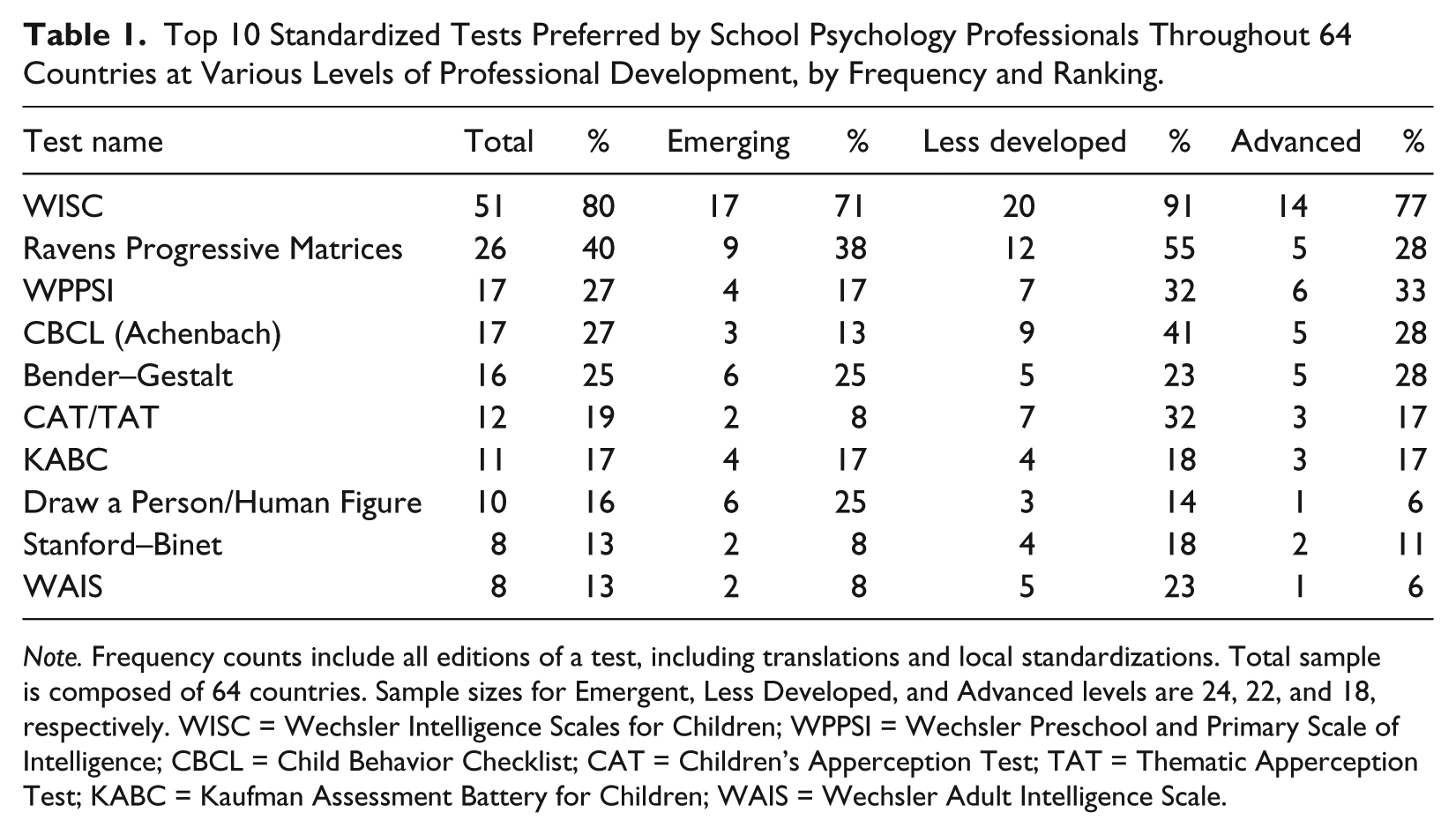
Note. Frequency counts include all editions of a test, including translations and local standardizations. Total sample is composed of 64 countries. Sample sizes for Emergent, Less Developed, and Advanced levels are 24, 22, and 18, respectively. WISC = Wechsler Intelligence Scales for Children; WPPSI = Wechsler Preschool and Primary Scale of Intelligence; CBCL = Child Behavior Checklist; CAT = Children’s Apperception Test; TAT = Thematic Apperception Test; KABC = Kaufman Assessment Battery for Children; WAIS = Wechsler Adult Intelligence Scale.
Discussion
Data From All Countries
All current forms of these 10 tests were standardized and marketed in the United States and use English. Nine rely principally on norm-referenced interpretations (i.e., the reporting of standard scores and percentiles), one on either norms or theory (i.e., Draw A Person), and one cluster that comprises the two apperception tests (i.e., Children’s Apperception Test and the Thematic Apperception Test) relies exclusively on theory-driven interpretations from the clinician. Eight tests were developed for use with children and youth. Eight tests measure cognitive abilities, among which seven measure intelligence. Two measure personality and behavior disorders. All but one, Ravens Progressive Matrices, are designed to be administered individually.
A Closer Look at the Top Ten Tests From the Total Group
The WISC, first developed by David Wechsler in 1949, are the most widely used individually administered measure—seemingly of any trait. The use of the term Wechsler intelligence scales for children would be more correct in that three editions of the WISC remain in use, from the 1974 publication of the Wechsler Intelligence Scale for Children–Revised (WISC-R), through the third and now the fourth editions.
The Ravens Progressive Matrices, developed in 1938 by John C. Raven, a British psychologist, and now standardized and normed in the United States, provides a non-verbal, multiple-choice, group measure of intelligence. These features are appealing to school psychologists who work in resource-limited regions, and where English is not used commonly. School psychologists also often rely on older versions of this measure, including its related Standard Progressive Matrices, Colored Progressive Matrices, and Advanced Progressive Matrices.
The WPPSI, developed by the Psychological Corporation in 1967, measures intelligence of children aged 2 through 7. Clinicians may consider this scale a downward extension of the earlier developed WISC. Its original edition and its 1989 and 2002 editions are in use. A 2003 version was published in the United Kingdom.
The Child Behavior Checklist, a component in the Achenbach System of Empirically Based Assessment developed by Thomas Achenbach, is used to help identify behavior problems displayed by children and youth. Its appeal is due, in part, to its international availability through the Internet, its translation into other languages, and the universality of the behaviors it measures.
The Bender Visual Motor Gestalt Test, developed by Lauretta Bender in 1938, quickly became a staple in the clinical assessment of visual motor abilities. Some clinicians use this measure to augment their assessment of children’s neurocognitive abilities. Clinicians value its quick 7- to 10-min administration and its appeal to children. The simplicity of the nine Bender–Gestalt figures displayed on three by five cards often results in the measure being reproduced without regard to copyright.
The Children’s Apperception Test (CAT; for ages 3 through 10), developed by Leopold and Sonya Bellak in 1949, together with the Thematic Apperception Test, assesses personality qualities through the use of projective methods. Children tell stories in response to seeing pictures, often of family members and common environments. Its appeal is due, in part, to its non-reliance on norms.
The KABC, developed by Alan and Nadeen Kaufman in 1983, provides an assessment of intelligence based on neuropsychological theory and problem-solving processes. Its original edition and its 2004 revision are used. Some evidence suggests it provides a fairer assessment of intelligence of racial/ethnic minority children.
Draw-a-Person tests (e.g., human figure drawings), originally developed by Florence Goodenough in 1926, have been revised by others and are available from various sources. This untimed measure may ask a child to draw a picture of a man, a woman, and himself or herself on the same or separate papers. The drawings may be interpreted quantitatively (e.g., to assess intelligence) or qualitatively (e.g., to assess personal and social qualities). Its use with children who display language difficulties or differences or who are from a non-Western culture is somewhat common.
The Stanford–Binet Intelligence Scale constitutes the forerunner of many current tests of intelligence. Originally developed by Alfred Binet in France and published shortly after his death in 1911, it was adapted by Lewis Terman, a professor of psychology at Stanford University, and then standardized and marketed in the United States in 1916. It became one of the first widely (e.g., internationally) used, individually administered, measures of intelligence. Its various editions also are used.
The WAIS, a measure of intelligence for individuals aged 16 to 90, was developed by David Wechsler in 1955 as a revision of the 1939 Wechsler–Bellevue Intelligence Scale. Survey respondents report using the second through the fourth editions of this scale. Among this list’s seven measures of intelligence, the WAIS is the only scale that provides adult norms.
A Closer Look at the Top Ten Tests From the Three Groups
The rank orders of tests in the emerging, less developed, and advanced countries are remarkably similar to those for the total group. Again, the WISC consistently is most widely used, followed closely by the Ravens in all three country cluster groups. In contrast, the Stanford–Binet and WAIS generally are used less widely.
In emerging countries (38% of the sample), the somewhat higher use of a Draw-a-Person and the Bender–Gestalt is understandable. These measures are often taught in professional programs, are available from sources other than test publishers, and thus are attractive in countries with limited financial and professional personnel resources. In less developed countries (43% of the sample), the somewhat frequent use of the WAIS is higher than expected, given the age range of children typically assessed through standardized tests (i.e., ages 6 through 12). In advanced countries (28% of the sample), the rank order of the tests generally is remarkably similar to that for the total group.
Comparisons Between the 1989 and 2013 Surveys
Data from the 1989 survey (Hu & Oakland, 1991; Oakland & Hu, 1991, 1992, 1993) led to the following rank order: WISC, Ravens Progressive Matrices, Bender–Gestalt Test, Rorschach Inkblot Test, Stanford–Binet, WAIS, Thematic Apperception Test, Differential Aptitude Test, Minnesota Multiphasic Personality Inventory, and the Frostig Developmental Test of Visual Perception.
The top two tests identified in the 1989 and 2013 surveys (i.e., the WISC and Ravens) retain their rank order. This is understandable for several reasons. First, these tests are time- and field-tested. Psychologists often become comfortable with their use and are reluctant to relinquish them. Second, psychologists working in emerging countries typically have fewer testing resources and little money to purchase new tests. Next, no authoritative regulations require older versions of tests to be discontinued on the release of newer tests (Oakland, 2009). Last, their strong psychometric features often warrant their use. Thus, the continued use of the WISC and the Ravens over this 24-year period is understandable. The continued inclusion of the Bender–Gestalt, Stanford–Binet, and WAIS on the top 10 is understandable for similar reasons (e.g., time-tested and psychometrically sound).
Changes also occurred during these 24 years. The Rorschach Inkblot Test and the Thematic Apperception Test, classic projective/theory-based staples used in adult clinical psychology assessment, now are used rarely by school psychologists, possibly displaced, in part, by the use of two measures more relevant for children and youth: the Child Behavior Checklist, a norm-referenced test, and the Children’s Apperception Test, a projective/theory-referenced test. Reliance on norm-based versus projective/theory-based measures of personality is variable internationally. Historically, a number of countries held a strong allegiance to projective assessment, especially those in which psychoanalysis is practiced widely. A trend from reliance on projective measures to norm-based measures of personality, seen in the United States and other Western countries during the last seven decades, also is somewhat evident in countries that historically relied on projective measures (Wechsler et al., 2014). However, school psychologists have not shed all interest in the use of classic theory-driven measures as seen by the continued inclusion of the Children’s Apperception Test on the 2013 list.
The absence of the Differential Aptitude Test, a paper-and-pencil measure used to measure an individual’s ability to acquire specific skills through future training (ages 7 through adults), on the 2013 list suggests a current trend to rely more on aptitude measures designed specifically for use with children and youth (e.g., the WPPSI, WISC, and KABC) rather than those designed for a broader age range.
The absence of the Minnesota Multiphasic Personality Inventory is also likely to be attributable, in part, to its emphasis on adult rather than child psychopathology, a growing reliance on the Child Behavior Checklist, and the emergence of various measures that assess personality (e.g., measures of the Big Five personality factors are readily found on the Internet). The Frostig Developmental Test of Visual Perception, once a somewhat widely used measure of attention to visual cues and non-verbal intelligence, now is used rarely. Its 10th place ranking on the 1989 list also suggests its use then was limited internationally.
The Narrowness of Qualities Measured by These Tests and Their Average Age
Behavioral science has developed a broad range of standardized tests for use with children and youth. They include measures of adaptive behavior, academic achievement, behavior and psychopathology (e.g., aggression, anger, anxiety), career identification and development, creativity, language and speech, motor development, personal development (e.g., emotional intelligence, self-esteem), specific cognitive abilities (e.g., executive functioning, memory), temperament and personality, and tests specific to some common diagnostic categories (e.g., children who display attention deficits with and without hyperactivity, Autism Spectrum Disorder, depression, posttraumatic stress disorders). However, the list of the 10 most commonly used tests internationally reflects a narrow range, mainly those that assess cognitive abilities. Four additional measures could have been added as their numbers were only slightly lower than the 10th ranked test: Wechsler Individual Achievement Test, Wide Range Achievement Test, Adaptive Behavior Assessment System, and the Vineland Adaptive Behavior Scale.
School psychologists in some countries rely on old versions of the tests (e.g., the 1973 Terman and Merrill form of the Stanford–Binet or the 1974 WISC-R). Although norms may have been acquired 40 or more years ago and may be based on U.S. children, scores rarely are adjusted in light of the Flynn effect or otherwise equated. The mean year in which the 10 tests originally were published, 1947, namely, 68 years ago, suggests they are time-tested and have become standard in the industry. However, reliance on them suggests newly developed tests have not displaced older ones.
The continued reliance on older tests and reluctance to adopt newer ones are due, in part, to four interlocking qualities (Oakland, 2009): fewer tests from which to select, limited professional and financial resources, reluctance to change, and a lemming effect.
School psychologists working in a number of emerging countries have fewer standardized tests to use, their tests often are older, and one test may be used to assess multiple qualities (e.g., to measure intelligence, achievement, language, and neuropsychological qualities). Emerging countries typically have limited professional and financial resources needed for test development, revisions, and adaptations. The entry level for psychologists often is an undergraduate degree—a level of education that does not enable students to acquire expertise in the development of psychological tests, and may be limited in preparing them to use them. Few companies internationally engage in these test development and revision activities.
Test development is market driven. Test development occurs when prospects to sell tests are high. However, given a lack of funds, few tests are purchased and thus developed. When new tests are developed, companies may not realize a net profit for many years. Furthermore, the widespread practice of photocopying tests, a violation of copyright protection, precludes the development of a viable testing industry. Thus, school psychologists may need to use outdated versions of tests because they simply have few from which to select.
Furthermore, the practices of psychologists generally are consistent with their academic and professional preparation. They may be reluctant to update their assessment practices or feel they must rely on photocopies of instruments on which they were trained. They are guided by the belief that access to some tests, even those below professional standards, is better than no access to tests. In addition, many psychologists rely on these top 10 tests because they seemingly are the best they have. The tests are perceived to be of high quality and help serve their needs.
An examination of issues affecting test use through another lens suggests a lemming effect in which psychologists in emerging countries are inclined to decide they need tests used commonly in advanced countries and thus strive to duplicate test resources used in them (Grigorenko, 2009). Practitioners from emerging countries may wrongly assume that because a test is accepted and established in advanced countries, it is necessarily appropriate for any setting. Decisions on what tests are needed rarely are made with supporting market evidence derived from those who use test results. In contrast, a national market survey of Botswana students, their parents, and educators led to consensus-driven support for the use of tests that assess learning readiness, various aptitudes, personal development, socialization, and guidance and counseling services in that country (Mpofu, Oakland, Ntinda, Seeco, & Maree, 2014). The widespread use of these participatory action research methods that involve market surveys could help other emerging countries develop a framework for test use, rather than relying on a narrow range of professionals to decide what is best for a country. The need to match testing resources with practical, market-driven, consumer needs is obvious.
Intelligence Test Use
The considerable reliance placed on the use of intelligence measures in school psychology practice as seen in the two international surveys may be understandable. Data from quality measures of intelligence can be highly useful as they account for more variance in academic achievement than any other single variable (Sattler, 2014), thus justifying their use in an educational context. School psychologists in emerging countries often are employed initially to assess students’ intelligence, to estimate their academic aptitude, to inform school admission decisions, and to diagnose intellectual and learning disabilities (Cunningham, 2007; Oakland, 2000). The value of using these tests seen by school administrators led to their widespread use and thus enhanced employment opportunities for school psychologists.
Achievement Tests Are Not Included Among the Top Ten
None of the top 10 tests measures academic achievement. Although school-based assessment practices typically rely heavily on individually administered achievement tests, their absence among the top 10 is understandable. Achievement tests typically reflect prevailing curricula within a country and are norm-sensitive. Test norms are likely to differ internationally. Data from the 53 educational systems that participate in the measurement of science and math achievement (Trends in International Mathematics and Science Study [TIMSS]; http://nces.ed.gov/TIMSS/; January, 2015) and reading achievement (Progress in International Reading Literacy Study [PIRLS]; http://nces.ed.gov/surveys/pirls/; January 2015) show considerable national differences. Thus, with one possible exception, an achievement test developed in one country and used in others may result in norms that are not applicable. The international use of U.S.-developed achievement tests may be justified in private schools if their curricula reflect those used in the United States, and instruction is offered in English.
Limitations
Little is known about test development and use in many of the small and emerging countries, including those for children and youth (Oakland, 2009). The availability of data from countries not included in the current survey may add to our understanding. In addition, the study relied largely on school psychologists to serve as respondents, given their prominence as assessment specialists with children and youth in most countries (Jimerson et al., 2007). The inclusion of other professionals who use tests with children and youth (e.g., speech/language pathologists, social workers) may provide a broader understanding. The survey’s focus on individually administered standardized tests results in overlooking the use of group tests. In addition, some respondents did not complete all sections of the survey, which is a typical shortcoming in research of this type.
An additional limitation of the present study pertains to the relative experience level (e.g., number of years practicing within the field) of the participants. Specifically, although survey respondents were of varying levels of experience, they were generally mid-career practitioners. Given the purpose of the present research—to collect data on current testing and test development practices—the more experienced practitioners may perhaps be speaking to measures most familiar to them. With this in mind, however, many of the survey respondents are actually trainers of psychology, suggesting their obligation to be aware of “current” testing practices, in the name of offering appropriate and accurate curricula.
Footnotes
Acknowledgements
We thank the following respondents to the survey: Annan, Jean; Aricak, Tolga; Boulon-Díaz, Frances; Brown Earle, Orlean; Carvalho, Moises; Chilina Leon, Carmen; Christiany; Crowley, Peadar; Curkovic, Natalija; de Baessa, Yetilú; Dinca, Margareta; Negovan,Valeria; Iliescu, Dragos; Dominguez Espinosa, Alejandra; Elena Brenlla, María; Emam, Mahmoud Mohamed; Faulkner, Michael; Foxcroft, Cheryl; Gajdosova, Eva; Gemmell, Patricia; Gintiliene, Grazina; Gregoire, Jacques; Grob, Alexander; Haavisto, Marja-Leena; Ho, Irene; Hun Lee, Dong; Hung, Li-Yu; Io Chan, Choi; Ivanchenko, Svitlana; Janeiro, Isabel N.; Jianping, Xu; Kangas, Elena; Kiksas, Eve; Maital, Sharone L.; Martinelli, Victor; Merino Soto, Cesar; Mhaka Mutepfa, Magen; Miller, Shauna; Morter-Lewis, Corinth; Musabelliu, Gladiola; Oakland, Tom; Parekh, Suresh; Perez, Patty; Pradhan, R. K.; Rizwan, Muhammad; Rodriguez Moreira, Cristina Isabel; Rowiński, Tomasz; S., Malykh; Saklofske, Don; Saliba, Sabah; Sebre, Sandra; Solís, María Pérez; Stech, Stanislav; Szabó, Éva; Tangdhanakanond, Kamonwan; Tarroja, Maria Caridad H.; Thi Le Thu, Tran; Thirion, H.; Tideman, Eva; Topping, Keith; Tyldesley, Kathleen; van Boxtel, Herman; Utreras, Esteban; Viteria, Ana Maria; Vrignaud, Pierre; and Wechsler, Solange.
Authors’ Note
The following is the list of 64 countries from which data were acquired: Albania, Argentina, Australia, Belgium, Belize, Brazil, Canada, China, Croatia, Cyprus, Czech Republic, Ecuador, Egypt, England, Estonia, Finland, France, Greece, Guatemala, Hong Kong, Hungary, India, Indonesia, Ireland, Israel, Jamaica, Japan, Latvia, Lebanon, Lithuania, Macau, Malta, Mexico, Namibia, the Netherlands, New Zealand, Pakistan, Panama, Peru, Philippines, Poland, Portugal, Puerto Rico, Romania, Russia, Seychelles, Singapore, Slovak Republic, South Africa, South Korea, Spain, Sweden, Switzerland, Taiwan, Thailand, Turkey, Uganda, Ukraine, United Arab Emirates, the United Kingdom, the United States, Venezuela, Vietnam, and Zimbabwe.
Declaration of Conflicting Interests
The author(s) declared no potential conflicts of interest with respect to the research, authorship, and/or publication of this article.
Funding
The author(s) received no financial support for the research, authorship, and/or publication of this article.
In Memory of Tom Oakland
On March 4, 2015, Dr. Thomas D. Oakland was attacked and killed at his home in Gainesville, Florida. Police arrested a convicted felon whom Tom had helped on numerous occasions with charitable gifts of cash and food. At the time of his death, Tom was 75 years old and productive. The incredible breadth and immeasurable value of Tom’s work cannot be understated, and indeed, is a challenge to detail. What follows is an attempt to relay the enormity of Tom’s influence on the field of psychology and those who work within it.
Before a brief summary of his vita, however, it is crucial to explain the personal traits that made Tom not only an incomparable scholar, but also a truly remarkable person. Tom was exceedingly generous with his time and wisdom, both of which are more valuable than any charitable gift he could have given. Tom believed in the value of all individuals, and took any opportunity to help others recognize and achieve their potential. His kindness, gentle spirit, and welcoming smile were features that anybody with the good fortune of meeting Tom, would instantly notice. Tom’s passion for professional competence is only rivaled by his unique capacity to simultaneously serve as both a mentor and a friend; there was no one better equipped to serve each of these roles.
Tom had an academic career that spanned more than 45 years. He served as faculty at the University of Texas, the University of Florida, and the University of Hong Kong. Tom authored more than 400 scholarly manuscripts, chapters, and books. Tom’s professional service was incomparable. He served on the editorial board of more than 60 academic journals and founded the International Journal of Testing, the Society for the Study of School Psychology, and the International Foundation for Children’s Education. He was editor of the Journal of School Psychology. Tom served as president of APA’s Division 16 (School Psychology), the International Test Commission, the International Association of Applied Psychology, and the International School Psychology Association. He is the co-author of the Student Styles Questionnaire, the Guide to the Assessment of Test Session Behavior, and the Adaptive Behavior Assessment System. Throughout his esteemed career, Tom devoted countless hours to international affairs and program development, frequently on a pro bono basis. He consulted in more than 40 countries on matters related to the education and welfare of children and youth. He was a Fulbright Scholar. Tom was a highly sought-after forensic expert, particularly in death penalty cases. Recently, he co-authored an amicus brief to the US Supreme Court on behalf of individuals with cognitive impairments. Dr. Oakland will be remembered as a scholar, mentor, humanitarian, friend, and father. Tom’s life was an inspiration.