







Abstract
The present study analyzed the factor validity of the Patterns of Adaptive Learning Scale (PALS) to assess students’ perceptions of mathematics classroom goal structures. Participants were N = 7,773 Italian students aged from 11 to 15 years (M = 11.97, SD = 0.50). The confirmatory factor analysis replicated a three-factor structure (i.e., mastery, performance-avoidance, and performance-approach goals) of the scale. Multigroup confirmatory factor analyses supported configural, metric, and scalar measurement invariance of the scale across gender. Moreover, the students’ mathematics achievement was positively related to mastery goals and negatively associated with performance-avoidance goals. The use of the scale may help teachers to understand the relations between classroom goal structures and mathematics achievement during middle school.
Academic success represents one of the best indicators of psychological adjustment in adolescence (Zuffianò et al., 2013). Previous researchers have analyzed the impact of students’ individual characteristics on academic achievement. For example, academic achievement was positively related to adolescents’ self esteem (Marsh, Trautwein, Ludtke, Koller, & Baumert, 2006) and socially appropriate behaviors (Caprara et al., 2014).
The role of contextual factors on students’ academic achievement has also been underlined. Noteworthy, classroom achievement goals, defined as the learning goals emphasized within the classroom for which students orient themselves to achieving academic success, have been associated with adolescents’ academic achievement (Bergsmann, Lüftenegger, Jöstl, Schober, & Spiel, 2013). In this regard, Elliot and Church (1997) suggested a trichotomous achievement goal model. A classroom mastery-approach goal corresponds to achievement goals focused on improvement and learning, and in general to students’ desire to develop new skills. A classroom performance-approach goal consists of the desire to perform better than peers and to look competent. Finally, a classroom performance-avoidance goal reflects an approach aimed at avoiding to perform worse than classmates and demonstrate incompetence.
Researchers have demonstrated a positive relation between the classroom mastery-approach goal and the students’ academic achievement (Bergsmann et al., 2013) and a negative association between classroom performance-avoidance goal and their academic achievement (Senko & Harackiewicz, 2005). Mixed results have been found in the link between classroom performance-approach goal and students’ academic achievement (Kaplan, Gheen, & Midgley, 2002).
Therefore, given the association between students’ academic achievement and classroom academic goals, we need to provide valid measures to assess classroom goal structures. The Patterns of Adaptive Learning Scale (PALS; Midgley et al., 2000) is widely used to assess the personal and classroom goal structures in academic domains. Confirmatory factor analyses (CFAs) supported a correlated three-factor model in which mastery, performance-approach, and performance-avoidance represent separate dimensions of the goal structures in different countries (e.g., United States, New Zealand; Lam, Ruzek, Schenke, Conley, & Karabenick, 2015; Meissel & Rubie-Davies, 2016). Overall, the internal consistency for each dimension was acceptable (greater than .70; Lam et al., 2015). Gender differences were found with higher scores on mastery in females than in males (Vassiou, Mouratidis, Andreou, & Kafetsios, 2016). However, gender invariance of the classroom goal structures was analyzed in very few studies through multigroup CFAs (Diseth & Samdal, 2015). In the present study, we analyzed the factorial validity and the measurement invariance of the PALS across gender as well as the relations between classroom goal structures and the Italian students’ academic achievement in mathematics. To our knowledge, the psychometric properties of the classroom goal structures in mathematics have not been investigated in Italian students during sixth grade.
The Present Study
In this study, we aim to extend the existing literature in several ways. First, we examined the factorial structure of the PALS in Italian sixth graders, particularly in the context of mathematics. Next, we tested the measurement invariance of the scale across gender. Finally, we analyzed the relations between classroom goal structures and students’ mathematics achievement. We expected to find a positive association between classroom mastery goal structures and students’ scores in mathematics and a negative relation between classroom performance-avoidance goal structures and students’ scores in mathematics.
The use of the PALS may be particularly important in the Italian context, especially during the middle school years when students interact with the same teachers and classmates for 3 years before they enter high school. Having a valid scale on classroom goal structures may help Italian teachers identify and adopt classroom goal structures that may sustain adolescents’ academic achievement in mathematics over the 3 years of middle school level. Due to the stability of the relationships over the 3 years, we focused on mathematics because some scholars have hypothesized that the competition between students may be encouraged in this discipline (Middleton, Kaplan, & Midgley, 2004).
Method
Participants
Participants were N = 7,773 students (n = 3,906 males) enrolled in 235 public middle Italian schools (37% North Italy, 21% Middle Italy, and 42% South Italy). The students were primarily Italian (94%) and were between 11- and 15-year-olds (M = 11.97, SD = 0.50). All participants were at the end of sixth grade. Most of the parents had a high school degree (30%) or finished middle school (31%).
Measures
Classroom goal structures in mathematics
Students completed the PALS (Midgley et al., 2000), composed of three subscales, on a 5-point Likert-type scale (1 = I strongly disagree, 5 = I strongly agree). The PALS was translated and then back-translated for its use in the Italian sample. The Classroom Mastery Goal Structure subscale consists of six items that describe achievement goals on improvement and learning within the classroom. The Classroom Performance-Approach Goal Structure subscale is composed of four items that assess students’ focus on demonstrating competence in mathematics. Finally, the Classroom Performance-Avoidance Goal Structure subscale consists of four items that describe students’ desire to avoid demonstrating incompetence.
Mathematics achievement
To assess students’ performance in mathematics, each student completed a multiple choice test on the same day of the PALS’ administration. The test was devised by the national testing agency to evaluate students’ ability to solve problems, understand basic mathematics concepts, and use complex procedures (INVALSI). The Cronbach’s alpha was .87.
Analytic Approach
First, we conducted a CFA in the total sample. Then, multigroup CFAs were performed to test the measurement invariance of the scale across gender. Configural invariance (the groups have same pattern of free and fixed factor loadings), metric invariance (the groups have the same factor loadings), and scalar invariance (the groups have the same intercepts) were tested. Finally, using a Structural Equation Modeling (SEM), we analyzed the concurrent validity of the PALS using students’ scores in mathematics.
Each model was assessed using model fit indices. We accepted comparative fit index (CFI) values around .95, root mean square error approximation (RMSEA) values lower than .08, and standardized root mean square residual (SRMR) values lower than .06 as an evidence of a good model fit (Kline, 2010). To handle the hierarchical structure of data, we used the “type = complex” option (Geiser, Eid, Nussbeck, Courvoisier, & Cole, 2010) in Mplus 5.1.
Results and Discussion
The CFA (see Figure 1) confirmed a model with a adequate fit to the data, Satorra–Bentler (S-B) χ2(74) = 1301.536, c = 1.377, p < .0001, CFI = .96, RMSEA = .05, 90% CI = [.04, .05], SRMR = .05. The factor loadings ranged from .38 to .76 for mastery (α = .81), .52 to .79 for performance-avoidance (α = .79), and .73 to .78 for performance-approach (α = .84) factors.
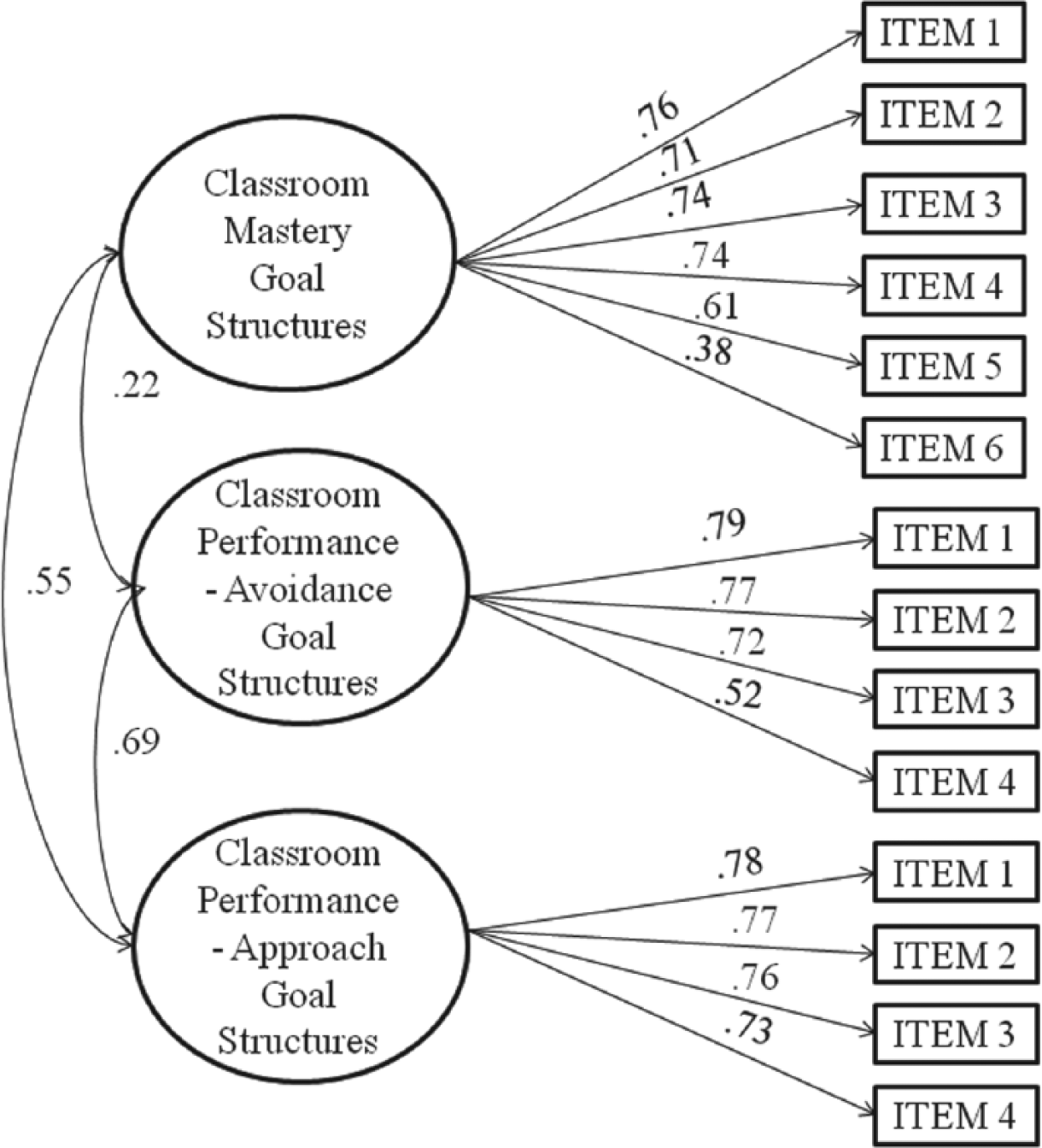
Factor model of the PALS.
Successively, we tested the measurement invariance of the PALS across gender. As suggested by the differences in CFI (Cheung & Rensvold, 2002), we found configural invariance, S-B χ2(148) = 1390.714, c = 1.356, p < .0001, CFI = .957, RMSEA = .05, 90% CI = [.04, .05], SRMR = .05; metric invariance, S-B χ2(159) = 1424.914, c = 1.338, p < .0001, CFI = .957, RMSEA = .05, 90% CI = [.04, .05], SRMR = .06; and scalar invariance, S-B χ2(173) = 1828.614, c = 1.313, p < .0001, CFI = .943, RMSEA = .05, 90% CI = [.04, .05], SRMR = .06, of the PALS across gender.
Finally, we tested a SEM model to understand the associations between each subscale of the PALS and scores in mathematics. The fit of the model was good, S-B χ2(85) = 1401.725, c = 1.336, p < .0001, CFI = .96, RMSEA = .05, 90% CI = [.04, .05], SRMR = .05. We found a positive relation between mastery goals and students’ scores in mathematics and a negative association between performance-avoidance goals and students’ scores in mathematics (see Figure 2).
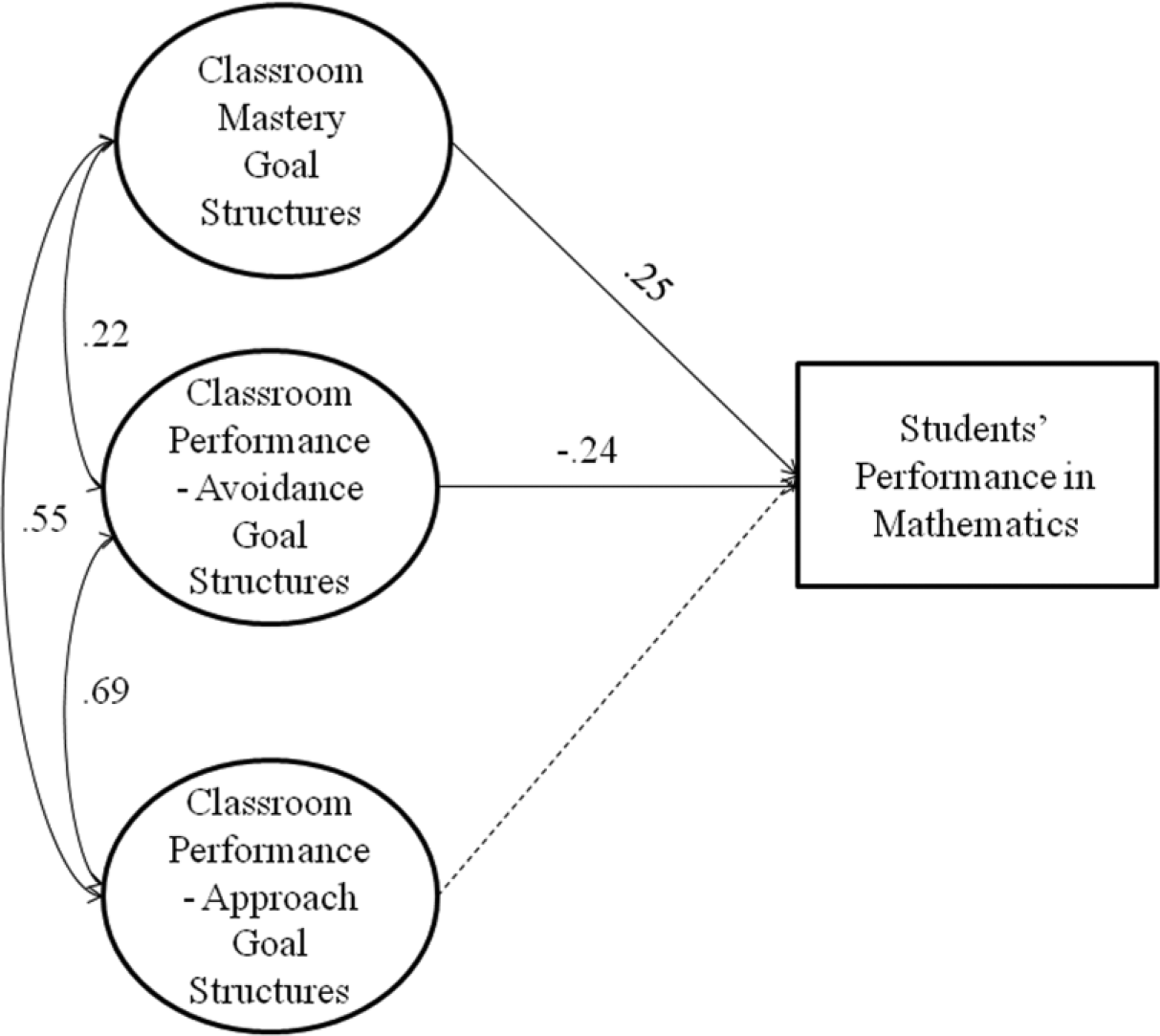
The relations between PALS and students’ performance in mathematics discipline.
To summarize, similar to the original version of the PALS and to the results in other countries, we confirmed a solution with three correlated factors. Moreover, the factorial structure of the scale was invariant across males and females. Therefore, the three-factor structure and item content of the PALS were substantially confirmed in Italian students. Regarding the relation between PALS and students’ mathematics achievement, we found that only the classroom mastery goal was positively related to mathematics achievement. These findings are in line with previous studies that underlined the link between the classroom mastery goals structures and students’ adaptive outcomes, such as learning strategies, positive relationships within classroom, and intrinsic motivation (Federici, Skaalvik, & Tangen, 2015).
However, the present study has several limitations. We only considered the mathematics discipline. Researchers should investigate the factor validity of the PALS in other disciplines in the future. Second, our data were cross-sectional and we were not able to infer the direction of the relations between study variables. Finally, it may be useful to consider the associations between teachers’ perceptions of classroom goal structures and students’ academic achievement.
In conclusion, Italian teachers should be supported in using classroom goal structures focused on understanding and developing new skills. A classroom mastery goal approach may offer useful and practical information to sustain students’ performance in mathematics across middle school years.
Footnotes
Declaration of Conflicting Interests
The author(s) declared no potential conflicts of interest with respect to the research, authorship, and/or publication of this article.
Funding
The author(s) disclosed receipt of the following financial support for the research, authorship, and/or publication of this article: This work was supported by the European Structural Funds (PON 2007-2013) under Grant H-9-FSE-2009-1.