







Abstract
The Big Three Perfectionism Scale (BTPS) is a 45-item self-report measure of perfectionism with three overarching factors: rigid, self-critical, and narcissistic perfectionism. Our objective was to create a brief version of the BTPS, the Big Three Perfectionism Scale–Short Form (BTPS-SF). Sixteen items were selected, and confirmatory factor analysis using a large sample of Canadian university students (N = 607) revealed the BTPS-SF had acceptable model fit. Moreover, the BTPS-SF displayed strong test–retest reliability. The relationships of the BTPS-SF factors with depression, anxiety, stress, emotional intelligence, personality, resiliency, and elements of subjective well-being also suggested adequate criterion validity. Overall, results suggest the BTPS-SF represents an efficient, easily administered, and novel means of assessing multidimensional perfectionism.
Introduction
Perfectionism is a multidimensional personality trait characterized by overly high personal standards, critical evaluations of oneself and others, and strivings for flawlessness (Frost, Marten, Lahart, & Rosenblate, 1990; Hewitt & Flett, 1991b). Over the past three decades, researchers have proposed various models and measures of perfectionism (see Flett & Hewitt, 2016, for review). One commonly used self-report measure of perfectionism is Frost’s Multidimensional Perfectionism Scale (Frost et al., 1990) which incorporates five dimensions (concern over mistakes, personal standards, parental expectations, parental criticism, and doubts about actions). Hewitt and Flett’s Multidimensional Perfectionism Scale (Hewitt & Flett, 1991b), which describes three dimensions of perfectionism (self-oriented perfectionism, other-oriented perfectionism, socially prescribed perfectionism), is another commonly used measure.
Research has demonstrated that perfectionism has an influential role in psychopathology (see Limburg, Watson, Hagger, & Egan, 2017). Perfectionism is positively associated with anxiety, suicide ideation, and the prior number of suicide attempts (e.g., Smith, Sherry, Chen, et al., 2017; Smith, Vidovic, Sherry, Stewart, & Saklofske, 2018). Perfectionism is also associated with depression, including evidence that perfectionism confers risk of depression (e.g., Hewitt & Flett, 1991a; Smith, Sherry, Mushquash, et al., 2017). An association between eating disorders and higher perfectionism has also been found (e.g., Bardone-Cone et al., 2007; Smith, Sherry, Gautreau, et al., 2017). These studies found that perfectionism can have a negative effect on well-being. However, aspects of perfectionism that refer to self-evaluations reflecting high personal standards and goals broadly termed “perfectionistic strivings” are conceptualized by some researchers as contributing to positive outcomes (e.g., Dunkley, Blankstein, Halsall, Williams, & Winkworth, 2000; Frost, Heimberg, Holt, Mattia, & Neubauer, 1993; Stoeber & Otto, 2006). Perfectionistic strivings appear to be double-edged, associated with both positive outcomes (e.g., active coping) and negative outcomes (e.g., suicide ideation; Hill, Huelsman, & Araujo, 2010; Smith, Saklofske, & Yan, 2015; Smith, Sherry, Chen, et al., 2017; Stoeber & Otto, 2006; Stoeber & Rennert, 2008).
A more recent model, reflected in the Big Three Perfectionism Scale (BTPS; Smith, Saklofske, Stoeber, & Sherry, 2016), represents a novel multidimensional conceptualization of perfectionism. The BTPS was created to unite the subscales from different measures often used to assess perfectionism factors into a singular measure (Smith, Saklofske, et al., 2016). An extensive literature review of various perfectionism-related theories and measures was used to construct this 45-item measure (Smith, Saklofske, et al., 2016). The BTPS contains 10 perfectionism facets, which make up three distinct primary factors labeled rigid, self-critical, and narcissistic perfectionism (Smith, Saklofske, et al., 2016).
Rigid perfectionism is defined as demanding flawless performance from the self (Smith, Saklofske, et al., 2016). It contains the facets self-oriented perfectionism and self-worth contingencies (Smith, Saklofske, et al., 2016). Self-oriented perfectionism reflects the importance placed on, as well as striving toward, perfection (Hewitt & Flett, 1991b). Self-worth contingencies were included following DiBartolo, Frost, Chang, LaSota, and Grills’s (2004) recommendation to include assessments of performance contingent on individual self-worth alongside assessments relating to self-oriented perfectionism, which reflects the link between one’s self-worth and meeting personal standards of perfection (DiBartolo et al., 2004).
Self-critical perfectionism is defined as concerns about and negative responses to imperfect or flawed performance and believing others desire one to be perfect (Dunkley, Zuroff, & Blankstein, 2003). Self-critical perfectionism was operationalized using Dunkley et al.’s (2003) representation of self-critical perfectionism: concern over mistakes (overly negative reactions to perceived mistakes and failures), doubts about actions (pervading uncertainty and dissatisfaction of one’s performance), self-criticism (overly self-critical responses to perceived absence of perfection), and socially prescribed perfectionism (a propensity to believe that others demand perfection from oneself; Blatt, D’Afflitti, & Quinlan, 1976; Frost et al., 1990; Hewitt & Flett, 1991b).
A unique feature of the BTPS is that it is the first available self-report measure of narcissistic perfectionism. Narcissistic perfectionism is defined as a tendency to demand perfection from others in a grandiose, hypercritical, and entitled way (Smith, Saklofske, et al., 2016). Smith, Saklofske, and colleagues (2016) developed the BTPS, in part, to answer the call for a “dedicated scale for narcissistic perfectionism . . . [to] allow more empirical validation of this emerging construct and support future research in this area” (Nealis, Sherry, Sherry, Stewart, & Macneil, 2015, p. 23). Smith, Saklofske, et al. (2016) operationalized narcissistic perfectionism following Nealis et al.’s (2015) four-facet model. This model of narcissistic perfectionism is an amalgamation of previously separate other-oriented perfectionism and narcissistic traits, which loaded onto a factor distinct from self-critical perfectionism, thereby representing a unique perfectionism component. Narcissistic perfectionism for the BTPS contains other-oriented perfectionism (unrealistic expectations of perfection for others; Hewitt & Flett, 1991b), hypercriticism (intolerance of others’ mistakes and lack of perfection; see Nealis et al., 2015), entitlement (feelings of entitlement related to perfection and special treatment; see Nealis et al., 2015), and grandiosity (i.e., believing that one is perfect and having a sense of superiority regarding one’s perfection; see Flett, Sherry, Hewitt, & Nepon, 2014; Stoeber, Sherry, & Nealis, 2015) as facets. Evidence suggests narcissistic perfectionism is a psychometrically sound construct. For instance, narcissistic perfectionism’s indicators reliably cluster across studies (Curran, Hill, & Williams, 2017; Nealis, Sherry, Lee-Baggley, Stewart, & Macneil, 2016; Nealis et al., 2015). Furthermore, the structure of narcissistic perfectionism replicates using both self- and informant reports (Nealis et al., 2016). In addition, Nealis et al.’s (2015) results imply narcissistic perfectionism is neither redundant with nor fully captured by other perfectionism components, thereby demonstrating incremental validity.
Present Study
Our aim was to create a short-form version of the BTPS (Smith, Saklofske, et al., 2016), which we refer to as the Big Three Perfectionism Scale–Short Form (BTPS-SF). Short-form versions of existing scales are valuable in research where participants have to complete a large battery of measures, a less detailed measure is sufficient for a study, time is limited, or the same instruments have to be administered at multiple time points (e.g., Austin, Saklofske, & Smith, 2018). Indeed, the use of short-form measures is a very common occurrence in psychological assessment where brief versions of complex and lengthy measures of intelligence, personality, and conative factors are frequently used in research studies. Specifically, we aimed to replicate the factor structure of the long-form BTPS defined by rigid, self-critical, and narcissistic perfectionism in our short-scale version. Recently, DiFabio, Saklofske, and Smith (2018) reported on the development of an Italian short-form version of the BTPS resulting in 18 items tapping the three major factors of rigid, self-critical, and narcissistic perfectionism. The present study aims to create an English short-form version of the BTPS. We predicted that the English BTPS-SF would demonstrate the best model fit when assessed using the three-factor structure of perfectionism found in the long version of the BTPS.
In addition, perfectionism is a trait that is proposed to remain stable across time (Hewitt & Flett, 1991b). Previous studies using other measures of perfectionism and perfectionism factors have found evidence of good test–retest reliability (e.g., Hewitt & Flett, 1991b; McGrath et al., 2012), providing evidence for the interindividual stability of perfectionism. Evidence for the stability of perfectionism levels over time has even been demonstrated during periods of varying depression levels (Rice & Aldea, 2006). Thus, test–retest stability is important for perfectionism. Accordingly, we investigated the test–retest reliability of the BTPS-SF’s three factors (rigid, self-critical, and narcissistic perfectionism) over an approximate 2-month time period. We predicted that the BTPS-SF factors would show good test–retest reliability in the present study.
To assess criterion validity, we examined the relationship between the BTPS-SF primary factors and indices representing the five-factor and six-factor models of personality. Previous studies have shown a relationship between personality traits and various factors of perfectionism. In synthesizing this literature, Smith, et al. (2019) showed that perfectionistic concerns were primarily characterized by neuroticism (and to a lesser extent low extraversion and low agreeableness), perfectionistic strivings primarily by conscientiousness, and other-oriented perfectionism primarily by low agreeableness. When examining correlations between personality traits and perfectionism factors as assessed by the BTPS, Smith, Saklofske, et al. (2016) found a positive relationship between rigid perfectionism and conscientiousness, a positive relationship between self-critical perfectionism and neuroticism, and a negative relationship between narcissistic perfectionism and agreeableness. Besharat and Atari (2017) correlated the five-factor personality traits with a Farsi translation of the BTPS, mostly confirming these relationships. We expected to replicate Smith, Saklofske, et al.’s (2016) relationships between rigid perfectionism, self-critical perfectionism, and narcissistic perfectionism and major personality traits.
Furthermore, trait emotional intelligence was included in this validation analysis as it reflects a lower order personality characteristic assessing emotion-related self-views (Petrides & Furnham, 2001; Petrides, Pita, & Kokkinaki, 2007). Findings regarding its association with perfectionism are mixed, demonstrating positive relations with a construct akin to rigid perfection, but a negative one to a construct similar to self-critical perfectionism (e.g., Smith, Saklofske, & Nordstokke, 2014; Smith et al., 2015).
The present study also assesses how perfectionism factors relate to well-being outcomes, including resiliency, mental health symptoms of depression, anxiety, and stress, and elements of subjective well-being (i.e., life satisfaction, positive affect, negative affect; Diener, 1984). At present, there is a current deficit of studies reporting on relationships between the three BTPS factors and well-being outcomes; however, in line with Smith, Sherry, et al.’s (2016) findings that conceptually similar constructs to rigid and self-critical perfectionism are associated with depressive symptoms, we expected rigid and self-critical perfectionism to be associated with negative mental health–relevant outcomes. Likewise, findings demonstrating narcissistic perfectionism’s relationship with anger, interpersonal conflict, and socially prescribed discrepancies (Nealis et al., 2016; Nealis et al., 2015) suggest narcissistic perfectionism has negative personal and interpersonal outcomes for individuals. Casale, Fioravanti, Rugai, Flett, and Hewitt (2019) showed positive correlations between the BTPS factors and measures of depression and social anxiety in an Italian sample. Therefore, we predicted that all three perfectionism factors would have a negative relationship with well-being.
Method
Participants
Data for our study were obtained from two larger studies conducted concurrently at a Canadian university. The two respective samples of university students were recruited from the same undergraduate participant pool between late September and mid-October 2016. Sample 1 in our study was obtained from a larger resiliency and student success study (Wilson, Babcock, & Saklofske, 2019; Wilson et al., 2019), which included the BTPS as a measure. Sample 2 data were drawn from a study assessing emotional management of others (Austin et al., 2018).
Sample 1 (N = 287) included 63 males and 224 females, with a mean age of 18.0 years (SD = 1.4 years). Sample 1 was part of a longitudinal study where perfectionism data were collected at a second testing several months later at Time 2. Time 2 data collection consisted of N = 108 participants. Sample 2 (N = 389) was composed of 76 males and 313 females, with 98.2% between the ages 17 and 22 years.
Measures
The data were collected as part of two larger studies; therefore, only some of the measures were utilized for the purposes of the present analyses. Sample 1 participants completed measures assessing perfectionism, trait emotional intelligence, the Big Five personality traits, life satisfaction, resiliency, and depression, anxiety, and stress. Participants in Sample 2 completed measures assessing perfectionism, trait emotional intelligence, six-factor personality traits, life satisfaction, and positive and negative affect.
Perfectionism
The Big Three Perfectionism Scale (BTPS; Smith, Saklofske, et al., 2016) contains 45 items and 10 facets to measure the three primary perfectionism factors (i.e., rigid perfectionism, self-critical perfectionism, and narcissistic perfectionism). Participants responded to items (e.g., “I have a strong need to be perfect”) using a scale from 1 (disagree strongly) to 5 (agree strongly). Preliminary support for the internal consistency of the BTPS primary factors (α = .92-.93) is reported in Smith, Saklofske, et al. (2016).
Trait emotional intelligence
The 30-item short version of the Trait Emotional Intelligence Questionnaire (TEIQue-SF; Petrides, 2009) employs a 7-point Likert-type scale from 1 (completely disagree) to 7 (completely agree) to assess trait emotional intelligence (e.g., “I often pause and think about my feelings”). The TEIQue-SF has demonstrated good internal consistency, ranging from α = .87 to .88 for women and men, respectively (Cooper & Petrides, 2010). Global trait emotional intelligence was assessed in the present study.
Personality
Traits in the five-factor personality model were assessed in Sample 1 using the 20-item Mini International Personality Item Pool (Mini-IPIP; Donnellan, Oswald, Baird, & Lucas, 2006). The Mini-IPIP assesses five personality traits: imagination/intellect, conscientiousness, extraversion, agreeableness, and neuroticism (Donnellan et al., 2006) using a 5-point scale from 1 (very inaccurate) to 5 (very accurate). Acceptable levels of internal consistency reliability (α = .62-.71 for the traits) are reported by Baldasaro, Shanahan, and Bauer (2013).
Participants in Sample 2 completed the 60-item HEXACO Personality Inventory–Revised (HEXACO-60; Ashton & Lee, 2009), which assesses six personality domains: honesty–humility, emotionality, agreeableness, extraversion, conscientiousness, and openness to experience. A 5-point scale was used to respond, ranging from 1 (strongly disagree) to 5 (strongly agree). Evidence suggests the HEXACO-60 has good internal consistency, ranging from .77 to .80 in a college sample (Ashton & Lee, 2009).
Resiliency
The 50-item Resiliency Scale for Young Adults (RSYA; Prince-Embury, Saklofske, & Nordstokke, 2017) measures personal resiliency defined by a three-factor model: Sense of mastery (15 items; e.g., “I always try and look on the bright side”), sense of relatedness (20 items; e.g., “I can meet new people easily”), and emotional reactivity (15 items; e.g., “People say that I am easy to upset”). The RSYA uses a 5-point scale ranging from 0 (never) to 4 (almost always). The RSYA factors have good internal consistency (α = .89-.92; Prince-Embury et al., 2017).
Life satisfaction
The Satisfaction With Life Scale (SWLS; Diener, Emmons, Larsen, & Griffin, 1985) contains five items (e.g., “The conditions of my life are excellent”) rated on a 7-point scale from 1 (strongly disagree) to 7 (strongly agree). Evidence of good internal consistency with alpha levels above .80 across studies has been reported (e.g., Lucas, Diener, & Suh, 1996).
Positive and negative affect
The Positive and Negative Affect Schedule (PANAS; Watson, Clark, & Tellegen, 1988) is a 20-item measure of the prominence of positive (e.g., “interested”) and negative (e.g., “nervous”) affect. Participants responded using a 5-point Likert-type scale from 1 (very slightly or not at all) to 5 (extremely) to indicate their affect over the past week. There is support for high internal consistency of this scale, with α = .89 for positive affect and α = .85 for negative affect (Crawford & Henry, 2004).
Depression and stress and anxiety
The short form of the Depression, Anxiety, and Stress Scale (DASS-21; Lovibond & Lovibond, 1995) measures depression (e.g., “I couldn’t seem to experience any positive feeling at all”), anxiety (e.g., “I felt I was close to panic”), and stress (e.g., “I found it hard to wind down”). Each emotional state is measured with seven items using a 4-point scale from 0 (did not apply to me at all) to 3 (applied to me very much, or most of the time). The DASS-21 has demonstrated good internal consistency, ranging from α = .82 to .90 for the three emotional state subscales (Henry & Crawford, 2005).
Procedure
The studies in our present research were approved by the University’s Research Ethics Board. Questionnaires were completed online, and participants received course credit as compensation. Approximately 2 months following initial participation, participants in Sample 1 were invited to complete a Time 2 assessment.
Data Analytic Strategy
To create the BTPS-SF, our goal was to select between one and two items from each of the 10 perfectionism facets in the BTPS. We examined the original BTPS results (Smith, Saklofske, et al., 2016) using a rational and construct approach to select items based on inspection of the original exploratory factor analysis of the BTPS. Only items with adequately high factor loadings were selected. The 16 items selected had loadings ranging from .43 to .83 with minimal or no cross loadings on other factors (Smith, Saklofske, et al., 2016), thus meeting the suggested requirement of high loadings being above .40 in magnitude (Field, 2009).
Consideration during item selection was given to ensuring proper theoretical and content coverage of each perfectionism facet. Thus, the most representative items were picked. For example, although the other-oriented perfectionism item “I demand perfection from my friends and family” had the highest loading of .81, it was limited in its coverage because it only applied to family and friends, and could exclude other close relations such as romantic partners or coworkers. Thus, we selected the item “I expect those close to me to be perfect,” which had a loading of .77, but was a more representative item. Other factors that influenced our item selection were checks to ensure item redundancy did not occur and attempting to select items that matched the operational definition of the perfectionism facet in its wording. We held frequent meetings to reach final agreement for the 16 items selected for the BTPS-SF (see Appendix).
The two study samples utilized in the present article were combined to produce a larger data set for analysis. The combined perfectionism data set contained 612 participants. For the N = 64 overlapping participants (i.e., individuals who participated in both Sample 1 and 2 studies), only their initial responses were retained. A confirmatory factor analysis (CFA) of the 16 BTPS-SF items ensured all the selected items loaded adequately onto their corresponding perfectionism factors. The final combined sample was reduced to 607 participants after accounting for missing values using listwise deletion. CFA using weighted least squares means and variance adjusted (WLSMV) estimation in MPlus Version 7.4 (Muthén & Muthén, 1998-2015) was used to assess the fit of the three-factor model structure of the newly formed scale. Alternative two-factor and one-factor models were also calculated. Testing a two-factor model of perfectionism addressed the high correlations found between the rigid and self-critical perfectionism in the three-factor model, by evaluating whether the items attributed to these factors load better when loading onto a combined factor. Assessment of a one-factor model addressed the opinions of some researchers who critique assessing perfectionism as a multidimensional construct (e.g., Shafran, Cooper, & Fairburn, 2002). For evaluations of model fit, root mean square error of approximation (RMSEA) values close to .06 were considered indicative of good fit, values between .07 and .08 to be of moderate fit, values between .08 and .10 to be of marginal fit, and values greater than .10 to be of poor fit (Hu & Bentler, 1999; MacCallum, Browne, & Sugawara, 1996). We considered comparative fit index (CFI) values close to .95 or larger to be indicative of good model fit (Hu & Bentler, 1999).
The correlations between BTPS-SF and criterion variables, unique to each of the two samples, were separately assessed in the samples. Patterns of correlations between criterion variables and both the short-form and long-form perfectionism factors were also examined. Test–retest reliability of the perfectionism facets were investigated using Time 1 and 2 data from Sample 1.
Results
Descriptive Statistics
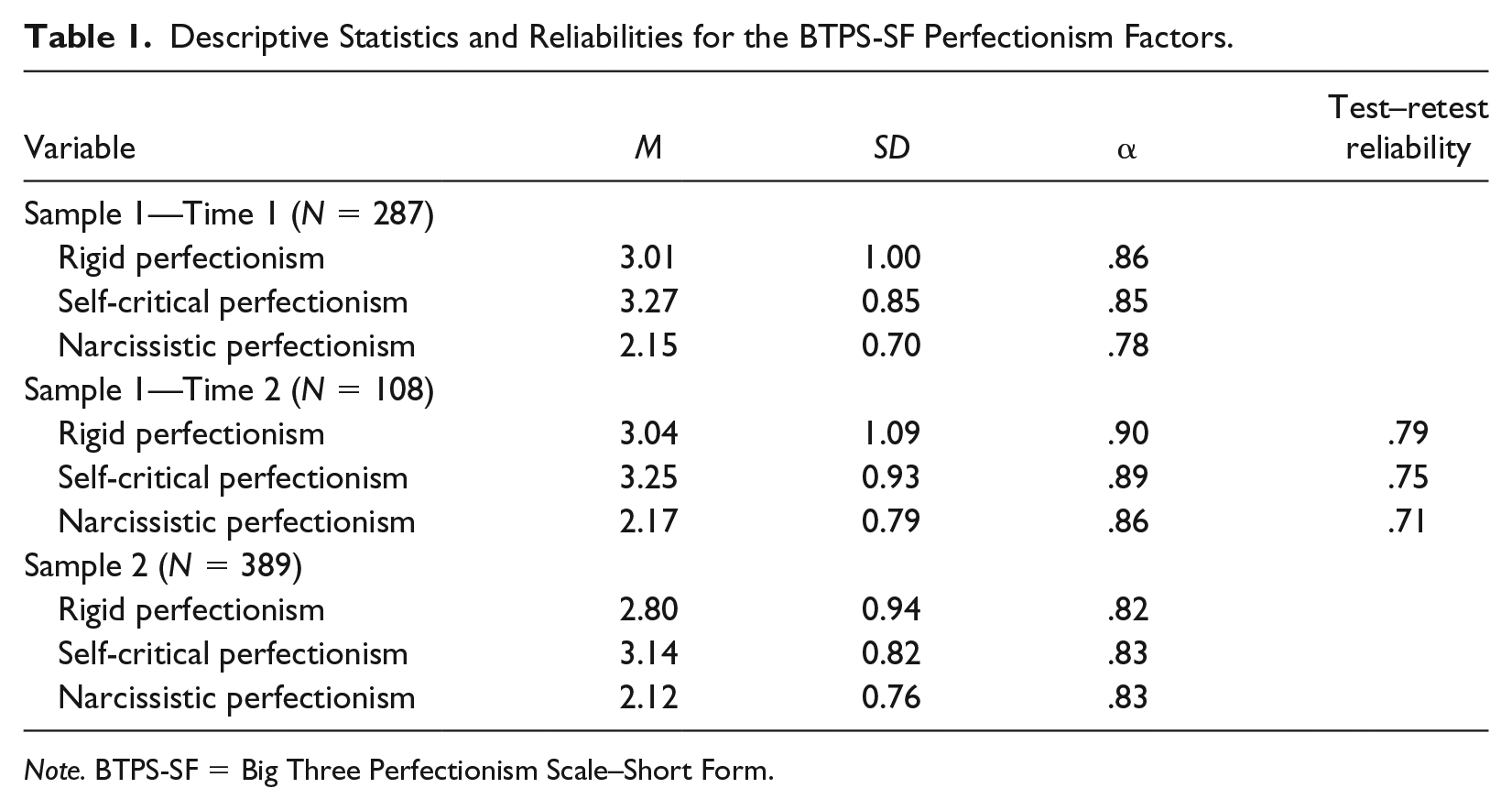
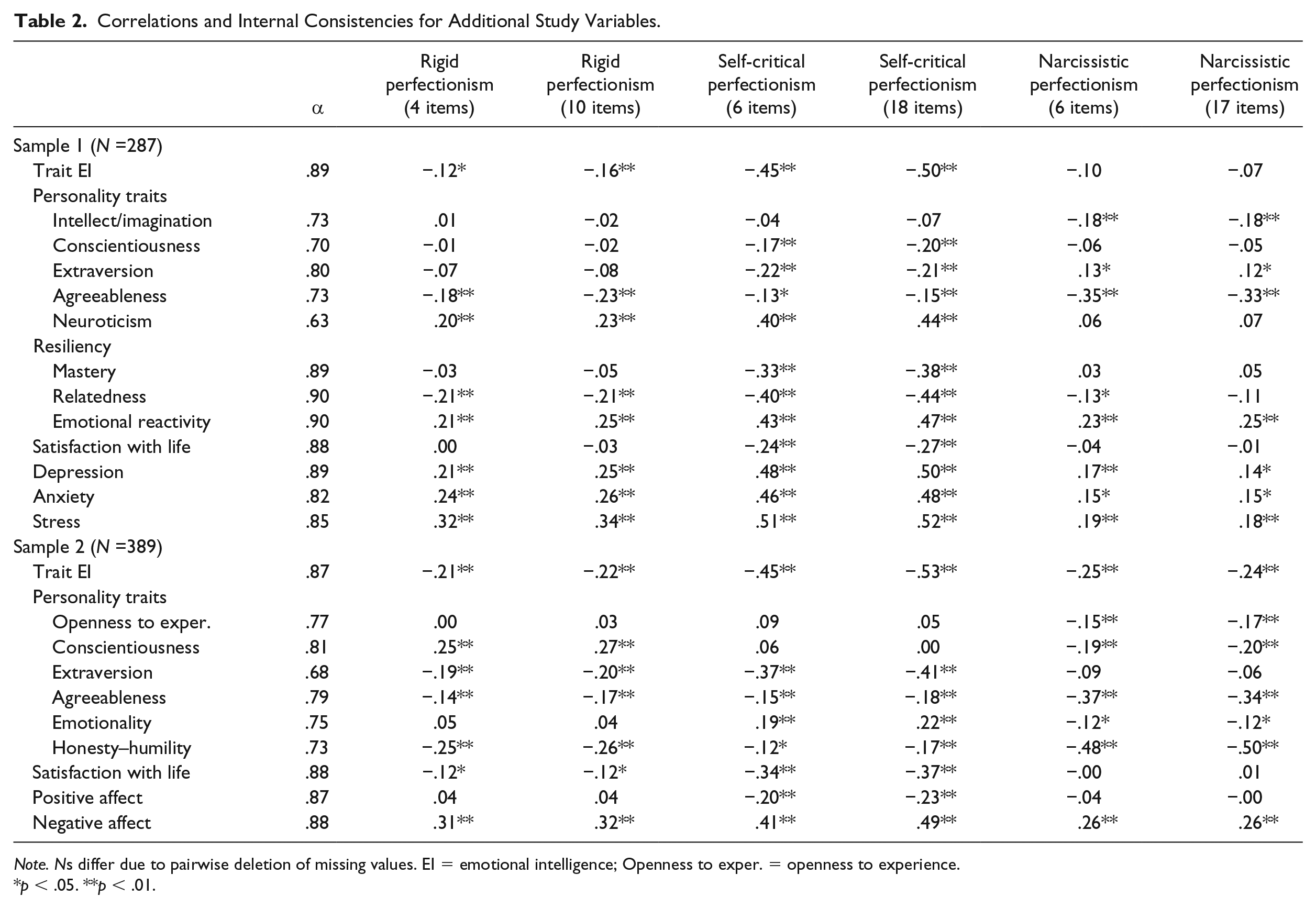
Descriptive statistics and Cronbach’s alpha for the BTPS-SF perfectionism factors are in Table 1. Sample 1 had two data time points (initial and retest data collection), whereas Sample 2 completed all measures at one time. Across both samples, coefficient alpha values for BTPS-SF perfectionism factors were high, ranging from .78 (narcissistic perfectionism) to .90 (rigid perfectionism). Internal consistency for the long-scale version of the BTPS in the combined sample was α = .91 for rigid perfectionism, α = .92 for self-critical perfectionism, and α = .91 for narcissistic perfectionism. Internal consistency values for all other variables are in Table 2.
Descriptive Statistics and Reliabilities for the BTPS-SF Perfectionism Factors.
Note. BTPS-SF = Big Three Perfectionism Scale–Short Form.
Correlations and Internal Consistencies for Additional Study Variables.
Note. Ns differ due to pairwise deletion of missing values. EI = emotional intelligence; Openness to exper. = openness to experience.
p < .05. **p < .01.
Correlations between corresponding long and short BTPS factors were also assessed in each sample. In Sample 1 (N = 286), correlations between the short and long scale were r = .96 for rigid perfectionism, r = .96 for self-critical perfectionism, and r = .95 for narcissistic perfectionism. In Sample 2 (N = 384), these correlations were r = .96 for rigid perfectionism, r = .95 for self-critical perfectionism, and r = .95 for narcissistic perfectionism.
Confirmatory Factor Analysis of 16-Item BTPS-SF
One-, two-, and three-factor models were tested to examine the factor structure of the 16-item BTPS-SF (see Table 3). The one-factor model consisted of a general perfectionism factor, and the two-factor model consisted of rigid and self-critical perfectionism items as one factor and narcissistic perfectionism items as the second factor. Finally, the proposed three-factor model assessed rigid, self-critical, and narcissistic perfectionism as separate factors, in line with the three-factor model of the original BTPS (Smith, Saklofske, et al., 2016). Fit for the one-factor perfectionism model was poor: WLSMV χ2(104) = 2562.96, RMSEA = .197 (90% confidence interval [CI] = [0.191, 0.204]), CFI = .757, Tucker–Lewis Index [TLI] = .719. Item loadings ranged from .36 to .85. Model fit improved marginally for the two-factor model, but was still relatively poor: WLSMV χ2(103) = 1187.70, RMSEA = .132 (90% CI = [0.125, 0.139]), CFI = .893, TLI = .875. Item loadings ranged from .49 to .87. Finally, model fit improved for the proposed three-factor model of the short-form BTPS (see Figure 1), which demonstrated marginally acceptable fit: WLSMV χ2(101) = 633.88, RMSEA = .093 (90% CI = [0.086, 0.100]), CFI = .947, TLI = .937. Factor loadings of the three-factor model were generally strong, ranging from .49 to .92. The three-factor model of the short-form BTPS fit significantly better than either the two-factor model, WLSMV Δχ2(2) = 236.18, p < .001, or the one-factor model, WLSMV Δχ2(3) = 569.31, p < .001.
Item-Level CFA for the Perfectionism Scales (N = 607).
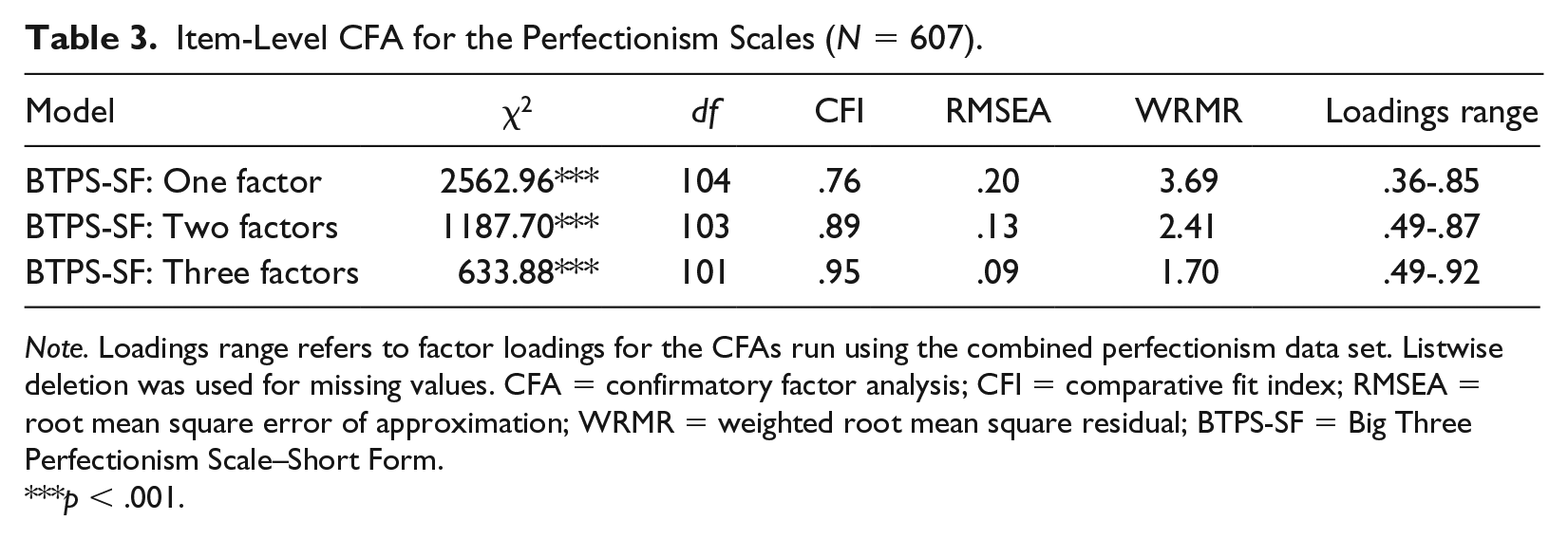
Note. Loadings range refers to factor loadings for the CFAs run using the combined perfectionism data set. Listwise deletion was used for missing values. CFA = confirmatory factor analysis; CFI = comparative fit index; RMSEA = root mean square error of approximation; WRMR = weighted root mean square residual; BTPS-SF = Big Three Perfectionism Scale–Short Form.
p < .001.
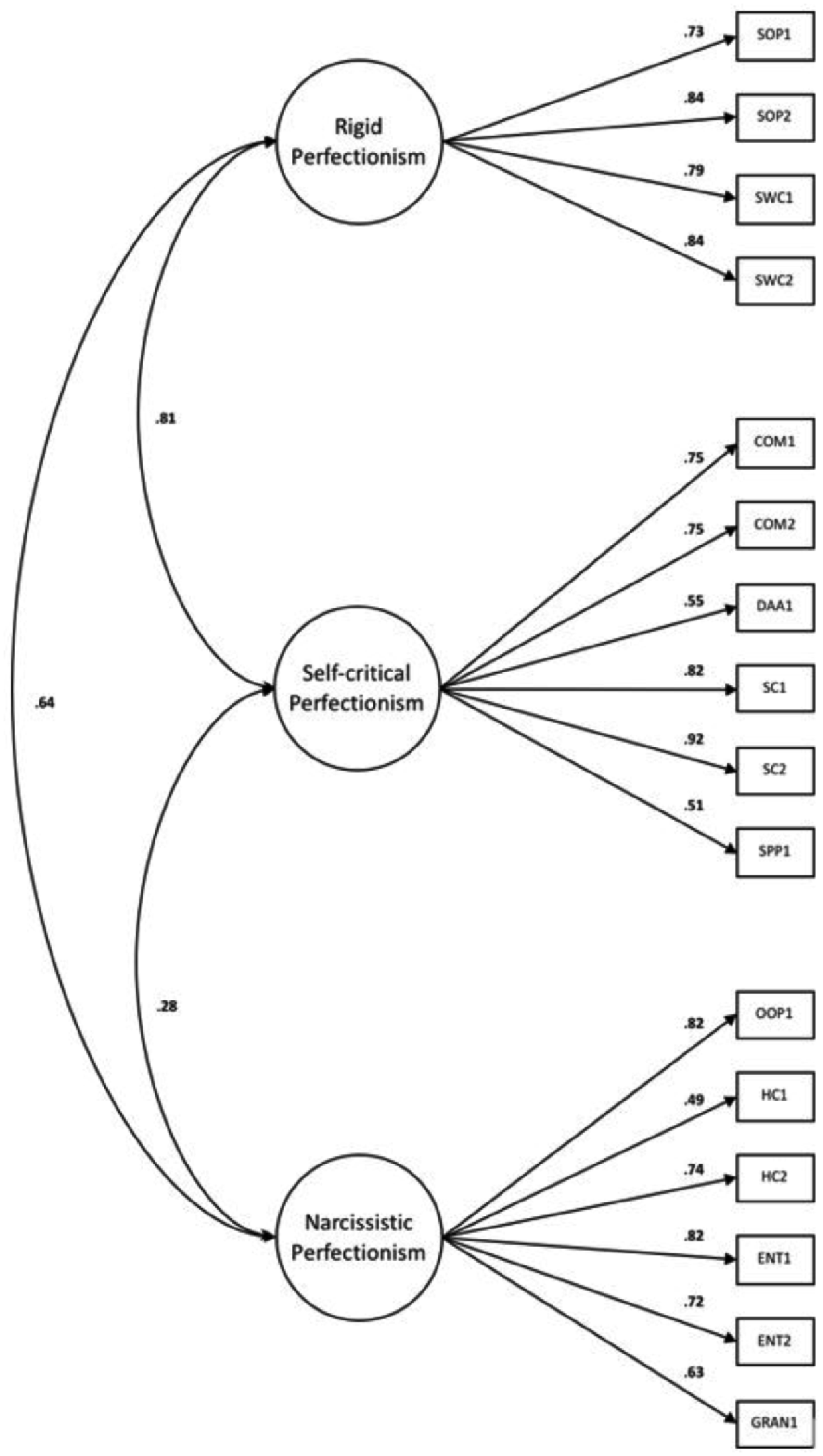
Confirmatory factor analysis of three-factor Big Three Perfectionism Scale–Short Form (BTPS-SF).
Test–Retest Reliability of BTPS-SF
In Sample 1, test–retest reliability of the BTPS-SF over a range of 38 to 93 days was examined (M = 58.2 days, SD = 10.6 days) between Time 1 and Time 2 testing. Each of the three perfectionism factors demonstrated high test–retest reliability: rigid perfectionism, r = .79, p < .001; self-critical perfectionism, r = .75, p < .001; and narcissistic perfectionism, r = .71, p < .001.
Correlations Between BTPS-SF Perfectionism Factors and Other Variables
Bivariate correlations between perfectionism factors and personality traits, trait emotional intelligence, resiliency, life satisfaction, positive and negative affect, stress, anxiety, and depression were examined in the present study (see Table 2). Patterns of relationships were consistent across both long and short forms.
Using Cohen’s (1992) criteria for small, medium, and large effect sizes, we found a small positive relationship between rigid perfectionism and conscientiousness (Sample 2 only), a small to medium positive relationship between self-critical perfectionism and neuroticism/emotionality (Samples 1 and 2), and a medium negative relationship between narcissistic perfectionism and agreeableness (Samples 1 and 2). Regarding other personality trait relationships, rigid perfectionism shared a small negative relationship with agreeableness and a small positive relationship with neuroticism in Sample 1. Small negative relationships were found with extraversion, agreeableness, and honesty–humility in Sample 2. Regarding self-critical perfectionism, small negative relationships were found with conscientiousness, extraversion, and agreeableness in Sample 1, and small to medium negative relationships with extraversion, agreeableness, and honesty–humility in Sample 2. Finally, patterns of correlations for narcissistic perfectionism in Sample 1 demonstrated a small negative relationship with intellect/imagination, and a small positive relationship with extraversion. In Sample 2, narcissistic perfectionism had small negative relationships with openness, conscientiousness, and emotionality, and a medium negative relationship with honesty–humility.
Regarding relationships between perfectionism factors and the other study variables, in Sample 1, trait emotional intelligence had a small negative relationship with rigid perfectionism and a medium negative relationship with self-critical perfectionism. With regard to resiliency, each perfectionism factor in Sample 1 showed small to medium negative relationships with the relatedness factor, and positive relationships with the emotional reactivity factor. Self-critical perfectionism had a medium negative relationship with the mastery resiliency factor. Each perfectionism factor was positively related to depression, anxiety, and stress, though the magnitude of these effects varied. In Sample 2, trait emotional intelligence had small to medium-sized negative relationships with all the perfectionism factors. Small to medium negative relationships emerged between rigid and self-critical perfectionism factors and life satisfaction, as well as positive affect and self-critical perfectionism. Finally, all perfectionism factors showed small to medium positive relationships with negative affect.
Discussion
The current research was conducted to develop the BTPS-SF, a 16-item short-form version of the BTPS (Smith, Saklofske, et al., 2016). The BTPS-SF reflects the three-factor model of perfectionism proposed by Smith, Saklofske, et al. (2016), where perfectionism is conceptualized using a multidimensional model composed of three higher order primary factors: rigid, self-critical, and narcissistic perfectionism. Like its long-form counterpart, the BTPS-SF is unique in including a measure of narcissistic perfectionism in the scale. A 16-item version of the perfectionism short scale was created in the present study, versus an 18-item version created in an Italian study (DiFabio et al., 2018). There was some overlap in items between the scales developed in these studies, with six items (at least one item from each of the three perfectionism factors) matching in these two short-form scales.
In line with our hypothesis, CFA results revealed the BTPS-SF had the best fit statistics when conceptualized as a three-factor model (i.e., rigid, self-critical, and narcissistic perfectionism), which was consistent with the three-factor representation of perfectionism espoused in the longer BTPS (Smith, Saklofske, et al., 2016). The three BTPS-SF factors also had high internal consistency so that a reduction of items from 45 to 16 items did not result in a noticeable loss in scale internal reliability. The factor correlations ranged from small (r = .28) to large (r = .81) in size and were all in a positive direction. The largest correlation (r = .81) occurred between rigid perfectionism and self-critical perfectionism, which is consistent with the high correlation reported in Smith, Saklofske, et al. (2016). Other studies have similarly found large magnitude correlations between conceptually similar representations of these perfectionism factors (personal standards and evaluative concerns perfectionism; e.g., Dunkley, Blankstein, & Berg, 2012). Although this indicates high overlap between these different dimensions of perfectionism, these dimensions are generally represented as distinct in the literature, for example, covering somewhat different aspects related to perfectionism and having unique patterns of relationships with other variables (e.g., see Dunkley et al., 2012; Dunkley, Blankstein, Masheb, & Grilo, 2006). Moreover, in our study, a two-factor model of perfectionism (where rigid and self-critical perfectionism loaded onto one factor) and one-factor model of perfectionism did not demonstrate adequate fit, indicating that a three-factor model of perfectionism provides a comparatively better fit. Our study thus adds to evidence conceptualizing perfectionism as a multidimensional construct (e.g., Frost et al., 1990; Hewitt & Flett, 1991b; Hewitt, Flett, Besser, Sherry, & McGee, 2003).
We also found good test–retest reliability for rigid, self-critical, and narcissistic perfectionism. Stability of perfectionism dimensions over time is considered a central assumption of perfectionism (Hewitt & Flett, 1991b), and the results regarding the stability of the BTPS-SF primary factors supported this assumption. Similar patterns regarding temporal stability of perfectionism dimensions have been found for other perfectionism scales, with test–retest reliability scores ranging from modest to good for Frost’s Multidimensional Perfectionism Scale (r = .63-.88) and Hewitt and Flett’s Multidimensional Perfectionism Scale (r = .75-.88; Hewitt & Flett, 1991b; Rice & Dellwo, 2001).
Correlations between the three primary perfectionism factors and depression, anxiety, stress, trait emotional intelligence, personality traits, resiliency, life satisfaction, positive affect, and negative affect were also examined in each of the two samples to assess criterion validity. Rigid perfectionism had a negative relationship with positive outcomes and characteristics (e.g., trait emotional intelligence, satisfaction with life) and was positively related to negative outcomes (e.g., stress, depression). These findings support those found in the meta-analysis by Smith, Sherry, et al. (2016) regarding perfectionism (including components such as self-oriented perfectionism) serving as a risk factor for depressive symptoms. Self-critical perfectionism was related to poorer psychological outcomes, which is in line with findings that represent a positive relationship between self-critical perfectionism and maladaptive outcomes such as depression, anxiety, and stress (e.g., Smith et al., 2015).
Our study also examined the BTPS’ operationalization of narcissistic perfectionism with well-being outcome variables. Narcissistic perfectionism has small but positive relationships with depression, anxiety, stress, and negative affect. Although other studies have found that other-oriented perfectionism (a facet of narcissistic perfectionism) does not relate significantly to depression or anxiety (Hewitt & Flett, 1991a), the present study findings suggest perhaps the negativity of other-oriented perfectionism for depression and anxiety is not observed until considered alongside other traits (e.g., hypercriticism) in the narcissistic perfectionism family.
Relationships of the perfectionism factors with personality traits were also explored. The present study’s bivariate correlation findings did lend support to the three main expectations derived from Smith, Saklofske, et al.’s (2016) findings: a positive association between rigid perfectionism and conscientiousness, a positive association between self-critical perfectionism and neuroticism, and a negative association between narcissistic perfectionism and agreeableness. These findings are also mostly in line with correlational results found by the Besharat and Atari (2017) study regarding perfectionism and these personality traits. Therefore, the correlational patterns found in the current study attest to the criterion validity of the BTPS-SF measure.
Limitations and Future Directions
Although the BTPS (Smith, Saklofske, et al., 2016) measures perfectionism both at the facet level and at the factor level, the present short-form scale measures perfectionism only at the factor level. Nevertheless, what it sacrifices regarding breadth of measurement, the short scale makes up for in ease of administration and time efficiency and replication of the three-factor structure of the longer BTPS. Future studies might further examine the three-factor model in both the BTPS and the BTPS-SF with new and more diverse samples.
A limitation of this research was the relatively low number of male participants. Future studies should try to collect a more gender-balanced sample. The present study also used Canadian samples, and future studies should assess the reliability and the validity of the scale in other countries, as well as determine whether the three-factor model of perfectionism holds up cross culturally. Whereas the BTPS-SF reported in this article contains 16 items, the Italian version (DiFabio et al., 2018) included 18 items to capture the three factors, suggesting that scales, whether the original or brief form should be shown to have the necessary psychometric and practical support (see International Test Commission, 2017) whenever adapted for use in another country or culture, especially with a different language. Assessment of the model fit of the BTPS-SF across other samples is also necessary to further evaluate the higher RMSEA values obtained in the current study. Finally, research is also needed in examining how the BTPS-SF relates to other perfectionism measures (e.g., Multidimensional Perfectionism Scale; Hewitt & Flett, 1991b).
Concluding Remarks
The BTPS-SF is a multidimensional measure of perfectionism that offers a short version of the BTPS (Smith, Saklofske, et al., 2016). This 16-item scale can be easily and quickly administered, thus giving researchers a convenient means to assess perfectionism. The BTPS-SF factor structure also supports the three-factor structure of perfectionism proposed by Smith, Saklofske, et al. (2016), where perfectionism is a personality trait composed of three distinct but related primary factors: rigid perfectionism, self-critical perfectionism, and narcissistic perfectionism.
Footnotes
Appendix
Declaration of Conflicting Interests
The author(s) declared no potential conflicts of interest with respect to the research, authorship, and/or publication of this article.
Funding
The author(s) disclosed receipt of the following financial support for the research, authorship, and/or publication of this article: Parts of this study were supported by the University of Western Ontario Social Science Research Fund awarded to Dr. Donald Saklofske.
