






Abstract
Character strengths are an important foundation for positive development and thriving in adolescence. Most research on character strengths has been conducted with youths in Western cultures. We examined character strengths in relation to positive and negative well-being indicators in a sample of Iranian youths. We investigated the reliability and validity of the Farsi version of the Values in Action Inventory of Strengths for Youth (VIA Y-96)—a self-report survey commonly used in Western contexts. Participants were adolescents in Iran (N = 1,359; 48.5% female; M age = 13.54, SD = 1.00) who completed the VIA Y-96 and questionnaires assessing life satisfaction, positive/negative experiences, depression, anxiety, and stress. We found that reliability coefficients were acceptable for most of the VIA subscales. A confirmatory factor analysis (CFA), as well as a second-order CFA, supported the construct validity of the Farsi VIA Y-96. Correlations between the character strengths and positive and negative well-being indicators supported convergent validity. Measurement invariance for the VIA Y-96 was established in this study comparing boys’ and girls’ response patterns. Sex and grade level differences were found for some of the subscales. Overall, the Farsi VIA Y-96 had acceptable psychometric properties, suggesting that it can be used in research on character strengths with Iranian youths.
Character strengths—those aspects of personality that are morally valued and reflect virtues in societies (Peterson & Seligman, 2004)—play a central role in youths’ positive development (Park, 2004). A total of 24 character strengths have been identified (see Peterson & Seligman, 2004) and are used widely in research on positive development and functioning (Niemic, 2013). In research with adolescents, character strengths have been positively correlated with indicators of thriving and well-being (e.g., Toner et al., 2012; Weber et al., 2016) and negatively with problem behaviors and risk factors (Benson et al., 2012).
Research on adolescent character strengths has grown substantially over the past decade. However, a majority of the studies have been conducted with North American adolescents (e.g., Park, 2004) or with adolescents in other Western countries, such as Germany (e.g., Ruch et al., 2014) and Australia (e.g., Toner et al., 2012). Fewer studies have examined adolescent character strengths in cultural contexts outside of Western countries. This is problematic because findings are mostly limited to adolescent character strengths in the so-called WEIRD societies (i.e., Western, Educated, Industrialized, Rich, and Democratic) which dominantly value individualism and independence (Henrich et al., 2010). This raises the question whether findings on adolescent character strengths from Western societies are generalizable to adolescents in other—the so-called non-WEIRD—societies. Non-WEIRD societies tend to be collectivistic, value interdependence, and may therefore hold different virtues (Henrich et al., 2010).
The purpose of this study was to examine character strengths in Iranian adolescents in relation to indicators for positive and negative well-being. We examined the reliability and the validity of the Values in Action Inventory of Strengths for Youth (VIA Y-96), a commonly used character strength survey, to identify character strengths in Iranian adolescents based on mean scores on the classification of the 24 character strengths. Moreover, as many studies have shown sex and age effects on character strengths (e.g., Park & Peterson, 2005; Ruch et al., 2014; Toner et al., 2012; Van Eeden et al., 2008), we explored differences in strengths based on various demographic characteristics. We discuss our findings in the context of previous research with youths in Western countries and in comparison to studies that have examined character strengths in other collectivistic societies.
The present research is important for several reasons. To our knowledge, this is the first study that examines adolescent character strengths in the context of Iran. Iran can be described as a collectivistic and interdependent cultural context (Ghorbani et al., 2013); this allows us to examine the generalizability of findings about youths’ character strengths from previous research with adolescents in Western countries. The present study furthermore creates a foundation for future research and informs clinical and educational practices with Iranian adolescents (e.g., the development of interventions that foster character strengths).
Character Strengths and Positive Youth Development
The study of character strengths in adolescence is theoretically embedded within the frameworks of positive psychology (Seligman & Csikszentmihalyi, 2000) and positive youth development (PYD) (Lerner et al., 2003). Positive psychology reflects a shift in scientific attention away from dysfunction and maladaptation and toward understanding the key components of a psychologically good and healthy life (Seligman & Csikzentmihaliyi, 2000). Good character is one of the key components as it reflects a well-developed composition of positive traits in a person (Park & Peterson, 2005).
Peterson and Seligman (2004) have identified six overall virtues that are reflected through the 24 character strengths. Virtues are valuable personal characteristics that are common in the history of most cultures (Peterson & Seligman, 2004). Character strengths are psychological aspects and subdivisions of virtues. In previous research, character strengths have been positively associated with adolescents’ life satisfaction and well-being (e.g., Gillham et al., 2011) and negatively related to psychological and behavioral problems such as depression and anxiety, aggression (Proctor, 2013), and substance use (Benson et al., 2012). The link between character strengths to satisfaction with life is important because life satisfaction—a person’s evaluation of their life as a whole (Diener et al., 1999)—is an important indicator of positive mental health and overall wellness (Seligman, 2002). Researchers have argued that interventions to promote character strengths in youths could be a strategy to support positive mental health and well-being (Proctor et al., 2011). Similarly, depression, anxiety, and stress are indicators of compromised mental health and indicate emotional vulnerability in adolescents (Lichenstein et al., 2016), and researchers have argued that enhancing character strengths in youths can function as a buffer from mental health problems. Overall, character strengths are considered an important asset, and a promotive and protective factor in youth development (Proctor, 2013).
Assessment of Character Strengths With the VIA-Youth
Park and Peterson (2006) developed the VIA-Youth (198 items)—a self-report tool that assesses the 24 character strengths through 24 subscales (see Supplementary Table 1 for a list of the 24 character strengths). Based on the original 198-item version, the authors employed an exploratory factor analysis in previous research, which identified a four-factor structure (i.e., temperance, intellectual, theological, and other-directed strengths) under which the 24 factors were organized (Park & Peterson, 2006).
Several studies have established the reliability and validity of the VIA-Youth in Western countries. For example, in a study of 306 adolescents from the United States, between 8th to 10th grade, the VIA-Youth had good psychometric properties. Specifically, Cronbach’s alphas were moderate to satisfactory (.66–.88) for the most scales (Park & Peterson, 2005). In one of a few studies conducted outside of the Western cultural context, the 198-item VIA-Youth had good psychometric properties in a sample of 1691 13- to 17-year-old adolescents in South Africa; reliability coefficients ranged from .52 to .77, indicating acceptable reliability for most of the subscales (Van Eeden et al., 2008). While Peterson and Seligman (2004) have suggested that their classification of character strengths is universal and applicable in other cultures, it is critical for researchers to test this assumption by examining more widely to whether the character strength classification is indeed stable across cultures and to what extent character strengths are related to indicators of well-being in a given cultural context.
The Present Study
The first goal of this research was to identify most and least common character strengths based on mean scores on the VIA Y-96 in adolescents in Iran. The second goal was to examine differences in the character strengths based on adolescents’ demographic characteristics (i.e., sex, grades, and the type of school). In order to address these goals, the VIA Y-96 needed to be translated into Farsi, adapted to the cultural context of Iran, and validated.
We conducted a confirmatory factor analysis (CFA) to examine whether the previously established model with the 24 character strengths fit the data in the present study. Next, we conducted a second-order CFA to test a four-factor solution (i.e., temperance, intellectual, theological, and other-directed strengths) based on a theoretical framework by Park and Peterson (2006) to explore a more complex structure of the character strengths. Then, we investigated correlations between all character strengths and indicators of well-being (i.e., life satisfaction and positive affect) and mental health problems (i.e., negative affect, depression, anxiety, and stress). Last, we explored whether character strengths differed according to youths’ sex, grade levels (i.e., grades 7, 8, and 9), and the type of school they attended (i.e., public and private). Before comparing boys’ and girls’ scores on character strengths, we conducted analyses to establish measurement invariance of the VIA Y-96 across sexes.
Based on previous research (e.g., Benson et al., 2012; Toner et al., 2012), two research hypotheses were formulated: first, we expected a positive correlation between character strengths and indicators of well-being (i.e., life satisfaction and positive affect). Second, we expected a negative correlation between character strengths and mental health problems (i.e., negative affect, depression, anxiety, and stress). Whether or not there would be differences in character strengths based on demographic backgrounds were exploratory questions.
Method
Participants
A total of 1411 middle school students (48.5% female; 7th grade: 34.7%, 8th grade: 32.2%, 9th grade: 33.1%) in 60 classrooms across 20 schools in Tehran (i.e., the capital city of Iran) participated. Ten schools were private (attended by 38% of the participants) and ten schools were public (attended by 62% of the participants). Age ranged from 12 to 16 years (M = 13.54, SD = 1.00). A total of 39/42% of the participants reported that their father/mother held a diploma or a degree lower than a diploma, 28/34% reported that their father/mother held a bachelor’s degree, and 24/14% reported that their father had completed postgraduate education. About 10% did not know their parents’ educational backgrounds. The participation rate was 96%. Students’ assent was obtained before survey implementation. We did not obtain active consent from parents because in the context of Iran, the decision of whether students can participate in a school-based research study is commonly made by the school principal.
Procedure
We invited 20 principals from five different regions in Tehran (i.e., north, south, east, west, and center) to participate in this research project on character strengths with grade 7, 8, and 9 students in their schools. School principals selected one classroom per grade to participate in the research based on the students’ curricular commitments during the specific time of the research visit. Hence, three classrooms representing 3 grade levels were recruited in each school. All adolescents in the respective classrooms were invited to complete the questionnaires. Adhering to the cultural norms of the country, female researchers visited all girls’ schools and a female researcher accompanied by a male assistant to visit all the boys’ schools. Surveys were paper-based and completed within 45–60 minutes in the classroom setting during regular school hours. All data were collected between January and March 2018.
Measures
Demographics
Participants provided demographic data (i.e., birth date, sex, grade level, and their parents’ level of education).
VIA Y-96
Character strengths were assessed with the 96-item version, derived from the 198-item VIA-Youth (VIA-Youth; Park & Peterson, 2006), a self-report survey for children and adolescents between the ages of 10 and 17 years (see www.viacharacter.org). In a previous study with 253 adolescents, .82 was the mean correlation between original (i.e., long) and revised (i.e., short) character strength scales (McGrath & Walker, 2016). Character strengths are measured in 24 different domains (see Supplementary Table 1). Each of the 24 strengths is assessed through 4 items that are rated on a 5-point Likert scale ranging from 1 (not like me at all) to 5 (very much like me) (five items are reverse-scored). Higher scores on a subscale indicate a higher level of strength.
Translation of the VIA Y-96 into Farsi
We obtained a Farsi translation of the VIA Y-96 from the VIA Institute on character (www.viacharacter.org). An expert review of the survey with a group of Farsi-English bilingual researchers and psychologists indicated that the available Farsi version needed to be revised in several places to accurately reflect the meaning of the items in a common language. Minor modifications were made to the wording of almost all items; the revised Farsi version of the VIA Y-96 was translated back to English by different translators. Then, another two individuals who were experts in English translation compared the original form with the translated form and validated the translation. Next, the translated scale was given to 18 Iranian bilingual psychologists who work with youths in Iran. They reviewed the revised items regarding comprehension, the necessity of words used, and clarity. The content validity ratio (CVR; Lawshe, 1975) was computed for each item. The CVR is a linear transformation of a proportional level of agreement on how many experts rate an item as “essential,” whereas −1 indicates full disagreement; a CVR of +1 indicates full agreement.
Although the CVR is one of the earliest and most widely used methods for assessing content validity, it is not flawless. In fact, Wilson et al. (2012) corrected and expanded (Lawshe’s, 1975) table. They computed critical values in unit steps and at multiple alpha levels. In this study, the CVR was acceptable when considering either, Lawshe’s (1975) or Wilson et al. (2012) critical values for all but five items. The five items were retranslated and reviewed until acceptable. Last, a group of 38 grade 7 students completed the revised Farsi version of the VIA Y-96 and provided feedback for each of the items that resulted in very minor revisions to wording.
Life Satisfaction
The Farsi version of the Satisfaction with Life Scale (SWLS; Diener et al., 1985 was used to assess adolescents’ life satisfaction. The SWLS includes 5 items that indicate the extent to which students feel satisfied with their lives (sample item: “The conditions of my life are excellent”). Items are completed on a 7-point scale, ranging from 1 (strongly disagree) to 7 (strongly agree). Sum scores across all items resulted in an overall total score of life satisfaction. Several previous studies have supported the validity and reliability of the SWLS with children and adolescents (e.g., Gouveia et al., 2009; Moksnes et al., 2014; Silva et al., 2015). The reliability of the Farsi SWLS was high in previous research (Sheikhi et al., 2011). Similarly, internal consistency was satisfactory in the present study (Cronbach’s alpha = .84).
Depression, Anxiety, and Stress
We measured depression, anxiety, and stress with the Farsi version of the Depression, Anxiety, and Stress Scale-21 (DASS-21; Lovibond & Lovibond, 1995). The DASS-21 contains 21 items (i.e., 7 items per subscale). Sample items: “I couldn’t seem to experience any positive feeling at all” (depression); “I felt scared without any good reason” (anxiety); and “I found it difficult to relax” (stress). Adolescents rated their mental state over the past week on a 4-point Likert scale (ranging from 0 = did not apply to me at all to 3 = applied to me very much or most of the time). For each subscale, composites were created by summing up the scores across all items. As the DASS-21 is the short form version of DASS-42, the total raw score of each subscale was multiplied by two to yield the equivalent scores to the full version of this scale (see Lovibond & Lovibond, 1995). Research has found good psychometric properties of the DASS-21 in adolescents (e.g., Shaw et al., 2017; Szabo, 2010; Willemsen et al., 2011). In a study with Iranian adolescents, internal consistency was satisfactory for all subscales (Aazami et al., 2017). In the present study, Cronbach’s alphas were .79 (depression), .75 (anxiety), and .77 (stress).
Positive and Negative Experiences
Adolescents’ day-to-day positive and negative experiences were assessed with the Farsi version of the 12-item Scale of Positive and Negative Experience (SPANE; Diener et al., 2009). Six items measured positive experiences (e.g., joyful) and 6 items measure negative experience over the past month (e.g., unpleasant). Responses to the items were made a 5-point Likert scale ranging from 1 (very rarely or never) to 5 (very often or always). Scores were calculated by summing the scores for the relevant items. In past research, Diener et al., (2009) found satisfactory Cronbach’s alphas for positive feeling .84 and negative feeling .80. In the present study, internal consistency was also satisfactory (PA: alpha = .85 and NA: alpha = .75).
Data Analytic Procedure
Statistical analyses were conducted using SPSS 22 (preliminary analyses, correlations, and analyses of variances) and LISREL 8.8 (CFA and second-order CFA). First, preliminary analyses were conducted to examine missing data patterns. Of the 1411 participants, 52 students did not complete the survey, reducing the number of final participants for data analyses to 1359. All missing data were missing at random, and we followed established guidelines to impute missing data (see Graham, 2009; Meyers et al., 2013). 1 Because LISREL handles missing data through listwise deletion, CFA and second-order CFA were conducted only on cases with complete data on the VIA Y-96, resulting to a final sample size of 1170 for this subset of analyses.
Second, we computed descriptive statistics and Cronbach’s alpha reliability coefficients for all scales. Third, we conducted a CFA using structural equation modeling to assess the construct validity of the VIA Y-96. The widely used classification of the 24 character strengths (see Peterson & Seligman, 2004) was used as a theoretical framework. Additionally, in alignment with previous research, we performed a second-order CFA in which we fit a four-factor solution (i.e., temperance, intellectual, theological, and other-directed strengths) for this scale (see Park & Peterson, 2006) to assess whether the same factors would be found in this sample and to provide further supports for the construct validity of the VIA Y-96. We used the maximum likelihood method to assess the statistical fit of the measurement model (Jöreskog & Sörbom, 2005). Good model fit was indicated by root-mean-square error of approximation (RMSEA) values of less than .05, comparative fit index (CFI) values greater than .95, and standardized root-mean-square residual (SRMR) values less than .08; a statistically nonsignificant chi-square test also indicates a good model fit (e.g., Hu & Bentler, 1999).
We further conducted correlation analyses between the character strengths and life satisfaction, positive affect, depression, anxiety, stress, and negative affect to determine the convergent validity of the Farsi VIA Y-96 scale. Pearson correlations coefficients were interpreted in accordance with established guidelines (r = .1 to .3: small, r = .3–.5: medium, and r > .5: large; Cohen, 1988). To determine that sex comparisons are valid, measurement invariance was tested using multigroup confirmatory factor analysis (MGCFA). Then, to investigate the character strengths as functions of sex, grade, and school, univariate analyses of variances (ANOVA) were completed. Eta square values of .09, .14, and .22 were considered to indicate weak, moderate, and strong effects (Gamst et al., 2008). To protect from type 2 error, we adjusted the significance level to .002 (i.e., .05/24 = .002; because 24 different character strengths were investigated).
Results
Descriptive Statistics and Reliability
Descriptive Statistics, Skewness, Kurtosis, Internal Consistencies, and Pearson Correlations Between the 24 Character Strengths on the VIA Y-96 and Positive/Negative Well-being Indicators.
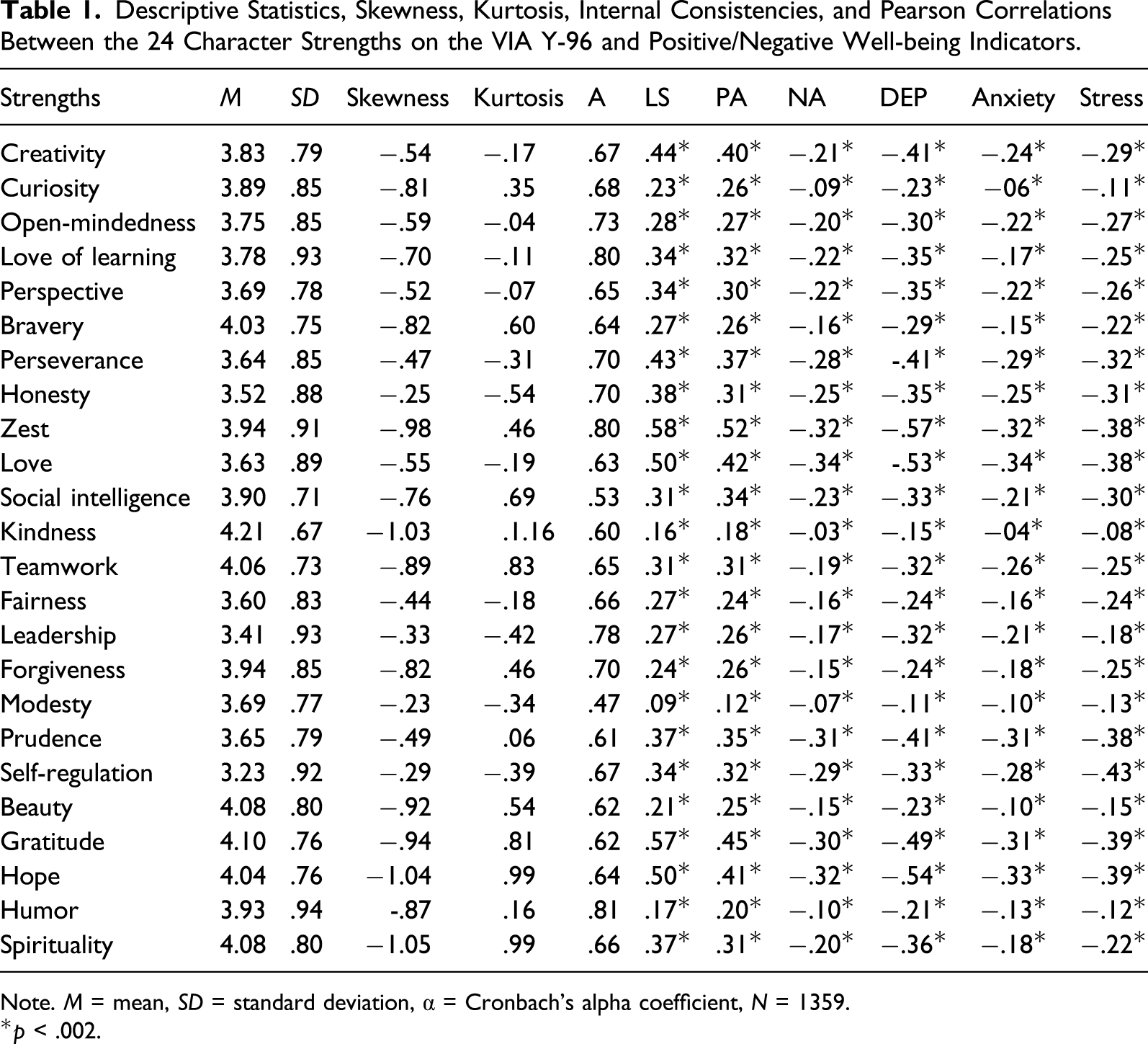
Note. M = mean, SD = standard deviation, α = Cronbach’s alpha coefficient, N = 1359. *p < .002.
Confirmatory Factor Analyses
The model with 24 factors had a good fit (RMSEA = .037; SRMR = .047; CFI was .97). The chi-square test was statistically significant (χ2 = 10,908.15, df = 4188, p < .001). As noted by Hooman (2005), the chi-squared test is highly sensitive to sample size. In large samples, the model fit should thus be interpreted by dividing the chi-square value by the degrees of freedom. A resulting value below 3 is considered an acceptable model fit (Hooman, 2005). In the present study, we yielded a value of 2.60 (i.e., 10,908.15/4188), indicating good model fit. Item loadings on their factors (i.e., the subscales representing the 24 character strengths) are shown in Supplementary Table 1. T-values for all items were above 1.96, indicating acceptable item loading for all items (Kline, 1994).
A second-order CFA (see Supplementary material Figure 1) revealed that the model had an overall good fit (RMSEA = .044; SRMR = .055; CFI was .96). The chi-square test was statistically significant (χ2 = 12,897.61, df = 4434, p < .001). T-values for all items were above 2.56, indicating acceptable item loading for all items (Kline, 1994). The relations between the variables and standardized beta coefficients are shown in the supplementary material.
Validity Evidence for the VIA Y-96: Convergent Validity
All the 24 character strengths were positively and significantly correlated with the positive well-being indicators (satisfaction with life and positive affect) and negatively and significantly correlated with the negative well-being indicators (depression, anxiety, stress, and negative affect) (see Table 1). Specifically, life satisfaction and positive affect were strongly or moderately related to higher levels of creativity, zest, gratitude, love, and hope. Similarly, negative affect, anxiety, and depression were strongly or moderately related to lower levels of zest, gratitude, love, and hope. Stress was moderately related to lower levels of self-regulation.
Demographic Backgrounds and Character Strengths
Measurement invariance across sex groups (i.e., boys and girls) was examined to determine whether sex comparisons are valid and interpretations are meaningful. Examining whether constructs are measured similarly across different groups is critical to understand whether different groups ascribe the same meaning to scale items (e.g., Fischer et al., 2009; Gouveia et al., 2009). Multigroup confirmatory factor analysis (MGCFA) was performed to test four common “measurement invariance” models (i.e., configural, metric, scalar, and error invariance) and three “structural invariance” models (i.e., factor variance, factor covariance, and factor mean invariance; Milfont & Fischer, 2010). Results showed that the chi-square test was significant in all models. Given that chi-square statistic is sensitive to sample size (Cheung & Rensvold, 2002), measurement invariance across sex groups was inferred based on goodness of fit indices. Goodness of fit indices (e.g., RMSEA <.05, SRMR <.08, and CFI >.95) and additional comparative fit indices (e.g., ΔCFI > −.01, ΔGH > −.001, and ΔNCI > −.02; Cheung & Rensvold, 2002) provided support for measurement invariance, indicating that the observed variables were invariant across boys and girls without systematic measurement bias. Results for the measurement invariance analyses are shown in Supplementary Table 4.
Significant group differences on character strengths were found for sex and grade level only. Detailed results are reported in Supplementary Table 2 and 3. Boys had significantly higher scores for creativity, perseverance, zest, love, self-regulation, hope, and spirituality. Girls’ scored significantly higher on kindness, modesty, and appreciation of beauty and excellence. Grade 7 students had significantly higher scores on creativity, curiosity, bravery, perseverance, honesty, zest, love, teamwork, prudence, and hope in comparison to grade 8 or 9 students. All effects were small. There were no significant differences by type of school (public vs. private school) on the 24 character strengths.
Discussion
The goal of this study was to explore character strengths in relation to youths’ well-being in a large sample of Iranian adolescents who completed the Farsi version of the VIA Y-96. Overall, the structure previously found in research with adolescents from North America and Europe—24 character strengths and four items loading on each of the strengths (see Peterson & Seligman, 2004)—was replicated for the Farsi version of the survey in the present study. Further, in alignment with Park and Peterson (2006), we found the same four-factor structure (i.e., temperance, intellectual, theological, and other-directed strengths) in the current study, providing support for the construct validity of the VIA Y-96.
All character strengths were significantly related to the positive and negative indicators of well-being in the present study, providing evidence for the convergent validity of the Farsi version of the VIA Y-96. Specifically, creativity, zest, gratitude, love, and hope were strongly or moderately related to satisfaction with life, positive and negative affect. These findings are in line with results of previous studies that have examined the convergent validity of the VIA-Youth (198 items) (e.g., Park & Peterson, 2006; Ruch et al., 2014; Van Eeden et al., 2008).
We found the reliability coefficients of the VIA Y-96 subscales to be somewhat lower than reliability coefficients found by Park and Peterson (2006) and those found by Ruch et al. (2014). The lower reliability coefficients in this study may be due to having fewer items in comparison to the long version (i.e., the VIA-Youth). Out of the 24 coefficients in our study, 15 ranged from .65 to .81 and nine ranged from .47 to .64 (i.e., bravery, love, social intelligence, kindness, modesty, prudence, beauty, gratitude, and hope). This finding is similar to findings from research with the VIA in the context of South Africa (see Van Eeden et al., 2008). In fact, in a study on character strengths using the VIA-Youth, Van Eeden and colleagues found lower reliabilities (ranging from .52 to .79) for seven character strengths (i.e., teamwork, love, kindness, social intelligence, self-regulation, modesty, and hope); several of these overlapped with the ones found to be lower in the present study. One possible explanation is that the constructs, or the wording used to assess the constructs, may reflect Western concepts that cannot directly be translated for use in non-Western cultures. While similar character strengths may exist in non-Western cultures, it is possible that they are understood and defined differently and would have to be measured through different items. Further research needs to be conducted to better understand why the reliability was lower for several character strengths in our study and what modifications need to be made to improve internal consistency.
Considering which types of strengths were dominant among adolescents in the present study, we found highest scores for adolescents’ kindness, gratitude, appreciation of beauty and excellence, and spirituality and lowest scores for adolescents’ prudence, honesty, leadership, and self-regulation. This finding is consistent with findings from a South African sample of adolescents (Van Eeden et al., 2008). However, our findings differ from findings from a sample of American adolescents (Park & Peterson, 2006) and findings from a sample of adolescents in Germany/Switzerland (Ruch et al., 2014). In both studies, adolescents scored highest on gratitude, humor, and love and lowest on spirituality. A possible explanation is that both South Africa and Iran are considered to be more collectivistic than individualistic cultures; collectivistic cultures’ values center on promoting group harmony, whereas individualistic cultures’ values include a sense of personal uniqueness, autonomy, and freedom (Ghorbani et al., 2013). Our finding that kindness and gratitude emerged as dominant strength in Iranian adolescents, whereas leadership scores were amongst the lowest scores, is in alignment with this cultural description.
The result of the measurement invariance test showed that the observed variables were invariant across boys and girls. This indicates that the scale items functioned similarly for boys and girls, suggesting that the observed difference in boys’ and girls’ character strengths scores is meaningful. Sex comparisons across all character strengths revealed that female adolescents scored significantly higher on kindness, modesty, and appreciation of beauty and excellence than male adolescents. The magnitude of this finding was small. This finding was consistent with the results of other studies in which women scored higher on kindness and appreciation of beauty and excellence than men (Park, 2004; Park & Peterson, 2005, 2006; Ruch et al., 2014; Toner et al., 2012). Male adolescents in our study scored significantly higher than female on creativity, perseverance, zest, love, self-regulation, and hope. These results differed from studies in which girls scored higher than boys’ scores on some of these strengths, especially on love (Park, 2004; Ruch et al., 2014). A possible reason for these sex differences may be the cultural norms around gender expression in Iran (Shahidian, 2002). Overall, expression of kindness and appreciation of beauty and excellence is more common for girls and women, whereas for boys and men, expressing perseverance, hope, and zest may be more consistent with cultural norms than for girls and women.
Regarding grade level, 7th grade students scored significantly higher than 8th or 9th grade students on creativity, curiosity, bravery, perseverance, honesty, zest, love, teamwork, prudence, and hope. These findings were consistent with previous research (Park & Peterson, 2006; Ruch et al., 2014). Some researchers have argued that during the earlier years of adolescence, young people tend to self-assess their character strengths to be more positive because they tend to be more egocentric than during later years (Park & Peterson, 2005). Researchers have also found that positive characteristics, such as life satisfaction and quality of life, tend to decline throughout adolescence (Bisegger et al., 2005). Park and Peterson (2008) note that the commonly found decline of several strengths in later adolescence (e.g., creativity, perseverance, and hope) raises the need for early strength-based interventions that support adolescents in building and fostering character strengths. We did not find significant differences for any of the character strengths for adolescents in private and in public schools. This finding supports the stability of character strengths across school settings, which can be considered an indicator for youths’ socioeconomic background in Iran; further research is needed to provide more support for this finding.
Limitations and Future Directions
It is critical for future research to replicate the findings from the present study and to conduct research on character strengths in Iranian youths through a longitudinal design to test the stability of strengths over time. The present research was focused on an urban center in Iran, and findings may not reflect character strengths in rural settings or among other ethnic and language groups in Iran (e.g., adolescents with Azerbaijani, Kurdish, or Turkish backgrounds). We only collected data from adolescents in grades 7 to 9. Future research needs to include children during the transition to adolescence and during the transition to adulthood. It also needs to be noted that we conducted a second-order CFA to test a four-factor solution in the present study, based on previous findings by Park and Peterson (2006). This contrasts the six-factor solution that has been theorized by Peterson and Seligman (2004) and that has not been confirmed in empirical research (McGrath and Walker, 2016). Future research needs to examine the theorized six-factor structure alongside the empirically supported four-factor structure to capture a more comprehensive picture of possible higher-order factor solutions for the VIA-Youth.
Moreover, even though self-report has been considered the best approach to assess character strengths in a valid way (Park & Peterson, 2006), using additional measures such as teacher, parent, and peer reports can add valuable information about character strengths. Last, most of the research on character strengths has been conducted with the long version of the VIA-Youth, whereas our study used the VIA Y-96. Though overall findings remain comparable, given the strong correlation between the two versions, this makes a direct comparison of mean scores across studies more challenging.
Conclusions
The current study is, to our knowledge, the first study that assessed character strengths in Iranian adolescents living in Iran, and one of the few studies assessing character strengths in a non-Western society. While our findings suggest the VIA Y-96 can be used as a tool to identify character strengths in Iranian youths, several subscales (i.e., bravery, love, social intelligence, kindness, modesty, prudence, appreciation of beauty and excellence, gratitude, and hope) had lower reliability and should be used with caution. Peterson and Seligman (2004) argued that the classification of strengths is consistent across cultures. However, most empirical research on character strengths has been conducted in the North American context. Therefore, doing further research in different contexts would provide a better understanding of these vital positive aspects of human traits.
Supplemental Material
sj-pdf-1-jpa-10.1177_07342829211005300 – Supplemental Material for Examining the Link Between Character Strengths and Positive and Negative Mental Health Indicators in Iranian Adolescents
Supplemental Material, sj-pdf-1-jpa-10.1177_07342829211005300 for Examining the Link Between Character Strengths and Positive and Negative Mental Health Indicators in Iranian Adolescents by Mahsa Jabbari, Shahriar Shahidi, Leili Panaghi, Mohammad Ali Mazaheri and Eva Oberle in Journal of Psychoeducational Assessment
Footnotes
Acknowledgments
The authors thank all students, teachers, and school principles for their support and their participation in the present research.
Declaration of Conflicting Interests
The author(s) declared no potential conflicts of interest with respect to the research, authorship, and/or publication of this article.
Funding
The author(s) received no financial support for the research, authorship, and/or publication of this article.
Ethical Approval
This procedure is typical and it was approved by the ethics committee of the Shahid Beheshti University by Ministry of Education and by the Education Department of each school district.

Supplemental Material
Supplemental material for this article is available online.
Note
References
Supplementary Material
Please find the following supplemental material available below.
For Open Access articles published under a Creative Commons License, all supplemental material carries the same license as the article it is associated with.
For non-Open Access articles published, all supplemental material carries a non-exclusive license, and permission requests for re-use of supplemental material or any part of supplemental material shall be sent directly to the copyright owner as specified in the copyright notice associated with the article.
