







Abstract
This study examined the psychometric properties of the Motivational scale of the Motivated Strategies for Learning Questionnaire in a sample of 656 Chinese secondary students in an English learning context. Exploratory factor analysis and confirmatory factor analysis results suggested that a five-factor motivational structure fit the data better as opposed to the original six-factor motivational model reported by Pintrich and his colleagues. Reliability coefficients of these five motivational subscales (i.e., intrinsic value, extrinsic goal orientation, control of learning beliefs, self-efficacy for learning and performance, and test anxiety) were in the adequate to good range. All motivational subscales except test anxiety were positively correlated with metacognitive regulation and/or students’ self-rated English proficiency. The second-order CFA further provided empirical evidence to consider a common and broad motivational factor that can be inferred from the five subscales.
Keywords
Introduction
While previous meta-analytic reviews of studies using the entire Motivated Strategies for Learning Questionnaire (MSLQ) or some subscales show that the MSLQ is a reliable and useful instrument (e.g., Credé & Phillips, 2011; Duncan & McKeachie, 2005), researchers have highlighted the need to adapt and validate the MSLQ in diverse learning contexts (Pintrich et al., 2000). For example, Hamilton and Akhter (2009) examined the construct validity of the Motivational scale of the MSLQ with 327 New Zealand university students. Their results of exploratory factor analysis did not generate support for either a six-factor or three-factor motivational structure. After deleting item 12 from the self-efficacy subscale and correlating two errors, Hamilton and Akhter’s respecified six-factor model with 30 items had a clearer factor structure (intrinsic goal orientation, extrinsic goal orientation, task value, control of learning beliefs, self-efficacy, and test anxiety factors).
Meanwhile, relatively fewer studies using the MSLQ have been conducted with Chinese students. Tong et al. (2020) examined the internal structure of an adapted version of the MSLQ for Chinese university students. One modification in the Motivational scale of their adapted version was that the revised Motivational scale retained five of the original MSLQ motivational factors (i.e., extrinsic goal orientation, task value, control of learning beliefs, self-efficacy for learning and performance, and test anxiety), and 23 of the original 31 motivational items. Tong et al. noted that because of the absence of the original motivational factor of intrinsic goal orientation, items originally belonging to this factor were either removed or combined with items loaded on task value. In Tong et al.’s revised Motivational scale, the self-efficacy for learning and performance factor, 7 of the 8 original items were retained; the task value factor, 4 of the 6 original items were retained; the control of learning beliefs factor, 2 of the 4 original items were retained.
Wang et al. (2022) adapted the MSLQ for Chinese secondary students in mathematics learning. For the motivational component of their adapted questionnaire, Wang et al. retained 6 of the original motivational factors, but deleted 5 of the original MSLQ motivational items (i.e., 1 item from test anxiety; 3 items from self-efficacy; and 1 item from extrinsic goal orientation). According to Wang et al. (2022), the reasons for deletion of the 5 motivational items were: (1) items corresponding to the designated factor had lower factor loadings (i.e., lower than .4; DeVellis, 2003; Hair et al., 2010); (2) items with cross-loadings on different factors that were higher than .4; and (3) high correlations with other items as indicated by high modification indices.
The studies reviewed above suggest that the psychometric properties of MSLQ’s items and variables may vary across countries, subjects, and grade levels, pointing to the need of validating the MSLQ with different populations to obtain better criterion validity and determine its factor structure (Pintrich et al., 2000). As is well-known, China has the largest English learner population in the world. To the best of our knowledge, however, the Motivational scale of the MSLQ has not been used in its entirety with 31 items for English learners in China. The current study therefore reports on results of a validation study of the motivational component of the MSLQ for studying English with Chinese secondary students.
Method
Participants
A convenience sample of 656 senior secondary school students from six secondary schools in five cities in China were recruited for this study. The gender distribution was considerably balanced in this sample with 54.3% male and 45.7% female. The mean age of the sample was 15.95 years (SD = .76) with a range between 13 and 19.
Measures
The Motivational Scale
The adapted English learning Motivational scale of the MSLQ (Pintrich et al., 1991, 1993) was used in this study to measure students’ motivation for English learning. The original motivation scale contained 31 items measuring six dimensions of learning motivation in general, that is, Intrinsic Goal Orientation (α = .74), Extrinsic Goal Orientation (α = .62), Task Value (α = .90), Control of Learning Beliefs (α = .68), Self-Efficacy for Learning and Performance (α = .93), and Test Anxiety (α = .80). All the items on the scale were rated on a 7-point Likert scale ranging from 1 (not at all true of me) to 7 (very true of me).
Metacognitive Self-Regulation Scale
This six-item Metacognitive Self-Regulation Scale was adapted from Pintrich et al.’s MSLQ (1993). The six items were also rated on a 7-point Likert scale ranging from 1 to 7. The Cronbach’s alpha value for the original six-item Metacognitive Self-Regulation Scale is .92, which indicates a high reliability for its scale scores.
Self-Rated English Proficiency
The students in this study were asked to self-rate their English proficiency, using a six-point Likert scale ranging from 1 (very poor) to 6 (very good) to respond to the question: “What is your overall English proficiency?”
Statistical Analyses
The total sample was divided evenly into two halves. We first performed EFA by means of principal axis factoring and promax rotation using one-half of the sample and CFA by means of maximum likelihood estimation using the other half to assess and validate the factor structure of the adapted Motivational scale. To test whether the derived motivational factors belong to a single broad latent motivational factor, a second-order CFA was carried out on the data. To assess the concurrent and predictive validity of the scale scores, Pearson correlation and regression analysis were conducted to examine correlations of the motivational factors with metacognitive regulation, as well as how the motivational factors predicted self-rated English proficiency.
Results
Exploratory Factor Analysis
Skewness and kurtosis indices ranged from −1.81 to.04 and from −.82 to 4.01, respectively, which indicated the univariate normality of the current data, as Hair et al. (2010) and Bryne (2010) suggested that data are considered to be normal if skewness is between -2 to +2 and kurtosis is between -7 to +7.
Bartlett’s Test of Sphericity showed a chi-square value of 7411.80 (p < .001), and degrees of freedom for Bartlett’s test is 465. The test of Kasier-Meyer-Olkin measure showed a value of .93 (p < .001), indicating that the first half of the sample (n = 328) was appropriate for factor analysis. Using Principal Axis Factoring and Promax rotation, EFA yielded a five-factor solution that accounted for 61.34% of the total variance, and that somewhat differed from the original six-factor motivational structure of the MSLQ. The discrepancy was found in a combination of the two original factors of intrinsic goal orientation and task value, which we re-named as intrinsic value in our study. The other four factors formed in the EFA corresponded to the original four factors, that is, extrinsic goal orientation, control of learning beliefs, self-efficacy for learning and performance, and test anxiety. Note that the factor-loading of Item 2 (If I study in appropriate ways, then I will be able to learn the material in this English course) and Item 21 (I expect to do well in this class) did not meet the criterion of .40, and therefore these two items were removed.
Five-Factor Structure of the Scores of the Adapted Motivational Scale Using Exploratory Factor Analysis.
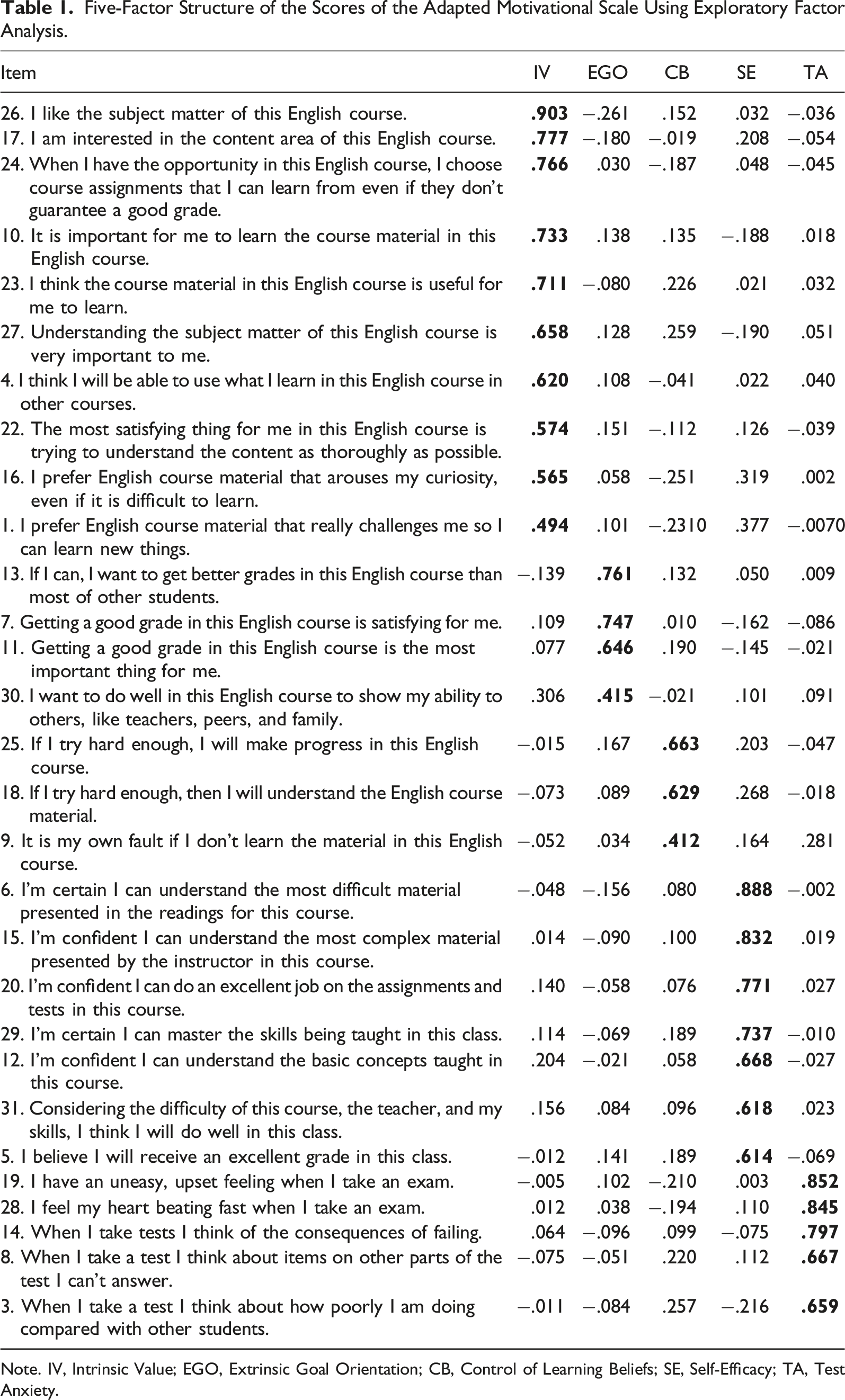
Note. IV, Intrinsic Value; EGO, Extrinsic Goal Orientation; CB, Control of Learning Beliefs; SE, Self-Efficacy; TA, Test Anxiety.
Confirmatory Factor Analysis
We performed CFA by means of maximum likelihood estimation using the remaining half of the sample (n = 328). A test of the initial model indicated an unsatisfactory model fit (χ2 = 1112.01, df = 367, χ2/df = 3.03, CFI = .90, TLI = .89, RMSEA = .08, SRMR = .06). The modification indices were then examined, and a large modification index value was found between items 1 and 16, suggesting a correlated error between these two items. The model was respecified with a correlated error between items 1 and 16 because it made statistical and substantive sense and the model was rerun. The modified five-factor model had an adequate model fit with χ2 = 1005.52, df = 366, χ2/df = 2.75, CFI = .92, TLI = .91, RMSEA = .07, SRMR = .06 (see Figure 1 and the Appendix in the Supplemental Materials). The Five-Factor Model. Note. IV, Intrinsic Value; EGO, Extrinsic Goal Orientation; CB, Control of Learning Beliefs; SE, Self-Efficacy; TA, Test Anxiety.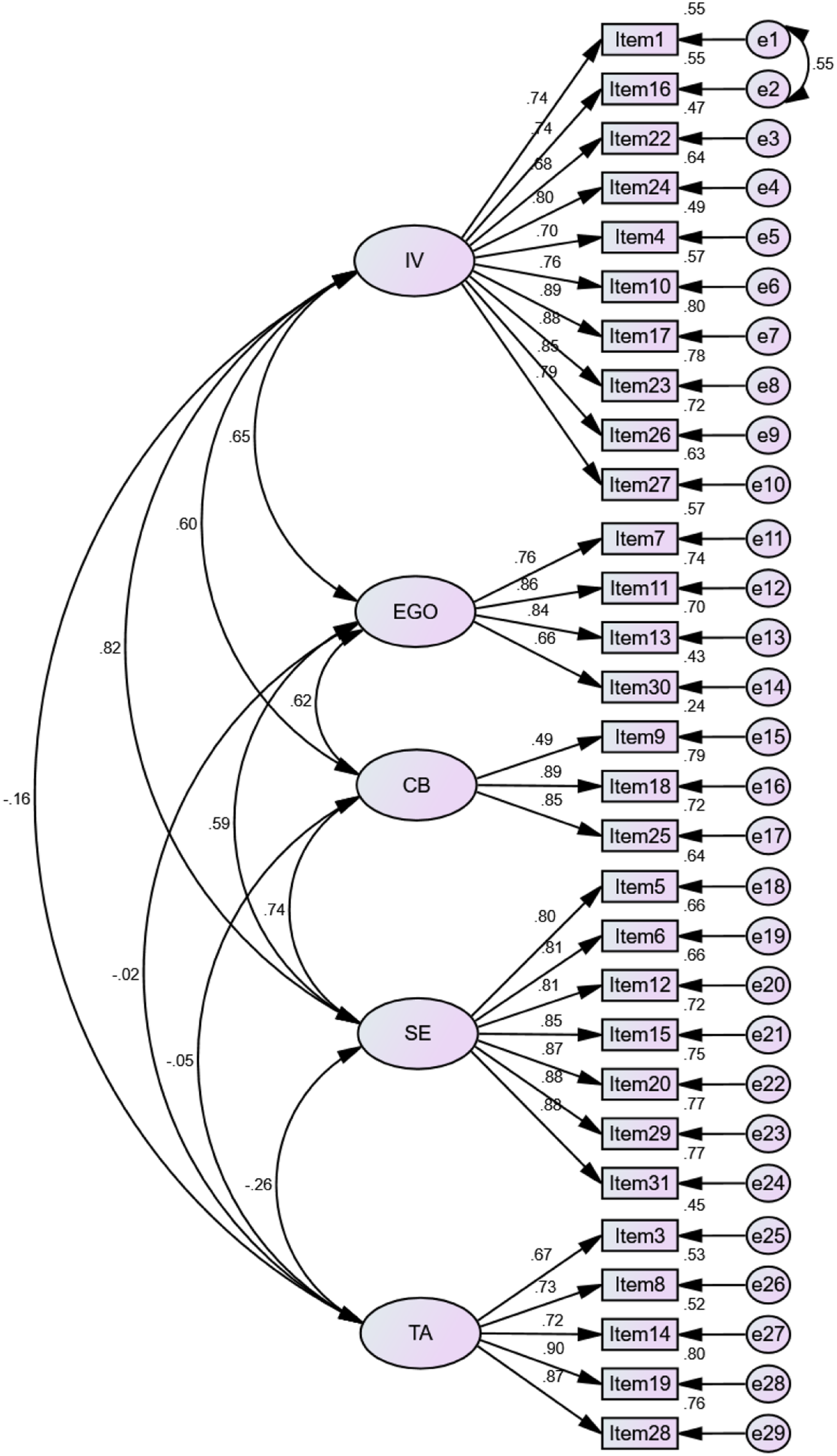
As shown in Table S3 in Supplemental Materials, the Average Variance Extracted (AVE) of the five motivational factors were .63, .61, .58, .71, and .61, respectively; the Composite Reliability (CR) values for the factors were .92, .87, .80, .94, and .89, respectively. AVE were all higher than .50, and CR were all higher than .80, indicating adequate validity for the measurement model (Fornell and Larcker, 1981; Hair et al., 2010).
A second-order confirmatory factor analysis
In order to test if the five factors belonged to a broader latent motivational factor, a second-order CFA (see Figure 2) was conducted on the data. The result yielded an adequate model fit: χ2 = 1057.35, df = 371, χ2/df = 2.85, CFI = .91, TLI = .90, RMSEA = .08, SRMR = .07. The standardized regression weights between the second-order factor and the five first-order factors were .86, .69, .77, .94, −.21, respectively, and were all statistically significant at the alpha level of .05. We then further conducted a difference test in R to see whether the modified first-order five-factor model or the five-factor model with a higher-order factor provides the more parsimony model. We found that the first-order CFA model fit the data significantly better than the second-order one (Δχ2 (5) = 51.95, p < .001). These results provided empirical evidence to consider a common motivational factor as a unitary construct with five subfactors. A Second-Order Model. Note. IV, Intrinsic Value; EGO, Extrinsic Goal Orientation; CB, Control of Learning Beliefs; SE, Self-Efficacy; TA, Test Anxiety.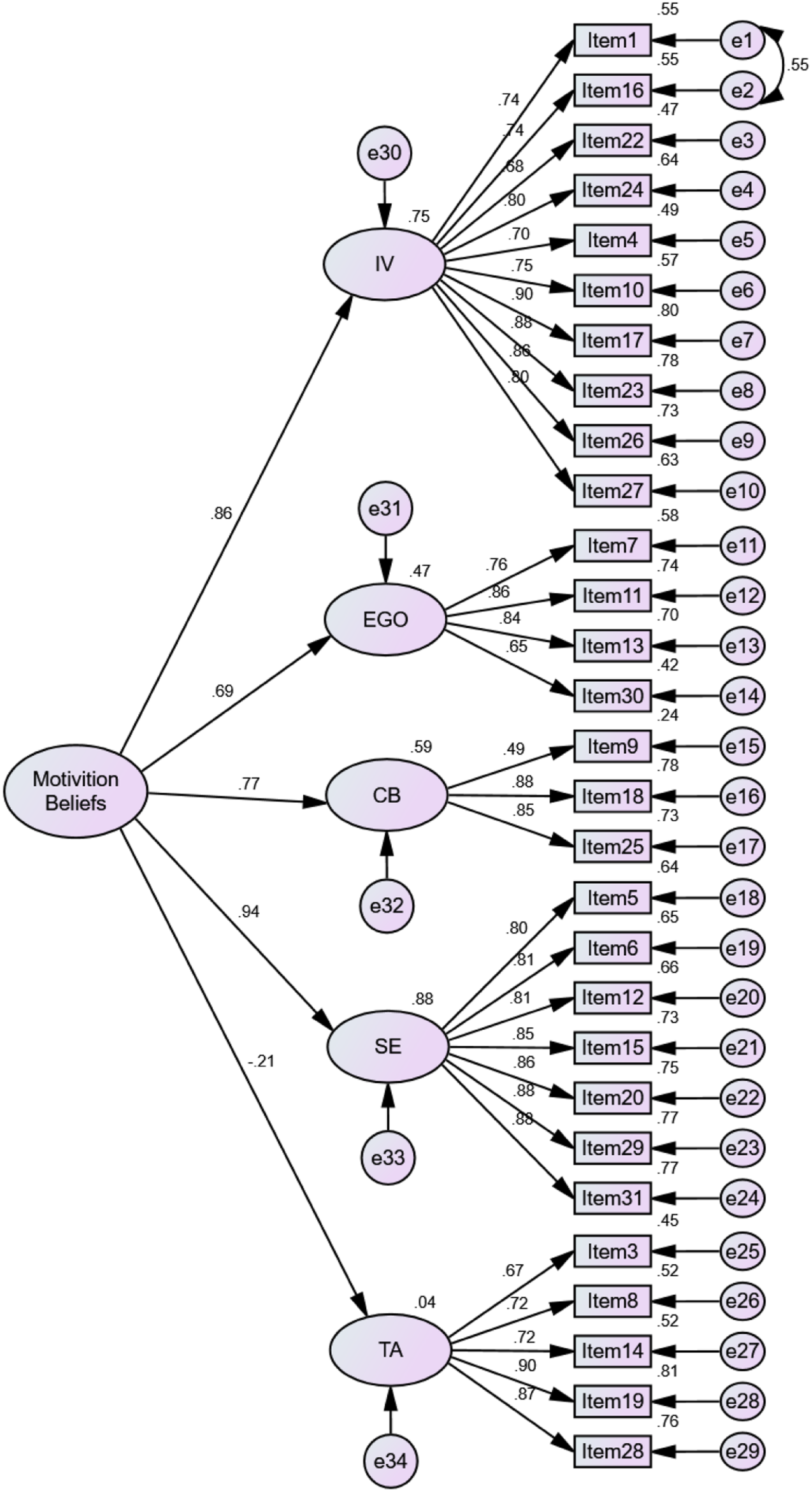
Concurrent and Predictive Validity
Table S4 in the Supplemental Materials shows that intrinsic value, extrinsic goal orientation, control of learning beliefs, and self-efficacy scores were significantly positively correlated with metacognitive regulation scores. In contrast, the test anxiety scores were found to be negatively correlated with metacognitive regulation scores. These results supported the concurrent validity of the scores of the adapted Motivational scale.
Multiple regression analysis was used to explore the relative strength of the five factors in predicting students’ perceived English proficiency (F = 116.51, df = 5, p < .001, R2 = .47). As can be seen in Table S5 in the Supplemental Materials, extrinsic goal orientation (B = .13, β = .08, p < .05), control of learning beliefs (B = −.23 β = −.18, p < .001), self-efficacy (B = .80, β = .67, p < .001), and test anxiety (B = −.17, β = −.16, p < .001) were significant predictors of students’ perceived English proficiency, with self-efficacy being the most powerful predictor.
Discussion
The aim of this study was to adapt the Motivational scale of the MSLQ for English learning among Chinese secondary students and to examine its psychometric properties. Results of this study revealed that the adapted Motivational scale has showed adequate psychometrics in terms of reliability and validity evidence. The EFA and CFA results lend empirical support to the existence of five distinct yet related dimensions of English learning motivation in the Chinese context as opposed to the six-factor motivational model of the original MSLQ. The major modification is that items from the two motivational factors (i.e., intrinsic goal orientation and task value) of the original MSLQ combined to form one factor (i.e., intrinsic value) on our adapted Motivational scale for English learning. This finding can be interpreted by reference to both previous research and English learning and the Chinese context. For example, Greene et al. (2004) noted that when students perceive a subject as being important and useful in relation to their future goals, the students are intrinsically willing to study hard to master and develop competence in the subject. Unlike other subjects in Chinese schools, English proficiency has been viewed as a definite asset of unique value both at an individual and a societal level in China in the contemporary era of economic globalization (You & Dörnyei, 2016). Moreover, previous research has documented combining the intrinsic goal orientation and task value dimensions into one construct (e.g., Jacobs et al., 2002; Pintrich et al., 1993).
Given a lack of motivation measures in English as a foreign language learning context that represents the latest theoretical insights in motivational research, the current study addresses an important gap in research on foreign language learning motivation by adapting the MSLQ’s Motivation scale in the Chinese context for English learning and scrutinizing its psychometric properties. Pedagogically, teachers can use this scale as a useful tool to assess students’ English learning motivation and may initiate an appropriate intervention program for improvement if students are found to be weak in some of the motivational dimensions. Two limitations, however, need to be acknowledged. First, the participants in this study were urban secondary students, which may limit the generalizability of the findings to other populations. Future research should examine the validity of the scores on the adapted motivation scale using samples from rural secondary schools in China. Future research is also recommended to replicate the present research among Chinese university English learners to examine the generalizability of the findings. Second, the present study relied solely on self-reported measures to investigate the relationships between motivational subscales and students’ self-rated English proficiency as well as metacognitive regulation. Although our findings were consistent in the theoretically expected directions, future research should consider longitudinal and mixed-methods designs to corroborate the statistical evidence reported in this paper.
Supplemental Material
Supplemental Material - Examining the Psychometric Properties of the Motivational Scale of Motivated Strategies for Learning Questionnaire for English Learning Among Chinese Secondary Students
Supplemental Material for Examining the Psychometric Properties of the Motivational Scale of Motivated Strategies for Learning Questionnaire for English Learning Among Chinese Secondary Students by Zhengdong Gan, Zheng Yuan, and Randall Schumacker in Journal of Psychoeducational Assessment
Footnotes
Declaration of Conflicting Interests
The author(s) declared no potential conflicts of interest with respect to the research, authorship, and/or publication of this article.
Funding
The author(s) received no financial support for the research, authorship, and/or publication of this article.

References
Supplementary Material
Please find the following supplemental material available below.
For Open Access articles published under a Creative Commons License, all supplemental material carries the same license as the article it is associated with.
For non-Open Access articles published, all supplemental material carries a non-exclusive license, and permission requests for re-use of supplemental material or any part of supplemental material shall be sent directly to the copyright owner as specified in the copyright notice associated with the article.
