







Abstract
In order to make appropriate educational recommendations, psychologists must understand how cognitive test scores influence specific academic outcomes for students of different ability levels. We used data from the WISC-V and WIAT-III (N = 181) to examine which WISC-V Index scores predicted children’s specific and broad academic skills and if cognitive-achievement relations varied by general intelligence. Verbal abilities predicted most academic skills for children of all ability levels, whereas processing speed, working memory, visual processing, and fluid reasoning abilities differentially predicted specific academic skills. Processing speed and working memory demonstrated significant interaction effects with full-scale IQ when predicting youth’s essay writing. Findings suggest generalized intelligence may influence the predictive validity of certain cognitive tests, and replication studies in larger samples are encouraged.
Psychologists often use standardized cognitive and achievement tests to assess children’s capacities and determine appropriate academic placements and interventions. These assessment results can help psychologists determine students’ eligibility for special education services, rule out an intellectual disability, or evaluate students’ readiness for enrichment or acceleration. Historically, relations between children’s cognitive abilities and academic skills have also informed learning disability identification practices, and learning disability assessment remains one of the most common reasons psychologists use cognitive and academic tests with children. As such, psychologists must understand the relations between cognitive ability and academic skills scores for diverse groups of students.
There is no consensus about the best way to assess for learning disabilities. The three most common identification approaches involve aptitude-achievement discrepancies, patterns of strengths and weaknesses, and response to intervention (Grigorenko et al., 2020). The role of cognitive tests in learning disability identification has been debated for decades. The aptitude-achievement discrepancy and patterns of strengths and weaknesses approaches consider relations between children’s cognitive and achievement performance for identification. Response to intervention does not require formal cognitive assessment, though cognitive assessments may be used to supplement a response to intervention approach (Machek & Nelson, 2010).
Those who oppose the use of cognitive tests in learning disability identification argue that cognitive tests have less predictive validity than other methods (Fletcher & Miciak, 2017). Some opponents argue achievement tests alone are better suited to diagnose learning disabilities because they focus on specific domains more closely related to the academic skills of interest (Burns et al., 2016; Fletcher & Miciak, 2019). Others argue there is insufficient evidence that cognitive measures predict response to intervention (Steubing et al., 2009). Nonetheless, a survey of school psychologists found that 86% believed cognitive ability tests should be used for learning disability identification within a response to intervention model to better understand specific reading problems (Machek & Nelson, 2010). Outside of schools, clinical neuropsychologists use cognitive assessments to identify the neurocognitive underpinnings of learning and behavioral problems and make recommendations for both school and home (Baker, 2012). Some believe cognitive assessments may be useful in differentiating between specific learning disabilities and intellectual disabilities (Kavale et al., 2008; Wodrich et al., 2006).
Despite significant controversy around the role of cognitive assessment in learning disability identification, there is broad consensus that LDs should not be identified using a single measure or indicator (Fletcher & Miciak, 2019; Francis et al., 2005; Grigorenko et al., 2020). Learning disabilities are diagnosed within the context of multiple complex factors that influence students’ learning. Understanding the relations between cognitive abilities and academic skills can help psychologists better interpret cognitive test scores as one piece of the broader picture of the student’s cognitive, behavioral, socioemotional, and academic profile.
Cognitive-Achievement Relations
Like many cognitive tests, the Wechsler Intelligence Scale for Children – Fifth Edition (WISC-V) has a scoring and factor structure informed by the empirically validated Cattell-Horn-Carroll (CHC) theory of intelligence (Schneider & McGrew, 2018). The Full-Scale IQ score on the WISC-V measures general intelligence (g) and the primary index scores correspond to five CHC broad abilities—verbal comprehension knowledge (also referred to as crystallized intelligence, which measures youth’s vocabulary, general knowledge, and language reasoning), fluid reasoning (novel problem solving that is less reliant on prior knowledge), visual processing (analysis and problem solving with visual information), working memory (retaining and manipulating information over short periods of time), and processing speed (quickly and accurately performing simple repetitive tasks, often with a motor component) (Schneider & McGrew, 2018). Although different intelligence tests have different task demands, stimuli, and response formats, an analysis of six intelligence tests supported the applicability of CHC theory across the different tests and found the CHC broad abilities were measured similarly despite those differences (Caemmerer et al., 2020).
Many cognitive-achievement studies are guided by CHC theory (see McGrew & Wendling, 2010; Zaboski et al., 2018 for comprehensive reviews of the literature). The application of CHC theory to cognitive-achievement research allows evidence of the influence of cognitive abilities on academic skills to be compared across different tests. Across tests and studies, there are inconsistencies in the relations between many of the CHC broad abilities and academic skills, which is described in detail below. Therefore, further examination of cognitive-academic relations is needed to clarify these inconsistencies, particularly with the Wechsler tests given their frequent use (Benson et al., 2019; Rabin et al., 2016; Wright et al., 2017). Previous cognitive-achievement research has relied on data from the Woodcock-Johnson tests (McGrew & Wendling, 2010; Zaboski et al., 2018), which limits the generalizability of findings to other test batteries.
Measures of academic achievement often include scores for both specific academic skills (e.g., basic reading skills, which measures decoding skills) and broad academic skills (e.g., broad reading ability, which summarizes performance on decoding and comprehension tasks). Studies of specific academic skills examine basic and advanced academic skills separately. Broad academic skills combine basic and advanced skills and focus on the common aspects across reading, writing, and math measures. Academic fluency skills are often excluded from cognitive-achievement studies despite their importance for academic success as fluency may serve as a bridge from basic to advanced skills (Paige et al., 2019). Our study examined both specific and broad reading, writing, and math skills. Most Wechsler cognitive-achievement studies examined broad academic skills, apart from one study that only examined specific academic skills (Caemmerer et al., 2018).
Influence of General Intelligence on Academic Achievement
General intelligence (g) is a measure of general reasoning, problem solving, and learning (Colom et al., 2010) and appears to have a large direct influence on children’s specific and broad reading, math, and writing skills (Beaujean et al., 2014; Benson et al., 2016; Caemmerer et al., 2018, 2023; McGill, 2015; Parkin & Beaujean, 2012; Zaboski et al., 2018). When the influence of CHC broad abilities is also examined, the effect of g appears fully mediated by the broad abilities (Caemmerer et al., 2023).
Influence of CHC Broad Abilities on Academic Achievement
Specific Reading Skills
Basic reading skills include decoding and word recognition, while advanced reading skills typically refer to reading comprehension or the ability to construct meaning from text. Children’s verbal comprehension knowledge abilities show a strong, consistent relation to their basic reading and reading comprehension skills. This strong relationship was found across several tests, including the WISC-V, Kaufman Assessment Battery for Children, Second Edition (KABC-II), and multiple editions of the Woodcock-Johnson tests (WJ; Benson, 2008; Caemmerer, 2018; Cormier et al., 2016; Evans et al., 2002; Floyd et al., 2007; Garcia & Stafford, 2000; Hajovsky et al., 2014; McGrew, 1993; Niileksela et al., 2016; Vanderwood et al., 2002; Zaboski et al., 2018).
Across tests, there are inconsistent findings regarding the influence of other broad abilities on reading skills. Children’s working memory influenced their basic reading skills but not their reading comprehension on the WISC-V and KABC-II (Caemmerer et al., 2018; Hajovsky et al., 2014). Some WJ studies found significant influences of children’s working memory and processing speed on their basic reading and reading comprehension skills, but findings varied depending on the WJ edition (Cormier et al., 2016; Evans et al., 2002; Floyd et al., 2007; McGrew, 1993). Studies using three different WJ editions suggest children’s fluid reasoning moderately influences their reading comprehension (Cormier et al., 2016; Evans et al., 2002; McGrew, 1993; Niileksela et al., 2016). A fluid reasoning-reading comprehension relation was not found on the WISC-V (Caemmerer et al., 2018), and this relation was not tested on the KABC-II (Hajovsky et al., 2018). Most studies have not found a relation between visual processing and specific reading skills, except one KABC-II study which found a significant effect on reading comprehension in grades 1–3 (Hajovsky et al., 2014).
Reading fluency typically refers to reading rate. In the few studies that have examined the cognitive predictors of reading rate, verbal comprehension knowledge and processing speed influenced reading rate (Benson, 2008; Caemmerer et al., 2018; Cormier et al., 2016; Niileksela et al., 2016). Moreover, one study found an influence of fluid reasoning which weakened with age (Cormier et al., 2016).
Broad Reading Skills
Broad reading is a combination of basic reading and reading comprehension skills. Verbal comprehension knowledge strongly influenced broad reading achievement on prior editions of the Wechsler scales (Beaujean et al., 2014; Glutting et al., 2006; Oh et al., 2004). One study found working memory and fluid reasoning also significantly predicted children’s broad reading skills (Beaujean et al., 2014).
Specific Math Skills
Specific math skills include basic math and math reasoning, which is an advanced academic skill sometimes referred to as math problem solving. Basic math involves arithmetic and computation skills. Math reasoning involves solving word problems and applying mathematical operations and concepts (McGrew & Wendling, 2010). Multiple studies have identified a direct influence of children’s fluid reasoning (Gf) on both basic math and math reasoning skills; this finding has been replicated across diverse samples and across multiple versions of the Woodcock-Johnson as well as the fourth and fifth editions of the WISC (Caemmerer et al., 2018; Floyd et al., 2003; McGrew & Hessler, 1995; Niileksela et al., 2016; Parkin & Beaujean, 2012; Peng et al., 2019; Zaboski et al., 2018).
Most WJ studies have identified verbal comprehension knowledge (Gc) as an important influence on basic math and math reasoning (Floyd et al., 2003; McGrew & Hessler, 1995; Niileksela et al., 2016; Zaboski et al., 2018), but a study with the WISC-V did not find a significant influence of Gc on basic math or math reasoning (Caemmerer et al., 2018).
Other CHC broad abilities show less consistent and smaller relations with specific math skills. Processing speed showed an effect on children’s basic math skills on the WISC-V (Caemmerer et al., 2018) and on their basic math and math reasoning skills on the WJ tests (Floyd et al., 2003; McGrew & Hessler, 1995; Niileksela et al., 2016). Children’s working memory inconsistently influenced their basic math and math reasoning on the WJ tests (Floyd et al., 2003; McGrew & Hessler, 1995) and did not have an influence on the WISC-V (Caemmerer et al., 2018). Relations between children’s visual processing and specific math skills are generally not supported, except for one WJ-IV study which found a significant Gv-math reasoning relation (Niileksela et al., 2016). These mixed findings illustrate the need for continued research with tests frequently used in practice.
Math fluency refers to how quickly someone can complete simple math operations and is typically measured by timed tests of simple addition, subtraction, multiplication, and division. One study tested whether processing speed influenced math fluency, after accounting for the influence of basic math skills on math fluency, and found a significant effect (Niileksela et al., 2016). Working memory and processing speed had large influences on math fluency on the WISC-V (Caemmerer et al., 2018). Only two studies have examined math fluency, and more research that focuses on math fluency is needed.
Broad Math Skills
Broad math skills encompass math computation, math word problems solving, and the application of math operations and concepts. Children’s verbal comprehension knowledge and working memory influenced their broad math on the third and fourth editions of the Wechsler scales (Glutting et al., 2006; Oh et al., 2004; Parkin & Beaujean, 2012). One study found a significant influence of fluid reasoning and visual processing on broad math measured by the WISC-IV (Parkin & Beaujean, 2012).
Specific Writing Skills
CHC cognitive-writing relations are the least frequently studied academic domain. Specific writing skills include basic writing, measured by spelling, knowledge of writing mechanics, and word usage skills, as well as written expression, which is an advanced writing skill measured by sentence construction, sentence production in response to prompts or pictures, and essay composition. Verbal comprehension knowledge (Gc) appears to consistently influence children’s basic writing skills across different editions of the Woodcock-Johnson and Wechsler tests (Caemmerer et al., 2018; Cormier et al., 2016; Floyd et al., 2008; Kranzler et al., 2015; McGrew & Knopik, 1993; Niileksela et al., 2016). Gc had a significant influence on sentence writing written expression tasks on the Kaufman Assessment Battery for Children, Second Edition, WISC-V, and older editions of the WJ (Caemmerer et al., 2018; Floyd et al., 2008; Hajovsky et al., 2018; McGrew & Knopik, 1993). However, Gc did not significantly predict WJ-IV sentence writing or WISC-V essay writing performance (Caemmerer et al., 2018; Cormier et al., 2016; Niileksela et al., 2016).
Findings for other CHC broad abilities are inconsistent and vary across tests. Processing speed (Gs) influences basic writing and written expression on the WJ tests, which include a timed writing fluency subtest as part of written expression (Cormier et al., 2016; Floyd et al., 2008; McGrew & Knopik, 1993; Niileksela et al., 2016). Gs was not a significant predictor for either skill on the WISC-V (Caemmerer et al., 2018). Children’s working memory (Gwm) influenced their basic writing skills on the WISC-V and the two most recent WJ tests (Caemmerer et al., 2018; Cormier et al., 2016; Floyd et al., 2008; Niileksela et al., 2016). Gwm-written expression relations were observed on the KABC-II, WISC-V, and older editions of the WJ tests (Caemmerer et al., 2018; Floyd et al., 2008; Hajovsky et al., 2018; McGrew & Knopik), but findings on the recent WJ tests contradicted each other (Cormier et al., 2016; Niileksela et al., 2016).
Fluid reasoning (Gf) had a significant influence on written expression on the WISC-V (Caemmerer et al., 2018), but the influence of Gf on specific writing skills is inconsistent across WJ studies. Relations between Gf and basic writing and written expression skills were significant on multiple editions of the WJ (Cormier et al., 2016; Floyd et al., 2008; McGrew & Knopik, 1993), except for one WJ-IV study (Niileksela et al., 2016). Lastly, most of the WJ studies and the WISC-V study did not find an influence of visual processing (Gv) on specific writing skills (Caemmerer et al., 2018; Cormier et al., 2016; Floyd et al., 2008; McGrew & Knopik, 1993). There were two exceptions; Gv-written expression relations were observed on the KABC-II and in one WJ-IV study (Hajovsky et al., 2018; Niileksela et al., 2016). Cognitive predictors of writing fluency have not been examined in previous cognitive-achievement studies.
Broad Writing Skills
Broad writing encompasses spelling, word usage, writing fluency, sentence construction, and essay composition. There was one broad writing study with the WISC-IV. Children’s fluid reasoning, verbal comprehension knowledge, working memory, and processing speed significantly predicted their broad writing skills; there was no significant effect of visual processing (Beaujean et al., 2014).
Generalizability of Cognitive-Achievement Relations
Most cognitive-achievement studies have assumed relations are the same for different subgroups of children. Moderation can be used to test this assumption and determine if the strength of the relation between cognitive abilities and academic skills varies for different children, which provides evidence related to generalizability. Some studies have tested moderation across children’s age (Caemmerer et al., 2018, 2023; Floyd et al., 2008; Niileksela et al., 2016), gender (Hajovsky et al., 2018; Lewno-Dumdie & Hajovsky, 2020), and race and ethnicity groups (Hajovsky & Chesnut, 2022; Keith, 2019; Weiss & Prifitera, 1995; Woods et al., 2021). Moderation across the span of general intelligence is also possible; cognitive-achievement relations may differ based on children’s level of general intelligence. People with high general intelligence learn more quickly and form connections among information more easily (Gottfredson, 1997). Therefore, broad cognitive abilities strongly associated with general intelligence such as fluid reasoning and verbal comprehension knowledge abilities may have a stronger relation to academic skills for high-ability learners. In contrast, students with lower general intelligence may rely more on processing skills to attend to, comprehend, encode, and recall new academic information (Henry & Winfield, 2010). Emerging research has started to explore these relations with the Woodcock-Johnson tests. For example, a WJ-III cognitive-reading study found processing speed had stronger effects on reading comprehension for adolescents with lower general intelligence (Hajovsky et al., 2018). A WJ-IV study found children’s processing speed predicted performance on all academic tasks for individuals with average general ability but only predicted performance on speeded academic fluency tasks for high-ability individuals (Maddocks, 2018).
Study Rationale
Although much research has examined the relations between cognitive ability and academic achievement, some findings are inconsistent and most of this research has analyzed data from the Woodcock-Johnson tests (McGrew & Wendling, 2010; Zaboski et al., 2018). More cognitive-achievement research is needed with the most frequently used intelligence test for children, the WISC (Benson et al., 2019; Rabin et al., 2016; Wright et al., 2017). To our knowledge, Caemmerer et al. (2018) published the only study to date that examined cognitive-achievement relations using the fifth edition of the WISC (WISC-V). Their study used “latent” or unobserved variables, which remove measurement error from estimates of the cognitive and academic constructs but do not correspond directly with the observed composite scores that psychologists use for diagnostic and intervention decisions. As such, one goal of our study was to examine relations using observed scores which are more applicable to practical contexts. Furthermore, their 2018 study examined specific but not broad academic skills, whereas our study examined both, which allows for direct comparison to older WISC studies that examined broad academic skills. Moderation by age was examined by Caemmerer et al. (2018), but moderation by general intelligence has never been examined on any edition of the WISC. Practicing psychologists must understand if and how cognitive-achievement relations differ by general intelligence in order to make informed decisions regarding students of varied ability. In addition, our study adds to the limited research on cognitive predictors of academic fluency. The research questions for our study were: 1. Which WISC-V Index scores predict children’s specific and broad reading, writing, and math skills? 2. Do cognitive-achievement relations vary based on general intelligence ability levels?
Method
Participants
We used the standardization linking sample of the WISC-V and WIAT-III (N = 181) collected by Pearson Assessments. Children ranged in age from 6 to 16 (M = 11.82), with 81 girls and 100 boys. Half of the sample identified as White non-Hispanic, 21% as Hispanic, 20% as Black, 7% as Other, and 2% as Asian. Their parents’ education level included 11% with 11 years or less, 25% with 12 years, 35% with 13–15 years, and 30% with 16 years or more of education. The mean time between WISC-V and WIAT-III administrations was 16 days.
Measures
WISC-V
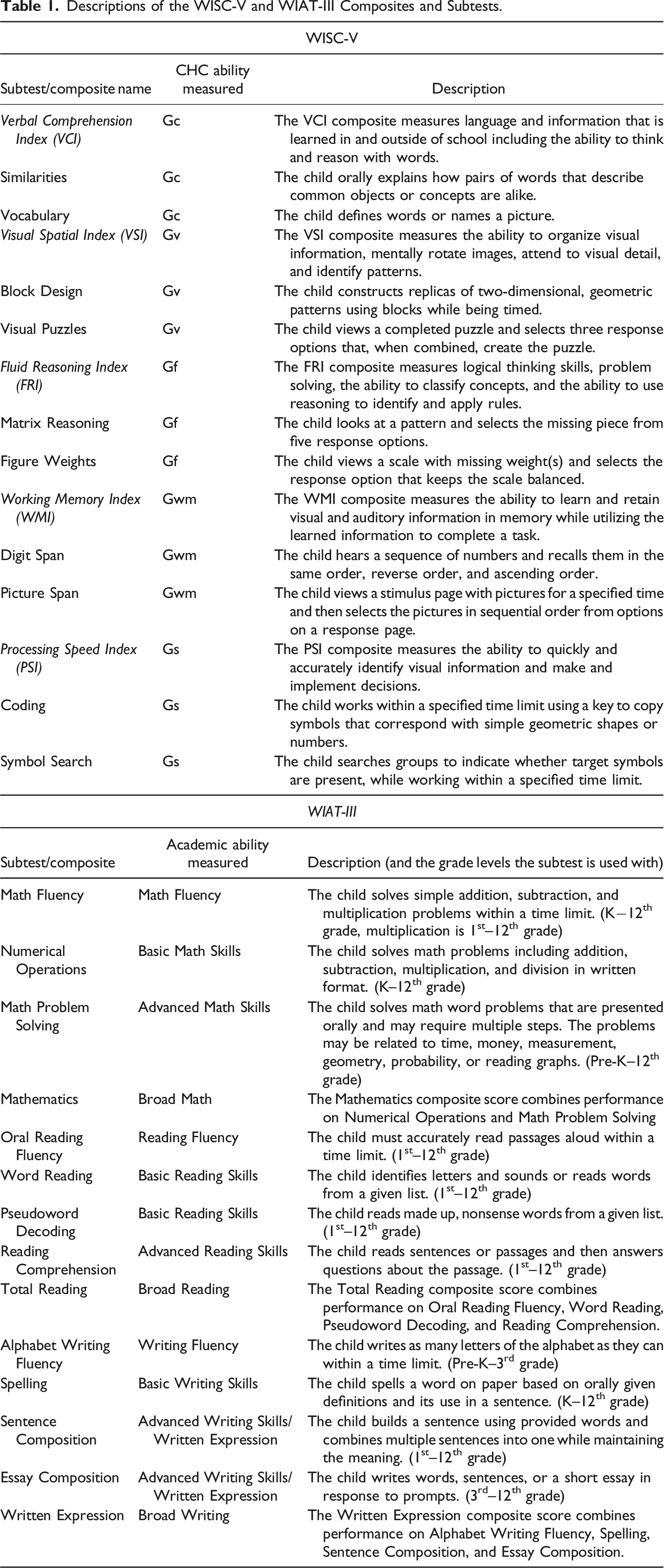
Descriptions of the WISC-V and WIAT-III Composites and Subtests.
WIAT-III
The Wechsler Individual Achievement Test – Third Edition (WIAT-III) assesses a comprehensive range of academic skills across multiple domains, including reading, writing, mathematics, and oral language (Wechsler, 2009). It is designed to identify individual’s strengths and weaknesses in various academic areas, aid in the identification of learning difficulties, track progress, and inform educational interventions. We examined 11 WIAT-III reading, writing, and math subtests and three composite scores (see Table 1 for details). WIAT-III age standardized composite and subtest scores were analyzed (M = 100, SD = 15). The WIAT-III has well established evidence of reliability and validity in children and adolescents (Breaux & Lichtenberger, 2016; Wechsler, 2009).
In the WISC-V technical manual, correlations were reported between the WISC-V index scores and WIAT-III composite scores for the linking sample. Youth’s Verbal Comprehension Index had the strongest correlations across their reading, math, and writing composite scores. Correlations between their Processing Speed Index and WIAT-III composite scores tended to be the weakest, except for Math Fluency. The magnitude of correlations between WIAT-III composite scores and Visual Spatial Index, Fluid Reasoning Index, and Working Memory Index scores were generally between these two other indices (NCS; Pearson, 2014).
Analysis
All analyses were conducted in R (R Core Team, 2021); the R packages and code can be found at https://osf.io/n7gbd/. We simultaneously regressed each WIAT-III subtest and composite score on the five primary WISC-V Index scores (VCI, FRI, VSI, WMI, and PSI) to determine which CHC broad ability predicted each academic skill. It is important to note that each multivariate regression model controlled for the influence of all other CHC broad abilities. We also regressed FSIQ alone on each WIAT-III subtest and composite score to examine the direct effect of estimated general intelligence. We considered standardized regression coefficients of .05 to .09 to be small, .10 to .24 to be medium, and .25 and greater to be large (Keith, 2019).
To test if cognitive-achievement relations varied by general intelligence, we created cross-product terms and mean-centered the FSIQ and Index scores. The sample mean for each variable was subtracted from the variables’ scores to enhance interpretation and reduce collinearity (Cohen et al., 2003). Given the number of tests of significance conducted, the alpha level for the interaction tests was set to .01 (for review, see Kim & Choi, 2019). For models with statistically significant interaction terms, we examined the change in R2 when the interaction term was added to the direct effects model. A relative contribution statistically different from zero suggests the interaction term explains a significant amount of variance in achievement (Keith, 2019).
Results
Means and standard deviations of the WISC-V and the WIAT-III scores were similar to those of the norming sample (range M = 99.14 to 102.9, SD = 11.3–15.8), data were normally distributed, and assumptions of linearity, homoscedasticity, and normally distributed errors were met. There was less than 3% missing data across variables except for Essay Composition, which was 17% missing because 18 children under 8 did not meet the minimum age required for this subtest.
Standardized Univariate and Multivariate Coefficients and Confidence Intervals.
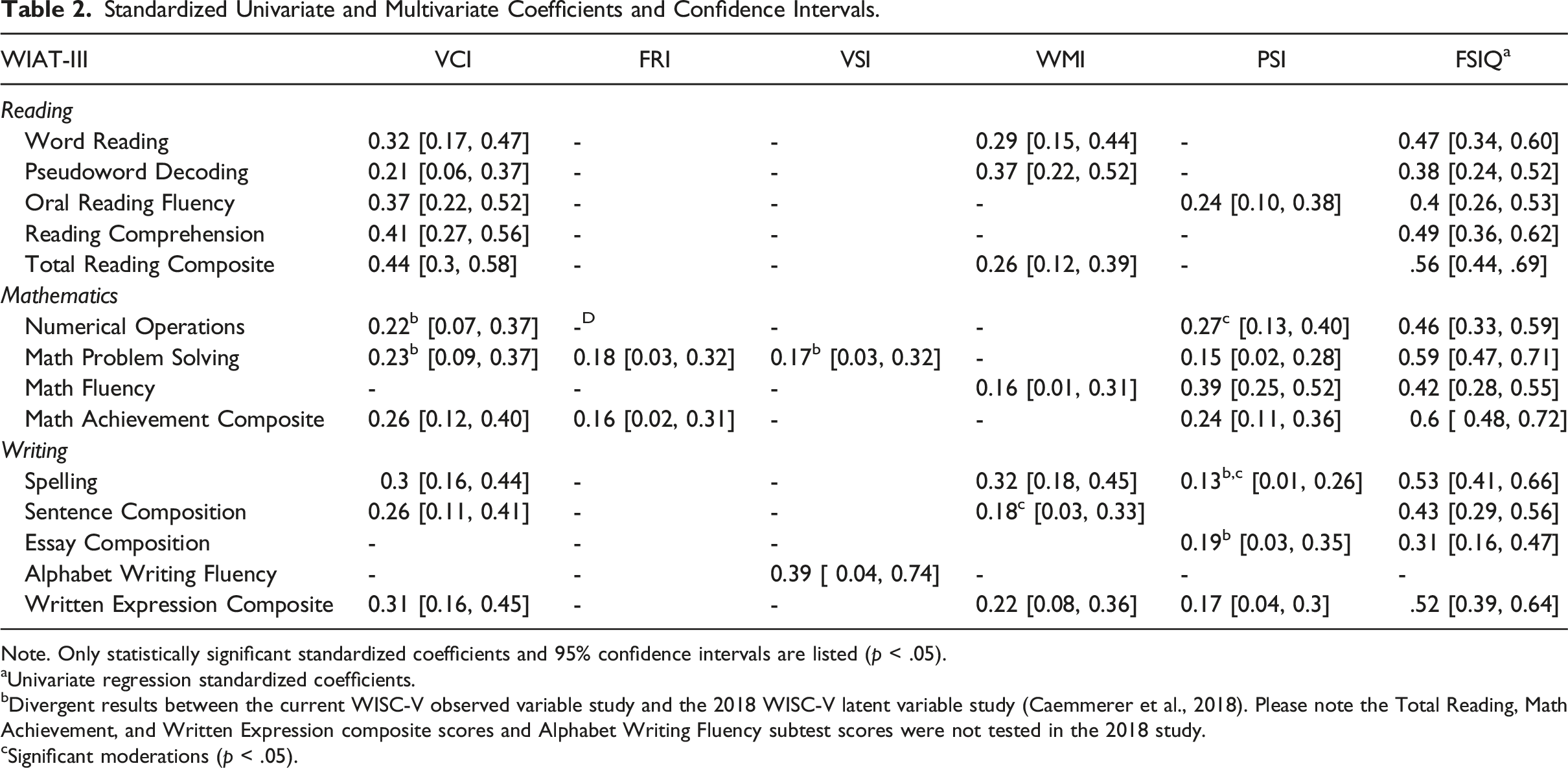
Note. Only statistically significant standardized coefficients and 95% confidence intervals are listed (p < .05).
aUnivariate regression standardized coefficients.
bDivergent results between the current WISC-V observed variable study and the 2018 WISC-V latent variable study (Caemmerer et al., 2018). Please note the Total Reading, Math Achievement, and Written Expression composite scores and Alphabet Writing Fluency subtest scores were not tested in the 2018 study.
cSignificant moderations (p < .05).
To examine whether cognitive-achievement relations varied based on general intelligence, we estimated interactions between the FSIQ score and each index score as continuous variables. Results indicated two statistically significant interactions: FSIQ moderated the influence of the Processing Speed Index and Working Memory Index on Essay Composition (PSI ∆R2 = 0.040, b = −.019, SE = 0.007, 95% CI [−0.033, −0.004], p = .009; WMI ∆R2 = 0.04, b = −0.017, SE = 0.007, 95% CI [−0.031, −0.004], p = .012). Though significant, these interactions were small in magnitude and thus reported to three decimal places to accurately reflect the non-zero bounds of the confidence intervals.
To visually interpret each significant interaction effect, we used generalized additive models to create contour plots of the influence of FSIQ and the Processing Speed Index and Working Memory Index on Essay Composition (Figure 1). Contour plots show the value of the given achievement scores in relation to students’ FSIQ and CHC broad ability index scores. Achievement scores are represented by a color gradient similar to a topological terrain map. The color gradient starts at green which indicates the lowest achievement scores. As scores increase, the gradient moves through yellow, orange, and finally red which indicates the highest achievement scores. Regions of the graph for which combinations of scores on the predictor variables were not present in our data were not plotted and left as white space. Contour lines represent areas of equal achievement scores for a given combination of broad ability and FSIQ scores and are labeled with the standardized score value. The closer the contour lines are to each other, the steeper the slope. For some achievement scores, there are multiple contour lines which indicate the same expected performance at different levels of FSIQ and the given broad ability. For example, there are two contour lines that indicate an Essay Composition score of 105, which suggests students with relatively lower FSIQ scores, and higher working memory abilities may achieve the same score on Essay Composition as students with the reverse profile. Contour Plots for WIAT-III Subtests with Significant Interaction Effects. Note: Contour plots show the value of the given achievement scores in relation to students’ FSIQ and broad ability index scores. Achievement scores are represented by a color gradient similar to a topological terrain map. Regions of the graph for which combinations of scores on the predictor variables were not present in our data were not plotted and left as white space. The color gradient starts at green which indicates the lowest achievement scores. As scores increase, the gradient moves through yellow, orange, and finally red which indicates the highest achievement scores. Contour lines represent areas of equal achievement scores for a given combination of broad ability and FSIQ scores and are labeled with the standardized score value. The closer the contour lines are to each other, the steeper the slope.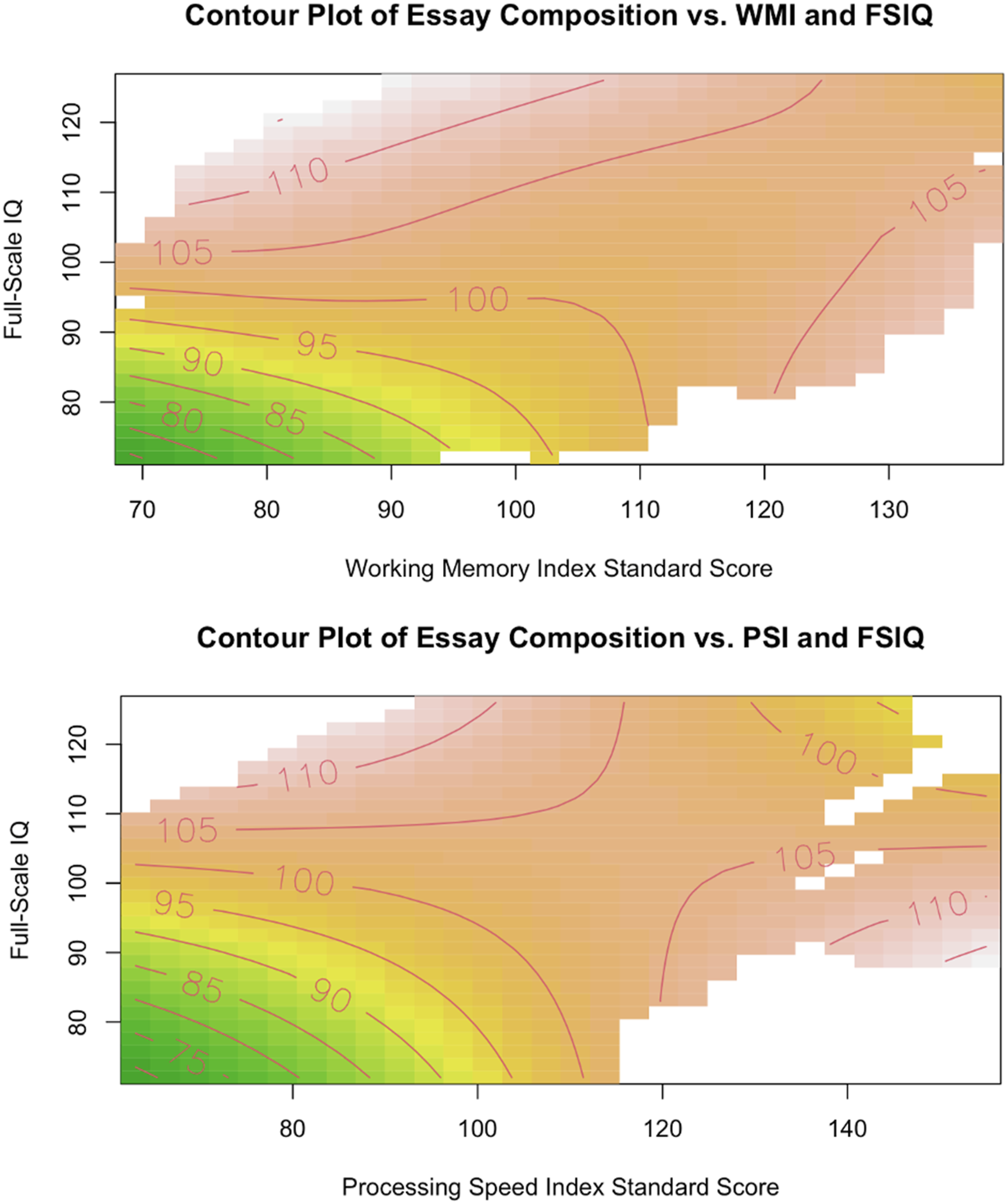
On each plot, the contour lines are closer together (i.e., the slope is steeper) for students with lower processing speed or working memory (PSI or WMI) and FSIQ scores than those with higher scores, which suggests a relatively stronger influence of both types of cognitive scores on Essay Composition for students with lower scores. Moreover, visual analysis of the plots also suggests that having both a very high FSIQ and PSI or WMI does not predict as high of an Essay Composition score as a strength in just one or the other cognitive score. However, it is important to note few students in our sample had this cognitive profile; only four students had both FSIQ and PSI over 120 and only two had both FSIQ and WMI scores over 120.
Discussion
The goal of this study was to determine which WISC-V Index composite scores best predict children’s broad and specific achievement on the WIAT-III, and whether predictive validity varies by children’s level of general intelligence. Our findings also contribute to the limited research on academic fluency. Our results share some consistencies with previous cognitive-achievement findings, but there is variability across different tests and measures of broad and specific academic skills. Most findings are consistent between our WISC-V measured variable study and the WISC-V latent variable study, but there are six divergent findings. Table 2 identifies the differences between the two WISC-V studies, which may be due to differences in the cognitive subtests analyzed or methodological differences. The CHC broad abilities in the latent variable included six additional subtests which are considered supplemental on the WISC-V and not included in the calculation of any of the primary index scores used in the current study. Also, measurement error is inherent in observed variables which were analyzed in this study, but this error is removed from latent variables.
As in previous WISC studies (Beaujean et al., 2014; Caemmerer et al., 2018; Glutting et al., 2006; Oh et al., 2004), we found moderate to large relations between children’s verbal abilities and their reading and writing performance. Similarly, verbal comprehension knowledge (Gc)-reading relations, including basic reading and reading comprehension, are supported by studies of different editions of the Woodcock-Johnson tests and the single Kaufman Assessment Battery for Children, Second Edition (KABC-II) study (Benson, 2008; Caemmerer, 2018; Cormier et al., 2016; Evans et al., 2002; Floyd et al., 2007; Garcia & Stafford, 2000; Hajovsky et al., 2014; McGrew, 1993; Niileksela et al., 2016; Vanderwood et al., 2002; Zaboski et al., 2018). CHC theory can be applied to the interpretation of many different cognitive tests including the WISC, WJ, and KABC. The different tests measure similar CHC broad cognitive abilities (Caemmerer et al., 2020).
There are more inconsistent findings in the writing literature. Previous WJ studies consistently found Gc predicted basic writing, but Gc’s influence on written expression was inconsistent (Cormier et al., 2016; Floyd et al., 2008; Hajovsky et al., 2018; Kranzler et al., 2015; McGrew & Knopik, 1993; Niileksela et al., 2016). On the KABC-II, Gc significantly predicted children’s written expression performance. On the WISC-V, the Gc-written expression relation depended on the specific subtest. Gc significantly predicted children’s performance on the WIAT-III sentence construction task but not the essay composition task in our study and the previous WISC-V latent variable study (Caemmerer et al., 2018). Perhaps differences in the written expression task demands have resulted in these divergent findings as the WJ written expression subtest requires single sentence responses, the Kaufman Test of Educational Achievement subtest requires a combination of basic mechanics, single sentences, and an essay response, and the WIAT has a subtest that requires single sentences and another subtest that requires an essay response.
Our study found verbal comprehension knowledge (Gc) influenced children’s basic math, math problem solving, and broad math. The WISC-III and -IV studies also found a significant influence of Gc on children’s broad math and the Woodcock-Johnson studies consistently found significant Gc-math relations (Floyd et al., 2003; Glutting et al., 2006; McGrew & Hessler, 1995; Niileksela et al., 2016; Oh et al., 2004; Parkin & Beaujean, 2012). There were no significant Gc-specific math relations in the WISC-V latent variable study (Caemmerer et al., 2018). Given the otherwise strong support for the importance of verbal abilities on math performance, it seems likely our findings better represent the relation between Gc and math on the WISC-V than the latent variable study.
In our study, children’s working memory (Gwm) predicted their basic and broad reading, basic writing, sentence writing, and broad writing skills. These specific relations were also found in the WISC-V latent variable study (Caemmerer et al., 2018) and in one WISC-IV broad reading and writing study (Beaujean et al., 2014). Children’s Gwm influenced their basic reading skills on the KABC-II (Hajovsky et al., 2014), but findings were inconsistent among the WJ studies (Cormier et al., 2016; Evans et al., 2002; Floyd et al., 2007; McGrew, 1993). Gwm influenced math fluency skills in our study, which is supported by the WISC-V latent variable study and studies that were not guided by CHC theory (Balhinez & Shaul, 2019; Blankenship et al., 2015). Working memory may support the retrieval of math facts (Kaufman, 2002).
Children’s ability to quickly process simple and repetitive information, their processing speed (Gs), influenced their math fluency and reading fluency skills which is consistent with other studies (Benson, 2008; Caemmerer et al., 2018; Cormier et al., 2016; Niileksela et al., 2016). In our study, Gs also influenced all the math skills and children’s basic writing and essay writing. The writing relations are consistent with previous WJ studies and the fourth edition of the WISC study (Beaujean et al., 2014; Cormier et al., 2016; Floyd et al., 2008; McGrew & Knopik, 1993; Niileksela et al., 2016). The influence of processing speed on math was inconsistent across tests and broad measures of math (Floyd et al., 2003; McGrew & Hessler, 1995; Niileksela et al., 2016; Parkin & Beaujean, 2012).
Children’s fluid reasoning (Gf) significantly influenced their math problem solving and broad math, which aligns with previous WISC and WJ studies (Caemmerer et al., 2018; Parkin & Beaujean, 2012). There is strong support for Gf-math problem solving relations among the WJ, (Floyd et al., 2003; McGrew & Hessler, 1995; Niileksela et al., 2016), but unlike these WJ studies and the WISC-V latent variable study, our study did not find a significant relation between Gf and basic math. The Gf latent variable study included two more subtests than our study, Arithmetic and Picture Concepts. It is possible that these construct composition differences resulted in the divergent findings, or the difference may be due to methodological differences.
We found a significant visual processing (Gv)-math problem solving relation, as did one WJ-IV and WISC-IV broad math study (Niileksela et al., 2016; Beaujean et al., 2014). The other WISC studies and most WJ studies found no significant relations between Gv and math skills. Gv also had a moderate influence on Alphabet Writing Fluency in our study. Alphabet Writing Fluency has not been studied previously, but visual processing may have implications for the visual representations of letters and orthographic knowledge.
The majority of cognitive-achievement relations did not differ based on children’s general intelligence in our sample, which suggests psychologists can interpret most relations between scores similarly for children regardless of their overall cognitive ability. Among children with lower FSIQ scores, however, slower processing speed and weaker working memory was associated with lower scores on essay writing. For these children, weaknesses in processing speed and working memory seemed to undermine essay writing. Psychologists may consider accommodations and curricular recommendations for children with low overall abilities that might reduce the negative effects of slow processing speed and weak working memory on essay writing tasks, such as providing students extended time, teaching graphic organizers or other planning tools, breaking information into digestible chunks, and allowing the use of assistive technology (Mather & Jaffe, 2016).
Alternatively, our findings suggest weaknesses in processing speed and working memory do not strongly influence performance on Essay Composition among children with average and above-average FSIQ scores. These results are consistent with previous research that also found fewer relations between processing speed and achievement for children of high cognitive ability (Maddocks, 2018), possibly because students with higher FSIQ scores use their verbal and reasoning strengths to compensate for their relatively slower processing speed on these academic tasks (Silverman, 2009). Psychologists should still be aware of specific deficits in processing speed and working memory in children of higher abilities who may still require accommodations to demonstrate their best performance (e.g., removing time constraints when possible).
Limitations and Future Directions
The generalizability of these findings is limited by the small sample size (n = 181) and the restriction of range compared to the range of general intelligence in the general population. The small sample size negatively impacted the power to detect small yet statistically significant cognitive-achievement relations and interactions. Future research should replicate the present analyses in larger samples with a broader general intelligence spectrum to confirm these findings, particularly for the interaction effects given the limited research in this area. In addition, future study should continue to examine the generalizability of cognitive-achievement relations across different groups including age, gender, race and ethnicity, and other important demographic characteristics.
It is worth noting that there are several inconsistent cognitive-achievement findings across studies, tests, and academic variables and reconciling these differences is challenging. Future studies can include joint analyses of multiple academic and intelligence tests, known as cross-battery analyses (Caemmerer et al., 2023), which will allow for several measures of all variables and broader representations of the cognitive and academic constructs of interest. Finally, it is important to note that although we found many significant effects of cognitive abilities on academic achievement, many were moderate to small in magnitude. Psychologists must consider cognitive test scores as only one valuable but imperfect predictor of school achievement and always consider a students’ comprehensive profile when customizing intervention plans.
Conclusions
Youth’s general intelligence strongly influenced their academic skills across all domains. Among broad cognitive abilities, youth’s verbal abilities had the broadest influence across academic skills. Their working memory influenced their basic reading, broad reading, basic writing, written expression, broad writing, and math fluency. Processing speed influenced all of their math skills, oral reading fluency, basic writing, written expression, and broad writing. Fluid reasoning influenced math problem solving and broad math achievement, while visual spatial abilities influenced math problem solving and alphabet writing fluency. Processing speed and working memory demonstrated significant interaction effects with general intelligence when predicting essay writing and appeared to have stronger effects for children with lower scores. These findings may have important implications for creating individualized education plans for students of diverse ability levels, yet further research is needed to replicate these results in larger samples and with different assessment batteries.
Footnotes
Acknowledgments
Standardization data from the Wechsler Intelligence Scale for Children, Fifth Edition (WISC-V). Copyright © 2014 NCS Pearson, Inc. Used with permission. All rights reserved.
Declaration of Conflicting Interests
The author(s) declared no potential conflicts of interest with respect to the research, authorship, and/or publication of this article.
Funding
The author(s) received no financial support for the research, authorship, and/or publication of this article.
