







Abstract
Grounded in Self-Determination Theory (SDT), this study proposes the Teachers’ Motivational Styles (TMS) questionnaire, a new tool designed to assess how teachers support or frustrate students’ basic psychological needs. Items were developed based on a recent SDT-based taxonomy of need-supportive and need-thwarting teaching behaviors. The questionnaire was administered to 2454 secondary school students in Italy and the United Kingdom. Exploratory Structural Equation Modeling supported a bifactor structure with two general factors—Need Support and Need Frustration—and three specific factors for autonomy, competence, and relatedness. Measurement invariance confirmed the tool’s robustness across countries. Need-supportive teaching predicted higher Positive Affect, lower Negative Affect, and lower Intention to Drop out of school. In contrast, need-frustrating teaching styles predicted increased negative affect and greater risk of school disengagement. The TMS is a psychometrically sound, theory-driven instrument. Its cross-cultural validation supports its use in international contexts, with important implications for research, teacher training, and interventions to promote student well-being.
Keywords
Introduction
The educational environment plays a pivotal role in shaping students’ psychological and academic development. In the classroom, teachers’ behaviors are especially influential in promoting or hindering student outcomes. Through daily interactions, teachers establish relationships that can either nurture a positive learning atmosphere or create barriers to engagement. Therefore, teacher behaviors are not simply instructional techniques; they are interpersonal experiences that affect the everyday life of students and contribute to broader developmental outcomes. Their influence extends beyond academics, as they model behaviors, set expectations, and create conditions that impact students’ motivation and confidence in their abilities (Amerstorfer & Freiin von Münster-Kistner, 2021).
Teachers’ Motivational Behaviors
Self-Determination Theory (SDT) (Ryan & Deci, 2017) offers a powerful lens for understanding these dynamics. According to SDT, adolescent students have three basic psychological needs—autonomy, competence, and relatedness—which must be satisfied in order for them to function optimally in terms of motivation, performance, and well-being. The need for autonomy refers to the feeling of volition and self-determination in one’s actions, where students perceive themselves as the initiators of their own behavior. Competence reflects a sense of efficacy and mastery over challenges, and relatedness involves feeling connected, supported, and understood by others, such as peers and teachers (Ryan & Deci, 2017). Decades of research have shown that the satisfaction of adolescent students’ basic psychological needs is strongly associated with a range of positive outcomes in educational settings, including greater academic engagement, emotional well-being, intrinsic motivation, and lower risk of school dropout (Howard et al., 2024; Raimondi et al., 2026; Reeve, 2009; Stroet et al., 2013). In contrast, when these needs are repeatedly frustrated, students are more likely to experience negative emotions, and disengagement from school activities (Bartholomew et al., 2011; Howard et al., 2024; Soenens et al., 2012). Therefore, understanding how the classroom environments support or thwart these needs is essential for promoting optimal learning and development.
Research has shown that need-supportive teachers promote student participation by encouraging initiative and decision-making, allowing room for authentic expression, and valuing students’ input during class activities (Haakma et al., 2016; Howard et al., 2024; Reeve & Cheon, 2021). Specific behaviors associated with this style include listening attentively to students’ opinions, offering explanations that give sense to requests or learning activities, and opening space for feedback and discussion (Ahmadi et al., 2023; Howard et al., 2024). Such approaches contribute to not only enhance students’ sense of agency but also promote positive affect in the classroom, such as enjoyment and satisfaction. In addition, they promote students’ engagement with schoolwork and support the development of resilience when facing academic challenges (Haerens et al., 2015). On the other hand, when teachers adopt a need-frustrating motivational style, the dynamics in the classroom change significantly. This style is typically marked by rigid control, prescriptive communication, and a lack of flexibility in dealing with students’ perspectives and reactions (Standage et al., 2005). Rather than fostering dialogue, these teachers tend to impose unilateral decisions, correct behaviors through admonishments, and maintain authority through rules that are not discussed or shared. Importantly, this style may also involve covert tactics, such as making students feel guilty for not meeting expectations, ignoring their emotional reactions, or giving attention selectively, based on performance or obedience (Filippello et al., 2019). Over time, students exposed to this kind of interpersonal climate are more likely to experience negative affect, such as frustration, boredom, and anxiety, leading to a greater risk of maladjustment or dropout (Garn et al., 2019; Soenens et al., 2012). Since these affective experiences and dropout tendencies represent the most immediate and well-established consequences of need-supportive versus need-frustrating teaching, they also offer theoretically coherent external criteria for evaluating the validity of instruments designed to measure teachers’ motivational styles.
Given the complexity and diversity of these classroom behaviors, Ahmadi et al. (2023) developed for the first time a taxonomy that systematically organizes the description and definitions of teachers’ behaviors in relation to either the support or frustration of adolescent students’ autonomy, competence, and relatedness, based on findings from multiple studies. By offering a structured and theoretically grounded classification, this work bridges the gap between SDT theory and its practical application in educational contexts. In particular, the taxonomy provides a useful foundation for researchers aiming to develop measurement tools, such as questionnaires, by offering clear and operationalizable descriptions and definitions of teaching behaviors, relevant for the school setting.
Limitation of Existing Measures of Teachers’ Behaviors
Despite the growing interest in the role of teachers in shaping students’ psychological needs, within the framework of SDT, existing tools present several limitations which undermine the assessment of how teachers support or thwart students’ autonomy, competence, and relatedness. The following section briefly reviews the most widely used instruments within the SDT framework, highlighting their strengths and limitations.
The most frequently used instrument, the Learning Climate Questionnaire (LCQ) (Black & Deci, 2000) assesses students’ perceptions of their teachers’ need-supportive style. Specifically, the LCQ considers supportive teaching as a general and unidimensional construct, conceptualizing autonomy support and controlling teaching as opposite ends of a single continuum (Deci et al., 1981). However, LCQ’s biggest limitation is that it does not differentiate the specific ways in which teachers foster or hinder students’ autonomy, competence, and relatedness.
Most recently, Aelterman et al. (2018) developed the Situation-in-School Questionnaire (SIS), which assesses teachers’ motivating and demotivating behaviors using a Circumplex Model that provides a multidimensional perspective on teaching styles. This model is structured along two independent axes: the first distinguishes teachers’ need-supportive behaviors (i.e., autonomy support and structure) from teachers’ need-thwarting behaviors (i.e., control and chaos), while the second differentiates teachers using a directive approach (i.e., structure and control), from teachers using a less directive approach (i.e., autonomy support and chaos). As a result, the Circumplex Model identifies four overarching teaching styles—autonomy support, structure, control, and chaos—each representing a different combination of these two dimensions. Although this theoretical framework provides a sophisticated way to categorize teaching styles, it does not explicitly distinguish teachers’ behaviors in relation to the three fundamental psychological needs—autonomy, competence, and relatedness—as conceptualized in Self-Determination Theory.
Finally, another important tool is the Interpersonal Behaviors Questionnaire (IBQ) (Rocchi et al., 2017). The IBQ was originally developed to assess athletes’ perceptions of their coaches’ interpersonal behaviors in sports settings, in relation to the six dimensions of basic psychological needs. Although the IBQ was later adapted for use in educational contexts (Burgueño et al., 2022; Buzzai et al., 2021), it presents two key limitations. First, its items were not originally designed to capture the specific dynamics of teacher–student interactions in the classroom, and even though adaptations for the school context exist, these mainly involved minor wording changes (e.g., replacing “my coach” with “my teacher”) without modifying the content of the items to reflect specific teaching practices during lessons. Second, and most importantly, the IBQ does not align with conceptual and behavioral definitions recently proposed in the SDT literature (Ahmadi et al., 2023), therefore lacking adequate content validity for the assessment of teachers’ motivational behaviors.
These examples highlight the presence of a significant gap in the existing SDT literature, which means that no instrument currently provides a comprehensive assessment of teachers’ motivational behavior styles in relation to each specific need.
Study Aims and Hypotheses
Given the importance of correctly assessing teachers’ motivational behaviors, both theoretically and psychometrically, and how it can affect students’ academic achievement and well-being, the main aim of the present study was to fill a gap in the literature by validating an instrument designed to measure teachers’ behaviors that support or thwart students’ psychological needs, in accordance with the latest developments in the theoretical definitions of SDT. The proposed questionnaire was created by developing items that were direct operationalizations of the descriptions of behaviors identified in the classification system by Ahmadi et al. (2023). Each item was carefully crafted to represent these descriptors, ensuring they aligned with either the satisfaction or frustration of students’ psychological needs of autonomy, competence, and relatedness, as outlined by SDT, to promote content validity.
By conducting a dual-country study involving Italy and the United Kingdom, the current research aims to provide stronger support for the cross-cultural validity of the proposed measure. Moreover, since SDT posits the theoretical assumption of “universality without uniformity” (Vansteenkiste et al., 2023), comparisons across countries can offer valuable insights into both the universality and contextual specificity of these dynamics (Vansteenkiste et al., 2023), deepening our understanding of how teachers can foster positive emotional and academic outcomes for students in diverse educational settings. In addition, when instruments developed within one linguistic and cultural context are applied in another, it is necessary to verify that they retain the same meaning and measurement properties across groups (Chen, 2007). Even when rigorous translation procedures are employed, cultural norms, response tendencies, and contextual educational practices may influence how students interpret and endorse items. Although both Italy and the United Kingdom belong to Western European contexts, their educational systems and classroom interaction norms differ in meaningful ways. The Italian school system has traditionally been characterized by more teacher-centered instructional practices and a stronger emphasis on hierarchical authority relationships, whereas the UK educational context has increasingly promoted student participation, dialogical instruction, and autonomy-oriented pedagogies. These differences may shape students’ expectations regarding teacher behavior, particularly in relation to autonomy support, classroom structure, and relational involvement. Therefore, establishing measurement invariance is essential before drawing substantive cross-country comparisons, particularly when examining similarities and differences in latent constructs (Van de Vijver & Leung, 2021).
Specifically, this study aimed to develop and validate a new instrument to assess teachers’ motivational behaviors, grounded in SDT. Particular attention was devoted to content validity, by aligning the questionnaire items with the theoretical and behavioral definitions recently developed in the SDT literature (Ahmadi et al., 2023) and quantitatively evaluating their representativeness. Moreover, we sought to examine the psychometric properties (e.g., factorial structure, internal consistency, and construct validity) of the newly developed scale, as well as its cross-cultural applicability across two countries (Italy and the United Kingdom).
Hence, given the described theoretical background and study’s aims, we will test the following hypotheses:
While SDT posits that each need is distinct and there is no hierarchical dependency among them (Filippello et al., 2019; Ryan & Deci, 2017), research has shown that teachers may engage in behaviors that reflect broader supportive or thwarting styles, simultaneously accounting for the satisfaction or frustration of multiple needs. This theoretical framework provides a rationale for a bifactor model. Therefore, we anticipate two general factors, reflecting the teachers’ supporting and frustrating behavioral styles, and 3-specific factors, reflecting the basic psychological need of autonomy, competence, and relatedness. This structure will help provide a direct estimation of the teachers’ global motivational behaviors, while also accounting for their specific levels of satisfaction and frustration of basic psychological needs.
Based on the theoretical principle of universality of SDT’s basic psychological needs across different cultures (Vansteenkiste et al., 2023), we hypothesize that the proposed questionnaire will demonstrate cross-country measurement invariance. Specifically, we expect the factor model to reach full measurement invariance across both Italy and the United Kingdom, reflecting the applicability of the instrument across different educational contexts.
Based on previous research (Haakma et al., 2016; Haerens et al., 2015; Howard et al., 2024), we hypothesize that a need-supporting teaching style will be positively associated with positive affect experienced by the students, and negatively with the experience of negative affect and intention to dropout from school.
Based on previous research (Filippello et al., 2019; Soenens et al., 2012), we hypothesize that a need-frustrating teaching style will be positively associated with the experience of negative affect and intention to dropout from school of the students, and negatively with positive affect.
Methods
Participants and Procedure
Descriptive Statistics of the Sample (N = 2454)
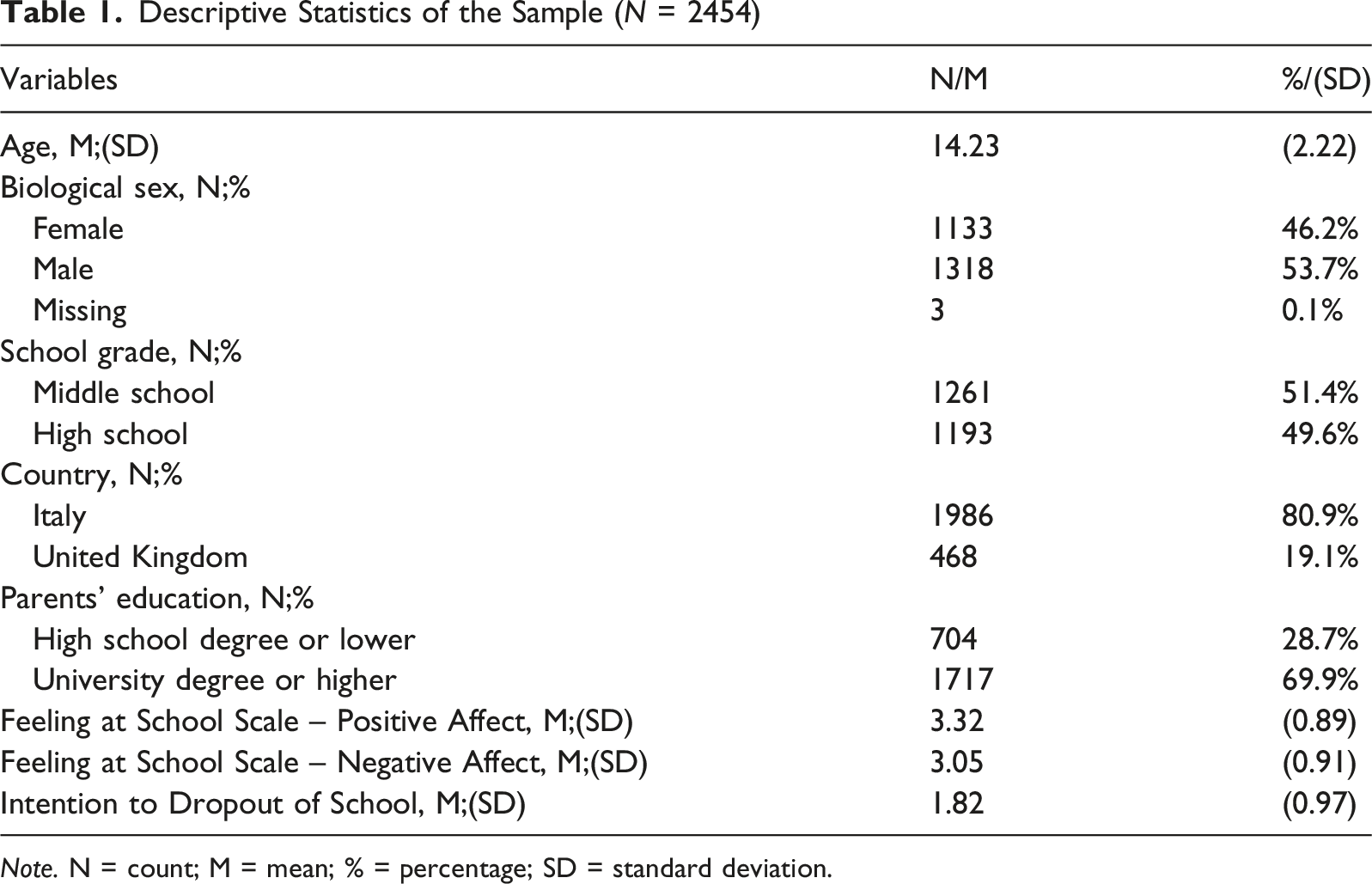
Note. N = count; M = mean; % = percentage; SD = standard deviation.
Questionnaire Development
Item Development
The identification of the items that reflect teachers’ motivational behaviors followed a systematic, multi-phased process rooted in SDT (Ryan & Deci, 2017). An initial set of items was drafted by the first [SG] and last [FA] Authors, specifically reflecting teachers’ behaviors proposed by Ahmadi et al. (2023), which included descriptions of teachers’ behaviors categorized into two major groups: need-supportive and need-thwarting. Need-supportive behaviors were identified as those that promote the fulfillment of students’ basic psychological needs, such as, following Ahmadi taxonomy (Ahmadi et al., 2023, see Table 1), “allow for students input or choice” and “provide feedback aimed at improvement or effort.” In contrast, need-thwarting behaviors (Ahmadi et al., 2023, see Table 1) such as “using pressuring language” or “criticize losing, via peer-comparison” were found to frustrate students’ needs, potentially leading to disengagement or controlled motivation. Since one of the aims of the present study was to ensure that the newly developed questionnaire was based on behaviors that were clearly aligned with SDT principles, when developing the items, we placed particular emphasis on content validity. Each item was formulated in order to reflect teachers’ behaviors experienced directly by the individual student, rather than as “general” actions observed in the classroom. When students perceive teachers’ behaviors as directed specifically toward them, it reinforces or undermines their sense of autonomy, competence, and relatedness (Bartholomew et al., 2018; Reeve et al., 2004; Yang et al., 2022). This individualized perspective provides a more accurate assessment of how teacher actions affect students’ motivation, as it captures the unique student–teacher interaction, ensuring that the behaviors assessed are relevant and personalized experiences rather than generalized classroom dynamics.
Teachers’ Behaviors and Item Correspondence
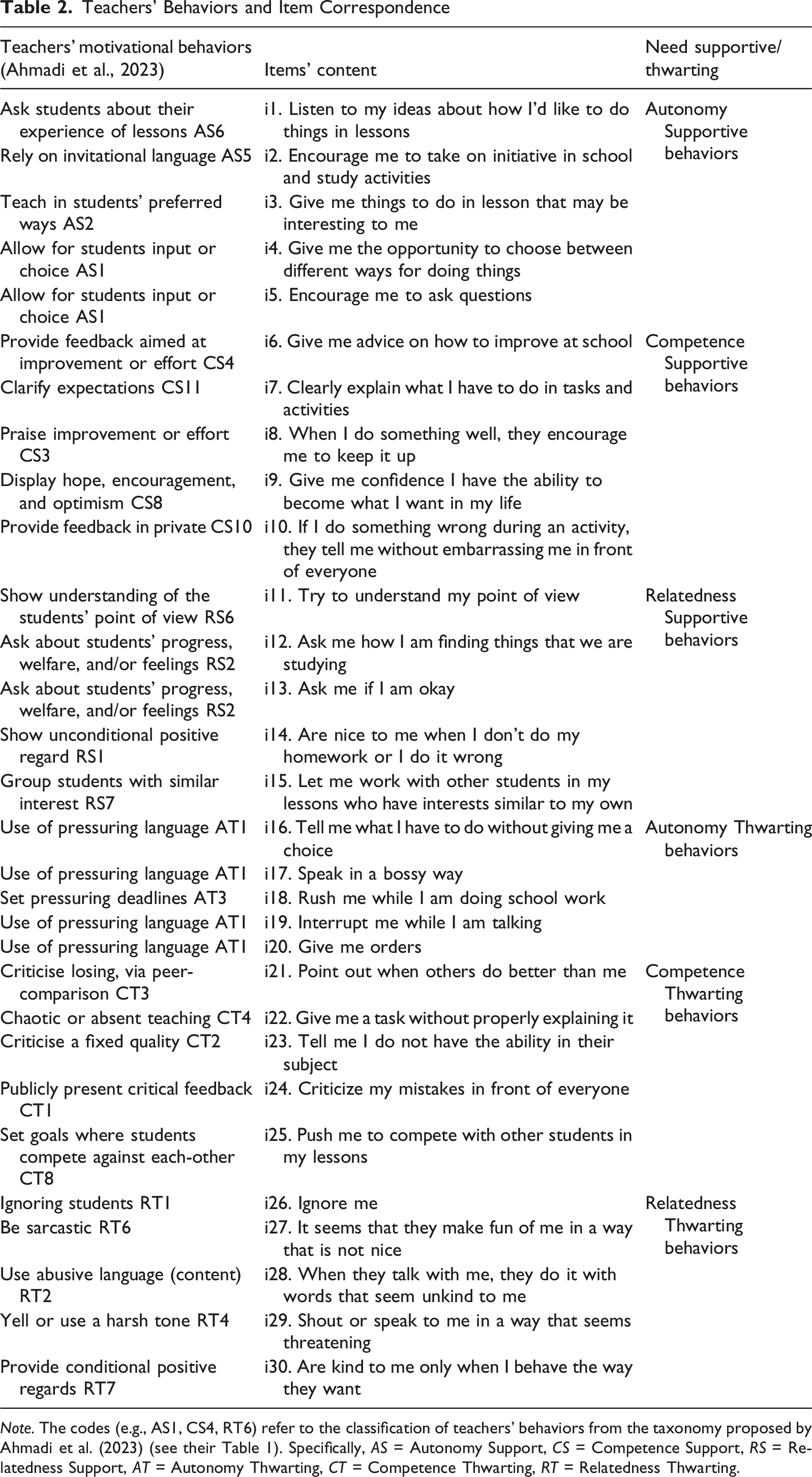
Note. The codes (e.g., AS1, CS4, RT6) refer to the classification of teachers’ behaviors from the taxonomy proposed by Ahmadi et al. (2023) (see their Table 1). Specifically, AS = Autonomy Support, CS = Competence Support, RS = Relatedness Support, AT = Autonomy Thwarting, CT = Competence Thwarting, RT = Relatedness Thwarting.
Content Validity
In order to provide a quantitative measure for the content validity of this newly developed questionnaire, we utilized the Average Content Validity Index (AVE-CVI) and Universal Agreement Content Validity Index (UA-CVI) (Polit & Beck, 2006; Shultz et al., 2020). Content validity is essential in ensuring that the items within an instrument fully cover and represent the construct being measured. Quantitative indices like AVE-CVI and UA-CVI allow for a systematic evaluation of this validity, capturing both item relevance and overall content coverage (Polit & Beck, 2006; Polit et al., 2007; Shultz et al., 2020).
For the proposed questionnaire, three authors [GR, MZ, and JD] rated each item on a 4-point scale according to its relevance to the corresponding description of behaviors proposed by Ahmadi et al. (2023), ranging from “1” indicating “not relevant/not representative,” to “4” indicating “extremely relevant/representative.” First, the item-level content validity (I-CVI) is calculated by dividing the number of Authors who rated each item as “relevant” (i.e., all authors rating as “3” or “4”), by the total number of authors. Then, the AVE-CVI is calculated by summing all the I-CVI values and dividing it by the total number of items. This index provides a mean score that reflects the overall relevance across the whole questionnaire, with values of 0.80 or above considered acceptable and 0.90 or higher indicative of excellent content validity (Polit & Beck, 2006; Shultz et al., 2020). Following, the UA-CVI was also calculated by dividing the number of items that were judged as “relevant” by all the raters (i.e., all authors rating as “3” or “4”), by the total number of items. The UA-CVI represents a stricter measure since it reflects the proportion of items on which all authors agreed as relevant, with values of 0.70 or higher considered as indicative of good content validity (Polit et al., 2007). The combined use of AVE-CVI and UA-CVI strengthens the content validity of the proposed instrument, confirming that each item and the entire questionnaire meet strict standards of comprehensiveness and representativeness (Polit et al., 2007; Shultz et al., 2020).
Measures
All students were administered questions regarding their socioeconomic variables: age, biological sex (i.e., female/male), and parents’ education (i.e., parents with a high school level of education or below vs. parents with a university degree or higher, which is also a proxy measure of parents’ SES) (Sirin, 2005). Subsequently, participants were administered the newly developed TMS tool and the following questionnaires.
Positive and Negative Affect
The Feelings at School Scale (FASS) (Alivernini et al., 2019) was used to measure students’ Positive and Negative Affect in the school context (i.e., “If you think about how you felt at school over the past few months, how often did you experience the following feelings?”). The FASS is composed of eight items (four measuring Positive Affect “happy, cheerful, good, calm,” and four Negative Affect “sad, upset, worried, angry”), rated on a five-point scale: 1 (“Never”) to 5 (“Very often”). Both the English and Italian versions of the scale were already validated, yielding satisfactory psychometric properties (Alivernini et al., 2019). The Cronbach’s alphas for the Positive Affect and Negative Affect scales in the current sample were of 0.87 and 0.80, respectively.
School Dropout Intention
The Intention to Drop out of School was assessed using the three items by Hardre and Reeve (2003). The Italian version (Alivernini & Lucidi, 2011) has already been used in other studies (Bianchi et al., 2021) and both the English and Italian versions demonstrated satisfactory psychometric properties. Items are rated on a five-point scale ranging from 1 (“Never”) to 5 (“Very often”). The Cronbach’s alpha for the current sample was of 0.79.
Statistical Analyses
Given that the items generated for this questionnaire reflect both the unique variances explained by each specific psychological need (i.e., autonomy, competence, and relatedness), and the broader variances associated with the general factors of satisfaction and frustration, we employed Exploratory Structural Equation Modeling (ESEM), using the robust maximum likelihood (MLR) estimator. ESEM was chosen for its ability to simultaneously model both latent constructs and their cross-loadings on multiple factors, providing a more flexible and accurate representation of the data. Moreover, Confirmatory Factor Analysis (CFA) is not optimal for capturing complex, multidimensional constructs, not hierarchically organized, often leading to greater biased parameter estimation (Marsh et al., 2020). We began by testing a bifactor ESEM model with two general factors—representing teachers’ motivational styles of need support and need frustration—and three specific factors, corresponding to autonomy, competence, and relatedness needs. The use of a bifactor structure allowed us to capture both the broad, overarching constructs (general factors) and the more nuanced, specific aspects of motivational styles (specific factors). The model was estimated in Mplus using ROTATION = TARGET(ORTHOGONAL), which is the recommended rotation for bifactor–ESEM models. In this specification, all factors were set as orthogonal: the two general factors (i.e., Need Support and Need Frustration) were orthogonal, and the three specific factors (i.e., Autonomy, Competence, and Relatedness) were also orthogonal both to the general factors and to each other. Each item loaded on both general factors and on its corresponding specific factor, with all cross-loadings freely estimated. Subsequently, the model hypothesized was compared with several other potential factor models using both ESEM and CFAs. This procedure was conducted separately for both countries, Italy and the United Kingdom, in order to assess whether the hypothesized model fits well independently within each group, ensuring that the latent constructs are appropriately represented by the items.
The following indices were used to assess all models fit: the Root Mean Square Error of Approximation (RMSEA), with values below 0.05 indicating evidence of absolute fit (Browne & Cudeck, 1992; Hu & Bentler, 1999); the Comparative Fit Index (CFI), with values > 0.95 indicating good model fit (Bentler, 1990); the Standardized Root Mean square Residual (SRMR), with values < 0.08 indicating good fit (Yu, 2002); and the chi-square (χ2) test, with p-values greater than 0.05 indicating an adequate fit to the data. However, chi square is sensitive to sample size, and so p-values might become significant for large samples (Schumacker & Lomax, 2010). Models’ comparisons were conducted using the Akaike Information Criterion (AIC) (Akaike, 1974) and the Bayesian Information Criterion (BIC) (Schwarz, 1978), with smaller values indicating better model adequacy for both indices.
Following, a hierarchical series of multigroup analyses on the Bifactor ESEM model were performed in order to examine the measurement invariance of the best-fitting model across the two countries. Three levels of measurement invariance (Meredith, 1993) were tested: (i) configural invariance, which assesses whether the same number of factors, defined by the same items, fits the data equally across groups; (ii) metric invariance, which evaluates whether each item contributes to its latent dimension equally across groups, by constraining factor loadings to be equivalent across groups; and (iii) scalar invariance, which assesses whether items’ intercepts are equivalent across groups, and allows mean differences of the latent factors to be compared. To assess the differences between the levels of invariance, ΔCFI (≤ −0.01) and ΔRMSEA (≤ 0.015) were used (Chen, 2007). The adequacy of the nested models was assessed by using the corrected chi-square difference test (since the MLR estimation was used in the analysis) (Satorra & Bentler, 2001).
The Cronbach’s alpha (Cronbach, 1951) and McDonald’s omega (McDonald, 1999) were calculated as a measure of internal consistency, in both countries. Specifically, the omega coefficient was calculated following the formula indicated by Rodriguez et al. (2016), which takes into account the items’ cross-loadings. Furthermore, the Explained Common Variance (ECV) was also computed to quantify the proportion of common variance attributable to both general and specific factors. However, given the absence of standardized computational guidelines for estimating explained specific variance in bifactor–ESEM models, two complementary approaches were implemented.
In the first approach, the ECV for each of the general factors was calculated by dividing the sum of squared standardized loadings by the total common variance explained by all factors in the model (i.e., both general and specific factors). This approach quantifies the proportion of total common variance in the bifactor solution attributable to the general dimensions.
In the second approach, the ECV for each general factor was computed separately, isolating its unique contribution. Specifically, for each general factor, the ECV was calculated as the sum of squared standardized loadings of all items on that general factor, divided by the total common variance explained by that general factor plus the variance explained by the specific factors, thus excluding the contribution of the other general factor. This approach provides an estimate of the proportion of common variance uniquely attributable to each overarching motivational style.
The same two approaches were applied to the specific factors. Under the first approach, the ECV of each specific factor was calculated relative to the total common variance explained by all general and specific factors, thereby estimating its contribution within the complete bifactor structure. Under the second approach, the ECV for each specific factor was computed net of the variance explained by the general factors, in this case, consisting only of the total common variance attributable to the specific factors. This approach allows estimation of the proportion of common variance uniquely explained by each need-specific dimension, net of the variance explained by the general factors.
Finally, to assess the convergent and divergent validity of the Teachers’ Motivational Styles (TMS) questionnaire, a SEM model was conducted between the TMS, Positive and Negative Affect (FASS), and Intention to Drop out experienced by the students, on the whole sample. The TMS was included in the model as the independent variable, while the Positive and Negative Affect and the Intention of Dropout of School were included as outcomes. The adequacy of the model was estimated with the same indices reported above.
All the analyses were performed with Mplus 8.3 (Muthén & Muthén, 2017), and the Statistical Package for Social Sciences (IBM Corp., 2019).
Results
The content validity assessment yielded an AVE-CVI of 0.91, indicating excellent overall relevance across items, and a UA-CVI of 0.79, meeting the recommended threshold for strong consensus among experts. Together, these values suggest that the questionnaire items are highly relevant and representative of the description of each behavior for the specific needs, confirming the robust content validity of the questionnaire (see Supplemental Material for both the Italian and English versions).
The factor analyses conducted revealed that the ESEM bifactor model, with two general factors reflecting the global motivation styles of Need Support and Need Frustration, and three specific factors, reflecting each specific need-support and -frustration (see Figure 1),
1
yielded a better fit to the data (Italy: χ2 = 970.92, df = 295; RMSEA = 0.03; CFI = 0.96; TLI = 0.95; SRMR = 0.02; UK: χ2 = 519.71, df = 295; RMSEA = 0.04; CFI = 0.96; TLI = 0.94; SRMR = 0.02), compared to all the other models tested (see Table S1 in Supplemental Material). Indeed, this model also yielded the lowest AIC and BIC values (Italy: AIC = 157754.90; BIC = 158237.46; UK: AIC = 34948.38; BIC = 35143.32) for both countries, indicating that this bifactor model offers a superior balance between model complexity and goodness of fit. Standardized factor loadings for items on the general factors were all greater than their respective loadings on the specific factors, which indicates that the items primarily reflect the broader underlying constructs captured by the general factors, rather than the more narrowly defined specific factors (see Table S3, S4, and S5 in Supplemental Material for items’ contents and factor loadings for both countries). Finally, in line with our second hypothesis, the measurement invariance analysis indicated that the model reached scalar invariance, across both countries (χ2 = 1827.89 df = 740; RMSEA = 0.04; CFI = 0.96; TLI = 0.95; SRMR = 0.03) (see Table S6 in Supplemental Material). Dimensionality of the ESEM bifactor model of the Teachers’ Motivational Style (TMS) questionnaire. Note. To improve the clarity and readability of the figure, only the expected paths consistent with the design of the scale are displayed: each item loads on its corresponding general factor (Need Support or Need Frustration) and on its specific factor (Autonomy, Competence, or Relatedness). Standardized loadings of the ESEM bifactor model for both Countries are reported in Tables S3 and S4 in the Supplemental Material.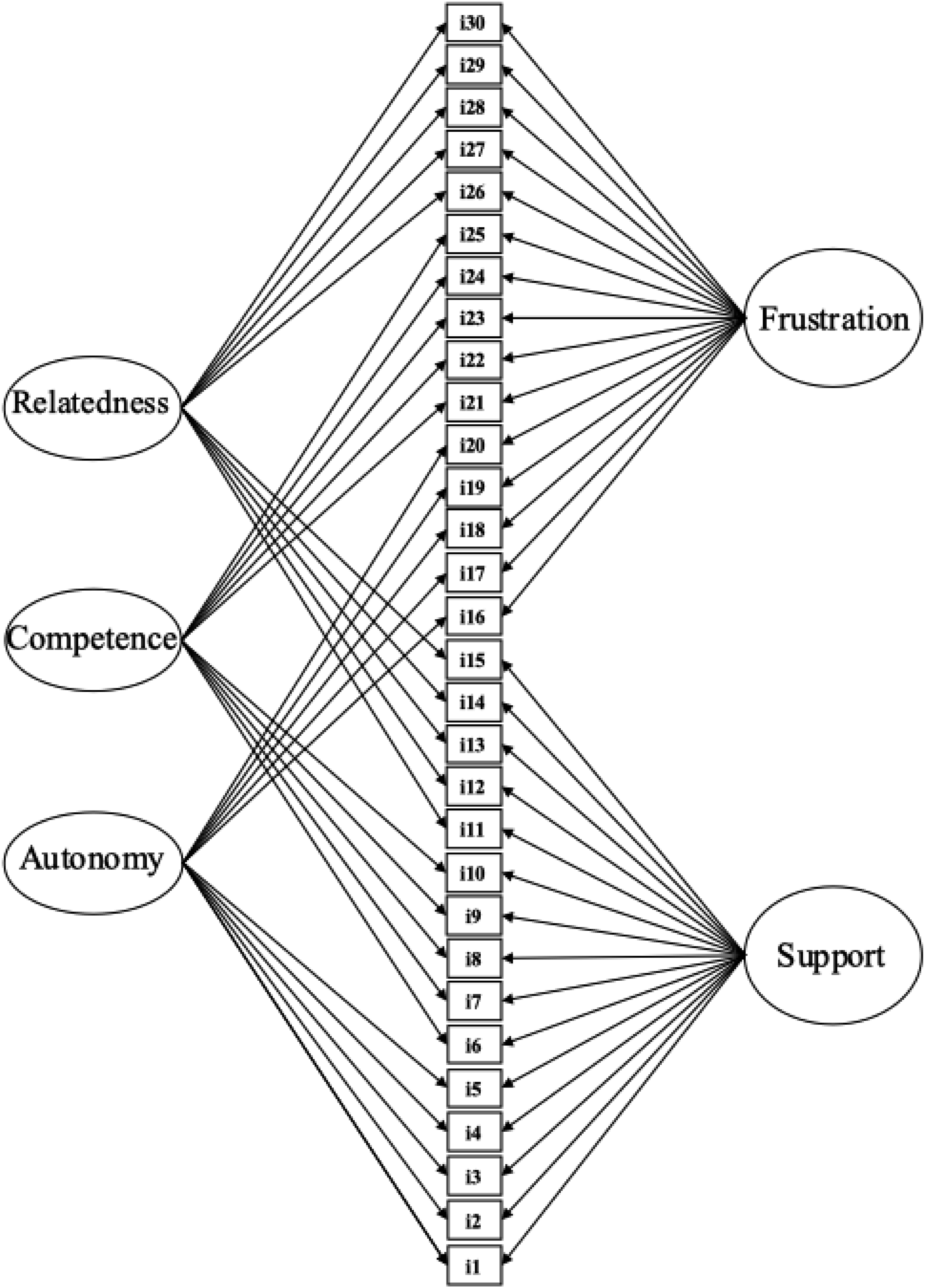
For both countries, the three specific factors of the TMS demonstrated a satisfactory internal consistency (Italy: 0.74 < Cronbach’s α < 0.77; 0.74 < McDonald’s ω < 0.78; UK: 0.79 < Cronbach’s α < 0.83; 0.75 < McDonald’s ω < 0.78). While Cronbach’s α values were higher for both the general factors of Supporting and Frustrating style, McDonald’s ω for the Frustration general factor was lower than the ω values for the specific factors (Italy: Cronbach’s α = 0.88 and 0.91; McDonald’s ω = 0.81 and 0.70, respectively; UK: Cronbach’s α = 0.90 and 0.91; McDonald’s ω = 0.84 and 0.72, respectively) (see Table S7 in Supplemental Material
Under the second approach (where the ECV for each factor was calculated net of the variance explained by the other general factor (for the general dimensions) or net of the variance explained by the general factors (for the specific dimensions)), the general factors retained substantial proportions of common variance (Italy: Need Support = 0.72; Need Frustration = 0.75; UK: Need Support = 0.65; Need Frustration = 0.67). In this same framework, the specific factors accounted for meaningful proportions of common variance net of the general factors (Italy: Autonomy = 0.48, Competence = 0.29, Relatedness = 0.23; UK: Autonomy = 0.40, Competence = 0.37, Relatedness = 0.21).
Lastly, in line with our third and fourth hypotheses, the TMS showed associations with both Positive and Negative Affect and the Intention to Dropout of School (see Figure 2), indicating adequate convergent and divergent validity, with a good fit of the model to the data (χ2 = 1287.67, df = 370; RMSEA = 0.03; CFI = 0.97; TLI = 0.95; SRMR = 0.02). Specifically, the general factor of Support was positively associated with Positive Affect (β = 0.40; p < 0.001), and negatively associated with Negative Affect (β = −0.20; p < 0.001), and Intention to Drop out of School (β = −0.13; p < 0.001); while the general factor of Frustration was negatively associated with Positive Affect (β = −0.26; p < 0.001), and positively associated with Negative Affect (β = 0.38; p < 0.001), and Intention to Drop out of School (β = 0.24; p < 0.001). Regarding the specific factors, small significant associations emerged beyond the effects of the general dimensions. The autonomy-specific factor was positively associated with Negative Affect (β = 0.08; p < 0.01) and negatively associated with Intention to Drop out of School (β = −0.21; p < 0.001). The competence-specific factor showed a negative association with Positive Affect (β = −0.08; p < 0.05). Finally, the relatedness-specific factor was negatively associated with Negative Affect (β = −0.12; p < 0.01) (see Table S8 in Supplemental Material for all paths from the specific factors). SEM model for the construct validity of TMS. Note. *p < 0.05; **p < 0.01; ***p < 0.001. Standardized coefficients reported (see Table S7 in Supplemental Material for all standardized coefficients for the specific factors). In order to improve readability, we have omitted the paths from the specific factors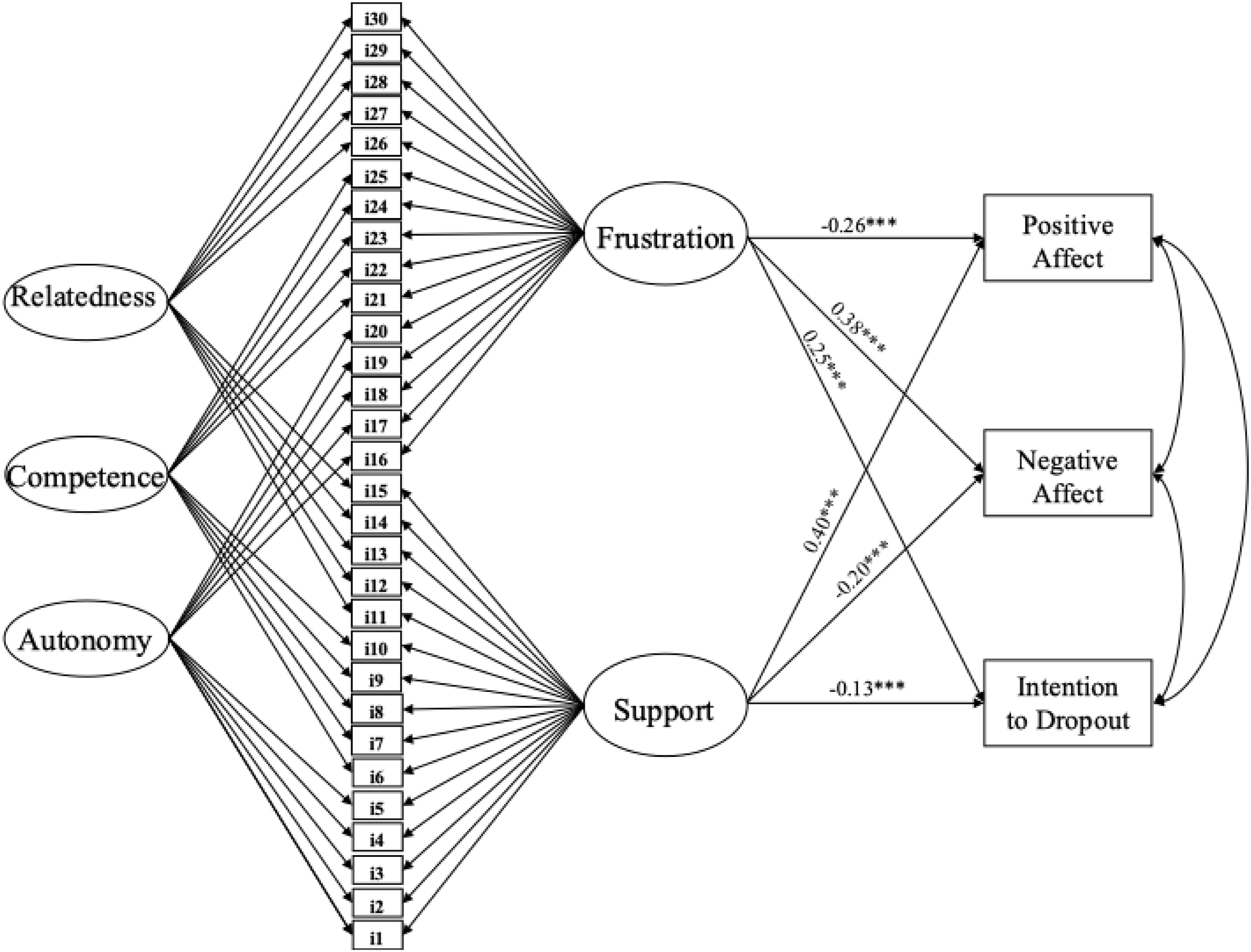
Discussion
The present study aimed to develop and validate a novel instrument designed to assess teachers’ motivational styles, grounded in Self-Determination Theory (SDT) (Deci et al., 1996). The focus was on measuring behaviors that either support or thwart students’ psychological needs for autonomy, competence, and relatedness. By operationalizing the descriptions of teachers’ behaviors identified in the taxonomy proposed by Ahmadi et al.’s (2023), this study contributes significantly to the field of educational psychology, offering a tool that helps educators and researchers to systematically evaluate teachers’ behaviors in relation to SDT.
Psychometric Properties and Cultural Validity
Regarding the first hypothesis, the bifactor model for the Teachers’ Motivational Styles (TMS) questionnaire provided a more nuanced understanding of how teachers’ behaviors contribute to different motivational experiences in students, proving to be the most fitting factor model for the newly proposed questionnaire. By distinguishing between general factors of Need Support and Need Frustration, alongside specific factors related to each psychological need, the study confirms that while teachers’ behaviors may be conceptually distinct, they ultimately converge into broader motivational styles. In our model, the two general factors are interpreted in line with SDT as broad need-supportive and need-frustrating teaching styles. Accordingly, the specific factors should not be interpreted as additional supportive or frustrating dimensions, but rather as residual autonomy-, competence-, and relatedness-dimensions after the supportive and frustrating components have been taken into account. In other words, once the general supportive and frustrating variance is controlled for, the remaining loadings still reflect theoretically coherent content linked to the three basic psychological needs.
This can be seen in the interpretation of the specific autonomy factor. After removing the supportive and frustrating components, this factor reflects the extent to which students’ behavior is internally versus externally directed, in line with the concept of perceived locus of causality within Self-Determination Theory (Ryan & Deci, 2017). Thus, higher scores indicate a stronger tendency to act according to externally imposed requests, whereas lower scores indicate a stronger tendency to act based on internally directed behavior (e.g., “Tell me what I have to do without giving me a choice”). A similar logic applies to the competence-specific factor. After removing the supportive and frustrating components, this factor reflects the extent to which students can exercise their competence in dealing with the task, capturing a task-related sense of control. In this sense, competence can be expressed only when the task is clear enough to be taken on. Accordingly, higher scores reflect a more external locus of control, meaning that students experience the task as something given from the outside, with less personal control over how to approach it, whereas lower scores reflect a more internal locus of control, meaning that students experience themselves as knowing what to do and as able to bring their competence into play in dealing with the task (e.g., “Give me a task without properly explaining it”). Finally, the relatedness-specific factor captures residual variance associated with conditional regard, that is, the extent to which relational warmth depends on students’ behavior. In this case, higher scores reflect a stronger tendency to regulate one’s behavior in order to obtain relational warmth, whereas lower scores reflect a stronger tendency to experience relational warmth as independent of one’s behavior (e.g., “Are kind to me only when I behave the way they want”).
Taken together, these interpretations show that the direction of the loadings does not contradict the theoretical framework. Rather, once the general supportive and frustrating dimensions are modeled at the broader level, the specific factors retain theoretically interpretable residual variance linked to autonomy, competence, and relatedness.
Even though our primary aim was to maximize content validity by ensuring broad semantic coverage of need-supportive and need-thwarting behaviors, each specific factor also demonstrated acceptable internal consistency, as indicated by Cronbach’s α and McDonald’s ω values all above 0.70, as well as the two general factors of Supporting and Frustrating teachers’ motivational styles. This pattern suggests that while teachers’ behaviors can be categorized into the three specific dimensions reflecting the satisfaction or frustration of each need, they also converge into broader motivational styles of support and frustration. Thus, the proposed questionnaire appears to effectively balance specificity and generalizability, providing a comprehensive assessment of teachers’ motivational behaviors. Moreover, the AVE-CVI and UA-CVI supported the content validity of the TMS, indicating substantial agreement among authors on item relevance (Polit et al., 2007; Shultz et al., 2020). Further insight into the bifactor structure was provided by the explained common variance (ECV) indices. Across both countries, the general factors accounted for the largest proportion of common variance, supporting the interpretation that the TMS correctly captures teachers’ overarching motivational styles. Importantly, the ECV results also indicated that the autonomy, competence, and relatedness-specific factors retained meaningful proportions of common variance once the contribution of the general factors was taken into account. When calculated net of the variance explained by the general dimensions, the specific factors accounted for substantial proportions of common variance across both countries. This pattern suggests that, although teachers’ motivational behaviors are primarily organized around broad supportive and frustrating orientations, the need-specific dimensions capture coherent and non-trivial distinctions in how these overarching styles are enacted in relation to autonomy, competence, and relatedness. Taken together, all these findings suggest that the instrument achieves both the representativeness and relevance in capturing the broader constructs of teachers’ supportive/frustrating behaviors, as well as need-specific distinctions aligned with the three basic psychological needs of autonomy, competence, and relatedness. The balance between the theoretical framework and practical reliability highlights the utility of the questionnaire in capturing essential aspects of teachers’ behaviors and their impact on students’ psychological needs. Consequently, the TMS has demonstrated to be suited for applications where theoretical coverage is as important as internal homogeneity.
Unlike previous instruments, whose major limitation was that they did not provide a comprehensive assessment of teachers’ motivational behavior styles, the items in the TMS reflect specific classroom dynamics (e.g., “Encourage me to take on initiative in school and study activities”; “Push me to compete with other students in my lessons”), through behaviors that students can recognize, recall, and respond to in the classroom setting.
Consistent with our second hypothesis, the results of the measurement invariance analysis demonstrated that the TMS questionnaire reached full invariance across the Italian and UK samples. Specifically, the model showed configural, metric, and scalar invariance, indicating that the TMS’s factorial structure, factor loadings, and item intercepts are equivalent in both cultural contexts, supporting its validity as a cross-cultural measure. These findings align with the principle of SDT which underscore the universality of autonomy, competence, and relatedness as core psychological needs (Ryan & Deci, 2017). Despite potential cultural nuances in educational practices, the invariance results suggest that the constructs measured by the TMS are equivalently interpretable across different educational contexts.
In line with our third and fourth hypotheses, the observed associations between the TMS and student outcomes such as Positive and Negative Affect provided support for the construct validity of the TMS questionnaire (Messick, 1995; Shultz et al., 2020). Autonomy-supportive behaviors, for instance, were positively related to Positive Affect and negatively related to Negative Affect and Intention to Drop out of School. This aligns with Garn et al.’s (2019) findings, which highlighted the long-term benefits of autonomy-supportive teaching on students’ psychological need satisfaction and motivational outcomes. In contrast, the association between need-thwarting behaviors and increased Intention to Drop out of School echoes concerns raised in prior research about the detrimental effects of controlling teaching styles on student motivation (Bartholomew et al., 2011). These results highlight the central role that teacher behavior plays in either facilitating or undermining students’ motivational experiences and well-being, ultimately impacting their engagement and retention in the school setting.
Beyond the effects of the general motivational styles, the specific need-factors showed differentiated associations with student outcomes that warrant closer consideration. Within a bifactor–ESEM framework, these specific factors represent need-related variance net of the general supportive or frustrating style. As discussed in prior bifactor applications in SDT research (e.g., Garn et al., 2019), such factors can be interpreted as reflecting a relative emphasis on one need domain once the global interpersonal orientation of the teacher is controlled.
In this light, the autonomy-specific factor was negatively associated with Intention to Drop out of School, suggesting that, beyond a generally supportive style, behaviors uniquely promoting volition and initiative may play a distinct protective role against disengagement. This finding aligns with SDT literature indicating that autonomy support fosters internalization and persistence, reducing withdrawal tendencies. At the same time, its small positive association with Negative Affect may indicate that when autonomy is too much emphasized, students may experience uncertainty or pressure linked to increased responsibility, a dynamic consistent with multidimensional conceptualizations of need-supportive teaching (Haerens et al., 2015).
The competence-specific factor showed a small negative association with Positive Affect. Once the general motivational style is accounted for, the remaining competence-related variance may reflect a stronger focus on performance standards, evaluation, or comparison processes. Prior research has shown that when competence-relevant cues are perceived as evaluative or controlling, they may attenuate enjoyment and increase vulnerability to maladaptive emotional experiences (Filippello et al., 2019; Haerens et al., 2015), even in contexts that are not globally frustrating.
Finally, the relatedness-specific factor was negatively associated with negative emotions, suggesting that teacher behaviors uniquely conveying involvement and interpersonal care may buffer students’ distress beyond the general motivational climate. This is consistent with SDT-based evidence showing that supportive student–teacher relationships mitigate emotional strain and protect against disengagement processes (Filippello et al., 2019; Haerens et al., 2015).
Taken together, these findings indicate that while the general factors capture the dominant motivational climate established by teachers, the specific factors provide additional, theoretically meaningful information regarding how different need-related emphases relate to distinct emotional and engagement outcomes.
Practical Implications
The practical implications of this study are significant, particularly for educators and school psychologists. The TMS provides a reliable and theoretically grounded tool for assessing teachers’ motivational styles, offering valuable insights into how classroom environments can be optimized to support students’ psychological needs. By relying on items based on observable behaviors, the TMS questionnaire is both practical and easy to implement in real-world educational settings. It can allow teachers to receive targeted feedback on their instructional practices, helping them reflect on whether they are fostering a supportive or frustrating environment for students.
Given the links between teacher behaviors and students’ emotional outcomes, the TMS can also be used as a tool for designing interventions, helping teachers adopt more need-supportive practices and reduce need-thwarting behaviors, ultimately promoting better academic and emotional outcomes for students.
Limitations and Future Directions
Despite the strengths of this study, some limitations should be acknowledged. First, the cross-sectional design of the current study does not allow for the assessment of the stability over time of the factor structure or the causal relationships between teachers’ motivational styles and student outcomes. Future research should employ longitudinal designs to assess temporal invariance of the factor structure and to examine whether changes in teacher behaviors over time influence students’ motivation and academic performance. A point that warrants consideration regards the magnitude of the factor loadings on the specific need-related factors. In the bifactor framework, these specific factors represent residual variance after accounting for the general dimensions of need-supportive and need-frustrating teaching. Consequently, lower loadings on the specific factors do not indicate weak measurement, but rather reflect the intentional partitioning of variance between global motivational styles and need-specific expressions. Given that this represents the first study to systematically operationalize and measure teachers’ motivational behaviors grounded in SDT, further research is needed to continue examining the factorial structure of the TMS. Replication studies may help clarify the stability of the specific need-related factors and their role within the broader motivational structure.
Additionally, although we reported explained common variance (ECV) indices using two complementary computational approaches, it is important to note that there are currently no fully established guidelines for estimating and interpreting explained specific variance in bifactor ESEM models. Future research should further investigate the most appropriate strategies for quantifying the contribution of specific factors in bifactor–ESEM models and continue to evaluate the distinct role of autonomy, competence, and relatedness dimensions in teachers’ motivational styles. Another limitation concerns the absence of a pilot study prior to administering the developed questionnaire. However, it is important to note that the items were developed based on the taxonomy proposed by Ahmadi et al. (2023), which was specifically designed to capture teachers’ behaviors relevant to adolescent students. Moreover, future studies may integrate alternative methods, such as teacher self-reports or classroom observations, to integrate student-reported perceptions and further strengthen the overall validity argument of the scale. Additionally, although this study was conducted in two different educational systems, further research is needed to further explore the generalizability of our findings and examine the invariance of the TMS across other countries and cultural contexts. In this regard, it would also be valuable to extend measurement invariance testing to include socio-cultural characteristics, such as biological sex and socioeconomic status. Examining the stability of the factorial structure across these subgroups would offer deeper insight into whether students from different backgrounds perceive teachers’ motivational behaviors in comparable ways, thus broadening the generalizability of the TMS. Finally, future research could also examine potential latent mean differences across different demographic or cultural contexts.
Conclusion
Teachers play a crucial role in supporting and frustrating students’ psychological needs of autonomy, competence, and relationship. The present study addresses a critical gap in the literature by validating a new instrument, the Teachers’ Motivational Styles (TMS) questionnaire. A major strength of the TMS lies in its bifactor structure, which allows for the simultaneous estimation of a general motivational style, reflecting overall need-satisfaction versus need-thwarting teaching, and specific factors capturing how teachers distinctly support or frustrate students’ autonomy, competence, and relatedness. Another key aspect of the TMS regards its item development process, which simultaneously prioritized content validity and theoretical coverage. The measurement invariance demonstrated across Italian and UK samples further underscores the reliability of the TMS as a cross-cultural instrument, capable of capturing universal aspects of teachers’ motivational behaviors. The TMS represents an important contribution to educational research and practice, and a robust tool that reflects students’ direct experiences in the classroom.
Supplemental Material
Supplemental Material - Measuring Teachers’ Motivational Styles: Development and Validation of a Self-Determination Theory-Based Questionnaire in a Dual-Country Study
Supplemental Material for Measuring Teachers’ Motivational Styles: Development and Validation of a Self-Determination Theory-Based Questionnaire in a Dual-Country Study by Sara Germani, Giulia Raimondi, Michele Zacchilli, Sara Manganelli, Elisa Cavicchiolo, James Dawe, Tommaso Palombi, Andrea Chirico, Stephen Pendleton, Fabio Lucidi, Fabio Alivernini in Journal of Psychoeducational Assessment.
Footnotes

Ethical Considerations
The Ethics Review Committee at Sapienza University of Rome approved our interviews (approval: prot N.1226) on October 06, 2021.
Consent to Participate
Respondents gave written consent for review and signature before starting interviews.
Author Contribution
Conceptualization: Sara Germani and Fabio Alivernini; Data Curation and Investigation: Sara Germani, Stephen Pendleton, and Fabio Alivernini; Formal analysis: Giulia Raimondi; Methodology: Giulia Raimondi and Sara Manganelli; Supervision: Fabio Alivernini; Visualization: Sara Manganelli and Elisa Cavicchiolo; Writing—original draft: Sara Germani and Giulia Raimondi; Writing—review and editing: All authors.
Funding
The authors disclosed receipt of the following financial support for the research, authorship, and/or publication of this article: This work was supported by Sapienza University of Rome, “Economically deprived and Immigrant youth: the protective role of psychological resources and educational context,” project number RD12318A949D7606.
Declaration of Conflicting Interests
The authors declared no potential conflicts of interest with respect to the research, authorship, and/or publication of this article.
Data Availability Statement
The data that support the findings of this study are available from the fist author [SG], upon reasonable request.
Supplemental Material
Supplemental material for this article is available online.
Note
References
Supplementary Material
Please find the following supplemental material available below.
For Open Access articles published under a Creative Commons License, all supplemental material carries the same license as the article it is associated with.
For non-Open Access articles published, all supplemental material carries a non-exclusive license, and permission requests for re-use of supplemental material or any part of supplemental material shall be sent directly to the copyright owner as specified in the copyright notice associated with the article.
