







Abstract
Critical thinking is increasingly recognized as a key skill in higher education, but its systematic development and assessment remain limited in Eastern Europe. This study aimed to adapt and psychometrically validate the Slovak version of the Critical Thinking Disposition Scale (CTDS). Data were collected from 545 Slovak university students (Mage = 21.94; SDage = 2.19). Confirmatory factor analysis compared one- and two-factor models and tested measurement invariance across gender. The two-factor model, including Critical Openness and Reflective Skepticism, showed a better fit (CFI = 0.971; RMSEA = 0.040) and was partially invariant across genders. The scale scores showed acceptable reliability, stability of Critical Openness over time, and convergent validity through positive correlations with selected constructs from the Motivated Strategies for Learning Questionnaire. The findings support the Slovak CTDS score as reliable and valid for assessing critical thinking dispositions in higher education, allowing for gender comparisons and contributing to cross-cultural research.
Keywords
Evidence from numerous large-scale assessments (Programme for the International Assessment of Adult Competencies [PIAAC], Wirtz & Zelmanová, 2024; Programme for International Student Assessment [PISA], Organisation for Economic Cooperation and Development [OECD], 2024) indicates declining levels of reading literacy and problem-solving skills among Slovak students. These competencies rely on higher-order processes akin to critical thinking (CT), involving the deliberate engagement of slow, reflective reasoning, or System 2 processing (Kahneman, 2012) and depend on intrinsic motivation or motivated skepticism (Sternberg et al., 2007).
Although these skills are often highlighted in education systems worldwide (Bernal et al., 2020) and in Slovakia (Kosturková, 2022), simply acquiring them does not ensure their effective use (Halpern, 1998). As cognitive misers (Taylor, 1981), individuals tend to conserve cognitive resources, often exhibiting cognitive laziness (Stanovich, 2011). Therefore, CT is used only when people are motivated enough. To effectively engage it, students must develop specific attitudes or dispositions (Lawrence et al., 2008; Wang et al., 2020).
Contemporary models of CT typically distinguish between cognitive skills (e. g., analysis, interpretation) and motivational components that govern the likelihood that an individual will engage these skills (Ku, 2009). Dispositions, widely recognized as a component of CT (Facione, 2011), refer to the willingness to apply CT skills, including their active use and a desire for new information (Güner & Gökçe, 2021). They represent motivational tendencies that guide behavior in response to people, events, or circumstances (Karakuş, 2024). While research often prioritizes skills, dispositional development requires more attention (Schoute & Alexander, 2025), necessitating long-term interventions (Puig et al., 2019) and psychometrically sound assessment tools (Butler, 2024). Compared to skill assessments, self-report disposition tools are more recent, beginning with the California Critical Thinking Disposition Inventory (CCTDI, Facione et al., 1994). Later scales inspired by it often had a narrow rather than broad focus (Critical Thinking Disposition Scale for Nursing Students – Kwon et al., 2006; The Student-Educator Negotiated Critical Thinking Dispositions Scale – Quinn et al., 2020), emphasized attitudes more than dispositions (The Critical Thinking Toolkit – Stupple et al., 2017; The questionnaire of Attitudes towards Critical Thinking – Manassero-Mas et al., 2022), or were time-consuming (Critical Thinking Disposition Inventory – Redhana et al., 2017).
On the contrary, Sosu (2013) created the Critical Thinking Disposition Scale (CTDS), a short, relevant, and practical tool for measuring individuals’ tendency to use CT skills, assessing the success of developmental programs, and aiding application in real-world situations. This framework synthesizes foundational taxonomies (Facione et al., 1994; Perkins et al., 1993) to conceptualize critical thinking dispositions as a multidimensional and simple construct centered on open-mindedness, curiosity, and reflection – namely Critical Openness (CO) and Reflective Skepticism (RS) – while delineating these inherent inclinations from separate cognitive abilities (Facione et al., 1994). CO involves the willingness to accept and critically examine new ideas, as well as to reevaluate one’s perspectives based on new evidence. RS refers to the habit of learning from past experiences and carefully questioning available evidence. Consistent with this conceptualization of the CTDS, empirical research indicates that the RS dimension predicts stronger critical thinking skills (Ku et al., 2019). The CTDS has demonstrated validity across various cultural contexts and has become a widely used research tool. As summarized in supplemental materials (see Table S1 1 ), validation studies conducted in different settings with diverse samples, most often university students, generally reveal age-related differences in dispositions, favoring older students (Ku et al., 2019). Across the 11 identified validation studies, including the original study by Sosu (2013), confirmatory factor analysis (CFA) was applied in 10 studies, whereas only one study relied exclusively on exploratory factor analysis (EFA) (Luiz et al., 2021). Three studies combined both EFA and CFA (Bakhtiari-Dovvombaygi et al., 2024; Nguyen et al., 2023; Sosu, 2013). However, several studies exhibit methodological limitations that warrant cautious interpretation. Specifically, Yockey (2016) demonstrates limited reporting transparency, Bakhtiari-Dovvombaygi et al. (2024) employ a non-recommended approach by conducting both EFA and CFA on the same dataset, and Martínez-Huamán et al. (2025) exhibit reporting inconsistencies. Findings regarding gender differences are less consistent. While several studies reported no significant differences between men and women (Barta et al., 2022; Yockey, 2016), Bravo et al. (2020) identified statistically significant latent mean differences favoring women. Orhan’s (2023) validation study further confirmed the model’s gender invariance. Testing factorial invariance is essential to ensure differences reflect psychological variation rather than measurement bias (Putnick & Bornstein, 2016). Across studies, the CTDS has shown good internal consistency (> 0.70). Factor analyses in most studies support the two-factor structure with acceptable fit (Akin et al., 2015; Bakhtiari-Dovvombaygi et al., 2024; Gerdts-Andresen et al., 2022; Nguyen et al., 2023; Orhan, 2023; Sosu, 2013; Thomas & Hayes, 2021), though some Iberian adaptations suggest unidimensionality (Bravo et al., 2020; Luiz et al., 2021; Martínez-Huamán et al., 2025). Previous validation studies indicate consistent positive associations between the CTDS and related cognitive (Thomas & Hayes, 2021) and motivational constructs (Nguyen et al., 2023). Conceptually, CTDS should relate positively to related constructs such as intrinsic motivation and metacognitive self-regulation, based on their theoretical framework (Credé & Phillips, 2011). CO, the willingness to engage with new ideas and revise beliefs, overlaps with intrinsic learning motives such as curiosity and mastery orientation, and RS, the habit of questioning evidence and learning from experience, aligns closely with metacognitive processes and deliberate regulation of learning.
The increasing number of studies using the CTDS (in Slovakia alone: Ballova Mikušková & Verešová, 2023; Lukačková & Šeboková, 2024; Marková & Sollár, 2024; Oravcová et al., 2024) highlights its research potential and the need for further validation. So far, the psychometric properties of the CTDS have not been studied in Central or Eastern European contexts (based on available English-language literature). Validating the instrument with a Slovak sample will help expand understanding of its cross-cultural applicability and help clarify whether CT dispositions are uni- or multidimensional. Therefore, this study aims to adapt the CTDS for Slovak university students using confirmatory factor analysis, testing invariance and equivalence across gender, assessing internal consistency, stability over time, and construct validity with selected scales from the Motivated Strategies for Learning Questionnaire, where we follow previous scientific outcomes (Nguyen et al., 2023) and expect a small-to-moderate positive relationship.
Methods
Participants
An a priori power analysis was conducted using the Sample Size Calculator by Soper (2025), with an expected effect size of λ = 0.10, α = .05, and 1–β = .80. With 2 latent variables and 11 observed variables, the minimum sample size needed to model the structure is 138.
In the current study, data were collected from 560 Slovak university students. Participants were recruited through convenience sampling (e.g., in classes, via acquaintances) and, in anonymous survey, provided informed consent by completing the questionnaire. Extreme outliers identified through boxplot analysis were excluded, resulting in a final sample of 545 participants (347 female), aged 17 to 32 years (M = 21.94; SD = 2.19); 307 humanities, 180 technical, and 58 medical students. A subsample of 168 participants (108 female; age range 20–32 years, M = 23.33, SD = 1.68) was used to assess convergent validity. Construct stability over time (3 months) was examined in a test–retest subsample of 23 participants (21 female; age range 22–34 years; M = 23.09; SD = 2.56).
Instruments
The Critical Thinking Disposition Scale (CTDS; Sosu, 2013) is an 11-item self-report measure that assesses two traits: Critical Openness (willingness to engage with unusual information and revise beliefs) and Reflective Skepticism (tendency to critically evaluate new information). Participants rated each statement on a five-point Likert scale (1 = strongly disagree to 5 = strongly agree).
The Motivated Strategies for Learning Questionnaire (MSLQ; Pintrich, 1991) Intrinsic Goal Orientation subscale (IGO), which has four items, assesses how much students engage in learning tasks for challenge, curiosity, or mastery (α = .701). The Critical Thinking subscale (CT), consisting of five items, measures the extent to which students report applying previous knowledge to new situations to solve problems (α = .791). The Metacognitive Self-Regulation (MS), with 12 items, evaluates students’ ability to plan, monitor, and regulate their learning processes (α = .772). Items are rated on a seven-point Likert scale (1 = Not at all true of me; 7 = Very true of me). The MSLQ is one of the most widely used instruments in educational psychology and is considered a benchmark measure for assessing academic motivation and learning strategies. Its strong psychometric properties and broad applicability across educational contexts have been supported in a large meta-analytic review (Credé & Phillips, 2011).
The questionnaires were translated using the standard back-translation procedure (see Appendix A for the CTDS wording). First, two independent translators translated the original English version into Slovak. Their translations were then compared and combined into a single final version. This version was then backtranslated into English by a third independent translator. No semantic shifts were found in any of the items. If differences in translated versions existed, we planned on discussing them.
Procedure
Data were collected from January to May 2025 via an online platform. Data from participants were obtained using the forced-response type of collection. All procedures followed were in accordance with the ethical standards of the responsible committee on human experimentation (both institutional and national) and with the Declaration of Helsinki of 1975, as revised in 2000. The study was also approved as part of an ongoing project by the ethics committee (UKF/370/2025/191013:024).
Data Analysis
Statistical analyses were conducted using two platforms: JASP (version 0.19.03) and RStudio (version 2025.05.1+513) the lavaan package. CFA was performed in JASP to evaluate both one-factor and two-factor structures of the questionnaire. Given the ordinal nature of the items, the Weighted Least Squares Mean and Variance adjusted (WLSMV) estimator was applied (Park, 2023), implemented in R via the Diagonally Weighted Least Squares (DWLS) method within the lavaan package. Furthermore, the robust Satorra–Bentler χ2 difference test was used in R to compare the one-factor and two-factor models (Satorra & Bentler, 2001).
Additional analyses were carried out in R (lavaan), where measurement invariance across gender was tested. Because item DCT3 had an empty response category (value = 1) in male group, thresholds could not be estimated, so lavaan processed the Likert items as continuous (DWLS), yielding intercepts instead of thresholds for invariance testing (Rhemtulla et al., 2012). Sequentially, models of configural, metric, and scalar invariance were examined. Invariance evaluation was based on changes in fit indices (difference in the Comparative Fit Index – ΔCFI ≤ −0.010, difference in the Root Mean Square Error of Approximation – ΔRMSEA ≤ 0.015) between models, applying threshold criteria recommended by Chen (2007). Latent mean differences across gender were estimated within the scalar invariance model by fixing latent means to zero in the reference group (women) and freely estimating them in men; given equal latent variances across groups, effect sizes were computed (Cohen’s d).
Reliability evidence was obtained using Cronbach’s α, McDonald’s ω coefficients, and via test–retest correlations (Spearman’s correlation coefficient). Construct validity was examined using standard correlation coefficients, selected based on the normality of data distribution (within or outside the range of −1 to +1) (Field, 2024). Cohen’s guidelines (1988) for interpreting the correlation coefficient (r) were used (.10 – small, .30 – medium, and .60 – large).
Results
Fit Indices for CFA Models: Comparison of One-Factor and Two-Factor Solutions
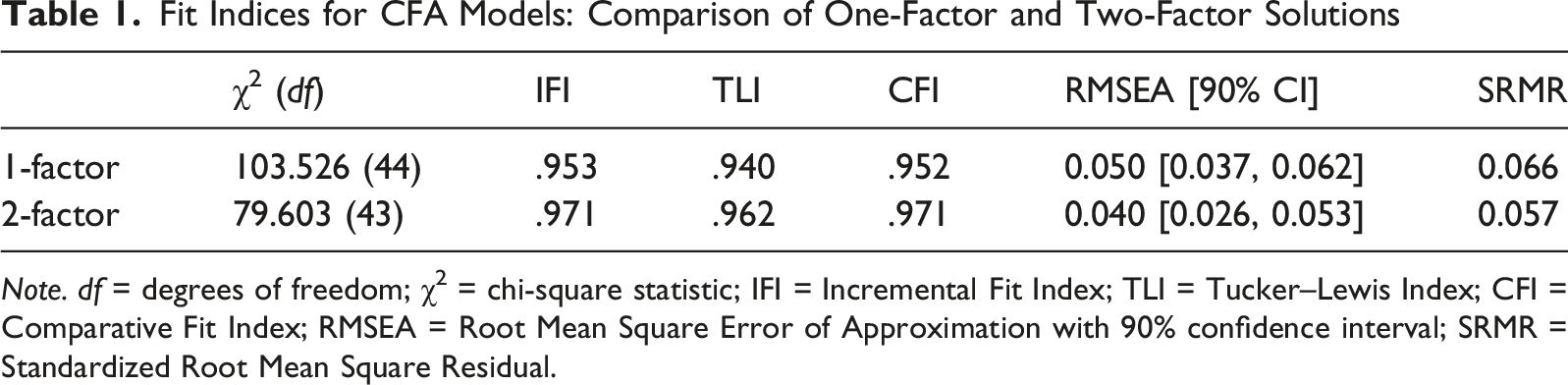
Note. df = degrees of freedom; χ2 = chi-square statistic; IFI = Incremental Fit Index; TLI = Tucker–Lewis Index; CFI = Comparative Fit Index; RMSEA = Root Mean Square Error of Approximation with 90% confidence interval; SRMR = Standardized Root Mean Square Residual.
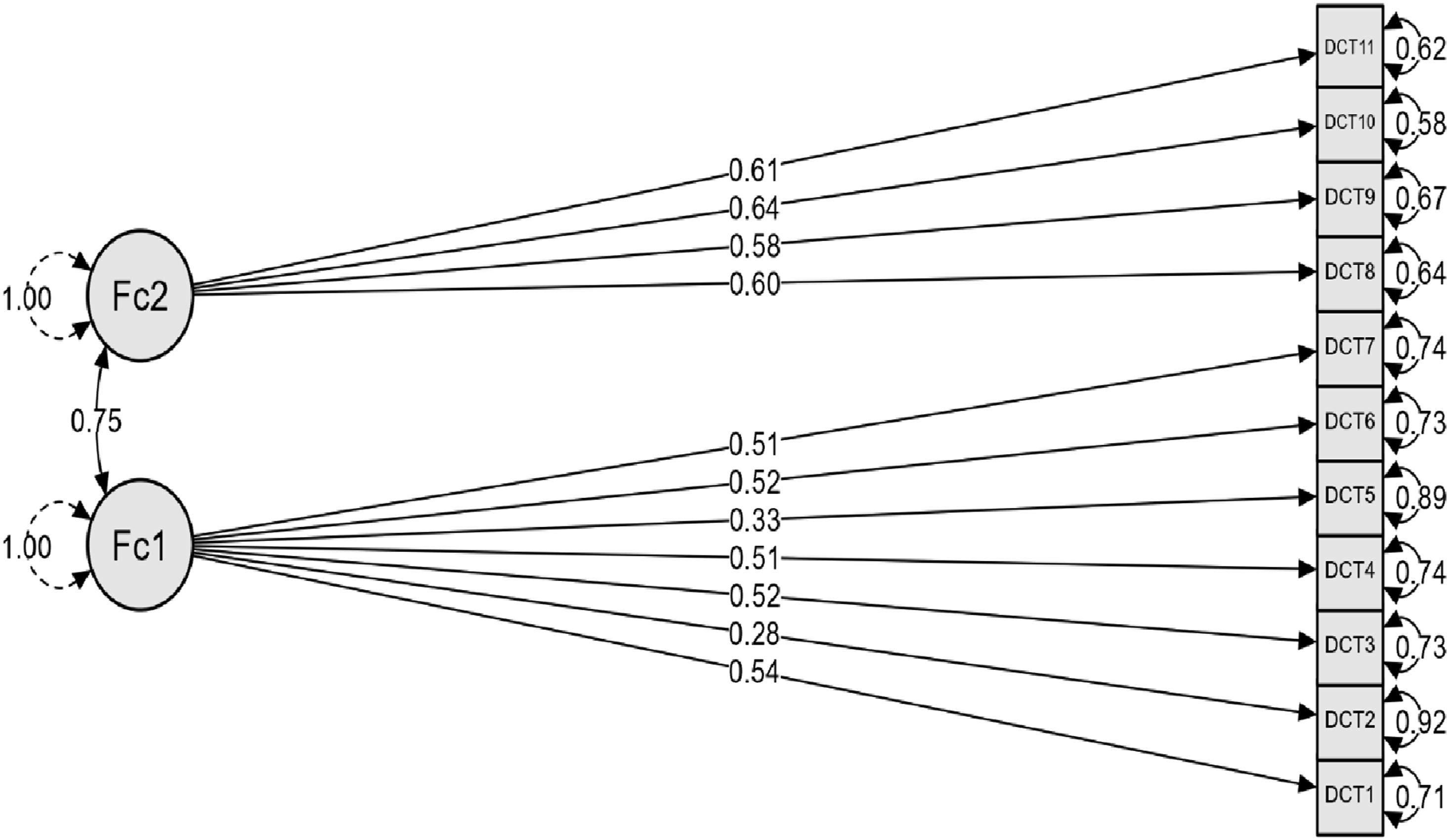
Structure of the two-factor model of the Slovak version of the Critical Thinking Disposition Scale. Note. Fc1 = Factor 1, Fc2 = Factor 2
Comparison of One-Factor and Two-Factor Models Using Robust Chi-Square Difference Test
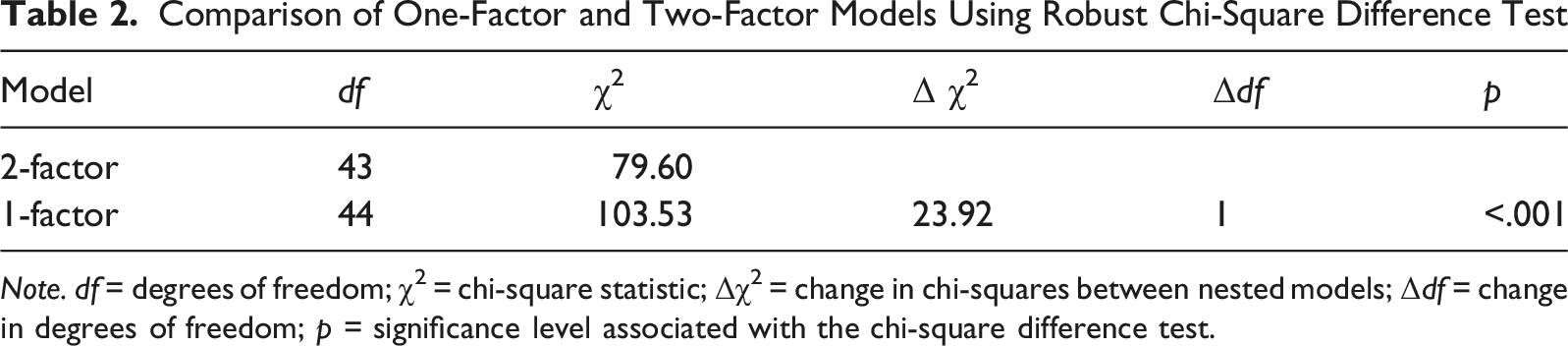
Note. df = degrees of freedom; χ2 = chi-square statistic; Δχ2 = change in chi-squares between nested models; Δdf = change in degrees of freedom; p = significance level associated with the chi-square difference test.
Evaluation of Measurement Invariance Across Gender
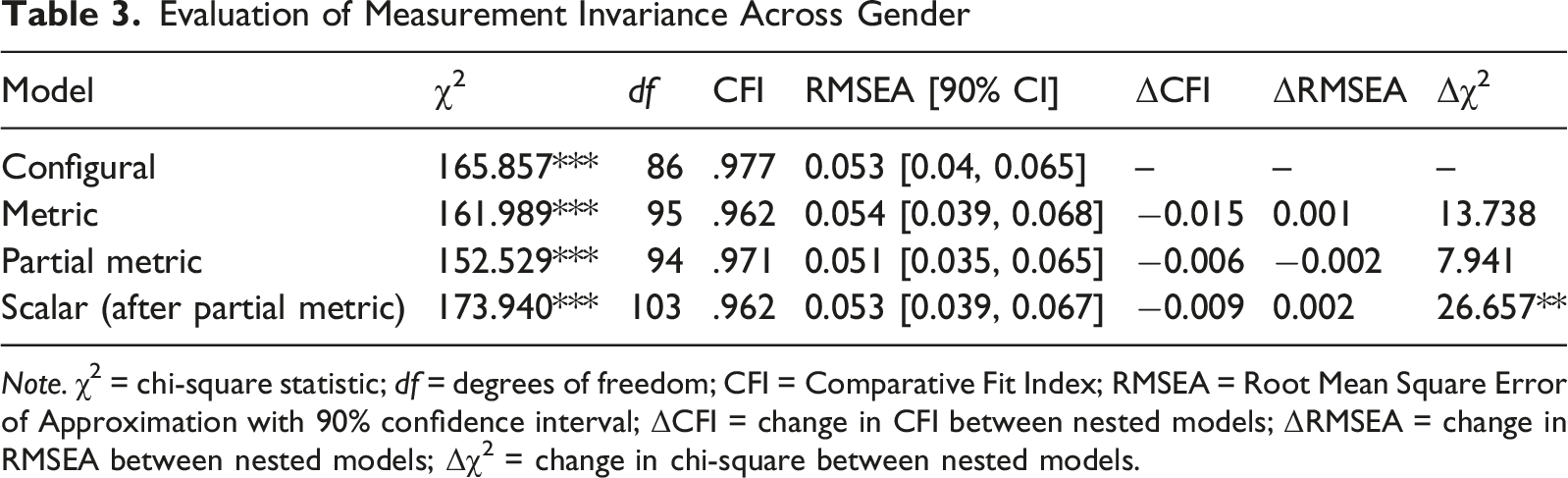
Note. χ2 = chi-square statistic; df = degrees of freedom; CFI = Comparative Fit Index; RMSEA = Root Mean Square Error of Approximation with 90% confidence interval; ΔCFI = change in CFI between nested models; ΔRMSEA = change in RMSEA between nested models; Δχ2 = change in chi-square between nested models.
Correlation Coefficients Between CTDS and MLSQ Scores (N = 168)
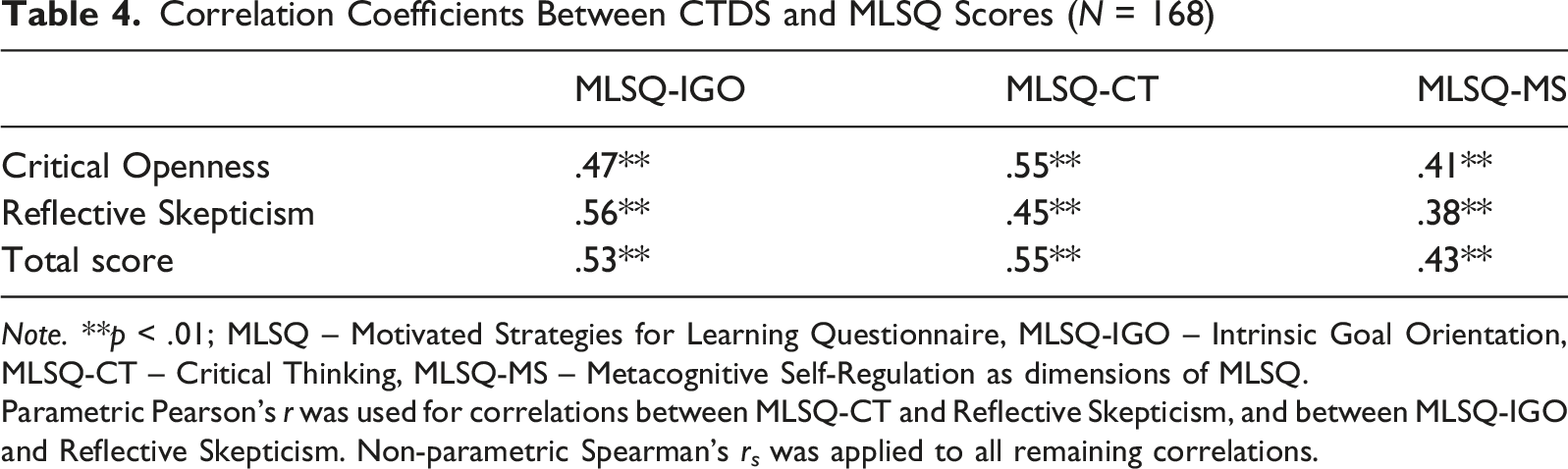
Note. **p < .01; MLSQ – Motivated Strategies for Learning Questionnaire, MLSQ-IGO – Intrinsic Goal Orientation, MLSQ-CT – Critical Thinking, MLSQ-MS – Metacognitive Self-Regulation as dimensions of MLSQ.
Parametric Pearson’s r was used for correlations between MLSQ-CT and Reflective Skepticism, and between MLSQ-IGO and Reflective Skepticism. Non-parametric Spearman’s r s was applied to all remaining correlations.
Latent Mean Differences Across Gender
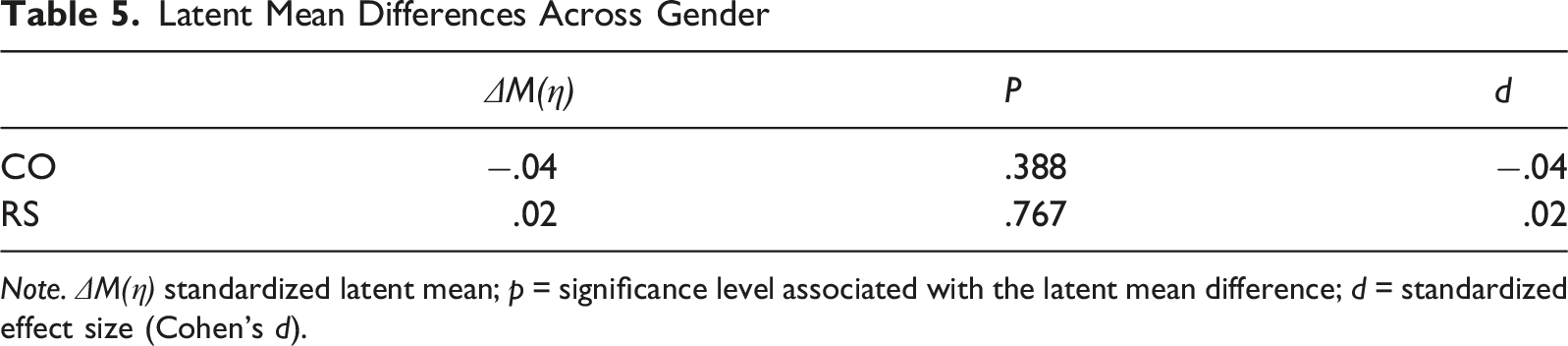
Note. ΔM(η) standardized latent mean; p = significance level associated with the latent mean difference; d = standardized effect size (Cohen’s d).
Discussion
The objective of the present study was to analyze the psychometric properties of the Slovak version of the CTDS scale and offer further insights into the conceptual nature of critical thinking dispositions and the feasibility of adapting this instrument within the Central European context.
The present study provided empirical support for the two-factor structure of the CTDS (Sosu, 2013), comprising the dimensions of CO and RS. This structure demonstrated superior fit to the data compared to a unidimensional model.
The theoretical distinction between individual dispositions is evident in the original conceptualization of the scale (Sosu, 2013). Although both dimensions relate to critical engagement with information, RS concerns critical self-reflection and questioning of one’s own assumptions (e.g., item 8: ‘I often re-evaluate my experiences so that I can learn from them’), whereas CO involves a readiness to consider and integrate alternative viewpoints (e.g., item 6: ‘It is important to understand other people’s viewpoint on an issue’). This pattern aligns with the theoretical delineation of the constructs and their conceptual proximity to the personality trait of Openness to Experience (Big Five model) (Sosu, 2013). Based on the convergence of theoretical insights and our empirical evidence, we advocate for the two-factor model, consistent with several prior studies (e.g., Gerdts-Andresen et al., 2022; Nguyen et al., 2023).
The two-factor model exhibited adequate internal consistency, consistent with prior CTDS validation studies (e.g., Akin et al., 2015; Yockey, 2016). The study also partially confirmed the temporal stability of the score indicating that critical thinking dispositions represent relatively enduring, personality-anchored tendencies rather than mere situational manifestations (Facione, 2000). While CO showed particularly stable scores over time, RS appeared somewhat more variable, suggesting subtle differences in the temporal dynamics of the two dimensions. This pattern, observed in a small Slovak sample (n = 23), warrants further investigation in larger samples to confirm these findings and the multifactorial nature of critical thinking dispositions. Our results align with the existing literature; however, only two validation studies to date (Bakhtiari-Dovvombaygi et al., 2024; Nguyen et al., 2023) have directly examined temporal stability, both of which also supported the reliable measurement of critical thinking dispositions over time.
The interpretation of measurement invariance across gender warrants particular attention. Full metric invariance was not supported; therefore, a partial metric invariance model was established by freeing one non-invariant factor loading, resulting in acceptable model fit. Scalar invariance was subsequently tested based on this adjusted model, yielding support for partial scalar invariance. Overall, these findings indicate that the measure demonstrates partial measurement invariance across gender, with only minor parameter non-invariance at the item level. Taken together, these findings provide support for cautious latent mean comparisons across gender and indicate that observed group differences largely reflect true psychological variation rather than measurement bias (Putnick & Bornstein, 2016). In line with this, no significant latent mean differences across gender were observed for either CO or RS, consistent with previous findings (Yockey, 2016). To date, only two validation studies (Bravo et al., 2020; Orhan, 2022a, 2022b) have evaluated gender invariance of the CTDS, both of which corroborated its presence. Invariance testing represents a fundamental element of psychometric validation and instrument adaptation (Chen, 2007), yet it is often overlooked (Orhan, 2023), highlighting the contribution of the present study to more rigorous instrument evaluation.
Convergent validity of the CTDS was demonstrated by moderate, positive correlations with conceptually related scales of the MSLQ. Both theoretical frameworks (Facione, 2011) and the extant literature offer multiple validations of these associations (Dökmecioğlu et al., 2022; Kuloğlu & Orhan, 2024; Nguyen et al., 2023). Although the correlations were generally moderate and positive across selected MLSQ scales, RS tended to correlate more strongly with intrinsic motivation, while CO showed a slightly higher association with critical thinking. This pattern may reflect subtle differences in the motivational versus cognitive components of CT dispositions and point to differential functional roles of the two CT disposition dimensions. Although the observed differences were small, they provide additional support for treating CO and RS as distinct yet related facets of a multifactorial construct of CT dispositions.
Limitations and Implications for Future Studies
The present study is subject to several limitations. First, data were collected via convenience sampling, which facilitated efficient recruitment but restricted the generalizability of findings to the broader population of university students. Second, the sample exhibited limited age variability, constraining the applicability of results to older student cohorts. Future research should therefore recruit a more heterogeneous sample with respect to age, field of study, and geographic origin and examine the tool’s robustness across diverse populations. Third, the assessment of convergent, discriminant, and incremental validity could be extended by including objective measures of critical thinking and additional theoretically relevant constructs. Similarly, future research should aim to provide a more rigorous examination of the construct’s temporal stability. Finally, we recommend implementing social desirability controls to mitigate introspective biases inherent in self-report assessments. Although partial scalar invariance across gender was supported at the construct level, future research should further examine measurement invariance across additional populations and evaluate the stability of scalar invariance findings.
Conclusion
The present study offers a psychometric evaluation of the Slovak version of the CTDS (Sosu, 2013), thereby enabling valid assessment of critical thinking dispositions within the Central European context and contributing to the broader application of disposition-based measurement tools in academic settings. The original two-factor structure was supported through confirmatory factor analysis. The findings indicate acceptable reliability and convergent validity of the scale scores in the Slovak sample. Evidence of partial invariance with respect to gender suggests that the instrument permits cautious cross-gender comparisons while maintaining interpretive integrity.
Considering the growing societal and digital demands for critical thinking, the CTDS represents a valuable contribution to the field. Particularly in regions where students’ critical thinking development and its empirical investigation remain limited; the use of this scale may support not only academic advancement but also foster cross-cultural applicability and stimulate scholarly discourse regarding the dimensionality and nature of critical thinking dispositions.
Supplemental Material
Supplemental Material - Psychometric Evaluation of the Slovak Adaptation of the Critical Thinking Disposition Scale
Supplemental Material for Psychometric Evaluation of the Slovak Adaptation of the Critical Thinking Disposition Scale by Ema Lukačková, Barbora Kuviková, Natália Marková, Jana Uhláriková, Gabriela Šeboková in Journal of Psychoeducational Assessment
Footnotes

Ethical Considerations
All study procedures were in accordance with the ethical standards of the responsible committee on human experimentation (institutional and national) and with the Helsinki Declaration of 1975, as revised in 2000. The study was also approved as part of an ongoing project by the ethics committee (UKF/370/2025/191013:024).
Author Contributions
All authors contributed to the study conception and design. The theoretical framework was developed by Barbora Kuviková. Material preparation and data collection were performed by Ema Lukačková, Barbora Kuviková, Natália Marková, Jana Uhláriková, and Gabriela Šeboková. Methodological development and data analysis were conducted by Ema Lukačková and Barbora Kuviková. The discussion section was written by Ema Lukačková, Barbora Kuviková, and Natalia Marková. The manuscript was reviewed by Gabriela Šeboková. All authors read and approved the final manuscript.
Funding
The authors disclosed receipt of the following financial support for the research, authorship, and/or publication of this article: This work was supported by the project VEGA 1/0336/24: Critical thinking in relation to academic success and decision-making in specific areas of students’ lives.
Declaration of Conflicting Interests
The authors declared no potential conflicts of interest with respect to the research, authorship, and/or publication of this article.
Supplemental Material
Supplemental material for this article is available online.
Note
Appendix
References
Supplementary Material
Please find the following supplemental material available below.
For Open Access articles published under a Creative Commons License, all supplemental material carries the same license as the article it is associated with.
For non-Open Access articles published, all supplemental material carries a non-exclusive license, and permission requests for re-use of supplemental material or any part of supplemental material shall be sent directly to the copyright owner as specified in the copyright notice associated with the article.
