







Abstract
“Glass walls,” or patterns of male/female segregation by job type, have been found in federal, state, and local government employment. Research shows women are more often employed in government agencies that deal in redistributive policies, such as housing, but less commonly in either regulatory (enforcement) or distributive (public works) agencies. The authors question whether the same patterns go beyond government jobs to influence a profession closely tied to government, namely, urban planning. Based on this study, the good news is the almost total lack of glass walls in planning’s private sector, but there is still room for progress in the public sector, namely, in transportation, management, infrastructure, and law. Examining this phenomenon is important because the planning profession values equality, fairness, and social justice, particularly in public policy.
Glass ceilings refer to the barriers women face in moving up the career ladder into management positions, whereas glass walls refer to when women and men find themselves “separated from one another into different occupations or departments” (Sneed, 2007, p. 880). Glass walls are thought to endure due to a lack of change in organizational cultures or due to skills in one job not being easily transferable to other jobs (Miller, Kerr, & Reid, 1999, p. 218). There has been extensive study of glass walls in federal, state, and local government employment (Connell, 2006; Kerr, Miller, & Reid, 2002; Miller et al., 1999; Newman, 1994; Sneed, 2007). Many of these studies have focused on understanding this phenomenon by testing Theodore Lowi’s (1972, p. 299) contention that “policies determine politics” in some respects. Policies are “outward manifestations of the state” extending down through agency missions to influence not only the work of administrators, but also who (male or female) gets which jobs (Lowi, 1985, p. 69). For example, government agencies administering regulatory (enforcement) policies are more likely to employ men, whereas redistributive agencies that transfer benefits, costs, or rights between different groups are more welcoming to women and are more likely to achieve gender balance (50% female employment; Kerr et al., 2002; Miller et al., 1999; Newman, 1994; Sneed, 2007).
The question we explore here is whether these patterns of policy type and gender (im)balance go beyond government jobs to influence entire professions, particularly the urban planning profession. The planning profession as a whole is tied directly and indirectly to government. Federal, state, and local governments employ planners, but they also contract with planning consultants, provide grants to planning educators and nonprofits, and regulate the work of public and private sector planners through a plethora of rules and permitting processes. Perhaps the influence of policy type does not go beyond direct government employment, or perhaps the gender patterns in planning are different because of the profession’s emphasis on cultural pluralism, social justice, and equity (American Planning Association, 2005; Davidoff, 1965/2003; Hendler, 1995).
This article begins by looking at the historical composition of women in the planning profession, gender representation, and sex segregation in general, and Lowi’s (1972) policy typology. Within Lowi’s typological framework, we use data from the 2006 American Planning Association (APA) Salary Survey (2006) to explore whether the patterns of sex segregation found in government agencies and departments extend across the field of urban planning. We conclude with our findings and discuss the implications these results may hold for the profession.
Women in the Planning Profession
Leavitt (1983, p. 55) noted that women’s issues in planning have been divided into two distinct categories: “issues affecting women planners and issues of women’s needs.” “Issues of women’s needs” refer to the increase in female-headed households, economic biases and poverty, safety, child care concerns, increased female participation in the work force, and the growing female older adult population, which all need to be considered within the sphere of urban planning (McFarlane, 1995). Planning research has shed light on a variety of gender and policy issues, such as transportation (Blumenberg, 2004; Crane, 2007; Levinson & Kumar, 1995), public safety (Doyle, Kelly-Schwartz, Schlossberg, & Stockard, 2006), urban design (Talen & Coffindaffer, 1999), and public participation (Harwood, 2007). To help address these issues, McFarlane (1995, p. 39) recommends “increasing the proportion of female elected representatives in cities and the number of women entering the planning and related professions” to be complemented with “training all professionals so they understand and include women’s perspectives within their occupational frames of reference.” This observation goes back to Leavitt’s point about “issues affecting women planners.” Sandercock and Forsyth (1992, p. 54) suggest the need for more gender equity within the profession in the following terms:
There are very few women running or even in the senior ranks of planning agencies. Women are concentrated in human services and social planning, professional areas with . . . relatively little prestige and power compared with development control, metropolitan strategy, or transportation planning. In essence, despite their growing numbers, women are still on the periphery rather than at the center of planning practice.
They explain that “the internal culture of planners reflects the biases of the wider masculine culture, and poses dilemmas for professional women about whether to adjust their behavior accordingly” . . . (or instead) “try to introduce more female ways of socializing into the workplace” (Sandercock & Forsyth, 1992, p. 55).
A historically male-dominated field, urban planning is now seeing progress in the overall number of professional female planners. According to APA’s 2006 Salary Survey, women represent more than one third of domestic full-time planners, increasing from 34% in 2004 to 37% in 2006. This remains less than the 46% of women in the total 2007 U.S. labor force (U.S. Department of Labor, 2008); however, these percentages are significant when one looks at comparable figures from the past 30 years or so. In 1981, women represented only 18% of respondents to the APA’s survey (Hecimovich, 1987, p. 14) increasing to 27% in 1991 (Morris, 1992, p. 21). The APA’s salary survey has shed light on the status of women in planning, particularly with respect to entry into the field and the extent to which female planners hit glass ceilings. In 1971, only 7 planning agencies out of 623 had female directors (Hannah, 1971, p. 32). Twelve percent of agency heads were women in 1987 (Hecimovich, 1987, p. 12), increasing to 26% in 2006 (American Planning Association, 2006).
In addition to examining glass ceilings facing female planners, APA surveys have also compared male and female planners in terms of the different types of agencies or employers making us of their talents. The 1989 survey found, “Women are underrepresented in state planning agencies, federal agencies, consulting firms, universities and colleges, development firms, financial institutions, and real estate firms” (Hecimovich, 1989, p. 22). In 1991, women continued to be underrepresented in development firms and educational institutions. They were also underrepresented in metro/regional agencies, but only slightly so in county agencies (Morris, 1992, p. 21). A 1977 survey showed women planners were most commonly employed by big cities (Mayo, 1985).
Looking at planners in the 1980s, Glasmeier and Kahn (1989, p. 10) revealed that new female planning graduates (48% of them) were finding work in nontraditional fields. In their study, nontraditional fields were those “other than land use planning, current land use planning, regional planning, comprehensive planning, environmental planning, physical planning, social planning, redevelopment, and general planning” (Glasmeier & Kahn, 1989, p. 9). Women were underrepresented in the following fields: academia, architecture, law, general planning, and land use planning (Glasmeier & Kahn, 1989, p. 10). Similar to Glasmeier and Kahn’s findings, a later study by Dalton (2007, p. 43) demonstrated that female planners were more likely than their male counterparts to say their work was “nontraditional,” thus showcasing how women may be creating their own niches in planning.
Wadhwa’s study of gender and urban planning professionals in Ohio examined both vertical and horizontal workplace characteristics. Vertical integration of women in a profession refers to entering the field and breaking glass ceilings, whereas horizontal integration refers to breaking glass walls. Wadhwa (2003, p. 111) noted:
Male planners were found in a greater proportion than female planners in the fields of administration, Engineering/Architecture/Urban Design, and private/commercial development, all of which are in general literature held to be male-dominated fields. Female-dominated specialties in this study were social service related, and to an extent, transportation.
She found that occupational specialties in planning had reached a good degree of horizontal integration in Ohio since the two genders were nearly equally represented in traditional planning fields. Based on Wadhwa’s research and other studies (Dalton, 2007; Glasmeier & Kahn, 1989;), it appears that women are making inroads, but the results are uneven.
Gender Representation
The theory of representative bureaucracy stresses the importance of bureaucracies reflecting the same diversity of composition as the communities they serve. “The argument for representational participation (in bureaucracies), in short, is that it leads to functional effectiveness” (Krislov, 1974/2003, p. 28). Beyond the normative argument that workplaces (particularly those in the public sector) ought to reflect their communities, men and women, different racial and ethnic groups, and people from different social backgrounds bring different approaches and ways of thinking to the workplace (Rosenbloom & Kravchuk, 2005). In summarizing the literature on women in management, Reid, Kerr, and Miller (2003, p. 6) point out that women managers tend to encourage more employee participation in decision making and add diversity that can lead to change and “organizational regeneration.” From their study of senior state administrators, Brudney, Ted Hebert, and Wright (2000, p. 497) found that female managers are inclined to place greater value on organizational effectiveness, quality, and high morale than their male counterparts. Similarly, female city managers are more likely to value citizen input and communication (Fox & Schuhmann, 1999).
In terms of ideology and conceptual frameworks, women state agency heads are less likely to take conservative stands on social, moral, and tax-and-spend issues (Bowling, Kelleher, Jones, & Wright, 2006, p. 831). Kathlene examined policy making in Colorado’s House of Representatives and discovered that women legislators are more contextual in their thinking than male legislators who are inclined to be more instrumental in their orientation. When examining the types of bills men and women sponsored, the bills put forward by women legislators were less likely to be incremental in nature and more likely to include new strategies or delve into new subject areas. They also were more likely to sponsor legislation concerning education, family, and children’s issues (Kathlene, 2001, p. 41). At the local level, female city council members tend to be more responsive to constituents and ask more questions at meetings than their male counterparts (Beck, 2001). On a hypothetical zoning case related to a single parent renting a room in her house to a boarder to supplement her income, women council members were more amendable to allowing this use whereas male council members were concerned with property values and legal issues (Beck, 2001, p. 63).
To be sensitive to gender issues influencing communities, planning must also be sensitive to gender equity issues internal to the profession. This begins with how equitably gender is represented in the planning profession, and specifically how well women are integrated within professional planning practice. Without gender equity within the profession, it is questionable that planning can truly balance external gender issues and policies that affect the communities they serve. Fainstein and Servon (2005, p. 2) note the importance of policy in the gender balance equation in observing that, “planning and policy have historically been the province of white upper-middle class men, and the decisions that have been made reflect the interests and experiences of this group.”
Sex Segregation
On a simple level, sex segregation refers to the physical separation of people according to gender. On a more meaningful level, segregation “is a fundamental process in social inequality. The characteristics on which groups are sorted symbolize dominant or subordinate status and become the basis for differential treatment” (Reskin, 1993, p. 241). Looking at sex segregation by occupation goes back to the work of Gross who noted that professions changing from male dominance to female dominance may not necessarily represent a sign of progress. “Evidence of a basic structural change would be that of an occupation which was once all-male or all-female but which became equally accessible to both sexes” (Gross, 1968, p. 200).
Measuring sex segregation is difficult. There is no set standard that defines at what point a group is segregated. Many researchers attempt to measure segregation through the “index of segregation” that calculates the proportion of the dominant group that would have to move to the other group in order for both groups to be equally distributed. This index is commonly applied on an aggregate level and may overlook factors influencing segregation on a finer level. Reskin (1993, p. 243) states, “The more aggregated the categories across which segregation is measured, the less segregation we will capture.” In aggregate, a workforce may appear balanced with 50% men and 50% women, but the picture changes if fine-grained analyses reveal that all the men are in one profession and all the women in another.
Common explanations for sex segregation focus on supply-side and demand-side influences (Reskin, 1993). Demand-side influences include employers’ preferences, the size of the qualified labor pool (the smaller the labor pool, the more employers will hire nontraditional employees, that is, women), cost of hiring, training, and paying prospective workers, reliance on informal social networks to fill open positions (most social networks tend to be segregated), and the level of bureaucracy and political exposure (the larger the bureaucracy and political pressure, the less sex segregation). Supply-side influences include the size of labor supply (the more restricted the supply of male workers, the more customarily male occupations open up for women), workers’ preferences and values, gender-role socialization, and job opportunities and aspirations. An example of a demand-side influence is the role of public policy and how different policies are viewed as “women’s work” or “men’s work.” As Stivers (2002) points out, the public sphere is often assumed to be the province of men while women take care of private or household concerns. The types of policies, or the preferences of “the state,” are delegated to agencies and manifest themselves in who is chosen to carry out those policies (Lowi, 1985). To understand how policies may influence the planning profession, we next present and then apply Lowi’s (1972) policy typology, which other researchers have employed to understand sex segregation among government agencies.
Lowi’s Policy Typology and Sex Segregation
Lowi (1972) brought to light that policies influence politics and thus the work of government. By starting with policies versus politics, he is able to show how power relationships can change depending on policy type. His typology divides policy into four main areas: regulative, distributive, redistributive, and constituent. Within the sex segregation literature, the first three policies have been used most often to reveal patterns of gender imbalance by policy area (Alkadry, Nolf, & Condo, 2002; Kerr et al., 2002; Miller et al., 1999; Newman, 1994; Sneed, 2007).
“Regulatory agencies are responsible for implementing the classic control policies of government, formulating or implementing rules imposing obligations on individuals, and providing punishment for nonconformance” (Lowi, 1985, p. 85). Regulatory policies are the most coercive. In their study of sex segregation in state bureaucracies, Kerr et al. (2002, p. 414) placed the following job categories under the regulatory umbrella: police, fire, corrections, utilities, and transportation. Their study revealed that regulatory state agencies were most likely to be male dominated. Other studies support their findings (Alkadry et al., 2002; Miller et al., 1999; Sneed, 2007), particularly for police and corrections (Warner, Steel, & Lovrich, 1989).
Unlike regulatory agencies that see their relationships with individuals as “controller and controlled,” distributive agencies see their relationships as “patron and client” (Lowi, 1985, p. 87). Distributive policies “confer facilities or privileges unconditionally” (p. 74). These types of policies often include public works projects and maintenance of facilities. In their distributive agency category, Kerr et al. included state agencies involved in streets, highways, natural resources, parks and recreation, and community development. They found the greatest gender imbalance in highways, natural resources, and parks, with less of an imbalance in community development. A similar pattern was found by Sneed (2007) when looking at Michigan’s civil service. A common speculation made in the literature is that gender inequity persists because distributive policy agencies often rely on highly educated specialists from the sciences (engineers, biologists, social scientists), areas of study that have been historically the province of men (Kerr et al., 2002; Newman, 1994).
The third policy type is redistributive. It is considered the most welcoming job market for women because they are often most supportive of affirmative action goals (Dolan, 2000; Newman, 1994). Redistributive polices are the “Robin Hood” policies of society. The “rules discriminate” between “rich versus poor, young and employed versus old and unemployed, savers versus consumers” (Lowi, 1985, p. 93). Kerr et al. placed public welfare, health, and employment functions within the redistributive category for state agencies. Redistributive agencies most often feature gender balance (Kerr et al., 2002; Sneed, 2007).
Constituent policies make up the fourth policy category. These types of policies make “services and facilities generally available” or create “powers or jurisdictions” (Lowi, 1985, p. 74). Lowi describes these policies as “rules about rules” and places budgetary and personnel policy agencies in this category. When describing this category, Lowi’s characteristics point toward an interesting mix of what are considered male traits, such as decision making (Stivers, 2002), “the older ideal of the good administrator” . . . (with) “the ability to make decisions” (Lowi, 1985, p. 94), and “special access to the chief executive” (p. 95), and female traits, such as collaboration (Helgesen, 1990), “collegiality and trust” . . . (with), and “lines of authority and communication indicating a network rather than a hierarchy” (Lowi, 1985, p. 95). When looking at women in the federal government’s Senior Executive Service, Dolan (2004, p. 302) found somewhat more men than women in constituency policy organizations. In her study of glass walls in Michigan’s state agencies, Sneed (2007) discovered that agencies involving financial administration and general control were more male dominated. Related to budgetary agencies, economics (McDowell, Singell, & Ziliak, 2001) and banking (Kerr et al., 2002, p. 416) are often more closely associated with men than women. As a result, constituent policy agencies are likely to employ more men than women.
Method
This study examines sex segregation and policy type in the planning profession by using data available from the American Planning Association as part of their “salary survey,” along with existing methods of categorizing agencies by policy type. The 2006 survey was a web-based survey of APA members resulting in 11,588 replies out of 26,583 for a 44% response rate. In the end, results were compiled for the 10,497 planners who indicated they were employed or self-employed as full-time planners or in planning-related positions (American Planning Association, 2006). The data were obtained from APA through the Planning Accreditation Board and via an interface available to members on the APA’s website called the “Salary Calculator” where specific queries or cross-tabulations can be made. The Salary Calculator interface allows for queries of the 2008 survey, but more data are available by planning specialization from the 2006 survey so it was used instead of the 2008 survey. For the sake of comparing equivalent cases, data were analyzed only for those who had a master’s degree or above (law degree or doctorate; 7,082 planners, 37% women, 63% men).
The 2006 survey asked respondents to choose which planning specialization(s) describe their work. They could choose from the following list: community development and redevelopment; economic planning and development; environment and natural resources planning; facilities and infrastructure planning; health and human services planning; housing; information technology; land-use or code enforcement; parks and recreation planning; participation and empowerment; planning law; planning management, budgeting, and finance; planning methods; preservation; spatial planning; transportation planning; urban design; and other. For this study, each author independently took the 17 specializations and placed them into categories by policy type. For guidance, we used Newman (1994), Alkadry et al. (2002), and Dolan (2004) for examples of placing state or federal agencies into Lowi policy categories. For her study of Florida state agencies, Newman put the following agencies into the “regulatory” category: Insurance, Environmental Protection, Business Regulation, Professional Regulation, Legal Affairs, Commerce, Corrections, Law Enforcement, and Parole Commission. Under “distributive” agencies went Highway Safety and Motor Vehicle, Natural Resources, Agriculture and Consumer Services, Transportation, Citrus, and the Game and Fish Commission. She then placed Welfare, Education, Health and Rehabilitative Service, Community Affairs, Veteran Affairs, Labor and Employment Security, and Revenue agencies into the “redistributive category.” Alkadry et al. had a similar list for West Virginia state agencies. Dolan used the constituency policy category for agencies, such as the Office of Management and Budget, the Office of Personnel Management, and State. We also referred to descriptions of planning specializations (land use planning, environmental planning, economic development planning, transportation planning, and housing, social, and community planning) by the Association of Collegiate Schools of Planning (ACSP, 2008) to see which specialization fit into which policy type. Where we agreed on placement, the specialization was placed into that category, and when we disagreed we discussed until we were satisfied we had made a proper designation. In making these decisions we discovered some of the specializations (information technology, planning methods, spatial planning, and urban design) simply did not fit into any of the policy types or we did not have sufficient information to make a designation.
Land use planners were described in the ACSP brochure as coordinators of development and administrators of regulations (Association of Collegiate Schools of Planning, 2008), so the land use or code enforcement specialization was placed in the regulatory category. Planning law logically fit in the regulatory category. Preservation was also placed under the regulatory policy type because, like land use planners, historic preservation planners are often advising property owners of regulations or enforcing regulations. The specializations of facilities and infrastructure planning, parks and recreation planning, and transportation planning seemed to follow patterns similar to state agencies that have been placed in the distributive category by other researchers. Likewise, state agencies labeled as redistributive were good guidance for the placement of the planning specializations (community development and redevelopment, health and human services, and housing). The planning management, budgeting, and finance specialization was placed into the constituent policy category.
There were three specializations that we thought included elements of two policy types so they were placed in more than one category. The participation and empowerment specialization was placed under the constituency policy category because of it emphasis on relationships with constituents, but it was also placed in the redistributive category because public participation experts focus on involving those not normally involved in decision making (Arnstein, 1969; Davidoff, 1965/2003). There was not enough information or similar state agency examples to place the environment and natural resources planning specialization in either the regulation or distributive category so it was placed in both. The economic planning and development specialization was likewise placed into two categories. Some development projects fit the patron–client relationship of distributive policies, whereas others are a redistribution of resources from wealthy areas to poor areas (see Table 1 for a list of the planning specializations by policy type and pattern of sex segregation).
Planning Specializations by Policy Type and Historic Sex Segregation Patterns
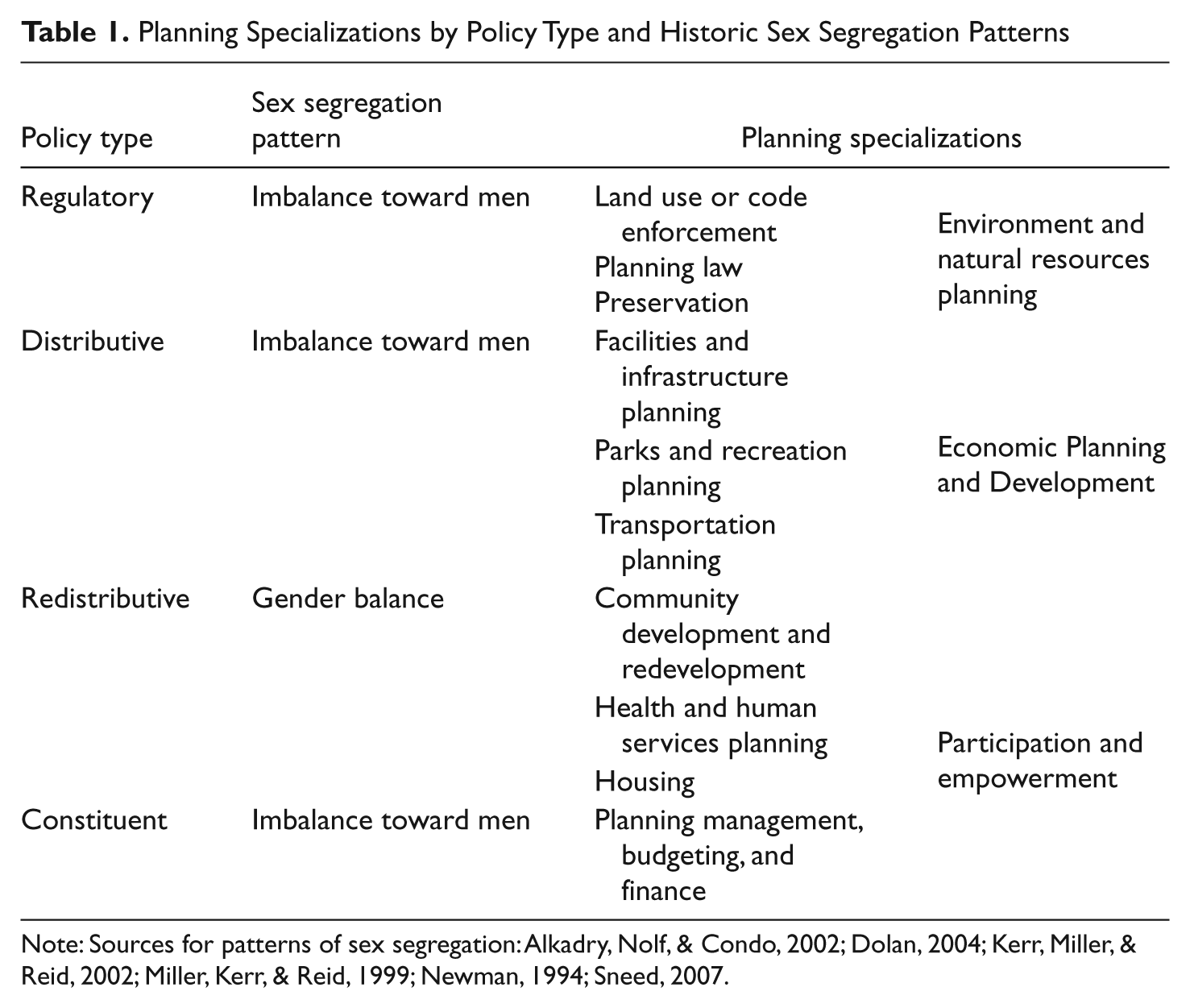
Note: Sources for patterns of sex segregation: Alkadry, Nolf, & Condo, 2002; Dolan, 2004; Kerr, Miller, & Reid, 2002; Miller, Kerr, & Reid, 1999; Newman, 1994; Sneed, 2007.
The numbers of male and female planners in each of the planning specializations were analyzed using chi-square tests. A chi-square test compares what the proportions in a table’s cells would look like if there was no relationship between the two variables with the actual proportions in the table’s cells. For example, if there is no great difference in the numbers of men and women employed in the different specializations, the chi-square test would show no statistically significant results. After the chi-square test, the Phi coefficient is used as a measure of the strength of the association. It ranges from −1.00 to +1.00 and is interpreted as being equivalent to a correlation coefficient (note that for nominal-level data, the negative sign is an artifact of coding, such as, females as 0 and males as 1; Bohrnstedt & Knoke, 1988, p. 333). For this study, a negative Phi coefficient indicates a specialization with more women than men.
Findings
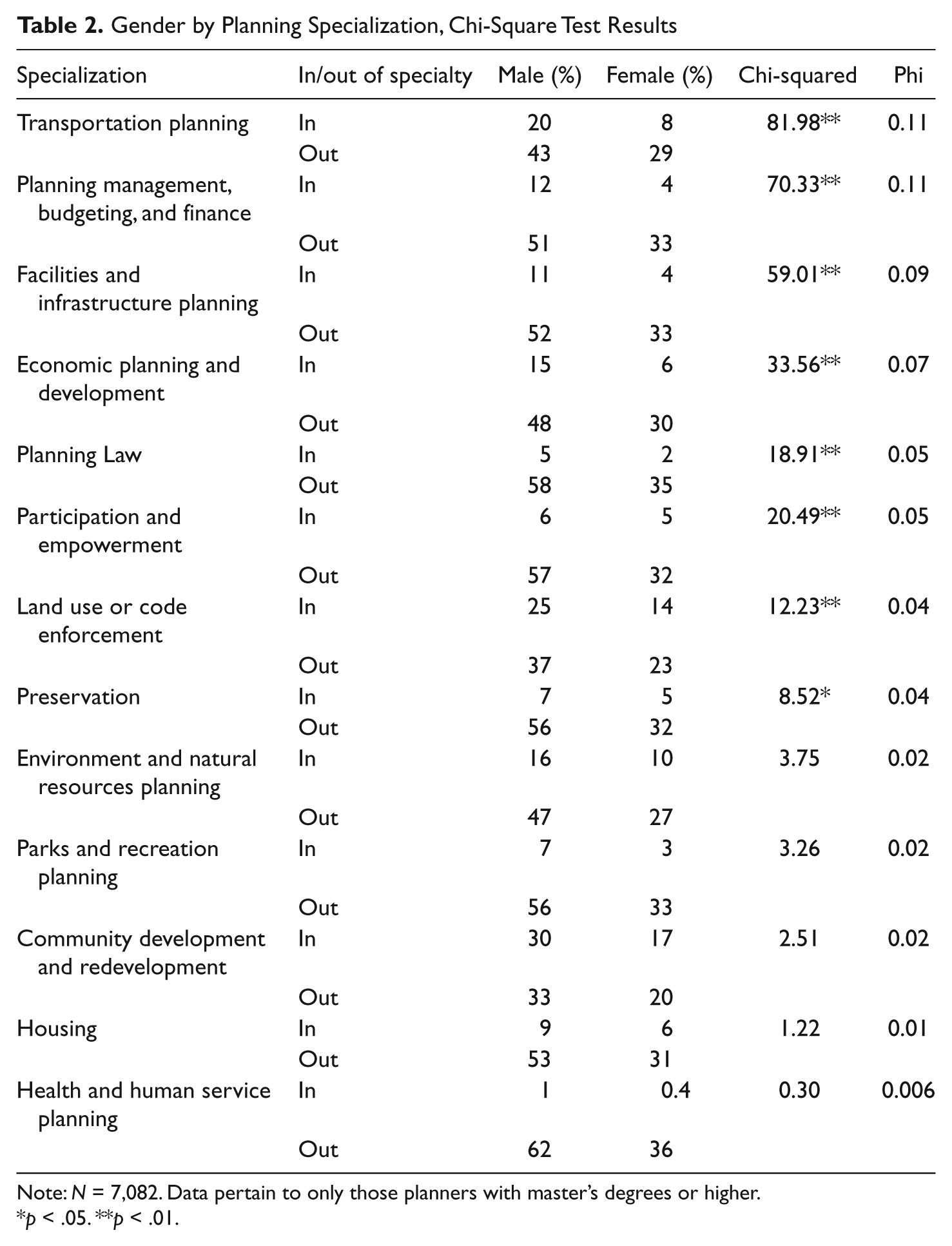
Table 2 shows the percentages of male and female planners, with master’s degrees or above, choosing each specialization and the results of the chi-square test for each. The chi-square tests were performed on 2 x 2 tables of gender (male and female) and being in the specialization or not (those who chose that particular specialization compared to those who did not). The specializations are listed in order based on the measure of association (Phi) and statistical significance. The specializations showing statistically significant associations with gender were transportation planning; planning management, budgeting, and finance; facilities and infrastructure planning; economic planning and development; planning law; participation and empowerment; land-use or code enforcement; and preservation.
Gender by Planning Specialization, Chi-Square Test Results
Note: N = 7,082. Data pertain to only those planners with master’s degrees or higher.
p < .05. **p < .01.
From previous research, regulatory agencies are generally the most male dominated, distributive agencies are the next highest, then constituent agencies, with redistributive agencies most likely to be gender balanced (Alkadry et al. 2002; Dolan, 2004; Kerr et al., 2002; Miller et al., 1999; Newman, 1994; Sneed, 2007). As theorized, the results from Table 2 show that none of the redistributive planning specializations are segregated by sex. The environmental and natural resources planning and parks and recreation planning specializations showed no statistically significant segregation by sex. The strongest association between gender and a specialization was found in the transportation area that falls into the distributive policy category. Although all of the distributive and regulatory specializations (except environment and natural resources planning and parks and recreation planning) were associated with gender and higher percentages of men than women, the distributive specializations in planning showed greater associations than the regulatory specializations. The second highest association was with the planning management, budgeting, and finance specialization that is in the constituent policy category.
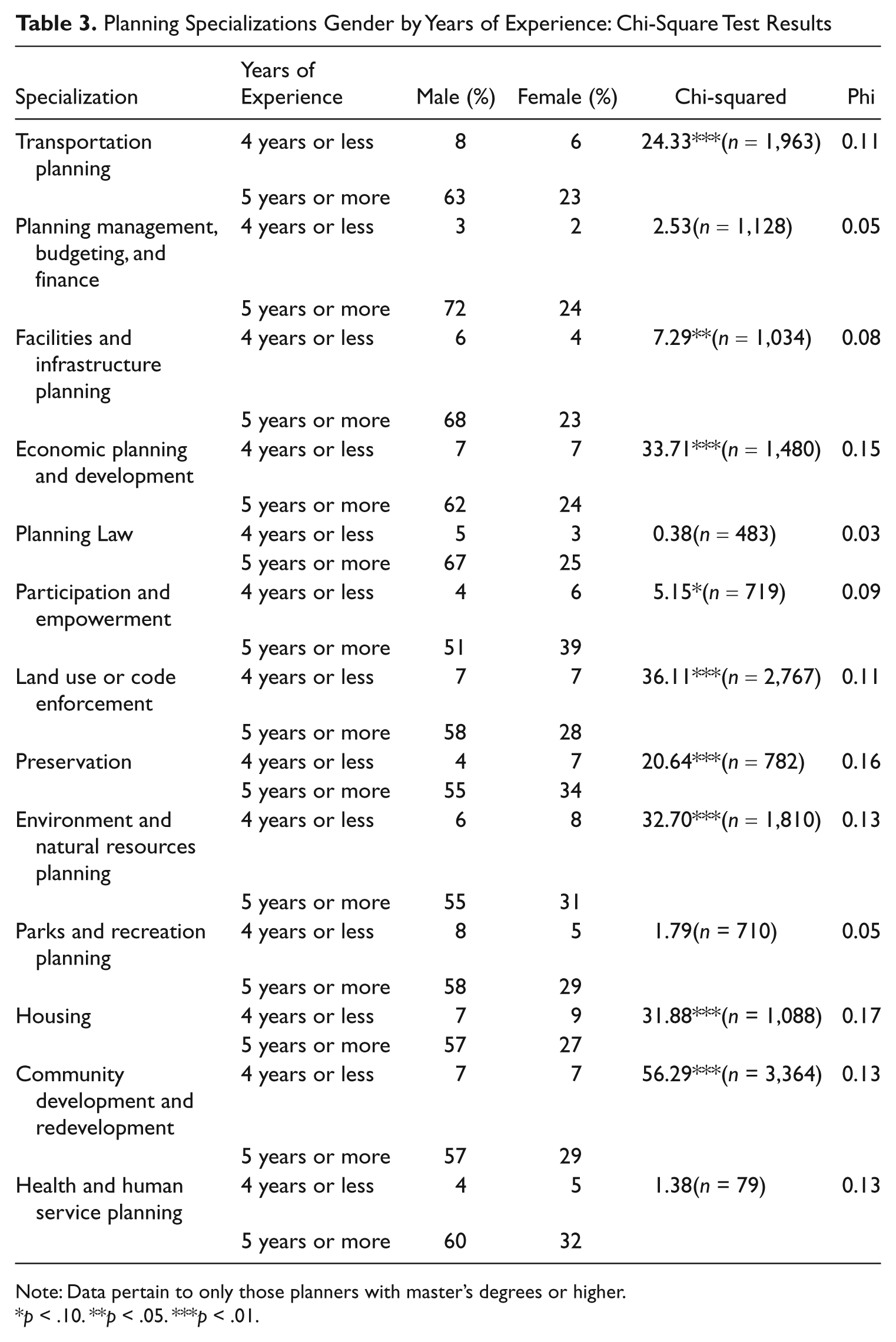
In general, the planning specializations follow patterns similar to those found in governmental agencies. However, the results may be due in part to years of experience. With planning’s past history as a male-dominated profession it may be that a greater number of men are simply more experienced than women, and thus there are more men than women in some specializations. To look at the role of experience in the specializations, Chi-square tests were conducted on 2 x 2 tables for each of the specializations by gender (male and female) and years of experience (those with 4 years or less experience and those with 5 years or more experience). As with Table 2, education level is controlled by only including data from respondents with master’s degrees or above. The results of this analysis are shown in Table 3. When looking at years of experience, the housing, the environmental, and the community development specializations show an association with gender, but in Table 2 they show no association. All the other specializations are consistently associated with gender across Tables 2 and 3 except for planning management and planning law that show no association with gender in Table 3. Based on the results shown in Table 3, it appears that experience should be taken into consideration before determining whether a specialization is sex-segregated or not.
Planning Specializations Gender by Years of Experience: Chi-Square Test Results
Note: Data pertain to only those planners with master’s degrees or higher.
p < .10. **p < .05. ***p < .01.
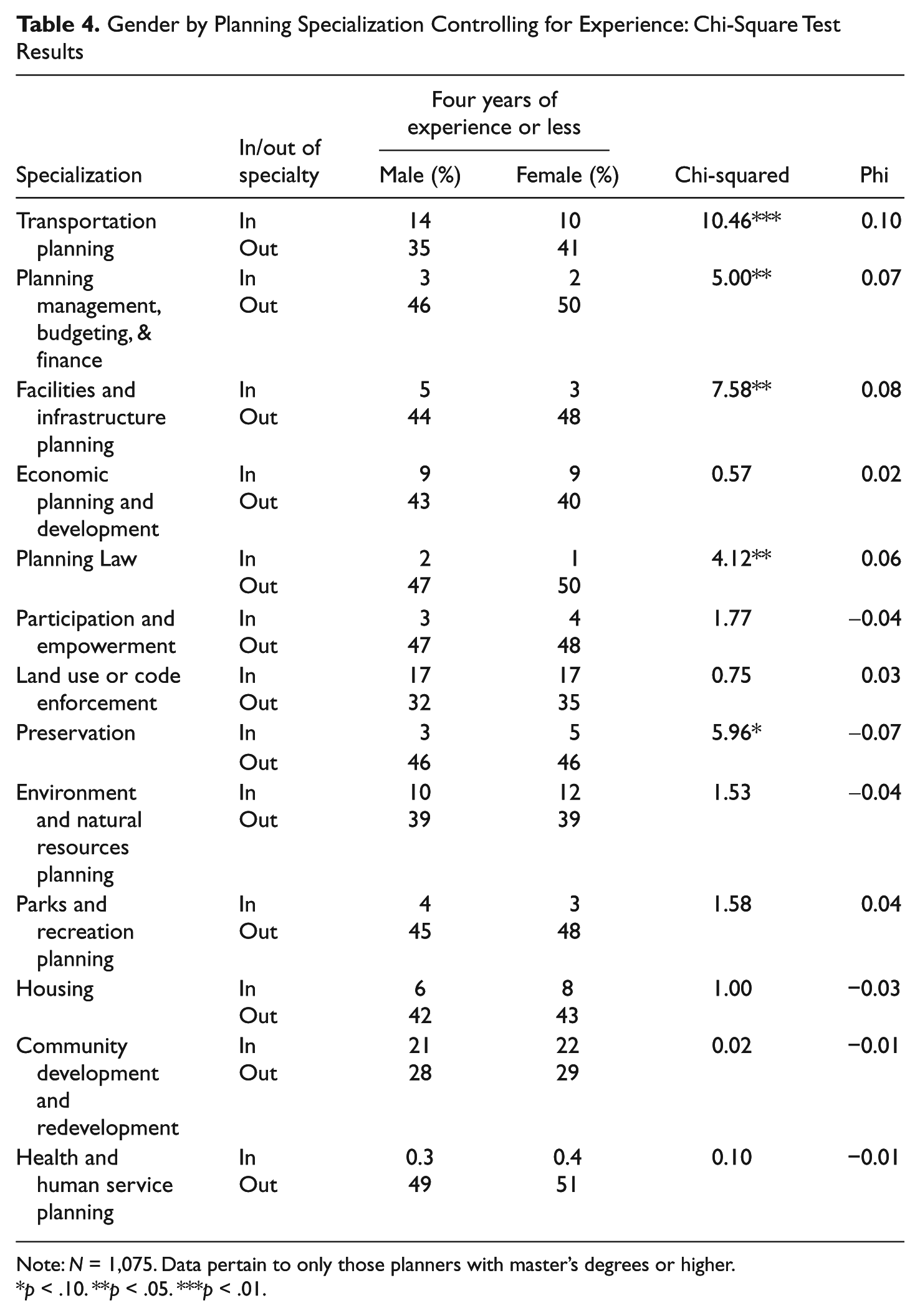
To test sex segregation by specialization but controlling for years of experience, Table 4 shows each of the specializations and gender, but only uses data from those with 4 years of planning experience or less (with master’s degrees or above). Thus, as far as education and experience are concerned, there is a “level-playing field” for men and women in the different specializations. The results of this analysis show transportation planning; planning management, budgeting, and finance; facilities and infrastructure planning; planning law; and preservation as specializations with statistically significant associations with gender. All have higher percentages of men than women in the specializations, except for preservation planning that has more women than men. Table 2 and Table 4 show that economic planning and development, participation and empowerment, and land-use or code enforcement are becoming more gender balanced with newer hires being more evenly distributed between men and women. The preservation specialization flips going from male dominance to female dominance. Corresponding with Sneed’s (2007) research showing financial administration and general control types of jobs as male dominated, the planning management, budgeting, and finance specialization continues to employ more men than women, even for new hires. Also in accordance with Lowi’s theory, transportation planning and facilities and infrastructure, classified as distributive policy areas, and planning law, classified as a regulatory policy area, are still male dominated. The redistributive policy area specializations (community development and redevelopment, housing, and health and human service planning) were expected to be more balanced vis-à-vis gender and they were. Some others do not perform as expected. The environment and natural resources planning and parks and recreation planning specializations show gender balance across Tables 2 and 4. Comparing Tables 2 and 4 not only shows where planning is becoming more gender balanced over time but also indicates some areas with room for improvement.
Gender by Planning Specialization Controlling for Experience: Chi-Square Test Results
Note: N = 1,075. Data pertain to only those planners with master’s degrees or higher.
p < .10. **p < .05. ***p < .01.
To fully understand how policy type influences the planning profession, we test one more variable. The research on the influence of policy type has historically focused on public sector jobs (Alkadry et al., 2002; Dolan, 2004; Kerr et al., 2002; Miller et al., 1999; Newman, 1994; Sneed, 2007). For this study, we are interested in how policy type influences a profession closely tied to the public sector. Based on Tables 2 and 4 it appears planning has followed some of the same-sex segregation patterns seen in previous research, but is getting better over time. Table 5 shows the patterns of sex segregation when controlling for private sector versus public sector planning jobs. Public sector planning jobs included in this analysis were those in the following categories: city planning agency, county planning agency, other public agency, state/federal agency, and metropolitan/regional agency. Private sector planning jobs included those respondents selecting—“private consulting firm” or “other nonpublic.” Table 5 shows the persistence of male dominance in transportation planning; planning management, budgeting, and finance; facilities and infrastructure planning; and planning law in the public sector. However, the only specialization showing male dominance in the private sector is facilities and infrastructure planning. Within the private sector, all but one of the specializations are gender balanced.
Gender by Planning Specialization Controlling for Experience and Sector: Chi-Square Test Results
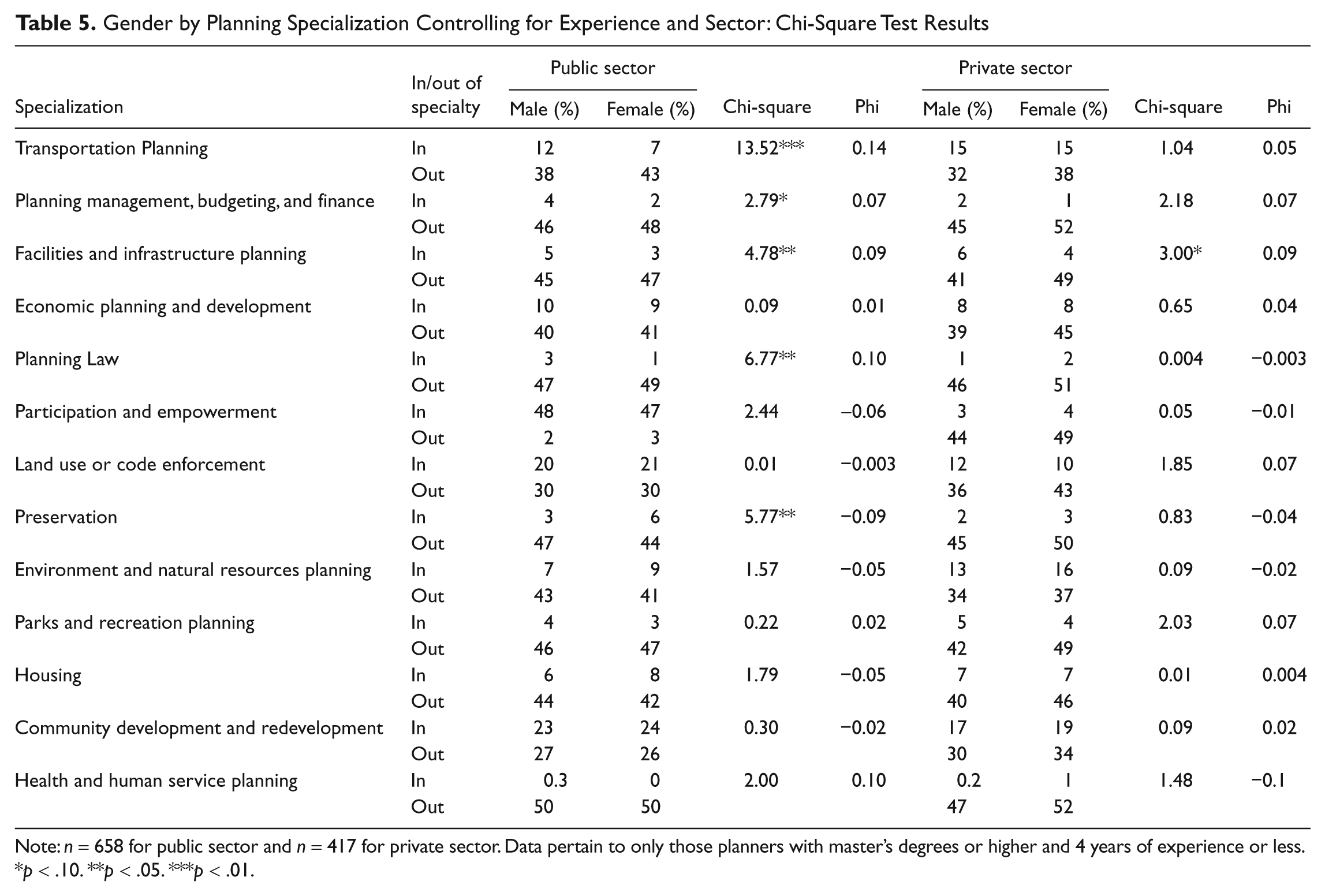
Note: n = 658 for public sector and n = 417 for private sector. Data pertain to only those planners with master’s degrees or higher and 4 years of experience or less.
p < .10. **p < .05. ***p < .01.
Discussion
This study asked the question, “Does policy type and patterns of sex segregation found in government agencies impact a whole profession closely tied to the public sector, such as urban planning?” Initial results (Table 2) displayed patterns similar to those in earlier research showing planning specializations in the regulatory, distributive, and constituent categories being male dominated and the three redistributive planning specializations being gender balanced. However, Table 4 indicated the patterns were perhaps holdovers from the past as new hires were only experiencing male-dominated sex segregation in the transportation planning; planning management, budgeting, and finance; facilities and infrastructure planning; and planning law specializations. When controlling for private sector employment, all of the sex segregation disappears except for facilities and infrastructure planning. In the public sector, male dominance persists in transportation planning (distributive policy type); planning management, budgeting, and finance (constituent policy type); facilities and infrastructure planning (distributive policy type); and planning law (regulatory policy type) specializations. The results indicate that even though the planning profession is tightly linked with government, sex segregation patterns by policy type do not spill over into the private sector.
Among the findings reported here, of particular interest are the preservation planning and land use or code enforcement specializations that are both classified as regulatory (male-dominated) policy areas. Looking at newer hires, the preservation planning specialization gender percentages flip from a higher percentage of men to a higher percentage of women. Also, the land use or code enforcement specialization has been male dominated in past planning surveys (Glasmeier & Kahn, 1989) but is gender balanced for new hires in this study. Reskin and Roos explain that two dynamics are at work when the sex compositions of occupations change over time. One dynamic is the development of “labor queues” or how employers favorably or unfavorably view different workers. The other dynamic is “job queues,” which is how workers favorably or unfavorably view different jobs. Generally, workers rank their job preferences based on pay, prestige, job security, good working conditions, and other factors such as opportunity for promotion (Reskin & Roos, 1990, p. 38). Women make inroads into male-dominated occupations when the “queues” change. Those changes occur due to job expansion (shortages of men to fill the positions), the reordering of men’s job preferences (salaries, benefits, and prestige in some male-dominated professions going down as compared to other professions open to men), and employers’ preferences reordering (rethinking attitudes toward the productivity of men vs. women, realizations that women will do the same jobs for less money, and the people making hiring decisions becoming more integrated). Further research is needed to look at these factors in relation to the preservation planning and land use or code enforcement specializations. However, it is noteworthy that, among the specializations discussed here, preservation planning and land use or code enforcement are the lowest-paid planning fields (see Table 6).
2006 and 2008 Income (Total Compensation) by Planning Specialization (4 Years or Less Experience and Master’s Degree or More Education)
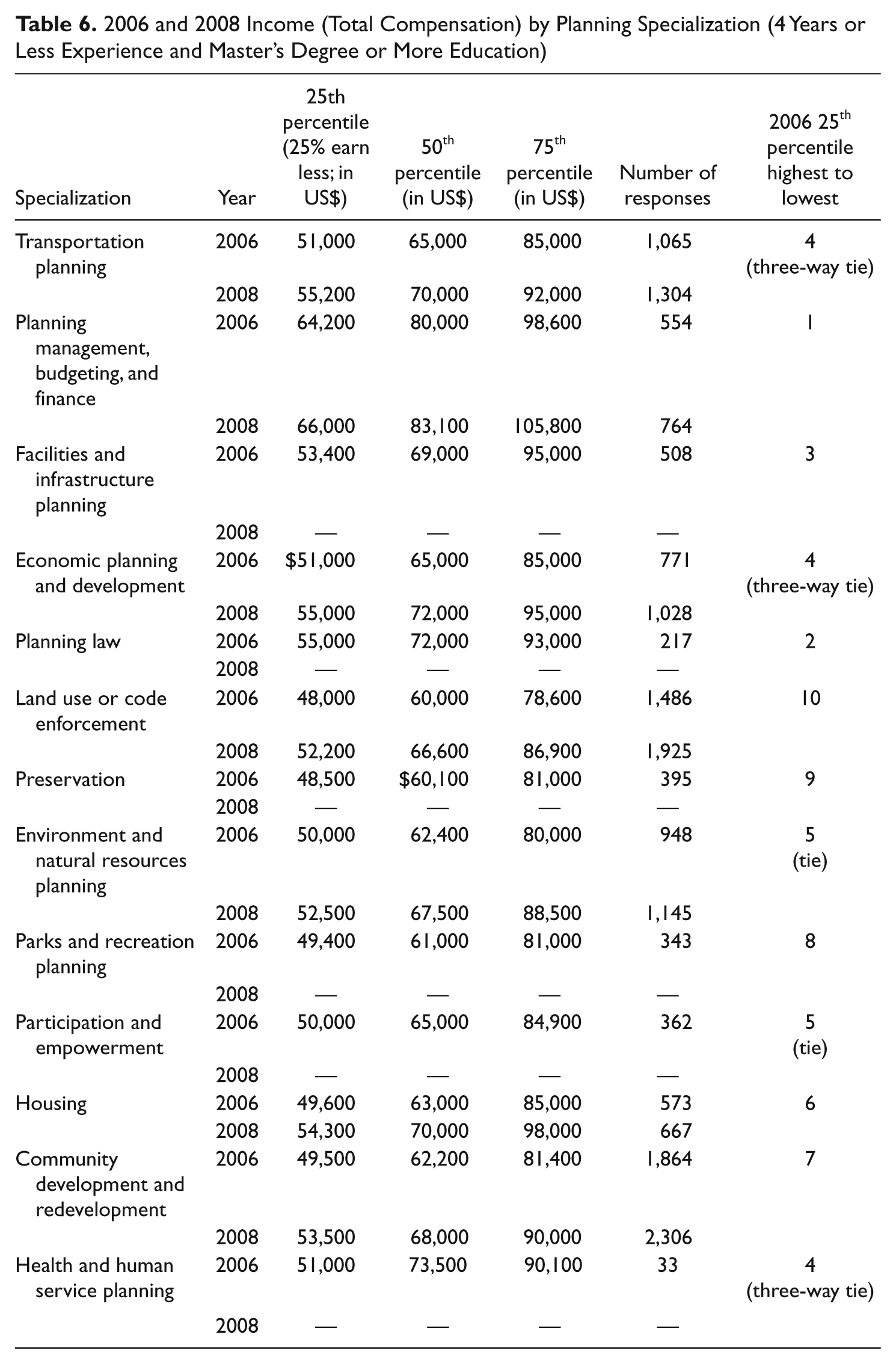
The three most highly paid specializations are those categorized as falling into male-dominated policy types, and they are the areas of planning that continue to show an association with men despite controlling for education and experience (planning management, budgeting, and finance; planning law; and facilities and infrastructure planning). It is encouraging that the fourth and fifth highest-ranked specializations by income are a mix of policy types and are more balanced in gender composition. The sole exception is transportation planning (tied for fourth place), which is in a male-dominated policy type. Particularly encouraging is the economic planning and development specialization. This is another specialization that becomes more gender balanced for new hires, but it is one of the better paying specializations.
In looking at Lowi’s policy typology and applying it to planning specializations, it is interesting to look at the areas (in the public sector) that were not male dominated as expected, such as those in or partially in the distributive category (parks and recreation, economic planning and development, environment and natural resources) and the participation and empowerment specialization in the constituent policy category. These indicate where public planning departments or agencies are different from the rest of the public sector. It does seem that planning’s emphasis on participation and advocating for the disadvantaged places, at least, some of the work of participation and empowerment specialists in the redistributive category (Davidoff, 1965/2003; Krumholz & Forester, 1990). Also, Lowi’s (1985) emphasis on constituent service providers being networked versus hierarchical shows an area where women would be expected to excel (Helgesen, 1990). For the economic planning and development category, perhaps women’s dominance in real estate sales (Thomas & Reskin, 1990) has influenced employment in this area. The last two distributive policy types (parks and recreation and environment and natural resources) may indicate areas that are becoming more redistributive over time. In planning, both of these specializations emphasize environmental justice and sustainability that balances equity, ecology, economy, and livability (Day, 2006; Friedmann, 1989; Godschalk, 2004; Haughton, 1999; Lee & Moudon, 2004; Talen & Anselin, 1998). The other distributive policy categories, transportation planning and facilities and infrastructure planning, show male dominance despite planning’s emphasis on equity in these areas (Deka, 2004; Krumholz & Forester, 1990; Levinson, 2002; Talen, 1998). These may be showcasing the pervasiveness of male dominance in science, technology, engineering, and mathematics or what are called “STEM” fields (Bystydzienski, 2004; Hersh, 2000).
Policy influences agency missions, and, thus, organizational cultures that can endure and maintain glass walls (Miller et al., 1999, p. 218), which means change can occur as policies change categories over time. The areas where planning performed better than expected may show planning’s emphasis on equity, social justice, and sustainability (Davidoff, 1965/2003; Godschalk, 2004), thus moving typically distributive or regulatory policy specializations into the redistributive category when it comes to urban planning policy.
Another way glass walls are broken is when job skills in one job are easily transferable to other jobs (Miller et al., 1999, p. 218), which is the case with planners. Once someone has proven that they are capable of successfully bringing stakeholders and teams of experts together and bring a project from idea to fruition (Brooks, 2002, p. 136), those skills are easily transferable within the planning profession. Also, in a 1999 survey of planners, 88% described themselves as “generalists” able to bring together skills from multiple specializations (Dalton, 2007, p. 43). The specializations in the public sector that continue to be male dominated may be the ones where it is hardest to transfer skills (transportation and infrastructure with an emphasis on engineering, law requiring a license, and management with the need for human resources or budgeting skills), but this does not explain the dynamic in the private sector where only one area is male dominated.
There are limitations to this study that deserve mention. It uses only 1 year of data and uses bivariate analyses. A multivariate analysis would be able to control for more variables and shed further light on factors such as age, race/ethnicity, salary, different types of public sector work (city, county, state, federal), and experience. In addition, a trend analysis would be most instructive.
Implications
“Researchers agree that no single theory can fully explain occupational segregation and that a combination of factors is responsible” (Sneed, 2007, p. 881). Nevertheless, Newman (1994, p. 284) explained well the usefulness of the Lowi policy typology lens for understanding glass walls, “at the very least, the peculiarities of mission and agency type are the silent partners in any analysis of structures of opportunity and gender.” Using policy type to understand gender differences between planning specializations not only shows areas of gender imbalance that public sector planners have in common with government agencies (transportation; planning management, budgeting, and finance; facilities and infrastructure planning; and planning law) but also shows areas where they are doing better than expected, particularly for new hires, (economic planning and development, land use or code enforcement, participation and empowerment, environment and natural resources planning, and parks and recreation planning). It also shows that planning in the private sector is making even more progress with only facilities and infrastructure planning showing male dominance.
The vast differences in sex segregation between the public and private sectors echoes what others have discussed in terms of needing more women in elected offices (McFarlane, 1995), in the public sphere (Stivers, 2002), and in positions of power, such as in transportation planning and planning management (Sandercock & Forsyth, 1992). The progress of female planners in the private sector reinforces findings that women are going into nontraditional planning positions (Dalton, 2007; Glasmeier & Kahn, 1989). As governments continue to contract out services (Osbourne & Gaebler, 1992; Sclar, 2000), the gender balance in planning’s private sector may start to influence planning’s public sector.
This study is only a beginning at understanding gender equity issues in the planning profession. The study showcases the usefulness of the policy–gender balance framework for evaluating patterns of gender employment for an entire profession. Fully understanding the glass walls in planning will not only include coming to terms with the influence of policy type on public sector planning but also delving deeper into individual choices, how different specializations are valued socially (Newman, 1994), the possible role planning education plays in why particular students choose certain specializations (Leavitt, 1983), the inclusion of gendered perspectives in planning education (Rahder & O’Neill, 1998), and dealing with gender imbalances among STEM fields (Jackson, 2004). This study also directs attention to the need for further research into planning specializations opening up to women, but possibly doing so only after decreases in compensation or when women seek private sector or nontraditional employment. The profession will also need to keep an eye on specializations “flipping” or becoming female dominated, which is not a sign of progress (Gross, 1968). As a field concerned with balanced economic and social developments, planning needs to be sensitive to external gender issues and their impact on communities. In order to be sensitive to external gender issues, planning must also be attentive to internal gender equity issues, including the question of how well women are integrated within professional planning practice across the public and private sectors.
Footnotes
Acknowledgements
The authors wish to thank the reviewers, Kirk McClure, Nicholas P. Lovrich, Jr., and William Budd for their guidance.
The authors declared no potential conflicts of interest with respect to the research, authorship, and/or publication of this article.
The authors received no financial support for the research, authorship, and/or publication of this article.