







Abstract
Given that an employee’s personal responsibilities can have an effect on their work, one method increasingly used by government agencies to improve performance has been to offer programs that assist workers in balancing work and personal obligations. Employee demand for such work-life programs is also increasing due to the growing amount of women in the workplace, two-career families, and workers wanting a greater ability to manage work and life. Yet despite the increase in supply and demand for work-life programs, empirical examinations regarding the benefits of these programs in government agencies are scarce. As a result, this article examines the association between employee satisfaction with work-life programs and two important factors that drive work motivation: organizational commitment and job involvement. Data was obtained from the 2010 Federal Employee Viewpoint survey, and the results from the analysis extended previous literature in several important ways. First, work motivation was not consistently affected by employee levels of satisfaction with work-life benefits in federal agencies. More specifically, employee satisfaction with most work-life benefits (i.e., telework, health and wellness programs, child care, and older adult care) were positively associated to organizational commitment, and none were associated to job involvement. Next, organizational commitment was influenced more by family-friendly programs and health and wellness programs than by flexible working arrangements. The implications of these findings are detailed in the study.
Keywords
Public organizations are constantly searching for ways to improve the productivity of workers. Given that an employee’s personal responsibilities can have an effect on their work, one method increasingly used by government agencies to improve performance has been to offer programs that assist workers in balancing work and personal obligations. Employee demand for such work-life programs is also increasing due to the growing amount of women in the workplace, two-career families, and workers wanting a greater ability to manage work and life responsibilities (Baltes, Briggs, Huff, Wright, & Neuman, 1999). For instance, the percent of eligible employees’ teleworking in U.S. federal agencies increased from 8.7% to 10.4% from 2008 to 2009 alone (Office of Personnel Management, 2010).
Yet despite the increase in supply and demand, empirical examinations regarding the benefits of work-life programs in government agencies are scarce, with only a few notable examples. Harrick, Vanek, and Michlitsch (1986) conducted a longitudinal study on federal government employees taking part in alternate work schedules and found that it negatively affected leave usage and positively affected satisfaction with work schedules. On the other hand, the researchers did not find that it increased objective measures of productivity. Durst (1999) surveyed 110 federal, state, and local government employees, and the findings revealed that most employees perceived performance increased, turnover decreased, and recruitment was improved due to implementation of family-friendly programs. Using data from city employees, Facer and Wadsworth (2008) found that employees perceived that alternate work schedules increased their productivity and their ability to deliver services, while lowering work–family conflict. However, the authors failed to find an association between these work schedules and job satisfaction. And Wadsworth, Facer, and Arbon (2010) surveyed human resource directors in 151 city government agencies and found that these managers believed that alternate work schedules had more organizational and employee benefits (e.g., morale and work–life balance) than drawbacks.
When taken together, the results of these aforementioned studies suggest that work-life programs are generating net benefits. Nevertheless, what is missing is an examination into how these net benefits (i.e., employee satisfaction with work-life programs) affected work motivation. Furthermore, such an examination is critical not only because research is lacking in this area but also because satisfaction with work-life programs may be the “missing link” that leads to higher work motivation (i.e., higher commitment, performance, and retention), which is the rationale behind the adoption of these programs. For instance, research regarding the connection between performance and work-life programs is mixed (Durst, 1999; Facer & Wadsworth, 2008; Harrick et al., 1986). One explanation for the varied results is that performance was measured differently, that is, subjectively (based on perceptions) versus objectively. Another could be that these programs were ill-designed and did not meet the needs of employees; employee productivity would, therefore, not be expected to increase in such programs. In other words, previous research focused on whether or not someone’s performance increased when participating in work-life programs, while overlooking satisfaction with these programs, which may be the impetus that leads to elevated performance. As a result, this article examines the association between factors that propel work motivation and employee satisfaction with work-life programs (i.e., child care, older adult care, and health and wellness) that are scarcely mentioned in human resource literature (Perry, 2010) and in public administration motivation literature.
This article is structured in the following manner. First, work-life programs are described along with their presumed benefits to workers and organizations. Second, the theory of work motivation and two of its factors (organizational commitment and job involvement) are explained and hypotheses pertaining to work-life programs and organizational commitment and job involvement are proposed from the literature. Third, the survey administration, as well as the dependent and explanatory factors employed in the model, is detailed in the Method section. Fourth is the Results section, which explains the findings from the survey. Finally, a discussion of the implications from the findings, conclusion, and limitations is presented.
Work-Life Programs
Organizations utilize many work-life programs to assist employees in balancing work and personal responsibilities. These programs can be grouped into flexible working programs, family-friendly programs, and health and wellness programs.
Flexible working programs are those that give employees the flexibility needed to better balance work and life, such as flextime, compressed workweek, and telecommuting. Under flextime, employees have the latitude to determine when they begin and end their workday, while still working a standard 8-hr day. But, there is at least one requirement: Employees utilizing this arrangement are typically required to be present during common core blocks of time (e.g., 10:00 to 11:00 and 1:00 to 2:00) to ensure full participation in certain activities, like department meetings (Wadsworth et al., 2010).
In addition, flextime is the most common flexible working benefit organizations offer (Society for Human Resource Management [SHRM], 2009) for several reasons. The first is that flextime has been positively linked to productivity, job satisfaction, and attendance (Baltes et al., 1999). Second, organizations utilizing this arrangement are able to have workers present for longer portions of the workday, meaning citizens can be served outside of normal work hours. The last reason is that flextime affords employees an ability to manage personal duties.
This program is not without shortcomings. For instance, managers may have a difficult time balancing employee scheduling needs with those of customers (Wadsworth et al., 2010). Teamwork, which is important in organizations, may also be disrupted during certain periods of the day when workers are not present.
In the second category of flexible working schedules, compressed work schedules are those that allow employees to work less than 10 days in a biweekly pay period, with employees typically exceeding 8 hr each workday. The most prevalent compressed work schedule is 10-hr days, with Mondays or Fridays off, resulting in a 3-day weekend. Unlike flextime, beginning and ending times are generally fixed, indicating that the work schedule is the same for all employees participating in this flexible arrangement.
Some benefits of compressed work schedules are an extended weekend and, therefore, an extra day off to take care of personal needs. Since compressed work schedules require employees to work more than 8 hr a day, a potential problem is employees could experience fatigue. Nonetheless, research examining this association suggests compressed work schedules actually reduce fatigue (Facer & Wadsworth, 2008; Pierce & Dunham, 1992), probably owing to employees having a long weekend in which to relax and recharge. Another potential problem with compressed work schedules is that customer service may be affected on Mondays and Fridays when fewer employees are working.
Finally, telecommuting, the final category of flexible working programs, refers to employees performing some or all of their duties away from the traditional office by using information and communication technology (ICT), resulting in work being done from home, at a designated regional satellite office, or anywhere the employee is able to connect to an ICT (Baruch, 2001). Although the telecommuting location is usually established by the organization, the frequency in which they telecommute is typically the result of negotiations between organizations and employees.
Similar to the first two categories, the benefits of telecommuting include greater quality of life, mainly because employees are able to work on their own time (Baruch, 2000; Major, Verive, & Joice, 2008; Maruyama, Hopkinson, & James, 2009; U.S. General Accounting Office, 2003). On the other hand, the drawbacks are that, because they are often physically away from coworkers and supervisors, telecommuters tend to feel isolated and experience problems communicating and understanding information using ICT (Crandall & Gao, 2005).
However, telecommuting has the potential to provide greater benefits in comparison to the other flexible working arrangements, depending on the frequency in which employees telecommute. For instance, frequent telecommuting reduces organizational costs, because organizations do not have to provide office space for all employees (Bailey & Kurland, 2002; Crandall & Gao, 2005; Martinez-Sanchez, Perez-Perez, de-Luis-Carnicer, & Vela-Jimenez, 2007). Since frequent telecommuters do not have to live in the area, it strengthens the organizations’ ability to recruit individuals outside of the geographical location (Crandall & Gao, 2005). Telecommuting is also highly sought after, affording organizations the ability to recruit the most qualified individuals (Potter, 2003). In addition, teleworkers commute less than traditional workers (especially so if done full-time), thereby reducing traffic congestion, accidents, and dependence on gas (Crandall & Gao, 2005; Harpaz, 2002; Mello, 2007).
The second category of work-life programs is family-friendly benefits, which include child care and older adult care. In federal agencies, in particular, child care assistance consists of on-site services, resource and referral services, and subsidies. 1 Because the majority of single parents are in the labor force and since 60% of nuclear families have both parents employed, child care benefits can boost recruiting and job satisfaction (SHRM, 2009). These organizational benefits can also enhance quality of life, as costs are often subsidized by agencies and commute times are reduced when on-site care is available.
Older adult care is an increasing concern for today’s workers. The Society for Human Resource Management (2009) reported that about 20% of families provide some care to a senior relative or friend. Older adult care programs are designed to assist employees in balancing work and caregiving responsibilities. Such programs include flexible spending accounts, support groups, and resources for health insurance, health care, housing options, legal assistance, and financial matters (e.g., Social Security and wills). 2 Older adult care programs primarily encompass support and assistance, even though flexible spending accounts can offset some of the cost associated with care for older adults. Similar to child care, care for older adults can assist in recruiting and job satisfaction.
The final category of work-life programs is health and wellness. Health and wellness programs encompass health fairs, newsletters, preventative programs, fitness centers, life coaches, weight loss programs, stress management programs, and premium discounts for avoiding certain behaviors (SHRM, 2009). With scarce resources and escalating health care costs, public organizations have initiated these types of programs because they are designed to lower the cost of insurance premiums by reducing adverse health outcomes. Improved health outcomes reduce the amount of sick days, suggesting that health and wellness programs are positively associated with productivity as well (Benavides & David, 2010).
In terms of availability, SHRM (2009) reports that 72% of organizations offer employees wellness information and resources and that 59% offer some type of wellness program. The federal government has also strongly supported wellness programs by adopting many of the ones listed above, 3 which vary by agency. With that backdrop, the discussion now turns to the theory of work motivation.
Work Motivation
The theory of work motivation refers to those intrinsic and extrinsic factors that impel choice, effort, and persistence of employee action (Locke & Latham, 2004). According to another definition, “Work motivation . . . is a process by which the employee decides to work hard and sustain his/her efforts” (Anderfuhren-Biget, Varone, Giauque, & Ritz, 2010, p. 216). Although work motivation is typically defined broadly (Ritz & Waldner, 2011; Wright, 2004), one conventional way of operationalizing it is by using the constructs organizational commitment and job involvement. Locke (1997) conducted an extensive review of work motivation theories and suggested that organizational commitment and job involvement are vital to explaining and characterizing this concept. More recently, when examining public agencies, Moynihan and Pandey (2007) operationalized work motivation by employing several separate multiitem scales, including organizational commitment and job involvement, and Wright (2004) and Anderfuhren-Biget et al. (2010) incorporated items related to organizational commitment and job involvement in their overall work motivation measures. As a result, a similar path is taken here and organizational commitment and job involvement are used to operationalize work motivation.
Allen and Meyer identified three facets of organizational commitment in the literature. Affective commitment refers to “a strong belief in and acceptance of the organization’s goals and values; a willingness to exert considerable effort on behalf of the organization; and a definite desire to maintain organizational membership” (Porter, Steers, Mowday, & Boulian, 1974, p. 604). Continuance commitment is when there are benefits associated with remaining in the organization (e.g., pay and promotion) and costs associated with quitting, resulting in the recognition that it will cost more to leave than to stay (Allen & Meyer, 1990). Last, normative commitment, the facet examined in this article, “is viewed as the totality of internalized normative pressures to act in a way that meets organizational goals and interests” (Wiener, 1982, p. 421). Another way of characterizing it is that a worker “should be loyal to his organization, should make sacrifices on its behalf, and should not criticize it” (Wiener & Vardi, 1980, p. 86). Thus, normative commitment is distinguished from the other two types of commitment in that it emphasizes “an employee’s formal and informal responsibility” rather than an “attachment to the organization” or a weighing of costs and benefits (Park & Rainey, 2007, p. 199). Even though these three types of organizational commitment are exclusive of one another, normative commitment is examined instead of the others because it is a general way of conceptualizing commitment (Lee & Whitford, 2007) and because each type has a similar effect on such organizational factors as performance (Park & Rainey, 2007). Therefore, normative commitment is a reasonable facet of organizational commitment.
The other factor, job involvement, is defined as the extent to which a person identifies psychologically with their work or the degree to which their work is essential to one’s self-image (Lodahl & Kejner, 1965, p. 24). Other researchers operationalize job involvement as being absorbed in work (Reid, Riemenschneider, Allen, & Armstrong, 2008) and satisfying vital needs (Moynihan & Pandey, 2008). Moreover, job involvement is “dependent on the extent to which his or her job satisfies his or her own needs” (Word & Park, 2009, p. 109).
Organizational commitment/job involvement and satisfaction with work-life programs
The association between organizational commitment/job involvement and work-life programs has been explained using the theory of work adjustments, which was developed by Dawis et al. (Dawis, Lofquist, & Weiss, 1968). According to this theory, “Each individual seeks to achieve and maintain correspondence with” their work environment, where correspondence is the point at which a mutual exchange is made between the worker and their employer or the degree to which both the employee and employer’s requirements are attained. For instance, workers are required to bring vital skills, abilities, and performance to the workplace. In return, the worker expects to receive such extrinsic rewards as merit increases and promotions, as well as those benefits that afford the worker a greater ability to manage work and personal obligations, that is, work-life benefits (Pierce & Newstrom, 1980).
In this theory, the worker is “satisfactory” when they achieve work requirements and “satisfied” when the organization meets the worker’s expectations. Furthermore, the attainment of correspondence (the level at which both satisfactoriness and satisfaction are achieved) increases the likelihood that the employee will remain with the organization (Dawis et al., 1968). Therefore, retention is the outcome of correspondence, with satisfactory inversely related to the likelihood of being fired or forced out and satisfied inversely associated to the likelihood of quitting. Since research indicates that employees are less likely to leave when they are satisfied with their jobs, empirical support is found for the latter proposition of the theory of work adjustments (e.g., Moynihan & Landuyt, 2008).
Pierce and Newstrom (1980) later extended the theory of work adjustments. In their view correspondence (or satisfaction) with work-life benefits not only increases retention but also enhances organizational commitment, job involvement, and quality of life while reducing stress and fatigue. Therefore, their proposition is that satisfaction with work-life programs and organizational commitment/job involvement are positively related. In a study involving police officers whose shift changed from a standard workweek to a compressed one, Pierce and Dunham (1992) confirmed components of their proposition but failed to validate the positive association to organizational commitment and job involvement. Specifically, positive outcomes resulted (namely, lower stress and fatigue levels, improvement in work–life balance, satisfaction with the arrangement, and job satisfaction) after changing to a compressed work schedule. However, the scholars only examined the size of the variation in each variable once the schedule changed and not the connection between satisfaction with this arrangement and organizational commitment and job involvement, which is more consistent with the theory of work adjustments. As a result, the following hypotheses are proposed:
Hypothesis 1: Satisfaction with telework will be positively related to organizational commitment/job involvement.
Hypothesis 2: Satisfaction with alternative work schedules (flextime/compressed work schedule) will be positively related to organizational commitment/job involvement.
Hypothesis 3: Satisfaction with health and wellness benefits will be positively related to organizational commitment/job involvement.
Hypothesis 4: Satisfaction with child care programs will be positively related to organizational commitment/job involvement.
Hypothesis 5: Satisfaction with older adult care programs will be positively related to organizational commitment/job involvement.
Research also suggests that employees’ level of organizational commitment increases as they perceive more support from their organization (Eisenberger, Armeli, Rexwinkel, Lynch, & Rhoades, 2001). Therefore, high support from the organization engenders a high level of commitment from workers, medium support engenders a medium level of commitment, and low levels of support lead to low levels of commitment. Since some work-life benefits provide more support to employees than to others, the programs workers perceive as providing the greater support may also produce the higher levels of commitment/involvement from employees than the ones providing less support. This means the satisfaction with some work-life benefits will have a greater impact on work motivation than others depending on the level of worker satisfaction. Although such comparisons were not found in the literature, flexible working benefits, in general, are expected to have larger effect sizes than family-friendly benefits because these benefits, in aggregate, seem to provide workers with a greater ability to manage work and life than do family-friendly benefits and health and wellness benefits. Telecommuting, in particular, is also expected to have a greater impact than the other work-life benefits because it seems to give employees more flexibility (i.e., a greater ability to balance work and personal obligations) than the other work-life programs. Furthermore, comparing the impact of each work-life benefit on organizational commitment and job involvement is important, as it allows a determination to be made regarding the wisdom of using some of these benefits to impel work motivation. Therefore, the hypotheses are,
Hypothesis 6: The impact will be larger between employee satisfaction with flexible working arrangements and organizational commitment/job involvement than it will be between family-friendly benefits and commitment/job involvement and health and wellness benefits and commitment/job involvement. Hypothesis 7: The impact will be larger between employee satisfaction with telecommuting and organizational commitment/job involvement than it will be between the other work-life benefits and commitment/job involvement.
Method
To test the hypotheses, data were derived from the 2010 Federal Employee Viewpoint Survey, which is designed to find out how to improve job satisfaction, commitment, engagement, and ultimately the achievement of agency missions. The U.S. Office of Personnel Management (OPM) is responsible for administering the survey, and it did so over the Internet during February and March of 2010 to permanent full-time workers in U.S. cabinet and independent agencies. OPM sent follow-up letters to remind employees to complete the online survey. Of the 504,609 surveys that were sent, 263,475 were completed and returned for a 52% response rate. 4 The 2010 Federal Employee Viewpoint Survey was chosen over others for several reasons. The first is that it was a large-scale survey, encompassing numerous departments and functions, making the results generalizable to other governments. Next, it provided more information about work-life benefits as well as employee and organizational related factors. Last, the U.S. federal government has focused heavily on offering and improving these programs, and, therefore, it is interesting to see the extent to which these efforts were realized. Following are the dependent variables and the items from the survey that were used to measure them.
Dependent Variables
As previously mentioned, the work motivation factors organizational commitment and job involvement were chosen because they are important predictors of performance (Chen & Francesco, 2003; Chughtai, 2008; Hunter & Thatcher, 2007; Shih, Chiang, & Hsu, 2010).
Organizational commitment
In the sample organizational commitment was measured using a normative-type 5-point Likert-type multiitem scale. Since a central way of conceptualizing commitment is that an employee “should be loyal to his organization, should make sacrifices on its behalf, and should not criticize it” (Wiener & Vardi, 1980, p. 86), the chosen items were “I recommend my organization as a good place to work”; “I have a high level of respect for my organization’s senior leaders”; and “In my organization, leaders generate high levels of motivation and commitment in the workforce.” This scale is also nearly identical to the normative commitment scale used by Lee and Whitford (2008). Furthermore, the three items were then averaged and the Cronbach’s alpha was .87 for the scale. It is important to note that this scale is not a perfect measure of normative commitment, which is usually the case when government surveys are used for scholarly purposes. Caution should, therefore, be used when interpreting the results. However, the goal was to construct a variable resembling commitment from which researchers could build upon.
Job involvement
The other factor that propels work motivation, job involvement, was also measured using a multiitem scale. The exact scale is, “My work gives me a feeling of personal accomplishment,” and “I like the kind of work I do.” These two items were also averaged and the Cronbach’s alpha for the scale was .79. Furthermore, the scale is similar to the concept of job involvement that was put forth by Lawler and Hall (1970) who described it as the degree to which work is important to the employee’s identity. 5 Similar to organizational commitment, this scale is not an exact measure of job involvement, and, therefore, the same caution applies.
To find out whether these measures were distinct, a factor analysis was performed. The Varimax rotation was predictable, revealing that the individual items representing organizational commitment loaded on a different factor than the items for job involvement. This suggests these measures are different constructs that can be modeled separately.
Independent Variables
Control variables
Several control variables were included in the model. Respondent characteristics are included because they are presumed to have an effect on commitment and job involvement (Moynihan & Pandey, 2007). These factors are gender (1 = male, 0 = female), minority (1 = minority, 0 = nonminority), age (1 = 29 and younger; 2 = 30-29, 3 = 40-49, 4 = 40-59, 5 = 60 or older), tenure with government (1 = less than 1 year, 2 = 1-3 years, 3 = 4-5 years, 4 = 6-10 years, 5 = 11-14 years, 6 = 15-20 years, and 7 = more than 20 years), and supervisor (1 = supervisor or manager, 0 = nonsupervisory).
Work motivation explanatory variables
Several independent variables were included in the model. These factors represent job characteristics and human resource factors that were found in the survey and that have been used to predict organizational commitment and job involvement in models (e.g., Locke & Latham, 2004). The first job characteristic variable is role ambiguity, a measure of the extent to which employee responsibilities and duties are unclear. Role ambiguity has been found to be inversely associated to work motivation factors because it is a stressor; that is, time and energy needed to perform well are instead devoted to trying to figuring out roles and expectations. In fact, role ambiguity is an important obstacle to organizational commitment and job involvement (Caillier, in press; Gilboa, Shorom, Fried, & Cooper, 2008). To measure role ambiguity, a scale similar to the one developed by Rizzo, House, and Lirtzman (1970) was employed. The items were, “I have enough information to do my job well” (reversed), and “I know what is expected of me on the job” (reversed), and the Cronbach’s alpha was .74.
The second independent variable used in the study was the job characteristic variable, empowerment, and it has also been found to have an impact on attitudes that propel work motivation (Caillier, in press; Gould-Williams & Davies, 2005). The item used to measure empowerment was, “Employees have a feeling of personal empowerment with respect to work processes.” Third, employees have high levels of commitment and involvement when they receive support from managers (Caillier, in press; Gould-Williams & Davies, 2005). As a result, the following item was employed from the survey, “My supervisor/team leader provides me with constructive suggestions to improve my job performance.” Fourth, employee workload was examined because exhausted workers have low levels of commitment and involvement (Caillier, in press; Cole, Panchanadeswaran, & Daining, 2004). The item that was used to measure workload was, “My workload is reasonable.” Finally, employees are more motivated to work when they are satisfied with their jobs (e.g., Locke & Latham, 2004; West & Berman, 2009). Job satisfaction was, therefore, included using the following item: “Considering everything, how satisfied are you with your job?”
Several human resource measures were examined as well. The first such measures encompassed employees’ level of satisfaction with each of the five work-life programs. The first two programs representing flexible working arrangements were telecommuting, “How satisfied are you with the following Work/Life programs in your agency . . . Telework?” and alternative work schedules, “How satisfied are you with the following Work/Life programs in your agency . . . Alternative Work Schedules?” It is important to note that alternative work schedules (AWS) in the federal government refer to compressed work schedules and flextime. Therefore, the latter item combines both types of work schedules.
Family-friendly benefits were also examined. Specifically, this encompassed child care programs, “How satisfied are you with the following Work/Life programs in your agency . . . Child Care Programs?” and older adult care programs, “How satisfied are you with the following Work/Life programs in your agency . . . Elder Care Programs?” The fifth and final work-life benefit was health and wellness programs. The item that was used to measure this factor was, “How satisfied are you with the following Work/Life programs in your agency . . . Health and Wellness Programs?”
Concerning the scale for the work-life programs, employees were given the following choices: 1 = very dissatisfied, 2 = dissatisfied 3 = neither satisfied nor dissatisfied, 4 = satisfied, 5 = very satisfied, and X = no basis to judge. Obviously, employees were only included in the sample when they reported satisfaction levels 1 to 5. However, a reporting of a satisfaction level does not necessarily indicate that the employee actually participated in the program. Therefore, satisfaction based on familiarity of programs was measured rather than usage, with the rationale that these programs are valuable to employees, even if they do not use them now. For instance, a worker who plans on having children may choose an agency based on the type of child care program that is offered. This same worker may also be more committed to and involved in their job because they like the program. Furthermore, this approach is somewhat similar to others in that they did not restrict their models just to those utilizing these arrangements (e.g., McNall, Masuda, & Nicklin, 2010). However, it is important to mention that they examined availability instead of what is measured here: familiarity.
The next human resource factor was the degree to which employees were satisfied with their pay, “Considering everything, how satisfied are you with your pay?” Although government workers are presumed to be less motivated by pay than those in the private sector (e.g., Perry & Wise, 1990), satisfaction with pay is still an important factor that can affect motivation (Caillier, in press). And the last factor was employee satisfaction with their training, “How satisfied are you with the training you received for your present job?”
To summarize, Figure 1 is provided to illustrate the variables and their expected effects on work motivation. Since quantitative approaches are more appropriate in analysis focused on testing theoretical relationships among variables, such an approach was utilized here. Moreover, quantitative approaches have the added advantage over qualitative ones in that they are more objective and free from inherent bias, that is, postpositivism (Onwuegbuzie, Johnson, & Collins, 2009).
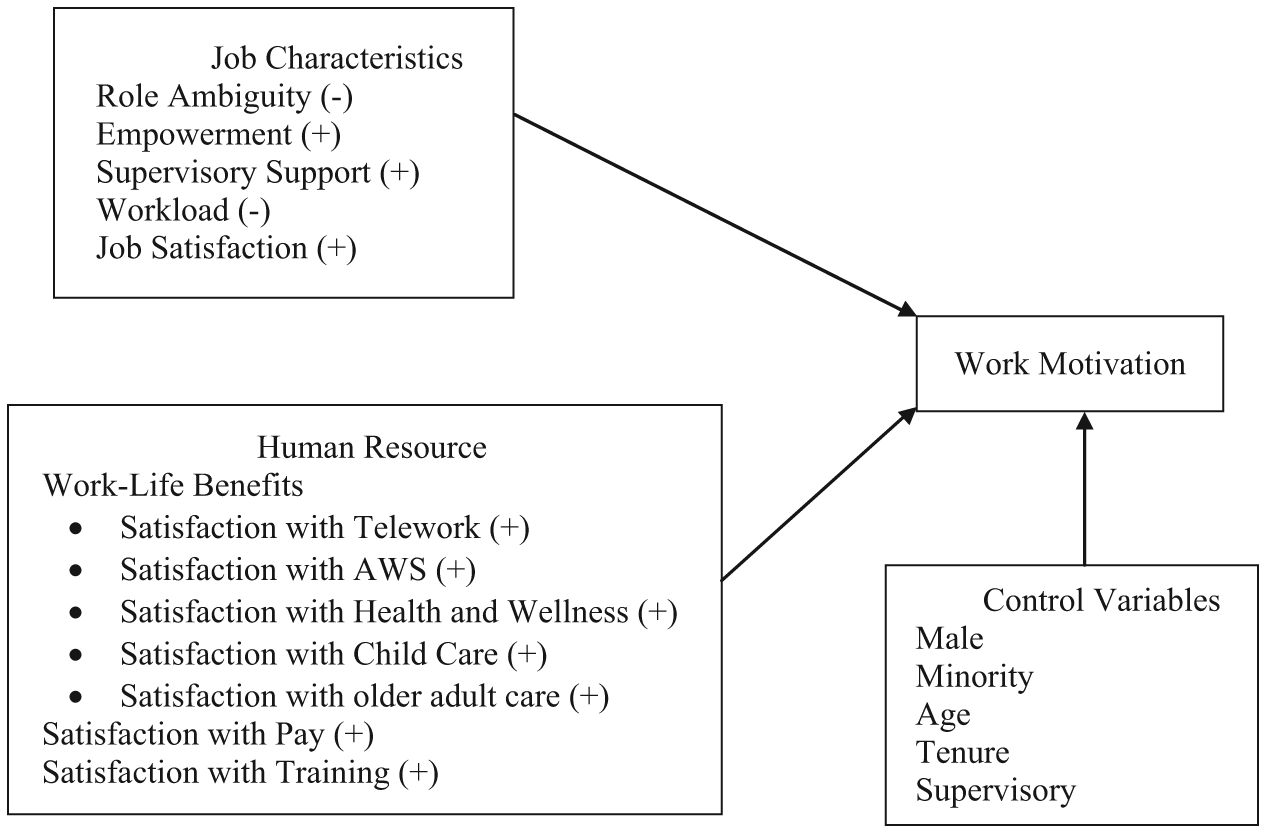
Theoretical research model.
Results
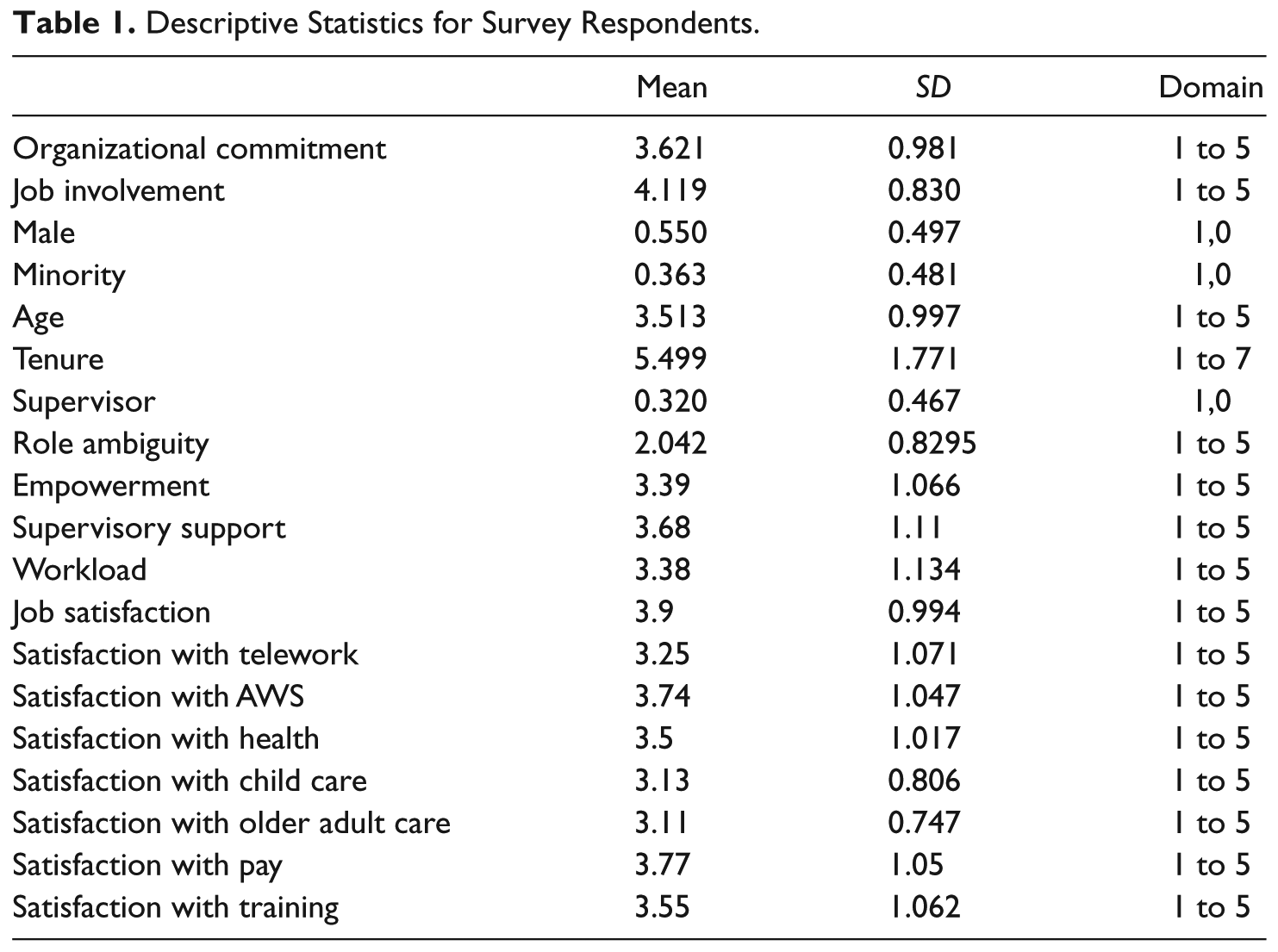
Table 1 details the descriptive statistics for the sample’s measures (mean, standard deviation, and domain), and correlations and reliabilities are provided in Table 2. In Table 1, it is clear that workers reported higher job involvement levels than organizational commitment. In addition, there is a high correlation between “Satisfaction with Older Adult Care” and “satisfaction with child care” (r = .817) in Table 2, suggesting that these two variables are strongly related. (More will be mentioned about this relationship later.) This table also demonstrates that role ambiguity, empowerment, supervisory support, and job satisfaction are strongly related to the dependent variables’ organizational commitment and job involvement.
Descriptive Statistics for Survey Respondents.
Measures of Correlations and Reliabilities of Variables.
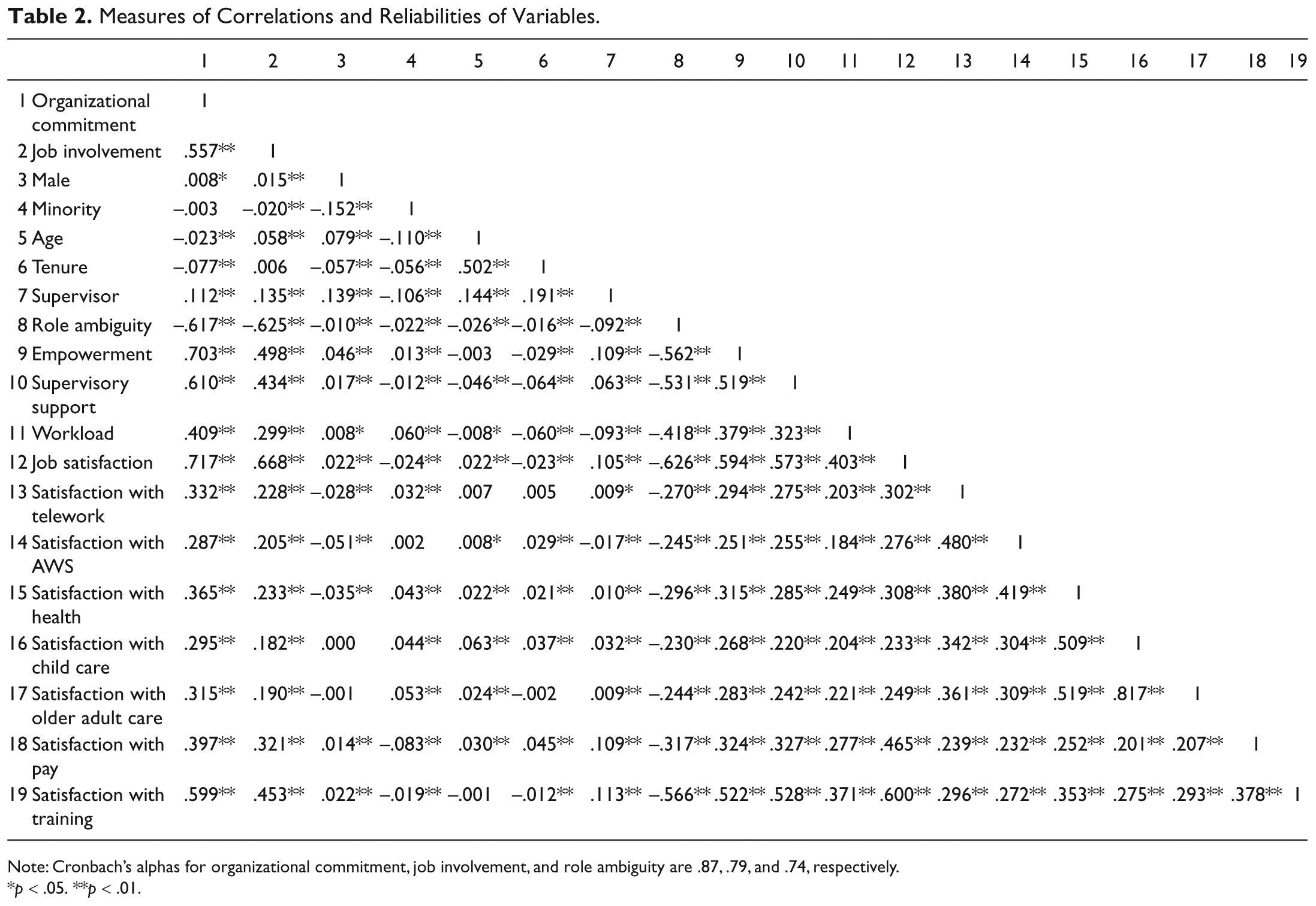
Note: Cronbach’s alphas for organizational commitment, job involvement, and role ambiguity are .87, .79, and .74, respectively.
p < .05. **p < .01.
Since some of the variables were highly correlated, a variance inflation factor (VIF) was employed to determine the level of multicollinearity in the model and it revealed that the highest dimension was 3.1, well within the acceptable limit of 3.4 (Diamantopoulos & Siguaw, 2006). Thus, multicollinearity is not a problem in the model and, as a result, the final models contain each of the aforementioned correlated variables, including empowerment, role ambiguity, job satisfaction, satisfaction with child care, and satisfaction with older adult care.
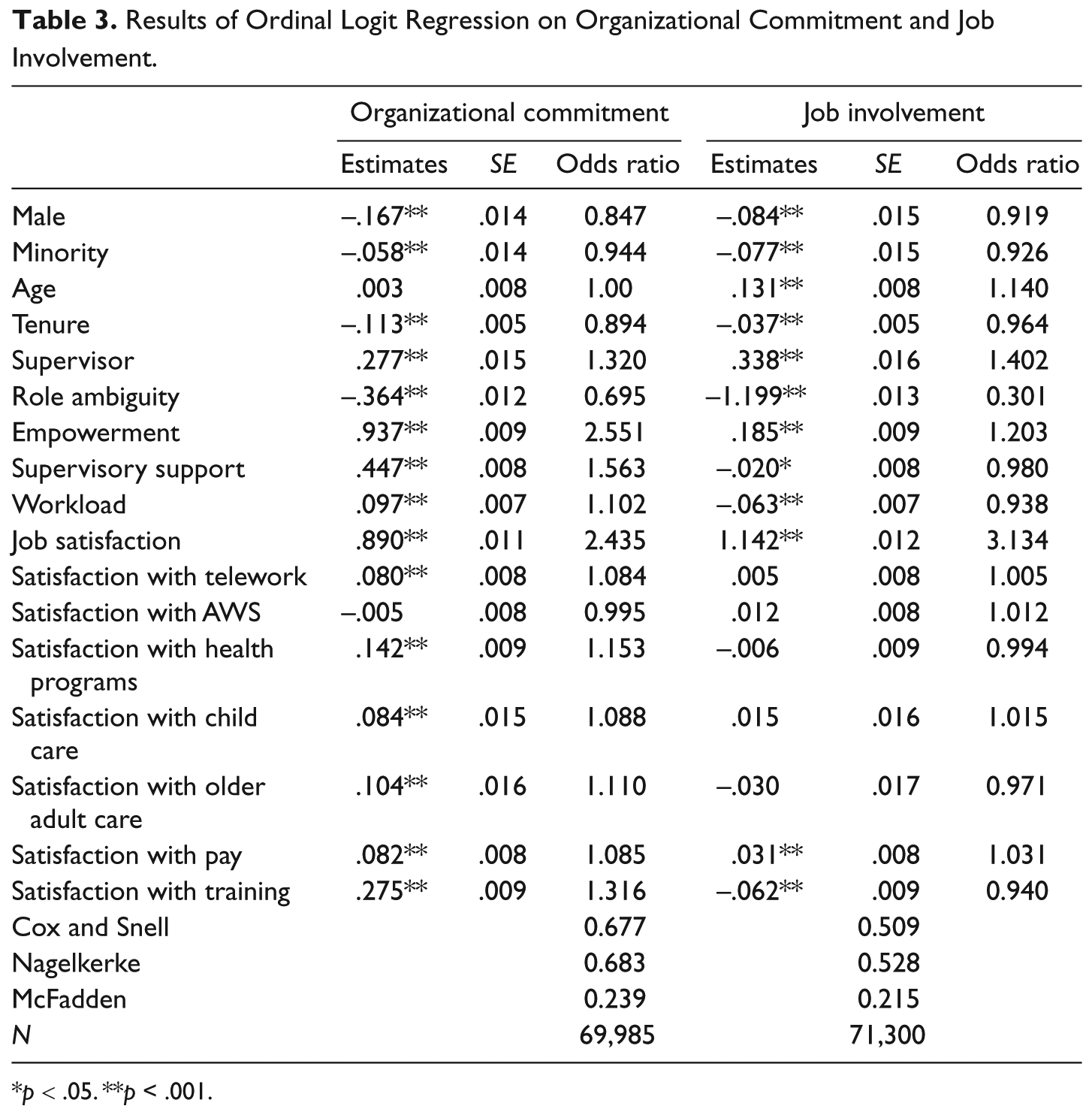
To examine the impact of these work-life programs on commitment and job involvement, ordinal logit regression was utilized instead of ordinary least squares because the dependent variables were ordinal and, as a result, did not have a normal distribution. Furthermore, ordinal logit regression is deemed an appropriate estimator in ordinal models where certain conditions are not violated (Norušis, 2005). 6 As demonstrated in Table 3, there are two separate models, one with organizational commitment as a dependent variable and the other with job involvement. The R2 values for the models indicate that each is a good fit, explaining a large amount of the variance. An important observation is that both models have about 70,000 workers, which is much less than the 263,475 employees who completed the survey. This is because survey participants were allowed to respond with “no basis to judge” when they weren’t familiar with the program. Therefore, the sample does not include employees who were not familiar with all of the programs, which represented the majority of respondents.
Results of Ordinal Logit Regression on Organizational Commitment and Job Involvement.
p < .05. **p < .001.
An important note regarding interpretation in Table 3 is that odds ratios indicate the probability of being committed to the organization and involved in work associated with a one-unit change in the factors. Factors also have an inverse relationship when their odds ratios are less than 1, no impact when their odds ratios are near 1, and a positive impact when their odds ratios are above 1. Moreover, the further the odds ratio is from 1, the greater the inverse or positive impact of the factors on either organizational commitment or job involvement.
When each dependent variable is examined separately, the first model reveals that satisfaction with telework, health programs, child care, and older adult care were positively related to organizational commitment (p = .000), whereas satisfaction with AWS was not (p > .05). Therefore, a one-unit increase in satisfaction with telework was associated with an increased likelihood of being committed to the organization by 1.08, a one-unit increase in satisfaction with health programs was associated with an increased likelihood of being committed by 1.15, a one-unit increase in satisfaction with child care was associated with an increased likelihood of being committed by 1.08, and a one-unit increase in older adult care was associated with an increased likelihood of being committed to the organization by 1.11.
For a more detailed explanation, the odds ratios can be expressed in terms of probability, when other factors are held to their means. For instance, as workers’ perceptions shifted from very dissatisfied with teleworking to very satisfied with teleworking, the probability of being very committed increased from .02 to .23. As perceptions shifted from dissatisfaction to satisfaction with health programs, the probability of being committed increased from .02 to .25. As perceptions changed from dissatisfaction to satisfaction with child care programs, the probability of being committed increased from .02 to .33. Finally as workers perceptions changed from dissatisfaction to satisfaction with older adult care programs, the probability of being committed increased from .02 to .37. 7
On the other hand, none of the work-life benefits was statistically associated to job involvement in the second model (p > .05). In fact, satisfaction with older adult care achieved the highest level of significance at p = .08. Thus, only partial support was found for Hypotheses 1, 3, 4, and 5, which assumed that both organizational commitment and job involvement would be positively related to the satisfaction of telework, child care, older adult care, and health and wellness programs. Moreover, no support was found for Hypothesis 2, that AWS (i.e., flextime and compressed workweek) would be positively related to work motivation (i.e., organizational commitment/job involvement).
Several other factors were statistically significant across models (p < .05). Men reported lower levels of organizational commitment and job involvement than women. Minorities were less likely to be committed and involved than nonminorities. In other words, nonminorities and women exhibited higher work motivation. Employees with greater tenure were less likely to report high levels of job involvement and commitment than those with lower tenure. This was unexpected, suggesting employees become less motivated as they spend more time working for government. Supervisors were more likely to report high commitment and job involvement than staff, probably because individuals with higher work motivation are promoted to these positions. High role ambiguity was associated with lower commitment and involvement levels than low role ambiguity, suggesting the stress of not knowing job-related roles reduces work motivation. Empowered employees were more likely to report higher levels of commitment and involvement. Supervisory support was positively related to commitment and inversely related to job involvement. These findings indicate that work motivation is affected either positively or negatively by management styles. Hence, management matters. Employees had high levels of commitment when their workload was reasonable but low levels of involvement under the same conditions. An explanation is that an unreasonable workload causes exhaustion, which in turn decreases commitment, whereas employees become more involved in their jobs under the same circumstances, probably because of the time and effort associated with high workloads. Job satisfaction was positively related to organizational commitment and job involvement, and it had the greatest impact on work motivation of the variables (odds ratios were 2.43 and 3.13, respectively). Thus, satisfied employees were highly work motivated. Last, employee satisfaction with pay was positively related to commitment and job involvement, and satisfaction with training was positively associated to commitment and negatively associated to job involvement, demonstrating a connection between human resource management and work motivation, or, to restate, human resource management matters. Therefore, supervisory support, reasonable workload, and satisfaction with training were intriguing variables in that they were positively related to one work motivation factor (i.e., organizational commitment) and inversely to the other (i.e., job involvement).
When the odds ratios are examined, the relationship between satisfaction with flexible working benefits and organizational commitment—the only work motivation factor associated to work-life benefits—was not greater than it was to the other benefits. In fact, satisfaction with alternate working schedules posted the lowest impact (i.e., odds ratios were the closest to 1). Therefore, Hypothesis 6 was not supported. Moreover, satisfaction with health and wellness programs had the highest odds ratio, followed by satisfaction with older adult care, child care, and then telework. Support was, therefore, not found for Hypothesis 7 as well, which stated that the impact would be larger between employee satisfaction with telecommuting and organizational commitment/job involvement than it would be between the other work-life benefits and commitment/job involvement.
In addition, a comparison of odds ratios for work-life benefits and explanatory variables reveals that work-life benefits had a much smaller impact on commitment and involvement and, thus, work motivation in general than some explanatory variables. For instance, conventional factors, such as role ambiguity, empowerment, and job satisfaction, had greater odds ratios than the work-life benefits.
Finally, to examine the combined effect of the work-life programs on commitment and involvement, the items for the work-life variables were aggregated to create one variable. This analysis is noted in Table 4 and reveals that work-life benefits are positively associated with organizational commitment. Indeed, as workers’ perceptions shifted from very dissatisfied with work-life benefits to very satisfied with work-life benefits, the probability of being very committed increased from .01 to .43. However, work-life benefits did not have an impact on job involvement. These results are, therefore, similar to the previous model in that they indicate that work-life programs have an impact on organizational commitment and not on job involvement.
Results of Ordinal Logit Regression on Organizational Commitment and Job Involvement, When Work-Life Benefits Are Aggregated.
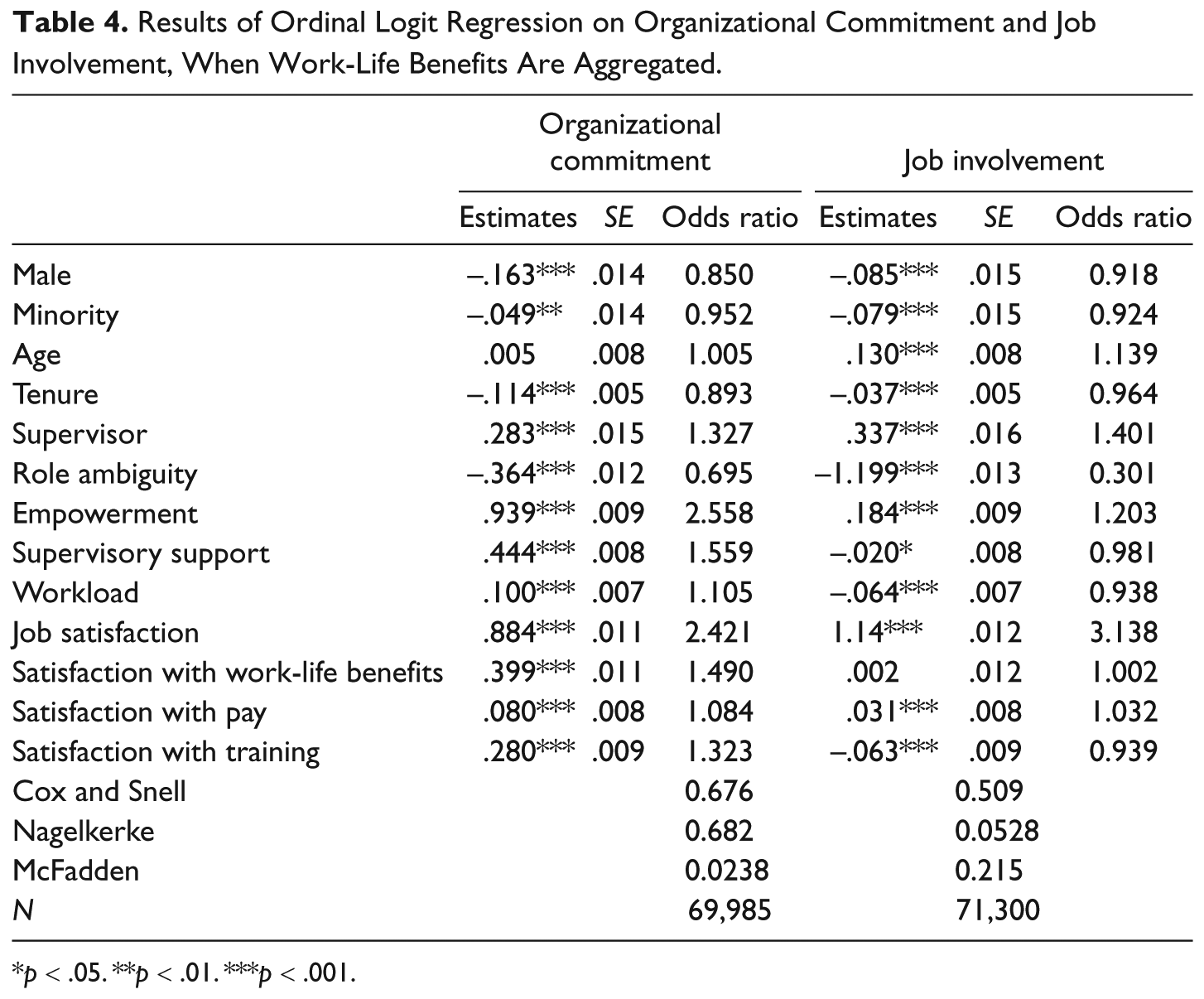
p < .05. **p < .01. ***p < .001.
Discussion and Conclusion
The aim of this article was to examine the relationship between satisfaction with various work-life benefits and work motivation (organizational commitment and job involvement). Data from the 2010 Federal Employee Viewpoint survey were examined, revealing several important findings that extend previous research. First, it appears that work motivation was not consistently affected by employees’ level of satisfaction with the various work-life benefits. More specifically, employee satisfaction with most work-life benefits (i.e., telework, health and wellness programs, child care, and older adult care) were positively associated to organizational commitment, while none were associated to job involvement. The combined effects of employee satisfaction with work-life benefits were also associated to commitment but not to involvement. Thus, the proposition derived from the theory of work adjustments, that employees will show an increase in both commitment and job involvement by improving employee satisfaction with work-life benefits, was only partly validated by the findings.
Specifically regarding organizational commitment and satisfaction with work-life programs, several implications emerge. First, the results suggest that organizations are likely to have high levels of commitment when their employees are satisfied with teleworking arrangements, and vice versa. To improve employee satisfaction with telework, employers can limit the amount of time employees telecommute. For example, Golden found that the benefits of telework were maximized when employees worked away from the office 2 days a week. That may seem counterintuitive, but too much telecommuting reduces needed interpersonal workplace interactions (Golden, 2006). Frequent teleworkers also fear that their isolation from the office may cause them to be forgotten and ultimately passed over for promotions (Khaifa & Davidson, 2000). In addition, employees working exclusively from home could find that it interferes with personal obligations, as the home becomes the workplace (Baruch, 2000; Mirchandani, 1999; Tietze & Musson, 2005). Therefore, employers should seek to find the right mix of remote working and face-to-face interactions.
Second, the results suggest that agencies are more likely to have a committed workforce when employees are satisfied with family-friendly programs (i.e., child care and older adult care) than when employees are dissatisfied with these work-life programs. Therefore, commitment is likely to increase as these programs are enhanced in ways that improve employee satisfaction. Providing onsite programs and vouchers will presumably increase the satisfaction with child care programs, as they lower commute times and costs, and flexible spending accounts may improve the satisfaction of older adult care programs, as they reduce the costs of caring for older adult relatives.
Third, the results indicate that satisfaction with health and wellness programs was positively related to organizational commitment, validating Rudman and Steinhardt (1988) who suggested that a wellness center led employees to have a higher regard for the organizations. In a recent study, Tucker and Irwin (2011) posed university students with several health constructs and found that they were most interested in those programs that focused on physical activity and dietary habits. Organizations might also find the same results among workers. The point is that to increase employee satisfaction with health and wellness programs, organizations should start by offering those programs that are of interest to employees. Moreover, some wellness programs could possibly improve performance directly (Benavides & David, 2010) and organizations should seek to offer those.
Finally, the results suggest that managers may not be able to elevate the commitment of employees when they seek to improve employee satisfaction with AWSs. This might be because the two AWS programs, flextime and compressed work schedules, are relatively structured, not affording employees a great amount of flexibility. For instance, employees utilizing compressed work schedules usually work Monday through Thursday or Tuesday through Friday, and, as a result, it may be more difficult to have high levels of employee satisfaction in this program and, thus, commitment. AWS also does not entail restructuring employee jobs, as teleworking does, and work motivation has consistently been found to be connected to work redesign (e.g., Chen & Chen, 2008). That is, flextime and compressed work schedules do not call for the redesigning of work but rather the modifying of work schedules and, as a result, may not endear workers to their employers. Another possible reason why AWS benefits did not show a significant relationship is because flextime and compressed work schedules were not separated in the survey item. Therefore, the finding may have produced different results if these AWSs benefits had separate measures (i.e., one of the AWSs may have been significant).
Concerning job involvement, the findings suggest that work-life benefits will not engender employees to be more involved in their jobs. It appears this is due to differences in the two constructs. For instance, organizational commitment refers to acting in ways that are important to the organization, whereas job involvement is the degree to which employees are absorbed in their work. In other words, commitment focuses on the organization as a whole and job involvement on the job. Therefore, these constructs are distinct and, consequently, may be influenced differently. Moynihan and Pandey (2007) and Caillier (in press) found that commitment and involvement were not always affected by the same factors.
The second important finding was that flexible working arrangements did not have a greater impact on commitment and job involvement than did family-friendly benefits and health and wellness programs. In fact, it was the opposite. Agencies were more likely to have high levels of commitment when their employees were satisfied with family-friendly benefits and health and wellness programs than when they were satisfied with flexible working arrangements. The former programs therefore provided a greater benefit. A possible reason for this occurrence could be based on the perceived motives behind the programs. For instance, these flexible arrangements entail restructuring jobs not only to improve the ability to juggle work and personal obligations but also to improve retention, performance, and reduce costs associated with energy consumption (e.g., electricity) and overhead. Family-friendly benefits, on the other hand, occur outside of work duties and may be viewed as an act of goodwill rather than a way to get employees to work harder, which in turn may make employees feel more obligated to reciprocate by demonstrating loyalty to the organizations. Another possible reason why family-friendly benefits had a greater impact is that flexible working arrangements have many drawbacks (e.g., isolation) that may reduce such benefits as organizational commitment (Mello, 2007).
The third important finding of the study is that agencies were less likely to have high levels of commitment when their employees were satisfied with teleworking arrangements than when they were satisfied with the other work-life benefits. For instance, satisfaction with health and wellness programs had the highest positive impact on commitment, followed by satisfaction with older adult care, child care, and, then telework. It therefore appears that, although several factors were related to commitment, managers will realize the largest increase in organizational commitment when they focus on improving employee satisfaction with health and wellness programs. Taking into account the theory of work adjustments and other work-life programs, this outcome demonstrates how valuable health and wellness programs are to employees.
The final important finding was that several conventional factors had a stronger impact on work motivation than the work-life programs did. A managerial implication is that organizations should focus more on those factors with the greatest impact. For instance, job satisfaction, empowerment, and role ambiguity (inversely related, of course) had the greatest impact on work motivation, and these factors can be improved by redesigning jobs, empowering employees, and clarifying roles and responsibilities. That is not to say that work-life programs do not provide benefits, as they improve retention and recruitment.
To recapitulate, the findings revealed that satisfaction with telework, satisfaction with child care programs, satisfaction with older adult care programs, and satisfaction with health and wellness programs were associated with organizational commitment. The combined effects of work-life benefits also had a positive impact on commitment. Job involvement, on the other hand, was not affected by work-life programs. Finally, family-friendly programs and health and wellness programs were found to have a greater impact on commitment than flexible working arrangements.
Notwithstanding these findings, there are several limitations to consider. The first is data were obtained from a government survey and, as a result, many theoretical constructs were not precisely measured by items in the questionnaire. In addition, factors that could have had an effect on commitment and job involvement, such as self-efficacy and job performance, were not included in the survey. Even though such surveys are not perfect, they have been used extensively by scholars, yielding many important findings. Next, this survey was cross-sectional, rendering it impossible to determine causality.
Future studies should seek to eliminate these limitations by developing questions specifically designed to measure these constructs, ostensibly through practitioner-centered focus groups, and by testing them on workers over an extended period. Future research should also examine worker participation in these benefits by employing satisfaction with work-life programs as a mediating or moderating variable to work motivation and performance. Finally, researchers should examine specifically why some work-life programs are more beneficial to employees than other programs.
Footnotes
Declaration of Conflicting Interests
The author(s) declared no potential conflicts of interest with respect to the research, authorship, and/or publication of this article.
Funding
The author(s) received no financial support for the research, authorship, and/or publication of this article.