






Abstract
Australia has its own unique institutional arrangements within which its civil services operate, yet its experience in public sector human resource management over the last 40 years or so has much in common with that of many other Western democracies, including the United States. It faces enduring challenges such as the relationship between politics and administration while its approach to public management has evolved from traditional Weberian administration through new public management to a much more complex, open and networked system. While the role of government in society has not radically changed, the way in which that role has been exercised has changed significantly. Government employees represent a smaller proportion of the workforce, what they do and their skills have changed dramatically, internal arrangements to foster ethics and to manage staff are different today, new approaches have been adopted to compensate and motivate employees, the diversity of employees has widened, and the place of human resource management (HRM) in agencies’ strategic management processes has ebbed and waned. In each of these areas, human resource (HR) managers in Australia today face difficult questions about future directions. Most of these will be familiar to HR managers in other countries.
Keywords
Background, Enduring Challenges, and Changing Contexts
Some Australian Background
The Commonwealth of Australia was established on January 1, 1901, by British law. The Constitution was developed over the previous 20 years through a series of conventions and drew consciously from both the United Kingdom and the United States, as well as Canada. It incorporates a broadly U.K.-style parliamentary system. Australia also adopted from the beginning the U.K. approach to separating politics from administration, with a merit-based civil service based on the 1854 Northcote–Trevelyan Report (Northcote & Trevelyan, 1854). The Constitution provides for a federal structure with many similarities to U.S. arrangements, including an elected Senate based on state representatives. The powers of the national government are specified in the Constitution, the intention being to constrain its role; the six states have sovereignty in all other areas (there are now also two territories with broadly similar responsibilities).
In practice, over the next 100 years, the role of government has widened and the power of the national government in Australia has increased very substantially. Nonetheless, more than 75% of public sector employees are employed by state and territory governments, which continue to manage most service delivery—schools, hospitals, public transport, and police. Local government plays a limited role in Australia, with about 10% of all public sector employees, these being mostly involved in property services (local planning, roads, storm water, garbage collection, etc.) and some community services (such as local libraries). The national government has about 15% of public sector employees, but it also collects the vast majority (about 80%) of government revenue and uses this to play a significant role in most sectors including health, education, and welfare as well as in traditional areas of federal responsibilities such as the national economy, defense, trade, and social security.
Enduring Challenges
While contexts change over the years, two of the enduring challenges in public administration in Australia, as elsewhere (e.g., Thompson, 1988; Wilson, 1886), are the relationship between politics and administration, and the balance between the respective roles of government, the market, and civil society. Old debates on these get refreshed and reframed as new technologies and new ways of doing business are introduced. Concepts of merit, nonpartisanship, impartiality, professionalism, and anonymity in the public service are inevitably recalibrated in the light of modern communications and the corresponding professionalization of politics, and the continuing obligations of the civil service to be responsive to the elected government and to be publicly accountable. Similarly, the classic concepts of the role of government in liberal market economies, such as allocation, (re)distribution, and stability (Musgrave & Musgrave, 1980), involving the delivery of public goods and addressing market failures as well as protecting the poor and dampening the impact of economic cycles on unemployment and inflation, all require rethinking with technological change, and social developments including globalization and demographic change.
There are also enduring challenges in public sector human resource management (HRM). Stephen Condrey’s (2010) Handbook of Human Resource Management in Government provides a comprehensive guide to public sector HRM in the United States. Five of the challenges he identifies are explored further below in the Australian context: the identification of the size and skills required in the public sector; the values, ethics, and leadership needed to foster the workforce culture required; compensation and motivation arrangements that not only attract and retain the skilled people needed but also encourage high-level individual and organizational performance; the desired representativeness and diversity of the public sector workforce; and the place of HRM in top-level public sector management. Each of these also requires continuing review as the context changes.
The Changing Public Administration Context Over the Last 40 Years
The broad approach to public administration is continually evolving as circumstances change. It is now possible to discern paradigm shifts over the last 40 years, although it is not so easy to identify more recent patterns.
In Australia, the 1976 Royal Commission Into Australian Government Administration (RCAGA) report, also known as the Coombs Report, marks the beginning of a significant paradigm shift away from what might be termed traditional administration. That approach relied heavily on detailed rules and processes, and involved firm hierarchies and central controls; public service was a lifetime career and the public sector was dominated by Anglo-Saxon men; and the public service had almost a monopoly in advising government and delivering government programs. It was a Weberian bureaucratic model.
The Coombs Report questioned the appropriateness of this approach in the 1970s and proposed three key directions for reform: more responsiveness to the elected government, a stronger focus on efficiency and performance, and a better reflection of Australian society within the public service. The traditional public service was seen to be too reliant on its own expertise and experience and not sufficiently responsive to changes in society as reflected in the shifting policy views of society’s elected representatives; the focus on rules and hierarchies was not conducive to efficient management and the achievement of program objectives; and the service itself was too isolated from society, offering limited opportunities for women, Indigenous Australians, people from non-English speaking backgrounds and people with a disability.
The Coombs Report was not suddenly adopted, but it did mark a shift already underway that accelerated over the following decade and more. The new paradigm of the 1980s and 1990s became known as New Public Management (NPM) and its Australian version bears not only many similarities to, but also some important differences from, the reforms in other Anglo-American countries over this period. In Australia, NPM was often termed “managerialism” (Nethercote, 1989) or, less pejoratively, “management for results” (Keating, 1989). The key attributes were as follows:
devolution of management authority;
stronger accountability for results;
firmer direction by the elected government which set the policy and program objectives and the results to be achieved;
wider use of private sector management approaches such as corporate planning, performance management, and accrual accounting; and
a gradual increase in the role of markets via outsourcing, commercialization, and privatization.
NPM in Australia originally had little if any ideological content though it did reflect an emphasis on efficiency and the use of economic ideas and levers. It was strongly promoted from within the public service and it had bipartisan support, each side of politics seeing the developments as ways to better achieve their (often different) policy objectives (or “results”). The overall size of government in Australia, as measured by government expenditure as a share of gross domestic product (GDP), did not shrink over these decades (Figure 1) but the way government did its business shifted very significantly, from “providing” to “purchasing” and by new and very different forms of regulation.
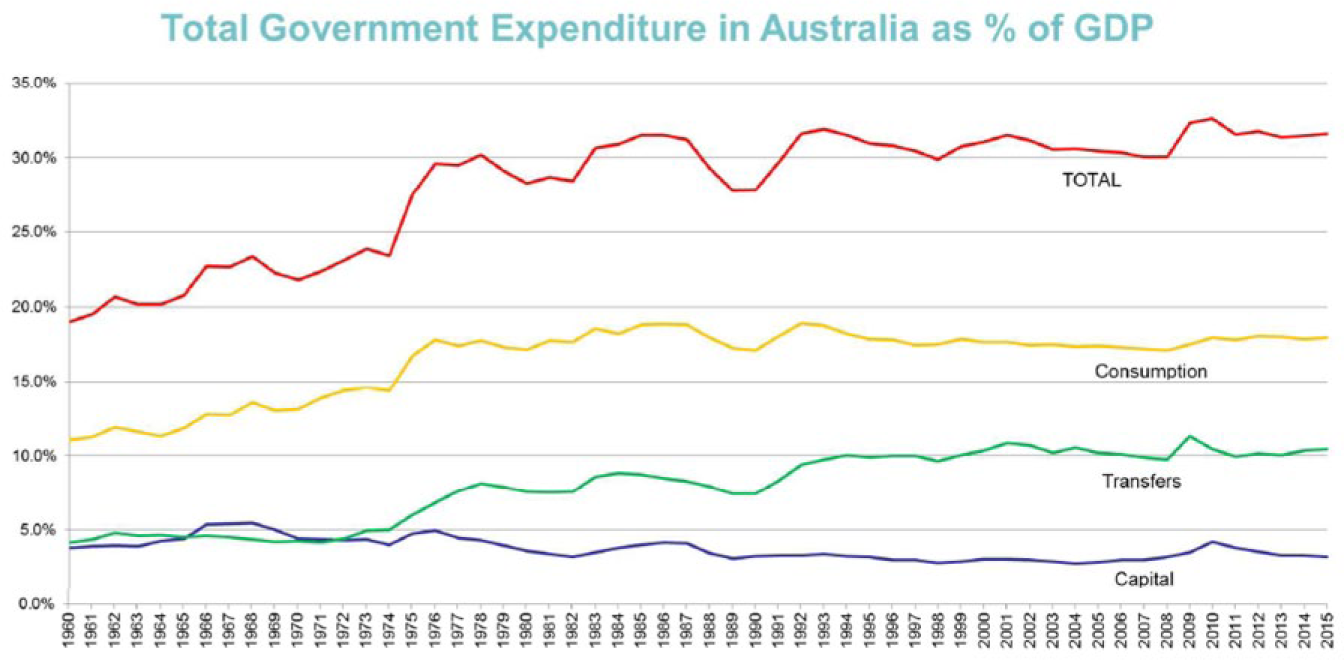
Total government expenditure in Australia as percentage of GDP, 1960-2015.
Notwithstanding evidence of significant improvements in efficiency and effectiveness resulting from NPM (Productivity Commission, 2005), by the early 2000s, serious limitations of the approach became evident. Despite the ostensible emphasis on devolution, NPM remained hierarchical, being dependent upon principal–agent arrangements and strict definitions of objectives and targets. Its focus on each agency and each program also constrained cooperation and joint effort, which was essential for many complex public policy issues (“wicked” problems). Despite improved “customer focus,” accountability remained primarily “upward” to management, ministers, and the parliament rather than “downward” and “outward” to the community.
The subsequent adjustments are often now termed “New Public Governance” (NPG; Edwards, 2002). They have not involved any wholesale rejection of NPM, but more a range of modifications—some softening NPM’s hard edges, others extending NPM’s shift away from public sector monopolies. The key attributes of NPG in Australia are as follows:
wider use of networks across and beyond government,
partnerships involving collaboration and not just competition and strict purchaser/provider,
horizontal rather than vertical management (the Australian term is whole-of-government),
downward and outward accountability as well as upward accountability, and
increased interest in addressing complex problems such as social exclusion, environmental concerns, and Indigenous well-being.
These have led both to some winding back of devolution to achieve more coordination and “connected government” (Management Advisory Committee, 2004) and to further increases in the use of nongovernment organizations to deliver public services particularly the use of NGOs for disability, employment, and health-related services through partnership agreements.
While both NPM and NPG approaches remain extant, there are some signs of possible new developments. Australia is yet to see any significant reverse to what some Europeans (e.g., Pollitt & Bouckart, 2011) call “neo-Weberian” governance based on rebuilding the role and capability of the public sector. Nor is there yet any widespread appreciation of the limits to and dangers of the earlier reforms, including to the career public service itself, which Kearney and Hays so well identified in the late 1990s (Kearney & Hays, 1998). But there is new interest in Australia in the capability of the public service and of stewardship by its leaders. Public service and financial management legislation has been substantially rewritten in the last 5 years (Parliament of Australia [PoA], 2013a, 2013b). In part, this is in response to evidence of capability loss over the last 20 years (Australian Public Service Commission [APSC], 2011) in such areas as strategic policy advising and HRM professionalism, and of reduced application of some of the better management techniques developed under NPM such as corporate planning and program evaluation. But there is also renewed interest in investing in technology and skills to improve program delivery and efficiency.
Another possible emerging development is in “experimentalism” (Sabel & Simon, 2011), involving more systematic approaches to the use of devolution and experimentation to identify and disseminate effective ways to address complex issues and to inform the decision-makers, including the legislature, so that policy can be suitably refined. This has yet to take hold, but there are signs of interest in such areas as disability services and Indigenous employment and welfare.
HRM Implications and Developments
Workforce Implications and Developments
While Figure 1 shows government spending as a proportion of GDP is largely unchanged, the numbers of public sector workers as a proportion of the workforce has dropped significantly over the last 40 years (see Figures 2 and 3).
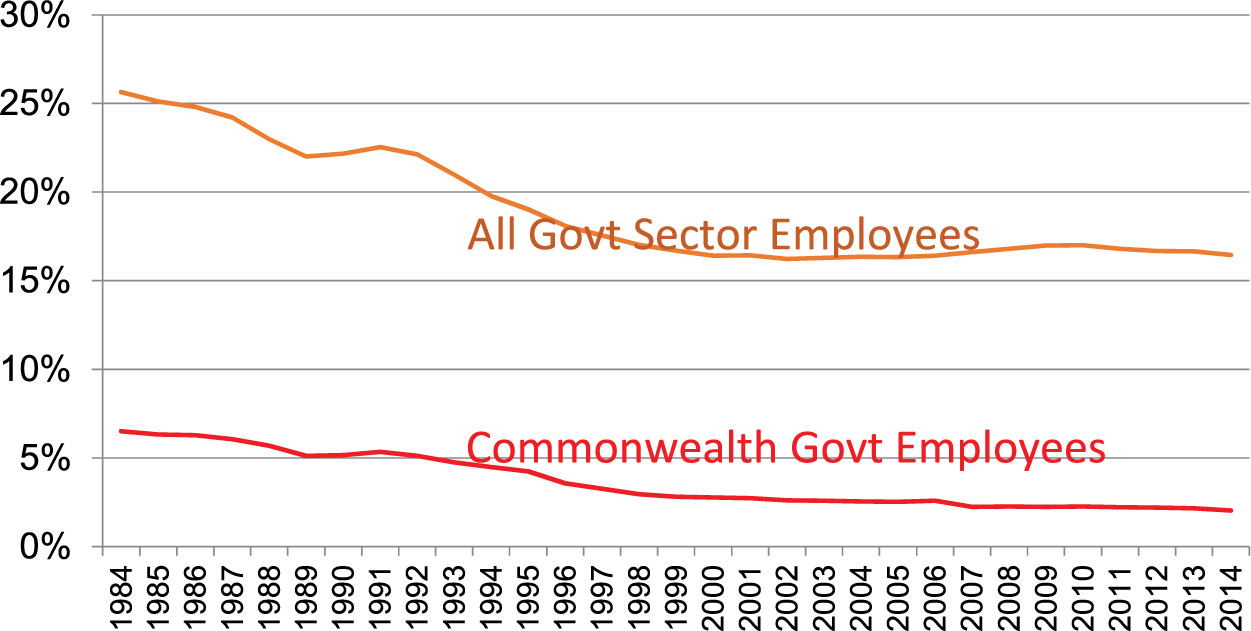
Public sector employment as a percentage of total Australian employment.
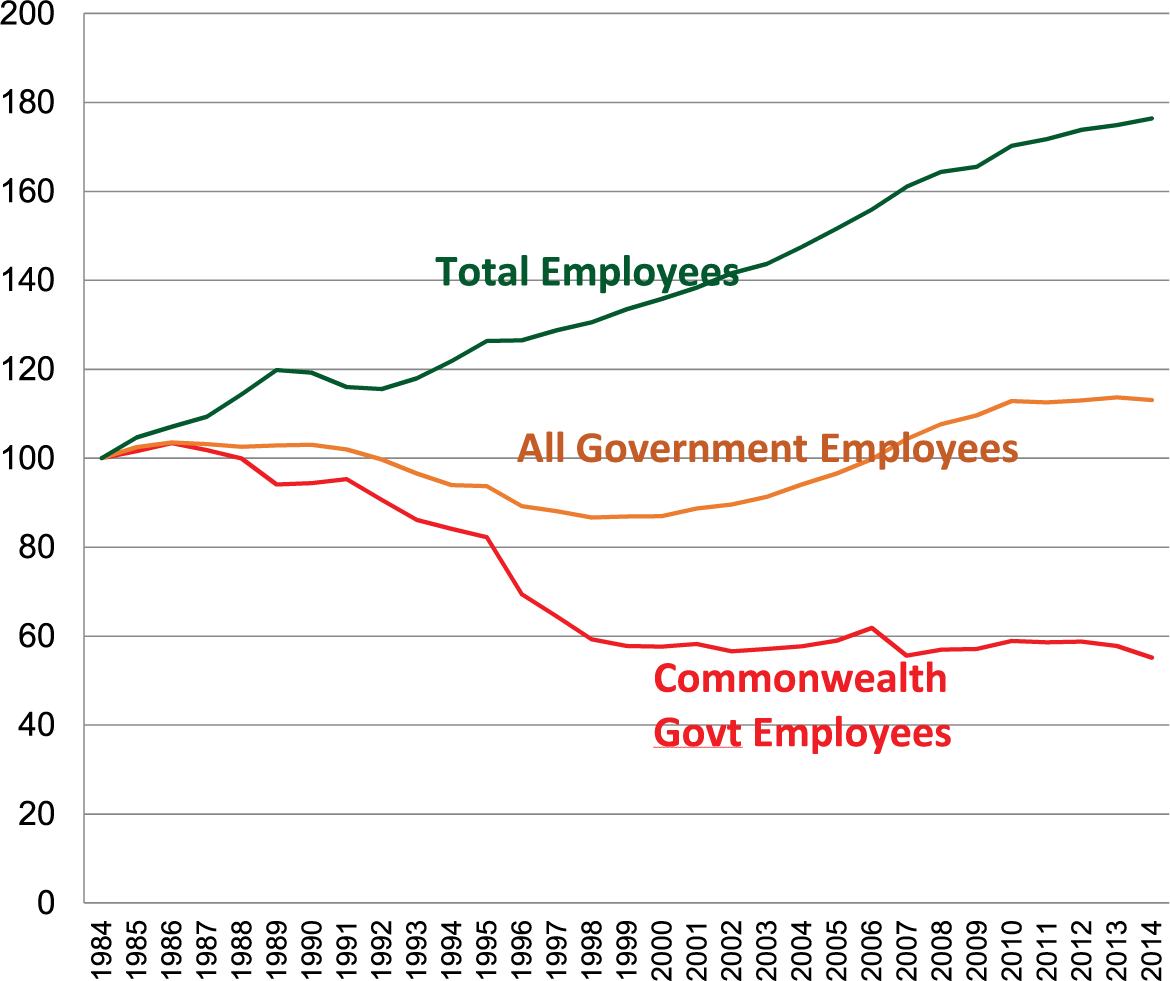
Index of employment growth in Australia—Public sector and total employees.
Much more starkly, the skills and qualifications of public sector workers have changed enormously. Table 1 sets out the classification profile of the Australian Public Service (the national government civil service), using the classification categories now in place (starting at APS1 and moving up to APS6 followed by middle managers (Executive Levels) and the Senior Executive Service.
Australian Public Service Classification Profile, 1980-2015.

Note. APS = Australian Public Service.
In 1980, more than two thirds of all the APS were in the lowest classification levels that now apply—there were then many more classification categories at and below these levels such as for typists, data entry staff, administrative assistants, and technical officers; these now make up only 6% of the APS. The APS is now much more “multiskilled,” technology having replaced a wide range of technically qualified support staff. The pattern is very similar in the other Australian jurisdictions. The shift reflects the enormous impact of technology on the workforce generally, the move toward a graduate-based public sector and, to a lesser degree, the shift under NPM and NPG to outsourcing, commercialization, and partnering.
There has also been a significant increase in public sector workforce mobility, with increased lateral recruitment into middle and senior management jobs and greater use of temporary (“non-ongoing”) and part-time staff. The majority of senior executives, however, are still career public servants, and the level of turnover at lower classification levels has not increased all that much (it has always been quite substantial).
In reviewing these developments, a number of important questions come to mind for today’s HRM professionals and public administration analysts and advisers:
Should and will the preference for the private sector (including NGOs) to deliver public services continue?
Is competition delivering the claimed efficiencies and meeting desired outcomes or has the point of diminishing returns been passed? What must the public sector do to regain public confidence in the quality and efficiency of the services it provides? How should the public sector partner with the private sector to get the best results?
Has the public service become too responsive to elected officials and their political appointees, and lost capacity and influence in strategic policy advising?
Has multiskilling and our emphasis on graduates gone too far?
Have new obstacles been placed in the way of some groups’ ability to gain public sector jobs?
Has there been too much “classification creep”?
Did the reduction in lower level jobs really justify the increase at the top end? Would efficiency be improved if senior staff had more junior staff to perform routine tasks?
Where will new technology next affect the skills profile required?
Will employees at middle levels, including professionals, be affected by the next wave of developments in information and communications technology What new skills are needed to take advantage of this technology?
Ethics and Leadership
The public administration shift under NPM, and continuing under NPG, from an emphasis on rules and processes to an emphasis on results, was accompanied by a parallel change of approach toward promoting ethical behavior and toward leadership in the public sector.
The focus on “ends” never meant ignoring “means.” But it took some time before a satisfactory way of promoting ethical behavior in the absence of detailed rules and processes was defined and articulated. This involved identifying core principles, or the “values” that should shape public service behavior. The reduced emphasis on rules and processes also demanded changes in management behavior, from strict hierarchical command and obey to “leadership” where authority is exercised by personal example and shared power, and by influence rather than control.
These ideas, promoted internationally for the private sector as well as the public sector, were explored in some depth in Australia in the 1990s and reviewed further in the 2000s. Four key principles were included in new financial management legislation in 1997 (efficient, effective, economical, and ethical) and 15 APS Values were enshrined in the new Public Service Act 1999 (Parliament of Australia, 1997, 1999). The latter represented a compromise between the political parties and were widely acknowledged as somewhat cumbersome, but the APS Commission addressed this weakness by placing the values into four groups: relationship with government and the parliament (e.g., nonpartisanship, responsiveness, accountability), relationship with the public (e.g., impartiality), workplace relationship (e.g., merit), and personal behavior (e.g., highest ethical behavior). This not only helped to explain the public service values but also emphasized their role in shaping relationships and behaviors through “values-based management,” and highlighted the unique public service approach in each area.
More recently, the legislation has been amended to simplify the values and make them more widely known and readily understood. Those relating to workplace relations, including merit, are now in separate “Employment Principles.” The core APS Values are publicized by the pneumonic “I CARE” (Table 2).
APS Values in the Public Service Amendment Act 2013.

Source. Parliament of Australia (2013).
Note. APS = Australian Public Service.
While the legislation and directions under it spell out what each of these values entails, it is disappointing that the grouping previously developed has been lost as that had highlighted the unique roles and responsibilities of the civil service and included its historic emphasis on merit (which is now no longer a “value” but included among separate “employment principles”).
Leadership has also been defined for the Australian public service through the development of the capabilities required. These have been used since the early 2000s as selection criteria for the SES and for development purposes. What is particularly significant is that verbs are used to describe each of the capabilities (Table 3).
Senior Executive Leadership Capability Framework.

While no longer used systematically for selection purposes, this framework and the associated documentation is still widely used for career development purposes.
The articulation and promotion of values and leadership capabilities has raised a number of practical questions that are still being debated in Australia:
How to address the problem of rhetoric disguising reality?
What is the best way to embed the values into public service culture? How should leadership capabilities be married with hard-nosed management and technical skills? How should ethical competence be taught?
How far can third parties (contractors, etc.) be expected to reflect public sector values?
Are third parties used precisely because they are not subject to the processes that underpin public sector values? What are the implications for contracts and agreements of the different values that are central to for-profit and not-for-profit private organizations?
Compensation, Classification, and Motivation
The demand for more management flexibility to achieve results more efficiently led to a series of changes in the way pay and conditions of government employees were funded and set in Australia.
Initially, steps were taken in the 1980s to aggregate appropriations for administrative expenses, allowing agency managers to shift resources between different administrative items, including between employee salaries and expenses such as travel and training and development. Then centrally funded and delivered services such as property, cars, and publishing were subject to user charges, the funding being redirected through agencies which could then review the level and mix of resources they needed. They subsequently also demanded power to choose providers, which in time often led to commercialization and privatization (APSC, 2003b).
In a broadly similar way, while superannuation continued to be based on defined benefit, pay-as-you-go arrangements, the assessed premiums were charged to agencies so that they were responsible for their employees’ total remuneration. This also allowed agencies to assess directly the relative costs of in-house provision of services and contracting out. The high premiums for the defined benefit schemes led to increased pressure to reform public sector superannuation over the following 20 years, shifting it progressively to defined contribution schemes (there was already some pressure to move in this direction as the defined benefit schemes constrained mobility between the public service and other sectors and tended to penalize women).
In the late 1980s, first steps were taken toward devolution of pay and conditions in an attempt to drive greater productivity and performance. The steps were also consistent with the Labor Government’s broader industrial relations reforms to replace collective bargaining with enterprise-based bargaining which required more careful consideration of productivity. Public service pay increases became subject to agency-level negotiations within tightly capped administrative budgets. Agencies could choose to trade off certain conditions for pay increases, and agencies were encouraged to experiment with private sector ideas such as performance pay, particularly for more senior staff. Devolution of pay and classification was extended very substantially in the late 1990s under the then Conservative Government, with the new Public Service Act confirming that agency heads had all the powers of an employer, including over pay and classification, subject only to budgets, centrally determined classification principles and Government pay policy. There were some examples of genuine productivity-improving innovations, such as Centrelink’s “virtual vocational training college” and its formal approach to career management, but most agencies negotiated narrowly defined productivity offsets with limited, if any, long-term advantages.
While most agencies retained the classification structure developed in the 1980s, some varied the structure, many applied new approaches to career progression within the structure (often effectively combining levels), and most ended up with their own unique pay levels and sets of conditions. In general, emphasis has been given to pay over conditions, and conditions have been reduced.
By 2010, a new Labor Government had accepted that such variations were not justified on efficiency grounds, they inhibited mobility and they made very difficult restructuring across agencies (Advisory Group on Reform of Australian Government Administration, 2010). But unscrambling the egg has proven to be very hard; significant differences remain 8 years after that Government came into office (Table 4).
Base Salary Variations in the Australian Public Service, 2015.

Note. APS = Australian Public Service; EL = Executive Level; SES = Senior Executive Service.
As in the labor market generally, the public sector industrial relations changes not only focused on increased labor market flexibility and productivity but, in doing so, also reduced considerably the role and power of the unions. Agencies could negotiate directly with their staff, though most large agencies chose to work with the union(s) representatives among their staff. But agencies were very firmly constrained by their budgets and by Government policies to contain pay increases, leaving little room for union (or staff) negotiations. Over the last 6 years, these constraints have been tighter under both Labor and Conservative governments than previously, finally causing serious industrial unrest and reinvigorating the key public sector union. Nonetheless, there has not yet been serious disruption to public services (the most serious to date has caused only modest delays in getting through immigration and customs at international airports on a few days of industrial action).
There is widespread disillusion within the Australian public sector about the way pay and classification are set. Notwithstanding a degree of recentralization over the last decade, wide variations continue unrelated to any genuine difference in productivity. The centralized processes seem to be driven only by budget considerations and ideological disregard for public servants, not any genuine study of attraction, development, and retention of required skills or of labor market demand and supply.
Given very limited increases in pay in the private sector recently, it is most unlikely that a more evidence-based approach would lead to pay increases across the public service, but it might well lead to more differentiation according to skills and experience, with some pay rates increasing, others reducing over time and with a considerable downward shift in the classification profile.
The experimentation with performance pay in Australia was largely a failure (as has been the U.S. experience (Bowman, 2009)). The experimentation in the late 1980s led to mandated arrangements for senior executives in the 1990s and widespread application at other levels, particularly among middle managers. Staff surveys demonstrated wide dissatisfaction with the systems put into place, particularly about fairness and the impact on teamwork (APSC, 2004). Agencies that invested heavily to address those concerns to ensure consistency and a reasonable degree of objectivity questioned whether the costs involved were worth the benefits gained in terms of genuine improvements in organizational performance. Some chose to continue the practice, but most have looked to remove performance pay. For agency heads themselves, concerns were expressed about the tendency for political factors to displace genuine performance factors in assessing performance bonuses (Podger, 2007).
Legacy programs still involve performance bonuses in some agencies, and conservative ministers and their appointees still occasionally express the desire for the public sector to follow private sector practice in this and other respects, but most agencies now give more emphasis to performance feedback and individual personal development rather than manage formal performance pay regimes. A continuing challenge, however, is the management of underperformance. Particularly in the absence of formal performance appraisal systems, this is proving very hard to manage.
Despite more than 30 years of increased permeability between the public and private sectors, and of flirting with private sector ideas within the public sector (and continuing advocacy to do so by some), there are signs of interest in other ways of motivating public sector employees. “Public service motivation” is not yet a widely used term in Australia (but see Taylor, 2008), but the opportunity to contribute to society remains a selling point in advertising for new staff. Altruism, and the “buzz” of involvement in public policy and public service delivery may also help to explain the degree of personal commitment and effort demonstrated by data on hours of work by public servants and evidence of increased strategic investment in training and development to improve career opportunities, and to put more effort into promoting improved work–life balance (APSC, 2011) and embracing diversity (see further below). These may rely in part on keeping relevant public service conditions despite the long trend to reduce them.
The key questions now for future compensation, classification, and motivation of public sector employees in Australia are as follows:
How far should pay and classification, and related matters, be devolved?
How might compensation policy properly support attraction and retention requirements (and not political factors)?
How important are public service conditions, and not just pay, to attraction, retention, and performance?
What role does, and can, public service motivation play in attraction, development, and retention in a world of more permeability between the public and private sectors?
What is the best way to reward performance and to manage underperformance? Can performance pay help, and under what conditions?
Diversity
The emphasis in the 1978 Coombs Report on improving the representativeness of the public service reflected broader social debates and trends at the time, particularly about the role of women in society and the rights of Indigenous Australians.
There has in fact been significant progress in the representation of women and Indigenous people in the Australian Public Service though challenges remain. The story for the other priority diversity groups (people with a disability and those from a non-English speaking background) is far more mixed. Figure 4 shows the proportion in 1985 and in 2015, while Figure 5 presents the change in population since 1985 as an index.
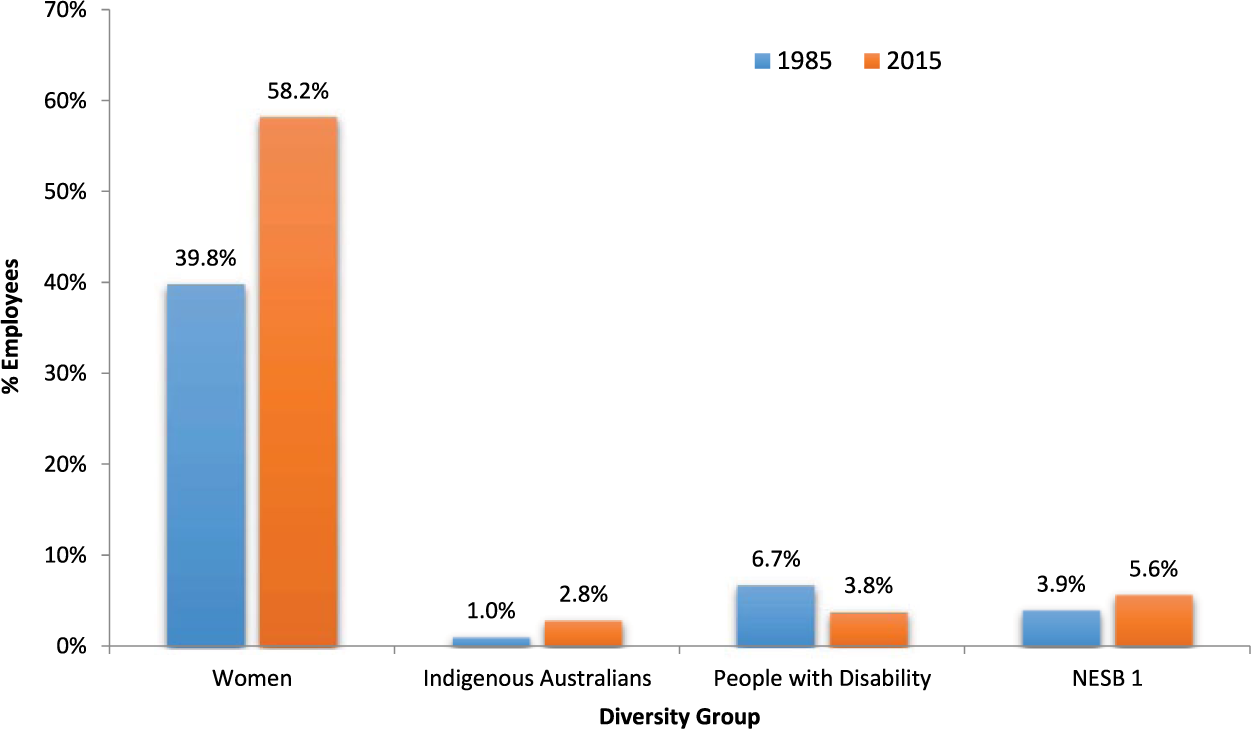
Representation in APS by Diversity Groups, 1985 and 2015.
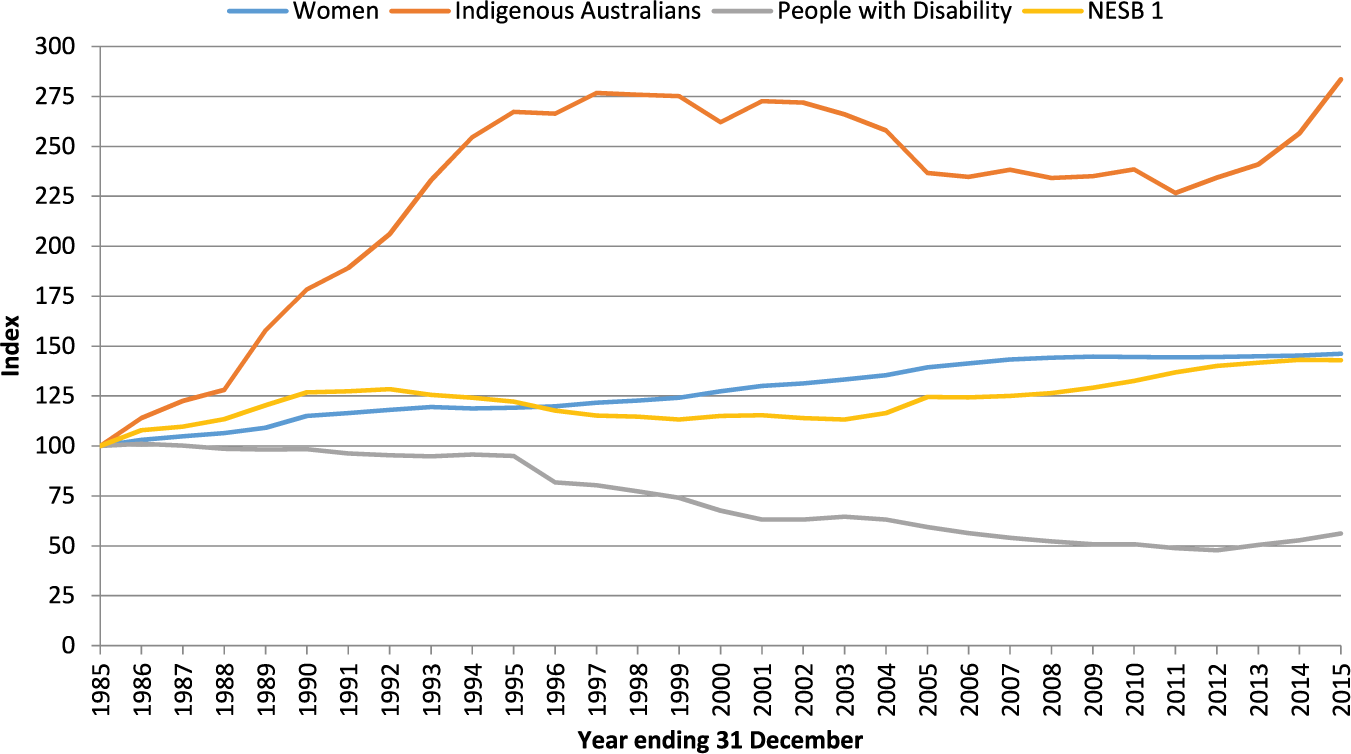
Change in population (weighted and indexed) for diversity groups, 1985-2015 (1985 = 100).
Women now represent 58% of the whole APS, compared with less than 40% 30 years ago. In 1986, the vast majority of the women were in the lowest classification levels. While those in the SES are still well below 50% (see Figure 6), the improved representation of women is most marked in the more senior (EL and SES) classifications (see Figure 7).
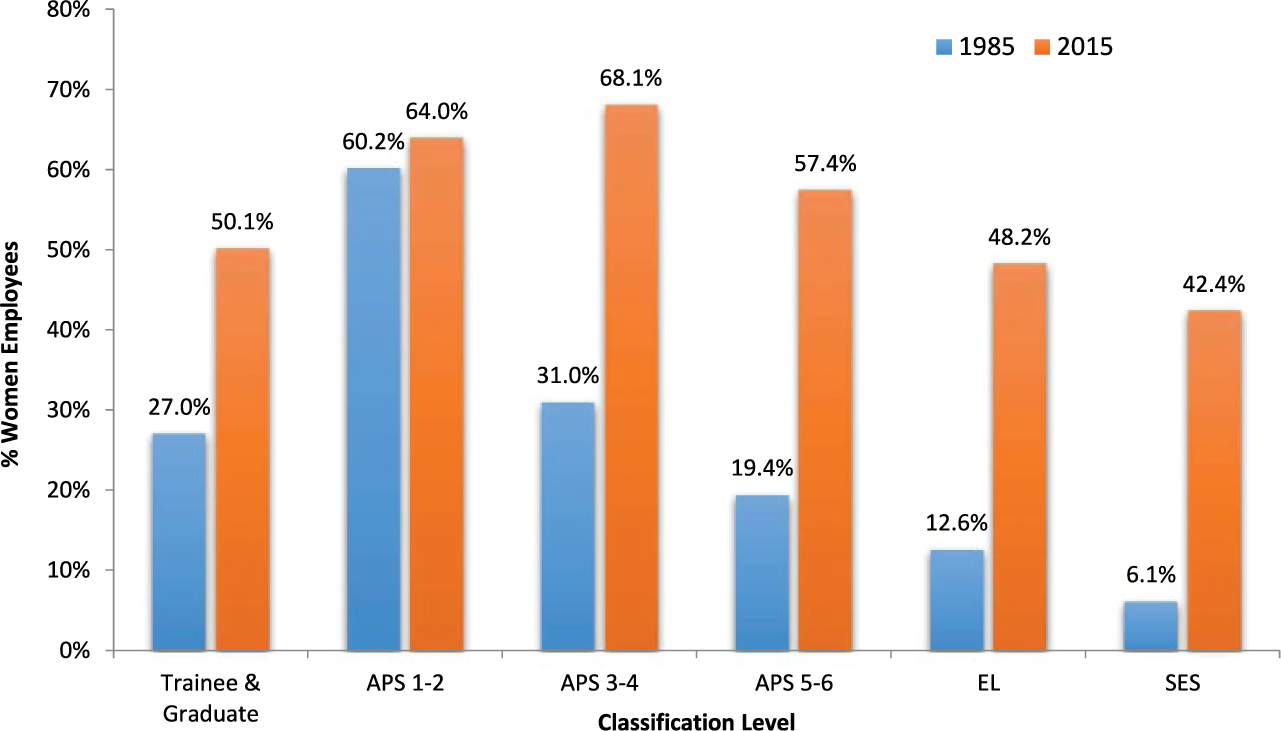
Representation of women by classification level, 1985 and 2015.
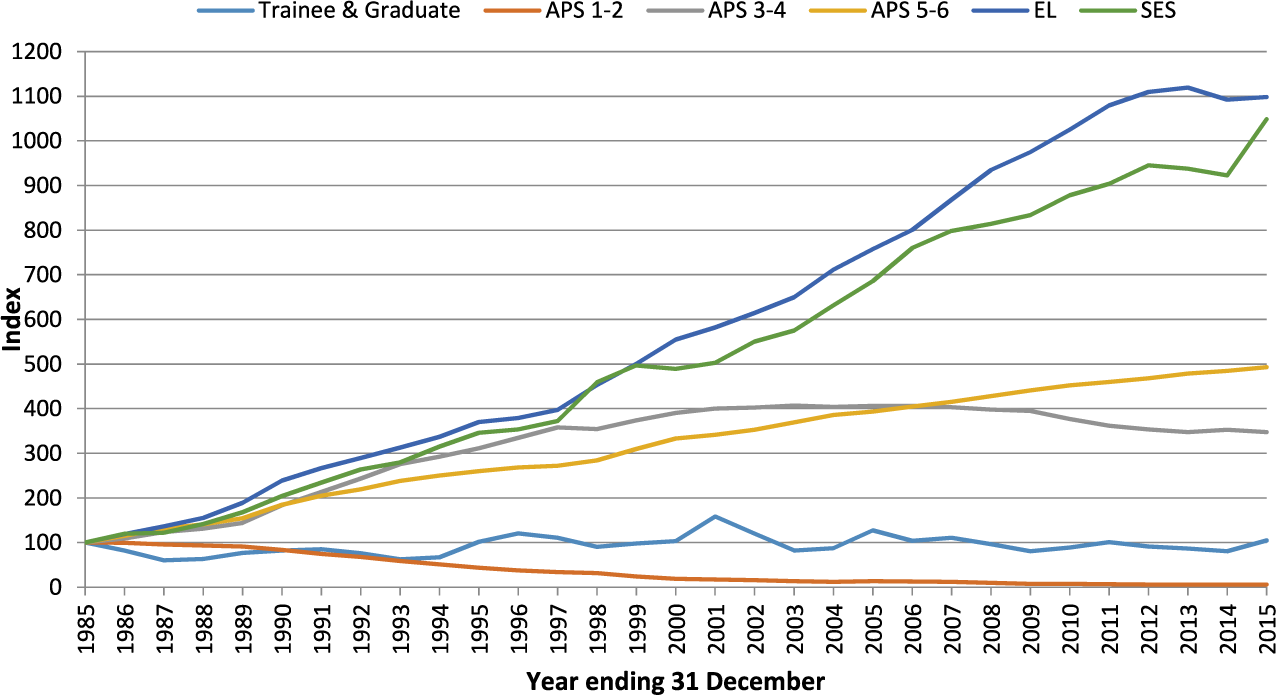
Change in representation (weighted and indexed) of women by classification level between 1985 and 2015 (1985 = 100).
These improvements have been achieved by concerted effort, not just changes in the supply of well-educated women seeking employment. Equal employment opportunity (EEO) programs were introduced in the 1980s aimed to invest in the training, development and mentoring of women and to address biases in recruitment and promotion processes. In the face of initial strong resistance from the union, part-time work opportunities were steadily increased across all classification levels. Conditions aimed at supporting female employees were also introduced, including paid and unpaid maternity leave, flexible working hours, and access to child care.
EEO programs were also introduced to improve Indigenous employment. The expansion of programs to improve the health, education, employment, and welfare of Aboriginal and Torres Strait Islander people also drove demand to employ Indigenous staff. This was also encouraged during the 1980s and early 1990s as those programs were aimed to support a degree of “self-determination.”
By the early 2000s, the APS employed about the same proportion of Indigenous people as are represented in the Australian population, much higher than in other jurisdictions or in the private sector. Most, however, were employed in agencies, and program areas, devoted to delivering services to Indigenous people. Employment of Indigenous Australians outside these areas remained (and still remains) low.
Figure 5 also shows that, since 2003, Indigenous employment fell as a proportion of the APS for a few years, though there has been renewed improvement since 2012. Analysis by the APS Commission suggests that a significant contributor to the fall was the reduction in jobs at low classification levels which in the past have provided an effective bridge into the APS. Once employed in the APS, Indigenous people do gain promotions at a similar if not better rate than other employees, but the narrowing of the bridge into the APS, as it evolved into a graduate-dominated employer, did have unintended effects. The more recent improvements reflect new trainee programs and related support.
It is evident from Figures 4 and 5 that people with a disability have long had, and continue to have, very serious problems in gaining employment in the APS. It seems likely that a contributing factor has been the shift in skills in demand during the 1980s as a result of technological change. As mentioned earlier, this removed many jobs with narrow technical skills requirements, and led to a demand for multiskilling in the vast majority of positions. A number of jobs suited to people with a disability, such as telephonists, disappeared, and agencies did not invest in the additional technology required for people with a disability to exercise multiskilling. Nor was it common for agencies to redesign workplaces to facilitate opportunities for people with a disability to contribute effectively to a team’s overall task. The slight improvement since 2012 shown in Figure 5 suggests some small reversal of the long decline, but it is clear there is a very long way to go.
Questions for diversity of the public sector workforce include the following:
How substantial is the remaining underrepresentation of women at senior levels? Will the improvements at feeder levels already underway suffice?
Is the extent of overall feminization becoming a problem now?
Why is disability such a difficult obstacle to public sector employment?
Have long-term solutions to improve Indigenous employment now been found and implemented, or is Indigenous employment still concentrated too far within Indigenous public service programs and too confined to junior levels?
Does the shift to a graduate public service entail new problems for the representativeness of the public sector workforce?
Strategic Role for HRM
While devolution of management responsibilities (both financial and human resource [HR]) improved the links between management of resources and the achievement of program results, the primary focus of the reforms in the 1980s and 1990s was efficiency and financial management. The former Public Service Board was abolished in 1987 and replaced by a much smaller and less powerful Commission (now named the Australian Public Service Commission [APSC]), and this center of HRM excellence lost much of its expertise and influence. The Finance Department, in contrast, became more powerful.
Agencies did strengthen their corporate management teams in response to devolution, but in most cases, the emphasis was on financial management, and HRM responsibilities were often allocated to people with program experience but little if any HRM expertise. This emphasis on financial management continued in the 2000s and to the present day, with the widespread use of Chief Financial Officers (CFOs) whose role includes supporting agency heads in strategic planning and risk management. CFOs are usually members of agency executive management teams and are expected to have strong professional accounting skills (if not themselves, in their support teams). Few agencies have developed an equivalent role for HRM.
While outsourcing of various HR activities (e.g., payroll, training, and development) in the 1990s has increased efficiency, the management of the outsourcing was mixed. In some cases, including the Department of Finance’s case, the outsourcing went too far and removed capacity for any serious consideration of HR issues in agency strategic planning. In other cases, the outsourcing was managed competently but still reduced in-house expertise.
Nonetheless, in the 1980s and 1990s, there was marked improvement in agency strategic planning drawing from private sector experience spearheaded by the Financial Management Improvement Program in the 1980s and an active Management Advisory Board in the 1990s. Plans identifying “key result areas” and “critical success factors” for improving agency and program performance often included HR strategies as well as strategies to improve financial management, communications, stakeholder relations, and so on. Such strategic or corporate planning was seen as an essential complement to the NPM focus on “results,” and part of agencies’ overall performance management framework (Management Advisory Committee, 2001). It ensured agencies considered “how” as well as “what” in their management for results.
More recent studies in Australia of the capability of public service agencies have identified a number of common weaknesses (APSC, 2013). Among these are HRM expertise and the role of HRM in agencies’ strategic management. Strategic policy advising is another area of concern, the evidence suggesting that agencies are focusing too much on short-term tactical advice in response to the immediate requirements of ministers. More generally, the strategic planning emphasis of the 1990s and early 2000s seems to have faded.
The identification of these weaknesses has contributed to important changes in both public service and financial management legislation over the last 5 years. The public service legislation (Parliament of Australia, 2013b) now gives more emphasis to “stewardship” of the APS, both by agency heads individually and by the collective APS leadership (now called the Secretaries’ Board, previously the Management Advisory Committee or Management Advisory Board). The financial management legislation (Parliament of Australia, 2013a) now mandates the development and publication of corporate plans and sets out the minimum range of matters to be covered by the plans. In addition, there is currently renewed effort to strengthen expertise in HRM and to invest more heavily in such areas as talent management, recognizing the central role of HR in agencies’ capability.
Among the questions arising from this experience over 30 years are the following:
What needs to be done to rebuild HRM expertise across the public sector?
Does this require a strong center of excellence for the public service as a whole? Should HRM devolution be wound back?
What HR functions need to remain in-house?
Where should HRM sit in the agency hierarchy? Is there an equivalent to the CFO?
Conclusion
Australia’s experience of public sector reform has many unique elements but also many that are common to other Western democracies. Many of the drivers—technology, globalization, better informed public—are the same, and experiences in different countries are quickly exchanged.
Similarly, the impact on public sector HRM in Australia has some unique elements, but also many common elements. The challenges for the future may also be similar to those of the United States and other developed democracies and some will also be relevant to other countries at an earlier stage of developing their public sector HRM capability.
This overview focuses on five priority areas of public sector HRM drawn from Steve Condrey’s (2010) magnum opus, and presents for each a series of questions about the future.
First, Australia’s public sector workforce has changed dramatically over the last 30 years. It is more professional and better educated and there is more mobility across jurisdictions and with the private sector, but has it moved too far from its traditional role in service delivery and policy advising, giving too much ground to the private sector and to political operatives, and losing capability as a result? What must it do to regain public confidence, and what will be the implications of future technological change?
Second, there has been considerable effort to articulate public service values and to promote leadership in parallel with the reforms that have been aimed at improving efficiency and effectiveness, but how real has been the impact compared with the rhetoric?
Compensation and classification have been devolved more in Australia than in most countries, and with serious consequences. Moreover, despite continuing calls for more private sector flexibility, the system actually pays little regard to the labor market or attraction and retention concerns, and seems constrained today by an ideological disregard for public servants. There are serious challenges not only to attract and retain the skills required but to do so in a way that also recognizes and respects nonfinancial public service motivation.
The public service has achieved considerable diversity improvements, particularly with regard to women and Indigenous Australians. There remain serious problems with regard to people with a disability. Perhaps also it is time to reflect on whether feminization is going too far and whether increased professionalism is causing new problems for the representativeness of the public sector workforce.
Finally, one of the capabilities that seem to have suffered most through the reform era is strategic HRM. While this is now recognized by the public service leadership in Australia, rebuilding HRM expertise in practice is proving to be enormously difficult.
Footnotes
Author’s Note
The article is based on a presentation at a symposium organized by the American Society for Public Administration’s Section on Personnel Administration and Labor Relations (SPALR) in March 2016 in honor of Steve Condrey, former ASPA national president and editor of Review of Public Personnel Administration (ROPPA).
Declaration of Conflicting Interests
The author(s) declared no potential conflicts of interest with respect to the research, authorship, and/or publication of this article.
Funding
The author(s) received no financial support for the research, authorship, and/or publication of this article.