







Abstract
Based on the implication of the job demands–resources (JD-R) model, this study examined the associations between job demands (organizational resource declines and work overload) and resources (job-goal specificity, performance feedback, and work unit climate) with employees’ organizational citizenship behavior (OCB). Although statistically significant negative associations were found between financial and human resource decline and OCB, the associations were weak from a practical perspective. In line with the JD-R model, this study also found that job-goal specificity, performance feedback, and work supervisor support had positive associations with OCB. However, the effect of work overload was found to be marginalized, and the expected buffering role of job resources on the negative association of work overload with OCB was not confirmed in this study.
Keywords
Introduction
Organizational citizenship behavior (OCB) is defined as “individual behavior that is discretionary, not directly or explicitly recognized by the formal reward system, and that in the aggregate promotes the effective functioning of the organization” (Organ, 1988, p. 4). OCB examples in the public sector are helping coworkers, proactive involvement to solve citizen problems, and providing innovative ideas to solve problems with current public service provisions. Recent public management studies have recognized the importance of OCB. For example, Vigoda-Gadot and Beeri (2012, p. 575) posited that OCB could enhance the productivity of government agencies by “reinforcing the bureaucratic value of the good soldier syndrome, the willingness to serve other citizens, and strengthening the overall ethos of public service.” In particular, they suggested that government employee OCB could contribute to government agency innovation by encouraging employees to think from different perspectives to seek ways to improve organizational performance. Securing a high OCB level could also be important for government cutback management as employees with a high OCB level could fill gaps in public service provision by protecting citizens’ rights and democratic values (Shim & Faerman, 2017).
The present study sought to answer two questions. First, we examined whether organizational resource decline had a negative association with employee OCB. As organizational resource declines reduce training opportunities and increase workloads for less reward, employees facing organizational resource decline might experience emotional distress or attempt to disengage themselves from their jobs and organizations. Although several public administration scholars have discussed the potential challenges of maintaining employee work motivation and performance in the context of cutback management (Andrews & Ashworth, 2015; Levine, 1979), to the best of our knowledge, few empirical studies have investigated the association between organizational resource decline and OCB. Second, this study investigated whether employee job resources (i.e., job-goal specificity, performance feedback, and work unit climate) played a significant role in sustaining employee OCB. Although previous studies have found positive associations between job resources and OCB (Demerouti, Cropanzano, Bakker, & Leiter, 2010; Saks, 2006), the associations have not been examined in the context of government organizations. Based on the theoretical implications of the job demands–resources (JD-R) model suggested by Bakker and Demerouti (Bakker & Demerouti, 2007; Demerouti, Bakker, Nachreiner, & Schaufeli, 2001), this study examined the work contexts that could induce government employee OCB.
The remainder of this study is structured as follows. The next section discusses the potential associations among organizational resource decline, job resources (i.e., job specificity, performance feedback, and work unit climate), and OCB. After this, the data sources and items used for this study are explained. The findings from the data analyses are then presented. The last section discusses implications and concludes the article.
Literature review and hypotheses
JD-R and OCB
The basic tenet of the JD-R model proposed by Bakker and his colleagues (Bakker & Demerouti, 2007; Demerouti et al., 2001) is that employers face various risks in sustaining employee work engagement, which could be categorized into job demands and job resources. Job demands are defined as the “physical, psychological, social, or organizational aspects of a job that require sustained physical and/or psychological (cognitive and emotional) effort or skills and are therefore associated with certain physiological and/or psychological costs” (Bakker & Demerouti, 2007, p. 312). A traditional example of job demand is work overload. However, variables such as role conflict and red tape have also been recognized as government organization job demands (Kim & Wright, 2007; Shim, Park, & Eom, 2017). Job resources are “physical, psychological, social or organizational aspects of a job that either/or function to achieve work goals, reduce job demands and associated physiological and psychological costs, and stimulate personal growth, learning and development” (Bakker & Demerouti, 2007, p. 312). There are different types of job resources at the organizational level (e.g., pay, career opportunities, and job security), in interpersonal relations (e.g., supervisor and coworker support and work unit climate), and in job characteristics (e.g., role clarity, autonomy, performance feedback, and participatory decision making).
The JD-R model has found that job resources can enhance employees’ psychological well-being and that work engagement and job demands can hamper employee occupational health due to work stress and exhaustion (Bakker & Demerouti, 2008). As high job demands often require employees to deal with work stress and psychological exhaustion, it could cause a reduction in OCB because personal energy could be depleted. Conversely, employees who have ample job resources are more likely to be engaged in OCB as they have the required psychological energy. This study identified organizational resource decline and work overload as job demands and recognized job-goal specificity, performance feedback, and supervisor support as job resources. While work overloads, job-goal specificity, performance feedback, and supervisor support are individual-level variables, organizational resource decline is a contextual organization-level variable.
Organizational Resource Decline and OCB
Scholars of occupational psychology have recognized that the psychological loss of resources can hamper an individual’s psychological well-being, and those who experience a loss of resources may show coping behaviors. For example, Hobfoll (1989, 2001) found that psychological distress was experienced when there was a major loss of valuable resources as the acquisition and protection of resources could be a central motivation. Hockey (1997) also found that performance attainment under high work demands required greater physiological and psychological energy because compensatory efforts could drain energy and cause burnout or emotional distress. He posited that when personal resources are being depleted, employees might attempt to reduce their exposure to the stressors by altering their performance level whenever possible (fatigue after-effects).
Based on these theoretical implications, this study posited that organizational resource decline could be one of the job demand factors that constrain employee OCB. When financial and human resources are being reduced, employees might experience a psychological loss and a reduced capacity to focus on discretionary performance, thus constraining their engagement in OCB. This study specifically investigated the decline in financial and human resources, as reductions in these resources are most meaningful and visible to employees. Therefore, the following hypotheses were proposed:
Job Demand, Job Resources, and OCB
This study also examined the impact of individual-level job demands (i.e., work overload) and resources (job-goal specificity, performance feedback, and supervisor) on OCB. As mentioned, studies based on the JD-R model have identified work overload as a major job demand (Schaufeli & Bakker, 2004) and have consistently found that work overload caused greater work exhaustion (Bakker & Demerouti, 2007, 2008). Similar findings have been reported in studies on government organizations (Kim & Wright, 2007; Shim et al., 2017), and several studies have also found that work exhaustion had a detrimental effect on employee OCB (Cropanzano, Rupp, & Byrne, 2003; Halbesleben & Bowler, 2007). Cropanzano et al. (2003) found that a trusting relationship could be breached when employees experienced work exhaustion, as they tended to develop resentment toward their organization because they perceived the organization was behaving unfairly and overworking them to the point of burnout. Cropanzano et al. (2003) found, in their empirical study, that work exhaustion reduced employee organizational commitment, which reduced OCB. Based on these findings, we hypothesized the following:
Based on the job characteristics theory (Hackman & Oldham, 1980) and the self-determination theory (Ryan & Deci, 2000), the JD-R model assumes that job resources affect both intrinsic and extrinsic motivation. First, job resources can enhance employee intrinsic motivation as they provide more chances for employees to learn and develop their skills and contribute to employee growth (Salanova & Schaufeli, 2008). Job resources could also be critical for the completion of particular tasks (Bakker & Demerouti, 2007). Previous studies have found that job boundaries and positive work behaviors expanded when a job provided the chance to participate in proactive behaviors (e.g., Bindl & Parker, 2010; Grant, 2007; Grant & Parker, 2009; Wrzesniewski & Dutton, 2001).
Although there might be different types of job resources, this study focused on the associations among job-goal specificity, performance feedback, supervisor support, and OCB. Public management studies based on the goal-setting theory (Locke & Latham, 1990, 2002) have found that higher levels of job-goal specificity increased work motivation. For example, Wright (2001) found that government employees were more likely to have higher motivation levels when given specific job goals and that they showed higher task completion persistence because they could focus better. Moynihan and Pandey (2007) found that role clarity for government managers had positive associations with job satisfaction and organizational commitment. Other studies have also found that job-goal specificity had positive associations with psychological empowerment (Taylor, 2013) and low turnover intention (Jung, 2014b). As these variables were reported to be consistent antecedents of OCB in previous studies (Hansen & Villadsen, 2010; Moynihan and Pandey, 2007; Shim & Faerman, 2017), job-goal specificity is also expected to have a positive association with OCB. Based on this notion, a third hypothesis was proposed:
This study also examined whether performance feedback was a significant job resource in sustaining OCB. The goal-setting theory (Locke & Latham, 1990) suggests that constructive feedback is critical as it can assist employees to determine the best way to attain their performance goals. In addition, constructive performance feedback raises the probability that employees will accept performance appraisals as accurate, fair, and supportive (Findley, Giles, & Mossholder, 2000). Therefore, effective performance feedback increases employee perceptions of supportiveness, thereby increasing OCB engagement. Although the association between performance feedback and OCB has not been previously examined in the context of government organizations, positive associations have been reported in studies on private sector organizations (Norris-Watts & Levy, 2004; Vigoda-Gadot & Angert, 2007). Based on this notion, the fourth hypothesis was developed:
This study also posited that supervisor support could be an extended job resource that could encourage employee OCB. Based on the social exchange theory and the organizational support theory, OCB scholars have suggested that employees are more likely to be engaged in OCB when they believe that their organizations are investing in them and valuing their contributions (Cropanzano & Mitchell, 2005; Rhoades & Eisenberger, 2002). In particular, employee supervisors could play an important role in developing employee perceptions of organizational support, as most employees believe that supervisor behavior is representative of the employing organization (Eisenberger, Fasolo, & Davis-LaMastro, 1990; Kuvaas & Dysvik, 2010). Johnson and Hall (1988) also suggested that social support could play a role similar to job resources by suppressing the relation between job demands and employee work stress and proposed a job demand-control-support model. Previous empirical studies have confirmed the positive association between supervisor support and OCB in various work settings (Chen & Chiu, 2008; Kuvaas & Dysvik, 2010; Shim & Faerman, 2017), and based on this notion, the fifth hypothesis was proposed:
Finally, this study examined whether job resources could complement the negative impact of work overload on OCB. According to the JD-R model, in a high-demand work environment, job resources could play a critical role in sustaining employee engagement and performance as complementary resources are needed to complete tasks in high job-demand situations. Bakker and Demerouti (2008) suggested that each job resource might act as a specific independent buffer on job demands. For example, if employees understand the link between their job and the organizational goals (i.e., high level of job-goal specificity), they might better understand the value of OCB in achieving these organizational goals and be less influenced by work overload; in other words, the negative effect of work overload on OCB could be mitigated by a high level of job-goal specificity. Employees who receive support from supervisors may not have reduced OCB even under high workload, as they would want to feel more obligated to be engaged in OCBs to sustain their trusting relationships with their supervisors. Furthermore, constructive performance feedback may also play a role in OCB engagement, particularly in demanding work environments, as constant performance feedback would give clearer role expectations and behavioral guidelines as to what is required to maintain a high performance level, meaning that employees would be less influenced by high demands. Several empirical studies have found that job resources had a greater influence on work engagement in high-demand work environments (Bakker & Demerouti, 2007; Bakker, Demerouti, & Euwema, 2005; Hakanen, Bakker, & Demerouti, 2005). In line with these theoretical and empirical findings, in this study, we assumed that job resources possibly play a buffering role for OCB engagement under high workloads. Based on this notion, the following hypotheses were proposed:
Method
Data and Sample
This study combined three data set sources. For the individual-level data, this study used the 2014 Federal Employee Viewpoint Survey (FEVS) provided by the U.S. Office of Personnel Management. The survey was first conducted in 2002, and the data have been collected annually since 2010. In 2014, 839,788 employees from 82 agencies comprising 37 departments/large agencies and 45 small/independent agencies were invited to participate in the survey, and 392,752 employees responded to the survey (46.8% response rate). Two organizational resource components were considered: financial resources and human resources. To measure financial resources, combined statements of budgetary resources were collected from each agency’s website. Human resource data were obtained from the Federal Human Resources Database (FedScope) and the Central Personnel Data File in the Office of Personnel Management. After the agency-level data were generated, the data were matched with the 2014 FEVS data. In the data-matching process, responses from several agencies were not included; for example, responses from the departments of Army, Air Force, and Navy were not included because information regarding financial resources could not be obtained. Responses from several small commissions or boards (e.g., Institute of Museum and Library Services, Surface Transportation Board, and Postal Regulatory Commission) were also excluded. As a result, 24 agencies were included in the current data analysis. Appendix 1 shows the list of agencies included in the analysis. Appendix 2 presents the demographic differences between the included and excluded respondents; no systematic differences were found.
Measures
OCB. The dependent variable in this study was OCB, which was measured using the following items: “When needed, I am willing to put in the extra effort to get a job done” and “I am constantly looking for ways to do my job better.” The first item is in line with the definition of OCB in that doing “something extra” for organizational success is the core aspect of OCB (Organ, Podsakoff, & MacKenzie, 2006). The second item is in line with individual initiative, one component of OCB (Moorman & Blakely, 1995) or change-oriented OCB (Campbell, 2015) as it captures employee efforts in finding innovative approaches to improve public services. We believe that these two OCB aspects were particularly important in sustaining government productivity when cutback management is being instigated. Although previous studies (Caillier, 2014; Nelson, 2015) have identified these two items as employee work efforts or engagement, our approach was consistent with those studies as OCB was considered a type of employee engagement (Macey & Schneider, 2008). The Cronbach’s alpha was .76, which was considered reasonable.
Organizational resource decline. This study measured financial and human resources based on the approach of Lee and Whitford (2013). For financial resources, this study used the total amount of budgetary resources. For human resources, this study used the number of full-time employees in an agency. The decline in human and financial resources was measured by a percentage (%) decrease using the following formula:

It should be noted that organizational resource decline was positive when FY 2014 resources were less than in FY 2010. For example, if the human resource decline score was 70 in the current study, it indicated that the human resources reduced by 70% in the given year. Although this approach might not capture temporal changes during the estimated periods, we believed that it was an appropriate measure for organizational resource decline as drastic changes in financial or human resources would not be prevalent in government organizations. In addition, because the decrease rate is more effective when interpreting the results of the empirical model, we used decrease rates as the measures for financial and human resource declines.
3. Job-goal specificity, performance feedback, supervisor support, and work overload. This study included three individual-level job resources and one job demand. Job-goal specificity was measured using two items: “I know what is expected of me on the job” and “I know how my work relates to the agency’s goals and priorities.” Both items have been used in previous studies as either role clarity or job-goal specificity (Caillier, 2012, 2014; Jung & Rainey, 2011). The Cronbach’s alpha for goal clarity was .69. Performance feedback was measured using two items: “In my most recent performance appraisal, I understood what I had to do to be rated at different performance levels” and “My performance appraisal is a fair reflection of my performance.” These measures were similar to measures that have been adopted in previous JD-R studies and were based on the job characteristics measures in Hackman and Oldham (1980) (Bakker, Demerouti, & Schaufeli, 2003; Demerouti et al., 2001; Schaufeli & Bakker, 2004). The Cronbach’s alpha was .80. Supervisor support was measured using six items, examples for which are “Supervisors in my work unit support employee development,” “My supervisor provides me with opportunities to demonstrate my leadership skills,” and “My supervisor supports my need to balance work and other life issues.” The Cronbach’s alpha was .94. Caillier’s (2012, 2014) approach was followed to measure work overload using one item: “My workload is reasonable (reverse coded).” A confirmatory factor analysis (CFA) was conducted with five variables (OCB, job-goal specificity, feedback, supervisor support, and work overload) to investigate the validity of the given items. The results generated five factors that were consistent with the variable specification explained in this section: χ2 = 107885.410; χ2/df(55) = 1961.55 (p < .01); standardized root mean square residual (SRMR) = .03; root mean square error of approximation (RMSEA) = .08; comparative fit index (CFI) = .96; Tucker–Lewis index (TLI) = .94; goodness of fit index (GFI) = 0.94. Appendix 3 gives the results of the CFA. The individual-level variables were imputed from the CFA.
4. Control variables. Demographic variables were included as additional control variables to examine whether there were different perceptions or behavioral patterns: female (female = 1; male = 0), short tenure (5 or fewer years = 1; 6 or more years = 0), education (no undergraduate degree = 1; undergraduate degree = 2; postgraduate degree = 3), and managerial position (supervisor/manager/executive = 1; nonsupervisor/team leader = 0). Several empirical studies have found that female workers tended to identify OCB as a regular part of their job (Heilman & Chen, 2005) and were more likely to be engaged in OCB than male workers (Allen & Rush, 2001; Farrell & Finkelstein, 2007). Previous studies have also found that organizational tenure should be considered to control any spurious associations between the antecedents and OCB. For example, Wright and Bonett (2002) and Ng and Feldman (2011) found that the association between organizational commitment and OCB could be spurious if organizational tenure was not controlled, as employees with a longer tenure might have higher organizational commitment. This could be similar to OCB in that employees with higher tenure might better understand the value of OCB in their organizational life and be more likely to engage in OCB. Consequently, in the FEVS, there were three categories included for employee tenure (<5 or fewer years; 6-14 years; 15 or more years). In this study, the fewer than 5 years category was taken as the reference group, as it was surmised that newcomer employees who experienced cutback management because of recent economic downturns possibly have different work expectations and behavioral orientations. Managerial position was also examined, as it was expected that respondents in managerial positions may have greater chances to assist others and may be in a better position to propose new ideas to their organization because they probably understand the value of engaging in OCB. Education level was also included to examine whether education levels affected the OCB engagement.
Results
Table 1 presents the descriptive statistics and correlation coefficients for organizational resources, financial resource decline, and human resource decline at the agency level. The descriptive statistics for financial and human resources showed that resource levels varied across the 24 agencies, that is, the standard deviations were greater than the financial and human resources arithmetic means. Between 2010 and 2014, 14 agencies (58.4%) experienced a financial resource decline; however, the fall in budgets was different across the agencies. For example, the Departments of Labor, Energy, and Commerce all had greater than 20% budget cuts between 2010 and 2014. Conversely, several agencies’ budgets increased; the Federal Housing Finance Agency, the Department of Veterans Affairs, and the Department of State all had greater than 20% budget increases during the same period. Even though 14 agencies (58.3%) saw a decrease in full-time employee numbers, the reduction was less drastic. Only four agencies (the Department of Treasury, the Environmental Protection Agency, the Department of Housing and Urban Development, and the General Services Administration) had a greater than 10% reduction in full-time employees in the given years. As the correlation between the variables was moderate and none of the associations were found to be statistically significant, the decline suggests that these variables might represent different organizational resource aspects.
Descriptive Statistics and Pearson’s Correlation Coefficients for Agency-Level Data (n = 24).
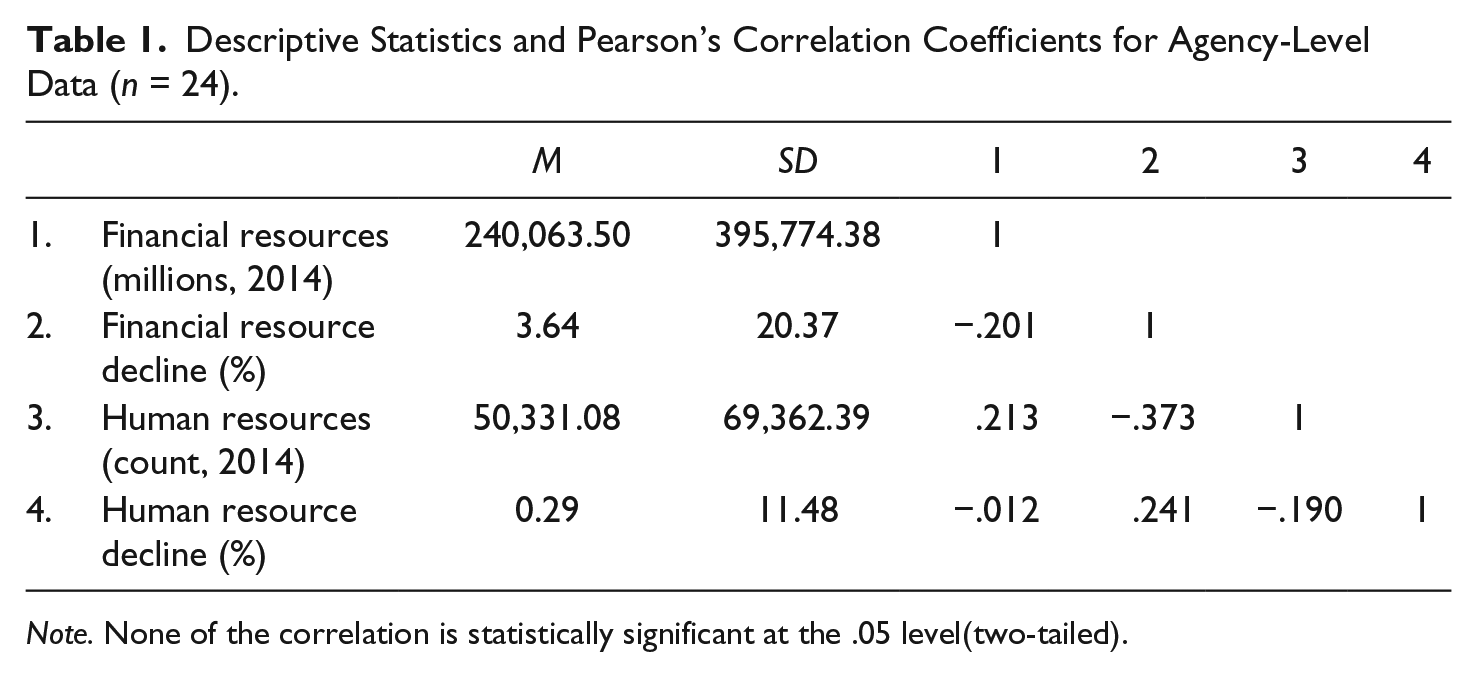
Note. None of the correlation is statistically significant at the .05 level(two-tailed).
Table 2 presents the descriptive statistics and correlation coefficients among the individual-level variables. The correlation direction between OCB and the independent variables was in line with expectations. For example, OCB was found to have positive associations with job-goal specificity (r = .43, p < .01), performance feedback (r = .28, p < .01), and supervisor support (r = .30, p < .01), and the associations between the independent variables were moderate. The highest absolute value for the correlation coefficients was found between supervisor support and performance feedback (r = .62, p < .01).
Descriptive Statistics and Pearson’s Correlation Coefficients for Individual-Level Data.
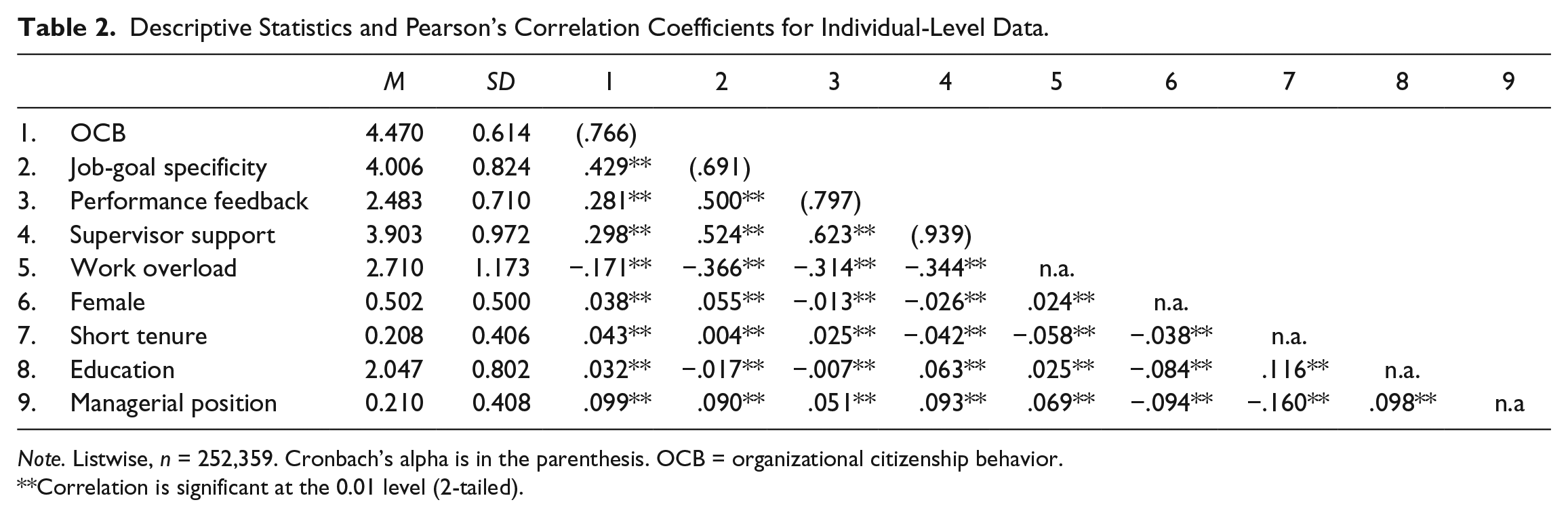
Note. Listwise, n = 252,359. Cronbach’s alpha is in the parenthesis. OCB = organizational citizenship behavior.
Correlation is significant at the 0.01 level (2-tailed).
Table 3 presents the associations between the independent variables and OCB from the multilevel analysis for which HLM 7 was used. The analysis had robust standard errors as the dependent variable arithmetic mean (OCB) was relatively high and negatively skewed (skewness = −1. 57; Kurtosis = 4.39). All individual- (Level 1) and agency- (Level 2) level variables were grand centered except for the three dummy variables (female, short tenure, and managerial position).
Results of the Multilevel Linear OCB Model (With Robust Standard Errors).
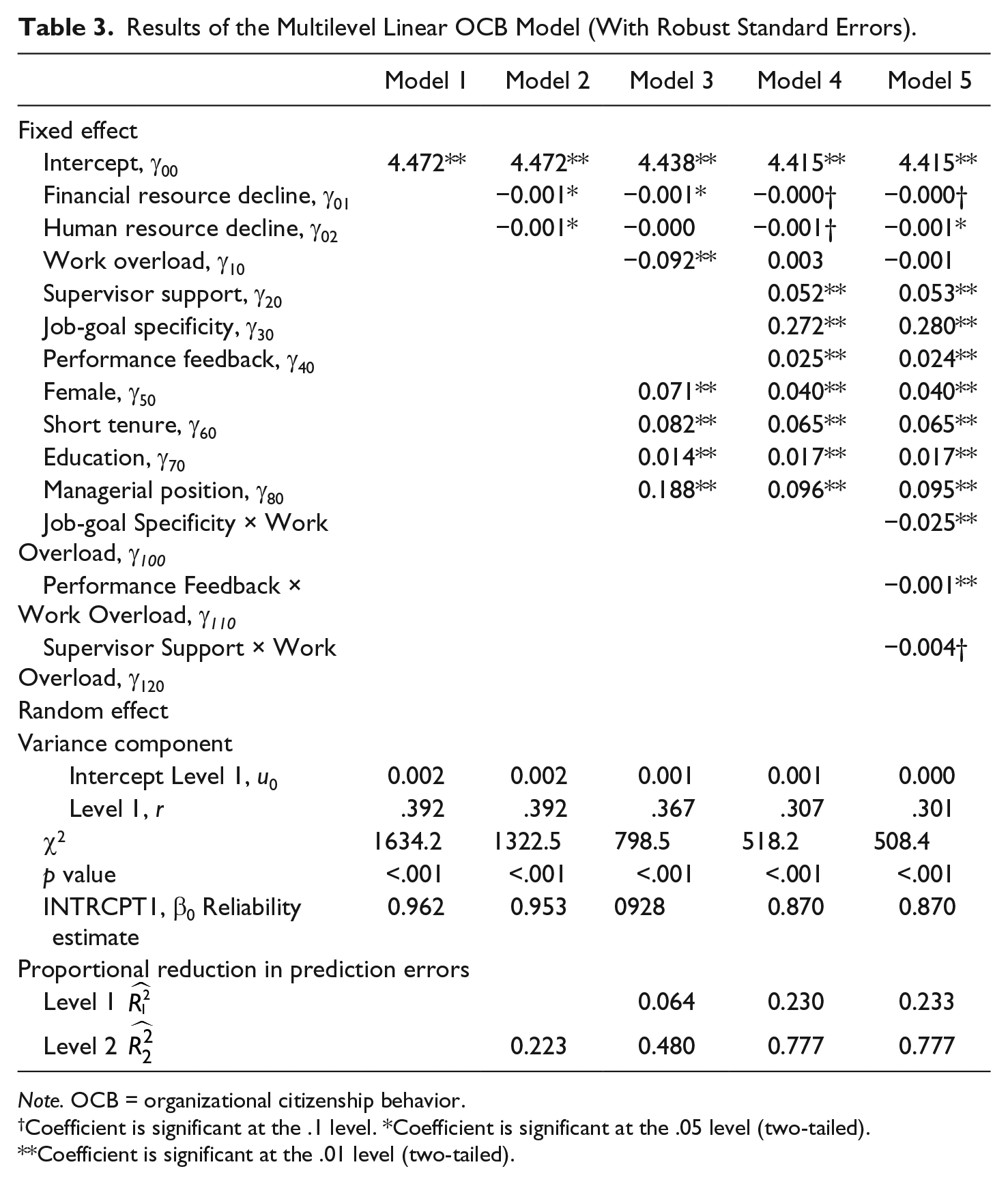
Note. OCB = organizational citizenship behavior.
Coefficient is significant at the .1 level. *Coefficient is significant at the .05 level (two-tailed). **Coefficient is significant at the .01 level (two-tailed).
Model 1 shows the unconditional random effects model (one-way ANOVA model). While this model does not contain any independent variables, it provides information about the dependent variable (OCB) and provides the reliability estimate of intercepts (λ = 0.95), which indicated that the OCB estimation by the different agencies was adequate. Model 2 examined the associations between organizational resource declines (i.e., financial resource decline and human resource decline) and OCB. Model 3 examined the associations between OCB and both the individual-level (i.e., work overload) and organizational job demands (i.e., organizational resource decline). Job resources and the OCB associations with all individual-level and agency-level variables were inserted in Model 4. Model 5 examined the interaction effects between job resources and work overload. All models showed adequate model fit such that the inclusion of the agency- and individual-level variables significantly reduced prediction errors (
Before testing the hypotheses, we examined the associations between the control variables and OCB. Consistent with previous studies, females were found to have a higher OCB level than males (γ50 = 0.07 [p < .01] in Model 3; γ50 = 0.04 [p < .01] in Models 4 and 5). In addition, employees with a tenure of less than five years tended to have a higher level of OCB than other employees (γ60 = 0.08 [p < .01] in Model 3; γ60 = 0.07 [p < .01] in Models 4 and 5). This finding that shorter tenure employees had higher OCB levels after controlling for the other factors is of interest as previous studies have found that longer tenure employees had higher OCB levels because they had more chances to be engaged (Ng & Feldman, 2011; Wright & Bonett, 2002). Education was also found to have a positive association with OCB (γ70 = 0.01 [p < .01] in Model 3; γ70 = .02 [p < .01] in Models 4 and 5), with employees who had higher education being found to be more likely to be engaged in OCB; however, the impact was somewhat marginal. Managerial position was found to have a significant association with OCB (γ80 = 0.19 [p < .01] in Model 3; γ80 = 0.10 [p < .01] in Models 4 and 5), indicating that employees in managerial positions might have greater chances to be engaged in OCB.
Hypothesis 1 proposed that there would be negative associations found between organizational resource declines and OCB. This was confirmed, as can be seen in Table 3. Negative associations between financial resource decline (Models 2 and 3: γ01 = −0.001 [p < .05]; Models 4 and 5: γ01 = −0.000 [p < .1]) and human resource decline (Models 2 and 5: γ02 = −0.001[p < .05]; Model 4: γ02 = −0.001[p < .1]; Model 3: γ02 = −0.000 [n.s.]) and OCB were found. Therefore, Hypotheses 1a and 1b were generally supported; however, the results require interpretive caution. As the intraclass correlation coefficient (ICC) 1 in the null model was 0.005 in the given data, the total variance that the agency-level variables could explain for the individual-level OCB was 0.5%, which is marginal at best. Furthermore, the practical significance of these associations was minimal; for example, the results from the given data found that a 10% decline in human resources would result in a 0.001 reduction in the OCB score. Therefore, no strong evidence was found that organizational resource declines had detrimental effects on employee OCB.
Based on the implications of the JD-R model, Hypothesis 2 proposed that work overload had a negative association with OCB; however, the results were mixed. When work overload was inserted along with organizational resource declines and the control variables in Model 3, the negative association between work overload and OCB was significant (Model 3: γ10 = −0.09 [p < .01]). However, the association became marginalized when job resources were inserted in Model 4 (γ10 = 0.003 [n.s.]) and Model 5 (γ10 = −0.001 [n.s.]). Therefore, Hypothesis 2 was not fully supported. However, as job-goal specificity was found to have a statistically significant positive association with OCB (γ30 = 0.27 [p < .01] in Model 4; γ30 = 0.28 [p < .01] in Model 5), Hypothesis 3 was supported to some extent. Of all the job resources in the given model, the magnitude of the coefficients for job-goal specificity was larger than for any of the other variables, indicating that it had the most significant association with OCB. A moderate but positive association was reported between performance feedback and OCB (γ40 = 0.03 [p < .01] in Model 4; γ40 = 0.02 [p < .01] in Model 5), and a moderate but statistically significant association was found between supervisor support and OCB (γ20 = 0.05 [p < .01] in Models 4 and 5). Therefore, Hypotheses 4 and 5 were supported.
Hypothesis 6 suggested that job-goal specificity (Hypothesis 6a), performance feedback (Hypothesis 6b), and work unit climate (Hypothesis 6c) buffered the associations between work overload and OCB. These hypotheses were seen to be supported if a significant positive coefficient of the interaction term was found; however, the results showed the opposite effect. The interaction effects for job-goal specificity and work overload (γ100 = −0.03 [p < .01] in Model 5), performance feedback and work overload (γ110 = −0.001 [p < .01] in Model 5), and supervisor support and work overload (γ120 = −0.004 [p < .1] in Model 5) were all negative; however, the impact was marginal. In other words, job resources might strengthen the negative associations between work overload and OCB. Therefore, Hypothesis 6 was not supported.
In sum, although consistent positive associations with job resources were found, there was no strong evidence that the job demand factors had negative associations with OCB in government organizations. In addition, the expected buffering effects were not supported as job-goal specificity, performance feedback, and supervisor support were found to strengthen the negative associations between work overload and OCB.
Discussion and Conclusion
This study has significant implications for public sector management studies. First, this study contributes to public sector cutback management research. Previous public management studies have raised concerns that cutback management involving staff cutbacks could result in employees becoming emotionally distressed (Levine, 1984) or could reduce their engagement with their work (Conway, Kiefer, Hartley, & Briner, 2014; Kiefer, Hartley, Conway, & Briner, 2015) as there would be more work and less resources. The results from our study, however, were mixed, since while statistically significant associations between organizational resource decline and OCB were found, the practical magnitudes of associations were marginal. These results might signify that organizational resource decline may be too removed from employees for them to feel any psychological stress or adjust their work attitudes. The other possibility is that organizational resource decline might have an indirect effect on employee performance by modifying the nature of individual jobs or engendering a less inclusive work environment (Andrews & Ashworth, 2015). Another possible explanation is that there are other types of organizational resources that government employees might consider more important rather than financial or human resources, such as administrative resources, political resources, or reputation resources.
This study also contributed to the JD-R model. First, the results of this study were in line with the basic tenet of the JD-R model as the positive associations between job resources and OCB were confirmed. The positive associations found between job-goal specificity, performance feedback, and work supervisor support indicated that providing adequate job resources could be important to maintaining employee OCB in government organizations. In particular, the dominating effects of job-goal specificity on OCB are worth noting, as this result was in line with previous public management studies that recognized the importance of job-goal specificity in enhancing government employee motivation and performance (Jung, 2014a, 2014b; Jung & Rainey, 2011; Wright, 2001).
However, this study also had some intriguing findings from the JD-R model’s perspective: (a) a significant negative association between work overload and OCB was not found and (b) no buffering effects of job resources on negative associations between work overload and OCB were found. Lepine, Podsakoff, and Lepine (2005) provided a clue regarding the complex nature of work overload and employee performance; they suggested that there were two types of stressors that place work demands on individuals: (a) challenge stressors and (b) hindrance stressors. Challenge stressors were seen as obstacles that employees face when attempting to achieve a performance goal or learning in an organization, while hindrance stressors were seen as job demands that could circumvent employee growth and success in the organization. Job demands such as work overload and job complexity may be challenge stressors, while role ambiguity, red tape, or organizational politics may be hindrance stressors. Lepine et al. (2005) found a complex association between challenge stressors and employee job performance in their meta-analysis, with the challenge stressors found to have a direct positive association with job performance by stimulating higher employee performance but were also found to have an indirect negative association with job performance as they increased employee strain (i.e., exhaustion). Given that work overload is a challenge stressor, the insignificant association between work overload and OCB found in Model 4 and the negative interaction terms found in Model 5 might reflect the balance between the positive and negative associations.
In particular, the negative interaction found in the current study suggested that there could be other associations between work overload and OCB. Several previous studies have hinted at the negative role of job-goal specificity and performance feedback on OCB. For example, Wright, George, Farnsworth, and McMahan (1993) posited that job-goal specificity had a negative impact on employee OCB because a strong emphasis on prescribed behavior would force employees to commit their maximum resources to attain their given job goals, thereby sacrificing extra-role behavior. In the same manner, Vigoda-Gadot and Angert (2007) argued that developing specific job goals as part of performance feedback might assist both supervisors and employees in clearly distinguishing between in-role and extra-role performance, which could lead employees to have lower motivation to engage in extra-role behavior, as they clearly recognize the behaviors that contribute to their individual job performance. In a similar manner, employees in high demanding work environments who feel that they have good supervisory support might not engage in OCB as they believe that their supervisor would cover their back. The results of this study do not support this argument as significant positive associations were found between job-goal specificity, performance feedback, and OCB. However, the negative interaction terms found in this study could imply that some job resources might impel government employees to focus on their prescribed performances under high workloads. Therefore, the results imply that not all job resources have similar buffering effects, especially in the context of high demanding work environments in government organizations.
Third, this study also contributes to OCB studies in government organizations. Previous OCB studies in government organizations have used either social exchange or self-concept theories to explain government employee OCB (Shim & Faerman, 2017). This study, therefore, differed from previous approaches as it emphasized the psychological capacity of employees to be engaged in OCB based on the JD-R model. Because psychological capacity could be influenced by job and work environments, job resources and demands were examined. Therefore, this study adds to the understanding of government employee OCB.
Nonetheless, this study had several limitations. First, common method bias could be a concern as self-reported OCB could inflate the associations between OCB and job resources (Organ & Ryan, 1995). However, based on the guidelines by Conway and Lance (2010), the researchers determined that common method bias played a limited role in the current study; (a) the construct validity of this study was theoretically and methodologically sound; (b) variable items included in this study did not have any semantic overlay with other items in the current study; and (c) the results of this study were in line with previous studies in terms of direction and magnitudes of associations between OCB and the independent variables. Even though there was no strong evidence of common method bias, future studies should reexamine the associations using data from multiple sources. Second, because this study was based on cross-sectional data, the possibility of reverse or reciprocal relationships could not be controlled. For example, those who were more engaged in OCB might have had more favorable opinions about their job resources as they might have secured more job resources in their organizational lives. In addition, because the agency-level independent variables were change rates, it would have been ideal if the study had adopted the OCB change rate of the lagged year; however, this approach was not possible in this research setting because the FEVS data were not designed to be matched at the individual level. Therefore, studies based on longitudinal data are needed for a deeper understanding of the nature of organizational resource decline and OCB change.
Several unexpected findings of this study could be interesting paths for future research. For example, future studies could investigate the influence of departmental or team resource decline on employee OCB rather than organizational resource decline, as employees might feel a more direct loss of their resources when their departmental or team resources decline. In addition, future studies could examine the relation between organizational resource decline and OCB by examining other types of organizational resources. Although the results of this study did not find any strong evidence of a negative association between organizational resource decline and OCB, it suggests that more studies are required to fully examine whether “working more with less” is truly feasible for effective public service provision.
Footnotes
Appendix
The Standardized CFA Regression Coefficients for Individual-Level Items.
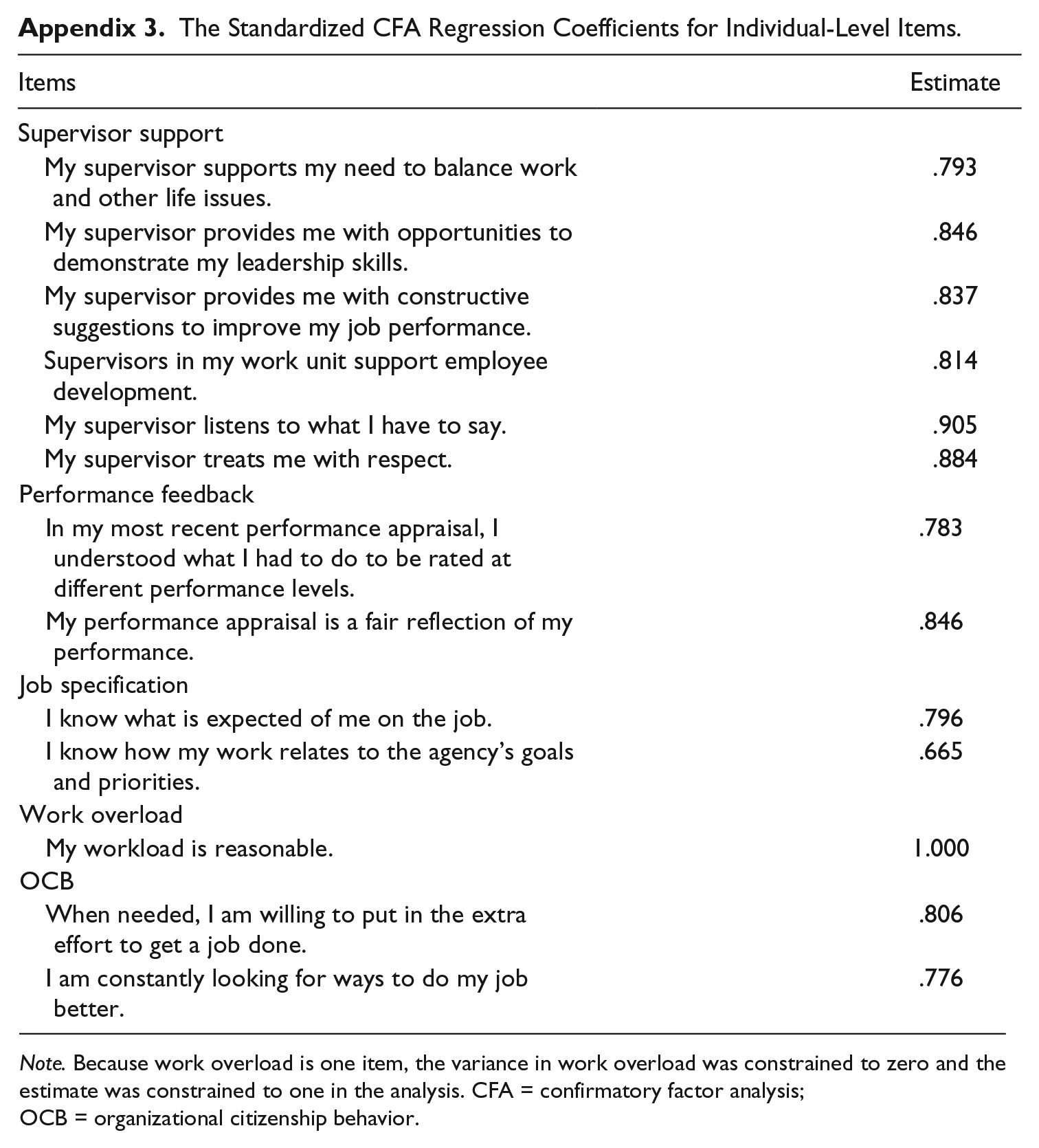
| Items | Estimate |
|---|---|
| Supervisor support | |
| My supervisor supports my need to balance work and other life issues. | .793 |
| My supervisor provides me with opportunities to demonstrate my leadership skills. | .846 |
| My supervisor provides me with constructive suggestions to improve my job performance. | .837 |
| Supervisors in my work unit support employee development. | .814 |
| My supervisor listens to what I have to say. | .905 |
| My supervisor treats me with respect. | .884 |
| Performance feedback | |
| In my most recent performance appraisal, I understood what I had to do to be rated at different performance levels. | .783 |
| My performance appraisal is a fair reflection of my performance. | .846 |
| Job specification | |
| I know what is expected of me on the job. | .796 |
| I know how my work relates to the agency’s goals and priorities. | .665 |
| Work overload | |
| My workload is reasonable. | 1.000 |
| OCB | |
| When needed, I am willing to put in the extra effort to get a job done. | .806 |
| I am constantly looking for ways to do my job better. | .776 |
Note. Because work overload is one item, the variance in work overload was constrained to zero and the estimate was constrained to one in the analysis. CFA = confirmatory factor analysis; OCB = organizational citizenship behavior.
Declaration of Conflicting Interests
The author(s) declared no potential conflicts of interest with respect to the research, authorship, and/or publication of this article.
Funding
The author(s) disclosed receipt of the following financial support for the research, authorship, and/or publication of this article: This work was supported by the Ministry of Education of the Republic of Korea and the National Research Foundation of Korea (NRF-2016S1A3A2924956).