






Abstract
While telework has been adopted widely in local governments because of the numerous potential benefits that it offers for the workforce, organizations, and society, little research has been done to examine if and how telework achieves expected worker outcomes in local governments. Drawing on insights from the social exchange and social exclusion theories, this article extends previous telework research by demonstrating the differential effects of telecommute and telework options on job satisfaction and performance of local government workforce. Data were collected through an online survey of workers at a large local government agency in California. Results showed that telework and telecommute options improved job satisfaction and performance of workers in the local government agency due to flexible work schedules and locations. In addition, telecommuters having more interpersonal interaction opportunities which reduce feelings of social isolation/work alienation experienced higher job satisfaction and performance than teleworkers.
Introduction
A large number of local governments pursue a variety of innovative work arrangements for their employees to satisfy their distinctive needs and preferences and improve job performance. Such innovative work programs include flexible work arrangements (FWA) that allow employees to perform work without the constraints of time and location, such as flextime, compressed workweek, and telework (Caillier, 2013; Kwon et al., 2019). Since the Telework Enhancement Act (TEA) was passed in 2010, the public sector has customized the traditional work arrangement to telework, which allows workers to perform work during any part of regular, paid hours, at home, or at an approved alternative worksite (e.g., telework center; TEA, 2010). Telework provides organizations, employees, and even society with numerous benefits, including an increased work-family balance through flexible work hours and/or locations, improved climate protection and energy sustainability due to employees driving less, reduced overhead costs of maintaining physical worksites, and ensuring employees’ safety during the pandemic such as the COVID-19 crisis (Mahler, 2012; Overmyer, 2011; Perez et al., 2004; Wadsworth et al., 2010). Due to increasing numbers of a new generation of workers, rising pollution, high real estate and utility costs, limited availability of worksites and parking, and/or global pandemic issues, many local governments are permitting telework for their employees (e.g., Kwon & Jeon, 2017; OECD, 2020) and the trend is expected to continue.
Despite its potential benefits to employees and organizations, telework poses managerial and cultural challenges and other constraints that may undermine the effectiveness of telework programs. Monitoring teleworkers who work remotely can be a major challenge for supervisors and managers (Kwon & Jeon, 2020; S. Y. Lee & Hong, 2011; Wadsworth et al., 2010). The physical separation of workforce may negatively affect workplace culture, such as non-teleworker resentment, antagonism toward teleworkers, and a lower level of cooperation and teamwork (Mahler, 2012). Moreover, teleworkers often have difficulty in separating work from personal lives and experience feelings of social isolation due to the lack of face-to-face interactions with supervisors and coworkers (Kwon & Jeon, 2020; Weinert et al., 2015). Teleworkers are often unclear about what is expected of them, what objectives they are supposed to meet, and whether they are sufficiently performing their tasks and duties unless their organizations have a performance-oriented culture with clear performance goals (Igbaria & Guimaraes, 1999; Overmyer, 2011; Tavares, 2015). These potential challenges can become major obstacles to the effectiveness of telework programs and may lead to the failure to achieve the promised worker outcomes of telework programs—for example, increased job satisfaction and job performance.
Recently, a number of studies have attempted to examine the effects of telework in federal government agencies (Bae & Kim, 2016; Kwon & Jeon, 2020; D. Lee & Kim, 2016; Mahler, 2012; Overmyer, 2011). For instance, Bae and Kim (2016) examined the impact of telework on federal employee job satisfaction, Lee and Kim (2016) studied how telework eligibility, participation, and managerial support affected federal teleworker’s and non-teleworker’s job satisfaction, and Kwon and Jeon (2020) examined determinants of teleworker satisfaction with telework programs in federal agencies. Additional studies have examined the effect of telework in the public workplace and explored determinants of telework adoption in local governments (Kwon & Jeon, 2017; Wadsworth et al., 2010). However, little research has been done to examine if and how telework achieves expected worker outcomes in local governments. To address this gap in the literature, the following research question is pursued: How does telework affect worker outcomes—job satisfaction and job performance—in local governments?
The research question is examined by using a dataset from an online survey of employees of a large local government agency in California, which provides a variety of welfare and medical services for children and adults with limited income. The agency provides a variety of FWA; telework is permitted for their employees to participate in one of two telework options—telecommute or telework. Explained in more detail later, the telecommute option allows employees to work from home for a few weekdays and work in the office for the rest of the week while the telework option enables employees to work remotely at all times without an assigned workspace in the agency. This study primarily focuses on the impacts of these two telework options on worker outcomes—job satisfaction and job performance—in the agency and provides local governments with a structured, detailed guide for effective telework implementation.
This article first outlines the key issues to be addressed, introduces the theoretical foundations of the study, and develops the research hypotheses. This is followed by a description of data and methods and then a presentation of research findings. Finally, the article discusses the implications of the research findings for managing public sector human resources in the telework environment and suggests directions for future research.
The Impacts of Telework
Local governments are increasingly facing dilemmas in managing and motivating the current multigenerational workforce. The following generations make up the current workplace: Baby boomers are members of a generation born between 1946 and 1964; Generation X is a generation born between 1965 and 1980; and Generation Y and Z are generations born after 1980. Each generation has varying needs and preferences (Berman et al., 2016). It is important for local governments to navigate these differing needs and preferences of each generation and find more customized ways to motivate them rather than a one-size-fits-all approach (Klingner et al., 2010; Kwon & Jeon, 2017). Otherwise, failure to motivate a multigenerational workforce can lead to a decline in job satisfaction, decreased productivity, increased absenteeism, and/or high turnover rates. Indeed, managing and motivating across generational boundaries is becoming a huge challenge for local government management.
To address the challenge, local governments have provided FWA as one of the solutions to meet the varying needs of their multigenerational workers. FWA include several flexible working programs, such as flextime, part-time, compressed workweek, and telework (Wadsworth et al., 2010). Flextime programs allow employees to work 8 hours per day with choice of work start time between 7 and 10 am (Klingner et al., 2010). Part-time program indicates that employees work fewer than 35 hours per week (15–30 hours commonly; Berman et al., 2016). Compressed workweek programs permit employees to work 40 hours per week but less than 5 days by adjusting working hours (10–12 hours/day; Kwon et al., 2019; Wadsworth et al., 2010). Telework provides not only flexible work hours, but also flexible work location and, as defined earlier, enables employees to work from home or at alternative work sites. Telework provides employees with greater flexibility for work location and time than any other FWA (Overmyer, 2011). Among the flexible work programs, telework is becoming popular for local governments because of the possible benefits of telework explained earlier. According to the 2010 International City/County Management Association (ICMA) survey, over 25% of cities permit telework for their employees (ICMA, 2010). In light of the current COVID-19 pandemic, a large number of local governments were forced to abruptly transition to telework, a phenomenon that is expected to continue even after the pandemic is over.
California is not an exception. Recent research finds a considerable number of local governments in California have adopted telework that permits their employees to work from home or alternative remote location (Kwon & Jeon, 2017). It is also expected that more city and county governments in metropolitan and urban areas of California will adopt telework because of high real estate and utility costs, limited availability of worksites and parking, rising concerns about sustainability, and pandemic issues. To maintain flexibility in accommodating personnel growth and to provide the highest level of service possible without adding additional worksites and parking while reducing greenhouse gas (GHG) emissions through reduction in employee mobility and protecting their workforce from pandemic diseases, California city and county governments in metropolitan and urban areas are looking at telework as a viable option to overcome these identified problems.
Telework and Telecommute Options in Local Government Agencies
Along with the continuing trend of adopting telework in California local governments, telework is permitted for local government workers with two options—telecommute option and telework option. The terms “telework” and “telecommute” have been used interchangeably, but in practice, the terms have different meanings (Caillier, 2013; Dahlstrom, 2013; Getha-Taylor & Lee, 2008; Kim & Wiggins, 2011; Kwon & Jeon, 2017; S. Y. Lee & Hong, 2011). Previously, telecommute was introduced as a FWA option to reduce commute to and from work sites by having employees work from home (Hill et al., 1998; Torraco, 2005). Later, telework was introduced as a more evolved and broader FWA option to provide not only workplace flexibility but also time flexibility, allowing employees to accomplish their work efficiently and effectively while accommodating family needs (Hunton & Norman, 2010; Kwon & Jeon, 2017, p. 204; Maruyama et al., 2009). Although the difference between these two terms is subtle, telework and telecommute have been used as two different telework options in local government agencies.
For instance, the agency we surveyed for this research offers their workers either the telecommute option or telework option. Telework option allows an employee to perform work, during any part of regular, paid hours at home or an approved alternative worksite, and the employee is not assigned to a work office. Therefore, “teleworker” refers to an employee who operates out of a home office and does not have a permanently assigned workspace at an agency facility. On the other hand, telecommute option allows an employee to perform work during any part of regular, paid hours at home or an approved alternative worksite even though the employee is assigned a physical work office. Thus, “telecommuter” refers to an employee who has a dedicated workspace assigned to him/her at an agency facility but also operates out of a home office. The major difference between these two options is that teleworkers work remotely at all times while telecommuters work remotely for a few weekdays and work in the office for the rest of the week so that they can have in-person interactions with other members in the workplace.
While these two telework options have been increasingly utilized in local government agencies, not much research has been done to study how each of the telework options affects worker outcomes through a comprehensive theoretical framework by using a large-N study. This study is timely and important in that it informs practicing supervisors, managers, and leaders of the impacts of telework options on worker outcomes as well as recommending the steps to be taken to reduce the potential negative effects. The present study focuses on the impact of telework and telecommute options on the following worker outcomes: job satisfaction and job performance. The social exchange and social exclusion theories provide theoretical frameworks for the present study.
Theories and Hypotheses: Social Exchange and Social Exclusion Theories
There has been vast research on the impacts of human resource management (HRM) practices on worker/organizational outcomes (Fuenzalida & Riccucci, 2018; Kroll & Moynihan, 2015; Weibel et al., 2010). In particular, there is a salient body of literature that examines how telework, as a new HRM practice, affects worker satisfaction, turnover intention, and the perceived fairness of personnel procedures and practices in federal agencies (Bae & Kim, 2016; Caillier, 2013; D. Lee & Kim, 2016). Consequently, recent telework studies confirm that despite its drawbacks, telework is a desirable HRM practice that provides numerous benefits for the federal government workforce (Caillier, 2013; Mahler, 2012; Overmyer, 2011). Our research makes important contributions to this body of findings by studying the impacts of telework on local government workforce.
Drawing on insights from the social exchange and social exclusion theories, we argue that whether or not local government workers participate in telework and whether they participate in the telework option or telecommute option affects their job satisfaction and job performance differently. We argue participating in either telework option or telecommute option is likely to result in higher job satisfaction and job performance than non-participation due to flexible work schedules and locations. In addition, it is expected that telecommute option participation has more significant and positive impacts on job satisfaction and job performance than telework option participation because telecommute option can reduce feelings of social isolation and work alienation by providing interpersonal interactions on a regular basis. The following discussion explores these arguments in more detail.
Social Exchange Theory
Social exchange theory has been used to examine the relationships between telework participation and individual perception, and actions on the job, such as job satisfaction, job involvement, and turnover intention (Bae & Kim, 2016; Caillier, 2012; D. Lee & Kim, 2016). This theory posits that individuals are likely to reciprocate in ways critical to the success of the organization, such as increasing job satisfaction and performance if they receive benefits from their organizations (Anderfuhren-Biget et al., 2010; Gouldner, 1960; Gould-Williams & Davies, 2007; Haas & Deseran, 1981). Such benefits may include development opportunities, empowerment, and employee friendly programs. Current telework research finds employees are likely to return the benefits associated with telework in the form of improved work motivation, retention, and work performance (Caillier, 2012; D. Lee & Kim, 2016). In addition, drawing on insights from social exchange theory, Bae and Kim (2016) find that telework programs are positively related to job satisfaction because teleworkers feel more encouraged to reciprocate the benefits of teleworking by exhibiting more positive attitude and behavior toward their job and organization than non-teleworkers. Perceived benefits of telework are translated into worker outcomes. In this respect, we hypothesize that when employees participate in telework/telecommute options implemented by their organization, they are likely to reciprocate by showing increased positive attitude and behavior toward their organization.
H1a: Teleworkers/Telecommuters are likely to have higher job satisfaction than workers who do not participate in telework options.
H1b: Teleworkers/Telecommuters are likely to have higher job performance than workers who do not participate in telework options.
Social Exclusion Theory
Nevertheless, employees in a remote work environment can face feelings of social isolation because of work alienation and physical separation from other members. Telework research argues that while the plentiful freedom on the job and flexible working schedules and locations are supposed to improve job satisfaction and performance among teleworkers, such remote work arrangement can cause employees to experience feelings of social exclusion due to lack of face-to-face interactions with supervisors and coworkers (Kwon & Jeon, 2020; Tavares, 2015). Therefore, building desirable interpersonal relationships among organizational members is critical to enhancing job satisfaction, performance, and productivity in a virtual work environment. Failure to connect organizational members can cause a high level of feeling isolated and excluded. Such social exclusion can significantly reduce the job satisfaction and productivity of workers in a remote work environment.
Drawing on insights from social exclusion theory, this study expects that the degree to which remote workers have interpersonal interactions with other members influence the level of their job satisfaction and job performance. According to social exclusion theory, it is human nature to avoid being excluded from social groups (Baumeister & Tice, 1990). Individuals are predisposed to be together with others and tend to interact with and rely on each other (Leary, 1990). It is expected that feelings of social isolation and work alienation caused by remote work can increase anxiety and loneliness and these negative psychological consequences are detrimental to job satisfaction and job performance of employees who participate in telework programs (Lee & Hong, 2011; Mahler, 2012). As such, it is important to provide certain attributes and activities that occur naturally in an in-person work environment for remote workers in order to build desirable interpersonal interactions, understanding, and trust among the workforce. Such attributes and activities include face-to-face meetings on a regular basis, open and innovative channels of communication with team members, virtual coffee chats and watercooler conversations, and so on. As defined earlier, telecommute option allows employees not only to work from home for a few weekdays, but also to work in the office for the rest of the week so that they can have more interpersonal interactions with other members on a regular basis. Accordingly, this study hypothesizes that telecommuters are likely to have better worker outcomes than teleworkers because telecommuting can reduce feelings of social isolation through interpersonal interactions on a regular basis while enabling employees to benefit from flexible working schedules and locations.
H2a: Telecommuters are likely to have higher job satisfaction than teleworkers and workers who do not participate in telework options.
H2b: Telecommuters are likely to have higher job performance than teleworkers and workers who do not participate in telework options.
Data and Methods
Data Source and Sample
Data in the study were obtained from the FWA Survey we conducted in 2019. The FWA Survey questionnaire was emailed to all employees at the California local agency to examine how they perceive FWA options in their workplace. Nearly one in three (n = 1,169) employees completed the survey with an overall response rate of 32.9%, which is a reasonable response rate for this type of survey. 1 To confirm to what extent our sample employees from the survey represent the agency employee population, we compared the sample’s characteristics—gender, age, minority, and usage of telework/telecommute—with the characteristics of the agency employee population data. The percentages for the gender characteristic are 20.9%/79.1% for male/female in the survey sample compared to 24%/74% for male/female in the agency employee population. Percentages of the minority characteristic are 27.6%/72.4% for non-minority/minority in the survey sample compared to 20%/80% for non-minority/minority in the agency employee population. For age, the survey sample presents 6.7% for under 30, 22.1% for 30 to 39, 35.5% for 40 to 49, 26.6% for 50 to 59, and 9.1% for 60 and over and the agency employee population illustrates 8.7% for under 30, 26.9% for 30 to 39, 31.9% for 40 to 49, 23.5% for 50 to 59, and 9% for 60. For usage of telework/telecommute, the survey sample demonstrates 29.9% for usage of telework/telecommute and the agency employee population presents 30.7% for usage of telework/telecommute. In a nutshell, the survey sample and the agency employee population show similar percentages for gender, minority, age, and usage of telework/telecommute and the sample is not so badly skewed that we would expect a sample error.
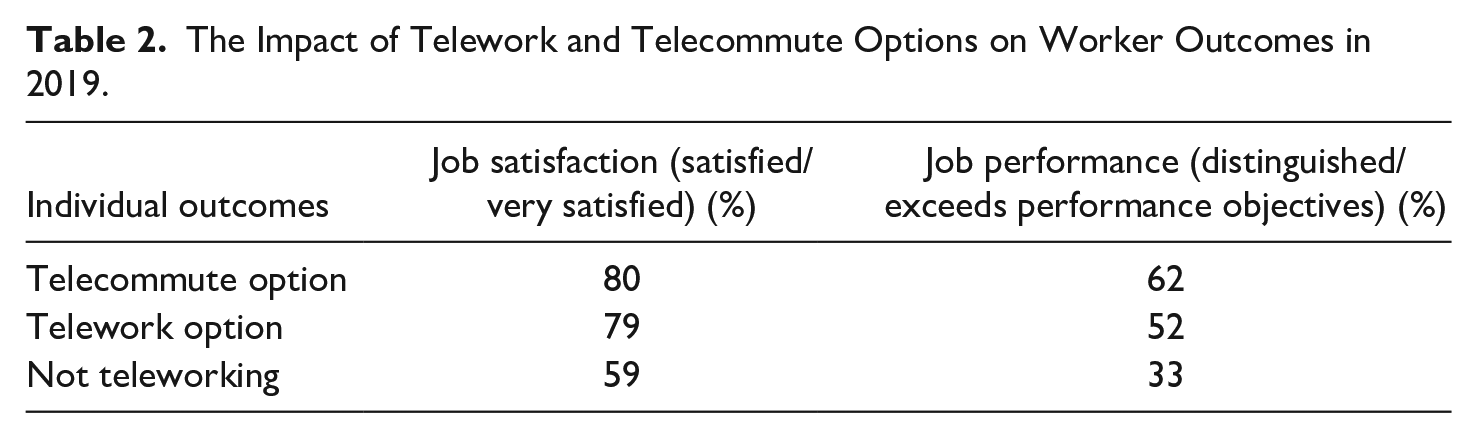
As presented in Table 1, 7.4% (86) of the survey respondents participated in the telework option and 22.5% (263) participated in the telecommute option. The survey also asked questions regarding worker outcomes. Table 2 demonstrates that telework participants tend to show higher job satisfaction and job performance than non-participants. Two empirical models were developed for hypotheses testing. The actual numbers of cases used in the empirical models were slightly less than 1,169 because some employees have missing values for one or more of the variables of interest. The first model was to examine how the explanatory variables influence employee job satisfaction. Out of the 1,169 completed surveys, 910 surveys were included for analysis in the first model because the other 259 surveys had missing values for one or more of the variables of interest. The second model was to examine how the explanatory variables influence employee job performance. Nine hundred and three (903) surveys were included for analysis in the second model, because the other 266 surveys had missing values for one or more of the variables of interest.
Number and Percent of Workers Participating Telework/Telecommute Options.

The Impact of Telework and Telecommute Options on Worker Outcomes in 2019.
Dependent Variables
The first dependent variable is perceived job satisfaction. It was measured by computing the mean of the following questions from the 2019 FWA survey:
Considering everything, how satisfied are you with your job? Very Dissatisfied Dissatisfied Neither Dissatisfied Nor Satisfied Satisfied Very Satisfied
Considering everything, how satisfied are you with your organization? Very Dissatisfied Dissatisfied Neither Dissatisfied Nor Satisfied Satisfied Very Satisfied
The questions were measured by a 5-point Likert-type scale with 1 being very dissatisfied and 5 being very satisfied. Cronbach’s alpha for the scale was .92, showing a high internal consistency among the questions.
The second dependent variable is job performance. It was also constructed based on a question from the 2019 FWA survey:
What did you receive on your performance evaluation? Needs Improvement/Does Not Meet Performance Objectives Solid/Meets Performance Objectives Distinguished/Exceeds Performance Objectives
The respondent chose from one of the three responses. If the response is “Needs Improvement/Does Not Meet Performance Objectives,” the item is coded as 1; “Solid/Meets Performance Objectives” is coded as 2; and “Distinguished/Exceeds Performance Objectives” is coded as 3.
We estimated an OLS regression for the first model because the dependent variable of job satisfaction is continuous at the individual level analysis. However, the other dependent variable of job performance has only one respondent (N = 1) for the response of “needs improvement/does not meet performance objectives.” Also, this respondent had missing values for several explanatory variables. As a result, we excluded this respondent from the second model and treated the dependent variable of job performance as dummy variable—0 for “Solid/Meets Performance Objectives” and 1 for “Distinguished/Exceeds Performance Objectives.” Therefore, we estimated binary logit regression for the second model with the dummy dependent variable of job performance (Long, 1997).
Independent Variables
The first and second models have 12 independent variables. All the independent variables are constructed based on questions from the 2019 FWA survey. The independent variables and the survey questions used to measure each independent variable are summarized below.
Primary explanatory variables
To avoid any confusion with regard to telecommute option and telework option, we generated a clear definition of each option and included these definitions in the survey questionnaire for respondents. As the first primary explanatory variable, “Telecommute Participation Option” was measured by the following survey questions:
Do you participate in telecommute option? (No/Yes)
How often do you telecommute? Everyday Four times per week Three times per week Twice per week Once per week Three or more times per pay period Twice per pay period Once per pay period
If respondents answer “No” to the first question, they are coded as 0. If respondents answer “Yes” to the first question and answer F through H to the second question, they are considered as pay period-basis telecommuters and coded as 1. If respondents answer “Yes” to the first question and answer D or E to the second question, they are considered as weekly-basis telecommuters and coded as 2. If respondents answer “Yes” to the first question and answer A through C to the second question, they are considered as daily-basis telecommuters and coded as 3.
As the second primary explanatory variable, “Telework Option Participation” was measured by the following survey questions:
Do you participate in telework option? (No/Yes)
How often do you telework?
Everyday Four times per week Three times per week Twice per week Once per week Three or more times per pay period Twice per pay period Once per pay period
If respondents answer “No” to the first question, they are coded as 0. If respondents answer “Yes” to the first question and answer B through H to the second question, they are considered as part-time teleworkers 2 and coded as 1. If respondents answer “Yes” to the first question and answer A to the second question, they are considered as full-time teleworkers and coded as 2.
Control Variables
Compressed workweek option was defined as “a work arrangement where the number of hours worked per week is condensed into fewer days” and this definition was included in the survey questionnaire for respondents. It was measured with the question, “Do you participate in compressed workweek option?” If the response is “Yes,” the item is coded as 1; and “No” is coded as 0. Perceived as a good place to work was measured with the statement, “I would recommend my organization as a good place to work.” The question was measured by a 5-point Likert-type scale with 1 being strongly disagree and 5 being strongly agree. Gender was measured with the question, “Are you (a) male, or (b) female?” Male was coded as 1 and female was coded as 2. Age was measured and categorized as follows: under 30 (1), 30 to 39 (2), 40 to 49 (3), 50 to 59 (4), and 60 or older (5). Marital status was measured with the question, “What is your marital status?” Single was coded as 1, married was coded as 2, and other was coded as 3. “Minority” refers to non-white workers. Non-white was coded as 1 and white was coded as 0. Supervisory Status was measured with the question, “What is your supervisory status?” Response options were Non-supervisor/Team Leader and Supervisor/Manager/Senior Leader. The response of non-supervisor/team leader was coded as non-supervisory employees (1), and the response of supervisor/manager/senior was coded as supervisory employees (2). Tenure was measured with the question, “How long have you been with the county government?” The category of “5 or fewer years” were coded as 1, “6 to 14 years” was coded as 2, and “15 or more years” was coded as 3. Income was measured as household income before taxes during the past 12 months and categorized as follows: less than $25,000 (1), $25,000 to $34,999 (2), $35,000 to $49,999 (3), $50,000 to $74,999 (4), $75,000 to $99,999 (5), $100,000 to $149,999 (6), and $150,000 or more (7). Education was measure with the question, “What is the highest degree or level of education you have completed?” It was categorized as follows: high school (1), some college (2), bachelor’s degree (3), and post-bachelor’s degree (4).
Results
In order to detect multicollinearity issues among independent variables, we conducted correlation matrix test (Table 3) and the variance inflation factor (VIF) test for each model. We found that all correlation coefficients are well below the threshold value of .7 and the mean VIF score for these two models is 1.23, which is below 2.5, indicating that multicollinearity is not a primary concern in these two models.
Descriptive Statistics and Correlations for the First and Second Models.

Does Participating in Telework Options Improve Worker Outcomes?
In Table 4, the first column titled “First Model (Job Satisfaction)” presents the OLS regression results for the first model. The R2 is used to test the goodness of fit for the OLS regression analysis. The R2 value (.64) indicates that 64% of variance in the dependent variable is explained by the independent variables; thus, overall, the support for the models is strong. Hypothesis 1a predicted a positive association between telework/telecommute option participation and job satisfaction. The results support hypothesis 1a, indicating that the positive coefficients of telecommute and telework participation variables are statistically significant and suggesting that telecommuters and teleworkers have higher job satisfaction than workers who do not participate in telework options.
OLS and Binary Logistic Regression Estimates for the First and Second Models.

p ≤ .10. **p ≤ .05. ***p ≤ .01.
Regarding control variables, only the perception of good place to work is statistically supported. The results suggest that participants who agree that their organization is a good place to work are likely to be more satisfied with their job than who do not agree with the statement. Other control variables did not show any statistically significant relationships with job satisfaction.
In Table 4, the second column titled “Second Model (Job Performance)” presents the binary logit regression results for the second model. The LR χ2 was statistically supported at less than 0.001; thus, overall, the support for the models is strong. While the R2 value (.10) for the model is not high, there are interesting findings based on the association between individual and dependent variables. Hypothesis 1b predicted a positive association between telework/telecommute option participation and job performance. The results show that the positive coefficients of telecommute participation variable and telework participation variable are statistically significant. The results suggest that teleworkers/telecommuters have higher job performance than workers who do not participate in telework options.
Regarding demographic control variables, age, supervisory status, education level, and the perception of good place to work have a statistically significant association with job performance. The results show a negative association between age and the likelihood of job performance while supervisory status and education level have positive relationships with job performance. In terms of good place to work, the results show that participants who agree that their organization is a good place to work are likely to have better job performance than those who do not agree with the statement. Finally, other control variables did not show any statistically significant relationships with the likelihood of job performance.
Which Option—Telecommute Versus Telework—Has Greater Impacts?
For testing Hypotheses 2a and 2b, this study also looked at the standardized coefficients—Beta and bStdX in the Table 3 (Kwon et al., 2020; Long, 1997). In the first model, the Beta of telecommute option participation variable (.05) is greater than the Beta of telework option participation variable (.04). Also, in the second model, the bStdX of telecommute participation variable (0.37) is greater than the bStdX of telework participation variable (0.12). The results support Hypothesis 2a and 2b, meaning that telecommute option participation has greater impact on job satisfaction and job performance than telework option participation. Overall, these findings provide support for the second hypotheses generated based on the social exclusion theory, suggesting that the telecommute option can promote the likelihood of increased job satisfaction and job performance for workers by providing them with more in-person interactions with other members on a regular basis, which can help them overcome social isolation and work alienation than the telework option.
Yet, the extent to which one can infer this association as the causal relationship is limited because all variables were measured at the same time. The study results can be interpreted differently with other possibilities due to this data limitation. Future research can generate longitudinal data and study various possibilities regarding the associations between telework options, telework/telecommute benefits, social isolation/work alienation, and worker outcomes.
Discussion and Implications
This study explored the impact of introducing telework into local governments on their worker outcomes. Although previous studies have reported on the role of telework in federal government agencies, there have been scant attempts to study how telework influences worker outcomes in local government agencies. Additionally, there is a lack of empirical data in local governments examining the relationship between telework and worker outcomes. Drawing on the insights from social exchange and exclusion theories and collecting empirical data from online surveys with workers in a large California local government agency, this study strives to understand how telework and telecommute options influence worker outcomes in local governments.
The findings suggest that telework and telecommute options improve job satisfaction and job performance of remote workers in the local government agency by motivating them with flexible work schedules and locations. Remote workers are pleased and appreciative of telework options and return the benefits associated with telework options by improving work performance. Also, the findings illustrate that telecommute options that help remote workers to reduce feelings of social isolation/work alienation by providing more opportunities for interpersonal interaction with others result in higher worker satisfaction and performance than telework options. As such, it is expected that organizations can increase remote worker job satisfaction and performance by using specific strategies (e.g., teleworking with periodical meetings, open and innovative channels of communication with team members, virtual coffee chats, and virtual watercooler programs) and achieve better outcomes from telework options.
Findings from this research have several local government management implications that explain what factors enhance the effectiveness of telework to achieve promised worker outcomes. First, despite a big growth in telework after the COVID-19, it seems that not many local governments have examined how their telework influences worker outcomes. Without proper assessment, telework is more likely to become a symbolic initiative to jump on the band wagon than a realistic and substantive innovation (Kwon & Jeon, 2020). This study suggests that local governments need to conduct telework assessments on a regular basis so that they can examine the strengths and weaknesses of their telework in order to improve its effectiveness.
Second, telework may fail to achieve its expected outcomes without specific strategies reducing feelings of social isolation and work alienation. Literature on strategic planning suggests that developing strategies leads to generating necessary tools/options for policy and/or program success (Bryson, 1988; Denhardt, 1995; Mintzberg et al., 2003). Moreover, strategic planning can give clear ideas about where a local government should go and how it will get there regarding a program and policy (Kanter, 1983; Mintzberg, 1994). Because telework is relatively new to the workplace, local governments need to generate specific strategies to overcome challenges and barriers to telework. As such, it is crucial for local governments to help remote workers overcome challenges and barriers during telework and to achieve expected objectives through strategic workforce planning.
Finally, our study contributes to the broader literature on local government management and telework. Our study is the first to draw on a sample of a local government agency. Based on the social exchange and exclusion theories, it identifies specific benefits of telework as well as challenges to maximizing its effectiveness. Further studies need to expand the sample size to see how these explanatory factors influence other local government agencies. It is also necessary for future studies to examine how telework contributes to achieving organizational goals and missions.
Conclusion
Since the start of the COVID-19 pandemic, telework options have been adopted widely in local governments. Beyond adoption, clear telework guidelines for employees and employers, sufficient organizational/technological supports, and desirable working environment should be established to enhance the effectiveness of telework implementation (Allen et al., 2015; Lee & Kim, 2016; Mahler, 2012; Overmyer, 2011). Also, findings from this study illustrate that a specific way of implementing telework—telecommute option—leads to higher job satisfaction and performance than other option. We suggest that local government agencies examine which way of implementing telework and/or what telework strategies of overcoming their unique challenges work better for their workforce through empirical analyses.
While conducting the FWA survey, we also had opportunities to interview managers and supervisors in the surveyed agency who manage teleworkers and telecommuters and also participate in telework options. The interviewees identified potential barriers to telework, such as difficulties in coordinating training for remote workers, eligibility issues in determining who can telework/telecommute, cultural backlash against teleworking/telecommuting, increasing social exclusion/work alienation, and computer/connectivity/application difficulties during teleworking/telecommuting.
These interview findings echo the recurring findings in recent telework studies examining the association between telework and workforce during the pandemic. In light of the current COVID-19 pandemic, a large number of workers were required to telework and faced challenges such as dissatisfaction with the internal infrastructure and working environment because of limited access to office equipment and documents, juggling between home and work commitments simultaneously, blurred lines between work and personal life, missing social interactions, limitations on monitoring, and cybersecurity issues such as the increased threat of data theft on home office computers (FastLane, 2020; Teo, 2020; Vyas & Butakhieo, 2021, p. 68). As such, managerial, personal, and technological challenges are still major recurring obstacles to the success of telework.
Future endeavors on continuing data-driven telework research should be undertaken to provide informative and realistic feedback on how this new normal HR practice is implemented and can be improved to achieve expected outcomes. One size does not fit all, but there are ways to identify a number of good ways for implementing HR practices that can be generalized to most practitioners (Berman et al., 2016). Different local government agencies may need to tailor their telework programs in different ways to meet their unique needs. In order to identify more specific HR practices that can be utilized by different agencies with different needs and environments to successfully implement telework, further studies should strive to collect workforce data from multiple and longitudinal sources and present opportunities to enhance the effectiveness of managing remote workers through evidence-based HR strategies/policies.
Limitations and Future Research
This study has a few limitations and raises some questions for future research. One limitation is the usage of the cross-sectional data from a single source. We collected data for all variables from the 2019 survey, which may cause a mono source bias and also the data does not guarantee the time precedence of independent variables in establishing the causal relationships. The finding on the association between telework options and worker outcomes should be interpreted as correlation rather than causality because all variables were measured at the same time. Future research can extend this study by generating longitudinal survey data from the same individuals over time regarding the impact of telework options on job satisfaction and job performance.
Another limitation is that as a large N study, this study may have omitted explanatory variables that influence job satisfaction and job performance. This study was originally intended to understand the impact of telework options on worker outcomes. This means that other explanatory factors may possibly affect job satisfaction and job performance. Also, different sample sizes between telework and telecommute options may cause possible bias in our findings. It is recommended that future studies expand our research, explore other possible determinants of worker outcomes beyond telework options, and collect similar sample sizes between telework and telecommute options.
Due to lack of local government data regarding telework, we were not able to test hypotheses on the associations of telework/telecommute and worker outcomes with a large sample of different local government agencies. As such, the study results may be limited in its scope because of the relatively small sample sizes and may not be suitable to be generalized to all local government agencies. Also, while job performance can be measured by various dimensions, it was measured by a single survey item and it could be open to manipulation. Because there are still fewer items than usual for dependent variable measures, the study results should be interpreted with these limitations in mind. Future research can expand this study by generating survey data from other local government agencies and measuring more dependent variable measures regarding job satisfaction and performance of teleworkers/telecommuters.
Footnotes
Declaration of Conflicting Interests
The author(s) declared no potential conflicts of interest with respect to the research, authorship, and/or publication of this article.
Funding
The author(s) received no financial support for the research, authorship, and/or publication of this article.
