







Abstract
Reporting workplace discrimination has garnered renewed attention in public administration scholarship. Missing, however, from the literature is bystander reporting, a relatively new and understudied mode of reporting. Using a sub-sample of respondents (i.e., bystanders) who witnessed others encountering workplace discrimination—specifically race- (n = 886) and/or sex-based discrimination (n = 1,152)—this study finds that less than one fifth (18.7% and 16.6% respectively) of all bystanders reported the alleged offense. However, this study suggests that personal characteristics such as age, race or ethnicity, and veteran status, as well as occupational variables such as supervisory status and tenure duration, significantly impacted bystander reporting after witnessing race-based discrimination. Likewise, personal characteristics such as age, as well as occupational variables such as grade level, supervisory status, and tenure duration, also significantly impacted bystander reporting after witnessing sex-based discrimination. These findings are important because a different mode of reporting may increase agency accountability for acts of workplace discrimination or retaliation.
Since the passage of the Notification and Federal Anti-Discrimination and Retaliation Act of 2002 (i.e., No FEAR Act)—which empowers employees to report unlawful behavior and expands agency accountability for acts of discrimination or reprisal in the workplace, as amended by the Elijah E. Cummings Federal Employee Anti-Discrimination Act of 2020—the subject of workplace discrimination and reporting behavior, specifically on race- and sex-based discrimination, has garnered ample attention in public administration scholarship (e.g., Alteri, 2020; Collins, 2004; Cortina & Berdahl, 2008; EEOC, 2016; Leasher & Miller, 2012; Lee & Yu, 2020; Reese & Lindenberg, 2005; Riccucci & Saldivar, 2014; Rubin & Alteri, 2019; Yu & Lee, 2020, 2021). This narrative is important because the Equal Employment Opportunity Commission (EEOC, 2021a) received 43,462 formal complaints alleging race- (22,064) and sex-based (21,398) discrimination in FY2020 alone, the third and fourth most charged basis of employment discrimination in the United States next to disability- (24,324) and retaliation-based (37,632) allegations. Likewise, the No FEAR Act further requires an agency to establish, or leverage, a system to track (and subsequently post on its public website certain summary statistical data) each complaint of discrimination, including retaliation, and submit a disciplinary action report to the EEOC after all appeals have been exhausted.
The EEOC (2021d, 2021e) describes race- and sex-based discrimination as containing any facet of employment, such as “hiring, firing, pay, job assignments, promotions, layoff, training, fringe benefits, and any other term or condition of employment,” unfavorably due to an applicant or employee’s race or gender respectively. In addition, race-based discrimination includes “personal characteristics associated with race, such as hair texture, skin color, or certain facial features” (EEOC, 2021d). Likewise, race- and sex-based harassment are modes of discrimination. For example, racial harassment includes “racial slurs, offensive or derogatory remarks about a person’s race or color, or the display of racially-offensive symbols” (EEOC, 2021d). Similarly, sexual harassment includes “unwelcomed sexual advances, requests for sexual favors, and other verbal or physical harassment of a sexual nature [as well as] offensive remarks about a person’s sex, including the person’s sexual orientation, gender identity, or pregnancy” (EEOC, 2021e). In both forms of harassment, it is also “illegal when it is so frequent or severe that it creates a hostile or offensive work environment or when it results in an adverse employment decision” (EEOC, 2021d, 2021e). While most of the scholarship has focused on why employees do not report workplace discrimination (e.g., Collins, 2004; Cortina & Berdahl, 2008; EEOC, 2016; Reese & Lindenberg, 2005; Yu, 2022), a small number of scholars have identified when employees will respond more positively toward reporting discrimination in the workplace (e.g., Lee & Yu, 2020; Rubin & Alteri, 2019; Yu & Lee, 2020, 2021).
Missing from this body of literature is bystander reporting. According to the EEOC (2021b), any individual (e.g., applicant, employee, or former employee) who believes that their employment rights have been violated can file an employment discrimination complaint, regardless of their citizenry or work status (e.g., full-time, part-time, seasonal, or temporary). However, an individual other than the alleged victim (e.g., bystander or witness) may also file an employment discrimination complaint in support of another person to safeguard that person’s identity (EEOC, 2021b). It is this group of potential reporters who serve as the central focus of this article. Yet not much is known about this prospective group. For example, there is scant research on bystander reporting, and the subject is limited to scholarship on reporting workplace abuse such as harassment (albeit a form of employment discrimination) and workplace bullying (e.g., Easteal & Ballard, 2017; Jacobson & Eaton, 2018; Low et al., 2007; Mulder et al., 2016), and bystander intervention training, a prevention program recommended by the EEOC to help employers prevent workplace discrimination (EEOC, 2016; Schulte, 2018). Despite this dearth of research, a body of literature in social psychology offers a well-established framework of bystander behavior (e.g., Berkowitz, 2009; Fischer et al., 2011; Latané & Darley, 1970) that can serve as a guide for understanding bystander reporting in the workplace, which ultimately can have a significant impact on reducing employment discrimination and empowering more employees to report race- and sex-based discrimination, as well as other forms of discrimination. Thus, the current study aims to gain more insight on this unfamiliar subject.
Using a sub-sample of respondents employed by a large federal department who responded “yes” to having witnessed others experiencing race- (n = 886) and/or sex-based discrimination (n = 1,149) at their current employment, this study examines the reporting behavior of bystanders. More specifically, the following research question is explored: who are the bystanders who choose to intervene and report perceived encounters of workplace discrimination? Furthermore, to expand knowledge on this topic, this study also solicits the reasons for why bystanders choose not to get involved. This dialog is important for several reasons. First, despite the enactment of the No FEAR Act, research has shown that reporting workplace discrimination is a struggle for many individuals; thus, different modes of reporting should be explored and examined. Second, this study introduces a new grouping variable of employees (i.e., bystanders) who may provide useful information on reporting behavior to both scholars and practitioners alike. Finally, the current #MeToo climate that empowers alleged victims of sexual harassment (and assault) to speak up in the workplace, coupled with the renewed priority of social justice and equity awareness, encourages federal administrators to empower all employees, including bystanders, to intervene and report workplace misconduct to increase agency accountability for acts of discrimination or retaliation.
The article is arranged as follows. First, this article proceeds with an overview on the scholarship on bystander behavior and intervention. Second, the research settings and methodology are informed, followed by empirical results. Lastly, this article concludes by offering discussion, implications for the findings, and limitations of this study.
Bystander Behavior and Intervention
Using hidden cameras, the popular ABC television program What Would You Do observed and commented on how ordinary citizens behave when confronted with dilemmas that require them to either act or ignore the situation. Although the program typically targets controversial vignettes on prejudicial conduct in a public setting, the focus on bystander behavior and intervention is clear. Furthermore, the emergence of smartphone cameras and advanced recording apps have empowered bystanders to capture misconduct and violent interactions involving public servants such as the police, as well as community residents, within their geographical jurisdiction. However, public servants are also faced with a similar dilemma when they witness workplace discrimination, deciding to act and subsequently report the unlawful workplace action or ignore the situation. Although many employees may purport to doing the right thing, most people will likely refrain from intervening on both counts (Hortensius & de Gelder, 2018), with the current study being no exception. To illustrate, less than one fifth of all respondents who witnessed some form of workplace discrimination reported the alleged offense. Thus, the bystander effect theory and subsequent intervention model are appropriate frameworks to help guide why individuals may choose to report workplace discrimination (e.g., intervene) or ignore the situation.
Bystander Effect Theory
A half century ago, social psychologists Darley and Latané (1968) initiated foundational research demonstrating that people avoid helping someone when other witnesses are present, also referred to as the bystander effect or bystander apathy. In the years since, research has greatly increased our understanding about how and when individuals accept or skirt responsibility. For example, conventional explanations for bystander apathy include three psychological factors: (1) diffusion of responsibility (e.g., the diminution of personal responsibility when more people are present); (2) evaluation apprehension (e.g., the fear of negative or critical public judgment while helping others); and (3) pluralistic ignorance (e.g., the belief that the situation is not actually an emergency because no one is helping) (Berkowitz, 2009; Darley & Latané, 1968; Hortensius & de Gelder, 2018; Kim, 2021). However, more contemporary explanations to bystander apathy also include: (4) the fear of embarrassment on the person who requires help and (5) the fear of negative consequences or retaliation against the bystander (Berkowitz, 2009).
Yet, a recent study by Hortensius and de Gelder (2018) presents a new theoretical model for bystander apathy that includes emotional, motivational, and dispositional aspects. The authors suggest that personality traits, specifically sympathy and distress, plays a key role in a bystander’s reflective or reflexive reactions, and conclude that individuals who score higher in experiencing trait-level sympathy and personal distress are likely to help someone in an emergency when no other bystanders are present. On the other hand, if there are greater numbers of bystanders, personal distress would be lower, resulting in a decrease to help someone in an emergency, although sympathy is still high. While witnessing workplace discrimination does not necessarily demonstrate the emergency that early scholars had envisioned when framing bystander apathy, workplace discrimination can have detrimental consequences for the victim and can cost an organization millions of dollars in financial and prospective relief:
These include actual cash relief for charging parties or other aggrieved individuals such as restored pay, compensatory damages, punitive and liquidated damages, and other items such as attorney’s fees, fringe benefits, and training or tuition costs. There is also prospective relief that may be included that is associated with the resolution of the charge including hiring, reinstatement, recall or other actions that result in employment for the charging party or aggrieved individuals, as well as promotions and prospective fringe benefits (EEOC, 2021a).
Altogether, the EEOC (2021a) estimated $74.8 million in relief for race-based discrimination and another $153.2 million in relief for sex-based discrimination in FY2020 alone. Furthermore, monetary benefits obtained through litigation totaled an additional $106.1 million in payouts.
As mentioned previously, not much is known about the experiences of bystanders who report workplace discrimination. However, there is research on bystanders who report workplace abuse such as harassment and workplace bullying that may explain why bystanders often remain silent, although some will choose to intervene and report workplace abuse. Not surprisingly, failure to disclose workplace abuse is similar to bystander apathy and commonly include fear of victim association, retaliation, dismissal, reprimand, or other adverse actions such as poor performance appraisals, demotion, involuntary transfers, and deprivation of job benefits and overtime opportunities (Cortina & Magley, 2003; Easteal & Ballard, 2017; Jacobson & Eaton, 2018; Low et al., 2007; Lutgen-Sandvik et al., 2007; Mulder et al., 2016; Parker, 2014).
In addition, bystanders may feel uncomfortable reporting negative or threatening information due to fear of being viewed or labelled negatively (e.g., reputational affects) by organizational hierarchy, and therefore, may damage valued relationships necessary for retention and promotion (Milliken et al., 2003). Furthermore, perpetrators (or bullies) will employ a range of tactics to silence bystanders (and victims) that impede their reporting, such as thwarting communication (e.g., engaging in one-way communication, charging employees with insubordination, and ignoring or ridiculing employees to intentionally impact peak job performance) and enforcing confidentiality agreements (Cortina & Magley, 2003; Parker, 2014). Finally, bystanders may not report workplace abuse because they believe it would violate the desires of the victim. For example, literature on victim empowerment emphasizes the necessity for the victim to make their own decisions because depriving a victim of their decision-making ability may cause them further harm (White & Sienkiewicz, 2018). Consequently, in an effort to expand knowledge on an understudied mode of reporting, this study sought additional responses to why workplace bystanders choose not to get involved.
Bystander Intervention Model
Some individuals (or bystanders) will choose to intervene. These strategies include: (1) confrontation (e.g., a directed conversation with the perpetrator on their inappropriate remark or action); (2) shifting the focus (e.g., ignoring the inappropriate remark or action to avoid the situation or shift attention away from the problem); and (3) shifting the person (e.g., helping the perpetrator understand their motivation for making the inappropriate remark or action to aid them in understanding why it is problematic) (Berkowitz, 2009). Accordingly, the current study uses reporting as a proxy for intervention and amends the first strategy by including reporting discrimination as an additional form of confrontation in its description. However, before a bystander chooses to ignore or intervene in a situation, they typically encounter the 5-step bystander intervention model: (1) notice that something is happening, (2) interpret the situation as an emergency, (3) take personal responsibility for acting, (4) determine how to act with the belief that one (i.e., the bystander) has the skills to succeed, and (5) implement the appropriate course of action (Latané & Darley, 1970).
Although this model has been applied to a wide range of situations, to include sexual violence (e.g., Darley & Latané, 1968; Latané & Darley, 1970; Leone & Parrott, 2019) and cyberbullying (e.g., Kim, 2021; Lytle et al., 2021; Nagar & Talwar, 2021) outside the workplace, recent scholarship has revealed developments to the initial framework, specifically the nature and scope of the emergency (Fischer et al., 2011). For example, Fischer et al. (2006, 2011) propose that dangerous or violent emergencies may increase rather than decrease bystander intervention, a phenomenon generally referred to as positive bystander effects (Lytle et al., 2021). They argue that dangerous situations are less ambiguous than non-dangerous situations, “which increases the cost of not helping the victim” (Fischer et al., 2011, p. 520). The cost of intervening is outweighed by the bystander’s moral obligation to assist. In this regard, employees who witness their colleagues experience race- or sex-based discrimination may feel compelled to act to prevent and stop workplace discrimination, an unlawful and continuing problem in the public workforce.
In addition, if the group composition of bystanders is higher in ratio in a dangerous situation, these additional witnesses (or bystanders) may provide support to the victim and the initial bystander by overcoming a potential perpetrator collectively, especially if the bystanders are known to one another (Fischer et al., 2011; Horowitz, 1971; Rutkowski et al., 1983). Likewise, if the bystander knows the victim, they are likely to intervene regardless of the number of additional witnesses (or bystanders) (Palmer et al., 2018). In this regard, employees who witness their co-workers experience race- or sex-based discrimination may collectively intervene and subsequently report workplace discrimination. Again, while workplace discrimination does not demonstrate the emergency that early scholars had envisioned when bystanders must interpret a situation, workplace discrimination to include harassment can have detrimental consequences for creating a hostile working environment for the victim.
Another recent development to the initial framework that has shown an increase in bystander intervention is when the individual can remain anonymous, thus reducing evaluation apprehension or public scrutiny on their action (Gao et al., 2015; Garcia et al., 2009; Schwartz & Gottlieb, 1980; Van Bommel et al., 2012). In this regard, some bystanders will choose to report workplace abuse if they feel their organization maintains a safe culture for reporting; have relevant policies in place for reporting harassment and workplace bullying without fear of repercussions, to include a clear complaint path and assurances of consequences for inappropriate behavior; and training programs that inform organizational policies and guidelines on workplace abuse to encourage reporting from both victims and bystanders (Easteal & Ballard, 2017; Jacobson & Eaton, 2018; Lutgen-Sandvik et al., 2007; McDonald & Flood, 2012).
For example, Jacobson and Eaton (2018) found in their study on organizational policies that a zero-tolerance policy (on harassment) led to the greatest estimates of bystander reporting. In addition, Gao et al. (2015) found in their study on reporting intentions (in this case whistleblowing) that an external third-party reporting channel mitigated bystander apathy and increased the likelihood of reporting, in comparison to an internal reporting mechanism. Furthermore, in their report on workplace harassment, the EEOC (2016) recommended bystander intervention training—a common violence prevention program (Centers for Disease Control and Prevention [CDC], 2021)—to empower co-workers and provide them the means to intervene when witnessing harassing or other discriminatory behavior. This training is modeled from the It’s On Us (2021) campaign—an outgrowth from the White House Task Force to Protect Students From Sexual Assault (Presidential Memorandum, dated January 22, 2014)—launched by the non-profit organization Civic Nation to reduce sexual violence in an educational setting by empowering campus staff, faculty, and students to be part of the solution when given the resources and tools to prevent sexual assault as engaged bystanders (CDC, 2021; EEOC, 2016). Thus, the EEOC (2016) suggested a similar It’s On Us campaign in workplaces across the country that “could transform the problem of workplace [discrimination] from being about [victims, perpetrators], and legal compliance, into one in which co-workers [and] supervisors. . .all have roles to play in stopping such [workplace discrimination]” (p. vi). Coincidentally, this recommended training also complies with Executive Order 14035 (2021)—Diversity, Equity, Inclusion, and Accessibility in the Federal Workforce—which encourages bystander intervention to address workplace harassment and other forms of discrimination.
Finally, social identity (or group membership) among those present can impact how the bystander may act (Abbott & Cameron, 2014; Levine & Crowther, 2008; Levine & Manning, 2013). It is this narrative that contributes to the central focus of this article: who are the bystanders who choose to intervene and report perceived encounters of workplace discrimination? For example, if the bystander shares similar characteristics such as race, ethnicity, or gender with the intended victim, regardless of if the bystander knows the victim, bystander intervention appears to increase due to in-group bias (Abbott & Cameron, 2014; Jenkins & Nickerson, 2017; Levine & Crowther, 2008; Levine & Manning, 2013). Therefore, employees who are members of a minority race or ethnic group who witness racial discrimination may also report workplace discrimination if the victim is a member of the same race or ethnic group. Likewise, female employees who witness sex-based discrimination may report workplace discrimination if the victim is another woman. On the other hand, it is possible that in-group bias may also protect the alleged perpetrator, negating the possibility of bystander intervention (Abbott & Cameron, 2014; Levine & Crowther, 2008; Levine & Manning, 2013). Although the current study did not capture the identity of the intended victim for which the bystander is purported to witness, decades of multi-disciplinary scholarship, as well as executive, legislative, and judicial efforts in the United States would contend that women and non-White employees respectively experience sex- and race-based discrimination at a significantly higher level than male and White employees respectively.
Furthermore, scholarship on assertive reporting behavior—albeit from the alleged victim—has identified other individual and occupational variables such as age, grade level, and tenure duration for their positive reporting of workplace discrimination (Haarr & Morash, 2013; Lee & Yu, 2021). These studies suggest that the experience- and/or seniority-level of an individual played a major factor in reporting, which emboldened them to report the unlawful behavior. Despite these opposing viewpoints (e.g., bystander vs. victim), this study expects similar outcomes for identifying the bystanders who choose to intervene and report perceived encounters of workplace discrimination. Thus,
Data and Methods
To test these hypotheses, this study draws its sub-sample from civil servants employed by a large federal department who responded “yes” to having witnessed race- (n = 886) and/or sex-based discrimination (n = 1,149) in the workplace, representing 18.9% and 24.6% respectively of the overall sample (N = 4,679). In addition, 11.1% of the overall sample (n = 519) described witnessing both race- and sex-based discrimination, resulting in a third of all respondents (n = 1,531) witnessing some form of workplace discrimination. Race- and sex-based discrimination were specifically chosen to observe bystander behavior because they are likely the most obvious forms of misconduct for bystanders to recognize when witnessing employment discrimination. Likewise, as discussed earlier, race- and sex-based discrimination are the third and fourth most charged basis of employment discrimination in the United States.
An online Qualtrics survey was sent to all potential respondents nationwide in 2021, using their work-provided email accounts, and was open for 5 weeks with a reminder email sent at the end of the third week. To increase reciprocity with potential research participants, the survey link was sent by the department’s Office for Civil Rights and Civil Liberties acknowledging the study and encouraging maximum voluntary participation. Furthermore, anonymity was guaranteed to all potential respondents. The effort yielded an 11.9% rate of return, an acceptable response for a departmental study. Although respondents had the option to skip any question they felt uncomfortable answering, cases where respondents skipped the primary questions on bystander behavior (i.e., witnessing perceived encounters of workplace discrimination) were excluded from the final sub-sample (n = 1,531). Finally, while the survey collected responses to other workplace topics, due to the specific aims of this study, only questions that captured bystander behavior were examined.
The initial half of the survey gathered responses to individual and occupational characteristics such as age (23–68 years), gender (1 = male [1,032]; 2 = female [423]), education level (1 = non-graduate degree [1,210]; 2 = graduate or professional degree [309]), race/ethnicity (1 = White [744]; 2 = non-White [700]), marital status (1 = not married [441]; 2 = married [1,059]), veteran status (1 = no [976]; 2 = yes [549]), grade (1 = GS-5 through GS-11 [59]; 2 = GS-12 [460]; 3 = GS-13 [639]; 4 = GS-14 [245]; 5 = GS-15 [71]; 6 = Senior Executive Service [14]), supervisory status (1 = no [1,046]; 2 = yes [481]), and tenure duration (1–46 years).
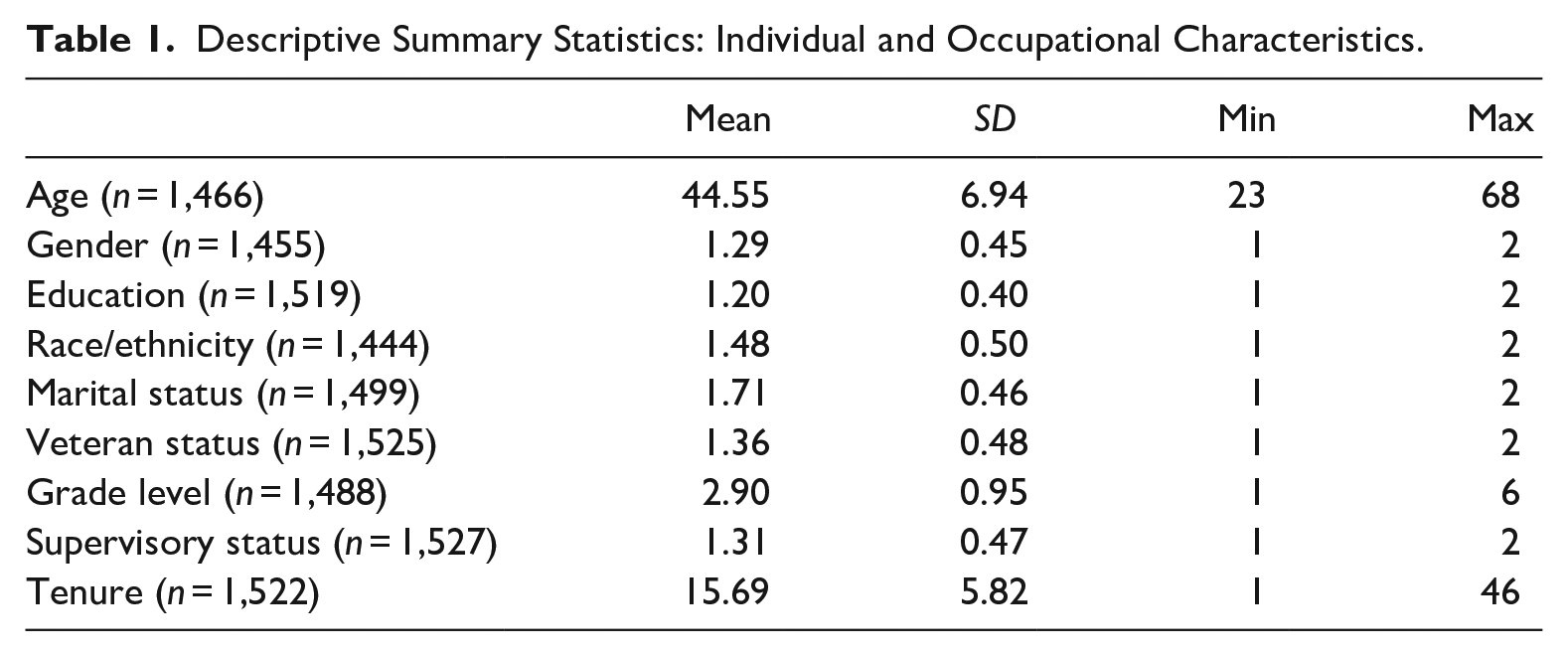
Table 1 provides the descriptive statistics of these variables based on the overall combined sub-sample (n = 1,531). The average age (M) of the sample was 44.55 years old, with a standard deviation (SD) of 6.94. The sample was overwhelmingly male (70.9%), diverse (48.5% non-White), educated (73.6% with college degree), and married (70.6%). In addition, 36% of the sample were veterans. Furthermore, summary statistics of the occupational variables revealed that the sample consisted of experienced civil servants. To illustrate, almost a third (31.5%) were in a supervisory or management role, the average grade level was GS-13, and the average tenure with their current employer was 15.69 years, with a standard deviation (SD) of 5.82.
Descriptive Summary Statistics: Individual and Occupational Characteristics.
The latter half of the survey collected responses to actual experiences of witnessing race- and/or sex-based discrimination. They were operationalized by the following baseline questions: “I have witnessed others experiencing sexual discrimination at my agency” and “I have witnessed others experiencing racial discrimination at my agency.” These two questions were coded as a binary variable (0 = no; 1 = yes), and the definitions of sexual discrimination and racial discrimination were provided in the survey instrument to limit individual bias. 1 If respondents answered yes to any of the two questions, they served as the sub-sample for this study and were asked a follow-up question: did you report it (0 = no; 1 = yes)? If respondents answered no, they were asked a fixed-choice follow-up question (i.e., Why did you not report it?) with an option to provide (write-in) a response not listed. The choices were: 1 = did not want to interfere (e.g., not my problem); 2 = consequences for my action (e.g., retaliation); 3 = nothing would be done/part of the culture; 4 = confronted the alleged perpetrator; and “other.” The responses for “other” were manually reviewed and coded into specific themes based on commonality. These include the following: 5 = difficulty in proving alleged offense; 6 = alleged offense was reported by victim or victim asked bystander not to interfere; and 7 = alleged perpetrator was in the reporting channel. Respondents also had the option to choose more than one response when asked why they did not report the wrongful encounter.
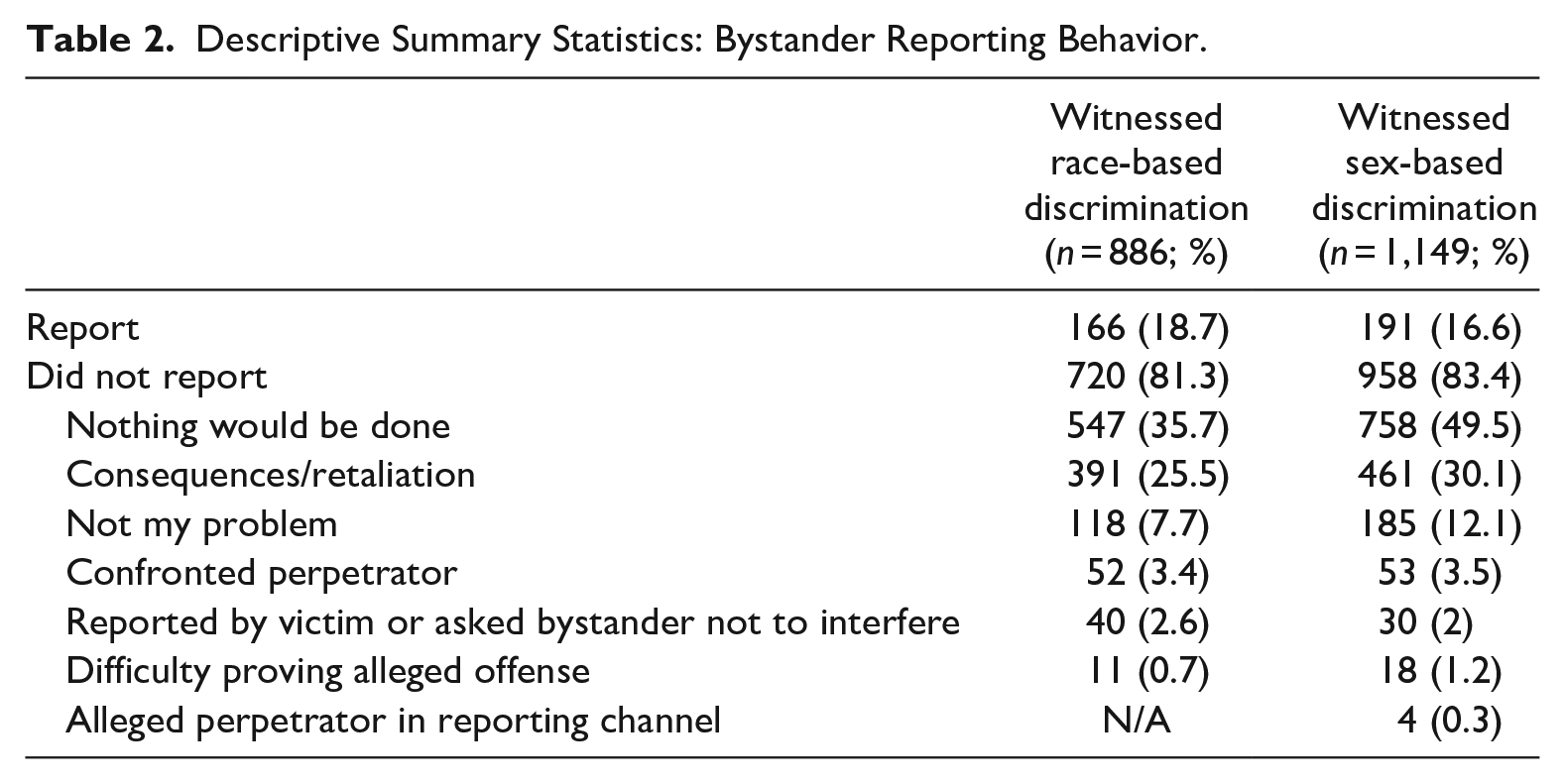
Table 2 provides a summary of these variables based on each sub-sample of respondents who reported witnessing race- (n = 886) or sex-based discrimination (n = 1,149) respectively in the workplace. With both forms of employment discrimination, less than one fifth (18.7% and 16.6% respectively) of all respondents who witnessed the encounter reported the alleged offense. For those who did not report the alleged offense (81.3% and 83.4% respectively), the top two responses for not reporting were because they believed nothing would be done (35.7% and 49.5% respectively) and/or they feared consequences for their reporting (25.5% and 30.1% respectively). A small percentage of respondents confronted the alleged perpetrator themselves (3.4% and 3.5% respectively) and/or specifically did not intervene and report the misconduct because they knew the incident was reported by the alleged victim (or another bystander) or the victim asked them to specifically not intervene and report the incident (2.6% and 2% respectively).
Descriptive Summary Statistics: Bystander Reporting Behavior.
To drive discussion and identify factors that may be typical characteristics for workplace bystanders who make a report after witnessing race- and/or sex-based discrimination in the workplace, a series of paired samples t-tests were performed to compare the mean differences in the individual and occupational characteristics of the bystanders who chose to report the employment discrimination in comparison to those who did not. To improve the estimation accuracy, comparisons were restricted to the respondents for each sub-sample. Finally, the Statistical Package for the Social Sciences (SPSS) was utilized for all analysis.
Findings
Table 3 provides the results of a comparison test between bystanders who made a report after witnessing workplace discrimination and those who did not. Regarding race-based discrimination, three individual characteristics (i.e., age, race/ethnicity, and veteran status) and two occupational characteristics (i.e., supervisory status and tenure duration) significantly differentiated the two groups, supporting hypotheses 1 and 3. More specifically, bystanders who made a report after witnessing race-based discrimination were likely to be older (p < .01), identify as a member of a minority race or ethnic group (p < .01), and previously served in the armed forces (p < .01), in comparison to their colleagues who chose not to report the incident. On average, the mean differences in age, race/ethnicity, and veteran status between the two groups were 3.06 years, 0.12 units, and 0.13 units respectively. In addition, workplace bystanders were more likely to make a report after witnessing race-based discrimination if they were in a supervisory position (p < .01) and had more workplace experience with their current employer by 1.49 years (p < .01), in comparison to their colleagues who chose not to report the incident. The mean difference in supervisory status was 0.12 units.
Reporting Comparisons: Individual and Occupational Characteristics.
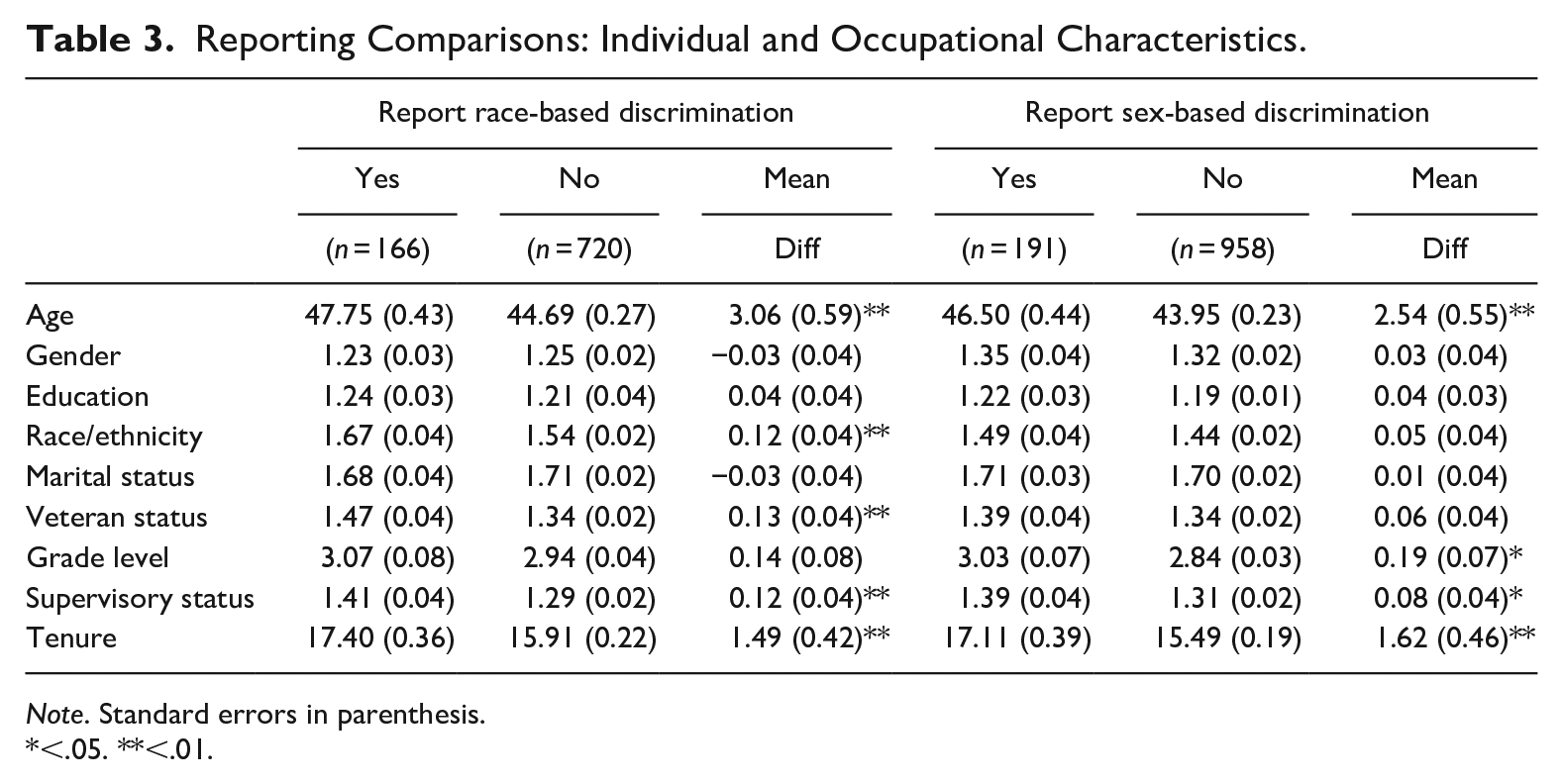
Note. Standard errors in parenthesis.
<.05. **<.01.
Regarding sex-based discrimination, only one individual characteristic (i.e., age) and three occupational characteristics (i.e., supervisory status, grade level, and tenure duration) differentiated the two groups, supporting hypothesis 3. That is, workplace bystanders who made a report after witnessing sex-based discrimination were likely to be older (p < .01) than their colleagues who chose not to report the incident. On average, the mean difference in age between the two groups was 2.54 years. Likewise, workplace bystanders were more likely to make a report after witnessing sex-based discrimination if they were in a supervisory position (p < .05), higher in grade level (p < .05), and had more workplace experience with their current employer by 1.62 years (p < .01), in comparison to their colleagues who chose not to report the incident. The mean differences in supervisory status and grade level were 0.08 and 0.19 units respectively. There was no significant difference in response by gender, rejecting hypothesis 2.
Discussion
These findings are important and bring attention to other modes of reporting that may provide useful information on bystander behavior to both scholars and practitioners alike. In addition, the current #MeToo climate, coupled with the renewed priority of social equity in public administration scholarship, promotes research on issues such as the current topic, while encouraging federal administrators to empower all employees, especially workplace bystanders, to intervene and report workplace misconduct. Likewise, bystander reporting can improve organizational climate and promotes accountability for the alleged perpetrator. Thus, there are practical and theoretical implications to federal employers and the bystander effect theory.
Practical Implications
First, this study confirms that workplace discrimination—specifically race- and sex-based discrimination—continues to be a problem for federal employers. As previously mentioned, nearly a third of all the respondents witnessed some form of workplace discrimination regardless of offense type. Therefore, highlighting a prospective group of reporters and their behavior have important practical implications, although less than a fifth of these workplace bystanders reported the incident. These stats are worrisome on both counts and provide employers the incentive to further encourage bystander reporting in their biennial No FEAR Act training requirement. According to the EEOC (2021c), the purpose of the No FEAR Act is to impose duties upon federal employers aimed at “reinvigorat[ing] their longstanding obligations to provide a work environment free of discrimination and retaliation.” One of those obligations is to “provide training to its employees, including managers, regarding the rights and remedies available under the employment discrimination and whistleblower protection laws.” In addition, federal employers are required to post on their website a statistical summary of data pertaining to complaints filed with the employer quarterly (EEOC, 2021c). These include:
the number of complaints filed; the number of persons filing those complaints; the number of persons filing multiple complaints; the bases and issues alleged in the complaints; the average length of time in takes an agency to complete certain stages of the complaint process; the number of final agency actions in which discrimination is found, broken down by issue, basis, and whether a hearing was held; the number of pending complaints that were filed in previous fiscal years, including the number of persons who filed those complaints; and, the number of complaints in which an investigation was not completed in a timely manner (EEOC, 2021c).
Nowhere is it mentioned that “persons” filing those complaints can only be alleged victims. In fact, as stated previously, the EEOC (2021b) acknowledges that an individual other than the alleged victim (e.g., bystander or witness) may file an employment discrimination complaint in support of another person to safeguard that person’s identity. Therefore, public employers may want to look further at this potential cohort of employees to tackle workplace discrimination to increase agency accountability in response to the No FEAR Act. Furthermore, the EEOC (2016) had previously recommended bystander intervention training to empower co-workers, colleagues, and supervisors to intervene when witnessing harassing or other discriminatory behavior. Likewise, Executive Order 14035 (2021) encourages bystander intervention to address workplace harassment and other forms of discrimination.
Finally, federal employers must submit an annual report to Congress, the Department of Justice, the Office of Personnel Management, and the EEOC setting forth “any action the [employer] has or will take to improve its complaint and civil rights programs with the goal of eliminating employment discrimination and retaliation” (EEOC, 2021c). It is precisely this obligation where federal employers can take the initiative to implement and highlight their own bystander intervention training, which encourages bystander reporting in the workplace. However, due to the findings in this study, federal employers should empower younger and less experienced employees to report workplace discrimination if they witness such misconduct.
To expand, in both forms of discrimination, it was not surprising that older employees with supervisory status and longer tenure duration positively impacted bystander reporting. Likewise, higher grade levels positively impacted bystander reporting in sex-based discrimination. Thus, experience and/or seniority with an agency appears to improve bystander reporting. Past studies, albeit from victims, support this narrative. For example, in Lee and Yu’s (2021) study on reporting behavior, they found that respondents’ older age, as well as higher grade levels and longer tenure duration, significantly impacted assertive reporting behavior for workplace discrimination. Likewise, Haarr and Morash (2013) found that the probability of reporting workplace discrimination was much higher for high-ranking employees in comparison to those in lower-ranking positions. Therefore, the focus on bystander intervention training should be geared to both younger and less experienced civil servants to improve the overall numbers in bystander reporting. Furthermore, it was no surprise that veteran status also positively impacted bystander reporting, as most individuals would expect former active-duty members to help others in need. Their inclusion in this study was appropriate due to the federal government’s hiring preference for veterans in response to the Veterans’ Preference Act of 1944. However, this study did have one unexpected finding, that gender was not significantly differentiated between the two groups for reporting sex-based discrimination, although members of a minority race or ethnic group were significantly differentiated for reporting race-based discrimination. The latter is consistent with past research on in-group bias (Abbott & Cameron, 2014; Jenkins & Nickerson, 2017; Levine & Crowther, 2008; Levine & Manning, 2013). Nonetheless, federal employers must continue to encourage all employees regardless of race/ethnicity or gender to report unlawful behavior using a transparent process. Although the No FEAR Act is designed to increase agency accountability for acts of discrimination or retaliation, employers must also keep alleged perpetrators accountable for their (mis)actions.
Theoretical Implications
In addition to these practical implications, this study informs bystander effect theory by confirming that most bystanders—even those who witness employment discrimination—will remain silent for reasons that have previously been communicated in the literature. These include fear of negative consequences or retaliation and diffusion of responsibility (Berkowitz, 2009; Darley & Latané, 1968; Hortensius & de Gelder, 2018; Kim, 2021). However, the top reason for bystander apathy in this study was the belief that nothing would be done regardless of reporting, a slight departure to pluralistic ignorance (e.g., the belief that because no one is helping, the situation is not actually an emergency), another common justification to bystander apathy (Berkowitz, 2009; Darley & Latané, 1968; Hortensius & de Gelder, 2018; Kim, 2021).
In this regard, as opposed to other bystanders not helping, the initial bystander did not trust the organization in helping. Thus, federal employers must emphasize a safe culture for reporting and have appropriate policies in place for reporting workplace discrimination without fear of retribution, to include a clear reporting channel and reassurances of accountability for workplace misconduct (Easteal & Ballard, 2017; Jacobson & Eaton, 2018; Lutgen-Sandvik et al., 2007; McDonald & Flood, 2012). That being said, this study also recognized the conditions for positive bystander reporting. For example, as mentioned earlier, in-group bias likely influenced positive bystander reporting for race-based discrimination. However, future studies should examine why gender did not influence bystander reporting for sex-based discrimination.
Likewise, this study extends the bystander intervention model by including the added step of reporting discrimination as a form of confrontation in its description. Specifically, intervening by reporting the alleged perpetrator for their inappropriate remark or action to the appropriate office/agency to create a culture of accountability and increase agency responsibility for acts of discrimination or retaliation. Finally, this study informs bystander effect theory beyond workplace abuse such as harassment and bullying and examines more egregious forms of unlawful misconduct such as race- and sex-based discrimination, in order to build better policies, practices, and training in the workplace. Although this study primarily substantiated bystander apathy, the importance of reporting cannot be understated if federal employers intend to be accountable for acts of discrimination or retaliation.
Conclusion
In sum, the current study expands knowledge on a potential group of reporters and their behavior after witnessing employment discrimination in the workplace. It sought answers to one specific exploratory question on bystander behavior: who are the bystanders who choose to intervene and report perceived encounters of workplace discrimination? Although the overwhelming majority chose not to get involved, reporting was common among veterans and those employees who were older, had more work experience, and were likely in a supervisory position. Likewise, reporting was common among employees of a minority race or ethnic group for race-based discrimination. Finally, for bystanders that chose not to intervene, consistent with research, the overwhelming majority chose not to get involved for reasons such as organizational apathy, fear of negative consequences, and diffusion of responsibility.
While these findings are important and bring attention to other modes of reporting that may provide useful information to both scholars and practitioners alike, they are not unique in its research limitations. First, the current study represents those respondents from one federal regulatory department. This limits the sampling frame and may not be representative of all federal agencies/organizations. Thus, caution should be taken when interpreting these findings. Future research endeavors should replicate this study at other federal departments with a different function or mission requirement to refute or corroborate the current findings. Likewise, as with many exploratory studies, the current study has led to additional questions that should be examined in subsequent studies to include the relationship between the bystander and victim (e.g., direct co-worker, periodic collaborator, known acquaintance), the hierarchical relationship between the victim and perpetrator, the time frame of the alleged incident (e.g., recent or early-career incident), and whether the bystander was ever a victim of discrimination themselves. Second, the significantly differentiated characteristics do not necessarily lead to positive bystander reporting after witnessing workplace discrimination. As a result, this study does not claim that age, veteran status, supervisory status, tenure duration, race/ethnicity (for race-based discrimination), and grade level (for sex-based discrimination) will actually increase bystander reporting in the workplace, but rather these characteristics will increase the likelihood of bystander reporting in the workplace. Despite these limitations, this study demonstrates the value of bystander reporting and encourages all employees to intervene and report workplace misconduct to increase accountabilities for all alleged perpetrators, as well as agency responsibility.
Footnotes
Acknowledgements
This publication is based upon work conducted under the U.S. Department of Homeland Security (DHS) Cooperative Research and Development Agreement No. 21-CRCL-001. The views and/or conclusions contained in this document are those of the author(s) and should not be interpreted as necessarily representing the official policies, either expressed or implied, of the DHS, and do not constitute a DHS endorsement of the equipment tested or evaluated.
Declaration of Conflicting Interests
The author declared no potential conflicts of interest with respect to the research, authorship, and/or publication of this article.
Funding
The author received no financial support for the research, authorship, and/or publication of this article.
