







Abstract
There is a significant emotive dimension to the work of public interest lawyers (PILs), whose jobs involve working with traumatized clients in a high-stakes legal environment. This vital public service profession represents marginalized clients, many of whom face extraordinary challenges. These attorneys must maintain their own composure as they simultaneously manage their clients’ emotional distress and legal predicaments. Drawing on interviews of PILs, we identify themes related to emotion regulation, vicarious trauma, burnout, and resilience. Findings reveal that PILs leverage emotion to build the trust that is essential for effective legal advocacy and they do this while navigating client trauma and systemic injustice. Compounding the emotive burden are risks of secondary trauma and feelings of institutional betrayal. Findings also reveal strategies that PILs employ to thrive, including on-ramps and off-ramps they use to set boundaries around the emotive demands of their work. HR implications are discussed.
Introduction
This study focuses on a category of public service jobs that merits more attention in the public human resource management literature. It is the work of lawyers who, as street-level bureaucrats, work with clients to advocate for their civil rights, to advance social justice, and to defend those charged of crimes when they cannot afford to hire private counsel. This work is public interest law and those who perform it are referred to as public interest lawyers (PILs). The work is emotionally intense and while emotional labor theory has been applied to a variety of other public service jobs, the most comprehensive of which is reported by Guy et al. (2019), the work of PILs has yet to be singled out for deeper inspection.
Public interest law is like mortar between the bricks of constitutional democracy. It is a legitimate institutionalized lever used to pry open inequalities. Public interest law breathes life into the protections guaranteed by law that are not automatically implemented until legal processes compel it. By using legal processes to advance claims, PILs illuminate social justice deficits and extend constitutionally guaranteed rights and privileges to marginalized populations. PILs are hired by federal and state governments primarily as public defenders, and are stationed in most counties in the U.S. They are also hired by non-profits whose mission is to advance social justice, and law firms that specialize in public interest law.
Like a Venn diagram, there is an intersection of PILs’ commitment to public service, to constitutional principles, and to serving the interests of their clients. At the same time, the practice of law is adversarial and this means that PILs are in conflict with the power of the State at the same time, as officers of the court, they use that power to represent their clients’ interests. In addition to the in-built tension of the work, in which the PIL’s benefactor is also the adversary, there is also emotive intensity between the client and the PIL. This study probes how lawyers navigate these tensions and regulate their own emotive state in the process. Findings are instructive for human resource professionals as they recruit PILs and design training that acknowledges the emotive skills that are essential for success. For scholars, the experiences of PILs presents an opportunity to learn how emotive intensity interacts with technical expertise in lawyering.
While the number of public interest lawyers defies a reliable count, one segment of them, public defenders, are easier to count. Public defenders, as part of the social safety net in the United States, are public servants, legal professionals, and street-level bureaucrats who work with some of the most under-served and under-represented residents (American Bar Association, 2024M. Lipsky, 1980). There are approximately 9,470 public defenders employed today with a gender breakdown that is about 54.9% women and 45.1% men (zippia.com, 2025). To understand their work at the street-level, consider this incident that happened in a detention center.
Anna Schamberg, a public defender, visited the jail where a client she had been assigned to represent, a 31-year old man with a lengthy criminal record, was being held. In prior visits the man had been restrained in four-point shackles, but this time he was neither handcuffed nor shackled when a deputy brought him to meet with Ms. Schamberg alone in a room. During the meeting, the client grew angry, grabbed her computer, and slammed it to the floor. Schamberg pressed the panic button but no one came to help. The client then struck her in the face twice and she pressed the button again. It was not until the client struck her a third time that deputies arrived. Afterward, Schamberg dealt with post-traumatic stress disorder and anxiety and could no longer do the work (Bradbury, 2025).
PILs are not only lawyers; they are also trauma workers who confront the consequences of the worst days of their clients’ lives (Kim et al., 2023). More needs to be understood about this. In Schamberg’s case, the trauma is also her own. Her experience demonstrates the exigencies that occur in street-level work. The research question that guides this inquiry is this: How do PILs manage the emotive dimension of their work and what does it take for them to be resilient enough to continue the work?
The next section links the work of PILs with the emotive intensity of their jobs and speaks to the kinds of trauma that PILs encounter. Applying emotional labor theory to work outcomes sets the stage for a research design that reveals strategies for emotion regulation. The methods section describes the process by which PILs from a variety of job duties, backgrounds, tenures, and geographical locations were interviewed. The subsequent sections describe findings, discuss themes that arose, and draw attention to the HR implications of PIL work.
The Work of Public Interest Lawyers
In the contemporary U.S. legal system, public interest lawyers (PILs) are the last line of defense for the poorest, least powerful, and most disadvantaged. Public interest law grew in response to the expansion of the administrative state under Presidents Franklin Roosevelt and Lyndon Johnson (Trubek, 1998). As disadvantaged clients gained legal rights, the demand for lawyers to protect those rights grew (Herr, 1989; Trubek, 2005). Without attorneys for the most disadvantaged, the social welfare goals of The New Deal (Roosevelt) and The Great Society (Johnson) were hollow promises giving protections only to those who already had the means to enforce them. By the 1960s, a cadre of PILs arose to fill this need.
As late 20th century federalism devolved social welfare programs to states and municipalities, the job of the PIL shifted (Resnik & Bazelon, 1998). “Classical” PILs developed deep knowledge in the law of a single agency or type of lawsuit, such as Substantive Due Process, the Equal Employment Opportunity Act, the Voting Rights Act, or the Americans with Disabilities Act (Herr, 1989; Trubek, 2005). When welfare supports were delegated to states, cities, and nonprofits, the public interest law model shifted to wraparound services, with less focus on litigation that would set national precedent, and more attention on helping individual clients negotiate the new complexities of the inter-sectoral social-welfare bureaucracy (Resnik & Bazelon, 1998).
PILs now practice this new public interest law, assisting clients through complex situations, often in tandem with organizers, social workers, educators, and healthcare workers (Sharpless, 2012). They work in government, nonprofit, and private legal practices such as public defense agencies, legal aid corporations, immigration law nonprofits, homelessness networks, and boutique workers’ rights firms (Cummings, 2017; Trubek, 2005). Though most attorneys are still men, PILs are disproportionately women, White, and paid dramatically less than lawyers in other specialties (American Bar Association, 2024). When immigrants face deportation, workers face discrimination, and indigent defendants face the possibility of execution, they do not face it alone. PILs stand beside them.
The Most Important Skill Not Taught in Law School: Emotion Management
Emotional labor is the work of managing feelings on the job, one’s own as well as those with whom one is interacting. It is done for a wage and is necessary to get the job done. The earliest studies focused on retail settings and customer satisfaction (Hochschild, 1983). Insights from the research were first applied to public service jobs by Guy et al. (2008). Emotional labor has since been shown to be a relevant concept for public service around the globe (Guy et al., 2019), especially for those who work directly with the public, such as child welfare workers (Drury, 2018), police officers (Oliveira et al., 2023), tax collectors (Chuayprakong, 2022), election administrators (Clark et al., 2023), and many other occupations. These studies are united in their conclusion that better understanding of emotive requirements of jobs is essential if job descriptions, training, and performance appraisal are to become more accurate and more helpful to both employer and employee. Emotion regulation, in order to perform the job, as well as to set boundaries around the job so it is does not encroach on workers’ private lives, is essential (Mastracci & Guy, in press).
Law is the backbone of public administration so research that probes the emotive component in legal casework is necessary. A corpus of work is growing, but slowly. Croft (2023) describes public defenders as “emotional laborers” in his profile of indigent criminal defense. Carline et al. (2025) discuss the emotive complexities of professionals who work in criminal courts. On the international scene, Kim et al. (2023) find that prosecutors perform emotional labor with trauma victims in New Zealand, defense attorneys project loyalty to their clients in Sweden (Flower, 2018), for-profit lawyers maintain traditional standards of the legal profession in the U.S. (Kadowaki, 2015), and U.S. military lawyers deal with vicarious trauma as they advocate for victims of sexual violence (Bonnes et al., 2025). A study of Finnish and Quebecois lawyers finds that emotional labor is used to maintain advantage for men as they climb the ranks in law firms (Choroszewicz, 2020). While research is increasing on how lawyers navigate the emotive demands of their work, there is much more that begs to be understood. Public sector human resource management is just beginning to probe the subject, despite law’s influence over every aspect of the administrative state (Rosenbloom et al., 2010). This study seeks to narrow the gap.
The Worst Days of a Client’s Life Are Mirrored in PIL Work
Trauma theory is relatively under-explored in public management HRM literature, but has the potential to develop new insights especially in helper professions like PIL (L. Lipsky, 2009). When a PIL’s client is caught up in the legal system, it is because something happened “either too much, too soon, too much for too long, or not enough for too long” (Duros & Crowley, 2014). This phrase is how social workers describe the causes of trauma. Trauma-informed practice is commonplace for social workers and others trained in the helping professions. However, law is not considered a helping profession; it is considered a technical field (Miller et al., 2022; Simkins, 2023).
Trauma is a physiological reaction that engages the autonomic nervous system (Dana, 2020). When this system is triggered, autonomic responses occur (L. Lipsky, 2009; Shay, 2002). Reactions are commonly fight, flight, or freeze. As we learn more about gender differences and emotion regulation strategies, additional responses have been added. Among these are “tend, befriend, and fawn” because feminist scholars argue they better reflect the gendered trauma responses of women (Dana, 2020; Taylor, 2012; Walker, 2013).
Trauma responses come into play in the work of PILs. Clients experiencing trauma may attempt to flee by avoiding the attorney’s questions or freeze by answering questions monosyllabically or not at all, inhibiting the ability to collect evidence. Likewise, a client may resort to fighting by accusing the attorney of collusion with the other side or fawning by showing undue deference to the attorney that prevents the kind of relationship necessary for honest communication. When an attorney is experiencing vicarious trauma she may turn to the fight instinct and assert her client’s rights with opposing counsel or a magistrate, sometimes too aggressively.
Vicarious or secondary trauma captures the experience of those who witness emotionally intense events second hand as they learn about the event (Rasmussen, 2019). Research into vicarious trauma has focused on those who treat clients who have experienced trauma, such as therapists, emergency responders, law enforcement officers, emergency call-takers, social workers, substance abuse workers, homelessness mitigation advocates, domestic violence advocates, as well as translators who must mirror the client’s emotion when recounting narratives (L. Lipsky, 2009). PILs should be included among these, as this study’s findings reveal.
Trauma From Institutional Betrayal
Beyond overt traumatic experiences, PILs may also fall victim to the trauma that results from institutional betrayal. PILs are susceptible to trauma from institutional betrayal because of their conflictual dual roles as advocates for those betrayed and as sworn servants of the Court that is betraying their clients. This also makes them vulnerable to burnout, similar to how social workers, clinical therapists, and “trauma workers” are (Dana, 2020; L. Lipsky, 2009, p. 1).
People who are powerless to change systems they perceive as unfair experience trauma similar to what they experience from violent stressors (Smidt & Freyd, 2018). For example, trauma from institutional betrayal has been documented in domestic violence victims who feel attacked by investigation processes that doubt their stories of abuse, sexual assault victims who must defend their clothing choices and alcohol consumption, and immigrants who follow the legal pathway to residency only to have politicians add additional hurdles (Goodman et al., 2017; Smidt & Freyd, 2018). PILs are not considered trauma workers, but we assume that vicarious trauma poses a threat because they are stewards of the trauma experienced by their clients.
The Skills to Thrive: Research Question
This inquiry focused on understanding the emotive dimension of PILs’ work. We started with a two-part question: (1) What are the emotive demands on PILs? (2) What strategies do PILs employ to develop resilience to the trauma they encounter? To answer, we conducted semi-structured interviews with PILs to identify themes grounded in the emotional labor and trauma literature. Consent and procedure were approved by the University of Nebraska Medical Center Institutional Review Board #0834-22-EP.
Method
The inquiry employed a qualitative research design. Two researchers conducted semi-structured interviews until conceptual saturation was reached, then conducted a joint analysis with one researcher creating a priori themes, and both researchers engaging with the data within those themes until agreement could be reached on findings. This section describes the sampling approach, interviewee demographics (see Table 1), interview guide (see Appendix), and analysis procedure.
Demographics of Informant Public Interest Lawyers.
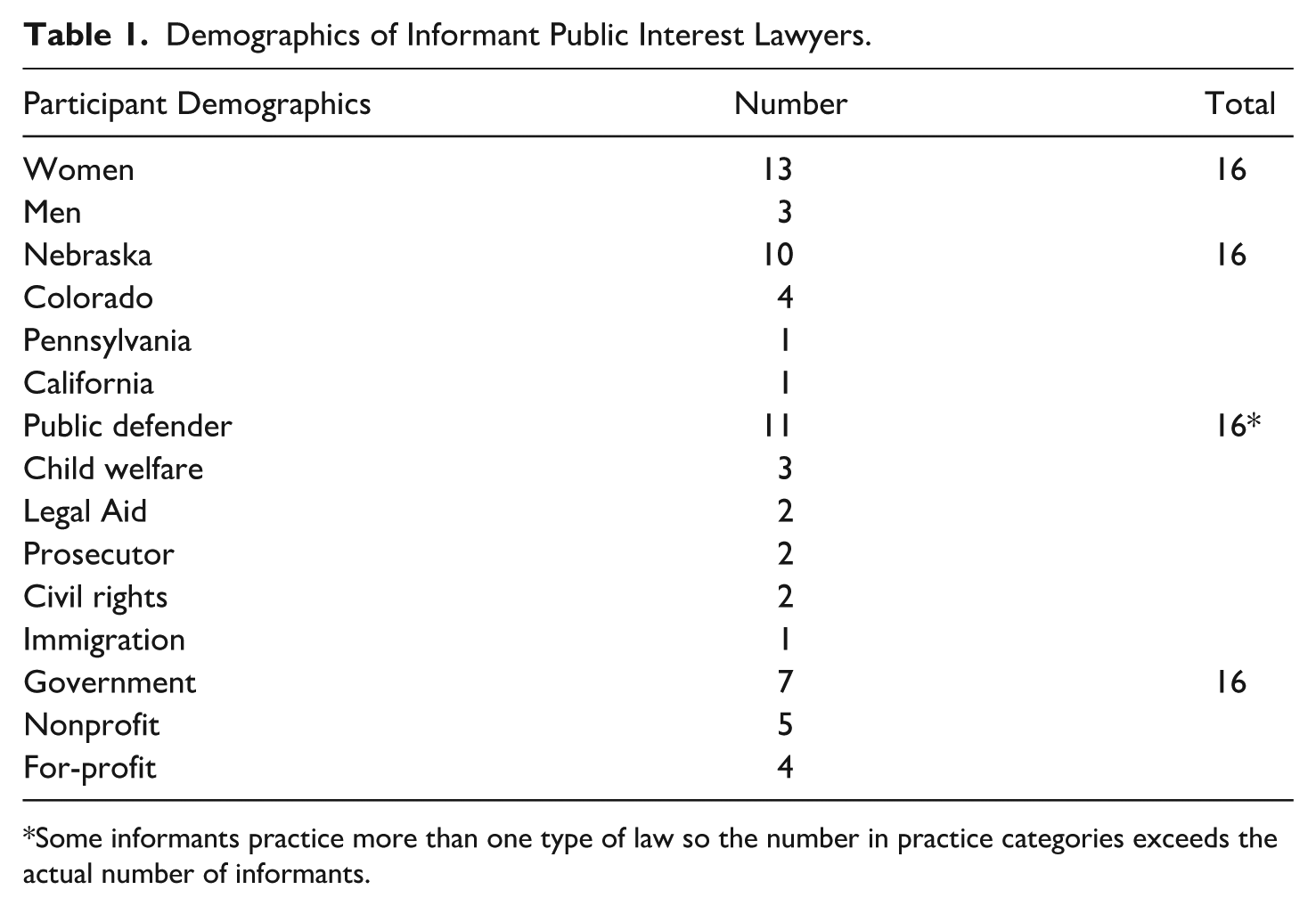
Some informants practice more than one type of law so the number in practice categories exceeds the actual number of informants.
Data Collection: Deliberate Differences and Snowballing
We used a combination of deliberate and snowball sampling to identify participants. Following the recommendations of Curtis et al. (2000), we used deliberate sampling to increase the likelihood that interviews would generate data relevant to the research question, generate narratives, and capture a variety of experiences of PIL practice. To these ends, we reached out to PILs using a convenience sample of the researchers’ acquaintances, and then used snowball sampling to identify interviewees that would enhance diversity of geographical and practice areas. We identified 16 interviewees. They reflect the demographics of U.S.-based PILs in that they were mostly women (n = 13) and mostly White (n = 14). Interviewees worked in Nebraska (n = 10), Colorado (n = 4), and one each in Pennsylvania and California. Including some attorneys who practiced in multiple public interest law arenas, they were public defenders (n = 11), legal aid attorneys (n = 2), prosecutors (n = 2), immigration attorneys (n = 1), civil rights lawyers (n = 2), and child welfare lawyers (n = 3). The most common sector in which they worked was the public sector (n = 7), followed by the nonprofit sector (n = 5), and private sector (n = 4). We conducted interviews over Zoom (n = 14) or in-person (n = 2) and recorded and transcribed the interviews for analysis.
Analysis: Interpretive Thematic Coding
We sought to learn from our interviewees about their work experiences in regard to emotion management. After transcribing the interviews, transcriptions were coded for themes related to emotional labor, resilience, vicarious trauma, and trauma resulting from institutional betrayal. We developed a priori themes from the literature described above and began by identifying saturation along those themes. Figure 1 indicates the primary themes we identified from the literature as (1) PILs encounter trauma in their work, (2) they engage in emotional labor to manage that trauma, and (3) they have developed resilience practices to help engage in that emotional labor. These themes included several subthemes or codes that we expected, but we hoped that our participants’ expertise would reveal new codes, especially when it came to resilience practices (Figure 1). We developed our interview guide from these themes, and included in that a list of concepts (e.g., naming injury, seeking friends and family, feeling hopelessness) that were found in the literature that we would follow up on should the interviewer encounter them (Appendix A).
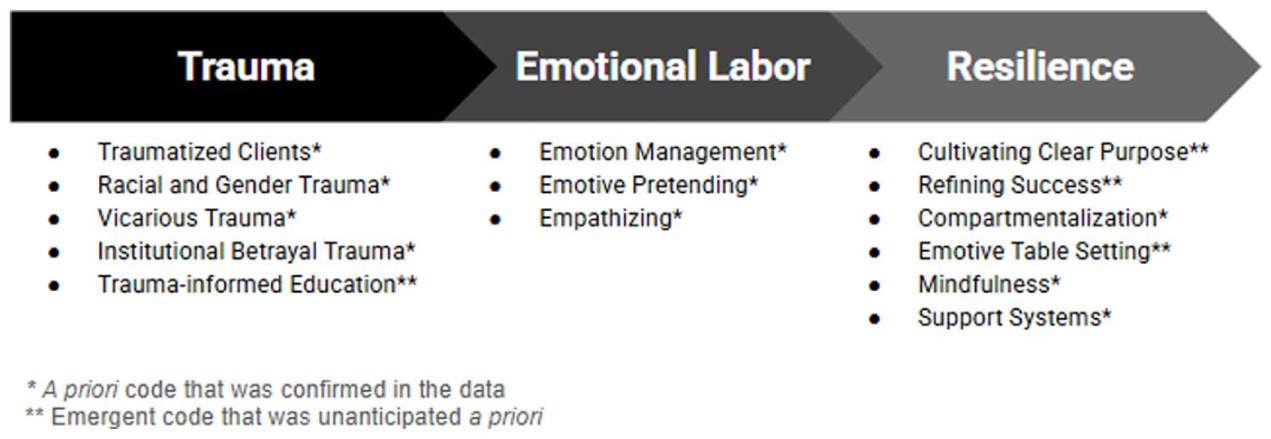
A priori themes with anticipated and emergent codes.
Our first analyzed interview was coded by two researchers who then discussed their coding decisions and rationales, and through this process, developed inter-coder agreement. Most interviews were coded by one researcher alone, with the alternate researcher coding the final interview to analyze the extent to which themes and codes had shifted during the coding process. Once all of the interviews were coded, two of the researchers discussed the themes and codes at length over the course of several 1-hr meetings until they could agree on the codes that became the findings. This process continued into the writing. One researcher wrote the outline and justification for the codes and findings, the other researcher filled in the outline with description and quotes directly from the data, and both those researchers engaged in revisions until both agreed on the findings and which findings were not at saturation and therefore left out of the analysis. An example of a finding that did not reach saturation was a statement by a participant that emotions were disruptive to the workplace, a datapoint that was not replicated elsewhere and so did not reach saturation to constitute a “finding.” This iterative and relational analysis process was repeated until both researchers agreed that no new information was available in the dataset. A third researcher then performed a final check on the logic of the findings and revised for clarity and relevance to emotional labor in human resource management specifically, and public management more generally. All three researchers are listed as authors on this study.
As researchers conducted their interviews, they discussed whether the data were saturated. After analysis, the researchers agreed that saturation was reached at around 11 interviews. We coded one more interviewee who had a combination of experiences and demographics that were unusual in the sample, and therefore might present new data. However, no new data was introduced, so we concluded that we had reached saturation. We did not include codes from the final four interviews in our analysis to avoid possible threats to rigor caused by oversaturation of qualitative data (Ebbinghaus, 2005).
We align with Ebbinghaus (2005), LeCompte and Schensul (2010), Esterberg (2002), and other qualitative methodologists, who argue that rigor for smaller-n qualitative analysis is not assessed according to generalizability. Instead, interpretive research is rigorous to the extent that it reflects the experiences of interviewees in sufficient detail to fully understand their understanding of the phenomena of interest (Esterberg, 2002; LeCompte & Schensul, 2010). To that end, the ideal amount of data is that which achieves saturation while not collecting so much that the researchers’ biases start to direct analysis by cherrypicking (Ebbinghaus, 2005; Sandelowski, 1995). Saturation is defined as the point at which theoretical implications of the data cut across many or most observations, experiences are described in similar or redundant ways, and responses convey a shared theory-in-use for interviewees (Esterberg, 2002; Weick et al., 2005). In other words, as Gravlee (2011) puts it, “your sample is large enough when you stop getting new information” (p. 79).
The analysis was interpretive, which we define according to Esterberg’s (2002) concept of a research tradition that leverages experiences of interviewees to provide the researcher with an account of their reality. Interpretive research is particularly appropriate for questions pertaining to emotive experience because the phenomena are psychological and, therefore, present few empirical artifacts that can be quantified or observed independent of the interviewees’ descriptions (Esterberg, 2002; LeCompte & Schensul, 2010). As we analyzed data, we avoided researcher bias by participating in ongoing inter-rater coding checking. Given the sensitive nature of emotions and trauma, we did not believe verifying our findings with interviewees would be useful.
Findings reported in the next section reflect our shared understanding of the major themes that emerged. We identified a major theme when all but one or two interviewees found the concept to be a factor in their work, or when four or more interviewees found the concept to be an important factor. For purposes of this study, we do not discuss minor themes except when they clarify major themes. The next section presents themes along with anonymized data that provide context and clarity.
Findings
“We’re called counselors for a reason.”
Findings reveal that emotional labor is a requirement for PILs to be effective. They also reveal that PILs experience trauma through their work. While many interviewees had never experienced formal training on emotion management or trauma-informed practice during their legal education or professional training, they all described in detail multiple instances in which they engaged in emotional labor and trauma management. Findings also reveal that interviewees see this emotive burden as part of their work, and they realize it can cause them injury.
Examples of emotion work and the presence of trauma are easily found in the data. One interviewee said, “I call it the trauma swap. . . I don’t know if I would go as far as to say it’s traumatizing for me. I’m just surrounded by it, right?” Another reported, “There are certain cases that still haunt me. There are cases that still wake me up in the middle of the night where I think about, you know, what I did at trial and my call or who I didn’t call and what questions I asked. And if I would have done something differently would this 18-year-old not be in jail for eight years. Things like that. That haunts me.” A third reported, “I always say we’re called counselors for a reason. We’re not therapists, but we do a lot of counseling and rapport building.”
While all interviewees reported having to manage their emotive workload, the extent to which they were prepared for that workload varied and depended on their workplace. When asked whether they had received any formal training on working with clients who had experienced trauma, all agreed that law schools are not providing that training. None had received any continuing legal education credit or law school training on relevant skills, although one interviewee received training on child brain development while volunteering with a Juvenile Justice Clinic as part of her legal education. Several organizations, and especially public defenders and immigration law firms in our study, adopted more holistic programs that include social workers. One interviewee reported “We are getting focused, intentional trainings on trauma.” Another said, “It’s becoming more and more relevant [to my field].”
Because much of the preparation for emotion work was provided by employers, solo practitioners encountered obstacles to receiving training. Sometimes a law firm is unable to take a client due to conflicts of interest or capacity. In these cases, a client is sent to a private contractor, often a solo-practitioner, who is establishing a practice in the precarious years just after graduating law school. One of these solo-practitioners said they had no training on this at all, and went on, “I’ve heard from people and even mentors now who I trust, you just gotta get the reps and learn how to speak to clients by doing.”
The idea that practice is necessary to get better at managing emotions in the workplace was a common theme regardless of the amount of training received by the attorney. One younger respondent said, “I’ve seen more experienced attorneys just by necessity get more and more calluses and my calluses are still forming.” The metaphor of calluses implies a certain amount of injury that takes place in the process of learning and managing the intense emotionality of public interest law. The metaphor also implies an emotive hardening, which is tantamount to burnout.
Burnout: “There are healthy and unhealthy ways of dealing with it, but one way or another we are all dealing with it.”
Interviewees shared that the work was demanding emotionally and could create unhealthy behaviors that lead to burnout. As one reported, “I think other people drink lots of alcohol, other people use cocaine, other people run marathons, other people really enjoy going to the park with their kids. I think there are healthy and unhealthy ways of dealing with it, but one way or another we are all dealing with it.”
The unhealthy behaviors that PILs mentioned include alcohol use, sleeplessness, hopelessness, disassociation, feelings of guilt, decreased motivation, and cynicism. Some interviewees were overcome by emotion during their interview because the questions identified the hardest part of their work, and the part they rarely talked about. One said they felt “Sad, defeated a lot of the time.” Another said, “I felt hopeless. I felt like I don’t want to put all of my money, my career, my education into something that is such a farce, and it was really hard to overcome.” Another reported being “pretty burned out, you know, deposing a seven-year-old, trying to break down her story when she was a victim of a sexual assault gets a little bit difficult, and those cases really bothered me.”
Interviewees also noted how much public interest law cost them personally. One felt that it cost them their social ties. “As I’ve gotten older, I don’t know, I regret that I don’t have that many close friends because I choose to spend time doing this stuff.” A few reported costs to their parenting. “I know that [my kids] knew that I was stressed out. I think that, you know, that bothers me that they knew that.” Others felt a need to process their experiences without having the time or capacity to do so. “The minute I begin to process it is the minute that I feel that I need to then do the work, and I don’t have the capacity to do the work. So I guess it’s really frustrating to think through this out loud because I’m complaining about something without offering a solution, mostly because I don’t have the capacity to do the work that the solution would entail.”
This cost led several interviewees to report they found themselves close to burnout. By only interviewing current PILs we forestalled our ability to understand the difference between those who quit and those who remained in the job, but interviewees provided us with some insight. The interviewee who was “pretty burned out” after interviewing yet another child who was the victim of sexual assault was one. Another said that they almost burned out when they moved to defending people who were charged with more serious offenses. “I had finally gotten control of my life, my work-life balance. I was going to the gym, I was seeing friends. I had managed to maintain a little bit more work-life balance. And then that got upended when I moved to felonies.” Another PIL said that they avoided working on larger social justice issues because they feared it would cause burnout. “I think the reason why I don’t do much in terms of action with regards to addressing these systemic inequities and system issues is because I can just appreciate that the minute I go down that road is the minute that not only am I a [PIL], but then I’m somewhat of a social worker and I won’t be able to do my current job well, also maintain a social life and do that systems advocacy. Well, I’m just setting myself up for professional burnout and I think emotional dysregulation and burnout as well.”
While none of the interviewees said they abused drugs and alcohol, they believed that those who did ended up burning out entirely. One PIL said alcohol and cocaine use was a common tactic for dealing with the emotional stress of the career. Another attorney said, “I see a lot of alcoholism. I see a lot of depression. I see a lot of behaviors that are a result of lack of work-life balance.” That interviewee described a peer who recovered from drug abuse and “runs our lawyers’ wellness division for lack of a better term.” Another interviewee from a more experienced cohort said of their PIL peers, “It used to be that everybody just drank themselves silly until that became destructive behavior.” Overall, burnout dangled over interviewees. Some of the symptoms they experienced were directly related to excessive emotion work, while some was the combination of emotion work, workloads, and other stressors.
Trauma: “I Deal with Some Pretty Scary Files”
Findings confirm that interviewees experienced varying degrees of trauma from (a) the act of eliciting information about acts of violence on behalf of their clients and then repeating the information in legal proceedings, (b) from interacting with abusive clients, and (c) from feelings of institutional betrayal when they were unable to help their clients through the larger system. Signs of trauma included being unable to stop feeling anxious and fearful in the workplace. One interviewee struggled to remain composed as they explained a file they reviewed, “Like late at night or some trigger will come up and you’ll remember those images. It’s like you . . . see [images of] victims and . . . bodies that have been mutilated.” Another described representing a client who “was very mentally ill, ended up leading to the manslaughter of her seven-year-old son,” and proceeded to describe the homicide in graphic detail to make her point that these things stick with you. A third interviewee shared listening to a client and his mother discuss what to do with children who had witnessed a crime. “And she just kept telling him, [client], you should have smoked the kids. He should have smoked the kids. It’s like Mom, I’m an idiot, blah blah blah. . . like I would tell you, I’m gonna pick up milk from the grocery store after work like there’s no empathy, no remorse, no humanity.” These attorneys sometimes had to witness evidence that was so disturbing that it could not be shared because doing so was itself a crime, as in videotapes of child pornography and “snuff film” videos. These intense moments led one interviewee to call it a “trauma swap” with clients. “Like sitting in the pit with them. Which while I’m not living it, I’m still sitting in the same pit.”
Trauma Due to Institutional Betrayal
Beyond the emotionally intense images and stories encountered by PILs, some of the trauma they experience is attributable to institutional betrayal. Most of the PILs we spoke with said they feel powerless or hopeless as they represent indigent clients. And some went further: One public defender asked, “If I would have done something differently with this 18-year-old, would he not be in jail for eight years, like things like that, that haunts me. Yeah. It’s very, very hard not to take this job home.” Another interviewee discussed how the system felt stacked against their clients. “We call it the criminal justice system, but often I just call it the criminal legal system or the criminal prosecution system because there’s not really much justice in it . . . . Once you’re caught up in the system, there’s very little that I can do to get you out of it.” This systemic failure was not abstract for the interviewees; it was very personal, as described by one attorney, “Telling an individual person that there’s no place else you can go is certainly harder, I think, than acknowledging that the system is going to remain broken for a while. One is a personal loss, the other is a professional loss.”
Trauma is not the way PILs like to describe how their work affects them. For example, two interviewees denied that they experienced trauma, despite describing trauma symptoms.
One said they had been diagnosed by their therapist as experiencing trauma. When the interviewer probed further, they responded, “I’m trying to get there. Something I’m still clearly working out. I don’t know.” Another interviewee with decades of experience said, “it certainly can be traumatizing for some people,” but denied that it was traumatizing for them. They went on to explain that attorneys younger than themselves are concerned about trauma, but “my generation of people who went into this work, like of course something horrible happened. That’s what we do.” A third said, “I feel like these have been the least traumatizing years of my life,” before describing her experience in private practice with no guaranteed income, “I have to eat what I kill, you know, knowing there’s no safety net.” (Note: This reflects data from the American Bar Association (2024) indicating that mental health is poorer in private law firms than in public law firms). Regardless of their personal experience with trauma, all interviewees navigated it as part of their work. Managing their emotions in the face of trauma was a “comes with” of the job and adds to the emotive burdens of the work.
Emotion Management
Interviewees used a variety of emotion management strategies as they performed the interpersonal side of their legal jobs, or as one interviewee put it, “I do think that my job, though, is like fifty percent sort of social work.” The two strategies most mentioned were emotive pretending 1 and empathizing.
Emotive Pretending
Emotive pretending is like wearing an emotive mask. It involves suppressing how one actually feels while displaying a different emotion, and it was common in this study. One interviewee described it this way: “Lots of times I do find what my client did absolutely f–ing disgusting, but you have to compartmentalize who you are as a human being . . . . I’ve had people tell me that they had been molesting their children or their grandson . . . . And then the lawyer side says, you know what? He’s really, really sorry. And I can let him tell his story of how sincerely sorry he is.” Another example is the attorney who hid her disgust as she listened to her clients express regret they had not killed witnesses.
Not all emotive pretending was directed at clients. Attorneys also have to don an emotive mask toward judges and opposing counsel. As one interviewee put it, “I can’t do this in court [gestures to a photo of a crying face]. You have to keep it together no matter what the judge is going to do. And I think it’s just like putting your heart and soul in it, but not being able to get too emotional. It’s difficult and it’s not recognized in a lot of ways.” Another said, “It is just being patient and waiting to scream until you hang up the phone [on opposing counsel].”
Emotive pretending is a strategy used by attorneys for the purpose of building relationships with clients. By displaying empathy, the strategy is effective at eliciting difficult stories needed for the attorney to make legal arguments in defense of the client. As one interviewee described it, “You are in this tiny room in a jail and asking our clients just like, ‘Okay, I know you don’t know me that well, but, like, tell me all the bad sh-t that has happened in your life.’”
To get clients to share traumatic stories requires skill, as one interviewee noted: “I generally find that people will share a lot of traumatic information if they think it’s generating sympathy or an explanation for their behavior.” Another attorney said, “I don’t find it difficult to keep them talking. I guess I am blessed-slash-lucky-slash-skilled in that. . . . I feel like I’m the place where you come to gush and let it all out.” This skill was not natural for all PILs, as one described, “I think I felt for a long time pretty out of touch with my clients. I think I feel differently now. . . .[L]ike I don’t really understand fully what their lives might be like. I think I’m better at empathizing now than I used to be.”
Empathizing
The work of empathizing was among the most pervasive themes in the study, with every interviewee explaining how communicating empathy was part of the job. These interviewees performed large amounts of emotional labor to engage in meaningful displays of empathy that enabled the trust necessary to perform their jobs. For example, one PIL said:
“A lot of times the work that I’m doing, this emotional labor, this care labor. Like with this mother, I was having a conversation with her and I was like, ‘I know you love your daughter. . .. The fact of the matter is that you have a lot going on in your life. You have a lot of therapy you need to do. You haven’t finished yet. And as a result, I think you’re self-medicating with a lot of drugs. And that doesn’t mean you’re a bad person. That doesn’t even necessarily mean you are a bad parent, but in this particular moment, you cannot be the parent that your daughter needs.”
The interviews make clear that emotion management is a core part of the job for PILs. They negotiate the trauma experienced by their clients, and they endure their own vicarious trauma. They must manage the emotions of clientele in order to elicit information that will aid in their defense. And they perform their work within a justice system that too often produces more trauma. This is why the subject of resilience is important. It is an issue of growing interest as we learn more about the emotive demands on PILs and so many other public service jobs, (Wursthorn et al., 2024).
Resilience: “. . . the hardest job I’ll ever have in my life, but also the most rewarding. . .”
Emotion work can be either exhilarating or exhausting. As Hsieh et al. (2024) explain, higher emotive intensity is paradoxical. Emotional extremes drive radically different reactions. It can lead to burnout or it can be invigorating and lead to greater commitment and meaningfulness. Prior paragraphs describe the emotional intensity of PIL work. In this section, we report strategies that interviewees use to develop resilience and to continue their work. Strategies include cultivating clarity and purpose in the work, compartmentalization, developing support systems, emotive table setting, deliberately defining success, and mindfulness practices.
Cultivating Clear Purpose: “If we quit, they win. So we can’t quit.”
Many PILs devote effort to cultivating clarity of mission. Doing so provides a reminder of why they entered the profession and why the work is worth doing. As an experienced attorney said, “The peaks are very high, but they’re brief. The valleys are very low and unfortunately they can be extended. Sometimes it’s difficult for the young kids to find a way to get out of that valley. I try to help them out. I have several mantras and one of them is, If we quit, they win. So we can’t quit.”
A woman described being motivated by the desire to help her client. “He’s the sweetest, nicest, intelligent kid whose life is now over and wasted because we failed him along the way. And yeah, that just pisses you off and keeps you going.” This response appears to be a hybrid of the trauma reactions commonly associated with men (i.e., fight) and that associated with women (i.e., tend). This use of anger to protect and care for clients reveals how trauma reactions may be used productively.
Sometimes, focusing on the job means more narrowly focusing on the task at hand and distancing oneself from the person being helped. One interviewee said, “You’re just like a doctor almost. You just, in the moment you let it go, and you kinda go into this autopilot mode where you’re doing your job, you’re doing what’s required of you, but you’re not connecting with that person.” Others embrace their emotional reaction to find fulfillment, as with the interviewee who said their job is “the hardest job I’ll ever have in my life, but also the most rewarding job I’ve ever had in my life.” Not all productive emotions are light-hearted. Another interviewee reported, “I just have an active sense of outrage that just keeps me going.”
As the quotes attest, strategies that provide resilience include taking a step back and using caring and commitment to cultivate clarity and purpose. This is especially true for the longest-serving PILs in our dataset.
Defining (and Redefining) Success: “Part of making this work emotionally sustainable is working to reframe success.”
While professionals set their own definition of success, PILs are in a particularly precarious spot because they represent some of the least resourced people in adversarial proceedings against better resourced agencies. To maintain the clarity of purpose that sustains their work, they must constantly define and redefine what it means to be successful. As one interviewee said, “Reframing success to not look like getting a [desirable outcome] necessarily, but rather having client-centered representation. Treating my clients with dignity and professionalism, taking what they say seriously and advocating for them in a way that is legally responsible and still honoring their desires. Yeah, so part of making this work emotionally sustainable is working to reframe success.” Another interviewee said, “. . . that one actually went all the way to trial and we actually did pretty well. They still got 80 to 100 years [in prison] or whatever, but it could have been a . . . death sentence.”
Compartmentalization: “I take all of that. I put it in a personal lockbox.”
Despite admonishments to bring the “whole self” to work, PILs in this study, and especially those who had more work experience, described compartmentalizing their work from the rest of their lives. This was one of the stronger resilience themes, only surpassed in saturation by cultivating clarity of purpose. One newer PIL said that when they encounter traumatizing stories at work, “I take all of that, I put it in a personal lockbox, and I lock it away. Then when I come home, I deal with that, process that, and that goes free.” For this PIL, home was a place of recovery and a respite where emotions were “processed” through everyday activities. They went on, “I shower. I deal with it. I eat food. I take my dog for a walk. I’m still learning.”
An experienced interviewee said they had figured out how to process the emotive burden through engaging in easy routines. “I think over the years, I think I’ve worked really hard to try to develop good habits, to kind of develop an on-off switch. Also, in the intervening time, I’ve had kids. You’re doing this very intense work. . .[A]nd then you’d have to go home and listen to Barney [the preschool television show].” Another experienced attorney combined compartmentalizing the work with clarity of purpose: “You have to compartmentalize who you are as a human being and what your job is, because I respect my job too much.”
Interviewees created boundaries between the emotive intensity of the work and the rest of their lives, even when some of the compartmentalizing is the work itself. For example, one interviewee described paperwork as part of the resilience practice. “I would say once I’m typing it up and I’m just by myself, I’m a little bit more removed. . .I’m detached to some extent and I’m just like, ‘how can I fit this into the familiar narrative that I know [will convince] judges.” Boundaries between the emotional toil of the job and the clarity of purpose provides PILs with the resilience necessary to engage in their work at work and in their personal lives after hours.
Emotive Table Setting: “We made the space to actually listen.”
Another way to establish boundaries around traumatic emotive experiences is what we label emotional table setting. This theme reached saturation quickly, and was standard practice for most, but not all interviewees. In some cases, emotive table setting was physical in that PILs literally prepared themselves for the emotion work that was to come. One interviewee had a basket of worry dolls next to their desk as they prepared to interview clients. They welcomed the researchers into their space by letting us know, “I’m just putting everyone on ‘do not disturb’, and I already put a sign outside my door, like ‘don’t bother me.’ I’m gonna light a scented candle.” They explained that they make coffee for clients before they show up and try to look like someone who is approachable. “I feel like it’s akin to walking into a salon and you’re coming to get your hair cut.” Another described how they position themself in the interview room at the jail, “If I’m meeting with them, we sit on the same side of the table. It’s not across from each other. We’re looking at body language. It’s like us together” (emphasis in interview).
While the purpose of table setting is primarily to develop trust quickly and to elicit client information, it also serves PILs by presenting a ritual boundary between the technical and emotional side of legal practice. As one interviewee noted, “One of the things that was really important to me is that we made the space to actually listen, even if we don’t have capacity to take the case.”
The PIL with the scented candle distinguished themself from other attorneys by sharing how they are engaged and “present” at client interviews. One prosecutor described how their professionalism was the reason that they “treat every defendant kindly and respectfully. I welcome them to the courtroom. I try to hear them out. . .. My role is to have less crime and fair outcomes.” These interviewees did not use the table setting and preparation merely to establish trust. They also used it as a cue that they are in a professional role, one that divided their work from their personal lives and recommitted them to their clarity of purpose.
Mindfulness Practices: “I’ve got that bad hearing coming up. I’ve got to get centered.”
Mindfulness practices are especially helpful for those who work in emotionally intense jobs (e.g., L. Lipsky, 2009). Interviewees described how they use it. As one said, “I’m trying to be more mindful of the fact that I need to take more care of myself.” Another said, “I think it’s just kind of a mindful practice. What am I feeling right now? What can I get done today?” Another said that it is important to take care of yourself because “You can’t pour from an empty cup.”
Therapy was mentioned by multiple interviewees, including the one who admitted that their therapist was treating trauma despite their denying they were experiencing trauma. Another said, “Just like therapists have therapists, I believe all defense attorneys out there should go to this expert.” Another said, “Getting a therapist also helped me recognize that I am letting that [work] spill over into my home life.” Another said, “Well myself, like most [PILs], are in therapy.
Beyond therapy, interviewees mentioned activities that help them process their feelings. These include dance, sewing, crocheting, yoga, going to a gym, getting a massage, playing in a band, or performing improv comedy. Time and again, when asked how they sustain themselves, hobbies were mentioned as central to their resilience strategy. Restorative activities serve as reverse table setting, establishing boundaries between work and home. As one interviewee said, “Identifying, laying out how [to exercise] is not just necessary for my physical body, but for my emotional boundaries as well.” Another worked out at the end of each day, “So I can get those endorphins going back home and be happy to see my child or my [spouse].
Support Systems
Support systems tether PILs to their self and their home and help them navigate their work experiences. Therapists, as already discussed, provide interviewees with professional support. At work, peers and mentors help PILs navigate their learning curve. One interviewee asked a social worker colleague, “‘How do I talk to mentally ill clients?’ And she was like, ‘Well, you know sometimes people are just mentally ill; sometimes people are just having a bad day; sometimes it’s a coping mechanism for trauma.’ And she was like, ‘This is what I learned in social work school.’” One interviewee offered the story of a lawyer who suffered from alcoholism who now facilitates peer support, and another interviewee with years of experience provided mentorship to other similarly situated new solo practitioners.
In addition to professional help, and help from peers and mentors, is support from family and friends. Many spoke about their children, and even when they did not have children, one interviewee said, “I don’t have any children. I have four nephews. There is no better self-care than being with kids and going to the playground. I have my own Nerf guns and everything.” Another said they turned to their best friend, “who is also in the same line of work to vent to.” A third said, “sometimes I can talk to my parents about stuff. I mean, I do feel like there’s a lot of people in my life that I can sort of process stuff with.” These support networks provide an informal venue for processing. They are part of the ecosystem of the trauma-resilient PIL.
In addition to direct support for PILs, supportive assistance for their clients frees them to focus on the legal/technical aspects of their work. Therapists and social workers provide behavioral support to clients for the same trauma for which PILs provide the legal support. This eases PILs’ emotive burdens and enables them to better focus on what they are trained to do. One interviewee said, “I almost always tried to refer them out to counseling if they aren’t already in counseling to work through these traumas. That way I don’t have too much difficulty with my adult clients.” Another lamented not having enough mental health resources for clients. “I think we’re just definitely in a situation where we don’t have enough resources for clients and that is always going to be a part of the struggle with this job.”
As the interviewees revealed, each PIL—in order to be resilient—develops their own supportive ecosystem. It is comprised of one or more strategies, ranging from professional help, to helpful peers and mentors, to escape activities such as hobbies, to the embrace of family and friends, to pressure “relief valves” in the form of additional professional assistance to their clients to help them deal with their emotional overloads and free the PIL to focus on legal work.
Discussion
The work of PILs is essential in a nation that prides itself on following the rule of law in the face of dramatic social and economic inequalities. This study demonstrates the human resource implications in their work. Although the technicalities of legal practice are acknowledged, the PIL’s job description does not mention the emotional intensity of the job. Nor does their legal training prepare them for the emotion management that is required. Nor do their performance appraisals accurately capture the skill with which they regulate their own emotions while managing the emotions of their clients. Nor does the staffing plan provide for team members who are trained in interpersonal relations and counseling.
Many of their tasks bring PILs face-to-face with grotesque images and outcomes. PILs must deal with fear that a client may commit suicide if the outcome goes the wrong way, or may spend decades in prison if they fail to make a persuasive case in court. They must be willing to see photos of horrific crimes committed by the client whom they are defending. As the Stambaugh case demonstrates, they must work with clients who are hostile and sometimes aggressive. The PILs interviewed made it clear that the emotional intensity of the job is a “comes with” in their practices. Strategies that PILs find helpful include mindfulness and the ability to regulate their own emotive reactions, both of which have been shown to be effective at improving resilience (Fitzhugh et al., 2024; Guy & Lee, 2015). But the entire burden cannot rest on the PIL. HR functions are designed to take the burdens of the job into account and to provide supports where they can be helpful.
While the definition of trauma in our research was broad, where we found trauma, we also found emotional labor being performed to navigate that trauma. The most common forms were emotion management and the emotive pretending that was necessary in order to manage the emotions of the client and the court. Emotion management was common as PILs suppressed their true feelings while expressing whatever emotion was necessary to manage abusive clients, calm traumatized clients as they told of the tragedies that led them into court, and wield anger or technocratic calm in court in order to convince the tribunal to hold in favor of their client. Emotion regulation is part of the job of lawyering, just as it is in other street-level jobs (Mastracci & Guy, in press).
The task of emotive pretending – displaying an emotion that is out of line with what is actually felt – occurs when PILs express more empathy than they actually feel for a client who had committed a heinous crime. It also occurs when they exhibit less empathy than they feel, such as when the PIL wishes to maintain professional composure for a client, judge, or opposing counsel. And sometimes PILs wish to appear like technocrats to suppress their own emotions when a trauma swap occurs between clients, judges, and opposing counsel. In sum, the job cannot be effectively performed without a significant amount of emotional labor.
On-Ramps and Off-Ramps
To have sustained resilience, PILs told us they engaged in boundary-creating practices, which we call on-ramps and off-ramps. The ramp metaphor captures the fact that
(1) PILs create boundaries both before emotionally intense events occur and afterward;
(2) Like traffic ramps onto an expressway, these boundaries provide a way to shift emotive gears. They provide breathing space.
On-ramps create time for preparing to meet emotionally intense, perhaps traumatic, stimuli with reserves of emotion management skills, while off-ramps create the space for healing and resolution, such as by connecting with support networks or by cultivating space for mindfulness. These ramps provide emotive distance while still connecting parts of the whole.
Ramps enable space for anticipating or resolving the emotions aroused by the interaction. Ramps come in alternate forms, such as meeting with a therapist, friend, or family member; walking the dog; playing in the park with a child; putting the trauma in a “lockbox;” or performing in an improv comedy troupe. The effectiveness of the on-ramps and off-ramps depend on the individual PIL Job design is the HR function that can assist with this by providing for time away from the desk or office or teleconference so the PIL can take a ramp.
Emotional table setting is a more successful strategy for some, while mindfulness at the end of the day is more effective for others. Prayers in the morning work for some, while happy-hours in the evening work for others. Whether on-ramp, off-ramp, or both, one finding comes with a high-level of certainty: There is not one best strategy. PILs use a variety of techniques to maintain their emotive reserves in order to be resilient.
Summary
This study has implications for human resource professionals while it draws attention to the need for more research into governance, legal practice, and emotional labor. Lawyers in general, and PILs in particular, provide a governance function that is all but unremarked upon in public management. Yet, law influences every aspect of governance, including creating the framework for the presence of administration in the first place and enabling the State to act upon democratic prerogatives. PILs are public facing street-level workers whose days shift between trauma work and technical expertise. Their successes set the terms and conditions for other welfare governance workers by literally making the law. More research on PILs and others who work in the courts would benefit human resource practitioners who want to create a healthy workplace.
Information gained in this study makes clear that new PILs are not equipped to perform the emotive component of the job and that training is needed. Overlooking the emotive dimension of the work invites burnout, addiction, turnover, and even behaviors that lead to malpractice. The failure of law schools to prepare students for this work puts the burden on employers to provide compensatory training. In other words, a small amount of training promises to yield a high rate of return for the legal profession and for the agencies that rely on PILs to achieve better, more effective legal resolutions.
Further, we hope that this research can be used as a starting point to better understand how institutional context may influence trauma management and emotional labor among public service professionals. 2 Pulling institutional theory into the analysis promises to develop an even larger collection of tools and understandings for researchers and practitioners currently engaged in trauma-laden practice. Subsequent research is needed to understand how the effects of lawyering as a profession have influenced the participants in this research, including the obligations that lawyers have to balance their responsibilities to their clients, their law firms, the courts, and the law.
Research shows that, regardless of occupation, employees who view government as the place where they can make the biggest difference, report lower levels of burnout (Sciepura & Linos, 2024). It is shortsighted, however, to simply rely on public service motivation to mitigate the effects of emotionally intense jobs. There are HR strategies that can be implemented to improve the work experience of PILs and other public service professionals. These include training that shows PILs how to regulate their own emotions as well as the emotional state of their clientele, and how to develop personal strategies that contribute to resilience. It also involves job redesign, and more accurate job descriptions and performance appraisals.
Footnotes
Appendix. Interview Guide
Final Comment: Thank you for your time and insights!
Declaration of Conflicting Interests
The authors declared no potential conflicts of interest with respect to the research, authorship, and/or publication of this article.
Funding
The authors received no financial support for the research, authorship, and/or publication of this article.
